
Chapter 559 of 943 · Business Tides: The Newsweek Era of Henry Hazlitt by Henry Hazlitt
Buying Unemployment
March 10, 1958
There is real danger that the present recession will be prolonged and intensified by some of the proposals most often put forward to cure it. One of these measures is bigger unemployment compensation for longer periods. The other is payment of still higher wage rates.
Not only labor-union leaders but academic economists have been assuring us that the repetition of a major depression is now impossible, chiefly because of what they are fond of calling “built-in stabilizers.” Foremost among these “built-in stabilizers” is thought to be unemployment compensation. The theory is simple. When there is unemployment, this compensation helps to maintain “consumer purchasing power.” So the recession tends automatically to correct itself.
What this beguiling theory overlooks is that the payment of overgenerous benefits may itself encourage and prolong unemployment. These act in the labor field somewhat like the price-support program in agriculture. Just as the farmer can overprice his crops as long as the government stands ready to buy and store whatever unsold surplus the excessive price creates, so unions can more easily overprice labor the more generous the government plan is to finance whatever unemployment an excessive wage-rate creates.
A dramatic illustration came on Feb. 19, when United Automobile Workers delegates voted to ask the Chrysler Corp. to re-establish a 44-hour week for its workers and to lay off those it could not employ full time. The union declared that many of the workers on a short-week schedule (some, they said, on only eleven hours) would make more money through unemployment benefits if they were made idle. A union official declared that with unemployment compensation and supplementary benefits, many would earn two-thirds of their regular pay, about $58.50 a week. Here is an appeal from a union for more unemployment on the ground that its members can “earn” more by not working than by working!
WAGE RATE VS. PAYROLL
As for the “cure” of paying still higher wage rates, I have pointed out in several recent columns that when wage rates rise to or above the “equilibrium” level, further increases do not increase payrolls and purchasing power but reduce employment, payrolls, and purchasing power.
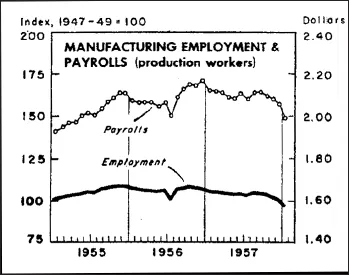
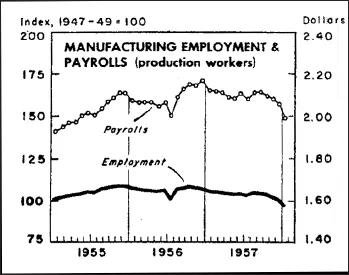
The statistical record now proves that this is precisely what has been happening. At the bottom of this column I reproduce two illuminating and significant charts, published without comment, and among other material, in the Feb. 14 issue of Business Statistics, put out weekly by the U.S. Department of Commerce. What these charts show is that, for the period they cover from the beginning of 1955, hourly wage rates in manufacturing have been rising steadily month by month to a new peak (about $2.10) in November, December, and January. But from the end of 1955, both working hours and employment have been falling. Fewer hours and less employment in combination have more than offset higher hourly rates since the end of 1956, and total manufacturing payrolls have taken a sharp dive—of nearly 13 percent—from a maximum index number of 171.4 in December 1956, to 149.5 in January 1958. A rise in wage rates, in brief, can mean a fall in payrolls.
Business Tides: The Newsweek Era of Henry Hazlitt
Read the whole book online · Book details
This work is published under a Creative Commons licence. You may copy, share, and re-host it with attribution.