
Chapter 671 of 943 · Business Tides: The Newsweek Era of Henry Hazlitt by Henry Hazlitt
Years of Inflation
May 2, 1960
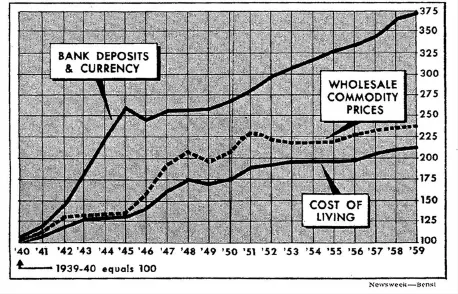
In this space nearly ten years ago (Newsweek, Sept. 17, 1951) I ran a chart comparing the increase in the cost of living, in wholesale commodity prices, and in the amount of bank deposits and currency, from the end of 1939 to the middle of 1951. This chart was incidental to pointing out that the rise in living costs and prices was the result of the increase in the supply of money and credit, and not of a “shortage of goods” or a so-called “cost push.”
We are now in a position to compare the same three items over a full twenty years, from the end of 1939 to the end of 1959. The accompanying chart gives us a panoramic view of the inflation during that period. It shows that, while consumer prices increased 113 percent between the end of 1939 and 1959, wholesale prices increased 136 percent in the same period and the total supply of bank deposits and currency increased 270 percent.
If we are to adopt the proper measures, the only effective measures, to halt inflation and prevent its resumption, we must clearly recognize that its basic cause is the increase in the supply of money.
Two rival theories still persist. One is that inflation and rising prices are caused by a “shortage of goods.” The figures refute this on their face. The official index of industrial production was 177 percent higher in 1959 than in 1939; in other words, the rate of production of goods was almost three times as great. It was in spite of this enormous increase in productivity that wholesale prices increased 136 percent—i.e., more than doubled—during the period. In other words, the increase in the money supply would have caused an even greater rise in prices if it had not been offset by an increase in the supply of goods. While the production of goods almost tripled, the supply of money and bank credit almost quadrupled.
MONEY VS. ‘COST PUSH’
The other rival theory is that inflation and the rise of prices are caused by higher wage demands—by a “cost push.” But this theory reverses cause and effect. “Costs” are prices. An increase in wages above marginal productivity, if it were not preceded, accompanied, or quickly followed by an increase in the supply of money, would not cause inflation; it would merely cause unemployment. It is not true, as so often assumed, that a wage increase in a given firm or industry can be simply “added on to the price.” Without an increased money supply, prices cannot be raised without reducing demand and sales, and hence production and employment. We can stop the “cost push” if we halt the increase in the money supply and repeal the labor laws that confer irresponsible private powers on union leaders.
Business Tides: The Newsweek Era of Henry Hazlitt
Read the whole book online · Book details
This work is published under a Creative Commons licence. You may copy, share, and re-host it with attribution.