
Chapter 4 of 13 · Deep Freeze: Iceland's Economic Collapse by Philipp Bagus
Chapter 2 Maturity Mismatching
Iceland has something in common with other developed economies that the recent economic crisis has affected: its banking system was heavily engaged in maturity mismatching. In other words, Icelandic banks issued short-term liabilities in order to invest in long-term assets. Thus, they had to continuously roll over (renew) their short-term liabilities until their long-term assets matured. If an event arose whereby Icelandic banks failed to find new borrowers to continue rolling their liabilities over, they would face a liquidity crisis and the Icelandic financial system would collapse.
Considering recent events that have exposed the riskiness of this strategy, the question that immediately comes to mind is, why did Icelandic banks engage so heavily in this risky practice in the first place? One reason is that maturity mismatching can turn out to be a very profitable business involving a basic interest arbitrage. Normally, long-term interest rates are higher than the corresponding short-term rates. A bank that sells short-term rates (borrows money short-term), while buying long-term rates (investing money long-term) may profit from the difference (the “spread”) between short- and long-term rates. Yet while maturity mismatching can turn out to be profitable, it is also very risky, because the short-term debts require continual reinvestment (that is, there must be a continual “rollover”). The most extreme case of maturity mismatching is the expansion of credit by banks, when deposits (i.e., debts of zero maturity) are used to grant credit (i.e., assets of longer maturities).
For much of its history, banking abided by a “golden rule” that is still alluded to today but rarely followed: the duration to maturity of a bank’s assets should correspond to that of its liabilities. Any incongruence opens the bank to risk in the event of liquidity shocks. The golden rule can be traced back at least to Otto Hübner,1 who wrote, “If a bank is to avoid the risk of being unable to fulfill its obligations, the credit it grants must correspond with the credit it receives, not only quantitatively but also qualitatively.”2
The golden rule was still upheld at the turn of the last century. Ludwig von Mises, building upon his German predecessor Karl Knies,3 expanded on this sound banking rule:
For the activity of the banks as negotiators of credit the golden rule holds, that an organic connection must be created between the credit transactions and the debit transactions. The credit that the bank grants must correspond quantitatively and qualitatively to the credit that it takes up. More exactly expressed, “The date on which the bank’s obligations fall due must not precede the date on which its corresponding claims can be realized.” Only thus can the danger of insolvency be avoided.4
When a bank or other financial entity takes on short-term liabilities and invests them for a longer term, it violates the “golden rule.”5 While Mises does not follow up to investigate how violating this rule affects the structure of production, it is clear that any alteration to the structure of interest rates will alter prevailing investment patterns. Maturity mismatching may breed instabilities much farther-reaching than fragility in the banking system. In combination with credit expansion,6 maturity mismatching can breed malinvestment. As credit expansion improves the likelihood that loans taken today can be renewed in the future, an increased amount of short-term borrowing will be undertaken to fund longer-term loans. An ever-riskier situation is fostered whereby a pyramid of illiquid long-term loans may make the banking system insolvent should an event arise whereby the sustaining short-term loans cannot be renewed, a situation that has been called “sudden stop syndrome”.7 If the perception of risk increases, it becomes more likely that short-term loans will not be continued, creating an illiquid situation for those banks that find themselves with an unsustainably mismatched loan portfolio.
Today’s banking system has made a curious change to earlier practice. Economists and bankers today disregard the golden rule, arguing that the very function of banking is to systematically violate it. For instance, Paul de Grauwe8 regards banks as institutions “which inevitably borrow short and lend long,” thus providing an “essential service.”9 Similarly, Douglas W. Diamond and Philip H. Dybvig10 regard the transformation of illiquid claims (banks’ assets) into liquid claims (demand deposits) as necessary.11
While the maturity mismatching is profitable and many modern economists endorse the practice, it carries the danger of insolvency. Thus, the question still remains: Why did Icelandic banks engage so heavily in this risky practice?
The answer is straightforward. Like banks in other countries, Icelandic banks enjoyed guarantees by the government to bail them out should their bets on the market turn out to have been wrong. But while this guarantee is merely implicitly assumed in most developed economies, the Central Bank of Iceland had committed itself explicitly to providing this function.12 At the critical point when liquidity was at risk of faltering, the CBI would function as the effective “roller-over” of last resort, providing fresh short-term debt as the market required it.
While this guarantee affected all Icelandic banks covered under the guarantee of the CBI, the three main banks, Kaupthing, Glitnir, and Landsbanki, had an additional perverse incentive. They were widely considered so big (with total assets almost eleven times the size of Iceland’s 2007 GDP) that they could regard themselves as too big to fail. The authorities could be expected to fear that if one of the large banks failed it would take with it companies that had stakes in it, and these bankruptcies would negatively affect other banks that were financing them. The larger and more interwoven the Icelandic banking sector became, the higher the probability that a single bank would be considered too big to fail. If a large bank became insolvent, a bailout would be all but inevitable. The three large banks’ sense that they were too big to fail created a moral hazard. With no fears of becoming insolvent should their bets on finding future short-term funding turn out to have been wrong, the Icelandic banking sector was granted a privilege to engage in exceedingly risky behavior. The Central Bank of Iceland had effectively given a green light to the banks to shoulder increasing amounts of shortterm risk uncompensated by assets of corresponding risk or duration. This seemed to work well until global liquidity dried up following the collapse of the American bank Lehman Brothers in late 2008. With a sudden dearth of funding—especially wholesale short-term funding—Icelandic banks were unable to roll over the debts that they had to roll over in order to remain solvent.
While the interbank loan market had dried up, removing the possibility of rolling over short-term debts, the banking system was also losing deposits. Depositors were beginning to get nervous about the prospects for the banks, especially after the failure of Glitnir on September 29, 2008. Small retailers were withdrawing funds, effectively failing to roll their deposits over. Banks in today’s fractional reserve system treat deposits as loans of zero maturity. By loaning out against them, they rely on a continued “renewal” of these deposits to maintain solvency. Any withdrawal of deposits stops the rollover, bringing banks to a liquidity crunch. Kaupthing’s subsidiary Kaupthing Edge was accustomed to net inflows of 100–150 million per week until mid-2008. In September 2008 this flow reversed to an outflow of 50 million per week. Deposits were leaking out and new depositors were difficult to attract.13
The explicit guarantee to bail out insolvent banks resulted in excessive maturity mismatching. Other central bank policies made the mismatching worse. On March 21, 2003, in a push to homogenize banking practices with the European Central Bank, the CBI reduced the reserve requirement for deposit institutions from four to two percent.14 This change increased the money multiplier from eight times to fifteen times.15 For liabilities maturing more than two years in the future, no allowance in reserves was required.
Unlike his counterparts at other countries’ central banks, the Central Bank of Iceland’s governor, Davíð Oddsson (the former Prime Minister), commensurately changed the reserve requirements that banks would have to safeguard in their vaults for a rainy day. By lowering this salient rate, the central bank allowed the banks to free up and use an additional portion of the deposits previously entrusted to them. A lower reserve ratio allows for a more pronounced credit expansion. Even without any increase in the supply of base money, decreasing the reserve requirement rate augments the credit supply immensely. As a result of the 2003 decision to lower reserve requirements, many banks needed to “park” their liquidity somewhere.16 An excess of liquidity in the banking system worked its way quickly to the loans market. In particular, there was a massive influx of funds into the mortgage market as banks tried to loan out their newly superfluous reserves.
Like all entrepreneurs, bankers eagerly search out and exploit profit opportunities. One simple way for banks to make a profit is to take advantage of the funds entrusted to them by depositors for safekeeping and issue them to businesses as loans, thus earning a profit-generating interest rate spread. Fractional reserves on demand deposits allows for credit expansion. Credit expansion serves to create new deposits and thereby increase the money supply. Under the guarantee of generous bailouts by the CBI, Iceland’s banks were more than willing to err against the side of prudence and always remain fully lent out, keeping reserve balances at the bare minimum legally necessary to satisfy their regulators. By lowering the reserve ratio repeatedly during the boom, the central bank allowed banks to issue increased credit against funds already deposited with them.
In 2003, at exactly the same time that it increased liquidity by reducing reserve requirements, the CBI commenced an extended period of lowering interest rates. In lowering its interest rates, Iceland was not the only culprit. The Federal Reserve lowered its borrowing rate by 5.5 percent during the boom, the European Central Bank lowered its rate 2.75 percent, and the Bank of Canada lowered its rate by 3.75 percent. Even the venerable Bank of England lowered its key rate by 2.5 percent. But in Iceland, unlike in many other developed economies, fresh credit issued via the artificially lowered central bank lending rates was not the only cause of the credit-fueled boom; Iceland further stimulated the expansion of credit by also lowering the reserve requirement ratio. (By way of comparison, during the 2000s while the Central Bank of Iceland was lowering its reserve requirement, America’s Federal Reserve kept its own reserve requirement for demand deposits steady at ten percent.) The lowering of interest rates and the reduction of the reserve requirement together ensured that the Iceland boom reached manic heights unreachable without the encouragement of ample credit, heights which other central banks of the world aspired to reach, but could not owing their own policy limitations.
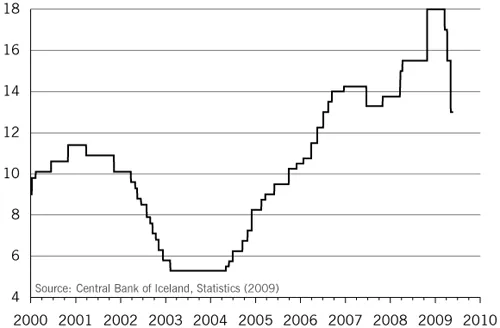
Figure 1: Central Bank of Iceland policy rate (percent)
When the Central Bank of Iceland shifted to a flexible exchange rate for the króna on March 27, 2001 it also adopted an inflation targeting framework for monetary policy. This change was widely heralded at the time, with promises that it would place the Central Bank of Iceland in a better position to integrate Iceland’s economy into the growing world economy, as well as effectively rein in inflation.17 By shedding the constraints of its fixed exchange rate regime and taking full control of its monetary policy the CBI hoped to bring a responsible era of low and stable inflation.
For most of Iceland’s recent history, inflation had been high and volatile. With this in mind, the Central Bank of Iceland targeted 2.5 percent price inflation, and set the margin of error at plus or minus 1.5 percent, both a higher base rate and a wider acceptable range than most central banks.18 When the inflation rate nevertheless breached the tolerance band beginning in February 2005, the question that arose in many peoples’ minds was “How tightly is it feasible to control inflation in Iceland?”19
From its inception, the CBI’s targeting scheme gave some commentators cause for concern. Iceland’s history of inflation volatility, mostly in tune with the season’s catch of fish, was a critical difficulty. Cautioning against the lofty goal of controlling Iceland’s inflation, Frank Engles20 remarked that effective inflation-targeting frameworks are “crucially dependent” on the central bank’s ability to accurately predict inflation.
Within the CBI’s targeting model lay the concealed assumption of a constant exchange rate over the forecast horizon.21 Starting in the second half of 2001, this assumption proved to be the model’s Achilles heel. As the króna exchange rate started to strengthen, the model persistently underestimated the inflation rate.22 Consequently, increases in the money supply were greater than would have been optimal given the inflation target. Strong increases in the money supply, in turn, drove interest rates on loans lower than they should prudently have been allowed to go if the inflation target was to be attained.
The root of this extremely accommodating monetary policy can be found within the efficient monetary policy frontier model employed by the CBI. The model, which estimated the locus of inflation and output gap alternatives given distinct policy choices, rested on four main factors: the output gap, expected inflation, expected foreign exchange rate, and monetary policy reaction function. These parameters were all forecast using Bayesian estimations; prior distributions of these variables were combined with current data in an attempt to estimate the posterior parameter distributions. Using prior data would prove to have been a poor choice. Iceland had a relatively short experience with its new flexible exchange rate regime; as a result, the data set encompassed two different policy regimes, so it provided estimates that were not wholly applicable.23
While the data for the model were taken from a previous and non-applicable exchange rate regime, the distributions themselves were taken from a similar policy model employed by the Bank of Canada, and were then fine-tuned with minor adjustments, explored in Pétursson.24 For example, Canada’s model estimated the target interest rate for an open economy using the United States as the relevant foreign sector. Iceland modified this by substituting the euro area, the United States, and the United Kingdom as the foreign sectors. But while Canada shares many policy inputs with its neighbor and largest trading partner, there are few such similarities between Iceland and the three economies used in the model as its foreign sector participants. Canada’s interest rates are highly correlated with America’s, as are its capital flows (since the two nations are each other’s primary trading partner). Iceland’s interest rates are controlled by much different factors than its European (or American) counterparts’; capital flows are influenced by a myriad of factors not amenable to inclusion in the inflation targeting framework borrowed from the Bank of Canada.
Perhaps the most troubling aspect of using a borrowed inflation-targeting framework is that Iceland’s inflation band was so much wider than most other countries’. In particular, it was four times as wide as the inflation band of Canada, the country from which the Central Bank of Iceland borrowed its model. One remedy that the CBI used was to exclude several volatile inputs from its inflation factor. This smoothed the data, making the foreign targeting model easier to implement. Housing, energy, and food were inputs that the CBI excluded from the consumer price index (CPI) because they normally suffered much variability in price.25
However much excluding these inputs may have increased the model’s usability, it brought at least two serious problems at the same time.26 First, nearly all of Iceland’s food is imported, making food an essential component of any inflation computation. Second, energy prices were extremely volatile over the forecast period, affecting not only real inflation but also inflationary expectations. Iceland’s “dated exchange rate targeting framework” was not able to cope with the massive changes that had occurred in the economy over its recent history.27 Cheap credit flowed into several key areas of the economy, primarily household spending and power-intensive industries, adding to inflationary pressures. The rapid growth in domestic demand put pressure on the prices of the relatively fixed supply of goods the island had available. This imbalance maintained upward pressure on inflation, causing it to stay well above the central bank’s target rate throughout the mid-2000s.28
These problems were noted relatively early in Iceland’s boom. Honjo and Hunt29 and Keiko Honjo and Srobona Mitra30 both recommended abandoning the efficient monetary frontier framework and implementing a simpler fiscal rule in its place. These economists cited the volatility of price inflation as the prime reason for the model’s lack of usability, though it should be noted that, given the parameters that were used, even stable inflation would have underestimated policy interest rates.
Moreover, there is no way to measure price inflation objectively in the first place. Comprised of an aggregate average of prices in the economy, any measured inflation rate is arbitrary. There is a plethora of different and changing prices in the economy. Which ones should be selected? The selection of goods in the basket is arbitrary, the weighting of the different prices is arbitrary, corrections to factor for qualitative improvements are arbitrary, and changes in the composition and the method of calculating the average are arbitrary. Every individual faces a unique inflation rate owing to his or her personal spending pattern. Any measured inflation rate will consequently diverge from the inflation rate facing any individual investor or entrepreneur.
These flaws acted in concert to underestimate present price inflation and allow for a looser monetary policy than was warranted given Iceland’s targeting framework. An International Monetary Fund staff visit to the country in 2004 warned that short-term interest rates should be increased quickly to com pensate for these too-low rates.32 Imbalances were identified, leading to a widely held view that an adjustment process was necessary and that it would be better to get it over with sooner rather than later. For almost ten years following the return to a flexible exchange rate regime, both actual inflation and future inflationary expectations were continually underestimated, and as a consequence the market was flooded with an ever increasing supply of money.
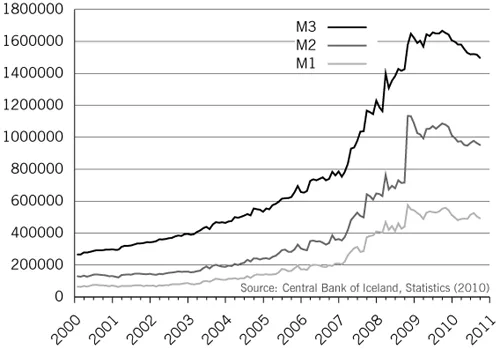
Figure 2: Icelandic money supply (January 2000–October 2010, million krónur)31
This extremely accommodating monetary policy, both domestically and internationally, made ample quantities of liquidity available to be borrowed and invested. The money supply grew at a steady pace until late 2005. At this point an inflationary trend surged as the CBI steadily opened the monetary spigots (Figure 2). Broad-based money and credit aggregates such as M2 grew at a rate over twenty percent per annum every year between 2003 and 2008 (Table 2).33 By the peak of the frenzy in 2008, M1 (the monetary base) had grown almost 500 percent on its level at the turn of the 21st century.
| M3 | M2 | M1 | ||
2000 |
11 |
−3 |
4 |
|
2001 |
17 |
12 |
6 |
|
2002 |
13 |
9 |
12 |
|
2003 |
21 |
27 |
43 |
|
2004 |
17 |
23 |
24 |
|
2005 |
18 |
22 |
22 |
|
2006 |
15 |
20 |
17 |
|
2007 |
57 |
82 |
100 |
|
2008 |
34 |
59 |
29 |
|
2009 |
0 |
−3 |
−6 |
|
201034 |
−6 |
−4 |
−1 |
Source: Central Bank of Iceland, Statistics (2010)
Table 2: Icelandic money supply growth (percent)
While the economy was likewise growing substantially, it was not enough to stave off the inflationary pressures created by such an expansion. Consumer price inflation rose above five percent for much of the Iceland boom’s duration. Real interest rates were driven lower as a result, giving the island’s small population an incentive to start spending rather than watch the value of their savings decline in an account. This increased demand for goods further served to mount inflationary pressures on the economy, thus spurring further spending. There was another, and arguably more direct, effect from the sharp growth in the money supply that the central bank had undertaken.
The Central Bank of Iceland’s continual credit creation policy drove short-term interest rates substantially lower than they would have been without this excess liquidity. Consequently, individuals had a strong incentive to borrow for the short-term at these artificially low rates. Starting in the early 2000s, approximately half of all Icelandic borrowing was undertaken on adjustable rates in order to take advantage of low short-term rates that were expected to remain reasonably low for the foreseeable future. Thórarinn G. Pétursson35 estimates that the CBI had de facto control of the yield curve for loan maturities of up to twelve months.
Usually central banks are constrained somewhat in their monetary policy options as they control only the short-term rates. The dominant role of long-term bonds provides a brake on long-term monetary policy, as central banks do not typically engage in commensurate long-term lending. But maturity mismatching translates artificially low short-term rates into artificially low long-term rates since banks increase the supply of long-term funds by lending long.
In addition to this process driving long-term rates lower, there was another state agency besides the CBI ready to ensure that long-term rates remained artificially reduced, enabling ample amounts of borrowing to continue pushing the economy into an unsustainable boom. The government created the Housing Financing Fund (HFF) in 1999 to take over the role and assets of its predecessor, the State Housing Board. The HFF provided mortgage loans. Private dwellings became the focal point of its operations, although companies and non-governmental agencies could also make use of its services. The HFF took the mortgage market by storm. By mid-2004 almost 90 percent of Icelandic households held an HFF loan, and HFF-issued bonds comprised more than half of the Icelandic bond market.36 Thus, not only were short-term interest rates manipulated and unduly lowered via a politically entrenched central bank, the longterm rates were likewise reduced via the government-controlled Housing Financing Fund. During the period leading to the financial crisis, the people of other countries saw a direct reduction only in their short-term interest rates, as a result of the policies of their central banks, but the people of Iceland were misled at all maturities of the yield curve.
The result of these policies was the extreme maturity mismatching that would eventually crash Iceland’s economy. Nowhere was the maturity mismatch as pronounced as in the three largest Icelandic banks, Kaupthing, Glitnir and Landsbanki. Figure 3 shows the maturity mismatch just prior to the breakdown of the financial system in late 2008. The funding gaps (i.e., liabilities minus assets for different maturities) of these banks as they issued short-term liabilities in order to invest in longterm assets are shown to be most severe for the most short-term (i.e., most liquid) securities.37 The three-month funding gap of 623 billion krónur amounted to almost fifty percent of the 2007 Icelandic GDP (1,279 billion krónur). In other words, the Icelandic economy as a whole would have needed half a year to cover the three-month funding gap that would result from a full roll-over stop.
What are the economic effects of maturity mismatching? The most obvious effect is that it can make the banking system unstable. If liquidity declines too much, lenders do not renew short-term debt, and a maturity-mismatched bank becomes illiquid. The problem can then spread quickly to the whole financial system. Illiquid banks are forced to sell assets to cover their funding shortfalls, and this selling depresses asset prices. As asset prices collapse, banks have to write down capital, and they face insolvency. This may induce other market participants to stop rolling over loans to banks, leading to a panic or, worse, a credit freeze. Trust in the banking system quickly evaporates. Liquidity problems spread and banks liquidate further assets to cover growing losses. During a panic, the long-term assets can only be sold at a significant loss, and so bank losses are increased. A bank run may ensue, leading to further liquidations and price declines. The whole banking system may eventually collapse.
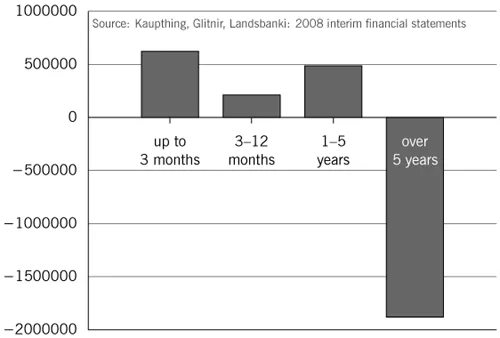
Figure 3: Funding gap: big three banks (as at June 2008, in million krónur)38
Hence, any rumor of problems concerning bank solvency can cause a rollover stoppage and thereby the breakdown of the financial system.
As recently as September 2007, the British retail bank Northern Rock had failed. As housing prices and mortgage-backed securities started to decline in value, wholesale short-term funding backed by these assets dried up. Depositors made an oldfashioned run on the bank that would have made It’s a Wonderful Life’s Henry Potter proud.39
Another crucial effect of an excessive level of maturitymismatched loans is that it creates distortions in the real economy. It distorts the capital structure, as demonstrated by Austrian business cycle theory. Demand deposits are bank liabilities that are due immediately (i.e., they have zero maturity). Because demand deposits are used to finance long-term investment projects, credit expansion contains extreme maturity mismatching. A similar maturity mismatch occurred when Icelandic banks borrowed in (mainly international) wholesale markets, via short-term interbank loans and repurchase agreements, asset-backed commercial paper, etc., in order to invest in long-term loans, such as commercial and residential mortgages.40
The ultimate problem with maturity mismatching is that there are insufficient savings available to complete the artificially high number of projects undertaken. Take a typical mortgage, for example. Lenders have only saved for three months (the term of the commercial paper) or they have not saved at all (the term of the deposit); in any case they have not saved for thirty or forty years, which is the term of the mortgage. Maturity mismatching deceives both investors and entrepreneurs about the available supply of long-term savings. By borrowing short and lending long, banks cause an artificial reduction of long-term interest rates. Entrepreneurs think that more long-term savings are available than really exist, and so they engage in malinvestments, which will have to be liquidated once it becomes obvious that there are not enough real savings to sustain them.
Interestingly, the maturity mismatch completes the skewing of the interest rate yield curve that the central bank commences but is usually unable to complete on its own. Central bank open-market operations are typically limited to the short end of the yield curve. Because central banks control their discount rate by offering short-term loans, typically thirty days or less, they are able to manipulate only these extremely short-term rates. The banking system transforms these artificial low short-term rates into artificial low long-term rates through maturity mismatching. By borrowing short, banks create an additional demand for short-term funds, thus bidding up short-term rates. By lending long, they create an additional supply of long-term funding, thus causing a decline of long-term rates. Thus, maturity mismatching flattens the yield curve, and transfers the effect of central bank manipulation of short-term rates to the long-term end of the curve.41
In Chapter 5 we will analyze specific malinvestments committed by the Icelandic financial system due to the increase in credit by the Central Bank of Iceland. But before we turn to this subject, we will explain the factor that potentiated the effects of maturity mismatching.
1Otto Hübner, DieBanken (Leipzig: Verlag von Heinrich Hübner, 1854), p. 28.
2 As translated from the original German: “Der Credit, welchen eine Bank geben kann, ohne Gefahr zu laufen, ihre Verbindlichkeiten nicht erfüllen zu können, muß nicht nur im Betrage, sondern auch in der Qualität dem Credit entsprechen, den sie genießt.”
3Karl Knies, Geld und Kredit, Vol. 2 (Berlin: Weidmann’sche Buchhandlung, 1876).
4Ludwig von Mises, The Theory of Money and Credit (New Haven, Conn.: Yale University Press, [1912] 1953), p. 263. In a similar way, Murray N. Rothbard touches on maturity mismatching: “Another way of looking at the essential and inherent unsoundness of fractional reserve banking is to note a crucial rule of sound financial management—one that is observed everywhere except in the banking business. Namely that the time structure of the firm’s assets should be no longer than the time structure of its liabilities.” Murray N. Rothbard, The Mystery of Banking, Second edition (Auburn, Ala.: Ludwig von Mises Institute, 2008), p. 98.
5This procedure is more commonly referred to as borrowing short and lending long. A downside of this terminology is that demand deposits are erroneously considered as short-term borrowing, at least in the present fractional reserve banking system. Both economically and legally it is questionable whether these fractional reserve demand deposits can be viewed as loans (Jesús Huerta de Soto, Money Bank Credit, and Economic Cycles, Second edition [Auburn, Ala.: Ludwig von Mises Institute, 2006], Philipp Bagus and David Howden, “the Legitimacy of Loan Maturity Mismatching: A Risky, but Not Fraudulent Undertaking,” The Journal of Business Ethics 90, no. 3 [2009], pp. 399–406).
6For a detailed examination of the economics of maturity mismatching see Philipp Bagus, “Austrian Business Cycle Theory: Are 100 Percent Reserves Sufficient to Prevent a Business Cycle?” Libertarian Papers 2, No. 2 (2010). See Bagus and Howden, “The Legitimacy of Loan Maturity Mismatching,” for the ethical aspects of this practice.
7Guillermo A. Calvo “Capital Flows and Capital-Market Crises: The Simple Economics of Sudden Stops,” Journal of Applied Economics 1 (1998): pp. 35-54.
8Paul de Grauwe, “Returning to Narrow Banking,” in What G20 Leaders Must Do to Stabilize Our Economy and Fix the Financial System, ed. Barry Eichengreen and Richard Baldwin, pp. 37–39 (London: Centre for Economic Policy Research, 2008), p. 37.
9Interestingly, de Grauwe sees this leading to an “inherently fragile system,” and advocates a return to a form of “narrow banking,” with commercial banks prohibited from investing in derivatives and complex structured products. He does not see the restriction of maturity mismatching that a free market system would create. As banks would be fully accountable for their risky loan portfolios (i.e., they would not have government-enacted bailout guarantees or subsidized deposit insurance), maturity-mismatched portfolios would be strictly curtailed. Furthermore, in a free market there is no need for the government to prohibit negative working capital for private companies; companies avoid it out of caution. Similarly, in a free market there is no need to prohibit banks from mismatching maturities.
10Douglas W. Diamond and Philip H. Dybvig, “Bank Runs, Deposit Insurance, and Liquidity,” Journal of Political Economy 91, No. 3 (1983): pp. 401–19.
11See also Tobias Adrian and Hyun Song Shin, “Financial Intermediaries, Financial Stability, and Monetary Policy,” Paper presented at the Federal Reserve Bank of Kansas City Symposium at Jackson Hole (August 21–23, 2008), and Xavier Freixas and Jean-Charles Rochet, Microeconomics of Banking, Second edition (Cambridge, Mass.: MIT Press, 2008) for similar views.
12See Central Bank of Iceland, “New Act on the Central Bank of Iceland,” Press Release (November 13, 2001), for the document that, among other things, promises a new era of price stability through an inflation-targeting framework, and the formal provision of a lender of last resort function.
13Thorvaldsson, Frozen Assets, p. 209.
14Benjamin Hunt, Robert Tchaidze, and Ann-Margret Westin, “Iceland: Selected Issues,” IMF country Report No. 05/366 (2005), p. 33.
15Ásgeir Jónsson, Why Iceland? How One of the World’s Smallest Countries Became the Meltdown’s Biggest Casualty (New York: McGraw Hill, 2009), p. 65.
16Hunt, Tchaidze, and Westin, “Iceland: Selected Issues,” p. 33n. 8.
17See, for example, Eduardo Aninat, “IMF Welcomes Flotation of Iceland’s Króna,” IMF News Brief No. 01/29, (March 28, 2001).
18Keiko Honjo and Benjamin Hunt, “Stabilizing Inflation in Iceland,” IMF Working Paper WP/06/262 (2006), p. 3.
19Hunt, Tchaidze, and Westin, “Iceland: Selected Issues,” p. 3.
20Frank Engles, “Iceland: Selected Issues and Statistical Appendix,” IMF Country Report no. 01/82 (2001), p. 3.
21Engles, “Iceland.”
22Frank Engles and Michael Gapen, “Iceland: Selected Issues,” IMF Country Report no. 02/129 (2002), pp. 8–9.
23Hunt, Tchaidze, and Westin, “Iceland: Selected Issues,” p. 11.
24Thórarinn G. Pétursson, “Wage and Price Formation in a Small Open Economy: Evidence from Iceland,” Central Bank of Iceland Working Paper no. 16 (2002).
25Officially measured CPI inflation allocates housing costs twenty percent of the index—higher than any other European nation. The sharp increases in housing prices caused large divergences between actual and CBI-computed inflation rates. In July 2005, for example, 12-month actual inflation measured 3.5 percent, but with the housing component excluded, inflation would only have registered a 0.1 percent increase over the same period (Hunt, Tchaidze, and Westin, “Iceland: Selected Issues,” p. 38).
26Hunt, Tchaidze, and Westin, “Iceland: Selected Issues.”
27Paul Kupiec, “Iceland: Financial System Stability Assessment Update, including Report on the Observance and Standards and Codes on the following topics: Banking Supervision, Insurance Regulation, Securities Regulation, Payment Systems, and Monetary and Financial Policy Transparency,” IMF Country Report no. 03/271 (2003).
28International Monetary Fund, “Iceland—2004 Staff Visit Concluding Statement,” (October 25, 2004).
29Honjo and Hunt, “Stabilizing Inflation.”
30Keiko Honjo and Srobona Mitra, “Iceland: Selected Issues,” IMF country Report no. 06/297 (2006).
31Icelandic M1 is defined as all demand deposits plus currency in circulation. M2 includes M1 plus sight deposits. M3 adds time deposits to the M2 figure to derive the broadest money supply measure.
32IMF, “2004 Staff Visit.”
33M1 includes all notes and coins in circulation, plus demand deposits (overdraft limits included).
34Year to date, October 1, 2010.
35Thórarinn G. Pétursson, “The Transmission Mechanism of Monetary Policy: Analyzing the Financial Market Pass-Through,” Central Bank of Iceland Working Paper no. 14 (2001).
36Hunt, Tchaidze and Westin, “Iceland: Selected Issues,” p. 29.
37These three largest banks dominated the Icelandic financial landscape, with assets which ballooned to 1100 percent of Icelandic GDP in 2007 (Willem H. Buiter and Anne Sibert, “The Icelandic Banking Crisis and What to Do About it: The Lender of Last Resort Theory of Optimal Currency Areas,” Centre for Economic Policy Research Policy Insight no. 26 (October, 2008): p. 4) and comprised nearly eighty percent of total Icelandic banking assets.
38The funding gap presents the liabilities less assets of a certain maturity. A positive funding gap of maturities up to three months means that there are more liabilities coming due in this period than there are assets maturing.
39Hyun Song Shin, “Reflections on Northern Rock: The Bank Run That Heralded the Global Financial Crisis,” Journal of Economic Perspectives 23, no. 1 (2009): pp. 101–19, assesses Northern Rock’s crisis and treats it as an unconventional bank run, in which the bank’s evaporating long-term asset base could not fund its short-term liabilities.
401here exist, however, important differences between credit expansion and other types of maturity mismatching—credit expansion increases the money supply (Bagus, “Austrian Business Cycle Theory”). Furthermore, an initially created unbacked demand deposit may lead to a far greater expansion of demand deposits if the rest of the banking system follows suit. Other types of maturity mismatching do not increase the money supply. Another difference lies in the ethical status of the practices. Credit expansion can be regarded as fraudulent, while borrowing short and lending long (i.e., maturity mismatching) is risky but not fraudulent (Bagus and Howden, “The Legitimacy of Loan Maturity Mismatching”).
41Philipp Bagus and David Howden, “The Term Structure of Savings, the Yield Curve, and Maturity Mismatching,” Quarterly Journal of Austrian Economics 13, no. 3 (2010): pp. 64–85.
Deep Freeze: Iceland's Economic Collapse
Read the whole book online · Book details
This work is published under a Creative Commons licence. You may copy, share, and re-host it with attribution.