
Chapter 6 of 13 · Deep Freeze: Iceland's Economic Collapse by Philipp Bagus
Chapter 4 Currency Mismatching
Domestic funds for profitable maturity mismatching were limited in Iceland’s small economy. During the boom in the financial sector, banks started to look elsewhere for funds. Domestic retail deposits were very limited and did not satisfy the banks’ lust for expansion, so they followed the path of U.S. investment banks that had no retail deposits at all: they used wholesale markets to fund their balance sheets and attract investment banking fees. Icelandic banks were able to tap these funds due to their strong credit ratings.
In 2003 Kaupthing merged with Bunadarbanki, and the combined bank received an A2 credit ranking, which drastically altered the way that the bank was funded. Now Kaupthing could issue bonds in international markets.1 Kaupthing followed this strategy of buying better-rated banks to improve its own rating. The other Icelandic banks also improved their ratings during the global liquidity boom of the early 2000s, gaining access to international wholesale markets. Later on, Icelandic banks tried to get further access to foreign retail markets by offering deposit accounts, mostly over the internet, to customers in Great Britain, the Netherlands, and Germany.
Thus, Icelandic banks borrowed foreign short-term funds to invest them for the long term, both domestically and internationally. This was especially attractive as domestic interest rates were higher than those of foreign central banks, which had undertaken even more extreme loose-money policies than the Central Bank of Iceland. This brings us to Iceland’s second and more specific problem: currency mismatching.
Like maturity mismatching, currency mismatching is based on a profitable arbitrage, this time in exchange rates. While maturity mismatching makes use of the fact that interest rates normally are lower for shorter maturities than for longer maturities (variation of rates over time), currency mismatching exploits the differences between interest rates in different economies (variation of rates over space). Currency mismatching implies that investors indebt themselves in currency areas where interest rates are low and invest in countries where interest rates are high, the now-famous carry trade. Figure 4 depicts the substantial interest rate differences between the policy rates of the Fed, the ECB, and the Bank of Japan (BoJ) in comparison to the CBI.
As Icelandic interest rates were relatively high, investors indebted themselves in dollars, euros and yen at low interest rates and invested the proceeds in Icelandic assets. Like maturity mismatching, this is risky. When the currency that has been invested depreciates relative to the currency that is loaned, there may be considerable losses, resulting in the insolvency of the investors exploiting the carry trade.
As with maturity mismatching, the question that comes to mind about currency mismatching is why did Icelandic banks engage so heavily in this risky practice? And for that matter, why does anyone? The answer relates to implicit government guarantees. Because of implicit government guarantees, especially the possibility of obtaining IMF assistance in dire circumstances, people start to believe that exchange rate risk is reduced.
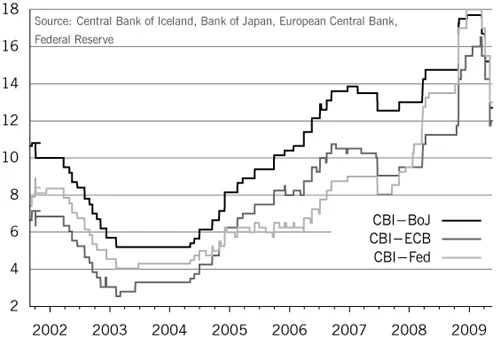
Figure 4: Interest rate gap of the CBI to the BoJ, ECB and the Fed (in percent)2
We may speak of an illusion caused by government guarantees. The illusion consists of the notion that government intervention can and will keep exchange rates more stable than is really the case.3 If these actions artificially stabilize exchange rates, investors see less risk in the relatively profitable carry trade. The risk of losses from adverse exchange rate movements usually limits the extent of this practice. Entrepreneurs are alert to this risk; indeed, it is one of the fundamental concerns of internationally operating firms. For such firms, the currency of revenue may rarely coincide with the currency of expenses, so they are cautious in making decisions involving, or hinging on, exchange rate movements.
Additionally, investors may think that countries that are highly interconnected in the international financial markets are “too big to fail.” This is in fact what some Icelandic bankers themselves thought: other nations would bail them out. The former CEO of Kaupthing Singer and Friedlander, Armann Thorvaldsson, writes,4
I always believed that if Iceland ran into trouble it would be easy to get assistance from friendly nations. This was based not least on the fact that, despite the relative size of the banking system in Iceland, the absolute size was of course very small. For friendly nations to lend a helping hand would not be difficult.
In other words, Thorvaldsson believed that if bad came to worse, other nations would bail Iceland out. However, he had not thought of the interconnectivity of financial markets and the possibility of a worldwide financial collapse. In the fall of 2008, Western countries had their own problems, and they were unable to attend to Iceland’s needs.
Investors may have thought it very unlikely, if not impossible, that a highly regarded Western nation would face bankruptcy and the consequent collapse of its currency. Iceland did, after all, consistently score high on the United Nations’ Human Development Index; its per capita GDP was among the highest in the world; its workforce was well educated; and its global brand was well known and growing. Each year its already credible list of achievements lengthened. Iceland rapidly extended its financial reach around the world, and rose meteorically to international financial stardom. Many investors did not expect that such a bright star could fall. And even if this rising star should turn into a shooting star, who would not rush to Iceland’s rescue to prevent a global collapse? The IMF has bailed out economies that were far less integrated with the rest of the world than Iceland’s (Latvia springs to mind). Because of this greater perceived stability, currency mismatching flourished.
There is another reason why the currency mismatch was thought to be unproblematic.5 Banks thought their offsetting currency swaps would hedge their risks. A currency swap is an exchange of future cash flows denominated in different currencies. It is a product of a post-gold-standard world with a myriad of fluctuating fiat paper monies. Imagine an Icelandic fisherman who sells his fish to the United Kingdom, receiving pounds in payment. He requires krónur to pay his bills, which are incurred in Iceland. At the same time, there may be a British entrepreneur selling Rover cars in Iceland for krónur but paying his mortgage in London with pounds. Both entrepreneurs face currency risk. For instance, the British entrepreneur faces the risk that the króna may depreciate before he is paid for the car. He has to convert his krónur income into pounds to pay the mortgage, but this income may be worth less in the future if the króna depreciates against the pound. The two entrepreneurs may therefore agree on a swap: the British entrepreneur may give some part of his Icelandic króna revenues to the fisherman in exchange for the fisherman’s pound revenues at an agreedupon exchange rate. Because the exchange rate is fixed at inception, they can forget about future exchange rate movements.
It is true that Icelandic banks did buy many swaps to hedge their positions. This gave many people a false sense of security concerning future liquidity constraints. A 2004 IMF report reinforced the belief that the Icelandic banking sector’s diversification into foreign markets was a positive development.6 Although it was true that revenue diversification was not problematic, there was a considerable and growing mismatch between lending in foreign currencies and revenues in the same currencies. In 2004, approximately 20–30 percent of foreign-denominated lending was directed towards firms with no offsetting foreign revenues. Instead of questioning the reasons for this growing imbalance or proposing actions to constrain it, the IMF recommended that the financial authorities increase monitoring and regulatory efforts in order to try to resolve potential crises stemming from this mismatch only after they occurred.
In judging that their currency swaps would protect them, the Icelandic bankers did not take into account their concomitant maturity mismatching, which made the swaps insufficient to help them. When short-term foreign debt comes due, there is a sudden need for foreign currency to retire the debt. A currency swap only allows a small sum to be made available each year (or other predetermined time period). For example, imagine that a bank has borrowed €100,000 in order to grant a mortgage of thirteen million Icelandic krónur.7 It pays €8,000 (eight percent) interest to its creditor and receives 1.3 million krónur from the mortgage holder (ten percent) annually. With a swap, the bank may convert each yearly payment by the mortgage holder (1.3 million krónur) into euros at a fixed rate (let us say 140 krónur per euro). Then the bank has hedged its €8,000 expenses every year by receiving €9,286. However, the whole mortgage cannot be converted into euros at any one time. If the bank has borrowed the €100,000 for a short duration and the loan cannot be renewed, then the bank suddenly needs all of the €100,000. It does not help the bank to be able to convert 1.3 million krónur into €9,286, as the bank needs the full amount: €100,000.
As long as foreign central banks continued to offer credit at artificially low interest rates, Icelandic banks had no problems renewing their short-term debts. Their investment-grade rating gave them seemingly unlimited access to foreign wholesale funding. Currency mismatching is, in fact, a way to export credit expansion (or maturity mismatching in general). International liquidity had been ample after the September eleventh attacks. Interest rates for borrowing denominated in euros, dollars, and yen were very low. The Federal Reserve held its target interest rate at one percent for nearly a year (from June 25, 2003 to June 20, 2004), the European Central Bank held its interest rate at two percent for two and a half years (from June 6, 2003 to December 6, 2005), and the Bank of Japan held its discount rate below one percent from 2001 to 2008. The monetary inflation pursued by the Fed, the ECB, and the Bank of Japan is shown in Figure 5.
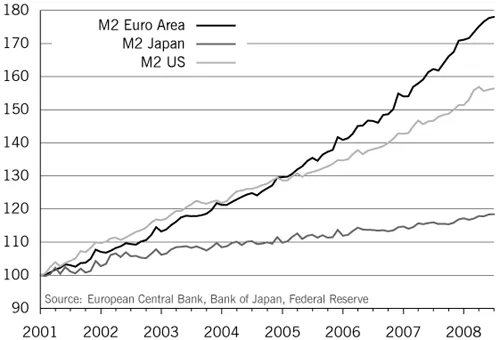
Figure 5: Euro area, Japanese yen, and U.S. dollar M2 (January 2001 = 100)8
Via currency mismatching, the main economies exported their credit expansion to Iceland. Thus, artificially low interest rates in Europe, the U.S., and Japan deceived entrepreneurs about the availability of real savings not only in their own currency areas but also in Iceland. Not only were Icelanders undertaking more investment in foreign currencies than real exchange rate risk would suggest was prudent, but more foreign currency was invested in Iceland than foreigners were saving.
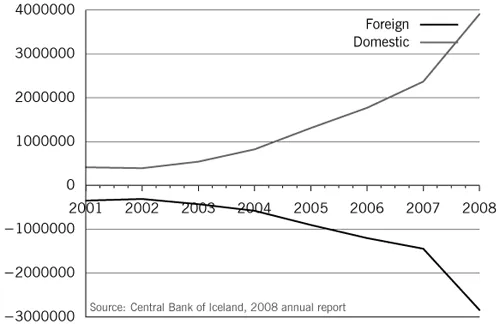
Figure 6: Net domestic and foreign assets of the banking system (million króna)
This currency mismatch had reached impressive dimensions. Over the past decade, the Icelandic financial system had accumulated a significant portion of its funding requirements in foreign currencies.
Figure 6 shows the Icelandic banking system’s domestic assets minus domestic liabilities on the positive scale, and its foreign assets minus foreign liabilities on the negative scale.
Most shockingly, we draw attention to the increase in foreign liabilities that occurred over the seven-year period: 2,300 percent. Domestic liabilities, in contrast, increased by 600 percent, the result of low nominal interest rates with real rates hovering close to zero.
The Central Bank of Iceland targeted an inflation rate of 2.5 percent (with a band of 1–4 percent) during the 2000s. It regularly overshot this target; Statistics Iceland regularly showed inflation ranging from four to six percent during the same years (Table 3). The resulting real rates dropped below three percent in 2004, the same year when the CBI was flushing the financial system with credit (over thirty percent of M1 growth) and Iceland’s big banks had started aggressively competing in the domestic mortgage market. Banks seized upon these low real rates to expand operations, both in Iceland and overseas.
| Policy Rate9 | Targeted Inflation |
CPI | Real Interest Rate | |
2000 |
10.5 |
2.5 |
5.0 |
5.4 |
2001 |
10.9 |
2.5 |
6.7 |
4.2 |
2002 |
8.4 |
2.5 |
4.8 |
3.6 |
2003 |
5.4 |
2.5 |
2.1 |
3.2 |
2004 |
6.2 |
2.5 |
3.2 |
2.9 |
2005 |
9.4 |
2.5 |
4.0 |
5.3 |
2006 |
12.5 |
2.5 |
6.8 |
5.8 |
2007 |
13.8 |
2.5 |
5.0 |
8.8 |
2008 |
15.6 |
2.5 |
12.4 |
3.2 |
Source: Central Bank of Iceland; Statistics Iceland
Table 3: CBI policy rate, inflation and real interest rates (2000–2008)
By 2008 the foreign funding gap (foreign assets minus foreign liabilities) amounted to twenty-two percent of year 2007 GDP. Domestic assets valued at inflated prices apparently filled this gap. In 2008, foreign liabilities amounted to eight times the 2007 GDP.
We can see this divergence in funding sources more clearly if we assess the specific gaps and surpluses on a yearly basis, as is shown in Table 4.
As can be seen, a relatively small foreign funding gap (foreigndenominated assets less foreign-denominated liabilities) in 2001 had grown by 717% over the eight-year run up to the 2008 collapse. It is true that the domestic funding surplus grew at an even wilder pace. Yet, at the end of 2008 as the boom had reached its frenzied extreme, twice as many foreign-denominated liabilities lacked any source of foreign funding as at the beginning of the year. This intense increase in unfunded foreign-denominated liabilities finally culminated as the króna’s decline in the foreign exchange markets put a halt to any further foreign acquisitions.
Source: Central Bank of Iceland, 2008 annual report
Table 4: Domestic and Foreign Funding Gaps (million króna, year-on-year percentage)
One main source of this external funding was loans denominated in Japanese yen.10 The Bank of Japan pursued an extremely loose monetary policy for many years to combat an extended recession. As a result of these artificially low borrowing rates, yen-denominated loans could be obtained at historically low interest rates, sometimes as low as one percent per annum. Because of these attractive rates, an ample amount of short-term liquidity was available, which in turn was invested in the now famous maturity mismatch. Icelanders invested domestic and foreign short-term funds in long-term investments, leading to inflated assets prices and malinvestments, both at home and abroad. The use of lower interest rate foreign currency financing became a ubiquitous scene in the financial landscape. When given a choice between double-digit interest rates on króna-denominated loans and negligible interest rates on foreign-denominated loans, the latter was almost certainly the preferred choice. As the head of the economics department at the University of Iceland, Gunnar Haraldsson, recounts, “When you bought a car, you’d be asked, ‘How do you want the financing? Half in yen and half in euros?’”11
Icelandic foreign-denominated credit increased by over 550 percent between 2002 Q4 and 2005 Q4.12 The low foreign interest rates provided Icelanders with ample liquidity, which they directed into highly profitable investments. Coupled with a strengthening króna exchange rate, this borrowing source was generating profit on its own; borrowed money was repaid in depreciated currency units. The interest rate differential—the now-famous carry trade—was highly profitable for several years. Icelandic banks believed that exchange rate risk was largely hedged, and so they allowed themselves to develop a significant foreign funding gap.13
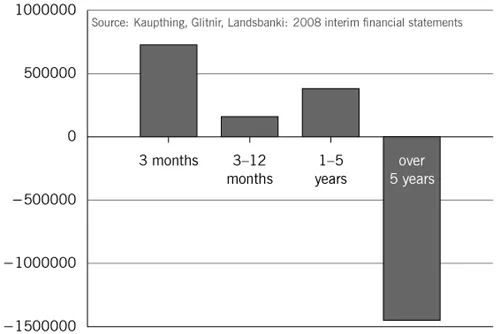
Figure 7: Foreign funding gap: big three banks (million krónur)14
Icelandic banks issued short-term foreign-denominated liabilities that they would later change into Icelandic krónur at the central bank. Consequently, the Icelandic money supply increased; however, the banks’ demand for krónur artificially maintained the króna rate. The newly created krónur were lent to Icelanders on a long-term basis. The result of this combined maturity mismatch and currency mismatch may be seen in Figure 7.
Banks used the leverage of foreign debts to increase their profits. Almost seventy percent of the debts of Icelandic banks were denominated in foreign currency.15 Some of these debts had been used to make loans in foreign currency. For example, Icelandic banks took on foreign-denominated liabilities to make foreign-denominated loans to Icelandic companies, which used these funds to engage in a spending spree, acquiring companies and assets throughout Europe. Another important part of this foreign debt, 2.5 billion krónur, was used to grant loans denominated in krónur that amounted to almost twice the Icelandic GDP. In other words, the currency mismatch was almost twice the whole island’s yearly productive capacity.
Icelandic banks could easily fill this funding gap when the króna was strong relative to these foreign currencies, but as the exchange rate commenced its weakening phase, filling the gap became more difficult. The collapse of the currency created a leak in the financial system that the CBI could not be plug by increasing the money supply. With only depreciating domestic assets to sell to “plug the hole,” the banks could not bear the financial drain caused by these foreign loans.
Only approximately 7.5 trillion krónur of foreign-denominated assets were available to finance over ten trillion krónur worth of foreign-denominated liabilities. Even taking into account the available domestic assets, the total asset base of fifteen trillion krónur would just barely be enough to cover the fourteen trillion krónur of debt commitments, both domestic and foreign. Any exchange rate shock would pose a liquidity problem for the banking sector, as liabilities could be met only with some difficulty.
This leveraged financial system heavily funded with foreign liabilities became unsustainable. The reduction in the króna exchange rate created a gap too large to fill through continued sales of domestic assets.
The IMF, to its credit, did note this dangerous development as early as 2004.16 The Fund expressed concern that most borrowing in the Icelandic financial sector was being undertaken for short durations, and that 20–30 percent of foreign-denominated loans were made to firms with no offsetting foreign currency revenues. This unhedged position meant that if an adverse exchange rate shock occurred, domestic firms would have little recourse for funding these liabilities except continual reliance on increasingly uncertain króna-denominated sources. This asymmetry exposed many firms to large degrees of exchange rate risk, which became painfully apparent in late 2008 when the exchange rate began collapsing.
In fact, this growing mismatch was recognized, but at the same time its importance was downplayed. In an IMF report on Iceland, Tchaidze, Annett, and Ong17 wrote that the steady growth in foreign-denominated borrowing “could potentially become an important indirect credit risk for banks.”18 In just one year, 2006, foreign-denominated borrowing had increased from sixty-eight percent of GDP to eighty-five percent. This increase was focused in the service, retail, and construction industries, the very industries that had the least amount of foreign revenues to offset the positions and mitigate the risk. It was becoming apparent that this mismatching was predicated on the belief that the CBI would continue pursuing a strong-króna monetary policy, allowing these foreign-denominated loans to be easily repaid.
As long as international liquidity remained high, Icelandic banks faced no problem continually obtaining new short-term funding in foreign currencies. When international short-term liquidity dried up, however, Icelandic banks were left with illiquid long-term assets.
1Thorvaldsson, Frozen Assets, p. 106.
2We used as interest rates the policy rate of the CBI, the federal funds target rate of the Fed, the Basic Discount Rate of the BoJ and the rate for the main refinancing operations of the ECB.
3Our point about the illusion of a stable fiat exchange rate is in line with Jörg Guido Hülsmann’s (“Toward a General Theory of Error Cycles,” Quarterly Journal of Austrian Economics 1, no. 4 [1998]: pp. 1–23) argument that government action provokes illusions that cause error cycles. Fractional reserve banking is one cause of error cycles. Fiat exchange rate stabilization is another cause of these cycles.
4Thorvaldsson, Frozen Assets, p. 194.
5Juan Ramón Rallo, “¿Qué pasó en Islandia?” La Illustratión Liberal 41 (2009): p. 46.
6IMF, “2004 Staff Visit.”
7Our choice of €100,000 is merely illustrative. The Icelandic banking system was entangled in millions of euros of currency swaps, all of which served to create liquidity problems when they could not be renewed.
8All figures are monthly. Euro growth is based on end-of-period quantities. Yen quantities are averages over the outstanding period. U.S. dollar figures are not seasonally adjusted.
9Yearly average rate.
10Approximately eighty percent of foreign-currency loans made to households were denominated in the two currencies with the lowest interest rates, Swiss francs and Japanese yen (Willem H. Buiter and Anne Sibert, “Icelandic Banking Crisis,” p. 16). Indeed, Iceland’s own domestic policies can hardly have been the lone source of the extreme credit expansion. As the Bank of International Settlements was able to discern after Iceland’s collapse, “During the early years of the twenty-first century, the situation on the global financial markets was highly unusual. The supply of credit was virtually inexhaustible and interest rates lower than they had been in a hundred years. Financial markets were hungry for bonds, including those issued by Iceland’s banks, which were a welcome addition to many of the structured securities that became so popular” (Ingimundur Friðriksson, “The Banking Crisis in Iceland in 2008,” BIS Review 22 [2009]).
11As quoted in Gumbel, “Iceland: The Country That Became a Hedge Fund.”
12Honjo and Mitra, “Iceland: Selected Issues,” p. 25.
13Tchaidze, Annett, and Ong, “Iceland: Selected Issues,” p. 26.
14The foreign funding gap is defined as foreign liabilities minus assets of a certain maturity. A positive funding gap of maturities up to three months means that there are more liabilities coming due in this period than there are assets maturing. The currency breakdown of the term structure of individual banks’ assets and liabilities is not publicly disclosed. Therefore, the respective currency mismatches have been calculated assuming the share of foreign-currency assets and liabilities in the balance sheet total is constant over all maturities.
15Rallo, “¿Qué pasó en Islandia?”
16IMF, “2004 Staff Visit.”
17Tchaidze, Annett, and Ong, “Iceland: Selected Issues,” p. 24.
18Tchaidze, Annett, and Ong noted that “banks’ foreign-currency lending to households, which has increased sharply, could potentially become an important indirect credit risk as unhedged households may underestimate the impact of currency movements on their debt service costs.” (Ibid., p. 32).
Deep Freeze: Iceland's Economic Collapse
Read the whole book online · Book details
This work is published under a Creative Commons licence. You may copy, share, and re-host it with attribution.