
Chapter 10 of 13 · Deep Freeze: Iceland's Economic Collapse by Philipp Bagus
Chapter 8 The Necessary Restructuring
Three aspects of Icelandic life need to return to normal for the economy to regain its footing and climb out of its pit.
Malinvestments—those misdirected resources and entrepreneurial errors—need to be liquidated. Prolonging their existence prevents the economy from moving production and consumption patterns to those that are conducive to long-term growth.
An oversized financial sector is not necessary for the country, nor is it healthy. It has removed resources from those areas where Iceland has a real competitive advantage. The financial sector needs to be allowed to shrink down to the size required by Iceland’s economy.
Lastly, the consumption-led boom bred a new type of Icelander. The inflationary economy of the boom years increased the time preference of the nation. Icelanders need to regain their traditional prudence about credit and spending. As Howden1 remarks of the recovery process necessary for ailing economies,
A healthy recovery phase, then, will be one characterized by an allowance for entrepreneurs to replace the skills learned in the previous expansionary financial environment with the skills needed for the maintenance of the production structure. To the extent that entrepreneurs are inhibited from completing this necessary transition, a healthy recovery phase will be delayed.
Allowing these three areas to return to normal will be a painful but a wholly necessary requisite for recovery. Delaying this outcome, whether via further inflation, exchange rate controls or manipulations, bailouts, or state guarantees, will prolong Iceland’s misery.
RESOURCE ADJUSTMENT
Credit expansion led to an artificially lengthened productive structure. This usually implies an increase in the production of capital goods, as signaled by the relative profitability increase at those orders of production further from their final.
During Iceland’s boom, capital shifted away from the previous mainstays in the economy, fishing and maritime products. These traditional industries were gradually eroded in favor of more capital-intensive production processes. A housing boom occurred which now leaves the island with a glut of inventory in search of homeowners or renters. The increased aluminum smelting capacity to capitalize on Iceland’s vast supply of cheap electricity now searches for profitable use. Investors started a plethora of capital-intensive industries and businesses over the past decade, at the expense of the mundane but stable industries in which Icelanders have historically specialized.
These specific malinvestments will prove difficult, though not impossible, to rectify. The process will involve two steps—both somewhat painful.
First, overconsumption during the boom led to a misallocation of goods. The crisis forced many to rethink their previously prolific spending. Many Icelanders were unable and unwilling to keep paying for cars bought with foreign-denominated loans. They defaulted on their automobile loans, and a surplus of used cars stormed the market at low prices. HEKLA, a seventy-four-year-old car importer and dealer in Iceland, constructed a database of used vehicles to help clear the market. With purchase prices attractive internationally due to the severely devalued króna, buyers from the Faroe Islands, Norway, Denmark, Sweden, and Germany rushed to purchase cars that cost comparatively little.2 Though it has no automobile production facilities, Iceland has become an exporter of cars.
The shedding of excess consumers’ goods, such as the cars bought during the boom, must continue until the economy regains stability. Reducing the excess supply of used consumers’ goods will allow prices for new goods to stabilize. Besides shedding the excess consumers’ goods from the economy, these exports will also serve an additional purpose. Foreign buyers who pay in foreign currency will provide a much-needed source of foreign exchange to cover the previously incurred debts. Foreign buyers who pay in Icelandic krónur will need, in most instances, to purchase these krónur on the open market, thus providing demand to support Iceland’s currency.
Second, entrepreneurs will need to redirect physical capital resources to areas of the economy in need. During the boom years, physical resources were redirected away from the productive maritime-based economy into construction. Depreciated fishing fleets will need to be repaired or built anew to reverse this resource shift. These specific malinvestments will prove difficult, but not impossible, to rectify.
This move back to a more traditional economy has been met with some obstacles. On July 10, 2009, the Minister of Fisheries announced the fishing quotas for the 2009–2010 fishing year. The total quota for haddock was reduced by almost fifty percent (30,000 tonnes) and the cod quota was reduced by eight percent (12,500 tonnes).3 This reduction could not have come at a worse time, as Iceland needs to obtain foreign currency via its exports to help it emerge from recession.
Other recent events have brought some improvement. On January 29, 2010, the capelin quota was increased to 130,000 tonnes. Of this total, the Minister of Fisheries will allocate over 97,000 tonnes to the Icelandic fishing fleet, with the remainder auctioned to foreigners.4 The Icelandic allocation promotes a return to a traditional economy led by maritime products, which will eventually increase exports. The quota allocated to foreigners will bring an immediate inflow of foreign exchange to ease the funding shortfall.
Labor will be a particularly time-consuming resource to shift. Because the distribution of the labor force among different industries underwent significant changes during the boom, a reassignment of the workforce will be necessary to employ the physical resources that entrepreneurs shifted away from previously unprofitable businesses and industries. Labor’s primary defining feature as a resource, nonspecificity, will turn out to be its greatest advantage and disadvantage in this process.
On the one hand, other physical resources will be only suitable to specific production processes. Newly produced condominiums, for example, cannot easily be diverted to satisfy the increased requirement for fish processing capacity. Bankers’ software programs, purchased to organize, track, and manage ballooning loan portfolios during the boom, cannot be used for any other purpose except that specific one. In fact, all physical capital has some degree of specificity. It is more suited to one production process rather than another. Labor, in contrast, is often a less specific input. Individuals can be reassigned to different production processes relatively easily.
A worker has the capacity to think for himself, undergo training, and change the ends towards which his labor may be applied. While this is labor’s distinct advantage, guaranteeing that labor always has the possibility to be utilized, it also poses difficulties. While other physical resources can be instantly reassigned provided that a suitable alternative use is available which they are suited to fulfill, labor will almost certainly require a period of time as its capabilities are altered. Training and reeducation time, in addition to the more commonly identified job search time, will be necessary to match employees to newly minted positions. A fisherman-turned-banker who Michael Lewis interviewed during Iceland’s boom illustrates the specific problem that labor runs into. The fisherman lamented, “I think it is easier to take someone in the fishing industry and teach him about currency trading than to take someone from the banking industry and teach them how to fish”.5
Anything that delays the reassignment of labor to more productive uses will increase the time until the economy returns to normal. Unemployment insurance decreases the incentive for the newly unemployed to seek reemployment in more profitable areas of the economy. Icelandic unemployment compensation is both generous and long lasting. It is available to anyone between the ages of sixteen and sixty-nine, and the sole requirement is that the worker has undertaken at least ten weeks of insured employment within the previous twelve-month period. Benefits amount to anywhere from 1,362 to 5,446 krónur per day.6 Unemployment insurance can be continued, provided that the recipient works no more than two days a week. Coverage continues for a maximum period of three years.
These benefits have resulted in a sharp decline in the number of labor hours worked by the average Icelander during the crisis. While other countries have suffered sudden increases in unemployment during the past few years, Iceland’s true situation has been somewhat masked by a peculiarity of the Icelandic labor market. Despite the appearance of an endless party during the boom-years, it was the norm that Icelanders worked two jobs to make ends meet. As a result, unemployment during the bust has been understated. Many people have lost one of their two jobs but still have the other; thus, the official unemployment statistics do not count them. A better measure of the decline in employment is the number of labor hours worked by the average citizen (Figure 19).
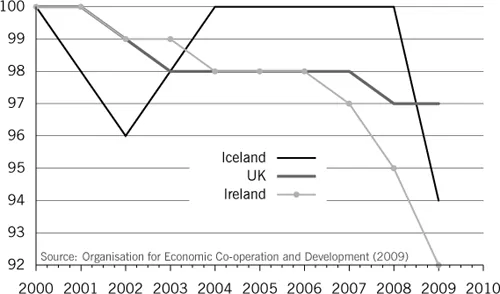
Figure 19: Average annual hours worked per employee (2000=100)
At the boom’s peak, the average Icelander was working 1,822 hours per year. By 2009 this had declined to just over 1,717 hours, nearly a six percent decline. This decline in hours worked has been more rapid in Iceland than in Europe’s other problem child, Ireland, and has made the decline in hours worked in Britain look paltry in comparison. Of the Icelanders registered as unemployed in 2009, eighty-five percent of them claim to have lost their job in October, just after the collapse of the financial system.7
Anything that hinders either the labor, goods, or financial markets from adjusting will prolong the pain of the Icelandic population. Flexibility is essential to allow factors to shift from the areas where they were malinvested to the areas where they can be most profitably used. A more flexible labor market, by reducing regulations and incentives not to work (i.e., unemployment insurance), would aid recovery by enticing workers to return to traditional industries more quickly.
SHRINKING THE FINANCIAL SECTOR
The shift away from the then relatively unprofitable real sectors of the economy (i.e., production-based sectors) and into the banking and, eventually, finance sectors may have been the most apparent event of the boom, and the reversal of this shift is the most apparent event of the current bust.
While the prospect of a whole industry engulfed in layoffs, empty offices, foreclosed branches, and a deteriorating reputation may seem unfortunate, we must realize that it is an unavoidable step on the long road to recovery. The source of the crisis is, after all, the promotion of an oversized and unsustainable financial sector, reliant on artificially reduced interest rates to remain profitable.
The shift has already largely occurred. While the physical resource shift that is necessary to shrink the sheer size of this behemoth of an industry will take some time—bankers need to be retrained for new jobs, bank offices need to be refurbished for new uses—the movement of financial capital out of the financial sector has taken place to a large extent already. Bank share prices have already collapsed, financial companies have gone bust, and previously soaring profits and bonuses have been reduced or eliminated. Iceland’s króna fell by more than fifty-eight percent during 2008 before stabilizing. In the short term there was considerable pain, but the long-term signal could not have been clearer.
The short-term pain was mainly from skyrocketing prices for imports—imports that the economy had come to rely on as the trade deficit mushroomed. Though it must have seemed disastrous to many, this rise in prices should have been welcomed as a clear signal that Iceland’s economy had reached a tipping point. While the increase in real prices forced painful changes, it also signaled Iceland’s new economic advantage. A cheaper króna made Icelandic exports relatively cheap for foreign countries, thus bolstering demand for these goods. It should be apparent by now that the real problem since the value of the króna stabilized at its new lower value has not been the relative increase in the price of imports to the country; the problem has been the lack of productive capacity to produce goods for export and capitalize on the new comparative advantage.
As the exchange rate resumed a position aligned with Iceland’s comparative advantage—exporting marine-based or energy-intensive products to the world—it became clear that there was no available excess capacity to meet this demand quickly. Financial assets quickly and effortlessly adjusted downward in price to reflect the reality of the situation, but real assets were slower to grow. If productive capacity had the characteristic of being instantly and effortlessly scalable, Iceland could have capitalized on the newly adjusted financial prices with little net disruption to the Icelandic financial landscape.
One significant feature of the government’s actions during the bust was its concerted effort to maintain the primacy of the financial sector. As the big three Icelandic banks, Kaupthing, Glitnir, and Landsbanki, neared or entered bankruptcy in late 2008 it should have been taken as a clear signal that financial assets had been misdirected previously and could be more productive in alternative uses. But a concerted effort was made to save these banks; they were nationalized, and they continue to operate.
The result was a prohibition of the natural response to the crisis. The financial sector was not allowed to shrink to the extent that was necessary for sustainability. Consequently, the real productive economy has not been able to expand to the extent necessary to benefit from the advantageous exchange rate depreciation.
While resources invested in industries and firms that produce goods for export would have realized an instant profit at the prevailing exchange rates, those resources that were directed towards the banking sector were met with continued losses or, as a best-case scenario, an uncertain future. Directing resources into the banking sector not only prolongs the life of this unsustainable aspect of the Icelandic economy, but also makes those resources unavailable to Iceland’s export-based production sectors.
In choosing to support the banking and financial sectors, the government weighed the advantages of easing short-term pain more heavily than the disadvantages of constraining long-term growth. Many will be quick to point out that Iceland’s economy, at least in its present state, relies on its financial industry. Whether this ever should have been the case can be answered in the negative. The future will require a pint-sized banking sector. How much smaller the Icelandic banking sector needs to get in order to become sustainable again remains to be seen.
1 Howden, “Knowledge Shifts,” p. 179.
2HEKLA was so eager to profit from these exports that it offered to cover the shipping costs for any buyers of its used vehicles. Used cars proved to be one source of necessary foreign income during the collapse.
3Central Bank of Iceland, Monetary Bulletin 11, no. 4 (2009), p. 63.
4Central Bank of Iceland, Monetary Bulletin 12, no. 2 (2010), p. 82.
5Lewis, “Wall Street on the Tundra.”
6In 2008, this amounted to a weekly unemployment insurance payment of between $112 and $446. By way of comparison, a comparable European country, Ireland, had a maximum unemployment insurance payment of $289 per week for a maximum duration of fifteen months.
7Iceland Review, “Salary Cuts for 14 Percent of Wage Earners” (January 14, 2009).
Deep Freeze: Iceland's Economic Collapse
Read the whole book online · Book details
This work is published under a Creative Commons licence. You may copy, share, and re-host it with attribution.