
Chapter 9 of 13 · Defending the Undefendable by Walter Block
V. FINANCIAL 14 THE (NONGOVERNMENT) COUNTERFEITER
The dictionary defines “counterfeit” as “forged; false; fabricated without right; made in imitation of something else with a view to defraud by passing the false copy for genuine or original.” Thus, counterfeiting is a special case of fraud. In a general case of fraud, the “falseness” consists of passing some good or article off in return either for another good or for money. In the case of counterfeiting, what is passed off as genuine is not a commodity or an article, but money itself. This special case of fraud constitutes theft, just as fraud in general does. But with counterfeiting, there are certain complications.
The effects of counterfeiting depend entirely upon whether or not the counterfeit money is ever exposed as such. If it is, then the theft takes place in a rather straightforward way. If the falseness is discovered before the counterfeiter himself can pass it off to the first recipient, he will have been caught red-handed, and no counterfeiting will have taken place (point 1 in the diagram below). If the falseness is discovered after it has been given to the first recipient, but before he has had a chance to pass it on (point 2 in the diagram), the counterfeiting amounts to a theft from this first recipient. Mr. B has given up a genuine good or service for a piece of paper which is then discovered to be fraudulent and worthless. The piece of paper is destroyed, and the first recipient is left with nothing.
If the discovery is made after the first recipient has passed it off (unknowingly) to a second recipient, but before the second has had a chance to pass it along to a third, then this second recipient takes the loss (point 3).
Discovery of counterfeiting at point:
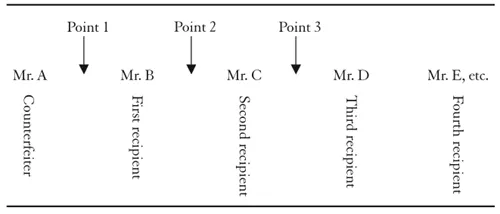
The second recipient loses because he has given the first recipient something of value, and has gotten nothing in return. If he can unearth the first recipient, the incidence of the loss would be complicated by the fact that the first recipient is innocent of any wrongdoing. The loss would probably have to be shared between the two recipients. Of course, if the original passer of the false money can be found and made to pay, no loss will have taken place, since in effect no counterfeiting will have taken place. But, if none of the previous passers can be found after the fact, the recipient who is discovered with the counterfeit money in his possession will bear the full loss, no matter how many times it has already been passed.
If the counterfeit money is never discovered, the situation is radically different. The losses due to counterfeiting are incurred, not by any one individual, but by the entire society, in a rather complicated way. The losses are not immediately apparent, for there is no one recipient who loses the total value of the commodity given up in return for the counterfeit money. But, it is easy to see that there are losses—for the counterfeiter has gained a value, without adding to the store of value of the rest of society. Since there are only so many goods in the society at any one time and the counterfeiter has gained some through fraud, there must be others who have lost out.
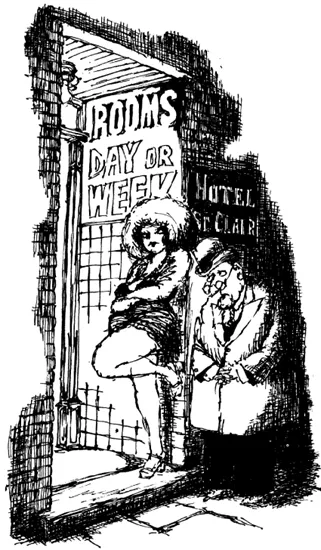
“I must say, young lady, it’s refreshing to find someone acquainted with the evils of the Federal Reserve System, but where could I get gold or silver bullion at this time of night?”
The way the loss is spread out though the society depends upon the rise in prices caused by the extra money (the counterfeited money) now in circulation. That prices will rise in response to the activities of the counterfeiters is a foregone conclusion, for counterfeiting increases the amount of money in circulation while the amount of goods and services remains the same. Prices will not rise all at once, nor will they rise smoothly and regularly. Rather, prices will rise in waves as does the water in a pool in response to a stone disturbing the equilibrium. They will first be driven up in the industry or area of which the first recipient of the counterfeit money is a member. Prices will be driven up because the counterfeit money spent in the industry is “extra”; that is, in the absence of the counterfeiting, it would not have been spent; therefore the first recipient benefits. He has received money which would not have been forthcoming but for the counterfeiting, and he is able to spend this extra money in an area where prices have not yet risen. The first recipient gains this incremental difference (though it may be substantial, it is in no way comparable to the counterfeiter’s gain).
The second recipient also gains, as do all other recipients at the beginning of the ever-spreading ripple effect. For these people all receive the new money before prices have had a chance to be pushed up by the extra money put into circulation by counterfeiting. However, in time there will be a recipient of the imitation money who will just come out even. He will receive money at a time when it is still possible to spend part of it in an area which has not yet had a counterfeit-induced price rise. If he spends his money in an area which has not yet received a boost in prices, he will gain slightly from the inflation; if not, he will lose. On the average, people in this phase of the monetary expansion will be neither greatly benefited nor greatly harmed from the counterfeiting.
People receiving the counterfeit money after this stage bear the losses of the monetary expansion. Before they receive any extra money, prices will have risen. When the counterfeit money finally filters down to them they will be net losers. There are some groups, such as widows and retired people, who will always lose from counterfeiting, because during the spread of the counterfeit-induced inflation, their incomes are fixed.
If all this is true, how can the counterfeiter be considered a hero? Given that the main result of counterfeiting which is eventually discovered is to bilk the person caught “holding the bag,” and that the main result of undiscovered counterfeiting is inflation which eventually harms many of us, it does indeed seem strange to call the counterfeiter a hero.
The justification for calling the common private counterfeiter heroic is that there is a prior counterfeiter in action and that the money falsified by the private counterfeiter is not really legitimate money; instead, it is itself counterfeit. It is one thing to say that counterfeiting genuine money amounts to theft; it is quite another thing to say that counterfeiting counterfeit money amounts to theft!
Perhaps an analogy will clarify this point. Taking someone’s rightfully owned property is theft, and therefore unjustified. But no such proscription holds for taking the wrongfully owned (stolen) property of the thief. Indeed, such an activity need not even be called theft. In other words, an act which seems to be seemingly identical with theft is not illegitimate at all if the victim has no legitimate claim over the articles taken. If B steals something from A, and then C takes it away from B, we cannot hold C guilty of theft. (For the sake of simplicity, we can assume that the original owner, A, cannot be found by C.) A forced transfer of goods is illegitimate only if the original owner was the rightful owner; if he was not, there was nothing untoward about the transfer.
In like manner, we can see that it does not follow from the fact that counterfeiting genuine money is illegitimate that counterfeiting counterfeit money is illegitimate. If the claims can be substantiated that the counterfeiting of counterfeit money is not itself illegitimate; and that if the “original” money is indeed counterfeit, then it will have been demonstrated that the “private enterprise” counterfeiter is not guilty of wrongdoing, and can perhaps be considered heroic.
The claim that the counterfeiting of counterfeit money is not itself illegitimate is based on our understanding that such an activity is identical in form with stealing from a thief. The original dictionary definition of counterfeiting spoke of “fabricating without right,” and of “passing the false copy for genuine or original.” But if what is being copied is itself counterfeit, then the counterfeiter is not passing the false copy for genuine. He is only passing off (another) false copy. And if fabricating without right means passing something off as genuine, then our counterfeiter is not fabricating without right, for he is not in fact trying to pass something as genuine—he is only trying to pass his handiwork as a copy of a counterfeit.
The money which our counterfeiter is copying is itself counterfeit. It is made by a nonprivate counterfeiter—the government.
This is a serious charge, and is not made lightly. Unappetizing though it may be, the fact is that governments everywhere make counterfeits of real money—gold and silver. Virtually all governments then forbid the use of real money and allow only the use of the counterfeits they fabricate. This is equivalent to a private enterprise counterfeiter not only copying the money in circulation, but also preventing and prohibiting the circulation of the “legal” money.
Consider the monetary system before governments became deeply involved with it. Gold and silver (and paper certificates representing them) were the circulating medium. The government could not simply intrude on this system and impose its fiat currency (currency based upon the compulsion of emperors, kings, and presidents, not upon the voluntary decisions of the people). The people would not accept it as money, and would not voluntarily give up their hard earned possessions for such tokens. Instead, the government utilized gradualist methods in its quest to seize control of the monetary mechanism.
Under the gold standard, private minters converted gold bullion into coins. The weight of these coins was certified by the private minters, whose reputations for accuracy and probity were their main stock in trade. The first step of government was to seize monopoly control of the mints, proclaiming that coinage was the proper domain of the sovereign, and that private coiners could not be entrusted with such an important task. The government thus nationalized the mint.
The second stage was debasement. After affixing the picture of the monarch on the coin, to insure the weight and quality, the coins were “sweated” (stamped at a greater face weight than actual weight). It was in this way that government counterfeiting began.
The third step was the enactment of legal tender laws. These laws required that money be traded and counted at its official stamped value, and not at any other value, such as that based on weight. A coin stamped at 10 gold ounces could legally be used in payment of a debt of 10 gold ounces, even though the actual coin weighed only 8 gold ounces. The protests of the creditor were ignored by the sovereign’s court system under the legal tender laws. The purpose of such laws was, of course, to establish the acceptability of money counterfeited by the government.
The government soon found that this was a small-time operation. There were limitations to the sweating of coins. However, even slowly replacing full-bodied coins (coins whose gold content equaled the stamped value) with token coins (coins which are intrinsically valueless as metals) would still not yield enough. Even if the government seized as much as 100 percent of the value of the coin, the value of all coins in total was limited. A course of action with much greater potential for counterfeiting was begun.
Step four was then introduced.1 The government stopped simply replacing gold coins with token coins, and began creating tokens representing more gold than it possessed. Not the gold value of coins, nor of bullion, nor even the value of the gold in the ground, any longer limited the scope of government counterfeiting.
With this innovation, government counterfeiting entered the fifth stage—the first “civilized” stage. Greenbacks, dollar bills, etc., could now be created seemingly without restraint. The printing presses were turned up to high speed, and government-counterfeit induced inflations began to take their place in the modern world.
With the sixth step, government spending received another “shot in the arm.” Counterfeiting paper money, begun in the fifth stage, had been an “improvement” over counterfeiting coins, but the prospect of taking over banks and checkbook money offered an even greater improvement. Depending on the reserve requirements of the banks, the banking system could create a multiple monetary expansion, through the well-known “multiplier effect.” In all expanding economies, paper money outstrips coins, and bank checking deposit money outstrips paper money. Taking over the banks, then (as well as the monopoly of coin and paper note issue), provided further scope for the counterfeiting plans of government.
Again under the guise that the free market could not be trusted, the government enacted legislation setting up the Central Bank, and later, the Federal Reserve System. The Central Bank was given a monopoly over paper money note issue, and the monetary tools (open market operations, setting the rediscount rate, and loans to banks) with which to keep the entire banking system in a harmonious state of counterfeiting.
The main argument used by the government was that the so-called “free” or “wildcat” banks, located mainly in inaccessible areas of the Midwest, were negligent in backing up their bank notes. This charge was true, in the main. But the reasons for it, which stem from the War of 1812, are illustrative. At the time of that war, New England banks were the soundest in the country. But New England was also the section of the country most opposed to the war. The central government thus had to borrow mainly from the Midwestern banks whose note issue far outstripped their gold stocks. (The government arrogated to itself the duty of maintaining the financial probity of the banks, but reneged.) The government spent much of this money (in the form of notes) in New England. When these banks presented the Midwestern notes for redemption, the government, further shirking from its self-procaimed duties, declared “banking holidays,” and allowed the wildcat banks to renege on their obligations for several years. The consequent exuberant policies which these banks followed gave private banking a bad name, and provided the government with a justification for taking over. These private banks were encouraged in their counterfeiting operations by the government itself.
At this stage of development, there was only one fly in the ointment, and it led the government to take the seventh step. Some countries engaged in counterfeiting, and hence inflation, to a greater degree than others. But when one country engages in a greater degree of counterfeiting-inflation than other countries, it becomes enmeshed in balance of payment problems. If country A’s government counterfeits at a greater rate than country B’s government, prices will rise faster in A than in B. A will find it easy to buy from B and hard to sell to B. Thus A’s imports (what it buys) will outstrip its exports (what it sells). The immediate result of the imbalance between imports and exports will be a flow of gold from A to B to pay for the excess in purchases. But, because gold is limited, this cannot go on forever.
There are several possible responses. Government A could set a tax on imports (a tariff), or B could set a tax on exports. Quotas could be set by both countries prohibiting trade beyond a certain point. A could devalue its currency, making it easier for it to export, and harder for it to import. Or, B could revalue its currency, with the opposite effects. There are problems, however, with all of these responses. Tariffs and quotas interfere with trade, specialization, and the international division of labor. Devaluations and revaluations are very disruptive and interfere with the system of international trade which the world has spent so many years building. In addition, they do not really solve the problem of imbalance, and currency crises are bound to recur every time changes in the relative value of the various currencies of the world occur.
The world is now undergoing this seventh step, hence, it is difficult to trace it to its conclusion. Two patterns, however, seem to be emerging. One is the advent of a world monetary conference of which Bretton Woods is an example. At conferences of this type, the leading counterfeiter-inflationists gather to discuss possible remedies for their actions (although of course they do not see their role in this way). They usually discuss adopting some version of the central banking system of the United States for worldwide use. Suggestions have been made for an international equivalent of our Federal Reserve System. A strong world bank of this type would have much the same power over the entire world that a national bank has over its own country. It would have the power to force all banks to inflate in unison, and to direct the inflation to ensure that no power but itself shall be able to counterfeit money. Because each nationalistic counterfeiting center has so far jealously guarded its own powers, such a world central bank has not yet come into existence.
An alternative system, popularized by Milton Friedman of the University of Chicago, is the system of “flexible exchange rates.” This system operates in such a way that whenever the prices or value of two countries’ currencies fall out of line with one another, they automatically readjust. That is, the currency prices of the various countries are allowed to change in terms of one another. This is in significant contrast to the agreements made at previous world monetary conferences, in which these prices are fixed in terms of each other. With a flexible system, if country A inflates at a higher rate than country B, there will be a relative excess supply of the currency of A, which will drive its price down, choke off its imports, and make its exports more attractive. The great advantage of the flexible exchange system over the fixed exchange systems of the world monetary agreements is that it is an entirely automatic system. Thus the crises which would occur under a fixed system every time currencies change value with respect to one another are avoided.
However, since both these systems are only superficial attempts to suppress the ill effects which result from government counterfeit-inflationary schemes, neither can be favored. Paradoxically, these ill effects are good things. Just as a pain in the body can be a warning of a far more serious condition, and is, therefore, beneficial, a balance of payments problem can be a signal of the menace of international inflation. Attempting to paper over these difficulties with flexible exchange rate schemes leaves the world’s economy open to the ravages of inflation. It would be far better for the economy of the world, and for every individual country, if instead of devising ways to prop up counterfeiting and the resultant inflation, the governments of the world gave up these policies altogether.
In this connection, one cannot help daydreaming about Treasury agents, the “T” men of modern television serials. Dedicated to the elimination of counterfeiting, dressed in the best “FBI modern” style, they represent the essence of “uncorruptible” (ho, ho), tough law enforcers. On television their adventures usually begin with an overview of them walking down the steps of the Treasury Building. Were they to turn around, and walk back up the steps, and back into the offices of their superiors, and arrest them, they would be corralling perhaps the biggest gang of counterfeiters the world has ever known.
As to the claim that the private counterfeiter is a hero, three criteria for heroic actions must be applied. The act must not violate the rights of innocent people; the act must be of great benefit to large numbers of people; and it must be performed at great personal risk.
There can be no doubt regarding the third point. Nongovernmental counterfeiters operate at great risk to themselves. The government has declared such activity illegal. The Treasury Department spends large sums of money to apprehend private counterfeiters. The government stands ready to prosecute all those accused of counterfeiting, and to jail all who are found guilty. It cannot be doubted that the “risk” criterion is more than amply met.
Furthermore, it is clear that the activities of private counterfeiters are beneficial to the public. Nongovernmental counterfeiting, if allowed to be pursued, would spell the ruin of the government’s own system of counterfeit money. The extent to which nongovernment counterfeiters are active is the extent to which the effectiveness of the government’s own counterfeit system is decreased. The fact that the government’s counterfeit system is very harmful constitutes in itself a strong prima facie case for nongovernment counterfeiting. (Of course, private counterfeiting is illegal, and cannot, therefore, be advocated. Still it is of interest to spin out the implications of economic theory.)
It may be objected that if private counterfeiters gained power, and replaced the government, the people would be no better off. This, of course, is true. But the fact is that private counterfeiters are “small time,” and will undoubtedly remain so. They could pose no more than a minor problem. It is in fact this reality which clinches the argument for private counterfeiters. They do not pose a threat to the people; they are not, nor are they likely to become strong enough to do that. The effect they have is to reduce and counteract the great evil of government counterfeiting. This is beneficial for great numbers of people. Although a few individuals may suffer a loss from this activity, on balance, the activity of the private counterfeiter is more beneficial than harmful. And, it must be remembered, their activity is not fraudulent and hence immoral, since they do not seek to pass off counterfeit money for genuine.
1We do not claim a strict, nonoverlapping temporal order for these stages. They are rather devices to clarify exposition.
15
THE MISER
The miser has never recovered from Charles Dickens’ attack on him in A Christmas Carol. Although the miser had been sternly criticized before Dickens, the depiction of Ebenezer Scrooge has become definitive and has passed into the folklore of our time. Indeed, the attitude pervades even in freshman economics textbooks. There the miser is roundly condemned and blamed for unemployment, changes in the business cycle, and economic depressions and recessions. In the famous—or rather infamous—"paradox of savings,” young students of economics are taught that, although saving may be sensible for an individual or a family, it may be folly for the economy as a whole. The prevalent Keynesian doctrine holds that the more saving in an economy, the less spending for consumption, and the less spending, the fewer jobs.
It is time that an end be put to all these misconceptions. Many and various benefits are derived from saving. Ever since the first caveman saved seed corn for future planting, the human race has owed a debt of gratitude to the hoarders, misers, and savers. It is to those people who refused to use up at once their entire store of wealth and chose rather to save it for a needy time, that we owe the capital equipment which enables us to aspire to a civilized standard of living. It is true, of course, that such people became richer than their fellows, and perhaps thereby earned their enmity. Perhaps the whole process of saving and accumulating was cast into disrepute along with the saver. But the enmity is not deserved. For the wages earned by the masses are intimately dependent upon the rate at which the saver can accumulate money. There are, for example, many reasons contributing to the fact that the American worker earns more than, say, his Bolivian counterpart. The American worker’s education, health, and motivation play important roles. But a major contribution to the wage differential is the greater amount of capital stored up by American employers than by Bolivians. And this is not an exceptional case. The saver has been instrumental throughout history in lifting the pack above the level of the savage.
Perhaps it will be objected that there is a difference between saving (acknowledged to be productive in the process of capital accumulation), and hoarding (withholding money from consumption spending), and that the saver channels his money into capital goods industries where they can do some good; hoarded money is completely barren. The hoarder, it will be claimed, reduces the money received by retailers, forcing them to fire employees and reduce orders from jobbers. Jobbers in turn are forced to reduce their staff and to cut back on orders from wholesalers. The whole process, under the influence of hoarders, will be repeated throughout the entire structure of production. As employees are fired, they will have less to spend on consumption goods, thus compounding the process. Hoarding is thus seen as completely sterile and destructive.
The argument is plausible except for a crucial point which this Keynesian-inspired argument fails to take into account—the possibility of changes in prices. Before a retailer begins to lay off employees and cut back on orders because of unsold goods, he will usually try lowering his prices. He will hold a sale or use some other technique which will be equivalent to a decrease in price. Unless his troubles are due to the unsalability of his wares, this will suffice to end the vicious circle of unemployment and depression. How so?
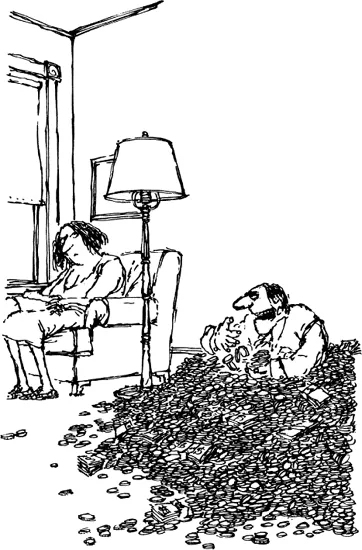
“Lip up, will ya’, Edith! You knew I wasn’t a Keynesian when you married me!”
In withholding money from the consumer’s market, and not making it available for the purchase of capital equipment, the hoarder causes a decrease in the amount of money in circulation. The amount of available goods and services remains the same. Since one of the most important determinants of price in any economy is the relationship between the amount of money and the amount of goods and services, the hoarder succeeds in lowering the level of prices. Consider a simplistic but not wholly inaccurate model in which all the dollars in the economy are bid against all its goods and services. Thus the fewer the dollars, the greater the purchasing power of each. Since hoarding can be defined as reducing the amount of money in circulation, and, other things equal, less money means lower prices, it can readily be seen that hoarding leads to lower prices.
There is no harm in lowering the level of prices. Quite the contrary, one of the great benefits is that all other people, the nonmisers, benefit from cheaper goods and services.
Nor will lower prices cause depressions. Indeed, the course of the prices of some of our most successful machinery has followed a strong downward curve. When cars, televisions, and computers were first produced, they were priced far beyond the reach of the average consumer. But technical efficiency succeeded in lowering prices until they were within the reach of the mass of consumers. Needless to say, neither a depression nor recession was caused by these falling prices. In fact, the only businessmen who suffer in the face of such a trend are those who follow the Keynesian analysis and do not lower their prices in the face of falling demand. But far from causing an ever widening depression, as the Keynsenians contend, such businessmen only succeed in driving themselves into bankruptcy. For the rest, business continues as satisfactorily as before, but with a lower price level. The cause of depressions, therefore, exists elsewhere.1
There is likewise no substance in the objection to hoarding on the ground that it is disruptive, and continually forces the economy to adjust. Even if true, it would not constitute an indictment of hoarding, for the free market is preeminently an institution of adjustment and reconciliation of divergent and ever-changing tastes. To criticize hoarding on this ground, one would also have to criticize changing clothing styles as well, for they continually call on the market for “fine tuning” adjustment. Hoarding is not even a very disruptive process because for every miser stuffing money into his mattress, there are numerous misers’ heirs ferreting it out. This has always been the case, and it is not likely to change drastically.
Claims that the miser’s hoard of cash is sterile because it does not draw interest as it would if it were banked is also without merit. Could the money held by individuals in their wallets be characterized as sterile since it does not draw interest either? If people voluntarily forbear to earn interest on their money and instead hold it in cash balances, the money may appear useless from our point of view, but it undoubtedly is not useless from theirs. The miser may want his money not for later spending, not to bridge the gap between expenditures and payments, but rather for the pure joy of holding cash balances. How can the economist, educated in the utility maximization tradition, characterize joy as sterile? Art lovers who hoard rare paintings and sculpture are not characterized as engaging in a sterile enterprise. People who own dogs and cats, solely for the purpose of enjoyment and not investment, are not described as engaging in sterile activity. Tastes differ among people, and what is sterile for one person may be far from sterile for another.
The miser’s hoarding of large cash balances can only be considered heroic. We benefit from lowered price levels, which result from it. The money which we have and are willing to spend becomes more valuable, enabling the purchaser to buy more with the same amount of money. Far from being harmful to society, the miser is a benefactor, increasing our buying power each time he engages in hoarding.
1See Murray N. Rothbard, America’s Great Depression (New Rochelle, N.Y.: Van Nostrand, 1963).
16
THE INHERITOR
Heirs and heiresses are usually depicted as irresponsible, idle, lazy individuals who enjoy lives of unearned luxury. This is perhaps a true characterization of many in the class. But it does not detract from the heroic role played by the inheritor.
An inheritance is simply a form of gift—a gift that is given upon death. Like gifts that are given upon births, birthdays, weddings, anniversaries, and holidays, it can be defined as the voluntary transfer of considerations from one party to another. One cannot, therefore, oppose inheritances, and at the same time favor other types of gifts. Yet, many people do just that. Their anti-inheritance bias is spurred on by images of thieves who pass on their ill-gotten gains to their children. They see members of the ruling class accumulating fortunes, not through honest trade, but through government subsidies, tariffs, and licensing protections, and passing on what they have accumulated. Surely this should be prohibited. The elimination of an inheritance seems to be a solution.
It would, however, be impossible to eliminate inheritance unless all other types of gifts were also eliminated. The 100 percent tax on inheritance, often suggested as the means by which to eliminate inheritance, would not accomplish this. For if other types of gifts were permitted, the tax could easily be circumvented. Money and property could simply be transferred by means of birthday gifts, Christmas gifts, etc. Parents might even have gifts held in trust for their children, to be turned over on the child’s first birthday after the death of the parent.
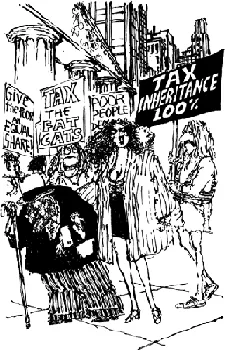
“Get lost, Creep!”
The solution to the problem of illicitly earned wealth, white-collar and otherwise, does not lie in preventing the next generation from obtaining the ill-gotten funds, but in making certain that these funds are not retained in the first place. Attention should rather be focused on retrieving the illicit property and returning it to the victim.
Will it be argued that the 100 percent inheritance tax is a “second best” policy? That since we do not have power to strip the criminals of their ill-gotten gains, efforts should be made to deny them the opportunity of passing the fortunes on to their children? This is contradictory. If the power is lacking to bring criminals to justice because white-collar criminals control the system of justice, then clearly there is a lack of power to impose a 100 percent inheritance tax on them.
In fact, even if such a tax could be enacted and enforced, the yearning for egalitarianism which really animates all such proposals would be frustrated. For true egalitarianism means not only an equal distribution of money, but also an equal distribution of nonmonetary considerations. How would the egalitarians remedy the inequities between those who are sighted and those who are blind, those who are musically talented and those who are not, those who are beautiful and those who are ugly, those who are gifted and those who are not? What of the inequities between those who have happy dispositions and those who are prone to melancholy? How would the egalitarians mediate them? Could money be taken from those who have “too much happiness” and given to those who have “too little” as compensation? How much is a happy disposition worth? Would $10.00 per year trade at par for five units of happiness?
The ludicrousness of such a position might lead the egalitarians to adopt a “second best” policy, such as the one used by the dictator in “Harrison Bergeron,” a short story in Welcome to the Monkey House by Kurt Vonnegut.1 In the story, strong people were forced to carry weights in order to bring them down to the level of the rest of the people; musically inclined individuals were forced to wear earphones that gave forth shockingly loud sounds in proportion to their musical talent. This is where the desire for egalitarianism logically leads. The elimination of monetary inheritance is but the first step.
It is the inheritor and the institution of inheritance that stands between civilization as we know it and a world in which no talent or happiness is allowed to mar equality. If individuality and civilization are valued, the inheritor will be placed on the pedestal he richly deserves.
1Kurt Vonnegut, Welcome to the Monkey House (New York: Dell, 1970).
17
THE MONEYLENDER
Ever since Biblical times, when the moneylenders were driven from the temple, they have been scorned, criticized, vilified, persecuted, prosecuted, and caricatured. Shakespeare, in The Merchant of Venice, characterized the moneylender as a Jew scurrying around trying to exact his “pound of flesh.” In the movie, The Pawnbroker, the moneylender was an object of loathing.
The moneylender, however, together with his first cousins, the usurer, the pawnbroker, and the loan shark, have been badly misjudged. Although they perform a necessary and important service, they are, nevertheless, extremely unpopular.
Lending and borrowing take place because people differ as to their rate of time preference (the rate at which they are willing to trade money they presently possess, for money they will receive in the future). Mr. A may be anxious to have money right now, and not care too much about what money he may have in the future. He is willing to give up $200 next year in order to have $100 now. Mr. A has a very high rate of time preference. At the other end of the spectrum are the people with very low rates of time preference. To them, “future money” is almost as important as “present money.” Mr. B, with a low rate of time preference, is willing to give up only $102 next year in order to receive $100 now. Unlike Mr. A, who cares much more about present money than future money, Mr. B would not give up a large amount of future money for cash in hand. (It should be noted that a negative time preference does not exist, that is, a preference for money in the future over money in the present. This would be equivalent to saying that there would be a preference toward giving up $100 in the present, in order to get $95 in the future. This is irrational unless there are conditions other than time preference which operate. For example, one might want to purchase protection for money that is unsafe now, but will be safe a year hence, etc. Or, one may want to savor his dessert and postpone consumption until after dinner. “Dessert-before-dinner” would then be considered a different good than “dessertafter-dinner,” no matter how similar the two goods were in physical terms. There is thus no preference shown for a good in the future over the same good in the present.)
Although it is not necessary, it is usual for a person with a high time preference (Mr. A), to become a net borrower of money, and for a person with a low time preference (Mr. B), to become a lender. It would be natural, for example, for Mr. A to borrow from Mr. B. Mr. A is willing to give up $200 a year from now in order to get $100 now, and Mr. B would be willing to loan $100 now if he can get at least $102 after one year has elapsed. If they agree that $150 is to be repaid a year hence for a present loan of $100, they both gain. Mr. A will gain the difference between the $200 he would have been willing to pay for $100 now and the $150 that he will actually be called upon to pay. That is, he will gain $50. Mr. B will gain the difference between the $150 that he will actually get a year hence and the $102 that he would have been willing to accept in a year for giving up the $100 now, a gain of $48. In fact, because moneylending is a trade, like any other trade, both parties must gain or they would refuse to participate.
A moneylender may be defined as someone who loans out his own money or the money of others. In the latter case his function is that of intermediary between the lender and borrower. In either case, the moneylender is as honest as any other businessman. He does not force anyone to do business with him nor is he himself compelled. There are, of course, dishonest moneylenders just as there are dishonest people in all walks of life. But there is nothing dishonest or reprehensible about moneylending per se. Some criticism of this view deserves further examination.
1. “Moneylending is infamous because it is frequently accompanied by violence. Borrowers (or victims) unable to pay their debts are often found murdered—usually by the loan shark.” Individuals who borrow money from moneylenders usually have contracts with them to which they have fully agreed. One is hardly a victim of a moneylender if one has agreed to repay a loan, and then reneges on the contractual promise. On the contrary, the moneylender is the victim of the borrower. If the loan, but not the repayment is consummated, the situation is equivalent to theft. There is little difference between the thief who breaks into the moneylender’s office and steals money, and the person who “borrows” it contractually, and then refuses to pay it back. In both cases, the result is the same—someone has taken possession of money which is not theirs.
Killing a debtor is an unjust overreaction, just as the murder of a thief would be. The primary reason moneylenders take the law into their own hands, however, and do not hesitate to use forceful means, even murder, is that moneylending is controlled by the underworld. But this control came about virtually at the public’s request! When courts refuse to compel debtors to pay their rightful debts, and they prohibit the lending of money at high rates of interest, the underworld steps in. Whenever the government outlaws a commodity for which there are consumers, be it whiskey, drugs, gambling, prostitution, or high interest loans, the underworld enters the industry that law-abiding entrepreneurs fear to service. There is nothing in whiskey, drugs, gambling, prostitution, or moneylending that is intrinsically criminal. It is solely because of a legal prohibition that gangland methods become associated with these fields.
2. “Money is sterile and produces nothing by itself. Therefore, any interest charge for its use is exploitative. Moneylenders, who charge abnormal interest rates, are among the most exploitative people in the economy. They richly deserve the opprobrium they receive.”
Apart from the ability of money to buy goods and services, having money earlier, rather than later, provides an escape from the pain of waiting for fulfillment. It fosters a productive investment which, at the end of the loan period, even after paying the interest charge, yields more goods and services than at the beginning.
As for the “exorbitantly high” rates of interest, it should be understood that in a free market, the rate of interest tends to be determined by the time preferences of all the economic actors. If the rate of interest is inordinately high, forces will tend to develop which will push it down. If, for example, the rate of interest is higher than the time preference rate of the people involved, the demand for loans will be less than the supply, and the interest rate will be forced down. If the interest rate shows no tendency to decrease, this indicates not that it is too high, but that only a high rate of interest can equilibrate the demand for loans, and satisfy the time preference rate of the economic actors.
The critic of high interest rates has in mind a “fair” rate of interest. But a “fair” rate of interest or a “just” price does not exist. This is an atavistic concept, a throwback to medieval times when monks debated the question, along with the question of how many angels can fit on the head of a pin. If there is any meaning to the “fair” rate of interest doctrine, it can only be the rate which is mutually agreeable to two consenting adults, and that is exactly what the market rate of interest is.
3. “Moneylenders prey upon the poor by charging higher rates of interest than they charge other borrowers.”
It is a common myth that the rich compose virtually the whole moneylending class and that the poor virtually all the borrowing class. This, however, is not true. What determines whether a person becomes a net borrower or lender is his rate of time preference, not his income. Rich corporations that sell bonds are borrowers, for the sale of bonds represents money borrowed. Most wealthy people who own real estate or other properties which are heavily mortgaged, are almost certainly net borrowers, not net lenders. On the other hand, every poor widow or pensioner with a small bank account is a moneylender.
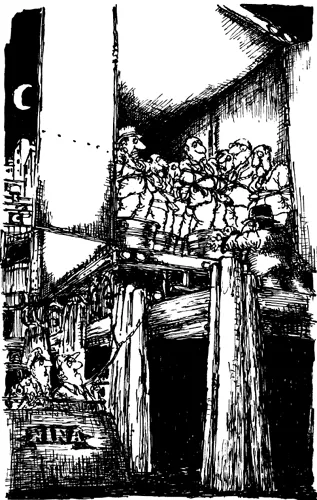
“I’m not surprised. Only yesterday the ’Journal’ reported that the default rate on loans was up 8.9% over the first quarter.”
It is true that moneylenders charge the poor higher rates of interest than they charge other people, but when stated in this way it can be misleading. For moneylenders charge higher rates of interest to individuals who are greater risks—those who are less likely to repay the loan—regardless of wealth.
One way to decrease the risk of default and, therefore, the rate of interest charged, is to put up collateral or real property that would be forfeited if the loan is not repaid. Since rich people are more capable of putting up collateral for loans than poor people, their loans are granted at lower rates of interest. The reason, however, is not because they are rich, but because the lender is less likely to undergo losses in case of default.
There is nothing untoward or unique about this situation. Poor people pay a higher rate for fire insurance since their houses have less fîreproofîng than rich people’s houses. They are charged more for medical care since they are less healthy. Food costs are higher for poor people because there is more crime in their neighborhoods, and crime raises the cost of conducting a business. This is, to be sure, regrettable, but it is not the result of malice against the poor. The moneylender, like the health insurance company and the grocer, seeks to protect his investment.
Imagine the results of a law which prohibits usury, which can be defined as charging a rate of interest higher than the lawmaker approves of. Since the poor and not the rich pay the higher interest rate, the law would have its first effects on them. The effect would be to hurt the poor, and, if anything, enhance the rich. The law seems to be designed to protect the poor from having to pay high interest rates, but in reality it would really make it impossible for them to borrow money at all! If the moneylender must choose between loaning money to the poor at rates he regards as too low, and not loaning them any money at all, it is not difficult to see what choice he will make.
What will the moneylender do with the money he would have loaned to the poor but for the prohibitory law? He will make loans exclusively to the rich, incurring little risk of nonrepayment. This will have the effect of lowering the interest rates for the rich, because the greater the supply of a good in any given market, the lower the price. The question of whether or not it is fair to prohibit exorbitant rates of interest is not now under discussion, only the effects of such a law. And these effects are, quite clearly, calamitous for the poor.
18
THE NONCONTRIBUTOR TO CHARITY
We are beset by the view that it is blessed to give to charity. That it is also virtuous, seemly, good, fair, respectable, altruistic, and endearing. In like manner, the refusal to give to charity is met with contempt, derision, incredulity, and horror. The person who refuses to contribute to charity is considered a pariah.
This sociological imperative is supported by legions of beggars, fundraisers, clerics, and other “needy” groups. We are exhorted from the pulpit and the media, by the Hare Krishnas and the panhandlers, the flower people and the March of Dimes children, the cripples, the helpless, the impoverished, and the beaten down.
Contributing to charity is not in itself evil. When it is a voluntary decision on the part of responsible adults, it does not violate an individual’s rights. Yet there are dangers in charity, and compelling reasons for refusing to contribute to it. In addition, there are serious flaws in the moral philosophy upon which charity is based.
THE EVILS OF CHARITY
One of the great evils of charity, and one of the most cogent reasons for refusing to contribute to it, is that it interferes with the survival of the human species. According to the Darwinian principle of the “survival of the fittest,” those organisms most able to exist in a given environment will be “naturally selected” (by showing a greater propensity to live until the age of procreation, and thus be more likely to leave offspring). One result, in the long run, is a species whose members have a greater ability to survive. This does not imply that the strong “kill off” the weak, as has been alleged. It merely suggests that the strong will be more successful than the weak in the procreation of the species. Thus the ablest perpetuate themselves and the species thrives.
Some contend that the law of natural selection does not apply to modern civilization. Critics point to artificial kidney machines, open heart surgery, and other scientific and medical breakthroughs, and argue that Darwin’s survival law has been preempted by modern science. For people with diseases and genetic drawbacks, which in the past led to an early death, today live on to reproduce.
This does not, however, demonstrate that the Darwinian law is inapplicable. Modern scientific breakthroughs have not “repealed” Darwin’s law, they have only changed the specific cases to which it applies.
In the past, the characteristic antithetical to human survival might have been a defective heart or poor kidneys. But with the advent of modern medical advances, medical failures are likely to become less and less important as grounds for natural selection. What will become more and more important is the ability to live on a crowded planet. Characteristics opposed to survival may include an allergy to smoke, excessive argumentativeness, or bellicosity. Such characteristics will tend to lessen a person’s ability to survive to adulthood. These characteristics lessen the person’s chances of maintaining a situation (marriage, employment) in which reproduction is possible. Thus, if the Darwinian laws are allowed to work themselves out, such negative traits will tend to disappear. But if charity is extended, these harmful traits will be carried over to the next generation.
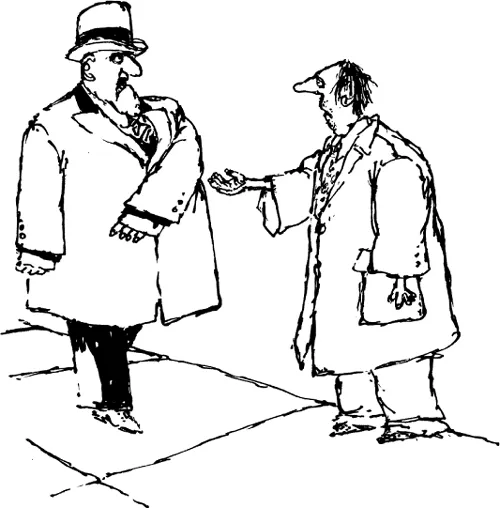
“Go inherit your own money!”
While charity of this type is undeniably harmful, when it is private, it is limited in scope by a type of Darwinian law that applies to the givers: they come to bear some of the harm they cause. Thus they are led, as if by Adam Smith’s “invisible hand” to cut back on their giving. For example, if parental charity takes the form of “sparing the rod and spoiling the child,” some of the harmful effects of this charity rebound upon the parents. Being on the receiving end of spoiled children tends to temper the giver. (Many of the parents who supported their adult “hippie” children throughout the sixties discontinued such support when they themselves suffered from its harmful effects.) Private charity also has a built-in limitation because any given private fortune is circumscribed. The case of public charity is ominously different.
In public charity, all natural barriers are virtually absent. It is a rare case indeed when public charity is reduced because of its harmful effects. The fortune at the goverment’s disposal is only limited by its desire for taxes and its ability to levy them on an unwilling public.
A case in point is the American foreign aid program of the 1950s and 1960s. The government of the United States paid American farmers more than the market price for their produce, thus creating gigantic surpluses, for which still more money had to be allotted. Large quantities of this produce were then sent to countries such as India, where the domestic farm industry was virtually ruined by this subsidized importation.
Other detrimental effects of governmental “charity” have been documented by a number of social scientists. G. William Domhoff in his book The Higher Circles,1 shows that “charitable” institutions such as workmen’s compensation, collective bargaining in labor, unemployment insurance, and welfare programs were begun not by advocates of the poor, as is universally accepted, but by the rich. These programs promote their own class interests. The aim of this state-corporate charity system is not to redistribute wealth from rich to poor, but to buy up the potential leaders of the poor and tie them to the hegemony of the ruling class, while maintaining an intellectual class determined to convince an unwary public that government charity actually benefits them.
In like manner, Piven and Cloward point out in Regulating the Poor2 that the “charitable” institution of welfare serves not mainly to aid the poor, but rather to suppress them. The modus operandi here is to allow the welfare rolls to increase not in times of great need, but in times of social upheaval, and to decrease the welfare rolls not in times of plenty, but in times of social tranquility. Thus the welfare system is a kind of “bread and circus” method of controlling the masses.
THE PHILOSOPHY BEHIND CHARITY
Despite these problems, there are those who view charity as a blessed state, and consider contributions a moral obligation. Such people would make charity compulsory, if they could. If, however, an act is made compulsory, it is not charity, for charity is defined as voluntary giving. If an individual is forced to give, he is not a contributor to charity, he is the victim of a robbery.
The crux of charity, for those who would wish it to be made compulsory, the laws of logic and linguistics notwithstanding, is that there is a duty, an obligation, a moral imperative, for all to give to the less fortunate. This rests on the premise that “we are each our brother’s keepers.”
This philosophy, however, contradicts a basic premise of morality—namely, that it should always be at least possible for a person to do what is moral. If there are two people in different geographical areas who are in dire need of John’s aid at the same time, it would be impossible for John to help both of them. If John cannot help both needy people, and since helping both is a requirement of the brother’s keeper morality, then clearly, with the best intentions, John cannot be moral. And if, according to any given theory of ethics, a well-intentioned person cannot be moral, the theory is incorrect.
The second basic flaw in the brother’s keeper moral view is that it logically calls for absolute income equality, whether or not its proponents realize this. Remember, this morality preaches that it is the moral duty of those who have more, to share with those who have less. Adam, who has $100, shares with Richard, who has only $5, by giving Richard $10. Adam now has $90 and Richard $15. One might think that Adam has followed the dictates of the sharing philosophy. However, this philosophy states that it is the duty of all people to share with the less fortunate, and Adam still has more than Richard. If Adam wishes to act morally, according to the brother’s keeper moral view, he will have to share again with Richard. The sharing can end only when Richard no longer has less than Adam.
The doctrine of absolute income equality, a necessary consequence of the brother’s keeper philosophy, will admit of no prosperity for anyone over and above the meager pittance the most helpless individual is able to amass. Thus the brother’s keeper philosophy is in direct and irreconcilable opposition to the natural ambition to improve one’s lot. Believers in it are torn by ultimately conflicting views and the result, naturally enough, is hypocrisy. How else can one describe people who claim to be practitioners of the brother’s keeper philosophy, and yet have well-stocked pantries, a television, a stereo set, a car, jewelry, and real estate, while in many parts of the world people face starvation? They dogmatically affirm their commitment to equality, yet deny that their lush wealth is in any way contradictory to this commitment.
One explanation offered is that a certain amount of wealth and well-being is necessary for them to maintain their jobs, which allows them to earn the money to contribute to the less fortunate. Clearly, it is true that the brother’s keeper must maintain his own ability to “keep” his brothers. His demise due to starvation is not called for by the brother’s keeper philosophy.
The wealthy brother’s keeper thus explains himself as being in a position similar to the slave owned by the “rational” slave owner. For the slave must be at least minimally healthy and comfortable, even contented, if he or she is to produce for the owner. The wealthy brother’s keeper has, in effect, enslaved himself for the benefit of the downtrodden whom he aids. He has amassed the amount which he needs in order to best serve his fellow man. His wealth and standard of living are just what a rational profit-maximizing slave owner would allow his slave to enjoy. Everything in his possession is enjoyed only to the extent, and for the sole purpose of, increasing and/or maintaining his economic ability to help those who are less fortunate than he is, according to this argument.
It might be barely possible that a brother’s keeper living in a garret could be telling the truth when he explains his possessions in these terms. But what of the average person who claims to practice the brother’s keeper morality—the civil servant earning $17,000 a year, and living in a cooperative apartment in New York City? It can hardly be seriously contended that the possessions he has collected are necessary for his productivity—especially when these holdings could be sold for money which could significantly aid the downtrodden.
Far from being a blessed activity, contributing to charity can have harmful effects. In addition, the moral theory upon which charity rests is riddled with contradictions and makes hypocrites of those who are pressured by it.
1G. William Domhoff, The Higher Circles (New York: Random House, 1970.)
2Frances F. Piven and Richard A. Cloward, Regulating the Poor (New York: Random House, 1971).
Defending the Undefendable
Read the whole book online · Book details
This work is published under a Creative Commons licence. You may copy, share, and re-host it with attribution.