
Chapter 7 of 12 · Early Speculative Bubbles and Increases in the Supply of Money by Doug French
Chapter 6--The Mississippi Bubble
The Mississippi Bubble 6
John Law began General Bank in May of 1716, a time when France was economically devastated. The late seventeenth century and early eighteenth century had been especially cruel to the French people. Under the reign of Louis XIV, France had fought wars almost continuously from 1689 to 1713, first with the League of Augsburg and then against Great Britain, Austria, Holland, and parts of Spain in the War of the Spanish Succession. In addition to the loss of life and financial costs of these wars, the French suffered through famines in 1693 and 1694, the loss of manpower and skilled labor resulting from the persecution of the Huguenots, and the extraordinarily cold winter of 1708–1709.
The War of the Spanish Succession (1701–1713) was fought mainly on foreign soil, which weighed heavily on the government treasury as it financed armies fighting in various theaters throughout Europe simultaneously. This financing was provided by floating debt, known as billets de monnaie. These certificates were first issued in 1701 to the owners of old coin and bullion who were delivering their specie for recoinage. But because the Paris mint was so far behind in striking and delivering new coins, this paper money was issued instead. The ever-increasing war needs led to overissue, with the expected depreciation in their value soon taking place. The billets de monnaie were made legal tender in Paris to stop this depreciation. Additionally, a royal proclamation was made on December 26, 1704, calling for 71/2 percent interest to be paid on these notes. Legal tender status was extended to the provinces on April 12, 1707.
To finance the war, bills were issued on various royal agencies, adding to the billets de monnaie already in circulation. By 1708, the total supply of billets de monnie had reached 800 million livre tournois (l.t.). This large increase in the supply of debt, on which the French government was obligated to pay interest, created a tremendous burden. To alleviate the financial strain, the Controller General of Finances, Nicolas Desmaretz, converted the 800 million l.t, in billets de monnaie into 250 million l.t. of billets d’êtat1 and lowered the interest rate on the new notes to 4 percent. However, taxes could not be paid with these new notes, as was the case with billets de monnaie, despite both notes being payable by the government. This provision served to replace specie with these new paper notes.
During this period, the French working class continued to deal in hard-money because both types of billets were issued in denominations too large for wage payments. More importantly, the common man harbored a healthy distrust for government-issued paper money. In spite of the billets’ legal tender status, Hamilton indicates that, “sellers accepted them for goods only at their market value in terms of specie, which varied from 20 to 50 percent of par.”2 These fluctuations in value made both types of billets unacceptable as mediums of exchange, and created a basic skepticism about paper money in general. It was this skepticism that prevented the establishment of a bank of issue.3
After the massive military buildup to wage war from the previous two decades, the French economy was to undergo a dramatic shift to peacetime operations. To resist the deflationary effects of this change in the economy, Desmaretz declared that money would be gradually devalued by approximately 40 percent from December 1, 1713 to September 1, 1715. The initial effect on prices was mixed, with lower prices in Paris, and higher prices in the cities of Marseille, Toulouse, and Bordeaux in 1714. But by 1715, prices throughout France had plunged.4
Louis XIV died in September of 1715 with France’s indebtedness being 31/2 billion livres, or 159 livres per person. In spite of numerous taxes and rigorous tax collection, the state could not pay its debts. France was technically bankrupt and was forced to restructure its debt. This restructuring was accomplished by a combination of reduction, repudiation, and renegotiation.
Philip, Duke of Orléans, came to power after the death of Louis XIV. He ruled as Regent of France from 1715 to 1723 during the minority of Louis XV, who was the great grandson of Louis XIV. Philip replaced Controller-General Desmaretz with the Duke of Noailles, who was given the unenviable task of reducing the state’s debts. All of the long-term debt owed by the government was refinanced, with city governments, particularly the Hôtel de Ville in Paris, acting as intermediaries. For a fixed return, investors would lend money to the municipalities, who in turn would lend the money to the state. Tax revenues would then be assigned to the municipalities to pay the interest due the bondholders. The state was the big winner in these transactions, at the expense of bondholders. The state’s floating rate debt was then subject to a Visa5, which reduced the floating debt from 597 million livres to 198 million livres. This new debt was in billets d’état, of which the government issued 250 million livres, 198 million livres toward the old debt, and 52 million livres for its own account.
How the various types of old, floating-rate debt was changed into billets d’état depended, in theory, upon the type of debt that was converted, whether the owner of that debt was the original purchaser, or whether the debt was paid for in cash. However, there was speculation that the size of the bribe to the Pâris Brothers, who operated the Visa, was the overriding factor in how much of a particular person’s debt was replaced with the billets.
In addition to the financial destruction imposed by the Visa, Noailles established the “Chamber of Justice” in March of 1716. Murphy describes the Chamber of Justice as follows:
The Chamber of Justice was an extraordinary commission established to judge and punish financiers and profiteers deemed to have made their wealth in a dishonest manner at the expense of the Crown. It was not a new phenomenon— there had been four Chambers of Justice in the seventeenth century in 1601, 1607, 1625, and 1661. They fulfilled a dual role, providing a blood-letting... and at the same time holding out hope of raising badly needed revenue for the Crown. Under the 1716–17 Chamber of Justice 8,000 people were investigated with just over half, 4,410, taxed a total of 220 million livres. In some less fortunate cases people found guilty were sent to the galleys, imprisoned, or locked in stocks and pilloried. Unlike some of the earlier Chambers of Justice, no one was executed.6
As was the case with the Visa, the Chamber of Justice was not true to its name in doling out tax levies. It was rife with corruption, and the wealthy financiers were treated favorably at the expense of a less fortunate, less wealthy class, who shouldered the brunt of the financial punishment. This inequities created a rebellion against the Chamber, which directly affected the collection of these taxes. Only 95 million livres were actually collected of the 220 million levied, with the majority being paid in depreciated paper. Noailles is said to have estimated the effective amount raised through the Chamber as only 51 million livres.
Like all other odious tax schemes, the Chamber of Justice, combined with the Visa, stifled the French economy. The wealthy were not inclined to spend or invest, credit tightened, and bankruptcies increased. Recognizing the damage inflicted by the Chamber, Noailles had it discontinued in March 1717.7
John Law obtained an exclusive charter (20-year term) for the General Bank in May 1716, and soon the Bank began operations in his home. Law picked the board of directors, the officers, and its first employees. Hamilton speculates that “no other national bank in history—not excepting the Reichsbank under Hjalmair Schacht or the Bank of England under Montagu Norman—has ever been so completely dominated by a single man.”8 The Bank’s protector was none other than Law’s old friend, the Duke of Orléans.
In the beginning, banknotes were to be payable in specie of the weight and standard of the date. The Bank was not subject to taxation, nor were foreigners’ deposits subject to confiscation, in the case of war. Depositors would receive banknotes on sight for their coin. The Bank could open deposit accounts, which could be withdrawn, or through which an amount could be transferred to another party, similar to today’s check writing. Bills and letters of exchange could be discounted by the Bank. However, the bank was not to engage in trade, maritime insurance, or commission business. There was no limit placed on the number of banknotes that could be issued by the bank. It was left to John Law’s judgment as to the amount of banknotes to be in circulation.9
On May 20, 1716, the organization of General Bank was revealed. The Bank’s capital totaled 6 million livres, comprised of 1,200 shares at 5,000 livres each. Murphy points out however, that:
The effective capital base of the bank was much smaller than this due to the fact that only one quarter of the capital was to be subscribed in specie money and three-quarters in billets d’état (a type of government security). The billets d’état were then at a discount of about 60 percent so that the effective amount of capital to be subscribed was:
Specie 1.5 million
Billets d’état (4.5 × 0.4) 1.8 million
3.3 million livres tournoisThus, at most, the effective capital base of the Bank would have amounted to 3.3 million livres, but even then capital was to be subscribed in four equal installments. It is believed that only one installment was actually paid up so that the General Bank started its operations with 825,000 livres (£52,700).10
A tremendous amount of government debt remained outstanding in spite of the amount lopped off by the Visa of 1716. It’s estimated that, in addition to the abundant amount of long-term debt outstanding in the form of annuities, some 250 million l.t. was outstanding in the form of billets d’état, along with 215 million l.t. more in other obligations of the state. With this tremendous amount of debt and only an undercapitalized bank to work with, John Law needed another vehicle to lower interest rates. This vehicle was the Company of the West, which originated in the summer of 1717.
The idea for the Company of the West came from Le Gendre d’Arminy who was the brother-in-law of financier Crozat. Crozat owed a large tax liability from the Visa, and wished to submit his ownership of the Louisiana trade lease as payment for this tax. Law made a grand proposal for the Company and was given permission to sell shares in the company in August of 1717. The company issued 200,000 shares at 500 l.t. each, or a total capitalization of 100 million l.t. These shares could only be purchased with billets d’état, which at the time where discounted between 68 and 72 percent. Thus, the effective capitalization was more like 30 million l.t. in total, or 150 l.t. per share. The Company of the West’s principal asset was the exclusive trading privilege with Louisiana that was granted by the French government. The privilege was received in exchange for the company’s conversion of the government’s debt into company stock at a lower interest rate.11
Initially, General Bank was prudently operated by Law and his staff. The banknotes issued by the bank were fully backed by specie. During the Bank’s first 31 months, the supply of money in France was increased only 3 percent by the Bank’s notes. The Bank met every obligation on demand and instilled a great deal of confidence for itself with the French public. By this time the operations of the Bank had expanded outside of Paris into the provinces. Law persuaded the Regent to order receivers to accept and redeem banknotes, and further, to remit tax receipts to Paris only in notes. Thus, circulation of the notes became widespread at a much quicker rate than would have taken place without such coercion.12 It was Law’s view that the power of the state should be used, if necessary, to force the use of banknotes, and that these notes should not bear interest, but be payable at site. He felt that the payment of interest on these notes created distrust amongst the people.
On April 10, 1717, it was decreed that all taxes and revenues of the State be paid in banknotes and received at par for that purpose. It is this date that is recognized as the first intervention of the state on behalf of General Bank, although as mentioned above, the provinces had received orders from the State six months prior to this. The provinces were united in their opposition to the use of the banknotes, and the Duke of Noailles was forced to follow up with supplementary decrees no less than three additional times, issued September 12, 1717, February 26, 1718, and June 1, 1718, before the opposition finally succumbed.13 On December 4, 1718, General Bank formally became the Royal Bank, although the outstanding stock of the bank had already been purchased by the government prior to this date.14
The share price of the Company of the West in May of 1719 was still languishing, selling at a discount to their nominal issue price of 500 livres per share. For Law to fully set in motion his system, buying momentum was needed to spur an increase in the share price. His first move was to merge the Company of East Indies and the China Company together with the Company of the West. The new company was known as the Company of the Indies (a.k.a. Mississippi Company). To accomplish this alliance required funds, to pay off the heavy debt of both the China and East Indies companies, to outfit existing ships, and to build new ships. The Company could then exploit the colonial trade that was now under its complete control. The Mississippi Company then took over the Company of Africa on June 4th, which required further funding. To generate the needed capital, Law proposed issuing 50,000 shares at 500 livres per share, with a premium of 50 livres per share due immediately. Parliament refused to approve the issue, but the Regent stepped in and unilaterally granted approval by a decree of council on June 17th. By this time, the price of the shares had risen to 650 livres, undoubtedly buoyed by the issue of 159.9 million livres in banknotes by the Royal Bank in five installments, the first in January 1719 for 18 million, 20 million more in February, two infusions in April totaling 71.9 million, and 50 million more in June.
Activity in Mississippi Company shares began to pick up, with Law fueling the fire by allowing the new issue of 50 million shares to be purchased in 20 monthly installments of 25 livres each. Law did not want interest in the old shares to wane while promoting the new shares, thus, in modern parlance, he created a rights issue, whereby only owners of old shares, called mères, could purchase new shares, called filles. For every four old shares owned, an investor could buy one new share Murphy explains:
These rights could be sold once they had paid the premium and the initial installment (50 livres plus 25 livres). Indeed, a decree of 27 July suggests that it was only necessary to pay the 50 livres premium and that the first payment of subscriptions was deferred till 1 September. In this way he maintained interest in the mères, thereby ensuring that holders such as the Regent and his followers made significant capital gains, but also provided a cheap way for others to come into the market by buying filles through monthly installments, when existing holders of old shares decided to realize some of their capital gains by selling their partly paid filles. But, above all, Law through the issue of partly paid shares provided leverage for investors to make capital gains that were a multiple of their initial investment. For example, if shares rose to 1,000 then the holder of a partly paid fille, assuming he had just paid the 50 livres premium, could make a profit of 450 livres (1,000–50+(25×20) by selling his fille, a profit nine times his initial investment.15
This new marketing ploy, allied with the expanded money supply, helped to increase investor interest in the shares of the Company of the Indies and the share price went over 1,000 in the middle of July.
On July 20, 1719, the Company of the Indies was awarded the profits of the Mint for a nine year period. The price to acquire these profits was 50 million livres, payable over a fifteen-month period. Within a week of this latest acquisition, the Royal Bank was allowed to increase the issue of banknotes by 240 million livres, and on July 25th, 220,660,000 livres worth of notes were issued. To enhance the value of the company’s shares, Law then declared a dividend of 12 percent (60 livres) payable in two half yearly payments in 1720. The very next day after declaring the dividend, Law floated a new rights issue hoping to raise the 50 million livres needed to pay for the Mint purchase. As put succinctly by Murphy:
Law had moved extremely quickly. He had increased the money supply and so oiled the speculative wheels of the stock market, he promised an extremely high dividend to increase the attractiveness of shares, and he was channelling more shares on to the market.16
This time Law priced the shares at 1,000 livres each, with the company of course gaining a 500 livre premium on each share. To buy these new shares, called petites filles, the purchaser had to own 4 mères and 1 fille. The petites filles were to be paid in twenty monthly installments of 50 livres each. To create a sense of urgency, Law only gave investors 20 days to subscribe to these rights. This stoking of the speculative fire was not needed, for the share price had moved over 1,000 livres. Murphy draws upon four sources to construct the following table of Mississippi Company share prices for a three week period in late July and early August, 1719.
25 July 1,300 (Piossens)
29 July 1,500 (Piossens)
11 August 2,250 (Dutot)
9 August 2,330 (Giraudeau)
4 August 2,940 (Giraudeau)17
The rise in the share price continued, reaching 5,000 livres in September. With the public interest in buying the shares at a fever pitch, Law turned to refinancing more of the government debt. Once again Law floated Mississippi Company shares, in an attempt to lend the King 1.2 billion livres at a 3 percent interest rate. This new financing was to refinance France’s remaining billets d’état in addition to replacing all of the state’s rentes, or long-term obligations.
Law made four share issues in the fall of 1719 that totaled 324,000 shares: 200,000 were issued in late September, with 124,000 more issued a week later on October 2nd and 4th. The share price was 5,000 livres, with payment for the shares to be made in ten monthly installments of 500 livres. These new shares came to be known as cinq-cents.
These new issues were to raise 1.5 billion livres, an amount 14 times greater than the total of Law’s first three stock issues combined. Law had struck while the fire was hot. But only a fraction of this amount was raised, because investors who purchased cinq-cents only put up 500 livres to acquire their rights, the rest to be paid in nine installments. In fact, if investors were having trouble making the monthly payments, Law would adjust the payment schedule to call for quarterly payments. Law was a master at developing ways to market the shares of the Company to the general public. In addition to the small down payment feature, Law developed an option market for the shares, called primes, in 1720. The Royal Bank made low interest loans for share purchases, and the shares were made bearer securities, thus providing anonymity of ownership. This later feature was important, given the people’s memories of the 1716 Visa tax.
But the principal fuel that drove the market was the continuous increase in newly created banknotes, supplied by the Royal Bank. By the end of 1719, the total amount of banknotes had increased to one billion livres, and Law, through his tool, the Royal Bank, was far from finished. In May of 1720, banknotes were to total 2.1 billion livres.18
Near the end of 1719, share prices had risen to 10,000 livres, and more than a few investors wanted to sell their shares and realize their profits in specie. At this point, the Regent stepped in with various decrees to repress the attempted realizations. On December 9th, the company was granted the monopoly for the refining and separation of precious metals. On December 21st, banknotes were fixed at a 5 percent premium over silver coin. Silver could then only be used for payments under 10 livres, with gold to be used only for payments less than 300 livres. In addition, all foreign letters of exchange could only be paid in notes. “Law foresaw that, unless he could prevent the circulation of coin, it would all be quietly remitted across the border.”19
On December 30, 1719, the company set the dividend for 1720 at 40 percent on the par value of 500 livres. Given a market price of 10,000 livres, the dividend amounted to a 2 percent yield, or a 4 percent yield on the recently issued cinq-cents. The company’s income could not have paid that dividend from current income. Thus, it is not viewed as legitimate, but yet another of Law’s tools to hype the stock price. Still, this dividend was only half the income the holders of rentes had received from the French government, prior to being forced to relinquish rentes for shares in the company. In fact, many rentes holders resisted the redemption. However, Law, upon being named Controller-General of France in January 1720, issued an ultimatum that rentes not redeemed by July 1st would be arbitrarily converted into 2 percent rentes.
As the share price began to wane, Law became determined to sustain the system by force if necessary. In late 1719, old gold and silver coins were confiscated. On January 20, 1720, a decree was passed authorizing the search of all homes for concealed coins. Eight days later it was decreed that banknotes were currency throughout the kingdom. The company was then allowed to search all buildings, with any specie seized benefiting the informer. Davis quotes from Mémoires Secrets sur les Règnes de Louis XIV. et de Louis XV:
They excited, encouraged, paid informers. Valets betrayed their masters. Citizen spied upon citizen. This made my Lord Stair say that there could be no doubt of Law’s Catholicity, since he established the Inquisition, after having already proved transubstantiation by changing paper to money.20
Those who still dared to hold on to coin lived in constant fear, and Law did not stop there. On February 4th, it was announced that the wearing of any type of precious stone was to be prohibited after the first of March, the penalty being confiscation and a hefty, 10,000 livre fine. Two days later, the Royal Bank was allowed to issue 200 million livres in banknotes, and on the 9th all legal proceedings involving banknotes, which might arise, were to be brought before the Council. On the 11th, all “futures” transactions between individuals were banned, with the company being reserved exclusive right to sell “futures.” On February 18th, it was decreed that goldsmiths were forbidden to manufacture or sell vessels of gold or silver, except for some articles of which the weight would be specified by the Regent. The next day, on February 19th, it was declared that no person was to have more than 500 livres in coin in his possession, and nobody, except goldsmiths and jewelers, was to have any articles of gold or silver. It was also announced that all payments of 100 livres and greater were to be made in banknotes, and all creditors of the State were ordered to be paid immediately.
Royal Bank was absorbed by Company of the Indies on February 22nd. John Law had the printing presses working full time to keep up with his ambitious banknote issue. Still the printers and clerks could not keep up. Engraved notes were abandoned, and more clerks were designated to sign the notes. In the case of 10 livre notes, so many had been created that many were issued without signature. These lax procedures created mistrust on the part of the public. To regain the appearance of conservatism, it was decreed that no more notes would be issued, except by decree at a meeting of the shareholders of the company.21
At the same meeting, in which it was decreed that the Royal Bank would be merged with the Mississippi Company, a number of other important measures were instituted. The King ceded to the company his 100,000 shares in the company, and in return he was credited with a 300,000 livre deposit at Royal Bank and the Company also committed to pay him 5 million livres a month for ten years. The total compensation was 900 million livres, or 9,000 livres per share. This was close to the then market price of 9,545 livres on February 22nd. The share price had peaked on January 8th at 10,100 livres. Thus Law was able to cash out the King very close to the market top.
At this same meeting, Law announced the closing of the Company’s office for the purchase and sale of shares. Prior to its closure, this office had supported the share price of the Company at a high level. Murphy explains the purpose of the office:
Ostensibly this was to bring some order to the market and prevent transactors being duped by some of the “sharks” who frequented the rue Quincampoix where the shares were traded. In reality it was to provide official support for the share price to prevent it falling below a certain minimum floor price. This policy had monetized the Mississippi shares and greatly expanded the liquidity of the economy.22
These measures combined to produce a precipitous decline in the price of the company’s shares. Within a week, the price fell from 9,545 livres to 7,825 livres, a 26 percent decline. Law had anticipated that there would be a movement out of shares and banknotes into specie, and had prepared for this event with his decrees of early February. On February 25, Law announced an augmentation of specie, raising the louis-d’or from 25 to 30 livres and other coins pari passu. Murphy speculates that:
This augmentation was meant to signal to the market that a diminution of specie was imminent, The message to specie holders was clear—move out of specie and into banknotes as specie would be worth less in terms of the money of account once the diminution was announced.23
Two days later Law repeated the decree that prohibited a person from holding more than 500 livres in coin.24 Thus the Bank could then refuse to convert more than 500 livres for any one person, and have the law to point to. Law had thus given people two choices as to what form their wealth could be in, banknotes or shares.
On March 5th, Law announced several policies. The first was to reopen the office that bought and sold the company’s shares. This office was now known as bureau de conversions, and was buying Mississippi Company shares at a guaranteed price of 9,000 livres. This measure served to again monetize the company’s shares. Davis explains:
With a fixed price attached to them, they became at once a part of the circulating medium, if not of the kingdom, at least of Paris. They were not receivable in payment of taxes, they were not made a legal tender, but they were convertible at will at a fixed price into bank-notes which fulfilled those purposes. Dutot calls attention to that phase of this decree. He says they—the shares—“became proper to fulfil the uses of money.”25
Next another augmentation of the coin was announced. Louisd’or went from 36 livres to 48 livres, and the ecu was raised from 6 to 8 livres. This augmentation foreshadowed an impending diminution of specie against banknotes at the Bank. It was also ordered that all bank loans would be called at maturity. As Davis indicates: “This order was peremptory, and the inference is unavoidable that the bank had no other business than loans on margins.”26
Within a week, on March 11th, a series of diminutions was decreed. These diminutions were intended to demonetize specie. Gold was to be demonetized by May 1st, with the silver marc to be demonetized in monthly diminutions from 80 livres to 30 livres, by December 1720. It is clear that Law’s intent was to have only two circulating mediums in France, banknotes and Mississippi Company shares, both of which were under his control.27
The decrees of March 5, 1720 have been viewed differently by various writers. Davis summarizes these views:
According to Daire, it was the keystone of the system, and fully realized Law’s economic thought. It transformed the bank into a reservoir of the circulating medium, which the paper of the Company of the Indies would keep at any height, since it served both as feeder and outlet. Should money become too abundant, it would find its way to the bank for conversion into shares. Should the reverse be the case, shares would be converted into notes. Dutot says the decree was a mortal blow to the system. Law was confronted with the necessity of sustaining either notes or shares, but was unable to protect both. Shares at the time represented more than fourfold the value of the notes, and he chose the shares. In taking this step, Dutot thinks a mistake was made. Law was responsible for the notes; but Dutot does not think him responsible for the speculation, intimates that the regent must be held responsible for the decree, and says that it was counselled by enemies of the system. Forbonnais says the decree absolutely decided the fall of the system. He thinks the purpose was to sustain the promised dividend by absorbing into the treasury shares on which the dividend would then not have to be paid, and that Law was attached to the principle of the multiplication of wealth, and believed that the shares would assume the property of money in circulation. Louis Blanc denounces the decree as a crime, which has unjustly been imputed to Law, and believes it was issued in the interest of the Court. The decree announcing that no more shares would be bought and sold saved the system by ruining several great lords. The decree of March 5 saved several great lords by ruining the system.28
However, the decree of March 5th was not the last “shoe to drop.” That distinction could possibly be assigned to the decree of May 21st, which Murphy describes as “the Beginning of the End.” In table 5 Murphy outlines the phased price reductions of shares and banknotes set forth in the decree of May 21st:
TABLE 5
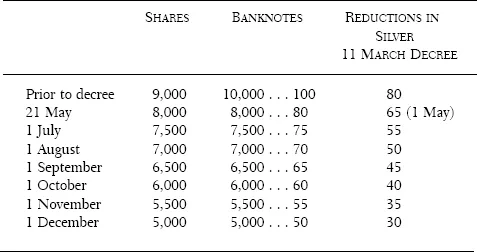
Source: Antoin Murphy, Richard Cantillon: Entrepreneur and Economist (Oxford: Clarendon Press, 1986), p. 148.
By this decree, Law was acknowledging that his decree of March 5th, guaranteeing the 9,000 livre price of the shares and at the same time stipulating that silver’s value would be diminished in phases, could not be sustained. Murphy explains in a footnote that:
Law argued that as silver was to be reduced from 80 to 30 it was illogical to hold that shares and banknotes should not be reduced also. ...In retrospective comments on the System he argued that he wanted to make such reductions in March but had been prevented from doing so by vested interest groupings.29
This comment adds credence to Louis Blanc’s view that the system was sacrificed for the benefit of political insiders. As quoted by Murphy, Law admitted to the public:
It was necessary to fix a just proportion betwixt the bank bills and the specie, therefore we were forced to deviate from the former proportion, without which, the actions and bank bills must unavoidably have lost their credit.30
As much as Law had hoped to drive specie out of circulation, by the use of both market incentives and heavy handed coercion, the French public could not be completely persuaded of Law’s view that paper money was better than gold and silver. The decrees of March, 1720 had but slight success in attracting specie to the Royal Bank. By May 21st, with the public holding 2.1 billion livres in banknotes and another 600 million livres at the bank or about to printed, the Royal Bank’s specie holdings amounted to only 21 million livres in silver and 28 million in gold.
For the investing public, Law’s decree of the 21st cast a cloud of doubt over what was supposed to be an infallible system. Now all of a sudden, shares were subject to diminution similar to specie. The public outcry forced Law’s friend, the Regent, to demote Law and place him under house arrest. The once revered Law, along with his system, was now despised, and on May 27th, the Regent attempted to stem the negative tide by revoking the May 21st decree. Two days later, he announced further an augmentation of specie along with rescinding the prohibition on the holding of gold and silver.
In spite of the system now being in shambles, Law was reappointed to a lesser position within the government, Intendant Général du Commerce, and was reaffirmed as director of the Royal Bank. Law attempted to keep the system afloat through the end of 1720, but the public did not fall for any more of Law’s financial razzle-dazzle. In table 6 Murphy shows the downward trend in Mississippi Company share prices from June through November of 1720.
Although share prices declined, they did so gradually, which is a departure from other bubbles, where asset prices typically break sharply. Murphy explains:
TABLE 6
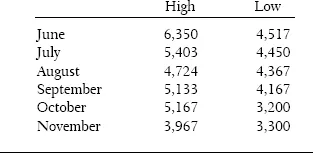
Source: Antoin Murphy, Richard Cantillon: Entrepreneur and Economist (Oxford: Clarendon Press, 1986), p. 151.
However, there is an explanation for the gradual collapse in the price of Mississippi shares, a phenomenon not mirrored by the collapse of the South Sea scheme where the fall in the price of shares was sharper and more sudden. In France large quantities of specie had been withdrawn from circulation, through Law’s measures and hoarding on the part of the more perspicacious public. Most wealth holders in France faced the classic Keynesian two-asset choice, that is money (banknotes) or bonds (shares of the Mississippi Company). The price of shares did not collapse because French investors were locked in to holding either shares or banknotes. At times the price of shares rose because investors felt marginally more confident about them than about holding banknotes.31
The way to truly gauge the affects of the excessive money creation by Law is to look at the French exchange rate, which sank from 20 pence sterling in May to 6 pence in September, and was so low it was not quoted for the last three months of 1720. It was the livres plunge against the pound sterling that is the manifestation of the bursting of the Mississippi Bubble. In table 7 Murphy juxtaposes this exchange rate relationship with Mississippi share prices in both livres and sterling for selected months in 1720.
TABLE 7
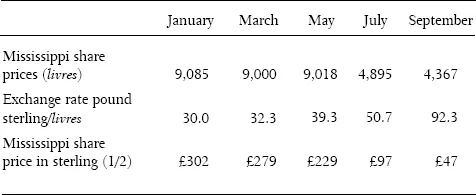
Source: Antoin Murphy, Richard Cantillon: Entrepreneur and Economist (Oxford: Clarendon Press, 1986), p. 152.
While the drama of this boom and subsequent bust was being played out, what was the effect upon the lives of the French working class? As is the case with all government created monetary schemes that expand the supply of money, money is not spread equally over the populace; certain groups gain access to the money, i.e., government, borrowers, and speculators, while other groups, such as, the working class, elderly, and savers are excluded.
Hamilton has developed index numbers to represent commodity prices, money wages, and real wages in Paris during the period of John Law’s system.32 The commodity price index is a composite of food, raw materials, wholesale building materials, and household staples. However, articles with “sticky” prices, such as bread and salt, were omitted. The money wage index is comprised of only daily wages of skilled and common labor, and excludes salaries. It is Hamilton’s intention that, “the present index numbers presumably do not underestimate the rise of prices and wages during the Mississippi Bubble.”
To gain a sense of the effects imposed upon the French populace from the tremendous increase in the supply of money, we shall juxtapose these indexes at selected months in the Mississippi Bubble story.
TABLE 8
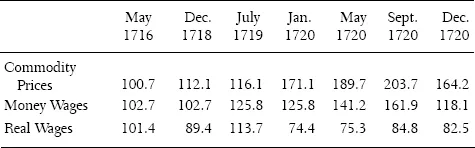
The selection of the above dates was not random, each date is significant:
May 1716 General Bank is chartered
Dec. 1718 General Bank becomes Royal Bank
July 1719 Royal Bank expands banknote issue by 221m
Jan. 1720 Company share price peaks at 10,100
Mar. 1720 Law’s diminution of silver
May 1720 Law’s diminution of banknotes and shares
Sep. 1720 Paris price index peaks
Dec. 1720 Law’s system falls apart
The above indexes illustrates the disparity between prices and wages. As prices continued to spiral upward, wages, although increasing a certain sporadic intervals, never kept pace with prices. Included in the above price index are building materials, which experienced the largest percentage increase of any of the goods included in Hamilton’s index for the year 1720. As is the case with many modern increases in the supply of money, construction activity in Paris was growing at a frantic pace, doubling the cost of building materials. The following year, after the bubble’s collapse, threequarters of this gain was lost.33
The boom and bust was not confined to Paris. Hamilton has compiled wage and price indices for three cities in southern France during the Mississippi Bubble period: Marseille, Toulouse, and Bordeaux.34 Hamilton summarizes his findings:
From June to October 1720 prices advanced 36 percent, at Bordeaux, 47.2 percent, at Toulouse, and 12.3 percent, at Marseille...
At their highest points, in October, prices at Bordeaux were twice as high, and at Toulouse 2.4 times as high, as the respective averages in 1716–1717. Owing to the catastrophic pestilence that ravaged Provence in the late spring and summer of 1720, the peak at Marseille, reached in September, was 2.7 times as high as in the base period. In their apogee, in September, commodity prices at Paris stood only 2.04 times as high as in 1716–17.35
Concerning wages, unfortunately, an acceptable wage series could not be found for Bordeaux, but Hamilton was able to secure financial records for Marseille delineating wages for seven different classes of labor, and wages for four different grades of labor in Toulouse. Wage rates in both cities fluctuated moderately between the years 1711 through 1718. As Law’s system began to take shape in earnest, in 1719, wages moved up sharply in the second quarter, but still lagged behind prices. As the system collapsed in the fourth quarter of 1720, real wages at Toulouse stood at 82.2, and 87.8 at Marseille, reflecting the same phenomenon as that in Paris. Wage increases were always a step behind commodity price increases. In the systems aftermath, wage-earners continued to be decimated in Toulouse, as the real wage index sank to 76.3 in the third quarter of 1721. This did not occur at Marseille, due to the plague’s decimation of the population, thus making labor scarce. Real wages began to rise in 1721 and continued through 1725.36
By all measures, John Law’s money machine was to spell disaster for the French working class, whether they lived in Paris or in the provinces. As Hamilton states, “Law’s System was a catastrophe to the labouring class.”37
As we recount the story of John Law’s Mississippi System and its eventual collapse, it is clear that Law was a man very much ahead of his time. He created a bank which in many ways could be considered the prototype of modern central banks. Through the vehicle of the Royal Bank, Law created paper money out of thin air and tried in vain to escape the confining clutches of gold and silver specie, a struggle that has been taken up by subsequent inflation mechanics from Benjamin Strong and Montagu Norman to Alan Greenspan. The following quote from Law sums up his view:
An abundance of money which would lower the interest rate to 2% would, in reducing the financing costs of the debts and public offices etc. relieve the King. It would lighten the burden of the indebted noble landowners. This latter group would be enriched because agricultural goods would be sold at higher prices. It would enrich traders who would then be able to borrow at a lower interest rate and give employment to the people.38
Law’s theories were virtually a blueprint for Keynesian economics, as Murphy says, “Keynes can be termed as post-Lawian!”39
Salerno quotes Rist’s critical summary of Law’s ideas:
Law’s writings... already contain all the ideas which constitute the equipment of currency cranks—fluctuations in the value of the precious metals as an obstacle to their use as a standard... the ease with which they can be replaced by paper money, money defined simply as an instrument of circulation (its function of serving as a store of value being ignored), and the conclusion drawn from this definition that any object can be used for such an instrument, the hoarding of money as an offence on the part of the citizens, the right of the government to take legal action against such an offence, and to take charge of the money reserves of individuals as they do of the main roads, the costliness of the precious metals compared with the cheapness of paper money.40
Given modern central bankers and their respective governments’ willingness, if not eagerness, to reach for the easy-money tonic to revive an ailing economy, it is no surprise that an overindebted Britain turned to John Law’s medicine in 1720. The manifestation of Britain’s financial chicanery is known as the South Sea Bubble, which had its origins with the founding of the Bank of England in 1694, an institution that Law sought to emulate with his Royal Bank.
Early Speculative Bubbles and Increases in the Supply of Money
Read the whole book online · Book details
This work is published under a Creative Commons licence. You may copy, share, and re-host it with attribution.