
Chapter 3 of 50 · Failure of the 'New Economics' by Henry Hazlitt
Chapter II POSTULATES OF KEYNESIAN ECONOMICS
1. What Is the Classical Theory of Employment?
Chapter 2 of the General Theory is called “The Postulates of the Classical Economics.”
Most treatises on the theory of Value and Production [Keynes begins] are primarily concerned with the distribution of a given volume of employed resources between different uses and with the conditions which... determine their relative rewards.... But the pure theory of what determines the actual employment of the available resources has seldom been examined in great detail (p. 4).
I doubt whether this factual statement can be supported. Many treatises before 1936 had explained in great detail how labor and other resources may come to be idle, and how goods already produced may long remain unsold, because of the rigidity or “stickiness” of some wages or prices, i.e., because of the refusal of unions or other sellers to accept the lowered market or “equilibrium” wage or price for the services or goods that they have to offer.
“The classical theory of employment—supposedly simple and obvious—has been based,” Keynes thinks, “on two fundamental postulates, though practically without discussion” (p. 5). The first of these is “I. The wage is equal to the marginal product of labor.” (His italics, p. 5.)
This postulate is correctly and clearly stated. It is not, of course, part of the classical theory of employment. That adjective should be reserved, in accordance with custom and in the interests of precision, for theory prior to the subjective-value or “marginalist” revolution of Jevons and Menger. But the postulate has become part of “orthodox” theory since its formulation by the “Austrian” school and, particularly in America, by John Bates Clark.
Having written this simple postulate, Keynes adds eight lines of “explanation” which are amazingly awkward and involved and do more to obfuscate than to clarify.
He then proceeds to state the second alleged “fundamental postulate” of “the classical theory of employment,” to wit: “II. The utility of the wage when a given volume of labor is employed is equal to the marginal disutility of that amount of employment.” (His italics, p. 5.) He adds, as part of his explanation: “Disutility must be here understood to cover every kind of reason which might lead a man, or a body of men, to withhold their labor rather than accept a wage which had to them a utility below a certain minimum” (p. 6).
“Disutility” is here so broadly defined as to be almost meaningless. It may be seriously doubted, in fact, whether this whole second “fundamental postulate,” as Keynes frames and explains it, is or ever was a necessary part of the “classical” or traditional theory of employment. Keynes does name and (later) quote A. C. Pigou as one whose theories rested on it. Yet it may be seriously questioned whether this “second postulate” is representative of any substantial body of thought, particularly in the complicated form that Keynes states it.
The “orthodox” marginal theory of wages and employment is simple. It is that wage-rates are determined by the marginal productivity of workers; that when employment is “full” wage-rates are equal to the marginal productivity of all those seeking work and able to work; but that there will be unemployment whenever wage-rates exceed this marginal productivity. Wage-rates may exceed this marginal productivity either through an increase in union demands or through a drop in this marginal productivity. (The latter may be caused either by less efficient work, or by a drop in the price of, or demand for, the products that workers are helping to produce.)
That is all there is to the theory in its broadest outlines. The “second postulate,” in the form stated by Keynes, is unnecessary and unilluminating.
Subject to certain qualifications, Keynes contends, “the volume of employed resources is duly determined, according to the classical theory, by the two postulates [which Keynes has named]. The first gives us the demand schedule for employment; the second gives us the supply schedule; and the amount of employment is fixed at the point where the utility of the marginal product balances the disutility of the marginal employment” (p. 6).
Is this indeed the “classical” theory of employment? The first postulate—that “the wage is equal to the marginal product of labor”—does not merely give us the “demand schedule” for labor; it tells us the point of intersection of both the “demand schedule” and the “supply schedule.” The demand schedule for workers is the wage-rate that employers are willing to offer for workers. The “supply schedule” of workers is fixed by the wage-rate that workers are willing to take. This is not determined, for the individual worker, by the “disutility” of the employment—at least not if “disutility” is used in its common-sense meaning. Many an individual unemployed worker would be more than willing to take a job at a rate below a given union scale if the union members would let him, or if the union leader would consent to reduce the scale.
But we can return to this subject later. After all, Keynes is not here stating his own theory; he is merely giving a garbled version of the orthodox theory.
Further, according to Keynes, “classical” theory allows only for two possibilities—“frictional” unemployment and “voluntary” unemployment. “The classical postulates do not admit of the possibility of the third category, which I shall define below as ‘involuntary’ unemployment” (p. 6).
Here is a classification that would trouble any logician. Unemployment must be either voluntary or involuntary. Surely these two categories exhaust the possibilities. There is no room for a third category. “Frictional” unemployment must be either voluntary or involuntary. In practice it is likely to be made up of a little of each. “Frictional” unemployment may be involuntary through illness, disability, failure of a firm, unexpected cessation of seasonal work, or discharge. “Frictional” unemployment may be voluntary because a family has moved to a new place, because a man has relinquished an old job in the hope of getting a better one, because he thinks he can get more pay than he is offered, or because he is taking a vacation between jobs. Such unemployment is the result of a decision, good or bad, on the part of the man who is unemployed. “Friction,” though a traditional term, is perhaps not the most fortunate metaphor to describe it.
One reason Keynes’s thought is so often difficult to follow, above all in the General Theory, is that he writes so badly (notwithstanding the dithyrambic admiration of the “lucidity,” “charm,” and “brilliance” of his style).1 And one reason he writes so badly (at least in the General Theory) is that he is constantly introducing technical terms that are not only unnecessary but inappropriate and misleading. Most of his worst terms are of his own coinage, but if someone else’s term is sufficiently bad he embraces it. Thus at this point he introduces the term “wage-goods industries,” describing it as “Professor Pigou’s convenient term for goods upon the price of which the utility of the money-wage depends” (p. 7). He then contrasts “wage-goods” with “non-wage-goods.”
This introduces a terminology that seems as needless as it is confusing. Do “wage-goods” mean anything essentially different from consumer goods? Do “non-wage-goods” mean anything essentially different from capital goods? No doubt “wage-goods” would not include mink coats or villas on the Riviera, but the common sense of the reader might be trusted not to introduce these items into an imaginary index of consumers’ goods prices. It hardly seems necessary to invent a special term to keep them out. This bad term is unfortunately continued throughout the General Theory. The reader is forced to translate it back each time into the familiar “consumers’ goods,” and to remind himself that it does not mean “goods the production of which requires the payment of wages.”
2. Wage-Rates and Unemployment
Section II of Chapter 2 is notable as the first attempt by Keynes in the General Theory to disprove a fundamental proposition of traditional economics—that the most frequent cause of unemployment is excessive wage-rates. This, of course, for “classical” economics, is merely the parallel of the proposition that the most frequent cause for an unsold surplus of a commodity is the refusal of sellers to accept a price that will clear the market. If the proposition is not true with regard to labor, it is not true with regard to commodities either. Both propositions rest upon the same line of reasoning. Both are special cases of a wider proposition covering both commodities and services.
It is instructive to notice that Keynes never challenges this proposition head-on, or by any coherent and clear-cut argument. He attacks it rather by a series of oblique sallies, in which the argument is usually involved and obscure and often clearly fallacious.
He begins by contending that “labor” is usually more interested in its “money-wage” than in its “real wage”:
Ordinary experience tells us, beyond doubt, that a situation where labor stipulates (within limits) for a money-wage rather than a real wage, so far from being a mere possibility, is the normal case. Whilst workers will usually resist a reduction of money-wages, it is not their practice to withdraw their labor whenever there is a rise in the price of wage-goods (p. 9).
So far as the United States is concerned (and, I suspect, so far as nearly every industrially advanced country is concerned), this contention is already obsolete. The big American unions all have their “economists” and “directors of research,” who are acutely aware of the monthly changes in the official Consumer Price Index. As of January, 1958, more than 4 million workers, moreover, mainly in the heavy industries—steel, automobiles, railroads—had insisted on, and secured, contracts providing for automatic wage increases with increases in the cost of living.2 So while it is true that unions will resist a fall in money wage-rates, even if it is less than the fall in consumer prices, it is not true that unions will acquiesce in stationary wage-rates when consumer prices are rising.
Even if Keynes’s contention, moreover, had been factually true, it would still have been irrelevant to the “classical” contention. The classical contention is that if wage-rates (whether considered in terms of money wage-rates or real wage-rates) are above the level of the marginal productivity of labor, there will be unemployment.
Why is Keynes so concerned to make this point about “labor’s” attitude toward money wage-rates and real wage-rates respectively? The collectivist word “labor” implies that we need not think in terms of what individual workers would wish or do, but only in terms of what union monopolists wish or do. He is concerned because he will be later eager to prove that while it is “impossible” to persuade unions to accept a cut in money wage-rates, it will be easy to deceive them into accepting a cut in real wage-rates by the simple process of monetary inflation—erosion of the purchasing power of the monetary unit. It will be noticed that even this argument, however, tacitly accepts the “classical” contention that the chief reason for unemployment is the existence of wage-rates above the point of labor’s marginal productivity.
Moreover, [Keynes goes on to maintain] the contention that the unemployment which characterizes a depression is due to a refusal by labor to accept a reduction of money-wages is not clearly supported by the facts. It is not very plausible to assert that unemployment in the United States in 1932 was due either to labor obstinately refusing to accept a reduction of money-wages or to its obstinately demanding a real wage beyond what the productivity of the economic machine was capable of furnishing (p. 9).
The reader will notice that there is no argument here, merely assertion. “It is not very plausible.” That is, it is not very plausible to Keynes, which proves nothing. Most of us require something more than ex cathedra pronouncements.
A trick that Keynes uses here and elsewhere is the attempt to discredit a doctrine by overstating it. The causes of the 1929 crisis, and of the depression from 1930 to 1940, were complex. I shall not try to go into all of them here. But I do not know of any serious economist who maintained or maintains that the initiating cause of the 1929 crisis was excessive wage-rates. What responsible economists did and do assert is that once the crisis had developed, and demand and prices had collapsed, it was necessary for wage-rates to adjust themselves to the reduced level of demand and of prices if mass unemployment was to be averted. It was the failure of this wage adjustment to occur that led to prolonged mass unemployment for ten years.
The insistence of unions on excessive2 wage-rates, it is true, may not always be a full explanation of total unemployment at any given time. But it is always part of the explanation. Though it is not always a sufficient cause, it cannot be dismissed also (as Keynes dismisses it) as a necessary cause. Rigidity or stickiness of contractual interest rates and rents, or unusual uncertainty or fear among buyers and consumers, may also be causes. But they are likely to be temporary causes. The longer mass unemployment is prolonged, the more warranted we are in assigning excessive wage-rates as the dominant cause of it.
Even Keynes feels the need of offering reasons why he finds the attribution of unemployment to excessive wage-rates “not very plausible.” But the reasons he offers are either fallacious or contrary to established fact. In explanation of the passage I have just quoted, he goes on:
Wide variations are experienced in the volume of employment without any apparent change either in the minimum real demands of labor or in its productivity. Labor is not more truculent in the depression than in the boom—far from it. Nor is its physical productivity less. These facts from experience are a prima facie ground for questioning the adequacy of the classical analysis (p. 9).
Are they? Keynes has here tumbled into a glaring fallacy. The absence of change in physical productivity is completely irrelevant to money wage-rates. What counts in economics is only value productivity—and value productivity stated in this case, of course, in monetary terms. If the marginal productivity of a worker is a given unit of a commodity that previously sold for $10, and the price of that unit has now fallen to $5, then the marginal value productivity of that worker, even though he is turning out the same number of units, has fallen by half. If we assume that this fall in prices has been general, and that this represents the average fall, then the worker who insists on retaining his old money wage-rate is in effect insisting on a 100 per cent increase in his real wage-rate.
Whether the worker is “truculent” or not is entirely beside the point. If prices fall by 50 per cent, and unions will accept a wage cut, but of no more than 25 per cent, then the unions are in effect demanding an increase in real wage-rates of 50 per cent. The only way they can get it, and retain full employment, is by an increase of 50 per cent in their physical (or “real” value) marginal productivity to make up for the drop in the price of the individual unit of the commodity they help to produce.
The passage I have just quoted is in itself prima facie ground for questioning the adequacy of the whole Keynesian analysis.
“It would be interesting to see the results of a statistical enquiry,” writes Keynes, “into the actual relationship between changes in money-wages and changes in real wages” (pp. 9-10). But without waiting for the results, he proceeds to tell the reader what they would be: “When money-wages are rising... it will be found that real wages are falling; and when money-wages are falling, real wages are rising” (p. 10). The second half of this statement is historically correct. The first half, in the modern world, is demonstrably not correct. The statistical results which Keynes expressed such an interest in seeing already existed, but he did not bother to look them up. Let us cite a few.
In the eighteen-year period between 1939 and 1957, weekly wages in manufacturing in the United States, according to the figures of the Department of Labor, rose from $23.86 in 1939 to $82.39 in 1957, an increase of 245 per cent. This compared with an increase in the official Consumer Price Index for the same period of only 102 per cent, making an increase in real weekly wages in the period of 71 per cent. The comparison is not very different if we take hourly wage-rates as the base of comparison instead of weekly wages. These rose from 63 cents an hour in 1939 to $2.07 in 1957, an increase of 229 per cent. In other words, when money-wages were rising in this period, real wages were also rising. Whatever historic foundation there may be for the traditional belief that in an inflation prices rise first and wages lag behind, the proposition has not been true for the United States, or for many other countries, in the last twenty years.
The second half of Keynes’s proposition, that “when money-wages are falling, real wages are rising” is, however, generally true. It is not easy to find in American statistical history extensive periods when money-wages were falling, but two such periods do exist in recent times—between 1920 and 1922, and between 1929 and 1933. I append a comparison for a selected series of years taken from a table published by the government3 comparing average hourly earnings of workers in manufacturing industries in “current prices,” i.e., in terms of the actual money wage-rates paid, and in “1954 prices,” i.e., in terms of “real” wage-rates, or money wage-rates expressed in terms of a dollar of assumed constant purchasing power:
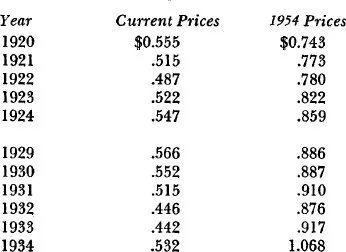
Let us look first at the period from 1920 to 1924. Between 1920 and 1922 there was a substantial drop in money wage-rates; yet they did not drop as much as consumer prices, and therefore real wage-rates, or wage-rates in “constant dollars,” actually increased between 1920 and 1922. Beginning in 1923, money wage-rates started up again; but real wages also rose, once more refuting Keynes’s proposition that “when money-wages are rising... it will be found that real wages are falling.”
Take, now, the period between 1929 and 1934. From 1929 to 1933 money wage-rates fell; but real wage-rates rose. There was a sole exception between the years 1931 and 1932; but it did not change the comparative trend over the whole period. Between 1933 and 1934, however, there was a dramatic jump both in money wage-rates and in real wage-rates, once more contradicting Keynes’s “law.”
It is only fair to point out that this jump in both money and real wage-rates in 1934 was the direct result of governmental intervention—the National Recovery Administration codes put into effect under government pressure in the first years of the New Deal. But it is precisely this jump in both money and real wage-rates that helps to explain the continuance of mass unemployment throughout the Thirties. This again is a statistical disproof of Keynes’s central thesis that unemployment has nothing to do with the height of wage-rates—or even that unemployment is rather owing to wage-rates being too low than to their being too high. From 1931 through 1939 both money wage-rates and real wage-rates rose. Money wage-rates rose from 51 cents an hour in 1931 to 63 cents in 1939. In constant (1954) prices, real wage-rates rose from 91 in 1931 to 122 in 1939. What was the result? In that ten-year period there was an average annual unemployment of 10 million men and women.
Before we proceed further with a direct consideration of Keynes’s argument on this point, it may be more profitable to digress a moment to consider the kind of argument, and particularly the set of assumptions, with which we have to deal. It is pertinent here to make three observations:
1. When Keynes writes about “classical theory” or “traditional theory,” it almost invariably turns out that what he is discussing is neither of these, strictly speaking, but some caricature, or the specific theories of the “Cambridge school” (consisting mainly of Marshall, Edgeworth, and Pigou) in which he was brought up.
2. This school never quite rid itself of a cost-of-production theory of prices, and neither did Keynes.
3. Keynes is even inferior to the Cambridge economists he criticizes in his addiction to lump thinking, in-block thinking.
Once we recognize the existence of these assumptions in Keynes’s thinking we can economize our detailed criticism. We can ignore many of his criticisms of the theories of Marshall and Pigou, for example, because those theories had already been superseded by the best economic thought long prior to the appearance of the General Theory. And we need not waste too much time over Keynes’s criticisms when we find that these themselves rest on crude lump thinking. Keynes writes on page 11, for example: “The traditional theory maintains, in short, that the wage bargains between the entrepreneurs and the workers determine the real wage.” (His italics.) Now there is no such thing as “the” real wage. Neither is there any such thing as “the general level of money-wages” (pp. 10, 12, 13, etc.). “The” wage, real or money, is a figment of the bad economist’s imagination. It is a violent oversimplification that assumes away the thousands of differences in individual wages and salaries that make up reality.
In the same way, “the general level of wages,” like “the general level of prices” (both of which concepts are central to Keynes’s thought), has no existence in reality. It is a statistician’s construct, a mathematical average which has a limited value in simplifying certain problems. But it simplifies away some of the chief dynamic problems in economics. The same relationship between an average of prices and an average of wages in two different periods may conceal gross changes in the relationship of specific prices to specific wages. It is precisely the latter that may be relevant to equilibrium or the lack of it, to the health of specific industries, to full employment or to substantial unemployment.
The word “level” can give rise to an additional false assumption—that prices and wages rise or fall evenly or uniformly. It is precisely their failure to do so that creates most of the problems of inflation or deflation. It is also the failure of specific prices or wages to rise or fall as much as the average that permits the continuous structural changes in production and in the labor force necessary for continuous economic efficiency and progress.
Keynes writes on page 13:
There may be no method available to labor as a whole whereby it can bring the wage-goods equivalent of the general level of money-wages into conformity with the marginal disutility of the current volume of employment. There may exist no expedient by which labor as a whole can reduce its real wage to a given figure by making revised money bargains with the entrepreneurs. This will be our contention.
I shall not attempt here to analyze thoroughly this highly implausible contention. It is enough to point out, for the moment, that “labor” does not act or do anything else “as a whole,” any more than “business” does. “Labor” certainly doesn’t set “its” wage-rate. There are thousands of different wage-rates being set every working day, sometimes industry by industry, more often company by company, or union by union, and most often individual by individual. Even an industry-wide union sets, not a single uniform rate, but a complicated scale of rates, fixed by “classifications.”
The whole dilemma that Keynes presents, as we shall later see, exists not in the real world of economics, but in his own confused method of thinking.
3. No “General Level” of Wage-rates
Section III of Keynes’s Chapter 2 is less than a page and a half in length, and yet it is so packed with fallacies and misstatements of fact, and these fallacies and misstatements are so crucial to Keynes’s whole theory, that it requires more than a page and a half of analysis.
Keynes’s argument in this section rests on three major confusions:
1. The word “wages” is sometimes used in the sense of wage-rates and sometimes in the sense of wage income or total payrolls. There is no warning to the reader as to when the meaning shifts, and Keynes himself is apparently unaware of it. This confusion runs through the General Theory, and gives birth to a host of sub-confusions and sub-fallacies.
2. “Labor” is treated in a Marxian manner as a lumped total, with a lumped interest opposed to an equally lumped interest of entrepreneurs. This kind of treatment overlooks both the frequent conflict of interest between different groups of workers and the frequent identity of interest between workers and entrepreneurs in the same industry or firm.
3. Keynes is constantly confusing the real interest of workers with their illusions regarding their interests.
Take this strange sentence from page 14: “Any individual or group of individuals, who consent to a reduction of money-wages relatively to others, will suffer a relative reduction in real wages, which is a sufficient justification for them to resist it.” (His italics.)
To see how bad this argument is, let us try to apply it to commodities. We would then have to say, for instance, that if wheat fell in price relatively to corn, the wheat farmers would be “justified” in combining to refuse to accept the lower price. If they did so, of course, they would simply leave part of their wheat unsold on the market. The result of this would be to hurt both wheat farmers and wheat consumers.
In a free, fluid, workable economy relative changes in prices are taking place every day. There are as many “gainers” as “losers” by the process. If the “losers” refused to accept the situation, and kept their prices frozen (or raised them as much as “the general level” had risen), the result would merely be to freeze the economy, restrict consumption, and lower production, particularly of the goods that otherwise have fallen relatively in price. This is precisely what happens in the labor field when the members of a single union refuse to accept a “relative” reduction of real wage-rates. By refusing to accept it they do not, in fact, improve their position. They merely bring about unemployment, particularly in their own ranks, and hurt their own interests as well as those of the entrepreneurs who employ them.
Keynes remained blind to the most glaring fact in real economic life—that prices and wages never (except perhaps in a totalitarian state) change uniformly or as a unit, but always “relatively.” It is individual prices and individual wages that go up or down, and adjust to each other in accordance with hourly changes in relative supply and relative demand.
After a given calendar year or month has closed, along comes a statistician and figures out a new average. If he is a bad statistician, he tells us that there has been such-and-such a change in the average “level” of prices or wages. Then bad economists build false theories on this misleading terminology. They reify this alleged “level.” Their next step is to announce that if the wages or prices in a free economy do not act in this completely uniform or lump way, there must be outrageous injustice going on, and that there is “sufficient justification” for any group of workers to resist a relative reduction in real wage-rates, even though, by resisting it, they merely create unemployment in their own ranks. This is adding pseudo-ethics to pseudo-economics. It is like telling a man that he is justified in cutting off his nose to spite his face.
“It would be impracticable,” Keynes continues, for any group of workers “to resist every reduction of real wages, due to a change in the purchasing power of money which affects all workers alike; and in fact reductions of real wages arising in this way are not, as a rule, resisted unless they proceed to an extreme degree” (p. 14). The second part of this statement, as we have already seen, is contrary to the facts of the modern world. Unions now insist on escalator contracts or wage boosts to offset changes as small as 1 per cent in the cost-of-living index.
Nor is it ever true that “a change in the purchasing power of money... affects all workers alike.” Such a change in purchasing power is always accompanied, and partly caused by, increases in some wage-rates. Keynes’s fallacy here arises once more from the crude supposition that “the price level” as a whole goes up in an inflation while “the wage level” as a whole stays where it is. Statistical averages may sometimes make this seem to happen, but this is precisely because mere averages hide the real diversity and dispersions of the economic process.
Keynes is constantly falling into this fallacy of averages or aggregates. His “aggregate” or “macro-economics” is not a step in advance; it is a retrograde step which conceals real relationships and real causation and leads him to erect an elaborate structure of fictitious relationships and fictitious causation.
The effect of combination on the part of a group of workers [Keynes goes on] is to protect their relative real wage. The general level of real wages depends on the other forces of the economic system.
Thus it is fortunate that the workers, though unconsciously, are instinctively more reasonable economists than the classical school, inasmuch as they resist reductions of money-wages, which are seldom or never of an all-around character... whereas they do not resist reductions of real wages.... (His italics, p. 14.)
Notice, first of all, the semantics of the word “protect.” The purpose and effect of unions, of course, is to increase the relative wage-rates of the union members as compared with other workers. The “general level” of real wages is merely the composite average of individual wage-rates. It does not depend “on the other forces of the economic system.” It depends on the calculations of statisticians. Of course any debasement of the monetary unit through inflation causes a rise in the average of wages and prices. But this occurs, in actuality, through a different (though sometimes only slightly different) percentage rise in the price of each individual commodity or each individual wage-rate. The exchange ratio of wheat and corn is determined by the value both of a bushel of wheat and of a bushel of corn, and never merely by the value of one of them. A monetary price or wage-rate is determined both by the exchange value of the monetary unit and the exchange value of a unit of a commodity or service, and not merely by the value of the monetary unit alone.
Finally, the ironical remark about workers being “more reasonable economists than the classical school” is based on a misconception both of how wages change and how “classical” economists think. No reductions of wages, except those that might be imposed by an authoritarian government, are ever “of an all-round character.” If the economy is free, individual wage-rates vary as much as individual prices, and there is great dispersion both when they go up and when they go down. (See charts on pp. 284 and 285.)
4. “Non-Euclidean” Economics
Sections IV and V of Keynes’s Chapter 2 are outstanding even in the General Theory for the involution and obscurity of their style, and for Keynes’s remarkable propensity for stating everything backwards. He begins by telling us that “classical theory” does not admit even the possibility of “involuntary” employment in the strict sense. Whether this is true or not depends upon the definition we give to “involuntary,” and also upon whether we interpret the word in relation to the plight of an individual worker or in relation to unions that insist on a given scale of wage-rates and see to it by their methods of intimidation not only that none of their own members, but nobody else, accepts employment below that wage-rate.
But here is Keynes’s own definition of “involuntary unemployment”:
Men are involuntarily unemployed if, in the event of a small rise in the price of wage-goods relatively to the money-wage, both the aggregate supply of labor willing to work for the current money-wage and the aggregate demand for it at that wage would be greater than the existing volume of employment. (His italics, p. 15.)
It would be hard to imagine a definition more wordy, involved or obfusc. I have read it an indefinite number of times, and as nearly as I can make out it means simply this: Men are involuntarily unemployed if an increase in prices relatively to wage-rates would lead to more employment.
As soon as we translate Keynes’s statement into plainer English, its falsity becomes evident. Keynes’s statement overlooks the fact that such an increase of employment could have been brought about equally well by a lowering of money wage-rates, with commodity prices remaining the same. To recognize this possibility, however, would have been to recognize that the unemployment was not in fact involuntary. Keynes tries to dismiss the possibility by pretending, on quite unconvincing grounds, that there would have to be a uniform and simultaneous reduction of wages throughout the entire economic system to make this result possible. But as I have already pointed out, wages never do go up or down uniformly or simultaneously. (See again the charts on pp. 284 and 285.)
We shall not now spend further time over Sections IV and V, though they are full of further involved and implausible propositions. Keynes advises us that: “The Theory of Wages in relation to employment, to which we are here leading up, cannot be full elucidated, however, until Chapter 19 and its appendix have been reached” (p. 18). We, too, can wait for that chapter before we make any further analysis of Keynes’s theory on this point.
Before leaving these sections, however, it is worth taking note of an extravagantly pretentious claim that has apparently taken in some of Keynes’s more fervent disciples.
The classical theorists [he writes] resemble Euclidean geometers in a non-Euclidean world who, discovering that in experience straight lines apparently parallel often meet, rebuke the lines for not keeping straight.... Yet, in truth, there is no remedy except to throw over the axiom of parallels and to work out a non-Euclidean geometry. Something similar is required today in economics (p. 16).
If we are to talk in these pretentious terms, I should like to suggest that the real economic world in which we live is, after all, pretty “Euclidean,” and that we had better stick to sound “Euclidean” economics in describing it. It is precisely Keynes, as we shall find, who starts rebuking the real economic world for not acting according to his theories—as when he contends, for example, against all experience under free economies, that wage-rates “ought” to go up or down or adjust themselves to “the price level” uniformly and simultaneously or not at all.
1 There are only a few oases of lucidity and eloquence in a vast Sahara of obscurity. This bad writing has been commented upon both by admirers like Paul A. Samuelson (already cited) and by less sympathetic critics like Jacob Viner and Frank H. Knight. Knight refers several times to “the hard labor involved” in reading the book. “Familiar terms and modes of expression seem to be shunned on principle.” “My difficulty (and no little annoyance) has been that of choosing between interpretations, one apparently nonsensical and the other more or less commonplace.” The Canadian Journal of Economics and Political Science, February, 1937, pp. 123, 108, and 122.
2 Monthly Labor Review, U. S. Department of Labor, Dec, 1957.
2 Whenever I speak of “excessive” wage-rates I refer, of course, merely to wage-rates that exceed the marginal productivity of labor. The term “excessive” must not be taken to imply moral disapprobation of such wage-rates. But it does imply that, whenever such wage-rates exist, there will be unemployment and a failure of the whole body of workers to receive the maximum total wage-income that conditions otherwise make possible.
31955 Historical and Descriptive Supplement to Economic Indicators. Prepared for the Joint Committee on the Economic Report by the Committee Staff and the Office of Statistical Standards, Bureau of the Budget, p. 29.
Failure of the 'New Economics'
Read the whole book online · Book details
Free to read online and to download from this archive.