
Chapter 20 of 50 · Failure of the 'New Economics' by Henry Hazlitt
Chapter XIX UNEMPLOYMENT AND WAGE-RATES
1. Unemployment is Caused by Excessive Wage-Rates
If I were put to it to name the most confused and fantastic chapter in the whole of the General Theory, the choice would be difficult. But I doubt that anyone could successfully challenge me if I named Chapter 19, on “Changes in Money-Wages.”
Its badness is after all not surprising. For it is here that Keynes sets out to challenge and deny what has become in the last two centuries the most strongly established principle in economics—to wit, that if the price of any commodity or service is kept too high (i.e., above the point of equilibrium) some of that commodity or service will remain unsold. This is true of eggs, cheese, cotton, Cadillacs, or labor. When wage-rates are too high there will be unemployment. Reducing the myriad wage-rates to their respective equilibrium points may not in itself be a sufficient step to the restoration of full employment (for there are other possible disequilibriums to be considered), but it is an absolutely necessary step.
This is the elementary and inescapable truth that Keynes, with an incredible display of sophistry, irrelevance, and complicated obfuscation, tries to refute.
He begins, as is his habit, by affecting to state the “classical theory” of the matter; and, as is also his habit, he misstates it. Then he discovers this theory to be question-begging and “fallacious.” Next he applies his “own method of analysis.”
I spare the reader the quotation, but if he is interested in reading an argument that outdoes Humpty-Dumpty’s best efforts in Alice in Wonderland or the complicated and bewildering chain of causation of a Rube Goldberg cartoon, I direct his attention to the long paragraph beginning at the top of page 261 and ending at the top of page 262. Instead of trying to unsnarl this Gordian knot one loop at a time, and calling attention to each fallacy and irrelevance, which would only take us over ground we have already covered, we shall economize time by by-passing it for the moment, as well as the whole chapter and most of its appendix, and by quoting a couple of paragraphs from the last two pages of the appendix in which Keynes contrasts his own views with those of A. C. Pigou:
The difference in the conclusions to which the above differences in assumptions and in analysis lead can be shown by the following important passage in which Professor Pigou sums up his point of view: “With perfectly free competition among workpeople and labor perfectly mobile, the nature of the relation (i.e. between the real wage-rates for which people stipulate and the demand function for labor) will be very simple. There will always be at work a strong tendency for wage-rates to be so related to demand that everybody is employed. Hence, in stable conditions everyone will actually be employed. The implication is that such unemployment as exists at any time is due wholly to the fact that changes in demand conditions are continually taking place and that factional resistances prevent the appropriate wage adjustments from being made instantaneously.” 1
He concludes (op. cit., p. 253) that unemployment is primarily due to a wage policy which fails to adjust itself sufficiently to changes in the real demand function for labor.
Thus Professor Pigou believes that in the long run unemployment can be cured by wage adjustments; whereas I maintain that the real wage (subject only to a minimum set by the marginal disutility of employment) is not primarily determined by “wage adjustments” (though these may have repercussions) but by the other forces of the system, some of which in particular the relation between the schedule of the marginal efficiency of capital and the rate of interest) Professor Pigou has failed, if I am right, to include in his formal scheme (pp. 277-278).
There is a double advantage in starting our discussion of Chapter 19 with this quotation. (1) Instead of giving us Keynes’s misstatement, which would first have to be corrected, of the “classical theory” of the relation of wage-rates to unemployment, it at least gives us Pigou’s statement of the “classical” view in his own words; and (2) it contains the most compact and lucid statement that Keynes gives of his own views on the subject.
Pigou’s statement is the correct one. Keynes’s view is clearly incorrect, though it does contain one grain of truth in a bushel of errors. This grain of truth, it may be added, is not original with Keynes.
Let us begin by seeing what qualifications are necessary in the Pigou statement.2
When Pigou speaks of “everybody” or “everyone” being employed, the word “everybody” must clearly be interpreted in a restricted sense. He cannot be speaking of those who do not need or do not want to work, or of children, or of the physically handicapped, or of criminals or lunatics, or those who are so incompetent, stupid, reckless, or slovenly that they destroy more value than they produce, so that an employer would be out of pocket even if he could hire them for nothing. By “everybody” he must mean employable persons who actually wish to work, and it would probably be better if he had used this phrase.
Again, when Pigou declares that “in stable conditions everyone will actually be employed” he must have meant to say in equilibrium conditions. It is not stability but the speed and precision of wage adjustments that Pigou is really emphasizing. Relatively “stable” unemployment is possible with a “stable” or frozen disequilibrium, as was shown both in Britain and the United States in the period between 1925 and 1939. (Keynes capitalized on this, as we have seen, by giving it the self-contradictory name of “unemployment equilibrium.”) The equilibrium that we should keep in mind need not be “stable” in the sense of static. That is to say, it need not refer merely to the kind of equilibrium postulated in a “stationary” or evenly rotating economy. It can refer to a dynamic equilibrium postulated as being achieved by instantaneous and precise adjustments to changing conditions, or constantly being approached in practice in a free competitive economy.
Finally, while maladjustments in wage-rates are usually the principal reason for unemployment, and can be the sole reason, other maladjustments can also cause unemployment, including maladjustments among particular prices and (here is the one germ of Keynesian truth) even (though improbably) maladjustments in interest rates.
Suppose now, for the sake of clarity, we rephrase Pigou’s summary in a more satisfactory form, retaining his own phrasing wherever that is acceptable: With perfectly free competition among workpeople and labor perfectly mobile, there will always be at work a strong tendency for wage-rates to be so related to demand that all employable persons who desire jobs are employed. Hence, in conditions of equilibrium all such persons will actually be employed. The implication is that such unemployment as exists at any time is due wholly to the fact that changes in demand conditions are continually taking place and that frictional resistances prevent the appropriate wage, price, and other (even interest-rate) adjustments from being made instantaneously.
Now if Keynes had been content to make merely these revisions, if he had been content merely to deny, in his quotation from Pigou, the implication that wage adjustments are the sole adjustments needed to retain or restore full employment, his objection would have been correct even if not original. But Pigou’s position as summarized by Keynes, that most often “unemployment is primarily due to a wage policy which fails to adjust itself sufficiently to changes in the real demand function for labor” (my italics, p. 278) is correct. Keynes explicitly denies even this. Keynes is definitely wrong, in short, when he maintains “that the real wage... is not primarily determined by ‘wage adjustments’... but by the other forces of the system.” (My italics, p. 278.) These other “forces,” it is true, even maladjustments in the interest rate, must be taken into account whenever there is heavy unemployment. But they are usually secondary to the unemployment caused by maladjustments in wage rates.
2. Wage-Rates Are Not Wage Income
With this correct positive doctrine in mind, it may be worth while to examine some of the major fallacies which led Keynes to his false conclusions.
Perhaps the first and most important of these fallacies is Keynes’s habitual confusion between hourly wage-rates and total wage payments. In common with, I fear, most writers on economics, he uses the loose word “wages” sometimes to mean wage-rates and sometimes to mean total payrolls, or total wage income. The reader is seldom sure in which of these two radically different senses Keynes is using the word; and Keynes seldom seems to be sure himself. I do not mean to imply that he always falls into this confusion. Sometimes the distinction is clear enough in his mind and explicit in the examples that he cites. The confusion is none the less frequent enough to account for many of the otherwise inexplicable conclusions in the General Theory.
This confusion is one of the prices that writers on economics pay for trying to use simple, popular language. It never occurs when they are discussing the prices of commodities. It would not occur to even a moderately competent economist to assume that if an entrepreneur raised the price of his product 20 per cent, his gross income would increase 20 per cent. If an individual entrepreneur, engaged in the production of a homogeneous competitive product, such as copper, were arbitrarily to raise his price 20 per cent above that of his competitors, his gross income, instead of increasing 20 per cent, would probably disappear entirely. None of his product would be sold. And even if the entrepreneur were a monopolist, or if all the entrepreneurs in the same industry uniformly raised their prices by 20 per cent, even the man in the street knows that (assuming no other change in the supply or demand “curve”) there would be a decline in the volume of sales. The gross income of the individual entrepreneur would not increase in proportion to the price rise; it might even fall below its previous level. In short, as far as commodities are concerned, there is no confusion in the popular mind between prices, volume of sales, and gross income. But in writing on labor, even many professional economists constantly confuse “prices” with total income because they call both by the same name— “wages.” 3
Many economists (and this partly derives from Keynes) put forward a curious argument in attempting to justify their double standard, or double set of economic principles, in the discussion of prices and wages respectively. They tell us, without a smile, that “wages” cannot be treated like other costs or other prices, because “wages” are the workers’ income, and if we cut this income we are not only being cruel and inhuman, but we correspondingly reduce “purchasing power” and send the economy into a downward spiral.
Now whatever is true in this statement is true not only of “wages” but of all costs and all prices. Everybody’s (monetary) cost is somebody else’s income. The price of finished steel is a motor-car manufacturer’s cost but (multiplied by tonnage) the steelmaker’s income. The price of iron ore or scrap steel is the finished steelmaker’s cost but the iron mine’s or scrapdealer’s income. But if wage-rates or steel prices or scrap prices are too high in relation to other prices, or to supply or demand, an increase in such wage-rates or prices will not lead to a corresponding increase in the total income of workers, or of steelmakers, or of scrap-dealers; and it may easily lead to a decrease in that total income, through unemployment or a decline in sales more than proportionate to the increase in price.
It is not merely a fallacy, therefore, but a sham humanitarianism, and a cruel deception, always to insist on wage-rate increases whether or not conditions justify them, and always to resist wage-rate reductions whether or not conditions require them.
3. “Elasticity” of Demand for Labor
A second fallacy of Keynes’s is that, even when he does explicitly distinguish between wage-rates and total wage income, he raises the question whether the demand for labor is really “elastic” or not, or whether its “elasticity” can be greater than “unity.” Now Paul Douglas and A. C. Pigou, as I have already pointed out in another connection, had independently, before the appearance of the General Theory, attempted a statistical answer to this question, and had come with surprising agreement to the conclusion that the elasticity of the demand for labor is about —3. This means that a 1 per cent reduction in wages can mean a 3 per cent increase in employment, if wages have previously been above the marginal productivity of labor, or, conversely, that a 1 per cent increase in wages can mean a 3 per cent reduction in employment if wages are above the marginal productivity of labor.
I have already pointed out that it is not possible to measure the “elasticity” of the demand for labor (or for anything else) statistically or mathematically. “Elasticity” of demand is merely a misleading and unfortunate name for responsiveness of demand. It is obviously impossible to know in advance precisely how the demand for any commodity or service will respond to a change in its price. There are too many factors in the situation, and these factors can never be assumed to be precisely the same for two successive months or minutes.
The concept of a measureable “elasticity” of demand (or of a predictable responsiveness of demand) is based on the tacit assumption that when the price of a commodity or service changes, or is changed, the demand “curve” remains exactly where it was. It can never, of course, be known whether this is in fact true. A price may have gone up because the demand curve itself has gone up—in which case there may be no decrease in the amount demanded. There may even be an increase in the amount demanded. Or a price may have gone down because the demand curve itself has gone down—in which case there may be no increase in the amount demanded, and there may even be a decrease in the amount demanded.
Now as the very existence of a demand “curve” (or demand “schedule”) is purely hypothetical, as the “slope” or “shape” of this curve can never be in fact known, and as it can never be known precisely how much it has risen or fallen (or, in the fashionable technical jargon, “moved to the right” or “to the left”), it follows that the “elasticity” of demand for any commodity or service can never be determined by comparing changes in the amount sold with changes in price. For these changes have occurred between two or more periods or moments of time, and we can have no assurance whatever that the demand “curve” has itself remained the same between those periods or moments of time. The demand “curve” may meanwhile have “shifted” from one position to another, or changed its “shape,” or we may be on a different “section” of it.
There are still other dangers in the application of the elasticity-of-demand concept to labor. We cannot legitimately speak, for example, of “the” elasticity of the demand for labor, for this will vary with every different kind of labor, almost with every firm, and with every different set of conditions. The responsiveness of employment of all building workers collectively to changes in wage-rates, for example, may be very high, whereas the responsiveness of employment of electrical installation workers alone to changes in their wage-rates may be very low, because the demand for electricians is a joint demand with that for other building workers. To speak of “the” elasticity of the demand for “labor,” therefore, may be to speak of an almost meaningless average.
If its dangers and limitations are kept constantly in mind, however, the “elasticity” of demand (or better, the responsiveness of demand) can be a useful tool of thought. The statistical investigations of Douglas and Pigou seem to raise at least a presumption in favor of a (usually) high responsiveness of employment to changes in wage-rates.
In any case, there is the strongest possible presumption in favor of letting free competitive market forces decide the question. When unemployment exists, it exists because there is disequilibrium somewhere. The most likely place is in the wage-rates of the occupations in which the unemployment exists. This presumption is enormously increased when such wage-rates are arbitrarily held at their existing level by labor-union insistence, which prevents free competitive market forces from operating in those occupations. And this presumption must hold either until free competition (for jobs and for workers) is restored in those occupations or until the unions concerned have consented to a provisional reduction in wage-rates to see whether such a reduction is followed by an increase in employment.
Of course unemployment could be caused in one occupation by an excessive wage-rate in another. (For example, some construction workers could be unemployed because wages [and prices] in the steel industry were too high.) It is even theoretically conceivable (to make every concession to Keynes) that the disequilibrium causing unemployment might be in some relationship among prices or even in interest rates. But this is highly improbable unless such inappropriate prices are monopolistically controlled, or unless interest rates have been made excessive as a result of governmental monetary mismanagement.
Another type of error that runs through Keynes’s Chapter 19 is his consistent failure to state all the relevant assumptions in the hypothetical illustrations that he sets up, and then to come to a conclusion that could only be warranted on the basis of an assumption (and often a self-contradictory one) that he has failed to state. When we are dealing with unemployment, for example, we must assume that there is a reason for the unemployment. The most probable reason is that wage-rates are too high—i.e. that they are above the point of equilibrium. This may not be so; but it is certainly one of the hypotheses, if not the first hypothesis, that ought to be considered. Keynes never considers it. His examples tacitly assume that wage-rates are already at, or even below, the point of equilibrium. Only on that assumption could he reach the conclusion, as he does, that a reduction of wage-rates would mean a reduction of wage income, either by not increasing employment in the least, or by actually reducing it further. Of course if wage-rates are already at, or below, the point of equilibrium, it would be an act not only of injustice but of sheer folly to reduce them further. But if, as it is enormously more plausible to assume, there is unemployment because wages are above the point of equilibrium, then reduction of wage-rates to the point of equilibrium would both restore full employment and increase payrolls and the total income of the community.
4. Fallacies of “Aggregative” Economics
At the very beginning of Chapter 19 Keynes professes to find a great invalid assumption at the heart of the “classical theory” that a decline in wage-rates (that have been above the equilibrium point) will restore employment. He states the “classical” argument of how this will happen in a particular “industry.” (He wrongly states it by giving only a special case, not the general theory.) Then he pauses. The classical theory, he says, has no way of extending its conclusions “in respect of a particular industry to industry as a whole” except by a false “analogy” (p. 260). Therefore “it is wholly unable to answer the question what effect on employment a reduction in money-wages will have” (p. 260).
Where’s the catch? Keynes explains:
The demand schedules for particular industries can only be constructed on some fixed assumption as to the nature of the demand and supply schedules of other industries and as to the amount of the aggregate effective demand. It is invalid, therefore, to transfer the argument to industry as a whole unless we also transfer our assumption that the aggregate effective demand is fixed. Yet this assumption reduces the argument to an ignoratio elenchi. For, whilst no one would wish to deny the proposition that a reduction in money-wages accompanied by the same aggregate effective demand as before will be associated with an increase in employment, the precise question at issue is whether the reduction in money-wages will or will not be accompanied by the same aggregate effective demand as before measured in money, or, at any rate, by an aggregate effective demand which is not reduced in full proportion to the reduction in money-wages (i.e. which is somewhat greater measured in wage-units). (Keynes’s italics, pp. 259-260.)
Now the only reason this tangled argument is worth noticing at all is that such a tremendous to-do has been made about it by the Keynesians, many of whom, indeed, think that this is the great flaw that Keynes has found in “classical” economics, and the great contribution that he has made to economics. “Aggregate” or “aggregative” economics, they tell us, has displaced “special” or “partial” economics, or “the economics of the firm.” The “macroscopic” view has displaced the “microscopic” view.
Keynes’s whole argument on this point is so confused that the chief difficulty in answering it is the difficulty of discovering just what the argument is.
Let us begin by looking again at the Keynesian term “effective demand.” We have seen that there is no need for the adjective. It implies that there are two kinds of demand—“effective” and ineffective. Ineffective demand could then only mean desire unaccompanied by monetary purchasing power. But economists have never called this demand. The term “demand” as used by economists has always meant effective demand, and nothing else. Inserting the adjective, then, adds nothing but confusion.4
How, then, about the term “aggregate demand”? Aggregate demand may be thought of in two senses—in terms of commodities or in terms of money. Abstracting from money, the aggregate demand for commodities is ultimately the aggregate supply of commodities. The supply of one commodity is the demand for another, and vice versa. We are back to “Say’s Law.” And Say’s Law is always true (in fact it is a truism) when we assume prices and production to be in equilibrium. Under such conditions, aggregate demand follows from aggregate supply. But Keynes and the Keynesians reject aggregative economics in the one sense in which it is both true and useful.
If the aggregate demand is thought of in terms of money, then it tends to change only with the supply of money.
If it is invalid, as Keynes contends, to argue from what happens in a particular “industry” to industry as a whole, then it is no less invalid to argue from what happens in a particular firm to what happens in a whole “industry.” 5 But, as a matter of fact, the invalidity exists only in Keynes’s mind and is a result of the confusion in his own thinking.
Let us begin with a single “industry” and see what happens. There are two main cases to be considered. The first is that in a “closed” domestic industry in which prices are too high because wage-rates are too high, and therefore the market is contracted and there is unemployment. Suppose wage-rates are reduced enough to allow prices to be reduced enough to restore the market and restore full employment in that industry. There is then both more employment in that industry and more production; therefore more total wages and more gross income; therefore more purchasing power for the goods of other industries. So restoring employment in that industry through cutting wage-rates (i.e., cutting them just enough to make the re-employment possible) has not merely left “aggregate effective demand” where it was; it has increased it by raising the “effective” demand of the workers and entrepreneurs in the industry involved while doing nothing whatever to reduce the effective demand of the workers and entrepreneurs in other industries.
Let us call this Industry A. Suppose, now, that the same thing happens in Industry B. Then the increase in the effective demand of Industry B for the products of all other industries, including A, must add still further to the aggregate effective demand. And so, also, if we go on to consider Industries C, D, E... N. Keynes has simply raised a pseudo-problem.
The other case, which Keynes does not consider, would be in an “open” international industry as, for example, copper. Here the price would be fixed internationally (with allowance for transportation costs) by the state of international supply and demand. The American copper industry would not be able to lower the world price (proportionately or perhaps even significantly) by lowering its own wages. But if there were unemployment in the American copper industry, it would be (assuming the mines themselves were not inferior to those elsewhere) because wage-rates were too high. They would have to be cut to make employment and the reopening of the mines possible. If a cut in wages did (proportionately or more than proportionately) restore employment in the American copper industry, however, obviously the effect would be to increase the effective demand of the workers and owners in that industry for the products of other American industries. Again Keynes’s problem becomes a pseudo-problem, created merely by his own confusion, not by some gap or missing link in classical theory.
5. The Attack on Flexible Wage-Rates
But the chapter on wages is crammed with confusions and fallacies. One of the most incredible is Keynes’s argument against permitting flexibility of wage rates. This flies in the face of everything that has been learned about economics, and the advantages of a free economy, in the last two centuries:
To suppose that a flexible wage policy is a right and proper adjunct of a system which on the whole is one of laissez-faire, is the opposite of the truth. It is only in a highly authoritarian society, where sudden, substantial, all-around changes could be decreed that a flexible wage-policy could function with success. One can imagine it in operation in Italy, Germany or Russia, but not in France, the United States or Great Britain (p. 269).
Such a statement fairly takes one’s breath away. Laissez faire means non-adjustment! Laissez faire means inflexibility! Authoritarianism means flexibility! Flexibility means rigidity! One thinks of George Orwell’s Nineteen Eighty-Four, where war is peace, ignorance is strength, and freedom is slavery.
Nor is the implied approval in the foregoing quotation of totalitarian economic controls to be dismissed as a mere momentary fancy. In the preface that Keynes wrote in September, 1936, to the German edition of his General Theory, he tried to “sell” his system to Nazi Germany by writing:
The theory of aggregate production that is the goal of the following book can be much more easily applied to the conditions of a totalitarian state than the theory of the production and distribution of a given output turned out under the conditions of free competition and of a considerable degree of laissez-faire.6
Keynes, in brief, does not believe in a free market, does not believe in a free and flexible economy. In his eyes the very virtues of a free economy become its vices:
Except in a socialized community where wage-policy is settled by decree, there is no means of securing uniform wage reductions for every class of labor. The result can only be brought about by a series of gradual, irregular changes, justifiable on no criterion of social justice or economic expediency (p. 267). If important classes are to have their remuneration fixed in terms of money in any case, social justice and social expediency are best served if the remuneration of all factors are somewhat inflexible in terms of money (p. 268).
Now in a free (non-statist, non-socialist, non-totalitarian) economy, wages do not and cannot adjust themselves en bloc, as a unit, by some neat, fixed, round, uniform percentage. Nor do prices adjust themselves en bloc, by a uniform percentage or as a unit. Nor does production adjust itself en bloc or as a unit. In a free economy there are literally millions of different prices,7 millions of individual wage-rates, thousands of classes of wage-rates, prices of hundreds of thousands of different commodities of different grades and at different points. In a free economy there are millions of daily adjustments of one wage-rate to another, of one price to another, of this wage-rate to that price, of that price to this wage-rate. There is constantly going on in a free economy, in brief, an almost infinite number of mutual adjustments. This is how the economy works. This is how its keeps in dynamic equilibrium. This is how the balance of production is maintained among thousands of different goods and services to meet the changing needs and desires of millions of different consumers.
But all this conflicts with the simplistic theories of Keynes. He thinks in aggregates, in averages, in abstractions which are mental constructs that have lost touch with reality. He thinks, in short, in lumps. He deals only in his own lump-concepts like average-“level”-of-wages, average-”level”-of-prices, aggregate demand, aggregate supply. Production itself is regarded as being divided only into a few big lumps called “industries.” Sometimes production is even regarded as one big homogeneous lump. Keynes cannot understand a free economy precisely because it does not consist of such lumps. Having reduced everything to averages, he cannot understand any adjustment, he is even against any adjustment, that is not a uniform adjustment of each of these averages, blocks, lumps, to the other.
In denouncing such a free and flexible adjustment of individual prices and wage-rates and outputs as “unjust” and “inexpedient,” Keynes does not seem to realize that he is by implication accepting as both economically and ethically “right” the previous interrelationship of prices and wage-rates. If only “a simultaneous and equal reduction of money-wages in all industries” (p. 264) is to be tolerated, if “a series of gradual, irregular” changes in wages is “justifiable on no criterion of social justice or economic expediency” (p. 267), then it must be because the previous relationship of wage-rate to wage-rate was precisely what it ought to have been. This is defending the status quo with a vengeance!
In brief, Keynes forms a ridiculously oversimplified theory of how a free enterprise economy ought to work, and because it does not work that way, he denounces it. Then he goes on to self-contradictory arguments to prove that reducing wage-rates to bring them more into line with economic realities would reduce or “violently” disturb prices and production, and that the way to stabilize the economy is to refuse to allow free or piecemeal adjustments to take place (p. 269).
6. Inflation vs. Piecemeal Adjustment
Having decided that piecemeal adjustment of wage-rates is unjust, Keynes decides that the best way to get a uniform reduction of wage-rates is by a little deception—i.e., by inflating or debasing the money supply so as to raise prices. It appears that “only a foolish person... would prefer a flexible wage policy to a flexible money policy” (p. 268), and “it can only be an unjust person who would prefer a flexible wage policy to a flexible money policy” (p. 268). In brief, a person must be both foolish and unjust not to prefer inflation (i.e., debasement of the monetary unit) to adjustment of individual wage-rates to a change in prices or conditions of supply and demand. And one of the advantages of a “flexible money policy” is that one can thereby systematically cheat creditors and so reduce “the burden of debt” (p. 268). And, of course, “having regard to the excessive burden of many types of debt, it can only be an inexperienced person” (pp. 268-269) who would hesitate to fleece creditors by paying them off in a debased currency rather than make honest wage adjustments.
Because Keynes, with his lump, aggregate thinking, is opposed to restoring employment or equilibrium by small, gradual, piecemeal adjustments, he can only advocate sudden, over-all, violent adjustments. Either we must simultaneously, he argues, slash the wages of everybody by a flat, uniform percentage, in totalitarian fashion, or we must achieve the same result by inflating the money supply and raising the price level, so that everybody’s real wages are slashed by the same percentage. But the irony of this is that, if only a small specific adjustment is needed in one sector of the economy, the violent remedy that Keynes recommends will be quite ineffective.
Let us assume a situation, for example, in which all wage-rates are at equilibrium levels except wages in the building trades, which are 10 per cent above equilibrium levels. There will then probably be unemployment, not only in the building trades themselves, but also, say, in the steel, cement, brick, and lumber industries, because of the falling off in demand from the building trades. And there will be some unemployment in the television, camera, clothing, and other trades because of the unemployment in the building trades and the consequent fall in retail business.
The whole situation could be cured by a 10 per cent cut in building wages alone (which would show up in the average for all industry, say, as a cut of less than 1 per cent in wage-rates). But such a cut in building wages alone, in Keynesian theory, would be “gradual” and “irregular” and hence “unjust” and “inexpedient.” For Keynesian theory is not interested at all in particular adjustments. It sees them merely as disturbing factors. Therefore Keynes’s remedy would be a 10 per cent debasement of the monetary unit to raise prices and living costs. In other words, he would wish to raise all prices 10 per cent, and cut everybody’s real wage about 10 per cent.
But if he could succeed in doing this, the outcome would not cure the situation. For after all these adjustments had been made, wages in the building trades would still be 10 per cent too high in terms of all other wages and prices. When the temporary effects of the inflation had worked themselves out, the unemployment would return, because the same maladjustment within the wage-price structure would exist.
I began the last paragraph by saying, “if he could succeed in doing this.” I meant, if he could succeed in his declared goal of cutting all real wage rates by a uniform 10 per cent. But, of course, this is not what inflation of the money supply would be likely to do. Unless the inflation were brought about chiefly by an increase in loans or subsidies to the construction industry itself, a more probable effect of a general monetary inflation would be to increase other wages and prices to bring them approximately “abreast of,” that is to say, more nearly in equilibrium with, wages and prices in the construction industry. This is what would happen, that is, if the Keynesian scheme worked as planned.
But even if it did, what would this mean? If wages in the construction industry constitute 9 per cent of all wages, then the Keynesian remedy, at its best, would involve raising 91 per cent of all money wages 10 per cent in order to avoid asking the receivers of 10 per cent of money wages to accept a 10 per cent cut. The Keynesian remedy, in short, is like changing the lock to avoid changing to the right key, or like adjusting the piano to the stool instead of the stool to the piano.
And even so, it is unlikely to be more than temporarily successful. For new maladjustments and disequilibria would be almost certain to occur at the higher scale of price. These, under the Keynesian ground rules, would have to be corrected by still further inflation, and so ad infinitum.
Always what is relevant to economic equilibrium and full employment is the relationship of particular wages-rates to other wage-rates, of particular prices to other prices, and of particular wages to particular prices; never of averages to averages, or of the wage “level” to the price “level.” Such mathematical averages or average levels do not exist in the real world. They are mental constructs; 8 they are fictions; they conceal the real maladjustments in any given economic situation, or make them appear to cancel out.
They do not really cancel out, however. If we use an index number of 100 to represent each equilibrium wage-rate, respectively, in four different industries, then if Industry A has a wage-rate index of 80, Industry B of 90, Industry C of 110, and Industry D of 120, their average index number would be 100. A Keynesian statistician, relying on averages and aggregates, would declare “wages” to be in equilibrium. Yet the wage-rate of none of the four industries would be in equilibrium. The solution, for a restoration of equilibrium and full employment, would be a mutual and multiple adjustment of particular wage-rates. It would not be to raise the whole level to an index number of 120 so as not to hurt the feelings or disturb the prejudices of the union leaders in Industry D.
It is important, finally, to point out that no real adjustments of wages or prices are ever made, upward or downward, in the flat uniform simultaneous way in which Keynes implies they are made or ought to be made.
I present, on pp. 284 and 285, two charts prepared for a 1948 publication,9 by the National Industrial Conference Board. These show the percentage changes in average hourly earnings of workers in twenty-five manufacturing industries over two different periods.
Let us see first of all what happened in the earlier period when wages were falling. (Chart 1.) In the period from 1929 to 1932, there was an average decline in hourly earnings in all twenty-five industries of 15.6 per cent. But the decline was different in each of the twenty-five industries, ranging from only 2.1 per cent in the least affected to 29 per cent in the most affected.
Turn to Chart 2, and let us see what happened in the longer period from 1929 to 1939, when wages were dominantly rising. In this period the average rise in all twenty-five industries was 22 per cent. But the rise was different in each of the twenty-five industries, ranging from 3.6 per cent in the least affected to 37.1 per cent in the most affected.
It is worth making some additional observations about these charts. The range of changes in individual hourly earnings is even greater than the charts show. Each of the twenty-five solid lines on each chart is itself an average of hourly earnings in a particular industry, and conceals the range within that industry.
Keynesians will no doubt be quick to point out that the decline in hourly earnings between 1929 and 1932 did not prevent (and they will no doubt contend that it even intensified) the decline in employment and output in that period. But several points may be made on the other side.
First, there is nothing in the charts to show that the declines were greatest in the industries where they were most needed to restore employment and production.
Secondly, changes in hourly earnings are likely to be much greater than changes in hourly wage-rates. This is because, when volume of business is low, overtime rates tend to disappear, and when volume of business is high, overtime rates tend to pile up. This gives an exaggerated impression, both ways, of changes in standard-time wage-rates. In fact, the hourly earnings may change widely in either direction without any change in standard wage-rates.
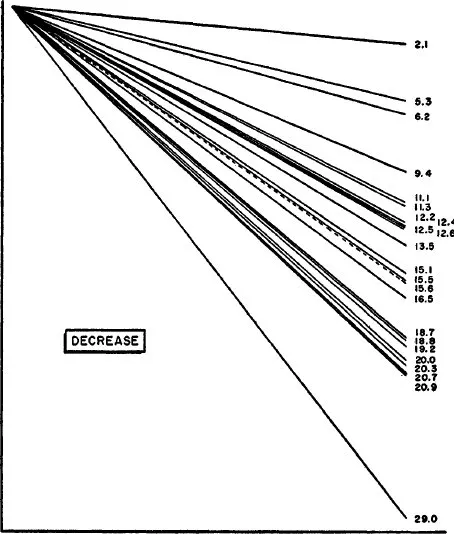
Chart I: Percentage Change in Average Hourly Earnings, 25 Manufacturing Industries, 1929 to 1932. Broken line represents 25 manufacturing industries.
Thirdly, wage-rates are not the only factor governing the volume of employment at any moment. Possibly from a purely hypothetical point of view there is always some wage-rate, however low, capable of assuring full employment under almost any condition. But in practice, supplementary adjustments will be necessary. In practice, also, no adjustment can be instantaneous, or sufficiently quick to assure full employment at all times, even with assumed flexible wage-rates.
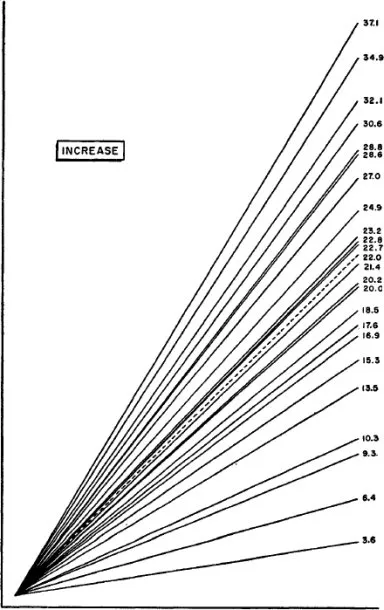
Chart II: Percentage Change in Average Hourly Earnings, 25 Manufacturing Industries, 1929 to 1939. Broken line represents 25 manufacturing industries.
Finally, the striking increase in hourly earnings between 1929 and 1939 (which of course meant an even more striking increase between 1932 and 1939) certainly did not wipe out unemployment or bring full recovery. On the contrary, the period was one of continued mass unemployment. (In the ten years from 1931 to 1940 there was average unemployment of ten million, or 18.6 per cent of the total working force.)
7. A Class Theory of Unemployment
Keynes’s preference for general monetary inflation over piecemeal wage and price adjustments is the result of still other major fallacies. He does not realize that the government cannot cheat creditors through inflation if the creditors have full advance knowledge of the government’s intentions. He does not realize that a planned inflation cannot be gradual or controlled, but will get out of hand the moment the plan is known. And he does not realize that when prices are falling because costs of production are falling, the price fall does not endanger profit margins or employment.
And bound up with these is still another major fallacy. Though Keynes has poured more derision on Ricardo than perhaps on any other economist, he has himself adopted a primitive “Ricardian” cost-of-production theory of prices according to which a nation can artificially hold up its “price-level” by holding up its “wage-level.” (Cf. pp. 268 and 271.) To explain this fallacy (after Menger, Jevons, Böhm-Bawerk, Wicksteed, Knight, Mises) would take too long. It is better to refer the Keynesians to some good modern textbook.
Nor shall I go at length into the reasons why unemployment is not caused, as Keynes insists, primarily by maladjustments between the rate of interest, the marginal efficiency of capital and investment. It is sufficient to point out not only that his theory of interest is completely false, but that interest rates are extremely fluid and flexible, that they are determined by full competition among lenders as well as borrowers, and not held rigid by compulsory collective bargaining, union monopolies and mass picket lines.
It is more instructive to inquire why Keynes put forward this extremely complicated and implausible theory. And here we may have to answer that, siding as he did with the immemorial labor-union insistence that employment is not caused by excessive wage-rates, he had to come up with some theory as to what does cause it. And as he couldn’t blame the labor-union leaders, what more natural (and politically convenient) than to blame the moneylenders, the creditors, the rich? Like Marxism, this is a class theory of the business cycle, a class theory of unemployment. As in Marxism, the capitalists become the scapegoats, with the sole difference that the chief villains are the moneylenders rather than the employers.
And that, I suspect, rather than any new discoveries of technical analysis, is the real secret of the tremendous vogue of the General Theory. It is the twentieth century’s Das Kapital.
1 A. C. Pigou, The Theory of Unemployment, p. 252.
2 The present book is a discussion of Keynes’s views, not of Pigou’s. The comments here are meant to apply merely to the passage quoted, not to the whole of Pigou’s views in his Theory of Unemployment or in later work, in which he revised and restated his earlier views as a result of Keynes’s criticisms. Pigou’s so-called “conversion” as a result of Keynes’s criticisms is probably one of the principal reasons for the present intellectual fashionableness of the Keynesian doctrines. But we shall do better to ignore this ad hominem argument and confine ourselves to the objective merits of the issue.
3 In my own discussion I have tried to avoid the ambiguous word “wages” altogether, distinguishing constantly between hourly wage-rates and total payrolls, total wage payments, or total labor income. Where I do occasionally use the word “wages” (to escape the appearance of pedantry) I should be understood always to refer to hourly wage-rates and never to total payrolls except when these are explicitly specified.
4 As we have remarked before, Keynes often succeeds in being technical and pedantic without being precise.
5 Keynes’s argument does not seem to recognize that an “industry” is not only itself an aggregate, but a purely conventional or arbitrary aggregate without definite boundaries. As of Jan. I, 1957, for example, there were at least 241 U.S. companies engaged in one or more processes of making steel products. But 23 were “integrated,” 60 were “semi-integrated,” and 147 were “non-integrated.” Some companies, for example, owned their own coal mines and railroads and made their own coke. Were they in the steel industry, the coal industry, the railroad industry, or the coke industry? The U.S. Steel Corporation has a subsidiary that builds bridges. Is it in the steel industry or the construction industry? Some companies make both steel pipe and plastic pipe. Are they in the steel industry or the plastic industry or the pipe-making industry? Firms concerned with different processes, from coke-making to cold finishing, sell to and buy from each other. Just where does “the steel industry” begin and end?
6 The German text reads: “Trotzdem kann die Theorie der Produktion als Ganzes, die den Zweck des folgenden Buches bildet, viel leichter den Verhältnissen eines totalen Staates angepasst werden als die Theorie der Erzeugung and Verteilung einer gegebenen, unter Bedingungen des freien Wettbewerbes und eines grossen Masses von laissez-faire erstellten Produktion.”
7 One price controller found, for example, that there were actually 350,000 separate prices in the United States for coal alone. (Testimony of Dan H. Wheeler, director of the Bituminous Coal Division. Hearings on extension of the Bituminous Coal Act of 1937.)
8 Cf. F. A. Hayek, Prices and Production, (London: George Routledge, 1935, 2nd ed., rev.), pp. 4-5, and Louis M. Spadaro, “Averages and Aggregates in Economics,” in On Freedom and Free Enterprise: Essays in Honor of Ludwig von Mises (ed.) Mary Sennholz, (Princeton: Van Nostrand, 1956).
9 Jules Backman and M. R. Gainsbrugh, Behavior of Wages (New York), pp. 16, 18.
Failure of the 'New Economics'
Read the whole book online · Book details
Free to read online and to download from this archive.