
Chapter 3 of 17 · Fascism versus Capitalism by Llewellyn H. Rockwell Jr.
Section One: The Reality of American Fascism
Section 1
The Reality of American Fascism
CHAPTER 1
The Reality of Red-State Fascism[*]
Year’s end is the time for big thoughts, so here are mine. The most significant socio-political shift in our time has gone almost completely unremarked, and even unnoticed. It is the dramatic shift of the red-state bourgeoisie from leave-us-alone libertarianism, manifested in the Congressional elections of 1994, to almost totalitarian statist nationalism. Whereas the conservative middle class once cheered the circumscribing of the federal government, it now celebrates power and adores the central state, particularly its military wing.
This huge shift has not been noticed among mainstream punditry, and hence there have been few attempts to explain it—much less have libertarians thought much about what it implies. My own take is this: the Republican takeover of the presidency, combined with an unrelenting state of war, has supplied all the levers necessary to convert a burgeoning libertarian movement into a statist one.
The remaining ideological justification was left to, and accomplished by, Washington’s kept think tanks, who have approved the turn at every crucial step. What this implies for libertarians is a crying need to draw a clear separation between what we believe and what conservatives believe. It also requires that we face the reality of the current threat forthrightly by extending more rhetorical tolerance leftward and less rightward.
Let us start from 1994 and work forward. In a stunningly prescient memo, Murray N. Rothbard described the 1994 revolution against the Democrats as follows:
a massive and unprecedented public repudiation of President Clinton, his person, his personnel, his ideologies and programs, and all of his works; plus a repudiation of Clinton’s Democrat Party; and, most fundamentally, a rejection of the designs, current and proposed, of the Leviathan he heads. . . . What is being rejected is big government in general (its taxing, mandating, regulating, gun grabbing, and even its spending) and, in particular, its arrogant ambition to control the entire society from the political center. Voters and taxpayers are no longer persuaded of a supposed rationale for American-style central planning. . . . On the positive side, the public is vigorously and fervently affirming its desire to re-limit and de-centralize government; to increase individual and community liberty; to reduce taxes, mandates, and government intrusion; to return to the cultural and social mores of pre-1960s America, and perhaps much earlier than that.
This memo also cautioned against unrelieved optimism, because, Rothbard said, two errors rear their head in most every revolution. First, the reformers do not move fast enough; instead they often experience a crisis of faith and become overwhelmed by demands that they govern “responsibly” rather than tear down the established order. Second, the reformers leave too much in place that can be used by their successors to rebuild the state they worked so hard to dismantle. This permits gains to be reversed as soon as another party takes control.
Rothbard urged dramatic cuts in spending, taxing, and regulation, and not just in the domestic area but also in the military and in foreign policy. He saw that this was crucial to any small-government program. He also urged a dismantling of the federal judiciary on grounds that it represents a clear and present danger to American liberty. He urged the young radicals who were just elected to reject gimmicks like the balanced-budget amendment and the line-item veto, in favor of genuine change. None of this happened of course. In fact, the Republican leadership and pundit class began to warn against “kamikaze missions” and speak not of bringing liberty, but rather of governing better than others.
Foreshadowing what was to come, Rothbard pointed out: “Unfortunately, the conservative public is all too often taken in by mere rhetoric and fails to weigh the actual deeds of their political icons. So the danger is that Gingrich will succeed not only in betraying, but in conning the revolutionary public into thinking that they have already won and can shut up shop and go home.” The only way to prevent this, he wrote, was to educate the public, businessmen, students, academics, journalists, and politicians about the true nature of what is going on, and about the vicious nature of the bi-partisan ruling elites.
The 1994 revolution failed of course, in part because the anti-government opposition was intimidated into silence by the Oklahoma City bombing of April 1995. The establishment somehow managed to pin the violent act of an ex-military man on the right-wing libertarianism of the American bourgeoisie. It was said by every important public official at that time that to be anti-government was to give aid and support to militias, secessionists, and other domestic terrorists. It was a classic intimidation campaign but, combined with a GOP leadership that never had any intention to change DC, it worked to shut down the opposition.
In the last years of the 1990s, the GOP-voting middle class refocused its anger away from government and leviathan and toward the person of Bill Clinton. It was said that he represented some kind of unique moral evil despoiling the White House. That ridiculous Monica scandal culminated in a pathetic and pretentious campaign to impeach Clinton. Impeaching presidents is a great idea, but impeaching them for fibbing about personal peccadilloes is probably the least justifiable ground. It’s almost as if that entire campaign was designed to discredit the great institution of impeachment.
In any case, this event crystallized the partisanship of the bourgeoisie, driving home the message that the real problem was Clinton and not government; the immorality of the chief executive, not his power; the libertinism of the left-liberals and not their views toward government. The much heralded “leave us alone” coalition had been thoroughly transformed in a pure anti-Clinton movement. The right in this country began to define itself not as pro-freedom, as it had in 1994, but simply as anti-leftist, as it does today.
There are many good reasons to be anti-leftist, but let us revisit what Mises said in 1956 concerning the anti-socialists of his day. He pointed out that many of these people had a purely negative agenda, to crush the leftists and their bohemian ways and their intellectual pretension. He warned that this is not a program for freedom. It was a program of hatred that can only degenerate into statism.
The moral corruption, the licentiousness and the intellectual sterility of a class of lewd would-be authors and artists is the ransom mankind must pay lest the creative pioneers be prevented from accomplishing their work. Freedom must be granted to all, even to base people, lest the few who can use it for the benefit of mankind be hindered. The license which the shabby characters of the quartier Latin enjoyed was one of the conditions that made possible the ascendance of a few great writers, painters and sculptors. The first thing a genius needs is to breathe free air.
He goes on to urge that anti-leftists work to educate themselves about economics, so that they can have a positive agenda to displace their purely negative one. A positive agenda of liberty is the only way we might have been spared the blizzard of government controls that were fastened on this country after Bush used the events of 9-11 to increase central planning, invade Afghanistan and Iraq, and otherwise bring a form of statism to America that makes Clinton look laissez-faire by comparison. The Bush administration has not only faced no resistance from the bourgeoisie. it has received cheers. And they are not only cheering Bush’s reelection; they have embraced tyrannical control of society as a means toward accomplishing their anti-leftist ends.
After September 11, even those whose ostensible purpose in life is to advocate less government changed their minds. Even after it was clear that 9-11 would be used as the biggest pretense for the expansion of government since the stock market crash of 1929, the Cato Institute said that libertarianism had to change its entire focus: “Libertarians usually enter public debates to call for restrictions on government activity. In the wake of September 11, we have all been reminded of the real purpose of government: to protect our life, liberty, and property from violence. This would be a good time for the federal government to do its job with vigor and determination.”
The vigor and determination of the Bush administration has brought about a profound cultural change, so that the very people who once proclaimed hatred of government now advocate its use against dissidents of all sorts, especially against those who would dare call for curbs in the totalitarian bureaucracy of the military, or suggest that Bush is something less than infallible in his foreign-policy decisions. The lesson here is that it is always a mistake to advocate government action, for there is no way you can fully anticipate how government will be used. Nor can you ever count on a slice of the population to be moral in its advocacy of the uses of the police power.
Editor & Publisher, for example, posted a small note the other day about a column written by Al Neuharth, the founder of USA Today, in which he mildly suggested that the troops be brought home from Iraq “sooner rather than later.” The editor of E&P was just blown away by the letters that poured in, filled with venom and hate and calling for Neuharth to be tried and locked away as a traitor. The letters compared him with pro-Hitler journalists, and suggested that he was objectively pro-terrorist, choosing to support the Muslim jihad over the US military. Other letters called for Neuharth to get the death penalty for daring to take issue with the Christian leaders of this great Christian nation.
I’m actually not surprised at this. It has been building for some time. If you follow hate-filled sites such as Free Republic, you know that the populist right in this country has been advocating nuclear holocaust and mass bloodshed for more than a year now. The militarism and nationalism dwarfs anything I saw at any point during the Cold War. It celebrates the shedding of blood, and exhibits a maniacal love of the state. The new ideology of the red-state bourgeoisie seems to actually believe that the US is God marching on earth—not just godlike, but really serving as a proxy for God himself.
Along with this goes a kind of worship of the presidency, and a celebration of all things public sector, including egregious law like the Patriot Act, egregious bureaucracies like the Department of Homeland Security, and egregious centrally imposed regimentation like the No Child Left Behind Act. It longs for the state to throw its weight behind institutions like the two-parent heterosexual family, the Christian charity, the homogeneous community of native-born patriots.
In 1994, the central state was seen by the bourgeoisie as the main threat to the family; in 2004 it is seen as the main tool for keeping the family together and ensuring its ascendancy. In 1994, the state was seen as the enemy of education; today, the same people view the state as the means of raising standards and purging education of its left-wing influences. In 1994, Christians widely saw that Leviathan was the main enemy of the faith; today, they see Leviathan as the tool by which they will guarantee that their faith will have an impact on the country and the world.
Paul Craig Roberts is right: “In the ranks of the new conservatives, however, I see and experience much hate. It comes to me in violently worded, ignorant and irrational emails from self-professed conservatives who literally worship George Bush. Even Christians have fallen into idolatry. There appears to be a large number of Americans who are prepared to kill anyone for George Bush.” Again: “Like Brownshirts, the new conservatives take personally any criticism of their leader and his policies. To be a critic is to be an enemy.”
In short, what we have alive in the US is an updated and Americanized fascism. Why fascist? Because it is not leftist in the sense of egalitarian or redistributionist. It has no real beef with business. It doesn’t sympathize with the downtrodden, labor, or the poor. It is for all the core institutions of bourgeois life in America: family, faith, and flag. But it sees the state as the central organizing principle of society, views public institutions as the most essential means by which all these institutions are protected and advanced, and adores the head of state as a godlike figure who knows better than anyone else what the country and world needs, and has a special connection to the Creator that permits him to discern the best means to bring it about.
The American right today has managed to be solidly anti-leftist while adopting an ideology—even without knowing it or being entirely conscious of the change—that is also frighteningly anti-liberty. This reality turns out to be very difficult for libertarians to understand or accept. For a long time, we’ve tended to see the primary threat to liberty as coming from the left, from the socialists who sought to control the economy from the center. But we must also remember that the sweep of history shows that there are two main dangers to liberty, one that comes from the left and the other that comes from the right. Europe and Latin America have long faced the latter threat, but its reality is only now hitting us fully.
What is the most pressing and urgent threat to freedom that we face in our time? It is not from the left. If anything, the left has been solid on civil liberties and has been crucial in drawing attention to the lies and abuses of the Bush administration. No, today, the clear and present danger to freedom comes from the right side of the ideological spectrum, those people who are pleased to preserve most of free enterprise but favor top-down management of society, culture, family, and school, and seek to use a messianic and belligerent nationalism to impose their vision of politics on the world.
There is no need to advance the view that the enemy of my enemy is my friend. However, it is time to recognize that the left today does represent a counterweight to the right, just as it did in the 1950s when the right began to adopt anti-communist militarism as its credo. In a time when the term patriotism means supporting the nation’s wars and statism, a libertarian patriotism has more in common with that advanced by The Nation magazine:
The other company of patriots does not march to military time. It prefers the gentle strains of ‘America the Beautiful’ to the strident cadences of ‘Hail to the Chief’ and ‘The Stars and Stripes Forever.’ This patriotism is rooted in the love of one’s own land and people, love too of the best ideals of one’s own culture and tradition. This company of patriots finds no glory in puffing their country up by pulling others’ down. This patriotism is profoundly municipal, even domestic. Its pleasures are quiet, its services steady and unpretentious. This patriotism too has deep roots and long continuity in our history.
Ten years ago, these were “right wing” sentiments; today the right regards them as treasonous. What should this teach us? It shows that those who saw the interests of liberty as being well served by the politicized proxies of free enterprise alone, family alone, Christianity alone, law and order alone, were profoundly mistaken. There is no proxy for liberty, no cause that serves as a viable substitute, and no movement by any name whose success can yield freedom in our time other than the movement of freedom itself. We need to embrace liberty and liberty only, and not be fooled by groups or parties or movements that only desire a temporary liberty to advance their pet interests.
As Rothbard said in 1965:
The doctrine of liberty contains elements corresponding with both contemporary left and right. This means in no sense that we are middle-of-the-roaders, eclectically trying to combine, or step between, both poles; but rather that a consistent view of liberty includes concepts that have also become part of the rhetoric or program of right and of left. Hence a creative approach to liberty must transcend the confines of contemporary political shibboleths.
There has never in my lifetime been a more urgent need for the party of liberty to completely secede from conventional thought and established institutions, especially those associated with all aspects of government, and undertake radical intellectual action on behalf of a third way that rejects the socialism of the left and the fascism of the right.
Indeed, the current times can be seen as a training period for all true friends of liberty. We need to learn to recognize the many different guises in which tyranny appears. Power is protean because it must suppress that impulse toward liberty that exists in the hearts of all people. The impulse is there, tacitly waiting for the consciousness to dawn. When it does, power doesn’t stand a chance.
[*] December 31, 2004
CHAPTER 2
The Fascist Threat[*]
Everyone knows that the term fascist is a pejorative, often used to describe any political position a speaker doesn’t like. There isn’t anyone around who is willing to stand up and say, “I’m a fascist; I think fascism is a great social and economic system.”
But I submit that if they were honest, the vast majority of politicians, intellectuals, and political activists would have to say just that.
Fascism is the system of government that cartelizes the private sector, centrally plans the economy to subsidize producers, exalts the police state as the source of order, denies fundamental rights and liberties to individuals, and makes the executive state the unlimited master of society.
This describes mainstream politics in America today. And not just in America. It’s true in Europe, too. It is so much part of the mainstream that it is hardly noticed any more.
It is true that fascism has no overarching theoretical apparatus. There is no grand theorist like Marx. That makes it no less real and distinct as a social, economic, and political system. Fascism also thrives as a distinct style of social and economic management. And it is as much or more of a threat to civilization than full-blown socialism.
This is because its traits are so much a part of life—and have been for so long—that they are nearly invisible to us.
If fascism is invisible to us, it is truly the silent killer. It fastens a huge, violent, lumbering state on the free market that drains its capital and productivity like a deadly parasite on a host. This is why the fascist state has been called the vampire economy. It sucks the economic life out of a nation and brings about a slow death of a once-thriving economy.
Let me just provide a recent example.
The Decline
The papers last week were filled with the first sets of data from the 2010 US Census. The headline story concerned the huge increase in the poverty rate. It is the largest increase in 20 years, and now up to 15 percent.
But most people hear this and dismiss it, probably for good reason. The poor in this country are not poor by any historical standard. They have cell phones, cable TV, cars, lots of food, and plenty of disposable income. What’s more, there is no such thing as a fixed class called the poor. People come and go, depending on age and life circumstances. Plus, in American politics, when you hear kvetching about the poor, everyone knows what you’re supposed to do: hand the government your wallet.
Buried in the report is another fact that has much more profound significance. It concerns median household income in real terms.
What the data have revealed is devastating. Since 1999, median household income has fallen 7.1 percent. Since 1989, median family income is largely flat. And since 1973 and the end of the gold standard, it has hardly risen at all. The great wealth-generating machine that was once America is failing.
No longer can one generation expect to live a better life than the previous one. The fascist economic model has killed what was once called the American dream. And the truth is, of course, even worse than the statistic reveals. You have to consider how many incomes exist within a single household to make up the total income. After World War II, the single-income family became the norm. Then the money was destroyed and American savings were wiped out and the capital base of the economy was devastated.
It was at this point that households began to struggle to stay above water. The year 1985 was the turning point. This was the year that it became more common than not for a household to have two incomes rather than one. Mothers entered the workforce to keep family income floating.
The intellectuals cheered this trend, as if it represented liberation, shouting hosannas that all women everywhere are now added to the tax rolls as valuable contributors to the state’s coffers. The real cause is the rise of fiat money that depreciated the currency, robbed savings, and shoved people into the workforce as taxpayers.
This story is not told in the data alone. You have to look at the demographics to discover it.
This huge demographic shift essentially bought the American household another 20 years of seeming prosperity, though it is hard to call it that since there was no longer any choice about the matter. If you wanted to keep living the dream, the household could no longer get by on a single income.
But this huge shift was merely an escape hatch. It bought 20 years of slight increases before the income trend flattened again. Over the last decade we are back to falling. Today median family income is only slightly above where it was when Nixon wrecked the dollar, put on price and wage controls, created the EPA; and the whole apparatus of the parasitic welfare-warfare state came to be entrenched and made universal.
Yes, this is fascism, and we are paying the price. The dream is being destroyed.
The talk in Washington about reform, whether from Democrats or Republicans, is like a bad joke. They talk of small changes, small cuts, commissions they will establish, curbs they will make in ten years. It is all white noise. None of this will fix the problem. Not even close.
The problem is more fundamental. It is the quality of the money. It is the very existence of 10,000 regulatory agencies. It is the whole assumption that you have to pay the state for the privilege to work. It is the presumption that the government must manage every aspect of the capitalist economic order. In short, it is the total state that is the problem, and the suffering and decline will continue so long as the total state exists.
The Origins of Fascism
To be sure, the last time people worried about fascism was during the Second World War. We were said to be fighting this evil system abroad. The United States defeated fascist governments, but the philosophy of governance that fascism represents was not defeated. Very quickly following that war, another one began. This was the Cold War that pitted capitalism against communism. Socialism in this case was considered to be a soft form of communism, tolerable and even praiseworthy insofar as it was linked with democracy, which is the system that legalizes and legitimizes an ongoing pillaging of the population.
In the meantime, almost everyone has forgotten that there are many other colors of socialism, not all of them obviously left wing. Fascism is one of these colors.
There can be no question of its origins. It is tied up with the history of post–World War I Italian politics. In 1922, Benito Mussolini became the Italian Prime Minister and established fascism as his philosophy. Mussolini had been a member of the Italian Socialist Party.
All the biggest and most important players within the fascist movement came from the socialists. It was a threat to the socialists because it was the most appealing political vehicle for the real-world application of the socialist impulse. Socialists crossed over to join the fascists en masse.
This is also why Mussolini himself enjoyed such good press for more than ten years after his rule began. He was celebrated by the New York Times in article after article. He was heralded in scholarly collections as an exemplar of the type of leader we needed in the age of the planned society. Puff pieces on this blowhard were very common in US journalism all through the late 1920s and the mid-1930s.
Remember that in this same period, the American Left went through a huge shift. In the teens and 1920s, the American Left had a very praiseworthy anticorporatist impulse. The Left generally opposed war, the state-run penal system, alcohol prohibition, and all violations of civil liberties. It was no friend of capitalism, but neither was it a friend of the corporate state of the sort that FDR forged during the New Deal.
In 1933 and 1934, the American Left had to make a choice. Would they embrace the corporatism and regimentation of the New Deal or take a principled stand on their old liberal values? In other words, would they accept fascism as a halfway house to their socialist utopia? A gigantic battle ensued in this period, and there was a clear winner. The New Deal made an offer the Left could not refuse. And it was a small step to go from the embrace of the fascistic planned economy to the celebration of the warfare state that concluded the New Deal period.
This was merely a repeat of the same course of events in Italy a decade earlier. In Italy too, the Left realized that their anticapitalistic agenda could best be achieved within the framework of the authoritarian, planning state. Of course our friend John Maynard Keynes played a critical role in providing a pseudoscientific rationale for joining opposition to old-world laissez-faire to a new appreciation of the planned society. Recall that Keynes was not a socialist of the old school. As he himself said in his introduction to the Nazi edition of his General Theory, National Socialism was far more hospitable to his ideas than a market economy.
Flynn Tells the Truth
The most definitive study on fascism written in these years was As We Go Marching by John T. Flynn. Flynn was a journalist and scholar of a liberal spirit who had written a number of best-selling books in the 1920s. He could probably be put in the progressive camp in the 1920s. It was the New Deal that changed him. His colleagues all followed FDR into fascism, while Flynn himself kept the old faith. That meant that he fought FDR every step of the way, and not only his domestic plans. Flynn was a leader of the America First movement that saw FDR’s drive to war as nothing but an extension of the New Deal, which it certainly was.
But because Flynn was part of what Murray Rothbard later dubbed the Old Right—Flynn came to oppose both the welfare state and the warfare state—his name went down the Orwellian memory hole after the war, during the heyday of CIA conservatism.
As We Go Marching came out in 1944, just at the tail end of the war, and right in the midst of wartime economic controls the world over. It is a wonder that it ever got past the censors. It is a full-scale study of fascist theory and practice, and Flynn saw precisely where fascism ends: in militarism and war as the fulfillment of the stimulus-spending agenda. When you run out of everything else to spend money on, you can always depend on nationalist fervor to back more military spending.
In reviewing the history of the rise of fascism, Flynn wrote,
One of the most baffling phenomena of fascism is the almost incredible collaboration between men of the extreme Right and the extreme Left in its creation. The explanation lies at this point. Both Right and Left joined in this urge for regulation. The motives, the arguments, and the forms of expression were different but all drove in the same direction. And this was that the economic system must be controlled in its essential functions and this control must be exercised by the producing groups.
Flynn writes that the Right and the Left disagreed on precisely who fits the bill as the producer group. The Left tends to celebrate laborers as producers. The Right tends to favor business owners as producers. The political compromise—and it still goes on today—was to cartelize both.
Government under fascism becomes the cartelization device for both the workers and the private owners of capital. Competition between workers and between businesses is regarded as wasteful and pointless; the political elites decide that the members of these groups need to get together and cooperate under government supervision to build a mighty nation.
The fascists have always been obsessed with the idea of national greatness. To them, this does not consist in a nation of people who are growing more prosperous, living ever better and longer lives. No, national greatness occurs when the state embarks on building huge monuments, undertaking nationwide transportation systems, carving Mount Rushmore or digging the Panama Canal.
In other words, national greatness is not the same thing as your greatness or your family’s greatness or your company’s or profession’s greatness. On the contrary. You have to be taxed, your money’s value has to be depreciated, your privacy invaded, and your well-being diminished in order to achieve it. In this view, the government has to make us great.
Tragically, such a program has a far greater chance of political success than old-fashioned socialism. Fascism doesn’t nationalize private property as socialism does. That means that the economy doesn’t collapse right away. Nor does fascism push to equalize incomes. There is no talk of the abolition of marriage or the nationalization of children.
Religion is not abolished but used as a tool of political manipulation. The fascist state was far more politically astute in this respect than communism. It wove together religion and statism into one package, encouraging a worship of God provided that the state operates as the intermediary.
Under fascism, society as we know it is left intact, though everything is lorded over by a mighty state apparatus. Whereas traditional socialist teaching fostered a globalist perspective, fascism was explicitly nationalist. It embraced and exalted the idea of the nation-state.
As for the bourgeoisie, fascism doesn’t seek their expropriation. Instead, the middle class gets what it wants in the form of social insurance, medical benefits, and heavy doses of national pride.
It is for all these reasons that fascism takes on a right-wing cast. It doesn’t attack fundamental bourgeois values. It draws on them to garner support for a democratically backed all-around national regimentation of economic control, censorship, cartelization, political intolerance, geographic expansion, executive control, the police state, and militarism.
For my part, I have no problem referring to the fascist program as a right-wing theory, even if it does fulfill aspects of the left-wing dream. The crucial matter here concerns its appeal to the public and to the demographic groups that are normally drawn to right-wing politics.
If you think about it, right-wing statism is of a different color, cast, and tone from left-wing statism. Each is designed to appeal to a different set of voters with different interests and values.
These divisions, however, are not strict, and we’ve already seen how a left-wing socialist program can adapt itself and become a right-wing fascist program with very little substantive change other than its marketing.
The Eight Marks of Fascist Policy
John T. Flynn, like other members of the Old Right, was disgusted by the irony that what he saw, almost everyone else chose to ignore. In the fight against authoritarian regimes abroad, he noted, the United States had adopted those forms of government at home, complete with price controls, rationing, censorship, executive dictatorship, and even concentration camps for whole groups considered to be unreliable in their loyalties to the state.
After reviewing this long history, Flynn proceeds to sum up with a list of eight points he considers to be the main marks of the fascist state.
As I present them, I will also offer comments on the modern American central state.
Point 1. The government is totalitarian because it acknowledges no restraint on its powers.
This is a very telling mark. It suggests that the US political system can be described as totalitarian. This is a shocking remark that most people would reject. But they can reject this characterization only so long as they happen not to be directly ensnared in the state’s web. If they become so, they will quickly discover that there are indeed no limits to what the state can do. This can happen boarding a flight, driving around in your hometown, or having your business run afoul of some government agency. In the end, you must obey or be caged like an animal or killed. In this way, no matter how much you may believe that you are free, all of us today are but one step away from Guantanamo.
As recently as the 1990s, I can recall that there were moments when Clinton seemed to suggest that there were some things that his administration could not do. Today I’m not so sure that I can recall any government official pleading the constraints of law or the constraints of reality to what can and cannot be done. No aspect of life is untouched by government intervention, and often it takes forms we do not readily see. All of healthcare is regulated, but so is every bit of our food, transportation, clothing, household products, and even private relationships.
Mussolini himself put his principle this way: “All within the State, nothing outside the State, nothing against the State.” He also said: “The keystone of the Fascist doctrine is its conception of the State, of its essence, its functions, and its aims. For Fascism the State is absolute, individuals and groups relative.”
I submit to you that this is the prevailing ideology in the United States today. This nation, conceived in liberty, has been kidnapped by the fascist state.
Point 2. Government is a de facto dictatorship based on the leadership principle.
I wouldn’t say that we truly have a dictatorship of one man in this country, but we do have a form of dictatorship of one sector of government over the entire country. The executive branch has spread so dramatically over the last century that it has become a joke to speak of checks and balances. What the kids learn in civics class has nothing to do with reality.
The executive state is the state as we know it, all flowing from the White House down. The role of the courts is to enforce the will of the executive. The role of the legislature is to ratify the policy of the executive.
Further, this executive is not really about the person who seems to be in charge. The president is only the veneer, and the elections are only the tribal rituals we undergo to confer some legitimacy on the institution. In reality, the nation-state lives and thrives outside any “democratic mandate.” Here we find the power to regulate all aspects of life and the wicked power to create the money necessary to fund this executive rule.
As for the leadership principle, there is no greater lie in American public life than the propaganda we hear every four years about how the new president/messiah is going to usher in the great dispensation of peace, equality, liberty, and global human happiness. The idea here is that the whole of society is really shaped and controlled by a single will—a point that requires a leap of faith so vast that you have to disregard everything you know about reality to believe it.
And yet people do. The hope for a messiah reached a fevered pitch with Obama’s election. The civic religion was in full-scale worship mode—of the greatest human who ever lived or ever shall live. It was a despicable display.
Another lie that the American people believe is that presidential elections bring about regime change. This is sheer nonsense. The Obama state is the Bush state; the Bush state was the Clinton state; the Clinton state was the Bush state; the Bush state was the Reagan state. We can trace this back and back in time and see overlapping appointments, bureaucrats, technicians, diplomats, Fed officials, financial elites, and so on. Rotation in office occurs not because of elections but because of mortality.
Point 3. Government administers a capitalist system with an Immense bureaucracy.
The reality of bureaucratic administration has been with us at least since the New Deal, which was modeled on the planning bureaucracy that lived in World War I. The planned economy—whether in Mussolini’s time or ours—requires bureaucracy. Bureaucracy is the heart, lungs, and veins of the planning state. And yet to regulate an economy as thoroughly as this one is today is to kill prosperity with a billion tiny cuts.
This doesn’t necessarily mean economic contraction, at least not right away. But it definitely means killing off growth that would have otherwise occurred in a free market.
So where is our growth? Where is the peace dividend that was supposed to come after the end of the Cold War? Where are the fruits of the amazing gains in efficiency that technology has afforded? It has been eaten by the bureaucracy that manages our every move on this earth. The voracious and insatiable monster here is called the Federal Code that calls on thousands of agencies to exercise the police power to prevent us from living free lives.
It is as Bastiat said: the real cost of the state is the prosperity we do not see, the jobs that don’t exist, the technologies to which we do not have access, the businesses that do not come into existence, and the bright future that is stolen from us. The state has looted us just as surely as a robber who enters our home at night and steals all that we love.
Point 4. Producers are organized into cartels in the way of syndicalism.
Syndicalist is not usually how we think of our current economic structure. But remember that syndicalism means economic control by the producers. Capitalism is different. It places by virtue of market structures all control in the hands of the consumers. The only question for syndicalists, then, is which producers are going to enjoy political privilege. It might be the workers, but it can also be the largest corporations.
In the case of the United States, in the last three years, we’ve seen giant banks, pharmaceutical firms, insurers, car companies, Wall Street banks and brokerage houses, and quasi-private mortgage companies enjoying vast privileges at our expense. They have all joined with the state in living a parasitical existence at our expense.
This is also an expression of the syndicalist idea, and it has cost the US economy untold trillions and sustained an economic depression by preventing the post-boom adjustment that markets would otherwise dictate. The government has tightened its syndicalist grip in the name of stimulus.
Point 5. Economic planning is based on the principle of autarky.
Autarky is the name given to the idea of economic self-sufficiency. Mostly this refers to the economic self-determination of the nation-state. The nation-state must be geographically huge in order to support rapid economic growth for a large and growing population.
This was and is the basis for fascist expansionism. Without expansion, the state dies. This is also the idea behind the strange combination of protectionist pressure today combined with militarism. It is driven in part by the need to control resources.
Look at the wars in Iraq, Afghanistan, and Libya. We would be supremely naive to believe that these wars were not motivated in part by the producer interests of the oil industry. It is true of the American empire generally, which supports dollar hegemony.
It is the reason for the planned North American Union.
The goal is national self-sufficiency rather than a world of peaceful trade. Consider, too, the protectionist impulses of the Republican ticket. There is not one single Republican, apart from Ron Paul, who authentically supports free trade in the classical definition.
From ancient Rome to modern-day America, imperialism is a form of statism that the bourgeoisie love. It is for this reason that Bush’s post-9/11 push for the global empire has been sold as patriotism and love of country rather than for what it is: a looting of liberty and property to benefit the political elites.
Point 6. Government sustains economic life through spending and borrowing.
This point requires no elaboration because it is no longer hidden. There was stimulus 1 and stimulus 2, both of which are so discredited that stimulus 3 will have to adopt a new name. Let’s call it the American Jobs Act.
With a prime-time speech, Obama argued in favor of this program with some of the most asinine economic analysis I’ve ever heard. He mused about how is it that people are unemployed at a time when schools, bridges, and infrastructure need repairing. He ordered that supply and demand come together to match up needed work with jobs.
Hello? The schools, bridges, and infrastructure that Obama refers to are all built and maintained by the state. That’s why they are falling apart. And the reason that people don’t have jobs is because the state has made it too expensive to hire them. It’s not complicated. To sit around and dream of other scenarios is no different from wishing that water flowed uphill or that rocks would float in the air. It amounts to a denial of reality.
Still, Obama went on, invoking the old fascistic longing for national greatness. “Building a world-class transportation system,” he said, “is part of what made us an economic superpower.” Then he asked, “We’re going to sit back and watch China build newer airports and faster railroads?”
Well, the answer to that question is yes. And you know what? It doesn’t hurt a single American for a person in China to travel on a faster railroad than we do. To claim otherwise is an incitement to nationalist hysteria.
As for the rest of this program, Obama promised yet another long list of spending projects. Let’s just mention the reality: No government in the history of the world has spent as much, borrowed as much, and created as much fake money as the United States. If the United States doesn’t qualify as a fascist state in this sense, no government ever has.
None of this would be possible but for the role of the Federal Reserve, the great lender to the world. This institution is absolutely critical to US fiscal policy. There is no way that the national debt could increase at a rate of $4 billion per day without this institution.
Under a gold standard, all of this maniacal spending would come to an end. And if US debt were priced on the market with a default premium, we would be looking at a rating far less than A+.
Point 7. Militarism is a mainstay of government spending.
Have you ever noticed that the military budget is never seriously discussed in policy debates? The United States spends more than most of the rest of the world combined.
And yet to hear our leaders talk, the United States is just a tiny commercial republic that wants peace but is constantly under threat from the world. They would have us believe that we all stand naked and vulnerable. The whole thing is a ghastly lie. The United States is a global military empire and the main threat to peace around the world today.
To visualize US military spending as compared with other countries is truly shocking. One bar chart you can easily look up shows the US trillion-dollar-plus military budget as a skyscraper surrounded by tiny huts. As for the next highest spender, China spends 1/10th as much as the United States.
Where is the debate about this policy? Where is the discussion? It is not going on. It is just assumed by both parties that it is essential for the US way of life that the United States be the most deadly country on the planet, threatening everyone with nuclear extinction unless they obey. This should be considered a fiscal and moral outrage by every civilized person.
This isn’t only about the armed services, the military contractors, the CIA death squads. It is also about how police at all levels have taken on military-like postures. This goes for the local police, state police, and even the crossing guards in our communities. The commissar mentality, the trigger-happy thuggishness, has become the norm throughout the whole of society.
If you want to witness outrages, it is not hard. Try coming into this country from Canada or Mexico. See the bullet-proof-vest-wearing, heavily armed, jackbooted thugs running dogs up and down car lanes, searching people randomly, harassing innocents, asking rude and intrusive questions.
You get the strong impression that you are entering a police state. That impression would be correct.
Yet for the man on the street, the answer to all social problems seems to be more jails, longer terms, more enforcement, more arbitrary power, more crackdowns, more capital punishments, more authority. Where does all of this end? And will the end come before we realize what has happened to our once-free country?
Point 8. Military spending has imperialist aims.
Ronald Reagan used to claim that his military buildup was essential to keeping the peace. The history of US foreign policy just since the 1980s has shown that this is wrong. We’ve had one war after another, wars waged by the United States against noncompliant countries, and the creation of even more client states and colonies.
US military strength has led not to peace but the opposite. It has caused most people in the world to regard the United States as a threat, and it has led to unconscionable wars on many countries. Wars of aggression were defined at Nuremberg as crimes against humanity.
Obama was supposed to end this. He never promised to do so, but his supporters all believed that he would. Instead, he has done the opposite. He has increased troop levels, entrenched wars, and started new ones. In reality, he has presided over a warfare state just as vicious as any in history. The difference this time is that the Left is no longer criticizing the US role in the world. In that sense, Obama is the best thing ever to happen to the warmongers and the military-industrial complex.
As for the Right in this country, it once opposed this kind of military fascism. But all that changed after the beginning of the Cold War. The Right was led into a terrible ideological shift, well documented in Murray Rothbard’s neglected masterpiece The Betrayal of the American Right. In the name of stopping communism, the right came to follow ex–CIA agent Bill Buckley’s endorsement of a totalitarian bureaucracy at home to fight wars all over the world.
At the end of the Cold War, there was a brief reprise when the Right in this country remembered its roots in noninterventionism. But this did not last long. George Bush the First rekindled the militarist spirit with the first war on Iraq, and there has been no fundamental questioning of the American empire ever since. Even today, Republicans elicit their biggest applause by whipping up audiences about foreign threats, while never mentioning that the real threat to American well-being exists in the Beltway.
The Future
I can think of no greater priority today than a serious and effective antifascist alliance. In many ways, one is already forming. It is not a formal alliance. It is made up of those who protest the Fed, those who refuse to go along with mainstream fascist politics, those who seek decentralization, those who demand lower taxes and free trade, those who seek the right to associate with anyone they want and buy and sell on terms of their own choosing, those who insist they can educate their children on their own, the investors and savers who make economic growth possible, those who do not want to be felt up at airports, and those who have become expatriates.
It is also made of the millions of independent entrepreneurs who are discovering that the number one threat to their ability to serve others through the commercial marketplace is the institution that claims to be our biggest benefactor: the government.
How many people fall into this category? It is more than we know. The movement is intellectual. It is political. It is cultural. It is technological. They come from all classes, races, countries, and professions. This is no longer a national movement. It is truly global.
We can no longer predict whether members consider themselves to be left wing, right wing, independent, libertarian, anarchist, or something else. It includes those as diverse as homeschooling parents in the suburbs as well as parents in urban areas whose children are among the 2.3 million people who languish in jail for no good reason in a country with the largest prison population in the world.
And what does this movement want? Nothing more or less than sweet liberty. It does not ask that the liberty be granted or given. It only asks for the liberty that is promised by life itself and would otherwise exist were it not for the Leviathan state that robs us, badgers us, jails us, kills us.
This movement is not departing. We are daily surrounded by evidence that it is right and true. Every day, it is more and more obvious that the state contributes absolutely nothing to our well-being; it massively subtracts from it.
Back in the 1930s, and even up through the 1980s, the partisans of the state were overflowing with ideas. They had theories and agendas that had many intellectual backers. They were thrilled and excited about the world they would create. They would end business cycles, bring about social advance, build the middle class, cure disease, bring about universal security, and much more. Fascism believed in itself.
This is no longer true. Fascism has no new ideas, no big projects—and not even its partisans really believe it can accomplish what it sets out to do. The world created by the private sector is so much more useful and beautiful than anything the state has done that the fascists have themselves become demoralized and aware that their agenda has no real intellectual foundation.
It is ever more widely known that statism does not and cannot work. Statism is the great lie. Statism gives us the exact opposite of its promise. It promised security, prosperity, and peace; it has given us fear, poverty, war, and death. If we want a future, it is one that we have to build ourselves. The fascist state will not give it to us. On the contrary, it stands in the way.
It also seems to me that the old-time romance of the classical liberals with the idea of the limited state is gone. It is far more likely today that young people embrace an idea that 50 years ago was thought to be unthinkable: the idea that society is best off without any state at all.
I would mark the rise of anarcho-capitalist theory as the most dramatic intellectual shift in my adult lifetime. Gone is that view of the state as the night watchman that would only guard essential rights, adjudicate disputes, and protect liberty.
This view is woefully naive. The night watchman is the guy with the guns, the legal right to use aggression, the guy who controls all comings and goings, the guy who is perched on top and sees all things. Who is watching him? Who is limiting his power? No one, and this is precisely why he is the very source of society’s greatest ills. No constitution, no election, no social contract will check his power.
Indeed, the night watchman has acquired total power. It is he who would be the total state, which Flynn describes as a government that “possesses the power to enact any law or take any measure that seems proper to it.” So long as a government, he says, “is clothed with the power to do anything without any limitation on its powers, it is totalitarian. It has total power.”
It is no longer a point that we can ignore. The night watchman must be removed and his powers distributed within and among the whole population, and they should be governed by the same forces that bring us all the blessings the material world affords us.
In the end, this is the choice we face: the total state or total freedom. Which will we choose? If we choose the state, we will continue to sink further and further and eventually lose all that we treasure as a civilization. If we choose freedom, we can harness that remarkable power of human cooperation that will enable us to continue to make a better world.
In the fight against fascism, there is no reason to be despairing. We must continue to fight with every bit of confidence that the future belongs to us and not them.
Their world is falling apart. Ours is just being built.
Their world is based on bankrupt ideologies. Ours is rooted in the truth about freedom and reality.
Their world can only look back to the glory days. Ours looks forward to the future we are building for ourselves.
Their world is rooted in the corpse of the nation-state. Our world draws on the energies and creativity of all peoples in the world, united in the great and noble project of creating a prospering civilization through peaceful human cooperation.
It’s true that they have the biggest guns. But big guns have not assured permanent victory in Iraq or Afghanistan—or any other place on the planet.
We possess the only weapon that is truly immortal: the right idea. It is this that will lead to victory.
As Mises said,
In the long run even the most despotic governments with all their brutality and cruelty are no match for ideas. Eventually the ideology that has won the support of the majority will prevail and cut the ground from under the tyrant’s feet. Then the oppressed many will rise in rebellion and overthrow their masters.
[*] June 19, 2012
CHAPTER 3
Machiavelli and State Power[*]
As libertarianism has acquired a higher profile in American life over the past several years, the attacks on and caricatures of libertarians have grown almost as rapidly. Libertarians, we read, are antisocial, and prefer isolation over interaction with others. They are greedy, and are unmoved if the poor should starve. They are naive about our dangerous enemies, and refuse their patriotic duty to support the government’s wars.
These caricatures and misconceptions can be put to rest by simply defining what libertarianism is. The libertarian idea is based on a fundamental moral principle: nonaggression. No one may initiate physical force against anyone else.
There is nothing antisocial about that. To the contrary, it is the denial of this principle that is antisocial, for it is peaceful interaction that lies at the heart of civilized society.
At first glance, hardly anyone can object to the nonaggression principle. Few people openly support acts of aggression against peaceful parties. But libertarians apply this principle across the board, to all actors, public and private. Our view goes well beyond merely suggesting that the State may not engage in gross violations of the moral law. We contend that the State may not perform any action that would be forbidden to an individual. Moral norms either exist or they do not.
Thus we cannot abide State kidnapping, just because they call it the draft. We cannot abide the incarceration of people who ingest the wrong substances, just because they call it the war on drugs. We cannot abide theft just because they call it taxation. And we cannot abide mass murder just because they call it foreign policy.
Murray Rothbard, who earned his Ph.D. from this very institution (Columbia University) in 1956 and went on to become known as Mr. Libertarian, said that you could discover the libertarian position on any issue by imagining a criminal gang carrying out the action in question.
In other words, libertarianism takes certain moral and political insights shared by a great many people, and simply applies them consistently.
For example, people oppose monopoly because they fear the increase in prices, the decrease in product quality, and the centralization of power that accompany it.
The libertarian applies this concern for monopoly to the State itself. After all, private firms, which we are supposed to fear, can’t simply charge whatever they want for their goods or services. Consumers can simply switch from one supplier to another, or from a particular product to a close substitute. Firms cannot engage in quality deterioration without likewise losing customers, who can find competitors offering better products.
But the State may, by definition, charge the public whatever it likes for the so-called services it supplies. Its subjects must accept whatever level of quality the State should deign to provide. And there can never, by definition, be any competitor to the State, since the State is defined as the territorial monopolist of compulsion and coercion.
With its wars, its genocides, and its totalitarian atrocities, the State has proven itself by far the most lethal institution in history. Its lesser crimes include the debt crises it has caused, the self-perpetuating bureaucracies that feed off the productive population, and the squandering of resources—which might otherwise have improved the general standard of living through capital formation—on arbitrary and politically motivated projects.
Yet the State, despite its failures, is consistently given a benefit of the doubt that no one would extend to actors and firms in the private sector. For instance, educational outcomes remain dismal despite vastly increased expenditures and far lower class sizes than in the past. Had the private sector presided over such a disaster, we would never hear the end of all the denunciations of the malefactors of great wealth who are keeping our children ignorant. When the government sector performs so poorly, there is silence. Silence, that is, interrupted by demands that the State be given still more resources.
Years ago, when John Chubb of the Brookings Institution tried to uncover how many bureaucrats were employed in New York City’s public school system, it took six telephone calls to reach someone who knew the answer—and that person was not allowed to disclose the information. It took another half dozen calls to find someone who both knew the answer and could reveal it. The answer? Six thousand.
Chubb then called the Archdiocese of New York to find out how many bureaucrats were employed in the administration of the city’s Catholic schools, which educated one-sixth as many students. When the first person he called didn’t know the answer, he figured he was in for it again. But that person went on to say, “Wait, let me count.” It was twenty-six.
Imagine if the situation were reversed, and the top-heavy school system had been the private one. There would be no end to the investigations, the media reports, the public outrage. But when the State is the guilty party, there is no interest in the story at all, and no one even hears about it.
Likewise, when the government courts force innocent parties to endure interminable delays and endless expense, there are no investigations or cries for justice. When the rich and famous are obviously favored by the system, people glumly accept it as a fact of life. Meanwhile, private arbitration companies are flourishing, quietly filling the gap left by the government’s awful system—and hardly anyone notices or cares, much less appreciates these improvements in our welfare.
The US government has carried out atrocities of an unspeakable kind, just in the past ten years, and justified them with propaganda claims that nobody around the world, apart from a gullible sector of the American population, took seriously. If K-Mart had somehow managed to do such a thing, everyone involved would have been roundly condemned, and the perpetrators would have been imprisoned, if not executed.
The government, on the other hand, persuades the people that they and the government are the same thing, that the government’s wars are their wars, that these conflicts involve us against them. People’s moral compasses become blurred as they begin to identify themselves and their own personal goodness, as they see it, with the wars in which “their” government is engaged.
In fact, for the libertarian, the government’s wars are not us versus them. The wars are a case of them versus them.
The other side of the Austro-libertarian coin is, of course, the Austrian School of economics.
The Austrian School has enjoyed a renaissance of sorts since the Panic of 2008, since so many economists who belong to this venerable tradition of thought predicted the crisis—in the face of official assurances to the contrary, in the media, among the political class, and from the Federal Reserve itself. Thanks to the Internet, it was impossible for official opinion to black out these dissident voices.
The Austrian School, which was born officially with Carl Menger’s 1871 book Principles of Economics, is sometimes conflated with other schools of thought loosely associated with the free market. But in its method, its price theory, its monopoly theory, its capital theory, its business-cycle theory, and in so much else, it is distinct from those other schools of thought, and often in direct opposition to them.
It is solidly realistic, and grounded in the individual actor and his decisions and preferences. It seeks to understand real-world prices, not the prices of a long-run equilibrium that can never exist except in the minds of economists.
It was the Austrians who solved problems that had vexed the classical economists, whose price theory could not account for why water, so necessary to life, commanded virtually a zero price on the market, while diamonds, a mere luxury, were so dear.
And it is the Austrians who predicted the Great Depression at a time when fashionable opinion claimed the business cycle had been tamed forever, who predicted the dot-com crash when Fed chairman Alan Greenspan was saying that perhaps booms didn’t necessarily have to be followed by busts any longer, and who, as I mentioned, predicted the most recent crisis when the regulators whom we are supposed to trust to keep the economy stable said there was no housing bubble and the fundamentals of that market were sound.
A common caricature holds that supporters of the free market believe the market yields a perfect social outcome, whatever that is supposed to mean. In a world of uncertainty and constant change, no system can yield a perfect result. No system can ensure that the whole structure of production instantaneously adjusts to precisely that allocation of capital goods that will yield the exact array of types and quantities of consumer goods that the public desires, while imposing the least cost in terms of opportunities foregone.
Our point is that no competing system can do a better job than the market. Only actors on the market can allocate resources in a non-arbitrary way, because only on the market can someone evaluate a course of action according to the economizing principle of profit and loss. This is what the Austrians call economic calculation.
This was the reason, economist Ludwig von Mises explained in 1920, that socialism could not work. Under socialism as traditionally understood, the State owned the means of production. Now if the State already owns all those things, then no buying and selling of them takes place. Without buying and selling, in turn, there is no process by which prices can arise. And without prices for capital goods, central planners cannot allocate resources rationally. They cannot know whether a particular production process should use ten units of plastic and nine units of lumber, or ten units of lumber and nine units of plastic (if we are indifferent between the two combinations from a technological point of view). Without market prices by which to compare incommensurable goods like lumber and plastic, they cannot know how urgently demanded each input is in alternative lines of production. Multiply this problem by the nearly infinite set of possible combinations of productive factors, and you see the impossible situation the central planning board faces.
Even the non-socialist State has a calculation problem. Since it operates without a profit-and-loss feedback mechanism, it has no way of knowing whether it has allocated resources in accordance with consumer preferences and in a least-cost manner. To the contrary, its decisions regarding what to produce and where, in what quantities and using which methods are completely blind from the point of view of social economizing. (By “social economizing” I mean the process by which we attain higher-valued ends with lower-valued means.)
Hence if we want to ensure that resources are not squandered or spent arbitrarily, we must keep them out of the hands of the State.
Strictly speaking, the Austrian School of economics has nothing to do with libertarianism. Economics, insisted economist Ludwig von Mises, is value-free. It describes rather than prescribes. It does not tell us what we ought to do. It merely explains the various phenomena we observe, from prices to interest rates, and supplies the cause-and-effect analysis that permits us to understand the consequences of coercive interference in the voluntary buying and selling decisions of individuals.
All the same, the knowledge the Austrian School imparts to us strongly implies that certain courses of action are more desirable from the standpoint of human welfare than others. Among other things, we learn from Austrian economics that the State’s allocation decisions cannot be socially economizing. We learn that the desires of consumers are best served by the free price system, which directs production decisions up and down the capital structure in accordance with society’s demands. And we learn that the State’s interference with money, the commodity that forms one-half of every non-barter exchange, gives rise to the devastation of the boom-bust business cycle.
Austro-libertarianism, then, in the spirit of Rothbard, takes the libertarian nonaggression principle and supplements it with the Austrian School’s descriptions of the free and unhampered market economy. The result is an elegant and compelling way of understanding the world, which in turn conveys the moral and material urgency of establishing a free society.
Now the seminar today asks us to consider questions of power and the State from an Austro-libertarian perspective, but also in light of Nicolo Machiavelli, the late fifteenth- and early sixteenth-century historian, political theorist, and counselor to princes. Most people know of Machiavelli for the views expressed in his short manual The Prince, and not for his longer and perhaps more substantial works, including his Discourses on Livy and his history of Florence. I have drawn largely but not exclusively from The Prince for my brief remarks today.
The Roman moralists of antiquity, and the Renaissance humanists who followed them, had urged that rulers had to possess a particular set of moral virtues. These were, first, the four cardinal virtues—cardinal from the Latin meaning “hinge”; hence all other virtues hinge on these—of courage, justice, temperance, and wisdom. Now all men were called to cultivate these virtues, but princes in particular were called to still others beyond these, such as princely magnanimity and liberality. These themes are developed in Cicero’s De Officiis, or On Duties, and in Seneca’s On Clemency and On Benefits.
The humanists anticipated the thesis Machiavelli would one day bring forth, namely that there ought to be a division between morality on the one hand and whatever happens to be expedient for the prince on the other. They answered it by cautioning that even if princely wickedness is not punished in this life, divine retribution in the next life would be fearsome and certain.
What made Machiavelli stand out so starkly was his radical departure from this traditional view of the prince’s moral obligations. As the great Machiavelli scholar Quentin Skinner points out, “When we turn to The Prince we find this aspect of humanist morality suddenly and violently overturned.”
The prince, says Machiavelli, must always “be prepared to act immorally when this becomes necessary.” And “in order to maintain his power,” he will—not just sometimes but often—be forced “to act treacherously, ruthlessly, and inhumanely.”
Most people will never interact with the prince themselves, hence Machiavelli’s note to the prince that “everyone can see what you appear to be” but “few have direct experience of what you really are.” “A skillful deceiver,” he continued, “always finds plenty of people who will let themselves be deceived.” We can surmise from this what kind of person the prince would have to be.
It is customary to object at this point that Machiavelli counseled that the prince pursue virtue when possible, and that he should not pursue evil for its own sake. Machiavelli does indeed make such an argument in chapter 15 of The Prince. But on the other hand, Machiavelli says that conduct considered virtuous by traditional morality and the general run of mankind merely “seems virtuous,” and that apparently wicked behavior that maintains one’s power only seems vicious.
Skinner poses, and answers, the historian’s natural question when faced with these moral claims:
But what of the Christian objection that this is a foolish as well as a wicked position to adopt, since it forgets the day of judgment on which all injustices will finally be punished? About this Machiavelli says nothing at all. His silence is eloquent, indeed epoch-making; it echoed around Christian Europe, at first eliciting a stunned silence in return, and then a howl of execration that has never finally died away.
Machiavelli’s view has sometimes been summarized as “the ends justify the means.” Such a distillation does not capture all aspects of Machiavelli’s thought, and no doubt this pithy summary irritates professors of political theory. But if the end in mind is the preservation of the prince’s power, then “the ends justify the means” is not an unfair description of Machiavelli’s counsel.
This principle, in turn, is what the collectivist State now appeals to in order to justify its own deviations from what people would otherwise consider moral and good. F.A. Hayek wrote, “The principle that the end justifies the means is in individualist ethics regarded as the denial of all morals. In collectivist ethics it becomes necessarily the supreme rule; there is literally nothing which the consistent collectivist must not be prepared to do if it serves ‘the good of the whole,’ because the ‘good of the whole’ is to him the only criterion of what ought to be done.” Collectivist ethics, he added, “knows no other limit than that set by expediency—the suitability of the particular act for the end in view.”
Almost everyone now accepts, at least implicitly, the claim that a different set of moral rules applies to the State, or that to one degree or another the State is above morality as traditionally understood. Even if they would not use some of the verbal formulations of Machiavelli, at some level they believe it is unreasonable to expect the State or its functionaries to behave the way the rest of us do. The State may preserve itself by methods that no private business, or household, or organization, or individual would be allowed to employ for their own preservation. We accept this as normal.
This is merely a more general statement of the phenomenon I described earlier, whereby few people even bat an eye when the State engages in behavior that would be considered a moral enormity if carried out by any other person or entity.
Now it will be objected that the coercive apparatus of the State is so important to the right ordering of society that we cannot insist too strongly on libertarian purity when evaluating its behavior. Sometimes the State just has to do what it has to do.
Every so-called service the State provides has in the past been provided non-coercively. We are simply not encouraged to learn this history, and the framework we unknowingly adopt from our earliest days in school makes our imaginations too narrow to conceive of it.
Machiavelli launched one revolution, on behalf of the State. Ours is the revolution against it, and in favor of peace, freedom, and prosperity.
[*] From a talk delivered on September 15, 2012, at a seminar sponsored by the Columbia University Department of Italian in association with the Mises Institute.
CHAPTER 4
Headed to National Socialism[*]
It was common on the Left to intimate that George W. Bush was like Hitler, a remark that would drive the National Review crowd through the roof but which I didn’t find entirely outrageous. Bush’s main method of governance was to stir up fear of foreign enemies and instigate a kind of nationalist hysteria about the need for waging war and giving up liberty through security.
Hitler is the most famous parallel here, but he is hardly the only one. Many statesmen in world history have used the same tactics, dating back to ancient times. Machiavelli wrote in his Art of War advice to the ruler:
To know how to recognize an opportunity in war, and take it, benefits you more than anything else.
But what’s the point of studying Hitler’s rise to power unless it is to learn from that history and apply the lessons? One lesson is to beware of leaders who come to power in troubled times, and then use foreign threats and economic crises to bolster their own power. Unless we can draw out lessons for our own times, history becomes nothing but a series of dry data points with no broader relevance.
Certainly Bush used 9-11 to consolidate his power and the neoconservative intellectuals who surrounded him adopted a deep cynicism concerning the manipulation of public opinion. Their governing style concerned the utility of public myth, which they found essential to wise rule. The main myth they promoted was that Bush was the Christian philosopher-king heading a new crusade against Islamic extremism. The very stupid among us believed it, and this served as a kind of ideological infrastructure of his tenure as president.
Then it collapsed when the economy went south and he was unable to sustain the absurd idea that he was protecting us from anyone. The result was disgrace, and the empowering of the political left and its socialistic ethos.
The talk of Hitler in the White House ended forthwith, as if the analogy extended only when nationalist ideology is ruling the day. What people don’t remember is that Hitlerism was about more than just militarism, nationalism, and consolidation of identity politics. It also involved a substantial shift in German domestic politics away from free enterprise, or what remained of it under Weimar, toward collectivist economic planning.
Nazism was not only nationalism run amok. It was also socialism of a particular variety.
Let’s turn to The Vampire Economy by Guenter Reimann (1939). He begins the story with the 1933 decree that all property must be subject to the collective will. It began with random audits and massive new bookkeeping regulations:
Manufacturers in Germany were panic-stricken when they heard of the experiences of some industrialists who were more or less expropriated by the State. These industrialists were visited by State auditors who had strict orders to “examine” the balance sheets and all bookkeeping entries of the company (or individual businessman) for the preceding two, three, or more years until some error or false entry was found. The slightest formal mistake was punished with tremendous penalties. A fine of millions of marks was imposed for a single bookkeeping error. Obviously, the examination of the books was simply a pretext for partial expropriation of the private capitalist with a view to complete expropriation and seizure of the desired property later. The owner of the property was helpless, since under fascism there is no longer an independent judiciary that protects the property rights of private citizens against the State. The authoritarian State has made it a principle that private property is no longer sacred.
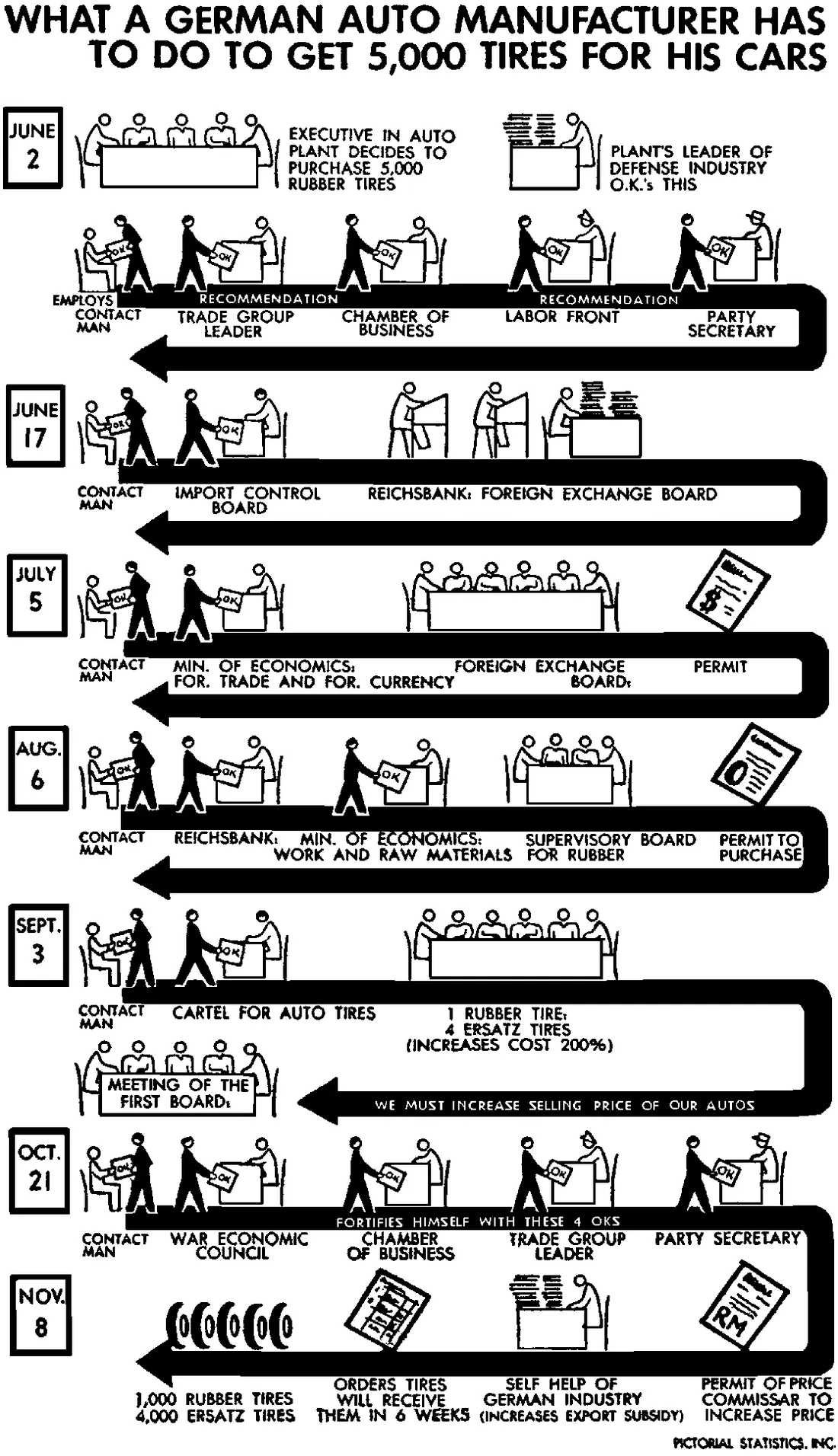
The rules begin to change slowly so that enterprise could no longer make decisions in the interest of profitability. The banks were nationalized. The heads of major companies were changed. Hiring and firing became heavily politicized. The courts ruled not on justice but on political priorities. It was no longer enough merely to obey the laws. The national will must trump economic concerns:
The capitalist under fascism has to be not merely a law-abiding citizen, he must be servile to the representatives of the State. He must not insist on “rights” and must not behave as if his private property rights were still sacred. He should be grateful to the Fuehrer that he still has private property. This state of affairs must lead to the final collapse of business morale, and sound the death knell of the self-respect and self-reliance which marked the independent businessman under liberal capitalism.
Price controls were next, enforced intermittently and with them grew up a large gray economy, with businesspeople spending more time getting around the rules than producing wealth.
To increase his prices a dealer must have a special permit from the Price Commissar. A request for a price increase must first be certified to by the group leader; it must be accompanied by a detailed statement of necessity and other pertinent data, such as production and distribution costs.
State production mandates were next. Goods were to be produced according to political goals.
Backed by the General Staff of the army, Nazi bureaucrats have been able to embark upon schemes which compel the most powerful leaders of business and finance to undertake projects which they consider both risky and unprofitable.
Bankers were required to act as state actors.
Under fascism, big bankers, formerly independent—except, of course, “non-Aryans”—have become State officials in everything but name. They are often in high and influential positions, but they are all members of the compact, centralized State machine. Their independence, their individual initiative, their free competitive position, all the principles for which they once fought fervently, are gone.
If you think that the parallels stopped after Bush left power, consider this passage from Reimann:
The totalitarian State reverses the former relationship between the State and the banks. Previously, their political influence increased when the State needed financial help. Now the opposite holds true. The more urgent the financial demands of the State become, the stricter measures are taken by the State in order to compel these institutions to invest their funds as the State may wish.
Once the banks were forced wholly under the control of the government, they became the means by which all property became subject to the state:
The totalitarian State will not have an empty treasury so long as private companies or individuals still have ample cash or liquid assets. For the State has the power to solve its financial difficulties at their expense. The private banks themselves, the financial institutions which previously dictated the terms on which they were willing to lend money, have built up the system of siphoning off liquid funds. This financial system is now utilized by the totalitarian State for its own purposes.
So it was for the stock market, which was regarded as a national asset. Speculation was forbidden. Public companies were entirely subject to bureaucratic rule. Order replaced the old spontaneity, while speculation of the old sort became an entirely underground activity. The largest companies didn’t entirely mind the course of events.
The disappearance of small corporations gives rise to a tendency among small investors not to risk their capital in new competitive enterprises. The larger the big corporations grow and the closer they become connected with the State bureaucracy, the fewer chances there are for the rise of new competitors.
So too for insurance companies, which were compelled to buy government paper.
The tendency toward ever more economic regulation resulted not in socialism as such but fascist planning.
The fascist State does not merely grant the private entrepreneur the right to produce for the market, but insists on production as a duty which must be fulfilled even though there be no profit. The businessman cannot close down his factory or shop because he finds it unprofitable. To do this requires a special permit issued by the authorities.
The national demand for “stimulus” replaced private decision making entirely, as businessmen were required to produce and avoid any economic downturns that might embarrass the state.
The Nazi government has expressly threatened the private entrepreneur with increased State coercion and reduction of personal rights and liberties unless he fulfills adequately the “duty to produce” according to the State’s demands.
But stimulus could not and would not work, no matter how hard the party officials tried, because the very institutions of private property and competition and all market forces had been overwritten.
The totalitarian regime has annihilated the most important conservative force of capitalism, the belief that private property ought to be a sacred right of every citizen and that the private property of every citizen ought to be protected. Respect for private property has penetrated the spirit of the people in all capitalist countries. It is the strongest bulwark of capitalism. Fascism has succeeded in destroying this conservative force. . . . People still have to work for money and have to live on money incomes. Possession of capital still provides income. But this income is largely at the mercy of State bureaucrats and Party officials.
Reimann sums up:
In Nazi Germany there is no field of business activity in which the State does not interfere. In more or less detailed form it prescribes how the businessman may use capital which is still presumably his private property. And because of this, the German businessman has become a fatalist; he does not believe that the new rules will work out well, yet he knows that he cannot alter the course of events. He has been made the tool of a gigantic machine which he cannot direct.
The regime also dramatically increased social and medical legislation, providing lifetime pensions to friends and conscripting doctors in the service of its dietary and medical goals.
Now, if any of this sounds familiar, it is because the principles of intervention are universal.
The Nazi regime represented not a unique evil in history but rather a now-conventional combination of two dangerous ideological trends: nationalism and socialism.
We know both all too well.
[*] July 10, 2009
CHAPTER 5
The Dawn of Late Fascism[*]
The downgrading of US debt this summer didn’t have huge economic consequences, but the psychological ones were truly devastating for the national elites who have run this country for nearly a century. For a State that regards itself as infallible, it was a huge blow that market forces delivered against the government, and it is only one of thousands that have cut against the power elite in recent years.
Another recent example was the vanishing of the much-vaunted Obama jobs bill. He pushed hard for this scheme for a month. He made an FDR-like national speech that attempted to whip up a public frenzy. He promised that if the legislature passed his law, supply and demand for workers would magically come together. We only need to agree to spend a few hundred billion more!
Well, the bully pulpit has become the bull-something pulpit. It seems that hardly anyone even took the speech seriously as a political point. It was reviewed and treated as the theater that it was, but the universal reaction to the specifics was a thumbs down, even from his own party.
No, Obama is not FDR. This is not the New Deal. The public will not be browbeaten as it once was. The polls show a vast lack of even a modicum of confidence in political leadership, the failures of which are all around us.
The longer the depression persists, the more the rebellious spirit grows, and it is not limited to the Wall Street protests. Poverty is growing, incomes are falling, business is being squeezed at every turn, and unemployment is stuck at intolerably high levels. People are angry as never before, and neither political party comes close to offering answers.
The State as we’ve known it—and that includes its political parties and its redistributionary, military, regulatory, and money-creating bureaucracies—just can’t get it together. It’s as true now as it has been for some twenty years: the Nation State is in precipitous decline. Once imbued with grandeur and majesty, personified by its Superman powers to accomplish amazing global feats, it is now a wreck and out of ideas.
It doesn’t seem that way because the State is more in-your-face than it has been in all of American history. We see the State at the airport with the incompetent bullying ways of the TSA. We see it in the ridiculous dinosaur of the post office, forever begging for more money so it can continue to do things the way it did them in 1950. We see it in the federalized cops in our towns, once seen as public servants but now revealed as what they have always been: armed tax collectors, censors, spies, thugs.
These are themselves marks of decline. The mask of the State is off. And it has been off for such a long time that we can hardly remember what it looked like when it was on.
So let’s take a quick tour. If you live in a big metropolitan city, drive to the downtown post office (if it is still standing). There you will find a remarkable piece of architecture, tall and majestic and filled with grandeur. There is a liberal use of Roman-style columns. The ceilings indoors are extremely high and thrilling. It might even be the biggest and most impressive building around.
This is a building of an institution that believed in itself. After all, this was the institution that carried the mail, which was the only way that people had to communicate with each other when most of these places were first erected. The state took great pride in offering this service, which it held up as being superior to anything the market could ever provide (even if market provisions like the Pony Express had to be outlawed). Postmen were legendary (or so we were told) for their willingness to brave the elements to bring us the essential thing we needed in life apart from food, clothing, and shelter.
And today? Look at the thing that we call the post office. It is a complete wreck, a national joke, a hanger-on from a day long gone. They deliver physical spam to our mail boxes, and a few worthwhile things every once in a while, but the only time they are in the news is when we hear another report of their bankruptcy and need for a bailout.
It’s the same with all the grand monuments of yesteryear’s statism. Think of the Hoover Dam, Mount Rushmore, the endless infrastructure projects of the New Deal, the Eisenhower interstate highway system, the moon shot, the sprawling monuments to itself that the State has erected from sea to shining sea. As I’ve explained elsewhere, these all came about in an age when the only real alternative to socialism was considered to be fascism. This was an age when freedom—as in the old-fashioned sense—was just out of the question.
The State in all times and all places operates by force—and force alone. But the style of rule changes. The fascist style emphasized inspiration, magnificence, industrial progress, grandeur, all headed by a valiant leader making smart decisions about all things. This style of American rule lasted from the New Deal through the end of the Cold War.
But this whole system of inspiration has nearly died out. In the communist tradition of naming the stages of history, we can call this late fascism. The fascist system in the end cannot work because, despite the claims, the State does not have the means to achieve what it promises. It does not possess the capability to outrun private markets in technology, of serving the population in the way markets can, of making things more plentiful or cheaper, or even of providing basic services in a manner that is economically efficient.
Fascism, like socialism, cannot achieve its aims. So there is a way in which it makes sense to speak of a stage of history: We are in the stage of late fascism. The grandeur is gone, and all we are left with is a gun pointed at our heads. The system was created to be great, but it is reduced in our time to being crude. Valor is now violence. Majesty is now malice.
Consider whether there is any national political leader in power today the death of whom would call forth anywhere near the same level of mourning as the death of Steve Jobs. People know in their hearts who serves them, and it is not the guy with jackboots, tasers on his belt, and a federal badge. The time when we looked to this man as a public servant is long gone. And this reality only speeds the inevitable death of the State as the 20th century re-invented it.
[*] October 15, 2011
CHAPTER 6
The US Corporate State[*]
It didn’t take long for opponents of the market to pounce after the events of 2008. The crash was said to prove how destructive “unregulated capitalism” could be and how dangerous its supporters were—after all, free-marketeers opposed the bailouts, which had allegedly saved Americans from another Great Depression.
In The Great Deformation, David Stockman—former US congressman and budget director under Ronald Reagan—tells the story of the recent crisis, and takes direct aim at the conventional wisdom that credits government policy and Ben Bernanke with rescuing Americans from another Great Depression. In this he has made a seminal contribution. But he does much more than this. He offers a sweeping, revisionist account of US economic history from the New Deal to the present. He refutes widely held myths about the Reagan years and the demise of the Soviet Union. He covers the growth and expansion of the warfare state. He shows precisely how the Fed enriches the powerful and shelters them from free markets. He demonstrates the flimsiness of the present so-called recovery. Above all, he shows that attempts to blame our economic problems on “capitalism” are preposterous, and reveal a complete lack of understanding of how the economy has been deformed over the past several decades.
The Great Deformation takes on the stock arguments in favor of the bailouts that we heard in 2008 and which constitute the conventional wisdom even today. A “contagion effect” would spread the financial crisis throughout the economy, well beyond the confines of a few Wall Street firms, we were told. Without bailouts, payroll would not be met. ATMs would go dark. Wise policy decisions by the Treasury and the Fed prevented these and other nightmare scenarios, and staved off a second Great Depression.
The bailout of AIG, for example, was carried out against a backdrop of utter hysteria. AIG was bailed out in order to protect Main Street, the public was told, but virtually none of AIG’s busted CDS insurance was held by Main Street banks. Even on Wall Street the effects were confined to about a dozen firms, every one of which had ample cushion for absorbing the losses. Thanks to the bailout, they did not take one dollar in such losses. “The bailout,” says Stockman, “was all about protecting short-term earnings and current-year executive and trader bonuses.”
Ten years earlier, the Fed had sent a clear enough signal of its future policy when it arranged for a bailout of a hedge fund called Long Term Capital Management (LTCM). If this firm was to be bailed out, Wall Street concluded, then there was no limit to the madness the Fed would backstop with easy money.
LTCM, says Stockman, was
an egregious financial train wreck that had amassed leverage ratios of 100 to 1 in order to fund giant speculative bets in currency, equity, bond, and derivatives markets around the globe. The sheer recklessness and scale of LTCM’s speculations had no parallel in American financial history. . . . LTCM stunk to high heaven, and had absolutely no claim on public authority, resources, or even sympathy.
When the S&P 500 soared by 50 percent over the next fifteen months, this was not a sign that American companies were seeing their profit outlooks increase by half. It instead indicated a confidence on Wall Street that the Fed would prevent investment errors from receiving the usual free-market punishment. Under this “ersatz capitalism,” stock market averages reflected “expected monetary juice from the central bank, not anticipated growth of profits from free-market enterprises.”
It wasn’t just specific firms that would enjoy Fed largesse under chairmen Alan Greenspan and Ben Bernanke; it was the stock market itself. According to Stockman, Fed policy came to focus on the “wealth effect”: if the Fed pushed stock prices higher, Americans would feel wealthier and would be likely to spend and borrow more, thereby stimulating economic activity.
This policy approach, in turn, practically compelled the bailouts that were one day to come. Anything that might send stock prices lower would frustrate the wealth effect. So the system had to be propped up by whatever means necessary.
What does this policy have to show for itself? Stockman gives the answer:
If the monetary central planners have been trying to create jobs through the roundabout method of “wealth effects,” they ought to be profoundly embarrassed by their incompetence. The only thing that has happened on the job-creation front over the last decade is a massive expansion of the bedpan and diploma mill brigade; that is, employment in nursing homes, hospitals, home health agencies, and for-profit colleges. Indeed, the HES complex accounts for the totality of American job creation since the late 1990s.
Meanwhile, the number of breadwinner jobs did not increase at all between January 2000 and January 2007, remaining at 71.8 million. The booms in housing, the stock market, and household consumption had only this grim statistic to show for themselves. When we consider the entire twelve-year period beginning in the year 2000, there has been a net gain of 18,000 jobs per month—one-eighth of the growth rate in the labor force.
In the wake of the crash, the Fed has continued to gin up the stock market. By September 2012 the S&P had increased by 115 percent over its lows during the bust. Of the 5.6 million breadwinner jobs lost during the correction, only 200,000 had been restored by then. And during the vaunted recovery, American households spent $30 billion less on food and groceries in the fall of 2012 than they did during the same period in 2007.
The sudden emergence of enormous budget deficits in recent years, Stockman explains, simply made manifest what the bubble conditions of the Bush years had concealed. The phony wealth of the housing and consumption booms temporarily lowered the amount of money spent on safety-net programs, and temporarily increased the amount of tax revenue received by the government. With this false prosperity abating, the true deficit, which had simply been suppressed by these temporary factors, began to appear.
All along, the Fed had assured us that the United States was experiencing genuine prosperity. “Flooding Wall Street with easy money,” Stockman writes, the Fed
saw the stock averages soar and pronounced itself pleased with the resulting “wealth effects.” Turning the nation’s homes into debt-dispensing ATMs, it witnessed a household consumption spree and marveled that the “incoming” macroeconomic data was better than expected. That these deformations were mistaken for prosperity and sustainable economic growth gives witness to the everlasting folly of the monetary doctrines now in vogue in the Eccles Building.
Stockman also discusses the fiscal condition of the U.S. government. Part of that history takes him through the Reagan military buildup. Stockman’s isn’t the story you heard at the Republican conventions of the 1980s. The real story is as you suspected: a feeding frenzy of arbitrary and irrelevant programs which, once begun, could be stopped only with great difficulty if at all, given the jobs that depended on them.
But at least this buildup brought about the collapse of the Soviet Union, right? Stockman doesn’t buy it. “The $3.5 trillion (2005) spent on defense during the Gipper’s term did not cause the Kremlin to raise the white flag of surrender. Virtually none of it was spent on programs which threatened Soviet security or undermined its strategic nuclear deterrent.”
At the heart of the Reagan defense buildup . . . was a great double shuffle. The war drums were sounding a strategic nuclear threat that virtually imperiled American civilization. Yet the money was actually being allocated to tanks, amphibious landing craft, close air support helicopters, and a vast conventional armada of ships and planes.
These weapons were of little use in the existing nuclear standoff, but were well suited to imperialistic missions of invasion and occupation. Ironically, therefore, the Reagan defense buildup was justified by an Evil Empire that was rapidly fading but was eventually used to launch elective wars against an Axis of Evil which didn’t even exist.
What would actually bring the Soviet Union down was its command economy itself—a point, Stockman notes, that libertarian economists had been making for some time. Neoconservatives, on the other hand, advanced ludicrous claims about Soviet capabilities and the Soviet economy at a time when its decrepitude should have been obvious to everyone. These inflated claims about the regime’s enemies continued to be standard practice for the neocons long after the Reagan years were over.
To do it justice, The Great Deformation really requires two or three reviews. One could be devoted just to Stockman’s striking analysis of the New Deal. Stockman advances and then defends these and other arguments: the banking system had stabilized well before FDR’s ill-advised “bank holiday”; the economy had already turned the corner before FDR’s accession and worsened again as a result of FDR’s conduct during the interregnum; the New Deal was not a coherent program of Keynesian demand stimulus, so it makes no sense for Keynesians to draw lessons from it; the 1937 “depression within the Depression” was not caused by fiscal retrenchment; and FDR’s primary legacy is not the economic recovery, which would have occurred faster without him, but rather the impetus he gave to crony capitalism in one sector of the economy after another.
You may have gathered that The Great Deformation must be a long book. It is. But its subject matter is so interesting, and its prose style so lively and engaging, that you will hardly notice the pages going by.
The target of Stockman’s book is just about everyone in the political and media establishments. Left-liberal opinion molders—defenders of the common man, they would have us believe—supported the bailouts in overwhelming numbers. Herman Cain, meanwhile, lectured “free-market purists” for opposing TARP, and virtually the entire slate of GOP candidates in 2012 had supported it. Both sides, in tandem with the official media, repeated the regime’s scare stories without cavil. And both sides could think of nothing but good things to say about how the Fed had managed the economy for the past quarter century.
The free market stands exonerated of the charges hurled by the state and its allies.
Thanks to The Great Deformation, not a shred of the regime’s propaganda is left standing. This is truly the book we have been waiting for, and we owe David Stockman a great debt.
[*] March 2, 2013
Fascism versus Capitalism
Read the whole book online · Book details
This work is published under a Creative Commons licence. You may copy, share, and re-host it with attribution.