
Chapter 26 of 28 · Gold, Peace, and Prosperity by Ron Paul
The End—or the Beginning
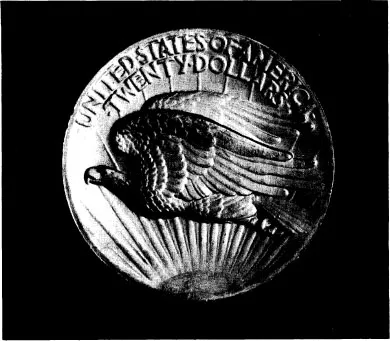
A U.S. $20 gold piece.
Government’s only legitimate reason for existence is to protect innocent life and property from aggression, foreign or domestic. When it deliberately destroys the money, government is acting perversely, by harming innocent life and property. Short of intentional war, inflation is the most immoral act political leaders can commit.
The legalized counterfeiting which is inflation must be ended —now.
The road to monetary destruction has been long and circuitous, but we are coming to the end of it. Sixty-seven years of central banking have brought us to the edge of depression and hyperinflation.
But the foundations have been laid for a new monetary order. The spirit of freedom, and the desire for honest money, still run strongly among our people. In 1974 we reversed the unconstitutional 1934 law that barred private ownership of gold. In 1977, gold clause contracts were legalized. In 1979, a bill to repeal the Treasury’s power to seize privately held gold was passed by the House.
The minting of U.S. gold medallions has emphasized the importance of the people’s right to own gold.
Historic Congressional hearings have been held on the gold standard, and an amendment to establish a gold commission passed both Houses unanimously. The commission, composed of public and private sector representatives, will specifically study the role of gold in the domestic and international monetary systems.
We must also work on halting massive gold sales at below market prices to European central bankers and Arab sheiks. If the administration is still intent on “demonetizing” gold with gold sales, let’s at least sell it only in sizes that Americans can afford—one, one half, and one quarter ounce coins.
Eventually, we must repeal the legal tender laws, which work only to the benefit of the government and other large debtors, by forcing creditors to accept depreciated currency, and permit free banking.
Federal Reserve notes must be made 100% redeemable in gold as of a fixed date, and at a rate determined by the market price on that date. We also must balance the budget and pledge never again to expand the money supply.
The argument that there’s not enough gold to do this is false. With a gold dollar, a car might cost $600 instead of $6,000, but the exact amount of the medium of exchange used wouldn’t matter.
“In a free market economy,” points out Dr. Hans Sennholz, “it is utterly irrelevant what the total stock of money should be. Any given quantity renders the full services and yields the maximum utility of a medium of exchange. No additional utility can be derived from additions to the money quantity. When the stock is relatively large, the purchasing power of the individual units of money will be relatively small. Conversely, when the stock is small, the purchasing power of the individual units will be relatively large. No wealth can be created and no economic growth can be achieved by changing the quantity of the medium of exchange. It is so obvious and yet so obscured by the specious reasoning of special interest spokesmen that the printing of another ton of paper money does not create new wealth.”
Our freedoms are too precious to risk, and if we do not act quickly, we will see them perish just as surely as our currency. This is the ultimate justification for honest money. Freedom cannot long exist without it.
“By a continuing process of inflation, governments can confiscate, secretly and unobserved, an important part of the wealth of their citizens,” says John Maynard Keynes. “As the inflation proceeds and the real value of the currency fluctuates wildly from month to month, all permanent relations between debtors and creditors, which form the ultimate foundation of capitalism, become so utterly disordered as to be almost meaningless; and the process of wealth-getting degenerates into a gamble and a lottery.
“Lenin was certainly right. There is no subtler, no surer means of overturning the existing basis of society than to debauch the currency. The process engages all the hidden forces of economic law on the side of destruction, and it does it in a manner which not one man in a million is able to diagnose.”*
The consequences of monetary destruction are complex, but the solution is not.
Without a moral foundation, a free society cannot survive. The same is true for our money. We will ensure a safe, secure, free, and productive America for ourselves and our descendants only by accepting both a moral defense of the free society and sound money.
“We may amuse ourselves,” wrote William Gouge, Treasury advisor to President Andrew Jackson, “by contriving new modes of paper banking. We may suppose that kind of money which has been tried, in various forms, in China, Persia, Hindostan, Tartary, Japan, Russia, Sweden, Denmark, Austria, France, Portugal, England, Scotland, Ireland, Canada, the United States, Brazil, and Buenos Aires, and which has everywhere produced mischief, would if we had control of it, be productive of great good. We may say, it is true that paper money has always produced evil, but it is because it has not been properly managed. But, if there is not something essentially bad in fictitious money, there seems to be something in human nature which prevents it from being properly managed. No new experiments are wanted to convince mankind of this truth.” Since Mr. Gouge wrote this in 1833, we have had many melancholy examples to add to his list.
Barter and the underground economy, which have already appeared in the U.S., are not the answers. Free people must not accept a retreat into primitive conditions. We must confront the enemies of freedom and honest money with superior ideas and superior determination.
We can prevent the calamity only with the concerted efforts of many dedicated, well-informed citizens willing to put forth a herculean effort—starting today.
The alternative to today’s monetary fraud and tomorrow’s chaos is readily available to us.
The calamities that accompany monetary chaos have brought dictators to power in other countries. We must prevent this from happening here.
“People fight the gold standard,” said Ludwig von Mises, “because they want to substitute national autarky for free trade, war for peace, totalitarian government omnipotence for liberty.”
It is no coincidence that the 19th Century, a time of gold coin standards for the most part, was an era of peace. Nor is it a coincidence that the 20th Century combines wars with paper money.
Everyone who believes in freedom must work diligently for sound money, fully redeemable.* Nothing else is compatible with the humanitarian goals of peace and prosperity.
* N.B.: “Many people have combed through every word of Lenin, to no avail,” writes Dr. Rothbard. “He simply never said it. (To do so he would have to be a lot more familiar with sound economics than he was.) Just another case where Keynes goofed.”
* If you would like a copy of the Monetary Freedom Act, which would accomplish this, write Congressman Ron Paul, 1234 Longworth House Office Building, Washington, D.C. 20515.
Gold, Peace, and Prosperity
Read the whole book online · Book details
This work is published under a Creative Commons licence. You may copy, share, and re-host it with attribution.