
Chapter 6 of 10 · Jefferson by Albert Jay Nock
Chapter VI EIGHT YEARS OF “SPLENDID MISERY” I
PREVIOUS to the election of the elder Adams to the Presidency, a most veracious stump orator from Providence addressed the Old Britoners and Hardscrabblers, on which occasion . . . he felt he could impart to such intelligent citizens as those before him a profound secret which, when learned, could not fail to convince every independent freeman present who had any regard for the honour and well-being of his country, how immensely in all respects John Adams, the profound and fearless patriot and full-blooded Yankee, exceeded in every respect his competitor, Tom Jefferson, for the Presidency, who, to make the best of him, was nothing but a mean-spirited, low-lived fellow, the son of a half-breed Indian squaw, sired by a Virginia mulatto father, as was well-known in the neighbourhood where he was raised wholly on hoe-cake (made of coarse-ground Southern corn), bacon and hominy, with an occasional change of fricaseed bullfrog, for which abominable reptiles he had acquired a taste during his residence among the French at Paris, to whom there could be no question he would sell his country at the first offer made to him cash down, should he be elected to fill the Presidential chair. . . .
At the conclusion of the speech, it was unanimously voted by the assembled freemen present that any Old Britoner or Hardscrabble freeman who should not vote for the glorious John Adams at the coming election, ought to be deemed guilty of treason and shunned by all his neighbours accordingly; whilst in case any individual or individuals should dare to vote for that half Injun, half nigger, half Frenchman, with a touch of the bullfrog, Tom Jefferson, he or they should be rode on a green split chestnut rail, sharp side up.
The Jonnycake Pafers.
The campaign of 1800 had many diverting features. The moral and religious forces of the country had already largely enlisted themselves in the service of partisan politics, with an immense preponderance on the Federalist side, since, to paraphrase Jay’s dictum, those who owned the churches governed the churches. “The rich and well-born” in New York and New England gave special attention to this mode of propaganda, getting such good results out of it that Hamilton presently proposed to organize it formally on a permanent basis by establishing a “Christian Constitutional Society.” This was to be, in principle, a cheap popular edition of the Order of the Cincinnati, to offset the “Jacobin clubs” and the “democratic societies.” Hamilton’s prospectus for this interesting project set forth its objects as, first, “the support of the Christian religion,” and, second, “the support of the Constitution of the United States.” Rather oddly, not a word more is said about the first object, but a great deal about the second. The Society was to attend to “the cultivation of popular favour by fair and justifiable expedients,” such as, first and foremost, “the diffusion of information. For this purpose not only the newspapers but pamphlets must be largely employed. . . . It is essential to be able to disseminate gratis useful publications.” Next, “the use of all lawful means in concert to promote the election of fit men.” Finally—most interesting anticipation of all—“the promoting of institutions of a charitable and useful nature in [i.e., under] the management of Federalists. The populous cities ought particularly to be attended to; perhaps it would be well to institute in such places—Ist, societies for the relief of emigrants; 2d, academies, each with one professor, for instructing the different classes of mechanics in the principles of mechanics and the elements of chemistry.”
Hamilton sketched this plan in a letter to Bayard, who deprecated it as unnecessarily obvious. All these desirable objects would in a little time be attained naturally and informally—much better so than by a national organization to “revive a thousand jealousies and suspicions which now began to slumber.” A little patience, and two or three years “would render every honest man in the country their proselyte.” Hamilton’s immense genius for organization stood in the way of his recognition of the imponderabilia; he never really understood the mighty force which has been so well called “the cohesive power of public plunder,” though it was all along his most effective ally—his entire practical statesmanship, indeed, might be not unfairly summed up as merely an agency for its release—and Bayard’s instinct for trusting to it to compass all the objects of Hamilton’s plan was the instinct of the better politician.
The informal confiscation of moral, religious and patriotic sentiment, in fact, had yielded excellent returns during the Presidential canvass, and was still producing a good steady revenue. Mr. Jefferson’s early efforts for the establishment of religious freedom in Virginia, and his long immersion in the suppositious atheism and impurity of French social life, furnished the basis for an endless playing-up of his ungodliness and immorality. One clergyman compared him to Rehoboam; another gave warning of his “solicitude for wresting the Bible from the hands of their [i.e., the congregation’s] children.” Another set forth that he had “obtained his property by fraud and robbery; that in one instance he had defrauded and robbed a widow and fatherless children of an estate to which he was executor, of ten thousand pounds sterling.”
The clergy of Connecticut in particular, under the leadership of Dr. Timothy Dwight, organized a kind of jehad. Dr. Dwight had a threefold responsibility to bear. He was a clergyman, president of Yale College, and related by blood or marriage to nearly the whole of the little politico-economic oligarchy that had controlled Connecticut from its Colonial beginnings. Some person of a genealogical turn tabulated this connexion, and published it during the campaign.
The Family Compact of Connecticut
1. Dr. Timothy Dwight, president of Yale, generally known as the Pope.
2. James Hillhouse, United States Senator. He and Dwight married sisters.
3. Theodore Dwight, candidate for Congress. A brother to the Pope.
4. Mr. Morris, the extraordinary chairman of Sedgwick in Congress. Married Pope Dwight’s sister.
5. Mr. Hosmer, member of Congress. Related to Hillhouse by marriage.
6. Chauncy Goodrich, member of Congress. Married Oliver Wolcott’s sister.
7. Oliver Wolcott, Secretary of Treasury.
8. Elizur Goodrich, brother of Chauncy.
9. Long John Allen, brother-in-law of Elizur Goodrich.
10. Mr. Austin, collector of customs at New Haven, is the stepfather of Long John Allen.
11. Son of Gov. Trumbull married the daughter of
12. Jeremiah Wadsworth.
13. Roger Griswold, candidate for Congress, a cousin of Hillhouse.
Dr. Dwight dictates the policy and prayers of the Illuminati; Mr. Hillhouse holds the purse, as Treasurer.
With all this moral momentum behind him, Dr. Dwight prophesied faithfully the terrible consequences of permitting the ungodly Virginian and his desperadoes to seize the reins of political power. In a single “discourse preached on the Fourth of July,” he managed to get them all in, even to the nationalization of women.1 “For what end shall we be connected with men of whom this is the character and the conduct? . . . Is it that we may change our holy worship into a dance of Jacobin frenzy, and that we may behold a strumpet personating a goddess on the altars of Jehovah? Is it that we may see the Bible cast into a bonfire, the vessels of the sacramental supper borne by an ass in public procession, and our children, either wheedled or terrified, uniting in chanting mockeries against God, and hailing in the sounds of Ça ira the ruin of their religion and the loss of their souls? Is it that we may see our wives and daughters the victims of legal prostitution; soberly dishonoured; speciously polluted; the outcasts of delicacy and virtue, the loathing of God and man? . . . Shall our sons become the disciples of Voltaire and the dragoons of Marat; or our daughters the concubines of the Illuminati?”
Such efforts in behalf of righteousness could not fail to have a great effect; and in fact, when Mr. Jefferson became President, certain pious women in New England buried their Bibles in their gardens, for fear that he would at once send out janizaries to confiscate them. The interesting thing about all this, however, is that John Adams had always let his mind play as freely on religious matters as Mr. Jefferson’s; he had always said a far more piquant say than Mr. Jefferson’s about the vices and hypocrisies of organized Christianity, and about the pernicious influence of its authoritarianism. But his economics were orthodox, at least in the main, and this made him a fit subject for the exercise of Christian tolerance, as much so as the erring brethren who made up the “corrupt squadron” in Congress. A sharp-witted pamphleteer of the period put it that “while our legislative majorities continue to serve an apprenticeship in the Hamiltonian academy of morals, it is of very small consequence whether they are atheists, Anabaptists, profess any religion or none.”
Meanwhile, the object of these attentions was tranquilly looking after his husbandry at Monticello, and baking brick for an addition to his house. He took no notice of either slander or abuse. It was really impracticable to notice them, even if one cared to do so, for “while I should be answering one, twenty new ones would be invented.” Besides, his experience of human nature was such as to make it seem little worth while to upset one’s equanimity to so slight purpose. “Dost thou wish to be praised by a man who curses himself thrice every hour?” asked Marcus Aurelius, searchingly. What really distressed Mr. Jefferson was that these people did not look at political differences disinterestedly and objectively. “It has been a source of great pain to me,” he wrote to Richard Johnson, “to have met with so many among our opponents who had not the liberality to distinguish between political and social opposition; who transferred at once to the person the hatred they bore to his political opinions.” He felt as he did when he wrote to the British officer, Phillips, in 1779, in the matter of the prisoners of Burgoyne’s army, that “the great cause which divides our countries is not to be decided by individual animosities,” or when, in the Virginia Statute for Religious Freedom, he declared that “the opinions and belief of men depend not on their own will, but follow involuntarily the evidence proposed to their minds.” Opinions are determined by the general sum of experience and knowledge, and there is a childish failure in dignity in permitting them to act as a divisive force between individuals. He had never permitted himself to bear this mark of immaturity, even in his disagreements with Hamilton; they always got on well in a social way, and Mr. Jefferson gave his great political opponent all possible evidence of personal esteem.
Curiously, it was this very failure on the part of Hamilton to draw a firm line between personal and political opposition, that had most to do with seating Mr. Jefferson in the Presidential chair. Hamilton had had a sharp collision with Aaron Burr in the spring election in New York State, in which Burr had outgeneraled him at every point, insuring the electoral vote of New York for the anti-Federalist ticket. When the national election came on, the popular vote for Mr. Jefferson was so large as to admit no doubt of the will of the country; but the vote in the electoral college resulted in a tie between Mr. Jefferson and Aaron Burr, who was not even a candidate for the Presidency. This threw the election into the House of Representatives, where the Federalists were strong enough to hold the matter at a deadlock. Thus Hamilton was confronted by a sorry choice among evils. He had tried hard at the outset to dislodge Adams and elect Thomas Pinckney, whom the Federalists had chosen to go on the ticket as a running-mate with Adams, but it could not be done. His resentment against Burr was no less than against Adams. Both of them had mightily dynamited his prestige, and he could not bring himself to support either. When Adams was eliminated, and the issue reduced to a miserable option between Aaron Burr and Mr. Jefferson, the more case-hardened of the Federalist leaders were rather in favour of Burr. Things were looking pretty dark, and there was a bare chance that Burr would be fairly corruptible; perhaps the Federalists might come to some kind of satisfactory pre-election understanding with him.
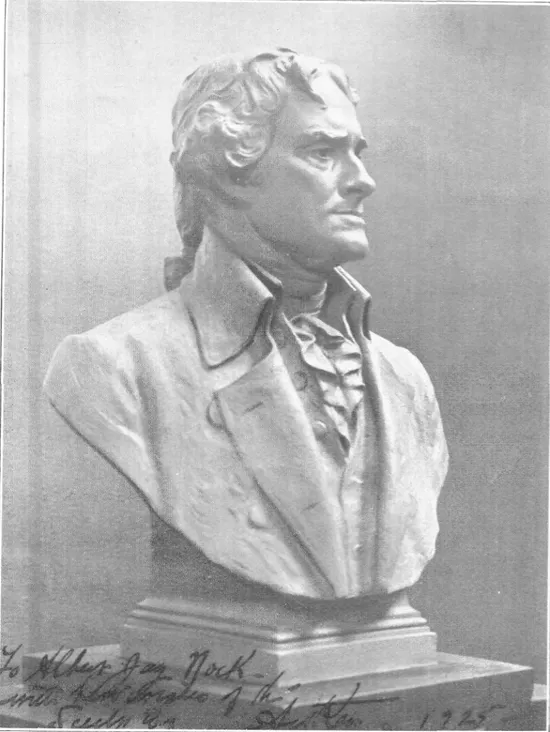
BUST OF THOMAS JEFFERSON BY R. I. AITKEN
In the Hall of Fame, New York
This was intolerable to Hamilton, and he threw himself with frantic energy into compassing the defeat of Burr. After all, Hamilton was a good patriot; it was not out of character that he should expect Burr to treat the country as cavalierly as he had treated him, Alexander Hamilton—l’Etat, c’est moi. All Hamilton’s differences with Mr. Jefferson had been above the plane of political sharp practice, and Mr. Jefferson had always been scrupulous; all the personalities injected into them had been injected by himself. Of the two calamities, therefore, Mr. Jefferson’s election was preferable. “Upon every virtuous and prudent calculation,” Hamilton wrote Wolcott, “Jefferson is to be preferred. He is by far not so dangerous a man; and he has pretentions to character.”
Hamilton’s authority had by this time so far weakened, however, that if Burr had done a hand’s turn for himself, he would no doubt have got enough Federalist support to carry him through. But he had said he would not contest the election with Mr. Jefferson, and he kept his word, behaving, according to Mr. Jefferson’s testimony, in an “honourable and decisive” way. One may say without the least disparagement of Burr, that this was wise. The country was in an ugly and dangerous mood, exasperated by the obstructionist tactics displayed at the election, and quite up to the mark of violence, if need be, in behalf of seeing the popular mandate carried out. Burr would not treat, would not put in an appearance; he remained in seclusion at Albany. Mr. Jefferson was warily approached for an understanding. If he would not disturb the fiscal system, not lean too far to the French side, not shut off development of the navy and not sweep out all the Federalist officeholders, there would be no trouble about electing him. He declared unequivocally “that I would not receive the government on capitulation, that I would not go into it with my hands tied.” On these terms he stood, and on these terms he was finally elected, after protracted obstructionism by the “circle of cabal, intrigue and hatred” had brought the country to the verge of general insurrection.
II
What was needed was peace. In his first month of office, Mr. Jefferson wrote his old friend John Page that he was “very much in hopes we shall be able to restore union to our country. Not indeed that the Federal leaders can be brought over. They are invincibles; but I really hope their followers may. The bulk of these last were real republicans, carried over from us by French excesses. ... A moderate conduct throughout, which may not revolt our new friends and may give them tenets with us, must be observed.” In the same month he made similar professions to Gerry and Gates of his hopes of “uniting a great mass of confidence.” In fact, the opposition party was pretty well disintegrated, and its flotsam and jetsam was in an approachable mood. The thing now was to soften asperities and let them melt out of minds already tired of them, to cultivate confidence and good temper.
Hamilton’s general system, he saw, was a fixture. “We can pay off his debts in fifteen years,” he said, mournfully, “but we can never get rid of his financial system.” If the government had only started differently—but a ship can not turn around in its own length. “When the government was first established, it was possible to have kept it going on true principles, but the contracted, English, half-lettered ideas of Hamilton destroyed that hope in the bud.” This was a characteristically sanguine view, and hardly tenable, underestimating as it does so grotesquely the lure of “public plunder.” Hamilton’s achievement could not be seriously meddled with; one must trust to time and a wider-spread enlightenment for that. “It mortifies me to be strengthening principles which I deem radically vicious, but this vice is entailed on us by the first error. . . . What is practicable must often control what is pure theory.” To be a Strafford and go in for a policy of “thorough,” ended disastrously, even under a monarchy; and the end of the Federalists showed what would happen in a republic.
Nevertheless a great deal could be done for the producer. Deflation of the public debt was out of the question, but the debt could be paid, thus drying up one contaminating stream at its source. On the eve of taking office, Mr. Jefferson wrote Samuel Adams of the “portentous aspect” presented by “a debt of a hundred millions, growing by usurious interest, and an artificial paper phalanx overruling the agricultural mass of our country.” To get rid of this, he was for “applying all the possible savings of the public revenue.” The Administration began its programme of economy, which Mr. Jefferson placed “among the first and most important of republican virtues,” with the appropriations for military purposes. The army was cut down to a skeleton, and naval construction stopped—and thus perished the Federalists’ covert plans for summary dealing with proletarian insurrection at home and contested markets abroad. The newly-created courts were abolished, and the Secretary of the Treasury, Gallatin, was set at work to rat-proof every avenue of access to public money. The law was laid down to him by an exacting and realistic master. Mr. Jefferson was ready to acknowledge always that the technique of finance was “foreign to his nature,” but he knew well enough what general results he wanted, and, in a general way, how to get them. He had told Madison four years before, that “the accounts of the United States ought to be, and may be, made as simple as those of a common farmer, and capable of being understood by common farmers.” He now served notice on Gallatin of his desire to see “the finances of the Union as clear and intelligible as a merchant’s books, so that every member of Congress and every man of any mind in the Union, should be able to comprehend them, to investigate abuses and consequently to control them.” He was severe upon the esoteric methods pursued by Gallatin’s predecessors, especially by Hamilton—methods which came under particular suspicion by reason of the outbreak of unaccountable fires among the Treasury records on the eve of Gallatin’s accession to office. “Alexander Hamilton,” Mr. Jefferson wrote in a memorandum to Gallatin,
in order that he might have the entire government of his [political] machine, determined so to complicate it that neither the President nor Congress should be able to understand it or to control him. He succeeded in doing this, not only beyond their reach, but so that at length he could not unravel it himself. He gave to the debt in the first instance, in funding it, the most artificial and mysterious form he could devise. He then moulded up his appropriations of a number of scraps and remnants, many of which were nothing at all, and applied them to different objects in reversion and remainder, until the whole system was involved in impenetrable fog; and while he was giving himself the airs of providing for the payment of the debt, he left himself free to add to it continually, as he did in fact, instead of paying it.
Plain going was to be the rule. Along with the enormous reduction in governmental expenditure, went a considerable lightening of taxes on production. The excise was abolished, to the great relief of a multitude of small remote farmers, especially in Pennsylvania, who could neither transport their corn nor find a market for it until they had converted it into whisky. Direct taxes of various kinds, projected in the war-fever of 1798, all went. At the end of his first term, Mr. Jefferson was able to proclaim that “it may be the pleasure and pride of an American to ask what farmer, what mechanic, what labourer, ever sees a tax-gatherer of the United States.” This was literally true; yet there were taxes remaining on certain articles of ordinary use, like salt, sugar, tea and coffee, which the consumer paid indirectly, beside a tariff on foreign goods, which had the inevitable stiffening effect upon general prices. Mr. Jefferson’s imperfect acquaintance with economics comes out in a suggestion to Gallatin about the tax on sugar and salt, which worried him a little, but which he could hardly see a way to get rid of without too much loss of revenue. In the strange belief that a tariff-tax stays where it is put, he wrote Gallatin that he wished “it were possible to increase the impost on any articles affecting the rich chiefly, to the amount of the sugar-tax, so that we might relinquish that at our next session.” Nor did he foresee the most unwholesome social consequence of the immense impetus that would be given to unlimited private land-monopoly by his cherished plan to clear off the public debt by the sale of Western lands.
He was able to do another great service to the producing interests, as he thought, by the purchase of the territory known as Louisiana—comprising, roughly, everything between the Mississippi and the Rocky Mountains—which had lately been ceded to France by Spain. There was also good politics in the purchase. The Mississippi was the avenue of transportation for all the products of the West, and with its outlet at New Orleans in possession of an energetic marauding foreign Power, there was bound to be trouble. The contingency that he foresaw while ambassador at Paris had come to pass. “Spain might have retained [New Orleans] quietly for years,” he wrote Robert Livingston. “Her pacific dispositions, her feeble state, would induce her to increase our facilities there, so that her possession of the place would hardly be felt by us. . . . Not so can it ever be in the hands of France.” What Mr. Jefferson chiefly dreaded in the event of a brush with France, was the inevitable political rapprochement with the other great predatory Power, England. “The day that France takes possession of New Orleans . . . seals the union of two nations who in conjunction can maintain exclusive possession of the ocean. From that moment we must marry ourselves to the British fleet and nation. We must turn all our attention to a maritime force . . . and . . . make the first cannon which shall be fired in Europe the signal . . . for holding the two continents of America in sequestration for the common purposes of the united British and American nations.”
This was a detestable prospect, for English influence had already far too strong a foothold in America to suit him. Curiously, however, it was always the external and superficial aspects of this influence that mostly concerned him. He continually mistook these for its underlying reality, and hence his exertions against it were robbed of a good deal of force. Three years before, for example, he wrote Gates that he wished “any events could induce us to cease to copy [the British governmental] model, and to assume the dignity of being original. They had their paper system, stockjobbing, speculations, public debt, moneyed interest, etc., and all this was contrived for us. They raised their cry against Jacobinism and revolutionists, we against democratic societies and anti-Federalists.” It was never thoroughly clear to Mr. Jefferson that this fiscal apparatus was contrived for America, by no means because it was British, but because there was money in it—because it was the most effective engine of exploitation by the “rich and well-born.” The only essential difference between government by the “rich and well-born” in a hereditary aristocracy, as in the France of Mr. Jefferson’s day, and in a republic, is that the former is a closed corporation, while the latter, by an indefinite extension of the cohesive power of public plunder, admits a steady accession of outsiders. In these respects Britain, being so largely an industrial and trading nation, most nearly resembled a republic, and her institutional safeguards of exploitation were most appropriate to republican conditions.
Mr. Jefferson sometimes caught glimpses of the rootvice of British influence in America, but his mind quickly reverted to its superficial appearances in matters of mere mode, fashion, predilection. Thus after the war of 1812, he wrote Cæsar Rodney that “their merchants established among us, the bonds by which our own are chained to their feet, and the banking combinations interwoven with the whole, have shown the extent of their control.” But he is chiefly worried by externalities that by comparison appear insignificant, by “the mimicry I found established of royal forms and ceremonies” under Washington; by “monarchism which has been so falsely miscalled Federalism”; by those who have “covered their devotion to monarchism under the mantle of Federalism.” There is great unconscious humour in his fine-spun analysis written to John Mellish as late as 1813. “Anglomany, monarchy and separation [i.e., secession] then, are the principles of the Essex Federalists, Anglomany and monarchy those of the Hamiltonians”—when, as the most obscure pamphleteer of the period knew, what really animated and held these people together was a predatory economic interest.
The purchase of Louisiana, then, would keep the country politically independent of England. It would also close the possibility of capture by British forces. In one of Mr. Jefferson’s first official opinions as Secretary of State, he committed himself unreservedly upon this peril. “I am so impressed with the magnitude of the dangers which will attend our government if Louisiana and the Floridas be added to the British Empire, that in my opinion we ought to make ourselves parties in the general war expected to take place, should this be the only means of preventing the calamity.” Mr. Jefferson had long contemplated buying the territory, but did not imagine at the moment, apparently, that Bonaparte would let it go. He gave large discretionary powers to Monroe, but opened negotiations only for New Orleans and the adjacent Floridan regions. Bonaparte backed and filled awhile, and ended by abruptly offering to close out the entire French possession. This was good business on both sides. Bonaparte needed the money, and he had too many military engagements on his hands to take care of pregnable holdings so far away. On the American side, there were Constitutional difficulties in the way of incorporating foreign territory into the United States, but the Administration went ahead on its own, and the bargain was closed.
In themselves, these difficulties did not worry Mr. Jefferson greatly. He had no doubt about the sentiment of the country. “It is the case of a guardian,” he wrote Breckenridge, “investing the money of his ward in purchasing an important adjacent territory, and saying to him when of age, I did this for your own good; I pretend to no right to bind you; you may disavow me and I must get out of the scrape as I can.” What worried him was that any play of fast and loose with the Constitution “presents a handle to the malcontents among us,” and might offset the overtures he had been making to the rank and file of the Opposition. But as it turned out, he had little to fear. The “invincibles,” especially those of the Essex Junto, had an uncommonly keen business sense. They did not like the prospective attenuation of New England’s hegemony through the admission of Western States; yet Louisiana was a dazzling vision for the land-monopolist—if it was a boon to the agrarian producer, it was a godsend to the speculator. So, after some formal objection and a vote of record in the Senate, the question of Constitutionality was quietly allowed to lapse. On the popular side, too, the purchase rather let the wind out of current gossip about Mr. Jefferson’s pro-French predilections. Apprehensions of objection from the British Government likewise turned out to be groundless. When the news of the sale reached the British Foreign Office, Lord Hawkesbury said graciously that he was very glad to hear it. There seems no reason why not. Loose British capital could, as it so abundantly did, find a safe investment there, and wax fat indefinitely on the rise in land-values produced by the continuous increase of population. American labour and capital would do all the work of development, and the British monopolist would appropriate the increment of value; and this, naturally, from the point of view of the British Foreign Office, would be a fair and laudable division of responsibility.
The industrial and commercial interests fared better under Mr. Jefferson than they expected. He did not harry them, and his views on the tariff and his unconcern with land-monopoly helped them. At the end of a year, Hamilton congratulated him and praised the impartiality of his Administration; and so did his old colleague in Washington’s Cabinet, General Henry Knox, who had lately gone into bankruptcy for $400,000, and was in a chastened frame of mind. Mr. Jefferson had an extremely low opinion of Knox in his public capacity, leaving record that he thought him a fool and a blabber; but he replied politely, though rather dryly, that “union is already effected from New York southward almost completely. In the New England States it will be slower than elsewhere, from peculiar circumstances better known to yourself than to me. But we will go on attending with the utmost solicitude to their interests and doing them impartial justice, and I have no doubt they will in time do justice to us.” In his dealings with the banks, he showed that two could play the game of building up capitalist support by the use of public money. “It is certainly for the public good,” he wrote Gallatin in 1802, “to keep all the banks competitors for our favours by a judicious distribution of [public funds in deposit] and thus to engage the individuals who belong to them in support of the reformed order of things, or at least in an acquiescence under it.” Some months later he wrote him again that “I am decidedly in favour of making all the banks Republican by sharing deposits among them in proportion to the dispositions they show. . . . It is material to the safety of Republicanism to detach the mercantile interest from its enemies and incorporate them into the body of its friends.”
This little transaction with the banks, however, was about all he attempted to do by power of the loaves and fishes. By cutting down the number of Federal offices about one-half, he made an astonishing and spectacular voluntary reduction in his resources of patronage; nor, except in one instance, did he employ the remainder for partisan purposes. On the personal side, he saw as clearly as any one the practicability of a strong political machine, and he was well aware that no ruler on earth had such enormous machine-power as the Constitution permitted a President to develop and use. “A person who wishes to make [patronage] an engine of self-elevation may do wonders with it,” he wrote James Sullivan in 1808, and as he surveyed the “madness and extravagance” of the Federalists in 1798, he wrote John Taylor that “those who have once got the ascendency and possessed themselves of all the resources of the nation, their revenues and offices, have immense means for retaining their advantage.” This was part of the Constitutional system devised in behalf of the “rich and well-born”; the Constitution was meant to work that way, and it did. But he was not disposed to take advantage of this. “The elective principle becomes nothing,” he said, “if it may be smothered by the enormous patronage of the General Government.” He made few removals, and those only “who had signalized themselves by their own intolerance in office”—about fifteen, in all—with some who were removed “for such delinquencies as removed the Republicans equally.” All this wretched peddling business of office-mongering was gall and wormwood to him. “The ordinary affairs of a nation offer little difficulty to a person of any experience,” he wrote Sullivan plaintively, “but the gift of office is the dreadful burthen that oppresses him.” Republican officeseekers were like any other; they came to Washington hungry, and, when disappointed, were ready to fry the President alive for breakfast. “Every office becoming vacant, every appointment made, me donne un ingrat et cent ennemis” In 1799, before he had practical experience of the fact, he remarked to Tench Coxe the great truth that “whenever a man has cast a longing eye on offices, a rottenness begins in his conduct”; and now he found that “the task of appointment is a heavy one indeed. He on whom it falls may envy the lot of a Sisyphus or Ixion. Their agonies were of the body; this of the mind. Yet, like the office of hangman, it must be executed by some one. It has been assigned to me and made my duty. I make up my mind to it therefore, and abandon all regard to consequences.”
The one exception to his impartial use of patronage was in the case of the implacable State of Connecticut. At the outset he served notice on his Attorney-General, Levi Lincoln, a Massachusetts man, as explicitly as he did on Gallatin, that the hard-shelled irreconcilables of the Federalist group should be fed on the bread of affliction until they brought forth works meet for repentance. Sedgwick, Cabot, Gore, Higginson, Pickering and the Family Compact of Connecticut, were fair prey; the game-law was out on them. “While we associate with us in affairs, to a certain degree, the Federal sect of Republicans, we must strip of all the means of influence the Essex Junto and their associate monocrats in every part of the Union.” Connecticut stood out stiffly; no Republican need apply for a State office in Connecticut. Mr. Jefferson noted this with disapproval, and put his back up. “Our gradual reformations seem to produce good effects everywhere except in Connecticut. Their late session of Legislature has been more intolerant than all others. We must meet them with equal intolerance. When they will give a share in the State offices, they shall be replaced in a share of the general offices. Till then, we must follow their example.”
Economy furnished Mr. Jefferson a good pretext for indulging his inveterate dislike of ceremonial formalities. “We have suppressed all those public forms and ceremonies which tended to familiarize the public eye to the harbingers of another form of government,” he wrote Kosciusko in 1802. When the House cut down Washington’s official title to a bare designation of office, Mr. Jefferson wrote Carmichael that he hoped “the terms of Excellency, Honour, Worship and Esquire, forever disappear from among us from that moment. I wish that of Mr. would follow them.” All his life, when writing formally in the third person, he rarely applied this last title to himself, except when not using it would have been at the price of ostentation; but on the other hand, he was invariably punctilious about the formal title of address to others. As President, he made a clean sweep of levees, parades, reviews, and public functions of a decorative character. These things cost money. Rules of precedence were superseded by the simple arrangements established by general good taste in ordinary unofficial society. Mr. Jefferson’s associates in office were men of dignity and good manners, so the plan worked well and produced a good effect at large. Thomas Moore, the poet, did not relish it; he was highly critical of the undistinguished treatment he received at the White House. The British Minister, too, an odd kind of fussbudget who bore the ill-assorted name of Merry, and who, as Mr. Jefferson remarked, had learned nothing of diplomacy but its suspicions, most unhumorously worked himself up into a great tantrum over a dinner at the White House, because Mr. Jefferson, who had asked Mrs. Madison to preside at his table, offered his arm to her instead of to Mrs. Merry. Poor Mr. Merry’s confidence in republican institutions was still further undermined when, calling at the White House on business at an irregular hour, he was received by Mr. Jefferson in slippers and a dressing-gown. Mr. Merry seems to have made these incidents the basis of a report to his Government, and to one of them is probably due the persistent tradition, otherwise quite devoid of foundation, that Mr. Jefferson was habitually careless and slipshod in his dress. According to Mr. Jefferson, however, the grey mare was so much the best horse in Mr. Merry’s stable that Mr. Merry had to trot to her gait, though otherwise “personally as desirable a character as could have been sent us,” and Mr. Jefferson would be sorry to lose him “as long as there remains a possibility of reclaiming him to the exercise of his own dispositions.” Every concession, every allowance should be made to the wretchedness of a henpecked man, and “if his wife perseveres, she must eat her soup at home, and we shall endeavour to draw him into society as if she did not exist.”
At the beginning of his Administration, Mr. Jefferson wrote a friend that “the path we have to pursue is so quiet that we have nothing scarcely to propose to our Legislature. A noiseless course, not meddling with the affairs of others, unattractive of notice, is a mark that society is going on in happiness.” At the end of his first term, he recapitulated the achievements of his Administration during four years of strict sticking to this noiseless course. “To do without a land tax, excise, stamp tax and the other internal taxes, to supply their place by economies so as still to support the government properly and to apply $7,300,000 a year steadily to the payment of the public debt; to discontinue a great portion of the expenses on armies and navies, yet protect our country and its commerce with what remains; to purchase a country as large and more fertile than the one we possessed before, yet ask neither a new tax nor another soldier to be added, but to provide that that country shall by its own income pay for itself before the purchase-money is due; to preserve peace with all nations, and particularly an equal friendship to the two great rival Powers, France and England, and to maintain the credit and character of the nation in as high a degree as it has ever enjoyed; are measures which I think must reconcile the great body of those who thought themselves our enemies.”
Indeed, they commanded the praise even of the unreconciled, for never since the time of the Antonines, if then, was seen anything comparable to the disinterestedness of this Administration. Erasmus made it a mark of true Christians that “they should be so blameless as to force infidels to speak well of them.” In 1828, after years spent in vitriolic hatred of Mr. Jefferson, John Randolph of Roanoke said in a public speech, “Sir, I have never seen but one Administration which seriously and in good faith was disposed to give up its patronage, and was willing to go farther than Congress, or even the people themselves, so far as Congress represents their feelings, desired; and that was the first Administration of Thomas Jefferson. He, sir, was the only man I knew or ever heard of, who really, truly, and honestly, not only said Nolo episcopari, but actually refused the mitre.”
III
In the full tide of a popularity as great as Mr. Jefferson’s, at about the same age, and from a far more exalted eminence in life—a solitary stylite, indeed, upon the august and unapproachable pinnacle of Roman rulership—Marcus Aurelius looked back upon the fate of famous men, “Camillus, Cæso, Valesus, Leonatus, and a little after also Scipio and Cato, then Augustus, then also Hadrian and Antoninus,” his own fosterfather and predecessor. Even their names seemed now in a manner antiquated. “And this I say of those who have shone in a wondrous way. For the rest, as soon as they have breathed out their breath, they are gone and no man speaks of them. And, to conclude the matter, what is even an eternal remembrance? A mere nothing.” As his first term in the Presidency ended, Mr. Jefferson’s mind took the same turn. Great men had lately gone—Samuel Adams, Alexander Hamilton, Edmund Pendleton, S. T. Mason—and some less eminent but as much beloved, Mann Page, Bellini, Parson Andrews. “To these I have the inexpressible grief of adding the name of my youngest daughter”; for Maria too had gone, as her mother had gone, a sacrifice to the social expectations put upon wifehood in her day. “This loss has increased my anxiety to retire, while it has dreadfully lessened the comfort of doing it.” But he had no serious thought of retiring. Midway of his policies, he felt obliged “to appeal once more to my country for a justification. I have no fear but that I shall receive honourable testimony by their verdict.”
He kept the line clear between official and personal popularity, in the face of extraordinary temptations to further the one by use of the other. Even to the last days of his Presidency he returned insignificant presents made him by admiring friends. Four months before his final retirement, he sent back to Samuel Hawkins an ivory cane, with a courteous letter of thanks, mentioning the rule that he had laid down for himself, and pleading his wish “to retain that consciousness of a disinterested administration of the public trusts which is essential to perfect tranquillity of mind.” When citizens of Boston proposed to make his birthday a holiday, he wrote them that he did not approve of “transferring the honours and veneration for the great birthday of our Republic to any individual, or of dividing them with individuals,” and that therefore he declined letting the date of his birth be known; and it remained unknown until some time after his death. He declined to make any public appearances. Sullivan suggested a swing around the circle, to let the people, particularly in the North, have a look at their popular President and see what he was like. He replied austerely that he was “not reconciled to the idea of a chief magistrate parading himself through the several States as an object of public gaze and in quest of an applause which, to be valuable, should be purely voluntary. I had rather acquire silent good will by a faithful discharge of my duties than owe expressions of it to my putting myself in the way of receiving them.” After leaving the White House, his inveterate indisposition to placing himself in any personal way “at the bar of the public” became invincible. He never again went outside his native State; indeed, it may almost be said that he never again set foot off his own property.
With an Epicurean so strongly bent on hiding his life, not much can be done. During the campaign of 1804, Mr. Jefferson remained as usual inactive in his own behalf, and silent under worse partisan defamation, if any could be worse, than was visited on him in 1800. He also kept an unsleeping eye on the political neutrality of his officeholders. Writing to Gallatin a month before the election, he mentions his fear that “the officers of the. Federal Government are meddling too much with the public elections. Will it be best to admonish them privately or by proclamation?” No activity was needed, however, on any one’s part; Mr. Jefferson carried every State but two. The inexorable State of Connecticut went solidly against him with nine electoral votes, and Delaware with three. Two of Maryland’s eleven votes were against him, and the total vote was one hundred and sixtytwo to fourteen.
Undeniably he had a popular mandate; yet hardly had he begun to look about him in his second term before he saw signs of disaffection. He had for a year been anticipating something of the kind. In 1803 he wrote Gallatin that he suspected trouble in Pennsylvania “between the moderates and highflyers,” and he predicted that “the same will take place in Congress whenever a proper head for the latter shall start up.” Sure enough, John Randolph, after a period of restlessness, broke with him, and drew some other Republican leaders together into a small faction which, from its position as a political tertium quid, became known as the Quid faction. Mr. Jefferson’s former Vice-President, Aaron Burr, was also a prolific trouble-breeder. Burr was one of the few towards whom it was temperamentally difficult for Mr. Jefferson to be strictly just. His sharp practice in securing a charter for a company in New York, nominally to provide the city with water but really to start a bank, was exactly the kind of thing that would stick in Mr. Jefferson’s mind. Again, Burr’s attitude towards public office during the preceding Administrations, his way of showing “that he was always at market” when a high military or diplomatic appointment was pending, made a most unplesant impression on Mr. Jefferson. Yet this distrust never degenerated into anything like personal enmity. Mr. Jefferson respected Burr’s ability, and if Burr had not unexpectedly landed in the Vice-Presidency, would have given him a high appointment out of regard “for the favour he had obtained with the Republican party by his extraordinary exertions and successes in the New York election in 1800.” But with the impressions that he had of Burr, “there never had been any intimacy between us and but little association.” Characteristically, he treated Burr with distinguished civility, wished to be just to him, and avoided him as much as he could.
He was slow to believe that Burr’s expedition was directed against the integrity of the Union, but when convinced, he behaved towards Burr with unjustifiable severity. His preceptors, Wythe and Small, might have shaken their heads gravely at their “man of science” prejudging Burr’s guilt while the matter was still at issue before the court. It now seems improbable that Burr was guilty as charged. Quite possibly his advertised purpose of setting up a colonizing project on an old land-grant issued to a Baron Bastrop was his real purpose, or at most, he may have contemplated ultimately some such land-grabbing enterprise as was carried out in 1836 by Houston. It is at all events certain that Mr. Jefferson’s confidence in General Wilkinson, his principal informant, was misplaced. Probably therefore, Burr’s trial resulted accidentally in substantial justice, notwithstanding its character of sheer travesty. The spirit of Mercutio may indeed have given an unconscious import to the action of a mob in Baltimore, which at the close of this discreditable performance burned in effigy both Burr and the presiding judge, John Marshall.1
Foreign relations involved Mr. Jefferson in further factional difficulties. England and France were again at war, each trying to draw in the United States against the other; England, moreover, according to her invariable policy, trying at the same time to cripple the rising commercial power of a potential rival. Both nations vigorously exercised piracy against American trade, leaving Mr. Jefferson’s margin of choice a narrow one. War with both Powers was out of the question; war with either was highly inadvisable at the time, as it meant not only a great debt, but an impracticable interruption of the policy of domestic development. “If we go to war now,” Mr. Jefferson wrote Monroe, “I fear we may renounce forever the hope of seeing an end of our national debt. If we can keep at peace eight years longer, our income, liberated from debt, will be adequate to any war, without new taxes or loans, and our position and increasing strength put us hors d’insulte from any nation.” Any increase in the national debt, or any slowing-up of its discharge, meant just so much strengthening of exploiting power directed against the producer. After the battle of Trafalgar, he saw that war with England was coming, but he was for holding off for a fair prospect that “by war we should take something and lose less than at present.” Perhaps, too, if the United States persisted in passive neutrality, self-interest might induce the belligerents to stop their depredations on American trade; they might see that by sweeping American trade off the ocean, they hurt themselves more than they hurt the United States. Meanwhile, one of two things might be done. The Administration might give formal notice of the state of war in Europe, and proclaim that every American ship that left its native waters did so at its own risk. Instead of this, Mr. Jefferson proposed a measure wholly subversive of the principle of liberty, and fraught with far more serious economic consequences and with political consequences at least as serious. In fact, the most arbitrary, inquisitorial and confiscatory measure formulated in American legislation up to the period of the Civil War was the Embargo Act.
The agrarians bore its hardships with fair patience, and the other producing interests displayed a good measure of fortitude, but the capitalist, industrial and trading interests went into paroxysms of indignation. In the long-run, the Act worked out far better for these latter than for the producing interests, but their view of its incidence was as short as Mr. Jefferson’s own. The difficulty of enforcement was immense. “The Embargo law is certainly the most embarrassing one we have ever had to execute.” Mr. Jefferson wrote naively to Gallatin, “I did not expect a crop of so sudden and rank growth of fraud and open opposition by force could have grown up in the United States.” Its political consequences were easily predicable. “Our Embargo has worked hard,” Mr. Jefferson wrote to Short. “It has in fact Federalized three of the New England States.” It did worse than that; it brought a threat of secession, under which Congress repealed the measure, the repeal to become effective on the day that its author retired from the Presidency. “I yielded, with others,” Mr. Jefferson said, “to avoid a greater evil.” But he never lost faith in the policy of the Embargo, and seems never to have had an inkling of its economic unsoundness. He was aware in 1808 that “should neither peace nor a revocation of the decrees and orders in Europe take place, the day can not be distant when the Embargo will cease to be preferable to open hostility.” He was also aware that since the Embargo had been running fifteen months, the loss in exports came to more than the cost of war, “besides what might be got by reprisal.” This consideration helped somewhat in reconciling him to the repeal. Nevertheless he persisted in believing that a continuance of the Embargo for two months longer would have effected its purpose, and would have averted the War of 1812.
IV
Mr. Jefferson’s imperfect sense of the economic causes that lie behind political development did not permit him to foresee the shift of his adversaries to their permanent stronghold in the Judiciary. Yet this shift was natural and inevitable. All that could be done through the legislative and executive branches had been done. The thing now necessary was to develop a central instrument of political power which should be permanent, independent of the elective principle and able to overrule it when, as happened in 1800, a popular majority should vote itself into control of these branches and administer them into inimical courses. The power of the Federal Judiciary was available as an instrument of absolutism, and to it accordingly the monopolist and exploiting interests of the country immediately took recourse.
Even after the fact, Mr. Jefferson was slow to get the bearings of this shift, and their economic rationale, indeed, he never got. Even in the last year of his life, he wrote about the subject with a simplicity almost naïve; his view of the process was so clear, and yet his understanding of its purpose remained so limited. “At the establishment of our Constitutions the judiciary bodies were supposed to be the most helpless and harmless members of the Government. Experience, however, soon showed us in what way they were to become the most dangerous; that the insufficiency of the means provided for their removal gave them a freehold and irresponsibility in office; that their decisions, seeming to concern individual suitors only, pass silent and unheeded by the public at large; that these decisions, nevertheless, become law by precedent, sapping little by little the foundations of the Constitution and working its change by construction, before any one has perceived that the invisible and helpless worm has been busily employed in consuming its substance.”
Nothing could be clearer than this view of the dangers of centralization in government, and that of the Judiciary as a centralizing agency. If this process went on, he saw plainly that the condition of Americans would be “as in Europe, where every man must be either pike or gudgeon, hammer or anvil. Our functionaries and theirs are wares from the same workshop, made of the same materials and by the same hands. In 1800 he wrote Granger of his belief that “a single consolidated government would become the most corrupt government on earth”; and twenty-one years later he remarked to Macon that “our Government is now taking so steady a course as to show by what road it will pass to destruction, to wit: by consolidation first, and then corruption, its necessary consequence. The engine of consolidation will be the Federal Judiciary; the other two branches the corrupting and corrupted instruments.” He also wrote William Johnson in 1823 that there was no danger he apprehended so much as “the consolidation of our Government by the noiseless and therefore unalarming instrumentality of the Supreme Court. This is the form in which Federalism now arrays itself, and consolidation is the present principle of distinction between Republicans and the pseudo-Republicans, but real Federalists.”
But why? What was the substantial motive of this surreptitious movement towards centralization? Mr. Jefferson was almost in full view of it when he observed to Granger in 1800, “What an augmentation of the field for jobbing, speculating, plundering, office-building and office-hunting would be produced by an assumption of all the State powers into the hands of the General Government!” Twenty-five years later, with almost his last breath, he speaks to Giles of those who “now look to a single and splendid Government of an aristocracy founded on banking institutions and moneyed corporations, under the guise and cloak of their favoured branches of manufactures, commerce and navigation, riding and ruling over the plundered ploughman and beggared yeomanry.” Here he comes plump upon the essential fact of a government fashioned for the distribution of wealth by political means rather than by economic means—for the economic exploitation of one class by another. But he did not recognize this fact when he saw it, for in his next sentence he reverts to his old bugbear—“This will be to them a next best blessing to the monarchy of their first aim, and perhaps the surest stepping-stone to it!” Yet the only conceivable practical gain by monarchy is absolutism, and if absolutism can be effected quite as well by the native mechanism of a Federal Judiciary, why trouble to import the foreign mechanism of monarchy?
Yet though his mind never correctly interpreted it, his instinct somehow felt this essential fact as the one that justified his opposition to a strong centralized government. It is mere idleness to think of the author of the Embargo Act as a doctrinaire enemy of strength in government. It is quite as idle to think of one who wrote as Mr. Jefferson did repeatedly in 1787 about the coercion of the States under the Articles of Confederation, as a doctrinaire enemy of centralization. If the Articles were not specific enough, he was for construing them quite as loosely as John Marshall himself might have done. “The coercive powers supposed to be wanting in the Federal head, I am of opinion they possess by the law of nature which authorizes one party to an agreement to compel the other to performance.” His instinctive objection was not to strength, but to irresponsibility; not to centralization in itself, but as an engine of exploitation. He never failed in respect to his old doctrine that “the people who constitute a society or nation [are] the source of all authority in that nation”; that they properly exercise that authority on the elective principle, as far as it will go, and then on the principle of revolution; and that “the people are the only censors of their governors.” In purchasing Louisiana, and in the matter of the Embargo, he had acted as an elected agent, answerable for the exercise of discretion in extraordinary circumstances. If the people did not like what he had done, they were “free to transact their common concerns by any agents they think proper; to change these agents individually, or the organization of them in form and function, whenever they please.” His exercise of power in laying down the Embargo Act, and in the unexampled severities of its enforcement, was the act of a strong central authority, but a responsible authority. With the eye of instinct he saw a great difference between this and a progressive insidious refashioning of government with intent to nullify the elective principle and abrogate official responsibility—and all for the final purpose of putting the legality of economic exploitation forever beyond the reach of both.
His second term was a steady fight against this process. He saw the Judiciary, led by “a crafty chief judge who sophisticates the law to his mind by the turn of his own reasoning,” made up of non-elective officers installed for life and answerable to none—for impeachment, as he found in the case of Justice Chase, was “not even a scarecrow”—he saw these functionaries “construing our Constitution from a co-ordination of a general and special government to a general and supreme one alone. This will lay all things at their feet.” When the case of Marbury vs. Madison was cited in the Burr trial, he took the ground that the material point in the Supreme Court’s decision—the point that Constitutional interpretation was a fixed function of the Court—was a “gratuitous opinion” on a hypothetical matter not properly within the contemplation of the Court, and was therefore not law. “The judges in the outset disclaimed all cognizance of the case, although they then went on to say what would have been their opinion had they had cognizance of it. This, then, was confessedly an extra-judicial opinion, and as such, of no authority.” He moreover gave notice that if need be, he would meet the Court’s encroachments with his old weapon of nullification by the Executive. “I should be glad therefore,” he wrote the Federal prosecutor in charge of the proceedings against Burr, “if in noticing that case you could take occasion to express the determination of the Executive that the doctrines of the case were given extra-judicially and against law, and that their reverse will be the rule of action with the Executive.”
But he always lost. The Chief Justice’s “twistifications in the case of Marbury, in that of Burr and the Yazoo case, show how dexterously he can reconcile law to his personal biasses.” They showed more than that; they showed how completely the Chief Justice was in the economic tradition of the Fathers. His decisions in these cases, with his subsequent decisions in the cases of McCulloch, Dartmouth College and Cohens, made the economic system of the United States, which was contemplated by the Constitution, formulated by Hamilton, put in operation by the Administrations of Washington and Adams, forever impregnable.
V
“The present principle of distinction between Republicans and the pseudo-Republicans, but real Federalists.” One may pause upon these words. In his reflections on the schisms and defections that took place in his second term, discovering himself so much alone in his resistance to the surreptitious structural refashioning of the government, Mr. Jefferson, like Hamilton, failed to reckon with one most important effect of the cohesive power of public plunder. With America opening as the land of unprecedented monopolist opportunity, men would of course be impelled to get out of the producing class and into the exploiting class as quickly as possible. It was not hard to foresee a time when, for instance, the greatest producing industry of the country, agriculture, would be exploited to the point of bankruptcy as an industry, leaving the rise in land-values as the only source of profit to the agriculturists. Nor, considering the tendency just mentioned, would it be hard to predict that the political will of the landowning agriculturalists themselves would be chiefly responsible for this breakdown. Mr. Jefferson never seemed aware that the prospect of getting an unearned dollar is as attractive to an agrarian as it is to a banker; to a man who owns timber or mineral deposits as it is to one who owns governmental securities or who profits by a tariff. For this reason he could not understand why Republicanism almost at once became a mere name. Nothing could be more natural, however, than for Republicans who saw any chance of participation in monopoly to retain the name and at the same time resist any tendency within the party to impair the system that held out this prospect. The certain course of political development, therefore, was towards bipartisanship; nothing could stop it. Party designation would become, like ecclesiastical designation, a merely nominal matter, determined by family tradition, local or sectional habit, or other causes as insignificant as these. The stated issues between parties would become progressively trivial, and would more and more openly tend to be kept up merely to cover from scrutiny the essential identity of the parties. The effect of this upon the practical conduct of politics would precisely correspond to that which Mr. Jefferson remarked in England. “The nest of office being too small for all of them to cuddle into at once, the contest is eternal which shall crowd the other out. For this purpose they are divided into two parties, the Ins and the Outs.”
Mr. Jefferson did not distinguish this process of development, even though it went on before his eyes. He had a fanciful theory of his own concerning the natural division of men into parties. “The sickly, weakly, timid man fears the people and is a Tory by nature. The healthy, strong and bold cherishes them and is a Whig by nature.” His only suggestion of an economic influence in the determination of partisanship is in a letter to Joel Barlow in 1802, and is more or less rhetorical. He there classifies “the rich and the corrupt” with the weakly and nerveless, as disposed to see “more safety and accessibility in a strong executive.” So far from seeing an economic interest in the factional divisions among Republicans and in their tendency to amalgamate with the Federalists, he said in 1805 that while the divisions are distressing, they are to be expected, because “the opinions of men are as various as their faces, and they will always find some rallying principle or point at which those nearest to it will unite, reducing themselves to two stations with a common name for each.”
Yet, curiously, no man ever drew a clearer picture of economic motive in party affiliation than Mr. Jefferson did in a letter to Professor Ebeling in 1795. Two parties, he said, exist in the United States:
They embrace respectively the following descriptions of persons. The anti-Republicans consist of:
1. The old refugees and Tories.
2. British merchants residing among us, and composing the main body of our merchants.
3. American merchants trading on British capital, another great portion.
4. Speculators, and holders in the banks and public funds.
5. Officers of the Federal Government, with some exceptions.
6. Office-hunters, willing to give up principles for places—a numerous and noisy tribe.
7. Nervous persons, whose languid fibres have more analogy with a passive than active state of things.
The Republican part of our Union comprehends:
1. The entire body of landholders throughout the United States. .
2. The body of labourers, not being landholders, whether in husbanding or the arts.
Nothing could be more obvious than the generalizations to be made from this, but more than intelligence was needed, to make them. The co-operation of the Zeitgeist was needed, and this was not yet to be had.
VI
Mr. Jefferson’s popularity was temporarily broken in his second term, but he had recovered it at the time of his retirement. He could have been re-elected, but declined to stand. There was “but one circumstance which could engage my acquisecence in another election, to wit: such a division about a successor as might bring in a monarchist”—once more his man of straw. Otherwise, Washington’s example was a good one. “If the principle of rotation be a sound one, as I conscientiously believe it to be with respect to this office, no pretext should ever be permitted to dispense with it, because there never will be a time when real difficulties will not exist, and furnish a plausible pretext for dispensation.” There was another consideration. Like many men of uncommon constitutional strength, whenever any little matter ailed him, he took it as a warning of approaching senility. “You suppose I am ‘in the prime of life for rule,’” he wrote an importunate correspondent, “I am sensible I am not; and before I am so far declined as to become insensible of it, I think it right to put it out of my own power.” He had the satisfaction, too, of knowing that Madison was the kind of successor “to whom I shall deliver the public concerns with greater joy than I received them.”
He went back to Monticello quietly and contentedly, with no pride in his achievements in office, and with a detached point of view upon the prospects for their continuance. John Adams, in one of his moments of greatness, which were many, wrote him in 1813 that “your character in history may easily be foreseen. Your Administration will be quoted by philosophers as a model of profound wisdom; by politicians, as weak, superficial and shortsighted.” Well, possibly; something of the sort might turn out to be true—who can tell? But why attempt to anticipate the definitive judgment of a long future? In the realm of the spirit as in the realm of affairs, Mr. Jefferson’s outlook was always sincerely practical. “We have set a good example,” he said, and more than that he was not disposed to say. As for the ensuing course of public affairs, he was aware that “in every government on earth is some trace of human weakness, some germ of corruption and degeneracy, which cunning will discover, and wickedness insensibly open, cultivate and improve.” One might always hope—indeed, it is one’s duty to do that—but expectations are inadmissible. “A government regulating itself by what is just and wise for the many, uninfluenced by the local and selfish views of the few who direct their affairs, has not been seen, perhaps, on earth. Or if it existed for a moment at the birth of ours, it would not be easy to fix the term of its continuance. Still, I believe it does exist here in a greater degree than anywhere else, and for its growth and continuance I offer sincere prayers,”
1 On the secular side, it is also to be noticed how promptly the familiar plea for the widows and orphans came into the campaign. “Tremble then in case of Mr. Jefferson’s election, all ye holders of public funds,” wrote one impassioned charitarian, “for your ruin is at hand. Old men who have retired to spend the evening of life upon the fruits of the industry have invested their moneys in the public debt, will be involved in one of their youth. Widows and orphans with their scanty pittances. Public banks, insurance companies, literary and charitable institutions, who, confiding in the admirable principles laid down by Hamilton and adopted by Congress, and in the solemn pledges of national honour and property, common, certain and not very distant ruin.”
1 The mob also burned in effigy Luther Martin, one of Burr’s counsel, an able jury lawyer and a mighty devotee of strong drink; and also Blen-nerhassett, the amiable amateur of music and chemistry, whom fate so sadly victimized through his casual acquaintance with Burr. The handbill inviting the public to this event is worth reproducing for the sake of its literary quality. It has been reprinted several times for other purposes, but perhaps never before for the sake of delighting a reader with the superb force and raciness of its style:
AWFUL!!!
The public are hereby notified that four choice spirits are this afternoon to be marshalled for execution by the hangman on Gallows Hill, in consequence of sentence passed against them by the unanimous voice of every honest man in the community. The respective crimes for which they suffer are thus stated in the record:
1. Chief Justice M——, for a repetition of his X. Y. Z. tricks, which are said to have been much aggravated by his strange capers in open court under pleas of irrelevancy.
2. His Quid Majesty, charged with the trifling crime of wishing to divide the Union and farm Baron Bastrop’s grant.
3. Blunderhassett, chemist and fiddler, convicted of conspiracy to destroy the tone of the public fiddle.
4th and last, but not least in crime, Lawyer Brandy-Bottle, for a false, scandalous and malicious prophecy that before six months Aaron Burr would divide the Union.
N.B. The execution of accomplices is postponed to a later day.
Jefferson
Read the whole book online · Book details
Free to read online and to download from this archive.