
Chapter 22 of 25 · Lessons for the Young Economist by Robert P. Murphy
ADVANCED LESSON 22 Government Debt
In this lesson you will learn:
- The difference between government deficits and debt.
- The connection between government debt and inflation.
- How government debt makes future generations poorer.
Government Deficits and Debt
Like a private company, the government takes in revenues which it uses to pay its expenses. Just as a private company can sometimes have periods where its expenses are higher than its revenues, so too for the government. In any particular budget period, the government may want to spend more total money on social programs, the military, and so forth than the government has collected in taxes, fees for the use of public parks, etc. When the government spends more than it takes in, it runs a budget deficit.
In most financial reports and commentary, government deficits are measured on an annual basis. For example, a critic of Ronald Reagan might say, “The U.S. federal budget deficit almost tripled during the 1980s, rising from about $74 billion in 1980 to $221 billion in 1990.”1 Strictly speaking, this sentence only tells us about the federal government’s finances in two different years; the budget deficit in 1980 was the difference between receipts and expenditures in that year, and the deficit in 1990 was the gap ten years later.
Sometimes reporters use sloppy language when reporting on a new government program. For example they might say “Because the new health reform legislation will raise federal spending by $900 billion while increasing taxes by only $800 billion, it will add $100 billion to the deficit over the next ten years.” But since most people use deficit to mean a single-year mismatch between receipts and spending, our reporter’s sentence is confusing. It would be as if a baseball announcer said that the big hitter at the plate had a batting average of 3,000 in his first ten years in the major leagues.
The government deficit measures the difference between spending and receipts during a particular slice of time; it is a flow variable that happens over a period (such as one year). In contrast, the government debt refers to the total amount of money that the government owes to other organizations or individuals.2 The debt is a stock variable meaning that its value is defined at any point in time. For example, it makes sense to ask, “What was the total government debt as of Monday at noon?” But it wouldn’t make sense to ask, “What was the federal budget deficit as of Monday at noon?” unless you implicitly had a previous starting point in mind, so that you were really asking, “How much has the government spent between the start point and Monday at noon, versus how much has it collected in taxes during the same period?”
When the government runs a deficit, it covers the shortfall just as a corporation can: it issues debt, meaning that the government sells Treasury bonds to outside investors.3
Interest on the “National Debt”
When the government borrows money from lenders by selling them government bonds, it must pay them interest. Specifically what happens is that the investors pay less for the bond than the face value,4 with the difference giving rise to the implicit interest return (or yield) on the bond. For example, if an investor buys an IOU from the U.S. federal government promising to pay him $10,000 in exactly one year, but the investor only has to pay (roughly) $9,524 for it, he earns a return of 5% on his money, because $9,524 x 1.05 = $10,000 (roughly).
As the federal budget deficit grows, the interest payments to service that debt (typically) grow as well.5 When people talk of the enormous national debt—by which they almost always mean the U.S. federal government’s debt—they might complain that interest payments are one of the largest spending categories, leaving less money available for other government programs.
The table on page 348 illustrates a hypothetical government’s finances for a three-year period. By walking through the table you will have a much better understanding of government deficits, debt, and interest payments.
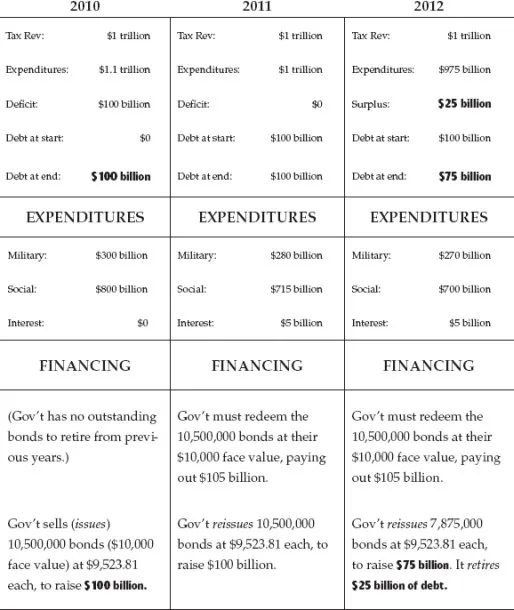
The table above contains a lot of information, but if you spend a few minutes to learn how it works, you will have a good grasp of the mechanics of government debt financing. Here are some general points:
- In any given year (each vertical column), the Tax Revenue is $1 trillion while the Expenditures vary. However, the Expenditures always equal the sum of that year’s spending on Military, Social programs, and Interest on the debt.
- If Tax Revenue is higher than Expenditures, there is a Surplus. If revenues are lower, there is a deficit. If they are equal, the budget is balanced.
- The government debt changes during the course of the year based on that year’s surplus or deficit.
- When the government carries a debt, part of its tax revenues must go to paying interest on the debt. Even if the government balances its budget in a particular year, it has less money available for the military and social programs if it is carrying a debt from earlier years.
- It is not counted as an expense of government when it simply reissues or rolls over debt that is maturing. In the table this happens in the year 2011. The government has a balanced budget, even though technically it must pay out a grand total of $1.1 trillion while tax revenues are only $1 trillion. Of the $105 billion that the government must pay to the bondholders (who purchased bonds in 2010), only $5 billion is considered a government expense—namely an interest expense—for the year 2011. The other $100 billion is simply rolled over by reissuing the same amount of debt in new one-year bonds.
- At any given time, the outstanding government debt is simply the present market value of the government bonds held by the public. This number is lower than the summation of the face value of all the outstanding bonds, because the government is not obligated to pay the full face value until the actual time of maturity. When that event is still in the future, the government’s contractual obligation is discounted by the interest rate (5% in our example).
In our example, the government’s debt always consists entirely in one-year bonds. In the real world the government spreads its debt among bonds of varying maturities (1-month, 3-months, 6-months, 1-year, 5-years, etc.). This allows the government to plan its finances more accurately by “locking in” interest rates for longer than one year when it borrows money.
Government Debt and Inflation
It is very common among the lay public and even sophisticated financial analysts to associate government debt with rising prices. Whenever the U.S. government runs a particularly high budget deficit, for example, many people will say, “This will hurt the dollar and cause [price] inflation.”
There is certainly an element of truth to this popular association, and there is also a decent (though far from tight) historical correlation between the U.S. federal debt and the CPI:

Yet even though there is apparently a general connection between government debt and rising prices, it’s important to use sound economic theory to understand why this should occur. The first important point is that a government budget deficit by itself is NOT inflationary. When the government runs a deficit and borrows money by issuing new bonds, it does not create new money in the economy. On the contrary if the government runs a deficit of (say) $200 billion, it means that other people in the economy have that much less money in their possession. They hand $200 billion in money to the government, in exchange for IOUs issued by the Treasury U.S. government bonds are very liquid (marketable) financial assets, but they are not the same thing as U.S. dollars—they are not money. In this narrow respect, a federal budget deficit is no more inflationary than a private corporation’s decision to borrow money from the public.
But there is more to the story. All we have really established is that by itself a government budget deficit doesn’t create new dollars, and therefore should not have any direct influence on the prices of goods and services in the United States. In practice, however, government budget deficits provide a strong incentive for the Federal Reserve to create more U.S. dollars. In the first place, price inflation tends to lighten the “real” burden of debt. By raising prices throughout the economy—including wages and salaries—through the creation of new dollars, the Federal Reserve can indirectly boost tax revenues for the federal government. This makes it easier to afford the fixed dollar payments on debt, especially long-term debt that was originally issued many years earlier.6
The more basic connection between government debt and inflation is simple: When the government wants to spend an incredible amount of money—such as during a world war—it can only raise so much through taxes. Then it can only raise so much more through borrowing. At that point, if the government still wants to spend more money, it turns to the printing press.
Suppose the government wants to spend $6 trillion, and only has tax revenues of $2 trillion. The government in principle could borrow the remaining $4 trillion, but investors would become nervous at such a large sum and might demand a much higher than normal interest rate. Furthermore, the public might balk at such a huge deficit (as a fraction of the total budget) and insist that the government slash its spending. In this pickle, then, the government might only borrow $1 trillion, and then literally create the extra $3 trillion in new money, in order to pay its bills. The government would be employing its position as the money monopolist in the exact same way that a private sector counterfeiter behaves.
Now in the United States financial system, the government actually doesn’t behave this blatantly. Instead, if the government wants to use its control of the printing press to help cover a deficit, it goes through a very complicated process: First, the Treasury issues enough new debt to buyers in the private sector to completely cover the official budget deficit. However, the private bond dealers are happy to oblige the Treasury with very low interest rates on these massive loans, because the Federal Reserve quickly steps in and buys the newly-issued Treasury bonds from the private dealers. The Federal Reserve pays for the bonds not out of its past savings, but rather through creating new dollars out of thin air.
When all is said and done, the Federal Reserve ends up holding the new Treasury bonds on its books, while the private bond dealers are back to their original position (plus a little money for commissions on the trades). If we step back and ignore the middlemen (i.e., the private bond dealers), what happens in the grand scheme is that the Federal Reserve creates new dollars and lends them to the Treasury, which then spends them on its various programs.7 So although the process is convoluted, the government’s control of the monetary and banking systems gives it the option of creating new dollars in order to close a budget shortfall. This is one important mechanism through which government deficits can lead to monetary inflation and ultimately higher prices.
Government Debt and Future Generations
In popular discussions, opponents of government deficits often claim that they represent theft from unborn generations. The idea is that if the government spends an extra $100 billion to make voters happy but without “paying for it” through raising taxes, then the present generation has gotten to enjoy an extra $100 billion whereas future taxpayers will have to bear the cost. Is this typical claim really right?
As with the popular association of government debt and inflation, the answer is nuanced: Yes government deficits do impoverish future generations, but no they don’t do so for the superficial reason that most people believe.
When thinking about any debt, be it government or private, keep in mind that all goods are produced out of present resources. There is no time machine by which people today can steal pizzas and DVDs out of the hands of people 50 years in the future. If the government spends an extra $100 billion to mail every voter a lump sum payment to go spend at the mall, it doesn’t matter whether the expenditure is financed through tax hikes or borrowing. Either way, it is the present generation (collectively) who pays for it.
Now of course, in practice there is a difference in how this burden is shared among the present generation, and that’s the whole reason that it’s popular to run budget deficits. If the government raised everyone’s taxes in order to send them all the money back in a check, that would be pointless. But if instead the government borrows $100 billion from a small group of investors and then mails this money out to everybody else, the average voter feels richer.
One way to see the fallacy in the standard “we’re living at the expense of our children” analysis is to realize that today’s investors bequeath their government bonds to their children. It is certainly true that higher government deficits today, mean that future Americans will suffer higher taxes (necessary to service and pay off the new government bonds). But by the same token, higher deficits today mean that future Americans will inherit more financial assets (those very same government bonds!) from their parents, which entitle them to streams of interest and principal payments.8
So what does all this mean? Are massive government deficits really just a wash? No, they’re not. The critics are right: Government deficits do make future generations poorer. But the reasons are subtler than the obvious fact that higher debts today lead to higher interest payments in the future, since (as we just explained) those interest payments go right into the pockets of people in the future generations. So here are two main reasons that government deficits make the country poorer in the long run:
- Crowding out. When the government runs a budget deficit, the total demand for loanable funds shifts to the right. This pushes up the market interest rate, which causes some people to save more (moving along the supply curve of loanable funds) but also means that other borrowers end up with less.9 In effect, the government competes with other potential borrowers for the scarce funds available. Economists say the government borrowing crowds out private investment. At the higher interest rate, entrepreneurs invest fewer resources into making new factories, buying more equipment, etc. So long as we make the very plausible assumption that the government will not use the borrowed money as productively as private borrowers would have, it means that future generations inherit an economy with fewer factories, less equipment, and so on. This is a major factor in explaining why government deficits translate into a poorer future.
- Government transfers are a negative-sum game. Another way that government debt makes future generations poorer is through the harmful incentive effects of the future taxes needed to service the debt. For example, if the government runs a deficit today, and needs to pay back $100 billion to creditors in 30 years, that does indeed make the country poorer at that time. But the problem is not the $100 billion payment per se—that comes out of the pockets of taxpayers, and goes into the pockets of the people who inherited the government bonds. Rather, the problem is that in order to raise the $100 billion, the government would probably raise taxes (rather than cut its spending), and this action would cause dislocations to the economy over and above the simple extraction of revenue.10
- The option of borrowing leads to higher spending. Yet another danger of government deficits is that they tempt the government into spending more than it otherwise would. Recall from Lesson 18 that all government spending, no matter how it is financed, siphons scarce resources away from entrepreneurs and directs them into channels picked by government officials. Because the public typically resists new government spending less vigorously when it is paid for through higher deficits, the possibility of issuing government bonds leads to higher government spending (and hence more resource misallocation, compared to the pure market outcome) than would occur if the government were forced to always run a balanced budget.
So we see that government deficits really do make everyone poorer (on average), but the mechanisms are subtler than the simple increase in the amount of money the federal government owes to various creditors. But as the bullet points above indicate, the way to alleviate these problems of deficits is to cut spending, not to raise taxes on the present generation! In other words, if the real problems of government deficits are that they take resources out of the present capital markets, and make it more likely that the government will hike tax rates in the future, then it would be no “solution” to close a budget deficit through tax hikes in the present. That would be a cure worse than the disease.
Lesson Recap...
- A government budget deficit is the amount by which it spends more than it collects in tax receipts over the course of a certain period (such as the year 2010). The overall debt is the total amount the government owes lenders at a certain time (such as May 14, 2010). The debt is the cumulative result of all previous deficits and surpluses.
- Government deficits by themselves do not create new money, and do not directly contribute to rising prices. However, in a very subtle process, government deficits allow the Federal Reserve to purchase more Treasury bonds, a practice that is inflationary.
- Government deficits do not impoverish future generations in the simple way that many people believe. If the government borrows $50 billion to build tanks today, those resources (steel, computer chips, labor hours, etc.) are provided by the present generation; they are not “paid for by our grandchildren” through a time machine. However, government deficits divert real resources away from private-sector investment, and result in a smaller inheritance for future generations. In that respect today’s deficits make future generations poorer than they otherwise would be.
NEW TERMS
Flow variable: A concept that is measured over a period of time. For example, the flow rate of an irrigation pipe could be 100 gallons per minute. This measurement wouldn’t refer to the total amount of gallons contained in the entire pipe, but instead would refer to how many gallons passed through a particular section of the pipe every 60 seconds.
Stock variable: A concept that is measured at a specific point in time. For example, a man’s weight at 9 a.m. on May 11, 2010 could be 150 pounds. This measurement wouldn’t refer to the number of pounds the man had recently gained or lost, but instead would refer to his weight at that very moment.
Face value of a bond: The amount of money the bond issuer promises to pay to the holder of the bond at the maturity date.
National debt / public debt: Usually refers to the total outstanding value of bonds issued by the U.S. Treasury. As of May 2010, the “public debt” was almost $13 trillion, but much of this consists of Treasury bonds held by other government agencies (such as the Social Security Administration’s “trust fund”). When economists compare the levels of debt owed by various governments, they usually net out the “intragovernmental holdings” and report only the government debt held by the public. As of May 2010, this figure for the U.S. Treasury was almost $8.5 trillion. (See http://www.treasurydirect.gov/govt/reports/pd/mspd/2010/opds052010.pdf)
Crowding out: The reduction in private-sector investment that results from government deficit spending. The government’s borrowing increases the demand for loanable funds, which makes the equilibrium interest rate higher than it otherwise would be. At the higher interest rate, private-sector businesses borrow less to fund investment spending.
STUDY QUESTIONS
- *Explain: “The government deficit is a flow variable, while the debt is a stock variable.”
- When the government spends more than it collects in tax revenues, what can we say about the budget?
- *Is it possible for the government to sell new bonds in a given year, even if the budget is in surplus?
- Are government budget deficits directly inflationary?
- *Does it help future generations by raising taxes now to close a budget deficit?
Lessons for the Young Economist
Read the whole book online · Book details
This work is published under a Creative Commons licence. You may copy, share, and re-host it with attribution.