
Chapter 11 of 25 · Lessons for the Young Economist by Robert P. Murphy
LESSON 10 Income, Saving, and Investment
In this lesson you will learn:
- The definitions of income, saving, and investment in a monetary economy.
- How saving and investment increase an individual’s future income.
- How saving and investment increase an economy’s future output.
Income, Saving, and Investment
In Lesson 4, we saw that even Robinson Crusoe, stranded on his island and with no one to trade with (except Nature), could classify his actions with the concepts of income, savings, and investment.
In a modern economy with many individuals who use money, the concepts are similar but easier to define. For an individual, income typically refers to how much money he or she can spend on consumption during a certain period of time, due to the sale of labor services and the earnings of assets that the individual owns. For a business firm, income (or earnings) is defined as revenues minus expenses. We recall from the previous lesson that revenues are the total amount of money customers spend on the business’ products and services. Expenses are the total amount of money the business spends in producing those goods and services.1
When an individual spends less on consumption than his or her income during a certain period, the difference becomes savings. (If saving is negative—meaning the individual consumes more than his or her income—then it is called borrowing or dissaving.) When the individual spends some of his or her savings in order to generate more future income, it is called investment.2,3
Investment Increases Future Income
The downside of saving (and investment) is that it reduces how much consumption you can enjoy today. On the other hand, the benefit of saving (and investment) is that it increases how much you can consume in the future. The tables on the following page illustrate the pros and cons of investment by looking at two hypothetical people, Prodigal Paul and Frugal Freddy.
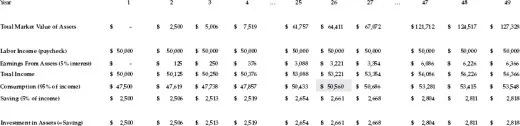
PRODIGAL PAUL’S FINANCES

FRUGAL FREDDY’S FINANCES
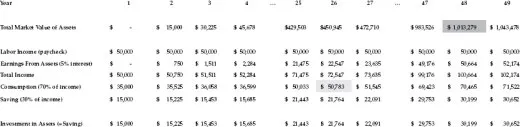
The tables track the financial activity of Paul and Freddy throughout their lives. They hold comparable jobs and earn a steady paycheck of $50,000 each year from selling their labor services. However, both men save some of their income and invest it in assets that pay 5% interest per year. We will discuss debt and interest payments in more detail in Lesson 12, but for now you just need to know that in any given year, in addition to their paychecks Paul and Freddy earn interest income equal to 5% of the total market value of their investments.
Paul and Freddy are identical, except for the proportion of their incomes that they save. Prodigal Paul only saves 5% of his income each year, and spends the rest on consumption—going out to dinner, flashy jewelry, vacations to Tahiti, and so forth. Frugal Freddy, on the other hand, sets aside 30% of his total income each year, and plows it into his financial assets.
The tables illustrate the different lifestyles caused by these savings decisions. In the earlier years, Paul enjoys more consumption than Freddy. He is able to attend more parties, wear nicer clothes, and generally have more fun. However, as the years pass, the gap between the two men constantly shrinks. Even though Frugal Freddy always consumes a much lower proportion of his income, his income itself is growing much faster than Prodigal Paul’s. In fact, by the 26th year, Freddy’s consumption of $50,783 is greater than Paul’s consumption of $50,560. From that point forward, Freddy can spend more on immediate enjoyments than Paul can afford. Remember, the two men have identical incomes from their labor services every year—they both earn the same paychecks from their jobs. But Freddy’s middle-aged years are much more prosperous, because he has been so frugal in his early working years.
One last interesting observation is that in the 48th year of his career, Freddy’s financial assets break the $1 million mark. Many people think that only “rich people” can ever get their hands on a million dollars. But as the table illustrates, even someone making $50,000 per year, and who invests in moderately safe assets, can eventually accumulate $1 million simply by habitually saving a large fraction of his income—at least in a world without taxes!
Retirement
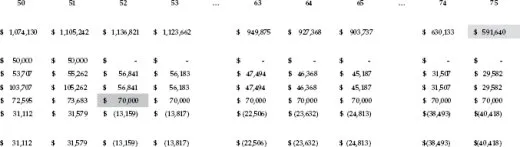
On the following set of tables we look at what happens after Paul and Freddy stop working, and their paychecks drop to $0. (We assume this happens in the 52nd year after they have entered the work force.) Both men now begin dissaving, meaning that they consume more than their incomes each year.4 This is possible because they have accumulated a stockpile of financial assets. Not only can the men spend money that is generated by the interest earnings on these assets, but they can also sell off a portion of the assets and consume the proceeds of the sale. (This is called reducing the principal of one’s assets or savings.)
At this point we really see the benefits of Freddy’s relative frugality. During his retirement years, he can easily afford to maintain a constant level of consumption of $70,000 per year. This is a tad lower than what he was used to just before he retired, but it is still a quite comfortable lifestyle—and it’s 40% more than his whole paycheck was during his working years!
In contrast, Prodigal Paul has to sharply cut back on his consumption spending once he stops going to work. He drops down to $15,000 in annual consumption. The reason Paul is in such dire straits is that at the time of retirement, he had only accumulated about $136,000 in assets, whereas Frugal Freddy had over $1.1 million. Thus Freddy not only has a much larger annual income from investment earnings during retirement, but he also has a much larger stockpile of assets to “draw down” and fund his retirement lifestyle.
As the tables show, the real crunch for Paul comes in Year 64. At this point, he can’t even eke out his $15,000 consumption for the year, because he has exhausted all of his financial assets. After living on an austerity budget of $5,384 this year, Paul is flat broke. If he doesn’t want to go back to work, he will need to get money for consumption from relatives, churches, or some other philanthropic organization. (We are still describing a pure market economy, so there are no government relief programs.)
Again in sharp contrast, Frugal Freddy can continue his very comfortable retirement lifestyle up until the 75th year after he began working, when we assume he passes away. Not only has Freddy’s frugality allowed him to fund his own retirement without relying on the generosity of others, but he even has almost $592,000 left in his estate to bequeath to his heirs.
How Saving and Investment Increase An Economy’s Future Output
Everyone who has held a job and a bank account understands the potential benefit of postponing consumption today in order to enjoy greater consumption in the future. However, many people—if pressed—would explain this increase to the saver’s income by an offsetting reduction in the income of a borrower somewhere in the economy.
This is certainly a possibility. For example, if Bill (the borrower) forgets his lunch money on Monday, he might ask his coworker Sally (the saver), “Can you lend me $10 and I’ll pay you back $11 tomorrow?” If Sally agrees, then it’s clear that her $1 in interest on the personal loan was paid out of Bill’s reduced income for that month. In other words, if Bill’s take-home pay that month were $5,000, then he would actually only have $4,999 to work with, because of his $1 expenditure in “buying a loan” from Sally. At the same time, if Sally’s normal paycheck were also $5,000, then this particular month she would actually have $5,001 to work with, after earning $1 in providing “lending services” to Bill.
In the scenario above, what basically happened is that Bill financed his consumption with an “advance” made by Sally. On the Monday in question, when Bill left his wallet at home, Sally had to have in her pocket enough spare cash to lend $10 to Bill. Perhaps this made her rearrange her planned spending that day, or perhaps it simply meant that Sally carried less cash in her own purse than she originally had desired. In any event, Sally provided a definite service to Bill. Given his mistake, both parties benefited from the voluntary loan transaction. Even though it might seem from a quick look as if Bill lost and Sally gained, in reality both parties benefited. In a sense Bill’s total monthly consumption was lower, but he preferred having $1 less in order to obtain his usual $10 lunch on the particular Monday. There is nothing irrational or “uneconomical” about Bill’s decision to pay $1 for Sally’s loan.
Making loans so that borrowers can finance their present consumption (at the expense of future consumption) is certainly part of what happens in a market economy on a grand scheme; it constitutes a large portion of the credit card industry. However, you should not conclude that all savings and investments are of this nature. When we consider the lifetime savings plan outlined in the previous section, there doesn’t need to be one or more borrowers who grow ever deeper in debt as the decades roll on. In fact, it is possible that every single person in a market economy provides for a comfortable retirement through saving and investment during his or her working career.
How is this possible? For every Sally who saves and earns ever-growing streams of interest income, doesn’t there have to be a Bill somewhere who borrows and pays ever-growing streams of income? Yes and no. The key is that the loans or investments can be made in productive enterprises, rather than simply being lent to an individual who increases his consumption in the present. If the savings are channeled into expanding production (rather than merely financing consumption), then “total output” grows over time, in principle allowing every member of society to enjoy larger incomes.
In Lesson 12 we will go over the mechanics of credit and debt more carefully, but for now we just need to understand the big picture of what would happen if everyone in society suddenly decided to save a large fraction of his or her income. In order to save more, each person would cut back on consumption. That means people would spend less on fancy restaurants, sports cars, electronic gadgets, and designer clothes. At the same time, people would increase the amount of money they lent and invested in businesses, either directly (through buying corporate stock or bonds) or indirectly (by depositing the money with banks which then advanced loans to businesses).
These large swings in how people spent their incomes—diverting it away from consumption and toward investments—would ultimately steer workers and other resources out of industries catering to immediate consumption, and toward industries catering to long-range production. For example, high-end retail and jewelry stores would see their sales plummet, and they would lay off workers and cut back on their inventory. Fancy restaurants too would lay off workers and close down some of their locations.
The laid-off workers would look for jobs in other industries, and this extra competition would push down wage rates in those sectors. At the lower wage rates, businesses in these other industries would be willing to hire the displaced workers. Other resources besides laid-off workers would be redirected to new uses, as well. For example, the owners of now-vacant buildings (which used to house clothing stores and other retailers) would lower their asking price for rents, making it easier for other businesses to expand their operations by filling the buildings.
If we ignore the real-world disruptions that would occur during the transition, even a large and sudden increase in the savings rate wouldn’t affect “total spending.” It’s true that consumption spending would (initially) be much lower, but investment spending by businesses would be correspondingly higher. The total number of jobs (eventually) would also be the same, because the laid-off waiters and mall employees would now be working in factories producing drill presses and backhoe loaders.
The essential insight is that a sudden increase in savings allows the economy’s output to shift away from consumption goods and into capital goods. Just as Robinson Crusoe was able to enhance the power of his bare hands through the wise use of saving and investment—even though he had nobody to “lend to” on the island—so too can the whole population enhance each other’s labor productivity by channeling more resources into the production of machinery and tools. There is no “cheating” going on here; everyone’s income can grow larger over the years when everyone is more physically productive because of the growing stockpile of capital goods.
In Lesson 12 we will give a longer explanation of how interest rates are determined. This is a very complex area. For example, the accumulation of capital goods directly raises workers’ incomes through higher wages (because each hour of work—with the better tools—now produces more output). In the present lesson, we are only making the important point that it’s possible for everyone to grow richer through saving. It is not true that a lender grows rich only when a borrower grows poor.
Lesson Recap...
- Because of interest, an individual can save and invest today, in order to increase his or her income in the future. A small decrease in consumption today, can lead to a much greater amount of consumption in the future.
- When individuals save and invest, the economy is physically transformed. Instead of channeling labor and other resources into making television sets and DVDs, production is redirected toward making tools and equipment. This reduces the amount of consumer goods produced in the present, but the new tools make workers more productive in the future.
- One person’s saving and investment doesn’t force someone else to sink ever deeper into debt. It is possible for every single person in the economy to save large sums and enjoy a much higher future income.
NEW TERMS
Income (individual): The amount of money that can be spent on consumption goods in a certain period, from the sale of labor and the earnings of other assets (such as stocks).
Income / earnings (business): Revenues minus expenses.
Savings: The amount by which income is greater than spending on consumption.
Borrowing / dissaving: The amount by which consumption spending is greater than income.
Investment: Savings that are spent in the hopes of increasing future income.
Interest: The income earned during a period of time from lending savings to others. Interest is usually quoted as a percentage of the principal (the amount of money originally lent) earned per year. For example, if someone lends $1,000 today and is paid back $1,050 twelve months later, then the principal is $1,000, the interest earned is $50, and the interest rate is 5%.
STUDY QUESTIONS
- Can investment occur without saving?
- What are the pros and cons of saving a high fraction of your income?
- What’s the connection between saving and retirement?
- If someone borrows in order to buy today rather than waiting to pay cash, is this an example of uneconomical behavior?
- *Is it possible for every individual in the community to accumulate assets for retirement—or does one person’s rising wealth translate into someone else’s rising debt?
Lessons for the Young Economist
Read the whole book online · Book details
This work is published under a Creative Commons licence. You may copy, share, and re-host it with attribution.