
Chapter 8 of 25 · Lessons for the Young Economist by Robert P. Murphy
LESSON 7 Indirect Exchange and the Appearance of Money
In this lesson you will learn:
- The limitations of direct exchange.
- The advantages of indirect exchange and money.
- The origin of money.
The Limitations of Direct Exchange
In Lesson 6 we learned the tremendous benefits of direct exchange. Because people often have different tastes (or preferences), and because they often start out with different amounts of various goods, there are gains from trade. People can voluntarily trade their property amongst each other, so that everyone ends up owning property that he or she values more than the original collection of property.
However, even though direct exchange benefits everyone who participates in it, there are limits to its effectiveness. In fact it’s hard to imagine a world where people only engaged in direct exchange, versus indirect exchange (which we’ll discuss in the next section). But in order to see the important difference, let’s just imagine a world where people only make direct exchanges.
Remember, in a direct exchange each person must directly want to use the object being acquired. So we rule out any case where someone trades away something he originally owns, in order to acquire something that he then intends to trade away to yet a third person. It turns out that this limitation it actually quite restrictive.
For example, suppose a farmer goes into town to get his tattered shoes repaired, and to buy a new shirt. He brings with him several dozen eggs hoping to make a trade. Our poor farmer has to not only find a cobbler with the necessary skills to repair his shoes, but he needs to find a cobbler who is that very same day looking to acquire eggs. The same is true of our farmer’s efforts to acquire a new shirt. He needs to find somebody who has a shirt that the farmer likes, and who is willing to trade away the shirt in exchange for the farmer’s eggs (at an acceptable price).
But if you think things are tough on our farmer, they’re even worse for the guy whose business is to produce stagecoaches. When he takes a finished stagecoach to market, he expects to get a large variety of goods and services in exchange for such a prized item. But if the world were limited to direct exchange, he would be unlikely to find a suitable trading partner. Not only would he have to find someone who owned an acceptable collection of meats, eggs, shirts, milk, ammunition, etc. that our manufacturer preferred to his stagecoach, but that special person would also have to be “in the market” for a stagecoach. What are the odds of that?
In reality, there would not be stagecoach producers, and probably not even shoe cobblers, in a world limited to direct exchange. People would not be able to specialize in certain professions, because it would be too risky. For example, a schoolteacher might instruct children in arithmetic and grammar, in exchange for milk, bread, and kerosene that the parents of the various children were willing to provide. But if one year there happened to not be any butchers who had school-age children, then the schoolteacher would have to go without meat the entire year!
So we see that in a world of direct exchange, people would probably live basically as Robinson Crusoe. As a default, they would have to provide for their own range of needs directly, acquiring their own food, making their own clothes, building their own shelter, and so on. Their standard of living would be much higher because of the benefits of trading with each other, but intensive specialization and large-scale production operations would be infeasible.
The Advantages of Indirect Exchange
We have seen the limitations of direct exchange. These limitations can be overcome when people begin to use indirect exchanges. In an indirect exchange, at least one of the traders gives up his own goods in return for something that he plans on swapping away for something else in the future. Once we allow this possibility, the limitations of direct exchange fall away.
For example, recall our farmer who went to town with a few dozen eggs, seeking shoe repair and a new shirt. Suppose the only cobbler in town told him, “Sorry I don’t need any eggs right now.” Under direct exchange, that would be that.
However, with the possibility of indirect exchange, the farmer can ask, “What would you be willing to trade away your shoe repair services for?” Suppose the cobbler answered, “I would fix your shoes if you could give me at least 6 pounds of butter, or 4 loaves of French bread, or a pound of bacon. Those are the things I’m really interested in right now.”
This holds out hope for our farmer. He can now walk around town (in his tattered shoes) looking for someone who wants eggs, and is willing to trade butter or French bread or bacon for them. Instead of needing to find the perfect match—a cobbler who was looking for eggs that very day—the farmer can now add three more potential candidates who will work.
In fact, depending on how much time he wants to spend on the project, the farmer can take things a step further. Suppose he finds a butcher who has extra bacon that he’s trying to sell, but that the butcher (like the cobbler) isn’t interested in any more eggs that day. The butcher mentions that he does want some fish. A few minutes later, the farmer meets up with a fisherman just back from a long haul, and who is dying to have a big omelet. If you have ever dabbled with role-playing computer games, we don’t need to spell out the opportunity this presents to our farmer.
Under direct exchange, the farmer needed to find a perfect match, namely a cobbler who wanted his eggs. Indirect exchange opens up a vast new range of beneficial trades, especially if traders are willing to operate at several “levels deep” of indirectness. The tremendous advantage of indirect exchange is that it facilitates rearrangements of property among multiple individuals, making them all better off, even though any single swap would have been vetoed by one of the required parties. The following diagram illustrates:
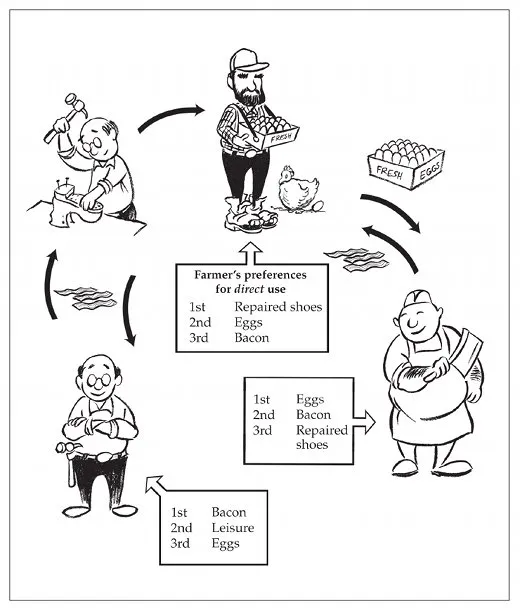
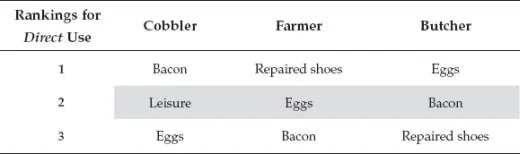
To keep things simple, in the diagram above we’ve left out the fisherman; we’re assuming the farmer was able to find a butcher who wanted eggs in exchange for bacon. As the diagram indicates, all three of the men are happier when (1) the cobbler repairs the farmer’s shoes, (2) the farmer gives his eggs to the butcher, and (3) the butcher gives his bacon to the cobbler. We know they’re all better off, because they’ve moved from their 2nd ranked positions up to their 1st ranked positions. (Their original possessions are highlighted.)
However, notice that under direct exchange, this beneficial rearrangement of property (and performance of services) could not have occurred. We already know from the original story that there are no direct gains from trade between the cobbler and farmer; the diagram above reflects this fact, because the cobbler values his leisure time more than the eggs the farmer has to offer. The diagram also shows that the butcher values his bacon more than having the cobbler repair his shoes, and so there are no gains from direct exchange between those two. Finally, there are no direct gains from trade between the farmer and butcher, because the farmer’s direct desire for bacon is ranked 3rd. If the farmer and butcher were the only people involved, then the farmer would not agree to the trade.
The beauty of indirect exchange is that it allows universally beneficial property (and service) transfers to get around the “bottlenecks” imposed by direct exchange. As the case of our hypothetical farmer illustrates, indirect exchange allows everyone to move much higher on his or her preference ranking, through suffering a temporary “hit” that is made up in the future by trading away the (directly) inferior object. When it comes to advantageous rearrangements of property, indirect exchange facilitates the principle of “one step back, two steps forward.”
The Advantages of Money
We have seen the advantages of direct exchange, and the even greater advantages of indirect exchange. However, even if people begin accepting items in trade, planning to trade them away for what they ultimately desire, this process can still be quite cumbersome. To see why, just recall our illustration of the farmer with tattered shoes: Even though it all worked out in the end, he still had to go traipsing through town, looking for someone who was selling the items that the cobbler wanted to buy.
Besides the physical exertion involved, we should also point out the mental effort that traders would have to waste keeping track of dozens or possibly hundreds of important price ratios. For example, let’s revisit our story of the farmer trying to find a buyer of his eggs so that he can give the cobbler enough bacon to fix his shoes. In the version of the story we told above, we simply assumed that once the farmer had run across the fisherman, that would be the end of the matter.
Yet in reality, our farmer may have held out for a better deal. If the fisherman were willing to trade 3 fish for 6 eggs, and the butcher were willing to trade a pound of bacon for 3 fish, then the farmer would realize, “Okay, I can ultimately get my shoes fixed by giving up 6 of my eggs.”
If this were his only option, the farmer would think it well worth the price. But what if the town were quite large, with many different merchants and professionals? Suppose the farmer could find a baker who would be willing to give up 4 loaves of French bread for only 5 eggs. In this case, our farmer would realize, “Okay, I can ultimately get my shoes fixed by giving up 5 of my eggs.” Notice that this is 1 egg cheaper than going through the route of trading eggs for fish.
Already you are probably getting lost in all the details. Yet in the real world, people would start keeping track of the exchange ratios of various goods against each other, in order to know whether they were getting a “good deal” on any particular trade. We see that the possibility of indirect exchange is thus a blessing and a curse: It’s a blessing because it allows many people to make complicated (yet unanimously beneficial) rearrangements of their property. But it can also be a curse because people now can’t merely consult their preferences of the direct use of goods when deciding whether and how much to trade. Before giving away something that they might personally find revolting, they first have to ask, “How much could I get for this if I held out for another buyer?”
What makes the above question particularly difficult is when traders need to reason two, three, or even more steps ahead to discover the ultimate “price” of the object they are trying to buy In our story of the farmer, look at how complicated things got, even after introducing just a handful of different traders and their offers. In theory, for our farmer to be sure he obtained the cobbler’s shoe repair services at the lowest possible price (measured in eggs), he would need to survey the entire town, writing down everyone’s willingness to buy and sell various types of goods against each other. Then he would need a math whiz to help him solve a complex problem, showing him the (perhaps very long) chain of individual trades through which our farmer could give up the least possible number of eggs, in order to ultimately acquire 6 pounds of butter, 4 loaves of French bread, or 1 pound of bacon (which the cobbler insists on before repairing the shoes).
Of course, in the real world we don’t have to go through such mental gymnastics every time we want to trade. Instead, we use money, which we can formally define as “a widely accepted medium of exchange.” In plain language, money is a good that stands on one side of (virtually) every transaction. Rather than trading other goods directly against each other, people first sell all their wares to obtain money, and then they use the money to buy all their desired items.
When people in a community use money, they retain all the advantages of indirect exchange but considerably reduce its disadvantages. Rather than keeping track of dozens or even hundreds of price ratios of various goods offered and sought by various people, with money traders can simply keep track of the highest and lowest prices—quoted in money—of the items in which they’re interested.
For example, if the town in our story above uses silver as its money, our farmer with the tattered shoes now has a relatively simple task. When he gets to town, he first searches for the person who will offer the most ounces of silver for his eggs. Then with the silver in hand, the farmer searches for the person who will repair his shoes for the fewest ounces of silver. So long as everyone in town buys and sells using silver, the above procedure ensures that the farmer obtains his shoe repair (and whatever else he wants to acquire) at the lowest possible sacrifice of his eggs. He no longer needs to write down the desires of every person he meets—he frankly doesn’t care what others want to buy—and he no longer needs a math whiz to solve a complicated optimization problem.1
Who Invented Money?
The short answer is, “No one.” As with a dirt trail through a forest, the English language, rock & roll, the rules of chess, and hairdos in the 1980s, no single person got up one day and invented money. Instead, money arose gradually over time as a cumulative result of the actions of many people. The institution of money is a classic example of what Austrian economist Friedrich Hayek called a spontaneous order, meaning that the use of money is a very complex and useful practice, even though it was not consciously planned by an expert or even a group of experts. Quoting the Scottish moral philosopher Adam Ferguson, Hayek described spontaneous orders (including money and spoken languages) as “the product of human action but not of human design.”
Today almost everyone on the planet thinks of money as pieces of paper issued by governments. However this was not always so. Historically, money arose first in the marketplace, as an outgrowth of voluntary exchanges between regular traders. Kings and other political rulers saw the spoils to be reaped and gradually took over this market-created institution, as we will explain in greater detail in Lesson 21.
But without the intervention of a wise king, how could society have adopted the use of money? How would everyone decide what to use? After all, researchers tell us that throughout history different cultures have used all sorts of things as money: sea shells, rocks, cattle, salt, tobacco, gold, silver, and even cigarettes (in World War II P.O.W. camps). How would a group of people settle on a particular commodity to use as their money without resort to a political process?
The answer is that it was probably a natural outgrowth of the efforts of people like our hypothetical farmer looking to get his shoes repaired. Recall that even though the farmer didn’t directly have any use for fish or bacon—he didn’t go to town to get either of those items—he ended up trading away his eggs for some fish, in order to trade the fish for bacon, in order to trade the bacon for a shoe repair. Notice that from the perspective of the fisherman and the butcher, they saw an increase in the market for their products because of indirect exchange. In other words, in addition to all the people who wanted to buy fish for their own direct use, the fisherman had a potential customer in the form of the farmer, who wanted to use the fish indirectly as a medium of exchange.
This process could snowball. In the beginning, when people were bartering goods against each other in a state of pure direct exchange, certain items (chickens, eggs, salt, etc.) would be widely desired in trade, while other items (telescopes, caviar, harpsichords, etc.) would be accepted by very few people. Then as the advantages of indirect exchange become obvious to more and more people, the initially more marketable goods would see a huge leap in their marketability. Even those people who didn’t initially want the (highly marketable) goods for their direct use would nonetheless be willing to accept them in trade, because they would know it would be easy to trade them away for whatever they ultimately desired. If the snowballing process ever reached a point where a particular good were accepted in trade by almost everyone in the community, that would mark the birth of money—”a widely accepted medium of exchange.”
To understand why some goods historically became money, and others did not, we can list some of the practical considerations, such as (1) ease of transport, (2) divisibility, (3) durability, and (4) convenient market value. When we consider these four criteria, we see why gold and silver have proven to be such excellent candidates of market-based money. For example, cattle are not very practical as money because they make smelly messes, they take up a lot of space, and you can’t simply cut a steer in half to “make change” during a transaction. Popsicles also wouldn’t stand the test of time as money, because they melt without proper care. Finally, a metal like bronze shares many of the excellent money-qualities of gold and silver, but because it is so plentiful, bronze has a much lower market value. That means a trader would need to carry a lot more bronze in his pockets (or in a cart) when making an expensive purchase, compared to how many gold and silver coins or bars he would need for the same trade.
There is nothing in economics that says gold and silver must be money or that they are the only “natural” form of money In a voluntary market, traders will end up adopting the money or monies that best suits their needs. We are merely explaining why, historically, gold and silver have so often been adopted by sophisticated merchants as money.
Lesson Recap...
- Although direct exchange is useful because it allows for win-win trades, it is limited because a trader needs to find someone who has the desired item and who wants to accept the good that the first trader wishes to give up. This limitation would make it very difficult for people to specialize in occupations: A dentist who wanted meat would need to find a butcher who had a toothache.
- Indirect exchange expands the opportunities of mutually beneficial trades. More complicated rearrangements of goods can occur, which make every participant better off. Indirect exchange eventually leads to the use of money, which makes it much easier for people to plan their trading activities.
- Nobody invented money. It arose spontaneously, almost “by accident,” out of people’s actions to improve their trading positions using indirect exchange.
NEW TERMS
Money: A good that is accepted by everyone in the economy on one side of every trade. In economics jargon, it is a widely (or universally) accepted medium of exchange.
Spontaneous order: A predictable pattern that is not planned by any one person. Examples would include the rules of grammar in the English language, the style of clothing that characterized the 1970s disco clubs, and the use of money.
Arbitrage opportunity: The ability to earn a “sure profit” when the same good sells at different prices at the same time.
Medium of exchange: An object that is accepted in a trade, not because the person receiving it wants to directly use it, but because he or she wants to trade it away in the future to acquire something else. Every indirect exchange requires a medium of exchange, which is the good through which the ultimate trade occurs. (Likewise, sound waves require a medium to travel through, in order to reach your ears. When it comes to sound waves, the medium will usually be the air, but it can also be water if you are in a pool with your head below the surface.)
STUDY QUESTIONS
- What’s the difference between direct and indirect exchange?
- Why would specialization be impractical in a world limited to direct exchange?
- How does indirect exchange facilitate the strategy of “one step back, two steps forward”?
- What are the disadvantages of indirect exchange without money?
- *Describe a society in which the people practice indirect exchange, but have not yet developed money.
Lessons for the Young Economist
Read the whole book online · Book details
This work is published under a Creative Commons licence. You may copy, share, and re-host it with attribution.