
Chapter 15 of 18 · Liberty: A Path to Its Recovery by F.A. Harper
Part Two: On Measuring Liberty
PART 2
ON MEASURING LIBERTY
Abstract liberty, like other mere abstractions, is not to be found.
EDMUND BURKE
CHAPTER TWELVE
A MEASURE OF LIBERTY
LIBERTY IS MORE than a word. It is a thing of substance that can be either present or absent, gained or lost. A person may be free or he may be a slave; presumably it is possible for that person to tell which is which, and that gives rise to the possibility of measurement.
We are concerned with the present status of liberty. If its status is to be discussed with accuracy, some specific measurements closely related thereto would be helpful. Otherwise the subject must endure futile debate in vague and meaningless terms. A means of measuring an important area where liberty is at stake will shortly be explained and applied to the United States.
This measure is not offered as a perfect measure of liberty, nor as a final answer to that question.1 But even a rough measure may help to pave the way for a better one.
Strictly speaking, liberty itself defies measurement because it is basically a subjective matter with each person. Measurement is limited to the reflections of liberty, or the indirect evidences of its presence or absence. It is in that sense that the measurement of liberty will be discussed.
Failure to be able to come to direct grips with a thing should not completely discredit an attempt to measure it, however. Much of the work of science with which we are familiar and which we use as a guide to our beliefs and acts employs methods of indirection for gaining evidence about the thing being studied; indications of the thing are accepted in lieu of the thing itself, and are deemed to be evidence worthy of use. Illustrations include original work in astronomy, in the germ theory of disease, and in many parts of chemistry such as the development of the atomic table.
Liberty is divisible. It may be present or absent in different aspects of our daily lives, leaving a person partly free and partly slave. Each person may at any time be anywhere between 0 per cent and 100 per cent at liberty, or between 100 per cent and 0 per cent a slave.
If one were to speak of the status of liberty in an entire country like the United States, it would be necessary to represent it by an average for the liberties of all the persons in that country. This would make it possible to speak of liberty in a nation as being at some point between 0 per cent and 100 per cent, the same as for one person; it would offer a device by which to judge whether liberty in a nation has been increasing or decreasing over a period of time. Such a treatment on a national basis obscures, but it does not deny, that liberty is an individual matter; that liberty for any one of these persons may be either above or below the national average.
A simple fact, but one significant to interpreting the status of liberty on a national basis, is that one person has a maximum of 100 per cent liberty. If each of two persons enjoyed full liberty, with neither of them desiring to enslave the other, their average would be 100 per cent liberty . If one of them acquired the desire to enslave the other, and did so, his liberty would still be only 100 per cent; that of his enslaved fellow would fall to 0 per cent, however, and their average liberty would fall to 50 per cent.
A dictator over a hundred million persons has no more liberty (100 per cent) than if he desired not to be a dictator and was a free man among a hundred million free men. But the national average of liberty under the dictatorship would be near 0 per cent , whereas without the dictatorship it could be near 100 per cent.
The desire to enslave his fellows, on the part of one dictatorially inclined, means that his liberty cannot be as much as 100 per cent except as he is able to accomplish that feat. In being prevented from enslaving his fellows, he is deprived of a full measure of his liberty, as we have defined it; we might assume, as illustration in one instance, that its prevention meant a loss of half of that person’s liberty, or of his willful desires. If he were the only one in the nation blighted with this illiberal desire, to allow him to grasp full power would reduce the average level of liberty for that nation to near zero ; whereas curbing his grasp for power would allow liberty to be near 100 per cent in that nation .
These simple numerical representations serve to indicate how the national average of liberty is affected directly in proportion as there is enslavement by any means whatsoever, within a nation.
THE FOUNDATION of economic liberty has been defined as the right of a person to the product of his own labor. If this definition be accepted, it becomes a means by which to measure one’s economic liberty — or its complement, the degree of economic slavery he is being forced to endure.
The slave is compelled to work for his master without any rights whatsoever to income that he may spend as he chooses. Nor does he have any rights to private property. Whatever economic living may be granted to the slave by his master is given to him in the same manner as one makes a gift to another, because there is no definite obligation involved; the slave has no right to demand any “pay” of food or other things; he has no means by which to assure himself of something to eat tomorrow, either from the work he does or from what he has saved. The master, of course, normally does not allow his slave to starve; he gives him food and necessities so that he may live to toil another day.
It may seem strange that the slave, totally lacking in liberty, frequently feels no strong resentment toward the master who has enslaved him. In fact, the slave may even feel grateful toward his master who “so kindly gives me food and necessities with which to live, and without which I would surely die.” It is said that many a newly-freed slave after the War Between the States feared liberty because, due to the narrow vision of his experience as a slave, he acquired this strange feeling of kindness toward his oppressor. A similar feeling is reported to have been held by the oppressed in Hitler’s Germany, and in Stalin’s Russia; and we have noted the same feeling among those who have acquired the habit of leaning on a benevolent government in our own country. All these victims of a lost liberty are unmindful of the fruits of liberty, due to the blindness which compulsory or voluntary slavery has caused. “Forgive them, for they know not.…”, but let them become free so that they may know!
If a slaveholder grants to his slave a daily wage of $10 — the market equivalent of what the slave produces — and then, after paying it, takes it all back again, one could hardly claim that the slave had thereby gained his economic liberty. The slave might properly say to his master: “You may as well keep my pay in the first place. I have no economic liberty unless I can keep it and can have free choice in its spending.”
Suppose that the master, instead of taking back all of the $10, should take back only three-fourths, or one-half, or one-fourth of it. Would it then be correct to say that the slave lacked economic liberty to the extent of three-fourths, or one-half, or one-fourth, as the case might be? According to our definition of economic liberty, this suggests a rough measure of the degree of economic liberty he is then enjoying, even though he is still legally bound to his master who may change the degree of this economic liberty at will.
Partial liberty under slavery is well illustrated by a practice that was established in Prussia centuries ago. The masters granted their serfs two days out of the week to work for themselves. They had that degree of economic liberty.
Now suppose that the slave, instead of working directly under the guidance of his master, should be allowed to pursue elsewhere any occupation and place of employment he may choose, and to sell all his services or all the product of his toil for a money wage or a market price. With legal ownership of his slave, and with full knowledge of the slave’s activities and the amount of his income, the master is able to claim all or part of the slave’s earnings. If he should take three-fourths or one-half or one-fourth of it, would it then be correct to say that the underling was still three-fourths or one-half or one-fourth in economic slavery? This would seem to be essentially a correct report of the situation. The master might choose to operate this way, instead of having the slave work directly for him, if he thought that the slave would thereby produce more for the master to take away from the slave.
As another variation, suppose that several slave masters combine into a slaveholding corporation for the management of their slaves, and suppose that the corporation, rather than each of the masters separately, is delegated to direct the operation and extract the pay from the slaves. Would this lessen the degree of slavery from what it had been before? No.
As still another variation, suppose that these slaves acquire their status of slavery as a result of a popular vote among their group while they were still free men, and that the majority voted that they should all become slaves. Would this lessen the degree of slavery from their previously reported plight? No.
Suppose that the master pleads innocence of slaveholding on the grounds that he is spending the slave’s earnings for what he considers to be the slave’s own welfare. Would that change the degree of liberty of the slave? Is liberty to be defined in such a way as to allow me to take from you the product of your labor, so long as I claim that I shall use it for your welfare, or for the “general welfare”? Should the robbing of banks be allowable under liberty, provided the bank robbers promise to put the proceeds of the robbery to some use they claim to be worthy, or even to some use that a majority of the people have judged to be worthy?
The test of economic liberty under all these varied conditions, and others that might be listed, is to be found in the definition of economic liberty as previously explained — the right to the product of one’s own labor. One who is deprived of these rights is a slave. To whatever extent he is deprived of these rights, he is to that extent a slave. And he is no less a slave because of the means of depriving him of the product of his labor.
ARE EMPLOYEES in modern society in the same position as slaves?
It is often asserted that employees are the equivalent of slaves, because the employer can pay them whatever he may desire and the employee can do nothing about it. But that is not so. There is a distinct difference between the two situations.
The slave, if he should object to his plight for any reason whatsoever, cannot move to a new situation of greater promise, nor can he leave to start a business for himself, nor can he quit work to live in retirement on his savings; he must continue to work where he is, in spite of his wishes, and continue to be subject to the dictates of the master. The employee, on the other hand, is free to make these changes; he may bargain with his employer, or he may leave for employment elsewhere, or he may start in business for himself; or he may choose to retire and not work at all, or work only part time, living on the savings he has accumulated.
But back of these differences is the one most vital to economic liberty. The employee has income of his own to spend or to save as he desires. The slave, on the other hand, does not.
An employee is not, because of that fact, a slave; nor is he the equivalent of a slave. Any employee who claims that he is the equivalent of a slave probably would not, if put to the test, willingly become a slave; the act is the test of sincerity of the belief.
The employee is, to be sure, under whatever dictates his employer chooses to impose while he is there as an employee. Presumably he has accepted this condition of employment willingly, rather than not to have that job with its pay; this is distinctly different from the plight of the slave, who was captured and held against his will and who is not free to return or to move to another job.
The employer-employee relationship amounts to this: The employer, who has the tools and other capital required for efficient production, and who presumably has the know-how of management, proposes to a prospective employee that they form a sort of partnership; the employee accepts it or not, voluntarily, dependent on whether or not he judges it to be a better prospect for him than any alternative. The employee may, in fact, take the initiative and make the original proposition to the employer because he strongly desires to cooperate in such an arrangement with one who has the tools and capital, or the know-how of management.
Whatever the route to a final deal, the employer-employee relationship is similar to two persons trading a cow and a horse, where both parties to the deal are beneficiaries. The employer, as his side of the offer, agrees to give the employee what amounts to a certain quantity of the product and a guaranteed market therefor, in exchange for the employee’s services. It may turn out that the employee gets either more or less than he contributes, resulting in either a loss or a profit for the employer.
The employer-employee arrangement is in sharp contrast to that of the master-slave relationship. The slave is not offered a proposition in the original deal; he is captured.
Apparently large numbers of persons in any country prefer to be told what to do, in large areas of their lives. Large numbers cannot or do not desire, in the economic arena, to be entirely on their own; so they choose to work for others at a wage those others are willing to pay. Yet they have the essence of liberty even in this situation, for reasons that have been given.
Employees, along with those who are self-employed, have an important stake in liberty. Contemplating alternatives should make this perfectly clear.
NOW WE COME to a crucial point. The question is this: If the master be the State (government, at all its levels), does the test of expropriated income still serve as a useful measure of liberty? Does the test that has been applied to a privately-owned slave still apply here?
A slave is no less a slave because of the manner by which he is deprived of the product of his own labor, and of the right to hold private property. Slavery cannot be transformed into nonslavery by having a group of owners combine to do the same thing. No matter what system is used to extract the fruits of his labors from the person, he is a free man or not (economically) to whatever extent he can or cannot have whatever he produces, to consume or to sell, to trade as he wishes for whatever he wishes, or to save as private property for later needs and uses.
This rule is still valid even when it is government that does the taking. If the government should take all that is produced, as does a master from his slave, all the citizens would then be the economic slaves of that government.
Most of the modern world has discarded the institution of private slavery, the slavery of person to person. This institution has been judged to violate the rights of persons to be free. But there is rapidly arising a form of slavery even more dangerous and deadly. The new form is more dangerous because it is more subtle, more difficult to detect and to guard against, and therefore far more widespread than personal slavery probably ever was. This is because it does not take the customary form of slavery of one person to another, as when one holds title to his slave or cattle or horses and is their unquestioned and exclusive master and owner. Therein lies the danger of this new form of slavery, a danger comparable to that of disease germs prior to the discovery of the microscope and the development of the germ theory of disease. Our present problem is to discover the equivalent of the microscope for use in diagnosing the causes of the economic diseases of our society whereby liberty is lost, and to develop the means of identification of the germs which cause those diseases.
The superstition prevails that if the government takes from unwilling people the product of their labor to pay for governmental costs of which they disapprove, it becomes a commendable act unlike that of the master taking from his slave. Especially is the taking supposed to be proper if it occurs in a “democratic” nation. It is as though we should rule, by custom or by law, that robbery becomes a commendable act if a large enough number of people approve of it and engage in it.
The mere fact of taxes having been paid is no test of basic willingness; it is no evidence that a form of slavery does not exist, as a result of the displacement of voluntary action in the free market of choice. The fact that a slave works in his master’s field, similarly, is no evidence that slavery is not involved. The giving of one’s wallet to the hold-up robber without a struggle of conspicuous conflict is no evidence that the robbery did not take place. In all these instances there is an overhanging threat which causes the seemingly peaceful submission; the unfortunate victim is allowed no alternative consistent with liberty. In the case of taxes, the act of non-payment results in a legal claim against one’s property and future income, presumably far greater in amount than the tax bill under protest.
“The power to tax is the power to destroy.”
The Chinese scholar, Chang Hsin-hai, in his article on “The Moral Basis of World Peace,” asserts that this disease of our society stems from a double standard of morals. He says that the root of our troubles, both national and international, lies in the acceptance of moral standards in government totally different from those accepted and demonstrated as necessary for a good society so far as individual conduct is concerned. If a politician, either national or international, engages in practices and policies which in individual conduct would be considered as most contemptible, he is commonly honored for his “progressiveness and farsightedness, and for the great service he is rendering to the citizens of his country.” He is elected again and again to public office, even though the same practices by the operator of a private grocery store or a farm would lead to his being all but run out of town.
At the root of the double standard of moral conduct, to which Chang Hsin-hai refers, is the accepted belief that many forms of predatory practice, when conducted under the name of government, are honorable acts. On that premise has been built a progressive encroachment on the liberty of individuals, which passes as “progressive” in politics. Governments in recent times have taken more and more of the product of persons' labor “for the common good.” But by the mere fact of its taking, the government is thereby engaging more and more in the enslavement of the citizens. If this process had involved the complete enslavement of certain persons, it would be more noticeable and we would then be able to see it in its true light.
AS ONE ASPECT of the problem of lost liberty and double standards of conduct, the government is getting more and more into business in a manner condemned in private practice. This fact must be observed in any discussion of the status of liberty in our time, even at the risk of not being fully understood in a cursory treatment of an involved question.
Nearly every business operated by government has these features:
1. They are monopolies.
2. Their initial capital is obtained through the force and power of taxation.
3. They need not operate efficiently, nor be able to cover their costs in order to stay in business, because they can always fall back on their taxing power to make up the difference between their performance and the people’s direct appraisal of its worth.
All three violate liberty in one way or another.
How would you like to compete in private business with someone who could force you to put up his initial capital and who could send you a bill for all his losses?
As an individual citizen, it is no defense against the loss of liberty to say that you are a citizen and have a share of ownership in these governmental projects. You will find, for instance, that you are a shareholder in the Spruce Production Corporation, one of the federal government’s hundreds of corporations which now have a total of over $30 billion of capital assets. Try some day to sell your “ownership” share in that project.
As another illustration, United States citizens — including teetotalers — are forced to support a budgeted deficit to pay for the federal production of rum in the Virgin Islands. One who does not care for this investment is forced to invest in it anyhow. He is not even allowed to shift his investment to some other governmental project that is more appealing to him; and if he were allowed to shift, it would make no difference anyhow because the set-up precludes enjoying any of the privileges of ownership in its real sense.
What, in any practical sense, do you have to say about who is to be the manager of “your” corporation? What sense is there to calling it ownership if you cannot sell it, and if in addition you can be assessed for its financial failures indefinitely into the future?
The corollary of the right of ownership is the right of disownership. So if I cannot sell a thing, it is evident that I do not really own it. Can a Russian citizen, who becomes dissatisfied with his part of the Russian system of socialistic “ownership in common,” sell his share of Russia some day and convert the proceeds into some other form of real wealth?
This matter of government in business must come under thorough review by anyone who would consider the status of liberty in our time. Strange as it may sound, it comprises an increasingly important aspect of the modern version of slavery. Any measure of lost liberty must include it, because it is one of the forms of delusion under which, as Burke said, people give up their liberties.
1 Some of its limitations are given in Appendix V.
CHAPTER THIRTEEN
THE EXTENT OF LOST LIBERTY
A ROUGH MEASUREMENT of the encroachment on liberty is to be found, then, in the proportion of the product of a person’s labor that is taken from him by force or by threat of force, by government. A study of these figures, over the century and a half of our history as a nation, gives cause for deep concern (see chart on page 108).1
In 1947 the figure for governmental take was 29 cents from each dollar of income, or one and one-half times the entire food bill of the nation (excluding the taxes buried in the price of food).2 A common reaction may be, “Perhaps so, but I don't pay any such amount in taxes.” Much of this tax is in the form of hidden taxes, and one cannot see what is hidden. About two-thirds of this 29 cents, or about $1,000 in a year for the average family, is in the form of various hidden taxes; this amount of tax has become buried in the prices of everything you buy and of every service you employ — bread, shoes, haircuts, electric bill, the new car, movies, railroad tickets — everything. One author has estimated that there are 502 taxes on a pair of shoes. When all of these hidden taxes are brought to light, one finds that he now works 3½ months for the government, leaving only 8½ months to work for himself.
LOSS OF FREE CHOICE IN THE SPENDING OF INCOMES
Figures prior to 1849 include Federal Government only
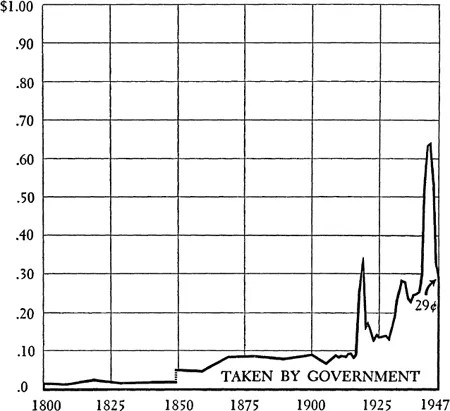
Government in the United States is now taking from persons’ incomes an amount equivalent to the complete enslavement of about 42 million persons — working persons and members of their families. Compare that figure, and the concern about it, with the figure of 4 million privately-owned slaves in the United States at the outbreak of the War Between the States!
All this is being done under the name of liberty, in a nation where liberty supposedly reigns as a beacon for the rest of an enslaved world. It is all being done under the name of a “progressive” society.
The present figure of 29 cents, even under present conditions of high employment and money incomes, is frightening enough. But a decline in employment to a point like that of 1938-40, in its effect on the national income, would automatically increase the burden to 35 cents or more out of each dollar of persons’ incomes; and this estimate fails to include any additional governmental costs “to relieve the depression.”
The threat and danger embodied in a figure of 35 cents, or more, can be gleaned from a few comparisons. The latest figure at hand for the United Kingdom is about 35 cents out of each dollar.3 The situation in the United Kingdom under this burden is well known, as suggested by the common use of the word “austerity,” and also by the fact that the United States is being asked to contribute great sums of money in the hope of bolstering the British economy.
A study of the tax burden of 48 nations in the late twenties offers some sobering evidence.4 Among those 48 nations were four large ones (over 25 million population) where the government was then taking more than 20 per cent of the citizen’s income. Call to mind what has happened in those four countries from the standpoint of liberty of the citizens:
Taxes as per cent of national | ||
USSR |
29 | |
Germany |
22 | |
France |
21 | |
United Kingdom |
21 |
A near-comparable figure for the United States at that time was 14 per cent, as the cost of government in proportion to the national income.
“The power to tax is the power to destroy.” The power to tax incomes is the power to destroy incomes. The power to tax property is the power to destroy property, whether by a capital levy or in any other form. And since income and property are the economic extensions of the person, the power to tax becomes the power to destroy persons to whatever extent economic considerations are important to life and happiness.
In an autocracy, the power to tax is the power of the autocrat to destroy persons in this sense. In a democracy, the power to tax becomes the power of certain persons to destroy other persons, and it becomes the right to use all forms of legalized power and influence to do so — lobbies, pressure groups, and all the others.
Dr. Colin Clark, the Australian economist, has concluded from his study of governmental costs that whenever the figure for any country rises to more than 20 or 25 per cent, progressive inflation and the debauchery of the currency is the likely result.5
And Lord Keynes reported:
Lenin is said to have declared that the best way to destroy the Capitalist System was to debauch the currency. By a continuing process of inflation, governments can confiscate, secretly and unobserved, an important part of the wealth of their citizens.6
The “Capitalist System,” which Lenin wished to destroy, is based on the right to the product of one’s own labor and on the right to save some of it as private property. It is based on the foundation of liberty, as herein defined.
The private property that comes into being when a person spends less than his income, or consumes for purposes of his current living less than he produces, becomes the capital of the “Capitalist System.” This right to private security in the form of one’s savings put to some productive use, is the essence of economic liberty. Destroying the “Capitalist System” means destroying this liberty and these rights; it means the prohibition of the self-responsibility and private security, in the form of personal savings; it means a most powerful invitation to personal irresponsibility and intemperance in economic consumption.
History confirms the effectiveness of these means of destroying the foundations of human liberty. And it further records the failures of socialistic nations of the past, in sharp contrast with the human happiness and progress that abounds wherever a high degree of human liberty prevails.
Events before the French Revolution illustrate the consequences of economic intemperance. Following a long series of governmental deficits, the debt by 1788 had reached such proportions that, with an added deficit of 20 per cent of governmental expenditures in that year, half of the budget went for costs of the debt.7 The cost of the debt would have exceeded even that proportion, except for the “shameless waste” and extravagance that padded the remaining portion of expenditures. Taxes, though having been raised to the limit of yield, were far from enough to pay the costs of this wastage and the pensioning of privilege and favoritism. Indirect taxes, including inflating the currency to pay expenses, was used more and more. The credit standing of the government finally was completely destroyed, so that income from the issuance of loans was no longer possible. The government extended its monopolies and confiscated wealth in various ways. Personal violence began and spread as a consequence of enforcing the decrees and as an accompaniment of the growing economic vice, until the bloody revolution was in full swing.
Among the authorities on the subject of liberty in relation to the rise and fall of civilizations is Sir Flinders Petrie, the great British archeologist. He traced the six great civilizations of the world during the last 8,000 years. He found that the rise of these civilizations occurred while liberty was at its height, that when economic parasitism set in these civilizations degenerated rapidly into a long period of “dark ages.”
That, in a nutshell, indicates the present status of liberty in the United States.
Many persons who call themselves realists, but who are called fatalists by others, know these events of history and believe that liberty in a nation tends to erode more and more until finally it has been almost entirely lost. Whereas it seems that such has tended to be the pattern of national experience, no one pattern is inevitable as the course of a national society. If it were inevitable, why would there be all the variation of patterns between nations now and at any other time in the past? This argument of inevitability becomes an effective weapon of those who are pleased with recent trends in this and in other countries, and who would like to have all opposition to their hopes fade before the “inevitable.”
The lovers of liberty must remember that, in a seriously ill society as with a seriously ill person, the choice may be between some form of early medical treatment — perhaps pills that may be unpalatable at the moment — and the services of an undertaker. If these preventive steps are not taken in time, and if the little problems of liberty are allowed to go unsolved, they accumulate into catastrophe; in the end there comes bloody revolution of the worst sort, when the growing octopus of tyranny has finally become unbearable.
The great social problem of our age is that of designing the preventive medicine that will stop the eroding liberty in the body politic. Further, once the disease has advanced to the point of a most serious danger, a bitter curative medicine is required to regain already-lost liberty.
1 For detailed comments on the history of these changes, see 31¢, by F. A. Harper, (Irvington, New York: The Foundation for Economic Education, 1947).
2 The figure includes “loans” by the United States Government to foreign nations, because past experiences and present conditions in these foreign governments suggest that repayment is highly questionable.
3 Derived from figures in “National Income and Expenditure of the United Kingdom,” His Majesty’s Stationery Office, London, 1947, and other sources.
The London Economist for March 19, 1949 reported that the figure for the current budget has risen further to 40 per cent of the total of all incomes.
4 Edmond E. Lincoln, “Sobering Realities Regarding Tax Burdens,” The Commercial and Financial Chronicle (April 1, 1948).
5 Dr. Colin Clark, “Public Finance and Changes in the Value of Money,” The Economic Journal (December, 1945).
6 John Maynard Keynes, The Economic Consequences of the Peace (New York: Harcourt, Brace and Howe, 1920, p. 235).
7 Georges Lefebvre, The Coming of the French Revolution (Princeton University Press, 1947, p. 22).
Liberty: A Path to Its Recovery
Read the whole book online · Book details
Free to read online and to download from this archive.