
Chapter 4 of 178 · Mises: The Last Knight of Liberalism by Jörg Guido Hülsmann
1. Roots
ON SEPTEMBER 29, 1881, Ludwig Heinrich Edler von Mises was the first in his family to be born a nobleman. A few months earlier, the Austrian emperor had ennobled Ludwig's greatgrandfather, Meyer Rachmiel Mises. The family would henceforth bear the new name “von Mises.” The emperor also conferred on them the honorific “Edler” which literally translates into “the noble” and was frequently accorded to Jews.1
Ludwig's birthplace was the city of Lemberg, the capital of the bygone “Kingdom of Galicia and Lodomeria.” For centuries Galicia had belonged to Poland before it fell to the house of Habsburg in 1772 when large chunks of Poland were divided among its three mighty neighbors: Russia, Prussia, and Austria.2 Even though the Habsburgs were the emperors of the German Reich, they never incorporated Galicia into Germany, but kept it the northeasternmost province of Austria, the Habsburgs' personal dominion.
At the time of Ludwig's birth, the Habsburg Empire was the second-largest political entity in Europe, second only to Russia. Until the end of the seventeenth century, the Habsburg dynasty had also ruled Spain and its overseas colonies all around the world. Not long before Mises was born, the Habsburgs had ruled northern Italy, as well as Belgium and the Black Forest region in Germany. By 1881 the empire had lost these latter dominions but was still composed of twelve major ethnic groups and hosted six large religious bodies. Young Ludwig grew up in a powerful nation with a rich mix of cultures and a diverse ethnic heritage.3
Even by Austrian standards, Galicia was an extreme case of ethnic richness. Most of its citizens were Poles, Ruthenians, Jews, and Germans, but there were also substantial numbers of Armenians, Greeks, and Italians. While Jews were an often-tiny minority in virtually all other Habsburg lands, eastern Galicia's Jews represented an actual majority. At the time of Ludwig's birth, they were nearly the largest group in the city of Lemberg, second only to the Polish majority.4 They had come to the country because the Catholic rulers of Poland, for more than 500 years, had been more tolerant toward Jews than had any other government. Legal protection for Jews started with the Statute of Kalisz (1264), and the fourteenth century King Casimir the Great and his successors upheld and extended these rights during the next 200 years, at a time when Jews were expelled from virtually all other countries of Europe. Over the centuries, the Jewish community in Poland gained ever-greater legal autonomy, and by the end of the eighteenth century there was virtually a Jewish state within Poland. This country had become a homeland for the Jews of the entire world, a new Holy Land, many of them believed. By 1750, some 70 percent of all Jews lived in Poland, a number that grew even during the Polish partitions: by 1780, Poland was home to more than 80 percent of all Jews worldwide.5
Because the early influx of Jews was from Germany, the German Jewish dialect of Yiddish became the common language, even among later waves of Jewish immigrants from other parts of the world. Assimilation to the Polish language and culture was slow, if it happened at all. The strongest assimilation occurred among the Jewish intellectual and economic leaders, who shared business ties and other common interests with the Polish ruling class. The eminent Austrian historian and political philosopher Erik Ritter von Kuehnelt-Leddihn claims that this Polish background had an important impact on Ludwig von Mises's early development. Kuehnelt-Leddihn argues that young Ludwig was influenced by Polish political thought and political institutions, which cherished an aristocratic ideal of republican liberty.
Movements for liberty, as a matter of fact, have typically been carried on by the nobility, which always opposed centralizing pressure and control. We saw this in England with the Magna Carta, in Hungary with the Golden Bull, in Aragon by the stubborn Grandes, and in France by the Fronde. In this respect, Poland went further; it became an elective monarchy in 1572 and called itself a republic. One of the slogans of this very independent nobility was: “Menace the foreign kings and resist your own!” Political power rested with the nobility, which (before the partitions) had no titles, and its claimants comprised a fifth of the population.... It was a nobility without legal distinctions and a proverb said: “The nobleman in his farmhouse is equal to the magnate in his castle.” And since all noblemen were equals, they could not be ruled by majorities. In the parliament, the Sejm, the opposition of a single man—the Liberum Veto—annulled any legal proposition.6
This Polish political tradition permeated the culture of the Polish upper class in Galicia and must have had a considerable impact on families such as the Miseses, who strove to be received into the higher social strata at the turn of the eighteenth and nineteenth centuries.
While his Polish heritage had its impact on the political thought of Ludwig von Mises, the cultural aspirations of his ancestors pointed in a completely different direction. Throughout the nineteenth century, in fact, the Mises family helped spearhead the Germanization of their native Galicia. In their eyes, German culture was the embodiment of social progress. The liberal policies pursued under Joseph II at the end of the eighteenth century promised to bring greater liberty for the Galician masses and emancipation for the Jews. This was exactly what “left-wing” secular Jews had been striving for. At the turn of the eighteenth and nineteenth centuries, these groups became pro-German under the determined leadership of wealthy merchants such as the Mises family.7 They supported the new political administration; they welcomed immigration of non-Jewish ethnic Germans; and they promoted the infusion of secular German culture into Jewish circles. Members of the Mises family played a leading role in advancing the study of philosophy and secular science among local Jews. Heinrich Graetz reports:
Since the wars with Napoleon, there had arisen small circles in the three largest Galician communities of Brody, Lemberg, and Tarnopol, banded together for self-culture, the promotion of education, and a war of annihilation against Chassidism.... In Lemberg... a kind of literary circle was founded, at whose head was a wealthy, highly-cultured man, Jehuda Löb Mises (died 1831). He provided ambitious young men in Lemberg with money, counsel, and, what was of special value to them, with an excellent library of Hebrew and European books.8
After 1772, the Habsburgs imposed a caste of German-speaking bureaucrats on the country and also encouraged German settlements on land confiscated from the Polish kings, the Jesuit order, and various monasteries.9 The Germanization of Poland went on for almost a century, during which the Polish aristocracy repeatedly tried to shake off Austrian rule. After a failed attempt in 1863, the old political establishment of Poland finally came to terms with the Habsburgs, promising loyalty of its Kolo Polske (“Polish Club”) to the Austrian crown in exchange for a free hand in ruling Galicia. In 1867, the Polish aristocracy obtained a “Galician Resolution” in the Austrian parliament, which granted them a large degree of autonomy in this easternmost part of the empire. The Polenklub in Vienna became one of the main factions supporting the Austrian governments until the eventual disintegration of the empire in 1918.10 At the same time, the Germanization of Galicia was rolled back and eventually died out. Only the traditional pillars of German language and culture remained: civil servants and secular Jews.11
Until 1867, pro-German orientation was the basis of the Mises family's influence in local political affairs. It made their influence felt even in national circles once the appearance of railroads brought Galicia into ever-closer economic ties with the rest of the Habsburg Empire.12
Mises at two years old
In the second half of the nineteenth century, railroads were an advanced technology that profoundly transformed economic, political, and social relationships. Railroad companies paid the highest salaries, provided opportunities for rapid career advancement, and attracted the most energetic and best-trained young men of the time. Virtually all these men belonged to a new intellectual class that had emerged during the nineteenth century: the engineers. Typically the children of bourgeois families, engineers epitomized intelligence, hands-on pragmatism, goal-orientation, and success.
Railroads came to Austria in the 1820s and by the early 1840s, the government was trying to take them over. During the next ten years, many Austrian lines were socialized until the cataclysmic events of 1848–1849 brought the state finances into such disarray that, starting in 1854, a re-privatization became necessary.13 Once again under private ownership, the railroads reached Galicia. The Mises family was strongly involved in both of the two major Galician railroad ventures, serving as board members and bankers. A generation later, in the 1870s and 1880s, Ludwig's father, Arthur Edler von Mises (born on September 6, 1854) worked for the Czernowitz railroad company while his uncle Emil was an engineer for the Carl-Ludwig company.
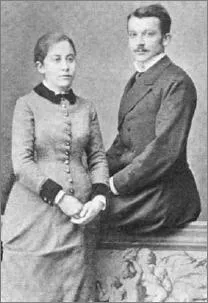
Mises's parents, Adele and Arthur, circa 1880
Arthur von Mises had married Adele Landau (born on June 4, 1858) from Vienna.14 Her family came from Brody, an almost exclusively Jewish town on the border of the Habsburg empire. Her father was Fischel Landau and her mother Klara Kallir. Adele had followed Arthur to Lemberg, where she gave birth to Ludwig and his younger brother Richard Martin (born 1883). A few years later they had a third boy, Karl, but he died of scarlet fever when Ludwig was twelve years old. Adele's native Brody was in those days a free trade zone for commerce with Poland and Russia. Her family had made good use of the profit opportunities and become affluent and influential. Her marriage with Arthur was not only a matter of love. It was also meant to cement a more encompassing alliance between two of the leading families of Eastern Galicia. Significantly, at the 1873 elections to the Austrian parliament, all three Jewish MPs from Galicia had family ties: Joachim Landau was elected for the city of Brody, Nathan Kallir joined the parliament as a representative of the Brody chamber of commerce, and Ludwig's uncle Hermann was elected for the county of Drohobycz.15
More than any other male family member of this generation, Hermann Mises featured the virtues that had made the Mises family so successful, and which, a generation later, would also characterize his nephew Ludwig: enthusiasm, determination, intelligence, love of his fatherland, leadership, and unpretentious and clear writing.16 After directing a branch office for a large insurance company and exploring for petroleum in Galicia, Hermann moved to Vienna in the early 1870s to work for a major newspaper, the Morgenpost. In 1873 he became a one-term member of the Reichsrat (the Austrian parliament) for the Galician district of Sambor-Stryj-Drohobycz, then returned to journalism, writing for another major paper, the Wiener Allgemeine Zeitung, where he was a tireless advocate for the industrialization of Galicia.17
Hermann and his brothers and cousins continued a tradition of achievement that can be traced back at least to their greatgrandfather—Ludwig's great-great grandfather—Efraim Fischel Mises. Fischel was a large-scale fabric merchant and real estate owner in Lemberg. After the Polish partition of 1772, the inhabitants of this poor rural area greatly profited from the new Austrian rule, which brought unprecedented liberties for the rural population and also for the cities, even though Maria Theresa, empress at the time of the partition, was not a champion of Jewish liberties. Some of her most important consultants—the famous Sonnenfels, for example—were of Jewish origin, but she would not tolerate Jewish residents in Vienna.18 In the cities that did tolerate Jewish residents, such as Lemberg, Jews were forced to live within special areas, the Judenviertel. They were generally prohibited from trading in the “forbidden districts” of the empire, and even those who had permission to trade there on business days could not stay overnight. So it remained, from her reign well into the nineteenth century.
Despicable as the system of regulations was, it allowed for exceptions. Thus the city of Lemberg would authorize Jewish residence outside of the Judenviertel if the person in question fulfilled three conditions: he had to be wealthy; he had to be educated; and he could not wear traditional Jewish clothes.19 A case in point was Fischel Mises, who enjoyed the privilege of living and trading in the forbidden district of Lemberg, where he also acted as the president of the secular organization of local Jews, the Jewish Cultural Community (israelitische Kultusgemeinde).
On June 23, 1800, Fischel's wife gave birth to the true founder of the Mises dynasty, the inexhaustible polymath Meyer Rachmiel Mises.20 The boy quickly proved to be successful in many fields and his father made him a partner in his firm early on. He also arranged a suitable marriage with Rosa Halberstamm, whose father ran an important German-Russian export business. Barely thirty years old, Meyer became president of the Lemberg Jewish Cultural Community, and a year later he took on the role of auditor for the provincial court in charge of trade issues, the Lemberger Wechselgericht. When his father died in 1842, he set up his own trade firm. Still in his forties, he was not only a successful businessman, but also an influential social leader, elected several times into the Lemberg city council; founder of an orphanage, of a Jewish school, and a Jewish kitchen for the poor. He also created several institutions providing funds for scholarships and other public-welfare oriented purposes.21
Meyer was the leader of the secular, pro-German wing within the Lemberg Jewish religious community, in which he held various positions beginning in 1840. The top three items on the agenda of the “enlightened” Jewish faction under Meyer were (1) spreading the German language, (2) creation of a deutsch-israelisches Bethaus—a progressive synagogue in which services were held in German, and (3) the creation of a German-language Jewish school. The main stumbling block for these projects was the local rabbi, a leader of the orthodox Ashkenazi. After the death of this man in the early 1840s, the Mises faction brought in Rabbi Abraham Kohn, who was well known for his progressive views. Once in Lemberg, Kohn was adamant in pursuing his agenda and must have driven his opponents to despair. In September 1848 he was murdered.22
Meyer Rachmiel Mises was probably among those who, after 1846, successfully led the country's bloody insurrection against the Polish nobility. These aristocrats had tried to reestablish the ancient custom of Robot—part-time serf labor for the nobility— that had slowly declined after the Austrian takeover of Galicia at the end of the eighteenth century. Two years later, when revolutionary insurrections broke out in Paris, Berlin, and Vienna, Meyer helped bring the fight to Galicia. He was one of four Jewish signers of a March 1848 Galician petition to the emperor, demanding among other things legal equality for all social classes, emancipation of the Jews, the creation of a Galician militia and of a Galician parliament.23 As an initial result, all forms of serfdom in Galicia were affirmatively abolished on April 17, 1848—though the Polish aristocrats received some compensation from the public treasury. In the same year, Meyer Rachmiel Mises was elected to the Galician parliament. He had now become a visible member of the unofficial “Jewish nobility” and was actively involved in major political reforms in this easternmost province of the Habsburg Empire. He may even have been one of the “democratic agitators” who caused such headaches for the defenders of the monarchy.
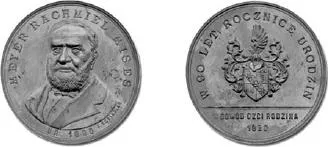
This coin, commissioned by the Mises family, was struck in 1880 to commemorate the 80th birthday of Meyer Rachmiel Mises. The obverse side carries Meyer's likeness and birth date. The words surrounding the Mises family crest, on the inverse, say “80th birthday anniversary,” and below the line, “with gratitude from the family, 1880.”
This was more than enough for a lifetime, one would think, but the most active and challenging part of his life still lay ahead. It came when the railways, which had begun crossing the European continent in the 1840s, reached Galicia in the mid-1850s. Meyer and his son Abraham positioned themselves in this business and were contracted by the Austrian army to transport wheat from Galicia in 1859. The army was preparing for its Italian campaign. The wheat deal brought them in touch with the financial empire of the Rothschild family. In 1855, Anselm von Rothschild had established the Credit-Anstalt bank, which specialized in financing industrial ventures and would soon become the largest bank on the Vienna stock exchange. One of its first major operations was to finance the Italian campaign. The deal must have gone well, for in 1860, Abraham accepted a position as director of Credit-Anstalt's new Lemberg branch office. Meyer had moved to banking three years earlier, becoming a director of the Lemberg branch office of the Austrian National bank—the central bank of the empire until the creation of the Austro-Hungarian bank in 1879.24 The thorough repositioning of the Mises family was complete when Meyer's younger son, Hirsche (Ludwig von Mises's grandfather), became a partner and managing director of the Hallerstein and Nirenstein bank, and his first-born grandson, Hermann, rose to the directorship of the Lemberg office of the Phoenix insurance company25 The Mises's economic interests, starting in a provincial trade company, had now shifted to the most profitable national industries: railroads and banking.
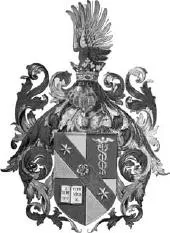
The coat of arms was awarded in 1881 when Ludwig von Mises's great-grandfather Meyer Rachmiel Mises was ennobled by the Emperor Franz Joseph. In the upper right-hand quadrant is the staff of Mercury, god of commerce and communication. In the lower left-hand quadrant is a representation of the Ten Commandments.
Meyer Rachmiel, as well as his father, presided over various Jewish cultural organizations in Lemberg. The banner, in red, displays the Rose of Sharon, which in the litany is one of the names given to the Blessed Mother, as well as the Stars of the Royal House of David, a symbol of the Jewish people.
In April 1881, Emperor Franz Joseph granted Meyer a patent of nobility, and in September of the same year, granted him and his lawful offspring the right to bear the honorific title “Edler.” A lonely patriarch, Meyer Rachmiel Edler von Mises survived both of his sons and his youngest daughter, Clara.26 When he died on February 28, 1891 in Lemberg, all of his grandsons had left for Vienna.
This exodus was by no means exceptional. Tens of thousands of Jewish families from the eastern provinces had seized the opportunities provided by the liberal post-1867 regime, which had abolished all legal impediments to Jewish migration, and established themselves in Vienna. Most of them held more secular views than those who remained in Galicia. Liberal Vienna held the promise of escape from the restrictions of small religious communities, and of secular integration into the larger world. Before 1867, city life in Lemberg and other major towns could offer similar prospects in Galicia. But by giving cultural supremacy in Galicia to the Polish Club, the Galician Resolution had quickly destroyed these prospects. The Polish aristocracy was adamant in suppressing any threat of social change. Liberalism and capitalism were not welcome. Neither were German-language schools, the great harbingers of social change in the preceding decades. In the Lemberg Jewish community, the rollback of German cultural supremacy was completed in 1882, when a pro-Polish president was elected to the Jewish Cultural Community.27
In the case of Ludwig's father Arthur, however, the crucial circumstance prompting his departure for Vienna may have been more prosaic. Austrian state finances had recovered in the 1870s and in the 1880s the government again took control of the railroad industry.28 The lines that had the greatest military importance were nationalized first, including those connecting Vienna with the borders of Russia, in Galicia.29 In the wake of this takeover, Arthur von Mises was accepted into the civil service as a construction counselor to the railroad ministry in Vienna.30
In those days, joining the civil service in Vienna was a big improvement in any man's career: employment in public administration was comparatively rare and far more prestigious than any other field of activity. The family moved into an apartment at Friedrichstrasse 4, its home for the next fifteen years. Adele had a maid and a cook to assist her in running the household—standard in bourgeois families—while her main duty and passion was the education of her sons. This involved, most notably, placing them in good schools to prepare them for their future careers.
The Miseses had become a typical Jewish family for the Vienna of that time, as described by cultural historian William Johnston:
It was characteristic of them that a businessman father would marry a wife who was more cultivated than he was. Together the couple would settle in Vienna, often in the Leopoldstadt district, where he established a career while she supervised the education of the children. The cultural ambition of the wife was then passed on to the sons, who aspired to excel their fathers by entering one of the liberal professions.31
By all human standards, Adele von Mises did an outstanding job educating her two sons. Each did far more than just surpass his father. They both turned out to be scientific geniuses: Ludwig in the social sciences and Richard in the natural sciences. Ample administrations of motherly love provided the foundation for their astounding achievements. But there was more. Adele taught her sons to care for others.32 She taught them to be modest and frugal.33 She taught them to honor truth and virtue more than the encomiums of the world. She taught them the art of writing. And she taught them always to strive for excellence.
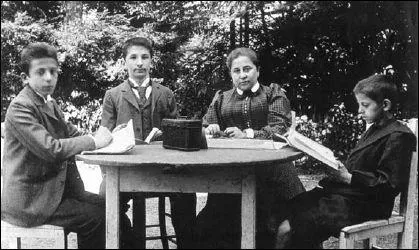
Richard, Ludwig, mother Adele, and Karl
In all of their later endeavors, Ludwig and Richard would be thorough and systematic. In their professional lives this was a matter of course. But it also permeated all their other activities. Ludwig for instance sought instruction even in popular sports such as mountain hiking, and when he played tennis it was always with a trainer.34 Like their mother, Ludwig and Richard wrote with a clear and unpretentious style. From childhood they set for themselves the highest standards. And as they developed taste and expertise, they would judge their own achievements and those of others in the light of these standards.
Ludwig was especially adamant in his refusal to allow social or political considerations into his judgment of persons and deeds. He had a lifelong disdain for people who had attained positions of leadership without true competence. As a mature man, he would openly despise the great majority of his professorial colleagues, not for their errors, but for their dilettantism.35 His complete inability to suffer fools would make him many enemies and almost ruin his career; it gained him the reputation of a stubborn doctrinaire.
Mises nevertheless got along on his rocky road, thanks to his outstanding gifts; among them the natural gifts from his native Galicia. In this respect too he was a typical case:
Jewish lawyers, doctors, professors, and journalists abounded after 1880, and there were not a few rentiers like Stefan Zweig or Otto Weininger. These men, who had attended gymnasium and university in Vienna, often had grandparents who had lived in villages in Galicia or Moravia, close to the soil and to traditional Jewish culture. However ardently these young sophisticates might try to secularize themselves, they could not cut off all roots in the Jewish villages. They retained an earthy energy, a love of nature, a breadth of horizon that served them well and accorded with Vienna's traditions. After 1860, Vienna's Jews were not products of generations in an urban ghetto like that of Berlin or Frankfurt. They were newcomers to the city, who brought an energy, an ambition, an appetite for culture that made them capable of astonishing innovations.36
Earthy energy, breadth of horizon, ambition, and appetite for culture also characterized young Ludwig, and these qualities would lead him to astonishing innovations. The next chapters show how this newcomer conquered first Vienna, and eventually the world of ideas.
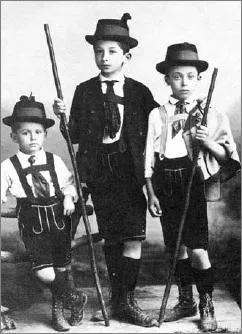
The three Mises brothers, left to right, Karl, Ludwig, and Richard
Mises: The Last Knight of Liberalism
Read the whole book online · Book details
Published here by permission of Jörg Guido Hülsmann. This work is still in copyright: free to read and download from this archive, but not licensed for re-publication elsewhere.