
Chapter 157 of 178 · Mises: The Last Knight of Liberalism by Jörg Guido Hülsmann
A Misesian Treatise
It was in these high years of the new American Misesians— the Human Action years—that Murray Rothbard completed his “textbook” rendering of Austrian economics. At first he stuck to the original project of a mere popularization of Human Action, trying “to do for Mises what McCulloch did for Ricardo.”110 But by October 1952, he had already decided to pursue a more independent exposition of economic science. Rothbard ended up writing an entire treatise of economic science, covering in some 900 pages the theory of the market economy and of government interventionism. The work was a masterpiece and had a deep impact on subsequent generations of Misesian economists.
Murray Rothbard at the Festschrift dinner honoring Mises in 1956
During the winter semester of 1952, Rothbard presented several chapters of his work in Mises's seminar.111 It was here that he might have defended for the first time some of the doctrines that set him apart from Mises. The professor handled the situation in his usual manner, namely, with scholastic laissez-faire. He encouraged Rothbard to follow the path he had chosen.112
This might have had to do with the specific American flavor of the exceptions Rothbard took to Mises's approach. For example, Rothbard had come to believe that there was a “science of rational ethics based on human nature and what is good for human nature.” Thus he had abandoned Max Weber's position, which Mises cherished, that there can be no science of ethics, but only subjective value judgments. Rothbard had probably come to adopt this new viewpoint under the influence of discussions with Ayn Rand's group. In the first version of his manuscript of chapter one, where he explained the first principles of human action, Rothbard had adopted the Weberian position, which was the “standard” position at Columbia. Probably, therefore, Rothbard attended meetings of Rand's group during 1952 and in the course of these encounters changed his mind on the question of scientific ethics.113
Rothbard also took exception to the philosophical pessimism that seemed to form the foundation of Mises's theory of human action. Mises had asserted that man acts to relieve dissatisfaction, which implied that man did not act when he was happy. Rothbard thought that such a view was “contrary to the natural state of man, which is at its happiest precisely when it is engaged in productive activity.”114
But Rothbard would soon disagree with Mises on a more fundamental issue. During the winter semester 1953, he was in the process of reviewing conventional price theory, which stressed cost curves and other remnants of classical “objective” price theories. His rejection of these approaches had led him to some original conclusions. Rothbard became convinced that the entire neo-classical theory of monopoly prices relied on a completely unwarranted fiction, namely that it was possible to distinguish these monopoly prices from competitive prices. He believed that Mises too had fallen prey to this fiction. Mises held indeed that the sovereignty of consumers was impaired in the presence of monopoly prices. Rothbard disagreed:
I have come to the conclusion that this theory is outright nonsense. I do not differ with Mises rashly on matters of economic theory, but in this particular case I think he has not freed himself from the shackles of the old neo-classical approach. The key question here is this: How do we know what the “competitive price” is? If we go to the illustration of this approach in, for example, Fetter's Economic Principles, we find a competitive price, and the monopolist assessing his demand curve at this price. But, in reality, we never know the competitive price. The competitive price is a result of action, and not a given. Even if we can observe a man restricting his investment and production in a product, and raising price, we can never know if this is a movement from “competitive price” to “monopoly price” or from “sub-competitive price” to “competitive price.” As Mises has told us again & again, a concept divorced from real action and employed as an actual reality and even an ideal, is invalid. Therefore, the whole concept of competitive price vs. monopoly price has to go by the board. On the free market there is only the “free market price” which in turn is competitive, since buyers and sellers freely compete with each other. And this is true not only for the individual seller, but also for a cartel. For I have come to the perhaps even more revolutionary conclusion that there is nothing in the world wrong with a cartel when it is voluntary. When many firms merge or form a cartel, what happens? In effect, the assets of many individuals are pooled and directed by them all, in accordance with their proportionate ownership and their contract. But how does this process differ from the formation of an ordinary corporation, when different individuals pool their capital and assets according to their voluntary contract? Not in the slightest.115
Another year later, at the beginning of the academic year 1954–1955, Mises concentrated in his NYU seminar on price theory and other aspects of the theory of the market economy, possibly because he sensed that Rothbard was in a decisive phase of his work and close to completion. He had Rothbard deliver several presentations, in particular, on Robinson's and Chamberlin's theory of monopolistic competition and on selling costs.116
Rothbard was better prepared than ever. He had spent the summer discussing economics for endless hours with young George Reisman. In the course of these discussions they developed an important extension of Mises's theory of economic calculation. Starting from the “question of how extensive the number of firms in the economy must be in order to have calculation,” they “came to the conclusion that for every ‘vertical integration’ within a firm, in order for the firm to allocate costs, etc., internally, there would have to be a market for that area external to the firm. Thus, the inability of a Socialist government to calculate is a special case of the inability of any firm to calculate for departments internal to itself, if there is no external market to which to refer.”117
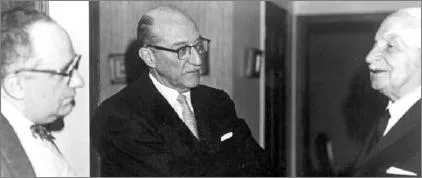
Murray Rothbard, Henry Hazlitt, and Ludwig von Mises
Combined with the Mises seminar, this intensive exchange gave a decisive boost to Rothbard's writing, to the point that, by July 1955, the manuscript had almost reached the form it would have when it was eventually published in 1962.118 Most important, Rothbard had by then completed the chapter explaining the conceptual framework within which he would analyze both the operation of the market economy and government interventions. In distinct contrast to all previous economists—with the notable exception of Gustave de Molinari, the dean of the French nineteenth century laissez-faire school—Rothbard did not present the modern state as an integral part of society. Rather, he distinguished between two types of production of security: coercive and free. The former was characteristic of the modern state, whereas the latter would exist only in a hypothetical free society.119
These statements, which Rothbard made in his July 1955 report to the Volker Fund, must have set off alarm bells with Luhnow and other Volker Fund people. For the first time, Rothbard had spelled out his thoroughly anti-statist worldview and tried to prove that this view found support in the tenets of economic science. This brazen display of political anarchism was apparently too much even for the Volker Fund. Rothbard was given another extension of his research grant, which he used, during the academic year 1955–1956, to polish his manuscript (by July 1956 it amounted to 1900 typed pages) and finally to finish his Ph.D. in economics at Columbia University. But it must have been made clear to him that he could not count on Volker Fund support in the future, at least not to the extent he had enjoyed it in the past. By April 1956, he applied for a new research grant for work on the Great Depression—this time from the Earhart Foundation.120 Mises supported him unequivocally, stating that he was “fully convinced that [Rothbard] will one day be counted among the foremost economists.”121
Rothbard's treatise was put on hold. He worked part-time for FEE writing a short book on money (What Has Government Done to Our Money?) and he continued to polish the manuscript of his treatise for the next few years.122 The directors of the Volker Fund needed quite some time to ponder the question of what to do with this explosive material, which threatened to disintegrate the nascent libertarian movement. In May 1959, Rothbard reported completion of the manuscript in a letter to Mises. He also expressed his regret that he had only rarely been attending Mises's seminar.123
This version of the manuscript was passed on to the Volker Fund's Frank S. Meyer, ostensibly in an effort to bring the project to completion. (Or the decision might have been related to already existing plans to close down the Fund.) Meyer was no Rothbardian. He was chosen as a third-party or “objective” opinion on the merits of the book. He delivered a report that would allow both the author of the book and his sponsor to agree on how to proceed without losing face. Meyer said the book was “one of the two or three most important discussions of economics to be written in this century,” and he lavishly praised it for its radical break with the traditional utilitarian underpinnings of economic theory, a break that opened the prospect of integrating the economic rationale against collectivism into certain strands of conservative thought.124 On the other hand, Meyer admonished that certain chapters were “fundamentally political in their scope and written from the point of view of an uncompromising anarchism.” These chapters should be removed and their economic content be collected into a single chapter.
And so it happened. Rothbard's treatise (with anarchism excised) was published in 1962 as Man, Economy, and State. His discussion of a stateless market society would eventually appear eight years later in a separate book with the title Power and Market.
Mises: The Last Knight of Liberalism
Read the whole book online · Book details
Published here by permission of Jörg Guido Hülsmann. This work is still in copyright: free to read and download from this archive, but not licensed for re-publication elsewhere.