
Chapter 149 of 178 · Mises: The Last Knight of Liberalism by Jörg Guido Hülsmann
First Reactions
Neither Mises nor his friends expected the success the book would have. After his return from Mexico, Mises left for a two-week vacation in the Berkshire Mountains.2 The book was released to the bookshops while he was away, on September 14, 1949. In his weekly Newsweek column, Henry Hazlitt announced and praised it, anticipating the role it would play in subsequent events:
Human Action is, in short, at once the most uncompromising and the most rigorously reasoned statement of the case for capitalism that has yet appeared. If any single book can turn the ideological tide that has been running in recent years so heavily toward statism, socialism, and totalitarianism, Human Action is that book.3
This was almost a self-fulfilling prophecy. Not three months later, by December 6, more than 4,000 copies had been sold and the book was in its third printing.4 With the reports of ever more sales, Mises's euphoria lasted for months.5 His NYU seminar addressed “fundamental problems and theorems of economics and their relationship to philosophical, historical, and political ideas.”6 It started on his birthday, September 29.
When Ludwig and Margit spent New Year's Day 1950 with Hazlitt, Schütz, and Hayek at their Manhattan apartment on West End Avenue, it was already clear that Human Action was a phenomenal success, especially for a 900-page scientific treatise. Even his ideological opponents had to admit that the sixty-eight-year-old economist had written a “Capitalist Manifesto”7 and “a truly unvarnished and unconditional defense of laissez-faire.”8
Many other reviews followed over the course of the next several months. Most of these were insubstantial and their criticisms boiled down to carping at the book's pontifical style.9 One reviewer had the audacity to complain that as a reader of the work one “continually has the sense of being argued out of existence.”10 But other reviews were receptive to its monumental contributions. Young Murray Rothbard praised Human Action as a masterpiece of original synthesis. The book contained “a complete structure of economic science,” which was “firmly grounded in praxeology, the general principles of individual action.”11 Similarly Richard C. Cornuelle highlighted that Mises had integrated value and price theory, and was therefore in a position to defend capitalism without basing his reasoning on such fictions as homo oeconomicus.12
The book also found an exceptionally friendly reception in Germany, were Cologne University professor Armin Spitaler published a long review in the Weltwirtschaftliches Archiv. In South Africa, a young professor adopted Mises's epistemological point of view without reservations in his fall 1950 inaugural lecture at the University of Witwatersrand in Johannesburg. The man who lectured on “Economics as a Social Science,” Ludwig Lachmann, was a graduate of the London School of Economics, where he had studied in the 1930s under Hayek and Robbins. Before that, he had been a student of Werner Sombart's in Berlin. Lachmann was already acquainted with Mises's aprioristic epistemology which the Vienna economist had first outlined in his 1933 Grundprobleme der Nationalökonomie (Epistemological Problems of Economics), and which now for the first time hit the Anglo-Saxon intellectual scene.13
A member of Mises's NYU seminar, George Koether, arranged for chapter 35—“The Economics of War”—to be reprinted by the New York based Christian Freedom Foundation (CFF) in September 1950, as a reaction to the Korean War which should soon entail a new round of price controls and economic regimentation. Koether worked at the time both for CFF and for FEE. The Foundation reprinted the chapter in its fortnightly newspaper, Christian Economics.,14 This publication reached some 100,000 clergymen spread out over the entire country.
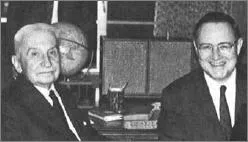
Mises and George Koether
This might have been Mises's first contact with CFF and its staff, and it became a productive and beneficial collaboration that would last a lifetime. George Koether continued to attend Mises's NYU seminar for many years and became a personal friend of Ludwig and Margit's. After Ludwig's death, he helped Margit write her autobiographical recollections, My Years with Ludwig von Mises.15 In the 1950s, he worked in the New York area, first for CFF and FEE, then as an automotive and transportation editor of Look Magazine, and eventually as an economist of the U.S. Steel Corporation.16
Mises had another disciple and admirer on the CFF staff. Brooklyn-born Percy Laurie Greaves (1906–1984) was the American self-made man par excellence. Before he began to work at the Christian Freedom Foundation in 1950, he had been a bookkeeper, seaman, advertising manager, instructor in economics, financial editor, ghostwriter, and research assistant to the U.S. Congress, where he had collaborated in the investigation of the Pearl Harbor Attack and in the drafting of the Taft-Hartley Act.17 Greaves faithfully attended all sessions of Mises's NYU seminar and, together with his future wife Bettina Bien, wrote minutes for each one of them.18 Eventually he made a career out of promoting Misesian economics in public lectures and seminars. But most importantly, the Greaveses cared for their professor in the late 1960s and early 1970s, when Mises and his octogenarian spouse became frail. After Mises died in 1973, they continued to assist Margit von Mises. When Percy died, Bettina continued to take care of her revered teacher's widow, until Margit too died in 1993, at the age of 103. Bettina then became the curator of Ludwig von Mises's literary estate, as she still is today.
Percy Greaves and Mises in 1959
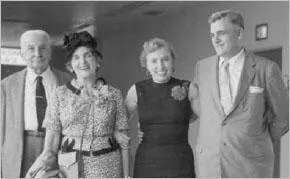
Mises, Margit, Bettina and Percy Greaves at the airport in 1959
The president of CFF and editor of Christian Economics was Howard Kershner, but the man behind the organization and its journal was the wealthy Philadelphia industrialist, J. Howard Pew, who had inherited the Sun Oil Company from his father and was an extremely successful entrepreneur in his own right. Pew assumed various social responsibilities besides sponsoring CFF. He was the chairman of the board of Grove City College in western Pennsylvania, and he owned the Chilton Press, which published the Pathfinder and the Farm Journal.19 Mises had known him at least since March 1945, when the National Association of Manufacturers sent him the manuscript of a talk in which Pew had explained how cartels threaten economic progress.20The two men had entered into direct correspondence in November 1948, when Pew asked Mises to write a letter to the editor of the New York Times, in response to what they both believed was a shameful column by a certain Edward Collins. Mises declined the request, responding that any such attempt was futile:
First of all, they have the habit of “editing” and shortening such letters so that they lose a good deal of their persuasive power or even become completely garbled. Secondly the editor or the columnist has the privilege of the last word. The effect on the uncritical reader is always that “his” paper is right.
What is needed to fight such allegedly “non-dogmatic” dogmas as those advanced by Mr. Collins (and a host of other writers) is an independent journal of opinion.21,22
Pew was quick to react. In early December 1948, he met with the team running Plain Talk magazine—Alfred Kohlberg, Isaac Don Levine, and Eugene Lyons—to discuss the advisability of “making it into just such a journal of opinion.”23 Pew's idea was to provide a forum for Mises, Hazlitt, and other select economists. These talks did not lead to the desired result, but two years later, one year after the publication of Human Action, Pew stood again first in line to finance a libertarian journal of opinion, The Freeman, which for a few glorious years would spread Austrian economics among a larger public.
Pew had the habit of giving away shares of his corporation, Sun Oil, to all of his employees. Starting in 1951, he also gave such shares to Mises as Christmas gifts. He did this every year until 1968. He wrote:
While you have been devoting your life to saving the world from those processes which inevitably lead to Communism, the rest of us have been devoting our time to operating industry to the exclusion of everything else, so that we have been blinded to the future. And so I hope you will accept from me, at this Christmas Season, a small token of my appreciation in the form of a few shares of stock in the Company to which I have devoted my life.24
Mises: The Last Knight of Liberalism
Read the whole book online · Book details
Published here by permission of Jörg Guido Hülsmann. This work is still in copyright: free to read and download from this archive, but not licensed for re-publication elsewhere.