
Chapter 152 of 178 · Mises: The Last Knight of Liberalism by Jörg Guido Hülsmann
The Freeman
The success of Human Action prompted the creation of another important libertarian institution. Mises had long been arguing the need for a free-market journal of opinion. Now organizers, journalists, and, especially, financial backers rallied to establish such a journal. Its explicit purpose would be to promote the ideas Mises stood for. The Austrian economist became the intellectual standard-bearer of The Freeman, which reinforced the infant network of Mises's NYU seminar, FEE, and the Mont Pèlerin Society. Despite its eventual departure from its founding auspices, The Freeman would play a significant role in the revival of American libertarianism under new Austrian auspices. Two historians have aptly summarized this role:
It is difficult to convey a sense of the crucial role of The Freeman at the height of its prestige, between 1950 and 1954. The American Left, in these years, had many well-known and reputable journals from which to choose; the American Right had almost none.43
By the end of 1955, when new owners changed the nature of the magazine, a self-conscious and relatively coherent movement had evolved. If “creeping conservatism” was “the grand trend of the 1950s”... then The Freeman had been its professional and articulate journal of opinion.44
The Freeman began as a successor to the journal Plain Talk, which for some time had been in financial trouble and could only survive on subsidies from New York businessman Alfred Kohlberg. Initial financing of The Freeman came through the fundraising efforts of Jasper Crane, which had resulted in a substantial donation from Herbert Hoover and sizeable loans from Howard J. Pew and Crane himself.45
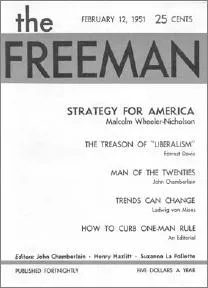
The explicit motivation of Pew and Crane was to provide a forum for the author of Human Action and like-minded intellectuals, but to ensure editorial independence all initial funds came in the form of donations and loans, rather than by stock.46 Leadership of The Freeman was in the hands of its three editors: Henry Hazlitt, John Chamberlain, and Suzanne LaFollette. Chamberlain became the president and Hazlitt the vice-president of the journal. They published The Freeman as a fortnightly review, with Mises on an eleven-man board of directors. The first issue appeared on October 2, 1950.47
Many observers greeted the new publication as the necessary exception in a media landscape dominated by the Left. Raymond Moley explained to his readers in Newsweek:
It is difficult to realize how firmly entrenched in this country are the forces which would pervert the free institutions of this country into the reality of a socialist state. The drift toward more state power, particularly Federal power, began many years ago under such names as “progressivism” or “liberalism.” This movement as organized politics ultimately captured the Democratic Party under FDR. It pervades most of the economic and political thinking in our colleges and universities. It has seized ascendancy in our literary criticism and book reviewing. And finally, through the political arms of the CIO and AFL it has measurably brought together into a hard core the immense financial and voting strength of the unions.
No little credit for this is due to two journals of opinion, The Nation and New Republic. These journals, once the voice of minority protest, have become the gospel of what has almost become an established order of thinking. A whole generation of teachers and other leaders of thought have to a measurable degree taken their political bearings from these journals.
The Freeman's great role is that of a protest against the new orthodoxy which holds that all good comes from the state. This new protest has the virtue, however, of conformity to the oldest and best traditions of American freedom—traditions that if neglected too long will wither and die.48
The journal had an excellent start. Subscriptions increased from 5,203 in the first issue to 12,200 in May 1951. By March 1952, Time and Newsweek reported that the new kid on the block distributed close to 20,000 copies. At the end of March 1952, Alfred Kohlberg dropped out as treasurer and returned to his import business. In came Alex Hillman, publisher of Pageant and People Today and other magazines. This was the first great blossoming of Austro-libertarianism in America. Mises now felt that things had substantially improved, and he wrote in correspondence that the case for liberty had made great progress since the dark days of 1945.49
The Freeman not only provided Mises with a forum for his ideas, but also with an organizational basis through which he could reach out directly to students. At the initiative of Henry Hazlitt, The Freeman sponsored a two-week Mises seminar in the afternoons of June 25 through July 6, 1951 in the alumni room of the NYU Faculty Club on Washington Square.50 In the first week, Mises dealt with fundamental problems of economic analysis, and in the second turned to monetary economics. Young Leland Yeager, at the time a graduate student in monetary economics, was one of the thirty-nine participants. The second week would leave a lasting impression him.51 He wrote:
Reading your books is very instructive, but seeing and hearing you in person is a genuine inspiration. You revealed yourself not only as a great economist but as a great humanitarian too. The interventionists who cite you as an example of a “die-hard reactionary” are only showing their own complete ignorance. What a pity that the world has so few intellectually courageous men like you!52
Yeager was one of the few student participants. Most members of the seminar were teachers, journalists, businessmen, and professors. The two weeks were a great success and led to a second Mises seminar in June and July 1952, in San Francisco's Public Library, before an audience of forty-six participants.53 Again the first week was dedicated to fundamentals. Mises here delivered his analysis of dialectical materialism, which a few years later appeared as a chapter of his book Theory and History. In the second week, he dealt with capital theory (saving, investment and the accumulation of capital, the demand for capital, and the economic and political significance of foreign investment).
Again the seminar was very successful, but it did not go to his head. When invited to appear on television in California, he declined saying, “my foreign accent prevents me from appearing on television or radio. These media of communication intensify the shortcomings of the speaker's pronunciation.”54
In the tradition of Plain Talk, one of the concrete goals of The Freeman was to expose Communism as a totalitarian scheme. Anti-Communism also provided a unifying theme for dealing with foreign policy and domestic policies, which could be denounced as Communist-inspired. Yet there was no fundamental agreement on the strategic role of anti-Communism. Chamberlain and LaFollette saw in it the very essence of their mission. For Mises and Hazlitt, Communism was just a particularly gruesome species of the more general disease of statism, which manifested itself most notably in domestic government interventionism.
Many of The Freeman articles in the decisive early years dealt with American foreign policy, especially with the role of the United States in confronting the Soviet-led East Bloc. The focus on anti-Communism in foreign policy was certainly convenient in that it allowed the editors to expand their readership without offending those who were both anti-Communist and prointerventionist.
Even on the issue of foreign policy, however, there was no unity in the libertarian camp. One faction advocated political isolationism combined with cultural and commercial openness to foreign countries. On the other side, there were the interventionists who championed American government opposition to Communism on a worldwide scale. The latter tended to be less interested in combating Communism by intellectual and educational means, focusing instead on the denunciation of Communist infiltrators, the prosecution of domestic traitors, and military action against Communist troops abroad. The confrontation crystallized in a semi-public correspondence between Leonard Read and Lawrence Fertig. Read had championed a resolute anti-war stance, because he recognized that war was the great mainspring of government power. Fertig commented:
Your philosophy seems to trend toward non-resistance and even slightly toward anarchism. I believe that the raising of an army is a perfectly legitimate function of government. Your implication that we must wait on these shores before striking back at an aggressor, makes no sense to me. Your statement that a man in the army shooting Communists in Korea is just as guilty as a man blowing the head off a baby in Centerport, is a statement that I reject completely55
And he went on to say that the fundamental problem cannot be coercion per se because taxes are after all coercively levied on the citizenry. Read replied:
Personally, I am unable to concede that there is any right that comes into being by reason of you and me acting collectively. From a moral standpoint can the collective be right in doing what is wrong for the person? I concede that you have a moral right to protect your life and property against violence otherwise initiated. Collectively we have the same right, but no more. This reasoning is not anarchical nor is it pacifistic. It is nothing more than the limitation of force to what I think is its proper scope.56
Mises's views on the issue are revealed in a letter that he wrote some years later to Anthony Fisher, the founder of the neo-liberal Institute of Economic Affairs in England. Mises deplored the pro-socialist leanings of public opinion on the western side of the Iron Curtain, which “paralyzes all political actions of the West and makes it possible for the Russians to do what they want in Hungary, Poland and the Near-East.” He continued:
The average American intellectual condemns England and France as aggressors. But he does not consider as aggression what the Russians are doing in Hungary. He admits that the Russians are rather harsh in Hungary. But he excuses this harshness. It is, he thinks, rather unrealistic to apply to eastern affairs the yardstick of Western civilization. What in America would have to be qualified as brutality is in the East merely behaving as everybody does.57
Otherwise Mises did not get involved in these debates. In Liberalism, he had argued that the Russians should be allowed to do in their own country whatever they wished; that they should be free to spread their ideology in the West, even with the help of clandestine hirelings; and that businessmen and other citizens of the Western countries should be free to make loans to Bolsheviks in Russia and elsewhere. What he opposed was Western governments actively supporting the destructive policies of Communism, whether through premiums paid on exports to the Soviet Union, or through propaganda on their behalf.58 He had espoused this position a quarter-century earlier and he had not retracted a single world. He was convinced that Communism first and foremost posed an intellectual challenge and had to be fought with the weapon of the mind.59 Mises wanted The Freeman to run more articles and book reviews dealing with economic principles but he was aware that the journal lacked the manpower to do so.
This dispute over American foreign policy foreshadowed dividing lines within the American libertarian movement that have continued to the present day, but in the early 1950s, it was only a side show in the unfolding drama that led to the early demise of The Freeman.
The main factor in this drama was a disagreement between Hazlitt and Chamberlain on strategic issues of editorial policy. Then, too, there was the fact that Hazlitt, who had the backing of the main sponsors, was unwilling to give up his position at Newsweek to run The Freeman full time. Conflicts between the Hazlitt-Mises camp and the Chamberlain-LaFollette camp were inevitable, given their different outlooks on what The Freeman was and should be. For Mises and Hazlitt, the essential mission of the journal was to educate the larger public, not to take part in the daily strife of political factions:
As I see it, the function of The Freeman is to make it possible for dissenters to challenge the ideas of the Left.... The issue is not so much to fight communism as this task is to some extent accomplished by other media of communication. What matters is to expound sound economics and to expose current economic fallacies.60
In contrast, Chamberlain favored a more aggressive tone both attacking and endorsing specific persons, parties, and political candidates. With an eye on Mises, Röpke and other academic contributors, he later argued against “sterile” journalism:
We believe that it was the intention of the founders that The Freeman should be a comprehensive fortnightly review of the contemporary scene and not merely a journal of classical economics, allowing a selected group of economists to talk to each other via their papers.61
In short, Chamberlain held that the magazine must have “crusading zeal... wit, satire and editorial bite.”
Hazlitt replied:
Exactly. But one man's crusading zeal is merely another man's vehemence; one man's wit and satire merely another man's trivial wisecracks; one man's “editorial bite” merely another's vituperation.
After two years of experience, Hazlitt found his concerns confirmed. He quoted Chicago economist Frank Knight, who had told him in correspondence that The Freeman
seems to “scream” in a way that may tickle the ears of those already converted or “overconverted,” but it would hardly convert anybody, at least nobody open to reason, and they are the only ones I'm personally interested in.62
Hazlitt himself was later reported to object to putting out the “kind of magazine in which McCarthy is a sacred character.” And Fertig was quoted in the same source, saying that The Freeman “should have convinced by logic and reason, with less shrillness, less direct hysteria.”63 Hazlitt stated his own opinion in October 1952:
A libertarian journal of opinion is only worth publishing, as I see it, if it can have a real effect in turning the tide of national thought in this crucial era. To have such an effect, it must command the respect of the intellectuals—even (in fact, particularly,) of those we are trying to convert. And it cannot command this respect unless it has dignity and a note of authority Of course the magazine must also be lively to reach as wide an audience as possible without sacrificing these qualities.64
Even though Hazlitt was only a part-time editor, his work with The Freeman proved to be a severe drain on his energies. By May 1952, he brought a new man onto the editorial team: Forrest Davis, a former Washington editor for the Saturday Evening Post. But just a few days after his arrival, it was clear that Davis was not to be Hazlitt's man. Isolated in his editorial stance, Hazlitt resigned in June. Officially, he took a “leave of absence of four months” at the request of Mises, Fertig, and other friends on the board of directors, who did not want to abandon control of The Freeman to the remaining editors.65
So far so good for Chamberlain, LaFollette, and Davis. Their major problem in the long run was to find funding independent of the financial fathers of the magazine, Pew and Crane, who backed the Hazlitt line. This problem seemed to find a convenient solution in the form of a fundraising dinner at the occasion of The Freeman's second anniversary. One month before the event, however, the Hazlitt camp started torpedoing the dinner preparations.
It is not entirely clear what prompted them to this action. The following scenario seems most likely: During Hazlitt's leave of absence, Howard Pew had made it clear both to the Chamberlain camp and to the members of the Board of Directors that he stood ready to finance The Freeman single-handedly if it focused on the communication of broad principles of the free-market philosophy, rather than engaging in partisan attacks on persons and programs—that is, if it followed the Hazlitt editorial line.66 When Chamberlain and his associates did not yield, Mises and the others started a last desperate attempt to direct The Freeman toward Hazlitt's position by scuttling the fundraiser that would have made the editors financially independent of Pew and Crane.
The struggle got uglier and more personal. Chamberlain now wrote nasty letters accusing Hazlitt of being Pew's lapdog, and in a heated board meeting in October 1953, Mises said Chamberlain and LaFollette were secondrate journalists compared to Hazlitt.67
Hazlitt himself resigned both from the board of editors and as vice-president on October 8, 1952, as he had intended since May. Meanwhile Crane and Fertig lined up a majority behind their position, and at a board meeting on January 21, 1953, Hazlitt was elected editor-in-chief, whereupon Chamberlain, LaFollette, and Davis resigned immediately.68
But this was only a symbolic victory. More than six months of quarrels had brought The Freeman to the verge of bankruptcy. Jasper Crane desperately tried to raise new money with fundraising letters, and Frederick Nymeyer tried to acquire new advertisers, but to no avail.69 After a few months, Hazlitt, who still continued to write for Newsweek and to fulfill other contractual obligations, became discouraged by the desperate financial situation.
In 1955, the magazine was taken over by the Irvington Press, a subsidiary of FEE, with Frank Chodorov as editor. Mises contributed an article on “Inequality of Wealth and Income” to the first issue, May 1955. By January of the next year, The Freemanwas officially the journal of FEE. Paul Poirot would be its editor for the next few decades, and it would continue to publish the work of Mises and promote the economics of the Austrian School. But it never reached a mass audience.
Mises: The Last Knight of Liberalism
Read the whole book online · Book details
Published here by permission of Jörg Guido Hülsmann. This work is still in copyright: free to read and download from this archive, but not licensed for re-publication elsewhere.