
Chapter 98 of 178 · Mises: The Last Knight of Liberalism by Jörg Guido Hülsmann
The New Theoreticians
Mises's hope for a wiser future monetary policy did not seem quite as naïve at the time as it now seems in retrospect. The year 1928 marked the high point of his influence on German monetary thought. The majority of the contributions to the meeting of the Verein für Sozialpolitik in Zurich elaborated on his writings. One of the many participants from Vienna later recalled: “In the year 1928, almost all professors and other members held Mises in high esteem and admired him.”41 Another sign of his influence was the international recognition he received on a May 1928 lecture tour in England.
Mises visited England just when his new book on monetary stabilization was about to come out. He had already written his lectures, which dealt with “private property and socialism,” and he offered the manuscript to the University of London Press for publication. The Press eventually declined, saying the manuscript was not voluminous enough.42
Still, the 1928 lecture tour marked one of the high points of the golden age of the Vienna-London “Austrian axis.” Mises later recalled that he had first joined the British Royal Economic Society in the 1920s because it did not yet promote a left-wing agenda. “At the time Lionel Robbins and Sir William (now Lord) Beveridge were dubbed ‘Austrians’ by their critics because they agreed with me.”43
A few months after Mises's lecture tour in England, the annual convention of the Verein für Sozialpolitik was held in Zurich. The subject of the discussions, “goals and methods of business-cycle research,” had been determined at the 1926 Vienna meeting. Already at that point, it was clear that the second edition of Theory of Money and Credit had been received far more positively than the 1912 edition. General experience with wartime inflation and postwar hyperinflation had made the Misesian message—that business cycles were the result of fiduciary credit—more palatable to a broad public. In the following years the popularity of the monetary theory of the trade cycle increased to such an extent that, by 1933, Mises himself believed that it had become the dominant theory in Germany and Austria.44
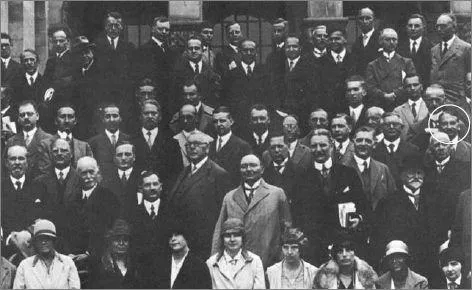
Meeting of the Verein für Socialpolitik, at the University of Zurich, September 11–13, 1928. Third and fourth rows include: Sombart, Hayek, Machlup, Mayer, Strigl, Degenfeld, Mises, Spitzmüller, Bettelheim, Hunold. Top two rows include: Morgenstern, Schams, Löwe, Rosenstein-Rodan, Rüstow, Dietze
The 1928 Zurich meeting was an important milestone in this progress. In preparation for the meeting, the Verein's subcommittee on economic theory published a 370-page volume on business cycle theory, containing papers written predominantly by economists of the rising generation—those who had turned away from historicism toward the study of theoretical problems. Among them were Eucken, Hayek, Hahn, Löwe, and Kuczynski. Mises himself took an active part in the sessions and concluded with the statement that the present discussion was a proof of progress, even though no agreement had been reached and many problems still remained. Only sixteen years earlier, he had been the only German to develop the monetary theory of the trade cycle. He was proud that many of his ideas, rejected at the time, were now commonplace for the majority of economists. The progress was even more pronounced when the comparison was to the meeting of 1903 (twenty-five years earlier), which was the only other time the Verein had even dealt with the problem of economic crises.45
A few months later, Mises was one of six new members elected to the board of the Verein.46 Although he himself did not attach much importance to the event, it symbolized better than anything else his professional standing in those days. Starting as an eccentric in 1912, Mises had become a respected academic leader. The Verein establishment may not have appreciated him, but it was realistic enough to recognize him as the representative of a growing movement among the members. More importantly, however, his rise epitomized the new respectability of theoretical research, which the Verein's founding generation had despised.
Mises: The Last Knight of Liberalism
Read the whole book online · Book details
Published here by permission of Jörg Guido Hülsmann. This work is still in copyright: free to read and download from this archive, but not licensed for re-publication elsewhere.