
Chapter 34 of 178 · Mises: The Last Knight of Liberalism by Jörg Guido Hülsmann
Theory of Money
Despite his workday immersion in the details and intricacies of the Austrian tax policies, Mises had somehow managed to write a treatise on money and banking. He had written no articles for a year, focusing instead on the completion of his book. In mid-December 1911, he put the finishing touches to a manuscript with the title Theorie des Geldes und der Umlaufsmittel (Theory of Money and Fiduciary Media—misleadingly published in English as Theory of Money and Credit).
Excited to see the work of more than five years come to completion, he had already approached several prestigious publishers and now decided to accept the offer of Duncker & Humblot in Leipzig.71 They had produced the beautiful edition of Schumpeter's spectacular first book and were one of the most prestigious names in economic publishing. Mises worked feverishly revising the proof pages, making last-minute changes, and constantly inquiring about the production process. Under his pressure to speed up production, Duncker & Humblot even hired additional staff.72 On June 14, 1912, the book was delivered to the book dealers who sold it for the cover price of 10 marks.
The long-term impact of Mises's first treatise can only be called spectacular, and we therefore take a deeper look at its main ideas in the next chapter. After ninety years, it is still in print and remains a source of inspiration for monetary theorists. Despite initial rejection by the majority of German economists, the value of Mises's work was recognized immediately by the profession's greatest minds. Max Weber called it the “most acceptable theory dealing with the substantive monetary problems.”73 Schumpeter praised its “power and originality,” noticing that “as usual” the critics had overlooked these qualities in their discussion of unsubstantial side issues.74 After the war, Albert Hahn would stress the Mengerian qualities of Mises's work, saying that its “author, a master of economic theory, never falls for the temptation to pursue fictitious abstractions, but stands on the firm ground of the facts.”75 On the other side of the Atlantic, a young pioneer of economic theory praised the book for essentially the same reasons: “In von Mises there seems to me to be very noteworthy clarity and power. His Theorie des Geldes und der Umlaufsmittel is an exceptionally excellent book. Von Mises has a very wide knowledge of the literature of the theory of money. He has a keen insight into the difficulties involved.”76
The greatest sign of recognition, however, was the fact that Böhm-Bawerk devoted two entire semesters of his seminar to the discussion of Mises's book—an honor shared by no one else, not even Schumpeter. Böhm-Bawerk acknowledged Schumpeter's brilliance but wrote that he wished to see Schumpeter turn to serious work. Apparently, Mises's book was serious theoretical work of the sort Böhm-Bawerk had in mind, and its enduring success proved the old master to be right once again.
Mises submitted the book to the University of Vienna to obtain the Habilitation degree and to be admitted as a Privatdozent, a private lecturer who could offer the students optional courses. His request was granted in the spring of 1913 and he began lecturing in the summer semester. What glorious days when one could study under Böhm-Bawerk, Wieser, Philippovich, and Mises! But these days were numbered. The all-star Austrian faculty lasted only three semesters. In August 1914, Böhm-Bawerk died and Mises was sent to the front. His best students perished in the war.77
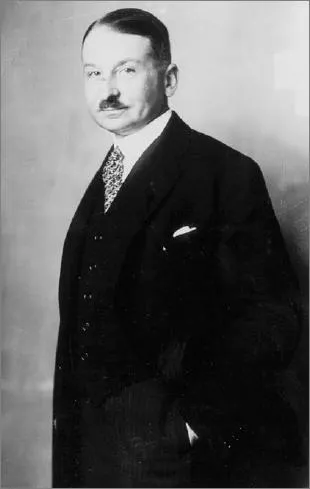
Mises in the 1920s
Mises: The Last Knight of Liberalism
Read the whole book online · Book details
Published here by permission of Jörg Guido Hülsmann. This work is still in copyright: free to read and download from this archive, but not licensed for re-publication elsewhere.