
Chapter 66 of 68 · Money, Bank Credit, and Economic Cycles by Jesus Huerta de Soto
Bibliography
Abrams, M.A., Money in a Changing Civilisation (London: John Lain, 1934).
Aguirre, J.A. de, El poder de emitir dinero: De J. Law a J.M. Keynes (Madrid: Unión Editorial, 1985).
Aguirre, J.A. de, La moneda única europea (Madrid: Unión Editorial, 1990).
——, Appendix to the Spanish edition of V.C. Smith's, The Rationale of Central Banking and the Free Banking Alternative (Indianapolis, Ind.: Liberty Press, 1990).
——, “Introducción” to the Spanish edition of Böhm-Bawerk's book, Capital and Interest, vol. 2, Positive Theory of Capital (Teoría positiva del capital) (Madrid: Ediciones Aosta/Unión Editorial, 1998).
Albácar López, J.L., and J. Santos Briz, Código Civil: doctrina y jurisprudencia (Madrid: Editorial Trivium, 1991), vol. 6.
Albaladejo, M., Derecho Civil, vol. 2, Derecho de las obligaciones: los contratos en particular y las obligaciones no contractuales (Barcelona: Librería Bosch, 1975).
——, ed., Comentarios al Código Civil y compilaciones forales (Madrid: Editorial Revista del Derecho Privado EDERSA, 1982).
Alchian, A.A., and W.R. Allen, University Economics (Belmont, Calif.: Wadsworth Publishing, 1964).
Alderfer, E.B., and H.E. Michel, Economics of American Industry, 3rd ed. (New York: McGraw-Hill, 1957).
Allais, M., “Les Faux Monnayeurs,” Le Monde (October 29, 1974).
——, L'Impôt sur le capital et la réforme monétaire (Paris: Hermann Éditeurs, 1989).
——, “Les conditions monétaires d'une économie de marchés: des enseignements du passé aux réformes de demain,” Revue d'économie politique 3 (May–July 1993): 319–67.
Allen, R.L., Irving Fisher: A Biography (Oxford: Blackwell, 1993).
Anderson, B.M., Economics and the Public Welfare: A Financial and Economic History of the United States, 1914–1946 (Indianapolis, Ind.: Liberty Press, 1979).
Andreu García, J.M., “El coeficiente de caja óptimo y su posible vinculación con el déficit público,” Boletín económico de Información Comercial Española (June 29–July 5, 1987): 24–25.
——, “En torno a la neutralidad del coeficiente de caja: el caso español,” Revista de economía 9.
Anes, R., “El Banco de España, 1874–1914: un banco nacional,” in La banca española en la Restauración (Madrid: Servicio de Estudios del Banco de España, 1974), vol. 1.
Angell, J.W., “The 100 Percent Reserve Plan,” Quarterly Journal of Economics L, no. 1 (November 1935): 1–35.
Aranson, P.H., “Bruno Leoni in Retrospect,” Harvard Journal of Law and Public Policy (Summer, 1988).
Arena, R., “Hayek and Modern Business Cycle Theory,” in Money and Business Cycles: The Economics of F.A. Hayek, M. Colonna and H. Hagemann, eds., vol. 1, chap. 10, pp. 203–17.
Arrow, K.J., “The Economics of Moral Hazard: Further Comments,” American Economic Review 58 (1968): 537–53.
——, “Uncertainty in the Welfare Economics of Medical Care,” American Economic Review 53 (1963): 941–73.
Azpilcueta, M. de, Comentario resolutorio de cambios (Madrid: Consejo Superior de Investigaciones Científicas, 1965); original Spanish edition (Salamanca: Andrés de Portonarijs, 1556); Portuguese ed., Comentario resolutorio de onzenas (Coimbra: Ioam de Barreyra, 1560).
Backhaus, J., Heijmann, W., Nantjes, A., and van Ophem, J., eds., Economic Policy in an Orderly Framework: Liber Amicorum for Gerrit Meijer (Münster: LIT Verlag, 2003).
Bajo Fernández, M., M. Pérez Manzano, and C. Suárez González, Manual de derecho penal, Special section, “Delitos Patrimoniales y Económicos” (Madrid: Editorial Centro de Estudios Ramón Areces, 1993).
“Banco de España,” Boletín estadístico (August 1994): 17.
Barnes, H.E., An Economic History of the Western World (New York: Harcourt, Brace, 1940).
Barrallat, L., La banca española en el año 2000: un sector en transición (Madrid: Ediciones de las Ciencias Sociales, 1992).
Becker, G.S., “A Proposal for Free Banking,” Chapter 2 in Free Banking, Modern Theory and Policy, L.H. White, ed., vol. 3, pp. 20–25.
Belda, F., “Ética de la creación de créditos según la doctrina de Molina, Lessio y Lugo,” Pensamiento 73, no. 19 (1963): 53–89.
Bell, D., and I. Kristol, eds., The Crisis in Economic Theory (New York: Basic Books, 1981).
Beltrán, L., “Sobre los orígenes hispanos de la economía de mercado,” in Ensayos de economía política (Madrid: Unión Editorial, 1996), pp. 234–54.
Benegas Lynch, A., Poder y razón razonable (Buenos Aires and Barcelona: Librería “El Ateneo” Editorial, 1992).
Benham, F., British Monetary Policy (London: P.S. King and Shaw, 1932).
Bérenger, J., A History of the Habsburg Empire, 1273–1700, C.A. Simpson, trans. (London and New York: Longman, 1994).
Biblia Sacra vulgatam versionem, R. Weber, ed. (Stuttgart, 1969).
Blanchard, O.J., and S. Fischer, Lectures on Macroeconomics (Cambridge, Mass.: The MIT Press, 1990).
Blaug, M., Economic Theory in Retrospect (Cambridge: Cambridge University Press, 1978).
——, “Hayek Revisited,” Critical Review 7, no. 1 (Winter, 1993): 51–60.
Block, W., “Fractional Reserve Banking: An Interdisciplinary Perspective,” Chapter 3 in Man, Economy, and Liberty: Essays in Honor of Murray N. Rothbard, W. Block and L.H. Rockwell, Jr., eds. (Auburn, Ala.: Ludwig von Mises Institute, 1988), pp. 24–32.
——, “Henry Simons is Not a Supporter of Free Enterprise,” Journal of Libertarian Studies 6, no. 4 (Fall, 2002).
Block, W., and K.M. Garschina, “Hayek, Business Cycles and Fractional Reserve Banking: Continuing the De-Homogenization Process,” Review of Austrian Economics 9, no. 1 (1996): 77–94.
Block, W., and L.H. Rockwell, Jr., eds., Man, Economy, and Liberty: Essays in Honor of Murray N. Rothbard (Auburn, Ala.: Ludwig von Mises Institute, 1988).
Boettke, P., “Where Did Economics Go Wrong? Modern Economics as a Flight from Reality,” Critical Review 1 (Winter, 1997): 11–64.
Boettke, P., and Prychitko, D.L., eds. The Market Process: Essays in Contemporary Austrian Economics, 2 vols. (Aldershot, England: Edward Elgar, 1998).
Bogaert, R., Banques et Banquiers dans les Cités Grecques (Leyden, Holland: A.W. Sijthoff, 1968).
Böhm-Bawerk, E.v., “Capital and Interest Once More,” Quarterly Journal of Economics (November 1906 and February 1907).
——, Kapital und Kapitalzins: Geschichte und Kritik der Kapitalzins—theorieen (Innsbruck: Verlag der Wagner'schen Universitäts-Buchhandlung, 1884); English translation by Hans F. Sennholz, Capital and Interest: History and Critique of Interest Theories (South Holland, Ill.: Libertarian Press, 1959); Spanish translation by J.A. de Aguirre, Teoría positiva del capital (Madrid: Ediciones Aosta/Unión Editorial, 1998).
——, “The Nature of Capital: A Rejoinder,” Quarterly Journal of Economics (November 1907).
——, “Professor Clark's Views on the Genesis of Capital,” Quarterly Journal of Economics 9 (1895): 113–31; reprinted in Classics in Austrian Economics, I.M. Kirzner, ed., vol. 1, pp. 131–43.
——, Kapital und Kapitalzins: Positive Theorie des Kapitales (Innsbruck: Verlag der Wagner'schen Universitäts-Buchhandlung, 1889); English translation by Hans F. Sennholz, Capital and Interest: Positive Theory of Capital (South Holland, Ill.: Libertarian Press, 1959).
Boorman, J.D., and T.M. Havrilesky, Money Supply, Money Demand and Macroeconomic Models (Boston, Mass.: Allyn and Bacon, 1972).
Borch, K.H., Economics of Insurance (Amsterdam and New York: North-Holland, 1990).
Bresciani-Turroni, C., Curso de economía política, vol. 2, Problemas de economía política (Mexico: Fondo de Cultura Económica, 1961).
——, Le vicende del marco tedesco (Milan: Università Bocconi Editrice, 1931); English translation by Millicent E. Savers, The Economics of Inflation: A Study of Currency Depreciation in Post-War Germany (London: Routledge, 1937 and London and New York: Augustus M. Kelley, 1968).
Butos, W.N., “The Recession and Austrian Business Cycle Theory: An Empirical Perspective,” Critical Review 7, nos. 2–3 (Spring and Summer, 1993).
Cabrillo, F., ed., Lecturas de economía política (Madrid: Minerva Ediciones, 1991).
——, Quiebra y liquidación de empresas: un análisis económico del derecho español (Madrid: Unión Editorial, 1989).
Cagan, P., Determinance and Effects of Changes in the Stock of Money, 1875–1960 (New York: Columbia University Press, 1965).
Caldwell, B., Beyond Positivism: Economic Methodology in the Twentieth Century (London: George Allen and Unwin, 1982; 2nd ed., London: Routledge, 1994).
Cantillon, R., Essai sur la nature du commerce en général (Holborn, London: Fletcher Gyles, 1755).
Carande, R., Carlos V y sus banqueros, 3 vols. (Barcelona and Madrid: Editorial Crítica, 1987).
Casas Pardo, J., Curso de economía, 5th ed. (Madrid, 1985).
Castañeda Chornet, J., Lecciones de teoría económica (Madrid: Editorial Aguilar, 1972).
Centi, J.P., “Hayekian Perspectives on the Monetary System: Toward Fiat Private and Competitive Moneys,” Austrian Economics Today I, The International Library of Austrian Economics, K.R. Leube, ed. (Frankfurt, FAZ Buch, 2003), vol. 7, pp. 89–104.
Cernuschi, H., Contre le billet de banque (Paris: Guillaumin, 1866).
——, Mécanique de l'échange (Paris: A. Lacroix, 1865).
Cicero, M.T., De re publica (Cambridge, Mass.: The Loeb Classical Library, 1961).
Chafuen, A.A., Christians for Freedom: Late-Scholastic Economics (San Francisco, Calif.: Ignatius Press, 1986).
Checkland, S.G., Scottish Banking: A History, 1695–1973 (Glasgow: Collins, 1975).
Churruca, J. de, “La quiebra de la banca del cristiano Calisto (c.a. 185–90),” Seminarios Complutenses de Derecho Romano (February–May 1991; Madrid, 1992), pp. 61–86.
Cipolla, C.M., The Monetary Policy of Fourteenth-Century Florence (Berkeley: University of California Press, 1982).
——, Money in Sixteenth-Century Florence (Berkeley.: University of California Press, 1989).
Clark, J.B., “Concerning the Nature of Capital: A Reply,” Quarterly Journal of Economics (May 1907).
——, The Distribution of Wealth (New York: Macmillan, 1899; New York: Augustus M. Kelley, 1965).
——, “The Genesis of Capital,” Yale Review (November 1893): 302–15.
——, “The Origin of Interest,” Quarterly Journal of Economics 9 (April 1895): 257–78.
Clough, S.B., The Economic Development of Western Civilization (New York: McGraw-Hill, 1959).
Cohen, E.E., Athenian Economy and Society: A Banking Perspective (Princeton, N.J.: Princeton University Press, 1992).
Colmeiro, M., Historia de la economía política española (1863; Madrid: Fundación Banco Exterior, 1988), vol. 2.
Colonna, M., and H. Hagemann, eds., Money and Business Cycles: The Economics of F.A. Hayek, 2 vols. (Aldershot, England: Edward Elgar, 1994).
Colunga, A. and Turrado, L., eds., Biblia Sacra Iuxta Vulgatam Clementinam, A. Colunga and L. Turrado, eds. (Madrid: Biblioteca de Autores Cristianos, 1994).
Coppa-Zuccari, P., Il deposito irregolare, Biblioteca dell “Archivio Giuridico Filippo Serafini” (Modena, 1901), vol. 6.
——, “La natura giuridica del deposito bancario,” Archivio Giuridico “Filippo Serafini,” n.s. 9 (Modena, 1902): 441–72.
Corona Ramón, J.F., Una introducción a la teoría de la decisión pública (“Public Choice”) (Alcalá de Henares and Madrid: Instituto Nacional de Administración Pública, 1987).
Coronel de Palma, L., La evolución de un banco central (Madrid: Real Academia de Jurisprudencia y Legislación, 1976).
Corpus Juris Civilis, Dionysius Gottfried edition (Geneva 1583).
Costouros, G.J., “Development of Banking and Related Book-Keeping Techniques in Ancient Greece,” International Journal of Accounting 7, no. 2 (1973): 75–81.
Courcelle-Seneuil, J.G., La banque libre: exposé des fonctions du commerce de banque et de son application à l'agriculture suivi de divers écrits de controverse sur la liberté des banques (Paris: Guillaumin, 1867).
Covarrubias y Leyva, D., Veterum collatio numismatum, in Omnia opera (Salamanca, 1577). Partial Spanish translation by Atilano Rico Seco in Textos jurídico-políticos, compiled by Manuel Fraga Iribarne (Madrid: Instituto de Estudios Políticos, 1957).
Cowen, T., Risk and Business Cycles: New and Old Austrian Perspectives (London: Routledge, 1998).
Crick, W.F., “The Genesis of Bank Deposits,” Economica (June 1927).
Cuello Calón, E., Derecho penal, 13th ed. (Barcelona: Editorial Bosch, 1972), tome 2, special section, vol. 2.
Cuenta corriente de efectos o valores de un sector de la banca catalana: su repercusión en el crédito y en la economía, su calificación jurídica en el ámbito del derecho penal, civil y mercantil positivos españoles según los dictámenes emitidos por los letrados señores Rodríguez Sastre, Garrigues, Sánchez Román, Goicoechea, Miñana y Clemente de Diego, seguidos de un estudio sobre la cuenta de efectos y el Mercado Libre de Valores de Barcelona por D. Agustín Peláez, Síndico Presidente de la Bolsa de Madrid, La (Madrid: Delgado Sáez, 1936).
Dabin, J., La teoría de la causa: estudio histórico y jurisprudencial, F. de Pelsmaeker, trans. and adapted by F. Bonet Ramón, 2nd ed. (Madrid: Editorial Revista de Derecho Privado, 1955).
Davanzati, B., A Discourse upon Coins (London: J.D. and J. Churchill, 1696).
Davenport, H.J., The Economics of Enterprise, 1913 (New York: Augustus M. Kelley, Reprints of Economic Classics, 1968).
——, “Keynes in the City,” in Essays on John Maynard Keynes, Milo Keynes, ed. (Cambridge: Cambridge University Press, 1975).
Davies, J.R., “Chicago Economists, Deficit Budgets and the Early 1930's,” American Economic Review (June 1968).
De Roover, R., The Rise and Decline of the Medici Bank, 1397–1494 (Cambridge, Mass.: Harvard University Press, 1963).
Delvaux, T., and M.E. Magnee, Les nouveaux produits d'assurance-vie (Brussels, Belgium: Editions de L'Université de Bruxelles, 1991).
Demosthenes, Discursos privados I (Madrid: Editorial Gredos, Biblioteca Clásica Gredos, 1983).
——, Discursos privados II (Madrid: Editorial Gredos, Biblioteca Clásica Gredos, 1983).
Dempsey, B.W., Interest and Usury, Introduction by Joseph A. Schumpeter (Washington, D.C.: American Council of Public Affairs, 1943).
Díez-Picazo, L., and A. Gullón, Sistema de derecho civil, 6th ed. (Madrid: Editorial Tecnos, 1989).
Dimand, R.W., “Irving Fisher and Modern Macroeconomics,” American Economic Review 87, no. 2 (May 1997): 442–44.
——, “Hawtrey and the Multiplier,” History of Political Economy 29, no. 3 (Fall, 1997): 549–56.
Dolan, E.G., ed., The Foundations of Modern Austrian Economics (Kansas City, Mo.: Sheed and Ward, 1976).
Dorn, J.A., ed., The Future of Money in the Information Age (Washington, D.C.: Cato Institute, 1997).
Dowd, K., The State and the Monetary System (New York: Saint Martin's Press, 1989).
——, The Experience of Free Banking (London and New York: Routledge, 1992).
——, Laissez-Faire Banking (London and New York: Routledge, 1993).
Drucker, P.F., “Toward the Next Economics,” in The Crisis in Economic Theory, D.Bell and I. Kristol, eds. (New York: Basic Books, 1981).
Durbin, E.F.M., The Problem of Credit Policy (London: Chapman and Hall, 1935).
——, Purchasing Power and Trade Depression: A Critique of Under-Consumption Theories (London and Toronto: Jonathan Cape, 1933).
Eatwell, J., M. Milgate, and P. Newman, The New Palgrave: A Dictionary of Economics, 4 vols. (London: Macmillan, 1987).
Enciclopedia práctica de la banca (Barcelona: Editorial Planeta, 1989), vol. 6.
Enciclopedia universal ilustrada europeo-americana (Madrid: Editorial Espasa-Calpe, 1979).
Erias Rey, A., and J.M. Sánchez Santos, “Independencia de los bancos centrales y política monetaria: una síntesis,” Hacienda pública española 132 (1995): 63–79.
Escarra, J., E. Escarra, and J. Rault, Principes de droit commercial (Paris: Recueil Sirey, 1947).
Estey, J.A., Business Cycles: Their Nature, Cause, and Control, 3rd ed. (Englewood Cliffs, N.J.: Prentice Hall, 1956); Spanish edition Tratado sobre los ciclos económicos (Mexico: Fondo de Cultura Económica, 1948).
Estapé, F., Introduction to the third Spanish edition of Joseph A. Schumpeter's book, The History of Economic Analysis [Historia del análisis económico] (Barcelona: Editorial Ariel, 1994).
Febrero, R., ed., España y la unificación monetaria europea: una reflexión crítica (Madrid: Editorial Abacus, 1994).
——, ed., Qué es la economía (Madrid: Ediciones Pirámide, 1997).
Feldberg, M., K. Jowel, and S. Mulholland, eds., Milton Friedman in South Africa (Johannesburg, South Africa: Graduate School of Business of the University of Capetown, 1976).
Fernández, T.R., Comentarios a la ley de disciplina e intervención de las entidades de crédito, Serie de Estudios de la Fundación Fondo para la Investigación Económica y Social (Madrid, 1989).
Ferrer Sama, A., El delito de apropiación indebida. Publicaciones del Seminario de Derecho Penal de la Universidad de Murcia (Murcia: Editorial Sucesores de Nogués, 1945).
Fetter, F.A., Capital, Interest, and Rent (Kansas City, Mo.: Sheed Andrews and McMeel, 1977).
——, “Interest Theory and Price Movements,” American Economic Review 17, no. 1 (1926): 72.
Figueroa, E. Teoría de los ciclos económicos (Madrid: CSIC, 1947).
Figuerola, L., Escritos económicos, edited with a preliminary study by Francisco Cabrillo Rodríguez (Madrid: Instituto de Estudios Fiscales, 1991).
Fisher, I., The Nature of Capital and Income (New York: Macmillan, 1906).
——, 100 Percent Money (New York: Adelphi Company, 1935).
——, The Purchasing Power of Money: Its Determination and Relation to Credit Interest and Crises (New York: Macmillan, [1911] 1925; New York: Augustus M. Kelley, 1963).
——, “What is Capital?” Economic Journal 6 (December 1896): 509–34.
Fisher, I.N., My Father Irving Fisher (New York: A Reflection Book, 1956).
Fraser, H.F., Great Britain and the Gold Standard (London: Macmillan, 1933).
Friedman, M., “Comment on the Critics,” in Milton Friedman, Monetary Framework, Robert J. Gordon, ed. (Chicago, Ill.: Chicago University Press, 1974).
——, Dollars and Deficits (Englewood Cliffs, N.J.: Prentice Hall, 1968).
——, “Has Gold Lost its Monetary Role?” in Milton Friedman in South Africa, M. Feldberg, K. Jowel, and S. Mulholland, eds. (Johannesburg, South Africa: Graduate School of Business of the University of Capetown, 1976).
——, The Optimum Quantity of Money and Other Essays (Chicago, Ill.: Aldine, 1979).
——, “The ‘Plucking Model’ of Business Fluctuations Revisited,” Economic Inquiry 30 (April 1993): 171–77.
——, A Program for Monetary Stability (New York: Fordham University Press, 1959).
——, “Quantity Theory of Money,” in The New Palgrave: A Dictionary of Economics, J. Eatwell, M. Milgate, and P. Newman, eds. (London: Macmillan, 1987), vol. 4, pp. 3–20.
——, A Theory of the Consumption Function (Princeton, N.J.: Princeton University Press, 1957).
Friedman, M., and A.J. Schwartz, “Has Government Any Role in Money?” Journal of Monetary Economics 17 (1986): 37–72; reprinted as Chapter 26 in The Essence of Friedman, Kurt R. Leube, ed. (Palo Alto, Calif.: Hoover Institution Press, Stanford University, 1986) pp. 499–525.
——, A Monetary History of the United States, 1867–1960 (Princeton, N.J.: Princeton University Press, 1971).
——, Monetary Trends in the United States and United Kingdom: Their Relation to Income, Prices and Interest Rates, 1867–1975 (Chicago, Ill.: University of Chicago Press, 1982).
Fullarton, J., On the Regulation of Currencies, being an examination of the principles on which it is proposed to restrict, within certain fixed limits, the future issues on credit of the Bank of England and of the other banking establishments throughout the country (London: John Murray, 1844. 2nd rev. ed., 1845).
Galiani, F., Della moneta (Naples: Giuseppe Raimondi, 1750).
Gallatin, A., Considerations on the Currency and Banking System of the United States (Philadelphia, Penn.: Carey and Lea, 1831).
García del Corral, I.L., ed., Cuerpo de derecho civil romano: a doble texto, traducido al castellano del latino, translated into Spanish by Ildefonso L. García del Corral; reprint, 6 vols. (Valladolid: Editorial Lex Nova, 1988).
García-Garrido, M.J., “La Sociedad de los Banqueros (Societas Argentaria),” in Studi in Honore di Arnaldo Biscardi (Milan, 1988), vol. 3.
García-Pita y Lastres, J.L., “Depósitos bancarios y protección del depositante,” in Contratos Bancarios (Madrid: Colegios Notariales de España, 1996), pp. 119–266.
——, “Los depósitos bancarios de dinero y su documentación,” La Revista de Derecho Bancario y Bursátil, Centro de Documentación Bancaria y Bursátil (October–December 1993): 919–1008.
Garrigues, J., Contratos bancarios (Madrid: Published by the author, 1975).
Garrison, R.W., “Austrian Macroeconomics: A Diagrammatical Exposition,” originally published in New Directions in Austrian Economics, L.M. Spadaro, ed. (Kansas City, Mo.: Sheed Andrews and McMeel, 1978, pp. 167–201; reprinted as an independent book by the Institute for Humane Studies, 1978).
——, “The Austrian-Neoclassical Relation: A Study in Monetary Dynamics” (Doctoral thesis, University of Virginia, 1981).
——, “The Costs of a Gold Standard,” in The Gold Standard: An Austrian Perspective, L.H. Rockwell, Jr., ed. (Lexington, Mass.: Lexington Books, 1985).
——, “The Limits of Macroeconomics,” Cato Journal: An Interdisciplinary Journal of Public Policy Analysis 12, no. 1 (1993).
——, “Is Milton Friedman a Keynesian?” in Dissent on Keynes: A Critical Appraisal of Keynesian Economics, M. Skousen, ed. (New York and London: Praeger, 1992), chap. 8.
——, “The Roaring Twenties and the Bullish Eighties: The Role of Government in Boom and Bust,” Critical Review 7, nos. 2–3 (Spring–Summer, 1993): 259–76.
——, Time and Money: The Macroeconomics of Capital Structure (London and New York: Routledge, 2001).
——, “Time and Money: The Universals of Macroeconomic Theorizing,” Journal of Macroeconomics 6, no. 2 (Spring, 1984).
——, “What about Expectations?: A Challenge to the Austrian Theory,” presented at the 2nd Austrian Scholars Conference, Auburn University, April 4–5, 1997.
Gellert, W., H. Kustner, M. Hellwich, and H. Kastner, eds., The Concise Encyclopedia of Mathematics (New York: Van Nostrand, 1975).
Geyer, P., Theorie und Praxis des Zettelbankwesens nebst einer Charakteristik der Englischen, Französischen und Preussischen Bank (Munich: Fleischmann's Buchhandlung, 1867).
——, Banken und Krisen (Leipzig: T.O. Weigel, 1865).
Gherity, J.A., “The Evolution of Adam Smith's Theory of Banking,” History of Political Economy 26, no. 3 (Fall, 1994): 423–41.
Gil Peláez, L., Tablas financieras, estadísticas y actuariales, 6th revised, enlarged edition (Madrid: Editorial Dossat, 1977).
Gimeno Ullastres, A., “Un impuesto llamado inflación,” Homenaje a Lucas Beltrán (Madrid: Editorial Moneda y Crédito, 1982), pp. 803–23.
Glasner, D., Free Banking and Monetary Reform (Cambridge: Cambridge University Press, 1989).
——, “The Real-Bills Doctrine in the Light of the Law of Reflux,” History of Political Economy 24, no. 4 (Winter, 1992): 867–94.
Gómez Camacho, F., Introduction to La teoría del justo precio, by Luis de Molina (Madrid: Editora Nacional, 1981).
Goodhart, C.A.E., The Business of Banking, 1891–1914 (London: Weidenfeld and Nicholson, 1972).
——, The Central Bank and the Financial System (Cambridge, Mass.: The MIT Press, 1995).
——, The Evolution of Central Banks, 2nd ed. (Cambridge, Mass.: The MIT Press, 1990).
——, “The Free Banking Challenge to Central Banks,” Critical Review 8, no. 3 (Summer, 1994): 411–25.
——, “What Should Central Banks Do? What Should be their Macroeconomic Objectives and Operations?” Economic Journal 104 (November 1994): 1424–36.
Gordon, R.J., ed., Milton Friedman's Monetary Framework (Chicago, Ill.: Chicago University Press, 1974).
——, “What is New-Keynesian Economics?” Journal of Economic Literature 28 (September 1990).
Gottfried, D., ed., Corpus iuris civilis (Geneva, 1583).
Graham, F.D., “Partial Reserve Money and the 100 Percent Proposal,” American Economic Review 26 (1936): 428–40.
Granger, C.W.J., “Investigating Causal Relations by Econometric Models and Cross-Spectral Methods,” Econometrica 37, no. 3 (1969): 428.
——, “Testing for Causality: A Personal Viewpoint,” Journal of Economic Dynamics and Control 2, no. 4 (November 1980): 330.
Grassl, W., and B. Smith, Austrian Economics: History and Philosophical Background (London and Sydney: Croom Helm, 1986).
Graziani, A., “Book Review of Stephen Kresge and Leif Wenar, eds., Hayek on Hayek: An Autobiographical Dialogue,” European Journal of the History of Economic Thought 2, no. 1 (Spring, 1995): 230–32.
Graziani, A., “Sofismi sul risparmio,” Rivista Bancaria (December 1932); reprinted in Graziana, A., Studi di Critica Economica (Milan: Società Anonima Editrice Dante Alighieri, 1935), pp. 253–63.
Greaves, B.B., “How to Return to the Gold Standard,” The Freeman: Ideas on Liberty (November 1995): 703–07.
Gregory, T.E., Gold, Unemployment and Capitalism (London: P.S. King and Shaw, 1933).
Grice-Hutchinson, M., Early Economic Thought in Spain, 1177–1740 (London: George Allen and Unwin, 1978).
——, Economic Thought in Spain: Selected Essays of Marjorie Grice-Hutchinson, L.S. Moss and C.K. Ryan, eds. (Aldershot, England: Edward Elgar, 1993).
——, “The Concept of the School of Salamanca: Its Origins and Development,” Chapter 2 in Economic Thought in Spain: Selected Essays of Marjorie Grice-Hutchinson, p. 25.
——, The School of Salamanca: Readings in Spanish Monetary Theory, 1544–1605 (Oxford: Clarendon Press, 1952).
Groenveld, K., Maks, J.A.M., and J. Muysken, eds., Economic Policy and the Market Process: Austrian and Mainstream Economics (Amsterdam: North-Holland, 1990).
Gullón, A., and L. Díez-Picazo, Sistema de derecho civil, 6th ed. (Madrid: Editorial Tecnos, 1989).
Guzmán Hermida, J.M., “Introducción General” to Discursos (Madrid: Biblioteca Clásica Gredos, 1979), vol. 1.
Haberler, G., Der Sinn der Indexzahlen: Eine Untersuchung über den Begriff des Preisniveaus und die Methoden seiner Messung (Tübingen: Verlag von J.C.B. Mohr [Paul Siebeck], 1927).
——, The Liberal Economic Order, vol. 2, Money and Cycles and Related Things, A.Y.C. Koo, ed. (Aldershot, England: Edward Elgar, 1993).
——, “Mr. Keynes' Theory of the ‘Multiplier’: A Methodological Criticism,” Zeitschrift für Nationalökonomie 7 (1936): 299–305; reprinted as Chapter 23 of Selected Essays of Gottfried Haberler, Anthony Y. Koo, ed. (Cambridge, Mass.: The MIT Press, 1985).
——, “Monetary Equilibrium and the Price Level in a Progressive Economy,” Economica (February 1935): 75–81; reprinted in Gottfried Haberler, The Liberal Economic Order, vol. 2, Money and Cycles and Related Things, A.Y.C. Koo, ed. (Aldershot, England: Edward Elgar, 1993), pp. 118–25.
——, “Money and the Business Cycle,” 1932; reprinted in The Austrian Theory of the Trade Cycle and Other Essays (Washington, D.C.: Ludwig von Mises Institute, 1978), pp. 7–20.
——, Prosperity and Depression (Geneva: League of Nations, 1937); Spanish translation by G. Franco and J. Márquez (Mexico: FCE, 1942).
——, “Reviewing A Book Without Reading It,” Austrian Economics Newsletter 8 (Winter, 1995); reference in Journal of Economic Perspectives 10, no. 3 (Summer, 1996): 188.
Hagemann, H., and M. Colonna, eds., Money and Business Cycles: The Economics of F.A. Hayek (Aldershot, England: Edward Elgar, 1994).
Hahn, L.A., Common Sense Economics (New York: Abelard-Schumann, 1956).
Hall, R.E. “Macrotheory and the Recession of 1990–1991,” American Economic Review (May 1993): 275–79.
Hanke, S.H., L. Jonung, and K. Schuler, Russian Currency and Finance (London: Routledge, 1993).
Harcourt, G.C., Some Cambridge Controversies in the Theory of Capital (Cambridge: Cambridge University Press, 1972).
Hardin, G., and J. Baden, eds., Managing the Commons (San Francisco, Calif.: Freeman, 1970).
Hart, A.G., “The ‘Chicago Plan’ of Banking Reform,” Review of Economic Studies 2 (1935): 104–16.
Hawtrey, R.G., Capital and Employment (London: Longmans Green, 1937).
——, “Review of Hayek's Prices and Production,” Economica 12 (1932): 119–25.
——, The Art of Central Banking (London: Longman, 1932).
Hayek, F.A., The Counter-Revolution of Science (Glencoe, Ill.: Free Press, 1952; Indianapolis, Ind.: Liberty Press, 1979).
——, Contra Keynes and Cambridge: Essays, Correspondence, The Collected Works of F.A. Hayek, vol. 9, B.J. Caldwell, ed. (London: Routledge, 1995); Spanish edition, J. Huerta de Soto, ed., F. Basáñez, and J.A. de Aguirre, trans., Contra Keynes y Cambridge: ensayos, correspondencia (Madrid: Unión Editorial, 1996).
——, Prices and Production, with a foreword by Lionel Robbins (London: Routledge, 1931; 2nd revised, enlarged edition, London: Routledge, 1935); later reprinted over ten times in England and the United States (Clifton, N.J.: Augustus M. Kelley); Spanish translation by C.R. Braun, Precios y produccion (Madrid: Unión Editorial, 1996).
——, “Price Expectations, Monetary Disturbances and Malinvestment,” 1933; reprinted in Profits, Interest and Investment (Clifton, N.J.: Augustus M. Kelley, 1975), pp. 135–56.
——, “Reflections on The Pure Theory of Money of Mr. J.M. Keynes (1),” Economica 11, no. 33 (August 1931): 270–95; reprinted in Friedrich A. Hayek: Critical Assessments, J.C. Wood and R.N. Woods, eds. (London: Routledge, 1991); also in Contra Keynes and Cambridge: Essays, Correspondence, The Collected Works of F.A. Hayek, B. Caldwell, ed. (London: Routledge, 1995), vol. 9.
——, “Reflections on The Pure Theory of Money of Mr. J.M. Keynes (continued)(2),” Economica 12, no. 35 (February 1932): 22–44; reprinted in Friedrich A. Hayek: Critical Assessments, J.C. Wood and R.N. Woods, eds. (London: Routledge, 1991); also in Contra Keynes and Cambridge: Essays, Correspondence.
——, “Das intertemporale Gleichgewichtssystem der Preise und die Bewegungen des ‘Geldwertes,’” Weltwirtschaftliches Archiv 2 (1928): 36–76; English translation, “Intertertemporal Price Equilibrium and Movements in the Value of Money,” in Money, Capital and Fluctuations: Early Essays, R. McCloughry, ed. (Chicago, Ill.: University of Chicago Press, 1984), pp. 71–118; English translation, “The System of Intertemporal Price Equilibrium and Movements in the ‘Value of Money,’” in Classics in Austrian Economics: A Sampling in the History of a Tradition, vol. 3, The Age of Mises and Hayek, Israel M. Kirzner, ed. (London: William Pickering, 1994), pp. 161–98.
——, Hayek on Hayek: An Autobiographical Dialogue, S. Kresge and L. Wenar, eds. (London: Routledge, 1994).
——, The Collected Works of F.A. Hayek, vol. 3, The Trend of Economic Thinking: Essays on Political Economists and Economic History, W. W. Bartley III and S. Kresge, eds. (London and New York: Routledge, 1991).
——, “A Rejoinder to Mr. Keynes,” Economica 11, no. 34 (November 1931): 398–404; reprint, Chapter 5 in Friedrich A. Hayek: Critical Assessments, J.C. Wood and R.N. Woods, eds., vol. 1 (London and New York: Routledge, 1991), pp. 82–83; also in Contra Keynes and Cambridge.
——, Monetary Theory and the Trade Cycle (Clifton, N.J.: Augustus M. Kelley, [1933] 1975).
——, The Constitution of Liberty (London: Routledge, [1960] 1990).
——, The Fatal Conceit: The Errors of Socialism (Chicago, Ill.: University of Chicago Press, 1989).
——, “The Pretence of Knowledge,” Nobel Memorial Lecture, delivered December 11, 1974; reprinted in American Economic Review (December 1989): 3–7.
——, “Die Währungspolitik der Vereinigten Staaten seit der Überwindung der Krise von 1920,” Zeitschrift für Volkswirtschaft und Socialpolitik, n.s. 5 (1925), vols. 1–3, pp. 25–63; vols. 4–6, pp. 254–317; English translation, “The Monetary Policy of the United States after the Recovery from the 1920 Crisis,” Chapter 1 in Money, Capital and Fluctuations: Early Essays, R. McCloughry, ed. (Chicago, Ill.: University of Chicago Press, 1984).
——, “Kapitalaufzehrung,” Weltwirtschaftliches Archiv 2, no. 36 (1932): 86–108; English translation, “Capital Consumption,” Chapter 6 in Money, Capital and Fluctuations: Early Essays, R. McCloughry, ed. (Chicago, Ill.: University of Chicago Press, 1984).
——, 1980s Unemployment and the Unions: The Distortion of Relative Prices by Monopoly in the Labour Markets, 2nd ed. (London: Institute of Economic Affairs, 1984).
——, Money, Capital, and Fluctuations: Early Essays, R. McCloughry, ed. (Chicago, Ill.: University of Chicago Press, 1984).
——, “The Keynes Centenary: The Austrian Critic,” Economist 7293 (June 11, 1983).
——, “Three Elucidations of the Ricardo Effect,” Journal of Political Economy 77, no. 2 (1979); reprinted as Chapter 11 in New Studies in Philosophy, Politics, Economics and the History of Ideas (London: Routledge and Kegan Paul, 1978), pp. 165–78.
——, Law, Legislation and Liberty (Chicago, Ill.: University of Chicago Press, 1978).
——, ed. An Inquiry into the Nature and Effects of the Paper Credit of Great Britain, by H. Thornton (Fairfield, N.J.: Augustus M. Kelley, 1978).
——, Denationalisation of Money—The Argument Refined, 2nd extended ed. (London: Institute of Economic Affairs, 1978).
——, New Studies in Philosophy, Politics, Economics and the History of Ideas (London: Routledge and Kegan Paul, 1978).
——, ¿Inflación o Pleno Empleo? (Madrid: Unión Editorial, 1976).
——, “Profits, Interest and Investment” and Other Essays on the Theory of Industrial Fluctuations (London: Routledge, 1939; Clifton, N.J.: Augustus M. Kelley, 1969 and 1975).
——, Geldtheorie und Konjunkturtheorie. Beitrage zur Konjunkturforschung, herausgegeben vom Österreischischen Institut für Konjunkturforschung (Vienna and Leipzig: Hölder-Pichler-Tempski, A.G., 1929), no. 1; English translation by N. Kaldor, Monetary Theory and the Trade Cycle (London: Routledge, 1933; Fairfield, N.J.: Augustus M. Kelley, 1975); Spanish translation by L. Olariaga, La teoría monetaria y el ciclo económico (Madrid: Espasa Calpe, 1936).
——, “The Maintenance of Capital,” Economica 2 (August 1934); also Chapter 3 in Profits, Interest and Investment (Clifton, N.J.: Augustus M. Kelley, 1975), pp. 83–134.
——, “Gibt es einen ‘Widersinn des Sparens’?” Zeitschrift für Nationalökonomie 1, no. 3 (1929); English translation, “The ‘Paradox’ of Saving,” Economica (May 1931); and appendix to “Profits, Interest and Investment” and Other Essays on the Theory of Industrial Fluctuations (London: George Routledge and Sons, 1939; Clifton, N.J.: Augustus M. Kelley, 1975), pp. 199–263.
——, A Tiger by the Tail: 40-Years Running Commentary on Keynesianism by Hayek, S.R. Shenoy, ed. (London: Institute of Economic Affairs, 1972).
——, Monetary Nationalism and International Stability (London: Longman, 1937; New York: Augustus M. Kelley, 1971).
——, “The Ricardo Effect,” Economica 34, no. 9 (May 1942): 127–52; reprinted as Chapter 11 in Individualism and Economic Order (Chicago, Ill.: University of Chicago Press, 1948), pp. 220–54.
——, Individualism and Economic Order (Chicago, Ill.: University of Chicago Press, 1948).
——, The Pure Theory of Capital (1941; London: Routledge and Kegan Paul, 1976); Spanish translation, La teoría pura del capital (Madrid: Aguilar, 1946).
——, “A Commodity Reserve Currency,” Economic Journal 53, no. 210 (June–September 1943): 176–84; also Chapter 10 in Individualism and Economic Order, pp. 209–19.
——, “Investment that Raises the Demand for Capital,” Review of Economics and Statistics 19, no. 4 (November 1937); reprinted in Profits, Interest and Investment, pp. 73–82.
——, “The Mythology of Capital,” Quarterly Journal of Economics (February 1936): 199–228.
——, “Saving,” originally published in the Encyclopedia of the Social Sciences, 1933; reprinted as Chapter 5 in Profits, Interest and Investment.
——, “Über ‘Neutrales Geld.’” Zeitschrift für Nationalökonomie 4 (1933): 659–61; subsequent English translation, “On Neutral Money,” Chapter 7 in Money, Capital and Fluctuations, pp. 159–62.
——, “Das Schicksal der Goldwährung,” Deutsche Volkswirt 20 (February 1932): 642–45 and no. 21, pp. 677–81; English translation, “The Fate of the Gold Standard,” Chapter 5 in Money, Capital and Fluctuations, pp. 118–35.
Hazlitt, H., ed., The Critics of Keynesian Economics (New York: Arlington House, 1977).
Herbener, J.M., “The Myths of the Multiplier and the Accelerator,” Chapter 4 in Dissent on Keynes, A Critical Appraisal of Keynesian Economics, M. Skousen, ed. (New York and London: Praeger, 1992).
——, The Meaning of Ludwig von Mises (Amsterdam: Kluwer Academic Publishers, 1993).
Hernández-Tejero Jorge, F., Lecciones de derecho romano (Madrid: Ediciones Darro, 1972).
Hey, J.D., “The Bayesian approach rules out the possibility of surprise,” Economics in Disequilibrium (New York: New York University Press, 1981).
Hicks, J.R., “Is Interest the Price of a Factor of Production?” in Time, Uncertainty, and Disequilibrium: Exploration of Austrian Themes, M.J. Rizzo, ed. (Norwell, Mass.: Lexington Books, 1979).
——, Capital and Time: A Neo-Austrian Theory (Oxford: Clarendon Press, 1973).
——, The Theory of Wages (London: Macmillan, 1932).
Hicks, J.R., and A.G. Hart, The Social Framework of the American Economy (New York: Oxford University Press, 1945).
Higgs, H., ed., Palgrave's Dictionary of Political Economy, 3 vols. (London: Macmillan, 1926).
——, “Richard Cantillon,” Economic Journal 1 (June 1891): 276–84.
Hippolytus, Hippolytus Wercke, vol. 2, Refutatio Omnium Haeresium (Leipzig: P. Wendland, 1916).
Hirschman, A.O., “Courcelle-Seneuil, Jean-Gustav,” The New Palgrave: A Dictionary of Economics, vol. 1, pp. 706–07.
Holden, Milnes J., The Law and Practice of Banking, vol. 1, Banker and Customer (London: Pitman Publishing, 1970).
Homenaje a Lucas Beltrán (Madrid: Editorial Moneda y Crédito, 1982).
Hoppe, H.H., “How is Fiat Money Possible?—or The Devolution of Money and Credit,” Review of Austrian Economics 7, no. 2 (1994): 72–73.
——, The Economics and Ethics of Private Property (Dortrecht, Holland: Kluwer Academic Publishers, 1993).
Hoppe, H.H., J.G. Hülsmann, and W. Block, “Against Fiduciary Media,” Quarterly Journal of Austrian Economics 1, no. 1 (1998): 19–50.
Horwitz, S., Monetary Evolution, Free Banking, and Economic Order (Oxford and San Francisco: Westview Press, 1992).
——, “Keynes' Special Theory,” Critical Review 3, nos. 3 and 4 (Summer–Fall, 1989): 411–34.
Horwitz, S., Microfoundations and Macroeconomics (London: Routledge, 2000).
Hübner, O., Die Banken (Leipzig: Published by the author, 1853 and 1854).
Huerta Ballester, J., A Brief Comparison Between the Ordinary Life Contracts of Ten Insurance Companies (Madrid, 1954).
Huerta de Soto, J., “Conjectural History and Beyond,” Humane Studies Review 6, no. 2 (Winter, 1998–1989): 10.
——, “The Ongoing Methodenstreit of the Austrian School,” Journal des Économistes et des Études Humaines 8, no. 1 (March 1998): 75–113.
——, “Banque centrale ou banque libre: le débat théorique sur les réserves fractionnaires,” Journal des Économistes et des Études Humaines 5, nos. 2 and 3 (June–September 1994): 379–91; Spanish version, “La teoría del banco central y de la banca libre” Chapter 11 in J. Huerta de Soto, Estudios de economía política, pp. 129–43; English translation, “A Critical Analysis of Central Banks and Fractional Reserve Free Banking from the Austrian School Perspective,” Review of Austrian Economics 8, no. 2 (Summer, 1995): 117–29; Romanian translation by O. Vasilescu, “Banci centrale si sistemul de free-banking cu rezerve fractionare: O analizá criticá din perspectiva Scolii Austriece,” Polis: Revista de stiinte politice (Bucharest) 4, no. 1 (1997): 145–57.
——, “New Light on the Prehistory of the Theory of Banking and the School of Salamanca,” Review of Austrian Economics 9, no. 2 (1996): 59–81.
——, “A Theory of Liberal Nationalism,” Il Politico IX, no. 4 (University of Pavia, Italy, 1995): 583–98.
——, “The Economic Analysis of Socialism,” Chapter 14 of New Perspectives on Austrian Economics, G. Meijer, ed. (London and New York: Routledge, 1995).
——, “A Critical Note on Fractional-Reserve Free Banking,” Quarterly Journal of Austrian Economics 1, no. 4 (Winter, 1998): 25–49.
——, Estudios de economía política (Madrid: Unión Editorial, 1994).
——, Nuevos estudios de economía política (Madrid: Unión Editorial, 2002).
——, “La teoría austriaca del ciclo económico,” Moneda y Crédito 152 (March 1980): 37–55; reprint, Chapter 13 in J. Huerta de Soto, Estudios de economía política (Madrid: Unión Editorial, 1994), pp. 160–76.
——, “Método y crisis en la ciencia económica,” Hacienda pública española 74 (1982): 33–48; reprint, Chapter 3 in J. Huerta de Soto, Estudios de economía política (Madrid: Unión Editorial, 1994), pp. 59–82.
——, “Interés, ciclos económicos y planes de pensiones,” Annals of the Congreso Internacional de Fondos de Pensiones (Madrid, April 1984), pp. 458–68; reprint, Chapter 23 in J. Huerta de Soto, Estudios de economía política (Madrid: Unión Editorial, 1994), pp. 285–94.
——, “Génesis, esencia y evolución de la Escuela Austriaca de Economía,” Chapter 1 in J. Huerta de Soto, Estudios de economía política (Madrid: Unión Editorial, 1994), pp. 17–55.
——, “Historia, ciencia económica y ética social,” Chapter 7 in Jesús Huerta de Soto, Estudios de economía política (Madrid: Unión Editorial, 1994), pp. 105–09; English version, “Conjectural History and Beyond,” in “‘The Fatal Conceit,’ by F.A. Hayek, A Special Symposium,”Humane Studies Review 6, no. 2 (Winter, 1998–1999): 10.
——, “The Crisis and Reform of Social Security: An Economic Analysis from the Austrian Perspective,” Journal des Économistes et des Études Humaines 5, no. 1 (March 1994): 127–55.
——, Socialismo, cálculo económico y función empresarial (Madrid: Unión Editorial, 1992 and 2001).
——, Lecturas de economía política (Madrid: Unión Editorial, 1986–1987), vols. 1–3.
——, La Escuela Austriaca: Mercado y creatividad empresarial (Madrid: Editorial Síntesis, 2000 and 2001); Italian translation by Paolo Zanotto, La Scuola Austriaca: Mercato e creatività impreditoriale (Soveria Mannelli, Catanzaro, Italy: Rubbetino, 2003).
——, “A Hayekian Strategy to Implement Free Market Reforms,” in Economic Analysis in an Orderly Framework: Liber Amicorum for Gerrit Meijer, J. Backhaus, W. Heijmann, A. Nantjes, and J. van Ophem, eds. (Münster: LIT Verlag, 2003), pp. 231–54.
Huerta Peña, J., La estabilidad financiera de las empresas de seguros (Madrid, 1954).
Hughes, A. Middleton, “The Recession of 1990: An Austrian Explanation,” Review of Austrian Economics 10, no. 1 (1997): 107–23.
Hülsmann, J.G., Review of “Dinero, Crédito Bancario y Ciclos Económicos,” Review of Austrian Economics 3, no. 2 (2000): 85–88.
——, “Free Banking and Free Bankers,” Review of Austrian Economics 9, no. 1 (1996): 3–53.
——, “Has Fractional-Reserve Banking Really Passed the Market Test?,” Independent Review vii, no. 3 (Winter, 2003): 399–422.
Hume, D., Essays: Moral, Political and Literary, E.F. Miller, ed. (Indianapolis, Ind.: Liberty Classics, 1985).
Hutt, W.H., The Keynesian Episode: A Reassessment (Indianapolis, Ind.: Liberty Press, 1979).
——, Politically Impossible...? (London: Institute of Economic Affairs, 1971).
Ibn Abí Zayd (Al-Qayrawání), Compendio de derecho islámico (Risála, Fí-l-Fiqh), J. Riosalido, ed. (Madrid: Editorial Trotta, 1993).
Ihering, R.v., El espíritu del derecho romano, F. Vela, ed. (Madrid: Marcial Pons, 1997).
Iglesias, J., Derecho romano: instituciones de derecho privado, 6th revised, enlarged ed. (Barcelona: Ediciones Ariel, 1972).
Imbert, J., Historia económica (de los orígenes a 1789); Spanish translation by Armando Sáez (Barcelona: Editorial Vicens-Vives, 1971).
Ingram, J.K., “Banks, Early European,” in Palgrave's Dictionary of Political Economy, H. Higgs, ed. (London: Macmillan, 1927), vol. 1, pp. 103–06.
Isocrates, Discursos, general introduction by J.M. Guzmán Hermida (Madrid: Biblioteca Clásica Gredos, 1979).
Issing, O., Central Bank Independence and Monetary Stability (London: Institute of Economic Affairs, 1993).
Jevons, W.S., The Theory of Political Economy (1871; reprint, 5th ed., New York: Kelley and Millman, 1957).
——, Money and the Mechanism of Exchange (New York: D. Appleton, 1875; London: Kegan Paul, 1905).
John Paul II, Centesimus Annus: Encyclical Letter on the Hundredth Anniversary of Rerum Novarum, 1991, no. 48 (London: Catholic Truth Society, 1991).
Jouvenel, B. de, “The European Intellectuals and Capitalism,” in Capitalism and the Historians, F.A. Hayek, ed. (Chicago, Ill.: University of Chicago Press, 1954).
Junankar, P.N., “Acceleration Principle,” in The New Palgrave: A Dictionary of Economics, vol. 1, pp. 10–11.
Justinian, Digest, Spanish translation by Ildefonso L. García del Corral, Cuerpo de derecho civil romano: a doble texto, traducido al castellano del latino, reprint, 6 vols. (Valladolid: Editorial Lex Nova, 1988); alternate translation by A. D'Ors, F. Hernández-Tejero, B. Fuentes Aca, M. García-Garrido, and J. Murillo (Pamplona: Editorial Aranzadi, 1968).
Juurikkala, O., “The False Money Debate in the Journal des Économistes: Déjà Vu for Austrians?,” Quarterly Journal of Austrian Economics 5, no. 4 (Winter, 2002): 43–55.
Kaldor, N., “Capital Intensity and the Trade Cycle,” Economica (February 1939): 40–66.
——, “Professor Hayek and the Concertina Effect,” Economica (November 1942): 359–82.
Katz, J.N., “An Austrian Perspective on the History and Future of Money and Banking,” Erasmus Programme in Law and Economics (Summer, 1997).
Keynes, J.M., The General Theory of Employment, Interest and Money (London: Macmillan, 1936); German translation by F. Waeger, Allgemeine Theorie der Beschäftigung, des Zinses und des Geldes, with a special prologue written by Keynes on September 7, 1936 (Berlin: Duncker and Humblot, 1936 and 1994).
——, The Collected Writings of John Maynard Keynes, vol. 13, The General Theory and After, Part 1, Preparation, Donald Moggridge, ed. (London: Macmillan, 1973).
——, The Collected Writings of John Maynard Keynes, vol. 29, The General Theory and After: A Supplement (London: Macmillan, 1979).
——, The Collected Writings of John Maynard Keynes, Part 2, The General Theory and After, vol. 14, Defence and Development (London: Macmillan, 1973).
——, The Collected Writings of John Maynard Keynes, vol. 7, The General Theory of Employment, Interest and Money (London: Macmillan, 1973).
——, The Collected Writings of John Maynard Keynes, vol. 1, A Treatise on Money (London: Macmillan, 1971).
——, The Collected Writings of John Maynard Keynes, vol. 5, The Pure Theory of Money (London: Macmillan, 1971).
——, The Collected Writings of John Maynard Keynes, vol. 12, Economic Articles and Correspondence: Investment and Editorial, Donald Moggridge, ed. (Cambridge: Cambridge Univesity Press, 1983).
——, “The Pure Theory of Money: A Reply to Dr. Hayek,” Economica 11, no. 34 (November 1931): 394.
——, “Review of Ludwig von Mises' Theorie des Geldes und der Umlaufsmittel,” Economic Journal (September 1914); reprinted in Collected Writings, vol. 11, pp. 400–03.
——, ed., Essays on John Maynard Keynes (Cambridge: Cambridge University Press, 1975).
Kindleberger, C.A., A Financial History of Western Europe, 2nd ed. (New York: Oxford University Press, 1993).
Kirzner, I.M., Essays on Capital and Interest: An Austrian Perspective (Cheltenham, England: Edward Elgar, 1996).
——, ed., Classics in Austrian Economics: A Sampling in the History of a Tradition, 3 vols. (London: William Pickering, 1994).
——, “The Pure Time-Preference Theory of Interest: An Attempt at Clarification,” Chapter 4 in The Meaning of Ludwig von Mises: Contributions in Economics, Sociology, Epistemology, and Political Philosophy, J.M. Herbener, ed. (Dordrecht, Holland: Kluwer Academic Publishers, 1993), pp. 166–92.
——, Discovery and the Capitalist Process (Chicago and London: University of Chicago Press, 1985).
——, “Economics and Error,” Chapter 8 in Perception, Opportunity and Profit (Chicago, Ill.: University of Chicago Press, 1979), pp. 120–36.
——, An Essay on Capital (New York: Augustus M. Kelley, 1966).
Klein, B., “The Competitive Supply of Money,” Journal of Money, Credit and Banking 6 (November 1974): 423–53.
Knight, F.H., “Capitalist Production, Time and the Rate of Return,” in Economic Essays in Honour of Gustav Cassel (London: George Allen and Unwin, 1933).
——, “Review of Frederick Soddy's Wealth, Virtual Wealth and Debt,” Saturday Review of Literature (April 16, 1927): 732.
Kornai, J., “The Hungarian Reform Process,” Journal of Economic Literature 24, no. 4 (December 1986): 1726.
Kretzmer, P.E., “The Cross-Industry Effects of Unanticipated Money in an Equilibrium Business Cycle Model,” Journal of Monetary Economics 2, no. 23 (March 1989): 275–96.
Kydland, F.E., and E.C. Prescott, “Business Cycles: Real Facts and a Monetary Myth,” Federal Reserve Bank of Minneapolis Quarterly Review 14 (1990): 3–18.
——, and E.C. Prescott, “Time to Build and Aggregate Fluctuations,” Econometrica 50 (November 1982): 1345–70.
Lachmann, L.M., “Austrian Economics under Fire: The Hayek-Sraffa Duel in Retrospect,” in Austrian Economics: History and Philosophical Background, W. Grassl and B. Smith, eds. (London and Sydney: Croom Helm, 1986), pp. 225–42.
——, “John Maynard Keynes: A View from an Austrian Window,” South African Journal of Economics 3, no. 51 (1983): 368–79.
——, Capital and its Structure (Kansas City, Mo.: Sheed Andrews and McMeel, 1978).
——, “A Reconsideration of the Austrian Theory of Industrial Fluctuations,” Economica 7 (May 1940); reprinted in Ludwig M. Lachmann, Capital, Expectations and the Market Process: Essays on the Theory of the Market Economy (Kansas City, Mo.: Sheed Andrews and McMeel, 1977), pp. 267–84.
——, Capital, Expectations and the Market Process: Essays on the Theory of the Market Economy (Kansas City, Mo.: Sheed Andrews and McMeel, 1977).
——, “On Austrian Capital Theory,” The Foundations of Modern Austrian Economics, Edwin E. Dolan, ed. (Kansas City, Mo.: Sheed and Ward, 1976).
——, “On Crisis and Adjustment,” Review of Economics and Statistics (May 1939).
Lacruz Berdejo, J.L., Elementos de derecho civil, 3rd ed. (Barcelona: José María Bosch, 1995), vol. 2.
Laidler, D., “Free Banking Theory,” The New Palgrave: Dictionary of Money and Finance (London and New York: Macmillan Press, 1992), vol. 2, pp. 196–97.
——, The Golden Age of the Quantity Theory (New York: Philip Allan, 1991).
——, “Hayek on Neutral Money and the Cycle,” in Money and Business Cycles: The Economics of F.A. Hayek, M. Colonna and H. Hagemann, eds., vol. 1, pp. 3–26.
Lavoie, D.C., “Economic Calculation and Monetary Stability,” Cato Journal 3, no. 1 (Spring, 1983): 163–70.
Law, J., John Law's “Essay on a Land Bank,” A.E. Murphy, ed. (Dublin: Aeon Publishing, 1994).
——, Money and Trade Considered with a Proposal for Supplying the Nation with Money (Edinburgh: A. Anderson, 1705; New York: Augustus M. Kelley, 1966).
Layard, R., and A. Richter, “Who Gains and Who Loses from Russian Credit Expansion?” Communist Economies and Economic Transformation 6, no. 4 (1994): 459–72.
Lee, G.A., “The Oldest European Account Book: A Florentine Bank Ledger of 1211,” in Accounting History: Some British Contributions, R.H. Parker and B.S. Yamey, eds. (Oxford: Clarendon Press, 1994), pp. 160–96.
Lehmann, F., “100 Percent Money,” Social Research 3, no. 1: 37–56.
Leijonhufvud, A., “What Would Keynes Have Thought of Rational Expectations?,” UCLA Department of Economics Discussion Paper No. 299 (Los Angeles, Calif.: University of California, Los Angeles, 1983).
Leoni, B., Freedom and the Law (Princeton, N.J.: D. Van Nostrand, [1961] 1972; Indianapolis, Ind.: Liberty Fund, 1991).
——, Scritti di Scienza Politica e Teoria del Diritto (Milan: A Giuffrè, 1980).
Lessines, A., De usuris in communi et de usurarum contractibus (1285).
Leube, K.R., ed., The Essence of Friedman (Palo Alto, Calif.: Hoover Institution Press, Stanford University, 1986).
——, ed., Austrian Economics Today I, The International Library of Austrian Economics (Frankfurt: FAZ Buch, 2003), vol. 7.
Lewin, P., “Capital in Disequilibrium: A Reexamination of the Capital Theory of Ludwig M. Lachmann,” History of Political Economy 29, no. 3 (Fall, 1997): 523–48.
Lipsey, R.G., An Introduction to Positive Economics, 2nd ed. (London: Weidenfeld and Nicolson, 1966), pp. 682–83.
Lloyd, Jones S. (Lord Overstone), Reflections Suggested by a Perusal of Mr. J. Horseley Palmer's Pamphlet on the Causes and Consequences of the Pressure on the Money Market (London: P. Richardson, 1837); reprinted in Tracts and Other Publications on Metallic and Paper Currency, by the Rt. Hon. Lord Overstone, by J.R. McCulloch (London: Harrison and Sons, 1857).
Locke, J., Some Considerations of the Consequences of the Lowering of Interest, and Raising the Value of Money (In a Letter to a Member of Parliament) (London: Awnsham and John Churchill, Black-Swan in Pater-Noster-Row, 1692).
——, Further Considerations Concerning Raising the Value of Money (London: Awnsham and John Churchill, Black-Swan in Pater-Noster-Row, 1695).
——, The Works of John Locke, 12th ed. (London: C. and J. Rivington, 1824), vol. 4.
Longfield, S.M., “Banking and Currency,” 4 articles, Dublin University Magazine 15: 3–15, 218–33; 16: 371–89, 611–20, 1840.
López, G., Las siete Partidas de Alfonso X “El Sabio,” annotated by G. López, facsimile ed. (Madrid: Boletín Oficial del Estado, 1985).
López-Amor y García, M., “Observaciones sobre el depósito irregular romano,” Revista de la Facultad de Derecho de la Universidad Complutense 74 (1988–1989): 341–59.
Lucas, R.E., “Nobel Lecture: Monetary Neutrality,” Journal of Political Economy 104, no. 4 (August 1996): 661–82.
Lugo Hispalensis, J. de, Disputationum de iustitia et iure, Tomus Secundus (Lyon: Sumptibus Petri Prost, 1642).
Machlup, F., Economic Semantics (London: Transaction Publishers, 1991).
——, “Forced or Induced Saving: An Exploration into its Synonyms and Homonyms,” Review of Economics and Statistics 25, no. 1 (February 1943); reprinted in Economic Semantics, by Fritz Machlup (London: Transaction Publishers, 1991), pp. 213–40.
——, “Professor Knight and the ‘Period of Production,’” Journal of Political Economy 43, no. 5 (October 1935); reprinted in Classics in Austrian Economics, I.M. Kirzner, ed., vol. 2, pp. 275–15.
——, “The Consumption of Capital in Austria,” Review of Economics and Statistics 17, no. 1 (1935): 13–19.
——, The Stock Market, Credit and Capital Formation (London: William Hodge, 1940); original German edition, Börsenkredit, Industriekredit und Kapital-Bildund. Beiträge zur Konjunkturforschung 2 (Vienna: Verlag von Julius Springer, 1931).
Macrae, Duncan C., “A Political Model of the Business Cycle,” Journal of Political Economy 85 (1977): 239–63.
Maling, C., “The Austrian Business Cycle Theory and its Implications for Economic Stability under Laissez-Faire,” vol. 2, Friedrich A. Hayek: Critical Assessments, J.C. Wood and R.N. Woods, eds. (London: Routledge, 1991), chap. 48.
Mant, L., “Origen y desenvolvimiento histórico de los bancos,” Enciclopedia Universal Ilustrada Europeo-Americana (Madrid: Editorial Espasa Calpe, 1979), vol. 7, p. 477.
Mariana, J. de, Tratado y discurso sobre la moneda de vellón que al presente se labra en Castilla y de algunos desórdenes y abusos; original ed., De monetae mutatione, 1609; reprint with a preliminary study by Lucas Beltrán (Madrid: Instituto de Estudios Fiscales, Ministerio de Economía y Hacienda, 1987); English translation by P.T. Brannan, S.J., Introduction by A. Chafuen, “A Treatise on the Alteration of Money,” Journal of Markets and Morality 5, no. 2 (Fall, 2002): 523–93.
Marshall, A., Official Papers by Alfred Marshall (London: Royal Economic Society and Macmillan, 1926).
——, Money Credit and Commerce (London: Macmillan, 1924).
——, Principles of Economics, 8th ed. (London: Macmillan, 1920).
Martínez, J.H., “El Sistema monetario y bancario argentino,” Homenaje a Lucas Beltrán (Madrid: Editorial Moneda y Crédito, 1982), pp. 435–60.
Marx, K., Capital: A Critique of Political Economy, F. Engels, ed., E. Untermann, trans., vol. 3, The Process of Capitalist Production as a Whole (Chicago, Ill.: Charles H. Kerr and Company, 1909; England: Penguin Books, 1981); German edition, Das Kapital: Kritik der politischen Ökonomie (Berlin: Dietz Verlag, 1964).
Mata Barranco, N.J. de La, Tutela penal de la propiedad y delitos de apropiación: el dinero como objeto material de los delitos de hurto y apropiación indebida (Barcelona: Promociones y Publicaciones Universitarias [PPU, S. A.], 1994).
Mayer, H., “Der Erkenntniswert der funktionellen Preistheorien,” Die Wirtschaftheorie der Gegenwart (Vienna: Verlag von Julius Springer, 1932), vol. 2, pp. 147–239b; English translation, “The Cognitive Value of Functional Theories of Price: Critical and Positive Investigations Concerning the Price Problem,” Chapter 16 in Classics in Austrian Economics: A Sampling in the History of a Tradition, vol. 2, The Interwar Period, I.M. Kirzner, ed. (London: William Pickering, 1994), pp. 55–168; revised, enlarged Italian ed., “Il concetto de equilibrio nella teoria economica,” in Economia Pura, G. del Vecchio, ed., Nuova Collana di Economisti Stranieri e Italiani (Turin: Unione Tipografico-Editrice Torinese, 1937), pp. 645–799.
Mayer, T., Monetarism and Macroeconomic Policy (Aldershot, England: Edward Elgar, 1990).
McCulloch, J.R., Historical Sketch of the Bank of England with an Examination of the Question as to the Prolongation of the Exclusive Privileges of that Establishment (London: Longman, Rees, Orme, Brown and Green, 1831).
——, A Treatise on Metallic and Paper Money and Banks (Edinburgh: A. and C. Black, 1858).
Meltzer, A., “Comments on Centi and O'Driscoll,” presented at the general meeting of the Mont Pèlerin Society, Cannes, France, September 25–30, 1994.
Menger, C., Grundsätze der Volkswirthschaftslehre (Vienna: Wilhelm Braumüller, 1871). English edition, Principles of Economics, trans. by J. Dingwall and B. Hoselitz, (Glencoe, Ill.: Free Press, 1950; New York: New York University Press, 1981).
——, “On the Origin of Money,” Economic Journal (June 1892): 239–55; reprinted in Classics in Austrian Economics: A Sampling in the History of a Tradition, I.M. Kirzner, ed., vol. 1, pp. 91–106.
——, Untersuchungen über die Methode der Socialwissenschaften und der Politischen Ökonomie insbesondere (Leipzig: Duncker and Humblot, 1883). English edition, Investigations into the Method of the Social Sciences with Special Reference to Economics (New York: New York University Press, 1985).
Mercado, T. de, Suma de tratos y contratos, Nicolás Sánchez Albornoz, ed. (Madrid: Instituto de Estudios Fiscales, 1977); original edition (Seville: Hernando Díaz, 1571; Restituto Sierra Bravo, ed. Madrid: Editora Nacional, 1975).
Michaelis, O., Volkswirthschaftliche Schriften (Berlin: Herbig, 1873), vols. 1 and 2.
Mill, J.S., Principles of Political Economy (1848; reprint, Fairfield, N.J.: Augustus M. Kelley, 1976).
Mill, M.A., and A.B. Laffer, International Economics in an Integrated World (Oakland, N.J.: Scott Foresman, 1982).
Miller, H.E., Banking Theory in the United States Before 1860 (1927; reprint, New York: Augustus M. Kelley, 1972).
Mills, F.C., Prices in Recession and Recovery (New York: National Bureau of Economic Research, 1936).
Mints, L.W., Monetary Policy for a Competitive Society (New York, 1950).
Mises, Ludwig von, Human Action: A Treatise on Economics, 3rd ed. (Chicago, Ill.: Henry Regnery, 1966); 4th ed. by B.B. Greaves (New York: Foundation for Economic Education, 1996); Scholar's Edition (Auburn, Ala.: Ludwig von Mises Institute, 1998); Spanish translation from the English by J. Reig Albiol, La acción humana: tratado de economía; 7th ed., with a preliminary study by J. Huerta de Soto (Madrid: Unión Editorial, 2004).
——, “The Position of Money Among Economic Goods,” originally published in Die Wirtschaftstheorie der Gegenwart, H. Mayer, ed. (Vienna: Julius Springer, 1932), vol. 2; English translation by A.H. Zlabinger, in Money, Method and the Market Process: Essays by Ludwig von Mises, R.M. Ebeling, ed. (Dordrecht, Holland: Kluwer Academic Publishers, 1990), p. 55.
——, Money, Method and the Market Process: Essays by Ludwig von Mises, R.M. Ebeling, ed. (Dordrecht, Holland: Kluwer Academic Publishers, 1990).
——, Nation, State and Economy: Contributions to the Politics and History of Our Time, translated from the original German by L.B. Yeager (New York and London: New York University Press, 1983); original German ed., Nation, Staat und Wirtschaft (Vienna and Leipzig: Manzsche Verlags Buchhandlung, 1919).
——, Nationalökonomie: Theorie des Handelns und Wirtschaftens (Geneva: Editions Union, 1940; Munich: Philosophia Verlag, 1980).
——, Theorie des Geldes und der Umlaufsmittel (Munich and Leipzig: Duncker and Humblot, 1912), 2nd ed., 1924; English translation by H.E. Batson, The Theory of Money and Credit (Indianapolis, Ind.: Liberty Classics, 1980); Spanish translation by J. Marcos de la Fuente (Madrid: Unión Editorial, 1997).
——, On the Manipulation of Money and Credit, trans. from the German by B.B. Greaves (Dobbs Ferry, N.Y.: Freemarket Books, 1978), German ed., Geldwertstabilisierung und Konjunkturpolitik (Jena: Gustav Fischer, 1928).
——, “Die Stellung und der nächste Zukunft der Konjunkturforschung,” in Festschrift in honor of Arthur Spiethoff (Munich: Duncker and Humblot, 1933), pp. 175–80; English translation, “The Current Status of Business Cycle Research and its Prospects for the Immediate Future,” in On the Manipulation of Money and Credit (New York: Freemarket Books, 1978), pp. 207–13.
——, Die Verstaatlichung des Kredits: Mutalisierung des Kredits (Bern, Munich and Leipzig: Travers-Borgstroem Foundation, 1929); English translation, “The Nationalization of Credit?” in A Critique of Interventionism: Inquiries into the Economic Policy and the Economic Ideology of the Present (New York: Arlington House, 1977), pp. 153–64.
——, “Pensions, the Purchasing Power of the Dollar and the New Economics,” in Planning for Freedom and Twelve Other Addresses (South Holland, Ill.: Libertarian Press, 1974), pp. 86–93.
——, Omnipotent Government: The Rise of the Total State and Total War (New York: Arlington House, 1969).
——, “Elastic Expectations in the Austrian Theory of the Trade Cycle,” Economica (August 1943): 251–52.
——, “La causa de las crisis económicas,” Revista de Occidente (February 1932).
——, Theory and History (New Haven, Conn.: Yale University Press, 1957).
Modeste, V., “Le billet des banques d'émisión et la fausse monnaie,” Le Journal des Économistes, n.s., 3 (August 15, 1866).
Moggridge, D.E., Maynard Keynes: An Economist's Biography (London: Routledge, 1992).
Molina, L. de, Tratado sobre los cambios (Cuenca, 1597); Francisco Gómez Camacho, ed. (Madrid: Instituto de Estudios Fiscales, 1991).
——, Tratado sobre los préstamos y la usura (Cuenca, 1597); Francisco Gómez Camacho, ed. (Madrid: Instituto de Estudios Fiscales, 1989).
——, La teoría del justo precio with an introduction by F. Gómez Camacho (Madrid: Editora Nacional, 1981).
Montanari, G., La zecca in consulta di stato., reprinted as La moneta, in Scrittori classici italiani di economía Política (Milan: G. Destefanis, 1804), vol. 3.
Moss, L.S., and K.I. Vaughn, “Hayek's Ricardo Effect: A Second Look,” History of Political Economy 18, no. 4 (Winter, 1986): 545–65.
Mueller, R.C., “The Role of Bank Money in Venice, 1300–1500” in Studi Veneziani, n.s. 3 (Pisa: Giardini Editori, 1979), pp. 47–96.
——, The Venetian Money Market: Banks Panics, and the Public Debt, 1200–1500 (Baltimore, Maryland: Johns Hopkins University Press, 1997).
Murphy, A.E., Richard Cantillon: Entrepreneur and Economist (Oxford: Clarendon Press, 1986).
——, John Law: Economic Theorist and Policy Maker (Oxford: Clarendon Press, 1997).
Newman, P., M. Milgate, and J. Eatwell, The New Palgrave Dictionary of Money and Finance, 3 vols. (London: Macmillan, 1992).
Nichols, D.M., Modern Money Mechanics: A Workbook on Deposits, Currency and Bank Reserves (Chicago, Ill.: Federal Reserve Bank of Chicago, 1970).
Niveau, M., Historia de los hechos económicos contemporáneos, Spanish translation by A. Bosch Doménech (Barcelona: Editorial Ariel, 1971).
Nordhaus, W.E., “The Political Business Cycle,” Review of Economic Studies 42, no. 130 (April 1975): 169–90.
Norman, Warde G., Remarks upon some Prevalent Errors with respect to Currency and Banking, and Suggestions to the Legislature and the Public as to the Improvement in the Monetary System (London: P. Richardson, 1838).
Nove, A., “Tugan-Baranovski, M.,” in The New Palgrave: A Dictionary of Economics, J. Eatwell, M. Milgate, and P. Newman, eds., vol. 4, pp. 705–06.
O'Brien, D.P., The Classical Economists (Oxford: Oxford University Press, 1975).
O'Driscoll, G.P., “Rational Expectations, Politics and Stagflation,” Chapter 7 in Time, Uncertainty and Disequilibrium: Exploration of Austrian Themes, M.J. Rizzo, ed. (Mass.: Lexington Books, 1979).
——, “The Specialization Gap and the Ricardo Effect: Comment on Ferguson,” History of Political Economy 7 (Summer, 1975): 261–69.
——, “Money: Menger's Evolutionary Theory,” History of Political Economy 4, no. 18 (1986): 601–16.
——, “An Evolutionary Approach to Banking and Money,” Chapter 6 of Hayek, Co-ordination and Evolution: His Legacy in Philosophy, Politics, Economics and the History of Ideas, J. Birner and R. van Zijp, eds. (London: Routledge, 1994).
O'Driscoll, G.P., and M.J. Rizzo, The Economics of Time and Ignorance (Oxford: Basil Blackwell, 1985; London: Routledge, 1996).
Oscáriz Marco, F., El contrato de depósito: estudio de la obligación de guarda (Barcelona: J.M. Bosch Editor, 1997).
Parnell, H., Observations on Paper Money, Banking and Other Trading, including those parts of the evidence taken before the Committee of the House of Commons which explained the Scotch system of banking (London: James Ridgway, 1827).
Parker, R.H., and B.S. Yamey, Accounting History: Some British Contributions (Oxford: Clarendon Press, 1994).
Pastor, L.M., Libertad de Bancos y Colas del de España (Madrid: B. Carranza, 1865).
Patinkin, D., “Real Balances,” in The New Palgrave: A Dictionary of Economics, vol. 4, pp. 98–101.
Pauly, M.V., “The Economics of Moral Hazard,” American Economic Review 58 (1968): 531–37.
Pedraja García, P., Contabilidad y análisis de balances de la banca, vol. 1, Principios generales y contabilización de operaciones (Madrid: Centro de Formación del Banco de España, 1992).
Pemberton, R.L., The Future of Monetary Arrangements in Europe (London: Institute of Economic Affairs, 1989).
Pennington, J., “On the Private, Banking Establishments of the Metropolis,” February 13, 1826; published as an appendix to the works of Thomas Tooke, A letter to Lord Grenville; On the Effects Ascribed to the Resumption of Cash Payments on the Value of the Currency (London: John Murray, 1826) and A History of Prices and of the State of Circulation from 1793–1837 (London: Longman, 1838), vol. 2, p. 369.
Petty, W., The Economic Writings of Sir William Petty (New York: Augustus M. Kelley, 1964), vol. 1.
Philbin, J.P., “An Austrian Perspective on Some Leading Jacksonian Monetary Theorists,” Journal of Libertarian Studies: An Interdisciplinary Review 10, no. 1 (Fall, 1991): 83–95.
Phillips, C.A., Bank Credit: A Study of the Principles and Factors Underlying Advances Made by Banks to Borrowers (New York: Macmillan, [1920] 1931).
Phillips, C.A., T.F. McManus, and R.W. Nelson, Banking and the Business Cycle (New York: Arno Press, 1937).
Phillips, R.J., The Chicago Plan and New Deal Banking Reform (Armonk, N.Y.: M.E. Sharpe, 1995).
Piquet, J., Des banquiers au Moyen Age: les Templiers, étude de leurs opérations financières (Paris, 1939).
Pirenne, H., Economic and Social History of Medieval Europe (London: Kegan Paul, Trench, Trubner and Co., 1947).
——, Histoire Économique et Sociale du Moyen Age (Paris: Presses Universitaires de France, 1969).
Pollock, A.H., “Collateralized Money: An Idea Whose Time Has Come Again?” Durrell Journal of Money and Banking 5, no. 1 (March 1993): 34–38.
Powell, E.T., Evolution of Money Markets (London: Cass, 1966).
Principe, A., La responsabilità della banca nei contratti di custodia (Milan: Editorial Giuffrè, 1983).
Raguet, C., “Report on Bank Charters,” Journal of the Senate, 1820–1921 (Pennsylvania Legislature), pp. 252–68.
Ramey, V.A., “Inventories as Factors of Production and Economic Fluctuations,” American Economic Review (June 1989): 338–54.
Rappaport, A., “Prisoners' Dilemma,” The New Palgrave: A Dictionary of Economics, J. Eatwell, M. Milgate, and P. Newman, eds. (London: Macmillan, 1987), vol. 3, pp. 973–76.
Real Cédula de S.M. y, Señores del Consejo, por la qual se crea, erige y autoriza un Banco nacional y general para facilitar las operaciones del comercio y el beneficio público de estos Reynos y los de Indias, con la denominación de Banco de San Carlos baxo las reglas que se expresan (Madrid: Imprenta de D. Pedro Marín, 1782).
Ricardo, D., The Works and Correspondence of David Ricardo, vol. 1, On the Principles of Political Economy and Taxation, 1817, P. Sraffa and M.H. Dobb, eds. (Cambridge: Cambridge University Press, 1982).
——, The Works and Correspondence of David Ricardo, vol. 4, Absolute Value and Exchange Value, P. Sraffa and M.H Dobb, eds. (Cambridge: Cambridge University Press, 1951).
——, The Works and Correspondence of David Ricardo, Piero Sraffa, ed. (Cambridge: Cambridge University Press, 1951–1973).
——, Minor Papers on the Currency Question, 1805–1823, J. Hollander, ed. (Baltimore, Maryland: Johns Hopkins University Press, 1932), pp. 199–201.
Ritter, L.S., and W.L. Silber, Principles of Money, Banking and Financial Markets, 3rd revised, enlarged ed. (New York: Basic Books, 1980).
Rizzo, M., ed., Time, Uncertainty, and Disequilibrium: Exploration of Austrian Themes (Lexington, Mass.: Lexington Books, 1979).
Robbins, L., The Great Depression (New York: Macmillan, 1934).
Robinson, J., Collected Economic Papers (London: Blackwell, 1960).
Roca Juan, J., “El depósito del dinero,” Comentarios al Código Civil y compilaciones forales, Manuel Albaladejo, ed. (Madrid: Editorial Revista del Derecho Privado EDERSA, 1982), tome 22, vol. 1, pp. 246–55.
Rockwell, Jr., L.H. ed., The Gold Standard: An Austrian Perspective, introduction by L.B. Yeager (Lexington, Mass.: Lexington Books, 1985).
Rojo, L.A., Keynes: su tiempo y el nuestro (Madrid: Alianza Editorial, 1984).
——, Renta, precios y balanza de pagos (Madrid: Alianza Universidad, 1976).
——, Teoría Económica III: Apuntes basados en las explicaciones de clase, Curso 70–71 (Madrid: Published by the author, 1973).
Romer, D., Advanced Macroeconomics (New York: McGraw Hill, 1996).
Röpke, W., Economics of the Free Society, P.M. Boarman, trans. (Grove City, Penn.: Libertarian Press, 1994; Chicago, Ill.: Henry Regnery Co., 1963).
——, Crises and Cycles (London: William Hodge, 1936).
Rostovtzeff, M., The Social and Economic History of the Roman Empire, 2nd ed. (Oxford: Clarendon Press, 1957), vol. 2.
——, The Social and Economic History of the Hellenistic World (Oxford: Clarendon Press, 1953), vol. 1.
Rothbard, M.N., America's Great Depression, 5th ed. (Auburn, Ala.: Ludwig von Mises Institute, 2000).
——, “The Present State of Austrian Economics,” Journal des Économistes et des Études Humaines 6, no. 1 (March 1995): 43–89; reprinted in The Logic of Action I (Cheltenham, England: Edward Elgar, 1997), p. 165.
——, Wall Street, Banks, and American Foreign Policy (Burlingame, Calif.: Center for Libertarian Studies, 1995).
——, Economic Thought before Adam Smith, vol. 1 of An Austrian Perspective on the History of Economic Thought (Aldershot, England: Edward Elgar, 1995).
——, Classical Economics, vol. 2 of An Austrian Perspective on the History of Economic Thought (Aldershot, England: Edward Elgar, 1995).
——, “The Solution,” The Freeman: Ideas on Liberty (November 1995): 697–702.
——, The Case Against the Fed (Auburn, Ala.: Ludwig von Mises Institute, 1994).
——, Man, Economy, and State: A Treatise on Economic Principles, 3rd ed. (Auburn, Ala.: Ludwig von Mises Institute, 1993). The Scholar's Edition, Man, Economy, and State with Power and Market (Auburn, Ala.: Ludwig von Mises Institute, 2004).
——, “Aurophobia: or Free Banking on What Standard?” Review of Austrian Economics 6, no. 1 (1992): 98–108.
——, The Case for a 100 Percent Gold Dollar (Auburn, Ala.: Ludwig von Mises Institute, 1991).
——, What Has Government Done to Our Money? (Santa Ana, Calif.: Rampart College, 1974; Auburn Ala.: Ludwig von Mises Institute, 1990).
——, “The Other Side of the Coin: Free Banking in Chile,” Austrian Economics Newsletter (Winter, 1989): 1–4.
——, “The Myth of Free Banking in Scotland,” Review of Austrian Economics 2 (1988): 229–45.
——, “Timberlake on the Austrian Theory of Money: A Comment,” Review of Austrian Economics 2 (1988): 179–87.
——, “The Case for a Genuine Gold Dollar,” in The Gold Standard, L.H. Rockwell, Jr., ed. (Lexington, Mass.: Lexington Books, 1985), pp. 2–7.
——, “The Federal Reserve as a Cartelization Device: The Early Years: 1913–1930,” Chapter 4 in Money in Crisis: The Federal Reserve, The Economy and Monetary Reform, B.N. Siegel, ed. (San Francisco, Calif.: Pacific Institute, 1984), pp. 89–136.
——, The Mystery of Banking (New York: Richardson and Snyder, 1983).
——, “Austrian Definitions of the Supply of Money,” in New Directions in Austrian Economics, L.M. Spadaro, ed. (Kansas City, Mo.: Sheed Andrews and McMeel, 1978), pp. 143–56.
——, “New Light on the Prehistory of the Austrian School,” in The Foundations of Modern Austrian Economics, E.G. Dolan, ed. (Kansas City, Mo.: Sheed and Ward, 1976), pp. 52–74.
——, “Inflation and the Creation of Paper Money,” Chapter 26 in Conceived in Liberty, vol. 2, “Salutary Neglect”: The American Colonies in the First Half of the 18th Century (New York: Arlington House, 1975).
——, The Panic of 1819: Reactions and Policies (New York and London: Columbia University Press, 1962).
——, “Milton Friedman Unraveled,” Journal of Libertarian Studies 16, no. 4 (Fall, 2002): 37–54.
Rubio Sacristán, J.A., “La fundación del Banco de Amsterdam (1609) y la banca de Sevilla,” Moneda y crédito (March 1948).
Rueff, J., “The Fallacies of Lord Keynes' General Theory,” in The Critics of Keynesian Economics, H. Hazlitt, ed. (New York: Arlington House, 1977), pp. 239–63.
Ruiz Martín, F., Pequeño capitalismo, gran capitalismo: Simón Ruiz y sus negocios en Florencia (Barcelona: Editorial Crítica, 1990).
Salerno, J., “War and the Money Machine: Concealing the Costs of War Beneath the Veil of Inflation,” Chapter 17 in The Costs of War: America's Pyrrhic Victories, J.V. Denson, ed. (New Brunswick, N.J. and London: Transaction Publishers, 1997), pp. 367–87.
——, “Mises and Hayek Dehomogenized,” Review of Austrian Economics 6, no. 2 (1993): 113–46.
——, “Gold Standards: True and False,” Cato Journal: An Interdisciplinary Journal of Public Policy Analysis 3, no. 1 (Spring, 1983): 239–67.
Salerno, J.T., and R.M. Ebeling, “An Interview with Professor Fritz Machlup,” Austrian Economics Newsletter 3, no. 1 (Summer, 1980): 12.
Salin, P., “Macro-Stabilization Policies and the Market Process,” in Economic Policy and the Market Process: Austrian and Mainstream Economics, K. Groenveld, J.A.M. Maks, and J. Muysken, eds. (Amsterdam: North-Holland, 1990), pp. 201–21.
——, L'unité monétaire européene: au profit de qui? (Paris: Economica, 1980).
——, “In Defense of Fractional Monetary Reserves,” 7th Austrian Scholars Conference, Auburn, Alabama, Mach 30–31, 2001.
——, “Maurice Allais: un économiste liberal?” Forthcoming.
Samuelson, P.A., Economics, 8th ed. (New York: Macmillan, 1970; 11th ed., McGraw-Hill, 1980; 13th ed., 1989; 14th ed., 1992; 15th ed., 1995).
——, “Paradoxes in Capital Theory: A Summing Up,” Quarterly Journal of Economics 80 (1966): 568–83.
Santillana, R., Memoria histórica sobre los bancos nacional de San Carlos, Español de San Fernando, Isabel II, Nuevo de San Fernando, y de España (Madrid: Banco de España, 1982).
Saravia de la Calle, L., Instrucción de mercaderes (Medina del Campo: Pedro de Castro, 1544); Colección de Joyas Bibliográficas (Madrid, 1949).
Sardá, J., La política monetaria y las fluctuaciones de la economía española en el siglo XIX (Barcelona: Ediciones Ariel, 1970; Madrid: Consejo Superior de Investigaciones Científicas, Instituto de Economía “Sancho de Moncada,” 1948).
Scaramozzino, P., Omaggio a Bruno Leoni (Milan: A. Guiffré, 1969).
Schubert, A. The Credit-Anstalt Crisis of 1931 (Cambridge: Cambridge University Press, 1991).
Schuler, K., and L. White, “Free Banking History,” in The New Palgrave Dictionary of Money and Finance (London: Macmillan, 1992), vol. 2, pp. 198–200.
Schumpeter, J.A., The Theory of Economic Development (Cambridge, Massachusetts: Harvard University Press, 1968); original German edition, Theorie der Wirtschaftlichen Entwicklung: Eine Untersuchung über Unternehmergewinn, Kapital, Kredit, Zins und den Konjukturzyklus (Munich and Leipzig: Verlag von Duncker Humblot, 1911).
——, History of Economic Analysis (Oxford and New York: Oxford University Press, 1954); Spanish edition (Barcelona: Editorial Ariel, 1994).
Schwartz, A.J., “The Theory of Free Banking,” presented at the regional meeting of the Mont Pèlerin Society, Rio de Janeiro, September 5–8, 1993.
——, “Banking School, Currency School, Free Banking School,” in The New Palgrave: Dictionary of Money and Finance (London: Macmillan, 1992), vol. 1, pp. 148–51.
Schwartz, P., “Macro y Micro,” Cinco Días (Madrid, April 12, 1993): 3.
——, “El monopolio del banco central en la historia del pensamiento económico: un siglo de miopía en Inglaterra,” in Homenaje a Lucas Beltrán (Madrid: Editorial Moneda y Crédito, 1982).
Selgin, G.A., “The Stability and Efficiency of Money Supply under Free Banking,” Journal of Institutional and Theoretical Economics 143 (1987): 435–56; reprinted in Free Banking, vol. 3, Modern Theory and Policy, L.H. White, ed. (Aldershot, England: Edward Elgar, 1993), pp. 45–66.
——, Less Than Zero: The Case for a Falling Price Level in a Growing Economy, Hobart Paper 132 (London: Institute of Economic Affairs [I.E.A.], 1997).
——, “Free Banking and Monetary Control,” Economic Journal 104, no. 427 (November 1994): 1449–59.
——, “Are Banking Crises a Free-Market Phenomenon?” presented at the regional meeting of the Mont Pèlerin Society, Rio de Janeiro, September 5–8, 1993.
——, “Short-Changed in Chile: The Truth about the Free-Banking Episode,” Austrian Economics Newsletter (Spring–Winter, 1990).
——, The Theory of Free Banking: Money Supply under Competitive Note Issue (Totowa, N.J.: Rowman and Littlefield, 1988).
Selgin, G.A., and L.H. White, “In Defense of Fiduciary Media or, We are Not Devo(lutionists), We are Misesians!” Review of Austrian Economics 9, no. 2 (1996): 83–87.
——, “How Would the Invisible Hand Handle Money?” Journal of Economic Literature 32, no. 4 (December 1994): 1718–49.
Sennholz, H.F., Money and Freedom (Spring Mills, Penn.: Libertarian Press, 1985).
Serrera Contreras, P.L., El contrato de deposito mercantil (Madrid: Marcial Pons, 2001).
Shah, P.J., “The Option Clause in Free Banking Theory and History: A Reappraisal,” Review of Austrian Economics 10, no. 2 (1997): 1–25.
Sherman, H.J., Introduction to the Economics of Growth, Unemployment and Inflation (New York: Appleton, 1964).
Shorter Oxford English Dictionary, 3rd ed., 2 vols. (Oxford: Oxford University Press, 1973).
Siegel, B.N., ed., Money in Crisis: The Federal Reserve, the Economy and Monetary Reform (San Francisco, Calif.: Pacific Institute for Public Policy Research, 1984).
Sierra Bravo, R., El pensamiento social y económico de la Escolástica desde sus orígenes al comienzo del catolicismo social (Madrid: Consejo Superior de Investigaciones Científicas, Instituto de Sociología “Balmes,” 1975).
Simons, H.C., Economic Policy for a Free Society (Chicago, Ill.: University of Chicago Press, 1948).
——, “Rules versus Authorities in Monetary Policy,” Journal of Political Economy 44, no. 1 (February 1936): 1–30; reprinted as Chapter 7 in Economic Policy for a Free Society, pp. 160–83.
——, “A Positive Program for Laissez-Faire: Some Proposals for a Liberal Economic Policy,” original version, “Public Policy Pamphlet” no. 15, H.D. Gideonse (Chicago, Ill.: University of Chicago Press, 1934); reprinted as Chapter 2 in Economic Policy for a Free Society.
Skidelsky, R., John Maynard Keynes: The Economist as Saviour, 1920–1937 (London: Macmillan, 1992).
Skousen, M., The Economics of a Pure Gold Standard (Auburn, Ala.: Praxeology Press, [1977] 1988; New York: Foundation for Economic Education, 1996).
——, “I Like Hayek: How I Use His Model as a Forecasting Tool,” presented at the general meeting of the Mont Pèlerin Society, Cannes, France, September 25–30, 1994.
——, “Who Predicted the 1929 Crash?” in The Meaning of Ludwig von Mises, J.M. Herbener, ed. (Amsterdam: Kluwer Academic Publishers, 1993), pp. 247–84.
——, ed., Dissent on Keynes: A Critical Appraisal of Keynesian Economics (New York and London: Praeger, 1992).
——, Economics on Trial: Lies, Myths and Realities (Homewood, Ill.: Business One Irwin, 1991).
——, The Structure of Production (London and New York: New York University Press, 1990).
——, “The Free Market Response to Keynesian Economics,” in Dissent on Keynes.
——, “The Perseverance of Paul Samuelson's Economics,” Journal of Economic Perspectives 2, no. 2 (Spring, 1997).
Smith, A., An Inquiry into the Nature and Causes of the Wealth of Nations (London: W. Strahan and T. Cadell in the Strand, 1776; Modern Library, New York: E. Cannan, [1937] 1965; The Glasgow Ed., Oxford University Press, 1976).
Smith, V.C., The Rationale of Central Banking and the Free Banking Alternative (Indianapolis, Ind.: Liberty Press, 1990).
Soddy, F., Wealth, Virtual Wealth and Debt (New York: E.P. Dutton, 1927).
Soto, D. de, De iustitia et iure. (Salamanca: Andreas Portonarijs, 1556) bilingual Latin/Spanish ed., 5 vols. (Madrid: Instituto de Estudios Políticos, 1968).
Sousmatzian Ventura, E., “¿Puede la intervención gubernamental evitar las crisis bancarias?” Revista de la Superintendencia de bancos y otras instituciones financieras (Caracas, Venezuela), no. 1 (April–June 1994): 66–87.
Spadaro, L.M., ed., New Directions in Austrian Economics (Kansas City, Mo.: Sheed Andrews and McMeel, 1978).
Sprague, O.B.W., History of Crises and the National Banking System (1910; Fairfield, N.J.: Augustus M. Kelley, 1977).
Sraffa, P., “Doctor Hayek on Money and Capital,” Economic Journal 42 (1932): 42–53.
——, Production of Commodities by Means of Commodities: Prelude to a Critique of Economic Theory (Cambridge: Cambridge University Press, 1960).
Stankiewicz, T., “Investment under Socialism,” Communist Economies 1, no. 2 (1989): 123–30.
Steuart, J., An Enquiry into the Principles of Political Oeconomy: Being an Essay on the Science of Domestic Policy in Free Nations (London: A. Miller and T. Cadell in the Strand, 1767).
Stigler, G.J., Production and Distribution Theories (London: Transaction Publishers, 1994).
Stiglitz, J.E., “Risk, Incentives and Insurance: The Pure Theory of Moral Hazard,” The Geneva Papers on Risk and Insurance 26 (1983): 4–33.
Strigl, R.v., Kapital und Produktion (Munich and Vienna: Philosophia Verlag, [1934] 1982); English translation Capital and Production, M.R. and H.H. Hoppe, trans., J.G. Hülsmann, ed. (Auburn, Ala.: Mises Institute, 2000).
——, Curso medio de economía, Spanish translation by M. Sánchez Sarto (Mexico: Fondo de Cultura Económica, 1941).
Summers, L., Understanding Unemployment (Cambridge, Mass.: The MIT Press, 1990).
Tamames, R., Fundamentos de estructura económica, 10th rev. ed. (Madrid: Alianza Universidad, 1992).
Taussig, F.W., Principles of Economics, 3rd ed. (New York: Macmillan, 1939), vol. 1.
Tavlas, G.S., “Chicago, Harvard and the Doctrinal Foundations of Monetary Economics,” Journal of Political Economy 105, no. 1 (February 1997): 153–77.
Taylor, J., Construction Construed and Constitutions Vindicated (Richmond, Va.: Shepherd and Polland, 1820; New York: Da Capa Press, 1970).
Tedde de Lorca, P., El banco de San Carlos, 1782–1829 (Madrid: Banco de España y Alianza Editorial, 1988).
——, “La banca privada española durante la Restauración, 1874–1914,” in La banca española en la Restauración (Madrid: Servicio de Estudios del Banco de España, 1974), vol. 1.
Tellkampf, J.L., Die Prinzipien des Geld- und Bankwesens (Berlin: Puttkammer and Mühlbrecht, 1867).
——, Essays on Law Reform, Commercial Policies, Banks, Penitentiaries, etc., in Great Britain and the United States of America (London: Williams and Norgate, 1859).
Termes Carreró, R., Carlos V y uno de sus banqueros: Jacobo Fugger (Madrid: Asociación de Caballeros del Monasterio de Yuste, 1993).
Thatcher, M., The Downing Street Years (New York: HarperCollins, 1993).
Thies, C.F., “The Paradox of Thrift: RIP,” Cato Journal 16, no. 1 (Spring–Summer, 1996): 119–27.
Thorbecke, W., “The Distributional Effects of Disinflationary Monetary Policy” (George Mason University, 1995).
Thornton, H., “Evidence given before the Lords' Committee of Secrecy appointed to inquire into causes on which produced the Order of Council of the 27th February 1797”; reprinted in An Inquiry into the Nature and Effects of the Paper Credit of Great Britain, F.A. Hayek, ed. (Fairfield, N.J.: Augustus M. Kelley, 1978), p. 303.
——, An Inquiry into the Nature and Effects of the Paper Credit of Great Britain, 1802; reprinted with an introduction by F.A. Hayek (Fairfield, N.J.: Augustus M. Kelley, 1978).
Timberlake, R., “The Government's Licence to Create Money,” Cato Journal: An Interdisciplinary Journal of Public Policy Analysis 9, no. 2 (Fall, 1989): 302–21.
——, “A Reassessment of C.A. Phillips' Theory of Bank Credit,” History of Political Economy 20, no. 2 (1988): 299–308.
——, “A Critique of Monetarist and Austrian Doctrines on the Utility and Value of Money,” Review of Austrian Economics 1 (1987): 81–86.
——, “Private Production of Scrip-Money in the Isolated Community,” Journal of Money, Credit and Banking 19 (October 4, 1987): 437–47.
——, “The Central Banking Role of Clearinghouse Associations,” Journal of Money, Credit and Banking 16 (February 1984): 1–15.
Tobin, J., “Financial Innovation and Deregulation in Perspective,” Bank of Japan Monetary and Economic Studies 3 (1985): 19–29.
Todd, S.C., The Shape of Athenian Law (Oxford: Clarendon Press, 1993).
Tooke, T., A History of Prices and of the State of the Circulation from 1793–1837, with an appendix by J. Pennington (London: Longman, 1838), vol. 2.
——. An Inquiry into the Currency Principle (London 1844).
Toribio Dávila, J.J., “Problemas éticos en los mercados financieros,” presented at the Encuentros sobre la dimensión ética de las instituciones y mercados financieros, Fundación BBV, Madrid, June 1994.
Torre Saavedra, E. de la, R. García Villaverde, and R. Bornardell Lenzano, eds., Contratos Bancarios (Madrid: Editorial Cívitas, 1992).
Torrens, R., A Letter to the Right Hon. Lord Viscount Melbourne, on the Causes of the Recent Derangement in the Money Market, and on Bank Reform (London: Longman, Rees, Orme, Brown and Green, 1837).
Torrero Mañas, A., La crisis del sistema bancario: lecciones de la experiencia de Estados Unidos (Madrid: Editorial Cívitas, 1993).
Torres López, J., Introducción a la economía política (Madrid: Editorial Cívitas, 1992).
Tortella-Casares, G., Banking, Railroads, and Industry in Spain, 1829–1874 (New York: Arno Press, 1977).
Trautwein, H-M., “Money, Equilibrium, and the Business Cycle: Hayek's Wicksellian Dichotomy,” History of Political Economy 28, no. 1 (Spring, 1996): 27–55.
——, “Hayek's Double Failure in Business Cycle Theory: A Note,” in Money and Business Cycles: The Economics of F.A. Hayek, M. Colonna and H. Hagemann, eds. (Aldershot, England: Edward Elgar, 1994), vol. 1, chap. 4, pp. 74–81.
Trigo Portela, J., “Historia de la Banca,” in Enciclopedia práctica de la banca (Barcelona: Editorial Planeta, 1989), vol. 6, chap. 3.
Tufte, E.R., Political Control of the Economy (Princeton: Princeton University Press, 1978).
Tugan-Baranovsky, M., Industrial Crises in England (St. Petersburg, 1894).
——, Las crisis industriales en Inglaterra (Madrid: La España Moderna, 1912).
Usabiaga Ibáñez, C., and J.M. O'Kean Alonso, La nueva macroeconomía clásica: una aproximación metodológica al pensamiento económico (Madrid: Ediciones Pirámide, 1994).
Usher, A.P., The Early History of Deposit Banking in Mediterranean Europe (Cambridge, Mass.: Harvard University Press, 1943).
Valpuesta Gastaminza, E.M., “Depósitos bancarios de dinero: libretas de ahorro,” in Contratos bancarios, E. de la Torre Saavedra, R. García Villaverde, and R. Bonardell Lenzano, eds. (Madrid: Editorial Cívitas, 1992).
Van Zijp, R., Austrian and New Classical Business Cycle Theory (Aldershot, England: Edward Elgar, 1994).
Viaña Remis, E., Lecciones de contabilidad nacional (Madrid: Editorial Cívitas, 1993).
Vilar, P.A., History of Gold and Money, 1450–1920 (London: NLB, 1976).
Wainhouse, C.E., “Empirical Evidence for Hayek's Theory of Economic Fluctuations,” Chapter 2 in Money in Crisis: the Federal Reserve, the Economy and Monetary Reform, B.N. Siegel, ed. (San Francisco, Calif.: Pacific Institute for Public Policy Research, 1984).
——, “Hayek's Theory of the Trade Cycle: The Evidence from the Time Series” (Ph.D. dissertation, New York University, 1982).
Walker, A., The Science of Wealth: A Manual of Political Economy Embracing the Laws of Trade, Currency and Finance (Boston, Mass.: Little Brown, [1867] 1869).
West, E.G., Adam Smith and Modern Economics: From Market Behaviour to Public Choice (Aldershot, England: Edward Elgar, 1990).
White, L.H., “What Has Been Breaking U.S. Banks?” Critical Review 7, nos. 2–3 (Spring–Summer, 1993): 321–34.
——, ed., Free Banking, vol. 1, 19th Century Thought; vol. 2, History; vol. 3, Modern Theory and Policy (Aldershot, England: Edward Elgar, 1993).
——, ed., The Crisis in American Banking (New York: New York University Press, 1993).
——, “Mises on Free Banking and Fractional Reserves,” Chapter 35 in A Man of Principle: Essays in Honour of Hans F. Sennholz (Grove City, Penn.: Grove City College Press, 1992), pp. 517–33.
——, Competition and Currency: Essays on Free Banking and Money (New York: New York University Press, 1989).
——, Free Banking in Britain: Theory, Experience and Debate, 1800–1845 (London and New York: Cambridge University Press, 1984).
Wicker, E., The Banking Panics of the Great Depression (Cambridge: Cambridge University Press, 1996 and 2000).
Wicksell, K., Geldzins und Güterpreise: Eine Studie über die den Tauschwert des Geldes bestimmenden Ursachen (Jena: Verlag von Gustav Fischer, 1898); English translation by R.F. Kahn, Interest and Prices: A Study of the Causes Regulating the Value of Money (London: Macmillan, 1936; New York: Augustus M. Kelley, 1965).
——, Lectures on Political Economy (London: Routledge and Kegan Paul, 1935 and 1950), vols. 1 and 2.
Wilson, J., Capital, Currency and Banking (London: The Economist, 1847).
Winiecki, J., The Distorted World of Soviet-Type Economies (London: Routledge, [1988] 1991).
Wood, C.J., and R.N. Woods, eds., Friedrich A. Hayek: Critical Assessments (London and New York: Routledge, 1991).
Wood, G.A., et al., Central Bank Independence: What is it and What Will it Do for Us? (London: Institute of Economic Affairs, 1993).
Wubben, E.F.M., “Austrian Economics and Uncertainty,” presented at the First European Conference on Austrian Economics (Maastricht, April 1992).
Yeager, L.B., ed., In Search of a Monetary Constitution (Cambridge, Mass.: Harvard University Press, 1962).
——, “The Perils of Base Money,” Review of Austrian Economics 14, no. 4 (2001): 251–66.
——, The Fluttering Veil: Essays on Monetary Disequilibrium, G. Selgin, ed. (Indianapolis, Ind.: Liberty Fund, 1997).
Yeager, L.B., and R. Greenfield, “Competitive Payments Systems: Comment,” American Economic Review 4, no. 76 (September 1986): 848–49.
——, “A Laissez-Faire Approach to Monetary Stability,” Journal of Money, Credit, and Banking 3, no. 15 (August 1983): 302–15; reprinted in Free Banking, L.H. White, ed., vol. 3, chap. 11, pp. 180–95.
Zahka, W.J., The Nobel Prize Economics Lectures (Aldershot, England: Avebury, 1992).
Footnotes
PREFACE TO THE SECOND SPANISH EDITION
1 I am particularly grateful to Leland Yeager (Review of Austrian Economics 14 no. 4 [2001]: 255) and Jörg Guido Hülsmann (Quarterly Journal of Austrian Economics 3 no. 2 [2000]: 85–88) for their remarks.
2 Comments on this second edition are welcome and may be sent to huertadesoto@dimasoft.es.
INTRODUCTION
1 See Jesús Huerta de Soto, “The Ongoing Methodenstreit of the Austrian School,” Journal des Économistes et des Études Humaines 8, no. 1 (March 1998): 75–113.
2 Jesús Huerta de Soto, Socialismo, cálculo económico y función empresarial (Madrid: Unión Editorial, 1992; 2nd ed., 2001).
3 I have presented the theory of the three-tiered approach to studying social issues in Jesús Huerta de Soto, “Conjectural History and Beyond,” Humane Studies Review 6, no. 2 (Winter, 1988–1989): 10.
4 Vera C. Smith, Fundamentos de la banca central y de la libertad bancaria (Madrid: Unión Editorial/Ediciones Aosta, 1993), pp. 27–42. (The Rationale of Central Banking and the Free Banking Alternative [Indianapolis: Liberty Press, 1990].)
5 Jesús Huerta de Soto, “Banque centrale ou banque libre: le débat théorique sur les réserves fractionnaires,” in the Journal des Économistes et des Études Humaines 5, no. 2/3 (June-September 1994): 379–91. This paper later appeared in Spanish with the title “La teoría del banco central y de la banca libre” in my book, Estudios de economía política, chap. 11, pp. 129–43. Two other versions of this article were also later published: one in English, entitled “A Critical Analysis of Central Banks and Fractional Reserve Free Banking from the Austrian School Perspective,” in The Review of Austrian Economics 8, no. 2 (1995): 117–30; the other in Romanian, thanks to Octavian Vasilescu, “Banci centrale si sistemul de free-banking cu rezerve fractionare: o analizá criticá din perspectiva Scolii Austriece,” Polis: Revista de stiinte politice 4, no. 1 (Bucharest, 1997): 145–57.
CHAPTER 1: THE LEGAL NATURE OF THE MONETARY IRREGULAR-DEPOSIT CONTRACT
1The Shorter Oxford English Dictionary, 3rd ed. (Oxford: Oxford University Press, 1973), vol. 1, p. 1227.
2 Manuel Albaladejo, Derecho civil II, Derecho de obligaciones, vol. 2: Los contratos en particular y las obligaciones no contractuales (Barcelona: Librería Bosch, 1975), p. 304.
3 Juan Iglesias, Derecho romano: Instituciones de derecho privado, 6th rev. updated ed. (Barcelona: Ediciones Ariel, 1972), pp. 408–09.
4Fungible goods are those for which others of the same sort may be substituted. In other words, they are goods which are not treated separately, but rather in terms of quantity, weight, or measure. The Romans said that things quae in genere suo functionem in solutione recipiunt were fungible; that is, things res quae pondere numero mensurave constant. Consumables are often fungible.
5 Our student César Martínez Meseguer argues convincingly that another adequate solution to our problem is to consider that in the irregular deposit there is no true transference of ownership, but rather that the concept of ownership refers abstractly to the tantundem or quantity of goods deposited and as such always remains in favor of the depositor and is not transferred. This solution is the one offered, for example, in the case of commixture covered in article 381 of the Spanish Civil Code, which admits that “each owner will acquire rights in proportion to the part corresponding to him.” Though the irregular deposit has traditionally been viewed differently (as involving the actual transfer of ownership of physical units), it appears more correct to define ownership in the more abstract terms of article 381 of the Spanish Civil Code, in which case we may consider there to be no transference of ownership in an irregular deposit. Moreover, this seems to be the view of Luis Díez-Picazo and Antonio Gullón, Sistema de derecho civil, 6th ed. (Madrid: Editorial Tecnos, 1989), vol. 2, pp. 469–70.
6 In the specific case of the monetary irregular deposit, the occasional use of cashier services offered by banks is an additional advantage.
7 As Pasquale Coppa-Zuccari wisely points out,
a differenza del deposito regolare, l'irregolare gli garantisce la restituzione del tantundem nella stessa specie e qualità, sempre ed in ogni caso.... Il deponente irregolare è garantito contro il caso fortuito, contro il quale il depositario regolare non lo garantisce; trovasi anzi in una condizione economicamente ben più fortunata che se fosse assicurato. (See Pasquale Coppa-Zuccari, Il deposito irregolare [Modena: Biblioteca dell' Archivio Giuridico Filippo Serafini, 1901], vol. 6, pp. 109–10)
8 Coppa-Zuccari may have expressed this essential principle of the irregular deposit better than anyone when he said that the depositary
risponde della diligenza di un buon padre di famiglia indipendentemente da quella che esplica nel giro ordinario della sua vita economica e giuridica. Il depositario invece, nella custodia delle cose ricevute in deposito, deve spiegare la diligenza, quam suis rebus adhibere solet. E questa diligenza diretta alla conservazione delle cose propie, il depositario esplica: in rapporto alle cose infungibili, con l'impedire che esse si perdano o si deteriorino; il rapporto alle fungibili, col curare di averne sempre a disposizione la medesima quantità e qualità. Questo tenere a disposizione una eguale quantità è qualità di cose determinate, si rinnovellino pur di continuo e si sostituiscano, equivale per le fungibili a ciò che per le infungibili è l'esistenza della cosa in individuo. (Coppa-Zuccari, Il deposito irregolare, p. 95)
Joaquín Garrigues states the same opinion in Contratos bancarios (Madrid, 1975), p. 365, and Juan Roca Juan also expresses it in his article on the deposit of money (Comentarios al Código Civil y Compilaciones Forales, under the direction of Manuel Albaladejo, tome 22, vol. 1, Editorial Revista del Derecho Privado EDERSA [Madrid, 1982], pp. 246–55), in which he arrives at the conclusion that in the irregular deposit the safekeeping obligation means precisely that the depositary
must keep the quantity deposited available to the depositor at all times, and therefore must keep the number of units of the sort deposited necessary to return the amount when it is requested of him. (p. 251)
In other words, in the case of the monetary irregular deposit, the safekeeping obligation means the demand for a continuous 100-percent cash reserve.
9 Other related offenses are committed when a depositary falsifies the number of deposit slips or vouchers. This would be the case of the oil depositary who issues false deposit vouchers to be traded by third parties, and in general, of any depositary of a fungible good (including money) who issues slips or vouchers for a larger amount than that actually deposited. It is clear that in this case we are dealing with the offenses of document forgery (the issue of the false voucher) and fraud (if in issuing the voucher there is an intention to deceive third parties and obtain a specific profit). Later on we will confirm that the historical development of banking was based on the perpetration of such criminal acts in relation to the “business” of issuing banknotes.
10 Antonio Ferrer Sama, El delito de apropiación indebida (Murcia: Publicaciones del Seminario de Derecho Penal de la Universidad de Murcia, Editorial Sucesores de Nogués, 1945), pp. 26–27. As we indicated in the text and Eugenio Cuello Calón also explains (Derecho penal, Barcelona: Editorial Bosch, 1972, tome 2, special section, 13th ed, vol. 2, pp. 952–53), the crime is committed the moment it is established that appropriation or embezzlement has occurred, and the offense actually derives from the intention of committing the appropriation. Due to their private nature, these intentions must be perceived by the result of external acts (like the alienation, consumption or lending of the good). These deeds generally take place long before the discovery is made by the depositor who, when he tries to withdraw his deposit, is surprised to find that the depositary is not able to immediately hand over to him the corresponding tantundem. Miguel Bajo Fernández, Mercedes Pérez Manzano, and Carlos Suárez González (Manual de derecho penal, special section, “Delitos patrimoniales y económicos” [Madrid: Editorial Centro de Estudios Ramón Areces, 1993]) also conclude that the offense is committed the very moment the act of disposal takes place, no matter what the subsequent effects are, and continues to be a crime even when the object is recovered or the perpetrator fails to profit from the appropriation, regardless of whether the depositary is able to return the tantundem the moment it is required (p. 421). The same authors contend that there exists an unacceptable legal loophole in Spanish criminal law, compared to other legal systems containing
specific provisions for corporate crimes and breach of trust, under which it would be possible to include the unlawful behaviors of banks with respect to the irregular deposit of checking accounts. (p. 429)
In Spanish criminal law, the article governing misappropriation is article 252 (mentioned by Antonio Ferrer Sama) of the new 1996 Penal Code (article 528 of the former), which states:
The penalties specified in article 249 or 250 will be applied to anyone who, to the detriment of another, appropriates or embezzles money, goods, securities or any other movable property or patrimonial asset which he has received on deposit, on consignment or in trust, or by way of another claim carrying the obligation to deliver or return the property, or who denies having received it, when the amount appropriated exceeds 300 euros. These penalties will be increased by 50 percent in the case of a necessary deposit.
Finally, the most thorough work on the criminal aspects of the misappropriation of money, which covers in extenso the position of Professors Ferrer Sama, Bajo Fernández, and others, is by Norberto J. de la Mata Barranco, Tutela penal de la propiedad y delitos de apropiación: el dinero como objeto material de los delitos de hurto y apropiación indebida (Barcelona: Promociones y Publicaciones Universitarias [PPU, Inc.], 1994), esp. pp. 407–08 and 512.
11 These judicial rulings appear in Jean Escarra's Principes de droit commercial, p. 256; Garrigues also refers to them in Contratos bancarios, pp. 367–68.
12 “Dictamen de Antonio Goicoechea,” in La Cuenta corriente de efectos o valores de un sector de la banca catalana y el mercado libre de valores de Barcelona (Madrid: Imprenta Delgado Sáez, 1936), pp. 233–89, esp. pp. 263–64. Garrigues also refers to this ruling in Contratos bancarios, p. 368.
13 José Luis García-Pita y Lastres cites this decision in his paper, “Los depósitos bancarios de dinero y su documentación,” which appeared in La revista de derecho bancario y bursátil (Centro de Documentación Bancaria y Bursátil, October–December 1993), pp. 919–1008, esp. p. 991. Garrigues also makes reference to this ruling in Contratos bancarios, p. 387.
14 Ludwig von Mises, The Theory of Money and Credit (Indianapolis, Ind.: Liberty Classics, 1980), pp. 300–01. This is the best English edition of H.E. Batson's translation of the second German edition (published in 1924) of Theorie des Geldes und der Umlaufsmittel, published by Duncker and Humblot in Munich and Leipzig. The first edition was published in 1912.
Conseguenza immediata del diritto concesso al deponente di ritirare in ogni tempo il deposito e del correlativo obbligo del depositario di renderlo alla prima richiesta e di tenere sempre a disposizione del deponente il suo tantundem nel deposito irregolare, è l'impossibilità assoluta per il depositario di corrispondere interessi al deponente. (Coppa-Zuccari, Il deposito irregolare, p. 292)
Coppa-Zuccari also points out that this incompatibility between the irregular deposit and the payment of interest does not apply, as is logical, to the completely separate case where interest is awarded because the depositary fails to return the money upon request, thus becoming a defaulter. As a result, the concept of depositum confessatum was, as we shall see, systematically used throughout the Middle Ages as a legal ploy to bypass the canonical prohibition on the charging of interest on loans.
16 Mises, The Theory of Money and Credit, p. 301.
17 The fact that interest agreements are incompatible with the monetary irregular-deposit contract does not mean the latter should be free of charge. Indeed, in keeping with its very nature, the irregular deposit usually includes the stipulation of payment by the depositor to the depositary of a certain amount for the costs of guarding the deposit or maintaining the account. The payment of interest is a reasonable indication that the essential obligation of safekeeping in the irregular deposit contract is almost certainly being violated and that the depositary is using the money of his depositors for his own benefit, misappropriating part of the tantundem which he should keep available at all times to the depositors.
18 J. Dabin, La teoría de la causa: estudio histórico y jurisprudencial, translated by Francisco de Pelsmaeker and adapted by Francisco Bonet Ramón, 2nd ed. (Madrid: Editorial Revista de Derecho Privado, 1955), pp. 24 and on. That the purpose of the irregular deposit contract is custody or safekeeping and is different from the object of the loan contract is recognized even by authors who, like García-Pita or Ozcáriz-Marco, still do not accept that the unavoidable, logical consequence of its purpose of safekeeping is a 100-percent reserve requirement for bank demand deposits. See José Luis García-Pita y Lastres, “Depósitos bancarios y protección del depositante,” Contratos bancarios (Madrid: Colegios Notariales de España, 1996), pp. 119–266, and esp. 167–91; and Florencio Ozcáriz Marco, El contrato de depósito: estudio de la obligación de guarda (Barcelona: J.M. Bosch Editor, 1997), pp. 37 and 47.
19 Civil law experts unanimously agree that a term is essential to a loan contract, unlike an irregular deposit contract, which has no term. Manuel Albaladejo emphasizes that the mutuum contract concludes and the loan must be given back at the end of the term (for example, see article 1125 of the Spanish Civil Code). He even indicates that if a term has not been explicitly designated, then the intention to set one for the debtor must always be assumed, since a term is required by the essential nature of the loan contract. In this case a third party (the courts) must be allowed to stipulate the corresponding term (this is the solution adopted in article 1128 of the Spanish Civil Code). See Albaladejo, Derecho civil II, Derecho de obligaciones, vol. 2, p. 317.
20 Clearly, it is the tantundem which is kept continually available to the depositor, and not the same specific units deposited. In other words, even though ownership of the concrete physical units deposited is transferred and they may be used, the depositary does not gain any real availability, since what he gains with respect to the specific units received is exactly compensated by the necessary loss of the equivalent availability regarding other specific units already in his power, and this necessity stems from the obligation to keep the tantundem constantly available to the depositor. In the monetary deposit contract, this constant availability to the depositor is usually referred to by the expression “on demand,” which illustrates the essential, unmistakable purpose of the checking account or “demand” deposit contract: to keep the tantundem continually available to the depositor.
21 At this point it is important to draw attention to the “time deposit” contract, which possesses the economic and legal characteristics of a true loan, not those of a deposit. We must emphasize that this use of terminology is misleading and conceals a true loan contract, in which present goods are exchanged for future goods, the availability of money is transferred for the duration of a fixed term and the client has the right to receive the corresponding interest. This confusing terminology makes it even more complicated and difficult for citizens to distinguish between a true (demand) deposit and a loan contract (involving a term). Certain economic agents have repeatedly and selfishly employed these terms to take advantage of the existent confusion. The situation degenerates further when, as quite often occurs, banks offer time “deposits” (which should be true loans) that become de facto “demand” deposits, as the banks provide the possibility of withdrawing the funds at any time without penalty.
22 Carl Menger, Untersuchungen über die Methode der Socialwissenschaften und der Politischen Ökonomie insbesondere (Leipzig: Duncker and Humblot, 1883), esp. p. 182. (Investigations into the Method of the Social Sciences with Special Reference to Economics [New York: New York University Press, 1985]). Menger himself eloquently formulates this new question which his proposed scientific research program for the economy is designed to answer:
How is it possible that the institutions which are most significant to and best serve the common good have emerged without the intervention of a deliberate common will to create them? (pp. 163–65)
The best and perhaps the most brilliant synopsis of Menger's theory on the evolutionary origin of money appears in his article, “On the Origin of Money,” Economic Journal (June 1892): 239–55. This article has very recently been reprinted by Israel M. Kirzner in his Classics in Austrian Economics: A Sampling in the History of a Tradition (London: William Pickering, 1994), vol. 1, pp. 91–106.
23 F.A. Hayek, The Constitution of Liberty (London: Routledge, 1st edition [1960] 1990); Law, Legislation and Liberty (Chicago: University of Chicago Press, 1978); and The Fatal Conceit: The Errors of Socialism (Chicago: University of Chicago Press, 1989).
24 See Jesús Huerta de Soto, Estudios de economía política (Madrid: Unión Editorial, 1994), chap. 10, pp. 121–28, and Bruno Leoni, Freedom and the Law (Princeton, N.J.: D. Van Nostrand Company, 1961), essential reading for all jurists and economists.
Nostra autem res publica non unius esset ingenio, sed multorum, nec una hominis vita, sed aliquod constitutum saeculis et aetatibus, nam neque ullum ingenium tantum extitisse dicebat, ut, quem res nulla fugeret, quisquam aliquando fuisset, neque cuncta ingenia conlata in unum tantum posse uno tempore providere, ut omnia complecterentur sine rerum usu ac vetustate. (Marcus Tullius Cicero, De re publica, 2, 1–2 [Cambridge, Mass.: The Loeb Classical Library, 1961], pp. 111–12. See Leoni, Freedom and the Law, p. 89)
Leoni's book is by all accounts exceptional. Not only does he reveal the parallelism between the market and common law on the one hand, and socialism and legislation on the other, but he is also the first jurist to recognize Ludwig von Mises's argument on the impossibility of socialist economic calculation as an illustration of
a more general realization that no legislator would be able to establish by himself, without some kind of continuous collaboration on the part of all the people concerned, the rules governing the actual behavior of everybody in the endless relationships that each has with everybody else. (pp. 18–19)
For information on the work of Bruno Leoni, founder of the prestigious journal Il Politico in 1950, see Omaggio a Bruno Leoni, Pasquale Scaramozzino, ed. (Milan: Ed. A. Guiffrè, 1969), and the article “Bruno Leoni in Retrospect” by Peter H. Aranson, Harvard Journal of Law and Public Policy (Summer, 1988). Leoni was multifaceted and extremely active in the fields of university teaching, law, business, architecture, music, and linguistics. He was tragically murdered by one of his tenants while trying to collect the rent on the night of November 21, 1967. He was fifty-four years old.
26 In the words of Bruno Leoni, law is shaped by
una continua serie de tentativi, che gli individui compiono quando pretendono un comportamento altrui, e si affidano al propio potere di determinare quel comportamento, qualora esso non si determini in modo spontaneo. (Bruno Leoni, “Diritto e politica,” in his book Scritti di scienza politica e teoria del diritto [Milan: A. Giuffrè, 1980], p. 240)
27 In fact, the interpreter of the ius was the prudens, that is, the legal expert or iuris prudens. It was his job to reveal the law. Jurists provided advice and assistance to individuals and instructed them in business practices and types of contracts, offered answers to their questions and informed judges and magistrates. See Juan Iglesias, Derecho romano: Instituciones de derecho privado, 6th rev. ed. (Barcelona: Ediciones Ariel, 1972), pp. 54–55.
28 Iglesias, Derecho romano: Instituciones de derecho privado, p. 56. And esp. Rudolf von Ihering, El espíritu del derecho romano, Clásicos del Pensamiento Jurídico (Madrid: Marcial Pons, 1997), esp. pp. 196–202 and 251–53.
The occupation of interpretatio was intimately related to the role of advisor to individuals, magistrates, and judges, and consisted of applying time-honored principles to new needs; this meant an expansion of the ius civile, even when no new institutions were formally created. (Francisco Hernández-Tejero Jorge, Lecciones de derecho romano [Madrid: Ediciones Darro, 1972], p. 30)
30 This force of law was first acquired in a constitution from the year 426, known as the Citation Law of Theodosius and Valentinianus III. See Hernández-Tejero Jorge, Lecciones de derecho romano, p. 3.
31Corpus Juris Civilis (Geneva: Dionysius Gottfried, 1583).
32 Justinian stipulated that the necessary changes be made in the compiled materials so that the law would be appropriate to the historical circumstances and as close to perfect as possible. These modifications, corrections and omissions are called interpolations and also emblemata Triboniani, after Tribonian, who was in charge of the compilation. There is an entire discipline dedicated to the study of these interpolations, to determining their content through comparison, logical analysis, the study of anachronisms in language, etc., since it has been discovered that a substantial number of them were made after the Justinian era. See Hernández-Tejero Jorge, Lecciones de derecho romano, pp. 50–51.
33 Ulpian, a native of Tyre (Phoenicia), was advisor to another great jurist, Papinian, and together with Paul, he was an advising member of the concilium principis and praefectus praetorio under Alexander Severus. He was murdered in the year 228 by the Praetorians. He was a very prolific writer who was better known for his knowledge of juridical literature than for his creative work. He wrote clearly and was a good compiler and his writings are regarded with special favor in Justinian's Digest, where they comprise the main part. On this topic see Iglesias, Derecho romano: Instituciones de derecho privado, p. 58. The passage cited in the text is as follows in Latin:
Depositum est, quod custodiendum alicui datum est, dictum ex eo, quod ponitur, praepositio enim de auget depositum, ut ostendat totum fidei eius commissum, quod ad custodiam rei pertinet.
34 However, as Pasquale Coppa-Zuccari astutely points out, the expression depositum irregolare did not appear until it was first used by Jason de Maino, a fifteenth century annotator of earlier works, whose writings were published in Venice in the year 1513. See Coppa-Zuccari, Il deposito irregolare, p. 41. Also, the entire first chapter of this important work deals with the treatment under Roman law of the irregular deposit, pp. 2–32. For an excellent, current treatment in Spanish of bibliographic sources on the irregular deposit in Rome, see Mercedes López-Amor y García's article, “Observaciones sobre el depósito irregular romano,” in the Revista de la Facultad de Derecho de la Universidad Complutense 74 (1988–1989): 341–59.
35 This is actually a summary by Paul of Alfenus Varus's Digest. Alfenus Varus was consul in the year 39 A.D. and the author of forty books of the Digest. Paul, in turn, was a disciple of Scaevola and an advisor to Papinian during the time Papinian was a member of the imperial council under Severus and Caracalla. He was a very ingenious, learned figure and the author of numerous writings. The passage cited in the text is as follows in Latin:
Idem iuris esse in deposito; nam si quis pecuniam numeratam ita deposuisset ut neque clausam, neque obsignatam traderet, sed adnumeraret, nihil aliud eum debere, apud quem deposita esset, nisi tantundem pecuniae solvere. (See Ildefonso L. García del Corral, ed., Cuerpo de derecho civil romano, 6 vols. [Valladolid: Editorial Lex Nova, 1988], vol. 1, p. 963)
36 Papinian, a native of Syria, was Praefectus Praetorio beginning in the year 203 A.D. and was sentenced to death by the emperor Caracalla in the year 212 for refusing to justify the murder of his brother, Geta. He shared with Julianus the reputation for being the most notable of Roman jurists, and according to Juan Iglesias, “His writings are remarkable for their astuteness and pragmatism, as well as for their sober style” (Derecho romano: Instituciones de derecho privado, p. 58). The passage cited in the text is as follows in Latin:
centum numos, quos hac die commendasti mihi annumerante servo Sticho actore, esse apud me, ut notum haberes, hac epitistola manu mea scripta tibi notum facio; quae quando volis, et ubi voles, confestim tibi numerabo. (García del Corral, ed., Cuerpo de derecho civil romano, vol. 1, p. 840)
Quoties foro cedunt numularii, solet primo loco ratio haberi depositariorum, hoc est eorum, qui depositas pecunias habuerunt, non quas foenore apud numularios, vel cum numulariis, vel per ipsos exercebant; et ante privilegia igitur, si bona venierint, depositariorum ratio habetur, dummodo eorum, qui vel postea usuras acceperunt, ratio non habeatur, quasi renuntiaverint deposito. (García del Corral, ed., Cuerpo de derecho civil romano, vol. 1, p. 837)
Furtum est contrectatio rei fraudulosa, lucri faciendi gratia, vel ipsius rei, vel etiam usus eius possessionisve; quod lege naturali prohibitum est admittere. (Ibid., vol. 3, p. 645)
39 Ibid., p. 663.
Si depositi experiaris, non immerito etiam usuras tibi restitui flagitabis, quum tibi debeat gratulari, quod furti eum actione non facias obnoxium, siquidem qui rem depositam invito domino sciens prudensque in usus suus converterit, etiam furti delicto succedit. (Ibid., vol. 4, p. 490)
Si is, qui depositam a te pecuniam accepit, eam suo nomine vel cuiuslibet alterius mutuo dedit, tam ipsum de implenda suscepta fide, quan eius successores teneri tibi, certissimum. est. (Ibid., p. 491)
42 “Ut hoc timore stultorum simul et perversorum maligne versandi cursum in depositionibus homines cessent.” As is clear and we will later expand upon, it had already been demonstrated that depositaries made perverse use of money entrusted to them by their depositors. See ibid., vol. 6, pp. 310–11.
Qui pecuniam apud se non obsignatam, ut tantundem redderet, depositam ad usus propios convertit, post moram in usuras quoque iudicio depositi condemnandus est. (Ibid., vol. 1, p. 841)
In bonis mensularii vendundis post privilegia potiorem eorum causam esse placuit, qui pecunias apud mensam fidem publicam secuti deposuerunt. Set enim qui depositis numis usuras a mensulariis accepurunt, a ceteris creditoribus non seperantur; et merito, aliud est enim credere, aliud deponere. (Ibid., vol. 3, p. 386)
Papinian, for his part, states that if a depositary fails to comply with his responsibilities, money to return deposits can be taken not only from deposited funds found among the banker's assets, but from all the defrauder's assets. The depositors'
privilege extends not only to deposited funds still among the banker's assets, but to all of the defrauder's assets; and this is for the public good, given that banking services are necessary. However, necessary expenses always come first, since the calculation of assets usually takes place after discounting them. (The principle reflected here of bankers' unlimited liability appears in point 8, title 3, book 16 of the Digest.)
45 In Las Partidas deposits are called condesijos [hidden deposits], and in law 2 of this work we read that
Control over the possession of goods given another for safekeeping is not transferred to the receiver of the goods, except when the deposit can be counted, weighed or measured when handed over; and if it is given the receiver in terms of quantity, weight or measure, then control is transferred to him. However, he must return the good or the same amount of another equal to that given him for safekeeping.
This topic is covered with the utmost eloquence and clarity in Las Partidas. See Las Siete Partidas, annotated by the university graduate Gregorio López; facsimile edition published by the Boletín Oficial del Estado [official gazette] (Madrid, 1985), vol. 3, 5th Partida, title 3, law 2, pp. 7–8.
46 See the reference made by Juan Roca Juan to the Fuero Real in his article on “El depósito de dinero,” in Comentarios al Código Civil y Compilaciones Forales, vol. 1, tome 22, p. 249.
CHAPTER 2: HISTORICAL VIOLATIONS OF THE LEGAL PRINCIPLES LEGAL PRINCIPLES GOVERNING THE MONETARY IRREGULAR-DEPOSIT CONTRACT
1 We are referring to the most obvious source of profit, which initially motivated bankers to misappropriate depositors' money. In chapter 4 we will examine a source of much greater earnings: the power of bankers to issue money or create loans and deposits out of nowhere. The resulting profit is immensely larger; however, as it arises from an abstract process, it is certain not even bankers were fully aware of it until very late in the evolution of finance. Nevertheless, the fact that they did not understand, but only intuited, this second type of profit does not mean they failed to take advantage of it completely. In the next chapter we will explain how bankers' violation of traditional legal principles through fractional-reserve banking makes it possible to create loans out of nowhere, the return of which is then demanded in hard cash (with interest to boot!). In short, we are dealing with a constant, privileged source of funding in the shape of deposits bankers create out of nothing and constantly employ for their own uses.
2 Luis Saravia de la Calle, Instrucción de mercaderes (Medina del Campo: Pedro de Castro, 1544; Madrid: Colección de Joyas Bibliográficas, 1949), chap. 8, p. 179.
3 The archeologist Lenor Mant discovered among the ruins of Babylon a clay tablet with an inscription attesting to intercity trading and the use of commercial and financial means of payment. The tablet mentions an Ardu-Nama (the drawer, of the city of Ur) ordering a Marduk-Bal-at-Irib (the drawee) of the city of Orkoe to pay in Ardu-Nama's name the sum of four minas and fifteen shekels of silver to Bel-Abal-Iddin within a set time period. This document is dated the 14th of Arakhsamna, year 2 of the reign of Nabonaid. For his part, the researcher Hilprecht discovered in the ruins of the city of Nippur a total of 730 baked clay tablets with inscriptions, thought to have belonged to the archives of a bank existing in the city in 400 B.C., called Nurashu and Sons (see “Origen y desenvolvimiento histórico de los bancos,” in the Enciclopedia universal ilustrada europeo-americana [Madrid: Editorial Espasa-Calpe, 1979], vol. 7, p. 477). In turn, Joaquín Trigo, apart from offering us the above information, reports that around the year 3300 B.C. the temple of Uruk owned the land it exploited, received offerings and deposits and granted loans to farmers and merchants of livestock and grain, becoming the first bank in history. In the British Museum we also find tablets recording the financial operations of the bank Sons of Egibi. The sequence of the tablets demonstrates that from the time of the Assyrians, and for more than 180 years, the institution was controlled by a true financial dynasty. The Code of Hammurabi facilitated the transfer of property and strictly regulated the rights associated with it, as well as commercial activity, limiting interest rates and even establishing public loans at 12.5 percent. Partnership agreements were also regulated, as was the keeping of accounts of operations. The Manu Smriti of India also makes reference to banking and financial operations. In short, remaining records indicate that financial operations occurred between 2300 and 2100 B.C., though the spread of the “banking” business began between 730 and 540 B.C., when Assyrian and New Babylonian dynasties ensured safe trade, which gave rise to specialized banks. This activity also spread to Egypt, and later from there to the Ancient Greek world (Joaquín Trigo Portela, “Historia de la banca,” chapter 3 of the Enciclopedia práctica de la banca (Barcelona: Editorial Planeta, 1989), vol. 6, esp. pp. 234–37).
4 Raymond de Roover points out that the current term banker originated in Florence, where bankers were called either banchieri or tavolieri, because they worked sitting behind a bench (banco) or table (tavola). The same logic was behind terminology used in ancient Greece as well, where bankers were called trapezitei because they worked at a trapeza, or table. This is why Isocrates's speech “On a Matter of Banking” is traditionally known as Trapezitica. See Raymond de Roover, The Rise and Decline of the Medici Bank, 1397–1494 (Cambridge, Mass.: Harvard University Press, 1963), p. 15. The great Diego de Covarrubias y Leyva, for his part, indicates that
the remuneration paid to money changers for the exchange of money was called collybus by the Greeks, and therefore money changers were called collybists. They were also called nummularii and argentarii, as well as trapezitei, mensularii or bankers, because apart from changing money, they carried out a much more profitable business activity: they received money for safekeeping and loaned at interest their own money and that of others.
See chapter 7 of Veterum collatio numismatum, published in Omnium operum in Salamanca in 1577.
5 Isocrates was one of the ancient macróbioi, and he lived to be almost 100 years old (436–338 B.C.). His life began during the last years of peaceful Athenian dominance over Persia and lasted through the Peloponnesian War, Spartan and Theban supremacy and the Macedonian expansion, which ended in the battle of Chaeronea (Chaironeia), in which Philip II defeated the Delian League the same year Isocrates died. Isocrates's father, Theodorus, was a middle-class citizen whose flute factory had earned him considerable wealth, permitting him to give his children an excellent education. Isocrates's direct teachers appear to have included Theramines, Gorgias, and especally Socrates (there is a passage in Phaedrus where Plato, using Socrates as a mouthpiece, praises the young Isocrates, apparently ironically, predicting his great future). Isocrates was a logographer; that is, he wrote legal speeches for others (people suing or defending their rights) and later he opened a school of rhetoric in Athens. For information on Isocrates, see Juan Manuel Guzmán Hermida's “Introducción General” to Discursos (Madrid: Biblioteca Clásica Gredos, 1979), vol. 1, pp. 7–43.
6 Isocrates, “Sobre un asunto bancario,” in Discursos I, p. 112.
7 More than 2200 years after Isocrates, the Pennsylvanian senator Condy Raguet also recognized the great power of bankers and their use of it to intimidate their enemies and to in any way possible discourage depositors from withdrawing their deposits and hinder these withdrawals, with the vain hope, among others, of avoiding crises. Condy Raguet concluded that the pressure was almost unbearable and that
an independent man, who was neither a stockholder or a debtor who would have ventured to compel the banks to do justice, would have been persecuted as an enemy of society.
See the letter from Raguet to Ricardo dated April 18, 1821, published in David Ricardo, Minor Papers on the Currency Question 1805–1823, Jacob Hollander, ed. (Baltimore: The Johns Hopkins University Press, 1932), pp. 199–201. This same idea had already been expressed almost three centuries earlier by Saravia de la Calle, who, indicating obstacles created by bankers to keep depositors from withdrawing their money, obstacles few dared to protest, mentioned the
other thousands of humiliations you inflict upon those who go to withdraw their money from you; you detain them and make them waste money waiting and threaten to pay them in weak currency. In this way you coerce them to give you all you want. You have found this way to steal, because when they go to withdraw their money they do not dare ask for cash, but leave the money with you in order to collect much larger and more infernal profits. (Instrucción de mercaderes, p. 183)
Finally, Marx also mentions the fear and reverence bankers inspire in everyone. He cites the following ironic words of G.M. Bell:
The knit brow of the banker has more influence over him than the moral preaching of his friends; does he not tremble to be suspected of being guilty of fraud or of the least false statement, for fear of causing suspicion, in consequence of which his banking accommodation might be restricted or cancelled? The advice of the banker is more important to him than that of the clergyman. (Karl Marx, Capital, vol. 3: The Process of Capitalist Production as a Whole, Frederick Engels, ed., Ernest Untermann, trans. [Chicago: Charles H. Kerr and Company, 1909], p. 641)
8 Isocrates, “Sobre un asunto bancario,” pp. 114 and 117.
9 The Greeks distinguished between monetary demand deposits (phanerà ousía) and invisible deposits (aphanés ousía). The distinction, rather than denote whether or not the money was continually available to the depositor (in both cases it should have been), appears to have referred to whether or not the deposit and its amount were publicly known. If they were, the money could be seized or confiscated, mostly for tax reasons.
10 Isocrates, “Sobre un asunto bancario,” p. 116.
11 Demosthenes, Discursos privados I, Biblioteca Clásica Gredos (Madrid: Editorial Gredos, 1983), pp. 157–80. The passages from the text are found on pp. 162, 164 and 176, respectively, of the above edition. For information on the failure of Greek banks, see Edward E. Cohen, Athenian Economy and Society: A Banking Perspective (Princeton, N.J.: Princeton University Press, 1992), pp. 215–24. Nevertheless, Cohen does not seem to understand the way in which bank credit expansions caused the economic crises affecting the solvency of banks.
12 Demosthenes, Discursos privados II, Biblioteca Clásica Gredos (Madrid: Editorial Gredos, 1983), pp. 79–98. The passage mentioned in the main text is found on p. 86.
13 Ibid., pp. 99–120. The passage cited is found on p. 102.
14 G.J. Costouros, “Development of Banking and Related Book-Keeping Techniques in Ancient Greece,” International Journal of Accounting 7, no. 2 (1973): 75–81.
15 Demosthenes, Discursos privados II, p. 119.
16 Ibid., p. 112.
17 Ibid., p. 120.
18 Stephen C. Todd, in reference to Athenian banking, affirms that
banks were not seen as obvious sources of credit... it is striking that out of hundreds of attested loans in the sources only eleven are borrowed from bankers; and there is indeed no evidence that a depositor could normally expect to receive interest from his bank. (S.C. Todd, The Shape of Athenian Law (Oxford: Clarendon Press, 1993), p. 251)
Bogaert, for his part, confirms that bankers paid no interest on demand deposits and even charged a commission for their custody and safekeeping:
Les dépôts de paiement pouvaient donc avoir différentes formes. Ce qu'ils ont en commun est l'absence d'intérêts. Dans aucun des cas précités nous n'en avons trouvé des traces. Il est même possible que certains banquiers aient demandé une commission pour la tenue de comptes de dépôt ou pour “l'exécution des mandats.” (Raymond Bogaert, Banques et banquiers dans les cités grecques [Leyden, Holland: A.W. Sijthoff, 1968], p. 336)
Bogaert also mentions the absence of any indication that bankers in Athens maintained a certain fractional-reserve ratio (“Nous ne possédons malheureusement aucune indication concernant l'encaisse d'une banque antique,” p. 364), though we know that various bankers, including Pison, acted fraudulently and did not maintain a 100-percent reserve ratio. As a result, on many occasions they could not pay and went bankrupt.
The money supply at Athens can thus be seen to consist of bank liabilities (“deposits”) and cash in circulation. The amount of increase in the bank portion of this money supply will depend on the volume and velocity of bank loans, the percentage of these loan funds immediately or ultimately redeposited in the trapezai, and the time period and volatility of deposits. (Cohen, Athenian Economy and Society, p. 13)
20 Bogaert, Banques et banquiers dans les cités grecques, pp. 391–93.
21 Ibid., p. 391.
22 Trigo Portela, “Historia de la banca,” p. 238. Raymond Bogaert, in contrast, estimates Passio's annual income before his death at nine talents, several times larger:
Cela donne en tout pour environ 9 talents de revenus annuels. On comprend que le banquier ait pu constituer en peu d'années un important patrimonie, faire des dons généreux à la cité et faire les frais de cinq triérchies. (Bogaert, Banques et banquiers dans les cités grecques, p. 367 and also Cohen, Athenian Economy and Society, p. 67)
23 Michael Rostovtzeff, The Social and Economic History of the Hellenistic World (Oxford: Oxford University Press, 1953), vol. 1, p. 405.
24 Michael Rostovtzeff, The Social and Economic History of the Hellenistic World (Oxford: Oxford University Press, 1957), vol. 2, p. 1279.
25 Ibid., p. 623.
26 In Plautus's Captivi, for example, we read: “Subducam ratunculam quantillum argenti mihi apud trapezitam sied” (i.e., “I go inside because I need to calculate how much money I have in my bank”) cited by Knut Wicksell in his Lectures on Political Economy (London: Routledge and-Kegan Paul, 1935), vol. 2, p. 73.
27 Trigo Portela, “Historia de la banca,” p. 239.
28 The extraordinary fact that someone in the banking profession actually became Pope and later a saint would seem to make Callistus I a good choice for a patron saint. Unfortunately, he set a bad example as a failed banker who abused the good faith of his fellow Christians. Instead, the patron saint of bankers is St. Charles Borromeo (1538–1584), Archbishop of Milan. He was the nephew and administrator of Giovanni Angelo Medici (Pope Pius IV) and his feast day is November 4.
29 Hippolytus, Hippolytus Wercke, vol. 2: Refutatio omnium haeresium (Leipzig: P. Wendland), 1916.
30 Juan de Churruca, “La quiebra de la banca del cristiano Calisto (c.a. 185–190),” Seminarios complutenses de derecho romano, February–May 1991 (Madrid, 1992), pp. 61–86.
31 “Ginesthe trapezitai dókimoi.” See “Orígenes y movimiento histórico de los bancos,” in Enciclopedia universal ilustrada europeo-americana (Madrid: Espasa Calpe, 1973), vol. 7, p. 478.
32 See Manuel J. García-Garrido, “La sociedad de los banqueros (societas argentaria),” in Studi in honore di Arnaldo Biscardi (Milan 1988), vol. 3, esp. pp. 380–83. The unlimited liability of banker association members under Roman law was established, among other places, in the aforementioned text by Ulpian (Digest, 16, 3, 7, 2–3) and also in a passage by Papinian (Digest, 16, 3, 8), where he dictates that money to repay the debts of fraudulent bankers be drawn not only from “deposited funds found among the banker's assets, but from all the defrauder's assets” (Cuerpo de derecho civil romano, vol. 1, p. 837). Some present-day authors have also proposed a return to the principle of unlimited liability for bankers, as an incentive for them to manage money prudently. However, this requirement is not necessary to achieve a solvent banking system, nor would it be a a sufficient measure. It is not necessary, since a 100-percent reserve requirement would eliminate banking crises and economic recessions more effectively. It is not sufficient, because even if banks' stockholders had unlimited liability, bank crises and economic recessions would still inevitably recur when a fractional reserve is used.
33 Under the Roman Empire, some large, influential temples continued to double as banks. Among these were the temples at Delos, Delphi, Sardis (Artemis), and most importantly, Jerusalem, where Hebrews, rich and poor, traditionally deposited their money. This is the context in which we must interpret Jesus's expulsion of the money changers from the temple in Jerusalem, as described in the New Testament. In Matthew 21:12–16 we read that Jesus, entering the temple,
overturned the tables of the money changers and the benches of those selling doves. “It is written,” he said to them, “My house will be called a house of prayer,” but you are making it a “den of robbers.”
Mark 11:15–17 offers an almost identical text. John 2:14–16 is a bit more explicit and tells us how, after entering the temple courts,
he found men selling cattle, sheep and doves, and others sitting at tables exchanging money. So he made a whip out of cords, and drove all from the temple area, both sheep and cattle; he scattered the coins of the money changers and overturned their tables.
(New International Version). The translation of these biblical passages is not very accurate, and the same mistake is found in García del Corral's translation of the Digest. Instead of “money changers,” it should read “bankers,” which is more in accordance with the literal sense of the Vulgate edition of the Bible in Latin, in which Matthew's account reads as follows:
Et intravit Iesus in templum et eiiciebat omnes vendentes et ementes in templo, et mensas numulariorum, et cathedras vendentium columbas evertit: et dicit eis: Scriptum est: Domus mea domus orationis vocabitur: vos autem fecistis illam speluncam latronum. (Biblia Sacra iuxta Vulgatam Clementinam, Alberto Colunga and Laurencio Turrado, eds. (Madrid: Biblioteca de Autores Cristianos, 1994), Mateo 21:12–13, p. 982)
These evangelical texts confirm that the temple at Jerusalem acted as a true bank where the general public, rich or poor, made deposits. Jesus's clearing of the temple can be interpreted as a protest against abuses stemming from an illicit activity (as we know, these abuses consisted of the use of money on deposit). In addition, these biblical references illustrate the symbiosis already present between bankers and public officials, since both the chief priests and the teachers of the law were outraged by Jesus's behavior (all italics have, of course, been added). On the importance of the Jerusalem temple as a deposit bank for Hebrews, see Rostovtzeff, The Social and Economic History of the Roman Empire, vol. 2, p. 622.
34 Jean Imbert, in his book, Historia económica (de los orígenes a 1789), Spanish translation by Armando Sáez (Barcelona: Editorial Vicens-Vives, 1971), p. 58, points out that
the praescriptio was an equivalent of today's checks. When a capitalist instructed a banker to make a loan payment in his name, the banker would do so upon presentation of a bank draft called a praescriptio.
35 See, for instance, New Constitution 126 on “Bank Contracts,” edict 7 (“Decree and Regulation Governing Bank Contracts”) and edict 9, “On Bank Contracts,” all by Justinian and included in the Novellae (see Cuerpo de derecho civil romano, vol. 6, pp. 479–83, 539–44 and 547–51).
36 A superb overview of the causes of the fall of the Roman Empire appears in Ludwig von Mises's work, Human Action: A Treatise on Economics, Scholar's Edition (Auburn, Ala.: Ludwig von Mises Institute, 1998), pp. 161–63. We will also quote Mises's Human Action by the more widespread third edition (Chicago: Henry Regnery, 1966), pp. 767–69.
37 See, for example, Jules Piquet's book, Des banquiers au Moyen Age: Les Templiers, Étude de leurs opérations financièrs (Paris, 1939), cited by Henri Pirenne in his work, Histoire Économique et Sociale Du Moyen Age (Paris: Presses Universitaires de France, 1969), pp. 116 and 219. Piquet believes he sees the beginnings of double-entry bookkeeping and even a primitive form of check in the records kept by the Templars. However, it appears the Templars' accounting practices were, at most, mere direct predecessors of double-entry bookkeeping, later formalized in 1494 by Luca Pacioli, the Venetian monk. A bank in Pisa used double-entry bookkeeping as early as 1336, as did the Masari family (tax collectors in Genoa) in 1340. The oldest European account book we have evidence of came from a Florentine bank and dates back to 1211. See G.A. Lee, “The Oldest European Account Book: A Florentine Bank Ledger of 1211,” in Accounting History: Some British Contributions, R.H. Parker and B.S. Yamey, eds. (Oxford: Clarendon Press, 1994), pp. 160–96.
In theory at least, early banks of deposit were not discount or lending banks. They did not create money but served a system of 100 percent reserves, such as some monetarists today would like to see established. Overdrafts were forbidden. In practice, the standards proved difficult to maintain, especially in face of public emergency. The Taula de Valencia was on the verge of using its deposited treasure to buy wheat for the city in 1567. Illegal advances were made to city officials in 1590 and illegal loans to the city itself on a number of occasions. (Charles P. Kindleberger, A Financial History of Western Europe, 2nd ed. [Oxford: Oxford University Press, 1993], p. 49)
39 Islamic law also banned bankers' personal use of irregular deposits throughout the medieval period, especially on the Iberian Peninsula. See, for instance, the Compendio de derecho islámico (Risála, Fí-l-Fiqh), by the tenth-century Hispano-Arabic jurist Ibn Abí Zayd, called Al-Qayrawání, published with the support of Jesús Riosalido (Madrid: Editorial Trotta, 1993). On p. 130 we find the following statement of a juridical principle: “he who uses a money deposit to do business commits a reprehensible act, but if he uses his own money, he may keep the profit.” (See also pp. 214–15, where it is stipulated that, in the case of a true loan or mutuum, the lender may not withdraw the money at will, but only at the end of the agreed-upon term, as Málik indicates; the Islamic legal concept of money deposit closely parallels that of the Roman irregular deposit.)
40 Abbott Payson Usher taught economics at Harvard University and authored the celebrated work, The Early History of Deposit Banking in Mediterranean Europe (Cambridge, Mass.: Harvard University Press, 1943).
41 Ibid., pp. 9 and 192.
42 “In all these Genoese registers there is also a series of instruments in which the money received is explicitly described as a loan (mutuum).” Ibid., p. 63.
Against these liabilities, the Bank of Deposit held reserves in specie amounting to 29 percent of the total. Using the phraseology of the present time, the bank was capable of extending credit in the ratio of 3.3 times the reserves on hand. (Ibid., p. 181)
However, we cannot agree with the statement Usher makes immediately afterward; he contends that private banks also operating in Barcelona at the time must have had a much lower reserve ratio. Quite the opposite must have been true. As private banks were smaller, they would not have inspired as much confidence in the public as the municipal bank did, and as they operated in a strictly competitive environment, their cash reserves must have been higher (see pp. 181–82 of Usher's book). In any case, Usher concludes that
there was considerable centralization of clearance in the early period and extensive credit creation. In the absence of comprehensive statistical records, we have scarcely any basis for an estimate of the quantitative importance of credit in the medieval and early modern periods, though the implications of our material suggest an extensive use of credit purchasing power. (Ibid., pp. 8–9)
We will later cite works by C. Cipolla, which fully confirm Usher's main thesis. In chapter 4 we will examine bank multipliers in depth.
44 In fifteenth-century Catalonia, guarantees were not required, though only bankers who offered them were allowed to spread tablecloths over their counters. By this system, the public could easily identify the more solvent businesses. Ibid., p. 17.
45 Marjorie Grice-Hutchinson, Early Economic Thought in Spain 1177– 1740 (London: George Allen and Unwin, 1978). See “In Concealment of Usury,” chap. 1, pp. 13–60.
Until the thirteenth century, the greater part of financial activity was in the hands of Jews and other non-Christians, usually from the Near East. For such unbelievers from the Christian point of view there could be no salvation in any event, and the economic prohibitions of the Church did not apply to them.... Hatred for the Jews arose on the part of the people who resented such interest rates, while monarchs and princes, if less resentful, scented profits from expropriation of this more or less helpless group. (Harry Elmer Barnes, An Economic History of the Western World [New York: Harcourt, Brace and Company, 1940], pp. 192–93)
47 This is precisely the opinion held by Father Bernard W. Dempsey S.J., who concludes in his remarkable book Interest and Usury (Washington, D.C.: American Council of Public Affairs, 1943) that even if we accept interest as legitimate, fractional-reserve banking amounts to “institutional usury” and is especially harmful to society, since it repeatedly generates artificial booms, bank crises and economic recessions (p. 228).
48 A clear, concise list of the tricks used to systematically disguise loans and interest can be found in Imbert's book, Historia económica (de los orígenes a 1789), pp. 157–58. Imbert mentions the following methods of concealing interest-bearing loans: (a) bogus contracts (such as repurchase agreements or real estate guarantees); (b) penalty clauses (disguising interest as economic sanctions); (c) lying about the amount of the loan (the borrower agreed to repay a sum higher than the actual loan); (d) foreign exchange transactions (which included the interest as an additional charge); and (e) income or annuities (life annuities including a portion of both the interest and the repayment of the principal). Jean Imbert makes no express mention of the depositum confessatum, one of the most popular ways of justifying interest. It fits well into the “penalty clauses” category. See also the reference Henri Pirenne makes to the “utmost ingenuity” used to conceal “dangerous interest.” Economic and Social History of Medieval Europe (London: Kegan Paul, Trench, Trubner and Company, 1947), p. 140.
49 Canonists' equation of the monetary irregular deposit with the mutuum or loan contract led experts to search for a common juridical feature between the two contracts. They soon realized that in the deposit of a fungible good, “ownership” of the individual units deposited is “transferred,” since the depositary is only obliged to safeguard, maintain, and return upon demand the tantundem. This transfer of ownership appears to coincide with that of the loan or mutuum contract, so it was natural for scholars to automatically assume that all monetary irregular deposits were loans, since both include a “transfer” of “ownership” from the depositor to the depositary. Hence, theorists overlooked the essential difference (see chapter 1) between the monetary irregular deposit and the mutuum or loan: the main purpose of the irregular deposit is the custody and safekeeping of the good, and while “ownership” is in a sense “transferred,” availability is not, and the tantundem must be kept continually available to the depositor. In contrast, a loan entails the transfer of full availability, apart from ownership (in fact, present goods are exchanged for future goods) and involves this fundamental element: a term during which the goods cease to be available to the lender. Irregular deposits do not include such a term. In short, since the canonical prohibition of interest gave rise to the fraudulent and spurious institution of the depositum confessatum, it was indirectly responsible for the loss of clarity in the distinction between the monetary irregular deposit and the mutuum. This confusion is clearly behind the wrong 1342 final court decision on the Isabetta Querini vs. The Bank of Marino Vendelino case, mentioned by Reinhold C. Mueller in The Venetian Money Market: Banks, Panics, and the Public Debt, 1200–1500 (Baltimore: Johns Hopkins University Press, 1997), pp. 12–13.
50 In fact, Pasquale Coppa-Zuccari, whose work we have already cited, was the first to begin to reconstruct the complete legal theory of the monetary irregular deposit, starting from the same premise as the classic Roman scholars and again revealing the illegitimacy of banks' misappropriation of demand deposits. Regarding the effects of the depositum confessatum on the theoretical treatment of the juridical institution of irregular deposit, Coppa-Zuccari concludes that
le condizioni legislative dei tempi rendevano fertile il terreno in cui il seme della discordia dottrinale cadeva. Il divieto degli interessi nel mutuo non valeva pel deposito irregolare. Qual meraviglia dunque se chi aveva denaro da impiegare fruttuosamente lo desse a deposito irregolare, confessatum se occorreva, e non a mutuo? Quel divieto degli interessi, che tanto addestrò il commercio a frodare la legge e la cui efficacia era nulla di fronte ad un mutuo dissimulato, conservò in vita questo ibrido instituto, e fece sì che il nome di deposito venissi imposto al mutuo, che non poteva chiamarsi col proprio nome, perchè esso avrebbe importato la nullità del patto relativo agli interessi. (Coppa-Zuccari, Il deposito irregolare, pp. 59–60)
51 For example, Raymond Bogaert mentions that of the 163 known banks in Venice, documentary evidence exists to show that at least 93 of them failed. Bogaert, Banques et banquiers dans les cités grecques, note 513, p. 392. A detailed list of 46 failures of deposit banks in Venice can also be seen in Mueller, The Venetian Money Market, pp. 585–86. This same fate of failures affected all banks in Seville in the 15th century. Hence, the systematic failure of fractional-reserve private banks not supported by a central bank (or equivalent) is a fact of history. Pascal Salin overlooks this fact in his article “In Defense of Fractional Monetary Reserves,” presented at the Austrian Scholars Conference, March 30–31, 2001.
52 As is logical, bankers always carried out their violations of general legal principles and their misappropriations of money on demand deposit in a secretive, disgraceful way. Indeed, they were fully aware of the wrongful nature of their actions and furthermore, knew that if their clients found out about their activities they would immediately lose confidence in the bank and it would surely fail. This explains the excessive secrecy traditionally present in banking. Together with the confusing, abstract nature of financial transactions, this lack of openness largely protects bankers from public accountability even today. It also keeps most of the public in the dark as to the actual nature of banks. While they are usually presented as true financial intermediaries, it would be more accurate to see banks as mere creators of loans and deposits which come out of nowhere and have an expansionary effect on the economy. The disgraceful, and therefore secretive, nature of these banking practices was skillfully revealed by Knut Wicksell in the following words:
in effect, and contrary to the original plan, the banks became credit institutions, instruments for increasing the supplies of a medium of exchange, or for imparting to the total stock of money, an increased velocity of circulation, physical or virtual. Giro banking continued as before, though no actual stock of money existed to correspond with the total of deposit certificates. So long, however, as people continued to believe that the existence of money in the banks was a necessary condition of the convertibility of the deposit certificates, these loans had to remain a profound secret. If they were discovered the bank lost the confidence of the public and was ruined, especially if the discovery was made at a time when the Government was not in a position to repay the advances. (Wicksell, Lectures on Political Economy, vol. 2, pp. 74–75)
53 Various articles have been written on this topic. See the interesting one by Reinhold C. Mueller, “The Role of Bank Money in Venice, 1300–1500,” in Studi Veneziani n.s. 3 (1979): 47–96, and chapter 5 of his book, The Venetian Money Market. Carlo M. Cipolla, in his notable publication, The Monetary Policy of Fourteenth-Century Florence (Berkeley: University of California Press, 1982), p. 13, also affirms: “The banks of that time had already developed to the point of creating money besides increasing its velocity of circulation.”
54 Cipolla, The Monetary Policy of Fourteenth-Century Florence, p. 9.
55 Ibid., p. 1. See also Boccaccio's commentary on the economic effects of the plague, cited by John Hicks in Capital and Time: A Neo-Austrian Theory (Oxford: Clarendon Press, 1973), pp. 12–13; see footnote 60, chap. 5.
56 Carlo M. Cipolla's interpretive analysis of historical events reveals a greater knowledge and application of economic theory than other authors have displayed (such as A.P. Usher and Raymond de Roover, who both express surprise at medieval economic recessions, the origins of which are often “mysterious and inexplicable” to them). Still, his analysis, monetarist in nature, focuses on the stages of recession, which he attributes to a shortage of the money supply, resulting in turn from an overall tightening of credit. Remarkably, he ignores the prior economic boom, unconsciously lapsing into a “monetarist” interpretation of history and thus failing to recognize the artificial boom caused by credit expansion as the true source of the ensuing, inevitable recessions. Cipolla's thesis that it was the Black Death that eventually resolved the “shortage” of money is highly debatable, since money shortages tend to correct themselves spontaneously through a general drop in prices (via a corresponding increase in the value of money) which makes it unnecessary for individuals to maintain such high cash balances. There is no need for a war or plague to decimate the population. Even if there had been no plague, once the investment errors made during the boom had been corrected, the process of economic decline would have ended sooner or later, due to an increase in the value of money and a subsequent reduction in cash balances. This process undoubtedly coincided with, yet occurred independently of the Black Death's effects. Hence, even the most educated and insightful historians, like Cipolla, clearly make partial judgement errors in their interpretations when they do not use the appropriate theoretical tools. At any rate, it is still very significant that these defenders of an inflationary interpretation of history continue to point out the “positive effects” of wars and plagues and consider them the key to recovery from economic crises.
57 De Roover, The Rise and Decline of the Medici Bank, 1397–1494.
The Medici Bank and its subsidiaries also accepted deposits from outsiders, especially great nobles, church dignitaries, condottieri, and political figures, such as Philippe de Commines and Ymbert de Batarnay. Such deposits were not usually payable on demand but were either explicitly or implicitly time deposits on which interest, or rather discrezione, was paid. (De Roover, The Rise and Decline of the Medici Bank 1397–1494, p. 101)
59 Ibid., p. 213.
60 Ibid., p. 245.
61 Ibid., p. 239.
62 Hence, over the bank's lifespan, its owners gradually increased their violations of the traditional legal principle requiring them to maintain possession of 100 percent of demand deposits, and their reserve ratio continuously decreased:
A perusal of the extant balance sheets reveals another significant fact: the Medici Bank operated with tenuous cash reserves which were usually well below 10 percent of total assets. It is true that this is a common feature in the financial statements of medieval merchant-bankers, such as Francesco Datini and the Borromei of Milan. The extent to which they made use of money substitutes is always a surprise to modern historians. Nevertheless, one may raise the question whether cash reserves were adequate and whether the Medici Bank was not suffering from lack of liquidity. (Ibid., p. 371)
63 Usher, The Early History of Deposit Banking in Mediterranean Europe, p. 239.
64 Ibid., p. 239.
65 Ibid., pp. 240 and 242. In light of recent scandals and bank crises in Spain, one could jokingly wonder if it might not be a good idea to again punish fraudulent bankers as severely as in fourteenth-century Catalonia. A student of ours, Elena Sousmatzian, says that in the recent bank crisis that devastated Venezuela, a senator from the Social-Christian Party Copei even “seriously” suggested such measures in a statement to the press. Incidentally, her remarks were quite well-received among depositors affected by the crisis.
66 Ibid., p. 244.
In February 1468, after a long period of strain, the Bank of Deposit was obliged to suspend specie payments completely. For all balances on the books at that date, annuities bearing interest at 5 percent were issued to depositors willing to accept them. Those unwilling to accept annuities remained creditors of the bank, but they were not allowed to withdraw funds in cash. (Ibid., p. 278)
68 Documents show that in 1433, at least 28 percent of deposits in Barcelona's Taula de Canvi came from compulsory judicial seizures and were very stable. See Usher, The Early History of Deposit Banking in Mediterranean Europe, p. 339, and Kindleberger, A Financial History of Western Europe, p. 49. At any rate, the reserve ratio progressively worsened until the suspension of payments in 1464. Following its reorganization at that time, Barcelona's Bank of Deposit managed a fragile financial existence for the next 300 years, due to the privileges it enjoyed with respect to judicial deposits and the limits established on loans to the city. Shortly after Barcelona was captured by the Bourbons on September 14, 1714, the bank was taken over by a new institution with statutes drafted by the Count of Montemar on January 14, 1723. These statutes were the bank's backbone until its final liquidation in the year 1853.
69 Another English version of this section appeared in Jesús Huerta de Soto, “New Light on the Prehistory of the Theory of Banking and the School of Salamanca,” Review of Austrian Economics 9, no. 2 (1996): 59–81.
70 Ramón Carande, Carlos V y sus banqueros, 3 vols. (Barcelona and Madrid: Editorial Crítica, 1987).
71 Spanish banks of the seventeenth century had no better luck:
At the beginning of the seventeenth century there were banks in the court, Seville, Toledo and Granada. Shortly after 1622, Alejandro Lindo complained that not one still existed, the last one (owned by Jacome Matedo) having failed in Seville. (M. Colmeiro, Historia de la economía política española [1863; Madrid: Fundación Banco Exterior, 1988], vol. 2, p. 342)
72 Eventually, after much effort, he was able to obtain around 200,000 ducats, writing at the time, “I am afraid I will cause the failure of all the banks in Seville.” See Carande, Carlos V y sus banqueros, vol. 1, pp. 299–323, esp. pp. 315–16, which refer to Gresham's visit to Seville.
73 See Cipolla's Money in Sixteenth-Century Florence (Berkeley: University of California Press, 1989), esp. pp. 101ff. The intimate financial and trade relationship between Spain and Italy in the sixteenth century is very well documented in Felipe Ruiz Martín's book, Pequeño capitalismo, gran capitalismo: Simón Ruiz y sus negocios en Florencia (Barcelona: Editorial Crítica, 1990).
74 Cipolla indicates that in the 1570s, the Ricci Bank could no longer meet demands for cash withdrawals and actually suspended payments, only paying “in ink” or with bank policies. Florentine authorities focused on just the symptoms of this worrisome situation and made a typically spontaneous attempt to resolve it with mere ordinances. They imposed upon bankers the obligation to pay their creditors immediately in cash, but they did not diagnose nor attack the fundamental source of the problem (the misappropriation of deposits and channeling of them into loans and the failure to maintain a 100-percent cash reserve). Consequently, the decrees which followed failed to have the desired effect and the crisis gradually worsened until it exploded violently in the mid-1570s. See Cipolla, Money in Sixteenth-Century Florence, p. 107.
75 The best source on the relations between the Fugger Bank and Charles V is arguably Ramón Carande's Carlos V y sus banqueros. Also deserving mention is a study by Rafael Termes Carreró, entitled Carlos V y uno de sus banqueros: Jacobo Fugger (Madrid: Asociación de Caballeros del Monasterio de Yuste, 1993). Rafael Termes makes an interesting observation about the Fuggers' dominance in Spain, pointing out that
there is a street in Madrid named after the Fuggers. Calle de Fúcar, between Atocha and Moratín streets, bears the hispanized version of their last name. In addition, the word fúcar is listed even today as meaning “rich and wealthy person” in the Diccionario of the Spanish Royal Academy. (p. 25)
76 The following authors, among others, have recently examined the contributions of Spanish scholastics to economic theory: Murray N. Rothbard, “New Light on the Prehistory of the Austrian School,” in The Foundations of Modern Austrian Economics, Edwin G. Dolan, ed. (Kansas City, Mo.: Sheed and Ward, 1976), pp. 52–74, and Economic Thought Before Adam Smith, chap. 4, pp. 97–133; Lucas Beltrán, “Sobre los orígenes hispanos de la economía de mercado,” in Ensayos de economía política (Madrid: Unión Editorial, 1996), pp. 234–54; Marjorie Grice-Hutchinson, The School of Salamanca: Readings in Spanish Monetary Theory 1544–1605 (Oxford: Clarendon Press, 1952), Early Economic Thought in Spain 1177–1740, London: George Allen and Unwin, 1978, and Economic Thought in Spain: Selected Essays of Marjorie Grice-Hutchinson, Laurence S. Moss and Christopher K. Ryan, eds. (Aldershot, England: Edward Elgar, 1993); Alejandro A. Chafuen, Christians for Freedom: Late-Scholastic Economics (San Francisco: Ignatius Press, 1986); and Huerta de Soto, “New Light on the Prehistory of the Theory of Banking and the School of Salamanca,” pp. 59–81. The intellectual influence of the School of Salamanca on the Austrian school is not a mere coincidence or quirk of history, but a consequence of the close historical, political and cultural connections established between Spain and Austria during the time of Charles V and his brother Ferdinand I. These ties lasted for several centuries, and Italy played a crucial role in them, acting as a true cultural, economic and financial link between the two furthermost tips of the Empire (Spain and Vienna). (On this subject, we recommend Jean Bérenger's interesting book, A History of the Habsburg Empire, 1273-1700, C.A. Simpson, trans. [London: Longman, 1994, pp. 133–35]). Nevertheless, the scholastics' doctrine on banking has been largely overlooked in the above writings. Marjorie Grice-Hutchinson does touch upon the topic with a near verbatim reproduction of Ramón Carande's brief contribution to the matter (see The School of Salamanca, pp. 7–8). Ramón Carande, in turn, simply cites (on pp. 297–98 of volume 1 of his book, Carlos V y sus banqueros) Tomás de Mercado's reflections on banking. A more profound examination is made by Alejandro A. Chafuen, who at least reports Luis de Molina's views on banking and considers the extent to which the School of Salamanca approved or disapproved of fractional-reserve banking. Another relevant source is Restituto Sierra Bravo's work, El pensamiento social y económico de la Escolástica desde sus orígenes al comienzo del catolicismo social (Madrid: Consejo Superior de Investigaciones Científicas, Instituto de Sociología “Balmes,” 1975), vol. 1, pp. 214–37 includes a rather biased interpretation of the views of members of the School of Salamanca on the banking business. According to Sierra Bravo, some among the School's theorists (including Domingo de Soto, Luis de Molina, and even Tomás de Mercado) tended to accept fractional-reserve banking. However, he ignores the writings of other members of the School who, on firmer theoretical grounds, held a radically opposing view. The same criticism can be applied to references Francisco G. Camacho makes in his prefaces to the Spanish translations of Molina's works, particularly his “Introduction” to La teoría del justo precio (Madrid: Editora Nacional, 1981), esp. pp. 33–34. This version of the doctrine, according to which some members of the School of Salamanca accepted fractional-reserve banking, has been greatly influenced by an article by Francisco Belda, S.J., entitled “Ética de la creación de créditos según la doctrina de Molina, Lessio y Lugo,” published in Pensamiento 19 (1963): 53–89. For the reasons indicated in the text, we disagree with the interpretation these authors make of the doctrine of the School of Salamanca with respect to banking. We will consider these objections in greater detail in section 1 of chapter 8.
77 Saravia de la Calle, Instrucción de mercaderes, p. 180.
78 Ibid., p. 181.
79 Ibid., p. 195.
80 Ibid., p. 196.
81 Ibid., p. 197.
82 Ibid.
83 Ibid., p. 186.
84 Ibid., p. 190; italics added.
85 Ibid., p. 198.
86 Martín de Azpilcueta, Comentario resolutorio de cambios (Madrid: Consejo Superior de Investigaciones Científicas, 1965), pp. 57–58. In our study of Dr. Navarro's doctrines we have used the first Spanish edition, published by Andrés de Portanarijs in Salamanca in 1556, as well as the Portuguese edition, published by Ioam de Barreyra in Coimbra in 1560 and entitled Comentario resolutorio de onzenas. In this edition, the text corresponding to the above quotes appears on pp. 77–80.
87 Azpilcueta, Comentario resolutorio de cambios, pp. 60–61.
88 Ibid., p. 61.
89 We quote the Instituto de Estudios Fiscales edition published in Madrid in 1977, edited and prefaced by Nicolás Sánchez Albornoz, vol. 2, p. 479. Restituto Sierra Bravo has another edition, published by the Editora Nacional in 1975. The above excerpt appears on page 401 of this edition. The original edition was published in Seville in 1571 “en casa de Hernando Díaz Impresor de Libros, en la calle de la Sierpe.”
90 Mercado, Suma de tratos y contratos, vol. 2, p. 480 of the Instituto de Estudios Fiscales edition and p. 401 of the Restituto Sierra Bravo edition.
91 See the writings by Restituto Sierra Bravo, Francisco Belda, and Francisco García Camacho cited in footnote 76.
92 Mercado, Suma de tratos y contratos, vol. 2, p. 480 of the Instituto de Estudios Fiscales edition and p. 401 of the Restituto Sierra Bravo edition.
93 Ibid.
94Nueva Recopilación, law 12, title 18, book 5, enacted in Zamora on June 6, 1554 by Charles V, Queen Juana, and Prince Philip; it reads:
Because the public banks in the markets of Medina del Campo, Rioseco and Villalón, and in the cities, towns and villages of these kingdoms... [have engaged in business other than their specific task concerning money], they have as a result suspended payments and failed; [in order to] avoid the above-mentioned events, we decree that, from now on, they confine themselves to their specific duty, and that not just one person but at least two be required to establish these public banks... and that before they... [can practice their profession], they must provide sufficient guarantees. (italics added)
Note that “public banks” refers here not to government banks but to private banks which may receive deposits from the public under certain conditions (more than two owners, sufficient guarantees, etc.). See José Antonio Rubio Sacristán, “La fundación del Banco de Amsterdam (1609) y la banca de Sevilla,” Moneda y crédito (March 1948).
95 This is the quotation of Mercado which Ramón Carande includes in vol. 1 of Carlos V y sus banqueros, in the introduction to his treatment of bankers in Seville and the crisis that led them all to fail. See Mercado, Suma de tratos y contratos, vol. 2, pp. 381–82 of the 1977 edition of the Instituto de Estudios Fiscales and p. 321 of the Sierra Bravo edition.
Habet autem praeterea istorum usus, ut fertur si mercatorum quispiam in cambio numeratam pecuniam deponat, campsor pro maio ri illius gratia respondeat. Numeravi campsori dece milia: fide habebo apud ipsum & creditu pro duodecim, & forfam pro quim decim: qui capsori habere numerata pecuniam bonum est lucrum. Neq, vero quicq vitij in hoc foedere apparet. (Domingo de Soto, De iustitia et iure [Salamanca: Andreas Portonarijs, 1556], book 6, topic 11, the only article, p. 591. Instituto de Estudios Políticos edition [Madrid, 1968], vol. 3, p. 591)
Sierra Bravo (El pensamiento social y económico de la Escolástica, p. 215) is of the opinion that these words by Domingo de Soto imply his acceptance of fractional-reserve banking.
97 It is very significant that various authors, including Marjorie Grice-Hutchinson, hesitate to place Luis de Molina among the theorists of the School of Salamanca: “The inclusion of Molina in the School seems to me now to be more dubious.” Marjorie Grice-Hutchinson, “The Concept of the School of Salamanca: Its Origins and Development,” chapter 2 of Economic Thought in Spain: Selected Essays of Marjorie Grice-Hutchinson, p. 25. It seems clear that the core members of the School of Salamanca were Dominican, and at least on banking matters it is necessary to separate them from Jesuit theologians, a deviationist and much less rigorous group.
98 Luis de Molina, Tratado sobre los cambios, edited and introduced by Francisco Gómez Camacho (Madrid: Instituto de Estudios Fiscales, 1991), pp. 137–40. The original edition was published in Cuenca in 1597.
99 Luis de Molina, Tratado sobre los préstamos y la usura, edited and introduced by Francisco Gómez Camacho (Madrid: Instituto de Estudios Fiscales, 1989), p. 13. The original edition was published in Cuenca in 1597.
100 Molina, Tratado sobre los cambios, p. 137.
101 Ibid., pp. 138–39; italics added.
102 After Molina, the leading scholar with a similar viewpoint on banking issues is Juan de Lugo, also a Jesuit. This suggests that, with regard to banking, the School of Salamanca comprised two currents of thought: one which was sound, doctrinally well-supported, close to the future currency school, and represented by Saravia de la Calle, Martín de Azpilcueta, and Tomás de Mercado; and another, one more prone to the follies of inflationism and to fractional-reserve banking, and close to the future banking school. Luis de Molina, Juan de Lugo, and to a much lesser extent, Domingo de Soto exemplified this current. In chapter 8 we will set out this thesis in greater detail. For now we would just like to point out that Juan de Lugo followed in Molina's footsteps and gave an especially clear warning to bankers:
Qui bene advertit, eivsmodi bancarios depositarios peccare graviter, & damno subsequuto, cum obligatione restituendi pro damno, quoties ex pecuniis apud se depositis tantam summam ad suas negotiationes exponunt, ut inhabiles maneant ad solvendum deposentibus, quando suo tempore exigent. Et idem est, si negotiationes tales aggrediantur, ex quibus periculum sit, ne postea ad paupertatem redacti pecunias acceptas reddere non possint, v.g. si euenrus ex navigatione periculosa dependeat, in qua navis hostium, vel naufragij periculo exposita sit, qua iactura sequunta, ne ex propio quidem patrimonio solvere possint, sed in creditorum, vel fideiussorum damnum cedere debet. (R.P. Joannis de Lugo Hispalensis, S.I., Disputationum de iustitia et iure tomus secundus, Disp. 28, section 5 [Lyon: Sumptibus Petri Prost, 1642], pp. 406–07)
103 As for the curious reference to the public banks of Seville (and Venice) as models (!) for the Bank of Amsterdam, included in a petition from leading Dutch merchants to the Council of Amsterdam, see José Antonio Rubio Sacristán, “La fundación del Banco de Amsterdam (1609) y la banca de Sevilla.”
104 Pierre Vilar, A History of Gold and Money, 1450–1920, Judith White, trans. (London: NLB, 1976), p. 207. The deposit and reserve figures we have cited in the text are also found here on pp. 208–09. Two other European banks modeled after the Bank of Amsterdam were the Bank of Venice and the Bank of Hamburg. They were both founded in 1619. Although the first eventually violated the strict safekeeping obligation and disappeared in 1797, the Bank of Hamburg operated in a more consistent manner and survived until merging with the Reichsbank in 1873. J.K. Ingram, “Banks, Early European,” in Palgrave's Dictionary of Political Economy, Henry Higgs, ed. (London: Macmillan, 1926), vol. 1, pp. 103–06.
105 Vilar, A History of Gold and Money, 1450–1920, p. 209.
106 We quote directly from a copy of the Real Cédula de S. M. y Señores del Consejo, por la qual se crea, erige y autoriza un Banco nacional y general para facilitar las operaciones del Comercio y el beneficio público de estos Reynos y los de Indias, con la denominación de Banco de San Carlos baxo las reglas que se expresan (Royal Charter of H.M. and Members of the Council, by which a universal, national bank is created, erected and authorized, to promote trade and the common good of these kingdoms and the New World), printed by Pedro Marín (Madrid, 1782), pp. 31–32; italics added. There is an excellent profile on the history of the Banco de San Carlos by Pedro Tedde de Lorca, entitled El banco de San Carlos, 1782–1829 (Madrid: Banco de España and Alianza Editorial, 1988).
107 We quote from pp. 284–85 of the excellent reissue of David Hume's work, Essays: Moral, Political and Literary, edited by Eugene F. Miller and published by Liberty Fund, Indianapolis 1985; italics added.
108 Quoted by Rothbard, Economic Thought Before Adam Smith, pp. 332–35 and 462.
109 We quote from the original edition, published by A. Miller and T. Cadell in the Strand (London, 1767), vol. 2, p. 301; italics added. Prior to Steuart's analysis, we find a more superficial study of the Bank of Amsterdam's operation in the Abbot Ferdinando Galiani's famous book, Della moneta. The original edition was published by Giuseppe Raimondi (Naples, 1750), pp. 326–28.
110 We quote directly from the original edition of Adam Smith, An Inquiry into the Nature and Causes of the Wealth of Nations (London: W. Strahan and T. Cadell in the Strand, 1776), vol. 2, pp. 72–73.
111 Ibid., p. 73.
112 Ibid., p. 74.
113 Vilar, A History of Gold and Money, 1450–1920, p. 208. On the operation of the Bank of Amsterdam see also Wicksell, Lectures on Political Economy vol. 2, pp. 75–76.
114 In this sense, as Kindleberger perceptively points out in A Financial History of Western Europe, pp. 52–53, the Riksbank's system of organization was a precursor to the structure which two centuries later the Peel Act (Bank Charter Act) of 1844 assigned the Bank of England.
115 In celebration of the tercentenary of the Bank of Stockholm in 1968, an endowment was made to fund a yearly Nobel Prize in economics.
116 For instance, in 1640, Charles I, echoing the policies pursued in Spain a hundred years earlier by his namesake the emperor Charles V, seized the gold and valuables deposited for safekeeping in the Tower of London and in the process completely ruined the reputation of the mint as a safe place for valuables. Thirty-two years later, Charles II also failed in his duty, causing the royal treasury to suspend payments and precipitating the bankruptcy of many private banks that had extended loans to the crown or had directly bought treasury bonds with funds from demand deposits. See Kindleberger, A Financial History of Western Europe, pp. 53–54.
117 In 1720 the South Sea Company devised an ambitious plan to take over Britain's national debt for a sum of money. This company emerged from the Tory party, just like the Bank of England, and was intended to help finance the war. In return, the government granted privileges to certain corporations. The actual aim of South Sea Company promoters was to speculate with company stock, to the extent that government debt obligations were accepted in payment for new stocks. During that year the Bank of England extended loans on its own securities to facilitate their acquisition, just as the South Sea Company had done. This set off an inflationary process in which the price of company and bank stock was driven to great heights, generating huge profits. Speculators, including many company officials, took advantage of these benefits. A portion of profits was invested in land, the price of which also rose significantly. All of this speculative and inflationist mania came to an abrupt halt during the summer of 1720, at the same time John Law's network of speculation began to deteriorate in Paris. Once prices began to fall it became virtually impossible to stop their plunge. South Sea Company stock prices plummeted from 775 points in September to 170 in mid-October and Bank of England stocks dropped from 225 points to 135 in just one month. Parliament responded by passing the Bubble Act, which from that time on severely limited the establishment of corporations. However, it was not until 1722, and after much difficult negotiation, that the financial problem was alleviated. That year Parliament approved an agreement between the Bank of England and the South Sea Company, stipulating that the former was to receive four million pounds of the latter's capital through yearly payments of 5 percent, guaranteed by the Treasury.
118 From this point on many theorists, especially in the United States, proclaimed the great threat posed to individual liberty by an implicit or explicit alliance between bankers and governments. This type of pact was expressed through the continual, systematic granting of privileges to allow banks to violate their legal commitments by suspending the cash repayment of deposits. For example, John Taylor, an American senator from the second half of the eighteenth century, classified this practice as true fraud, stating that “under our mild policy the banks' crimes may possibly be numbered, but no figures can record their punishments, because they are never punished.” See John Taylor, Construction Construed and Constitutions Vindicated (Richmond, Va.: Shepherd and Polland, 1820; New York: Da Capa Press, 1970), pp. 182–83. Another very interesting piece on this topic is James P. Philbin's article entitled “An Austrian Perspective on Some Leading Jacksonian Monetary Theorists,” published in Journal of Libertarian Studies 10, no. 1 (Fall, 1991): 83–95, esp. 89. Murray N. Rothbard wrote a magnificent summary of the emergence of fractional-reserve banking in the early United States: “Inflation and the Creation of Paper Money,” chapter 26 of Conceived in Liberty, vol. 2: “Salutary Neglect”: The American Colonies in the First Half of the 18th Century (New York: Arlington House, 1975), pp. 123–40; 2nd ed. (Auburn, Ala.: Ludwig von Mises Institute, 1999).
119 A detailed account of Law's notorious bank failure in France by a scholar with first-hand knowledge of the events can be found in the book Della moneta by Ferdinando Galiani, pp. 329–34; and in chapter 23 through 35 of volume 2 of An Enquiry into the Principles of Political Oeconomy, by Sir James Steuart (pp. 235–91). An enlightening and theoretically solid analysis of the financial, monetary, and banking systems in eighteenth-century France is found in F.A. Hayek's article “First Paper Money in Eighteenth Century France,” first published as chapter 10 in the book, The Trend of Economic Thinking: Essays on Political Economists and Economic History, vol. 3 of The Collected Works of F.A. Hayek, W.W. Bartley III and Stephen Kresge, eds. (London and New York: Routledge, 1991), pp. 155–76. The best biography of John Law is by Antoin E. Murphy, John Law: Economic Theorist and Policy Maker (Oxford: Clarendon Press), 1997.
120 Richard Cantillon was the first to maintain that “safe” banking could be conducted with only a 10 percent reserve ratio: “Dans ce premier exemple la caisse d'un Banquier ne fait que la dixième partie de son commerce.” See p. 400 of the original edition of Essai sur la nature du commerce en général, published anonymously in London, Fletcher Gyles in Holborn, 1755. Incredibly, Murray Rothbard does not mention this in his brilliant study on Cantillon. See Rothbard, Economic Thought Before Adam Smith, pp. 345–62.
121 Admittedly, Thornton's bank did not fail until after his death, in December 1825. See pp. 34–36 of F. A. Hayek's “Introduction” to Henry Thornton's book An Inquiry into the Nature and Effects of the Paper Credit of Great Britain, originally published in 1802 and reissued by Augustus M. Kelley, 1978. A.E. Murphy also notes that Law and Cantillon share the unhappy “distinction” of being the only economists, apart from Antoine de Montchrétien, who were accused of murder and other crimes. See A.E. Murphy, Richard Cantillon: Entrepreneur and Economist (Oxford: Clarendon Press, 1986), p. 237. Thornton's religious and puritanical reputation at least protected him from being charged with such atrocities.
122 See Hayek, “Richard Cantillon (1680–1734),” chapter 13 of The Trend of Economic Thinking, pp. 245–93, esp. p. 284.
123 On the irregular deposit of securities and the type of misappropriation committed by Cantillon and later Catalonian bankers until the start of the twentieth century, see La cuenta corriente de efectos o valores de un sector de la banca catalana: su repercusión en el crédito y en la economía, su calificación jurídica en el ámbito del derecho penal, civil y mercantil positivos españoles según los dictámenes emitidos por los letrados señores Rodríguez Sastre, Garrigues, Sánchez Román, Goicoechea, Miñana y Clemente de Diego, seguidos de un estudio sobre la cuenta de efectos y el mercado libre de valores de Barcelona por D. Agustín Peláez, Síndico Presidente de la Bolsa de Madrid (Madrid: Delgado Sáez, 1936).
124 Antoin E. Murphy, Richard Cantillon: Entrepreneur and Economist (Oxford: Clarendon Press, 1986), pp. 209 and 291–97. Murphy mentions the following facts in support of this last thesis: (1) Cantillon liquidated a substantial part of his assets the day prior to his murder; (2) The body was burned beyond recognition; (3) His family displayed a mysterious indifference following the murder; and (4) The accused behaved strangely, never acting like the typical murderer.
CHAPTER 3: ATTEMPTS TO LEGALLY JUSTIFY FRACTIONAL-RESERVE BANKING
1 See Bertrand de Jouvenel, “The European Intellectuals and Capitalism,” in Friedrich A. Hayek, ed., Capitalism and the Historians (Chicago: University of Chicago Press, 1954).
2 Shepard B. Clough, The Economic Development of Western Civilization (New York: McGraw-Hill, 1959), p. 109; italics added.
3 As we know, the fact that the monetary irregular deposit is a deposit contract means the actio depositi directa applies to it. Roman jurists developed this concept, which leaves it to the depositor to decide at any moment when his deposit is to be returned to him. This availability is so pronounced that the depositor's claim is considered equivalent to the ownership of the money deposited (since the tantundem of the deposit is fully and immediately available to him).
4 See Luis de Molina, Tratado sobre los cambios, edited and prefaced by Francisco Gómez Camacho, Disputation 408, 1022 d., p. 138. As we have seen, Juan de Lugo shares Molina's viewpoint, and Domingo de Soto does also, though to a much lesser degree. All other members of the School of Salamanca, particularly Dr. Saravia de la Calle, being wise jurists true to Roman tradition, were against fractional-reserve banking despite the pressures they were subjected to and the practices they witnessed.
5 See F.A. Hayek, “Richard Cantillon (1680–1734),” in The Collected Works of F.A. Hayek, vol. 3: The Trend of Economic Thinking: Essays on Political Economists and Economic History, p. 159. See also the classic article by Henry Higgs, “Richard Cantillon,” in The Economic Journal 1 (June 1891): 276–84. Also, Murphy, Richard Cantillon: Entrepreneur and Economist.
6 On this topic see pp. 194ff. in the “Dictamen de Joaquín Garrigues,” included in the book, La cuenta corriente de efectos o valores de un sector de la banca catalana y el mercado libre de valores de Barcelona, pp. 159–209. In this remarkable book, many of the arguments against the thesis that full availability is transferred in the irregular deposit of securities as fungible goods are therefore also directly applicable to criticism of the same theory with respect to the irregular deposit of money as a fungible good. We will incorporate these arguments into our study whenever appropriate.
7 The opposite would be an inadmissible logical contradiction; Florencio Oscáriz Marco, however, makes such an error. He maintains that deposits of bulk goods are not irregular deposits “because there is no power to use them and even less to take them at will, only power to mix them,” while in the case of deposits of another fungible good (money), he mysteriously does consider there to be a transfer of power over use and availability, a transfer converting deposits into “loans.” In addition to this conceptual error, Oscáriz makes an error in terminology: he cites the decision of the Spanish Supreme Court regarding a deposit of oil made by some olive dealers (Spanish Supreme Court decision of July 2, 1948) in an analysis of the “unique case” of deposits of bulk goods. In actuality the bulk goods deposit is the best model example imaginable of a deposit of fungible goods or irregular deposit. See Oscáriz Marco, El contrato de depósito: estudio de la obligación de guarda, pp. 110–12.
8 See La cuenta corriente de efectos o valores de un sector de la banca catalana y el mercado libre de valores de Barcelona.
9 This type of ruling contrasts with the trend of sound judgments established by the declaration that American grain depositaries acted fraudulently in the 1860s when they appropriated a portion of the grain deposits they were to safeguard and speculated with it on the Chicago market. In response to this disconcerting event, Rothbard wonders:
[W]hy did grain warehouse law, where the conditions—of depositing fungible goods—are exactly the same... develop in precisely the opposite direction?... Could it be that the bankers conducted a more effective lobbying operation than did the grain men?
See Murray N. Rothbard, The Case Against the Fed (Auburn, Ala.: Ludwig von Mises Institute, 1994), p. 43. The same valid legal doctrine has been evident in Spanish court decisions regarding bulk deposits of oil in olive oil mills. (See the Spanish Supreme Court decision of July 2, 1948.)
10 See the note on p. 73 of the book by E.T. Powell, Evolution of Money Markets (London: Cass, 1966), and Mark Skousen's comments on this decision in his book, The Economics of a Pure Gold Standard (Auburn, Ala.: Ludwig von Mises Institute, 1977), pp. 22–24. Two precedents of Lord Cottenham's decision were Sir William Grant's ruling of 1811 in Carr v. Carr and the judgment delivered five years later in Devaynes v. Noble. See J. Milnes Holden, The Law and Practice of Banking, vol. 1: Banker and Customer (London: Pitman Publishing, 1970), pp. 31–32 and 52–55.
11 José Luis Albácar López and Jaime Santos Briz, Código Civil: doctrina y jurisprudencia (Madrid: Editorial Trivium, 1991), vol. 6, p. 1770. Navarra's civil code, in law 554 at the end of title 12, also makes reference to the irregular deposit:
When in the deposit of a fungible good the depositary is either expressly or tacitly granted the power to use the good, the provisions established for the monetary loan in laws 532, 534 and 535 shall be applied.
As we see, the content of Article 1768 of the Spanish Civil Code is repeated here almost literally.
12 Curiously Spanish banks, when specifying the general conditions for their different checking account contracts, avoid using the word “deposit” for fear of the legal repercussions of such a contract (especially charges of misappropriation). They also avoid the words “loan” and “credit” because, although they would be legally covered if they called monetary irregular deposits “loans,” it is obvious that business-wise, it would be much harder to attract deposits from customers if they were generally aware that in opening a checking account they are actually loaning money to the bank rather than making a deposit. Consequently, bankers prefer to maintain the current ambiguity and confusion, since the existing contractual obscurity benefits them as long as they enjoy the privilege of using a fractional-reserve ratio and are backed by the central bank in the event of a liquidity crisis. However, bankers' own legal classifications of their operations sometimes give them away. For example, the sixth general condition established by the Banco Bilbao-Vizcaya for draft discounting reads as follows:
Regardless of the different accounts and operations of the assignor, whether in cash, securities, collateral, guarantees or another type of document representing them, and notwithstanding the manner in which they are itemized... the bank is authorized to offset them by the loans it chooses to contract for any entitlement, including any type of deposit... this condition shall apply even to operations and loans which the assignor holds against the bank prior to the current transaction. Moreover, whereas the Banco Bilbao-Vizcaya, in reference to the demand deposit represented by the so-called “savings passbook,” classified the latter as “the justificatory claim representing the right of the holder to request and obtain full or partial repayment of the balance in his favor,” the Banco Hispano-Americano went even further, establishing that the passbook “constitutes the nominative and non-negotiable document which is evidence of the holder's ownership.” As we see, in the latter case, the bank, without realizing it, attributes ownership status to the deposit contract; incidentally, this classification is much closer to the true legal nature of the institution (given the continuous availability in favor of the depositor) than that of a mere loan claim on the deposited sum. On this subject, see Garrigues, Contratos bancarios, pp. 368–79, footnotes 31 and 36. Garrigues notes that private bankers do not refer directly to monetary deposit contracts by name, but instead usually call demand deposits checking accounts, as revealed by an examination of deposit slips and general terms of accounts, as well as by bank statements, balance notices, etc. Moreover, this reluctance to speak of “monetary deposits” is evident even on bank balance sheets where there is never any mention of such a heading and where monetary irregular deposits are instead entered under “Checking Accounts” in the corresponding liabilities column under “Creditors.” Thus from a legal and contractual standpoint, with the consent of financial authorities, bankers purposefully contrive to conceal the true legal nature of their activities, especially from third parties and clients. The effects of the confusion created by banks is studied by Jörg Guido Hülsmann in his article, “Has Fractional-Reserve Banking Really Passed the Market Test?” The Independent Review 7, no. 3 (Winter, 2003): 399–422.
13 Garrigues, Contratos bancarios, p. 363; italics added.
14 Strangely, our top commercial law scholar rushes into an attempted justification of fractional-reserve banking while preserving the concept of the irregular deposit through the artifice of a redefinition of availability, without pausing first to examine the factors that make it impossible to equate the irregular deposit contract and the loan contract. It is as if Garrigues were ultimately aware that his redefinition implicitly entails equating deposits and loan contracts—at least from the banker's (the recipient's) perspective. For this reason it does not behoove him to advance a detailed argument against equating deposits and loans, because such an argument would backfire on the doctrine he later defends. This attitude is quite understandable in a famed scholar whose chief customers were the country's banks and bankers and who would therefore think twice before jeopardizing his prestige and academic standing by questioning the legitimacy of such an influential institution as fractional-reserve banking, which was rooted in practice and government-endorsed. In addition, during the years when Garrigues was developing his theories, he could only depend for support on an economic theory which, paralyzed by Keynesian doctrines (see footnote 20 in ibid.), justified any system of credit expansion, no matter how expedient, on the mistaken assumption that this would benefit “economic activity.” During those years of doctrinal poverty in economics, the only possible defense for the processes of social interaction against banking practices would have been strict observance of the basic principles governing the irregular deposit, which unfortunately received very weak support from mainstream theorists and were quickly abandoned. Despite all of these adverse circumstances, the writings of Garrigues and others who concentrate on the same topic, an unmistakable impression persists: that in order to justify the unjustifiable, theorists carry out the most forced legal reasoning and maneuverings to disguise as legal an activity that results from an unseemly, unlawful privilege granted by the government.
15 See, for example, the legal treatment Jean Dabin gives the cause of contracts in La teoría de la causa.
16 For Antonio Gullón,
the equating of the irregular deposit with the mutuum is still an artifice that conflicts with the true will of the parties. The depositor of money, for example, does not intend to grant a loan to the depositary. Just as in the regular deposit, he desires the safekeeping of the good and to always have it available. He happens to achieve these objectives more easily with the irregular deposit than with the regular deposit, since with the latter he risks the loss of his deposit in the event of an unavoidable accident, and he would bear the loss instead of the depositary. Meanwhile, in the irregular deposit, the depositary is the debtor of a type of good, which as such is never lost. (Italics added)
Cited by José Luis Lacruz Berdejo, Elementos de derecho civil, 3rd ed. (Barcelona: José María Bosch, 1995), vol. 2, p. 270.
17 This subjectivist conception is the basis of the logic of action on which all economic theory is constructed, according to the Austrian School of economics, founded by Carl Menger. On this topic, see our article, “Génesis, esencia y evolución de la Escuela Austriaca de Economía,” published in Huerta de Soto, Estudios de economía política, pp. 17–55.
18 Francisco Belda, following the example of Luis de Molina and Juan de Lugo, believes he resolves this contradiction with the facile, superficial assertion that “each of the two has the perfect right to view the operation from the angle which most behooves him.” However, Belda fails to realize that, as there is an essential difference and a contradiction between the causes motivating the parties to enter into the contract, the problem is quite another: it is not that each party views the contract as most behooves him, but rather that the fulfillment of the aim or cause of one party (the investment of funds by the banker) prevents the successful fulfillment of the aim or cause of the other (the custody, safekeeping and continual availability of the money). See Belda, S.J., “Ética de la creación de créditos según la doctrina de Molina, Lesio y Lugo,” pp. 64–87. See also Oscáriz Marco, El contrato de depósito: estudio de la obligación de guarda, footnote 83, p. 48.
19 The fact that depositors sometimes receive interest in no way detracts from the essential purpose of the deposit (the safekeeping of money). Since interest is attractive, the unsuspecting depositor will jump at the offer of it if he still trusts the banker. But in the case of a true deposit, the depositor would enter the contract even if he were not to receive any interest and had to pay a safekeeping fee. The essential nature of the contract is not altered by the unnatural payment of interest to depositors, and only indicates that bankers are making undue use of the money placed with them.
20 Significantly, the only theoretical reference cited by Garrigues in his book, Contratos bancarios, is Keynes's Treatise on Money, which he expressly mentions at least twice in the main text (pp. 357 and 358) and twice in the footnotes (pp. 352 and 357, footnotes 1 and 11, respectively). With such a theoretical basis, the confusion evident in Garrigues's entire discussion of the irregular deposit is hardly surprising. It seems as if his remarkable legal instinct were pointing him in the right direction, while the economic treatises he was reading on banking were leading him astray.
21 Garrigues, Contratos bancarios, p. 367; italics added. It is surprising that Garrigues has not realized that in economic terms, dual availability means “it becomes possible to create a fictitious supply of a commodity, that is, to make people believe that a supply exists which does not exist.” See William Stanley Jevons, Money and the Mechanism of Exchange (New York: D. Appleton, 1875 and London: Kegan Paul, 1905), p. 210. Convincing the public of the existence of a fictitious stock of fungible goods is definitive proof of the illegitimacy of all irregular deposits (of fungible goods) in which a fractional-reserve ratio (any ratio under 100 percent) is allowed.
22 Garrigues, demonstrating his characteristic gift of expression, concludes that in this contract “the banker counts on the money as if it were his, and the customer counts on the money even though it is not his.” The solution to this apparent paradox is very simple, because although the customer has ceased to own the money, he retains the right to demand the custody and safekeeping of the tantundem by the banker at all times; that is, a 100-percent reserve ratio, in keeping with the essential, ontological legal nature of the monetary irregular-deposit contract, which we covered in chapter 1. See Garrigues, Contratos bancarios, p. 368.
23 Ibid., footnote 31 on pp. 367–68.
24 Coppa-Zuccari, Il deposito irregolare, p. 132.
25 See Hernández-Tejero Jorge, Lecciones de derecho romano, pp. 107–08. Hernández-Tejero himself provides the following example, which is perfectly applicable to the case we are dealing with: “If one person entrusts to another a good on deposit, and the person receiving the good believes the transaction to be a mutuum or loan, then neither a deposit nor a mutuum exists.”
26 Furthermore, it is obvious that permission or authorization to use the good cannot be assumed but must be proven in each case. It seems unlikely that in most demand deposit contracts entered into by individuals such proof would be possible.
27 On aleatory contracts see Albaladejo, Derecho civil II, Derecho de obligaciones, vol. 1: La obligación y el contrato en general, pp. 350–52. It is important to emphasize that the fact that there is an aleatory nature to the monetary irregular-deposit contract with a fractional reserve in which the law of large numbers is fulfilled (in fact impossible) is only secondary to the other points we raise against such a contract.
28 The popular reaction of Argentinian citizens against the banking crisis of 2001 and the subsequent blockade of all their demand deposits (known as corralito) is a perfect empirical illustration of the true safekeeping purpose of bank deposit contracts and of the impossibility of fractional-reserve banking (without a lender of last resort).
29 “Dictamen del señor de Diego (Felipe Clemente)” in La cuenta corriente de efectos o valores de un sector de la banca catalana y el mercado libre de valores de Barcelona, pp. 370–71. It is true that Felipe Clemente de Diego makes this comment in response to the argument of bankers who wished to defend the validity of the contract of irregular deposit of securities, with a fractional-reserve ratio, in which the depositary would be permitted to freely use the deposited goods, like in the monetary irregular-deposit contract. Yet as we have already mentioned, the arguments for and against either institution are identical, as both are contracts of the irregular deposit of fungible goods, whose legal nature, cause, purpose and circumstances are the same. Pasquale Coppa-Zuccari also highlights the contradictory nature of the monetary bank-deposit contract which, in the form in which it has been “legalized” by governments, is neither a deposit nor a loan, “La natura giuridica del deposito bancario,” Archivio giuridico “Filippo Serafini,” Modena n.s. 9 (1902): 441–72.
30 We do not support the doctrine that time “deposits” are not loan or mutuum contracts from the legal perspective, since both their economic and legal natures reflect all the fundamental requirements we studied in chapter 1 for a loan or mutuum. Among the scholars who attempt to justify the theory that time “deposits” are not loans, José Luis García-Pita y Lastres stands out with his paper, “Los depósitos bancarios de dinero y su documentación,” esp. pp. 991ff. The arguments García-Pita y Lastres offers here on this topic fail to convince us.
31 That is, fractional-reserve banking conflicts with traditional legal principles and only survives as a result of an act of coercive intervention found in a mandate or governmental statutory privilege, something that other economic agents cannot take advantage of and which expressly states that it is legal for bankers to maintain a fractional-reserve ratio (Article 180 of the Spanish Commercial Code).
32 Garrigues, Contratos bancarios, p. 375.
33 Ibid., p. 365.
34 Ibid., p. 367. García-Pita y Lastres defends the same theory in his paper “Los depósitos bancarios de dinero y su documentación,” where he concludes that
under the circumstances, instead of regarding “availability” as the simple right to claim immediate repayment, we should consider it a combination of behaviors and economic and financial activities aimed at making repayment possible. (p. 990)
He continues in the same vein in his paper “Depósitos bancarios y protección del depositante,” pp. 119–226. Also espousing this view, Eduardo María Valpuesta Gastaminza argues that
the bank is under no obligation to hold the deposited good, but rather custody becomes a responsibility to prudently manage both the customers' and the bank's resources, and to keep these available, which is also ensured by legitimate governmental regulations (which set the reserve requirement, limits to risk-taking, etc.). (pp. 122–23)
See “Depósitos bancarios de dinero: libretas de ahorro” in Contratos bancarios, Enrique de la Torre Saavedra, Rafael García Villaverde, and Rafael Bonardell Lenzano, eds. (Madrid: Editorial Civitas, 1992). The same doctrine has recently been endorsed in Italy by Angela Principe in her book La responsabilità della banca nei contratti di custodia (Milan: Editorial Giuffrè, 1983).
35 Garrigues, Contratos bancarios, p. 365.
36 Furthermore, the standard criterion of “prudence” is not applicable in this case: an imprudent bank may be successful in its speculations and preserve its solvency. By the same token, a very “prudent” banker may be seriously affected by the crises of confidence that inevitably follow artificial booms, which are generated by the fractional-reserve banking system itself. Hence, prudence is of little use when there is a violation of the only condition capable of guaranteeing the fulfillment of the bank's commitments at all times (a 100-percent reserve ratio).
37 Rothbard, The Case Against the Fed, pp. 90–106. This is how Rothbard describes the leading role private bankers, especially J.P. Morgan, played in the creation of the American Federal Reserve:
J.P. Morgan's fondness for a central bank was heightened by the memory of the fact that the bank of which his father Junius was junior partner—the London firm of George Peabody and Company—was saved from bankruptcy in the Panic of 1857 by an emergency credit from the Bank of England. The elder Morgan took over the firm upon Peabody's retirement, and its name changed to J.S. Morgan and Company. (p. 93 footnote 22)
38 Hayek, The Fatal Conceit, pp. 103–04.
39 Many “irregular” transactions are accompanied by the “guarantee” of continuous availability to persuade the customer that there is no need to relinquish it nor make the sacrifice required by lending. This practice makes attracting funds much easier, especially when the customer is naïve and can be tempted (as in any sham or swindle) with the possibility of obtaining high profits with no sacrifice nor risk.
40 If we carry this line of reasoning to extremes, the entire stock market could be viewed as an orchestrator of true deposits if the state were to at all times guarantee the creation of the liquidity necessary to maintain stock market indexes. For reasons of public image, governments and central banks have insisted on pursuing this objective and policy at least occasionally, during many stock market crises.
41 Another example of a simulated deposit is a temporary assignment with an agreement of repurchase on demand. This transaction is conducted as a loan from customer to bank: Collateral is offered in the form of securities, normally national bond certificates, in case of noncompliance by the depositary. The loan bears interest at an agreed-upon rate up until a specified date and is repayable at the simple request of the “lender” prior to that date. If he exercises this option of early cancellation, the resulting amount to be paid him is calculated by compounding the interest on the original amount at the agreed-upon rate up until the date he exercises the option. For the client, this operation is identical to a loan backed by securities, combined with an American option. An option is an agreement conferring the right, not the obligation, to buy or sell a certain quantity of an asset on a particular date or up until a particular date. An option to purchase is a call option, and an option to sell, a put option. If the right granted lasts until a specified date, the option is called an “American” option; if it refers to a particular date, a “European” option. The acquirer of the right compensates the other party via the payment of a premium at the moment the contract is finalized. The client will exercise his option only if the interest rates paid on new time deposits maturing at the same time as his exceed the rate he originally negotiated. He will not exercise the option if interest rates fall, even if he needs the liquidity, because he will normally be able to take out a loan for the remainder of the term at a lower rate of interest and provide the bond certificates as collateral. Some institutions even offer these contracts accompanied by the cashier services typical of checking accounts, so the customer can issue checks and pay bills by direct debiting. Banks use this contract as a way to speculate with securities, since the public finances them and banks keep the profits. We are grateful to Professor Ruben Manso for providing us with some details of this type of operation.
42 Another interesting question is how to determine in practice when time “deposits” (loans) with a very short term become true deposits. Although the general rule is clear (the subjective intention of the parties must prevail, and upon maturity all loans become deposits requiring a 100-percent reserve until withdrawn), for practical purposes a temporary limit is often needed (a month? a week? a day?), under which loans granted to the bank should be regarded as actual deposits. As for the so-called secondary medium of exchange, which are not money but can be converted into cash very easily, meriting an additional premium for their purchase on the market, see Mises, Human Action, pp. 464–67.
43 In the model we propose (and which we will consider in greater detail in the last chapter), the control exerted in the financial sphere by the central bank and its officials would be replaced by that of judges, who would recover their full authority and central role in the application of general legal principles in the financial area as well.
44 As life insurance entails disciplined saving over a period of many years, it is much more difficult to sell than other financial products sold with the guarantee that the customer's money will remain continuously available to him (deposits). For this reason life insurance is sold through a costly network of salespeople, while the public goes willingly and without prompting to make bank deposits. Life insurance companies foster and encourage voluntary, long-term saving, whereas banks produce loans and deposits from nothing and require no one to make the prior sacrifice of saving.
45 Murray N. Rothbard, “Austrian Definitions of the Supply of Money,” in New Directions in Austrian Economics, Louis M. Spadaro, ed. (Kansas City: Sheed Andrews and McMeel, 1978), pp. 143–56, esp. pp. 150–51. Rothbard's position is fully justified, however, with respect to all the new “life insurance” operations conceived to simulate deposit contracts.
46 Furthermore the surrender of the insurance policy traditionally entails a significant financial penalty for the policyholder. This penalty results from the company's need to amortize the high acquisition costs it incurs during the first year of the contract. The tendency to reduce these penalties is a clear indication that the operation has ceased to be a traditional life insurance policy and has become a simulated bank deposit.
47 As we will see at the end of chapter 7, from 1921 to 1938, while chairman of the National Mutual Life Assurance Society, a leading British life insurance firm, John Maynard Keynes played a key role in the corruption of traditional principles governing life insurance. During his chairmanship, he not only promoted an “active” investment policy strongly oriented toward variable-yield securities (abandoning the tradition of investing in bonds), but he also defended unorthodox criteria for the valuation of assets (at market value) and even the distribution of profits to policyholders through bonuses financed by unrealized stock market “earnings.” All these typical Keynesian assaults on traditional insurance principles put his company in desperate straits when the stock market crashed in 1929 and the Great Depression hit. As a result, Keynes's colleagues on the Board of Directors began to question his strategy and decisions. Disagreements arose between them and led to Keynes's resignation in 1938, since, as he put it, he did not think “it lies in my power to cure the faults of the management and I am reluctant to continue to take responsibility for them.” See John Maynard Keynes, The Collected Writings (London: Macmillan, 1983), vol. 12, pp. 47 and 114–54. See also Nicholas Davenport, “Keynes in the City,” in Essays on John Maynard Keynes, Milo Keynes, ed. (Cambridge: Cambridge University Press, 1975), pp. 224–25. See also footnote 108 of chapter 7.
48 In short, the apparent boom in life insurance sales was an illusion, since the figures actually corresponded to radically different operations, i.e., fractional-reserve bank deposits. These figures completely lose their splendor if, instead of contrasting them with traditional life insurance sales (much more modest, since abnegation and a long-term commitment to saving and foresight are required), we compare them to the total of a country's bank deposits, of which they make up only a small percentage. When only genuine life insurance sales are included in sector statistics, the situation is put back in perspective, and the mirage everyone (especially the government) strained to see vanishes.
CHAPTER 4: THE CREDIT EXPANSION PROCESS
The operation of the money and credit structure has,... with language and morals, been one of the spontaneous orders most resistant to efforts at adequate theoretical explanation, and it remains the object of serious disagreement among specialists.... [S]elective processes are interfered with here more than anywhere else: selection by evolution is prevented by government monopolies that make competitive experimentation impossible.... The history of government management of money has... been one of incessant fraud and deception. In this respect, governments have proved far more immoral than any private agency supplying distinct kinds of money in competition possibly could have been. (Hayek, The Fatal Conceit, pp. 102–04)
2 It is also interesting to note that the monetary and financial excesses which provoked this crisis stemmed mainly from the policies applied in the latter 1980s by the supposedly neoliberal administrations of the United States and the United Kingdom. For example, Margaret Thatcher recently acknowledged that the key economic problem of her term in office originated “on the ‘demand side’ as money and credit expanded too rapidly and sent the prices of assets soaring.” See Margaret Thatcher, The Downing Street Years (New York: HarperCollins, 1993), p. 668. In addition, in the field of money and credit, the United Kingdom merely followed the process of irresponsibility that had been initiated in the United States during the second Reagan administration. If possible, these events indicate even more plainly the importance of advancing theory to prevent other political authorities (even those with pro freemarket views) from committing the same errors as Reagan and Thatcher and to allow them to clearly identify the type of monetary and banking system appropriate for a free society, something many people with a laissez-faire stance remain distinctly unsure about.
3 We could likewise have assumed that Bank A used the money to grant consumer loans or short-term loans to trade, as occurs when bills are discounted three, six, nine and twelve months before maturity. The consideration of these uses is irrelevant to our analysis, however.
4 On the essence of entrepreneurship, consisting of discovering and taking advantage of opportunities for profit, and on the sheer entrepreneurial profit that results, see chapter 2 of Huerta de Soto, Socialismo, cálculo económico y función empresarial, pp. 41–86.
5 Murray N. Rothbard, in reference to banks' role as true intermediaries between original lenders and final borrowers, states:
[t]he bank is expert on where its loans should be made and to whom, and reaps the reward of this service. Note that there has still been no inflationary action by the loan bank. No matter how large it grows, it is still only tapping savings from the existing money stock and lending that money to others. If the bank makes unsound loans and goes bankrupt then, as in any kind of insolvency, its shareholders and creditors will suffer losses. This sort of bankruptcy is little different from any other: unwise management or poor entrepreneurship will have caused harm to owners and creditors. Factors, investment banks, finance companies, and money-lenders are just some of the institutions that have engaged in loan banking. (Murray N. Rothbard, The Mystery of Banking [New York: Richardson and Snyder, 1983], pp. 84–85)
6 Mises, The Theory of Money and Credit offers this explanation:
Therefore the claim obtained in exchange for the sum of money is equally valuable to him whether he converts it sooner or later, or even not at all; and because of this it is possible for him, without damaging his economic interests, to acquire such claims in return for the surrender of money without demanding compensation for any difference in value arising from the difference in time between payment and repayment, such, of course, as does not in fact exist. (p. 301; italics added)
7 Stephen Horwitz states that bankers' misappropriation of depositors' money began as “an act of true entrepreneurship as the imaginative powers of individual bankers recognized the gains to be made through financial intermediation.” For reasons given in the main text, we find this assertion dangerously erroneous. Furthermore, as we will see, in the appropriation of demand deposits no financial intermediation takes place: only an awkward creation of new deposits from nothing. As for the supposedly “commendable” act of “entrepreneurial creativity,” we do not see how it could possibly be distinguished from the “creative entrepreneurship” of any other criminal act, in which the criminal's powers of imagination lead him to the “entrepreneurial discovery” that he benefits from swindling others or forcibly taking their property. See Stephen Horwitz, Monetary Evolution, Free Banking, and Economic Order (Oxford and San Francisco: Westview Press, 1992), p. 117. See also Gerald P. O'Driscoll, “An Evolutionary Approach to Banking and Money,” chap. 6 of Hayek, Co-ordination and Evolution: His Legacy in Philosophy, Politics, Economics and the History of Ideas, Jack Birner and Rudy van Zijp, eds. (London: Routledge, 1994), pp. 126–37. Perhaps Murray N. Rothbard has been the strongest, most articulate critic of Horwitz's idea. Rothbard states:
[a]ll men are subject to the temptation to commit theft or fraud.... Short of this thievery, the warehouseman is subject to a more subtle form of the same temptation: to steal or “borrow” the valuables “temporarily” and to profit by speculation or whatever, returning the valuables before they are redeemed so that no one will be the wiser. This form of theft is known as embezzlement, which the dictionary defines as “appropriating fraudulently to one's own use, as money or property entrusted to one's care.” (Rothbard, The Mystery of Banking, p. 90)
For more on why the above activity should be legally classified as a criminal act of misappropriation, see chapter 1.
8 The description of the different accounting systems (the English and the continental) and how they ultimately bring about identical economic results is found in F.A. Hayek, Monetary Theory and the Trade Cycle (Clifton, N.J.: Augustus M. Kelley, [1933] 1975), pp. 154ff.
9 Money is the only perfectly liquid asset. The bank's failure to comply with a 100-percent reserve ratio on demand deposits brings about a serious economic situation in which two people (the original depositor and the borrower) simultaneously believe they are free to use the same perfectly liquid sum of 900,000 m.u. It is logically impossible for two people to simultaneously own (or have fully available to them) the same perfectly liquid good (money). This is the fundamental economic argument behind the legal impracticability of the monetary irregular-deposit contract with fractional reserves. It also explains that when this “legal aberration” (in the words of Clemente de Diego) is imposed by the state (in the form of a privilege—ius privilegium—given to the bank), it entails the creation of new money (900,000 m.u.).
10 “If the money reserve kept by the debtor against the money-substitutes issued is less than the total amount of such substitutes, we call that amount of substitutes which exceeds the reserve fiduciary media.” Mises, Human Action, p. 430. Mises clarifies that it is not generally possible to declare whether a particular money substitute is or is not a fiduciary medium. When we write a check, we do not know (because the bank does not directly inform us) what portion of the check's sum is backed by physical monetary units. As a result, from an economic standpoint, we do not know what portion of the money we are paying is a fiduciary medium and what portion corresponds to physical monetary units.
11 This terminology has become the most widespread, as a result of Chester Arthur Phillips's now classic work. Phillips states:
a primary deposit is one growing out of a lodgement of cash or its equivalent and not out of credit extended by the bank in question... derivative deposits have their origins in loans extended to depositors... they arise directly from a loan, or are accumulated by a borrower in anticipation of the repayment of a loan. (Bank Credit: A Study of the Principles and Factors Underlying Advances Made by Banks to Borrowers (New York: Macmillan, [1920] 1931, pp. 34 and 40)
Nonetheless, we have a small objection to Phillips's definition of “derivative deposits” as deposits originating from loans. Though loans are their most common source, derivative deposits are created the very moment the bank uses, either for granting loans or any other purpose, a portion of the deposits received, converting them ipso facto into fiduciary media or derivative deposits. On this topic, see Richard H. Timberlake, “A Reassessment of C.A. Phillips's Theory of Bank Credit,” History of Political Economy 20 no. 2 (1988): 299–308.
12 Nevertheless we will demonstrate that the fractional-reserve banking system itself regularly generates abnormal (massive) withdrawals of deposits and cannot with a fractional-reserve ratio fulfill at all times depositors' demands for these withdrawals.
13 We are, of course, referring to the different historical stages in which fractional-reserve banking emerged (prior to the existence of central banks); we covered these in chapter 2.
14 Wilhelm Röpke, Economics of the Free Society, trans. Patrick M. Boarman (Grove City, Pa.: Libertarian Press, 1994), p. 97.
15 We will examine the process of loan creation and the resulting transfer of wealth to bankers in our analysis of the effects fractional-reserve banking has from the perspective of the entire banking system. Regarding the fact that it is not necessary for fiduciary media to be lent (though in practice this is always or almost always the case), Ludwig von Mises states:
[i]t is known that some deposit banks sometimes open deposit accounts without a money cover not only for the purpose of granting loans, but also for the purpose of directly procuring resources for production on their own behalf. More than one of the modern credit and commercial banks has invested a part of its capital in this manner... the issuer of fiduciary media may, however, regard the value of the fiduciary media put into circulation as an addition to his income or capital. If he does this he will not take the trouble to cover the increase in his obligations due to the issue by setting aside a special credit fund out of his capital. He will pocket the profits of the issue, which in the case of token coinage is called seigniorage, as composedly as any other sort of income. (Mises, The Theory of Money and Credit, p. 312; italics added)
In light of these considerations, it is not surprising that of all economic institutions, banks generally display to the public the most spectacular, luxurious buildings and spend the most disproportionate amount on offices, payroll, etc. It is no less surprising that governments have been the first to take advantage of banks' great power to create money.
16 See footnote number 25.
17 Hayek, Monetary Theory and the Trade Cycle, p. 154. Hayek goes on to say: “Granted this assumption, the process leading to an increase of circulating media is comparatively easy to survey and therefore hardly ever disputed.”
18 The banking practices of the English-speaking world have been adopted in Spain as well, as evidenced, among other sources, by Pedro Pedraja García's book, Contabilidad y análisis de balances de la banca, vol. 1: Principios generales y contabilización de operaciones (Madrid: Centro de Formación del Banco de España, 1992), esp. pp. 116–209.
19 Herbert J. Davenport, The Economics of Enterprise (New York: Augustus M. Kelley, [1913] 1968), p. 263. Fourteen years later, W.F. Crick expressed the same idea in his article, “The Genesis of Bank Deposits,” Economica (June 1927): 191–202. Most of the public and even some scholars as distinguished as Joaquín Garrigues fail to understand that banks are mainly creators of loans and deposits, rather than mediators between lenders and borrowers. In his book Contratos bancarios (pp. 31–32 and 355), Garrigues continues to insist that banks are primarily credit mediators that “loan money which has been lent to them” (p. 355) and also that bankers
loan what they are lent. They are credit mediators, businessmen who mediate between those who need money for business deals and those who wish to invest their money profitably. Banks, however, may engage in two different types of activities: they may act as mere mediators who bring together contracting parties (direct credit mediation) or they may carry out a double operation consisting of borrowing money in order to later lend it (indirect credit mediation). (p. 32)
Garrigues clearly does not realize that, with respect to banks' most important enterprise (accepting deposits while maintaining a fractional reserve), banks actually grant loans from nothing and back them with deposits they also create from nothing. Therefore, rather than credit mediators, they are ex nihilo creators of credit. Garrigues also subscribes to the popular misconception that “from an economic standpoint,” the bank's profit consists of “the difference between the amount of interest it pays on the deposit operation and the amount it earns on the loan operation” (p. 31). Though banks appear to derive their profit mainly from an interest rate differential, we know that in practice the chief source of their profit is the ex nihilo creation of money, which provides banks with financing indefinitely. Banks appropriate these funds for their own benefit and charge interest on them to boot. In short, bankers create money from nothing, loan it and require that it be returned with interest.
20 Significantly, however, Ludwig von Mises, in his important theoretical treatises on money, credit and economic cycles, has always resisted basing his analysis on the study of the credit expansion multiplier we have just worked out in the text. These writings of Mises all focus on the disruptive effects of creating loans unbacked by an increase in actual saving, and the fractional-reserve banking system which carries out such loan creation by generating deposits or fiduciary media. Mises's resistance to the multiplier is perfectly understandable, considering the aversion the great Austrian economist felt to the use of mathematics in economics and more specifically to the application of concepts which, like the bank multiplier, may be justly labeled “mechanistic,” often inexact and even deceptive, mainly because they do not take into account the process of entrepreneurial creativity and the evolution of subjective time. Furthermore, from the strict viewpoint of economic theory, it is unnecessary to work out the multiplier mathematically to grasp the basic concept of credit and deposit expansion and how this process inexorably provokes economic crises and recessions. (Ludwig von Mises's chief theoretical goal was to arrive at such an understanding.) Nevertheless the bank multiplier offers the advantage of simplifying and clarifying the explanation of the continual process of credit and deposit expansion. Therefore, for the purpose of illustration, the multiplier reinforces our theoretical argument. The first to employ the bank multiplier in a theoretical analysis of economic crises was Herbert J. Davenport in his book, The Economics of Enterprise, (esp. chap. 17, pp. 254–331) a work we have already cited. Nonetheless F.A. Hayek deserves recognition for incorporating the theory of the bank credit expansion multiplier to the Austrian theory of economic cycles (Monetary Theory and the Trade Cycle, pp. 152ff.). See also note 28, in which Marshall, in 1887, provides a detailed description of how to arrive at the most simplified version of the bank multiplier formula.
21 Phillips, Bank Credit, pp. 57–59.
22 Other forces exist to explain the process of bank mergers. They all stem from banks' attempt to minimize the undesirable consequences they suffer as a result of their violation, via the corresponding state privilege, of the essential principles behind the monetary irregular-deposit contract. One advantage banks gain from mergers and acquisitions is the ability to establish centralized cash reserves, which are kept available for fulfilling withdrawal requests at any location where a higher than average number of them may be made. In a market where many banks operate, this benefit is lost, since each bank is then obliged to maintain separate, relatively higher cash reserves. Public authorities also urge rapid mergers, because they hope it will make it easier for them to prevent liquidity crises, implement monetary policy and regulate the banking industry. We will later analyze bankers' persistent desire to increase the volume of their deposits, since as the formula shows, the sum of deposits forms the basis for the multiple expansion of loans and deposits, which banks create ex nihilo and from which they derive so many benefits. On bank mergers, see Costantino Bresciani-Turroni, Curso de economía política, vol. 2: Problemas de economía política (Mexico: Fondo de Cultura Económica, 1961), pp. 144–45. In any case, it is important to recognize that the irresistible bank-merger process results from state interventionism in the field of finance and banking, as well as from the privilege that allows banks to operate with fractional reserves on demand deposits, against traditional legal principles. In a free-market economy with no government intervention, where economic agents are subject to legal principles, this continual trend toward bank mergers would disappear, banks' size would be practically immaterial and there would be a tendency toward a very high number of entirely solvent banks.
23 Even though, from the standpoint of an isolated bank, it appears as if the bank were loaning a portion of its deposits, the reality is that even an isolated bank creates loans ex nihilo for a sum larger than that originally deposited. This demonstrates that the principal source of deposits is not depositors, but rather loans banks create from nothing. (Deposits are a secondary result of these loans.) This will be even clearer when we study the overall banking system. C.A. Phillips expresses this fact by stating, “It follows that for the banking system, deposits are chiefly the offspring of loans.” See Phillips, Bank Credit, p. 64, and the quotation from Taussig in note 62, chapter 5.
24 Former continental accounting methods are more complex. However, it is possible to arrive at balance sheet (25) by supposing that the statement k =0.2, instead of referring to the percentage of loan funds unused (which, as we know, this system does not reflect), represents the proportion of the public which does business regularly with the bank and therefore will deposit funds back into it. In this case, the entries would appear as follows:
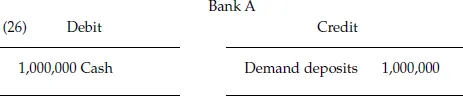
Upon loaning 900,000 m.u., the bank would make the following entry:

If we suppose that 20 percent of the 900,000 m.u. which leave the bank's vault will again be deposited in the same bank, and that 90 percent of that amount will then be loaned, etc., the entries appear as follows:

When 90 percent of this amount is loaned:
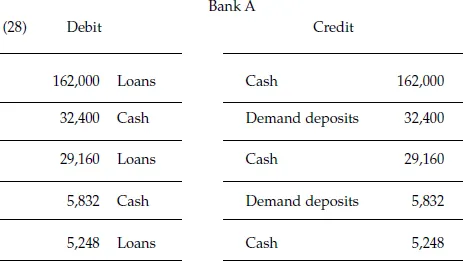
We have supposed that 20 percent of each loan granted has returned to the bank's vault, given that the final recipients of that proportion of funds loaned are customers of the bank.
Therefore, a balance sheet drawn up according to the continental system would look like this:

These figures are practically identical to those in balance sheet (25). They do not match exactly because our example stops at the third repetition of the loan-deposit process. If we had continued to follow the process, the numbers in balance sheet (29) would have become more and more similar to those in (25), and they eventually would have matched exactly.
25 In some cases banks even pay interest to their checking-account holders in order to attract and keep new deposits. As a result, they ultimately reduce the large profit margins reflected in entry (15). This does not affect our essential argument nor banks' capacity to create deposits, their main source of profit. In the words of Mises, in this competitive process “some banks have gone too far and endangered their solvency.” Mises, Human Action, p. 464.
26 Bresciani-Turroni, Curso de economía, vol. 2: Problemas de economía política, pp. 133–38.
27 The sum of the sequence:
[9] Sn = ar + ar + ar2... + arn-1; if multiplied by the common ratio r, is:
[10] rSn = ar + ar2 + ar3... + arn-1 + arn; by subtracting [10] from [9], we obtain:
Sn - rSn = a - arn; and factoring out the common factor on both sides:
Sn(1 - r) = a(1 - rn); then we isolate Sn:

Therefore we may conclude that:

The Greek sophist Zeno was the first to pose the problem of adding the terms in a sequence with a common ratio less than one. He addressed the problem in the fifth century B.C., posing the well-known question of whether or not the athlete Achilles would be able to catch the turtle. The problem was not satisfactorily solved, however, because Zeno failed to realize that infinite series with a common ratio less than one have a convergent sum (not a divergent sum, like he believed). See The Concise Encyclopedia of Mathematics, W. Gellert, H. Kustner, M. Hellwich and H. Kastner, eds. (New York: Van Nostrand, 1975), p. 388.
28 This is how Marshall describes the procedure which led him to this formula:
I should consider what part of its deposits a bank could lend, and then I should consider what part of its loans would be redeposited with it and with other banks and, vice versa, what part of the loans made by other banks would be received by it as deposits. Thus I should get a geometrical progression; the effect being that if each bank could lend two-thirds of its deposits, the total amount of loaning power got by the banks would amount to three times what it otherwise would be. If it could lend four-fifths, it will then be five times; and so on. The question how large a part of its deposits a bank can lend depends in a great measure on the extent on which the different banks directly or indirectly pool their reserves. But this reasoning, I think, has never been worked out in public, and it is very complex. (Alfred Marshall, “Memoranda and Evidence before the Gold and Silver Commission,” December 19, 1887, in Official Papers by Alfred Marshall [London: Royal Economic Society, Macmillan, 1926], p. 37)
29 Also relevant is the formula for the maximum credit expansion an isolated bank can bring about based not on the money it receives in original deposits, but on the reserves it holds, r, in excess of the required amount, cd. In this case, the decrease in reserves which results from the new expansion x (1 – k) must be equal to the excess reserves, r, minus the reserve ratio corresponding to the portion of loans unused, k · c · x. In other words:
[18] (1 - k)x = r - k. c . x
k. c . x + (1 - k)x = r
x(kc + 1 - k) = r
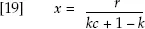
If, as in our example, we suppose that an original deposit of 1,000,000 m.u. is made, c =0.1 and k =0.2, the excess of reserves is precisely r =900,000, and therefore:

This, of course, is exactly the same result we obtained with formula [4].
30 See, for example, Juan Torres López, Introducción a la economía política (Madrid: Editorial Cívitas, 1992), pp. 236–39; and José Casas Pardo, Curso de economía, 5th ed. (Madrid, 1985), pp. 864–66.
31 This is the example Bresciani-Turroni prefers to follow in his book, Curso de economía, vol. 2, pp. 133–38.
32 Richard G. Lipsey, An Introduction to Positive Economics, 2nd ed. (London: Weidenfeld and Nicolson, 1966), pp. 682–83.
33 Rothbard, The Mystery of Banking, chap. 8, pp. 111–24.
34 Saravia de la Calle, Instrucción de mercaderes, p. 180.
35 Under these circumstances, which most closely resemble actual market conditions, Phillips's statement loses credibility. In his words (Credit Banking, p. 64), “It follows for the banking system that deposits are chiefly the offspring of loans. For an individual bank, loans are the offspring of deposits.” This second affirmation is the incorrect one under true conditions. This is due to the fact that, given the existence of many banks and many original deposits, and considering that these banks expand credit simultaneously, the deposits of each individual bank are also a result of the credit expansion carried out by all of the banks in unison. In chapter 8 we will examine the distinct possibility (denied by Selgin) that, even in a free-banking system, all banks might simultaneously initiate credit expansion, even when the volume of primary deposits does not increase in all of them (that is, through a generalized decrease in their cash or reserve ratio). In the same chapter, we will explain, as Mises has done, that in a free-banking system, any bank which unilaterally expands its credit by reducing its cash reserves beyond a prudent level will endanger its own solvency. These two phenomena account for the universal tendency of bankers to agree among themselves to jointly orchestrate (usually through the central bank) a uniform rate of credit expansion.
36 We have arrived at these formulas following the process described by Armen A. Alchian and William R. Allen in University Economics (Belmont, Ca.: Wadsworth Publishing, 1964), pp. 675–76. If the legal reserve requirement were reduced to zero, as is increasingly demanded, the total sum of net deposits, DN, would be:

And the net credit expansion, x:
x = DN - d = 4,666,667 m.u.
Therefore we must conclude that if no portion of the money supply were to filter out of the system (f = 0), and the banking authorities were to eliminate the reserve requirement (c = 0), these authorities could drive the volume of credit expansion as high as they chose, since:

(This expansion would bring about numerous disruptive effects on the real productive structure, on which its impact would be severe. See chapter 5.)
37 To illustrate how significantly the above factors can contribute to a decrease in the bank expansion multiplier, we must first note that in Spain, for instance, the total money supply consists of about 50 trillion pesetas (166.386 pesetas = 1 euro), which includes cash held by the public, demand deposits, savings deposits and time deposits. (In the Spanish banking system, despite their name, time deposits are usually true demand deposits, because they can be withdrawn at any time without penalty or with a very small penalty). Of the total money supply, only about 6.6 trillion pesetas are in the form of cash in the hands of the public. This means that a little over 13.2 percent of the total corresponds to this cash held by the public, and therefore the bank expansion multiplier in Spain would be greater than 7.5 times (which would be equal to a reserve ratio of 13.2 percent). Since the current reserve requirement in Spain is 2 percent (from the Bank of Spain's monetary circular 1/1996, October 11, and confirmed afterward by European Central Bank regulations), the difference between that and 13.2 percent can be attributed to the influence of f, the percentage of money which filters out of the system and into the pockets of private citizens. Perhaps the past economic recession has played a role by increasing the volume of cash and deposits held by banks and temporarily reducing their potential for boosting credit expansion. Our comments are based on provisional data from June published in August 1994 in the Boletín Estadístico del Banco de España, kindly supplied by Luis Alfonso López García, an inspector from the Bank of Spain.
38 Nevertheless, the relevant formulas are devised in Laurence S. Ritter and William L. Silber, Principles of Money, Banking and Financial Markets, 3rd rev., updated ed. (New York: Basic Books, 1980), pp. 44–46. Other writings which cover in detail the formulation of the bank multiplier theory are: John D. Boorman and Thomas M. Havrilesky, Money Supply, Money Demand and Macroeconomic Models (Boston: Allyn and Bacon, 1972), esp. pp. 10–41; Dorothy M. Nichols, Modern Money Mechanics: A Workbook on Deposits, Currency and Bank Reserves, published by the Federal Reserve Bank of Chicago, pp. 29–31; and the interesting book by Phillip Cagan, Determinance and Effects of Changes in the Stock of Money, 1875–1960 (New York: Columbia University Press, 1965). Also, José Miguel Andreu García has written extensively on the topic of bank multipliers and reserve requirements. For example, see his articles, “En torno a la neutralidad del coeficiente de caja: el caso español,” in Revista de Economía, no. 9, and “El coeficiente de caja óptimo y su posible vinculación con el déficit público,” Boletín Económico de Información Comercial Española (June 29–July 5, 1987): 2425ff.
39 Usher, The Early History of Deposit Banking in Mediterranean Europe, pp. 9 and 192.
He who has made a special promise to give definite parcels of goods in return for particular individual papers, cannot issue any such promissory papers without holding corresponding goods. If he does so, he will be continually liable to be convicted of fraud or default by the presentation of a particular document. (Jevons, Money and the Mechanism of Exchange, p. 209)
41 As chapter 8 will reveal in greater detail (pp. 605 ff. and 625 ff.), the first theorist to realize that bank deposits are money and that fractional-reserve banking increases the money supply was the Spanish scholastic Luis de Molina, Tratado sobre los cambios, edited and prefaced by Francisco Gómez Camacho (Madrid: Instituto de Estudios Fiscales, 1991; first edition was published in Cuenca in 1597). See esp. Disputation 409, pp. 145–56, esp. p. 147. Nevertheless, Luis de Molina did not observe the parallels between secondary deposits and unbacked bills, since in his time banks had still not begun to exploit the possibility of issuing banknotes. It would not be until 1797 that Henry Thornton would for the first time refer to the equivalence of bills and deposits (see his Response of March 30, 1797 in “Evidence given before the Lords' Committee of Secrecy appointed to inquire into the courses which produced the Order of Council of the 27th February 1797,” reproduced in An Inquiry into the Nature and Effects of the Paper Credit of Great Britain, F. A. Hayek, ed. (Fairfield, N.J.: Augustus M. Kelley, 1978), p. 303. Several years later the same conclusion was reached by Walter Boyd, James Pennington, and the Pennsylvania senator Condy Raguet, who believed that deposits and banknotes both constituted part of the money supply and that any bank which failed to immediately and on demand pay the value of banknotes issued by it should lose its license to operate, as should any bank which failed to immediately and in cash honor requests for withdrawals of deposits the bank had issued [see the “Report on Bank Charters” by Condy Raguet, included in the Journal of the Senate, 1820–1921, Pennsylvania Legislature, pp. 252–68 and Murray N. Rothbard's related comments included in his book, The Panic of 1819: Reactions and Policies (New York and London: Columbia University Press, 1962), p. 148]. Quite significantly, banking school theorists themselves were the first to rightly insist that it was very paradoxical to try to limit the issuance of unbacked bills while not advocating the same measure regarding deposits, given that bills and deposits had exactly the same economic nature. See, for example, James Wilson's book, Capital, Currency and Banking (London: The Economist, 1847), p. 282; see also Vera C. Smith's comments in her book, The Rationale of Central Banking and the Free Banking Alternative, p. 89. Smith makes a most perceptive observation when referring to Wilson and to the grave error of the Currency School, which was incapable of recognizing the economic parallels between bills and deposits, she states:
The reason the currency school usually gave for this distinction was that bank notes increased the circulation and deposits did not. Such an argument was not, of course, acceptable to Wilson as a member of the banking school of thought which both denied that the issue of notes could be increased to any undesirable extent so long as convertibility was strictly maintained, and pointed out that the difference claimed between notes and deposit liabilities was invalid. But it was still denied in many quarters that demand deposits formed part of the circulation, and it was probably by no means generally admitted right up to the time of MacLeod. (p. 89)
Wilson was completely justified in pointing out this contradiction; given the economic equivalence of banknotes and deposits, the arguments in favor of regulating the issuance of one unbacked form are directly applicable, mutatis mutandis, to the other. Moreover this is the same inconsistency manifested nearly a century later by defenders of the contract of irregular deposit of securities in which the bank is allowed to make use of deposits. This controversy arose at the beginning of the twentieth century with respect to banking practices in Barcelona, and at that time the use of a fractional reserve in connection with irregular deposits of securities was called into question and harshly condemned. As defenders of this contract correctly argued at the time, the reasons put forward against this practice should also be applied to monetary bank deposits with a fractional reserve (see related observations in chapter 3).
42 It is interesting to note how bankers involved in crises invariably complain that with just a little assistance from someone (the state or the central bank) in restoring their customers' confidence, they could continue to function with no problem and quickly reestablish their “solvency.”
43 See also chapter 5, no. 4. The serious harm bankers do those customers they urge to “enjoy” new loans and get involved in business deals requiring bank financing should theoretically be admitted in legal cases in which banks would be sued for damages with respect to the injury they inflict upon borrowers in this way. If until now such suits have not been brought before the court, it is because economic theory had not been advanced enough to clearly identify the cause and nature of the injury. However nowadays theoretical developments make it possible to apply theory in court. A very similar, parallel case would be the use of breakthroughs in biology to facilitate judicial declarations of paternity which were impossible a few years ago.
44 In the last chapter we will examine the comparative advantages of the classic gold standard based on a banking system subject to legal principles; that is, with a 100-percent reserve requirement.
CHAPTER 5: BANK CREDIT EXPANSION AND ITS EFFECTS ON THE ECONOMIC SYSTEM
1 The capital theory we will expound is the key to understanding how bank credit expansion distorts the economy's real productive structure. In fact the usual error of the critics of the Austrian theory of the business cycle (also called the circulation credit theory), which we present here, is that they fail to take capital theory into account. This is the case, for example, with Hans-Michael Trautwein and his two papers: “Money, Equilibrium, and the Business Cycle: Hayek's Wicksellian Dichotomy,” History of Political Economy 28, no. 1 (Spring, 1996): 27–55, and “Hayek's Double Failure in Business Cycle Theory: A Note,” chapter 4 of Money and Business Cycles: The Economics of F.A. Hayek, M. Colonna and H. Hagemann, eds. (Aldershot, U.K.: Edward Elgar, 1994), vol. 1, pp. 74–81.
2 On the concepts of human action, plans of action, the subjective conception of time, and action understood as a set of successive stages, see Huerta de Soto, Socialismo, cálculo económico y función empresarial, pp. 43ff.
3 The development of economics as a science which is always based on human beings, the creative actors and protagonists in all social processes and events (the subjectivist conception), is undoubtedly the most significant and characteristic contribution made by the Austrian School of economics, founded by Carl Menger. In fact Menger felt it vital to abandon the sterile objectivism of the classical (Anglo-Saxon) school whose members were obsessed with the supposed existence of external objective entities (social classes, aggregates, material factors of production, etc.). Menger held that economists should instead always adopt the subjectivist view of human beings who act, and that this perspective should invariably exert a decisive influence on the way all economic theories are formulated, in terms of their scientific content and their practical conclusions and results. On this topic see Huerta de Soto, “Génesis, esencia y evolución de la Escuela Austriaca de Economía,” in Estudios de economía política, chap. 1, pp. 17–55.
4 This classification and terminology were conceived by Carl Menger, whose theory on economic goods of different order is one of the most important logical consequences of his subjectivist conception of economics. Carl Menger, Grundsätze der Volkswirthschaftslehre (Vienna: Wilhelm Braumüller, 1871). Menger uses the expression “Güter der ersten Ordnung” (p. 8) to refer to consumer goods or first-order goods. English translation by J. Dingwall and B. Hoselitz, Principles of Economics (New York: New York University Press, 1981).
5 On the subjective, experimental and dynamic conception of time as the only conception applicable to human action in economics, see chapter 4 of the book by Gerald P. O'Driscoll and Mario J. Rizzo, The Economics of Time and Ignorance (Oxford: Basil Blackwell, 1985), pp. 52–70.
6 As Ludwig M. Lachmann has correctly stated, economic development entails not only an increase in the number of productive stages, but also an increase in their complexity, and therefore a change in their composition. Ludwig M. Lachmann, Capital and its Structure (Kansas City: Sheed Andrews and McMeel, 1978), p. 83. See also Peter Lewin, “Capital in Disequilibrium: A Reexamination of the Capital Theory of Ludwig M. Lachmann,” History of Political Economy 29, no. 3 (Fall, 1997): 523–48; and Roger W. Garrison, Time and Money: The Macroeconomics of Capital Structure (London and New York: Routledge, 2001), pp. 25–26.
7 José Castañeda eloquently states:
As more auxiliary means are introduced into the production process, the process becomes more lengthy, and in general, more productive. Of course more indirect processes may exist; that is, ones that are longer or more drawn-out, yet no more productive. Nevertheless these are not taken into account since they are not applied, and a longer process is only introduced when it improves productivity.
José Castañeda Chornet, Lecciones de teoría económica (Madrid: Editorial Aguilar, 1972), p. 385.
8 The law of time preference may even date back to Saint Thomas Aquinas, and it was expressly stated in 1285 by one of his most brilliant disciples, Giles Lessines, who maintained that
res futurae per tempora non sunt tantae existimationis, sicut eadem collectae in instanti nec tantam utilitatem inferunt possidentibus, propter quod oportet quod sint minoris existimationis secundum iustitiam.
In other words,
future goods are not valued as highly as goods available immediately, nor are they as useful to their owners, and therefore justice dictates they should be considered less valuable.
Aegidius Lessines, De usuris in communi et de usurarum contractibus, opuscule 66, 1285, p. 426; quoted by Dempsey, Interest and Usury, note 31 on p. 214. This idea was later presented by San Bernardino de Siena, Conrad Summenhart, and Martín Azpilcueta in 1431, 1499, and 1556 respectively (see Rothbard, Economic Thought Before Adam Smith, pp. 85, 92, 106–07 and 399–400). The implications this concept has for economic theory were later worked out by Turgot, Rae, Böhm-Bawerk, Jevons, Wicksell, Fisher, and especially Frank Albert Fetter and Ludwig von Mises.
9 In a world without time preference people would consume nothing and save everything, and eventually humans would die of starvation and civilization would disappear. “Exceptions” to the law of time preference are merely apparent and invariably result from a disregard for the ceteris paribus condition inherent in the law. Thus a careful examination of any supposed “counter-example” suffices to reveal that refutations of time preference do not involve identical circumstances. This is the case with goods that cannot be simultaneously enjoyed, or those which, although they appear physically equivalent, are not identical from the actor's subjective viewpoint (for instance, ice cream, which we prefer in summer, even when winter is closer). On the theory of time preference, see Mises, Human Action, pp. 483–90 (pp. 480–87 of the Scholar's Edition).
The principal point to be emphasized is that capital goods, thus defined, are distinguished in that they fall neatly into place in a teleological framework. They are the interim goals aimed at in earlier plans; they are the means toward the attainment of still further ends envisaged by the earlier plans. It is here maintained that the perception of this aspect of tangible things now available provides the key to the unraveling of the problems generally attempted to be elucidated by capital theory.
Israel M. Kirzner, An Essay on Capital (New York: Augustus M. Kelley, 1966), p. 38; reproduced in Israel M. Kirzner's book, Essays on Capital and Interest: An Austrian Perspective (Aldershot, U.K.: Edward Elgar, 1996), pp. 13–122.
11 This explains the traditional notion of three factors of production: land or natural resources, labor, and capital goods or higher-order economic goods. In each process of action or production, the actor, using his entrepreneurial sense, generates and combines these factors or resources. The processes culminate in the market in four different types of income: pure entrepreneurial profit, stemming from the actor's alertness and creativity; rent from land or natural resources, in terms of their productive capacity; labor income or wages; and rent derived from the use of capital goods. Even though all capital goods ultimately consist of combinations of natural resources and labor, they also incorporate (apart from the entrepreneurial alertness and creativity necessary to conceive and generate them), the time required to produce them. Furthermore from an economic standpoint capital goods cannot be differentiated from natural resources solely in terms of their distinct physical form. Only purely economic criteria, such as the unaltered permanence of a good with respect to the achievement of goals and the fact that no further action is required of the actor, enable us from an economic standpoint to clearly distinguish between land (or a natural resource), which is always permanent, and capital goods, which strictly speaking, are not permanent and are spent or consumed during the production process, making it necessary to take their depreciation into account. This is why Hayek has affirmed that, despite appearances, “Permanent improvements in land is land.” F.A. Hayek, The Pure Theory of Capital (London: Routledge and Kegan Paul, [1941] 1976), p. 57. See also p. 298 and footnote 31.
12 This is the classic example given by Eugen von Böhm-Bawerk, Kapital und Kapitalzins: Positive Theorie des Kapitales (Innsbruck: Verlag der Wagner'schen Universitäts-Buchhandlung, 1889), pp. 107–35. This work has been translated into English by Hans F. Sennholz, Capital and Interest, vol. 2: Positive Theory of Capital (South Holland, Ill.: Libertarian Press, 1959), pp. 102–18.
13 Saving always results in capital goods, even when initially these merely consist of the consumer goods (in our example the “berries”) which remain unsold (or are not consumed). Then gradually some capital goods (the berries) are replaced by others (the wooden stick), as the workers (Robinson Crusoe) combine their labor with natural resources through a process which takes time and which humans are able to go through due to their reliance on the unsold consumer goods (the saved berries). Hence saving produces capital goods first (the unsold consumer goods that remain in stock) which are gradually used up and replaced by another capital good (the wooden stick). On this important point, see Richard von Strigl, Capital and Production, edited with an introduction by Jörg Guido Hülsmann (Auburn, Ala.: Mises Institute, 2000), pp. 27 and 62.
14 Mark Skousen, in his book The Structure of Production (London and New York: New York University Press, 1990), reproduces a simplified outline of the stages in the production process used in the textile and oil industries in the United States (pp. 168–69). He illustrates in detail the complexity of both processes as well as the significant number of stages they comprise and the very prolonged time period they require. This type of flow chart can be used to provide a simplified description of the activity in any other sector or industry. Skousen takes the diagrams of the above-mentioned industries from the book by E.B. Alderfer and H.E. Michel, Economics of American Industry, 3rd ed. (New York: McGraw-Hill, 1957).
15 For this reason Hayek is especially critical of the traditional definition of a capital good as an intermediate good produced by humans, a definition he considers
a remnant of the cost of production theories of value, of the old views which sought the explanation of the economic attributes of a thing in the forces embodied in it.... Bygones are bygones in the theory of capital no less than elsewhere in economics. And the use of concepts which see the significance of a good in past expenditure on it can only be misleading.
Hayek, The Pure Theory of Capital, p. 89. Hayek concludes that
For the problems connected with the demand for capital, the possibility of producing new equipment is fundamental. And all the time concepts used in the theory of capital, particularly those of the various investment periods, refer to prospective periods, and are always “forward-looking” and never “backward-looking.” (Ibid., p. 90)
16 A demoralized entrepreneur who wishes to abandon his business and settle elsewhere can find sure, constant mobility in the market: legal contracts permit him to put his business up for sale, liquidate it and use his new liquidity to acquire another company. In this way he achieves real, effective mobility that is much greater than the mere physical or technical mobility of the capital good (which, as we have seen, is usually rather limited).
17 Nonetheless on various occasions we will be forced to use the term capital less strictly, to refer to the set of capital goods which make up the productive structure. This loose sense of “capital” is the one intended by, among others, Hayek in The Pure Theory of Capital, p. 54; it is also the meaning intended by Lachmann in Capital and its Structure, where on page 11 “capital” is defined as “the heterogeneous stock of material resources.”
18 This is precisely the fundamental argument Mises raises concerning the impossibility of economic calculation in a socialist economy. See Huerta de Soto, Socialismo, cálculo económico y función empresarial, chaps. 3–7.
19 Ibid., chaps. 2 and 3, pp. 41–155.
20 This is the terminology used, for example, by Knut Wicksell in Lectures on Political Economy (London: Routledge and Kegan Paul, 1951), vol. 1, p. 164, where Wicksell expressly mentions a “horizontal-dimension” and a “vertical-dimension” to the structure of capital goods.
21 The interest rate can actually be interpreted in two different ways. It can be seen as a ratio of today's prices (of which one corresponds to the good available today and the other corresponds to the same good available tomorrow); or it can be considered the price of present goods in terms of future goods. Both ideas yield the same result. The former is the one advocated by Ludwig von Mises, for whom the interest rate “is a ratio of commodity prices, not a price in itself” (Human Action, p. 526). We prefer to favor the latter here, following Murray N. Rothbard. A detailed analysis of how the interest rate is determined as the market price of present goods in terms of future goods, along with other studies, can be found in Murray N. Rothbard's book, Man, Economy, and State: A Treatise on Economic Principles, 3rd ed. (Auburn, Ala.: Ludwig von Mises Institute, 1993), chaps. 5–6, pp. 273–387. In any case the interest rate is determined in the same way as any other market price. The only difference lies in the fact that, rather than reflect an established price for each good or service in terms of m.u., the interest rate is based on the sale of present goods in exchange for future goods, each in the form of m.u. Although we defend the idea that the interest rate is determined exclusively by time preference (i.e., by the subjective valuations of utility which time preference entails), the acceptance of another theory (for example, that to a greater or lesser degree the interest rate is set by the marginal productivity of capital) does not affect this book's essential argument concerning the disruptive effects which banks’ expansive creation of loans has on the productive structure. In this regard, Charles E. Wainhouse states:
Hayek establishes that his monetary theory of economic fluctuations is consistent with any of the “modern interest theories” and need not be based on any particular one. The key is the monetary causes of deviations of the current from the equilibrium rate of interest.
“Empirical Evidence for Hayek's Theory of Economic Fluctuations,” chapter 2 in Money in Crisis: The Federal Reserve, the Economy and Monetary Reform, Barry N. Siegel, ed. (San Francisco: Pacific Institute for Public Policy Research, 1984), p. 40.
22 What we colloquially refer to as the “money market” is actually just a short-term loan market. The true money market encompasses the entire market in which goods and services are exchanged for m.u. and in which the price or purchasing power of money, and the monetary price of each good and service are simultaneously determined. This is why the following affirmation, made by Marshall, is wholly misleading: “The ‘money market’ is the market for command over money: ‘the value of money’ in it at any time is the rate of discount, or of interest for short period loans charged in it.” Alfred Marshall, Money Credit and Commerce (London: Macmillan, 1924), p. 14. Mises, in Human Action, p. 403, completely clears up Marshall's confusion of terms.
23 However, strictly speaking, the concept of a “rate of profit” makes no sense in real life, and we have only introduced it by way of illustration and to aid the reader in understanding the theory of the cycle. As Mises states:
[I]t becomes evident that it is absurd to speak of a “rate of profit” or a “normal rate of profit” or an “average rate of profit.”... There is nothing “normal” in profits and there can never be an “equilibrium” with regard to them. (Mises, Human Action, p. 297)
24 In fact the interest rate at which loans are negotiated in the credit market also includes an entrepreneurial component we have not mentioned in the text. This arises from the inescapable uncertainty (not “risk”) regarding the possibility that systematic changes could occur in society's rate of time preference or other disturbances impossible to insure against and characteristic of business cycles:
The granting of credit is necessarily always an entrepreneurial speculation which can possibly result in failure and the loss of a part of the total amount lent. Every interest stipulated and paid in loans includes not only originary interest but also entrepreneurial profit. (Mises, Human Action, p. 536)
25 This same idea is focal in Roger Garrison's latest book, which we read after the first edition of our book had been published in Spanish. Garrison states:
[T]he intertemporal allocation may be internally consistent and hence sustainable, or it may involve some systematic internal inconsistency, in which case its sustainability is threatened. The distinction between sustainable and unsustainable patterns of resource allocation is, or should be, a major focus of macroeconomic theorizing. (Garrison, Time and Money, pp. 33–34)
26 Mises, The Theory of Money and Credit and also Human Action.
27 The first theorist to propose an illustration basically identical to that of Chart V-1 was William Stanley Jevons in his book The Theory of Political Economy, the 1st edition of which was published in 1871. We have used a reprint of the 5th edition (Kelley and Millman, eds.), published in 1957 in New York; page 230 includes a diagram where, according to Jevons, “line ox indicates the duration of investment and the height attained at any point, i, is the amount of capital invested.” Later, in 1889, Eugen von Böhm-Bawerk gave more in-depth consideration to the theoretical issue of the structure of successive stages of capital goods and to using charts to illustrate this structure. He proposed to represent it by successive annual concentric circles (the expression Böhm-Bawerk uses is konzentrische Jahresringe), each of which depicts a productive stage; the circles overlap other larger ones. This type of chart appears, along with Böhm-Bawerk's explanation of it, on pp. 114–15 of his book, Kapital und Kapitalzins, vol. 2: Positive Theorie des Kapitales; the corresponding pages of the English edition, Capital and Interest, are pp. 106–07, vol. 2. The chief problem with Böhm-Bawerk's chart is that it depicts the passage of time in a very clumsy way and therefore reveals the need for a second dimension (vertical). Böhm-Bawerk could easily have gotten around this difficulty by replacing his “concentric rings” with a number of cylinders placed one on top of the other, so that each cylinder has a base smaller than the one below it (like a circular wedding cake whose layers are smaller in diameter the higher their position). Hayek later overcame this difficulty, in 1931, in the first edition of his now classic book, Prices and Production, foreword by Lionel Robbins (London: Routledge, 1931; 2nd rev. ed., in 1935); p. 36 of the first edition and p. 39 of the second. From this point on, unless we indicate otherwise, all quotations taken from this book will come from the 2nd edition. The book contains a chart very similar to Chart V-1. Hayek used this type of illustration again in 1941 (but this time in continuous terms) in his book, The Pure Theory of Capital (see, for example, p. 109). Moreover in 1941 Hayek also developed a prospective three-dimensional chart of the different stages in the production process. What this chart gains in accuracy, precision, and elegance, it loses in comprehensibility (p. 117 of the 1941 English edition). In 1962 Murray Rothbard (Man, Economy, and State, chaps. 6–7) proposed a depiction similar and in many aspects even superior to Hayek's. Mark Skousen follows Rothbard's illustration very closely in his book, The Structure of Production. In Spanish we first introduced the chart of the stages in the productive structure over twenty years ago in the article, “La teoría austriaca del ciclo económico,” originally published in Moneda y crédito, no. 152 (March 1980): 37–55 (republished in our book, Estudios de economía política, chap. 13, pp. 160–76). Although the triangular charts Knut Wicksell proposes in Lectures on Political Economy (vol. 1, p. 159) could also be interpreted as an illustration of the productive structure, we have deliberately left them out of this brief outline of the history of charts depicting the stages in the production process.
The inventory of capital constitutes, so to speak, a cross section of the many processes of production which are of varying length and which began at different times. It therefore cuts across them at very widely differing stages of development. We might compare it to the census which is a cross section through the paths of human life and which encounters and which arrests the individual members of society at widely varying ages and stages. (Böhm-Bawerk, Capital and Interest, vol. 2: Positive Theory of Capital, p. 106)
In the original edition, this quotation appears on p. 115.
29 John B. Clark, “The Genesis of Capital,” Yale Review 2 (November 1893): 302–15; and “Concerning the Nature of Capital: A Reply,” Quarterly Journal of Economics (May 1907). Frank H. Knight, “Capitalist Production, Time and the Rate of Return,” in Economic Essays in Honour of Gustav Cassel (London: George Allen and Unwin, 1933).
30 Ludwig von Mises very clearly states that
The length of time expended in the past for the production of capital goods available today does not count at all. These capital goods are valued only with regard to their usefulness for future satisfaction. The “average period of production” is an empty concept. (Mises, Human Action, p. 489)
Rothbard expresses a similar opinion in his book, Man, Economy, and State, pp. 412–13.
31 Furthermore Rothbard points out that
[l]and that has been irrigated by canals or altered through the chopping down of forests has become a present, permanent given. Because it is a present given, not worn out in the process of production, and not needing to be replaced, it becomes a land factor under our definition. (Italics in original)
Rothbard concludes that once
the permanent are separated from the nonpermanent alterations, we see that the structure of production no longer stretches back infinitely in time, but comes to a close within a relatively brief span of time. (Man, Economy and State, p. 414; italics added)
32 As F.A. Hayek has explained,
The different installments of future services which such goods are expected to render will in that case have to be imagined to belong to different “stages” of production corresponding to the time interval which will elapse before these services mature.
Prices and Production, p. 40; footnote on p. 2. In this respect the equivalence between durable consumer goods and capital goods had already been revealed by Eugen von Böhm-Bawerk, according to whom, “The value of the remoter installments of the renditions of service is subject to the same fate as is the value of future goods.” Capital and Interest, vol. 2: Positive Theory of Capital, pp. 325–37, esp. p. 337. In the German edition see the chapter dedicated to “Der Zins aus ausdauernden Gütern,” on pp. 361–82 of the 1889 edition already cited. Böhm-Bawerk expresses this principle in German in the following way: “In Folge davon verfällt der Werth der entlegeneren Nutzleistungsraten demselben Schicksale, wie der Werth künftiger Güter.” See Kapital und Kapitalzins, vol. 2: Positive Theorie des Kapitales, p. 365. In Spain José Castañeda Chornet reveals that perhaps he has been the one who has best understood this essential idea when he affirms that
Durable consumer goods, which generate a flow of consumer services over time, may be included in an economy's fixed capital. In a strict sense they constitute fixed consumer capital, not productive capital. So capital, in a broad sense, comprises productive or true capital as well as consumer capital, or capital for use. (Castañeda, Lecciones de teoría económica, p. 686)
33 Roger W. Garrison has put forward the additional argument that all consumer goods for which a secondhand market exists should be classified, from an economic standpoint, as investment goods. In fact consumer goods classified as “durable” simultaneously form a part of consecutive stages in the production process, although they legally belong to “consumers,” since consumers take care of, protect and maintain them in their productive capacity so they will render direct consumer services over a period of many years. Roger Garrison, “The Austrian-Neoclassical Relation: A Study in Monetary Dynamics,” doctoral thesis presented at the University of Virginia, 1981, p. 45. On the possibility and convenience of representing consumer durables in our chart, see Garrison, Time and Money, pp. 47–48.
34 Tables such as Table V-1 have been constructed for the same purpose by Böhm-Bawerk (Capital and Interest, vol. 2, pp. 108–09, where in 1889 he first recorded for each stage of production the value in “years of labor” of the products of the corresponding stage). Later, in 1929, F.A. Hayek performed the same task with greater precision in his article “Gibt es einen ‘Widersinn des Sparens'?” (Zeitschrift Für Nationalökonomie, Bd. 1, Heft 3, 1929), which was translated with the title “The ‘Paradox’ of Saving” and published in English in Economica (May 1931) and later included as an appendix to the book, Profits, Interest and Investment and Other Essays on the Theory of Industrial Fluctuations, 1st ed. (London: George Routledge and Sons, 1939 and Clifton, N.J.: Augustus M. Kelley, Clifton 1975), pp. 199–263, esp. pp. 229–31. As Hayek himself admits, it was precisely the desire to simplify the awkward presentation of these tables that led him to introduce the chart of production stages we have displayed in Chart V-1 (see Prices and Production, p. 38, note 1).
35 Adam Smith, The Wealth of Nations, book 2, chap. 2, p. 390 of vol. 1 of the original 1776 edition cited earlier, p. 306 of the E. Cannan edition (New York: Modern Library, 1937 and 1965); and p. 322 of vol. 1 of the Glasgow edition, (Oxford: Oxford University Press, 1976). As Hayek points out (Prices and Production, p. 47), it is important to note that Adam Smith's authority on this subject has misled many authors. For example, Thomas Tooke, in his book, An Inquiry into the Currency Principle (London 1844, p. 71), and others have used Smith's argument to justify the erroneous doctrines of the Banking School.
36 Hayek, Prices and Production, p. 49. This is precisely why the conception of capital as a homogeneous fund that reproduces by itself is meaningless. This view of capital is defended by J.B. Clark and F.H. Knight and is the theoretical basis (along with the concept of general equilibrium) for the extremely stale model of the “circular flow of income” that appears in almost all economics textbooks, despite the fact that it is misleading, as it does not reflect the temporal structure by stages in the production process, as in Chart V-1 (see also footnote 39).
37 For instance as Ramón Tamames indicates, the gross national product at market prices
can be defined as the sum of the value of all the final goods and services produced in a nation in one year. I speak of final goods and services because intermediate ones are excluded to avoid the double computation of any value.
Fundamentos de estructura económica, 10th revised ed. (Madrid: Alianza Universidad, 1992), p. 304. Also see the recent book by Enrique Viaña Remis, Lecciones de contabilidad nacional (Madrid: Editorial Cívitas, 1993), in which he states that
the distinction between intermediate inputs and depreciation has given rise to the convention of excluding the former and including the latter in the value added. Therefore we distinguish between gross value added, which includes depreciation, and net value added, which excludes it. Consequently both product and income can be gross or net, depending upon whether they include or exclude depreciation. (p. 39)
As we see, the label “gross” is used to describe a figure that continues to be net, given that it excludes the entire value of intermediate inputs. National income accounting textbooks have not always ignored the fundamental importance of intermediate products. The classic work, The Social Framework of the American Economy: An Introduction to Economics, by J.R. Hicks and Albert G. Hart (New York: Oxford University Press, 1945), includes an explicit reference to the great importance of the time span in any process of production of consumer goods (the concrete example used is that of the production of a loaf of bread). The authors give a detailed explanation of the different stages of intermediate products necessary to arrive at the final consumer good. Hicks and Hart conclude (pp. 33–34):
The products which result from these early stages are useful products, but not products which are directly useful for satisfying the wants of consumers. Their use is to be found in their employment in the further stages, at the end of which a product which is directly wanted by consumers will emerge.... A producers’ good may be technically finished, in the sense that the particular operation needed to produce it is completed.... Or it may not be technically finished, but still in process, even so far as its own stage is concerned. In either case it is a producers’ good, because further stages are needed before the result of the whole process can pass into the consumers’ hands. The consumers’ good is the end of the whole process; producers’ goods are stages on the road toward it. (Italics added)
38 Skousen, in his book, The Structure of Production, pp. 191–92, proposes the introduction of “gross national output,” a new measure in national income accounting. With respect to the possible gross national output of the United States, Skousen concludes the following:
First, Gross National Output (GNO) was nearly double [Gross National Product] (GNP), thus indicating the degree to which GNP underestimates total spending in the economy. Second, consumption represents only 34 percent of total national output, far less than what GNP figures suggest (66 percent). Third, business outlays, including intermediate inputs and gross private investment, is the largest sector of the economy, 56 percent larger than the consumer-goods industry. GNP figures suggest that the capital-goods industry represents a minuscule 14 percent of the economy.
All of these figures refer to 1982 national income accounting data for the United States. As we will later see when we focus on business cycles, traditional gross national product figures have the glaring theoretical defect of hiding the important oscillations which take place in the intermediate stages of the production process throughout the cycle. Gross national output, however, would reflect all of these fluctuations. See also the data for 1986, found at the end of footnote 20, chapter 6.
39 As Murray Rothbard indicates, the net quality of GNP invariably leads one to identify capital with a perpetual fund that reproduces by itself without the need for any particular decision-making on the part of entrepreneurs. This is the “mythological” doctrine defended by J.B. Clark and Frank H. Knight, and it constitutes the conceptual basis for the current national income accounting system. Thus this system is simply the statistical, accounting manifestation of the mistaken understanding of capital theory promoted by these two authors. Rothbard concludes: “To maintain this doctrine it is necessary to deny the stage analysis of production and, indeed, to deny the very influence of time in production” (Rothbard, Man, Economy, and State, p. 343). Furthermore the current method of calculating GNP also strongly reflects Keynes's influence, enormously exaggerating the importance of consumption in the economy and conveying the false impression that the most significant portion of the national product exists in the form of consumer goods and services, instead of investment goods. In addition this explains why most agents involved (economists, businessmen, investors, politicians, journalists, and civil servants) have a distorted idea of the way the economy functions. Since they believe the sector of final consumption to be the largest in the economy, they very easily conclude that the best way to foster the economic development of a country is to stimulate consumption and not investment. On this point see Hayek, Prices and Production, pp. 47–49, esp. note 2 on p. 48, and also Skousen, The Structure of Production, p. 190. See also next footnote 55.
40 Input-output tables partially escape the inadequacies of traditional national income accounting by permitting the calculation of the amount corresponding to all intermediate products. However even though input-output analysis is a step in the right direction, it also has very serious limitations. In particular, it reflects only two dimensions: it relates the different industrial sectors with the factors of production used directly in them, but not with the factors of production which are used but correspond to more distant stages. In other words, input-output analysis does not reflect the set of consecutive intermediate stages leading up to any intermediate stage or capital good or to the final consumer good. Instead it only relates each sector with its direct provider. Furthermore due to the great cost and complexity of input-output tables, they are only compiled every certain number of years (in the United States, every five years), and therefore the statistics they contain are of very slight value with respect to calculating the gross national output for each year. See Skousen, The Structure of Production, pp. 4–5.
41 The expected increase in profit is considered in absolute, not relative, terms. Indeed profits representing, for example, 10 percent of 100 m.u. (10 m.u.) are smaller than profits representing 8 percent of 150 m.u. (12 m.u.). Even though the interest rate or rate of accounting profit decreases as the result of the weaker time preference which causes an increase in saving and investment, in absolute terms the accounting profits rise by 20 percent, i.e., from 10 to 12 m.u. This is what generally occurs in the stages furthest from consumption during the process we are considering. Regarding the stages closest to consumption, it is important to remember that, as we will indicate in the main text, the comparison is not drawn with past profits, but with an estimate of those which would have been produced had the entrepreneurial investment strategy not been modified.
42 See pages 300–01 and footnotes 32 and 33.
43 While studying economics in the late seventies, we noticed that in no Economic Theory course did the instructor explain how an increase in saving affects the productive structure; professors described only the Keynesian model of the “paradox of thrift,” which as is widely known, outright condemns increases in social saving, because they reduce effective demand. Although Keynes did not expressly refer to the “paradox of thrift,” this concept follows when Keynes's economic principles are carried to their “logical” conclusion:
If governments should increase their spending during recessions, why should not households? If there were no principles of “sound finance” for public finance, from where would such principles come for family finance? Eat, drink and be merry, for in the long-run all are dead. (Clifford F. Thies, “The Paradox of Thrift: RIP,” Cato Journal 16, no. 1 [Spring–Summer, 1996]: 125)
See also our comments in footnote 58 on the treatment this subject receives in different editions of Samuelson's textbook.
44 Following Turgot, Eugen von Böhm-Bawerk was the first to confront and resolve this issue. His analysis was rudimentary, yet contained all the essential elements of a definitive explanation. It is found in volume 2 of his magnum opus, Capital and Interest, published in 1889 (Kapital und Kapitalzins: Positive Theorie des Kapitales, pp. 124–25). Due to its significance, we include here the passage from Capital and Interest in which Böhm-Bawerk poses the question of growth in voluntary saving in a market economy and the forces involved which lead to a lengthening of the productive structure: let us suppose, says Böhm-Bawerk, that
each individual consumes, on the average, only three-quarters of his income and saves the other quarter, then obviously there will be a falling off in the desire to buy consumption goods and in the demand for them. Only three-quarters as great a quantity of consumption goods as in the preceding case will become the subject of demand and of sale. If the entrepreneurs were nevertheless to continue for a time to follow the previous disposition of production and go on bringing consumption goods to the market at a rate of a full 10 million labor-years annually, the oversupply would soon depress the prices of those goods, render them unprofitable and hence induce the entrepreneurs to adjust their production to the changed demand. They will see to it that in one year only the product of 7.5 million labor-years is converted into consumption goods, be it through maturation of the first annual ring or be it through additional present production. The remaining 2.5 million labor-years left over from the current annual allotment can be used for increasing capital. And it will be so used.... In this way it is added to the nation's productive credit, increases the producer's purchasing power for productive purposes, and so becomes the cause of an increase in the demand for production goods, which is to say intermediate products. And that demand is, in the last analysis, what induces the managers of business enterprises to invest available productive forces in desired intermediate product.... [I]f individuals do save, then the change in demand, once more through the agency of price, forces the entrepreneurs into a changed disposition of productive forces. In that case fewer productive powers are enlisted during the course of the year for the service of the present as consumption goods, and there is a correspondingly greater quantity of productive forces tied up in the transitional stage of intermediate products. In other words, there is an increase in capital, which redounds to the benefit of an enhanced enjoyment of consumption goods in the future. (Böhm-Bawerk, Capital and Interest, vol. 2: Positive Theory of Capital, pp. 112–13; italics added)
45 These amounts correspond to the numerical example shown in Chart V–3.
46 The formula is 
which in terms of compound capitalization at interest i, corresponds to the present value of a temporary annuity, payable in arrears, of n periods, where the capitalization period coincides with the rent period. It is clear that as period n becomes longer and approaches infinity, the value of the rent will approach 1/i, which as a mnemonic rule, is applicable in practice to all capital goods with a very long life (and to land, due to its permanence). See Lorenzo Gil Peláez, Tablas financieras, estadísticas y actuariales, 6th revised updated ed. (Madrid: Editorial Dossat, 1977), pp. 205–37.
47 It should be noted that technological innovations which boost productivity (in the form of a greater quantity and/or quality of goods and services) by reducing the length of production processes will be introduced in any case, whether or not society's net saving increases. However such an increase makes possible the application of new technologies which, due to a marginal lack of resources, cannot be adopted prior to the rise in saving.
48 The ceiling price will be reached when the effect of the reduction in the interest rate subsides and is counteracted by the larger number and volume of securities issued in the primary stock and bond market, which will tend to cause the market price per security to stabilize at a lower level. In the next chapter we will see that all prolonged market buoyancy and in general, all sustained, constant rises in stock-market indexes, far from indicating a very healthy underlying economic situation, stem from an inflationary process of credit expansion which sooner or later will provoke a stock-market crisis and an economic recession.
49 As Hayek indicates, these reductions in prices may take some time, depending upon the rigidity of each market, and at any rate, they will be less than proportional to the fall in demand that accompanies saving. If this were not the case, saving would not entail any actual sacrifice and the stock of consumer goods necessary to sustain economic agents while more capital-intensive processes are completed would not be left unsold. See F.A. Hayek, “Reflections on the Pure Theory of Money of Mr. J.M. Keynes (continued),” Economica 12, no. 35 (February 1932): 22–44, republished in The Collected Works of F.A. Hayek, vol. 9: Contra Keynes and Cambridge: Essays, Correspondence, Bruce Caldwell, ed. (London: Routledge, 1995), pp. 179–80.
50 See David Ricardo, The Works and Correspondence of David Ricardo, vol. 1: On the Principles of Political Economy and Taxation, Piero Sraffa and M.H. Dobb, eds. (Cambridge: Cambridge University Press, 1982), pp. 39–40.
51 Ibid., p. 395.
52 See Hayek, “Profits, Interest and Investment” and Other Essays on the Theory of Industrial Fluctuations, p. 39. Shortly afterward, in 1941, F.A. Hayek briefly touched on this effect in relation to the impact an increase in voluntary saving exerts on the productive structure, though he did not expressly quote Ricardo. This is the only instance we know of in which the “Ricardo Effect” is directly applied to an analysis of the consequences of a rise in voluntary saving, and not to the role the effect plays in the different phases of the business cycle, theorists’ predominant concern up until now. The excerpt in question is found on p. 293 of The Pure Theory of Capital (London: Macmillan, 1941), and successively reprinted thereafter (we quote from the 1976 Routledge reprint). It reads as follows: “The fall in the rate of interest may... drive up the price of labour to such an extent as to enforce an extensive substitution of machinery for labour.” Hayek later returned to the topic in his article, “The Ricardo Effect,” published in Economica 34, no. 9 (May 1942): 127–52, and republished as chapter 11 of Individualism and Economic Order (Chicago: University of Chicago Press, 1948), pp. 220–54. Thirty years later he dealt with it again in his article, “Three Elucidations of the Ricardo Effect,” published in the Journal of Political Economy 77, no. 2 (1979), and reprinted as chapter 11 of the book New Studies in Philosophy, Politics, Economics and the History of Ideas (London: Routledge and Kegan Paul, 1978), pp. 165–78. Mark Blaug recently admitted that his criticism of the “Ricardo Effect” in his book, Economic Theory in Retrospect (Cambridge: Cambridge University Press, 1978), pp. 571–77, was based on an error in interpretation regarding the supposedly static nature of Hayek's analysis. See Mark Blaug's article entitled “Hayek Revisited,” published in Critical Review 7, no. 1 (Winter, 1993): 51–60, and esp. note 5 on pp. 59–60. Blaug acknowledges that he discovered his error thanks to an article by Laurence S. Moss and Karen I. Vaughn, “Hayek's Ricardo Effect: A Second Look,” History of Political Economy 18, no. 4 (Winter, 1986): 545–65. For his part, Mises (Human Action, pp. 773–77) has criticized the emphasis placed on the Ricardo Effect in order to justify a forced increase in wages through union or government channels with the purpose of raising investment in capital goods. He concludes that such a policy only gives rise to unemployment and a poor allocation of resources in the productive structure, since the policy does not stem from an increase in society's voluntary saving, but rather from the simple coercive imposition of artificially high wages. Rothbard expresses a similar view in Man, Economy, and State (pp. 631–32). Hayek does so as well in The Pure Theory of Capital (p. 347), where he concludes that dictatorially-imposed growth in wages produces not only a rise in unemployment and a fall in saving, but also generalized consumption of capital combined with an artificial lengthening and narrowing of the stages in the productive structure.
53 See Hayek, The Pure Theory of Capital, p. 256.
54 In the words of Hayek himself:
All that happens is that at the earlier date the savers consume less than they obtain from current production, and at the later date (when current production of consumers’ goods has decreased and additional capital goods are turned out...) they are able to consume more consumers’ goods than they get from current production. (Hayek, The Pure Theory of Capital, p. 275. See also footnote 13 above)
55 The above considerations reveal once again the extent to which traditional national income statistics and the measures of growth in national income are theoretically inadequate. We have already pointed out that the indicators of national income do not measure the gross national output and tend to exaggerate the importance of consumption, while overlooking the intermediate stages in the production process. It is also true that the statistical measures of economic growth and of the evolution of the price index are both distorted because they focus mainly on the final stage, consumption. Therefore it is easy to see how, in the initial phases of the process triggered when voluntary saving rises, a statistical decrease in economic growth is registered. In fact there is often an initial decline in final consumer and investment goods, while national accounting statistics fail to reflect the parallel increase in investment in the stages furthest from consumption, the creation of new stages, not to mention the growth in investment in non-final intermediate products, stocks and inventories of circulating capital. Moreover the consumer price index falls, since it merely reflects the effect the reduced monetary demand has on consumer goods stages, yet no index adequately records the growth in prices in the stages furthest from consumption. Consequently different agents (politicians, journalists, union leaders, and employers’ representatives) often make an erroneous popular interpretation of these economic events, based on these statistical national accounting measures. Hayek, toward the end of his article on “The Ricardo Effect” (Individualism and Economic Order, pp. 251–54), offers a detailed description of the great statistical difficulties which exist with respect to using national accounting methods to record the effects on the productive structure of an increase in voluntary saving; or in this case, the influence of the “Ricardo Effect.” More recently, in his Nobel Prize acceptance speech, F.A. Hayek warned against the particularly widespread custom of regarding unsound theories as valid simply because there appears to be empirical support for them. Hayek cautioned against rejecting or even ignoring true theoretical explanations merely because it is quite difficult, from a technical standpoint, to collect the statistical information necessary to confirm them. These are precisely the errors committed in the application of national income accounting to the process by which the productive stages furthest from consumption grow wider and deeper, a process always due to a rise in voluntary saving. See “The Pretence of Knowledge,” Nobel Memorial Lecture, delivered December 11, 1974 and reprinted in The American Economic Review (December 1989): 3–7.
56 Milton Friedman and Anna J. Schwartz, in reference to the period from 1865 to 1879 in the United States, during which practically no increase in the money supply occurred, conclude that,
[T]he price level fell to half its initial level in the course of less than fifteen years and, at the same time, economic growth proceeded at a rapid rate.... [T]heir coincidence casts serious doubts on the validity of the now widely held view that secular price deflation and rapid economic growth are incompatible. (Milton Friedman and Anna J. Schwartz, A Monetary History of the United States 1867–1960 [Princeton, N.J.: Princeton University Press, 1971], p. 15, and also the important statistical table on p. 30)
In addition Alfred Marshall, in reference to the period 1875–1885 in England, stated that
It is doubtful whether the last ten years, which are regarded as years of depression, but in which there have been few violent movements of prices, have not, on the whole, conduced more to solid progress and true happiness than the alternations of feverish activity and painful retrogression which have characterised every preceding decade of this century. In fact, I regard violent fluctuations of prices as a much greater evil than a gradual fall of prices. (Alfred Marshall, Official Papers, p. 9; italics added)
Finally, see also George A. Selgin, Less Than Zero: The Case for a Falling Price Level in a Growing Economy, Hobart Paper 132 (London: Institute of Economic Affairs, 1997).
57 The essential argument against the thesis that saving adversely affects economic development and that it is necessary to stimulate consumption to foster growth was very brilliantly and concisely expressed by Hayek in 1932 when he demonstrated that it is a logical contradiction to believe that an increase in consumption manifests itself as an increase in investment, since investment can only rise due to a rise in saving, which must always go against consumption. In his own words:
Money spent today on consumption goods does not immediately increase the purchasing power of those who produce for the future; in fact, it actually competes with their demand and their purchasing power is determined not by current but by past prices of consumer goods. This is so because the alternative always exists of investing the available productive resources for a longer or a shorter period of time. All those who tacitly assume that the demand for capital goods changes in proportion to the demand for consumer goods ignore the fact that it is impossible to consume more and yet simultaneously to defer consumption with the aim of increasing the stock of intermediate products. (F.A. Hayek, “Capital Consumption,” an English translation of the article previously published under the German title “Kapitalaufzehrung,” in Weltwirtschaftliches Archiv 36, no. 2 (1932): 86–108; italics added)
The English edition appears as chapter 6 of Money, Capital and Fluctuations: Early Essays (Chicago: University of Chicago Press, 1984), pp. 141–42. Hayek himself reminds us that this fundamental principle was put forward by John Stuart Mill, who in his fourth proposition on capital established that: “demand for commodities is not demand for labour.” Nevertheless Hayek indicates that John Stuart Mill failed to adequately justify this principle, which only became fully accepted by theorists upon the development of the theory of capital by Böhm-Bawerk and the theory of the cycle by Mises and Hayek himself (see John Stuart Mill, Principles of Political Economy (Fairfield, N.J.: Augustus M. Kelley, 1976), book 1, chap. 5, no. 9, pp. 79–88). According to Hayek, the understanding of this basic idea is the true test of any economist: “More than ever it seems to me to be true that the complete apprehension of the doctrine that ‘demand for commodities is not demand for labor’... is ‘the best test of an economist.’” Hayek, The Pure Theory of Capital (1976 ed.), p. 439. In short it means understanding that it is perfectly feasible for an entrepreneur of consumer goods to earn money even when his sales do not increase and even decrease, if the entrepreneur reduces his costs by substituting capital equipment for labor. (The increased investment in capital equipment creates jobs in other stages and makes society's productive structure more capital-intensive.)
58 To F.A. Hayek goes the credit for being the first to have theoretically demolished the supposed “paradox of thrift” in 1929, in his article, “Gibt es einen ‘Widersinn des Sparens'?” (“The ‘Paradox’ of Saving”) Economica (May 1931), and reprinted in Profits, Interest and Investment, pp. 199–263. In Italy Augusto Graziani defended a position very similar to Hayek's in his article, “Sofismi sul risparmio,” originally published in Rivista Bancaria (December 1932), and later reprinted in his book, Studi di Critica Economica (Milan: Società Anonima Editrice Dante Alighieri, 1935), pp. 253–63. It is interesting to note that an author as distinguished as Samuelson has continued to defend the old myths of the theory of underconsumption which constitute the basis for the paradox of thrift. He does so in various editions of his popular textbook, and as one might expect, relies on the fallacies of Keynesian theory, which we will comment on in chapter 7. It is not until the thirteenth edition that the doctrine of the “paradox of thrift” becomes optional material and the corresponding diagram justifying it disappears (Paul A. Samuelson and William N. Nordhaus, Economics, 13th ed. [New York: McGraw-Hill, 1989], pp. 183–85). Later, in the 14th edition (New York: McGraw-Hill, 1992), all references to the topic are silently and prudently eliminated. Unfortunately, however, they reappear in the 15th edition (New York: McGraw-Hill, 1995, pp. 455–57). See also Mark Skousen “The Perseverance of Paul Samuelson's Economics,” Journal of Economic Perspectives 2, no. 2 (Spring, 1997): 137–52. The main error in the theory of the paradox of thrift consists of the fact that it ignores the basic principles of capital theory and does not treat the productive structure as a series of consecutive stages. Instead it contains the implicit assumption that only two stages exist, one of final aggregate consumer demand and another made up of a single set of intermediate investment stages. Thus in the simplified model of the “circular flow of income,” it is assumed that the negative effect on consumption of an upsurge in saving immediately and automatically spreads to all investment. On this topic see Skousen, The Structure of Production, pp. 244–59.
59 Rothbard (Man, Economy, and State, pp. 467–79) has revealed that, as a result of the lengthening of the productive structure (a phenomenon we have examined and one which follows from an increase in voluntary saving), it is impossible to determine in advance whether or not the income capitalists receive in the form of interest will rise. In our detailed example this does not occur in monetary terms and perhaps not in real terms either. This is due to the fact that, even when saving and gross investment grow, we cannot establish, simply on the basis of economic theory, whether or not the value of income derived from interest will fall, rise or remain constant, since each of these alternatives is feasible. It is also impossible to ascertain what will happen to the monetary income received by owners of the original means of production. In our example it stays the same, which results in a dramatic increase in the owners’ real income once the prices of consumer goods decline. Nonetheless a drop in the income (in monetary terms) received by the owners of the original means of production is possible, although such a drop will always be less marked than the reduction in the prices of consumer goods and services. Nowadays it is clearly a challenge for us to conceive of an economy in rapid development, yet where the monetary income received by owners of the factors of production (especially labor) diminishes, however this scenario is perfectly feasible if the prices of final consumer goods and services fall even faster.
60 In the words of John Hicks himself:
Boccaccio is describing the impact on people's minds of the Great Plague at Florence, the expectation that they had not long to live. “Instead of furthering the future products of their cattle and their land and their own past labour, they devoted all their attention to the consumption of present goods.” [John Hicks asks:] “Why does Boccaccio write like Böhm-Bawerk? The reason is surely that he was trained as a merchant.” (Hicks, Capital and Time: A Neo-Austrian Theory, pp. 12–13)
61 Böhm-Bawerk, Capital and Interest, vol. 2: The Positive Theory of Capital, pp. 113–14. At the end of this analysis, Böhm-Bawerk concludes that saving is the necessary prior condition for the formation of capital. In the words of Böhm-Bawerk himself: “Ersparung [ist] eine unentbehrliche Bedingung der Kapitalbildung” (Böhm-Bawerk, German edition, p. 134).
62 Fritz Machlup clearly exposed the error committed by the theorists of the paradox of thrift when he made reference to the concrete historical case of the Austrian economy after World War I. At that time everything possible was done to foster consumption, however the country became extremely impoverished. Machlup ironically states:
Austria had most impressive records in five lines: she increased public expenditures, she increased wages, she increased social benefits, she increased bank credits, she increased consumption. After all these achievements she was on the verge of ruin. (Fritz Machlup, “The Consumption of Capital in Austria,” Review of Economic Statistics 17, no. 1 [1935]: 13–19)
Other examples of this kind of generalized impoverishments were the Argentina of General Perón and Portugal after the 1973 Revolution.
63 “So far as deposits are created by the banks, money means are created, and the command of capital is supplied, without cost or sacrifice on the part of the saver.” F.W. Taussig, Principles of Economics, 3rd ed. (New York: Macmillan, 1939), vol. 1, p. 357.
It does not matter whether this drop in the gross market rate expresses itself in an arithmetical drop in the percentage stipulated in the loan contracts. It could happen that the nominal interest rates remain unchanged and that the expansion manifests itself in the fact that at these rates loans are negotiated which would not have been made before on account of the height of the entrepreneurial component to be included. Such an outcome too amounts to a drop in gross market rates and brings about the same consequences. (Mises, Human Action, p. 552)
When under the conditions of credit expansion the whole amount of the additional money substitutes is lent to business, production is expanded. The entrepreneurs embark either upon lateral expansion of production (viz., the expansion of production without lengthening the period of production in the individual industry) or upon longitudinal expansion (viz., the lengthening of the period of production). In either case, the additional plants require the investment of additional factors of production. But the amount of capital goods available for investment has not increased. Neither does credit expansion bring about a tendency toward a restriction of consumption. (Ibid., p. 556)
A lengthening of the period of production is only practicable, however, either when the means of subsistence have increased sufficiently to support the laborers and entrepreneurs during the longer period or when the wants of producers have decreased sufficiently to enable them to make the same means of subsistence do for the longer period. (Mises, The Theory of Money and Credit, p. 400)
67 Elsewhere we have explained why systematic coercion and manipulation of market indicators, the result of government intervention or the granting of privileges by the government to pressure groups (unions, banks, etc.), prevent people from producing and discovering the information necessary to coordinate society, and serious maladjustments and social discoordination systematically follow. See Huerta de Soto, Socialismo, cálculo económico y función empresarial, chaps. 2 and 3.
68 Mises, Human Action, p. 553 (p. 550 of the Scholar's Edition). As all saving takes the form of capital goods, even when initially these goods are merely the consumer goods which remain unsold when saving rises, Mises's explanation is completely valid. See footnotes 13 and 54. Lionel Robbins, in his book, The Great Depression (New York: Macmillan, 1934), lists the following ten characteristics typical of any boom: first, the interest rate falls in relative terms; second, short-term interest rates begin to decline; third, long-term interest rates also drop; fourth, the current market value of bonds rises; fifth, the velocity of the circulation of money increases; sixth, stock prices climb; seventh, real estate prices begin to soar; eighth, an industrial boom takes place and a large number of securities are issued in the primary market; ninth, the price of natural resources and intermediate goods rises; and last, tenth, the stock exchange undergoes explosive growth based on the expectation of an uninterrupted increase in entrepreneurial profits (pp. 39–42).
69 Roger Garrison interprets this phenomenon as an unsustainable departure from the production possibilities frontier (PPF). See his book, Time and Money, pp. 67–76.
70 Our intention is to warn readers of the error which threatens anyone who might attempt to make a strictly theoretical interpretation of the charts we present. Nicholas Kaldor committed such an error in his critical analysis of Hayek's theory, as was recently revealed by Laurence S. Moss and Karen I. Vaughn, for whom
the problem is not to learn about adjustments by comparing states of equilibrium but rather to ask if the conditions remaining at T1 make the transition to T2 at all possible. Kaldor's approach indeed assumed away the very problem that Hayek's theory was designed to analyze, the problem of the transition an economy undergoes in moving from one coordinated capital structure to another.
See their article, “Hayek's Ricardo Effect: A Second Look,” p. 564. The articles in which Kaldor criticizes Hayek are “Capital Intensity and the Trade Cycle,” Economica (February 1939): 40–66; and “Professor Hayek and the Concertina Effect,” Economica (November 1942): 359–82. Curiously, Kaldor had translated from German to English Hayek's book, Monetary Theory and the Trade Cycle, first published in 1933 (London: Routledge). Rudy van Zijp recently pointed out that the criticism Kaldor and others have leveled against Hayek's “Ricardo Effect” has derived from the assumption of a hypothetical state of general equilibrium which does not permit a dynamic analysis of the intertemporal discoordination credit expansion inevitably provokes in the market. See Rudy van Zijp, Austrian and New Classical Business Cycle Theory (Aldershot, U.K.: Edward Elgar, 1994), pp. 51–53.
71 Mises, The Theory of Money and Credit, p. 401; italics added. The last two sentences are so important that it is worthwhile to consider Ludwig von Mises's expression of the essential idea in his original German edition:
Aber bald setzt eine rückläufige Bewegung ein: Die Preise der Konsumgüter steigen, die der Produktivgüter sinken, das heißt der Darlehenszinsfuß steigt wieder, er nähert sich wieder dem Satze des natürlichen Kapitalzinses. (Ludwig von Mises, Theorie des Geldes und der Umlaufsmittel, 2nd German ed. [Munich and Leipzig: Duncker and Humblot, 1924], p. 372)
Mises, who was strongly influenced by Wicksell's doctrine of “natural interest,” bases his theory on the disparities which emerge throughout the cycle between “natural interest” and “gross interest in the credit (or ‘monetary') market.” Banks temporarily reduce the latter in their process of credit expansion. Though we view Mises's analysis as impeccable, we prefer to base our presentation of the theory of the cycle directly on the effects credit expansion exerts on the productive structure, and to somewhat minimize the importance of Mises's analysis of the disparities between “natural interest” and “monetary interest.” Knut Wicksell's main work in this area is Geldzins und Güterpreise: Eine Studie über die den Tauschwert des Geldes bestimmenden Ursachen (Jena: Verlag von Gustav Fischer, 1898), translated into English by R.F. Kahn with the title Interest and Prices: A Study of the Causes Regulating the Value of Money (London: Macmillan, 1936 and New York: Augustus M. Kelley, 1965). Nevertheless Wicksell's analysis is much inferior to Mises's, particularly because it rests almost exclusively on changes in the general price level, rather than on variations in relative prices in the capital goods structure, which is the essence of our theory. Mises summarized and completed the exposition of his own theory in Geldwertstabilisierung und Konjunkturpolitik (Jena: Gustav Fischer, 1928); English translation by Bettina Bien Greaves, “Monetary Stabilization and Cyclical Policy,” included in On the Manipulation of Money and Credit (New York: Free Market Books, 1978).
72 Hayek's most important works are: Geldtheorie und Konjunkturtheorie, (Beitrage zur Konjunkturforschung, herausgegeben vom Österreichisches Institut für Konjunkturforschung, no. 1 [Vienna 1929]), translated into English by Nicolas Kaldor and published as Monetary Theory and the Trade Cycle (London: Routledge, 1933, and New Jersey: Augustus M. Kelley, 1975); Prices and Production, the first edition of which appeared in 1931 and the second, revised, updated edition of which appeared in 1935 and was later reprinted more than ten times in England and the United States; Profits, Interest, and Investment (1939, 1969, 1975); the series of essays published in Money, Capital and Fluctuations: Early Essays, Roy McCloughry, ed. (Chicago: University of Chicago Press, 1984); and last, The Pure Theory of Capital (1941 and four later editions). Hayek himself, in an “Appendix” to Prices and Production (pp. 101–04), lists the main forerunners of the Austrian theory or circulation credit theory of the business cycle, which can be traced back to Ricardo himself (the first to describe the effect Hayek christened the “Ricardo Effect”), Condy Raguet, James Wilson, and Bonamy Price in England and the United States; J.G. Courcelle-Seneuil, V. Bonnet, and Yves Guyot in France; and curiously, in German ideas very similar to those of the theorists of the Austrian School can be found in the writings of Karl Marx and especially in those of Mijail Tugan-Baranovski (see his work, Industrial Crises in England, St. Petersburg, 1894), and of course in those of Böhm-Bawerk (Capital and Interest, vol. 2: Positive Theory of Capital, pp. 316ff.). Later these contemporaries of Hayek worked along the same lines: Richard von Strigl, in Kapital und Produktion (1934, 1982; English translation, 2000); Bresciani-Turroni in Italy, The Economics of Inflation: A Study of Currency Depreciation of Post-War Germany (1931, 1937; London and New York: Augustus M. Kelley 1968); Gottfried Haberler, “Money and the Business Cycle,” published in 1932 and reprinted in The Austrian Theory of the Trade Cycle and Other Essays (Washington, D.C: Ludwig von Mises Institute, 1978), pp. 7–20; Fritz Machlup, The Stock Market, Credit and Capital Formation, originally published in German in 1931 and reprinted in English (London: William Hodge, 1940). Notable writings in the English-speaking world include: Davenport, The Economics of Enterprise, chap. 13; Frederick Benham, British Monetary Policy (London: P.S. King and Shaw, 1932); H.F. Fraser, Great Britain and the Gold Standard (London: Macmillan, 1933); Theodore E. Gregory, Gold, Unemployment and Capitalism (London: P.S. King and Shaw, 1933); E.F.M. Durbin, Purchasing Power and Trade Depression: A Critique of Under-Consumption Theories (London and Toronto: Johnathan Cape, 1933), and The Problem of Credit Policy (London: Chapman and Hall, 1935); M.A. Abrams, Money in a Changing Civilisation (London: John Lain, 1934); and C.A. Phillips, T.F. McManus and R.W. Nelson, Banking and the Business Cycle, (New York: Arno Press, 1937). And also in the United States, the work of Frank Albert Fetter, esp. his article, “Interest Theory and Price Movements,” American Economic Review 17, no. 1 (1926): 72ff. (included in F.A. Fetter, Capital, Interest, and Rent, Murray N. Rothbard, ed. [Kansas City: Sheed Andrews and McMeel, 1977]).
73 It is important to remember that in 1974 the Swedish Academy awarded F.A. Hayek the Nobel Prize in Economics precisely for his “pioneering work in the theory of money and economic fluctuations.” See William J. Zahka, The Nobel Prize Economics Lectures (Aldershot, U.K.: Avebury, 1992), pp. 19 and 25–28. Writings in Spanish on the Austrian theory of the business cycle are few but can be traced back to the article by Mises published in the Revista de Occidente in 1932 (“La causa de las crisis económicas,” Revista de Occidente, February 1932) and to Luis Olariaga's translation of Monetary Theory and the Trade Cycle, by F.A. Hayek (La teoría monetaria y el ciclo económico [Espasa-Calpe, 1936]). Olariaga's edition of this book of Hayek's contains, as an appendix, a translation into Spanish (entitled “Previsiones de Precios, Perturbaciones Monetarias e Inversiones Fracasadas”) of “Price Expectations, Monetary Disturbances and Malinvestments” from the original English version. This article appears as chapter 4 of Profits, Interest and Investment and undoubtedly holds one of Hayek's clearest presentations of his theory of the business cycle (fortunately it is included in the Spanish translation of Prices and Production published in 1996 [Precios y producción], Unión Editorial, Madrid). The fateful first year of the Spanish Civil War also coincided with the publication of the first Spanish translation (by Antonio Riaño) of The Theory of Money and Credit, by Ludwig von Mises (Teoría del dinero y del crédito (Madrid: Editorial Aguilar, 1936). It is not surprising that the war reduced the impact of these writings in Spain to a minimum. A notable achievement from the period following the civil war is Richard von Strigl's outline of the Austrian theory of the cycle in his book, Curso medio de economía, M. Sánchez Sarto, Spanish trans. (Mexico: Fondo de Cultura Económica, 1941). The year 1947 saw the publication of Teoría de los ciclos económicos (Madrid: CSIC, 1947), by Emilio de Figueroa. In volume 2 of this work Figueroa compares Hayek's and Keynes's theories of the cycle (pp. 44–63). The Fondo de Cultura Económica also published the translation of J.A. Estey's book, Business Cycles (Tratado sobre los ciclos económicos [Mexico: Fondo de Cultura Económica, 1948]), chapter 13 of which contains a detailed explanation of the Austrian theory. The only other works on this subject to be translated into Spanish are Gottfried Haberler's book, Prosperity and Depression (Prosperidad y depresión: análisis teórico de los movimientos cíclicos, translated by Gabriel Franco and Javier Márquez and published by the Fondo de Cultura Económica in 1942; chapter 3 of this book is devoted to the Austrian School's theory of circulation credit); F.A. Hayek's book, The Pure Theory of Capital (La teoría pura del capital, published by Aguilar in 1946); and Ludwig von Mises's work, Human Action (La acción humana: tratado de economía, the first edition of which was published in 1960 by the Fundación Ignacio Villalonga). Apart from these books, the only other work in Spanish on the topic is our article, “La teoría austriaca del ciclo económico,” which was published over twenty years ago in Moneda y Crédito 152 (March 1980), and which includes a comprehensive bibliography on the subject; and the series of essays by F.A. Hayek published as ¿Inflación o Pleno Empleo? (Madrid: Unión Editorial, 1976). Last, in 1996 Carlos Rodríguez Braun's translation of Hayek's Prices and Production (Precios y producción) appeared, published by Ediciones Aosta and Unión Editorial in Madrid.
74 In section 11 of chapter 6 we will see that our analysis does not change substantially even when a large volume of unused factors of production exists prior to credit expansion.
The additional demand on the part of the expanding entrepreneurs tends to raise the prices of producers’ goods and wage rates. With the rise in wage rates, the prices of consumers’ goods rise too. Besides, the entrepreneurs are contributing a share to the rise in the prices of consumers’ goods as they too, deluded by the illusory gains which their business accounts show, are ready to consume more. The general upswing in prices spreads optimism. If only the prices of producers’ goods had risen and those of consumers’ goods had not been affected, the entrepreneurs would have become embarrassed. They would have had doubts concerning the soundness of their plans, as the rise in costs of production would have upset their calculations. But they are reassured by the fact that the demand for consumers’ goods is intensified and makes it possible to expand sales in spite of rising prices. Thus they are confident that production will pay, notwithstanding the higher costs it involves. They are resolved to go on. (Mises, Human Action, p. 553)
Furthermore, assuming the existence of a (constant) supply curve of savings, the decrease in interest rates will reduce savings and increase consumption. See Garrison, Time and Money, p. 70.
76 Hayek expresses the concept in this concise manner:
[F]or a time, consumption may even go on at an unchanged rate after the more roundabout processes have actually started, because the goods which have already advanced to the lower stages of production, being of a highly specific character, will continue to come forward for some little time. But this cannot go on. When the reduced output from the stages of production, from which producers’ goods have been withdrawn for use in higher stages, has matured into consumers’ goods, a scarcity of consumers’ goods will make itself felt, and the prices of those goods will rise. (Hayek, Prices and Production, p. 88)
Sooner or later, then, the increase in the demand for consumers’ goods will lead to an increase of their prices and of the profits made on the production of consumers’ goods. But once prices begin to rise, the additional demand for funds will no longer be confined to the purposes of new additional investment intended to satisfy the new demand. At first—and this is a point of importance which is often overlooked—only the prices of consumers’ goods, and of such other goods as can rapidly be turned into consumers’ goods, will rise, and consequently profits also will increase only in the late stages of production.... [T]he prices of consumers’ goods would always keep a step ahead of the prices of factors. That is, so long as any part of the additional income thus created is spent on consumers’ goods (i.e., unless all of it is saved), the prices of consumers’ goods must rise permanently in relation to those of the various kinds of input. And this, as will by now be evident, cannot be lastingly without effect on the relative prices of the various kinds of input and on the methods of production that will appear profitable. (Hayek, The Pure Theory of Capital, pp. 377–78; italics added)
In an environment of increasing productivity (such as the one experienced during the period from 1995 to 2000), the (unit) prices of consumer goods will not rise significantly, yet the (monetary) amount companies closest to consumption bring in in sales and total profits will soar.
78 As is logical, the fact that, due to coercion and union action, wages may rise at a rate similar to that of the increase in the price of consumer goods, in no way detracts from our argument, since the other five factors we have mentioned in the text will continue to exert their influence. The “Ricardo Effect” may do so as well, given that, at least in relative terms, the price of the factors of production employed in the stages closest to consumption will always be lower than that of the resources used in the stages furthest from it, and therefore the “Ricardo Effect,” which is based on a comparison of relative costs, will continue to operate (entrepreneurs of the stages closest to consumption will begin to use, in relative terms, more labor than capital equipment). When coercion is used to improve the income of owners of the original factors, ultimately the only possible outcome is an important rise in involuntary unemployment among members of this group. This effect is especially acute in the stages furthest from consumption.
79 The first time Hayek expressly mentioned the “Ricardo Effect” to explain the process by which the initial effects of credit expansion reverse was in his essay, “Profits, Interest and Investment,” included in pp. 3–71 of the book of the same title. Hayek offers a very concise description of the “Ricardo Effect” on pp. 13–14 of this essay, where he states:
It is here that the “Ricardo Effect” comes into action and becomes of decisive importance. The rise in the prices of consumers’ goods and the consequent fall in real wages means a rise in the rate of profit in the consumers’ goods industries, but, as we have seen, a very different rise in the time rates of profit that can now be earned on more direct labour and on the investment of additional capital in machinery. A much higher rate of profit will now be obtainable on money spent on labour than on money invested in machinery. The effect of this rise in the rate of profit in the consumers’ goods industries will be twofold. On the one hand it will cause a tendency to use more labour with the existing machinery, by working over-time and double shifts, by using outworn and obsolete machinery, etc., etc. On the other hand, in so far as new machinery is being installed, either by way of replacement or in order to increase capacity, this, so long as real wages remain low compared with the marginal productivity of labour, will be of a less expensive, less labour-saving or less durable type.
Hayek also deals with the action of the “Ricardo Effect” in the most expansive phases of the boom in the following papers: “The Ricardo Effect” (1942, pp. 127–52), and the previously-cited “Three Elucidations of the Ricardo Effect” (1969). Other interesting writings on this topic include the article by Laurence S. Moss and Karen I. Vaughn, “Hayek's Ricardo Effect: A Second Look” (1986, pp. 545–65) and the one by G.P. O'Driscoll, “The Specialization Gap and the Ricardo Effect: Comment on Ferguson,” published in History of Political Economy 7 (Summer, 1975): 261–69.
80 Or as Mises explains:
[W]ith further progress of the expansionist movement the rise in the prices of consumers’ goods will outstrip the rise in the prices of producers’ goods. The rise in wages and salaries and the additional gains of the capitalists, entrepreneurs, and farmers, although a great part of them is merely apparent, intensify the demand for consumers’ goods.... At any rate, it is certain that the intensified demand for consumers’ goods affects the market at a time when the additional investments are not yet in a position to turn out their products. The gulf between the prices of present goods and those of future goods widens again. A tendency toward a rise in the rate of originary interest is substituted for the tendency toward the opposite which may have come into operation at the earlier stages of the expansion. (Mises, Human Action, p. 558)
81 As Ludwig von Mises wrote in 1928:
The banks can no longer make additional loans at the same interest rates. As a result, they must raise the loan rate once more for two reasons. In the first place, the appearance of the positive price premium forces them to pay higher interest for outside funds which they borrow. Then also they must discriminate among the many applicants for credit. Not all enterprises can afford this increased interest rate. Those which cannot run into difficulties. (See On the Manipulation of Money and Credit, p. 127)
This is Bettina Bien Greaves's translation into English of the book published in 1928 by Ludwig von Mises with the title, Geldwertstabilisierung und Konjunkturpolitik. The above passage is found on pp. 51–52 of this German edition, which contains a detailed explanation of all of Mises's theory on business cycles. It was published before Prices and Production and the German edition of Monetary Theory and the Trade Cycle by Hayek (1929). It is odd that Hayek almost never cites this important work, in which Mises formulates and develops the theory of the cycle, which he only had the opportunity to outline in his book, The Theory of Money and Credit, published sixteen years earlier. Perhaps this oversight was deliberate and arose from a desire to convey to the scientific community the impression that the first attempt to develop Mises's theory was made by Hayek in his writings on Monetary Theory and the Trade Cycle and Prices and Production, when Mises had already covered the topic very thoroughly in 1928.
82 See F.A. Hayek, “Investment that Raises the Demand for Capital,” published in Review of Economics and Statistics 19, no. 4 (November 1937) and reprinted in Profits, Interest and Investment, pp. 73–82.
83 Hayek himself, in reference to the rise in interest rates in the final stage of the boom, indicates that:
[T]he most important cause practically of such false expectations probably is a temporary increase in the supply of such funds through credit expansion at a rate which cannot be maintained. In this case, the increased quantity of current investment will induce people to expect investment to continue at a similar rate for some time, and in consequence to invest now in a form which requires for its successful completion further investment at a similar rate.... And the greater the amount of investment which has already been made compared with that which is still required to utilise the equipment already in existence, the greater will be the rate of interest which can advantageously be borne in raising capital for these investments completing the chain. (Hayek, “Investment that Raises the Demand for Capital,” pp. 76 and 80)
Mises points out the boom ends precisely when the entrepreneurs begin to experience difficulties in obtaining the increasing amount of financing they need for their investment projects:
The entrepreneurs cannot procure the funds they need for the further conduct of their ventures. The gross market rate of interest rises because the increased demand for loans is not counterpoised by a corresponding increase in the quantity of money available for lending. (Mises, Human Action, p. 554)
Entrepreneurs determined to complete their endangered long-term capital projects turn to the banks for more bank credit, and a tug-of-war begins. Producers seek new bank loans, the banking system accommodates the new loan demand by creating new money, product prices rise ahead of wage costs. In each market period the process repeats itself, with product prices always rising ahead of wages. (Moss and Vaughn, “Hayek's Ricardo Effect: A Second Look,” p. 554)
In Human Action Mises explains the process in this way:
This tendency toward a rise in the rate of originary interest and the emergence of a positive price premium explain some characteristics of the boom. The banks are faced with an increased demand for loans and advances on the part of business. The entrepreneurs are prepared to borrow money at higher gross rates of interest. They go on borrowing in spite of the fact that banks charge more interest. Arithmetically, the gross rates of interest are rising above their height on the eve of the expansion. Nonetheless, they lag catalactically behind the height at which they would cover originary interest plus entrepreneurial component and price premium. The banks believe that they have done all that is needed to stop “unsound” speculation when they lend on more onerous terms. They think that those critics who blame them for fanning the flames of the boom-frenzy of the market are wrong. They fail to see that in injecting more and more fiduciary media into the market they are in fact kindling the boom. It is the continuous increase in the supply of the fiduciary media that produces, feeds, and accelerates the boom. The state of the gross market rates of interest is only an outgrowth of this increase. If one wants to know whether or not there is credit expansion, one must look at the state of the supply of fiduciary media, not at the arithmetical state of the interest rates. (Mises, Human Action, pp. 558–59)
85 In the words of F.A. Hayek himself:
The crux of the whole capital problem is that while it is almost always possible to postpone the use of things now ready or almost ready for consumption, it is in many cases impossible to anticipate returns which were intended to become available at a later date. The consequence is that, while a relative deficiency in the demand for consumers’ goods compared with supply will cause only comparatively minor losses, a relative excess of this demand is apt to have much more serious effects. It will make it altogether impossible to use some resources which are destined to give a consumable return only in the more distant future but will do so only in collaboration with other resources which are now more profitably used to provide consumables for the more immediate future. (Hayek, The Pure Theory of Capital, pp. 345–46)
86 Precisely for this reason we have argued elsewhere that business cycles are a practical example of the errors in economic calculation which result from state interventionism in the economy (in this case in the monetary and credit field). See Huerta de Soto, Socialismo, cálculo económico y función empresarial, pp. 111ff. In other words, we could consider the entire content of this book as simply the application of the theorem of the impossibility of socialist economic calculation to the particular case of the credit and financial sector.
The whole entrepreneurial class is, as it were, in the position of a master-builder whose task it is to erect a building out of a limited supply of building materials. If this man overestimates the quantity of the available supply, he drafts a plan for the execution of which the means at his disposal are not sufficient. He oversizes the groundwork and the foundations and only discovers later in the progress of the construction that he lacks the material needed for the completion of the structure. It is obvious that our master-builder's fault was not overinvestment, but an inappropriate employment of the means at his disposal. (Mises, Human Action, p. 560)
88 See Huerta de Soto, “La teoría austriaca del ciclo económico,” chap. 13, p. 175. In Hayek's own words:
The situation would be similar to that of a people of an isolated island, if, after having partially constructed an enormous machine which was to provide them with all necessities, they found out that they had exhausted all their savings and available free capital before the new machine could turn out its product. They would then have no choice but to abandon temporarily the work on the new process and to devote all their labour to producing their daily food without any capital. (Hayek, Prices and Production, p. 94)
The entrepreneurs must restrict their activities because they lack the funds for their continuation on the exaggerated scale. Prices drop suddenly because these distressed firms try to obtain cash by throwing inventories on the market dirt cheap. Factories are closed, the continuation of construction projects in progress is halted, workers are discharged. As on the one hand many firms badly need money in order to avoid bankruptcy, and on the other hand no firm any longer enjoys confidence, the entrepreneurial component in the gross market rate of interest jumps to an excessive height. (Mises, Human Action, p. 562)
Mark Skousen indicates that in the recession phase the price of goods from the different stages undergoes the following changes: first, the most serious decreases in price and employment normally affect the companies operating furthest from consumption; second, the prices of products from the intermediate stages fall as well, though not as dramatically; third, wholesale prices drop, yet less sharply in comparison; and fourth and last, the prices of consumer goods also tend to decline, though much less noticeably than the rest of the above goods. Moreover if stagflation occurs the price of consumer goods may even rise instead of declining. See Skousen, The Structure of Production, p. 304.
90 Fritz Machlup has closely studied the factors which provoke the flattening of the productive structure and has examined the reasons it is different and poorer after the readjustment than before credit expansion:
(1) Many capital goods are specific, i.e., not capable of being used for other purposes than those they were originally planned for; major losses follow then from the change in production structure. (2) Capital values in general—i.e., anticipated values of the future income—are reduced by higher rates of capitalization; the owners of capital goods and property rights experience, therefore, serious losses. (3) The specific capital goods serviceable as “complementary” equipment for those lines of production which would correspond to the consumers’ demand are probably not ready; employment in these lines is, therefore, smaller than it could be otherwise. (4) Marginal-value productivity of labour in shortened investment periods is lower, wage rates are, therefore, depressed. (5) Under inflexible wage rates unemployment ensues from the decreased demand prices for labour. (See Fritz Machlup, “Professor Knight and the ‘Period of Production,’” Journal of Political Economy 43, no. 5 [October 1935]: 623)
The comments of Ludwig von Mises regarding the possibility that the new productive structure will resemble the one which existed prior to credit expansion are perhaps even more specific:
These data, however, are no longer identical with those that prevailed on the eve of the expansionist process. A good many things have changed. Forced saving and, to an even greater extent, regular voluntary saving may have provided new capital goods which were not totally squandered through malinvestment and overconsumption as induced by the boom. Changes in the wealth and income of various individuals and groups of individuals have been brought about by the unevenness inherent in every inflationary movement. Apart from any causal relation to the credit expansion, population may have changed with regard to figures and the characteristics of the individuals comprising them; technological knowledge may have advanced, demand for certain goods may have been altered. The final state to the establishment of which the market tends is no longer the same toward which it tended before the disturbances created by the credit expansion. (Mises, Human Action, p. 563)
91 In the eloquent words of Moss and Vaughn:
Any real growth in the capital stock takes time and requires voluntary net savings. There is no way for an expansion of the money supply in the form of bank credit to short-circuit the process of economic growth. (“Hayek's Ricardo Effect: A Second Look,” p. 555; italics added)
Perhaps the article in which Hayek most concisely and clearly explains this entire process is “Price Expectations, Monetary Disturbances and Malinvestment,” published in 1933 and included in his book, Profits, Interest and Investment, pp. 135–56. Along these lines we should also mention the work of Roger W. Garrison, who vividly illustrated the Austrian theory of capital and of the cycle and compared it with the most common diagrams used in macroeconomics textbooks to present the classical and Keynesian models, especially, “Austrian Macroeconomics: A Diagrammatical Exposition,” originally published on pp. 167–201 of the book, New Directions in Austrian Economics, Louis M. Spadaro, ed. (Kansas City: Sheed Andrews and McMeel, 1978; The Institute for Humane Studies, 1978, as an independent monograph), and the article by Ludwig M. Lachmann, “A Reconsideration of the Austrian Theory of Industrial Fluctuations,” originally published in Economica 7 (May 1940), and included on pp. 267–84 of Lachmann's book, Capital, Expectations and the Market Process: Essays on the Theory of the Market Economy (Kansas City: Sheed Andrews and McMeel, 1977). Finally, see Garrison's book, Time and Money.
92 On this topic see Huerta de Soto, Socialismo, cálculo económico y función empresarial, pp. 46–47.
93 “The Bayesian approach rules out the possibility of surprise.” J.D. Hey, Economics in Disequilibrium (New York: New York University Press, 1981), p. 99. Along the same lines, Emiel F.M. Wubben, in his article, “Austrian Economics and Uncertainty,” a manuscript presented at the First European Conference on Austrian Economics (Maastricht, April 1992, p. 13), states:
the conclusion to be drawn is the impossibility of talking about subjective probabilities that tend to objective probabilities. The dimensions are not on the same footing but cover different levels of knowledge.
94 Mises, Human Action, pp. 110–18.
95 In short we are referring to the phenomenon of moral hazard, which M.V. Pauly has already theoretically analyzed. According to Pauly, the optimality of complete insurance is no longer valid when the method of insurance influences the demand for the services provided by the insurance policy (“The Economics of Moral Hazard,” American Economic Review 58 (1968): 531–37). Another relevant article is Kenneth J. Arrow's “The Economics of Moral Hazard: Further Comments,” originally published in American Economic Review 58 (1968): 537–53. Here Arrow continues the research he started on this phenomenon in his 1963 article, “Uncertainty in the Welfare Economics of Medical Care,” American Economic Review 53 (1963): 941–73. Arrow holds the view that moral hazard is involved whenever “the insurance policy might itself change incentives and therefore the probabilities upon which the insurance company has relied.” These two articles by Arrow appear in his book, Essays in the Theory of Risk-Bearing (Amsterdam, London and New York: North Holland Publishing Company, 1974), pp. 177–222; see esp. pp. 202–04. Finally two further sources which warrant consideration are: chapter 7 (devoted to uninsurable risks) of Karl H. Borch's important book, Economics of Insurance (Amsterdam and New York: North Holland, 1990), esp. pp. 317 and 325–30; as well as Joseph E. Stiglitz's article, “Risk, Incentives and Insurance: The Pure Theory of Moral Hazard,” published in The Geneva Papers on Risk and Insurance 26 (1983): 4–33.
The boom produces impoverishment. But still more disastrous are its moral ravages. It makes people despondent and dispirited. The more optimistic they were under the illusory prosperity of the boom, the greater is their despair and their feeling of frustration. (Mises, Human Action, p. 576)
Remember also what we said in chapter 4, note 8.
97 In 1928 Ludwig von Mises admitted:
I could not understand why the banks didn't learn from experience. I thought they would certainly persist in a policy of caution and restraint, if they were not led by outside circumstances to abandon it. Only later did I become convinced that it was useless to look to an outside stimulus for the change in the conduct of the banks. Only later did I also become convinced that fluctuations in general business conditions were completely dependent on the relationship of the quantity of fiduciary media in circulation to demand.... We can readily understand that the banks issuing fiduciary media, in order to improve their chances for profit, may be ready to expand the volume of credit granted and the number of notes issued. What calls for a special explanation is why attempts are made again and again to improve general economic conditions by the expansion of circulation credit in spite of the spectacular failure of such efforts in the past. The answer must run as follows: According to the prevailing ideology of businessman and economist-politician, the reduction of the interest rate is considered an essential goal of economic policy. Moreover, the expansion of circulation credit is assumed to be the appropriate means to achieve this goal. (“Monetary Stabilization and Cyclical Policy,” included in the book, On the Manipulation of Money and Credit, pp. 135–36)
This work is the English translation of the important book Mises published in 1928 with the title, Geldwertstabilisierung und Konjunkturpolitik.
98 We first had the opportunity to defend the thesis that the theory of the “tragedy of the commons” should be applied to fractional-reserve banking at the Regional Meeting of the Mont-Pèlerin Society which took place in Rio de Janeiro, September 5–8, 1993. There we pointed out that the typical “tragedy of the commons” clearly applies to banking, given that the entire expansive process derives from a privilege against property rights, since each bank entirely internalizes the benefits of expanding its credit while letting the other banks and the whole economic system share the corresponding costs. Moreover as we will see in chapter 8, an interbank clearing mechanism within a free banking system may thwart individual, isolated attempts at expansion, but it is useless if all banks, moved by the desire for profit in a typical “tragedy of the commons” process, are more or less carried away by “optimism” in the granting of loans. On this topic see our “Introducción Crítica a la Edición Española” to Vera C. Smith's book, Fundamentos de la banca central y de la libertad bancaria [The Rationale of Central Banking and the Free Banking Alternative] (Madrid: Unión Editorial/Ediciones Aosta, 1993), footnote 16 on p. 38.
99 The standard analysis of the “public-choice school” could also be mentioned here to explain how banks, as a powerful pressure group, have mobilized to protect their privilege, establish a legal foundation for it and obtain government support whenever necessary. Thus it is not surprising authors such as Rothbard conclude that “bankers are inherently inclined toward statism.” Murray N. Rothbard, Wall Street, Banks, and American Foreign Policy (Burlingame, Calif.: Center for Libertarian Studies, 1995), p. 1.
100 Therefore the central bank constitutes the most concrete historical proof of the practical and theoretical failure of the attempt to insure against deposit withdrawal via a fractional reserve. The fact that a lender of last resort, to create and provide the liquidity required in times of panic, is considered necessary shows that such insurance is impossible and that the only way to avoid the inevitable, damaging consequences that the institution of fractional-reserve banking produces for banks is by creating and preserving an institution with absolute control over the monetary system and the ability to create the necessary liquidity at any time. In other words, the fractional-reserve privilege is also ultimately responsible for the central bank's strong, frequent intervention in the financial system, which is thus excluded from the processes of the free market subject to traditional legal principles. This book began with the assertion that the main practical and theoretical challenge facing the economy at the start of this new century is precisely to put an end to the intervention and systematic coercion of the state and to privileges within the financial system, by subjecting it to the same traditional legal principles which are invariably demanded of all other economic agents operating in a free market. This assertion is now perfectly understandable.
CHAPTER 6: ADDITIONAL CONSIDERATIONS ON THE THEORY OF THE BUSINESS CYCLE
1Moss and Vaughn, “Hayek's Ricardo Effect: A Second Look,” p. 535.
2Hayek himself, while commenting on the eruption of the economic crisis at the end of the 1970s, admitted:
[m]y expectation was that the inflationary boom would last five or six years, as the historical ones had done, forgetting that then their termination was due to the gold standard. If you had no gold standard—if you could continue inflating for much longer—it was very difficult to predict how long it would last. Of course, it has lasted very much longer than I expected. The end result was the same.
Hayek is referring to the inflationary process which in the 1960s and 1970s spread throughout the world and was encouraged by historical circumstances which, like the Vietnam War and other events, fostered almost unlimited credit expansion worldwide, thus triggering a process that would later give rise to the severe stagflation and high unemployment of the late 1970s and early 1980s. See Hayek on Hayek: An Autobiographical Dialogue, Stephen Kresge and Leif Wenar, eds. (London: Routledge, 1994), p. 145.
3Murray Rothbard assesses the possibility of deferring the arrival of the depression in the following terms:
Why do booms, historically, continue for several years? What delays the reversion process? The answer is that as the boom begins to peter out from an injection of credit expansion, the banks inject a further dose. In short, the only way to avert the onset of the depression-adjustment process is to continue inflating money and credit. For only continual doses of new money on the credit market will keep the boom going and the new stages profitable. Furthermore, only ever increasing doses can step up the boom, can lower interest rates further, and expand the production structure, for as the prices rise, more and more money will be needed to perform the same amount of work.... But it is clear that prolonging the boom by ever larger doses of credit expansion will have only one result: to make the inevitably ensuing depression longer and more grueling. (Rothbard, Man, Economy, and State, pp. 861–62)
4Hayek, Prices and Production, p. 150.
5Mark Skousen correctly indicates that, in relative terms, stagflation is a universal phenomenon, considering that in all recessions the price of consumer goods climbs more (or falls less) in relative terms than the price of the factors of production. Widespread growth in the nominal prices of consumer goods during a phase of recession first took place in the depression of the 1970s, and later in the recession of the 1990s. It sprang from the fact that the credit expansion which fed both processes was great enough in the different stages of the cycle to create and maintain expectations of inflation in the market of consumer goods and services even during the deepest stages of the depression (apart from the typical recent phenomena of relentless growth in public spending and in the deficit, and of massive social transfer payments which foster direct growth in the demand for, and therefore, in the prices of consumer goods and services). See Skousen, The Structure of Production, pp. 313–15.
6Hayek draws the following analogy to explain this phenomenon:
The question is rather similar to that whether, by pouring a liquid fast enough into one side of a vessel, we can raise the level at that side above that of the rest to any extent we desire. How far we shall be able to raise the level of one part above that of the rest will clearly depend on how fluid or viscid the liquid is; we shall be able to raise it more if the liquid is syrup or glue than if it is water. But in no case shall we be at liberty to raise the surface in one part of the vessel above the rest to any extent we like. Just as the viscosity of the liquid determines the extent to which any part of its surface can be raised above the rest, so the speed at which an increase of incomes leads to an increase in the demand for consumers’ goods limits the extent to which, by spending more money on the factors of production, we can raise their prices relative to those of the products. (Hayek, “The Ricardo Effect,” pp. 127–52; Individualism and Economic Order, p. 241)
In 1969 Hayek again used this analogy in his article, “Three Elucidations of the Ricardo Effect,” in which he reiterates that the distorting effect of credit expansion on the productive structure must continue as long as banks create new money and this money enters the economic system at certain points at a progressively increasing rate. Hayek criticizes Hicks for assuming the inflationary shock will “uniformly” affect the entire productive structure, and he demonstrates that if credit expansion escalates at a rate exceeding the rise in prices, this process “can evidently go on indefinitely, at least as long as we neglect changes in the manner in which expectations concerning future prices are formed.” He concludes:
I find it useful to illustrate the general relationship by an analogy which seems worth stating here, though Sir John [Hicks] (in correspondence) did not find it helpful. The effect we are discussing is rather similar to that which appears when we pour a viscous liquid, such as honey, into a vessel. There will, of course, be a tendency for it to spread to an even surface. But if the stream hits the surface at one point, a little mound will form there from which the additional matter will slowly spread outward. Even after we have stopped pouring in more, it will take some time until the even surface will be fully restored. It will, of course, not reach the height which the top of the mound had reached when the inflow stopped. But as long as we pour at a constant rate, the mound will preserve its height relative to the surrounding pool—providing a very literal illustration of what I called before a fluid equilibrium. (Hayek, New Studies in Philosophy, Politics, Economics and the History of Ideas, pp. 171–73)
On the important role of expectations in this entire process, see especially Garrison, Time and Money, chaps. 1–4.
7Ludwig von Mises examines this process in his analysis of the hyperinflation which assailed Germany from 1920 to 1923. Mises concludes:
Suppose the banks still did not want to give up the race? Suppose, in order to depress the loan rate, they wanted to satisfy the continuously expanding desire for credit by issuing still more circulation credit? Then they would only hasten the end, the collapse of the entire system of fiduciary media. The inflation can continue only so long as the conviction persists that it will one day cease. Once people are persuaded that the inflation will not stop, they turn from the use of this money. They flee then to “real values,” foreign money, the precious metals, and barter. (Mises, “Monetary Stabilization and Cyclical Policy,” p. 129)
Later, in Human Action, Mises states:
The boom can last only as long as the credit expansion progresses at an ever-accelerated pace. The boom comes to an end as soon as additional quantities of fiduciary media are no longer thrown upon the loan market. But it could not last forever even if inflation and credit expansion were to go on endlessly. It would then encounter the barriers which prevent the boundless expansion of circulation credit. It would lead to the crack-up boom and breakdown of the whole monetary system. (p. 555)
The classical treatment of Germany's hyperinflation process is the one Bresciani-Turroni gives in The Economics of Inflation: A Study of Currency Depreciation in Post-War Germany.
8Perhaps Fritz Machlup has most clearly and concisely explained this phenomenon. He states:
The view that the expansion of credit for financing the production of consumers’ goods will not lead to disproportionalities of the kind associated with inflation can be disproved by the following argument. Either the consumers’ goods industries would have borrowed on the money market, or the capital market, in the absence of any expansion of bank credit, in which case the satisfaction of their demand for funds by means of the credit expansion obviously implies that there is so much less pressure on the credit market, and that some producers’ goods industry, which would not otherwise have obtained credit to finance an expansion, will be enabled to do so by this means.... Or the consumers’ goods industries would not have had any incentive to extend production in the absence of the credit expansion; in this case the fact that they now enter the market for producers’ goods with relatively increased buying power as against all other industries... may lead to a change in the distribution of productive factors involving a shift from the stages far from consumption to the stages near to consumption. (Machlup, The Stock Market, Credit and Capital Formation, pp. 192–93)
In Prices and Production (pp. 60–62 of the 1935 edition) Hayek uses his triangular diagrams to explain how the productive structure will inevitably become flatter and less capital-intensive, and therefore, less productive and poorer, if consumption is directly promoted through the granting of loans to finance non-durable consumer goods and services.
9In the 1970s this phenomenon, along with the need to provide a simplified explanation of the process of malinvestment without relying on the complicated reasoning inherent in capital theory, led F.A. Hayek to slightly modify the popular presentation of his theory of the cycle. In his article, “Inflation, the Misdirection of Labor, and Unemployment,” written in 1975 (and included in the book, New Studies in Philosophy, Politics, Economics and the History of Ideas, pp. 197–209), he states:
[T]he explanation of extensive unemployment ascribes it to a discrepancy between the distribution of labour (and the other factors of production) between the different industries (and localities) and the distribution of demand among their products. This discrepancy is caused by a distortion of the system of relative prices and wages. (p. 200)
In the recent “biography” of Hayek, we see that in the last years of his life he believed modern cycles to be characterized by the very distinct forms of malinvestment involved, not only credit expansion in the stages furthest from consumption, but also artificial stimulation of consumption and, in general, all public spending which generates in the productive structure a change that cannot ultimately become permanent because the behavior of consumers does not support it. Hayek concludes:
[S]o much of the credit expansion has gone to where government directed it that the misdirection may no longer be of an overinvestment in industrial capital but may take any number of forms. You must really study it separately for each particular phase and situation.... But you get very similar phenomena with all kinds of modifications. (Hayek, Hayek on Hayek: An Autobiographical Dialogue, p. 146)
10Consequently in its broadest sense, “forced saving” refers to the forced expropriation to which banks and monetary authorities subject most of society, producing a diffuse effect, when they decide to expand credit and money, diminishing the purchasing power of the monetary units individuals possess, in relation to the value these units would have in the absence of such credit and monetary expansion. The funds derived from this social plunder can either be completely squandered (if their recipients spend them on consumer goods and services or sink them into utterly mistaken investments), or they can become business or other assets, which either directly or indirectly come, de facto, under the control of banks or the state. The first Spaniard to correctly analyze this inflationary process of expropriation was the scholastic Father Juan de Mariana, in his work, De monetae mutatione, published in 1609. In it he writes:
If the prince is not a lord, but an administer of the goods of individuals, neither in that capacity nor in any other will he be able to seize a part of their property, as occurs each time the currency is devalued, since they are given less in place of what is worth more; and if the prince cannot impose taxes against the will of his vassals nor create monopolies, he will not be able to do so in this capacity either, because it is all the same, and it is all depriving the people of their goods, no matter how well disguised by giving the coins a legal value greater than their actual worth, which are all deceptive, dazzling fabrications, and all lead to the same outcome. (Juan de Mariana, Tratado y discurso sobre la moneda de vellón que al presente se labra en Castilla y de algunos desórdenes y abusos [Treatise and Discourse on the Copper Currency which is now Minted in Castile and on Several Excesses and Abuses], with a preliminary study by Lucas Beltrán [Madrid: Instituto de Estudios Fiscales, Ministerio de Economía y Hacienda, 1987], p. 40; italics added)
A somewhat different translation from the original text in Latin has been very recently published in English. Juan de Mariana, S.J., A Treatise on the Alteration of Money, translation by Patrick T. Brannan, S.J. Introduction by Alejandro A. Chafuen, Journal of Markets and Morality 5, no. 2 (Fall, 2002): 523–93. The quotation is on page 544 (12 of the translation).
11Joseph A. Schumpeter attributes the appropriate expression “forced saving” (in German, Erzwungenes Sparen or Zwangssparen) to Ludwig von Mises in his book, The Theory of Economic Development, first published in German in 1911 (The Theory of Economic Development [Cambridge, Mass.: Harvard University Press, 1968], p. 109). Mises acknowledges having described the phenomenon in 1912 in the first German edition of his book, The Theory of Money and Credit, though he indicates he does not believe he used the particular expression Schumpeter attributes to him. In any case Mises carefully analyzed the phenomenon of forced saving and theoretically demonstrated that it is impossible to predetermine whether or not net growth in voluntary saving will follow from an increase in the amount of money in circulation. On this topic see On the Manipulation of Money and Credit, pp. 120, 122 and 126–27. Also Human Action, pp. 148–50. Mises first dealt with the subject in The Theory of Money and Credit, p. 386. Though we will continue to attribute the term “forced saving” to Mises, a very similar expression, “forced frugality,” was used by Jeremy Bentham in 1804 (see Hayek's article, “A Note on the Development of the Doctrine of ‘Forced Saving,’” published as chapter 7 of Profits, Interest and Investment, pp. 183–97). As Roger Garrison has aptly revealed, a certain disparity exists between Mises's concept of forced saving (what we refer to as “the broad sense” of the term) and Hayek's concept of it (which we will call “the strict sense”), and thus “what Mises termed malinvestment is what Hayek called forced savings.” See Garrison, “Austrian Microeconomics: A Diagrammatical Exposition,” p. 196.
12See Hayek, “A Note on the Development of the Doctrine of ‘Forced Saving,’” p. 197. See also the comments on Cantillon and Hume's contributions in chapter 8, pp. 615–20.
13Fritz Machlup has compiled up to 34 different concepts of “forced saving” in his article, “Forced or Induced Saving: An Exploration into its Synonyms and Homonyms,” The Review of Economics and Statistics 25, no. 1 (February 1943); reprinted in Fritz Machlup, Economic Semantics (London: Transaction Publishers, 1991), pp. 213–40.
14As a general rule, the closer a capital good is to the final consumer good, the more difficult it will be to convert. In fact all human actions are more irreversible the closer they are to their final objective: a house built in error is an almost irreversible loss, while it is somewhat easier to modify the use of the bricks if it becomes obvious during the course of the construction that using them to build a specific house is a mistake (see comments on pp. 280–82 previously).
15Thus the theory of the cycle is simply the application, to the specific case of credit expansion's impact on the productive structure, of the theory on the discoordinating effects of institutional coercion, a theory we present in Socialismo, cálculo económico y función empresarial (esp. pp. 111–18). Lachmann arrives at the same conclusion when he states that malinvestment is “the waste of capital resources in plans prompted by misleading information,” adding that, though many capital goods reach completion, they
will lack complementary factors in the rest of the economy. Such lack of complementary factors may well express itself in lack of demand for its services, for instance where these factors would occupy “the later stages of production.” To the untrained observer it is therefore often indistinguishable from “lack of effective demand.” (Lachmann, Capital and its Structure, pp. 66 and 117–18)
16In the words of F.A. Hayek himself:
The impression that the already existing capital structure would enable us to increase production almost indefinitely is a deception. Whatever engineers may tell us about the supposed immense unused capacity of the existing productive machinery, there is in fact no possibility of increasing production to such an extent. These engineers and also those economists who believe that we have more capital than we need, are deceived by the fact that many of the existing plant and machinery are adapted to a much greater output than is actually produced. What they overlook is that durable means of production do not represent all the capital that is needed for an increase of output and that in order that the existing durable plants could be used to their full capacity it would be necessary to invest a great amount of other means of production in lengthy processes which would bear fruit only in a comparatively distant future. The existence of unused capacity is, therefore, by no means a proof that there exists an excess of capital and that consumption is insufficient: on the contrary, it is a symptom that we are unable to use the fixed plant to the full extent because the current demand for consumers’ goods is too urgent to permit us to invest current productive services in the long processes for which (in consequence of “misdirections of capital”) the necessary durable equipment is available. (Hayek, Prices and Production, pp. 95–96)
After the boom period is over, what is to be done with the malinvestments? The answer depends on their profitability for further use, i.e., on the degree of error that was committed. Some malinvestments will have to be abandoned, since their earnings from consumer demand will not even cover the current costs of their operation. Others, though monuments of failure, will be able to yield a profit over current costs, although it will not pay to replace them as they wear out. Temporarily working them fulfills the economic principle of always making the best of even a bad bargain. Because of the malinvestments, however, the boom always leads to general impoverishment, i.e., reduces the standard of living below what it would have been in the absence of the boom. For the credit expansion has caused the squandering of scarce resources and scarce capital. Some resources have been completely wasted, and even those malinvestments that continue in use will satisfy consumers less than would have been the case without the credit expansion. (Rothbard, Man, Economy, and State, p. 863)
18We are referring to involuntary (or institutional) unemployment, not to the so-called “natural rate of unemployment” (or voluntary and “catallactic” unemployment) which has grown so spectacularly in modern times as a result of generous unemployment compensation and other measures which act as a strong disincentive to the desire of workers to return to work.
19See pp. 274–78. As Mark Skousen has pointed out:
Gross Domestic Product systematically underestimates the expansionary phase as well as the contraction phase of the business cycle. For example, in the most recent recession, real GDP declined 1–2 percent in the United States, even though the recession was quite severe according to other measures (earnings, industrial production, employment).... A better indicator of total economic activity is Gross Domestic Output (GDO), a statistic I have developed to measure spending in all stages of production, including intermediate stages. According to my estimates, GDO declined at least 10–15 percent during most of the 1990–92 recession. (See “I Like Hayek: How I Use His Model as a Forecasting Tool,” presented at The Mont Pèlerin Society General Meeting, which took place in Cannes, France, September 25–30, 1994, manuscript awaiting publication, p. 12.)
20Most conventional economists, along with political authorities and commentators on economic issues, tend to magnify the importance of the sector of consumer goods and services. This is primarily due to the fact that national income accounting measures tend to exaggerate the importance of consumption over total income, since they exclude most products manufactured in the intermediate stages of the production process, thus representing consumption as the most important sector of the economy. In modern economies this sector usually accounts for 60 to 70 percent of the entire national income, while it does not normally reach a third of the gross domestic output, if calculated in relation to the total spent in all stages of the productive structure. Moreover it is evident that Keynesian doctrines continue to strongly influence the methodology of the national income accounts as well as the statistical procedures used to collect the information necessary to prepare them. From a Keynesian standpoint, it is advantageous to magnify the role of consumption as an integral part of aggregate demand, thus centering national income accounting on this phenomenon, excluding from its calculations the portion of the gross domestic output which fails to fit well into Keynesian models and making no attempt to reflect the development of the different stages devoted to the production of intermediate capital goods, which is much more volatile and difficult to predict than consumption. On these interesting topics see Skousen, The Structure of Production, p. 306. According to a study carried out by the U.S. Department of Commerce, entitled, “The Interindustry Structure of the United States,” and published in 1986, 43.8 percent of the American gross domestic output (3,297,977 million dollars) comprised intermediate products which were not reflected by GDP figures (merely equal to 56.2 percent of the gross domestic output, i.e., 4,235,116 million dollars). See Arthur Middleton Hughes, “The Recession of 1990: An Austrian Explanation,” Review of Austrian Economics 10, no. 1 (1997): 108, note 4. Compare this data with that provided for 1982 in footnote 38 of chapter 5.
21Hayek, on the last pages of his 1942 article on the Ricardo Effect (“The Ricardo Effect,” pp. 251–54), examines the ways in which traditional consumer price index statistics tend to obscure or prevent the empirical description of the evolution of the cycle, in general, and of the operation of the Ricardo Effect during the cycle, in particular. In fact the statistics in use do not reflect price changes in the products manufactured in the different stages of the production process, nor the relationship which exists in each stage between the price paid for the original factors of production involved and the price of the products made. Fortunately recent statistical studies have in all cases confirmed the Austrian analysis, revealing how the price of goods from the stages furthest from consumption is much more volatile than the price of consumer goods. Mark Skousen, in his (already cited) article presented before the general meeting of the Mont Pèlerin Society of September 25–30, 1994 in Cannes, showed that in the United States over the preceding fifteen years the price of the goods furthest from consumption had oscillated between a +30 percent increase and a –10 percent decrease, depending on the year and the stage of the cycle; while the price of products from the intermediate stages had fluctuated between +14 percent and –1 percent, depending on the particular stage in the cycle, and the price of consumer goods vacillated between +10 percent and –2 percent, depending on the particular stage. These results are also confirmed by V.A. Ramey's important article, “Inventories as Factors of Production and Economic Fluctuations,” American Economic Review (June 1989): 338–54.
22See Huerta de Soto, Socialismo, cálculo económico y función empresarial, chaps. 2 and 3.
23However Mises makes the following astute observation:
it may be that businessmen will in the future react to credit expansion in a manner other than they have in the past. It may be that they will avoid using for an expansion of their operations the easy money available because they will keep in mind the inevitable end of the boom. Some signs forebode such a change. But it is too early to make a definite statement. (Mises, Human Action, p. 797)
Nevertheless, for reasons supplied in the main text, this augural presentation Mises made in 1949 of the hypothesis of rational expectations is not entirely justified, considering that even when entrepreneurs have a perfect understanding of the theory of the cycle and wish to avoid being trapped by it, they will always continue to be tempted to participate in it by the excellent profits they can bring in if they are perceptive enough to withdraw in time from the corresponding investment projects. On this topic, see also the section entitled, “A Brief Note on the Theory of Rational Expectations” from chapter 7 in this volume.
24This appears to be the case of the American economic boom of the late 1990s, when to a large extent the upsurge in productivity hid the negative, distorting effects of great monetary, credit and stock market expansion. The parallel with the development of economic events in the 1920s is striking, and quite possibly, the process will again be interrupted by a great recession, which will again surprise all who merely concentrate their analysis on the evolution of the “general price level” and other macroeconomic measures that conceal the underlying microeconomic situation (disproportion in the real productive structure of the economy). At the time of this writing (the end of 1997), the first symptoms of a new recession have already manifested themselves, at least through the serious banking, stock market, and financial crises which have erupted in Asian markets. [The evolution of the world economy since 1998 has confirmed entirely the analysis of this book as already mentioned in its Preface to the 2nd Spanish edition.]
25See, for example, Murray N. Rothbard's detailed analysis of this historical period in his notable book, America's Great Depression, 5th ed. (Auburn, Ala.: Ludwig von Mises Institute, 2000). Mises (Human Action, p. 561) indicates that in the past, economic crises have generally hit during periods of continual improvement in productivity, due to the fact that
[t]he steady advance in the accumulation of new capital made technological improvement possible. Output per unit of input was increased and business filled the markets with increasing quantities of cheap goods.
Mises explains that this phenomenon tends to partially counteract with the rise in prices which follows from an increase in credit expansion, and that in certain situations the price of consumer goods may even fall instead of rise. He concludes:
As a rule the resultant of the clash of opposite forces was a preponderance of those producing the rise in prices. But there were some exceptional instances too in which the upward movement of prices was only slight. The most remarkable example was provided by the American boom of 1926–29.
In any case Mises warns against policies of general price level stabilization, not only because they mask credit expansion during periods of increasing productivity, but also due to the theoretical error they contain:
It is a popular fallacy to believe that perfect money should be neutral and endowed with unchanging purchasing power, and that the goal of monetary policy should be to realize this perfect money. It is easy to understand this idea... against the still more popular postulates of the inflationists. But it is an excessive reaction, it is in itself confused and contradictory, and it has worked havoc because it was strengthened by an inveterate error inherent in the thought of many philosophers and economists. (Human Action, p. 418)
26The article was first printed in German with the title, “Das intertemporale Gleichgewichtssystem der Preise und die Bewegungen des ‘Geldwertes,’” and published in Weltwirtschaftliches Archiv 2 (1928): 36–76. It was not translated nor published in English until 1984, when it was included in the book, Money, Capital and Fluctuations: Early Essays, pp. 71–118. A second English translation, by William Kirby, appeared in 1994. It is superior to the first and is entitled, “The System of Intertemporal Price Equilibrium and Movements in the ‘Value of Money,’” chapter 27 of Classics in Austrian Economics: A Sampling in the History of a Tradition, Israel M. Kirzner, ed., vol. 3: The Age of Mises and Hayek (London: William Pickering, 1994), pp. 161–98. Prior to this article, Hayek dealt with the same topic in “Die Währungspolitik der Vereinigten Staaten seit der Überwindung der Krise von 1920,” Zeitschrift für Volkswirtschaft und Sozialpolitik 5 (1925): vols. 1–3, pp. 25–63 and vols. 4–6, pp. 254–317. The theoretical portion of this article has appeared in English with the title, “The Monetary Policy of the United States after the Recovery from the 1920 Crisis,” in Money, Capital and Fluctuations: Early Essays, pp. 5–32. Here Hayek first criticizes the stabilization policies adopted in the United States.
27F.A. Hayek, “Intertemporal Price Equilibrium and Movements in the Value of Money,” p. 97; italics removed. Even more specifically, Hayek concludes that
[t]here is no basis in economic theory for the view that the quantity of money must be adjusted to changes in the economy if economic equilibrium is to be maintained or—what signifies the same—if monetary disturbances to the economy are to be prevented. (p. 106)
28See Mark Skousen, “Who Predicted the 1929 Crash?” included in The Meaning of Ludwig von Mises, Jeffrey M. Herbener, ed. (Amsterdam: Kluwer Academic Publishers, 1993), pp. 247–84. Lionel Robbins, in his “Foreword” to the first edition of Prices and Production (p. xii), also expressly refers to the prediction of Mises and Hayek of the arrival of the Great Depression. This prediction appeared in writing in an article by Hayek published in 1929 in Monatsberichte des Österreichischen Instituts für Konjunkturforschung. More recently, in 1975, Hayek was questioned on this subject and answered the following (Gold & Silver Newsletter [Newport Beach, Calif.: Monex International, June 1975]):
I was one of the only ones to predict what was going to happen. In early 1929, when I made this forecast, I was living in Europe which was then going through a period of depression. I said that there [would be] no hope of a recovery in Europe until interest rates fell, and interest rates would not fall until the American boom collapses, which I said was likely to happen within the next few months. What made me expect this, of course, is one of my main theoretical beliefs, that you cannot indefinitely maintain an inflationary boom. Such a boom creates all kinds of artificial jobs that might keep going for a fairly long time but sooner or later must collapse. Also, I was convinced after 1927, when the Federal Reserve made an attempt to stave off a collapse by credit expansion, the boom had become a typically inflationary one. So in early 1929 there was every sign that the boom was going to break down. I knew by then that the Americans could not prolong this sort of expansion indefinitely, and as soon as the Federal Reserve was no longer to feed it by more inflation, the thing would collapse. In addition, you must remember that at the time the Federal Reserve was not only unwilling but was unable to continue the expansion because the gold standard set a limit to the possible expansion. Under the gold standard, therefore, an inflationary boom could not last very long.
This entire process, which Austrian economists found so easy to understand and predict because they already had the necessary analytical tools, took place in an environment in which the general price level of consumer goods not only did not rise, but tended to fall slightly. In fact in the 1920s the general price level in the United States was very stable: the index went from 93.4 (100 in the base year, 1926) in June 1921, to 104.5 in November 1925, and fell again to 95.2 in June 1929. However during this seven-year period, the money supply grew from 45.3 to 73.2 trillion dollars, i.e., more than 61 percent. See Rothbard, America's Great Depression, pp. 88 and 154. Rothbard, with his natural insight, concludes:
The ideal of a stable price level is relatively innocuous during a price rise when it can aid sound money advocates in trying to check the boom; but it is highly mischievous when prices are tending to sag, and the stabilizationists call for inflation. And yet, stabilization is always a more popular rallying cry when prices are falling. (p. 158)
Incidentally a great parallel exists between the situation Hayek described and that which is developing seventy years later, at the time of this writing (1997). Thus the American economic and stock-market boom may soon very possibly reverse in the form of a worldwide recession (which has already begun to manifest itself in Asian markets).
29Machlup, The Stock Market, Credit and Capital Formation, p. 177.
30Gottfried Haberler demonstrated that a fall in the general price level caused by improvements in all lines of production does not lead to the same adverse consequences as monetary deflation. See his monograph, Der Sinn der Indexzahlen: Eine Untersuchung über den Begriff des Preisniveaus und die Methoden seiner Messung (Tübingen: Verlag von J.C.B. Mohr [Paul Siebeck], 1927), pp. 112ff. See also his article, “Monetary Equilibrium and the Price Level in a Progressive Economy,” published in Economica (February 1935): 75–81 (this article has been reprinted in Gottfried Haberler, The Liberal Economic Order, vol. 2: Money and Cycles and Related Things, Anthony Y.C. Koo, ed. [Aldershot: Edward Elgar, 1993], pp. 118–25). Gottfried Haberler later qualified his position on the Austrian theory of the business cycle. This led some to believe, in our opinion unjustifiably, that Haberler had recanted his position entirely. The most substantial concession he made consisted of the statement that the theorists of the Austrian School had not rigorously shown that the stabilization of prices in an improving economy would necessarily always lead to an economic crisis (see Haberler, Prosperity and Depression, pp. 56–57). Furthermore Haberler did not base his change of opinion on any theoretical consideration, but merely on the possibility that during the evolution of the cycle, additional, unforeseen phenomena might occur (such as an increase in voluntary saving, etc.), which would tend to neutralize to an extent the forces indicated by the economic analysis. Therefore it is the responsibility of Haberler and his supporters to explain, in reference to each specific cycle, what particular circumstances may have neutralized the typical effects of credit expansion, effects, on the whole, predicted by the Austrians, whose formal theory Haberler and his followers have not been able to discredit at all (see also our comments on the similar thesis of D. Laidler, in chapter 7). Another author of relevant work is L. Albert Hahn, who, in his book, Common Sense Economics (New York: Abelard-Schumann, 1956, p. 128), asks whether or not a rise in productivity justifies a policy of inflationary credit expansion. He arrives at the conclusion that such a policy, which generates inflation without inflation and is generally considered totally harmless, can have very disturbing effects and cause a deep economic crisis. According to Hahn, theorists who consider such a policy innocuous err because they “overlook the fact that productivity increases mean profit increases for the entrepreneurs as long as costs— for labor as well as for capital—are not fully raised accordingly.” Hence Murray Rothbard concludes that the important factor is not so much the evolution of the general price level, but whether via a policy of credit expansion the interest rate is reduced to a level lower than the one which would prevail in a free market in the absence of such a policy (Man, Economy, and State, pp. 862–63).
One point should be stressed: the depression phase is actually the recovery phase;... it is the time when bad investments are liquidated and mistaken entrepreneurs leave the market—the time when “consumer sovereignty” and the free market reassert themselves and establish once again an economy that benefits every participant to the maximum degree. The depression period ends when the free-market equilibrium has been restored and expansionary distortion eliminated. (Roth-bard, Man, Economy, and State, p. 860)
Therefore even though upcoming Table VI-1 distinguishes between the phases of “depression” and “recovery” as in the text, strictly speaking, the stage of depression marks the beginning of the true recovery.
32A detailed study of recovery and its different phases can be found on pp. 38–82 of Hayek's book, Profits, Interest and Investment. See also pp. 315–17 of Skousen's book, The Structure of Production, where Skousen refers to a statement of Hayek's, according to which:
It is a well-known fact that in a slump the revival of final demand is generally an effect rather than a cause of the revival in the upper reaches of the stream of production— activities generated by savings seeking investment and by the necessity of making up for postponed renewals and replacements. (Skousen, The Structure of Production, p. 315)
Hayek made this astute observation in the journal, The Economist, in an article printed June 11, 1983 and entitled “The Keynes Centenary: The Austrian Critic,” no. 7293, p. 46.
33As Ludwig M. Lachmann indicates,
[w]hat is needed is a policy which promotes the necessary readjustments.... Capital regrouping is thus the necessary corrective for the maladjustment engendered by a strong boom. (Capital and its Structure, pp. 123 and 125)
34We agree with Murray N. Rothbard when he recommends that once the crisis erupts, the economy should be made as flexible as possible and the scope and influence of the state with respect to the economic system be reduced at all levels. In this way not only is entrepreneurship fostered in the sense that businessmen are encouraged to liquidate erroneous projects and appropriately redesign them, but a higher rate of social saving and investment is also promoted. According to Rothbard,
Reducing taxes that bear most heavily on savings and investment will further lower social time preferences. Furthermore, depression is a time of economic strain. Any reduction of taxes, or of any regulations interfering with the free-market, will stimulate healthy economic activity.
He concludes,
There is one thing the government can do positively, however: it can drastically lower its relative role in the economy, slashing its own expenditures and taxes, particularly taxes that interfere with saving and investment. Reducing its tax-pending level will automatically shift the societal saving-investment-consumption ratio in favor of saving and investment, thus greatly lowering the time required for returning to a prosperous economy. (America's Great Depression, p. 22)
Rothbard also provides us with a list of typical government measures which are highly counterproductive and which, in any case, tend to prolong the depression and make it more painful. The list is as follows:
(1) Prevent or delay liquidation. Lend money to shaky businesses, call on banks to lend further, etc. (2) Inflate further. Further inflation blocks the necessary fall in prices, thus delaying adjustment and prolonging depression. Further credit expansion creates more malinvestments, which, in their turn, will have to be liquidated in some later depression. A government “easy-money” policy prevents the market's return to the necessary higher interest rates. (3) Keep wage rates up. Artificial maintenance of wage rates in a depression insures permanent mass unemployment.... (4) Keep prices up. Keeping prices above the free-market levels will create unsalable surpluses, and prevent a return to prosperity. (5) Stimulate consumption and discourage saving... . [M]ore saving and less consumption would speed recovery; more consumption and less saving aggravate the shortage of saved capital even further.... (6) Subsidize unemployment. Any subsidization of unemployment... will prolong unemployment indefinitely, and delay the shift of workers to the fields where jobs are available. (America's Great Depression, p. 19)
35Hayek, Profits, Interest and Investment, p. 60. Hayek also mentions that the rate of unemployment fails to reflect differences between the various stages in production processes. He points out that normally, in the deepest stage of the crisis, up to 25 or 30 percent of workers who dedicate their efforts to the stages furthest from consumption may be unemployed, while unemployment among workers from the stages closest to consumption is noticeably reduced, and may reach 5 or 10 percent. See also footnote 2 on pp. 59–60.
36Lachmann, Capital and its Structure, p. 123.
37Hayek, Profits, Interest and Investment, p. 70.
38On this topic see Ludwig von Mises, “The Chimera of Contracyclical Policies,” pp. 798–800 of Human Action. See also the pertinent observations of Mark Skousen on “The Hidden Drawbacks of Public Works Projects,” pp. 337–39 of his book, The Structure of Production.
[T]he Austrian theory does not, as is often suggested, assume “Full Employment.” It assumes that in general, at any moment, some factors are scarce, some abundant. It also assumes that, for certain reasons connected with the production and planned use of capital goods, some of these scarcities become more pronounced during the upswing. Those who criticize the theory on the ground mentioned merely display their inability to grasp the significance of a fundamental fact in the world in which we are living: the heterogeneity of all resources. Unemployment of some factors is not merely compatible with Austrian theory; unemployment of those factors whose complements cannot come forward in the conditions planned is an essential feature of it. (Lachmann, Capital and its Structure, pp. 113–14)
40In 1928 Mises stated:
At times, even on the unhampered market, there are some unemployed workers, unsold consumers’ goods and quantities of unused factors of production, which would not exist under “static equilibrium.” With the revival of business and productive activity, these reserves are in demand right away. However, once they are gone, the increase of the supply of fiduciary media necessarily leads to disturbances of a special kind. (Mises, On the Manipulation of Money and Credit, p. 125)
This is the English translation of a passage found on p. 49 of the book Mises originally published in Jena in 1928. It is entitled, Geldwertstabilisierung und Konjunkturpolitik. Hayek, in his book, Profits, Interest and Investment, pp. 3–73, presents his theory of the business cycle, starting from the existence of idle resources. There he expressly reminds us that from the time Mises began developing the theory of the cycle in 1928, he assumed some labor and other resources would be unemployed (see also the footnote 1 on p. 42).
Thus it becomes obvious how vain it is to justify a new credit expansion by referring to unused capacity, unsold—or, as people say incorrectly, “unsalable”—stocks, and unemployed workers. The beginning of a new credit expansion runs across remainders of preceding malinvestment and malemployment, not yet obliterated in the course of the readjustment process, and seemingly remedies the faults involved. In fact, however, this is merely an interruption of the process of readjustment and of the return to sound conditions. The existence of unused capacity and unemployment is not a valid argument against the correctness of the circulation credit theory. (Mises, Human Action, p. 580)
Hayek arrives at a similar conclusion, though his reasoning differs slightly:
If the proportion as determined by the voluntary decisions of individuals is distorted by the creation of artificial demand, it must mean that part of the available resources is again led into a wrong direction and a definite and lasting adjustment is again postponed. And, even if the absorption of the unemployed resources were to be quickened in this way, it would only mean that the seed would already be sown for new disturbances and new crises. The only way permanently to “mobilise” all available resources is, therefore, not to use artificial stimulants—whether during the crisis or thereafter— but to leave it to time to effect a permanent cure by the slow process of adapting the structure of production to the means available for capital purposes. (Hayek, Prices and Production, pp. 98–99)
Mark Skousen also makes some very shrewd observations on this subject in his book, The Structure of Production, pp. 289–90.
42This expression, though quite vivid, is not theoretically rigorous, since money is never “in circulation,” but always forms part of the cash balances of someone.
43See the section entitled, “Cash-Induced and Goods-Induced Changes in Purchasing Power,” from chapter 17 of Mises, Human Action, 3rd ed., pp. 419ff.
44In short we attempt to fill an important theoretical gap in the economic theory of deflation. In 1933 Ludwig von Mises revealed this gap when he stated,
Unfortunately, economic theory is weakest precisely where help is most needed—in analyzing the effects of declining prices.... Yet today, even more than ever before, the rigidity of wage rates and the costs of many other factors of production hamper an unbiased consideration of the problem. Therefore, it would certainly be timely now to investigate thoroughly the effects of declining money prices and to analyze the widely held idea that declining prices are incompatible with the increased production of goods and services and an improvement in general welfare. The investigation should include a discussion of whether it is true that only inflationistic steps permit the progressive accumulation of capital and productive facilities. So long as this naive inflationist theory of development is firmly held, proposals for using credit expansion to produce a boom will continue to be successful.
Ludwig von Mises, “Die Stellung und der nächste Zukunft der Konjunkturforschung,” published in Festschrift in honor of Arthur Spiethoff (Munich: Duncker and Humblot, 1933), pp. 175–80, and translated into English as “The Current Status of Business Cycle Research and its Prospects for the Immediate Future,” published in On the Manipulation of Money and Credit, pp. 207–13 (the excerpt is taken from pp. 212–13).
45For example on May 13, 1925, Winston Churchill, at that time Chancellor of the Exchequer of the United Kingdom, decided to restore the pre-World War I gold parity of the pound sterling. In other words, the parity which had existed since 1717, when Sir Isaac Newton fixed it at 1 pound per 4.86 dollars of gold.
46The most typical examples of deflation deliberately initiated by governments are found in the United Kingdom: first, following the Napoleonic wars, and then, as mentioned above, under the auspices of Winston Churchill in 1925 when, despite the tremendous inflation which affected pound sterling notes in World War I, he decided to restore the currency's prewar parity with gold. In short Churchill blatantly disregarded the advice Ricardo had given 100 years earlier in a very similar situation, following the Napoleonic wars: “I should never advise a government to restore a currency which had been depreciated 30 per cent to par.” Letter from David Ricardo to John Wheatley, dated September 18, 1821, The Works of David Ricardo, Piero Sraffa, ed. (Cambridge: Cambridge University Press, 1952), vol. 9, p. 73. Ludwig von Mises, in reference to these two historical cases, states:
The outstanding examples were provided by Great Britain's return, both after the wartime inflation of the Napoleonic wars and after that of the first World War, to the prewar gold parity of the sterling. In each case Parliament and Cabinet adopted the deflationist policy without having weighed the pros and cons of the two methods open for a return to the gold standard. In the second decade of the nineteenth century they could be exonerated, as at that time monetary theory had not yet clarified the problems involved. More than a hundred years later it was simply a display of inexcusable ignorance of economics as well as of monetary history. (Mises, Human Action, pp. 567–68 and also p. 784)
F.A. Hayek points out the grave error of returning to the pre-World War I parity between gold and the pound and also mentions that this policy was implemented slowly and gradually, instead of in the form of a rapid shock, as took place in the United States between 1920 and 1921. Hayek concludes:
Though the clear determination of the government to restore the gold standard made it possible to do so as early as 1925, internal prices and wages were then still far from being adapted to the international level. To maintain this parity, a slow and highly painful process of deflation was initiated, bringing lasting and extensive unemployment, to be abandoned only when it became intolerable when intensified by the world crisis of 1931—but, I am still inclined to believe, just at the time when the aim of that painful struggle had been nearly achieved. (F.A. Hayek, 1980s Unemployment and the Unions: The Distortion of Relative Prices by Monopoly in the Labour Markets, 2nd ed. [London: Institute of Economic Affairs, 1984], p. 15. See also footnote 43 in chapter 8)
47It is also possible, in theory and in practice, for economic agents to raise their cash balances (demand for money) without at all modifying their volume of monetary consumption. They can do this by disinvesting in productive resources and selling capital goods. This leads to a flattening of the productive structure and brings about the widespread impoverishment of society through a process which is the exact opposite of the one we analyzed in chapter 5 with respect to a lengthening (financed by growth in voluntary saving) of the productive structure.
Whenever an individual devotes a sum of money to saving instead of spending it for consumption, the process of saving agrees perfectly with the process of capital accumulation and investment. It does not matter whether the individual saver does or does not increase his cash holding. The act of saving always has its counterpart in a supply of goods produced and not consumed, of goods available for further production activities. A man's savings are always embodied in concrete capital goods.... The effect of our saver's saving, i.e., the surplus of goods produced over goods consumed, does not disappear on account of his hoarding. The prices of capital goods do not rise to the height they would have attained in the absence of such hoarding. But the fact that more capital goods are available is not affected by the striving of a number of people to increase their cash holdings.... The two processes—increased cash holding of some people and increased capital accumulation—take place side by side. (Mises, Human Action, pp. 521–22)
49An analysis of the positive effects of this third type of deflation (caused by the tightening of credit in the recession stage of the cycle) can be found in Rothbard, Man, Economy, and State, pp. 863–71. See also Mises, Human Action, pp. 566–70. Furthermore Mises indicates that despite its negative effects, the deflationary squeeze is never as damaging as credit expansion, because
contraction produces neither malinvestment nor overconsumption. The temporary restriction in business activities that it engenders may by and large be offset by the drop in consumption on the part of the discharged wage earners and the owners of the material factors of production the sales of which drop. No protracted scars are left. When the contraction comes to an end, the process of readjustment does not need to make good for losses caused by capital consumption. (Mises, Human Action, p. 567)
50Wilhelm Röpke, Crises and Cycles (London: William Hodge, 1936), p. 120.
51Wilhelm Röpke, the chief “secondary depression” theorist, in his hesitant and at times contradictory treatment of the topic, acknowledges that in any case, in the absence of outside intervention or rigidity, spontaneous market forces prevent a “secondary depression” from hitting and developing. Even when the rigidity of labor markets and the implementation of protectionist policies causes such a depression and it develops, the market ultimately, invariably and spontaneously establishes a “floor” to the cumulative process of depression. See Röpke, Crises and Cycles, pp. 128–29.
52Hayek, Profits, Interest and Investment, footnote 1 on pp. 63–64. Hayek later amplified his ideas on the subject, indicating that in the thirties he was opposed to Germany's expansionary policy and even wrote an article that he never actually published. He sent the article to Professor Röpke with a personal note in which he stated the following:
Apart from political considerations I feel you ought not—not yet at least—to start expanding credit. But if the political situation is so serious that continuing unemployment would lead to a political revolution, please do not publish my article. That is a political consideration, however, the merits of which I cannot judge from outside Germany but which you will be able to judge.
Hayek concludes:
Röpke's reaction was not to publish the article, because he was convinced that at that time the political danger of increasing unemployment was so great that he would risk the danger of causing further misdirections by more inflation in the hope of postponing the crisis; at that particular moment, this seemed to him politically necessary and I consequently withdrew my article. (F.A. Hayek, “The Campaign Against Keynesian Inflation,” chapter 13 of New Studies in Philosophy, Politics, Economics and the History of Ideas, p. 211)
At any rate desperate measures such as this can only procure a brief respite, while postponing the resolution of problems, which become much more serious over time. Indeed despite Röpke's consequentialist decision, the situation in Germany continued to deteriorate and it was impossible to prevent Hitler's accession to power in 1933.
53F.A. Hayek himself mentions that, under such circumstances, the least damaging policy would consist of offering
employment through public works at relatively low wages so that workers will wish to move as soon as they can to other and better paid occupations, and not by directly stimulating particular kinds of investment or similar kinds of public expenditure which will draw labour into jobs they will expect to be permanent but which must cease as the source of the expenditure dries up. (Hayek, “The Campaign against Keynesian Inflation,” p. 212)
However the risk of this type of concession is that, in current democratic systems, it is almost certain to be used by politicians in a less than rigorous manner to justify their measures of intervention in any economic recession. A possible solution might be to include as an article in the constitution the principle, supported by classical experts of public finance, of a balanced budget. As the agreement of all political forces would be required in order to modify the article, and this would only occur in the case of a unanimous belief in the “critical” nature of the situation, the risk of the unjustified implementation of artificial expansionary measures in times of crisis could be reduced.
54The fact that new crises erupt every few years shows that they originate from the credit expansion process, which necessarily sets off the spontaneous readjustments we have studied. In the absence of credit expansion, economic crises would be specific, isolated events which would result only from unusual phenomena of a physical sort (poor crops, earthquakes, etc.) or of a social sort (wars, revolutions, etc.). They would not arise regularly, nor would they be as geographically widespread as they normally are.
The boom is called good business, prosperity, and upswing. Its unavoidable aftermath, the readjustment of conditions to the real data of the market, is called crisis, slump, bad business, depression. People rebel against the insight that the disturbing element is to be seen in the malinvestment and the overconsumption of the boom period and that such an artificially induced boom is doomed. (Mises, Human Action, p. 575)
Thus it is a grave error to believe real wealth is destroyed by the stock market crash which announces the crisis. On the contrary, the economic destruction takes place much earlier, in the form of generalized malinvestment during the previous stage, the credit boom. The fall in the stock market merely indicates economic agents have finally taken notice of this phenomenon. See also section 14.
56The effect of credit expansion is more harmful the more accustomed economic agents are to an austere economy, the sustained growth of which depends solely on voluntary saving. It is under these circumstances that credit expansion is most damaging. Nevertheless under current conditions, in which artificial booms alternate with recessions, economic agents begin to learn from experience and the expansionary effects of the granting of loans are increasingly reduced or are achieved solely at the cost of injecting mounting volumes of credit at an escalating rate.
57William D. Nordhaus, “The Political Business Cycle,” Review of Economic Studies 42, no. 130 (April 1975): 169–90. See also Edward R. Tufte, Political Control of the Economy (Princeton, N.J.: Princeton University Press, 1978); and C. Duncan MacRae, “A Political Model of the Business Cycle,” published in Journal of Political Economy 85 (1977): 239–63.
58Mises, Human Action, p. 578.
59Another essential function of the stock market and the options and futures market has been revealed, in accordance with the most hallowed tradition of the Austrian School, by Ludwig M. Lachmann, who states:
[T]he Stock Exchange by facilitating the exchange of knowledge tends to make the expectations of large numbers of people consistent with each other, at least more consistent than they would have been otherwise; and that through the continual revaluation of yield streams it promotes consistent capital change and therefore economic progress. (Lachmann, Capital and its Structure, p. 71; italics added)
60It is important to point out that the banking sector has largely usurped this important role of the stock market. Since the banking sector can expand credit, generate deposits and pay them out, it has become a popular tool for investing a temporary excess of cash. This is very harmful, as it permits an even greater increase in credit expansion, along with the negative effects we are familiar with. However if excess cash were placed in the stock market, it would lead to an effective rise in voluntary saving, which would permit the lengthening of investment processes, and no inevitable subsequent crisis would force entrepreneurs to suspend these processes (yet savers would never have the guarantee of receiving the same monetary sum for their securities, should they sell them, as they pay when they buy them). A common criticism against the stock market is that its small size and limited development make the issuance of bank deposits necessary for the financing of production projects. We are now in a position to grasp why this criticism is unjustified. The reality is actually quite the opposite: banks’ ability to finance investment projects via credit expansion unbacked by real saving is precisely what places banks in a position of prominence in many investment projects, to the detriment of the stock market, which loses importance in the process of investment and in many instances becomes a secondary market which, throughout the cycle, follows the guidelines set by the banking sector.
61Only a sudden, improbable drop in society's rate of time preference would allow stock-market indexes, in the absence of credit expansion, to jump to a new, consolidated level, from which point, at most, slow, gradual stock-market growth could take place. Thus continuously-prolonged stock-market booms and euphoria are invariably artificial and fed by credit expansion. Moreover such episodes of euphoria encourage the public to postpone consumption for the short term and invest cash balances in the stock market. Therefore while expectations of stock-market booms fed by credit expansion last, the crisis and recession can be temporarily postponed. This is what happened at the end of the 1990s, before the severe stock-market adjustment of 2000–2001.
62Machlup, The Stock Market, Credit and Capital Formation, p. 92. This book by Machlup is essential to understanding the cycle's influence on the stock market.
Stock Exchange profits made during such periods of capital appreciation in terms of money, which do not correspond to any proportional increase of capital beyond the amount which is required to reproduce the equivalent of current income, are not income, and their use for consumption purposes must lead to a destruction of capital. (F.A. Hayek, “The Maintenance of Capital,” Economica 2 [August 1934])
This article appears as chapter 3 of Profits, Interest and Investment, pp. 83–134. The above excerpt is found on p. 133.
64Regardless of its specific historical trigger, the stock market crisis will erupt after credit expansion decreases, since, as Fritz Machlup states,
The most probable result in this case is a quick recession of security prices. For higher stock prices will invite a new supply of securities, and the corporations, which want to take advantage of the higher prices in order to draw funds from the stock exchange and use them for real investment, will find that there are no additional funds to be had. (Machlup, The Stock Market, Credit and Capital Formation, p. 90)
65We make no mention of the unquestionable fact that the interests of many speculative security holders are behind a large part of the “public clamor” in favor of institutional support of the stock market. Likewise it is highly significant that when a stock market crisis erupts, the media almost unanimously convey “reassuring” messages which insist the phenomenon is transient and “unjustified” and advise the public not only to refrain from getting rid of their stocks, but also to take advantage of the situation to acquire more securities at a good price. The discordant voices of those who view the situation differently and believe it is wisest to sell (voices which, in crisis situations, represent precisely the majority of those who go to the market) are always discreetly and conveniently silenced.
66Hence, for example, just prior to the stock market crash of October 24, 1929, Irving Fisher himself confidently stated, on October 17, 1929, “We are in a ‘higher plateau’ of stock exchange prices,” that a fully consolidated level had been reached and would never necessarily drop. See the remarks he made to the Commercial & Financial Chronicle, remarks which appeared on October 26, 1929, pp. 2618–19. Cited by Benjamin M. Anderson, Economics and the Public Welfare: A Financial and Economic History of the United States, 1914–1946 (Indianapolis, Ind.: Liberty Press, 1979), p. 210. Wesley C. Mitchell, R.G. Hawtrey and even John Maynard Keynes committed the same error as Fisher. See Skousen, “Who Predicted the 1929 Crash?” pp. 254–57 (see also footnote 100 below).
This is clearly seen on the Stock Exchange which discounts future yield streams on the basis of the present rate of interest. A sensitive and well-informed market witnessing the spectacle of a strong boom will of course in any case sooner or later have its misgivings about future yields and the cost of present projects. But we need not doubt that where this is not so, a rising rate of interest would strongly reinforce the discounting factor and thus damp excessive optimism. (Lachmann, Capital and Its Structure, pp. 124–25)
Lachmann explains the great importance of the stock market and futures market in spreading the dispersed knowledge and information of the different economic agents, thus enhancing the inter- and intratemporal coordination among them. Hence both the stock market and the futures market facilitate economic coordination and stability, as long as they are not distorted by the inflationary impact of credit expansion. At any rate futures markets will be the first to predict the successive phases of the business cycle. Even if this should not be the case, the events themselves (an increase in interest rates, accounting losses in capital-goods industries, etc.) will eventually put an end to the stock market boom and precipitate the economic crisis.
68This is true of the current (2001) Japanese recession.
69Therefore it should not surprise us that the recovery stage combines a relative drop in the price of consumer goods and services, and hence, in the price of the listed securities which correspond to the companies closest to the last stage in the productive structure, with an increase in the price of the securities which correspond to the companies which operate furthest from consumption. As Fritz Machlup indicates,
A shift of demand from consumers’ goods to securities is “saving.” It is usually assumed that a significant price shift takes place not only between consumers’ goods and securities but also between consumers’ goods and producers’ goods. It may seem strange that the price fall in consumers’ goods should correspond on the other side to price rises in two categories of things at the same time. But there is nothing complicated about this, for the rise in price of titles to capital goods may actually involve the rise in prices of the capital goods themselves. (Machlup, The Stock Market, Credit and Capital Formation, pp. 70–71)
A continual rise of stock prices cannot be explained by improved conditions of production or by increased voluntary savings, but only by an inflationary credit supply. A lasting boom can result only from inflationary credit supply. (Ibid., pp. 99 and 290)
71Tugan-Baranovsky, Industrial Crises in England. Spanish translation included in Lecturas de economía política, Francisco Cabrillo, ed. (Madrid: Minerva Ediciones, 1991), pp. 190–210. See also chapter 7, footnote 87.
72Excerpt translated from Spanish edition. Ibid., p. 205; italics added.
In the German literature similar ideas were introduced mainly by the writings of Karl Marx. It is on Marx that M.V. Tougan-Baranovsky's work is based which in turn provided the starting point for the later work of Professor Spiethoff and Professor Cassel. The extent to which the theory developed in these lectures corresponds with that of the two last-named authors, particularly with that of Professor Spiethoff, need hardly be emphasised. (Hayek, Prices and Production, p. 103)
See also Hayek, The Pure Theory of Capital, p. 426. On Tugan-Baranovsky and the content of his doctoral thesis, The Industrial Crises in England, see the biographical article on this author by Alec Nove, published in The New Palgrave: A Dictionary of Economics, John Eatwell, Murray Milgate, and Peter Newman, eds. (London: Macmillan, 1987), vol. 4, pp. 705–06. The error in all of these doctrines of a “lack of proportion” lies in the fact that they disregard the monetary and interventionist origin (in the form of the privileged operation of the banking system) of such a lack, they fail to recognize the entrepreneurial tendency to detect and correct maladjustments (in the absence of state intervention) and they naively assume that government economic authorities possess a deeper knowledge of these effects than the network of entrepreneurs which act freely in the market. See Mises, Human Action, pp. 582–83.
74Hayek, Monetary Theory and the Trade Cycle, pp. 189–90. In 1929 the young Hayek added that, in his opinion, a rigid banking system would prevent crises, but “the stability of the economic system would be obtained at the price of curbing economic progress.” He concluded,
It is no exaggeration to say that not only would it be impossible to put such a scheme into practice in the present state of economic enlightenment of the public, but even its theoretical justification would be doubtful. (Ibid., p. 191)
Hayek himself recognized that his conclusion rested more on intuition and non-economic factors than on a rigorous theoretical analysis, and therefore it is not surprising that only a few years later, in Prices and Production and in Monetary Nationalism and International Stability, he changed his mind, proposed a constant money supply and advocated the demand for a 100-percent reserve requirement in banking. In “Hayek, Business Cycles and Fractional Reserve Banking: Continuing the De-Homogenization Process,” The Review of Austrian Economics 9, no. 1 (1996): 77–94, Walter Block and Kenneth M. Garschina level penetrating criticism against these statements the young Hayek made in 1929. However, on reflection, perhaps Hayek's comments should be understood in a different light. As early as 1925 he proposed, as a radical solution to economic cycles, a return to the prescriptions of the Bank Charter Act of 1844 and the establishment of a 100-percent reserve requirement for demand deposits held by banks. Thus maybe it would be wiser to interpret the assertions Hayek made in 1929 (in Monetary Theory and the Trade Cycle) in the context of the lecture given before the Verein für Sozialpolitik which took place in Zurich in September 1928, instead of in the context of his other research studies. (This lecture formed the basis of his 1929 book.) Hayek's speech was subject to a rigorous examination by professors who were little inclined to accept conclusions they viewed as too original or revolutionary. Hayek's first endorsement of a 100-percent reserve requirement is found in note 12 of his article, “The Monetary Policy of the United States after the Recovery from the 1920 Crisis,” p. 29 (see also upcoming footnote 94). Hayek's erroneous and short-lived concession regarding the supposedly beneficial effect of credit expansion on technological innovation echoes the naive inflationism implicit in Joseph Schumpeter's book, Theory of Economic Development. A brilliant critical evaluation of Schumpeter's unorthodox nature as viewed from the perspective of the Austrian theory of capital and business cycles is presented by José Antonio Aguirre in his “Introducción” to the Spanish edition of Böhm-Bawerk's book, Capital and Interest, vol. 2: Positive Theory of Capital (Teoría positiva del capital) (Madrid: Ediciones Aosta/Unión Editorial, 1998), pp. 19–22.
75In fact Marx himself considered the interventionist and syndicalist versions of socialism “utopian” and even stated that welfare and labor legislation aimed at benefiting workers would invariably be ineffective. In this sense he fully accepted the classical school's arguments against state regulation of the market economy. Marx's position on this issue in no way lessens the fact that Marxism, quite unintentionally, was the main ideological force behind the “reformist” movements that justified intervention in the labor market.
76We have completely devoted the book, Socialismo, cálculo económico y función empresarial, to demonstrating why it is impossible for a system of real socialism to exert a coordinating effect through its policies even under the most favorable conditions.
A dictator does not bother about whether or not the masses approve of his decision concerning how much to devote for current consumption and how much for additional investment. If the dictator invests more and thus curtails the means available for current consumption, the people must eat less and hold their tongues. No crisis emerges because the subjects have no opportunity to utter their dissatisfaction. Where there is no business at all, business can be neither good nor bad. There may be starvation or famine, but no depression in the sense in which this term is used in dealing with the problems of a market economy. Where the individuals are not free to choose, they cannot protest against the methods applied by those directing the course of production. (Mises, Human Action, pp. 565–66)
78Among others, Tomask Stankiewicz in his article, “Investment under Socialism,” Communist Economies 1, no. 2 (1989): 123–30. See also Jan Winiecki's book, The Distorted World of Soviet-Type Economies (London: Routledge, 1988 and 1991).
79The massive increase in budget deficits was a common characteristic of the 1980s (especially in Spain), and it served to prolong expansionary periods and to postpone and aggravate subsequent recessions. The negative effects of these indirectly-monetized deficits have combined with the harmful effects of credit expansion, and the result has been even greater maladjustments in the allocation of resources and a delay in the beginning of the necessary readjustment.
80A summary of the critical analysis of positivist methodology, along with a brief bibliography of the most important writings on the topic, appears in our article, “Método y crisis en la ciencia económica,” Hacienda pública española 74 (1982): 33–48, reprinted in Jesús Huerta de Soto, Estudios de economía política (Madrid: Unión Editorial, 1994), chap. 3, pp. 59–82. See also our article, “The Ongoing Methodenstreit of the Austrian School,” pp. 75–113. The methodological ideas of the Austrian School evolved in parallel with the debate on socialist economic calculation, and criticism of positivist methodology is one of the most interesting byproducts of this debate. The very factors which make socialism an intellectual error (the impossibility of obtaining the necessary practical information in a centralized way, for example) actually explain why it is not possible in economics to directly observe empirical events, nor to empirically test any theory, nor in short, to make specific predictions with respect to the time and place of future events. This is because the object of research in economics consists of the ideas and knowledge which human beings possess and create in connection with their actions, and this information changes constantly, is highly complex and cannot be measured, observed nor grasped by a scientist (nor by a central planning agency). If it were possible to measure social events and empirically test economic theories, socialism would be possible. The very factors which make socialism impossible demonstrate that positivist methodology is inapplicable. Thus “events” in the social realm, given their “spiritual” nature, can only be interpreted from a historical perspective, and this always requires a prior theory. For more on these controversial and thought-provoking issues, see the 33 bibliographical sources mentioned in our article, “Método y crisis en la ciencia económica,” and especially Mises's book, Theory and History (New Haven, Conn.: Yale University Press, 1957), Hayek's article, “The Facts of the Social Sciences,” in Individualism and Economic Order, pp. 57–76, and The Counter-Revolution of Science (Glencoe, Ill.: Free Press, 1952; Indianapolis, Ind.: Liberty Press, 1979). A favorable and unbiased explanation of the Austrian methodological paradigm appears in Bruce Caldwell, Beyond Positivism: Economic Methodology in the Twentieth Century (London: George Allen and Unwin, 1982; 2nd ed., London: Routledge, 1994), esp. pp. 117–38.
81Hayek made these important observations regarding the difficulty of empirically testing economic theories, particularly the theory of the cycle, in the acceptance speech he made on receiving the Nobel Prize December 11, 1974. See his article, “The Pretence of Knowledge,” The American Economic Review (December 1989): 3. Hayek concludes in the same place:
[W]hat is probably the true cause of extensive unemployment has been disregarded by the scientistically minded majority of economists, because its operation could not be confirmed by directly observable relations between measurable magnitudes, and that an almost exclusive concentration on quantitatively measurable surface phenomena has produced a policy which has made matters worse. (p. 5)
82Carlo M. Cipolla, The Monetary Policy of Fourteenth-Century Florence (Berkeley: University of California Press, 1982); and Money in Sixteenth-Century Florence (Berkeley: University of California Press, 1989).
83R.C. Mueller, “The Role of Bank Money in Venice: 1300–1500,” pp. 47–96. And more recently, The Venetian Money Market: Bank, Panics, and the Public Debt, 1200–1500.
84As Carlo Cipolla literally states: “The banks of that time had already developed to the point of creating money besides increasing its velocity of circulation.” Cipolla, The Monetary Policy of Fourteenth-Century Florence, p. 13.
85Ibid., p. 48.
86Cipolla, Money in Sixteenth-Century Florence, p. 106.
87Ibid., p. 111.
88See Hayek's article, “First Paper Money in Eighteenth Century France,” printed as chapter 10 of the book, The Collected Works of F.A. Hayek, vol. 3: The Trend of Economic Thinking, pp. 155–76. See also Kindleberger, A Financial History of Western Europe, pp. 98ff.
89See Rothbard, The Panic of 1819: Reactions and Policies. Rothbard made another important contribution with this book: in it he revealed that the crisis aroused a highly intellectual controversy regarding bank paper. Rothbard highlights the emergence of a large group of politicians, journalists and economists who were able to correctly diagnose the origins of the crisis and to propose appropriate measures to prevent it from recurring in the future. All of this occurred years before Torrens and others in England defined the essential principles of the currency school. The following are among the most important figures who identified credit expansion as the origin of economic evils: Thomas Jefferson, Thomas Randolph, Daniel Raymond, Senator Condy Raguet, John Adams, and Peter Paul de Grand, who even defended the call for banks to follow the model of the Bank of Amsterdam and to constantly maintain a 100-percent reserve ratio (p. 151).
90Tortella points out, quoting Vicens, that the Spanish crisis of 1866 “was at the origin of the Catalonian businessmen's proverbial mistrust towards banks and large corporations.” See Gabriel Tortella-Casares, Banking, Railroads, and Industry in Spain 1829–1874 (New York: Arno Press, 1977), p. 585. For more information on the Spanish economy during this period, see Juan Sardá, La política monetaria y las fluctuaciones de la economía española en el siglo XIX (Barcelona: Ariel, 1970; first ed., Madrid: C.S.I.C., 1948), esp. pp. 131–51.
91For a more detailed historical outline of the crises and economic cycles from the dawn of the Industrial Revolution until World War I, see, for example, Maurice Niveau, Historia de los hechos económicos contemporáneos, Spanish trans. Antonio Bosch Doménech (Barcelona: Editorial Ariel, 1971), pp. 143–60.
92Anderson, Economics and the Public Welfare, pp. 145–57. The above excerpt appears on p. 146.
93Rothbard, America's Great Depression, p. 88, column 4. Rothbard examines all peculiarities of the inflationary process, specifically their correspondence with a deliberate policy of the Federal Reserve, a policy endorsed by, among others, the Secretary of the Treasury, William G. McAdoo, according to whom,
The primary purpose of the Federal Reserve Act was to alter and strengthen our banking system that the enlarged credit resources demanded by the needs of business and agricultural enterprises will come almost automatically into existence and at rates of interest low enough to stimulate, protect and prosper all kinds of legitimate business. (p. 113)
Also see George A. Selgin, “The ‘Relative’ Inflation of the 1920's,” in Less Than Zero, pp. 55–59.
94Milton Friedman and Anna J. Schwartz, A Monetary History of the United States, 1867–1960 (Princeton, N.J.: Princeton University Press, 1963), pp. 710–12 (Table A-1, column 8). In the chapter they devote to the 1920s, Friedman and Schwartz indicate that one of the principal changes of the period was the decision, for the first time in history, to use
central-bank powers to promote internal economic stability as well as to preserve balance in international payments and to prevent and moderate strictly financial crises. In retrospect, we can see that this was a major step toward the assumption by government of explicit continuous responsibility for economic stability. (p. 240)
Although Friedman and Schwartz put their finger on the issue with this observation, the inadequacy of the monetary analysis with which they interpret their data leads them to consider the cause of the Great Depression of 1929 to be monetary policy errors committed by the Federal Reserve as of that date and not, as the theory of the Austrian School reveals, the credit expansion of the 1920s. Friedman and Schwartz completely overlook and fail to grasp the influence such expansion exerts on the productive structure.
95F.A. Hayek, “The Monetary Policy of the United States after the Recovery from the 1920 Crisis,” chapter 1 of Money, Capital and Fluctuations, pp. 5–32. This article is an extract from a much more extensive German version which appeared in 1925 in Zeitschrift für Volkswirtschaft und Sozialpolitik (no. 5, 1925, vols. 1–3, pp. 25–63, and vols. 4–6, pp. 254–317). It is important to point out that it is in note 4 of this article (pp. 27–28) that Hayek first presents the fundamental argument which he later develops in detail in Prices and Production and which he bases on the work of Mises. Moreover note 12 of this article contains Hayek's first explicit statement in favor of reestablishing a 100-percent reserve requirement for banking. Hayek concludes:
The problem of the prevention of crises would have received a radical solution if the basic concept of Peel's Act had been consistently developed into the prescription of 100-percent gold cover for bank deposits as well as notes. (p. 29)
96Hayek, Money, Capital and Fluctuations, p. 17.
97In other words high “inflation” was definitely a factor during this period, but it manifested itself in the sector of financial assets and capital goods, not in the consumer goods sector (Rothbard, America's Great Depression, p. 154). In his article, “The Federal Reserve as a Cartelization Device: The Early Years: 1913–1930,” chapter 4 in Money in Crisis, Barry N. Siegel, ed., pp. 89–136, Murray Rothbard offers us a fascinating account of the development of the Federal Reserve's policy from 1913 to 1930, together with an analysis of the close, expansion-related cooperation between Strong, governor of the Federal Reserve, and Montagu Norman, governor of the Bank of England. The large-scale open market operations of the 1920s followed. Their purpose was to inflate the American money supply in order to help the United Kingdom resolve its selfinflicted deflation problem.
98Ralph G. Hawtrey, The Art of Central Banking (London: Longman, 1932), p. 300. Rothbard describes Hawtrey as “one of the evil geniuses of the 1920s.” Rothbard, America's Great Depression, p. 159. The most serious error committed by Fisher, Hawtrey, and the rest of the “stabilizing” theorists is their failure to understand that the principal function of money is to serve as a vehicle for the creative exercise of entrepreneurship by leaving all creative possibilities for human action open with respect to the future. Therefore the demand for money and the purchasing power of money must never cease to vary. As Mises states,
With the real universe of action and unceasing change, with the economic system which cannot be rigid, neither neutrality of money nor stability of its purchasing power are compatible. A world of the kind which the necessary requirements of neutral and stable money presuppose would be a world without action. (Mises, Human Action, p. 419)
99According to Phillips, McManus, and Nelson, “The end result of what was probably the greatest price-level stabilization experiment in history proved to be, simply, the greatest depression.” Phillips, McManus, and Nelson, Banking and the Business Cycle, p. 176.
100On October 17, 1929, Fisher asserted: “Stocks have reached what looks like a permanently high plateau.” Anderson, Economics and the Public Welfare, p. 210. On the fortune Fisher made developing a calculator, and his inability to theoretically explain events he experienced and to predict the stock market crash in which he lost practically everything, see Robert Loring Allen's enthralling biography, Irving Fisher: A Biography (Oxford: Blackwell, 1993). Fisher's major forecasting errors account for the damage to his academic and popular reputation and for the fact that his subsequent theory on the causes of the Great Depression was not taken very seriously. See Robert W. Dimand, “Irving Fisher and Modern Macroeconomics,” American Economic Review 87, no. 2 (May 1997): 444.
101Elmus Wicker, The Banking Panics of the Great Depression (Cambridge: Cambridge University Press, [1996] 2000).
102Murray N. Rothbard concludes his analysis of the Great Depression in this way:
Economic theory demonstrates that only governmental inflation can generate a boom-and-bust cycle, and that the depression will be prolonged and aggravated by inflationist and other interventionary measures. In contrast to the myth of laissez-faire, we have shown how government intervention generated the unsound boom of the 1920's, and how Hoover's new departure aggravated the Great Depression by massive measures of interference. The guilt for the Great Depression must, at long last, be lifted from the shoulders of the free market economy, and placed where it properly belongs: at the doors of politicians, bureaucrats, and the mass of “enlightened” economists. And in any other depression, past or future, the story will be the same. (Rothbard, America's Great Depression, p. 295)
We have not yet mentioned the European side of the Great Depression, an analysis of which appears in Lionel Robbins's book, The Great Depression (1934). In a recent work, The Credit-Anstalt Crisis of 1931 (Cambridge: Cambridge University Press, 1991), Aurel Schubert provides a clear account of the crisis of the Austrian banking system (though the underlying theory at times leaves much to be desired).
103In an article in which he examines data from the crises between 1961 and 1987, Milton Friedman states that he sees no correlation between the amount of expansion and the subsequent contraction and concludes that these results “would cast grave doubt on those theories that see as the source of a deep depression the excesses of the prior expansion (the Mises cycle theory is a clear example).” See Milton Friedman, “The ‘Plucking Model’ of Business Fluctuations Revisited,” Economic Inquiry 31 (April 1993): 171–77 (the above excerpt appears on p. 172). Nevertheless Friedman's interpretation of the facts and their relationship to the Austrian theory is incorrect for the following reasons: (a) As an indicator of the cycle's evolution, Friedman uses GDP magnitudes, which as we know conceal nearly half of the total gross national output, which includes the value of intermediate products and is the measure which most varies throughout the cycle; (b) The Austrian theory of the cycle establishes a correlation between credit expansion, microeconomic malinvestment and recession, not between economic expansion and recession, both of which are measured by an aggregate (GDP) that conceals what is really happening; (c) Friedman considers a very brief time period (1961–1987), during which any sign of recession was met with energetic expansionary policies which made subsequent recessions short, except in the two cases mentioned in the text (the crisis of the late seventies and early nineties), in which the economy entered the trap of stagflation. Thanks to Mark Skousen for supplying his interesting private correspondence with Milton Friedman on this topic. See also the demonstration of the perfect compatibility between Friedman's aggregate data and the Austrian theory of business cycles, in Garrison, Time and Money, pp. 222–35.
104William N. Butos, “The Recession and Austrian Business Cycle Theory: An Empirical Perspective,” in Critical Review 7, nos. 2–3 (Spring and Summer, 1993). Butos concludes that the Austrian theory of the business cycle provides a valid analytical explanation for the expansion of the eighties and the subsequent crisis of the early nineties. Another interesting article which applies the Austrian theory to the most recent economic cycle is Roger W. Garrison's “The Roaring Twenties and the Bullish Eighties: The Role of Government in Boom and Bust,” Critical Review 7, nos. 2–3 (Spring and Summer, 1993): 259–76. The money supply grew dramatically during the second half of the 1980s in Spain as well, where it increased from thirty trillion pesetas to nearly sixty trillion between 1986 and 1992, when a violent crisis erupted in Spain (“Banco de España,” Boletín estadístico [August 1994]: 17).
105Margaret Thatcher herself eventually admitted, in her autobiography, that all of the economic problems of her administration emerged when money and credit were expanded too quickly and the prices of consumer goods rocketed. Thatcher, The Downing Street Years.
106Hughes, “The Recession of 1990: An Austrian Explanation,” pp. 107–23.
107For example, Lawrence H. White, “What has been Breaking U.S. Banks?” pp. 321–34, and Catherine England, “The Savings and Loan Debacle,” in Critical Review 7, nos. 2–3 (Spring and Summer, 1993): 307–20. In Spain, the following work of Antonio Torrero Mañas stands out: La crisis del sistema bancario: lecciones de la experiencia de Estados Unidos (Madrid: Editorial Cívitas, 1993).
108On this topic Robert E. Hall arrives at a most illustrative conclusion:
Established models are unhelpful in understanding this recession, and probably most of its predecessors. There was no outside force that concentrated its effects over the few months in the late summer and fall of 1990, nor was there a coincidence of forces concentrated during that period. Rather, there seems to have been a cascading of negative responses during that time, perhaps set off by Iraq's invasion of Kuwait and the resulting oil-price spike in August 1990. (Hall, “Macrotheory and the Recession of 1990–1991,” American Economic Review (May 1993): 275–79; above excerpt appears on pp. 278–79)
It is discouraging to see such a prestigious author so confused about the emergence and evolution of the 1990s crisis. This situation says a lot about the pitiful current state of macroeconomic theory.
109The Nikkei 225 index of the Tokyo Stock Exchange dropped from over 30,000 yen at the beginning of 1990 to less than 12,000 yen in 2001, following the failure of a number of banks and stock market firms (such as Hokkaido Takushoku, Sanyo and Yamaichi Securities and others). These bankruptcies have seriously harmed the credibility of the country's financial system, which will take a long time to recover. Furthermore the Japanese bank and stock market crises have fully spread to the rest of the Asian markets (the failure of the Peregrine Bank of Hong Kong, of the Bangkok Bank of Commerce, and of the Bank Korea First come to mind, among others), and in 1997 they even threatened to spread to the rest of the world. On the application of the Austrian theory to the Japanese recession see the interesting article Yoshio Suzuki presented at the regional meeting of the Mont Pèlerin Society, September 25–30, 1994 in Cannes, France. See also the pertinent comments of Hiroyuki Okon in Austrian Economics Newsletter (Winter, 1997): 6–7.
110We will not also go into the devastating effect of the economic and bank crisis in developing countries (for example, Venezuela), and on the economies of the former Eastern bloc (Russia, Albania, Latvia, Lithuania, the Czech Republic, Romania, etc.), which with great naivete and enthusiasm have raced down the path of unchecked credit expansion. As an example, in Lithuania at the end of 1995, following a period of euphoria, a bank crisis erupted and led to the closure of sixteen of the twenty-eight existing banks, the sudden tightening of credit, a drop in investment, and unemployment and popular malaise. The same can be said for the rest of the cases mentioned (in many of them the crisis has even been more severe).
111As explained in the Preface, when the English edition of this book was prepared (2002–2003), a worldwide economic recession was simultaneously affecting Japan, Germany, and (very probably) the United States.
112Wainhouse, “Empirical Evidence for Hayek's Theory of Economic Fluctuations,” pp. 37–71. See also his article, “Hayek's Theory of the Trade Cycle: The Evidence from the Time Series” (Ph.D. dissertation, New York University, 1982).
113Wainhouse states:
Within the constellation of available tests of causality, Granger's notion of causality—to the extent that it requires neither the “true” model nor controllability—seems to offer the best prospects for practical implementation. (Wainhouse, “Empirical Evidence for Hayek's Theory of Economic Fluctuations,” p. 55)
Wainhouse mentions the following articles of Granger's and bases his empirical testing of the Austrian theory on them: Clive W.J. Granger, “Investigating Causal Relations by Econometric Models and Cross-Spectral Methods,” Econometrica 37, no. 3 (1969): 428ff.; and “Testing for Causality: A Personal Viewpoint,” Journal of Economic Dynamics and Control 2, no. 4 (November 1980): 330ff.
114In his book, Prices in Recession and Recovery (New York: National Bureau of Economic Research, 1936), Frederick C. Mills presents another relevant empirical study which centers on the years of the Great Depression of 1929. Here Mills empirically confirms that the evolution of relative prices during the period of crisis, recession, and recovery which followed the crash of 1929 closely resembled that outlined by the Austrian theory of the business cycle. Specifically, Mills concludes that during the depression “Raw materials dropped precipitously; manufactured goods, customarily sluggish in their response to a downward pressure of values, lagged behind.” With respect to consumer goods, Mills states that they “fell less than did the average of all commodity prices.” Regarding the recovery of 1934–1936, Mills indicates that “the prices of industrial raw materials, together with relatively high prices of finished goods, put manufacturers in an advantageous position on the operating side” (pp. 25–26, see also pp. 96–97, 151, 157–58 and 222).
A helpful evaluation of Mills's writings appears in Skousen's book, The Structure of Production, pp. 58–60.
115Valerie A. Ramey, “Inventories as Factors of Production and Economic Fluctuations,” American Economic Review (July 1989): 338–54.
116Mark Skousen, “I Like Hayek: How I Use His Model as a Forecasting Tool,” presented at the general meeting of the Mont Pèlerin Society which took place September 25–30, 1994 in Cannes, France, pp. 10–11.
117Other recent empirical studies have also revealed the non-neutral nature of monetary growth and the fact that it exerts a relatively greater impact on the most capital-intensive industries, those in which the most durable goods are produced. See, for example, Peter E. Kretzmer, “The Cross-Industry Effects of Unanticipated Money in an Equilibrium Business Cycle Model,” Journal of Monetary Economics 23, no. 2 (March 1989): 275–396; and Willem Thorbecke, “The Distributional Effects of Disinflationary Monetary Policy,” Jerome Levy Economics Institute Working Paper No. 144 (Fairfax, Va.: George Mason University, 1995). Tyler Cowen, commenting on these and other studies, concludes:
[T]he literature on sectoral shifts presents some of the most promising evidence in favor of Austrian approaches to business cycles. The empirical case for monetary non-neutrality across sectors is relatively strong, and we even see evidence that monetary shocks have greater real effects on industries that produce highly durable goods. (Tyler Cowen, Risk and Business Cycles: New and Old Austrian Perspectives [London: Routledge, 1997], chap. 5, p. 134)
118Mises, “Fallacies of the Nonmonetary Explanations of the Trade Cycle,” in Human Action, pp. 580–82.
CHAPTER 7: A CRITIQUE OF MONETARIST AND KEYNESIAN THEORIES
1For example, when Oskar Lange and other theorists developed the neoclassical theory of socialism, they intended it to apply Walras's model of general equilibrium to solve the problem of socialist economic calculation. The majority of economists believed for many years that this issue had been successfully resolved, but recently it became clear their belief was unjustified. This error would have been obvious had most economists understood from the beginning the true meaning and scope of the subjectivist revolution and had they completely imbued themselves with it. Indeed if all volition, information, and knowledge is created by and arises from human beings in the course of their free interaction with other actors in the market, it should be evident that, to the extent economic agents’ ability to act freely is systematically limited (the essence of the socialist system is embodied in such institutional coercion), their capacity to create, to discover new information and to coordinate society diminishes, making it impossible for actors to discover the practical information necessary to coordinate society and make economic calculations. On this topic see Huerta de Soto, Socialismo, cálculo económico y función empresarial, chaps. 4–7, pp. 157–411.
2Frank H. Knight, in his introduction to the first English edition of Carl Menger's book, Principles of Economics, p. 25.
3The following words of John Hicks offer compelling evidence that the subjectivist revolution sparked off by the Austrian School lay at the core of economic development until the eruption of the neoclassical-Keynesian “counterrevolution”:
I have proclaimed the “Austrian” affiliation of my ideas; the tribute to Böhm-Bawerk, and to his followers, is a tribute that I am proud to make. I am writing in their tradition; yet I have realized, as my work has continued, that it is a wider and bigger tradition than at first appeared. The “Austrians” were not a peculiar sect, out of the main stream; they were in the main stream; it was the others who were out of it. (Hicks, Capital and Time, p. 12)
It is interesting to observe the personal scientific development of Sir John Hicks. The first edition of his book, The Theory of Wages (London: Macmillan, 1932), reflects a strong Austrian influence on his early work. Chapters 9 to 11 were largely inspired by Hayek, Böhm-Bawerk, Robbins, and other Austrians, whom he often quotes (see, for example, the quotations on pp. 190, 201, 215, 217 and 231). Hicks later became one of the main architects of the doctrinal synthesis of the neoclassical-Walrasian School and the Keynesian School. In the final stage of his career as an economist, he returned with a certain sense of remorse to his subjectivist origins, which were deeply rooted in the Austrian School. The result was his last work on capital theory, from which the excerpt at the beginning of this note is taken. The following statement John Hicks made in 1978 is even clearer, if such a thing is possible: “I now rate Walras and Pareto, who were my first loves, so much below Menger.” John Hicks, “Is Interest the Price of a Factor of Production?” included in Time, Uncertainty, and Disequilibrium: Exploration of Austrian Themes, Mario J. Rizzo, ed. (Lexington, Mass.: Lexington Books, 1979), p. 63.
4Alfred Marshall is undoubtedly the person most responsible for the failure of both monetarist and Keynesian School theorists, his intellectual heirs, to understand the processes by which credit and monetary expansion affect the productive structure. Indeed Marshall was unable to incorporate the subjectivist revolution (started by Carl Menger in 1871) into Anglo-Saxon economics and to carry it to its logical conclusion. On the contrary, he insisted on constructing a “decaffeinated” synthesis of new marginalist contributions and Anglo-Saxon Classical School theories which has plagued neoclassical economics up to the present. Thus it is interesting to note that for Marshall, as for Knight, the key subjectivist distinction between first-order economic goods, or consumer goods, and higher-order economic goods “is vague and perhaps not of much practical use” (Alfred Marshall, Principles of Economics, 8th ed. [London: Macmillan, 1920], p. 54). Moreover Marshall was unable to do away with the old, pre-subjectivist ways of thinking, according to which costs determine prices, not vice versa. In fact Marshall believed that while marginal utility determined the demand for goods, supply ultimately depended on “real” factors. He neglected to take into account that costs are simply the actor's subjective valuation of the goals he relinquishes upon acting, and hence both blades of Marshall's famous “pair of scissors” have the same subjectivist essence based on utility (Rothbard, Man, Economy, and State, pp. 301–08). Language problems (the works of Austrian theorists were belatedly translated into English, and then only partially) and the clear intellectual chauvinism of many British economists have also helped significantly to uphold Marshall's doctrines. This explains the fact that most economists in the Anglo-Saxon tradition are not only very distrustful of the Austrians, but they have also insisted on keeping the ideas of Marshall, and therefore those of Ricardo and the rest of the classical economists as part of their models (see, for example, H.O. Meredith's letter to John Maynard Keynes, dated December 8, 1931 and published on pp. 267–68 of volume 13 of The Collected Writings of John Maynard Keynes: The General Theory and After, Part I, Preparation, Donald Moggridge, ed. [London: Macmillan, 1973]. See also the criticism Schumpeter levels against Marshall in Joseph A. Schumpeter, History of Economic Analysis [Oxford and New York: Oxford University Press, 1954]).
5The following are J.B. Clark's most important writings: “The Genesis of Capital,” pp. 302–15; “The Origin of Interest,” Quarterly Journal of Economics 9 (April 1895): 257–78; The Distribution of Wealth (New York: Macmillan, 1899, reprinted by Augustus M. Kelley, New York 1965); and “Concerning the Nature of Capital: A Reply.”
6Perhaps the theorist who has most brilliantly criticized the different attempts at offering a functional explanation of price theory through static models of equilibrium (general or partial) has been Hans Mayer in his article, “Der Erkenntniswert der funktionellen Preistheorien,” published in Die Wirtschaftstheorie der Gegenwart (Vienna: Verlag von Julius Springer, 1932), vol. 2, pp. 147–239b. Recently this article was translated into English at the request of Israel M. Kirzner and published with the title, “The Cognitive Value of Functional Theories of Price: Critical and Positive Investigations Concerning the Price Problem,” chapter 16 of Classics in Austrian Economics: A Sampling in the History of a Tradition, vol. 2: The InterWar Period (London: William Pickering, 1994), pp. 55–168. Hans Mayer concludes:
In essence, there is an immanent, more or less disguised, fiction at the heart of mathematical equilibrium theories: that is, they bind together, in simultaneous equations, non-simultaneous magnitudes operative in genetic-causal sequence as if these existed together at the same time. A state of affairs is synchronized in the “static” approach, whereas in reality we are dealing with a process. But one simply cannot consider a generative process “statically” as a state of rest, without eliminating precisely that which makes it what it is. (Mayer, p. 92 in the English edition; italics in original)
Mayer later revised and expanded his paper substantially at the request of Gustavo del Vecchio: Hans Mayer, “Il concetto di equilibrio nella teoria economica,” in Economía Pura, Gustavo del Vecchio, ed., Nuova Collana di Economisti Stranieri e Italiani (Turin: Unione Tipografico-Editrice Torinese, 1937), pp. 645–799.
7A standard presentation of the “circular flow of income” model and its traditional flow chart appears, for example, in Paul A. Samuelson and William D. Nordhaus, Economics.
8For our purposes, i.e., the analysis of the effects credit expansion exerts on the productive structure, it is not necessary to take a stand here on which theory of interest is the most valid, however it is worth noting that Böhm-Bawerk refuted the theories which base interest on the productivity of capital. In fact according to Böhm-Bawerk the theorists who claim interest is determined by the marginal productivity of capital are unable to explain, among other points, why competition among the different entrepreneurs does not tend to cause the value of capital goods to be identical to that of their corresponding output, thus eliminating any value differential between costs and output throughout the production period. As Böhm-Bawerk indicates, the theories based on productivity are merely a remnant of the objectivist concept of value, according to which value is determined by the historical cost incurred in the production process of the different goods and services. However prices determine costs, not vice versa. In other words, economic agents incur costs because they believe the value they will be able to obtain from the consumer goods they produce will exceed these costs. The same principle applies to each capital good's marginal productivity, which is ultimately determined by the future value of the consumer goods and services which it helps to produce and which, by a discount process, yields the present market value of the capital good in question. Thus the origin and existence of interest must be independent of capital goods, and must rest on human beings’ subjective time preference. It is easy to comprehend why theorists of the Clark-Knight School have fallen into the trap of considering the interest rate to be determined by the marginal productivity of capital. We need only observe that interest and the marginal productivity of capital become equal in the presence of the following: (1) an environment of perfect equilibrium in which no changes occur; (2) a concept of capital as a mythical fund which replicates itself and involves no need for specific decision-making with respect to its depreciation; and (3) a notion of production as an “instantaneous” process which takes no time. In the presence of these three conditions, which are as absurd as they are removed from reality, the rent of a capital good is always equal to the interest rate. In light of this fact it is perfectly understandable that theorists, imbued with a synchronous, instantaneous conception of capital, have been deceived by the mathematical equality of income and interest in a hypothetical situation such as this, and that from there they have jumped to the theoretically unjustifiable conclusion that productivity determines the interest rate (and not vice versa, as the Austrians assert). On this subject see: Eugen von Böhm-Bawerk, Capital and Interest, vol. 1, pp. 73–122. See also Israel M. Kirzner's article, “The Pure Time-Preference Theory of Interest: An Attempt at Clarification,” printed as chapter 4 of the book, The Meaning of Ludwig von Mises: Contributions in Economics, Sociology, Epistemology, and Political Philosophy, Jeffrey M. Herbener, ed. (Dordrecht, Holland: Kluwer Academic Publishers, 1993), pp. 166–92; republished as essay 4 in Israel M. Kirzner's book, Essays on Capital and Interest, pp. 134–53. Also see Fetter's book, Capital, Interest and Rent, pp. 172–316.
9Irving Fisher, The Nature of Capital and Income (New York: Macmillan, 1906); see also his article, “What Is Capital?” published in the Economic Journal (December 1896): 509–34.
10George J. Stigler is another author of the Chicago School who has gone to great lengths to support Clark and Knight's mythical conception of capital. In fact Stigler, in his doctoral thesis (written, interestingly enough, under the direction of Frank H. Knight in 1938), vigorously attacks the subjectivist concept of capital developed by Menger, Jevons, and Böhm-Bawerk. In reference to Menger's groundbreaking contribution with respect to goods of different order, Stigler believes “the classification of goods into ranks was in itself, however, of dubious value.” He thus criticizes Menger for not formulating a concept of the production “process” as one in which capital goods yield “a perpetual stream of services (income).” George J. Stigler, Production and Distribution Theories (London: Transaction Publishers, 1994), pp. 138 and 157. As is logical, Stigler concludes that “Clark's theory of capital is fundamentally sound, in the writer's opinion” (p. 314). Stigler fails to realize that a mythical, abstract fund which replicates itself leaves no room for entrepreneurs, since all economic events recur again and again without change. However in real life capital only retains its productive capacity through concrete human actions regarding all aspects of investing, depreciating and consuming specific capital goods. Such entrepreneurial actions may be successful, but they are also subject to error.
11Eugen von Böhm-Bawerk, “Professor Clark's Views on the Genesis of Capital,” Quarterly Journal of Economics IX (1895): 113–31, reprinted on pp. 131–43 of Classics in Austrian Economics, Kirzner, ed., vol. 1. Böhm-Bawerk, in particular, predicted with great foresight that if Clark's static model were to prevail, the long-discredited doctrines of underconsumption would revive. Keynesianism, which in a sense stemmed from Marshall's neoclassical theories, is a good example:
When one goes with Professor Clark into such an account of the matter, the assertion that capital is not consumed is seen to be another inexact, shining figure of speech, which must not be taken at all literally. Any one taking it literally falls into a total error, into which, for sooth, science has already fallen once. I refer to the familiar and at one time widely disseminated doctrine that saving is a social evil and the class of spendthrifts a useful factor in social economy, because what is saved is not spent and so producers cannot find a market. (Böhm-Bawerk quoted in Classics in Austrian Economics, Kirzner, ed., vol. 1, p. 137)
Mises reaches the same conclusion when he censures Knight for his
chimerical notions such as “the self-perpetuating character” of useful things. In any event their teachings are designed to provide a justification for the doctrine which blames oversaving and underconsumption for all that is unsatisfactory and recommends spending as a panacea. (Human Action, p. 848)
Further Böhm-Bawerk criticism of Clark appears mainly in his essays, “Capital and Interest Once More,” printed in Quarterly Journal of Economics (November 1906 and February 1907): esp. pp. 269, 277 and 280–82; “The Nature of Capital: A Rejoinder,” Quarterly Journal of Economics (November 1907); and in the above-cited Capital and Interest. Moreover the fact that Böhm-Bawerk's “average production period” idea was misconceived, a fact recognized by Menger, Mises, Hayek, and others, in no way justifies the mythical concept of capital Clark and Knight propose. The members of the Austrian School have unanimously acknowledged that Böhm-Bawerk made a “slip” when he introduced the (non-existent) “average production period” in his analysis, since the entire theory of capital may be easily constructed from a prospective viewpoint; that is, in light of actors’ subjective estimates regarding the time periods their future actions will take. In fact Hayek states,
Professor Knight seems to hold that to expose the ambiguities and inconsistencies involved in the notion of an average investment period serves to expel the idea of time from capital theory altogether. But it is not so. In general it is sufficient to say that the investment period of some factors has been lengthened, while those of all others have remained unchanged. (F.A. Hayek, “The Mythology of Capital,” Quarterly Journal of Economics [February 1936]: 206)
12Fritz Machlup, “Professor Knight and the ‘Period of Production,’” p. 580, reprinted in Israel M. Kirzner, ed., Classics in Austrian Economics, vol. 2, chap. 20, pp. 275–315.
13F.A. Hayek, “The Mythology of Capital,” Quarterly Journal of Economics (February 1936): 203. Several years later, Hayek added:
I am afraid, with all due respect to Professor Knight, I cannot take this view seriously because I cannot attach any meaning to this mystical “fund” and I shall not treat this view as a serious rival of the one here adopted. (Hayek, The Pure Theory of Capital, p. 94)
14The negative consequences of disregarding the time factor and the stages involved in any action process were stressed by Hayek as early as 1928, when he pointed out that,
[I]t becomes evident that the customary abstraction from time does a degree of violence to the actual state of affairs which casts serious doubt on the utility of the results thereby achieved. (F.A. Hayek, “Intertemporal Price Equilibrium and Movements in the Value of Money,” originally published in German in 1928, chapter 4 of Money, Capital and Fluctuations, p. 72)
15Mises, Human Action, p. 848.
16See footnote 11 above.
17Mises, Human Action, p. 492.
18Kirzner, An Essay on Capital, p. 63; italics deleted.
19This is the transaction version of the equation of exchange. According to Irving Fisher (The Purchasing Power of Money: Its Determination and Relation to Credit Interest and Crises [New York: Macmillan, 1911 and 1925], p. 48 in the 1925 edition), the left side of the equation can also be separated out into two parts, MV and M’V’, where M’ and V’ denote respectively the supply and velocity of money with respect to bank deposits:
MV + M’V’ = PT
A national income version of the equation of exchange has also been proposed. In this case T represents a “real” national income measure (for example, the “real” gross national product), which, as we know, only includes consumer goods and services and final capital goods (see, for instance, Samuelson and Nordhaus, Economics). This version is particularly faulty, since it excludes all products of intermediate stages in the productive structure, products which are also exchanged in units of the money stock, M. Thus the equation more than halves the true, real value of T which MV supposedly influences. Finally, the Cambridge cash balance version is as follows:
M = kPT
where M is the stock of money (though it can also be interpreted as the desired cash balance) and PT is a measure of national income. See Milton Friedman, “Quantity Theory of Money,” in The New Palgrave: A Dictionary of Economics, vol. 4, esp. pp. 4–7.
20To be precise, Hawtrey stated that Hayek's book was “so difficult and obscure that it is impossible to understand.” See R.G. Hawtrey, “Review of Hayek's Prices and Production,” Economica 12 (1932): 119–25. Hawtrey was an officer of the British Treasury and a monetarist who competed with Keynes in the 1930s for prominence and influence on government economic policy. Even today the Austrian theory of the cycle continues to baffle monetarists. Modern monetarists keep repeating Hawtrey's boutade: for instance, Allan Meltzer, in reference to Hayek's Prices and Production, has stated:
The book is obscure and incomprehensible. Fortunately for all of us, and for political economy and social science, Hayek did not spend his life trying to explain what Prices and Production tried to do. (Allan Meltzer, “Comments on Centi and O'Driscoll,” manuscript presented at the General Meeting of the Mont Pèlerin Society, Cannes, France, September 25–30, 1994, p. 1)
21R.G. Hawtrey, Capital and Employment (London: Longmans Green, 1937), p. 250. Hayek levels penetrating criticism against Hawtrey in his review of Hawtrey's book, Great Depression and the Way Out, in Economica 12 (1932): 126–27. That same year Hayek wrote an article (“Das Schicksal der Goldwährung,” printed in the Deutsche Volkswirt 20 (February 1932): 642–45, and no. 21, pp. 677–81; English translation entitled “The Fate of the Gold Standard,” chapter 5 of Money, Capital and Fluctuations, pp. 118–35) in which he strongly criticizes Hawtrey for being, along with Keynes, one of the key architects and defenders of the program to stabilize the monetary unit. According to Hayek, such a program, based on credit expansion and implemented in an environment of rising productivity, will inevitably cause profound discoordination in the productive structure and a serious recession. Hayek concludes that
Mr. Hawtrey seems to be one of the stabilization theorists referred to above, to whose influence the willingness of the managements of the central banks to depart more than ever before from the policy rules traditionally followed by such banks can be attributed. (Hayek, Money, Capital and Fluctations, p. 120)
22See Milton Friedman, The Optimum Quantity of Money and Other Essays (Chicago: Aldine, 1979), p. 222, and the book by Milton Friedman and Anna J. Schwartz, Monetary Trends in the United States and United Kingdom: Their Relation to Income, Prices and Interest Rates, 1867–1975 (Chicago: University of Chicago Press, 1982), esp. pp. 26–27 and 30–31. The mention of “engineering” and the “transmission mechanism” betrays the strong scientistic leaning of these two authors.
23Hayek, New Studies in Philosophy, Politics, Economics and the History of Ideas, p. 215. Near the end of his life, Fritz Machlup commented on the same topic:
I don't know why a man as intelligent as Milton Friedman doesn't give more emphasis to relative prices, relative costs, even in an inflationary period. (Joseph T. Salerno and Richard M. Ebeling, “An Interview with Professor Fritz Machlup,” Austrian Economics Newsletter 3, no. 1 [Summer, 1980]: 12)
The main fault of the old quantity theory as well as the mathematical economists’ equation of exchange is that they have ignored this fundamental issue. Changes in the supply of money must bring about changes in other data too. The market system before and after the inflow or outflow of a quantity of money is not merely changed in that the cash holdings of the individuals and prices have increased or decreased. There have been effected also changes in the reciprocal exchange ratios between the various commodities and services which, if one wants to resort to metaphors, are more adequately described by the image of price revolution than by the misleading figure of an elevation or sinking of the “price level.” (Mises, Human Action, p. 413)
The formula of the quantity theorists is a monotonous “tit-tattoe”—money, credit, and prices. With this explanation the problem was solved and further research and further investigation were unnecessary, and consequently stopped—for those who believed in this theory. It is one of the great vices of the quantity theory of money that it tends to check investigation for underlying factors in a business situation.
Anderson concludes:
The quantity theory of money is invalid.... We cannot accept a predominantly monetary general theory either for the level of commodity prices or for the movements of the business cycle. (Anderson, Economics and the Public Welfare, pp. 70–71)
26The Spanish monetarist Pedro Schwartz once stated:
There is no proven theory of cycles: it is a phenomenon we simply do not understand. However with money becoming elastic and expansions and recessions leaving us speechless, it is easy to see how we macroeconomists became unpopular. (Pedro Schwartz, “Macro y Micro,” Cinco Días [April 12, 1993], p. 3)
It is regrettable that the effects of credit “elasticity” on the real economy continue to befuddle monetarists, and that they still insist on disregarding the Austrian theory of economic cycles, which not only fully integrates the “micro” and “macro” aspects of economics, but also explains how credit expansion, a product of fractional-reserve banking, invariably provokes a widespread poor allocation of resources in microeconomic terms, a situation which inevitably leads to a macroeconomic recession.
27See, for instance, Leland Yeager, The Fluttering Veil: Essays on Monetary Disequilibrium, George Selgin, ed. (Indianapolis, Ind.: Liberty Fund, 1997).
It is now a commonplace that, if saving depends upon real income, and if the latter is free to vary, then variations in the rate of investment induced by credit creation, among other factors, will bring about changes in the level of real income and therefore the rate of voluntary saving as an integral part of the mechanisms that re-equilibrate intertemporal choices. (See David Laidler, “Hayek on Neutral Money and the Cycle,” printed in Money and Business Cycles: The Economics of F.A. Hayek, M. Colonna and H. Hagemann, eds., vol. 1, p. 19.)
29In other words, it would be necessary for economic agents to save all monetary income corresponding to the shaded area in Chart V-6, which reflects the portion of the productive structure lengthened and widened as a result of credit expansion. Understandably it is nearly impossible for such an event to occur in real life. The above excerpt appears on p. 394 of The Pure Theory of Capital. In short, credit expansion provokes a maladjustment in the behavior of the different productive agents, and the only remedy is an increase in voluntary saving and a decrease in artificially-lengthened investments, until the two can again become coordinated. As Lachmann eloquently puts it:
What the Austrian remedy—increasing voluntary savings— amounts to is nothing but a change of data which will turn data which originally were purely imaginary—entrepreneurs’ profit expectations induced by the low rate of interest—into real data. (Lachmann, “On Crisis and Adjustment,” Review of Economics and Statistics [May 1939]: 67)
30David Laidler, The Golden Age of the Quantity Theory (New York: Philip Allan, 1991). Laidler specifically concludes:
I am suggesting, more generally, that there is far less difference between neoclassical and Keynesian attitudes to policy intervention, particularly in the monetary area, than is commonly believed. The economists whose contributions I have analyzed did not regard any particular set of monetary arrangements as sacrosanct. For most of them, the acid test of any system was its capacity to deliver price level stability and hence, they believed, output and employment stability too.
Laidler adds:
The consequent adoption of Keynesian policy doctrines, too, was the natural product of treating the choice of economic institutions as a political one, to be made on pragmatic grounds. (p. 198)
Laidler's book is essential for understanding current monetarist doctrines and their evolution.
31Irving Fisher, The Purchasing Power of Money, esp. pp. 25ff. in the 1925 edition. Mises, with his customary insight, points out that defenders of the quantity theory of money have done it more damage than their opponents. This is due to the fact that the great majority of the theory's defenders have accepted the mechanistic equation of exchange which, at best, merely represents a tautology: that the income and expenditure involved in all transactions must be equal. Furthermore they attempt to supply a comprehensive explanation of economic phenomena by adding up the prices of goods and services exchanged in different time periods and assuming the value of the monetary unit is determined by, among other factors, the “velocity” of circulation of money. They fail to realize that the value of money originates with humans’ subjective desire to maintain certain cash balances, and to focus exclusively on aggregate concepts and averages like the velocity of money conveys the impression that money only fulfils its function when transactions are carried out, and not when it remains “idle” in the form of cash balances held by economic agents. Nonetheless economic agents’ demand for money comprises both the cash balances they retain at all times, as well as the additional amounts they demand when they make a transaction. Thus money performs its function in both cases and always has an owner; in other words, it is included in the cash balance of an economic agent, regardless of whether the agent plans to increase or decrease the balance at any point in the future. According to Mises, another crucial defect of the equation of exchange is that it conceals the effects variations in the quantity of money have on relative prices and the fact that new money reaches the economic system at very specific points, distorting the productive structure and favoring certain economic agents, to the detriment of the rest. Ludwig von Mises, “The Position of Money Among Economic Goods,” first printed in Die Wirtschaftstheorie der Gegenwart, Hans Mayer, ed. (Vienna: Julius Springer, 1932), vol. 2. This article has been translated into English by Albert H. Zlabinger and published in the book, Money, Method, and the Market Process: Essays by Ludwig von Mises, Richard M. Ebeling, ed. (Dordrecht, Holland: Kluwer Academic Publishers, 1990), pp. 55ff.
32Murray N. Rothbard argues that the “general price level,” P, is a weighted average of prices of goods which vary in quantity and quality in time and space, and the denominator is intended to reflect the sum of heterogeneous amounts expressed in different units (the year's total production in real terms). Rothbard's brilliant, perceptive critical treatment of monetarists’ equation of exchange appears in his book, Man, Economy, and State, pp. 727–37.
33“For individual economic agents, it is impossible to make use of the formula: total volume of transactions divided by velocity of circulation.” Mises, The Theory of Money and Credit, p. 154. The concept of velocity of money only makes sense if we intend to measure the general price level over a certain time period, which is patently absurd. It is pointless to consider the prices of goods and services over a period of time, e.g., a year, during which the quantity and quality of goods and services produced vary, as does the purchasing power of the monetary unit. It so happens that from an individual's point of view prices are determined in each transaction, each time a certain amount of money changes hands, so an “average velocity of circulation” is inconceivable. Moreover from a “social” standpoint, at most we might consider a “general price level” with respect to a certain point in time (not a period), and thus the “velocity of circulation of money” concept is totally meaningless in this case as well.
34The Shorter Oxford English Dictionary, 3rd ed. (Oxford: Oxford University Press, 1973), vol. 1, p. 1016.
35Mises, The Theory of Money and Credit, p. 162 ff. Mises concludes:
The prices of commodities after the rise of prices will not bear the same relation to each other as before its commencement; the decrease in the purchasing power of money will not be uniform with regard to different economic goods. (p. 163)
Before Mises, the same idea was also expressed by Cantillon, Hume, and Thornton, among others. For instance, see “Of Money,” one of Hume's essays contained in Essays, pp. 286ff.
36Hans F. Sennholz, Money and Freedom (Spring Mills, Penn.: Libertarian Press, 1985), pp. 38–39. Sennholz explains Friedman's lack of a true theory of the cycle and his attempt to disguise this gap by designing a policy aimed simply at breaking out of a recession by monetary means, without accounting for its causes.
37F.A. Hayek, “A Rejoinder to Mr. Keynes,” Economica 11, no. 34 (November 1931): 398–404. Reprinted as chapter 5 of Friedrich A. Hayek: Critical Assessments, John Cunningham Wood and Ronald N. Woods, eds. (London and New York: Routledge, 1991), vol. 1, pp. 82–83; see also Contra Keynes and Cambridge, pp. 159–64.
38See section 9 of chapter 6, which covered the harmful effects of policies to stabilize the purchasing power of money.
39See the explanation on the evolution of the school of rational expectations in Garrison, Time and Money, chap. 2, pp. 15–30.
40As Leijonhufvud eloquently states:
When theorists are not sure they understand, or cannot agree, it is doubtful that they are entitled to the assumption that private sector agents understand and agree. (Axel Leijonhufvud, “What Would Keynes Have Thought of Rational Expectations?” UCLA Department of Economics Discussion Paper No. 299 [Los Angeles: University of California, Los Angeles, 1983], p. 5)
41This argument parallels the one we employ in Socialismo, cálculo económico y función empresarial, to explain the theoretical impracticability of socialism. This reasoning is based on the radical difference between practical (subjective) information or knowledge and scientific (objective) information or knowledge. Therefore rational expectations theorists commit the same type of error as the neoclassical theorists who sought to prove socialism was possible. There is only one difference: instead of assuming a scientist or dictator can obtain all practical information concerning his subjects, new classical economists start from the premise that the subjects themselves are capable of obtaining all relevant information, both practical (concerning the rest of the economic agents), and scientific (concerning the valid theories on the evolution of the cycle). See Huerta de Soto, Socialismo, cálculo económico y función empresarial, pp. 52–54 and 87–110.
42In light of the above considerations, the following remark Ludwig von Mises makes seems a bit exaggerated (see his article, “Elastic Expectations in the Austrian Theory of the Trade Cycle,” published in Economica [August 1943]: 251–52):
The teachings of the monetary theory of the trade cycle are today so well known even outside of the circle of economists, that the naive optimism which inspired the entrepreneurs in the boom periods has given way to a greater skepticism. It may be that businessmen will in the future react to credit expansion in another manner than they did in the past. It may be that they will avoid using for an expansion of their operations the easy money available, because they will keep in mind the inevitable end of the boom. Some signs forebode such a change. But it is too early to make a positive statement.
Although it is obvious that “correct” expectations of the course events will take will hasten their arrival and make credit expansion less “effective” than it would be under other circumstances, even if entrepreneurs have “perfect” knowledge of the typical characteristics of the cycle, they cannot forgo the profits which, in the short run, credit expansion gives them, especially if they believe they are capable of predicting the appropriate time to sell their capital goods and avoid the corresponding losses. Mises himself, in Human Action (p. 871), makes the following clarification:
What the individual businessman needs in order to avoid losses is knowledge about the date of the turning point at a time when other businessmen still believe that the crash is farther away than is really the case. Then his superior knowledge will give him the opportunity to arrange his own operations in such a way as to come out unharmed. But if the end of the boom could be calculated according to a formula, all businessmen would learn the date at the same time. Their endeavors to adjust their conduct of affairs to this information would immediately result in the appearance of all the phenomena of the depression. It would be too late for any of them to avoid being victimized. If it were possible to calculate the future state of the market, the future would not be uncertain. There would be neither entrepreneurial loss nor profit. What people expect from the economists is beyond the power of any mortal man. (Italics added)
43Gerald P. O'Driscoll and Mario J. Rizzo, The Economics of Time and Ignorance, p. 222. Further criticism of the theory of rational expectations appears in Gerald P. O'Driscoll's article, “Rational Expectations, Politics and Stagflation,” chapter 7 of the book, Time, Uncertainty and Disequilibrium: Exploration of Austrian Themes, Mario J. Rizzo, ed. (Lexigton, Mass.: Lexington Books, 1979), pp. 153–76. Along the same lines, Roger Garrison has remarked:
Feedback loops, multiple alternatives for inputs, and multiple uses of outputs... are complexities [that] preclude the hedging against crisis and downturn on a sufficiently widespread basis as to actually nullify the process that would have led to the crisis. The idea that entrepreneurs know enough about their respective positions to hedge against the central bank is simply not plausible. It all but denies the existence of an economic problem that requires for its solution a market process. (Roger W. Garrison, “What About Expectations?: A Challenge to Austrian Theory,” an article presented at the 2nd Austrian Scholars Conference [Mises Institute, Auburn, Alabama, April 4–5, 1997, manuscript pending publication], p. 21; see also Time and Money, pp. 15–30)
Our stance on the theory of rational expectations is, however, even more radical than that of O'Driscoll and Rizzo. As we have already stated, even if economic agents know not only the typical shape of the cycle, but also the specific moments and values at which the most important changes are to come about, they will still be inclined to accept the newly-created money to cash in on the myriad of opportunities for profit which crop up throughout the capital goods structure as the market process advances through the different stages in the cycle.
44Garrison, “What About Expectations?, p. 1.
The crucial question devolves around the source of errors in cyclical episodes. In Hayek's analysis, misallocations and errors occur as economic actors respond to genuine price signals.... Entrepreneurs are being offered a larger command over the real resources in society; the concomitant changes in relative prices make investing in these real resources genuinely profitable. There is surely nothing “irrational” in entrepreneurs grasping real profit opportunities. (O'Driscoll, “Rational Expectations, Politics and Stagflation,” in Time, Uncertainty and Disequilibrium, p. 166)
46See Robert E. Lucas's recent, refined and concise exposition in his “Nobel Lecture: Monetary Neutrality,” Journal of Political Economy 104, no. 4 (August 1996): 661–82. Lucas has described cycles as the real results of monetary shocks unanticipated by economic agents. Consequently various authors have pointed out supposed similarities between the theorists of the Austrian School and those of new classical economics. In view of the fact that new classical economists lack a capital and malinvestment theory, and that Austrians consider the equilibrium model, maximizing representative agent and aggregates their new classical economist colleagues use unrealistic and/or meaningless, we may reasonably conclude that the “similarities” are more apparent than real. See Richard Arena, “Hayek and Modern Business Cycle Theory,” in Money and Business Cycles: The Economics of F.A. Hayek, M. Colonna and H. Hagemann, eds., vol. 1, chap. 10, pp. 203–17; see also Carlos Usabiaga Ibáñez and José María O'Kean Alonso, La nueva macroeconomía clásica (Madrid: Ediciones Pirámide, 1994), pp. 140–44. A detailed analysis of the profound differences between the Austrian approach and the neoclassical perspective, which constitutes the microeconomic basis for Lucas's views, appears in Huerta de Soto, “The Ongoing Methodenstreit of the Austrian School”; see also Garrison, Time and Money, esp. chaps. 10–12.
47Mises, Human Action, p. 418. We must emphasize that Austrians do not consider money neutral even in the long term, since the productive structure which remains following all of the readjustments credit expansion provokes bears no resemblance to the one which would have formed in the absence of inflation.
48See Finn E. Kydland and Edward C. Prescott, “Time to Build and Aggregate Fluctuations,” Econometrica 50 (November 1982): 1345–70; and also “Business Cycles: Real Facts and Monetary Myth,” Federal Reserve Bank of Minneapolis Quarterly Review 14 (1990): 3–18. Authors of these and the other explanations for the economic cycle which are not based on the effects of credit expansion are obliged to acknowledge, at least implicitly, that credit expansion is always a factor and is a necessary element in any explanation for the sustained growth of an expansionary boom. See Mises, “The Fallacies of the Nonmonetary Explanations of the Trade Cycle,” in Human Action.
49Furthermore if rational expectations theorists are right and any government economic measure is “useless,” what sense is there in adopting expansionary policies again and again? The answer lies in the (seemingly beneficial) short-term effects, which always reverse, sabotaging the economy in the medium and long term.
50John Maynard Keynes, The General Theory of Employment, Interest and Money (London: Macmillan, 1936 and 1970), chap. 21, pp. 292–309. It is obvious in Keynes's book, The General Theory, that his macroeconomic theory of prices is simply a variant of the monetarist conception. In his book Keynes makes the following explicit assertion:
The Theory of Prices, that is to say, the analysis of the relation between changes in the quantity of money and changes in the price-level with a view to determining the elasticity of prices in response to changes in the quantity of money, must, therefore, direct itself to the five complicating factors set forth above. (Keynes, The General Theory, pp. 296–97; italics are added)
The best modern exposition of Keynes's theoretical framework is that of Roger Garrison (Time and Money, chaps. 7–9), who shows that Keynes was ultimately a socialist who did not believe in free markets for investment. Keynes himself acknowledged this fact when he wrote that his theories were “more easily adapted to the conditions of a totalitarian state” (Collected Writings [London: Macmillan, 1973], vol. 7, p. xxvi). This statement appears in the prologue (which Keynes wrote on September 7, 1936) to the German edition of The General Theory. The exact words follow:
Trotzdem kann die Theorie der Produktion als Ganzes, die den Zweck des folgenden Buches bildet, viel leichter den Verhältnissen eines totalen Staates angepasst werden als die Theorie der Erzeugung und Verteilung einer gegebenen, unter Bedingungen des freien Wettbewerbes und eines grossen Masses von Laissez-faire erstellten Produktion. (See John Maynard Keynes, Allgemeine Theorie der Beschäftigung, des Zinses und des Geldes [Berlin: Dunker and Humblot, 1936 and 1994], p. ix)
Footnote 76 of this chapter contains Keynes's explicit acknowledgement of his lack of an adequate theory of capital.
51F.A. Hayek, A Tiger by the Tail: A 40-Years’ Running Commentary on Keynesianism by Hayek, compiled and edited by Sudha R. Shenoy (London: Institute of Economic Affairs, 1972), p. 101.
52John Maynard Keynes, A Treatise on Money, vol. 1: The Pure Theory of Money, in The Collected Writings of John Maynard Keynes (London: Macmillan, 1971), vol. 5, p. 178, footnote 2. In the last piece of writing he published before his death, Haberler commented ironically on the weakness of the critical remarks Keynes directs at Mises in his review of the book, Theorie des Geldes und der Umlaufsmittel, printed in The Economic Journal (September 1914) and republished on pp. 400–03 of volume 11 of Collected Writings. See Gottfried Haberler, “Reviewing a Book Without Reading It,” Austrian Economics Newsletter 8 (Winter, 1995); also Journal of Economic Perspectives 10, no. 3 (Summer, 1996): 188.
Say's law is violated in the short run by a fiat credit inflation. Of course, the short run may take some time to work itself out! True, the larger supply created by the fiat money also creates its own excessive demand, but it is the wrong kind of demand in the case of a business credit expansion, an ephemeral demand which cannot last. (Skousen, The Structure of Production, p. 325)
54Letter from F.A. Hayek to John Maynard Keynes, dated February 2, 1936 and printed on p. 207 of vol. 29 of The Collected Writings of John Maynard Keynes: The General Theory and After: A Supplement (London: Macmillan, 1979), p. 207.
55Keynes, The General Theory, p. 21.
56John Maynard Keynes, The General Theory and After, part 2: Defence and Development, in The Collected Writings of John Maynard Keynes, vol. 14 (London: Macmillan, 1973), pp. 24 and 486. Here Keynes refers to “recent figures like Hayek, whom I should call ‘neoclassicals’” (p. 24) and to “the neo-classical school of Professor Hayek and his followers” (p. 486).
57Keynes, The General Theory, p. 75; italics added.
58Anderson, Economics and the Public Welfare, p. 391.
59Keynes, The General Theory, p. 83.
60Benjamin Anderson, in reference to Keynes's theory that credit expansion does not lead to a disproportion between investment and voluntary savings, since new money invested could be spent on consumer goods and services instead and therefore must first be “saved,” concludes:
One must here protest against the dangerous identification of bank expansion with savings, which is part of the Keynesian doctrine.... This doctrine is particularly dangerous today, when we find our vast increase in money and bank deposits growing out of war finance described as “savings,” just because somebody happens to hold them at a given moment of time. On this doctrine, the greater the inflation, the greater the savings! (Anderson, Economics and the Public Welfare, pp. 391–92)
61George Selgin essentially bases his entire doctrine of monetary equilibrium on this second argument of Keynes's (without specifically citing it). We will critically examine Selgin's doctrine in the next chapter. It is paradoxical that Selgin, an economist from an Austrian background, should fall into the Keynesian trap in an attempt to prove that credit expansion in the context of a free-banking system would be harmless for the economic system. Perhaps this fact provides the clearest evidence that the Old Banking School has been reincarnated today in the figures of theorists like Selgin, defenders of fractional-reserve free banking. See George A. Selgin, The Theory of Free Banking: Money Supply under Competitive Note Issue (Totowa, N.J.: Rowman and Littlefield, 1988), esp. pp. 54–55.
62In other words, although ex post facto all invested resources have been saved (I=S), Keynes overlooks the fact that, microeconomically speaking, saved resources can be invested either wisely or foolishly. In fact credit expansion misleads entrepreneurs with respect to the true rate of voluntary saving. Thus society's meager savings are unwisely invested in processes which are excessively capital-intensive and cannot be completed or sustained, and society grows poorer as a result (see pp. 375–84 of chapter 5).
63Jacques Rueff has pointed out that in an economy on the gold standard, an increase in the demand for money (or “hoarding”) does not push up unemployment at all. In fact, in accordance with the price system, it channels a greater proportion of society's productive resources (labor, capital equipment, and original means of production) into the mining, production, and distribution of more monetary units (gold). This is the market's natural, spontaneous reaction to economic agents’ new desire for higher cash balances. Therefore it is not necessary to initiate a program of public works (even if, as Keynes ironically remarked, it consisted merely of digging ditches and then filling them in again), since society will spontaneously use its productive resources to dig deeper mines and extract gold, thus more effectively satisfying the desires of consumers and economic agents for higher cash balances. Hence an increased “liquidity preference” cannot possibly produce a situation of permanent, combined equilibrium and unemployment. A combination of equilibrium and unemployment can only stem from a rigid labor market in which the coercive power of the state, the unions or both, prevents flexibility in wages and other employment contract and labor market conditions. See Jacques Rueff's article, “The Fallacies of Lord Keynes’ General Theory,” printed in The Critics of Keynesian Economics, Henry Hazlitt, ed. (New York: Arlington House, 1977), pp. 239–63, esp. p. 244.
64Keynes, The General Theory, pp. 82–83; italics added.
65Hayek, The Pure Theory of Capital, pp. 378 and 394. In the footnote on page 395 of the original English edition of The Pure Theory of Capital, Hayek emphasizes his thesis even more when he states:
[T]he essential thing... is that we must always compare the result of investment embodied in concrete goods with the money expenditure on these goods. It is never the investment which is going on at the same time as the saving, but the result of past investment, that determines the supply of capital goods to which the monetary demand may or may not correspond.
66Mises, On the Manipulation of Money and Credit, p. 125 (p. 49 of Geldwertstabilisierung und Konjunkturpolitik, the German edition).
67For Roger Garrison, the true general theory is that of the Austrians and “Keynesian theory [we would also say monetarist theory] becomes a special case of Austrian theory.” See Garrison, Time and Money, p. 250.
68It is interesting to remember how Keynes defines “involuntary” unemployment:
Men are involuntarily unemployed if, in the event of a small rise in the price of wage-goods relative to the money-wage, both the aggregate supply of labour willing to work for the current money-wage and the aggregate demand for it at that wage would be greater than the existing volume of employment. (Keynes, The General Theory, p. 15; italics deleted)
By this convoluted definition, Keynes simply means that “involuntary” unemployment exists whenever a drop in relative wages would give rise to an increase in employment. However there are two possible routes to a relative reduction in wages: either a worker may accept lower nominal wages, or he may agree to work in an environment where nominal wages remain unchanged, but the prices of consumer goods rise. The latter is the more indirect route. In neither case is unemployment involuntary: it is purely voluntary in both. In the first, a worker remains unemployed because he voluntarily chooses not to work for a lower nominal wage. In the second, he only agrees to work if he has deceived himself, since his real wages fall even though his nominal wages remain the same. (In other words, in the second case he agrees to work in an environment in which the prices of consumer goods and services increase faster than wages). In fact most of Keynes's policy prescriptions amount to an attempt to reduce unemployment by lowering real wages via the indirect route of increasing inflation, and thus the prices of consumer goods, while maintaining nominal wages constant. This remedy has failed, not only because workers are no longer fooled by the money illusion and demand nominal wage increases which at least compensate for decreases in the purchasing power of money, but also because the proposed “medicine,” apart from being ineffective, entails the enormous social cost of the economic crises and recessions credit expansion provokes. Furthermore we must realize that to a great extent, Keynes's own prescriptions, which consist of boosting effective demand through fiscal and monetary measures, are the main culprits in keeping labor markets rigid and even in making them gradually more so, since economic agents, specifically workers and unions, have come to believe that adjustments in real wages must always take the form of increases in the general price level. Hence Keynesian doctrine, rather than a “remedy” for the disease, has become an aggravating factor which worsens it. It will take much time and effort for economic agents to again become accustomed to living in a stable environment where the price system can again operate without the inflexibility that hinders it today. On this topic see Hans-Hermann Hoppe's article, “Theory of Employment, Money, Interest and the Capitalist Process: The Misesian Case Against Keynes,” chapter 5 in The Economics of Ethics and Private Property (London: Kluwer Academic Publishers, 1993), pp. 111–38, esp. pp. 124–26.
Similarly, in the banking sector, as Jörg Guido Hülsmann has written,
[t]he public no longer perceives business cycles and breakdown of the entire banking system as upshots of the fractional-reserve principle run amok under the protection of the law, but as a “macroeconomic” problem requiring action by the central-bank managers.
See his article, “Has Fractional-Reserve Banking Really Passed the Market Test?” p. 416.
69Keynes, The General Theory, p. 135.
Mr. Keynes... is presumably... under the influence of the “real cost” doctrine which to the present day plays such a large rôle in the Cambridge tradition, he assumes that the prices of all goods except the more durable ones are even in the short run determined by costs. (Hayek, The Pure Theory of Capital, p. 375, footnote 3)
Entrepreneurs will still tend to bid up the prices of the various kinds of input to the discounted value of their respective marginal products, and, if the rate at which they can borrow money remains unchanged, the only way in which this equality between the price of the input and the discounted value of its marginal product can be restored, is evidently by reducing that marginal product. (Hayek, The Pure Theory of Capital, p. 383)
72Denis H. Robertson, among others, agrees. When critically analyzing The General Theory, Robertson wrote the following directly to Keynes:
I don't think these pages (192–93) are at all a fair account of Hayek's own exposition. In his own queer language he is saying that the fall in the rate of interest will so much increase the demand price for machines (in spite of the fall in the price of their products) as to make it profitable to produce more machines. (See the letter from Denis H. Robertson to John Maynard Keynes dated February 3, 1935 and reprinted on pp. 496ff. of volume 13 of The Collected Writings of John Maynard Keynes. The above excerpt appears on page 504)
In his correspondence with Robertson (February 20, 1935), Keynes actually admitted that in the above-mentioned paragraphs of The General Theory he misinterpreted Hayek's words:
Thanks for the reference to Hayek which I will study. I do not doubt that Hayek says somewhere the opposite to what I am here attributing to him. (Ibid., p. 519)
Nonetheless Keynes lacked sufficient intellectual honesty to correct the manuscript prior to its definitive publication in 1936. Ludwig M. Lachmann also comments on the criticism Keynes directs at Mises and Hayek on pages 192 and 193 of The General Theory, where Keynes concludes that “Professor von Mises and his disciples have got their conclusions exactly the wrong way round.” Lachmann responds:
In reality, however, the Austrians were merely following Wicksell in drawing a distinction between the “natural rate of interest” and the money rate, and Keynes’ own distinction between marginal efficiency of capital and the latter is exactly parallel to it. The charge of simple confusion of terms is groundless. (Ludwig M. Lachmann, “John Maynard Keynes: A View from an Austrian Window,” South African Journal of Economics 51, no. 3 (1983): 368–79, esp. pp. 370–71)
73Keynes, The General Theory, p. 329. Monetarist writers such as Hawtrey, Friedman, and Meltzer have made the same explicit acknowledgement.
74Gottfried Haberler, “Mr. Keynes’ Theory of the ‘Multiplier’: A Methodological Criticism,” originally published in the Zeitschrift für Nationalökonomie 7 (1936): 299–305, and reprinted in English as chapter 23 of the book Selected Essays of Gottfried Haberler, Anthony Y. Koo, ed. (Cambridge, Mass.: The MIT Press, 1985), pp. 553–60, and esp. pp. 558–59. It is interesting to note that Hawtrey, a monetarist, was a forerunner of Keynes in the development of the multiplier theory. See Robert B. Dimand's account in “Hawtrey and the Multiplier,” History of Political Economy 29, no. 3 (Autumn, 1997): 549–56.
75Hayek wrote three articles in which he criticizes the monetary theories Keynes includes in his book, A Treatise on Money. The articles are: “Reflections on The Pure Theory of Money of Mr. J.M. Keynes (1),” published in Economica 11, no. 33 (August 1931): 270–95; “A Rejoinder to Mr. Keynes,” pp. 398–403; and finally, “Reflections on The Pure Theory of Money of Mr. J.M. Keynes (continued) (2),” also published in Economica 12, no. 35 (February 1932): 22–44. These articles and Keynes's responses to them appear in Friedrich A. Hayek: Critical Assessments, John Cunningham Wood and Ronald N. Woods, eds. (London: Routledge, 1991), pp. 1–86 and also in The Collected Works of F.A. Hayek, vol. 9: Contra Keynes and Cambridge: Essays, Correspondence (London: Routledge, 1995). In the first of these articles (Wood and Woods, eds., p. 7), Hayek concludes that Keynes's main problem is methodological and stems from the fact that the macroeconomic aggregates which form the basis of his analysis conceal from him the microeconomic processes essential to understanding changes in the productive structure.
76It is important to remember that John Maynard Keynes himself explicitly and publicly admitted to Hayek that he lacked an adequate theory of capital. In Keynes's own words:
Dr. Hayek complains that I do not myself propound any satisfactory theory of capital and interest and that I do not build on any existing theory. He means by this, I take it, the theory of capital accumulation relatively to the rate of consumption and the factors which determine the natural rate of interest. This is quite true; and I agree with Dr. Hayek that a development of this theory would be highly relevant to my treatment of monetary matters and likely to throw light into dark corners. (John Maynard Keynes, “The Pure Theory of Money: A Reply to Dr. Hayek,” Economica 11, no. 34 [November 1931]: 394; p. 56 in the Wood and Woods edition)
77This is not the appropriate place to carry out an exhaustive analysis of the rest of the Keynesian theoretical framework, for instance his conception of the interest rate as a strictly monetary phenomenon determined by the money supply and “liquidity preference.” Nonetheless we know that the supply of and demand for money determine its price or purchasing power, not the interest rate, as Keynes maintains, concentrating merely on the effects credit expansion exerts on the credit market in the immediate short term. (Besides, with his liquidity preference theory, Keynes resorts to the circular reasoning characteristic of the functional analysis of mathematician-economists. Indeed first he asserts that the interest rate is determined by the demand for money or liquidity preference, and then he states that the latter in turn depends on the former.) Another considerable shortcoming of Keynesian doctrine is the assumption that economic agents first decide how much to consume and then, from the amount they have decided to save, they determine what portion they will use to increase their cash balances and then what portion they will invest. Nevertheless economic agents simultaneously decide how much they will allot to all three possibilities: consumption, investment and the increase of cash balances. Hence if there is a rise in the amount of money each economic agent hoards, the additional amount could come from any of the following: (a) funds previously allocated for consumption; (b) funds previously allocated for investment; or (c) any combination of the above. It is obvious that in case (a) the interest rate will fall; in case (b) it will rise; and in case (c) it may remain constant. Therefore no direct relationship exists between liquidity preference or demand for money and the interest rate. An increase in the demand for money may not affect the interest rate, if the relationship between the value allotted for present goods and that allotted for future goods (time preference) does not vary. See Rothbard, Man, Economy, and State, p. 690. A list of all relevant critical references on Keynesian theory, including various articles on its different aspects, appears in Dissent on Keynes: A Critical Appraisal of Keynesian Economics, Mark Skousen, ed. (New York and London: Praeger, 1992). See also the previously cited chapters 7–9 of Garrison's Time and Money.
78Hayek, The Pure Theory of Capital, pp. 409–10. Hayek concludes:
It is not surprising that Mr. Keynes finds his views anticipated by the mercantilist writers and gifted amateurs: concern with the surface phenomena has always marked the first stage of the scientific approach to our subject. But it is alarming to see that after we have once gone through the process of developing a systematic account of those forces which in the long run determine prices and production, we are now called upon to scrap it, in order to replace it by the short-sighted philosophy of the business man raised to the dignity of a science. Are we not even told that, “since in the long run we are all dead,” policy should be guided entirely by short-run considerations? I fear that these believers in the principle of après nous le déluge may get what they have bargained for sooner than they wish. (p. 410)
79Hayek's main objection to macroeconomics (both Keynesian and monetarist versions) is that macroeconomists work with macroaggregates and thus do not take into account the harmful microeconomic effects of credit expansion, which as we have seen, leads to the malinvestment of resources and ultimately, to crisis and unemployment. Moreover, as Keynesians assume excess availability of all factors exists (due to idle capacity and unemployment of resources), they tend to ignore the price system, the functioning of which they consider unnecessary. The price system is therefore rendered a vague, incomprehensible redundancy. To the extent that all is determined by macroaggregate functions, the traditional microeconomic theory of relative-price determination and the theory of capital, interest and distribution, which are the backbone of economic theory, become unintelligible. Unfortunately, as Hayek points out, an entire generation of economists have learned nothing other than Keynesian [and monetarist] macroeconomics (“I fear the theory will still give us a lot of trouble: it has left us with a lost generation of economists who have learnt nothing else,” F.A. Hayek, “The Campaign against Keynesian Inflation,” in New Studies, p. 221). Hayek believes Keynes was aware he had developed a weak theoretical framework. Hayek indicates that the last time he saw Keynes prior to his death, he asked him if he was becoming alarmed at the poor use most of his disciples were making of his theories:
His reply was that these theories had been greatly needed in the 1930s; but if these theories should ever become harmful, I could be assured that he would quickly bring about a change in public opinion. (Hayek, “Personal Recollections of Keynes and the Keynesian Revolution,” p. 287)
Hayek states that Keynes died two weeks later without ever having the chance to alter the course of events. Hayek criticizes him for giving the name “general theory” to an erroneous conceptual framework which, as its own author eventually recognized, had been conceived ad hoc based on the specific circumstances of the 1930s. Today so-called “new Keynesian macroeconomists” (Stiglitz, Shapiro, Summers, Romer, etc.) focus on the analysis of the real and monetary rigidities they observe in the market. However they still do not understand that such rigidities and their chief effects appear and worsen precisely as a result of credit expansion and government intervention, nor do they recognize that certain spontaneous, microeconomic forces exist in the market which, in the absence of government intervention, tend to reverse, coordinate, and resolve maladjustments by a process of crisis, recession, and recovery. On the new Keynesians, see also upcoming footnote 94.
80Samuelson provides the following example to illustrate the accelerator principle:
Imagine a typical textile firm whose stock of capital equipment is always kept equal to about 2 times the value of its yearly sales of cloth. Thus, when its sales have remained at $30 million per year for some time, its balance sheet will show $60 million of capital equipment, consisting of perhaps 20 machines of different ages, with 1 wearing out each year and being replaced. Because replacement just balances depreciation, there is no net investment or saving being done by the corporation. Gross investment takes place at the rate of $3 million per year, representing the yearly replacement of 1 machine.... Now let us suppose that, in the fourth year, sales rise 50 per cent—from $30 to $45 million. Then the number of machines must also rise 50 per cent, or from 20 to 30 machines. In that fourth year, instead of 1 machine, 11 machines must be bought—10 new ones in addition to the replacement of the worn-out one. Sales rose 50 per cent. How much has machine production gone up? From 1 machine to 11; or by 1,000 percent! (Samuelson, Economics, 11th ed. [New York: McGraw-Hill, 1980], pp. 246–47)
Interestingly, the analysis of the accelerator principle was eliminated from the 15th edition of the book, published in 1992).
81Antecedents of the “accelerator principle” appear in the works of Karl Marx, Albert Aftalion, J.M. Clark, A.C. Pigou, and Roy F. Harrod. See P.N. Junankar, “Acceleration Principle,” in The New Palgrave: A Dictionary of Economics, Eatwell, Milgate and Newman, eds., vol. 1, pp. 10–11.
[I]f, for the sake of argument, we were ready to admit that capitalists and entrepreneurs behave in the way that the disproportionality doctrines describe, it remains inexplicable how they could go on in the absence of credit expansion. The striving after such additional investments raises the prices of the complementary factors of production and the rate of interest on the loan market. These effects would curb the expansionist tendencies very soon if there were no credit expansion. (Mises, Human Action, p. 586)
83See, for instance, Jeffrey M. Herbener's interesting article, “The Myths of the Multiplier and the Accelerator,” chapter 4 of Dissent on Keynes, pp. 63–88, esp. pp. 84–85.
84William H. Hutt, The Keynesian Episode: A Reassessment (Indianapolis, Ind.: Liberty Press, 1979), pp. 404–08.
85Rothbard, Man, Economy, and State, pp. 759–64.
86Friedrich Engels, Preface to the English edition of Karl Marx's Capital: A Critique of Political Economy, vol. 3: The Process of Capitalist Production as a Whole, Frederick Engels, ed., Ernest Untermann, trans. (Chicago: Charles H. Kerr and Company, 1909), pp. 19–20.
87Hayek's explicit reference to Tugan-Baranovsky appears in Prices and Production, p. 103, and also in The Pure Theory of Capital, p. 426. See also chapter 6, footnote 71.
88See Howard J. Sherman's book, Introduction to the Economics of Growth, Unemployment and Inflation (New York: Appleton, 1964), esp. p. 95.
It is evident and has usually been taken for granted that methods of production which were made profitable by a fall of the rate of interest from 7 to 5 per cent may be made unprofitable by a further fall from 5 per cent to 3 per cent, because the former method will no longer be able to compete with what has now become the cheaper method.... It is only via price changes that we can explain why a method of production which was profitable when the rate of interest was 5 per cent should become unprofitable when it falls to 3 per cent. Similarly, it is only in terms of price changes that we can adequately explain why a change in the rate of interest will make methods of production profitable which were previously unprofitable. (Hayek, The Pure Theory of Capital, pp. 388–89 [also pp. 76–77, 140ff., 191ff., and 200])
Augusto Graziani, for his part, asserts that Hayek “had shown the possibility of reswitching.” See Graziani's book review of “Hayek on Hayek: An Autobiographical Dialogue,” in The European Journal of the History of Economic Thought 2, no. 1 (Spring, 1995): 232.
90O'Driscoll and Rizzo, The Economics of Time and Ignorance, p. 183.
91Mark Blaug mistakenly calls the reswitching theorem “the final nail in the coffin of the Austrian theory of capital.” Blaug, Economic Theory in Retrospect, p. 552. Blaug fails to comprehend that once the objectivist remains Böhm-Bawerk brought to the Austrian theory of capital (the concept of a measurable average production period) are eliminated and the production process is viewed in strictly prospective terms, the Austrian theory of capital becomes immune to the attack of the reswitching theorists and is even strengthened by it. On this topic see Ludwig M. Lachmann, “On Austrian Capital Theory,” published in The Foundations of Modern Austrian Economics, Edwin E. Dolan, ed. (Kansas City: Sheed and Ward, 1976), p. 150; see also Israel M. Kirzner, “Subjectivism, Reswitching Paradoxes and All That,” in Essays on Capital and Interest, pp. 7–10. Kirzner concludes that
we should understand that comparing the complex, multidimensional waiting requirements for different techniques simply does not permit us to pronounce that one technique involves unambiguously less waiting than a second technique. (p. 10)
92The chief inadequacy of the neo-Ricardian theory of reswitching is not only that it rests on a comparative static equilibrium analysis which does not entail a prospective approach to dynamic market processes, but also that it fails to identify the ultimate causes of the interest-rate variations which provoke the supposed reswitching in the most profitable techniques. An increase in saving (and thus a decrease in the interest rate, other things being equal) may result in the replacement of a certain technique (the Roman plow, for instance) by a more capital-intensive one (the tractor). Even so, a subsequent drop in the interest rate may permit the reintroduction of the Roman plow in new production processes formerly prevented by a lack of saving (in other words, the established processes are not affected and still involve the use of tractors). Indeed a new lengthening of production processes may give rise to new stages in agriculture or gardening that incorporate techniques which, even assuming that production processes are effectively lengthened, may appear less capital-intensive when considered separately in a comparative static equilibrium analysis.
93We must not forget that although neo-Ricardians may have been circumstantial allies to the Austrians in their criticism of the neoclassical trend, the neo-Ricardians’ stated objective is precisely to neutralize the influence (which is not yet strong enough, in our opinion) exerted on economics since 1871 by the subjectivist revolution Menger started. The Ricardian counterrevolution erupted with Piero Sraffa's review of Hayek's book, Prices and Production (see “Doctor Hayek on Money and Capital,” Economic Journal 42 [1932]: 42–53), as Ludwig M. Lachmann points out in his article, “Austrian Economics under Fire: The Hayek-Sraffa Duel in Retrospect,” printed in Austrian Economics: History and Philosophical Background, Wolfgang Grassl and B. Smith, eds. (London and Sydney: Croom Helm, 1986), pp. 225–42. We should also mention Joan Robinson's work published in 1953 and devoted to criticizing the neoclassical production function (see Joan Robinson, Collected Economic Papers [London: Blackwell, 1960], vol. 2, pp. 114–31). Of particular relevance is chapter 12 of Piero Sraffa's book, Production of Commodities by Means of Commodities: Prelude to a Critique of Economic Theory (Cambridge: Cambridge University Press, 1960). The entire chapter deals with the “switch in methods of production.” On the neoclassical side, see the famous article by Paul A. Samuelson, who declared his unconditional surrender to the Cambridge Switching Theorem. The article appeared in Quarterly Journal of Economics 80 (1966): 568–83, and was entitled “Paradoxes in Capital Theory: A Summing Up.” On this point another interesting resource is Geoffrey C. Harcourt's book, Some Cambridge Controversies in the Theory of Capital (Cambridge: Cambridge University Press, 1972).
94Milton Friedman, Dollars and Deficits (Englewood Cliffs, N.J.: Prentice Hall, 1968), p. 15. The new Keynesians have in turn built on the foundations of neoclassical microeconomics to justify the existence of wage rigidities in the market. Specifically they have formulated the efficiencywage hypothesis, according to which wages tend to determine a worker's productivity and not vice versa. See, for example, Robert Gordon, “What is New-Keynesian Economics?” Journal of Economic Literature 28 (September 1990); and Lawrence Summers, Understanding Unemployment (Cambridge, Mass.: The MIT Press, 1990). Our criticism of the new Keynesians (for whom a more fitting name would be the “new monetarists,” according to Garrison in Time and Money, p. 232) centers on the fact that their models, like those of monetarists, are largely based on the concepts of equilibrium and maximization, and their hypotheses are almost as unreal (experience teaches us that very often, if not always, the wages of those talents in greatest demand are the ones which tend to rise) as those of the new classical economists who hold the theory of rational expectations. Peter Boettke, in reference to both schools, concludes:
Like rational-expectations theorists who developed elaborate “proofs” of how the (Neo-) Keynesian picture could not be true, the New Keynesians start with the assumption that it must be true, and then try to explain how this “reality” might have come to be. In the end, then, the New Keynesians are as ideological as the Chicago School. In the hands of both, economics is reduced to a game in which preconceived notions about the goodness or badness of markets are decked out in spectacular theory. (See Peter Boettke, “Where Did Economics Go Wrong? Modern Economics as a Flight From Reality,” Critical Review 1 [Winter, 1997]: 42–43)
A good overview of the trends in diffuse modern macroeconomics appears in Olivier J. Blanchard and Stanley Fischer, Lectures on Macroeconomics (Cambridge, Mass.: The MIT Press, 1990); see also David Romer, Advanced Macroeconomics (New York: McGraw-Hill, 1996).
95Peter F. Drucker, “Toward the Next Economics,” published in The Crisis in Economic Theory, Daniel Bell and Irving Kristol, eds. (New York: Basic Books, 1981), p. 9. Therefore, as Mark Skousen points out, it is not surprising that one of the most prominent monetarists of the 1930s, Ralph G. Hawtrey, allied himself with Keynes against Hayek, defending an anti-saving position and adopting viewpoints very similar to those of Keynesians with respect to capital theory and macroeconomics (see, among other sources, Hawtrey's Capital and Employment, pp. 270–86, and Skousen's Capital and its Structure, p. 263). The entire “consumption function” debate again reveals the obvious Keynesian and macroeconomic influence on monetarists. In fact Milton Friedman, while preserving all of the Keynesian analytical and theoretical tools, attempted with his “permanent-income hypothesis” to introduce an empirical variant which would make it possible to modify the conclusions reached through macroeconomic analysis. Indeed if economic agents plan their consumption in view of long-term permanent income, then according to Keynesian logic, more-than-proportional increases in saving will not accompany rises in income, and therefore the underconsumption issues Keynes analyzed will disappear. Nonetheless the use of this type of “empirical argument” suggests implicit acknowledgement of the validity of Keynesian hypotheses regarding the harmful effects of saving and the capitalist tendency toward underconsumption. Nevertheless we have already exposed the analytical errors of such a viewpoint, and we have based our reasoning on the microeconomic arguments which explain that certain market forces lead to the investment of saved amounts, regardless of the apparent historical form of the supposed consumption function. See Milton Friedman, A Theory of the Consumption Function (Princeton, N.J.: Princeton University Press, 1957).
Frank H. Knight, Henry Simons, Jacob Viner and their Chicago colleagues argued throughout the early 1930's for the use of large and continuous deficit budgets to combat the mass unemployment and deflation of the times. (J. Ronnie Davies, “Chicago Economists, Deficit Budgets and the Early 1930's,” American Economic Review 58 [June 1968]: 476)
Even Milton Friedman confesses:
So far as policy was concerned, Keynes had nothing to offer those of us that had sat at the feet of Simons, Mints, Knight and Viner. (Milton Friedman, “Comment on the Critics,” included in Robert J. Gordon, ed., Milton Friedman's Monetary Framework [Chicago: Chicago University Press, 1974], p. 163)
Skousen, commenting on both perspectives, states:
No doubt one of the reasons why the Chicago school gained greater acceptance was that there were some things they had in common with the Keynesians: they both used aggregate concepts; they both relied on empirical studies to support their models; and they both favoured some form of government involvement in the macroeconomic sphere. Granted, the Chicagoites favored monetary policy, while the Keynesians emphasized fiscal policy, but both involved forms of state interventionism. (Mark Skousen, “The Free Market Response to Keynesian Economics,” included in Dissent on Keynes, p. 26; italics added)
On this topic see also Roger W. Garrison's article, “Is Milton Friedman a Keynesian?” published as chapter 8 of Dissent on Keynes, pp. 131–47. Also, Robert Skidelsky confirmed that the Keynesian “remedies” for recession were nothing new to the theorists of the Chicago School in the 1930s. See Robert Skidelsky, John Maynard Keynes: The Economist as Saviour, 1920–1937 (London: Macmillan, 1992), p. 579. Finally, see the more recent, well-documented article by George S. Tavlas, “Chicago, Harvard and the Doctrinal Foundations of Monetary Economics,” Journal of Political Economy 105, no. 1 (February 1997): 153–77.
97This table appeared in our preface to the Spanish edition of F.A. Hayek's Contra Keynes and Cambridge [Contra Keynes y Cambridge, p. xii]. It is a personal adaptation of the tables included in Hayek's The Pure Theory of Capital, pp. 47–49, and Skousen's The Structure of Production, p. 370. Huerta de Soto, “The Ongoing Methodenstreit of the Austrian School,” p. 96, also includes a table which contrasts the Austrian and neoclassical viewpoints, and the information contained there is essentially reproduced here as well.
Except for the Austrian school and some sectors of the Swedish and early neoclassical school, the contending macroeconomic theories are united by a common omission. They neglect to deal with capital or, more pointedly, the economy's intertemporal capital structure in any straightforward and satisfactory way. Yet capital theory offers the richest and most promising forum for the treatment of the critical time element in macroeconomics. (Roger W. Garrison, “The Limits of Macroeconomics,” in The Cato Journal: An Interdisciplinary Journal of Public Policy Analysis 12, no. 1 [1993]: 166)
99Luis Ángel Rojo states:
On the whole, the current macroeconomic outlook is characterized by a high degree of confusion. Keynesian economics is in the grip of a deep crisis, as it has failed to adequately explain, much less control, the course of events. At the same time, new ideas have not yet taken root and are still an easy target in light of the empirical evidence.
Though we believe Rojo's diagnosis is correct, and he refers to the theoretical failings of both Keynesians and monetarists, it is unfortunate that he neglects to mention the need to base macroeconomics on an adequate capital theory which permits the correct integration of the “micro” and “macro” aspects of economics. See Luis Ángel Rojo, Keynes: su tiempo y el nuestro (Madrid: Alianza Editorial, 1984), pp. 365ff. In the same book Rojo makes a brief and largely insufficient reference to the Austrian theory of the economic cycle (see pp. 324–25). Ramón Febrero provides a useful summary of the current state of macroeconomics and attempts to bring some order to its chaotic and diffuse condition in his article, “El mundo de la macroeconomía: perspectiva general y concepciones originarias,” in Qué es la economía, Ramón Febrero, ed. (Madrid: Ediciones Pirámide, 1997), chap. 13, pp. 383–424. Unfortunately Febrero does not do justice to the alternative Austrian approach, which he hardly mentions at all.
100Hayek, The Pure Theory of Capital, p. 408.
The conception of money as a loose joint suggests that there are two extreme theoretical constructs to be avoided. To introduce money as a “tight joint” would be to deny the special problem of intertemporal coordination.... At the other extreme, to introduce money as a “broken joint” would be to deny even the possibility of a market solution to the problem of intertemporal coordination.... Monetarism and Keynesianism, have tended to adopt one of the two polar positions with the result that, as a first approximation, macroeconomic problems are seen to be either trivial or insoluble. Between these extreme conceptions is Hayek's notion of loose-jointed money, which serves to recognize the problem while leaving the possibility of a market solution to it an open question. (Roger W. Garrison, “Time and Money: The Universals of Macroeconomic Theorizing,” Journal of Macroeconomics 6, no. 2 [Spring, 1984]: 203)
According to Garrison, the Austrians adopt a healthy middle ground in the area of expectations as well:
Assuming either superrational expectations or subrational expectations detract from the equally crucial role played by the market process itself, which alone can continuously inform expectations, and subtracts from the plausibility of the theory in which these unlikely expectational schemes are employed. (Garrison, “What About Expectations?, p. 22.)
102See Hayek's article, “On Neutral Money,” published as chapter 7 of Money, Capital and Fluctuations, pp. 159–62, esp. p. 161. This is the English translation of the original German article, “Über ‘Neutrales Geld’” in Zeitschrift für Nationalökonomie 4 (1933): 659–61. Donald C. Lavoie has revealed that at any rate, the disruptive effects a simple variation in the general price level may provoke are less damaging and much easier to predict than those exerted on the productive structure by the type of monetary injection bank credit expansion entails:
My own judgment would be that the price-level effects are less damaging and easier to adjust to than the injection effects; thus the optimal policy for monetary stability would be as close to zero money growth as can be practically attained. In my view the gradual deflation that this policy would permit would be preferable to the relative price distortion which would be caused by attempting to inject enough money into the economy to keep the price level constant.
He adds:
Even gold money would undergo gradual increases in its supply over time. Some have estimated that about a two percent increase per year would be likely. To me this appears to be the best we can do. (Don C. Lavoie, “Economic Calculation and Monetary Stability,” printed in Cato Journal 3, no. 1 [Spring, 1983]: 163–70, esp. p. 169)
In chapter 9 we suggest a process for reforming the monetary and banking system. Upon its culmination, this process would obviate the need to design and implement any more “macroeconomic policies.”
103Luis Ángel Rojo has correctly pointed out that banks’ central activity does not involve their function as financial intermediaries, but their ability to create loans and deposits from nothing. However he still refers to banks as financial “intermediaries” and overlooks the prominent role true financial intermediaries (which he describes as “non-bank”) would play in an economy free of special privileges for banks. See Luis Ángel Rojo, Teoría económica III, Class Notes and Syllabus, year 1970–1971 (Madrid, 1970), pp. 13ff., and 90–96.
104Austrian economists have always recognized the major role life insurance plays in facilitating voluntary saving among broad sections of society. Thus Richard von Strigl makes explicit reference to the “life insurance business, which is of such extraordinary importance in capital formation.” Strigl indicates that, in order for voluntary saving in general and life insurance in particular to prosper, it must be clear that the purchasing power of the monetary unit will at least remain constant. See Richard von Strigl, Curso medio de economía, pp. 201–02. In addition, in his classic article on saving, F.A. Hayek refers to life insurance and the purchase of a home as two of the most important sources of voluntary saving (see F.A. Hayek, “Saving,” originally published for the 1933 edition of the Encyclopedia of the Social Sciences, and reprinted as chapter 5 of Profits, Interest and Investment, esp. pp. 169–70).
105We have attempted elsewhere to integrate the Austrian theory of economic cycles with an explanation of insurance techniques and have explained how insurance methods have spontaneously evolved to counter the harmful effects of recessions. At the same time, insurance companies have striven to constantly guarantee the fulfillment of their commitments to their customers (widows, orphans, and retired people). We conclude that this approach, which has been consistently successful, should be adopted with respect to uninsured “pension funds” as well, if we expect them to accomplish their purpose and be as immune as possible to the damaging consequences of the cycle. See our article, “Interés, ciclos económicos y planes de pensiones,” published in the Anales del Congreso Internacional de Fondos de Pensiones, which took place in Madrid in April 1984, pp. 458–68. Jesús Huerta Peña has studied the essential principles behind the financial stability of life insurance companies in his book, La estabilidad financiera de las empresas de seguros (Madrid, 1954).
[T]he cash surrender values of life insurance policies are not funds that depositors and policy holders can obtain and spend without reducing the cash of others. These funds are in large part invested and thus not held in a monetary form. That part which is in banks or in cash is, of course, included in the quantity of money which is either in or out of banks and should not be counted a second time. Under present laws, such institutions cannot extend credit beyond sums received. If they need to raise more cash than they have on hand to meet customer withdrawals, they must sell some of their investments and reduce the bank accounts or cash holdings of those who buy them. Accordingly, they are in no position to expand credit or increase the nation's quantity of money as can commercial and central banks, all of which operate on a fractional reserve basis and can lend more money than is entrusted to them. (Percy L. Greaves, in his Introduction to Mises's book, On the Manipulation of Money and Credit, pp. xlvi–xlvii; italics added)
107Although the arguments expressed in the text are more than sufficient to show that traditional life insurance is not a mask for demand deposits, from a legal and economic standpoint we cannot be absolutely certain unless insurers cease to guarantee a predetermined surrender value and limit this amount to the market value acquired at any specific point by the investments corresponding to the mathematical reserves of any particular policy. In this case no one would be able to claim a right to a predetermined surrender value; a customer would only be entitled to the liquidation value of his policy at secondary market prices. Nevertheless the difficulties insurers encounter in assigning specific investments to each policy, difficulties which stem from the long-term nature of life insurance contracts, have led companies to develop, from a legal and actuarial point of view, a series of contractual clauses (waiting periods, penalty fees in the event of surrender, etc.) which, de facto, have the same deterrent effect as the receipt of a reduced value at secondary market prices should the customer terminate the policy during an economic recession. A summary of the most typical surrender clauses appears in Jesús Huerta Ballester, A Brief Comparison Between the Ordinary Life Contracts of Ten Insurance Companies (Madrid, 1954).
108Thus traditional life insurance can also be corrupted, especially when its basic principles are to different degrees abandoned under the pretext of “financial deregulation” or when an attempt is made to combine the institution with a sector as foreign to life insurance as banking. John Maynard Keynes provided a historical example of this corruption of life insurance during the years he was chairman of the National Mutual Life Assurance Society of London. See related comments in chapter 3, footnote 47. While chairman, Keynes embraced an ad hoc investment policy centered on variable-yield securities, as opposed to the traditional policy of investing in fixed-yield securities. Furthermore he favored the use of unorthodox accounting principles, e.g., he valued assets at market prices, not at their historical cost, and he even authorized the distribution of profits to policyholders against unrealized gains. All of these typically Keynesian assaults on traditional insurance principles nearly cost him the solvency of his company with the arrival of the Great Depression. The negative influence Keynes exerted on the British life insurance industry can still be felt today, and to a certain extent, it has spread to the American insurance market as well. Those within the sector are now attempting to free themselves from such unhealthy influences and return to the traditional principles which from the beginning have guaranteed the smooth operation and solvency of the industry. On these issues, see the following references: Nicholas Davenport, “Keynes in the City,” published in Essays on John Maynard Keynes, Milo Keynes, ed. (Cambridge: Cambridge University Press, 1975), pp. 224–25; Skidelsky, John Maynard Keynes: The Economist as Saviour, 1920–1937, esp. pp. 25–26 and 524; and D.E. Moggridge, Maynard Keynes: An Economist's Biography (London: Routledge, 1992), esp. pp. 410 and 411. Keynes had a direct corrupting effect as a highly influential leader in the British insurance industry of his time. However he also had a much more damaging indirect effect on the insurance sector in general in the sense that his economic theory helped to push up inflation and to discredit and destroy the saving habits of ordinary people, in keeping with his “euthanasia of the rentier” philosophy, which exerted a very harmful influence on the development of the life insurance and pension market worldwide. In this respect, the fact that Keynes was chairman of a life insurance company for many years constitutes one of the most remarkable ironies in the history of life insurance. See Ludwig von Mises, “Pensions, the Purchasing Power of the Dollar and the New Economics,” included in Planning for Freedom and Twelve Other Addresses (South Holland, Ill.: Libertarian Press, 1974), pp. 86–93. See also the speeches Keynes delivered at the seventeenth general meetings (1922–1938) while chairman of the National Mutual Life Assurance Society. The speeches make fascinating reading and superbly illustrate the highly disruptive effects which, by the irony of fate, followed from giving a speculative “wolf” and enemy of saving, like Keynes, power over some peaceful “sheep” (his life insurance company). See volume 12 of The Collected Writings of John Maynard Keynes (London: Macmillan, 1983), pp. 114–254. Hermann Heinrich Gossen was another famous economist involved in the insurance sector. Apart from his role as advisor in a financially-doomed crop-and-livestock insurance company, Gossen designed a blueprint for a German savings bank devoted to the life insurance business. The project never came to fruition, however. See the article F.A. Hayek wrote on Gossen and which appears in Hayek's The Trend of Economic Thinking, vol. 3, p. 356.
109To the extent economic agents begin to subjectively view the surrender value of their policies as money available to them at all times, the recent “confusion” between the insurance and banking sectors warrants considering surrender values (which are generally lower than insurers’ mathematical reserves) as part of the money supply. This is the thesis Murray N. Rothbard presents in his article, “Austrian Definitions of the Supply of Money,” in New Directions in Austrian Economics, pp. 143–56, esp. pp. 151–52. Nevertheless we disagree with Rothbard's opinion that surrender values should automatically be included in the money supply, since this ultimately depends on whether actors in general subjectively regard the surrender value of their policies as part of their immediately-available cash balances, something which does not yet occur in most markets. Moreover we should note that confusion between the institutions of insurance and banking has not been complete, and even in those markets in which it was greatest, companies appear to be returning to traditional insurance principles, in particular the radical separation between insurance and banking. Regarding new life insurance operations and their similarities with bank deposits, see the book by Thierry Delvaux and Martin E. Magnee, Les nouveaux produits d'assurancevie (Brussels: Editions de L'Université de Bruxelles, 1991).
110Economically speaking, it is easy to show that a financial operation which involves an agreement of guaranteed repurchase at any time at its nominal value (not at the unpredictable, oscillating price of the secondary market) constitutes a demand deposit which requires a 100-percent reserve ratio. Indeed the only way for a company to guarantee at all times its ability to honor all its repurchase agreements is to keep available a monetary reserve equal in value to the total that would have to be paid if all agreements were exercised at once (100-percent reserve ratio). As long as companies fail to maintain such a reserve, they will always run the risk of being unable to immediately comply with the exercise of the repurchase option, a possibility which, during stages of recession in the economic cycle, will almost become a certainty without the unconditional support of a central bank to act as lender of last resort.
111Francisco Cabrillo, Quiebra y liquidación de empresas (Madrid: Unión Editorial, 1989).
112It is obviously impossible for credit insurance companies to technically insure loans the banking system itself grants during its expansionary phase, since, as we have already shown, the necessary independence between the existence of the insurance and the results of the hypothetically insured event is lacking. Indeed if bank loans were insured, there would be no limit to their expansion, and in the inevitable recession which credit expansion always causes, a systematic increase in the number of defaulters would render the policy technically unviable. Thus, for the same reasons the law of large numbers and a fractional-reserve ratio are inadequate to insure demand deposits, it is technically impossible to insure banks’ credit operations through the credit insurance industry.
CHAPTER 8: CENTRAL AND FREE BANKING THEORY
1The definitions of “Banking School” and “Currency School” offered in the text basically coincide with those Anna J. Schwartz proposes. According to Schwartz, theorists of the Currency School believe monetary policy should be disciplined and subject to general legal rules and principles, while members of the Banking School generally advocate granting bankers (and eventually the central bank) complete discretionary freedom to act and even to disregard traditional legal principles. In fact Anna J. Schwartz notes that the whole controversy centers on whether
policy should be governed by rules (espoused by adherents of the Currency School), or whether the authorities should allow discretion (espoused by adherents of the Banking School). (Anna J. Schwartz's article, “Banking School, Currency School, Free Banking School,” which appeared in volume 1 of The New Palgrave: Dictionary of Money and Finance [London: Macmillan, 1992], pp. 148–51)
2See especially the research Marjorie Grice-Hutchinson published under the direction of F.A. Hayek, The School of Salamanca: Readings in Spanish Monetary Theory, 1544–1605; Rothbard, “New Light on the Prehistory of the Austrian School,” pp. 52–74; Alejandro A. Chafuen, Christians for Freedom: Late-Scholastic Economics (San Francisco: Ignatius Press, 1986), pp. 74–86. On Marjorie Grice-Hutchinson see the laudatory comments Fabián Estapé makes in his introduction to the third Spanish edition of Schumpeter's book, The History of Economic Analysis (Historia del análisis económico [Barcelona: Editorial Ariel, 1994], pp. xvi–xvii).
3We have used the Omnia opera edition, published in Venice in 1604. Volume 1 includes Diego de Covarrubias's treatise on money under the complete title, Veterum collatio numismatum, cum his, quae modo expenduntur, publica, et regia authoritate perpensa, pp. 669–710. Davanzati often quotes this piece of writing, and Ferdinando Galiani does so at least once in chapter 2 of his famous work, Della moneta, p. 26. Carl Menger also refers to the treatise of Covarrubias in his book, Principles of Economics (New York and London: New York University Press, 1981), p. 317; p. 257 in the original version, Grundsätze der Volkswirthschaftslehre.
4Azpilcueta, Comentario resolutorio de cambios, pp. 74–75; italics added. However Nicholas Copernicus preceded Martín de Azpilcueta by almost thirty years, since he formulated a (more embryonic) version of the quantity theory of money in his book, De monetae cudendae ratio (1526). See Rothbard, Economic Thought Before Adam Smith, p. 165.
5See, for instance, the comments Francisco Gómez Camacho makes in his introduction to Luis de Molina's work, La teoría del justo precio (Madrid: Editora Nacional, 1981), pp. 33–34; the remarks Sierra Bravo makes in El pensamiento social y económico de la escolástica desde sus orígenes al comienzo del catolicismo social, vol. 1, pp. 214–37; the article by Francisco Belda which we cover in detail on the following pages; and the more recent article by Huerta de Soto, “New Light on the Prehistory of the Theory of Banking and the School of Salamanca.”
6Molina, Tratado sobre los cambios, p. 145.
7Ibid., p. 146.
8Ibid., p. 147; italics added.
9Ibid., p. 149.
Quare magis videntur pecuniam precario mutuo accipere, reddituri quotiscumque exigetur a deponente. Communiter tamen, pecunia illa interim negotiantur, et lucrantur, sine ad cambium dando, sine aliud negotiationis genus exercendo.
This is a direct quotation taken from p. 406, section 5, no. 60, “De Cambiis,” by Lugo Hispalensis, Disputationum de iustitia et iure.
11Perhaps it is Juan de Lugo who most clearly and concisely expresses this principle, as we saw in footnote 102 of chapter 2.
12In other words a banker may commit pure or genuine entrepreneurial errors (ones not insurable by the law of large numbers) which result in serious entrepreneurial losses, regardless of the degree of prudence he has shown. On the concept of “genuine error,” see Israel Kirzner, “Economics and Error,” in Perception, Opportunity and Profit (Chicago: University of Chicago Press, 1979), chap. 8, pp. 120–36.
13Published in Pensamiento, a quarterly journal of philosophical research and information, published by the Facultades de Filosofía de la Compañía de Jesús en España 73, no. 19 (January–March 1963): 53–89.
14Belda, pp. 63 and 69.
15Ibid., p. 87. Belda refers to Juan de Lugo, Disputationum de iustitia et iure, vol. 2, provision 28, section 5, nos. 60–62.
16Dempsey, Interest and Usury. We must note that Father Belda actually intended his article to be a Keynesian criticism of the ideas Father Dempsey presents in this book. Our thanks to Professor James Sadowsky, of Fordham University, for supplying a copy of Dempsey's book, which we were unable to find in Spain.
17In his introduction to Father Dempsey's book, Schumpeter strongly emphasizes Dempsey's deep theoretical knowledge of and complete familiarity with the economic doctrines of Ludwig von Mises, Friedrich A. Hayek, Wicksell, Keynes and others. Moreover, in his monumental work, The History of Economic Analysis, Schumpeter makes laudatory mention of Dempsey.
The credit expansion results in the depreciation of whatever circulating medium the bank deals in. Prices rise; the asset appreciates. The bank absolves its debt by paying out on the deposit a currency of lesser value.... No single person would be convicted by a Scholastic author of the sin of usury. But the process has operated usuriously; again we meet systematic or institutional usury.... The modern situation to which theorists have applied the concepts of diversion of natural and money interest, diversion of saving and investment, diversion of income disposition from tenable patterns by involuntary displacements, all these have a sufficient common ground with late medieval analysis to warrant the expression, “institutional usury,” for the movements heretofore described in the above expressions. (Dempsey, Interest and Usury, pp. 225 and 227–28; italics added)
In short, Dempsey simply applies to banking the thesis Juan de Mariana presents in his work, Tratado y discurso sobre la moneda de vellón.
19Dempsey, Interest and Usury, p. 210.
20A brilliant, concise summary of this monetary history appears with the title, “English Monetary Policy and the Bullion Debate,” in chapters 9–14 (part 3) of volume 3 of F.A. Hayek's The Collected Works. See also D.P. O'Brien, The Classical Economists (Oxford: Oxford University Press, 1975), chap. 6; and Rothbard, Classical Economics, chaps. 5 and 6.
21An English translation of Davanzati's book, entitled A Discourse upon Coins, was published in 1696 (London: J. D. and J. Churchill, 1696).
22Montanari's book was originally entitled La zecca in consulta di stato and was reprinted as La moneta in Scrittori classici italiani di economía política (Milan: G. Destefanis, 1804), vol. 3.
23See Sir William Petty's Quantulumcumque Concerning Money, 1682, included in The Economic Writings of Sir William Petty (New York: Augustus M. Kelley, 1964), vol. 1, pp. 437–48.
24Locke's writings on monetary theory include “Some Considerations of the Consequences of the Lowering of Interest, and Raising the Value of Money” (London: Awnsham and John Churchill, 1692) and his “Further Considerations Concerning Raising the Value of Money” (London: Awnsham and John Churchill, 1695). Both of these pieces were reprinted in The Works of John Locke, 12th ed. (London: C. and J. Rivington, 1824), vol. 4. Locke was the first in England to introduce the idea that the value of the monetary unit is ultimately determined by the amount of money in circulation.
25We must remember that, according to Carl Menger, Law was the first to correctly formulate the evolutionist theory on the origin of money.
26See John Law, Money and Trade Considered: With a Proposal for Supplying the Nation with Money (Edinburgh: A. Anderson, 1705; New York: Augustus M. Kelley, 1966). In Law's own words:
The quantity of money in a state must be adjusted to the number of its inhabitants,... One million can create employment for only a limited number of persons... a larger amount of money can create employment for more people than a smaller amount, and each reduction in the money supply lowers the employment level to the same extent. (Quoted by Hayek in “First Paper Money in Eighteenth-century France,” chapter 10 of The Trend of Economic Thinking, p. 158)
27See John Law's Essay on a Land Bank, Antoin E. Murphy, ed. (Dublin: Aeon Publishing, 1994).
Si un particulier a mille onces à païer à un autre, il lui donnera en paiement le billet du Banquier pour cette somme: cet autre n'ira pas peut-être demander l'argent au Banquier; il gardera le billet et le donnera dans l'occasion à un troisième en paiement, et ce billet pourra passer dans plusieurs mains dans les gros paiements, sans qu'on en aille de long-temps demander l'argent au banquier: il n'y aura que quelqu'un qui n'y a pas une parfaite confiance, ou quelqu'un qui a plusieurs petites sommes à païer qui en demandera le montant. Dans ce premier exemple la caisse d'un Banquier ne fait que la dixième partie de son commerce. (Cantillon, Essai sur la nature du commerce en général, pp. 399–400)
Cantillon obviously makes the same observation the theorists of the School of Salamanca had almost two centuries earlier with respect to bankers in Seville and other cities. Because these bankers enjoyed the public's trust, they could consistently conduct their business while maintaining only a small fraction in cash to cover current payments.
29Ferdinando Galiani follows in Davanzati and Montanari's footsteps, and his writings, included in Della moneta, rival even the works of Cantillon and Hume.
30These essays have been reprinted in splendid editions by Liberty Classics. See Hume, Essays: Moral, Political and Literary, pp. 281–327.
31See “Of Money,” ibid., p. 281. Even today this essential observation of Hume's escapes some highly distinguished economists, as is clear from the following assertion Luis Ángel Rojo makes:
From a social standpoint, the real money balances held by the public should be at a level where the social marginal productivity of the money is equal to the social marginal cost of producing it—a cost which is very low in a modern economy. From a private perspective, the overall possession of real money balances will reach a level where their private marginal productivity—which, for the sake of simplicity, we may assume to be equal to their social marginal productivity—is equal to the private opportunity cost of holding riches in money form. As the public will decide, based on personal standards, the volume of real money balances they wish to maintain, the amount actually held will tend to be lower than that which would be ideal from a social viewpoint. (Luis Ángel Rojo, Renta, precios y balanza de pagos [Madrid: Alianza Universidad, 1976], pp. 421–22)
In this excerpt Luis Ángel Rojo not only views money as if it were a sort of factor of production, but he also fails to take into account that money fulfills both its individual and social functions perfectly, regardless of its volume. As Hume established, any amount of money is optimal.
32Hume, Essays, p. 286.
33Ibid., p. 284; italics added.
34Ibid., pp. 284–85.
35Hume, “Of Interest,” Essays, p. 299.
36Ibid., pp. 305–06; italics added.
37Hayek has pointed out the surprising gaps in Keynes's knowledge of the history of economic thought concerning monetary matters in eighteenth- and nineteenth-century England and has indicated that, had Keynes's knowledge been deeper, we would have been spared much of the clear regression Keynesian doctrines have represented. See F.A. Hayek, “The Campaign against Keynesian Inflation,” in New Studies in Philosophy, Politics, Economics and the History of Ideas, p. 231.
38Adam Smith, An Inquiry into the Nature and Causes of the Wealth of Nations, vol. 1, p. 304; italics added. On the evolution of Adam Smith's ideas on banking, see James A. Gherity, “The Evolution of Adam Smith's Theory of Banking,” History of Political Economy 26, no. 3 (Autumn, 1994): 423–41.
39Edwin G. West has noted that Perlman believes Smith was aware of the problems of expanding credit beyond voluntary saving, even though Smith was unable to resolve the contradiction between his favorable treatment of fractional-reserve banking and his sound thesis that only investment financed by voluntary saving is beneficial for the economy. See Edwin G. West, Adam Smith and Modern Economics: From Market Behaviour to Public Choice (Aldershot, U.K.: Edward Elgar, 1990), pp. 67–69. Pedro Schwartz mentions that “Adam Smith did not express his thoughts on credit and monetary matters as clearly as Hume did” and that, in fact, “he misled several of his followers... by not always identifying his institutional assumptions.” Pedro Schwartz also indicates that Adam Smith knew much less about banking and paper money than James Steuart and even states: “Some of the criteria in Smith's presentation may have come from reading Steuart's book, Political Economy.” See the article by Pedro Schwartz, “El monopolio del banco central en la historia del pensamiento económico: un siglo de miopía en Inglaterra,” printed in Homenaje a Lucas Beltrán (Madrid: Editorial Moneda y Crédito, 1982), p. 696.
40See F.A. Hayek's edition of this book and the introduction (New York: Augustus M. Kelley, 1978).
41Hayek, The Trend of Economic Thinking, pp. 194–95.
42Schwartz, “El monopolio del banco central en la historia del pensamiento económico: un siglo de miopía en Inglaterra,” p. 712.
43Ricardo's chief banking contributions appear in his well-known book, Proposals for an Economical and Secure Currency (1816), which has been reprinted in The Works and Correspondence of David Ricardo, Piero Sraffa, ed. (Cambridge: Cambridge University Press, 1951–1973), vol. 4, pp. 34–106. Ricardo's criticism of banks is present in, among other documents, a letter he wrote to Malthus on September 10, 1815. This letter is included in volume 4 of The Works, edited by Sraffa, p. 177. Again, we must remember that Ricardo would never have advised a government to restore the parity of its devalued currency to predepreciation levels, as he clearly implies in his letter to John Wheatley of September 18, 1821 (contained in volume 9 of The Works, pp. 71–74). Hayek himself wrote in 1975:
I ask myself often how different the economic history of the world might have been if in the discussion of the years preceding 1925 one English economist had remembered and pointed out this long-before published passage in one of Ricardo's letters. (Hayek, New Studies in Philosophy, Politics, Economics and the History of Ideas, p. 199)
In fact the fatal mistake manifest in the British post-war attempt to return to the gold standard abandoned during the First World War and to restore the pound to its previous value, lowered by wartime inflation, had already been revealed in a remarkably similar situation (following the Napoleonic wars) by David Ricardo a hundred years earlier. Ricardo stated at that time that he
never should advise a government to restore a currency which had been depreciated 30 percent to par; I should recommend, as you propose, but not in the same manner, that the currency should be fixed at the depreciated value by lowering the standard, and that no farther deviations should take place. (David Ricardo, in the above-mentioned letter to John Wheatley dated September 18, 1821, included in The Works and Correspondence of David Ricardo, Sraffa, ed., vol. 9, p. 73; see also chap. 6, footnote 46)
44Actually, the main doctrines of the Banking School had already been put forward, at least in embryonic form, by theorists of the Anti-Bullionist School in eighteenth-century England. See chapter 5 (“The Early Bullionist Controversy”) from Rothbard's book, Classical Economics (Aldershot, U.K.: Edward Elgar 1995), pp. 159–274; and Hayek, The Trend of Economic Thinking, vol. 3, chaps. 9–14.
45John Fullarton, On the Regulation of Currencies, being an examination of the principles on which it is proposed to restrict, within certain fixed limits, the future issues on credit of the Bank of England and of the other banking establishments throughout the country (London: John Murray, 1844; 2nd rev. ed., 1845). Fullarton's law of reflux appears on p. 64 of the book. In continental Europe, Adolph Wagner (1835–1917) popularized Fullarton's version of the Banking School inflationist creed. John Fullarton was a surgeon, publisher, tireless traveler, and also a banker. On the influence Fullarton exerted on such diverse authors as Marx, Keynes, and Rudolph Hilferding, see Roy Green's interesting essay published in The New Palgrave: A Dictionary of Economics, vol. 2, pp. 433–34.
46Mises, The Theory of Money and Credit, pp. 340–41.
47Ibid., p. 342. For more on Mises's criticism of the Banking School, see On the Manipulation of Money and Credit, pp. 118–19 and Human Action, pp. 429–40.
48Reprinted in the Records from Committees of the House of Commons, Miscellaneous Subjects, 1782, 1799, 1805, pp. 119–31.
49James Pennington's contribution is dated February 13, 1826 and entitled “On Private Banking Establishments of the Metropolis.” It appeared as an appendix to Thomas Tooke's book, A Letter to Lord Grenville; On the Effects Ascribed to the Resumption of Cash Payments on the Value of the Currency (London: John Murray, 1826); it was also included in Tooke's work, History of Prices and of the State of the Circulation from 1793–1837, vol. 2, pp. 369 and 374. Murray N. Rothbard points out that before Pennington, Pennsylvania Senator Condy Raguet, an American theorist of the Currency School and defender of a 100-percent reserve requirement, had already shown (in 1820) that paper money is equivalent to deposits created by banks which operate with a fractional reserve. On this topic see Rothbard, The Panic of 1819, p. 149 and footnote 52 on pp. 231–32, as well as p. 3 of Rothbard's book, The Mystery of Banking.
50Albert Gallatin, Considerations on the Currency and Banking System of the United States (Philadelphia: Carey and Lea, 1831), p. 31.
It was the only merit of the Banking School that it recognized that what is called deposit currency is a money-substitute no less than banknotes. But except for this point, all the doctrines of the Banking School were spurious. It was guided by contradictory ideas concerning money's neutrality; it tried to refute the quantity theory of money by referring to a deus ex machina, the much talked about hoards, and it misconstrued entirely the problems of the rate of interest. (Mises, Human Action, p. 440)
52The most valuable contributions from these authors are covered in Hayek's recently-published summary of the controversy between the Banking and Currency Schools. See chapter 12 of The Trend of Economic Thinking. In particular we must cite the following: Samuel Jones Lloyd (Lord Overstone), Reflections Suggested by a Perusal of Mr. J. Horseley Palmer's Pamphlet on the Causes and Consequences of the Pressure on the Money Market (London: P. Richardson 1837); later reprinted by J.R. McCulloch in his Tracts and Other Publications on Metallic and Paper Currency, by the Right Hon. Lord Overstone (London: Harrison and Sons 1857). Also George Warde Norman, Remarks upon some Prevalent Errors with respect to Currency and Banking, and Suggestions to the Legislature and the Public as to the Improvement in the Monetary System (London: P. Richardson 1838); and especially Robert Torrens (perhaps the finest Currency School theorist), A Letter to the Right Hon. Lord Viscount Melbourne, on the Causes of the Recent Derangement in the Money Market, and on Bank Reform (London: Longman, Rees, Orme, Brown and Green, 1837).
53Nevertheless Ricardo foresaw the importance of making the central bank independent of the government. See José Antonio de Aguirre, El poder de emitir dinero: de J. Law a J.M. Keynes (Madrid: Unión Editorial, 1985), pp. 52–62 and footnote 16.
54We agree entirely with Pedro Schwartz when he classifies Keynes (and to a lesser extent, Marshall) as “Banking School” theorists who nonetheless defended the central bank system (precisely to gain the maximum “flexibility” to expand the money supply). See Schwartz's article, “El monopolio del banco central en la historia del pensamiento económico: un siglo de miopía en Inglaterra,” pp. 685–729, esp. p. 729.
55See Vera C. Smith, The Rationale of Central Banking and the Free Banking Alternative. Leland B. Yeager has written the preface to this magnificent edition. This work is a doctoral thesis written by the future Vera Lutz under the direction of F.A. Hayek. In fact Hayek had already devoted some time to a projected book on money and banking when, following his famous lecture series at the London School of Economics which yielded his book Prices and Production, he was appointed Tooke Professor of Economic Science and Statistics at that prestigious institution and was forced to interrupt his research. Hayek had completed four chapters: the history of monetary theory in England, money in eighteenth-century France, the evolution of paper currency in England, and the controversy between the Banking and Currency Schools. It was at this point he decided to hand over the work he had completed thus far, as well as the notes for a fifth and final chapter, to one of his most brilliant students, Vera C. Smith (later Vera Lutz), who, as a doctoral thesis, expanded on them and produced the above-mentioned book. Fortunately Hayek's original manuscript was recently recovered by Alfred Bosch and Reinhold Weit, and an English translation by Grete Heinz has been published as chapters 9, 10, 11, and 12 of volume 3 of The Collected Works of F.A. Hayek. See F.A. Hayek, The Trend of Economic Thinking. On pp. 112–13 (2nd English ed.) of her book, Vera C. Smith mentions the initial general agreement between the Banking and Free-Banking Schools, and between the Currency and Central-Banking Schools. On this matter see also Rothbard, Classical Economics, vol. 2, chap 7.
56Henry Parnell, Observations on Paper Money, Banking and Other Trading, including those parts of the evidence taken before the Committee of the House of Commons which explained the Scotch system of banking (London: James Ridgway, 1827), esp. pp. 86–88.
57See, for example, Mises, “The Limitation of the Issuance of Fiduciary Media,” section 12 of chapter 17 of Human Action, pp. 434–48; see esp. “Observations on the Discussions Concerning Free Banking,” p. 444.
58J.R. McCulloch, Historical Sketch of the Bank of England with an Examination of the Question as to the Prolongation of the Exclusive Privileges of that Establishment (London: Longman, Rees, Orme, Brown and Green, 1831). See also his A Treatise on Metallic and Paper Money and Banks (Edinburgh: A. and C. Black, 1858).
59Longfield's contributions appeared in a series of four articles on “Banking and Currency” published by the Dublin University Magazine in 1840. Vera C. Smith concludes:
The point raised by the Longfield argument is by far the most important controversial point in the theory of free banking. No attempt was made in subsequent literature to reply to it. (Smith, The Rationale of Central Banking and the Free Banking Alternative, p. 88)
See also our analysis supporting the initial Longfield insight on pp. 664–71.
60A debate parallel to this one took place in Belgium and France between proponents of Free-Banking and the Banking School (Courcelle-Seneuil, Coquelin, Chevalier, and others) and Currency School theorists in favor of a central bank (such as Lavergne, D'Eichtal, and Wolowsky). In Germany the quarreling factions were led by Adolph Wagner and Lasker, on the side of free banking, and Tellkampf, Geyer, Knies, and Neisser, on the side of the pro-central-bank Currency School. On this matter, see chapters 8 and 9 of Smith, The Rationale of Central Banking, pp. 92–132.
61The future development of payment and clearing systems through the Internet and other forms of computer-based communications will make the “emptying” of those banks which operate with a fractional reserve almost immediate upon the emergence of the slightest doubt concerning their solvency. In this respect the technological revolution in the field of computer communications will tend to promote private banking with a reserve requirement close to 100 percent (assuming the current system were to be completely privatized and the central bank were to disappear). See the paper by our pupil, Jesper N. Katz, “An Austrian Perspective on the History and Future of Money and Banking,” Erasmus Programme in Law and Economics, Summer 1997. See also The Future of Money in the Information Age, James A. Dorn, ed. (Washington, D.C.: Cato Institute, 1997). As for credit cards, or “plastic” or “electronic” money, as they are commonly known, we should note that they are not money, but mere instruments which, like paper checks, provide the ability to pay by charging to real money (or perfect money substitutes, such as bank deposits).
62Victor Modeste, “Le billet des banques d’émission et la fausse monnaie,” Le Journal des Économistes n.s. 3 (August 15, 1866).
Je crois que ce qu'on appelle liberté bancaire aurait pour résultat la disparition complète des billets de banque en France. Je souhaite donner à tout le monde le droit d’émettre des billets, de sorte que plus personne désormais n'en accepterait. (Henri Cernuschi, Contre le billet de banque [Paris: Guillaumin, 1866], p. 55)
See also Cernuschi's interesting work, Mécanique de l’échange (Paris: A. Lacroix, 1865). Ludwig von Mises fully accepts Modeste's and Cernuschi's views as expressed above and includes the excerpt in Human Action, with the following comment: “[F]reedom in the issuance of banknotes would have narrowed down the use of banknotes considerably if it had not entirely suppressed it.” Mises, Human Action, p. 446. Banking School theorists in favor of free banking opposed Cernuschi. In France this school was led by Jean-Gustav Courcelle-Seneuil. See especially his book, La banque libre: exposé des fonctions du commerce de banque et de son application à l'agriculture suivi de divers écrits de controverse sur la liberté des banques (Paris: Guillaumin, 1867). The best account of Modeste's and Cernuschi's doctrines (including an analysis of their differences) is that of Oskari Juurikkala's “The 1866 False Money Debate, in the Journal des Économistes: Déjà Vu for Austrians?” Quarterly Journal of Austrian Economics 5, no. 4 (Winter, 2002): 43–55.
64Another voice in support of a banking system subject to a 100-percent reserve requirement was that of the famous Davy Crockett, the frontier hero-turned-senator, for whom fractional-reserve banking systems were “species of swindling on a large scale” (Skousen, The Economics of a Pure Gold Standard, p. 32). Similar views were held by Andrew Jackson, the above-cited Martin Van Buren, Henry Harrison, and James K. Polk, all of whom would later become U.S. presidents.
65An outline of the evolution of this school in the United States during the first half of the nineteenth century appears in James E. Philbin's article, “An Austrian Perspective on Some Leading Jacksonian Monetary Theorists,” The Journal of Libertarian Studies: An Interdisciplinary Review 10, no. 1 (Autumn 1991): 83–95. Another book which covers the different Banking and Monetary Schools which emerged in the first half of the nineteenth century in the United States is Harry E. Miller's Banking Theory in the United States Before 1860 (1927; New York: Augustus M. Kelley, 1972).
66Johann Ludwig Tellkampf, Essays on Law Reform, Commercial Policies, Banks, Penitentiaries, etc., in Great Britain and the United States of America (London: Williams and Norgate, 1859). See also his Die Prinzipien des Geld- und Bankwesens (Berlin: Puttkammer and Mühlbrecht, 1867). As early as 1912 Mises made reference to Tellkampf's (and Geyer's) proposals in the following rather puzzling passage:
The issue of fiduciary media has made it possible to avoid the convulsions that would be involved in an increase in the objective exchange value of money, and reduced the cost of the monetary apparatus. (Mises, The Theory of Money and Credit, p. 359)
This does not seem to square with other comments made by Mises, who at the end of the book proposes a return to a 100-percent reserve ratio and a ban on the creation of new fiduciary media, just as Tellkampf and Geyer (among the defenders of a central bank), and Hübner and Michaelis (among the defenders of free banking) do. As we observed in chapter 7, a parallel contradiction exists between the Hayek of Monetary Theory and The Trade Cycle (1929) and that of Prices and Production (1931). The only explanation lies in the process of intellectual development followed by the two authors, who were at first reluctant to vigorously defend the implications of their own analysis. Moreover we must keep in mind that, as we will see in the next chapter, Mises defends the establishment of a 100-percent reserve requirement, but only on newly-created banknotes and deposits, in the same vein as Peel's Bank Charter Act. Therefore it is somewhat comprehensible that he should mention the advantages of the past issuance of fiduciary media, though it is surprising that he neglects to explain why the system he considers most suitable for the future would not also have been best in the past. We believe the advantages of the issuance of fiduciary media in the past were few compared with the severe damage it caused in the form of economic crises and recessions, and especially with the gross inadequacies of our current financial system, which is a result of those past errors.
67See Otto Hübner, Die Banken, published by the author in Leipzig in 1853 and 1854.
68Philip Geyer, Theorie und Praxis des Zettelbankwesens nebst einer Charakteristik der Englischen, Französischen und Preussischen Bank (Munich: Fleischmann's Buchhandlung, 1867). See also Geyer's book, Banken und Krisen (Leipzig: T.O. Weigel, 1865). Vera C. Smith criticizes Geyer and Tellkampf's proposal to abolish the issuance of fiduciary media and establish a 100-percent reserve requirement. Smith claims such an action would involve a deflationary process, but she fails to take into account that, as we will see in the next chapter when we consider the process of transition toward a 100 percent-based system, it is not necessary to reestablish the relationship which existed between banknotes and specie prior to the issuance of fiduciary media. On the contrary, any healthy transition process demands the avoidance of deflation and the redefinition of the relationship between fiduciary media and specie in light of the total quantity of bills and deposits already issued by the banking system. Therefore the point is not to trigger a monetary contraction, but to prevent any subsequent credit expansion.
69Otto Michaelis, Volkswirthschaftliche Schriften (Berlin: Herbig, 1873), vols. 1 and 2.
70Mises, Theorie des Geldes und der Umlaufsmittel. H.E. Batson translated the work into English, and Jonathan Cape published the first English edition (in London) in 1934. Thus it may have influenced Vera Smith's doctoral thesis, which was published two years later. It is interesting to note that Smith includes Mises, along with Hübner, Michaelis, and Cernuschi, in the double-entry table on pp. 144–45 of her book. She lists them in the section corresponding to the strictest Currency School theorists, who nevertheless defend a free-banking system as the best route to a 100-percent reserve ratio, given the circumstances. Perhaps one of the most valuable aspects of Smith's book is that it reveals that the Banking School and Free-Banking School do not exactly and automatically coincide, nor do the Currency School and Central-Banking School. Instead theorists fall into four distinct groups which can be outlined in a double-entry table. Because Vera Smith's table is relevant and illuminating, we include a revised version here.

The classification of theorists into four schools (Fractional-Reserve Free Banking, Fractional-Reserve Central Banking, Free Banking with a 100 percent reserve, and Central Banking with a 100 percent reserve) is much clearer and more accurate than the method chosen by (among others) Anna J. Schwartz and Lawrence H. White, who identify only three schools, the Currency School, the Banking School, and the Free-Banking School. (See Anna J. Schwartz, “Banking School, Currency School, Free Banking School,” pp. 148–52.)
71On the development in Spain of the doctrine in favor of the central bank and on this doctrine's influence on the establishment of the Spanish bank of issue, see Luis Coronel de Palma, La evolución de un banco central (Madrid: Real Academia de Jurisprudencia y Legislación, 1976), and the references cited therein. See also the writings of Rafael Anes, “El Banco de España, 1874–1914: un banco nacional,” and Pedro Tedde de Lorca, “La banca privada española durante la Restauración, 1874–1914.” Both appear in volume 1 of La banca española en la Restauración (Madrid: Servicio de Estudios del Banco de España, 1974). Despite the valuable references included in these works, a history of Spanish economic thought on the debate between central- and free-banking supporters has yet to be written. The most important (fractional-reserve) free banking theorist in Spain was Luis María Pastor (1804–1872). See his book Libertad de Bancos y Cola del de España (Madrid: B. Carranza, 1865).
A central bank is not a natural product of banking development. It is imposed from outside or comes into being as the result of Government favours. This factor is responsible for marked effects on the whole currency and credit structure which brings it into sharp contrast with what would happen under a system of free banking from which Government protection was absent. (Smith, The Rationale of Central Banking and the Free Banking Alternative, p. 169)
Thus we accept the hypothesis of Professor Charles Goodhart (see footnote 73), who believes the emergence of the central bank to be a necessary consequence of the shift from a system of commodity money to a system of fiduciary money. We accept this hypothesis as long as acknowledgment is made to the effect that such a shift is not a spontaneous result of the market, but on the contrary, an inevitable outcome of the violation of traditional legal principles (100-percent reserve ratio on demand deposits), which are essential to the correct functioning of any free market. The only serious flaw we see in Vera Smith's book lies in the author's failure to fully recognize that the central-bank system is simply the logical and unavoidable consequence of private bankers’ gradual and surreptitious introduction (in historical complicity with governments) of the fractional-reserve banking system. It is unfortunate that Smith neglects to devote some attention to the proposals for a 100-percent reserve requirement which were already circulating at the time she wrote the book. If she had examined these proposals, she would have realized that a true system of free-banking requires the re-establishment of a 100-percent reserve ratio on demand deposits. As we will see, many present-day theorists who defend the free-banking system commit the same error.
73The classic work on the evolution of central banks is Charles Goodhart's The Evolution of Central Banks, 2nd ed. (Cambridge, Mass.: MIT Press, 1990), esp. pp. 85–103. A brief, helpful outline of the emergence and development of central banks appears on pp. 9ff. of Tedde de Lorca's book, El Banco de San Carlos, 1782–1822. Ramón Santillana provides a good illustration of the formation of the central bank in nineteenth-century Spain to cope with the financial difficulties of the state, which was continually forced to take advantage of the privileges of money creation (bills and deposits) enjoyed by the fractional-reserve banking industry. See Santillana's book, Memoria histórica sobre los bancos Nacional de San Carlos, Español de San Fernando, Isabel II, Nuevo de San Fernando, y de España (reprinted by the Banco de España [Madrid, 1982]), esp. pp. 1, 3, 132, 236 and 237.
74Huerta de Soto, Socialismo, cálculo económico y función empresarial, p. 87. See also Jesús Huerta de Soto, “The Economic Analysis of Socialism,” in Gerrit Meijer, ed., New Perspectives on Austrian Economics (London and New York: Routledge, 1995), chap. 14.
75Huerta de Soto, Socialismo, cálculo económico y función empresarial, p. 95.
76A detailed analysis of all the theoretical conclusions outlined above appears in the first three chapters of Huerta de Soto, Socialismo, cálculo económico y función empresarial, pp. 21–155.
77For example, see article 15 of autonomy statute 13/1994 of the Bank of Spain, July 1. The statute reads:
The Bank of Spain shall have exclusive authority to issue bills in pesetas, which, notwithstanding the status applied to coinage, shall be the only legal tender with full, unlimited liberatory power in Spanish territory. (Spain's Official Gazette, July 2, 1994, p. 15404; italics added)
Logically, with Spain's entrance into the European Monetary Union as of January 1, 2002, the euro and the European Central Bank have replaced the peseta and the Bank of Spain, respectively.
78See, for example, the general list of central-bank duties included in article 7 of the above autonomy statute of the Bank of Spain.
79See the paper written by our student Elena Sousmatzian Ventura, “¿Puede la intervención gubernamental evitar las crisis bancarias?” Revista de la Superintendencia de bancos y otras instituciones financieras 1 (April–June 1994): 66–87. In this paper Elena Sousmatzian adds that though the notion that the current banking system shares the characteristics of a socialist or controlled economy may initially surprise many, it is easy to understand when we remember that: (a) the entire system rests on the government monopoly on currency; (b) the system is based on the privilege which permits banks to create loans ex nihilo by holding only a fractional reserve on deposits; (c) the management of the whole system is performed by the central bank, as an independent monetary authority which acts as a true planning agency with respect to the financial system; (d) from a legal standpoint, the principle which applies to the government, i.e., that it may act only within its jurisdiction, also applies to banks, in contrast to the rule for other private entities, who may always do anything that is not prohibited; (e) banks are commonly excluded from the general bankruptcy proceedings stipulated in mercantile law and are instead subject to administrative law procedures such as intervention and the replacement of management; (f) bank failures are prevented by externalizing the effects of banks’ liquidity crises, the costs of which are met by the citizenry through loans from the central bank at prime rates or non-recoverable contributions from a deposit guarantee fund; (g) a vast, inordinately complicated set of regulations applies to banking and closely resembles that which controls government; and (h) there is little or no supervision of government intervention in bank crises. In many cases such intervention is determined ad hoc, and principles of rationality, efficiency, and effectiveness are disregarded.
80We obviously exclude completely nationalized banking systems (China, Cuba, etc.), which at any rate are of little significance nowadays.
81Furthermore the central bank cannot guarantee all customers of private banks the recovery of their deposits in monetary units of unaltered purchasing power. The belief that central banks “guarantee” all citizens the return of their deposits, regardless of the actions of the private banks involved, is pure fiction, since the most central banks can do is to create new liquidity ex nihilo to meet all deposit demands private banks are confronted with. Nevertheless, by doing so they trigger an inflationary process which often significantly lowers the purchasing power of the monetary units withdrawn from the corresponding deposits.
There is one basic dilemma, which all central banks face, which makes it inevitable that their policy must involve much discretion. A central bank can exercise only an indirect and therefore limited control over all the circulating media. Its power is based chiefly on the threat of not supplying cash when it is needed. Yet at the same time it is considered to be its duty never to refuse to supply this cash at a price when needed. It is this problem, rather than the general effects of policy on prices or the value of money, that necessarily preoccupies the central banker in his day-to-day actions. It is a task which makes it necessary for the central bank constantly to forestall or counteract developments in the realm of credit, for which no simple rules can provide sufficient guidance. (Hayek, The Constitution of Liberty, p. 336)
83The various systems and agencies designed to “insure” created deposits in many western countries tend to produce an effect which is the exact opposite of that intended when they were established. These “deposit guarantee funds” encourage less prudent and responsible policies in private banking, since they give citizens the false assurance that their deposits are “guaranteed” and thus that they need not take the effort to study and question the trust they place in each institution. These funds also convince bankers that ultimately their behavior cannot harm their direct customers very seriously. The leading role deposit guarantee or “insurance” systems played in the eruption of the American bank crisis of the 1990s is covered in, among other sources, The Crisis in American Banking, Lawrence H. White, ed. (New York: New York University Press, 1993). It is therefore disheartening that the process of harmonizing European banking law has included the approval of Directive 94/19 C. E. of May 30, 1994, with respect to deposit guarantee systems. This directive establishes that each member state must officially recognize a deposit guarantee system and requires each European credit institution to affiliate itself to one of the agencies created for this purpose in each country. The directive also establishes that guarantee systems will insure coverage of up to 24,000 ecus on all deposits made by any one depositor, and that the European Commission will revise this figure every five years.
84Thus the monetary-policy error which most contributed to the appearance of the Great Depression was that committed by European central banks and the American Federal Reserve during the 1920s. It was not, as Stephen Horwitz indicates and Milton Friedman and Anna Schwartz did before him, that the central bank, following the stock-market crash of 1929, failed to properly respond to a 30 percent decrease in the quantity of money in circulation. As we know, the crisis erupted because prior credit and monetary expansion caused distortions in the productive structure, not because the corresponding reversion process invariably brought deflation with it. Horwitz's error in interpretation, along with his defense of the arguments invoked by members of the modern Fractional-Reserve Free-Banking School, appear in his article, “Keynes’ Special Theory,” in Critical Review: A Journal of Books and Ideas 3, nos. 3 and 4 (Summer–Autumn, 1989): 411–34, esp. p. 425.
85Charles A.E. Goodhart has written an accurate summary of the insurmountable theoretical and practical difficulties the central bank encounters in implementing its monetary policy. See his article, “What Should Central Banks Do? What Should be their Macroeconomic Objectives and Operations?” published in Economic Journal 104 (November 1994): 1424–36. The above excerpt appears on pp. 1426–27. Other interesting works by Goodhart include: The Business of Banking 1891–1914 (London: Weidenfeld and Nicholson, 1972), and The Evolution of Central Banks. Thomas Mayer also referred to the inevitable political influences exerted on the decisions of central banks, even those banks most independent of the executive branch from a legal standpoint. See Mayer's book, Monetarism and Macroeconomic Policy (Aldershot, U.K.: Edward Elgar, 1990), pp. 108–09.
86A helpful overview of the different positions on this point and of the most recent related literature has been prepared by Antonio Erias Rey and José Manuel Sánchez Santos in “Independencia de los bancos centrales y política monetaria; una síntesis,” Hacienda Pública Española 132 (1995): 63–79.
87On the positive effect which the independence of the central bank has on the financial system, see Geoffrey A. Wood et al., Central Bank Independence: What is it and What Will it Do for Us? (London: Institute for Economic Affairs, 1993). See also Otmar Issing's book, Central Bank Independence and Monetary Stability (London: Institute for Economic Affairs, 1993).
88János Kornai, “The Hungarian Reform Process,” Journal of Economic Literature 24, no. 4 (December 1986): 1726–27.
89Nonetheless we cannot completely rule out the possibility of intertemporal distortions in this case. Even if banks are required to maintain a 100 percent reserve, intertemporal distortions will inevitably occur if the central bank injects new money into the economic system via massive open-market purchases which directly affect securities markets, rates of return, and hence, indirectly, the interest rate in the credit market.
90F.A. Hayek has explained that unemployment often stems from the existence of intratemporal discrepancies between the distribution of the demand for different consumer goods and services and the allocation of labor and the other productive resources necessary to produce these goods. The creation and injection of new money by the central bank at different points in the economic system tends to produce and aggravate such qualitative discoordination. This argument, which is illustrated and reinforced by fractional-reserve banking to the extent that it combines intratemporal distortion with far more acute intertemporal discoordination, would still carry weight even if the central bank were to direct a banking system which operated with a 100-percent reserve ratio. In this case any increase in the money supply brought about by the central bank to achieve its monetary-policy goals would always horizontally or intratemporally distort the productive structure, unless (and this is inconceivable in real life) the new money were equally distributed among all economic agents. In this case the rise in the quantity of money in circulation would exert no effect, except to proportionally boost the prices of all goods, services and factors of production. All real conditions which could initially be cited as justification for an increase in the money supply would remain unaltered.
91The principal defenders of a private banking system based on a 100-percent reserve requirement and managed by a central bank include the members of the Chicago School in the 1930s and, currently, Maurice Allais, a recipient of the Nobel Prize in Economics. In the next chapter we will analyze their proposals in detail.
92It is precisely this process that Parnell originally described in 1826 and Ludwig von Mises later developed further in chapter 12 of Human Action: “The Limitation on the Issuance of Fiduciary Media,” pp. 434–48.
93Charles A.E. Goodhart states: “There were plenty of banking crises and panics prior to the formation of central banks” and cites O.B.W. Sprague's book, History of Crises and the National Banking System, first published in 1910 and reprinted in New Jersey by Augustus M. Kelley in 1977. See Charles A.E. Goodhart, “What Should Central Banks Do? What Should be their Macroeconomic Objectives and Operations?” p. 1435. See also the article by the same author, “The Free Banking Challenge to Central Banks,” published in Critical Review 8, no. 3 (Summer 1994): 411–25. A collection of the most important writings of Charles A.E. Goodhart has been published as The Central Bank and the Financial System (Cambridge, Mass.: MIT Press, 1995).
94On banks’ optimism and the “passive inflationism” which arises from bankers’ fear of not aborting artificial expansion in time, see Mises, Human Action, pp. 572–73. Moreover Mises argues that benefits derived from privileges tend to run out (in the realm of banking this is due to an increase in branches, expenses, etc.), thus sparking demands for further doses of inflation (ibid., p. 749).
95The expression “tragedy of the commons” came into use following Garret Hardin's article, “The Tragedy of the Commons,” Science (1968); reprinted on pp. 16–30 of Managing the Commons, Garret Hardin and John Baden, eds. (San Francisco: Freeman, 1970). However the process had already been fully described twenty-eight years earlier by Ludwig von Mises in his “Die Grenzen des Sondereigentums und das Problem der external costs und external economies,” section 6 of chapter 10 of part 4 of Nationalökonomie: Theorie des Handelns und Wirtschaftens (Geneva: Editions Union, 1940; Munich: Philosophia Verlag, 1980), pp. 599–605.
96Selgin and White have criticized our application of the “tragedy of the commons” theory to fractional-reserve free banking. They claim that what occurs in this sector is a pecuniary externality (i.e., one derived from the price system), which has nothing to do with the technological externality on which the “tragedy of the commons” rests. See George A. Selgin and Lawrence H. White “In Defense of Fiduciary Media, or We are Not (Devo)lutionists, We are Misesians!” Review of Austrian Economics 9, no. 2 (1966): 92–93, footnote 12. Nevertheless Selgin and White do not seem to fully grasp that the issuance of fiduciary media stems from the violation of traditional property rights in connection with the monetary bank-deposit contract, and that hence fiduciary media are not a spontaneous phenomenon of a legally based free-market process. Hoppe, Hülsmann, and Block, for their part, have come to our defense with the following assertion:
In lumping money and money substitutes together under the joint title of “money” as if they were somehow the same thing, Selgin and White fail to grasp that the issue of fiduciary media—an increase of property titles—is not the same thing as a larger supply of property and that relative price changes effected through the issue of fiduciary media are an entirely different “externality” matter than price changes effected through an increase in the supply of property. With this the fundamental distinction between property and a property title in mind, Huerta de Soto's analogy between fractional reserve banking and the tragedy of the commons makes perfect sense. (Hans-Hermann Hoppe, Jörg Guido Hülsmann and Walter Block, “Against Fiduciary Media,” The Quarterly Journal of Austrian Economics 1, no. 1 (1998): 23, footnote 6)
Furthermore Mises emphasizes that the chief economic effect of negative external costs is to complicate economic calculation and discoordinate society, phenomena which clearly take place in the case of credit expansion in fractional-reserve banking. See Mises, Human Action, pp. 655ff.
97Table VIII-2 is typically used to illustrate the classic “prisoner's dilemma,” which Albert W. Tucker first formulated and of which the “tragedy of the commons” is merely a generalized version involving more than two participants. See A. Rappaport's article, “Prisoners’ Dilemma,” published in The New Palgrave: A Dictionary of Economics, John Eatwell, Murray Milgate and Peter Newman, eds. (London: Macmillan, 1987), vol. 3, pp. 973–76. The reasoning behind our application of the “tragedy of the commons” to the fractional-reserve free-banking system parallels the argument originally offered by Longfield, though he attempts, without much justification, to apply his case even to isolated instances of expansion by a few banks, while in our analysis such instances are limited by the interbank clearing mechanism, a factor Longfield fails to consider. The tragedy of the commons also accounts for the forces which motivate banks in a fractional-reserve free-banking system to merge and to request the creation of a central bank, with the aim of establishing general, common policies of credit expansion. The first time we explained this typical “tragedy of the commons” process in this context was at the regional meeting of the Mont Pèlerin Society which took place in Rio de Janeiro September 5–8, 1993. At this meeting, Anna J. Schwartz also pointed out that modern fractional-reserve free-banking theorists cannot seem to grasp that the interbank clearing mechanism they refer to does not curb credit expansion if all banks decide to simultaneously expand their credit to one degree or another. See her article, “The Theory of Free Banking,” presented at the above meeting, esp. p. 5. At any rate, the process of expansion obviously stems from a privilege which conflicts with property rights, and each bank clearly reserves for itself all the benefits of its credit expansion and allows the costs to be shared by the entire system. Moreover if most bankers implicitly or explicitly agree to “optimistically” join in the creation and granting of loans, the interbank clearing mechanism does not effectively curtail abuses.
98Precisely for the reasons given I cannot agree with my friend Pascal Salin, who concludes that “the problem is [central bank] monetary monopoly, not fractional reserve.” See Pascal Salin, “In Defense of Fractional Monetary Reserves.” Even the most prominent defenders of fractional-reserve free banking have recognized that the interbank clearing system which would emerge in a free-banking environment would be incapable of checking a widespread expansion of loans. For example, see George Selgin's article, “Free Banking and Monetary Control,” printed in Economic Journal 104, no. 427 (November 1994): 1449–59, esp. p. 1455. Selgin overlooks the fact that the fractional-reserve banking system he supports would create an irresistible trend not only toward mergers, associations and agreements, but also (and even more importantly) toward the establishment of a central bank designed to orchestrate joint credit expansion without compromising the solvency of individual banks, and to guarantee necessary liquidity as a lender of last resort with the power to assist any bank in times of financial difficulties.
99Hayek, The Constitution of Liberty and Law, Legislation and Liberty. See also Huerta de Soto, Socialismo, cálculo económico y función empresarial, chap. 3.
100See p. 2 of our student Elena Sousmatzian Ventura's article, “¿Puede la intervención gubernamental evitar las crisis bancarias?” Ms. Sousmatzian quotes the following description (offered by Tomás-Ramón Fernández) of the crisis-legislation cycle:
Banking legislation has always developed in response to crises. When crises have hit, existing legislation has always been found inadequate and devoid of the necessary answers and solutions. Thus it has always been necessary to come up with hasty emergency solutions which, despite the context of their “invention,” at the end of each crisis have been incorporated into a new general legal framework, which has lasted only until the following shock, when a similar cycle has begun. (Tomás-Ramón Fernández, Comentarios a la ley de disciplina de intervención de las entidades de crédito [Madrid: Serie de Estudios de la Fundación Fondo para la Investigación Económica y Social, 1989], p. 9)
Elena Sousmatzian expresses the problem in this way: if bank crises are preventable, government intervention has proven unequal to the task of preventing them; and if crises are inevitable, government intervention in this area is superfluous. Both positions have truth to them, since fractional-reserve banking makes crises inescapable, regardless of the banking legislation which governments insist on drafting and which often does more to further aggravate cyclical problems than it does to lessen them.
101Mises, Human Action, p. 443.
102To be specific, Tooke remarked:
As to the free trade in banking in the sense which it is sometimes contended for, I agree with a writer in one of the American papers, who observes that free trade in banking is synonymous with free trade in swindling. Such claims do not rest in any manner on grounds analogous to the claims of freedom of competition in production. It is a matter of regulation by the State and comes within the province of police. (Thomas Tooke, A History of Prices, 3 vols. [London: Longman, 1840], vol. 3, p. 206)
We agree with Tooke in that if free banking implies freedom to operate with a fractional reserve, then essential legal principles are violated and the state, if it is to have any function at all, should diligently attempt to prevent such violations and punish them when they occur. This appears to be precisely what Ludwig von Mises had in mind when, in Human Action (p. 666), he quoted this excerpt of Tooke's.
103As David Laidler accurately points out, recent interest in free banking and the development of the Neo-Banking School originated with Friedrich A. Hayek's book on the denationalization of money (F.A. Hayek, Denationalization of Money: The Argument Refined, 2nd ed. [London: Institute of Economic Affairs, 1978]). Prior to Hayek, Benjamin Klein offered a similar proposal in his article, “The Competitive Supply of Money,” published in the Journal of Money, Credit and Banking 6 (November 1974): 423–53. Laidler's reference to the above two authors appears in his brief but stimulating article on banking theory, “Free Banking Theory,” found in The New Palgrave: A Dictionary of Money and Finance (London and New York: Macmillan Press, 1992), vol. 2, pp. 196–97. According to Oskari Juurikkala, the current debate among free-banking theorists (pro-100-percent reserve requirement versus pro-fractional reserve) is strictly parallel to the nineteenth century French debate between Victor Modeste (and Henry Cernuschi) and J. Gustave Courcelle-Seneuil. See his article, “The 1866 False-Money Debate in the Journal des Economistes: Déjà Vu for Austrians?”
104Lawrence H. White, Free Banking in Britain: Theory, Experience and Debate, 1800–1845 (London and New York: Cambridge University Press, 1984); Competition and Currency: Essays on Free Banking and Money (New York: New York University Press, 1989); and also the articles written jointly with George A. Selgin: “How Would the Invisible Hand Handle Money?” Journal of Economic Literature 32, no. 4 (December 1994): 1718–49, and more recently, “In Defense of Fiduciary Media—or, We are Not Devo(lutionists), We are Misesians!” Review of Austrian Economics 9, no. 2 (1996): 83–107. Finally, Lawrence H. White has compiled the most important writings from a Neo-Banking School standpoint in the following work: Free Banking, vol. 1: 19th Century Thought; vol. 2: History; vol. 3: Modern Theory and Policy (Aldershot, U.K.: Edward Elgar, 1993).
105George A. Selgin, “The Stability and Efficiency of Money Supply under Free Banking,” printed in the Journal of Institutional and Theoretical Economics 143 (1987): 435–56, and republished in Free Banking, vol. 3: Modern Theory and Policy, Lawrence H. White, ed., pp. 45–66; The Theory of Free Banking: Money Supply under Competitive Note Issue (Totowa, N.J.: Rowman and Littlefield, 1988); the articles written jointly with Lawrence H. White and cited in the preceding footnote; and “Free Banking and Monetary Control,” pp. 1449–59. I am not very sure if Selgin does still consider himself a member of the Austrian School.
106Stephen Horwitz, “Keynes' Special Theory,” pp. 411–34; “Misreading the ‘Myth’: Rothbard on the Theory and History of Free Banking,” published as chapter 16 of The Market Process: Essays in Contemporary Austrian Economics, Peter J. Boettke and David L. Prychitko, eds. (Aldershot, U.K.: Edward Elgar, 1994), pp. 166–76; and also his books, Monetary Evolution, Free Banking and Economic Order and Microfoundations and Macroeconomics (London: Routledge, 2000).
107Kevin Dowd, The State and the Monetary System (New York: Saint Martin's Press, 1989); The Experience of Free Banking (London: Routledge, 1992); and Laissez-Faire Banking (London and New York, Routledge, 1993).
108David Glasner, Free Banking and Monetary Reform (Cambridge: Cambridge University Press, 1989); “The Real-Bills Doctrine in the Light of the Law of Reflux,” History of Political Economy 24, no. 4 (Winter, 1992): 867–94.
109Leland B. Yeager and Robert Greenfield, “A Laissez-Faire Approach to Monetary Stability,” Journal of Money, Credit and Banking 15, no. 3 (August 1983): 302–15, reprinted as chapter 11 of volume 3 of Free Banking, Lawrence H. White, ed., pp. 180–95; Leland B. Yeager and Robert Greenfield, “Competitive Payments Systems: Comment,” American Economic Review 76, no. 4 (September 1986): 848–49. And finally Yeager's book, The Fluttering Veil: Essays on Monetary Disequilibrium.
110Richard Timberlake, “The Central Banking Role of Clearinghouse Associations,” Journal of Money, Credit and Banking 16 (February 1984): 1–15; “Private Production of Scrip-Money in the Isolated Community,” Journal of Money, Credit and Banking 19, no. 4 (October 1987): 437–47; “The Government's Licence to Create Money,” The Cato Journal: An Interdisciplinary Journal of Public Policy Analysis 9, no. 2 (Fall, 1989): 302–21.
111Milton Friedman and Anna J. Schwartz, “Has Government Any Role in Money?” Journal of Monetary Economics 17 (1986): 37–72, reprinted as chapter 26 of the book, The Essence of Friedman, Kurt R. Leube, ed. (Stanford University, Calif.: Hoover Institution Press, 1986), pp. 499–525.
112Thus Selgin himself states:
Despite... important differences between Keynesian analysis and the views of other monetary-equilibrium theorists, many Keynesians might accept the prescription for monetary equilibrium. (Selgin, The Theory of Free Banking, p. 56; see also p. 59)
113The detailed analysis appears, among other places, in Selgin's book, The Theory of Free Banking, chaps. 4, 5 and 6, esp. p. 34 and pp. 64–69.
114Stephen Horwitz maintains that Lawrence White
explicitly rejects the real-bills doctrine and endorses a different version of the “needs of trade” idea. For him the “needs of trade” means the demand to hold bank notes. On this interpretation, the doctrine states that the supply of bank notes should vary in accordance with the demand to hold notes. As I shall argue, this is just as acceptable as the view that the supply of shoes should vary to meet the demand for them. (Horwitz, “Misreading the ‘Myth’,” p. 169)
To be specific, White appears to defend the new version of the Old Banking School's “needs of trade” doctrine on pp. 123–24 of his book, Free Banking in Britain. In contrast to the thesis of Horwitz, Amasa Walker indicates, in connection with fiduciary media:
The supply does not satisfy the demand: it excites it. Like an unnatural stimulus taken into the human system, it creates an increasing desire for more; and the more it is gratified, the more insatiable are its cravings. (Amasa Walker, The Science of Wealth: A Manual of Political Economy, 5th ed. [Boston: Little Brown and Company, 1869], p. 156)
115“Free banking thus works against short-run monetary disequilibrium and its business cycle consequences.” Selgin and White, “In Defense of Fiduciary Media—or, We are Not Devo(lutionists), We are Misesians!” pp. 101–02.
116Joseph T. Salerno points out that for Mises, increases in the demand for money do not pose any coordination problem whatsoever, as long as the banking system does not attempt to adjust to them by creating new loans. Even a rise in saving (that is, a fall in consumption) expressed solely in increased cash balances (hoarding), and not in loans linked to spending on investment goods, would lead to the effective saving of consumer goods and services in the community and to a process by which the productive structure would become longer and more capital-intensive. In this case the rise in cash balances would simply boost the purchasing power of money by pushing down the nominal prices of the consumer goods and services of the different factors of production. Nonetheless, in relative terms, the price disparities characteristic of a period of rising saving and increasing capital intensity in the productive structure would arise among the different stages of factors of production. See Joseph T. Salerno, “Mises and Hayek Dehomogenized,” printed in Review of Austrian Economics 6, no. 2 (1993): 113–46, esp. pp. 144ff. See also Mises, Human Action, pp. 520–21. In the same article, Salerno strongly criticizes White for maintaining that Mises was the forerunner of the modern free-banking theorists and for not realizing that Mises always challenged the essential premises of the Banking School and only defended free banking as a way to reach the final goal of a banking system with a 100-percent reserve requirement. See pp. 137ff. in the above article. See also upcoming footnote 119.
117Let us remember that Hayek's objective in Prices and Production was precisely
to demonstrate that the cry for an “elastic” currency which expands or contracts with every fluctuation of “demand” is based on a serious error of reasoning. (See p. xiii of Hayek's preface to the first edition of Prices and Production)
118Mark Skousen states that a system based on a pure gold standard with a 100-percent reserve requirement in banking would be more elastic than the system Hayek proposes and would not have the defect of conforming to the “needs of trade”: decreases in prices would stimulate the production of gold, thereby generating a moderate expansion of the money supply without producing cyclical effects. Skousen concludes:
Based on historical evidence, the money supply (the stock of gold) under a pure gold standard would expand [annually] between 1 to 5 percent. And, most importantly, there would be virtually no chance of a monetary deflation under 100 percent gold backing of the currency. (Skousen, The Structure of Production, p. 359)
119Selgin himself recognizes that
Mises's support for free banking is based in part on his agreement with Cernuschi, who (along with Modeste) believed that freedom of note issue would automatically lead to 100 percent reserve banking;
and also that Mises “believed that free banking will somehow lead to the suppression of fractionally-based inside monies.” See Selgin, The Theory of Free Banking, pp. 62 and 164. Lawrence H. White attempts to place a different interpretation on Mises's position and presents Mises as the forerunner of modern fractional-reserve free banking defenders. See Lawrence H. White, “Mises on Free Banking and Fractional Reserves,” in A Man of Principle: Essays in Honor of Hans F. Sennholz, John W. Robbins and Mark Spangler, eds. (Grove City, Penn.: Grove City College Press, 1992), pp. 517–33. Salerno, in agreement with Selgin, makes the following response to White:
To the extent that Mises advocated the freedom of banks to issue fiduciary media, he did so only because his analysis led him to the conclusion that this policy would result in a money supply strictly regulated according to the Currency principle. Mises's desideratum was... to completely eliminate the destortive influences of fiduciary media on monetary calculation and the dynamic market process. (Salerno, “Mises and Hayek Dehomogenized,” pp. 137ff. and p. 145)
120Mises, Human Action, p. 442, footnote 17; italics added. Mises adds: “Free banking... would... not hinder a slow credit expansion” (Human Action, p. 443). Here Mises conveys an excessively optimistic impression of fractional-reserve free banking, particularly in light of this earlier passage from Theory of Money and Credit (1924): “[I]t is clear that banking freedom per se cannot be said to make a return to gross inflationary policy impossible.” Mises, Theory of Money and Credit, p. 436 (p. 408 in the German edition).
121The Banking School failed entirely in dealing with these problems. It was confused by a spurious idea according to which the requirements of business rigidly limit the maximum amount of convertible banknotes that a bank can issue. They did not see that the demand of the public for credit is a magnitude dependent on the banks' readiness to lend, and that banks which do not bother about their own solvency are in a position to expand circulation credit by lowering the rate of interest below the market rate. (Mises, Human Action, pp. 439–40)
Moreover let us remember that the process spreads and feeds upon itself as debtors borrow more newly-created deposits to repay earlier loans.
122Mises, Human Action, pp. 427–28; italics added.
123Curiously, like Keynesians and monetarists, modern free-banking theorists are obsessed with supposed, sudden, unilateral changes in the demand for money. They fail to see that such changes tend to be endogenous and to occur throughout an economic cycle which is first triggered by shifts in the supply of new money the banking system creates in the form of loans. The only other situations capable of producing a sudden rise in the demand for money are exceptional, like wars and natural disasters. Seasonal variations are comparatively less important and a free-banking system with a 100-percent reserve requirement could counteract them with a seasonal transfer of gold and slight price modifications.
124See Jörg Guido Hülsmann, “Free Banking and Free Bankers,” Review of Austrian Economics 9, no. 1 (1996): 3–53, esp. pp. 40–41.
125Remember our analysis contained in pages 664–71. See Laidler, “Free Banking Theory,” p. 197.
126Selgin, The Theory of Free Banking, p. 82.
127See, for example, Schwartz, “The Theory of Free Banking,” p. 3.
128Skousen, The Structure of Production, chap. 8, pp. 269 and 359.
129We cannot rule out even greater credit expansion in the event of shocks in the supply of gold, though Selgin tends to play down the importance of this possibility. Selgin, The Theory of Free Banking, pp. 129–33.
130Let us remember that for Mises (see footnote 120 above): “Banking freedom per se cannot be said to make a return to gross inflationary policy impossible,” especially if an inflationary ideology prevails among economic agents:
Many authors believe that the instigation of the banks' behavior comes from outside, that certain events induce them to pump more fiduciary media into circulation and that they would behave differently if these circumstances failed to appear. I was also inclined to this view in the first edition of my book on monetary theory. I could not understand why the banks didn't learn from experience. I thought they would certainly persist in a policy of caution and restraint, if they were not led by outside circumstances to abandon it. Only later did I become convinced that it was useless to look to an outside stimulus for the change in the conduct of the banks.... We can readily understand that the banks issuing fiduciary media, in order to improve their chances for profit, may be ready to expand the volume of credit granted and the number of notes issued. What calls for special explanation is why attempts are made again and again to improve general economic conditions by the expansion of circulation credit in spite of the spectacular failure of such efforts in the past. The answer must run as follows: According to the prevailing ideology of businessman and economist-politician, the reduction of the interest rate is considered an essential goal of economic policy. Moreover, the expansion of circulation credit is assumed to be the appropriate means to achieve this goal. (Mises, On the Manipulation of Money and Credit, pp. 135–36)
131“Crises have reappeared every few years since banks... began to play an important role in the economic life of people.” Ibid., p. 134.
132Hayek, The Pure Theory of Capital, p. 378.
133Ibid., p. 394. This appears to be the extreme case of an increase in saving which manifests itself entirely as a rise in balances of fiduciary media, the case Selgin and White use to illustrate their theory. See Selgin and White, “In Defense of Fiduciary Media—or, We are Not Devo(lutionists), We are Misesians!” pp. 104–05.
134Such a situation is definitely possible, as Selgin and White themselves recognize when they affirm: “An increase in savings is neither necessary nor sufficient to warrant an increase in fiduciary media.” Selgin and White, “In Defense of Fiduciary Media—or, We are Not Devo(lutionists), We are Misesians!” p. 104.
135Selgin and White implicitly acknowledge this point when they assert:
Benefits accrue... to bank borrowers who enjoy a more ample supply of intermediated credit, and to everyone who works with the economy's consequently larger stock of capital equipment. (Selgin and White, “In Defense of Fiduciary Media—or, We are Not Devo(lutionists), We are Misesians!” p. 94)
We deny that an increase in fiduciary media matched by an increased demand to hold fiduciary media is disequilibrating or sets in motion the Austrian business cycle. (Ibid., pp. 102–03)
137Keynes, The General Theory of Employment, Interest and Money, p. 83. This thesis, which we covered in chapter 7, stems from the tautology of equating saving with investment, an error which underlies all of Keynes's work and which, according to Benjamin Anderson, is tantamount to equating inflation with saving.
138Selgin, The Theory of Free Banking, pp. 54–55.
139Selgin, “The Stability and Efficiency of Money Supply under Free Banking,” p. 440.
140How is it conceivable that banknotes and deposits, which are money in themselves, are also “financial assets” that signify that the bearer has turned over money to a third party today in exchange for a certain amount of money in the future? The idea that notes and deposits are “financial assets” exposes the fact that banks in a fractional-reserve banking system duplicate means of payment ex nihilo: there is the money lent to and enjoyed by a third party, and there is the financial asset which represents the operation and is also considered money. To put it another way, financial assets are titles or certificates which signify that someone has given up present money on handing it over to another in exchange for a larger quantity of future money. If, at the same time, financial assets are considered money (by the bearer), then an obvious, inflationary duplication of means of payment takes place in the market which originates in the granting of a new loan without anyone's having to save the same amount first.
141Money is a perfectly liquid present good. With respect to the banking system as a whole, fiduciary media are not “financial assets,” since they are never withdrawn from the system, but circulate indefinitely and, hence, are money (or to be more precise, perfect money substitutes). In contrast, a financial asset represents the handing over of present goods (generally money) in exchange for future goods (also generally monetary units) on a specified date, and its creation corresponds to a rise in an economic agent's real saving. See Gerald P. O'Driscoll, “Money: Menger's Evolutionary Theory,” History of Political Economy 4, no. 18 (1986): 601–16.
142First off, it is plainly false to say that the holding of money, i.e., the act of not spending it, is equivalent to saving.... In fact, saving is not-consuming, and the demand for money has nothing to do with saving or not-saving. The demand for money is the unwillingness to buy or rent non-money goods—and these include consumer goods (present goods) and capital goods (future goods). Not-spending money is to purchase neither consumer goods nor investment goods. Contrary to Selgin, then, matters are as follows: Individuals may employ their monetary assets in one of three ways. They can spend them on consumer goods; they can spend them on investment; or they can keep them in the form of cash. There are no other alternatives.... [U]nless time preference is assumed to have changed at the same time, real consumption and real investment will remain the same as before: the additional money demand is satisfied by reducing nominal consumption and investment spending in accordance with the same pre-existing consumption/investment proportion, driving the money prices of both consumer as well as producer goods down and leaving real consumption and investment at precisely their old levels. (Hans-Hermann Hoppe, “How is Fiat Money Possible?—or The Devolution of Money and Credit,” in Review of Austrian Economics 7, no. 2 (1994): 72–73)
143Selgin's unjustified criticism of Machlup appears in footnote 20 on p. 184 of his book, The Theory of Free Banking. Selgin would consider the entire volume of credit shown by surface “A” in our Chart VIII-2 “transfer credit,” because it is “credit granted by banks in recognition of people's desire to abstain from spending by holding balances of inside money” (ibid., p. 60). In contrast, for Machlup (and for us), at least surface “B” of Chart VIII-4 would represent “created credit” or credit expansion, since economic agents do not restrict their consumption by the volume shown by surface “C”.
144As an additional advantage of the system he proposes, Selgin mentions that economic agents who maintain cash balances in the form of fiduciary media created in a free-banking system can obtain a financial yield on their money and use a series of banking facilities (payment, bookkeeping, cashier, etc.) “free of charge.” However Selgin fails to mention certain costs of fractional-reserve free banking, such as artificial booms, malinvestment of resources, and economic crises. He also fails to touch on what we definitely consider the highest cost: the harmful effects of the violation of legal principles in a free-banking system gives rise to a tendency toward the establishment of a central bank as a lender of last resort designed to support bankers and create the liquidity necessary to insure citizens the recovery of their deposits at any time. As for the supposed “advantage” of receiving interest on deposits and “free” cashier and bookkeeping services, there is no telling whether, in net terms, the interest economic agents would earn on funds truly saved and lent in a system with a 100-percent reserve requirement, less the cost of the corresponding deposit, cashier and bookkeeping services, would be equal to, higher than or lower than the real interest they currently receive on their demand checking accounts (minus the decline which chronically affects the purchasing power of money in the current banking system).
145To date, theorists have carefully examined around sixty free-banking systems from the past. The conclusion they have generally drawn follows:
Bank failure rates were lower in systems free of restrictions on capital, branching and diversification (e.g., Scotland and Canada) than in systems restricted in these respects (England and the United States).
However this matter is irrelevant from the standpoint of our thesis, since the above studies do not specify whether cycles of expansion and economic recession were set in motion. See The Experience of Free Banking, Kevin Dowd, ed., pp. 39–46. See also Kurt Schuler and Lawrence H. White, “Free Banking History,” The New Palgrave Dictionary of Money and Finance, Peter Newman, Murray Milgate and John Eatwell, eds. (London: Macmillan, 1992), vol. 2, pp. 198–200. The above excerpt appears on p. 108 of this last article.
146George A. Selgin, “Are Banking Crises a Free-Market Phenomenon?” a manuscript presented at the regional meeting of the Mont Pèlerin Society, Rio de Janeiro, September 5–8, 1993, pp. 26–27.
147White, Free Banking in Britain.
148Rothbard, “The Myth of Free Banking in Scotland,” Review of Austrian Economics 2 (1988): 229–45, esp. p. 232.
149Sidney G. Checkland, Scottish Banking: A History, 1695–1973 (Glasgow: Collins, 1975). White himself recognizes in his book that Checkland's is the definitive work on the history of the Scottish banking system.
150Though much work remains to be done, historical studies on fractional-reserve free-banking systems with very few (if any) legal restrictions and no central bank appear to confirm that these systems were capable of triggering significant credit expansion and provoking economic recessions. This is what took place, for instance, in Italian and Spanish financial markets in the fourteenth and sixteenth centuries (see chapter 2, section 3), as Carlo M. Cipolla and others have revealed, as well as in Scotland and Chile, as we indicate in the text.
151Albert O. Hirschman, in his article, “Courcelle-Seneuil, Jean-Gustav,” The New Palgrave: A Dictionary of Economics, John Eatwell, Murray Milgate, and Peter Newman (London: Macmillan, 1992), vol. 1, pp. 706–07, states that Chileans have even come to demonize Courcelle-Seneuil and to blame him for all the economic and financial evils which befell Chile in the nineteenth century. Murray N. Rothbard believes this demonization is unjust and stems from the fact that the poor functioning of the free-banking system Courcelle-Seneuil introduced in Chile also discredited the deregulating initiatives he launched in other areas (such as mining), when these efforts had a positive effect. See Murray N. Rothbard, “The Other Side of the Coin: Free Banking in Chile,” Austrian Economics Newsletter (Winter, 1989): 1–4. George Selgin responds to Rothbard's article on free banking in Chile in his paper, “Short-Changed in Chile: The Truth about the Free-Banking Episode,” Austrian Economics Newsletter (Spring–Winter, 1990): 5ff. Selgin himself acknowledges that the period of free banking in Chile from 1866 to 1874 was an “era of remarkable growth and progress,” during which “Chile's railroad and telegraph systems were developed, the port of Valparaiso was enlarged and improved, and fiscal reserves increased by one-quarter.” According to the Austrian theory, all of these phenomena are actually symptoms of the substantial credit expansion which took place during those years and was ultimately bound to reverse in the form of a recession (as, in fact, occurred). However Selgin attributes the subsequent bank crises (but not the recessions) to the Chilean government's maintenance of an artificial parity between gold and silver. When gold rose in value, this parity resulted in the massive outflow of gold reserves from the country (see Selgin, “Short-Changed in Chile,” pp. 5, 6 and footnote 3 on p. 7).
152Selgin, “Are Banking Crises a Free-Market Phenomenon?” Table 1(b), p. 27.
153Raymond Bogaert appears to confirm Rothbard's thesis. According to Bogaert, we have documented proof that of 163 banks created in Venice starting at the end of the Middle Ages, at least 93 failed. Raymond Bogaert, Banques et banquiers dans les cités grecques, p. 392 footnote 513.
154Thus Selgin himself recognizes: “A 100-percent reserve banking crisis is an impossibility.” See George A. Selgin, “Are Banking Crises a Free-Market Phenomenon?” p. 2.
155With respect to methodology, we fully concur with Horwitz's position (see his “Misreading the ‘Myth’, p. 167). However it is curious that an entire school which emerged with the analysis of the supposedly beneficial results of the Scottish free-banking system has been forced to stop relying on historical studies of the free-banking system. Stephen Horwitz, commenting on Rothbard's review of free-banking history, concludes:
If Rothbard is correct about them, we should look more sceptically at Scotland as an example. But noting the existence of government interference cannot by itself defeat the theoretical argument. The Scottish banks were neither perfectly free nor a conclusive test case. The theory of free banking still stands, and its opponents need to tackle it on both the historical and the theoretical level to refute it. (p. 168)
This is precisely what we have attempted in this book.
156Hoppe, “How is Fiat Money Possible?—or, The Devolution of Money and Credit,” p. 67.
157See, for example, White, Competition and Currency (New York: New York University Press, 1989), pp. 55–56, and Selgin, “Short-Changed in Chile,” p. 5.
158Hoppe, “How is Fiat Money Possible?—or, The Devolution of Money and Credit,” pp. 70–71.
159The multidisciplinary nature inherent in the critical analysis of the fractional-reserve banking system and the resulting importance of both legal and economic considerations in this analysis not only comprise the focal point of this book; Walter Block also highlights them in his article, “Fractional Reserve Banking: An Interdisciplinary Perspective,” published as chapter 3 of Man, Economy, and Liberty: Essays in Honor of Murray N. Rothbard, Walter Block and Llewellyn H. Rockwell, Jr., eds. (Auburn, Ala.: Ludwig von Mises Institute, 1988), pp. 24–32. Block points out the curious fact that no theorist from the modern, Fractional-Reserve Free-Banking School has built a critical, systematic case against the proposal of a banking system with a 100-percent reserve requirement. In fact, except for a few comments from Horwitz, neo-banking theorists have yet to even attempt to show that a banking system with a 100-percent reserve requirement would fail to guarantee “monetary equilibrium” and an absence of economic cycles. See Horwitz, “Keynes' Special Theory,” pp. 431–32, footnote 18.
160Our position on this point is even more radical than the one Alberto Benegas Lynch takes in his book, Poder y razón razonable (Buenos Aires and Barcelona: Librería “El Ateneo” Editorial, 1992), pp. 313–14.
The following shall be punishable by a prison term of eight to twelve years and a fine of up to ten times the face value of the currency: 1. The creation of counterfeit currency. (Article 386 of the new Spanish Penal Code)
It is important to note that credit expansion, like the counterfeiting of money, inflicts particularly diffuse damage on society, and therefore it would be exceedingly difficult, if not impossible, to fight this crime based on each injured party's demonstration of harm suffered. The crime of producing counterfeit currency is defined in terms of a perpetrator's act and not in terms of the specific personal damage caused by the act.
162Such “option clauses” were in force in Scottish banks from 1730 to 1765 and reserved the right to temporarily suspend payment in specie of the notes banks had issued. Thus, in reference to bank runs, Selgin states:
Banks in a free banking system might however avoid such a fate by issuing liabilities contractually subject to a ‘restriction’ of base money payments. By restricting payments banks can insulate the money stock and other nominal magnitudes from panic-related effects. (Selgin, “Free Banking and Monetary Control,” p. 1455)
The fact that Selgin considers resorting to such clauses to avoid bank runs is as significant in terms of the “solvency” of his own theory as it is surprising from a legal perspective that the attempt is made to base a system on the expropriation, albeit partial and temporary, of the property rights of depositors and note holders, who, in a crisis, would be transformed into forced lenders and would no longer be considered true depositors and holders of monetary units, or more specifically, perfect money substitutes. Let us remember a comment from Adam Smith himself:
The directors of some of those [Scottish] banks sometimes took advantage of this optional clause, and sometimes threatened those who demanded gold and silver in exchange for a considerable number of their notes, that they would take advantage of it, unless such demanders would content themselves with a part of what they demanded. (Smith, An Inquiry into the Nature and Causes of the Wealth of Nations, Book II, chap. 2, pp. 394–95)
On option clauses, see Parth J. Shah, “The Option Clause in Free Banking Theory and History: A Reappraisal,” a manuscript presented at the 2nd Austrian Scholars Conference (Auburn, Ala.: Ludwig von Mises Institute, April 4–5, 1997), later printed in the Review of Austrian Economics 10, no. 2 (1997): 1–25.
163It is interesting to note that many free-banking theorists fail to see that fractional-reserve banking is illegitimate from the standpoint of general legal principles, and instead of proposing the eradication of fractional-reserve banking, they suggest the banking system be completely privatized and the central bank be eliminated. This measure would certainly tend to check the practically unlimited abuses authorities have committed in the financial field, but it would not prevent the possibility of abuses (on a smaller scale) in the private sphere. This situation resembles that which would arise if governments were allowed to systematically engage in murder, robbery, or any other crime. The harm to society would be tremendous, given the enormous power and the monopolistic nature of the state. The privatization of these criminal acts (an end to governments' systematic perpetration of them) would undoubtedly tend to “improve” the situation considerably, since the great criminal power of the state would disappear and private economic agents would be permitted to spontaneously develop methods to prevent and defend themselves against such crimes. Nevertheless the privatization of criminal activity is no definitive solution to the problems crime poses. We can only completely solve these problems by fighting crime by all possible means, even when private agents are the perpetrators. Thus we conclude with Murray N. Rothbard that in an ideal free-market economic system:
[F]ractional-reserve bankers must be treated not as mere entrepreneurs who made unfortunate business decisions but as counterfeiters and embezzlers who should be cracked down on by the full majesty of the law. Forced repayment to all the victims plus substantial jail terms should serve as a deterrent as well as to meet punishment for this criminal activity. (Murray N. Rothbard, “The Present State of Austrian Economics,” Journal des Economistes et des Etudes Humaines 6, no. 1 [March 1995]: 80–81; reprinted in Rothbard, The Logic of Action I [Cheltenham, U.K.: Edward Elgar, 1997], p. 165)
164Leland Yeager seems to have (at least tacitly) accepted my thesis on the unworkability of a fractional-reserve free-banking system, when he proposes a monetary system based only on bank money in which all bank reserve requirements are abolished and no outside or base money is used at all. Yeager's system would be prone, of course, to all the cyclical problems we have analyzed in detail in this book. See Yeager, “The Perils of Base Money.”
CHAPTER 9: A PROPOSAL FOR BANKING REFORM: THE THEORY OF A 100-PERCENT RESERVE REQUIREMENT
1Mises, The Theory of Money and Credit, pp. 446–48; italics added. This is the best and most recent English edition of Mises's book. The above excerpt, in Mises's exact words, follows:
Es leuchtet ein, dass menschlicher Einfluss aus dem Umlaufsmittelwesen nicht anders ausgeschaltet werden kann als durch die Unterdrückung der weiteren Ausgabe von Umlaufsmitteln. Der Grundgedanke der Peelschen Akte müsste wieder aufgenommen und durch Miteinbeziehung der in Form von Kassenführungsguthaben ausgegebenen Umlaufsmittel in das gesetzliche Verbot der Neuausgabe in vollkommenerer Weise durchgeführt werden als dies seinerzeit in England geschah.... Es wäre ein Irrtum, wollte man annehmen, dass der Bestand der modernen Organisation des Tauschverkehres für die Zukunft gesichert sei. Sie trägt in ihrem Innern bereits den Keim der Zerstörung. Die Entwicklung des Umlaufsmittels muss notwendigerweise zu ihrem Zusammenbruch führen. (Mises, Theorie des Geldes und der Umlaufsmittel, pp. 418–19)
2Mises, Geldwertstabilisierung und Konjunkturpolitik, p. 81; English translation On the Manipulation of Money and Credit, pp. 57–173. The above excerpt appears on pp. 167–68 and the italics have been added. The exception Mises includes between dashes indicates that he, in keeping with the spirit of Peel's Act, merely calls for a 100 percent reserve in relation to newly-issued fiduciary media (deposits and banknotes) which would mean that the stock of these already issued at the time the reform is launched would remain unbacked by specie. The implementation of Mises's proposal would represent a large step forward and in practice could be achieved quite easily without initially producing substantial changes in the market value of gold. However the proposal is imperfect. It would leave banks without backing on those bills and deposits issued in the past, and banks would thus be particularly vulnerable to possible crises of confidence. Therefore in this chapter we propose a more radical program consisting of a 100-percent reserve requirement on all fiduciary media (whether already issued or not). Bettina Bien Greaves recently developed Mises's proposal in detail in “How to Return to the Gold Standard,” The Freeman: Ideas on Liberty (November 1995): 703–07.
3This memorandum had been forgotten and was rediscovered in the League of Nations archives when Richard M. Ebeling was preparing materials for the book, Money, Method, and the Market Process, pp. 78–95. The above excerpt appears on p. 90; italics added.
4Ibid., p. 91; italics added.
5Mises's exact words follow:
Wenn heute, dem Grundgedanken der Currency-Lehre entsprechend, auch für das Kassenführungsguthaben volle— hundertprozentige—Deckung verlangt wird, damit die Erweiterung der Umlaufsmittelausgabe auch in dieser Gestalt unterbunden werde, dann ist das folgerichtiger Ausbau der Ideen, die jenem alten englischen Gesetz zugrundelagen.... Auch das schärfste Verbot der Erweiterung der Umlaufsmittelausgabe versagt gegenüber einer Notstandsgesetzgebung. (Mises, Nationalökonomie, 2nd ed. [Munich: Philosophia Verlag, 1980, p. 403)
6In this sense, Mises's footnote on p. 402 of Nationalökonomie is particularly illustrative. It reads:
Für die Katallaktik ist der Begriff “normale Kreditausweitung” sinnlos. Jede Kreditausweitung wirkt auf die Gestaltung der Preise, Löhne und Zinssätze und löst den Prozess aus, den zu beschreiben die Aufgabe der Konjunkturtheorie ist.
This footnote was later translated into English on p. 442 of the 3rd rev. ed. of Human Action:
The notion of “normal” credit expansion is absurd. Issuance of additional fiduciary media, no matter what its quantity may be, always sets in motion those changes in the price structure the description of which is the task of the theory of the trade cycle. Of course, if the additional amount issued is not large, neither are the inevitable effects of the expansion.
This statement from Mises has generated substantial confusion among those members of the Austrian School who defend a fractional-reserve free-banking system (White, Selgin, Horwitz, etc.). The assertion reveals Mises's belief that such a system would not escape the phases of expansion and recession characteristic of the economic cycle (though they would be less severe than those which affect current banking systems backed by a central bank). Remember also what we said in footnote 120 of chapter 8.
7Mises, Human Action, 3rd ed., p. 443. Here, for the first time, Mises indicates that the problems related to the banking system stem from the fact that its participants are not subject to traditional legal principles. This is the fundamental idea Murray N. Rothbard would later develop and which lies at the heart of our thesis.
8Mises, The Theory of Money and Credit, pp. 481 and 491; italics added.
9Despite Mises's crystal clear statements in favor of a 100-percent reserve requirement, his defense of free banking as an indirect step toward the ideal of a 100 percent reserve (and thus toward a banking system subject to traditional legal principles) has prompted some Austrian theorists of the modern Neo-Banking School to make a self-interested interpretation of Mises's position. Thus these theorists view Mises as a defender of fractional-reserve free banking first, and of banking with a 100 percent reserve second. For instance, see White, “Mises on Free Banking and Fractional Reserves,” pp. 517–33. In an interesting article, Joseph T. Salerno recently showed White's position to be untenable:
because he overlooks important passages in the very works of Mises that he cites, and because he ignores significant developments in Mises's theory of money that occurred between the publication of the first German edition of The Theory of Money and Credit in 1912 and the publication of Nationalökonomie in 1940. (Salerno, “Mises and Hayek Dehomogenized,” pp. 137–46)
10Hayek, “The Monetary Policy of the United States after the Recovery from the 1920 Crisis,” chapter 1 of Money, Capital and Fluctuations: Early Essays, p. 29; italics added. This article is the English translation of the theoretical portion of the original, which was published in German with the title, “Die Währungspolitik der Vereinigten Staaten seit der Überwindung der Krise von 1920,” Zeitschrift für Volkswirtschaft und Sozialpolitik, vols. 1–3, no. 5 (1925): 25–63 and vols. 4–6, pp. 254–317.
11Hayek, Monetary Nationalism and International Stability, pp. 81–84, esp. p. 82; italics added. Hayek especially praises the proposal for a 100-percent reserve requirement “because it goes to the heart of the problem” (p. 81). Hayek sees only one disadvantage in this plan, apart from its being “somewhat impracticable”: it seems unlikely that unbacked bank deposits would not appear in some other legal form, given that “banking is a pervasive phenomenon” (p. 82). Later we will deal with this objection.
12Hayek, Denationalization of Money, pp. 94–95 and p. 55. The above excerpts appear on p. 119 of the 2nd rev. expanded ed. (London: Institute of Economic Affairs, 1978). Hayek also calls for the drawing of a definite distinction between simple deposit banking (to which a 100-percent reserve requirement would apply) and investment banking, which would be limited to the lending of those funds customers first lend their banks. Hayek concludes:
I expect that it will soon be discovered that the business of creating money does not go along well with the control of large investment portfolios or even control of large parts of industry. (pp. 119–20, 2nd ed.)
Sharp, yet just criticism of Hayek's other proposals related to the denationalization of money and the establishment of a currency based on a commodities index (which are only indirectly related to our object of study) appears in Murray N. Rothbard, “The Case for a Genuine Gold Dollar,” in The Gold Standard, Llewellyn H. Rockwell, Jr., ed. (Lexington, Mass.: Lexington Books), 1985, pp. 2–7.
13In Search of a Monetary Constitution, Leland B. Yeager, ed. (Cambridge, Mass.: Harvard University Press, 1962).
14Murray N. Rothbard, The Case for a 100 Percent Gold Dollar (Auburn, Ala.: Ludwig von Mises Institute, 1991), pp. 44–46.
15In September 1993, for the first time, we personally shared with Murray N. Rothbard the results of our research on the legal-Roman foundation of the bank deposit and the position of Salamancan theorists on the issue, and Rothbard was enthusiastic. He later encouraged us to publish a brief summary of our conclusions in an article for Review of Austrian Economics. Unfortunately he was unable to see the article published, as he passed away unexpectedly on January 7, 1995. Other important works in which Rothbard deals with the topic include: What Has Government Done to Our Money?, 4th ed. (Auburn, Ala.: Ludwig von Mises Institute, 1990); The Mystery of Banking; Man, Economy, and State, pp. 703–09; and the articles, “The Myth of Free Banking in Scotland,” pp. 229–45, and “Aurophobia: or Free Banking on What Standard?”pp. 99–108. Besides Murray Rothbard, in the United States current advocates of a 100-percent reserve requirement for banking include: Hans-Hermann Hoppe, The Economics and Ethics of Private Property (Dortrecht, Holland: Kluwer Academic Publishers, 1993), pp. 61–93, and “How is Fiat Money Possible?—or The Devolution of Money and Credit,” pp. 49–74; Joseph T. Salerno, “Gold Standards: True and False,” Cato Journal: An Interdisciplinary Journal of Public Policy Analysis 3, no. 1 (Spring, 1983): 239–67, and also “Mises and Hayek Dehomogenized,” pp. 137–46; Walter Block, “Fractional Reserve Banking: An Interdisciplinary Perspective,” pp. 24–32; and Skousen, The Economics of a Pure Gold Standard. This last work is a doctoral thesis on a 100-percent reserve requirement for banking, and it contains an especially valuable, exhaustive review of all related sources to date. Like Rothbard, the above theorists belong to the long line of American thinkers (beginning with Jefferson and Jackson) who assert that banking should be rigorously governed by legal principles and a 100-percent reserve requirement. The most important nineteenth-century theorist of this movement was Amasa Walker, The Science of Wealth, pp. 138–68 and 184–232.
16Maurice Allais, “Les conditions monétaires d'une économie de marchés: des enseignements du passé aux réformes de demain,” Revue d'économie politique 3 (May–July 1993): 319–67. The above excerpt appears on p. 326, and the original text reads:
Le mécanisme du crédit tel qu'il fonctionne actuellement et qui est fondé sur la couverture fractionnaire des dépôts, sur la création de monnaie ex nihilo, et sur le prêt à long terme de fonds empruntés à court terme, a pour effet une amplification considérable des désordres constatés. En fait, toutes les grandes crises des dix-neuvième et vingtième siècles ont résulté du développement excessif du crédit, des promesses de payer et de leur monétisation, et de la spéculation que ce développement a suscitée et rendue possible. (Italics added)
Maurice Allais introduced his theses to the general public in his well-known article, “Les faux monnayeurs,” published in Le Monde, October 29, 1974. Allais also presents them in chapters 6–9 of the book, L'impôt sur le capital et la réforme monétaire (Paris: Hermann Éditeurs, 1989), pp. 155–257. In 1994 our critical evaluation of fractional-reserve banking was also published in France in Huerta de Soto, “Banque centrale ou banque libre,” pp. 379–91.
17For example, see the quotations from Murray N. Rothbard's work on pp. 316, 317 and 320 of Allais's book, L'impôt sur le capital et la réforme monétaire. See also references to Amasa Walker on p. 317, and especially to Ludwig von Mises, whose book, The Theory of Money and Credit, Allais is perfectly familiar with and quotes on various occasions, among others, on pp. 355, 307 and 317. Moreover Maurice Allais pays warm tribute to Ludwig von Mises:
Si une société libérale a pu être maintenue jusqu' à présent dans le monde occidental, c'est pour une grande part grâce à la courageuse action d'hommes comme Ludwig von Mises (1881–1973) qui toute leur vie ont constamment défendu des idées impopulaires à l'encontre des courants de pensée dominants de leur temps. Mises était un homme d'une intelligence exceptionelle dont les contributions a la science économique ont été de tout premier ordre. Constamment en butte à de puissantes oppositions, il a passé ses dernières années dans la gêne, et sans l'aide de quelques amis, il n'aurait guère pu disposer d'une vie décente. Une société qui n'est pas capable d'assurer à ses élites, et en fait à ses meilleurs défenseurs, des conditions de vie acceptables, est une société condamnée. (p. 307)
Although in practice Maurice Allais fully agrees with the analysis and prescriptions of the Austrian School on matters of money and cycles, he embraces the mathematical development of the general equilibrium model and thereby separates radically from the Austrians, as certain fundamental errors in his analysis attest (Huerta de Soto, Socialismo, cálculo económico y función empresarial, pp. 248–49). Pascal Salin has therefore concluded that rather than a liberal economist of the same type as Hayek, Maurice Allais is a “social engineer” with strong personal laissez-faire leanings, a theorist whose mathematical analysis often leads him to a pragmatic utilitarianism which Hayek and Austrian scholars in general would clearly label “constructivist” or “scientistic.” See Pascal Salin, “Maurice Allais: Un économiste liberal?,” manuscript pending publication, p. 12. Salin has also published a paper in which he analyzes the Austrian theory of economic cycles and the banking-policy prescriptions that derive from it. See Pascal Salin, “Macro-Stabilization Policies and the Market Process,” Economic Policy and the Market Process: Austrian and Mainstream Economics, K. Groenveld, J.A.H. Maks, and J. Muysken, eds. (Amsterdam: North-Holland, 1990), pp. 201–21. In footnote 98 of chapter 8, we explain why we cannot agree with Salin's stance in favor of fractional-reserve free-banking.
18See Ronnie J. Phillips, The Chicago Plan and New Deal Banking Reform (Armonk, N.Y.: M.E. Sharpe, 1995), pp. 191–98.
19Albert G. Hart, “The ‘Chicago Plan’ of Banking Reform,” Review of Economic Studies 2 (1935): 104–16. The reference to professors Mises and Hayek appears at the foot of p. 104. Another interesting precedent for the Chicago Plan is found in a book by Frederick Soddy, a recipient of the Nobel Prize for Chemistry: Wealth, Virtual Wealth and Debt (New York: E.P. Dutton, 1927). Knight wrote a favorable review of Soddy's book that same year: “Review of Frederick Soddy's Wealth, Virtual Wealth and Debt,” Saturday Review of Literature (April 16, 1927): 732.
20James W. Angell, “The 100 Percent Reserve Plan,” The Quarterly Journal of Economics 50, no. 1 (November 1935): 1–35.
21Henry C. Simons, “Rules versus Authorities in Monetary Policy,” Journal of Political Economy XLIV, no. 1 (February 1936): 1–30.
22Simons, “Rules versus Authorities in Monetary Policy,” p. 181; reprinted as chapter 7, Economic Policy for a Free Society (Chicago: University of Chicago Press, 1948), pp. 181. It is highly significant that Simons makes this legal-institutional analysis in precisely the article in which he offers his proposal for banking reform based on a 100-percent reserve requirement.
23Henry C. Simons, “A Positive Program for Laissez-Faire: Some Proposals for a Liberal Economic Policy,” originally published as “Public Policy Pamphlet,” no. 15, Harry D. Gideonse (Chicago: University of Chicago Press, 1934). It was reprinted as chapter 2 of Economic Policy for a Free Society, pp. 64–65. On Henry Simons see Walter Block, “Henry Simons is Not a Supporter of Free Enterprise,” Journal of Libertarian Studies 16, no. 4 (Fall, 2002): 3–36.
24Henry C. Simons, in footnote 7 on p. 320 of his Economic Policy for a Free Society, adds:
There is likely to be extreme economic instability under any financial system where the same funds are made to serve at once as investment funds for industry and trade and as the liquid cash reserves of individuals. Our financial structure has been built largely on the illusion that funds can at the same time be both available and invested—and this observation applies to our savings banks (and in lesser degree to many other financial institutions) as well as commercial, demand-deposit banking.
25Fritz Lehmann, “100 Percent Money,” Social Research 3, no. 1: 37–56.
26Frank D. Graham, “Partial Reserve Money and the 100 Percent Proposal,” American Economic Review XXVI (1936): 428–40.
27Irving Fisher, 100 Percent Money (New York: Adelphi Company, 1935).
28Lloyd W. Mints, Monetary Policy for a Competitive Society (New York, 1950), pp. 186–87.
29Milton Friedman, A Program for Monetary Stability (New York: Fordham University Press, 1959). Friedman first published his ideas on a 100-percent reserve requirement in 1953 in his article, “A Monetary and Fiscal Framework for Economic Stability,” American Economic Review 38, no. 3 (1948): 245–64. Rothbard's criticism of Friedman is in his article, “Milton Friedman Unraveled,” Journal of Libertarian Studies 16, no. 4 (Fall, 2002): 37–54.
30Friedman, A Program for Monetary Stability.
31Friedman does not mention Mises, who, nearly fifty years earlier in German and twenty-five years earlier in English, had already put forward a detailed version of the same theory. Milton Friedman, A Program for Monetary Stability, footnote 10. Gary Becker's proposal was only very recently published: Gary S. Becker, “A Proposal for Free Banking,” Free Banking, vol. 3: Modern Theory and Policy, White, ed., chap. 2, pp. 20–25. Though Gary Becker could easily be classified with modern neo-banking advocates of fractional-reserve free banking, he recognizes that, in any case, a system which includes a 100-percent reserve requirement would be a considerable improvement on the current financial and banking system (p. 24).
32Irving Fisher also dealt with the legal aspects of a 100-percent reserve requirement. He indicated that in this system
demand deposits would literally be deposits, consisting of cash held in trust for the depositor... the check deposit department of the bank would become a mere storage warehouse for bearer money belonging to its depositors. (Irving Fisher, 100 Percent Money, p. 10)
Unfortunately Fisher's underlying economic theory was monetarist, and hence he never understood how the credit expansion which results from fractional-reserve banking affects society's structure of productive stages. Moreover Fisher recommended an indexed standard be established and the government retain control over monetary policy, to which Ludwig von Mises responded with sharp criticism (Human Action, pp. 442–43). Specifically, Fisher's use of the monetarist equation of exchange led to important errors in his theoretical analysis and economic forecasting. Fisher failed to see that aside from the macroeconomic effects accounted for by his formula, growth in the money supply distorts the productive structure and inexorably feeds crises and recessions. Thus in the late 1920s Fisher thought economic expansion would continue “indefinitely” and did not realize that it rested on an artificial foundation which was condemned to failure. Indeed, the Great Depression of 1929 took him completely by surprise and nearly ruined him. On the intriguing personality of this American economist, see Irving N. Fisher's book, My Father Irving Fisher (New York: A Reflection Book, 1956), and the biography by Robert Loring Allen, Irving Fisher: A Biography.
33As Pascal Salin states in his article on Maurice Allais, “Toute l'histoire monétaire montre que l'État a refusé de respecter les règles monétaires et que la source ultime de l'inflation provient de ce défaut institutionnel.” Pascal Salin, “Maurice Allais: un économiste liberal?” p. 11. Thus we cannot trust that a central bank, which will always be influenced to some extent by the current political scene, will be able to maintain a monetary policy which immunizes society against the evils of economic cycles, even if the desire is present and a 100-percent reserve requirement is established for private banking. This is so because nothing bars the central bank from directly financing state expenditures or, via open-market operations, acquiring massive numbers of treasury bonds and other securities, and thus injecting liquidity into the system through the capital market and temporarily distorting the interest rate and society's structure of productive stages. This would set in motion the inexorable mechanisms of economic cycles, which would trigger a severe depression. This is the prima facie argument against the conservation of the central bank, and it shows the necessity of combining the re-establishment of legal principles in private banking with the complete deregulation of the sector and the abolition of the central bank. On the traditional strong leaning toward interventionism of the Chicago School, see “Symposium: Chicago versus the Free Market,” Journal of Libertarian Studies 16, no. 4 (Fall, 2002).
34On the Keynesian side, James Tobin, who received the Nobel Prize for Economics in 1981, has proposed a “deposit currency” system which incorporates many aspects of the Chicago Plan for a 100-percent reserve requirement. See his “Financial Innovation and Deregulation in Perspective,” Bank of Japan Monetary and Economic Studies 3 (1985): 19–29. See also the comments Charles Goodhart makes on Tobin's proposal of a 100-percent reserve requirement in his The Evolution of Central Banks, pp. 87ff. More recently Alex Hocker Pollock has again defended a similar banking system in his article, “Collateralized Money: An Idea Whose Time Has Come Again?” Durrell Journal of Money and Banking 5, no. 1 (March 1993): 34–38. The main disadvantage of Pollock's proposal is that it indicates reserves should be held not in money, but in assets with a market value that makes them easy to liquidate.
35On the theory of the emergence of institutions, specifically money, see Menger, Untersuchungen über die Methode der Socialwissenschaften und der Politischen Ökonomie insbesondere and “On the Origin of Money,” pp. 239–55. We should also remember Mises's monetary regression theorem, according to which the price or purchasing power of money is determined by its supply and demand, which is in turn determined not by its purchasing power today, but by the knowledge the actor formed on its purchasing power yesterday. At the same time, the purchasing power of money yesterday was determined by the demand for money which developed based on the knowledge of its purchasing power the day before yesterday. We could trace this pattern back to the moment when, for the first time in history, people began to demand a certain good as a medium of exchange. Therefore this theorem reflects Menger's theory on the spontaneous emergence and evolution of money, but in this case there is a retroactive effect. Mises's monetary regression theorem is of capital importance in any project for reforming the monetary system, and it explains why in this field there can be no “leaps in the dark,” attempts to introduce ex novo monetary systems which are not the result of evolution and which, as in the case of Esperanto with respect to language, would inevitably be condemned to failure. On the monetary regression theorem, see Mises, Human Action, pp. 409–10, 425 and 610. The introduction in the market of new payment technologies (first paper, then plastic cards, and now electronic “money”) does not affect at all the conclusion of our analysis. It is not possible nor convenient to try to introduce a constellation of private fiat electronic moneys competing among themselves in a chaotic world of flexible exchange rates, especially when we already know the final result of the secular and free monetary evolution of humankind: a single worldwide commodity (gold) that cannot be manipulated either by private individuals or public servants. For these reasons we cannot accept the proposal of Jean Pierre Centi, “Hayekian Perspectives on the Monetary System: Toward Fiat Private and Competitive Moneys,” in Austrian Economics Today I, The International Library of Austrian Economics, Kurt R. Leube, ed. (Frankfurt: FAZ Buch, 2003), pp. 89–104. See also footnote 104.
36The best-known plan for the denationalization of money appears in Hayek's 1976 book, Denationalisation of Money. Nevertheless Hayek's follies in support of artificial monetary standards began thirty years earlier: “A Commodity Reserve Currency,” Economic Journal LIII, no. 210 (June–September 1943): 176–84 (included as chapter 10 of Individualism and Economic Order, pp. 209–19). While we consider Hayek's Mengerian analysis of the evolution of institutions to be correct, and we agree that it would be highly beneficial to permit in the monetary field as well the private experimentation characteristic of markets, we find it regrettable that Hayek ultimately proposed a completely artificial standard (comprised of a basket of various commodities) as a new monetary unit. Although one can interpret Hayek's proposal as a procedure for returning to traditional money (a pure gold standard and a 100-percent reserve requirement), Hayek clearly earned the criticism certain Austrian economists leveled against him. These economists judged his proposals quite severely and called them “scientistic” and “constructivist.” Among the critics were Murray N. Rothbard, Hans-Hermann Hoppe and Joseph T. Salerno, “Mises and Hayek Dehomogenized.” The same objections can be made to the very similar proposal of Leland B. Yeager, “The Perils of Base Money,” p. 262.
37Silver could also be considered a secondary, parallel metallic standard which, if economic agents should wish, could coexist with gold at the fluctuating exchange rate determined by the market between the two at all times. Furthermore we must recognize that the decline in the use of silver as money was accelerated when nineteenth-century governments established fixed exchange rates between gold and silver which artificially undervalued the latter. See Rothbard, Man, Economy, and State, pp. 724–26.
38The gold standard we propose does not remotely resemble the spurious gold standard used until the 1930s, a standard based on the existence of central banks and a fractional-reserve banking system. As Milton Friedman indicates:
A real honest-to-God gold standard... would be one in which gold was literally money and money literally gold, under which transactions would literally be made in terms either of the yellow metal itself, or of pieces of paper that were 100-percent warehouse certificates for gold. (Milton Friedman, “Has Gold Lost its Monetary Role?” in Milton Friedman in South Africa, Meyer Feldberg, Kate Jowel, and Stephen Mulholland, eds. [Johannesburg: Graduate School of Business of the University of Cape Town, 1976])
On the economic theory of gold see chapter 8 (“The Theory of Commodity Money: Economics of a Pure Gold Standard”) of Mark Skousen's book, The Structure of Production, pp. 265–81.
39Laureano Figuerola, Escritos económicos, preliminary study by Francisco Cabrillo Rodríguez, ed. (Madrid: Instituto de Estudios Fiscales, 1991), p. 268. This assertion, which even Mises and Hayek themselves could not have worded more accurately, appears in the report Laureano Figuerola delivered to the Spanish Constituent Assembly on February 22, 1869.
40In short, we recommend replacing the current web of administrative legislation which regulates banks with a few simple articles to be established in the Penal and Commercial Codes. For instance, in Spain, the entire body of banking legislation could be eliminated and simply replaced with new Articles 180 and 182 of the Commercial Code. The text of these new articles might resemble the following (excerpts which differ from the current phrasing are shown in italics):
Article 180: Banks will hold in their vaults an amount of cash equal to the total value of deposits, checking accounts and bills in circulation.
Article 182: The sum of the bills in circulation, together with the amount corresponding to deposits and checking accounts, will in no case exceed the total of the cash reserves held by each bank at any given moment.
In our articles for the Commercial Code we need not make reference to operations carried out in evasion of the law in order to mask a true deposit contract (transactions with a repurchase agreement, or American put options, etc.), since the legal technique of the doctrine of law evasion would render such operations null and void. However, to avoid the possibility that a financial “innovation” might be converted into money prior to its legal annulment, it would be wise to add the following to Article 180: “The same obligation must be fulfilled by all individuals and corporations which, in evasion of the law, conduct legal transactions which mask a true monetary-deposit contract.”
As to the Penal Code, in Spain the necessary reforms would be very few. Nevertheless in order to clarify even further the content of Article 252 of the new Penal Code and make it compatible with the phrasing we suggest for Articles 180 and 182 of the Commercial Code, it should be worded as follows:
Article 252: The penalties specified will be applied to anyone who, to the detriment of another, appropriates or embezzles money, goods or any other movable property or patrimonial asset which he has received on deposit, irregular deposit or monetary bank deposit, on consignment or in trust, or by way of any other similar claim carrying the obligation to deliver or return the property, or who denies having received it.... These penalties will be increased by 50 percent in the case of a necessary deposit, an irregular or monetary bank deposit, or any other operation which, in evasion of the law, masks a monetary irregular deposit.
These simple modifications to the Commercial and Penal Codes would make it possible to abolish all current banking laws in Spain. It would then fall to ordinary law courts to evaluate the behavior of individuals who might be suspected of breaking any of the prohibitions mentioned. (This process would logically include all the guarantees characteristic of a constitutional state, guarantees conspicuously absent today in many administrative actions of the central bank.)
41We are not able to chart the future of capitalism in any specificity. Our reason for this incapability is precisely that which assures us... the economic future of capitalism will be one of progress and advance. The circumstance that precludes our viewing the future of capitalism as a determinate one is the very circumstance in which, with entrepreneurship at work, we are no longer confined by any scarcity framework. It is therefore the very absence of this element of determinacy and predictability that, paradoxically, permits us to feel confidence in the long-run vitality and progress of the economy under capitalism. (Israel M. Kirzner, Discovery and the Capitalist Process [Chicago and London: University of Chicago Press, 1985], p. 168)
42Hayek, Denationalisation of Money, pp. 119–20.
43On the development of this network of mutual funds, see the article by Joseph T. Salerno, “Gold Standards: True and False,” pp. 257–58. The perception that shares in these mutual funds would eventually become money is incorrect, since such shares are merely titles to real investments and would not guarantee the recovery of the nominal value of such investments, which would always be subject to trends in the market prices of the corresponding capital goods, stocks and/or bonds. In other words, despite the high degree of liquidity these investments might reach, this liquidity would neither be immediate nor would it correspond to the nominal value attached to monetary units by definition. In fact any person with a need for liquidity would be obliged to find someone in the market willing to provide that liquidity by paying in gold the market value of the corresponding mutual-fund shares. Hence mutual funds can guarantee neither the value of the capital invested at the time the share is acquired, nor the interest rate of the investment. Any “guarantee” of liquidity simply refers to the relative ease with which the fund's shares can be sold on the market (though there is no legal guarantee that the sale will be possible under all circumstances nor much less at a set price).
44Therefore it is through no caprice of history that in a context of freedom gold has prevailed as generally accepted money, since it has the essential characteristics which, from the standpoint of general legal principles and economic theory, a widely accepted medium of exchange must have. In this area, as in many others (the family, property rights, etc.), economic theory has backed the spontaneous results of the process of social evolution.
45Among others, George A. Selgin, who confirms that “a 100-percent reserve banking crisis is an impossibility.” Selgin, “Are Banking Crises a Free-Market Phenomenon?” p. 2.
46See Cabrillo, Quiebra y liquidación de empresas: un análisis económico del derecho español.
47An accurate definition of property rights with respect to the monetary bank-deposit contract (100 percent reserve) and a strong, effective defense of these rights is therefore the only prerequisite for a “stable monetary system,” a goal Pope John Paul II views as one of the state's (few) key responsibilities in the economy. See John Paul II, Centesimus Annus: Encyclical Letter on the Hundredth Anniversary of Rerum Novarum, 1991, no. 48 (London: Catholic Truth Society, 1991), pp. 35–36. Here John Paul II states: “Economic activity, especially the activity of a market economy, cannot be conducted in an institutional, juridical or political vacuum.” This assertion harmonizes perfectly with our support for the application of legal principles to the concrete case of the monetary bank-deposit contract.
48As we know, the government may also cause horizontal (intratemporal) discoordination in the productive structure by issuing new money to finance a portion of its expenditures.
49See Skousen, “The Theory of Commodity Money: Economics of a Pure Gold Standard,” in The Structure of Production, pp. 269–71. Skousen also explains that, given the unchanging nature of gold, the worldwide stock of it accumulated throughout history only rises and does not decline. Therefore, other things being equal, if the volume of gold produced worldwide remains constant, the money supply will increase by less and less, in terms of percentage. However this circumstance is compensated for by technological improvements and innovations in the mining sector, which have determined that, on average, the worldwide stock of gold has risen from 1 to 3 percent per year since 1910. Mises, for his part, indicates that the annual increase in the worldwide stock of gold tends to match the gradual, enduring rise which population growth causes in the demand for money. Hence if demand mounts from 1 to 3 percent (a rate similar to that of the increase in gold), prices will drop by around 3 percent per year and nominal interest rates will fluctuate between 0.25 and 1 percent (assuming general economic productivity increases by 3 percent, on average). See Human Action, pp. 414–15. Mises does not mention that healthy, long-lasting deflation caused by growth in productivity tends, ceteris paribus, to reduce the demand for money, allowing for higher nominal rates of interest.
50George A. Selgin recently argued that the best monetary-policy rule is to allow the general price level to fall in accordance with growth in productivity. See his book, Less Than Zero: The Case for a Falling Price Level in a Growing Economy. We find this suggestion fundamentally sound. Nevertheless, for the reasons stated in chapter 8, we do not entirely support Selgin's theses. We particularly disagree with his view that the institutional measure most conducive to his suggestion would be to establish a fractional-reserve free-banking system.
51Mises, in the memorandum which he prepared for the League of Nations, and which we mentioned earlier in this chapter, expresses the above ideas brilliantly and concisely:
[I]f all expansion of credit by the banks had been effectively precluded, the world would have had a monetary system in which—even apart from the discoveries of gold in California, Australia, and South Africa—prices would have shown a general tendency to fall. The majority of our contemporaries will find a sufficient ground for regarding such a monetary system as bad in itself, since they are wedded to the belief that good business and high prices are one and the same thing. But that is prejudice. If we had had slowly falling prices for eighty years or more, we would have become accustomed to look for improvements in the standard of living and increases in real income through falling prices with stable or falling money income, rather than through increases in money income. At any rate, a solution to the difficult problem of reforming our monetary and credit system must not be rejected offhand merely for the reason that it involves a continuous fall in the price level. Above all, we must not allow ourselves to be influenced by the evil consequences of the recent rapid fall in prices. A slow and steady decline of prices cannot in any sense be compared with what is happening under the present system: namely, sudden and big rises in the price level, followed by equally sudden and sharp falls. (Mises, Money, Method, and the Market Process, pp. 90–91; italics added)
52We must remember that during the Great Depression of 1929, the money supply contracted by around 30 percent. A contraction of this sort would be impossible with a pure gold standard and a 100-percent reserve requirement, given that the monetary system we propose is inelastic with respect to contractions. Hence in our model, the monetary contraction which many mistakenly identify as the main cause of the Great Depression would not have occurred in any case. At the same time, it is highly improbable that the combination of a pure gold standard and a 100-percent reserve requirement has ever resulted in an inflationary rise in prices. See Mark Skousen, Economics on Trial: Lies, Myths and Realities (Homewood, Ill.: Business One Irwin, 1991), pp. 133–38. In fact, in no year from 1492 to the present has the total supply of gold increased by more than 5 percent, and the average increase, as we have already indicated, has been between 1 and 3 percent per year.
53In the exact words of Maurice Allais, “spéculation, frénétique et fébrile, est permise, alimentée et amplifiée par le crédit tel qui fonctionne actuellement.” Maurice Allais, “Les conditions monétaires d'une économie de marchés,” p. 326. Perhaps there is no more concise and elegant way to refer to what the Spanish have in recent years popularly come to call “la cultura del pelotazo” [the culture of easy money], a trend which has undoubtedly been made possible and fed by the uncontrolled credit expansion brought about by the financial system. Alan Greenspan has popularized the expression “irrational exuberance” in reference to the typical behavior of investors in the recent financial bubble.
54Allais, “Les conditions monétaires d'une économie de marchés,” p. 347. The original text reads:
Les offres publiques d'achat sont fondamentalement utiles, mais la législation les concernant doit être réformée. Il n'est pas souhaitable qu'elles puissent être financées par des moyens de paiement créés ex nihilo par le système bancaire, ou par l'émission des junk bonds, comme c'est le cas aux États-Unis.
55Thus we should be especially critical of those authors who, such as Alan Reynolds, Arthur B. Laffer, Marc A. Miles and others, attempt to establish a pseudo-gold-standard in which the central bank continues to play the leading role in monetary and credit policy, but with a reference to gold. Friedman has appropriately characterized this pseudo-gold-standard as “a system in which, instead of gold being money, gold was a commodity whose price was fixed by governments.” (See Friedman, “Has Gold Lost its Monetary Role?” p. 36). The proposals of Laffer and Miles appear in their book, International Economics in an Integrated World (Oakland, N.J.: Scott and Foresman, 1982). A brief, brilliant critique of these proposals can be found in Salerno, “Gold Standards: True and False,” pp. 258–61.
56See, for example, chapter 5 (“Ciclo Político-Económico”) of Juan Francisco Corona Ramón's book, Una introducción a la teoría de la decisión pública (Public Choice) (Alcalá de Henares; Madrid: Institución Nacional de Administración Pública, 1987), pp. 116–42, and the bibliography provided therein. Remember also the references of footnote 57 of chapter 6.
57Mises, On the Manipulation of Money and Credit, p. 22; italics added.
58Mises, The Theory of Money and Credit, p. 455. There we read:
Thus the sound-money principle has two aspects. It is affirmative in approving the market's choice of a commonly used medium of exchange. It is negative in obstructing the government's propensity to meddle with the currency system.
Hence we consider our proposal vastly superior to that of the School of monetary constitutionalism, the adherents of which attempt to solve current issues via the establishment of constitutional rules on monetary growth and banking and financial markets. Monetary constitutionalism is not necessary in the context of a pure gold standard and a 100-percent reserve requirement, nor would it curb politicians' temptation to manipulate credit and money.
Comme toute création monétaire équivaut par ses effets à un véritable impôt prélevé sur tous ceux dont les revenus se voient diminués par la hausse des prix qu'elle engendre inévitablement, le profit qui en résulte, considérable à vrai dire, devrait revenir à l'État en lui permettant ainsi de réduire d'autant le montant global des ses impôts. (Allais, “Les conditions monétaires d'une économie de marchés,” p. 331)
In the same place, Allais identifies the following as one of the most striking paradoxes of our time: though the public has become more aware of the serious dangers involved in government use of the money press, citizens remain completely ignorant of the identical dangers which the system of credit expansion unbacked by real saving poses in the form of fractional-reserve banking. The Spaniard Juan Antonio Gimeno Ullastres has studied the tax effect of inflation, though unfortunately he fails to mention the consequences of the credit expansion fractional-reserve banking entails. See his article, “Un impuesto llamado inflación,” published in Homenaje a Lucas Beltrán (Madrid: Editorial Moneda y Crédito, 1982), pp. 803–23.
60Ludwig von Mises, Nation, State and Economy: Contributions to the Politics and History of Our Time (New York and London: New York University Press, 1983), p. 163; and also Human Action, p. 442. The former is Leland B. Yeager's translation of Mises's Nation, Staat, und Wirtschaft, which was originally published in 1919, in German (Vienna and Leipzig: Manzsche Verlags Buchhandlung, 1919). On this important topic, see also Joseph T. Salerno, “War and the Money Machine: Concealing the Costs of War Beneath the Veil of Inflation,” chapter 17 of The Costs of War: America's Pyrrhic Victories, John V. Denson, ed. (New Brunswick and London: Transaction Publishers, 1997), pp. 367–87. Nevertheless the first to point out the close connection between militarism and inflation was, again, Father Juan de Mariana, in his book, De Monetae Mutatione, published in 1609. See Tratado y discurso sobre la moneda de vellón, p. 35 (English edition, A Treatise on the Alteration of Money).
61“Exhaustive research, however, fails to uncover any published critiques in this regard.” Walter Block, “Fractional Reserve Banking,” p. 31. Leland Yeager's brief critical comments on our proposal have already been answered in this section. See “The Perils of Base Money,” pp. 256–57.
62Mises, The Theory of Money and Credit, p. 361.
63For example, let us suppose the economy grows at an average rate of around 3 percent per year, and the money supply (the world stock of gold) rises by 1.5 percent. Under these circumstances, we will see very slight deflation of 1.5 percent per year. If the real market rate of interest is 4 percent (a natural rate of 3 percent and a risk component of 1 percent), the nominal market interest rate will be approximately 2.5 percent per year. In footnote 48 we supposed nominal interest rates would be even lower, due to population growth and a consequent, perennial increase in the demand for money.
64Under competitive conditions the benefits are partly enjoyed by the holders of fractionally-backed bank liabilities themselves, whose gain takes the form of explicit interest payments or lowered bank service charges or a combination of these. (Selgin, “Are Banking Crises a Free-Market Phenomenon?” p. 3).
65Il n'y a pas lieu de rendre gratuitement des services qui en tout état de cause ont un coût qu'il faut bien supporter. Si un déposant est affranchi des frais relatifs à la tenue de son compte, la banque doit les supporter. Dans la situation actuelle elle peut le faire, car elle bénéficie des profits correspondants à la création de monnaie par le mécanisme du crédit. Qui en supporte réellement le coût?: l'ensemble des consommateurs pénalisés par la hausse des prix entraînée par l'accroissement de la masse monétaire. (Allais, “Les conditions monétaires d'une économie de marchés,” p. 351)
66[T]he free market does not mean freedom to commit fraud or any other form of theft. Quite the contrary. The criticism may be obviated by imposing a 100% reserve requirement, not as an arbitrary administrative fiat of the government, but as a part of the general legal defense of property against fraud. (Rothbard, Man, Economy, and State, p. 709)
As Jevons stated:
“It used to be held as a general rule of law, that any present grant or assignment of goods not in existence is without operation,” and this general rule need only be revived and enforced to outlaw fictitious money-substitutes. Then banking could be left perfectly free and yet be without departure from 100% reserves. (Jevons, Money and the Mechanism of Exchange, pp. 211–12)
67By the same token, a free, voluntary “contract” by which two parties agree that one will pay the other to murder a third party would be invalid, since it would disturb the public order and be detrimental to third parties. The contract would be null and void even in the absence of deception or fraud, and even if both parties entered into it willfully and with full knowledge of its nature.
68We are not referring to a drop in purchasing power in absolute terms, but in relative terms, with respect to the growth which could be expected in the purchasing power of money in a banking system with a 100-percent reserve ratio. In addition, the economic consequences of current banking practices are, in this respect, identical to those of counterfeiting, an activity everyone agrees should be punished as a breach of public order, even if it is impossible to individually identify its victims.
69Juan José Toribio Dávila offers this critical argument, among others, in his paper, “Problemas Éticos en los Mercados Financieros,” which he presented at the Encuentros sobre la dimensión ética de las instituciones y mercados financieros, which took place in Madrid under the auspices of the Fundación BBV in June 1994. Moreover Toribio Dávila argues that a stable monetary policy could be achieved with any reserve ratio, while he fails to consider the factors behind the theoretical impossibility of central planning in general, and of its application to the financial sector in particular. These factors account for central bankers' lack of ability and desire to adequately calculate the demand for money and to control the supply which, supposedly, should match the demand. Furthermore Toribio Dávila overlooks the profound discoordinating effects which any growth in the money supply in the form of credit expansion (i.e., that unbacked by real saving) exerts on the productive structure. Finally, there is a clear connection between a 100-percent reserve requirement and ethics in the operations of financial institutions. In fact the link is evident not only in the host of ethically irresponsible behaviors characteristic of the feverish speculation credit expansion provokes, but also in the unquestionable fact that economic crises and recessions stem from the violation of an ethical principle which demands the maintenance of a 100 percent reserve on monetary demand-deposit contracts.
70Furthermore, Hülsmann has explained that
[T]he confusion between monetary titles and fractional-reserve IOUs brings into operation what is commonly known as Gresham's Law. Imagine a potential bank customer who is offered two types of deposits with a bank. He believes that both deposits deliver exactly the same services. The only difference is that he has to pay for the first type of deposit, whereas he does not have to pay—or even receives payment—for the second type of deposit. Clearly he will choose not to be charitable to his banker and will subscribe to a deposit of the second type. When genuine money titles and fractional-reserve IOUs are confused, therefore, the latter will drive the former out of the market. (Hülsmann, “Has Fractional-Reserve Banking Really Passed the Market Test?” pp. 399–422; quotation is from pp. 408–09)
71Hayek, Monetary Nationalism and International Stability, p. 82. On the same topic, see Simons, “Rules versus Authority in Monetary Policy,” p. 17.
72However, we can imagine how different the economic history of the last 150 years would have been had Peel's Act not neglected to impose a 100-percent reserve requirement on deposits as well! Incidentally, Hayek has argued that it is impossible to radically separate the different instruments which could represent money as a generally accepted medium of exchange, and thus there would only be a “continuum” of different degrees of liquidity, which would further complicate the challenge of determining when the traditional legal principles we defend here are upheld and when they are not. We do not find this a solid argument. As Menger maintains, it is always possible in practice to adequately distinguish between money and all other highly liquid instruments which, nevertheless, do not constitute immediate, generally accepted mediums of exchange. The distinction between these two types of goods lies in the fact that money is not only a highly liquid instrument; it is the only perfectly liquid good. Therefore people are willing to demand it even if they receive no interest for keeping it, while the holders of other, borderline instruments which lack perfect liquidity demand interest for possessing them. The essential difference between money and other peripheral “mediums” hinges on the existence of perfect liquidity (i.e., a loss of perfect, immediate availability). Gerald P. O'Driscoll elaborates on this point in his article, “Money: Menger's Evolutionary Theory,” pp. 601–16.
73For example, it is certainly possible to commit murder using increasingly sophisticated poisons which leave no trace and seriously hinder the collection of evidence concerning the true source and nature of the homicide. However no one has any doubt that murder is a violation of fundamental legal principles, and that all efforts necessary to prevent and punish this sort of conduct should be made.
74There are also financial innovations which, like takeover bids, fulfill a legitimate function in the market and do not in themselves violate any traditional legal principle, but which become corrupted in the presence of fractional-reserve banking and credit expansion unbacked by real saving. A concise, yet exhaustive analysis of the financial “innovations” which have emerged as a result of the poorly named process of “financial deregulation” (which has largely consisted of reducing the compliance of the financial sector with traditional legal principles) appears in Luis Barrallat's book, La banca española en el año 2000: un sector en transición (Madrid: Ediciones de las Ciencias Sociales, 1992), pp. 172–205. We should point out that many of these financial “innovations” arise within the fertile environment of feverish speculation (“irrational exuberance”), a consequence of the credit expansion fractional-reserve banking fuels.
75Hence this is another example which perfectly illustrates the acute corruptive effects which the fiscal and economic interventionism of the state exerts on the concept of substantive or material law, related social habits, and the sense of justice. We have dealt with this topic extensively in Huerta de Soto, Socialismo, cálculo económico y función empresarial, pp. 126–33.
76After the stock market crash of October 1987, a credit squeeze was kept at bay only momentarily by the massive doses of liquidity all central banks injected into the system. Even so, in the economic recession that followed (1990–1991), central bankers were helpless to convince economic agents to borrow new money, even when interest rates were set at historically low levels (2–3 percent in the United States). More recently (2001), Japanese monetary authorities lowered the interest rate in that country to 0.15 percent, without provoking the expansionary effects predicted. Later, the history repeated itself again after the stock market crash of 2001–2002 and the fixing of the rate of interest at 1 percent by the Federal Reserve.
77This is the argument C. Maling presents in his article, “The Austrian Business Cycle Theory and its Implications for Economic Stability under Laissez-Faire,” chapter 48 of J.C. Wood and R.N. Woods, Friedrich A. Hayek: Critical Assessments (London: Routledge, 1991), vol. 2, p. 267.
78On the Pigou effect, see Don Patinkin's article, “Real Balances,” The New Palgrave: A Dictionary of Economics, vol. 4, pp. 98–101.
79In a world of a rising purchasing power of the monetary unit everybody's mode of thinking would have adjusted itself to this state of affairs, just as in our actual world it has adjusted itself to a falling purchasing power of the monetary unit. Today everybody is prepared to consider a rise in his nominal or monetary income as an improvement to his material well-being. People's attention is directed more toward the rise in nominal wage rates and the money equivalent of wealth than to the increase in the supply of commodities. In a world of rising purchasing power for the monetary unit they would concern themselves more with the fall in living costs. This would bring into clearer relief the fact that economic progress consists primarily in making the amenities of life more easily accessible. (Mises, Human Action, p. 469)
80Horwitz, “Keynes' Special Theory,” footnote 18 on pp. 431–32. Moreover Horwitz asserts that the Austrians who defend a 100-percent reserve requirement have been unable to explain why a drop in the demand for money would necessarily be different, in terms of favoring the appearance of economic crises, than a rise in the supply of money. Horwitz overlooks the fact that it is the granting of fiduciary media unbacked by real saving, i.e., credit expansion, rather than a generalized decrease in the demand for money, which distorts the productive structure and causes crises. Other things being equal, a fall in the demand for money could only cause a decline in the purchasing power of the monetary unit and would not necessarily influence the creation of loans unbacked by real saving and thus, society's productive structure. Hence we must reject Horwitz's conclusion that “100-percent reserve banking is insufficiently flexible to maintain monetary equilibrium,” since this notion is based on a misleading theoretical analysis which fails to adequately deal with the mechanisms of discoordination set in motion in the economic cycle.
81Friedman and Schwartz, A Monetary History of the United States, 1867–1960, p. 15; italics added. Mises expresses an identical conclusion in Money, Method, and the Market Process, pp. 90–91, and he conveyed the same idea in the previously cited 1930 memorandum to the specialists of the financial committee of the League of Nations. See also the detailed economic study of the period from 1873 to 1896 which Selgin includes in his book, Less Than Zero, pp. 49–53.
82Samuelson, Economics, 8th ed. (New York: Macmillan, 1970).
83Leland B. Yeager, “Introduction,” The Gold Standard: An Austrian Perspective, p. x.
84Roger W. Garrison, “The Costs of a Gold Standard,” chapter 4 of the book, The Gold Standard: An Austrian Perspective, pp. 61–79.
85Ibid., p. 68.
86Furthermore, Roger W. Garrison reminds us that the cost in terms of real resources allocated for the production and distribution of gold is to a great extent inevitable, since people continue to devote a considerable volume of economic resources to the extraction, refining, distribution and storage of the yellow metal, regardless of whether it forms the basis of the monetary standard. Ibid., p. 70.
87See Friedman and Schwartz, “Has Government any Role in Money?” pp. 37–62. Therefore it is clear that a pure gold standard and a 100-percent reserve requirement should strongly appeal to monetarists, since this arrangement would mean the equivalent of a relatively stable monetary rule, and given the indestructible nature of the gold stock, it would preclude sudden contractions in the money supply while at the same time totally eliminating the government's discretionary use of authority in the monetary field. From this standpoint, for reasons of strict coherence, it is unsurprising that monetarists like Friedman have increasingly been leaning toward a pure gold standard, a system they had always categorically disregarded in the past.
88Skousen, Economics on Trial, p. 142.
89Rothbard states:
Depending on how we define the money supply—and I would define it very broadly as all claims to dollars at fixed par value—a rise in gold price sufficient to bring the gold stock to 100 per cent of total dollars would require a ten- to twenty-fold increase. This of course would bring an enormous windfall gain to the gold miners, but this does not concern us. I do not believe that we should refuse an offer of a mass entry into Heaven simply because the manufacturers of harps and angels' wings would enjoy a windfall gain. (Rothbard, “The Case for a 100-Percent Gold Dollar,” p. 68; italics added)
At any rate, we must admit, as Rothbard does, that such growth in the value of gold would, mainly during the first years following the transition, give an enormous push to the industry of gold mining and distribution, and consequently would somewhat modify the present structure of international trade, migratory flows and capital. Murray Rothbard later changed his mind, and in order to prevent banks from profiting illegitimately, he suggested that bank bills form the sole basis for gold conversion. This measure would force a deflation of the monetary stock corresponding to deposits. Despite this change in Rothbard's position, we find our proposal (to be presented further on) quite superior, since it would avoid the unnecessary deflation which would result from his. See Murray N. Rothbard, “The Solution,” The Freeman: Ideas on Liberty (November 1995): 697–702.
90A brief, clear description of the banking system General Perón established appears in José Heriberto Martínez's article, “El sistema monetario y bancario argentino,” in Homenaje a Lucas Beltrán (Madrid: Editorial Moneda y Crédito, 1982), pp. 435–60. We find the above excerpt on pp. 447–48.
91Curiously, bank deposits were again brought under government control during the new, brief Peronist period which began in 1973. This decision to nationalize deposits was reversed when a military junta overthrew the regime and seized power on March 24, 1976. What happened next has gone down in economic history and revealed that the system of banking “freedom” and irresponsibility which followed was almost as disruptive as the system previously instituted by Perón. Again, in December 2001, Argentina had the dubious honor of illustrating economic theory. In this case, its fractional-reserve currency board failed upon an evaporation of public confidence and a subsequent, corresponding run to withdraw dollars from bank deposits. This led Minister Cavallo to limit the amount people could withdraw weekly from banks to 250 dollars (limit popularly known as the “corralito”) and clearly demonstrates one of the essential theoretical principles highlighted in this book: that a fractional-reserve banking system without a lender of last resort is an impossibility.
92Perón's experiment revealed the failure not of a 100-percent reserve ratio, but of the nationalization of credit, and it produced all the adverse effects Ludwig von Mises had predicted in his 1929 article on the topic: Die Verstaatlichung des Kredits: Mutalisierung des Kredits (Bern, Munich, and Leipzig: Travers-Borgstroem Foundation, 1929). This paper was later translated into English with the title, “The Nationalization of Credit?” It appeared in A Critique of Interventionism: Inquiries into the Economic Policy and the Economic Ideology of the Present (New York: Arlington House, 1977), pp. 153–64.
93See Allais, “Une objection générale: la construction européenne,” pp. 359–60 of his article, “Les conditions monétaires d'une économie de marchés.”
94At any rate, if strong economies, like the United States and the European Union, were to establish a gold standard and 100-percent reserve requirement, they would be setting an immensely powerful example in the monetary field, an example other countries would be compelled to heed.
95See William H. Hutt's now classic work, Politically Impossible...? (London: Institute of Economic Affairs, 1971). A very similar analysis to that presented in the text, but in relation to the reform of the Spanish social security system, appears in Huerta de Soto, “The Crisis and Reform of Social Security: An Economic Analysis from the Austrian Perspective,” Journal des Economistes et des Etudes Humaines 5, no. 1 (March 1994): 127–55. Finally, we have updated, developed and presented our ideas on the best political steps to take to deregulate the economy in Jesús Huerta de Soto, “El economista liberal y la política,” Manuel Fraga: homenaje académico (Madrid: Fundación Cánovas del Castillo, 1997), vol. 1, pp. 763–88. English version entitled, “A Hayekian Strategy to Implement Free Market Reforms,” included in Economic Policy in an Orderly Framework: Liber Amicorum for Gerrit Meijer, J.G. Backhaus, W. Heijmann, A. Nentjes, and J. van Ophem, eds. (Münster: LIT Verlag, 2003), pp. 231–54.
96José Antonio de Aguirre, in his appendix to the Spanish edition of Vera C. Smith's book, The Rationale of Central Banking and the Free Banking Alternative (Indianapolis, Ind.: Liberty Press, 1990), explains why a broad consensus has arisen in favor of the independence of monetary authorities.
97A depositor at a bank is a holder of “money” inasmuch as he would be willing to keep his deposits at the bank even if they bore no interest. The fact that in fractional-reserve banking systems deposits have been confused with loans makes it advisable, in our view, to give depositors the chance to exchange deposits, within a reasonable time period, for shares in the mutual funds to be constituted with the bank's assets. In this way it would become clear which deposits are subjectively regarded as money and which are seen as true loans to banks (involving a temporary loss of availability). Also, massive, disturbing and unnecessary transfers of investments from deposits to mutual fund shares once the reform is complete would be prevented. As Ludwig von Mises points out,
The deposits subject to cheques have a different purpose [than the credits loaned to banks]. They are the business man's cash like coins and bank notes. The depositor intends to dispose of them day by day. He does not demand interest, or at least he would entrust the money to the bank even without interest. (Mises, Money, Method and the Market Process, p. 108; italics added)
The necessary reserve funds will be created by printing paper money and putting it in the hands of the banks which need reserves by simple gift. Even so, of course, the printing of this paper would be non-inflationary, since it would be immobilized by the increased reserve requirements. (Hart, “‘The Chicago Plan’ of Banking Reform,” pp. 105–06, and footnote 1 on p. 106, where Hart attributes this proposal to Frank H. Knight)
99Mises first pointed out that banknotes and deposits created from nothing through the fractional-reserve banking system generate wealth that could be considered the profit of banks themselves, and we explained this idea in chapter 4, when we indicated that such deposits provide an indefinite source of financing. The fact that in account books, loans created ex nihilo square with deposits also created ex nihilo conceals a fundamental economic reality from the general public: deposits are ultimately money which is never withdrawn from the bank, and banks' assets constitute a body of great wealth expropriated from all of the rest of society, from which banking institutions and their stockholders exclusively profit. Curiously, bankers themselves have come to recognize this fact implicitly or explicitly, as Karl Marx states:
So far as the Bank issues notes, which are not covered by the metal reserve in its vaults, it creates symbols of value, that form not only currency, but also additional, even if fictitious, capital for it to the nominal amount of these unprotected notes. And this additional capital yields an additional profit for it.—In B.A. 1857, Wilson asks Newmarch, No. 1563: “The circulation of a bank's own notes, that is, on an average the amount remaining in the hands of the public, forms an addition to the effective capital of that bank, does it not?”—“Assuredly.”—1564. “All profits, then, which the bank derives from this circulation, is a profit arising from credit, not from a capital actually owned by it?”—“Assuredly.” (p. 637; italics added)
Thus Marx concludes:
[B]anks create credit and capital, 1) by the issue of their own notes, 2) by writing out drafts on London running as long as 21 days but paid to them in cash immediately on being written, and 3) by paying out discounted bills of exchange, which are endowed with credit primarily and essentially by endorsement through the bank, at least for the local district. (Karl Marx, Capital: A Critique of Political Economy, vol. 3, p. 638; italics added)
100On the transition to a 100-percent reserve requirement, see Rothbard, The Mystery of Banking, pp. 249–69. In general we agree with the transition program formulated by Rothbard. However we object to the gift he plans for banks, a contribution which would allow them to keep the assets they have historically expropriated from society. In our opinion, it would be perfectly justifiable to use these assets toward the other ends we discuss in the text. Rothbard himself recognizes this weak point in his reasoning when he states:
The most cogent criticism of this plan is simply this: Why should the banks receive a gift, even a gift in the process of privatizing the nationalized hoard of gold? The banks, as fractional reserve institutions are and have been responsible for inflation and unsound banking. (p. 268)
Rothbard appears to lean toward the solution from his book because he wishes to ensure that both bills and deposits receive 100 percent backing, and not merely bills, which would obviously be deflationary. Nevertheless he does not seem to have thought of the idea we suggest in the text. Moreover we should remember that, as we indicated at the end of footnote 87, just before his death, Rothbard changed his mind and proposed that only bills in circulation be exchanged for gold (leaving out bank deposits).
101Ideally, the exchange would take place at the respective market prices of both the treasury bonds and the shares in the corresponding mutual funds. This goal would require that these funds be created and placed on the market some time before the exchange occurs (especially considering the number of depositors who may first opt to become shareholders and cease to be depositors).
102For example, in Spain, in 1997, demand deposits and equivalents totaled sixty trillion pesetas (around 60 percent of GNP), and outstanding treasury bonds in the hands of individuals added up to approximately forty trillion. Therefore the exchange we propose could be carried out with no major trauma, and it would permit the repayment of all treasury bonds at one time without placing the holders of them at a disadvantage nor producing unnecessary inflationary tensions. At the same time, we must remember that banks hold a large percentage of all live treasury bonds, and hence in their case, instead of an exchange, a simple cancellation would be made in the account books. The difference between the sixty trillion pesetas in demand deposits and equivalents which would be backed by a 100 percent reserve and the forty trillion pesetas in treasury bonds could be used for a similar, partial exchange involving other financial, government liabilities (in the area of state social-security pensions, for example). In any case, the sum available for this type of exchange would be that remaining after subtracting the amounts corresponding to those deposit-holders who had freely decided to convert their deposits into shares of equal value in the above mutual funds.
103Maurice Allais demands not only that monetary growth be used to finance the current expenditures of the state (which would reduce direct taxes; specifically, income taxes), but also that deposit banking (with a 100-percent reserve ratio) be radically separated from investment banking, which involves loaning to third parties money the bank has first been loaned by its customers. See Allais, “Les conditions monétaires d'une économie de marchés.” A detailed examination of the transition measures Maurice Allais suggests appears on pp. 319–20 of the book, L'Impôt sur le capital et la réforme monétaire. The separation between deposit banking and investment banking is also defended by Hayek in his work, Denationalisation of Money.
104The impossibility of replacing today's fiduciary money with artificial, private monetary standards follows from the monetary regression theorem, explained in footnote 34. This is why Murray N. Rothbard is especially critical of authors who, like Hayek, Greenfield, and Yeager, have at times recommended the creation of an artificial monetary system based on a basket of commodities. Rothbard states:
It is precisely because economic history is path-dependent that we don't want to foist upon the future a system that will not work, and that will not work largely because such indices and media cannot emerge “organically” from individual actions on the market. Surely, the idea in dismantling the government and returning (or advancing) to a free market is to be as consonant with the market as possible, and to eliminate government intervention with the greatest possible dispatch. Foisting upon the public a bizarre scheme at variance with the nature and functions of money and of the market, is precisely the kind of technocratic social engineering from which the world has suffered far too much in the twentieth century. (Rothbard, “Aurophobia: or Free Banking on What Standard?” p. 107, footnote 14)
Rothbard chose this curious title for his article in order to call attention to the obstinate efforts of many theorists to dispense with gold (historically the quintessential form of money) in their mental lucubrations on the ideal form of private money. On Richard H. Timberlake's critique of the monetary regression theorem (“A Critique of Monetarist and Austrian Doctrines on the Utility and Value of Money,” Review of Austrian Economics 1 [1987]: 81–96), see Murray N. Rothbard's article, “Timberlake on the Austrian Theory of Money: A Comment,” printed in Review of Austrian Economics 2 (1988): 179–87. As Rothbard discerningly points out, Timberlake resolutely claims that money has a direct, subjective utility, just like any other good, yet he fails to realize that money only generates utility as a medium of exchange, unlike consumer and intermediate goods, and thus the absolute volume of it is irrelevant with respect to the fulfillment of its function. Therefore one must turn to the “monetary regression theorem” (which is simply a retrospective version of Menger's theory on the evolutionary emergence of money) to explain how economic agents estimate money's purchasing power today based on that which it had in the past. This is the key to avoiding the vices of circular reasoning in this matter.
105Rothbard, “The Case for a Genuine Gold Dollar,” chapter 1 of The Gold Standard: An Austrian Perspective, p. 14; see also “The Solution,” p. 700.
106Thus it would be unnecessary and damaging to implement the proposal F.A. Hayek made in 1937, when, in reference to the establishment of a 100-percent reserve requirement for banking in a context of a pure gold standard, he concluded:
[I]t would clearly require as an essential complement an international control of the production of gold, since the increase in the value of gold would otherwise bring about an enormous increase in the supply of gold. But this would only provide a safety valve probably necessary in any case to prevent the system from becoming all too rigid. (Hayek, Monetary Nationalism and International Stability, p. 82)
In any case, the initial inflationary shock could be reduced if, during the years prior to the transition to the fifth stage, central banks were to inject their 2 percent increase in the money supply in the form of open-market purchases of gold.
107For example, see the book, España y la unificación monetaria europea: una reflexión crítica, Ramón Febrero, ed. (Madrid: Editorial Abacus, 1994). Other relevant works on this debate include: Pascal Salin, L'unité monétaire européene: au profit de qui? (Paris: Economica, 1980); and Robin Leigh Pemberton, The Future of Monetary Arrangements in Europe (London: Institute of Economic Affairs, 1989). On the different ideas of Europe and the role of its nations, see Jesús Huerta de Soto, “A Theory of Liberal Nationalism,” Il Politico LX, no. 4 (1995): 583–98.
108The prescription of fixed exchange rates is traditional among Austrian theorists who consider it second best in the pursuit of the ideal monetary system, which would consist of a pure gold standard and in which economic flows would be free of unnecessary monetary disturbances. The most exhaustive Austrian analysis of fixed exchange rates appears in Hayek's book, Monetary Nationalism and International Stability. Mises also defends fixed exchange rates (see his book, Omnipotent Government: The Rise of the Total State and Total War [New York: Arlington House, 1969], p. 252, and also Human Action, pp. 750–91). A valuable analysis, from an Austrian point of view, of the economic theory behind fixed exchange rates can be found in José Antonio de Aguirre's book, La moneda única europea (Madrid: Unión Editorial, 1990), pp. 35ff.
109In chapter 6 (footnote 109), we referred to the severe banking crises which have already erupted in Russia, the Czech Republic, Romania, Albania, Latvia, and Lithuania due to the disregard shown by these countries for recommendations like the ones we make in the text. See Richard Layard and Andrea Richter, “Who Gains and Who Loses from Russian Credit Expansion?” Communist Economies and Economic Transformation 6, no. 4 (1994): 459–72. On the different issues which interfere with plans for monetary reform in ex-communist countries, see, among other sources, The Cato Journal 12, no. 3 (Winter, 1993). See also the work by Stephen H. Hanke, Lars Jonung, and Kurt Schuler, Russian Currency and Finance (London: Routledge, 1993). The authors of this book propose the establishment of a currency-board system as the ideal model for monetary transition in the former Soviet Union. For reasons given in footnote 90, we deem this reform plan much less adequate than our proposal to institute a pure gold standard and 100-percent reserve requirement using Russia's substantial gold reserves.
Money, Bank Credit, and Economic Cycles
Read the whole book online · Book details
Free to read online and to download from this archive.