
Chapter 98 of 125 · Principles of Political Economy (Ashley edition) by John Stuart Mill
P.—: The Movement of Population (p. 360)
The rate of growth of the population of the several parts of the United Kingdom is shown by the following table:
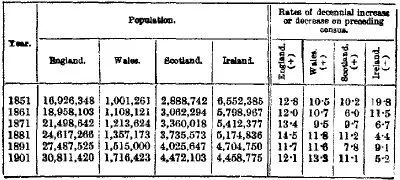
The factors in the increase of population are evidently (1) migration, (2) the “natural increase” of population, i.e. the excess of births over deaths. The annual natural increase has fallen in England and Wales from 14.5 per 1000 of the population for the period 1876–1880, to 12.1 in 1901–1905, in consequence of the fact that though the death-rate fell from 20.8 to 16 per thousand, the birth-rate fell from 35.3 to 28.1. The birth-rate in England and Wales, for the period since the Civil Registration Act of 1837, reached its maximum in the period 1870–1876, and has since shown a material decline.
The extent of this decline is shown in the next table:
| Period. | Average Annual Crude Birth-rate per 1000 of Total Population. |
Average Annual Corrected Birth-rate per 1000 of Female Population aged 15–45 years. |
|---|---|---|
| 1876–1880.... | 35.3 | 153.3 |
| 1881–1885.... | 33.5 | 144.3 |
| 1886–1890.... | 31.4 | 133.4 |
| 1891–1895.... | 30.5 | 126.8 |
| 1896–1900.... | 29.3 | 118.8 |
| 1901–1905.... | 28.1 | 112.5 |
| 1906...... | 27.1 | 108.3 |
| 1907...... | 26.3 | 105.1 |
As regards the decline in the birth-rate generally, the Registrar-General observes:
“There are sufficient grounds for stating that during the past 30 years approximately 14 per cent. of the decline in the birth-rate (based on the proportion of births to the female population aged 15–45 years) is due to the decrease in the proportion of married women in the female population of conceptive ages, and that over 7 per cent. is due to the decrease of illegitimacy. With regard to the remaining 79 per cent. of the decrease, although some of the reduced fertility may be ascribed to changes in the age constitution of married women, there can be little doubt that much of it is due to deliberate restriction of child-bearing.”
The decline in the birth-rate, whatever may be its cause, is a feature common to the birth statistics of most European countries. The statistics may be studied in the General Report on the Census of 1901, and in the Annual Reports of the Registrar-General. The figures are conveniently collected in the Blue-book, Public Health and Social Conditions, prepared by the Local Government Board (1909). The most detailed statistical analysis of the facts is to be found in a paper by Newsholme and Stevenson, and another by Yule, in the Journal of the Royal Statistical Society (March 1906).
Principles of Political Economy (Ashley edition)
Read the whole book online · Book details
Free to read online and to download from this archive.