
Chapter 15 of 17 · Study Guide of Man, Economy, and State by Robert P. Murphy
Power And Market
GOVERNMENT AND THE ECONOMY
CHAPTER 1
DEFENSE SERVICES ON THE FREE MARKET
Chapter Summary
Economists often talk of the “free market” without analyzing the nature of property rights, and in particular the legal system that would prevail in a truly free market society. Economists also typically assume that “the market” is a frail arrangement that crucially depends upon government provision of defense (broadly including military, police, and judicial services). However, if we are truly interested in studying the free market, we must suppose that even defense services are provided through voluntary exchange of justly derived property titles.
Two crucial aspects of the State are: (1) it derives funds through coercive taxation, and (2) it arrogates to itself a geographical monopoly.
One objection to market-based defense is that the State must initially define property rights, and then the market process can proceed. This is simply wrong, as legal scholars using their reason and voluntary persuasion can realize the objective properties of a free legal order. In particular, they would discover the necessity and justice of self-ownership and the homesteading principle.
A related objection is that defense is a necessary precondition of market activity, and hence the market cannot be trusted to provide it. Yet this argument would also prove that the State needs to provide food, clothing, or shelter.
A third objection is that there allegedly must be a court of final opinion. Yet the world itself has no such ultimate ruler; the minimal statists usually do not call for one world government.
A free market in defense would probably consist in protection agencies selling subscriptions and providing their services on call. Insurance companies would probably be involved, as they would stand to gain from limiting theft, property destruction, and violence to their clients. If two protection agencies had a dispute concerning interactions between their clients, they would almost certainly not resort to violence to settle the matter, as this would be expensive and would frighten off potential customers. Rather they would sign binding arbitration agreements and take their case to a third party, which would be chosen only because of past excellence and objectivity in such cases.
In a free society, the great majority of judges would unilaterally endorse the Law Code that enshrined the nonaggression axiom and spelled out its implications. The function of the judges would be to apply the Code to the specific cases brought before them voluntarily by disputants.
It is certainly possible that particular agencies might become criminal. The difference is that there would be no systematic legalized method of plunder in a libertarian society. Everyone would immediately recognize the criminal activities for what they were. In contrast, many subjects under States (especially democratic ones) view taxes as voluntary “contributions” that are agreed upon at the polls. Because of the excellent propaganda efforts of the intelligentsia, most people do not consider taxation as theft, or war as mass murder, or conscription as indentured servitude.
The notion of limited government is a contradiction. Once we abandon unbridled property rights, it is arbitrary to set limits on government.
Notable Contributions
• Although Rothbard is not the first free-market economist, nor the first advocate of the stateless society, his work represented the most mature marriage of sound economics and antistatist political theory. The earliest representative of this view is Gustav de Molinari.
Technical Matters
- The nonaggression axiom states that no individual may initiate the use of force. It is sometimes supplemented to explicitly prohibit the initiation of theft and fraud. Ultimately the axiom (upon which the libertarian Law Code would be built, according to Rothbard) means that the default position is a universal respect for everyone’s just property rights. However, once someone violates those rights, at that point it is permissible to use force against the aggressor.
- The nonaggression axiom immediately implies the “moderate” libertarian positions on drug prohibition, conscription, government schools, minimum wages, etc. Yet it also implies the “radical” abolition of all taxation and government monopoly of the courts.
- A proponent of limited government might object to Rothbard’s argument on the top of page 1055 along the following lines: “Yes, the ‘worst’ that could happen following an anarchist experiment is that the State would re-emerge, but it might be a far worse State than what we have now.”
Study Questions
- What is the “insoluble contradiction” of those who believe the State must protect property rights? (pp. 1048–49)
- Are there any historical precedents for Rothbard’s vision of private law? (p. 1051)
- Should an anarcho-capitalist be able to give a complete blueprint of a private defense industry? (p. 1051)
- Would vigilantism be allowed in Rothbard’s ideal society? (p. 1052, fn 3)
- Wouldn’t defendants be able to appeal their cases indefinitely? (p. 1053)
- Would libertarians have to use force to enshrine the Law Code? (p. 1053, fn 4)
- Do anarcho-capitalists naïvely assume that most people are basically good? (p. 1054)
- Why might it be easier to contain rogue protection agencies under anarchy, rather than an expanding State under minarchy? (pp. 1054–55)
- How do mainstream economists use the “collective goods” argument to justify the State? (p. 1055)
- What is the “inner contradiction” of limited government? (p. 1056)
CHAPTER 2
FUNDAMENTALS OF INTERVENTION
Chapter Outline
1. Types of Intervention
Intervention is the intrusion of aggressive physical force into society. The economic analysis of “private” coercion is the same as government coercion, but we focus on the latter because of its greater prevalence and number of apologists. Autistic intervention occurs when the aggressor uses force on an individual such that no one else is affected. Binary intervention occurs when the aggressor establishes a hegemonic relationship between himself and the victim. Triangular intervention occurs when the aggressor uses force to alter the relations between a pair of subjects.
2. Direct Effects of Intervention on Utility
A. Intervention and Conflict
In a free market, people only participate in an exchange if they believe they will benefit; thus the market “maximizes” ex ante utility of everyone in society. Any intervention, in contrast, increases the utility of the aggressor and necessarily reduces the utility of the affected subjects.
B. Democracy and the Voluntary
It is wrong to view State action in a democratic government as “voluntary.” At best, only the majority of voters achieve their ends via democracy. Moreover, even the winning voters may have picked the “lesser of two evils.” Note that no one uses such language in describing market purchases.
C. Utility and Resistance to Invasion
It is true that private defense agencies lower the utility experienced by an aggressor. However, the aggressor was himself interfering with the voluntary market by initiating force. It is still true that the free market (even with force-wielding defense agencies) maximizes utility for all of the noncriminals.
D. The Argument From Envy
One could object that the market does not necessarily maximize utility, because of envy. For example, it may not be true that a voluntary exchange of money for labor makes the two people better off (at least in their own ex ante estimation) and does nothing else; perhaps a third party is disappointed that he was not hired for the job. From a praxeological viewpoint, however, all we can analyze is concrete action; we cannot speculate on someone’s inner feelings. Even if someone publishes pamphlets denouncing the sale of tobacco, there is no ironclad proof that this person is not committing a practical joke.
E. Utility Ex Post
People always expect to benefit from voluntary exchanges, and in practice they usually will do so. In particular, inept businesses soon go bankrupt while entrepreneurs who make good forecasts earn profits. In contrast, in the government sector there are no mechanisms to minimize error. When a government policy fails in its stated objectives, the politicians do not necessarily suffer and the voters may not be sophisticated enough to perceive the true causes of the failure. It is ironic that advocates of democracy do not trust citizens to make personal decisions but do trust them to vote for wise politicians.
Notable Contributions
• Rothbard’s typology of intervention is original. (Much of the analysis in Power and Market was summarized in Chapter 12 of Man, Economy, and State when Rothbard learned that he would have to split up the volumes.)
Technical Matters
- Some have objected to Rothbard’s claim that the free market maximizes utility because protection agencies necessarily make criminals less happy through their protection of clients. To elaborate on Rothbard’s defense (p. 1068), consider that once someone initiates aggression, it is impossible to achieve Pareto improvements (relative to the starting point of the analysis). If just one person is willing to violate property rights, we can no longer achieve unanimity in value judgments regarding the desirability of particular actions, and economic analysis alone can say no more. However, as Rothbard points out, there is still a presumption in favor of private defense agencies, because in principle they could exist in a crime-free world, where social utility would be maximized. (This is because the defense agencies would have contractual, voluntary arrangements with their customers, and thus we would still have an unblemished free market.) In contrast, under a State even if all of the citizens respected property rights, the State itself would still be initiating aggression and hence the economist could make no welfare claims.
- Some economists have criticized Rothbard’s defense of his utility maximization claim from the “envy” objection (pp. 1068–69). For example, Bryan Caplan has argued that, were we to follow Rothbard’s logic, we also could not conclude that people signing a contract really wanted to cement a deal; perhaps the signers were merely practicing penmanship. And yet this is no contradiction on the part of Rothbard: as praxeologists, we can’t say that someone signing a contract agrees to the terms it spells out. After all, the person could be illiterate, force could have been threatened earlier, etc. (It is not praxeology that spells out the conditions for a legally enforceable contract.) What praxeology can say is that, at the moment of choice, the person thought that signing the contract would yield more utility than any rival course of action. Remember, the reason the praxeologist can also comment on coercive outcomes is that they necessarily differ from voluntary scenarios. (If they didn’t, then the aggressor wouldn’t bother threatening force.) That is why praxeologists conclude that voluntary actions increase utility while coerced ones harm at least one party. If at gunpoint two people agree to an exchange, then the praxeologist has no “ironclad proof” that they really possessed a reverse valuation for the items; Rothbard is thus not being pedantic just to rescue his welfare theory.
Study Questions
- What were Oppenheimer’s two means of satisfying wants? (pp. 1057–58)
- Why doesn’t it matter whether an intervention is “legal” or not? (p. 1057)
- On which type of intervention do most political economists focus? (pp. 1059–60)
- What is the distinction between classes and castes? (p. 1062, fn 5)
- Rothbard characterizes the State as inherently coercive, and yet he agrees with Hume that all governments rest on the consent of the governed (p. 1066, fn 9). Is this a contradiction?
- Won’t ignorant consumers make poor choices on the market? (p. 1070)
- Doesn’t advertising weaken the alleged virtues of the free market? (p. 1071)
- Can’t voters choose expert politicians in a responsible manner? (pp. 1071–72)
- Why is there no concrete test of success in government? (p. 1072)
- Why might intervention be undesirable ex post even in the eyes of its initial supporters? (p. 1073)
CHAPTER 3
TRIANGULAR INTERVENTION
Chapter Summary
Price control occurs when the intervener attempts to influence the terms on which products or services exchange. (In contrast product control is a coercive influence on the product or service itself, including the individuals who sell it.) A price control is ineffective if its penalties do not apply because the market price falls within the legally permissible range. The rest of the analysis assumes an effective price control.
A maximum price control occurs when the intervener threatens violence against anyone caught selling a good above a particular price. The immediate effect is a shortage. “Nonprice rationing” then comes into play, including queues, favoritism for certain customers, and discrimination against unpopular groups.
A minimum price control threatens violence to prevent sales of a good or service below a particular price. This leads to a surplus. An example is the mass unemployment caused by minimum wage laws.
Outright prohibition leads to black markets as suppliers sell the product outside legal channels. The reduced supply leads to higher prices, but also to an inferior product as the sellers cannot resort to economies of scale and name-brand advertising.
By prohibiting sale of a good or service except for a privileged group, the government confers an artificial monopoly (or oligopoly) grant. All of the alleged effects of free market cartels and monopolies do apply to government cartels and monopolies. Following are examples of typical monopoly grants:
Compulsory cartels occur when the government forces firms in an industry to restrict output. This helps inefficient firms and hurts consumers.
Licensing is a threat of violence that limits the permissible producers to particular groups (those who have obtained the license). The ostensible purpose of most licensing is to ensure quality and safety for consumers. Even so, the intervener necessarily eliminates the option of lower-quality but cheaper services. On the free market, sellers of adulterated products could be prosecuted for fraud and/or injuring the buyer’s body.
A tariff is a tax placed on imports in a particular industry. It directly injures domestic consumers and foreign producers, and it indirectly injures domestic exporters in other industries. Immigration restrictions confer a restrictionist wage to the domestic laborers, raise prices to consumers, and distort the location of workers and capital.
Child labor laws raise wages for adult workers and reduce total output. Compulsory school attendance lowers utility even more than a mere prohibition on work.
Conscription reduces the supply of able-bodied adult laborers, distorting production and raising wages.
Government unemployment benefits slow the transferral of displaced workers to new jobs, and help mask the harmful effects of unionism and other restrictionist policies.
Antitrust laws stifle efficient mergers and penalize those firms that gain market share by satisfying customers. Conservation laws defy the time preference schedules of individuals and confer gains to particular factor owners. On a free market, owners tend to maximize the present discounted value of their assets.
Chapter Outline
1. Price Control
Price control occurs when the intervener attempts to influence the terms on which products or services exchange. (In contrast product control is a coercive influence on the product or service itself, including the individuals who sell it.) A price control is ineffective if its penalties do not apply because the market price falls within the legally permissible range. The rest of the analysis assumes an effective price control.
A maximum price control occurs when the intervener threatens violence against anyone caught selling a good above a particular price. The immediate effect is a shortage, when the quantity demanded exceeds the quantity supplied. “Nonprice rationing” then comes into play, including queues, favoritism for certain customers, and discrimination against unpopular groups. Sellers may also reduce the quality of the product, e.g., landlords who do not maintain a building because of rent controls.
A minimum price control threatens violence to prevent sales of a good or service below a particular price. This leads to a surplus, when the quantity supplied exceeds the quantity demanded. An example is the mass unemployment caused by minimum wage laws.
2. Product Control: Prohibition
Prohibition leads to black markets as suppliers sell the product outside legal channels. The reduced supply leads to higher prices, but also to an inferior product as the sellers cannot resort to economies of scale and name-brand advertising. Partial prohibitions involve prohibitions after a certain point; examples include rationing systems and maximum-hour laws.
3. Product Control: Grant of Monopolistic Privilege
By prohibiting sale of a good or service except for a privileged group, the government confers an artificial monopoly (or oligopoly) grant. All of the alleged effects of free market cartels and monopolies (that are in truth illusory) do apply to government cartels and monopolies.
A. Compulsory Cartels
In order to lower the embarrassing gluts of minimum price controls, governments will often impose maximum production quotas on an industry, i.e., will force all of the relevant firms to join a cartel. Inefficient producers benefit at the expense of their efficient competitors.
B. Licenses
A popular form of monopolistic grant is the license, in which the government threatens violence against any producer who does not first obtain the license.
C. Standards of Quality and Safety
The ostensible purpose of most licensing is to ensure quality and safety for consumers. Even so, the intervener necessarily eliminates the option of lower-quality but cheaper services. Moreover, such regulation locks in particular standards and slows improvements. On the free market, sellers of adulterated products could be prosecuted for fraud and/or injuring the buyer’s body.
D. Tariffs
A tariff is a tax placed on imports from foreign producers in a particular industry, designed to “protect” the domestic suppliers. It directly injures domestic consumers (by raising prices) and foreign producers, and it indirectly injures domestic exporters in other industries by restricting the sales of foreigners. (A country ultimately pays for its imports with exports, and thus to restrict another country’s exports will reduce its demand for one’s own exported products.)
E. Immigration Restrictions
Restrictions on foreign workers confer a restrictionist wage to the domestic laborers. Such restrictions distort the location of workers and capital (investors will export more capital because of the artificially high domestic wages) and raise prices for consumers.
F. Child Labor Laws
Child labor laws raise wages for adult workers and reduce total output. Compulsory school attendance is an even worse means of eliminating child labor, as it not only prevents children from working but also compels them to participate in a specific alternate activity.
G. Conscription
The draft reduces the supply of able-bodied adult laborers, distorting production and raising wages. It also allows the government to field an army for a lower monetary expenditure than would be necessary to raise a volunteer army of comparable size.
H. Minimum Wage Laws and Compulsory Unionism
To the extent that government measures (such as the Wagner-Taft-Hartley Act) allow unions greater scope to coercively restrict the labor supply, they raise wages for the privileged workers and reduce them for the non-members.
I. Subsidies to Unemployment
Government unemployment benefits slow the transferal of displaced workers to new jobs, and help mask the harmful effects of unionism and other restrictionist policies.
J. Penalties on Market Forms
Arbitrary penalties on specific organizations harm efficient producers. Examples include taxes on chain stores, laws limiting hours of business operation, outlawing of pushcart peddlers, and corporate income taxes.
K. Antitrust Laws
As the only sensible criterion of trust or monopoly is a legal privilege conferred by government, the antitrust laws are necessarily vague. They stifle efficient mergers and penalize those firms that gain market share by satisfying customers.
L. Outlawing Basing-Point Pricing
On the free market, one price will prevail at the point of consumption, but producers may charge different prices “at the mill” (because of different costs of transportation) in order to remain competitive. Government rulings that this constitutes “price-fixing” distort the location of production centers and thus hamper efficiency.
M. Conservation Laws
Government measures designed to preserve nonrenewable resources defy the time preference schedules of individuals and confer gains to particular factor owners.
Whenever a unit of such a resource is consumed, it will be in the “present.” Why then should future generations receive special consideration, especially since they will be wealthier than the present generation? Conservation laws do not provide more for the future, but at best only provide more natural resources at the expense of capital goods.
Private owners tend to maximize the present discounted value of their assets. Conservation laws would only make sense if government bureaucrats were better at forecasting future uses for resources than businesspeople were.
N. Patents
A patent is a monopoly privilege granted to first discoverers of certain inventions. Far from being a legitimate form of property right, a patent is a restriction on the ability of others to use their property. The utilitarian argument for patents—that they are necessary to stimulate the “proper” amount of research and development— relies on an arbitrary value judgment that the free market level of research would be “too low.” Patents do not in fact encourage innovation per se, but rather distort the relative amounts of innovation in patentable and nonpatentable fields.
O. Franchises and “Public Utilities”
Franchises (in this context) are grants to use government streets. If they are restrictive, they are grants of monopoly. However, the issue is complicated by the fact that governments (illegitimately) own the streets and therefore must make some decision over usage.
P. The Right of Eminent Domain
The right of eminent domain allows a privileged group to compel the sale of property (generally land). For example, a railroad may be allowed to force homeowners to sell their property located in the path of a proposed new line. Eminent domain is of course a brazen violation of property rights that results in distortions in relative levels of investment.
Q. Bribery of Government Officials
Praxeologically, bribery is identical to sale of a government license to engage in a (nominally illegal) act. A defensive bribe mitigates the harm of government restrictions, while an invasive bribe is a further step away from the free market.
R. Policy Toward Monopoly
All true monopolies are conferred by government privilege and can be eliminated quite easily. Limited liability corporations do not enjoy special government privileges; on the free market investors could form such a company and any employee or customer would deal with them at his or her own risk.
APPENDIX A:
On Private Coinage
The typical justification for government control of the mint is that reliable standards are necessary in money. This argument ignores the abysmal record of government debasement, and it also proves far too much: Exact standards are necessary for machine-tools, yet this does not prove the need for a nationalization of this industry. On the free market private firms could certify coins and stamp them with a name brand.
APPENDIX B:
Coercion and Lebensraum
Restrictions on trade and immigration lead to hostility between nations. If a given country is truly “overpopulated,” it is only because of government restrictions on immigration by its neighbors.
Notable Contributions
• Rothbard continues with his exhaustive classification of intervention. In this chapter he takes his original concept of a “triangular intervention” and analyzes typical government measures from this perspective.
• Rothbard’s pioneering work in monopoly theory provides the background for his treatment of government “antimonopoly” policy.
Technical Matters
- In chapter 10 of Man, Economy, and State, Rothbard exploded the mainstream theory of monopoly price. In particular, Rothbard claimed that this theory rested upon an alleged dichotomy between the “competitive” price and the “monopoly” price. Yet on a free market, there is only the free market price; there is no basis upon which one could criticize the outcome of voluntary exchanges even when there are only one or a few sellers. In contrast, when the government establishes a cartel or monopoly, then we do have a sensible benchmark, namely the “free market” price and level of output.
- A government license on a business always hampers the satisfaction of the consumers, but it may not necessarily confer a monopoly price; depending on the demand in the industry, the licensed producers may find it most profitable to expand production to offset the elimination of unlicensed producers. In contrast, licensing of labor always raises wage rates; the licensed workers (generally) cannot sell more labor hours to completely offset the elimination of the unlicensed workers (p. 1096).
Study Questions
- Why does Rothbard call the black market “the” market? (p. 1079)
- What is Rothbard’s suggested restatement of Gresham’s Law? (pp. 1080–81)
- What caused the “dollar shortage” in Europe after World War II? (p. 1082)
- Why are legal tender laws classified as price controls? (p. 1083)
- How do usury laws hurt their intended beneficiaries? (p. 1084)
- Why does prohibition hurt both parties to an exchange, whereas price control arguably helps at least one party? (p. 1086)
- If the owner of a building would be sent to jail for manslaughter, would auto producers (or owners) be jailed after every car accident in a free society? (p. 1099)
- What is the fallacy of the infant industries justification for tariffs? (pp. 1105–07)
- Why should the advocate of immigration controls also favor compulsory birth control? (p. 1111)
- Does Rothbard think that children should work instead of going to school? (pp. 1111–12)
CHAPTER 4
BINARY INTERVENTION: TAXATION
Chapter Summary
Society is composed of taxpayers and tax consumers. The tax consumers benefit from taxation while the taxpayers foot the bill. All taxation distorts resource allocation and severs “distribution” from production. The total level of taxation is far more significant than the specific forms of the tax.
Tax incidence refers to the actual long-run burden of taxation, which may differ from the immediate target. No tax can be shifted forward. (If retailers had this power, why wait for the tax?) All sales taxes are ultimately income taxes.
An income tax reduces the utility of the taxpayers, and generally provides a disincentive to earn income. Income taxes may indirectly raise time preference rates by reducing overall income. It is no more odious to impair savings than consumption.
Taxes on wages cannot be shifted to the employer. Corporate taxes are examples of “double” taxation. This encourages stockholders to leave the net income as “undistributed” earnings and hence distorts the flow of funds. A capital gain is a form of income, just as other types of profit. If we desire the (unattainable) goal of uniform taxation, one would need to correct capital gains for inflation.
Proposals to directly tax consumption merely translate to an income tax. Such a tax does not favor savings, because the point of savings is to consume in the future (when the tax will also operate).
In contrast to a tax on current savings, the charge of “double taxation” is coherent when it comes to taxes on accumulated capital. These destroy the inherited tools, equipment, etc. from the past, and thus a 20 percent tax on capital is far more destructive than a 20 percent tax on income.
The typical arguments against the progressive tax are that (1) it reduces the incentive to work, (2) it reduces savings, and (3) it is robbery of the rich by the poor. The first argument is correct, but this is also true of a proportional tax. The second argument is also correct, but those making it usually imply (with no justification) that it is somehow worse to reduce saving than to reduce consumption. The third argument is wrong: Under progressive taxation, the government robs both the rich and the poor.
The Georgist proposal to tax ground rent ignores the owners’ role in allocating land to the most value-productive users. There would indeed be no incentive to charge rents at all; this would eliminate the Georgist tax base and cause severe distortions in the allocation of scarce land.
The only objectively “just price” is the market price. Economists have generally abandoned the medieval quest for the just price, yet they cling to the notion of a just tax.
It is impossible to tax everyone uniformly. First there is the distinction between taxpayers and tax consumers; since the latter pay no taxes, clearly “uniformity” is only possible if no one pays any taxes. Second, there is the problem of defining income. For example, should it include services in kind? Should it be calculated as a yearly average?
If each taxpayer were truly taxed according to how much he or she benefited from government services, then it would be pointless to provide the services in the first place. Moreover, all bureaucrats would have to work for free.
Chapter Outline
1. Introduction: Government Revenues and Expenditures
Government derives its revenue (income) from taxation and inflation. This chapter assumes that all revenue is spent.
2. The Burdens and Benefits of Taxation and Expenditures
Society is composed of taxpayers and tax consumers. The tax consumers (politicians, bureaucrats, and subsidized citizens) benefit from taxation while the taxpayers foot the bill, though the exact effects are difficult to trace. All government spending is consumption (not investment). All taxation distorts resource allocation and severs “distribution” from production (whereas there is no such distinction in a market). The total level of taxation is far more significant than the specific forms of the tax.
3. The Incidence and Effects of Taxation
Part I: Taxes on Incomes
A. The General Sales Tax and the Laws of Incidence
Tax incidence refers to the actual long-run burden of taxation, which may differ from the immediate target. Contrary to popular and even mainstream economics belief, no tax can be shifted forward. Even in the “obvious” case of a general sales tax, it is not true that the retailers can “pass on” the tax in the form of higher prices. (If they had this power, why wait for the tax?) They stay in business by shifting the tax backward to the factor owners. Thus all sales taxes are ultimately income taxes.
B. Partial Excise Taxes; Other Production Taxes
An excise tax distorts resource allocation (as all taxes do) by shifting demand from consumers to politicians, but also because it only applies to particular goods. Excise taxes too are ultimately taxes on income, not just consumption.
C. General Effects of Income Taxation
Because sales and other taxes are ultimately taxes on income, this section is not confined to the “official” income tax. An income tax naturally reduces the utility of the taxpayers, and generally provides a disincentive to earn income. (Even if someone ends up working greater hours to offset the tax, this still represents a loss of utility.) Income taxes may indirectly raise time preference rates by reducing overall income. They also encourage unofficial work, e.g., “do it yourself” projects, and hence impair the division of labor. Contrary to many “right wing” economists, it is no more odious to impair savings than consumption.
D. Particular Forms of Income Taxation
(1) Taxes on Wages
Taxes on wages cannot be shifted to the employer. In fact, the opposite is true. The employer contribution for Social Security is ultimately deducted from the employee’s wage.
(2) Corporate Income Taxation
Corporate taxes are examples of “double” taxation. This encourages stockholders to leave the net income as “undistributed” earnings and hence distorts the flow of funds.
(3) “Excess” Profit Taxation
This is a direct penalty on successful entrepreneurship.
(4) The Capital Gains Problem
A capital gain is a form of income, just as other types of profit. If we desire the (unattainable) goal of uniform taxation, one would need to correct capital gains for inflation.
(5) Is a Tax on Consumption Possible?
Proposals (such as Irving Fisher’s) to directly tax consumption merely translate to an income tax (albeit at a lower rate). Such a tax does not favor savings, because the point of savings is to consume in the future (when the tax will also operate). (This conclusion only holds if we rule out dishoarding or dissaving.)
4. The Incidence and Effects of Taxation
Part II: Taxes on Accumulated Capital
In contrast to a tax on current savings, the charge of “double taxation” is coherent when it comes to taxes on accumulated capital. These destroy the inherited tools, equipment, etc. from the past, and thus a 20 percent tax on capital is far more destructive than a 20 percent tax on income.
A. Taxation on Gratuitous Transfers: Bequests and Gifts
Gifts are transfers, rather than payment for production. Consequently taxes on gifts are taxes on capital. These taxes weaken private charity and family ties.
B. Property Taxation
Property taxes must rely on assessed values which can’t be known outside of market sales. They also penalize property under debt because of “double taxation.” Taxes on rents are capitalized in the sale price of assets and do not fall on future buyers.
C. A Tax on Individual Wealth
Although no one proposes it, we can analyze the effects of a hypothetical tax on individual wealth. Like an income tax, it could not be shifted. Unlike a tax on property, it could not be capitalized and hence the market could not “contain” its harmful effects after the initial shock.
5. The Incidence and Effects of Taxation
Part III: The Progressive Tax
The typical arguments against the progressive tax are that (1) it reduces the incentive to work, (2) it reduces savings, and (3) it is robbery of the rich by the poor. The first argument is correct, but this is also true of a proportional tax. The second argument is also correct, but those making it usually imply (with no justification) that it is somehow worse to reduce saving than to reduce consumption. The third argument is wrong: Under progressive taxation, the government robs both the rich and the poor.
6. The Incidence and Effects of Taxation
Part IV: The “Single Tax” on Ground Rent
The Georgist proposal to tax ground rent is severely flawed. The taxing agency must make estimates of ground rent, and moreover determine how much of gross rent is really the return to the land, and how much reflects interest and wages. (These returns are jumbled in the real world whenever original land has been augmented.) The Georgist theory ignores the role of time, and hence misunderstands cases of idle land with a positive capital value. If ground rents were fully taxed, then owners would cease performing their vital role of allocating land to the most value-productive users. There would indeed be no incentive to charge rents at all; this would eliminate the Georgist tax base and cause severe distortions in the allocation of scarce land.
7. Canons of “Justice” in Taxation
A. The Just Tax and the Just Price
The only objectively “just price” is the market price. Economists have generally abandoned the medieval quest for the just price, yet they cling to the notion of a just tax. Adam Smith advanced four criteria of justice in taxation that are analyzed below.
B. Costs of Collection, Convenience, and Certainty
It is not at all obvious that a given tax should be administered with the least possible cost; a costly tax may be implemented less vigorously. It is also possible that an inconvenient tax may be beneficial by encouraging the taxpayers to protest. It is also arguable that if a tax is uncertain that the taxpayer benefits, because now he or she has “wiggle room” when it comes to assessing total tax liability.
C. Distribution of the Tax Burden
There are various proposals for “justice” in distributing the tax burden:
(1) Uniformity of Treatment
(a) Equality before the law: tax exemption
Equality of treatment is not a virtue if the “treatment” is itself unjust! For example, if someone proposes to enslave others, it is much better that he ensnares only a few rather than enslaving everyone equally. Exemptions are not at all subsidies, because the government is not the rightful owner of one’s money. They are not really “loopholes” but rather just the law.
(b) The impossibility of uniformity
It is impossible to tax everyone uniformly. First there is the distinction between taxpayers and tax consumers; since the latter pay no taxes, clearly “uniformity” is only possible if no one pays any taxes. Second, there is the problem of defining income. For example, should it include services in kind? Should it be calculated as a yearly average?
(2) The “Ability-to-Pay” Principle
(a) The ambiguity of the concept
There are many plausible approaches to defining one’s “ability to pay” a tax; this underscores the arbitrariness of the concept.
(b) The justice of the standard
It is impossible to justify the “ability to pay” principle; it has been taken as self-evident. On the market, such a principle would lead to disaster.
(3) Sacrifice Theory
Some economists have attempted to justify progressive taxation on the basis of declining marginal utility of money, but this relies on nonsensical interpersonal utility comparisons.
(4) The Benefit Principle
Some economists conflate the benefit and cost principle when they justify proportional taxation on the grounds that the rich benefit more from government protection than the poor. Yet this assumes that the government somehow helped them earn their incomes. On its own terms, the benefit principle is nonsense: If each taxpayer were truly taxed according to how much he or she benefited from government services, then it would be pointless to provide the services in the first place. Moreover, all bureaucrats would have to work for free.
(5) The Equal Tax and the Cost Principle
In many respects a uniform head tax on all citizens would be more neutral than other proposals, but it too would require bureaucrats to work for free. It would deviate from a market price in that some people use more government services than others, yet would pay the same “price.” The cost principle is flawed because government costs are higher than private analogs and there is no guarantee that a government agency’s budget correlates to the benefits received by citizens.
(6) Taxation “For Revenue Only”
This slogan is silly since all taxes are “for revenue.” The government can implement all sorts of “social engineering” through the expenditure side.
(7) The Neutral Tax: A Summary
The quest for a neutral tax, i.e., one that does not distort the outcomes that would occur in a free market, is hopeless.
D. Voluntary Contributions to Government
Even if taxpayers made voluntary contributions to pay for government activities, there would still be no direct link between payment and service. Such a system would not be truly voluntary because of government prohibition on competitors. If competing legal and defense firms were permitted, then we would have a free market.
Notable Contributions
• As Rothbard notes (p. 1160), his analysis of tax incidence—and in particular the conclusion that taxes can’t be shifted forward—follows from the Austrian understanding of causality in market prices. Both the neoclassical and Austrian would agree that the equilibrium price of a radio could be higher after the imposition of a tax on sellers, and that (in a sense) consumers are bearing some of the tax burden. However, Rothbard emphasizes that the price rise is not “caused” by the tax, but rather the tax puts marginal sellers out of business, and then the marginal utility of the smaller supply of radios allows sellers to charge a higher price. The typical treatment of tax incidence subtly relies on a cost theory of prices.
Technical Matters
- The issue of “double taxation” can be confusing. Many economists argue that the income tax favors consumption and penalizes saving, because (say) if there is a ten percent income tax and Smith buys a savings bond, then Smith is first taxed on the income which he uses to buy the bond, and then Smith is taxed a second time when the bond matures and he is paid its face value. Reading Rothbard’s critique (p. 1169) of Fisher and others—“There is therefore no reason here to say that an income tax especially penalizes savings-investment”—one might conclude that Rothbard rejects such an analysis. However, Rothbard later on (pp. 1169–70) does indeed admit that an income tax reduces the net interest rate earned on an investment, and to that extent it penalizes saving. The (suggested) resolution to this apparent contradiction is that Rothbard is taking Fisher et al. to be arguing (in our example) that a 10 percent income tax penalizes present consumption of $100 by $10, while it penalizes present savings of $100 by more than $10, since the $100 investment will yield more than $100 of income in the future. It is this particular type of argument that Rothbard rejects. (If this is indeed their argument, then a slightly different way to expose the fallacy is to point out that the “higher” absolute amount of taxation in the future must be converted to present dollars when deciding whether to consume or invest the $100 today. Thus the rate of return completely drops out of the analysis when assessing the tax’s impact on present versus future consumption in this respect.)
- In footnote 11 (p. 1157), Rothbard erroneously says that a tax on income causes a “rise in the opportunity cost of leisure,” but it actually causes a fall, i.e., leisure becomes cheaper and thus people consume more of it. In footnote 36 (p. 1187), the final equation should be C=R/(i+t). (In other words, Rothbard should have added parentheses for clarity.)
Study Questions
- If tax consumers don’t really pay taxes, is it also true that (say) Ford executives don’t really pay for pickup trucks? (p. 1151, fn 3)
- Why don’t politicians keep all tax revenues for themselves? (p. 1152)
- Rothbard says (p. 1158) that a sales tax cannot be shifted forward because businesses don’t need a tax to raise prices (if that were really more profitable). But doesn’t this also prove that a sales tax can’t be shifted backward? (p. 1159) If businesses could get away with cutting wages, why wait for the sales tax?
- If government officials happen to have lower time preferences than the society at large, couldn’t an income tax increase savings? (pp. 1166–68)
- Rothbard argues that taxes on current saving and investment are not really cases of “double taxation,” whereas matters are different with taxes on capital accumulated in the past. Does this only apply to unanticipated, new taxes on capital, i.e., what if our forefathers knew their bequeathed capital stock would be taxed? Would this then constitute “single taxation”? (p. 1184)
- Would a reduction in property taxes be a subsidy to landowners? (pp. 1188–89)
- What is the tax illusion of the Chicago economists? (p. 1196)
- What is the “land question,” and how does the free market solve it? (p. 1209)
- When are land speculators truly the bad guys? (pp. 1210–11)
- Following the argument of footnote 58 (p. 1213), could someone legally get away with murder in a libertarian world, so long as he took care to wipe out his victim’s entire family?
CHAPTER 5
BINARY INTERVENTION: GOVERNMENT EXPENDITURES
Chapter Summary
There has been little economic analysis of government expenditure. Although in the real world the two are always mixed, we may conceptually distinguish between pure transfers and resource-using expenditures.
All subsidies transfer income from the efficient to the inefficient and distort resource allocation. They lower overall production by (1) diverting energies into “rent seeking” and (2) lowering the incentives to produce.
Government agents spend funds in order to achieve their ends, and hence all government spending is consumption, not investment. No government service can be “free” because of the scarce resources involved, but by charging low (or zero) prices, the government causes shortages and conflict. It is vain for the government to run an enterprise “on a business basis,” for the government enterprise raises its funds through coercion.
Socialism refers to government ownership of the “means of production.” The U.S. is more socialistic than generally believed, because of government loans (or guarantees) to business. The U.S.S.R. was less socialistic than generally believed because it relied on market prices from abroad and black markets internally.
Ownership is the ultimate control and direction of a resource. The public cannot “own” a park or a school building. Even government officials do not truly own resources at State disposal, because they enjoy only temporary control. In contrast to popular belief, politicians are inherently shortsighted and tend to use resources too quickly. Private owners, on the other hand, can always sell their property for its capitalized value, and thus will exploit it at the optimal rate.
Democracy refers to majority rule, but in the “classical” sense it means majority decision on policies, whereas in the “modern” sense it usually means majority decision on rulers (“representatives”) who then decide on actual policies.
The principle of democracy is riddled with contradictions. Can the people vote to end a democracy (either by moving to dictatorship or ushering in a totally free market)? “Democratic socialism” is infeasible, because the government ultimately decides on how many resources go to various propaganda efforts, and can determine the occupations of the opposition leaders.
There is also the more fundamental question: Why is democracy supposed to be so good? There are countless historical examples of the public making ignorant and evil decisions. It is also far from obvious that democracy is an effective means to check the growth of State power.
Simon Kuznets originally measured the size of government production by taxes paid, operating on the analogy with consumer expenditures for a private good or service. The problem is that taxpayers do not voluntarily give their funds for such “services.” The Department of Commerce instead calculates on the basis of the total “cost” of a given program, and hence the bigger the government deficit, the more it is “serving” the community.
Chapter Outline
There has been little economic analysis of government expenditure. Although in the real world the two are always mixed, we may conceptually distinguish between pure transfers and resource-using expenditures.
1. Government Subsidies: Transfer Payments
All subsidies transfer income from the efficient to the inefficient and distort resource allocation. They lower overall production by (1) diverting energies into “rent seeking” and (2) lowering the incentives to produce.
2. Resource-Using Activities: Government Ownership versus Private Ownership
Government agents spend funds in order to achieve their ends, and hence all government spending is consumption, not investment. No government service can be “free” because of the scarce resources involved, but by charging low (or zero) prices, the government causes shortages and conflict.
It is vain for the government to run an enterprise “on a business basis,” for the government enterprise raises its funds through coercion. Not only does this distort the incentives, it also makes it impossible for the State personnel to serve the desires of their “customers.” Even if a State enterprise allows competition, and buys factors and sells output in an open market, its initial capital was raised by coercion and hence gives it an unwarranted advantage. Finally, if someone really wants the enterprise to be run “on a business basis,” then he should favor complete privatization!
3. Resource-Using Activities: Socialism
Socialism refers to government ownership of the “means of production.” The particular form of government (democracy, monarchy, etc.) and the particular ideology (fascist, communist, etc.) are irrelevant to the economic analysis of socialism. The U.S. is more socialistic than generally believed, because of government loans (or guarantees) to business. The U.S.S.R. was less socialistic than generally believed because it relied on market prices from abroad and black markets internally.
4. The Myth of “Public” Ownership
Ownership is the ultimate control and direction of a resource. The public cannot “own” a park or a school building; the citizen who believes otherwise should try setting policies or selling his aliquot ownership share.
Even government officials do not truly own resources at State disposal, because they enjoy only temporary control. In contrast to popular belief, politicians are inherently shortsighted and tend to use resources too quickly. Private owners, on the other hand, can always sell their property for its capitalized value, and thus will exploit it at the optimal rate.
5. Democracy
Democracy refers to majority rule, but in the “classical” sense it means majority decision on policies, whereas in the “modern” sense it usually means majority decision on rulers (“representatives”) who then decide on actual policies. Although in principle democratic governments can be more or less laissez-faire, economics does have something to say about institutional biases.
The principle of democracy is riddled with contradictions. Can the people vote to end a democracy (either by moving to dictatorship or ushering in a totally free market)? “Democratic socialism” is infeasible, because the government ultimately decides on how many resources go to various propaganda efforts, and can determine the occupations of the opposition leaders.
The implementation of democracy is also riddled with problems. In a representative government, the delimitation of voting districts is completely arbitrary. National government and democracy are likewise inconsistent, because the only nonarbitrary pool of voters is the world population.
Besides these practical questions, there is the more fundamental one: Why is democracy supposed to be so good? There are countless historical examples of the public making ignorant and evil decisions. It is also far from obvious that democracy is an effective means to check the growth of State power.
APPENDIX:
The Role of Government Expenditures in National Product Statistics
Simon Kuznets originally measured the size of government production by taxes paid, operating on the analogy with consumer expenditures for a private good or service. The problem is that taxpayers do not voluntarily give their funds for such “services.” The Department of Commerce instead calculates on the basis of the total “cost” of a given program, and hence the bigger the government deficit, the more it is “serving” the community. For a more accurate approach, economists ought to first calculate Net National Product and then subtract either total government taxes or expenditures, whichever is higher.
Notable Contributions
• Rothbard’s rejection of the Keynesian concept of government “investment” (p. 1259) relies on a praxeological understanding of means and ends.
• Rothbard advances many novel objections to democracy (pp. 1279–91), most of which would be dismissed as unworthy of response by “serious” scholars because they are so fundamental.
Technical Matters
- The “ballots instead of bullets” justification for democracy (p. 1287) was one held by Mises, and relies on the insight of David Hume that all governments ultimately rest on the consent of the governed. Since the majority will ultimately achieve its desired government through revolution if necessary, Mises argued that periodic elections are essential to preserve the peace. (There is thus no presumption here that the majority of voters are likely to make wise decisions.) Rothbard’s somewhat facetious analysis (pp. 1287–91) is simply taking this justification at face value. In other words, Rothbard is questioning whether democratic elections really do give us “what would have happened anyway,” without the need for bloodshed.
- By saying that the Commerce Department uses the “cost” of a government program as a proxy for level of output, Rothbard simply means that they use expenditure (rather than Kuznet’s taxation) as the measure. This too is vitiated because of the failure to link consumers with payment. On the market, a firm’s expenditures on resources are not related to the satisfaction of consumers if the firm is suffering a loss.
Study Questions
- If government relief encourages poverty, why wouldn’t private charity do the same? (pp. 1257–58)
- If a politician gives a subsidy to a firm as a means to achieve a consulting position in four years, would that be investment from a praxeological viewpoint? (p. 1259)
- Why can’t government enterprises use the rule of marginal cost pricing to guide their decisions? (p. 1267)
- What are the “command posts” controlled by the State? (p. 1270)
- There are many suggestions for how private owners could, say, maintain adequate stocks of fish in lakes. Why can’t the government just take those ideas and implement them? (p. 1278)
- Why is “direct democracy” once again feasible? (p. 1284)
- Why does Rothbard argue that a consistent democrat should favor supremacy of the executive? (p. 1285)
- Couldn’t the defender of representative democracy claim that voters are ignorant on the issues but can choose wise leaders? (pp. 1285–86)
- Why can’t government statistics test economic theory? (p. 1292)
- Why does Rothbard include transfer payments in his deduction from NNP? (pp. 1294–95)
CHAPTER 6
ANTIMARKET ETHICS: A PRAXEOLOGICAL CRITIQUE
Chapter Summary
Praxeology is a value-free science; economics alone cannot imply value judgments. However, praxeology can demonstrate that certain ethical values either (1) rely on false propositions concerning cause and effect or (2) are conceptually impossible of fulfillment.
If we can demonstrate that X is an impossible and hence absurd goal, then it follows that any attempts to move toward X are likewise absurd, because the means derive their justification (value) from the sought end.
The advocate of laissez-faire does not assume that all people always act in their interest; it asserts rather “that everyone should have the right to be free to pursue his own interest as he deems best.” Once one admits that consumers’ preferences may be overridden due to immoral tastes, there is no limit to government control of “evil” or “dangerous” books, newspapers, etc. It is entirely useless to use force to (attempt to) achieve moral behavior, because without an uncoerced choice people cannot be moral.
Another straw man critique assumes that the market would work only if men were angels. On the contrary, regardless of one’s views concerning human nature, the market—which penalizes evil and rewards good—is far preferable to the government, which promotes those individuals most adept at wielding coercion.
Considering the diversity of human skills and their different locations in time and space, “equality” is an obviously nonsensical goal. Beyond that, it is not clear why intellectuals, who ostensibly favor the autonomy and full development of the individual, would at the same time champion equality.
The alleged tradeoff between freedom and security is a false one. The future is uncertain and hence absolute security is impossible. However, the free market provides security through savings, entrepreneurship, insurance, and charity.
It is a myth that medieval craftsmen and peasants were perfectly happy, until modern capitalism “alienated” them from their labor. The status society forced workers to remain in very specific occupations, regardless of aptitude or interest.
The market doesn’t deal in “material” goods so much as exchangeable goods (and services). To the extent that the market provides ever greater quantities of exchangeable goods, it lowers their marginal utilities and hence raises the relative importance of nonexchangeable goods.
Many allege that the unregulated market would implement Social Darwinism in which the strong destroyed the weak. Yet this biological analogy overlooks the criterion of “fitness” in a marketplace: serving the wishes of the consumers.
References to “robber barons” and “economic royalists” are inappropriate. The market economy is a positive sum game, in which there is a harmony of interests. As man’s power over nature grows, civilization develops. Yet a rise in one man’s power over another man retards growth and represents a net loss.
It is pointless to argue that “human rights” should trump property rights, for all rights are ultimately property rights. Moreover, they are property rights of humans.
Chapter Outline
1. Introduction: Praxeological Criticism of Ethics
Praxeology is a value-free science; economics alone cannot imply value judgments. However, praxeology can demonstrate that certain ethical values either (1) rely on false propositions concerning cause and effect or (2) are conceptually impossible of fulfillment. Thus praxeology cannot indicate the correct value judgments, but it can “veto” absurd ones.
If we can demonstrate that X is an impossible and hence absurd goal, then it follows that any attempts to move toward X are likewise absurd, because the means derive their justification (value) from the sought end.
2. Knowledge of Self-Interest: An Alleged Critical Assumption
The advocate of laissez-faire does not, contrary to popular belief, assume or require that all or even most people always act in their interest; it asserts rather “that everyone should have the right to be free to pursue his own interest as he deems best.” The consumers are admittedly not experts in all fields, but they can always hire experts to advise them. And if they are too ignorant to do so successfully, how then can they vote for wise politicians to choose for them?
3. The Problem of Immoral Choices
Once one admits that consumers’ preferences may be overridden due to immoral tastes, there is no limit to government control of “evil” or “dangerous” books, newspapers, etc. It is entirely useless to use force to (attempt to) achieve moral behavior, because without an uncoerced choice people cannot be moral.
4. The Morality of Human Nature
Another straw man critique assumes that the market would work only if men were angels. On the contrary, regardless of one’s views concerning human nature, the market—which penalizes evil and rewards good—is far preferable to the government, which promotes those individuals most adept at wielding coercion.
5. The Impossibility of Equality
Considering the diversity of human skills and their different locations in time and space, “equality” is an obviously nonsensical goal. Beyond that, it is not clear why intellectuals, who ostensibly favor the autonomy and full development of the individual, would at the same time champion equality.
6. The Problem of Security
The alleged tradeoff between freedom and security is a false one. The future is uncertain and hence absolute security is impossible. However, the free market provides security through savings, entrepreneurship, insurance, and charity.
7. Alleged Joys of the Society of Status
It is a myth that medieval craftsmen and peasants were perfectly happy, until modern capitalism “alienated” them from their labor. The status society forced workers to remain in very specific occupations, regardless of aptitude or interest. In any event, a return to the institutions of the Middle Ages would require the starvation of a large portion of the world’s present population.
8. Charity and Poverty
Before charity can occur, prior production is necessary. The unhampered market is far more productive than any rival system and hence can create the most goods for everyone. It is also not truly “charity” to take property and distribute it to others at gunpoint. The government has no interest in solving the problems of those who (allegedly) need its help, but prefers that they remain indefinitely dependent.
9. The Charge of “Selfish Materialism”
Another typical objection is that the market, though it may be very productive, causes people to focus on material ends, rather than spiritual concerns. This criticism relies on the empty notion of an “economic” end. Yet economy is simply the application of means to achieve desired ends; there are no separate “economic” ends to be contrasted with idealistic or spiritual ends.
Even if we believe people should adopt altruistic ends, it still does not follow that the market is objectionable. Indeed, someone who seeks maximum monetary income is precisely the person catering to the wishes of others (the consumers)! In contrast, if someone forgoes a high-paying job in order to work in a more pleasant environment, this worker is selfishly placing his utility above the desires of others.
The market doesn’t deal in “material” goods so much as exchangeable goods (and services). To the extent that the market provides ever greater quantities of exchangeable goods, it lowers their marginal utilities and hence raises the relative importance of nonexchangeable goods.
10. Back to the Jungle?
Many allege that the unregulated market would implement Social Darwinism in which the strong destroyed the weak. Yet this biological analogy overlooks the criterion of “fitness” in a marketplace: serving the wishes of the consumers. Those who feel the market has been too harsh with particular people are free to set up assistance programs.
11. Power and Coercion
A. “Other Forms of Coercion”: Economic Power
Those who claim that government must counterbalance private economic power (such as that wielded by an employer) mischaracterize the situation. If an employer refuses to hire a worker, he is merely exercising his property right; i.e., he is simply refraining from exchanging his money for the worker’s labor services. If the government can justly use violence to compel an exchange, then the individual worker would likewise be entitled to take the employer’s money through force.
B. Power Over Nature and Power Over Man
References to “robber barons” and “economic royalists” are inappropriate. The market economy is a positive sum game, in which there is a harmony of interests. As man’s power over nature grows, civilization develops. Yet a rise in one man’s power over another man retards growth and represents a net loss.
12. The Problem of Luck
It is true that the uncertainty of the future allows some to prosper and others to suffer through “luck.” However, this alone does not prove that market outcomes are unfair. After all, it is possible that all of the rich are actually earning less than their true DMVPs, while all of the poor are currently enjoying excellent luck and really would be paid much less if entrepreneurs had correctly forecasted the future.
13. The Traffic-Manager Analogy
In a free society all roads would be privately owned, and the profit-maximizing rules would be established on them. It is a complete non sequitur to argue that the need for traffic regulations somehow proves the necessity of government.
14. Over- and Underdevelopment
The critics contradict themselves when it comes to “backward” countries. On the one hand, they say that advanced economies are now so complex that they require planning. On the other hand, they maintain that underdeveloped nations need the guiding hand of the State in order to catch up to the West.
15. The State and the Nature of Man
It is common to observe that man is a social animal and hence requires a government. Yet this conflates society with the State. If private legal and police services are indeed feasible, then society can flourish without coercive government.
16. Human Rights and Property Rights
It is pointless to argue that “human rights” should trump property rights, for all rights are ultimately property rights. Moreover, they are property rights of humans. (If a man has a property right in a chair, it is not the chair that possesses the right, but the human being.)
The classic examples of crying fire in a public theater etc. can all be resolved by a specification of property rights. There is no need to weigh one abstract right against another; it is all a matter of contracts.
APPENDIX:
Professor Oliver on Socioeconomic Goals
A. The Attack on Natural Liberty
Oliver rightly criticizes watered-down versions of laissez-faire, but he fails to seriously consider the Rothbardian position. Many of Oliver’s alleged inconsistencies in the doctrine are due to his straw man construction.
B. The Attack on Freedom of Contract
Oliver again dismisses the radical position of unfettered freedom of contract, and focuses his attacks on versions that are either patently silly or are marred by unnecessary and confusing caveats. Rothbard provides a sound formulation of freedom-of-contract that deals with Oliver’s concerns and is fully consistent with unbridled laissez-faire.
C. The Attack on Income According to Earnings
Oliver wrongly states the position he wishes to attack as, “A man acquires a right to income which he himself creates.” Rothbard offers a better formulation as, “A man acquires a right to the property that he himself creates.” Oliver goes on to question marginal productivity theory, but this is entirely irrelevant to the ethical problem of property rights: When a capitalist employer hires someone’s labor, the employer is the just owner of the resulting product.
Notable Contributions
• Beyond using value-free economics to rule out ethical goals that rest upon false beliefs concerning a market economy, Rothbard explicitly relies on praxeology (p. 1298) when explaining why movements toward an impossible goal are also objectionable. Although most people would likely agree with this position, it would be hard to justify (to those for whom it was not self-evident) without the praxeological argument.
• Rothbard’s defense of market “monopoly” in the case of Crusoe and Friday (p. 1299) is particularly clever.
Technical Matters
- By an “existential criticism” (e.g., p. 1298), Rothbard means a criticism that involves a value judgment, but also relies on beliefs about how the world works. Thus if someone criticizes the free market because it leads to famine, this involves the value judgment that “starvation is bad.” However, there is no need to argue over ethics, because praxeology demonstrates that the free market does not lead to famine.
- When Rothbard criticizes utilitarianism (p. 1304), he does not necessarily mean the doctrine of Jeremy Bentham, but rather has in mind a consequentalist ethics of the type espoused by Ludwig von Mises. In this conception, ultimate value judgments really are “arbitrary” in the sense that no one could possibly prove them to be correct or incorrect. However, Mises thought that (coupled with praxeology and other value-free sciences) rational individuals would realize that their (admittedly subjective) goals would best be satisfied by obeying the standard tenets of morality. For example, to the extent that the vast majority prefer wealth to poverty, health to sickness, and so on, then they would understand that they had to refrain from murder and theft.
- When Rothbard declares, “There is but one way that morality can spread from the enlightened to the unenlightened—and that is by rational persuasion” (p. 1305), he is not advocating pacifism. He would think it perfectly acceptable for a private agency to use force, say, to stop a man from killing his neighbor. However, the point of such force would not be to create a moral man, but rather to prevent a crime.
Study Questions
- Does Rothbard think the end justifies the means? (p. 1298)
- Name three typical objections to the market, and give Rothbard’s responses (pp. 1299–1300).
- Why does Rothbard say that “each man should have X” is a much clearer rule than “all men should be equal in X”? (p. 1312)
- What was Clara Dixon Davidson’s observation on Herbert Spencer’s famous Law of Equal Freedom? (p. 1312, fn 13)
- Rothbard claims (p. 1324) that the market’s increased output of exchangeable goods would foster the opposite of “material” values. Give an example.
- Explain Nock’s distinction between social and State power (pp. 1331–32).
- How does gambling fit into Rothbard’s discussion of luck? (pp. 1333–34)
- In a free society, how would people settle the conflict between movie stars’ desire for privacy and the tabloid customers’ desire to see candid photos? (p. 1339)
- Oliver claims that natural rights connote a concept of property consisting in “things” rather than abstract “rights.” What is Rothbard’s response? (pp. 1342–43)
- What does Rothbard say in response to Oliver’s contention that marginal productivity cannot be applied within a corporation? (p. 1353)
CHAPTER 7
CONCLUSION: ECONOMICS AND PUBLIC PROPERTY
Chapter Outline
1. Economics: Its Nature and Its Uses
Economics is a science that provides us with true laws of cause and effect. It tells us that if we know A is true, then we conclude that B must also be true. Even though the logical implication is necessarily true (if our deductions are free of error), the conclusion B is only true when the initial assumption A is satisfied.
On an unhampered market, the economic theorist is of little use to the businessperson. However, in a regulated market, the economist can often provide insight because he understands the effects of intervention. The economist can say what will happen when the demand for butter increases, but this is of no use to the dairy farmer, who needs to know if the demand for butter will change. But such conditional laws are useful in public policy debates, because if the minimum law will change is precisely what the citizens can (indirectly) determine.
2. Implicit Moralizing: The Failures of Welfare Economics
The mainstream economist often smuggles dubious value judgments into his allegedly scientific work. Beyond this, mainstream economists often openly announce the ethical goal—such as “equality”—and then design policies to approach it. They are wrong for thinking that their role as mere advisor is still neutral, for by helping others achieve the goal, they implicitly endorse it.
3. Economics and Social Ethics
Even the Wertfrei economist can play a role in public policy questions. First, using only praxeology, he can rule out meaningless or conceptually impossible ethical goals championed by others, and he can also refute popular objections to the market that rely on false propositions. Second, the Wertfrei economist can explain all of the myriad consequences of government intervention and of complete socialism, and contrast these effects with the description of a free market economy.
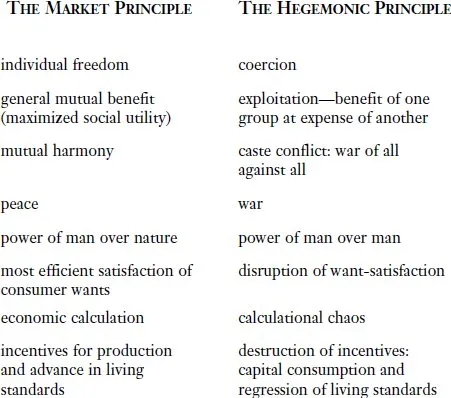
4. The Market Principle and the Hegemonic Principle
There are only two methods of social relations, the market versus the hegemonic principle. The difference can be summarized in the following table:
SOME CONSEQUENCES OF:
Notable Contributions
• Rothbard’s view (p. 1362) that the economist in a mere advisory role is implicitly endorsing the goals of his or her superiors is actually fairly unorthodox. Most economists believe that, as technicians, they can inform politicians about the likely consequences of various policies, all the while maintaining their own neutrality. However, surely Rothbard’s view is correct if we change the scenario to physicists and chemists working on horrible weapons for a totalitarian government.
• Rothbard even departs from Mises on the issue of ethical judgments. Mises generally assumed that, e.g., price controls only occurred because people falsely believed they would help the poor. Once economists had explained the true situation, Mises thought, the support for price controls would vanish. But as Rothbard points out (p. 1362), it is entirely possible that the rulers know the effects of their interventions and simply rank their own power higher on their scale of values than the welfare of their subjects.
Technical Matters
- Wertfrei was the German term Mises often used to describe economic science. It means “value-free.” This doesn’t mean that the study of economics commits one to nihilism, but rather that economics itself is a positive (versus normative) enterprise that discovers true causal relations in the world. In the same way, medicine is value-free; one must study bacteria or cancer in a neutral way to understand them. Of course the application of economic or medical science necessarily involves value judgments.
- Rothbard, unlike Mises, did not endorse Hume’s famous fact/value dichotomy, often summarized by, “You can’t derive an ought from an is.” Rothbard thought that an objective ethics was indeed possible, and that one could legitimately argue with another’s chosen values. Even so, Rothbard agrees with Mises that economics cannot do this.
Study Questions
- Give an example of a praxeological law with a conclusion that is always true, and one with a conclusion that might not be true in a particular situation (p. 1357).
- Give some examples of “implicit moralizing” in mainstream economics (pp. 1360–61).
- If the economist who advises an interventionist government is endorsing their goals (p. 1362), then would an economist who explains the effects of socialism (p. 1363) still be Wertfrei? (p. 1363)
- What are the three possible responses of the hypothetical director of the Office of Price Administration? Which of these is consistent with praxeology? (pp. 1364–65)
- If the world is a complex place, where each society has a mixture of the market and hegemonic principles, isn’t Rothbard’s table a bit simplistic? (pp. 1365–66)
- Why does the “mixed” society move toward one of the polar opposites of pure market or pure hegemony? (p. 1366)
- Is a socialist community impossible? (pp. 1366–67)
- Is a purely free economy necessarily stable? (p. 1367)
- Why is the American farm program a “classic example” of the cumulative nature of intervention? (pp. 1367–68)
- What does Proudhon mean by his maxim, “Liberty the Mother, not the Daughter, of Order”? (p. 1368)
Study Guide of Man, Economy, and State
Read the whole book online · Book details
Free to read online and to download from this archive.