
Chapter 3 of 44 · The Case for Legalizing Capitalism by Kel Kelly
Chapter 1: Labor: Workers Of The World Unite -- and Shoot Yourselves In The Foot
Labor: Workers of the World Unite — And Shoot Yourselves in the Foot
Blaming greedy companies for exploiting workers... it’s all the rage these days, and actually has been for several hundred years. Popular as well are politicians promising to resolve workers’ woes. Presidential candidates on the campaign trail in 2008 were trying to win votes by telling us how they planned to create jobs for us, and help us receive higher wages by boosting the economy. They promised to raise minimum wages and strengthen our unions. Democratic primary contenders, Barack Obama and Hillary Clinton both supported higher taxes on the wealthy with which to “pay” for lower taxes on the middle class, as Republican candidate John McCain had also once proposed. Most of our politicians support government taxpayer spending on programs that they believe will create jobs. But can the government really create jobs? Can it really help workers bring in higher wages? How does it all work?
You might think that a discussion of how workers earn wages must necessarily be dry and boring. This chapter will delve into some technical detail in the first half, but only enough to provide a framework for the following, decidedly less technical material in most of the other chapters in this book (and the book becomes more dynamic as it progresses). But understanding clearly how jobs and wages come about is crucial for comprehending how workers, economies, and standards of living improve. That process forms the very foundation of this book and of economics as a whole. Comprehending the economics of labor is important because most Marxist and Communist countries, and most left-wing ideologies in general, exist largely because of the very belief that workers are exploited by evil and greedy capitalistic companies.
This ambitious goal of the chapter — to prove that nothing could be further from the truth — will show that companies tend not only to pay workers the maximum amount they can bear, but that they are the creators of most jobs, provide the capital to improve productivity and raise real salaries, increase the quantity and quality of consumer goods, and bestow upon us a permanently higher standard of living, all while paying us in the process. At the same time, companies’ gains, though very large initially, are not as permanent as the workers’ gains. Further, this chapter will demonstrate why such a phenomenon as unemployment would never exist in a completely free market, and is in fact caused by the policies of the politicians who purport to help us workers.
What is an Economy and How Does it Work?
To understand how workers get paid, you need a basic knowledge of how an economy works. We hear a lot about the economy: that it’s strong, or it’s slowing, or that we need to improve it. We see it as a thing that we must somehow manage and grow as though it’s a wild animal. But the economy is not a thing: it is simply us and our lives. The economy embodies each of us working, producing things we all need for our lives, and exchanging these things with others who are doing the same. Whether as individuals producing, or as thousands of people grouped into a company and producing together, we all make “stuff” that businesses and individuals need, and we get compensated for the stuff we produce (and “producing” includes any of the activities that individuals and employees engage in that contribute towards creating a final product). We then exchange our stuff or our salaries for different stuff made by others. That’s an economy — it’s as simple as that.
Imagine that you are stuck on a desert island. To survive, you catch fish by hand in the ocean. Since they are fast and slippery, it’s a difficult job, taking you 12 hours to catch two fish; 6 hours per fish. You can therefore catch only two fish per day. But then you get smart: you decide to make a net. Yet making a fishing net by hand takes time, too, as it involves many steps: searching the island for raw materials like grasses and vines; finding something to serve as the handle; twining and bending strong but pliable vines or twigs into a rim to support the netting; and finally braiding and weaving vines into netting and tying it to the frame to form a sieve-like scoop. With no tools available, this process will take you five days by hand. To take five days off of fishing without going hungry, you must save some of your caught fish for a couple of days by eating only one fish per day instead of two. The saved fish will sustain you for the five days it takes to build the net, and once the net is complete, you can catch 50 fish per day.
This example introduces some basic components of an economy. You have savings (the fish you set aside to eat over the course of several days) that sustained you while you produced a capital good (the net). The capital good, which, in this case, was also a new technology, allowed you to improve your productivity (the number of fish you “produced” per day). Now that you have plenty of food to keep you from starving, you have more free time and labor available. You can use this to improve your standard of living by building a hut, a bed, clothes, and maybe even a boat. In addition to time and labor, though, you will need tools (more capital goods) with which to build these things. That means that it will take a lot of time, savings, and production of capital goods to improve your standard of living.
Now, suppose that several other people also landed on the desert island. With a division of labor, each person can focus on making the things they are best at (given what needs to be made), which increases the total amount that all islanders can produce, and each person can trade most of what they produce for the goods made by the others. Obviously, the more capital goods (e.g., knives, hammers, nails, shovels, nets, axes) that get produced, the more consumer goods (e.g., bowls, fish, beds, huts, hammocks, clothes) that can be produced in a given amount of time. With this division of labor among the castaways resulting in increased productivity, and with the existence of a capital structure, which consists of an organized collection of tools and technologies used to make things, there will be more goods produced overall in the island economy, which means higher standards of living. Obviously, part of the success of this process involves each person producing what others want or need; making something just for the sake of making it will not necessarily satisfy the needs of others in the community. This concept will be discussed in more detail throughout the book.
In this division of labor society, what each person produces becomes that individual’s purchasing power. The things people make that they don’t directly consume they can trade for other goods they need or want. In this hypothetical deserted island economy, the castaways’ amount of consumption is based on their amount of production: the value of what they produce becomes the value of the amount they can consume; and to the degree that their production adds to the supply of goods in the economy, prices (barter exchange ratios) fall in proportion, increasing their purchasing power. This notion that supply (things produced) creates its own demand (the means with which to consume) is known as Say’s Law.8
Notice specifically that what people on the island gain from producing and exchanging becomes their profit, not their wages. In this example, individual producers do not pay themselves or each other wages when they produce for themselves or when they trade for other goods. If the island’s cloth maker sells a shirt, or if the berry picker sells some berries, they are traded (they are “paid”) other goods in exchange for the full amount of their production.9
Now, back to the real world. Today’s complex, modern economy still contains the same basic functionality. In our modern, advanced economy, most of us produce a single thing — hair cutting, electrician services, sales or marketing services, etc.— and we then exchange our salary for everything else we want. We still have many individual producers such as hot dog vendors, farmers, painters, lawyers, and, of course, economists. But most production takes place in companies. The primary difference here is that in addition to profits, wages are also present. In contrast to individual production where all income consists of profit, wages appear once there is combined production (groups of people working together in companies) and individual producers within the group are paid in advance for producing an input, or an intermediate product, by businesspeople/employers/managers — that is, someone in charge of orchestrating the production of individual intermediate products to combine them into a final product. The final product is partly composed of each individual worker’s contribution; their contribution is only an intermediate step towards completion of the product (except for the product of those few workers who are involved in the very last stages of production). In combined production entities, workers have freely chosen to work for someone else in exchange for wages, instead of producing on their own for profit. They would only choose to do this if they felt they could make more income by accepting wages than in producing by themselves and earning profits.10
How We Progress as an Economy
Most of our rising standards of living can be attributed not to us single workers, but to entrepreneurs, capitalists (e.g., stock holders, bond holders, venture capitalists, individual wealthy investors) and businesspeople who create, finance, and run these companies.11 Innovative entrepreneurs seeking profits think up ingenious ideas for ways to make our lives more enjoyable or to produce things we currently produce more efficiently: mattresses, ovens, picture frames, computers, cell phones, and video games (consumer goods), or conveyer belts, nail guns, adhesive materials, and building cranes (capital goods). Individuals or other companies will buy these innovative products for the right price if they believe they will benefit from having or using them. A good idea can easily be made into a product because if the idea is potentially profitable — that is, if consumers will pay more for something than it costs to produce it — people with money to lend (capitalists) will do so in order to earn more money. Innovators/entrepreneurs will use this money to start businesses producing these products, or use part of the loaned funds to hire others who know how to do it for them.
To design, produce, market, and distribute the products, the businesspeople (once entrepreneurs begin producing they become businesspeople) hire laborers. They direct and manage the laborers, likely with the help of other managers reporting to them, who each oversee particular areas of production. When the final products are complete, the businesspeople will (hopefully) sell the products for more than the costs of production (including labor) and earn a profit.
A large profit,12 one significantly higher than the “average” profit (in percentage terms), is possible when a product is new and different, and has no competitors (think of the first personal computer, hula hoop, automobile, etc.). If a profit is very large, it is because sales revenues far exceed the total costs of producing the product. Costs consist of workers’ wages plus the cost of all the capital goods and materials (e.g., tools, machinery, building, raw materials, supplies). This large profit generally makes the entrepreneurs and capitalists who provided the funding for the ventures very wealthy. If a businessman was hired to run the company by the entrepreneur, that person most likely received a salary, but could also have shared in some of the profits. These high profits should be celebrated and seen as a good thing — after all, they signify the creation of something that customers desired so much that they preferred to have the product than their money — but in fact profits are generally frowned upon in our socialist-oriented society as evidence of greed and selfishness. But fret not, socialist friends, there is good news: these often-called “obscene” profits will not last long.
Large profits are fleeting because of the economy’s tendency to shift toward a uniform rate of profit throughout the economic system. The steps involved are simple and logical: (1) capitalists flock toward those products or industries where they see or anticipate the greatest percentage profits; (2) more capitalists in one product or industry means more money invested there; (3) increased investment creates a corresponding increase in demand for labor and the capital goods required for production; (4a) increased demand for labor and capital goods drives up the costs of labor and capital goods and simultaneously (4b) increased production and supply drives down the selling price of the products; thus (5) higher costs and lower selling prices mean lower profits. The same process works in reverse: if profits are low, fewer capitalists invest, causing monetary capital (e.g., monetary savings cum financial investment) to flow elsewhere; the resulting lower production means reduced supplies, which drives up selling prices, leading to increased profits. With money constantly shifting away from areas of low profits toward areas of high profits, rates of profit tend to equalize throughout the economy. There are many things that cause profits on companies’ income statements to vary widely in different industries, but the effective rate of return on monetary capital invested tends toward equality across industries.
With the understanding of the uniformity of profit principle, we can visualize what will happen to an entrepreneur’s successful company: others will notice the high profits from the entrepreneur’s new product, and will rush to produce the same product or, even more likely, either a cheaper or an improved version of the product. We see new examples of this daily. For example, once Apple came out with its Newton hand-held device, Palm soon followed up with its Pilot, and then Nokia with the first “smart phone,” the 9000 Communicator. Soon after, there were hundreds of models of smart phones from many companies, each competing by offering additional attributes. This kind of competition leads to each new round of products delivering versions that usually improve on the previous ones, and at lower costs.
As an example of profits being competed away, take the simple ballpoint pen. It first came to market in October 1945 at a selling price of $12.50 (over $50 in today’s money), with production costs per pen of 80¢ — a 94 percent profit!13 The following October, after several competitors entered the market, ballpoint pens sold for $3.85, and the production costs averaged 30¢ per pen. By December 1946 — just a few months later — there were over 100 pen manufacturers competing, causing pen prices to fall to 99¢ by February 1947. In 1948, pens sold for 39¢, and cost 10¢ to produce. Average profits had fallen to 74 percent. Within several years, average ballpoint pen profits were reduced such that they were in line with profits in other industries, which was probably about 10 percent to 12 percent (before taxes). The fact that pens have been sold an average of 57 times per minute since 195014 reveals the dramatic increase in supply. Today, Bic®, perhaps the best known pen manufacturer, has average profits of just over 10 percent.15
Clearly, once competitors arrive, big profits disappear quickly. But even older, established companies still have some rate of profit; they still have revenues that exceed their total costs. This profit is the “standard” uniform economy-wide profit, and it is this remaining profit that is generally seen as the problem associated with “exploitation,” as famously argued by Karl Marx.16 The charge of exploitation will be addressed below.
There are only two ways for companies earning the normal rate of profit to possibly — and temporarily — achieve large or excess profits. They must either develop a new, innovative, and original product, or they must find ways to produce current products more efficiently and cheaply. The former will raise sales revenues above costs, and the latter will lower costs below sales revenues.
To be able to constantly create new products for us consumers, and to be able to continually produce them more efficiently, new and additional physical capital (i.e., capital goods), paid for by monetary capital, must be employed.17 It is this capital — which, as we saw in our deserted island economy, comes from savings (i.e., production which is not yet consumed) — that sustains companies while they develop new and better ways to produce, and often, while they simultaneously use their current resources to continue producing in the current fashion. For example, for General Motors to have the ability to build a newer, more advanced factory while still producing vehicles in the current factory, it must obtain additional funding, since its current money is tied up in producing this year’s cars (it can’t use its profits as they are either paid out to owners or reinvested in production). The capital goods that are purchased with monetary capital, combined with new science and technologies, ultimately lead to increased productivity. These new capital goods and new technology allow each worker to produce more things during a given period.
Think about, for example, our large factories of today with automated equipment producing items en masse versus the small shops of years past where workers produced goods by hand. Or consider how much more efficiently 4,000-horsepower diesel-powered trains a half-mile long transport supplies versus the historical method of horse-drawn wagons. Think also about the fact that today’s car companies can produce an entire automobile in 18 hours mostly with automated means: machines. These machines, these capital goods, help humans produce many more things much more quickly. The capital goods do most of the work. People may run the machines, but the machines perform most of the actual production. Even office workers produce most of their work on machines: computers. To produce the same quantity of work by hand would take us hundreds or thousands of hours longer.
The following conclusion is one of the most important that could be understood in all of economics: The continually increasing rates of productivity enabled by tools and machines bought through savings and investment are what allow us to continually increase the amount of goods and services available. This increase in goods and services serves to reduce prices relative to our incomes, and thus increase our real wealth and standard of living. What counts is whether we are able to produce more wealth each year than we consume or that deteriorates.
Real Wealth
Money as we know it is not real wealth; money is only a medium of exchange that shows us the relative prices of different things. We have money so that we can exchange it for real stuff. The more real stuff we have — houses, refrigerators, medicine, food, diapers, soap, televisions, etc.— the richer we are and the fewer hours we have to work to maintain a particular standard of living. The more stuff we produce, the cheaper everything becomes relative to our incomes — that is, in real terms. That, in sum, is how an economy works.
Probably not one member of Congress (besides Ron Paul) fully understands this concept or else the government would be doing everything in its power to help companies grow their capital to build more tools and machines. Or perhaps they merely fear that doing so would not get them votes since they assume the public doesn’t understand the concept. They in fact do the opposite, as is chronicled throughout this book. If the government truly wanted to create economic progress, the best way would be to create capital. This is done by lowering tax rates, abstaining from printing money and inflating prices, undoing burdensome regulation, taking off price controls, etc. All of these forms of capital destruction will be discussed in detail.
The idea that goods get cheaper needs some explanation since we see prices around us rising, not falling. Though inflation raises the money price of goods, the real price — the price as a proportion of our income — falls as production and supply increase. The average automobile, for example, used to cost more than five times the average person’s income; now the average price of a new car sold in the United States is $28,40018 or a little less than three quarters of the average person’s Paul Woodward/Mises Institute income of $39,430.19 Looked at another way, the number of hours of labor it takes to purchase a certain item or the number of hours of labor it takes to achieve a particular standard of living constantly declines through time as our productivity rises. Figure 1.1 shows that the average worker today needs to spend only 11 hours per week to produce what took an average worker in 1950 a full 40 hours per week; European data is comparable.20
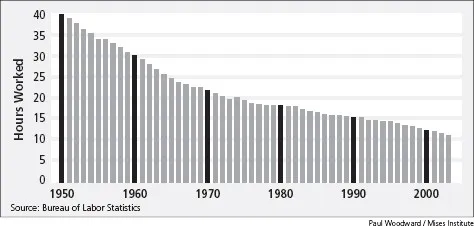
Figure 1.1: A comparison between the work hours required today versus those in 1950 to produce the same results.
This reduction in labor hours can be even better understood by looking at individual products as in Figure 1.2.
The prices of goods, and wages, rise because the government prints more money and adds it to the quantity already existing in the economy — that’s what inflation is, and nothing else. When the amount of money in an economy increases at a faster rate than the amount of goods and services, prices rise. But in real terms, if productivity is increasing, prices fall relative to wages, even if both are rising in “outside,” or nominal, prices (the increase in the quantity of money does not lower wages along with prices because the supply of workers does not increase along with goods and services).
Cost in Time
Hours worked at the average wage to purchase typical household goods
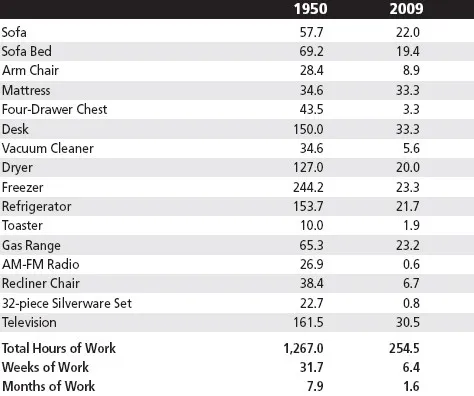
Source: mjperry.blogspot.com21
Figure 1.2: A comparison between the work hours required today versus those in 1950 to produce the same results
If there were a constant supply of money, if government did not increase the number of bills floating around, prices would necessarily fall because the same quantity of money in the economy would have to be spread across more and more goods. Think of it this way: if we have 100 dollars in an economy to purchase 100 items, each item would cost on average $1 ($100/100 items = $1). If we increase production such that we have 200 items in the economy, the same $100 must now buy, or “cover,” twice the items. This means that each item would cost on average 50 cents ($100/200 items = 50¢). The important point to remember is that in real terms (or, in a world of an unchanging supply of money), as we increase our production of goods, prices fall while our wages stay the same. This is how increased standards of living come about.
Since an economy is simply each of us producing things in the ways in which we decide is best for us, politicians can do nothing to improve our decision making — any intervention will necessarily reduce the optimization of the process and slow it down. Any “policy” the government promotes, unless it is one removing restrictions previously placed on capital accumulation and production, will cause fewer jobs to be created and fewer goods to be produced, and thus lower our standards of living. Neither the Democrats nor the Republicans, or any political party, including one composed of free marketers, have the ability to create wealth for us. Nor can any economist, including myself, orchestrate a better outcome for millions of people than individuals can create for themselves using their labor, incomes, capital, and the price system.
Profits Don’t Really Exist
I mentioned above that it is this standard rate of profit that Marxists and socialists (and most of society today) view as the means of worker exploitation. They argue that some or all of the profits should instead be paid to all the workers in a company instead of being kept by the capitalists. They suggest that workers are not being paid for the full value of what they produce. This is a grave misconception.
To see why we must understand what this standard rate of profit is and why it exists. The answer will tell us why workers don’t receive this profit in the form of additional wages. In reality, this standard rate of profit is not a profit at all — it is a mix of two different things. The first, inflation is in a class of its own. When the government creates new money and inserts it into the economy, the new money increases sales revenues of companies before it increases their costs; when sales revenues rise faster than costs, profit margins increase.
New money, which is created electronically by the government and loaned out through banks, is spent by borrowing companies.22 The expenditures show up as new and additional sales revenues for businesses. But much of the corresponding costs associated with the new revenues lag behind in time because of technical accounting procedures such as the act of spreading asset costs across the useful life of the asset (depreciation) and not recognizing inventory costs until the product is sold (cost of goods sold). These practices delay the recognition of costs on the profit and loss statements, or income statement.
Since costs are recognized on company’s income statements months or years after they are actually incurred, their monetary value is diminished by inflation by the time they are recognized. For example, if a company recognizes $1 million in costs for equipment purchased in 1999, that $1 million would be worth less today than in 1999, but on the income statement the corresponding revenues recognized today are in today’s purchasing power. There is an equivalently greater amount of revenues spent today for the same items than there were ten years ago (since it takes more money to buy the same good, due to the devaluation of the currency). Another way of looking at it is that with more money being created through time, the amount of revenues will always be greater than the amount of costs, since most costs were incurred when there was less money existing. Thus, because of inflation, the total monetary value of business costs in a given time frame is smaller than the total monetary value of the corresponding business revenues. Were there no inflation, costs would more closely equal revenues, even if their recognition were delayed. In summary, a majority of profits “earned” by businesses are actually inflation effects; thus, government gives companies much of their paper profits.
Since business sales revenues increase before business costs, with every round of new money printed, business profit margins stay widened; they also increase in line with an increased rate of inflation. This is one reason why countries with high rates of inflation have such high rates of profit.23 During bad economic times, when the government has quit printing money at a high rate, profits shrink, and during times of deflation sales revenues fall faster than do costs.
Bear in mind that these apparent profits are not real but a monetary illusion. Due to higher costs from inflation companies must at some point replace their plants, equipment, and inventories at much higher prices, which wipes out most of their paper profits, even though this cannot be seen on an income statement (companies often consume capital without even knowing it). Since businesses have their increased profits from inflation taxed, but have to replace inventory, plant, and equipment at higher costs than last time, the profits needed to replace the equipment at higher costs are diminished because a portion of them has been taxed away; companies thus have about the same, or likely less, real purchasing power with which to replace assets. In short, the increased profits that inflation provides companies do not constitute real increased wealth for these companies; at best, companies come out even.
Since the inflation effect is one derived solely by the government’s increasing the amount of dollars circulating in the economy, let’s look at what would constitute profit in the absence of the inflation effect. This second source of profits is the deduction of costs from sales revenues to compensate capitalists, whose money the companies are using to operate. In this way, the difference between revenues and total costs is not really profit, but a return on investment “paid” to those who really own the company: capitalists. More specifically, profit compensates the capitalists for waiting for a return on their investment, since the investment is made long before the final production it generates. Stated another way, the companies themselves do not make profits on what they sell; the profits are payments — like any other of the company’s payments to suppliers — to the suppliers of capital as a return on their investments. Without their investments, the company would not exist.
Income statements are set up in such a way that capitalists can see their returns — a view of the business as seen by the capitalists. The business’s view as seen by the company would theoretically include the capitalists’ required return as normal business cost alongside inventories, machines, or labor. Though this is never done, if it were, profits would not generally be left over after subtracting all business costs.24
In most cases, massive outlays of money are invested before any product exists. It can easily be years or even decades between the start of a business’s operations and when the business gets paid for the product it makes. For example, consider the aircraft industry: the amount of time required to plan and design a large plane, properly build and tool the factory, and to actually produce the plane can add up to many years or decades. Similarly, a nuclear plant takes 5 to 7 years just to build — and that does not include the time spent putting in place the company’s business and operations. Though less time is needed for the development and production of many items (e.g., shoes, furniture, candy), the same concept of production taking time still applies.
It is the capitalist who pays for labor (and machines) in advance in anticipation of future production. Can you imagine how long employees at the airplane factory would have to wait if they could not be paid until the product was sold? They would have to work for decades before receiving any income, and they would not be fully compensated until the very last plane was sold, many years after the first one. How would they purchase food, clothing, and housing? The capitalists take on the role of doing the waiting for the workers, by paying them in advance for their future production. This is why true cooperatives — those financed solely by the workers — rarely exist. Since the capitalists have their money tied up for several years, they are not able to use it, and have to forego their own immediate consumption. In short, they are compensated for the time spent without that money at their disposal. For this, they receive interest, just as a bank receives interest for lending out money. They also receive a bad rap as greedy, money-hungry pigs because they do not give away their money for free.
In the end, real profits do not exist on an ongoing basis. The cost of wages, supplies, machinery, land, and the money used for operations (capital), are all subtracted from revenues. After the subtraction of these items, nothing is left, except in those instances discussed earlier where exceptional profits can be made temporarily from introducing a new product or a new efficient production method.
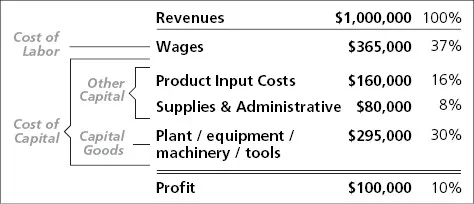
Figure 1.3: Simple income statement showing sales revenues, costs, and profits for a sample company
Capitalist Exploitation of Workers: The Myth
To return to the original question, how can we be so sure that the total wages a company pays are as high as they can be? How do we really know that workers (and machines) aren’t destined to be ripped off by their employers? Consider all the aspects of profitability and costs of a company’s income statement as shown in Figure 1.3. This sample company has sales revenues of $1,000,000, total costs of $900,000 and a profit of $100,000, or 10 percent. After allowing for the 10 percent profit, and after payment for other physical capital, $365,000 is the amount available to pay for labor (in reality, capital and labor purchases are chosen simultaneously). How do we know that all company employees combined will receive a total of $365,000 in salaries?
We know workers will be paid the full $365,000, the most they can be paid without the company losing its profit, because of the competitive nature of a capitalist economy. Labor is the scarcest resource we have. Thus, it will all be put to use (the existence of unemployment will be discussed below) by businesses competing for its limited supply. Individual workers tend to be paid according to the amount of sales revenue they can bring in based on their productivity. There is a going market wage for each type of worker and each level of productivity. Workers use capital goods to create their products, and both they and the capital goods get compensated according to the value of what they produce.
If a worker with a particular skill set, knowledge base, and education can produce work that brings in $40,000 in revenues, tight competition in the labor market will cause that laborer’s wage to be bid up to $40,000 as well, minus the amount needed to achieve the going rate of profit. If one firm tried to underpay the worker with a salary of $35,000, (ignoring, for the moment, the discount needed to achieve the required rate of profit) that person would be an undervalued asset because their associated revenues will be higher than their compensation/cost. Another firm would be inclined to offer the worker $38,000, another $39,000, and so on until the workers’ wage is ultimately bid up to $40,000. But the price will not be bid higher because if a firm paid more than the $40,000 the worker is capable of producing, it would lose money. Similarly, all workers together (along with supplies, machines, etc.) are paid the most that can be paid for them without losing a moderate profit margin. Total costs for a company, on average, will be equal to the amount of money the company takes in, except for the amount discounted from costs that is equal to the average, economy-wide rate of profit.25 Were there no waiting and no capital involved, a company’s costs would equal the amount of money it brought in.
What does all this led up to? Simply this: far from exploiting workers, companies do exactly the opposite. They (1) create jobs, (2) pay workers more than they would make on their own by being self-employed, and (3) provide the tools, technology, and machines to improve productivity and increase profits, thereby raising wages. All of this is thanks to entrepreneurs, business owners, and capitalists (who in some cases may be one and the same). While their big profits are short-lived, in the long run their actions result in permanent gains for the wage earners. That should make businesspeople the workers’ best friends, not their worst enemies.
Given these truths, it is ironic if not indeed tragic that the exploitation of labor is at the heart of many arguments for why we need government protection from companies that would supposedly otherwise abuse workers and pay them unfair salaries. We can see now that, on average, this could not be the case. Businesses would certainly like to pay lower wages and to take advantage of the workers, and in fact most care nothing about the workers personally beyond making sure that they are happy enough to be productive and help bring in revenues for the company. But businesses are not able to underpay workers because of the market forces explained above. If companies pay too little, workers can instead choose to work for other employers who will pay higher wages. The same principle applies to workers who want to earn more money — though they would like to earn more, they cannot ask for more than they are worth in the marketplace because their price will be uncompetitive: other workers with similar skills and abilities will sell their labor services for less money (i.e., the market wage). As with the prices of anything else in the economy, the price of labor is ultimately determined by supply and demand, not by individual greedy employers.
Capital Structure as the Driving Force of Rising Wages
It should be clear at this point that what helps workers, besides the ideas of entrepreneurs and the expertise of the business owners, is capital. The availability of capital derived from savings makes possible the transformation of an idea into real, physical goods and services, and the ability to produce these goods at faster rates, and with increasing salaries. Countries that experience a continually rising standard of living do so only because of a growing capital structure.
Since we now know that a capital structure is the collection of physical buildings, factories, machinery, and tools in place that make not only the consumer goods we buy, but also additional capital goods that allow us to make even more consumer goods, it should be clear that the bigger the capital structure, the more we can make of everything we need, and the more real wealth we have.
The key to using this capital structure is the existence of a division of labor in producing things (remember our castaways, with one fishing and another making fishing nets). Think of all the plants and factories we have and how there is a division of labor of industrial producers, just as there is a division of labor of workers. Any product you buy is assembled from individual parts, possibly thousands of parts, which are often made by different companies in different places. For an automobile, for example, sheet metal might be made by one company, leather by another, screws, radios, wiring, glass, rubber, and plastic each by other individual companies.
These companies are all part of a division of labor involved in the production of capital goods. The greater the division of labor of these capital goods, the more capital goods that can be made; this will ultimately result in more consumer goods. Each of the individual automobile components listed above was in turn produced by multiple companies: for example, raw materials dug out of the ground by one company get sent to another company to be cleaned and processed, then to another company to be mixed with other raw materials from yet another company and transformed into a new semi-finished material, and so on. For instance, it takes a combination of iron, carbon, silicon, graphite, chromium, nickel, and molybdenum to produce stainless steel. Semi-finished materials may go through several more stages before becoming something like sheet metal or screws. Now, think of all the tools, materials, and machines needed to process these raw materials — which themselves were made from thousands of different components from multiple sources — just to make them available for the original mining company to use in extracting the original raw materials which were later fed into these other goods. This complex web of production facilities, this subdivided capital structure, is what makes possible the standard of living we have today. It is also what is at risk of being diminished by the proposed policies of socialist-leaning politicians (which includes most Democrats and Republicans) and environmentalists — policies which tax, regulate, and restrict production to the point of suppressing it even more than has occurred already.
Economist Murray Rothbard26 often used a fascinating example of what was involved just to get a ham sandwich on his kitchen counter, and the number of years it took. The steps included such things as building a farm to raise cows that produce milk with which to make cheese, and growing rubber trees in order to produce rubber that would become tires for trucks that would deliver supplies such as wheat to the baking company that would bake the bread. This type of production structure consists entirely of capital goods (tens of thousands of them) — goods used to make things that will make other things that will eventually make consumer goods. Every factory producing the capital goods that go into producing other factories and machines all exist ultimately for the production of consumer goods — the “stuff” we have in our lives. The larger the production structure, the more “stuff” that can be made. In short, the bigger the capital structure, the wealthier, healthier, safer, and more comfortable we can be. Think of the process of production described above in contrast to production in some poor countries in Africa or Asia where people are producing only simple things, and all largely by hand, with crude, simple tools. They lack our modern factories, machines, tools, and technologies. It is for the lack of capital goods, not because of exploitive companies, that these peoples do not have our standard of living.
How Wealth Redistribution Harms the Poor
From the explanation on how the capital structure provides wealth, it should be clear that things our government does to support a growing capital structure will help us, and things that inhibit or especially reverse the growth of a capital structure will harm us. Since savings (monies we citizens have in banks, investment accounts, savings accounts, CDs, pensions, 401Ks, etc.,) and monies that come from companies reinvesting their profits instead of paying them out to the owners of the companies are used to build this capital structure, it should be obvious that the more savings we have, the bigger the capital structure we will have.
Taxing the rich, who have the most savings and monetary capital, is among the most damaging things that could be done for the overall economic health of the economy. When we take money from the rich, that money goes to our government and is spent. Whether it is given by the government to other people to spend or is spent by the government itself on behalf of all of us, it is consumed. This is somewhat true even when government spends on roads, bridges, and other infrastructure. Since government does not operate with profit and loss statements, it is a virtual certainty that it usually consumes more resources in producing something than society gets out of it.27, 28 This will be explained in detail later. Regardless, most government spending does not go toward infrastructure, but to thinly disguised wealth-redistribution schemes that are, most unhelpfully, a net consumption of wealth.
As a rule, we can consider that when the wealth of the rich, or of any of us, goes to pay taxes to the government, it is consumed. When wealth stays with its rightful owners, that portion not consumed is mostly used by businesses as monetary capital, which is transformed into capital goods. This is especially true for the rich, who save an overwhelming majority of their wealth.
Money in banks, savings institutions, and investment firms is loaned out or invested in places where it is ultimately used for the production of consumer goods (including services).29 Again, the more consumer goods we create, the more our real wages rise relative to the costs of things we buy — things become cheaper in real terms.
We can generally think, somewhat abstractly, of things in the following fashion: Every $1 not paid in taxes becomes $1.20 if left in the hands of its owners. If that same $1 goes to the government through taxes and is consumed, it becomes $0. The additional 20 cents created by capitalists can be thought of as a new tool with which to produce, and therefore a new consumer good or service, while the $0 can be thought of as a tool or good never having been created to begin with. Wealth kept by its owners, when saved, creates new jobs and products for us. Wealth taken and given to someone else is spent and disappears forever. It cannot be emphasized enough that the spending for capital goods and labor is paid for by savings, not by consumer spending! For when we go to purchase a car, home, or television set, these things have already been made before we arrive at the store. The necessary spending for production takes place long before we consumers show up, and is funded by savings/monetary capital. Without capital, there would be no money or tools with which to make things — we would all have to produce individually by hand. This would include even our cars and homes, as it is savings that pays for both the home and cars to be built in the first place and to finance them once they are built (since most of us could not afford to pay cash up front).
Think of the effect this has on individual workers. Consider that most politicians propose taking money from the rich to give to those who don’t earn as much. When this occurs, the redistributed money serves as a subsidy (or entire income) for those with lower salaries. But once they spend the money, it’s gone forever. How will this money be reproduced? Can the rich just somehow “make” more? No, they can’t, not for each portion of wealth taken from them. Even if the rich earn more afterward, the total amount of wealth existing in society is already diminished by the amount that was consumed. In fact, the rich need the monetary capital —i.e., the money that the government gives away in benefits to the poor — to make more money for themselves and thereby create new jobs and wealth for the rest of us.
The less savings and monetary capital businesses receive with which to operate, the less wealth the businesses can create for us. This means fewer jobs, and fewer goods being produced. If the lower income groups did not receive free money from (mostly) the rich, they would instead receive ongoing (and rising) salaries and a constant increase in goods available to them at constantly lower prices. Only capital creates jobs and pays wages. This is why wealth redistribution does not work. Taking from the rich will indeed harm the rich, but it will harm the poor considerably more.
How Government Creates Unemployment with Minimum Wage Laws
Politicians like to tell us that if we elect them, they will create jobs for us. This is impossible, unless they intend to expand government and have taxpayers pay more government workers to produce unprofitable services, or, to directly finance the creation of specific jobs in a specific marketplace with taxpayers’ money. In either case, a destruction of wealth is involved, and the jobs — unlike private sector jobs — do not pay for themselves and thus require yet new taxpayer funding each year, which further reduces capital in the economy. Except for the few wealth-destroying activities such as building space stations30 and military bases, government creates and builds nothing. It thus has no power to create real jobs in the marketplace; it can only “manage” and regulate. It is only individuals and individual companies that produce and create; their ideas and capital are what profitably create jobs. The only way politicians can create beneficial jobs for us in the marketplace is by undoing the existing policies that create unemployment.
That’s right, the government (and only the government) creates unemployment, except for unemployment that arises from temporary factors such as switching between jobs. The notion that there could not be enough jobs for everyone is absurd. Think back to the desert island example: can we imagine that regardless of whether there is one person or many people on the island that they could ever run out of things to do to improve their standards of living? The same is true in our economy today. There are many more things needing to be done than we have people to do them. Most companies operating today, given available monetary capital, would expand production of what they are currently producing, or create new lines of businesses if only they had additional workers available to do this new work. And the more people we would have producing, the more things we could produce.
So then why is there unemployment? Primarily because some workers are prevented from working by having the cost of their labor fixed artificially high, above the market price, by law.31 This is done in two primary ways. The first way is by the existence of a minimum wage. As we learned earlier, workers are compensated based on the expected value of what they can produce. If the government prevents companies from hiring workers for less than a given wage, and if workers are not capable of contributing enough to company revenues to be able to cover the cost of their wages, they will not be hired. If a worker’s contribution to production brings in $5 of company revenues per hour, then paying the worker $7 per hour will mean a loss of $2 per hour to the company. Such workers will thus be left out of the workforce because they are unprofitable.
One might counter-argue that companies should pay a minimum hourly wage of $7 simply in order for the worker to survive given the cost of living. This argument will be addressed later in the section on poverty. It could also be argued that companies could pay more to workers by paying the difference out of profit, or by raising their prices. Neither of these is possible. As was explained earlier, businesses pay the maximum amount they can afford to pay for both labor and physical capital. Paying more will cut into the capitalists’ returns, or eliminate their profit altogether, which will drive them away toward other ventures; the entire company could thus go under (not to mention that companies must reinvest much of their profit in order to produce next year’s goods). Similarly, businesses cannot raise their prices to pay for higher labor costs. If they were able to raise prices at all, they would have already done so simply to make a higher profit. Businesses charge as much as the market will bear given a particular amount of money in the economy; if they charge more, they will make less money because demand will drop. Businesses across the entire economy will only raise prices if there is an increase in the quantity of money in the economy —i.e., the government prints more money. The current discussion is based on a fixed quantity of money in the economy at a given time.
If companies charge more, people will purchase a lower dollar amount (higher price times a lower overall quantity purchased). If companies charge less, their customers will purchase a higher dollar amount (lower price times a higher overall quantity purchased). Which way is optimal? Companies charge an amount that maximizes the total revenue they receive based on a price/quantity mix that results in the highest amount of revenue. If they charge more than the optimal amount, the total dollar amount of goods purchased by customers at that particular price/quantity level will be lower than the total dollar amount purchased at the optimal point possessing a lower price and higher quantity.
As an example, consider a theoretical burger joint where the owner is wondering whether raising prices would make it possible to pay more to the workers. Figure 1.4 reveals the different amounts of revenues that would result from various prices of hamburger plates. Lowering the prices of each burger plate results in more burger plates sold. Raising the prices of each burger plate results in fewer burger plates sold. We can see that this owner’s optimal price to charge for a burger plate is $5.10. Charging more than this will result in lower revenues because the increase in price causes customers to buy fewer burger plates. Charging less than $5.10 will also result in lower revenues because even though the lower price leads to greater volume, it also means that fewer total dollars make it into the till. This example shows us that if the restaurant owner tried to charge more in order to pay workers more, the entire restaurant would lose business. The likely result would be the laying off of at least one worker in order to maintain profitability.
The minimum wage can help no one except those remaining workers who receive increased pay at the expense of the ones let go. Ultimately, having a minimum wage harms those it purports to help. But it’s more than ineffectual; it’s damaging. Those who are hurt the most are those with the lowest productivity — younger, less educated, inexperienced workers. Every time the minimum wage is increased, unemployment rates rise for this group, particularly for black, male teenagers. Further, as unskilled labor becomes too expensive to hire, businesses find it cheaper to replace labor with technology (automation, etc.). This is a primary reason why, for the most part, we no longer have many gas station attendants, maids or doormen.
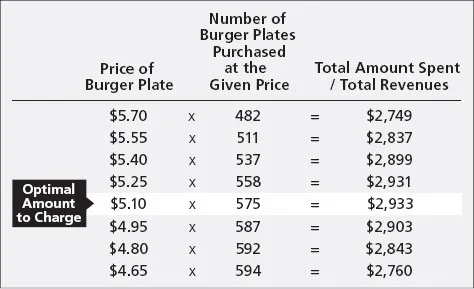
Figure 1.4: Optimal Amount to Charge: Companies, in selling their products, will choose the price and quantity combination which maximizes total revenues.
Most economists, free market-oriented or not, do not support minimum wage: it’s one of the few topics nearly all agree on. Those who do support the minimum wage usually do so for ideological or political reasons. The ideological reasons are based on emotions, not economic facts. The political reasons are obvious: to most politicians it seems not to matter whether they truly help or harm citizens. What is important to politicians is to be perceived as helping people. When Congress approves minimum wage legislation after hearing testimony from economists, most, if not all, of them voting in favor of it must surely be aware that the law will not help workers. The only explanation seems to be that they pass the law simply to look good to constituents who don’t understand the harm done.
In his 1993 textbook,32 Joseph Stiglitz wrote detailed explanations of how minimum wages, which are a type of price floor, cause unemployment. Yet after being appointed chairman of President Clinton’s Council of Economic Advisors (CEA), he suddenly changed his opinion and supported minimum wage legislation. Perhaps he did this to be seen a “team player.” President Clinton in turn said that he supported the legislation because his CEA supported it. Stiglitz, as leader of the CEA, pointed to the fact that a handful of economists had signed a petition in support of the legislation as the main reason that he had chosen to support it. In the end, this minority of economists all supported it simply because they all supported it.33
The economists who come up with obscure and often methodologically and theoretically questionable statistical studies that contradict most other studies on the minimum wage and conclude that increasing the cost of labor can somehow improve the lot of workers, are either ignorant of economics or are attempting to circumvent economic laws. Logic alone tells us that if the price of labor is raised above the value of its usefulness, there will be less of a demand for it.
After all, if raising wages will help workers, then why not apply the minimum wage to everyone, and make the minimum wage $100 per hour? Or $1,000,000 per hour?34 Our politicians do not do this because they know that most of us would then be unemployed. We will see in Chapter 6 that artificially high wage rates were the primary reason the Great Depression lasted so long, and why it even evolved from a simple recession into a depression.
How Government Creates Unemployment by Sponsoring Union Coercion
The second way government causes workers to be unemployed is by allowing unions to, in effect, extort companies and by preventing companies from dismissing workers who extort them. This is another form of unemployment caused by forcing companies to pay artificially high wages. Since companies have a fixed and limited amount of money they can expend on labor, they end up paying the same dollar amount of labor costs, but to fewer workers. Again, some workers benefit at the expense of others. And it’s not only the workers who get laid off from unionized companies who suffer: when union workers get laid off, they often have to find jobs in the non-unionized part of the economy, adding to the number of workers competing for jobs elsewhere and thus lowering wages of jobs outside of “union shops.” In the end, union workers gain at the expense of all other workers in the economy.
How do unions make companies pay workers more money against their will and best interest? The government forces companies to do so. The Norris-LaGuardia Act of 1932 deprived employers of the ability to obtain federal court injunctions against labor-union coercion. The National Recovery Act and the Wagner Act of 1935 made it mandatory for companies to recognize labor unions and to bargain with them (to pay higher wages than they want to pay or can afford to pay) or else be found guilty of “unfair labor practices.” Imagine that you run a business and employ people who have agreed to work for a certain wage. Then, they all come to you and tell you that they demand 10 percent higher wages than they agreed to, or they will stop working and effectively shut down your business. You know that you can’t afford to pay more, so your only choice is to replace them with other workers. But then you find out that you can’t because they have unionized and the government therefore forces you to negotiate with the original workers — to pay them somewhere between their current price and the 10 percent higher wages they want. In the end, you will be forced to pay more than you can afford. It’s your company and your property, but the government tells you that you must give in to threats or be taken to prison. Since you only have so much money you can spend on labor, in order to pay workers a higher wage, you must fire workers, so that the remaining workers can have the salaries of the ones who are fired.
Unions would be incapable on their own of imposing uncompetitive costs on employers. Only by preventing employers from replacing them with workers willing to accept the wages offered can union workers hold wages artificially high. This is why they threaten and torment non-union workers who consider taking their jobs for the market wage, and why they use the government to prevent employers and non-union employees from negotiating market wages (i.e., from freely exchanging money for labor services in a free market).
Many people who understand the damage that unions do today still maintain that unions somehow helped in the “old days.” They often argue that it was only because of unions in the early part of the twentieth century in America or during the industrial revolution in the U.K. that workers managed to get ahead. This is a fallacy. Unions have never helped any group as a whole. Mines and factories in the old days had competition too, from traditional self-sufficient farming as well as from other employers. They thus had to pay competitive wages in order to attract workers. Workers chose to leave farming and to instead work in mines or factories because they felt they benefited by doing so; they were free to leave at any moment. Mines and factories paid much lower wages then relative to today because they did not have the productivity-improving capital goods we have today.
Since it is employers that raise the productivity of labor and thus wages and not the unions, unions can only prevent the increased productivity of labor. They are against technology because they falsely believe it will obviate the need for workers. They prevent progress by preventing the implementation of labor-saving machinery — but what this actually prevents is an increase in productivity. Since it is increased productivity that raises wages, not coercion, unions prevent higher standards of living for all of us.
But unions do more damage than just cause unemployment. They also run companies out of business. Since they prevent companies from adopting more efficient methods of production, they cause them to lose their competitiveness. Part of this entails the production of lower quality goods brought about by the prevention of technological advancement. They can also force companies to raise selling prices to the point where the companies’ revenues decline because their prices are higher than those of competitors. These things have crippled America’s steel, shipping, and textile industries, to name just a few, and are currently threatening the automobile industry. Unions are a primary reason Ford and GM make lower quality cars at higher prices than their foreign competitors.
Union demands and government-forced compliance with these demands drag companies down in other ways, too. In 2006, after GM’s assembly plant in Oklahoma City shut down, the company was actually obliged by its UAW contract to pay 2,300 employees full salaries and benefits for doing no work at all. They reported to work each day to read, watch TV, or chat.35 Without the UAW, GM would have had an average cost per automobile similar to that of non-unionized Toyota, which makes an average profit per car of $2,000, while GM makes no profit per car. In 2005, the Cincinnati Enquirer reported that the UAW contract costs GM $2,500 per car.36 According to CNBC television, the costs of future union healthcare burdens alone total $1,500 per car.37 These costs equal the difference in competitiveness between GM and Toyota. The Center for Automotive Research estimates that the Detroit automakers spend an average of $63.65 per hour on production (excluding buyout and jobs bank costs) while non-unionized Toyota spends an average of $47.50.38
Because of government-imposed union power, companies are often prevented from making decisions that are best for the company because many decisions must be approved by union bosses. Employers must obtain union approval for new investments and strategies, on top of jumping through other union hoops (for example, purchasing goods only from unionized companies and thus paying higher prices). Unions are parasitic organizations that thrive only by weakening and ultimately destroying companies. The ultimate goal of unions is to forcefully transfer wealth to unions from these companies by making the companies pay higher-than-market salaries and benefits for doing as little work as possible. Unionization is literally legalized theft.
When unions face resistance from companies in getting what they want, they resort to violence. Union violence is well detailed in a 540-page 1983 book from the Industrial Research Unit of the Wharton School at the University of Pennsylvania entitled Union Violence: The Record and the Response by Courts, Legislatures, and the NLRB.39 The book cites over 2,598 incidents, including murder, attempted murder, destruction of property, arson, sabotage, stoning, shooting, stabbing, chaos, beating, dynamiting, intimidation, and threats.40 Police forces are well known for looking the other way and not getting involved in these incidents. The police, who are usually unionized themselves, are often sympathetic to unions since they consider them “brothers” who are fighting for their “rights.”
Union members are either gamblers or oblivious to the results of their own actions. This must be so because by forcing companies to raises wages for some of their members, they force other members to be unemployed. If union members are aware of this consequence of forcing their wages higher, they are playing Russian roulette with their jobs given that they don’t know which ones of them will be let go and which will be kept on. If they are not aware of the consequences, then they simply don’t understand the dangers that unions pose to them.
The only union members who have mostly secure jobs are the union bosses and economists. The bosses negotiate how many workers they will lose for a given pay and benefits increase. The role of the so-called labor economists is to perform the calculations that estimate the costs and benefits of the proposed trade-off. Union bosses are known to be concerned primarily with their “senior” members. The newer or less experienced members are easily disposable to union bosses (except, of course, that the loss of their membership fees will be mourned).
What about the politicians who support unions? Are they aware of the damage that unions cause to companies, employees, and consumers? Those who are aware are guilty of knowingly supporting something that harms the very workers they proclaim to protect. Those who are not aware are still guilty of intervening in the free market by preventing the voluntary labor arrangements entered into between employers and workers, and tampering with something they know nothing about. But why would politicians support something that either they know harms workers or something they are uncertain will produce a better outcome than would a free market? Because they care more about votes than they do about the gains or losses of others. Unions represent a major constituent with large-scale voting power. This is why Democrats fall all over themselves to convince unions they will support them. Even Republicans pay homage: in the 2008 Republican debates, Mitt Romney rather moderately stated that there are good and bad unions, and Rudolph Giuliani proudly stated that he recognized the good that unions have done, and cited his grandmother as having progressed out of poverty in her career as a garment worker because of unions. In this ongoing struggle for political power, it is the workers who suffer.
If one argues that it is not true that unemployment arises only because government has forced wage rates to be higher than the value of what workers could produce (and above the price at which they would voluntarily work), one has to explain why employers would not hire more people at lower wage rates, while still paying the same amount of total labor costs they incur currently. So for example, if there are 10 people in an economy available for work and employers who have $100 available to pay out in wages have hired only nine of these people for an average wage of $11.11 ($11.11 × 9 people = $100), why would they not instead hire all ten people for $10 each ($10 × 10 people = $100).41 With one additional person working, the company could produce more goods. Why would an evil capitalist willingly pay this current higher wage rate instead of a lower one? Only because the government does not permit the workers to accept a lower wage.
To argue that at any given point in time there is only so much work to do is illogical. If there will be more work to do next year, why couldn’t we do some of that work this year? We produce twice the amount of goods today that we did in 1970. Why couldn’t we have used some of the unemployed labor in 1971, 1972, etc. to produce some of the additional amount of goods that were later produced in 1975 or 1980 or today in excess of what we produced in 1970? Why couldn’t we use some of the unemployed people who exist today to produce more lumber, automobiles, nails, hula hoops, doorman services, garbage pickup services, construction services, McDonalds hamburgers, janitorial services, etc. (labor requiring mostly unskilled, unknowledgeable laborers)? Construction companies, for example, would like to have more workers who could hammer more nails. They could certainly use these unemployed people if it didn’t cost them anything. Wouldn’t they also pay $1 per day or $1 per hour? Or even $3 per hour? Of course they would. Saying that there is no more work to be done is simultaneously saying that there are no more goods and services we individuals want to consume (i.e., that as consumers we would have no more need or want of the additional things we would make as workers).
How Other Government Regulations Create Lower Wages and Unemployment
The consequences of any regulation that government imposes in the workplace are ultimately borne by workers and/or consumers. The more costs imposed on employers — for example, requiring better workplace health and safety regulations — the lower salary workers receive. As we’ve seen above, the costs cannot come out of profits, or else the companies will go under.
It is a mistake to think that workers need “protective” regulation at all; it is a fallacy to believe that workplaces will not improve without forced regulation. OSHA and EPA regulations came about only in the 1960s and 1970s as workplaces had already reached a state similar to what they are today. In other words, workplaces have been improving for hundreds of years without government force. Employers have a natural incentive to make workplaces safer, healthier, and more comfortable in order to attract laborers. For example, if company A has air conditioning and a safer environment than workplace B, which is uncomfortably hot and less safe, workers will choose workplace A as long as they are paid the same. Companies with less desirable workplaces will have to pay more for labor, but since they can’t easily afford to pay higher salaries, they compete with more satisfactory workplaces. This is why many workplaces today offer gyms, free food and drinks, entertainment, and other amenities voluntarily, without government force. In India, the outsourcing boom has resulted in a lack of qualified workers, and companies are not only bidding up wages to the point that they are increasing at over 30 percent per year, but they are also competing by offering myriad other benefits such as defined career paths, quicker promotions, more workplace amenities and services (such as transportation to work), more holidays, and flexible work schedules.
But when government tries to force such improvements before they are economically viable, workers will foot the bill with lower salaries. Think of the American textile factories in the early part of last century. They were hot in the summer and cold in the winter. They had poor lighting and bathrooms (if they had any bathrooms at all). Now suppose the government had forced employers to install central air, which since it was invented only in 1902, was still enormously costly even in, say, 1910. Suppose further that the employers were forced to install nicer, bigger bathrooms with a minimum number of stalls. In addition, imagine they were compelled to put in carpet, more windows, cutting edge technology lighting, and a break room stocked with food. Clearly, the less developed workplaces of those days could not have afforded such luxuries. They would have had to lay off many workers to pay for the additions, or else paid workers much less money. To have paid for improvements out of profits would have resulted in business losses, and thus the entire business would have gone under.
Why Sweatshops, Child Labor, and Dollar-a-Day Wages Should Be Embraced
In the same way that companies 100 years ago could prosper only by developing workplaces that were in line with the level of development of the economy as a whole, people and companies in third-world countries today can only prosper by having such things as so-called sweat shops and child labor — living and working conditions that are the norm in those countries. To force improvements in working conditions or to prevent children from working means, at best, a reduced standard of living for these workers, children included.
The name “sweat shop” implies that those workplaces are of less-than-average quality. They are not. They are in line with (actually, usually nicer than) other workplaces in those countries. These workplaces are not more developed because the country in which they operate is not more developed. Companies there can simply not afford to have nicer shops, factories, or offices. While much criticism has been leveled at companies like Nike that outsource work to supposed sweat shops in undeveloped countries, the truth is that Nike employees’ working conditions are usually an improvement over competing local companies, and the wages they pay are significantly higher than local market wages. In fact, the supposedly greedy and exploitative multinational companies we hear that conduct sweatshop operations in undeveloped countries usually pay about double the local wage.42
Were companies such as Nike to insist that their suppliers have first-world quality workplaces and pay developed-world-level wages, the result would be that any cost savings that caused them to select the undeveloped country in question would disappear. Thus, the local supplier producing and then selling shoes to Nike could not provide the shoes at the price they do currently under “sweatshop and child labor conditions.” As a result, you, the consumer, would not buy as many of Nike’s products, since the price would not be as low as it is, and you would therefore put the workers in these developed countries out of work. To the extent we keep paying for goods from so-called sweatshops, we not only help provide jobs for these poor workers, we help raise their standard of living by causing more investment and capital to flow to these locations (for the purpose of increased and more efficient production). We can also understand from the discussion on wages above, that paying “fair wages” to coffee growers in Latin America means that some farmers receive above-average selling prices at the expense of other local farmers who get nothing.
Child laborers are necessary in developing countries, as they were in developed countries when they were poorer, because many poor families in undeveloped countries rely on multiple incomes simply to survive. And just as it was more important for my grandfather to drop out of school in the 7th grade in 1907 to support his family so they would not go hungry, so it is more important for many children in undeveloped countries to work than to have the luxury of learning about science or history in school. If the working children of these countries did not have the employment they currently do, their likely alternative would be prostitution, begging, stealing, or starvation. Readers who have traveled to third-world countries will be more easily convinced of this. I, for example, witnessed scores of children in India whose parents cut off their fingers or hands so they would appear more pathetic and thus more likely to be given money by rich tourists; it’s why these children appear mostly at stop lights soliciting people in taxis. Make no mistake: children should never be forced to work against their will; it should always be done voluntarily and with the permission of the parents.
Abraham Lincoln had less than one year of formal education because he was needed by his parents to work as a farm hand.43 American society historically accepted child labor as necessity; it only became a “terrible” thing after child labor largely disappeared during the great depression. This was brought about by women’s unions, which wanted to reduce the competition they faced from child laborers. It was actually parents and clergy, not companies, who fought the movement to ban child labor.44 As prosperity increased in America, families were better off and did not need to have their children work as much. By 1930, only 6.4 percent of children of ages 10 to 15 were employed compared with about 30 percent in 1900. Though unions had tried for many years to prevent competition from children, they succeeded only after most children no longer worked anyway. The law that brought about the end of child labor served as a helpful political tool for politicians. As Jeffrey Tucker states:
It was the same law that gave us a minimum wage and defined what constitutes full-time and part-time work. It was a handy way to raise wages and lower the unemployment rate: simply define whole sectors of the potential workforce as unemployable.45
Most laws that the government passes — laws that are usually cloaked in rhetoric claiming to help citizens — in fact constitute the use of government by one group to reap benefits at the expense of another group.
The media like to tell us that workers in third-world countries are living on “only a dollar a day.” While it may be true, it is very misleading. A dollar a day in sub-Saharan Africa or Central America is not worth what it is in the United States. It is worth significantly more in real terms, and will buy workers there many things to enhance their lives. Houses in Ecuador, for example, average $820 per square meter;46 while houses in the U.S. average $14,898 per square meter.47 Wages adjusted for costs of living in Ecuador are indeed still disproportionately low relative to those in U.S., but this reflects the relative lack of capital accumulation there.
Though workers in poor countries earn lower wages than those in developed countries, they are nevertheless, on average, paid in accordance with the value of what they produce (where markets are permitted). Since the capital structure and thus labor productivity is lower in these countries, individual workers are unable to produce as much as workers in developed countries. But their wages are still market wages. Given the lack of work available overall in these poorer countries due to government actions, most workers are glad to receive the wages they do, which is why they often go so far as to bribe factory managers to hire them.48 It has also been shown that workers in these countries tend to choose a job in a factory at lower wages to a job working outside in the heat (or cold) — in nature — paying higher wages. It is not the workers who claim to be exploited and complain about slave wages, it is those of us in developed countries ignoring economic reality that try to “protect them” by preventing their getting the factory jobs they so desperately need and want.
The outrage over working conditions and wages of workers of poor countries should be targeted not at the employers who provide the opportunity for work and wages to these citizens but at the governments responsible for the general state of poverty in undeveloped countries. These governments usually (1) fail to either permit ownership of private property or to protect those ownership rights; (2) prevent foreign investment and capital from flowing into the country or confiscate it for themselves; (3) steal citizens’ wealth every way they can (including direct, physical confiscation); (4) intervene heavily in their economies in the form of absurd rules, restrictions, tariffs, price controls, and printing of money to the point of causing hyperinflation; and (5) prohibit or heavily restrict not only international trade but even domestic trade. In these and other ways they run their economies into the ground and leave their citizens with few tools with which to improve their lives and standard of living.
Zimbabwe is a prime example. Today Zimbabwe’s annual inflation is over 4 million percent, or 10,000 percent per day (it has a paper currency with a face value of $10,000,000), excluding compounding. Property has been literally stolen from certain groups and given to others, and grocery store shelves are empty and mass starvation is prevalent. Even in countries such as Guatemala where conditions are calm but people are generally poor, the blame should be directed at the government leaders who prevent their citizens from freely producing, trading, and borrowing foreign capital, and who prevent foreign firms from investing in their country, creating jobs, and sharing production knowledge with local businesspeople.
If people in any nation are poor, if they have not already increased their production of goods to the point that they have a decent standard of living, the only reason is that they have been prevented by governments or by some other coercive entity (e.g., mafia, warlords). There is plenty of proof — logical, circumstantial, and empirical — that any country, regardless of its starting level or level of education, will grow and flourish if given the freedom to do so. There is even more proof that governments cannot grow a country or its economy, only individuals can. Blame the local government leaders for sweatshop conditions and low wages; don’t blame the only party that is not only capable of helping poor workers but actually doing so — the business leaders — for only they are providing capital investment in these countries and raising workers’ productivity and wages (and most poor countries around the world are experiencing increasing standards of living).
The Notion of Inequality: Our Achilles’s Heel
The ultimate goal of socialism and communism is to make us all equal or, at the very least, to redistribute wealth Robin Hood49 style by taking from those who have more and giving it to those who have less. In seeking equality, socialists are not concerned with having everyone looking or acting the same (indeed, in these respects they often tout diversity, even by force); they care only about equality in financial terms (though many of them pretend to abhor money and disdain those who openly desire it). By understanding how wages rise and why we each receive the salaries we do, we can see not only that government-imposed transfers of wealth will not bring equality, but that such transfers will make things worse for the intended beneficiaries.
There is a tendency for us all to be paid in accordance with the value of what we are able to produce, and in accordance with the supply of available competition among each type of producer (secretary, veterinarian, store clerk, etc.). Teachers are paid less than athletes because there are many people capable of teaching, but relatively few capable of providing the entertainment athletes do. Since athletes bring in millions of dollars in revenues to their organizations, they are paid the value of their production. The fact that there is as much demand for basketball — and thus high basketball salaries, as there are — simply reflects the preferences of consumers. Were there little demand for basketball, players would be paid very little.
In the same way, individual workers are paid based on what they can produce. A worker who can produce twice that of another will, on average, end up being paid twice as much, depending on the number of people with similar capabilities. Naturally, entrepreneurs and business leaders are paid much more than workers because they provide the guiding and directing intelligence50 in the economy. Generally speaking, workers do not develop money-making ideas for consumers — businesses and entrepreneurs do. Workers do not provide the capital to companies and bear the risks of failure — capitalists do. Workers do not manage and design the specific and changing-as-needed divisions of labor within companies that lead to optimal production. Workers do not create the strategies and visions that allow companies to out-perform competitors. To the extent that workers are capable of contributing to any of these processes, they are recognized and rewarded accordingly, and will themselves then become business leaders and entrepreneurs. Examples of this abound; it seems that half of the business success stories are based on such instances.
It is not just blue-collar workers who are laborers: every person in an organization up to the CEO is a laborer. Naturally, those who contribute less to the creation of wealth are paid less; those who contribute most are paid the most. A laborer who uses a computer is likely to produce more than a laborer repairing machinery or answering telephones. Even laborers who use computers but perform only narrow tasks or manage only small groups — me included — are likely to produce less wealth for an organization than will those directing larger overall portions of a company or directing entire companies. Still, politicians continue to remark that it is the hard-working lower and middle classes that bring prosperity, as though business leaders and entrepreneurs do not work (or do not work very hard). President Obama went so far as to highlight the distinction between “the working class, as opposed to the wealthy.”51 Yet these supposed slackers in reality spend an extra 30–40 hours on top of the standard 40-hour workweek, while the rest of us spend that time eating out and watching Celebrity Fit Club and Project Runway.
To take money from those who make more and give it to those who make less results in less wealth for everyone — particularly for the so-called poor — for three reasons: (1) as the possibility for business leaders and entrepreneurs to maintain ownership of their accumulated wealth is diminished, the incentive to take both monetary risks and career risks to create wealth are similarly diminished; (2) when there are fewer innovations and fewer new products and companies created by entrepreneurs looking to make a profit, there are also fewer new goods, new jobs, and new ways of raising labor productivity; and (3) as wealth is taken from the rich and given to the “poor,” it is consumed instead of being transformed into physical capital and used to continually reproduce wealth. Wealth redistribution means that the poor receive one-time payments that disappear rather than ongoing payments in the form of wages. It also means that they miss out on receiving the additional and continual production of many more goods they would have at their disposal, goods that would reduce their real costs of living.
Capitalism may leave people far from equal in wealth, yet it leaves everyone better off than they would otherwise be. The poor today live better than most people in history ever have. Yet it seems that leftists of all variations cannot stand the idea that the poor (and often themselves) are not living as well as do some others.52 They are willing to make everyone, including themselves, worse off just to attempt to bring about equality. Equality is an impossible goal because individual human beings are unequal in multiple dimensions: we each have different goals, intelligence, capabilities, interests, and ways of thinking.
It has been proven time and again that pure socialism or communism, while they do in fact result in a kind of equality of most citizens, does so only by way of making all citizens equally poor and equally suffering in their miserable level of existence from a lack of food, health, security, and personal freedoms. And again, ironically, even in socialist countries the term equality applies not to all citizens, but only to most. For the wealthy still exist in the form of the citizens’ supposedly benevolent leaders who live lavishly while the citizens suffer with their truly slave wages. These great leaders, who impose equality and meager lives upon their subjects, live like kings off the production of the starving citizens.
Jealousy and the mistaken notion that financial equality is both desirable and achievable prevent all of us from having better lives. If we would all accept that most of us will never live like Bill Gates or Warren Buffet, or even the guy in the neighborhood down the street with the big house and the new tricked-out BMW, we will all be better off than we are now. No matter what rung of the ladder we are currently on, as long as we have the will and the freedom to do so, we can move up and increase not only our absolute wealth, but our wealth relative to that of others. As we will see in the following chapters, there is nothing holding us back. But if we’re not careful, the simple emotion of jealousy resulting from a misguided desire for economic equality will destroy the economy we currently have. It might sound noble or benevolent to try to help one group by taking from another, but such an approach simply cannot work and will only result in harming most people — particularly the lower-wage group we intend to help. If we will permit and accept inequality, we can all realize consistently increasing standards of living for everyone.
The Case for Legalizing Capitalism
Read the whole book online · Book details
This work is published under a Creative Commons licence. You may copy, share, and re-host it with attribution.