
Chapter 44 of 54 · The Left, the Right, and the State by Llewellyn H. Rockwell Jr.
SECTION 2: ECONOMICS & ECONOMISTS 77. WHAT ECONOMICS IS NOT February 2006
The most common misunderstanding about economics is that it is only about money and commerce. The next step is easy: I care about more than money, and so should everyone, so let’s leave economics to stockjobbers and money managers and otherwise dispense with its teachings. This is a fateful error, because, as Mises says, economics concerns everyone and everything. It is the very pith of civilization.
This is a confusion sown by economists themselves, who postulate something called “economic man” who possesses a psychological propensity to always behave in ways that maximize wealth. Their mathematical models, predictions, and analysis of policy are based on this idea.
In the real world, however, we know this not to be the case. The world as we know involves profit seeking but also extraordinary acts of charity, sacrifice, nonpecuniary giving, and voluntarism (though I dislike that term since all commercial exchanges are voluntary too!).
How to account for these? The Austrian approach to economics dispenses with the idea of “economic man,” or rather broadens the meaning of economics to include all action, which takes place in a framework of scarcity. Scarcity requires that we economize on something in all that we do, even when wealth is not the motivation. For this reason, Austrians analyze acting individuals, not maximizing prototypes.
Why is this important? A common complaint against the free market is that it needs to be supplemented by laws that restrict the power of materialism unleashed. The market does “greed” well, people admit, but we need government to provide charity, order, law, and restraint of all sorts, as if these areas lie outside the domain of economics.
The truth is that a theoretical structure that explains stock markets but not charity auctions, chain stores but not church attendance, savings rates but not child rearing, has no claim to be a universal theory at all.
Murray Rothbard defined the free market as integral to an entire theory of a free society that is ordered and developed through the cooperative action of all its membership. That action is not conditioned on profit seeking only, but on the institutions of ownership, contract, and free association.
Economics, then, is a science that is rooted in a larger understanding of what used to be called the liberal order. The central claim of this understanding is that society—just like the smaller subset often called “the economy”—needs no central manager to thrive.
And just as economic structures are best managed by property owners and traders, the entire society contains within itself the capacity for self-management. Any attempt to thwart its workings through the coercion of the state can only create distortions and reduce the wealth of all.
Anyone familiar with current economics texts and journals knows that this is not the view that they promote. They are still stuck in an era where bureaucrats imagined themselves as smarter than the rest of us, where central bankers believed that they could end the business cycle and inflate just enough to cause growth but not ignite inflation, where antitrust experts knew just how big businesses should be.
But can government managers know how to manage daily decisions on production and allocation better than property owners? Can they improve on the agreements, innovations, and rules created by acting individuals? They have neither the intellectual equipment nor the incentive to do so. They are blind to the realities of our lives and incapable of doing more for us than we can do for ourselves, even if they had the incentive to do more than rob and coerce us.
How is it that the economics profession has come to overlook these points? Murray Rothbard believed it was partially due to the decline of the general treatise on economic theory, systematic books that begin with fundamentals and trace cause and effect through the whole range of human action.
These books were common in the nineteenth century. Thank goodness that Mises wrote his amazing work Human Action, and Rothbard wrote his elaboration on Misesian economics in the form of Man, Economy, and State. The Mises Institute publishes both.
You know what? They are still being read, teaching each new generation of economists through the work of the Mises Institute. And not just in the United States: we receive regular progress reports from study groups in China, Latin America, Eastern Europe, and Africa. A universal theory is once again having a universal impact.
78.
ECONOMICS: THE WEATHER-VANE PROFESSION
March 1992
The economics profession has made a sharp turn to the left as was evident at the last meeting of the American Economic Association. Gone was any praise of tax cuts and private property, or criticism of federal spending and regulation. Instead, there were reassertions of Keynesian falsehoods, mathematical treatises with no economic content whatsoever, and an attempted (and mistaken) extension of economics into sex and religion.
This left turn took place, as it has in the past, because most economists are lapdogs of the state. Paid directly or indirectly by government, they seek their advancement through government, consider government jobs to be the pinnacle of their profession, and are ever attentive to their master’s voice.
When Reagan was in the White House, supply-sideism was in vogue. If most economists didn’t become disciples of Arthur Laffer, Jude Wanniski, and George Gilder, they were at least interested in incentives. The less-statist Rational Expectations and Monetarist Schools also became popular.
Now, however, with Bush’s neo-Keynesians in control of national policy, academic after academic defends government spending and deficits, and attacks tax cuts and “market failure.” Few write about privatization or deregulation.
Economists are buttressed in their attitudes by the national media, which are also pro-government. Any economist who wants to be “fit to print” had better stay in step with the zeitgeist.
Not that this is anything new. Contrary to myth, Franklin D. Roosevelt did not embark on his statist New Deal because of Keynesian economics. Keynes’s General Theory wasn’t published until 1936, when the New Deal was already three years old. (Mussolini’s program was FDR’s actual prototype.)
Nor was it a coincidence that the model that came to dominate the profession was the policy of nearly every industrial power (including Nazi Germany, whose economics Keynes praised in his Introduction to the German edition of the General Theory).
Not until Western governments began to run deficits as a matter of course did economists discover the benefits of red ink; most economists were not in favor of central bank manipulation of the economy until the Federal Reserve was established; and there was no profession-wide consensus on the virtue of redistribution until the income tax amendment.
Shifts to the left are made easier these days by mainstream analytical models, which are radically unsound. For starters, they bypass questions of private property, legal institutions, and differences among people. For this reason, the popular schools of the 1980s were not solidly free market. While they improved the old Keynesian aggregations, none—Supply-Side, Rational Expectations, nor Monetarist—challenged the Keynesian framework.
No Keynesian model allows economists to question the notion of government management, or that it can improve on the free market by making business more competitive, wages more flexible, prices more responsive, and money flows more rational. This is part of the reason that economists of almost all stripes have continued to dance to the Keynesian tune, changing only partners.
There is only one school of economic thought that refuses to dance: the Austrian. We want to fire the conductor, break the instruments, tear up the sheet music, and lock the ballroom.
Only the Austrian School is based on economic law, on real human beings acting in a world of scarcity, and on the natural order of liberty. That is why we know, and can demonstrate, that government intervention must always damage the market.
From Carl Menger’s day to our own, Austrian School economists have condemned the errors of government, no matter what the politicians wanted, no matter what the risk to careers.
Austrians remain a minority in the profession (the courageous are always a minority), but a bigger minority than at any time since the 1930s; we have an astounding number of good professors and students. But meanwhile, the welfare state grows. What to do?
We cannot rely on politicians, although we should try to elect the rare good one. Most economists are useless as well. That is why we need the public, guided by the right intellectuals. As Ludwig von Mises pointed out, economics is far too important to leave to the economists. Everyone should know at least the basics.
At the second annual meeting of the John Randolph Club in January, Club President Murray N. Rothbard laid out a strategy for involving the public. Certainly the inchoate sentiments already exist. Who doesn’t despise bureaucrats and politicians? What normal American really thinks they should run our families, regulate our businesses, and spend our incomes?
Most Americans are angry and resentful at the present state of affairs, and who can blame them? What other emotions should we feel as society, subverted by socialist egalitarianism, collapses around us? It is our job to point out the villains: state managers and their pet welfare recipients: underclass, foreign, and corporate.
Instead of trying to persuade the politicians of some marginal scheme, we need to show the public how the trillions extracted from their wallets are spent, and on whom. Once done—and it is no small task—we could begin an authentic revolution against Washington, DC. Then we need not worry about the economics profession. It will be following along nicely.
79.
KEYNES RULES FROM THE GRAVE
January 2003
Everyone is at work on a “stimulus plan” for doing something about the recession. But the much-publicized disagreement between the Republicans and Democrats is not about economic theory as such. There has been no critical thinking applied to the subject of why the recession, the longest in the postwar period, continues. Rather, the disagreement is about which levers to pull when, and who should get the benefits.
All this is evidence that Keynes rules us from the grave. Popularized and reduced to sound bites, the fallacies are far easier to detect than in Keynes’s impenetrable prose from his 1936 treatise that first resurrected ancient fallacies and garbed them in the language of science.
The underlying idea in the Keynesian tradition is to attribute the length of the recession to insufficient effective demand, so it is up to government to give the economy a kick-start, change public psychology, spend money on anything and everything, stop the money hoarding and start the buying, inflate a bit here and there, drive down interest rates, run deficits for a while, and fool the workers into thinking they’re getting raises while their real wages are falling.
That’s the traditional mix of policies that has been employed during every recession between the early thirties and the current day. Bush clearly subscribes to this view. After his meeting with a group of economists who should know better, he said a feature of his plan is that it “recognizes that money in the consumers’ pocket will help grow this economy.” In fact, the White House says that the first principle of its economic program is to “encourage consumer spending.”
Just think about this. Let’s say that every one of us emptied our bank account today and just bought something. And let’s say we used all our assets and leveraged them to the hilt to borrow as much money as possible, and then spent that. What would happen? Well, shelves would empty and prices would go up and the business pages would roar with approval.
But what about tomorrow? There would be no savings left to fund new projects after this little boomlet. Products on shelves would languish. Long-term projects would have no customers. We would have spent ourselves straight into recession again. This plan boosts the economy in the same way that an amphetamine boosts one’s mood. It’s an illusion that must end.
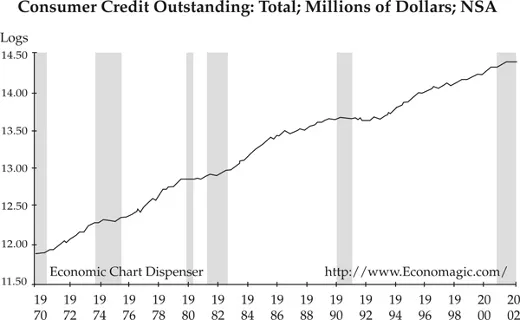
There is no evidence that this path has ever worked to pull an economy out of recession. And if you look at consumer debt, it seems that my little allegory of spending mania isn’t far from the reality.
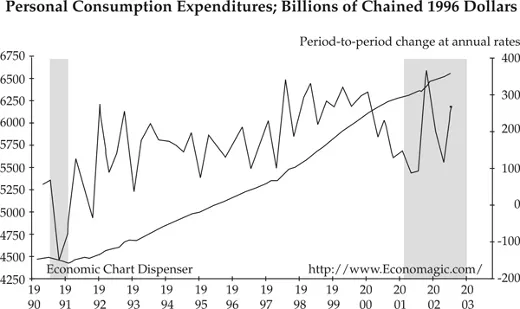
Personal consumption figures have topped any in history but still no recovery:
While any nonsocialist should cheer a tax cut (though if government keeps spending ever more money, it has to come from somewhere) let’s not pretend that the Bush administration is driven by the desire to free the economy from the taxman’s shackles. If every dime saved by taxpayers were put into savings accounts, the administration would consider its plan a failure. The idea is to get people to spend ever more money. Perfunctory tax cuts are the type of Keynesian policy Republicans like because it dovetails nicely with GOP slogans about small government.
The idea of eliminating taxes on dividends in particular is designed to boost demand for the stocks that pay them (typically older companies with more political connections). And where is the money that will flow to stocks coming from? Most likely from investments that currently yield interest payments—at least that’s the theory. If the purpose were merely to boost the business sector and eliminate double taxation, that could be accomplished by a reduction of corporate taxes, an idea that was ruled out early on.
Another idea that made a brief appearance in late December was to create a payroll tax holiday. The Democrats favored this idea because it would benefit their constituents, but the Republicans rejected it out of hand, proving once again that they have no general interest in making government cheaper for average Americans. The idea was quickly dropped when everyone realized the dangers associated with creating a precedent that would allow people not to pay a tax. After all, if a tax holiday is good for the economy, why not make it permanent?
But will draining savings and boosting spending cure what ails us? No, because the US economy is, in fact, not suffering from some blight of insufficient aggregate demand. It is suffering from the malinvestments of the previous boom, when the capital-goods sector expanded disproportionately to what savings could justify, an imbalance brought about by the Federal Reserve’s loose money policies of the late 1990s.
But you won’t read about this in the literature of the Keynesians who still rule the roost in Washington. For further proof, look at the headlong rush to extend unemployment benefits on into the future. This is completely contrary to what economic reality should dictate. In a recession with unemployment, wages need to fall in real terms. But an ironclad tenet of Keynesian economics is that this must never be allowed to happen. By this one error, the Great Depression in the United States and Britain was prolonged by many years.
There are several undeniable realities of a recessionary environment. Wages tend to fall. Businesses tend to be liquidated. Resources are withdrawn from investment and put into savings. Consumers spend less. Stock prices fall. All of these tendencies may seem regrettable but they are necessary to bring all sectors back into realistic balance with each other. It can only do harm to fight these developments—via policies that promote debt and gin up the business sector—as Japan has done for 10 years and Washington is doing again today.
Even if the first stimulus held out the prospect for success, Washington has worked for 18 months to cripple economic growth through mind-boggling spending, aggressive protectionism, and attacks on the personal liberty that undergirds free enterprise. The prospect of war and all it entails is the Sword of Damocles threatening American prosperity (not an additional spending boost, as the Bush administration seems to believe). All this drains power and resources from the private to the public sector, the last thing an economy in recession needs.
Might the economy be in recovery mode had Washington not engaged in these destructive acts? Perhaps. It is a general rule of public policy that when government acts to fix a problem, it makes the targeted problem worse and creates a few more in the process.
By all means cut taxes! Anytime, anywhere! But one must also cut spending if the goal is to reduce the overall burden of government (and that is clearly not the goal). One must also be prepared for the possibility that citizens will save this money, as they probably should, rather than spend it. In the current DC hysteria, however, it is Keynesianism and not clear economic thinking that rules.
80.
MYTHS OF THE MIXED ECONOMY
August 1992
The planned economy was all the rage in 1937, when Prentice-Hall published a 1,000-page tome on The Planned Society: Yesterday, Today, Tomorrow: A Symposium by Thirty-Five Economists, Sociologists, and Statesmen. The “question that confronts us today is not if we shall plan, but how we shall plan,” wrote Lewis Mumford in the Foreword. All the contributors—Keynesian, socialist, communist, and fascist—agreed with that point, including such luminaries as Sidney Hook, Benito Mussolini, and Joseph Stalin.
But the book was honest. It linked Stalin and Keynes, fascism and the New Deal. The plans were not identical, of course, but all agreed on government “rationality” as versus the “chaos” of the free market.
Most of the authors advocated the “mixed economy,” Mises’s name for an admixture of capitalism and socialism. Such a combination, he showed, is necessarily unstable, and our own mixed economy is tilting towards statism, with such regulatory disasters in the last few years as the Clean Air Act, the Americans With Disabilities Act, and the Civil Rights Act.
Today, no part of the economy is left untouched by the President’s budget and the swarm of regulatory agencies. Buttressed by most of the economics profession, the regulatory state today rules and ruins America. Communism lost, but social democracy won.
In the American mixed economy, it is the job of the planner to: ensure “full employment” (as federal policies create joblessness); encourage technological innovation (not through markets, but through subsidies); ensure a “fair” distribution of wealth (rewarding parasites and punishing the productive); manage international trade (though it needs no more management than domestic trade); and keep “public goods” out of private hands (even though public ownership must always be less efficient than private).
The planner has taboos as well. He must never mention private property, praise the coordinative function of prices, criticize pressure groups unless they’re anti-big-government, be cynical about the uses of power, call for a tax cut, or identify the real source of prosperity as the free market.
Charles Schultze, President Carter’s chairman of the Council of Economic Advisers, not only adheres to these rules and taboos in his new book Memos to the President, he sets them out for every policymaker to follow in the future.
In the entire work, he has not one good word to say about the market, private property, or the price system. His central assumption is that the government must manage the economy to prosperity. According to Schultze, we should believe that: the Federal Reserve protects the dollar, when our money has lost 93 percent of its value since the Fed was established; the Fed can cure business cycles, when every decade or so, it causes a serious economic setback; the government can create full employment, even as it causes unemployment with such welfare measures as the minimum wage and civil rights; the government can develop new technologies, even though bureaucracy is a proven technology killer; we can trust the government to improve our standard of living, though our standard of living has fallen for nearly 20 years; the government protects us from monopolistic capitalists, even while government creates and sustains destructive monopolies from the post office to the schools; regulatory agencies do protect us from dirty air, unsafe drugs, and lead poisoning, while everywhere government is biggest, from Moscow to DC, life is dirty and unsafe.
Naturally, mainstream economists—the useful idiots of the interventionist state—advise presidents on economic policy. Today, these economic planners see their primary task as “keeping supply and demand in balance.” That doesn’t mean allowing the market to work, of course, but rather pushing and releasing buttons on the planning machine.
There are two views on how to do this, one mainstream and one rival. The mainstream view says that a decrease in overall demand causes economic downturns, and so demand should be increased by government spending and money creation. This is supposed to make up for the deficiencies of the private sector.
The rival view says declines are caused by a fall in overall supply, caused by any number of factors, including an irrational fear of investment. So, boosting overall demand through spending or inflation only exacerbates the troubles.
The second view has better policy implications, but both are misguided. They assume that there is something called overall demand conglomerating the values of consumers and producers alike. This obscures the real economy.
The obscurantist aggregations don’t stop with “supply” and “demand.” The planners also discuss such categories as capital and investment as if they were homogeneous, representing these very diverse groupings as single letters in their macroeconomic models.
Both views also assume that government managers are smarter than the market. Imagine that you had to plan the household finances of your next-door neighbor, with little or no information about their income, tastes, and talents, all of which can and do change. Yet the planners have been trying to do this for decades, to the entire economy.
To explain their way out of this problem, the planners separate the “micro” economy from the “macro” and claim the decisions of individuals have nothing to do with the overall picture. It’s true that no one individual can, for example, change the net rate of savings in the economy, but there would be no net rate of savings without individual decisions.
It is out of the millions of decisions of real people that the economy is created, and it is the job of the economist to understand and explain how that happens, not to encumber it.
The planners of the mixed economy like to talk about supply and demand as if they needed the government to coordinate them. Yet supply and demand describe the natural pattern of economic behavior in the absence of government interference.
If there is a chicken plague, the price of eggs will soar. The consumer doesn’t have to read the “Chicken Health Update” to know that he should economize on eggs. The price tells him that, and he can then look for substitutes.
Conversely, if Frank Perdue genetically engineers a super-chicken that lays many more eggs than the normal bird, the price of eggs will plummet. But the consumer doesn’t need to read “Techno-Poultry Weekly” to know that. He need only look at the price.
In a free market, there is no need for planners to bring supply and demand into line. The daily transactions of millions of consumers do so, leavened by the risk-bearing entrepreneurs. It is the mixed economy itself that creates the demand for economic planners to run it. Massive deficits destabilize the economy, leading to calls for government to stabilize it.
The “entitlement” programs are interventions as well. Government spending may increase the demand for some goods and services, but it drains resources from the private economy just as surely as taxes. Yet the “opportunity costs” of confiscating these resources never factor into the planners’ models.
How much does the mixed economy cost us? We can’t know. Despite the well-intentioned attempts of some economists to figure it out, no one can know the effects of technologies never created; firms never started; people never hired; others hired by government fiat; central bank-created recessions; and higher prices from taxes, regulations, and government-generated demand. We can only know that the effect is gigantic, harmful, and growing.
Government intervention can be criticized on a number of other grounds that the mixed-economy planners do not mention:
- First, politicians and bureaucrats are self-interested. In the private sector, self-interest works to the common good. In the public sector, it means expansion of the government’s budget and power, which attacks the common good.
- Second, the market can sometimes anticipate the planners, negating the effects of government action. If the Federal Reserve increases the money supply, the market can take account of the likely inflationary effects and prices will rise sooner and higher than the managers thought.
- Third, intervention increases the incentive to evade the law, thereby enlarging the less-efficient and societally unfortunate underground economy.
- Fourth, intervention distorts the price system and the interest rate, which work to coordinate the use of resources. Price controls and regulations cause misallocation, and Fed-lowered interest rates cause businessmen to make bad investments.
- Fifth, intervention undermines the division of labor, preventing people from doing the tasks they are most suited for because regulation prevents employers from hiring on merit.
If the mixed economy is such a disaster, why do we have one? Because it enables the well connected to loot the rest of us in a social democracy disguised as “democratic capitalism.” To get away with the looting, the mixed-economy state attacks all countervailing institutions: families, neighborhoods, businesses, private schools, and charitable and religious organizations. The results are the barbarism and increasing poverty we see all around us.
The Planned Society didn’t mention that, but it is the inevitable outcome of what it recommended, and what the US government practiced in 1937, and today.
81.
A MARXOID “ OOPS”
November 1990
When a congressman cites the Constitution, I’m glad to hear it mentioned, but I know he’s subverting it with every vote he casts. That’s how I felt when left-wing economist Robert Heilbroner said in the New Yorker that “Mises was right” about socialism.
Ludwig von Mises was never able to get a paid academic post in the United States. He was shut out of American economic journals, and boycotted and ridiculed by the establishment—all because he told the truth, without fear or compromise, when it wasn’t fashionable to do so.
Heilbroner, however, has never been anything but fashionable. A professor at the New School for Social Research, his lecture fees are high and his books sell well, especially his history of thought, The Worldly Philosophers, which glorifies Marx and Keynes and never mentions the Austrians.
Like John Kenneth Galbraith, Heilbroner has gotten rich by attacking capitalism. And also like Galbraith, every time he writes a book, the reviews in the top media read like sales copy.
In his New Yorker article, Heilbroner mentions the debate of the 1920s and 1930s on the workability of socialism. Mises started it by saying, in his 1920 article on “Economic Calculation in the Socialist Commonwealth” and 1922 book Socialism, that socialism was impossible. For more than two decades, the left sought to refute this, and the conventional wisdom held—until the collapse of Communism in 1989—that Mises had been wrong.
Now Heilbroner says Mises was right: “no Central Planning Board could ever gather the enormous amount of information needed to create a workable economic system.” Although true, that was not Mises’s point. His critique was far more radical: that an economy couldn’t function properly, i.e., economically, without a free price system. Socialism in particular couldn’t work because there are no free prices for its commonly owned means of production.
Mises also made an even more significant point for those of us in the West: free prices are what makes an efficient economy possible. Therefore, every step away from the free market subverts economic calculation. Mises’s arguments about socialism therefore also apply to the American economy of today.
Therefore Heilbroner’s misstatement serves a purpose. If he really believed that Mises was right, he could hardly endorse “socialist capitalism” as the answer to our problems.
As late as 1970, Heilbroner was apologizing for Stalin. Sure, old Joe made mistakes, usually “self-defeating” ones, poor guy, but “we must bear in mind that industrialization on the grand scale has always been wrenching, always accompanied by economic sacrifice, and always carried out by the more or less authoritarian use of power.” This is Stalin as the Soviet Henry Ford.
Also in 1970, Heilbroner ridiculed Mises (without naming him) as the reactionary dolt who claimed “in the first days of chaos following the Russian Revolution” that “socialism was... ‘impossible.’”
Ha ha, said Heilbroner. The USSR has grown “roughly twice as fast as the United States,” and Soviet socialism “continues to produce at good rates.”
In the midst of a government-caused depression in 1978, Heilbroner had the answer: “a powerful, and I think irresistible, force for planning the economic process”—“a general sticking of the public nose into private life.”
In 1980, Heilbroner praised Communism for “the immense material and cultural improvement that these regimes have brought to their peoples.” History cannot be pushed back. “In our times and henceforth, change is upon the world, in large part inspired and guided by Marxism itself. The task now is to understand it.”
He endorsed world government as necessary for economic justice in 1988, since “the nation is in some way the ultimate barrier that has to be transcended before something like socialism may be reached.”
Like other rich leftist intellectuals, Heilbroner is a trimmer. Even his New Yorker piece is all mea and no culpa. He wasn’t wrong when he disagreed with Mises; the times have changed.
Mises was right at the wrong time. This is in contrast to Heilbroner, who was right then and right now.
Heilbroner, like all leftists, doesn’t believe in economic law. What worked in 1920 may not work in 1990, but might work again in 2000. Socialism may not be feasible now, but that doesn’t tell us anything about the future—if it comes back into fashion in Manhattan salons.
In Eastern Europe, the Baltics, and Russia, Heilbroner—like Galbraith—is scorned as an apologist for totalitarianism, while interest is high in the unabashed capitalists like Mises, Hayek, and Rothbard.
But in the United States, the situation is less encouraging. What conservative or libertarian could be published on Mises or any other subject in the New Yorker? In intellectual America, now as in the past, only the left is respectable—whether it repents its sins or not.
82.
STILL THE STATE’S GREATEST LIVING ENEMY
April 2005
The more time you spend with Austrian economists or libertarian intellectuals, the more you realize that Murray Rothbard’s influence has been underestimated. No, his name is not a household word (yet) but his influence is felt in another way: those who read him experience what amounts to the intellectual challenge of their lives. Whether that means adopting his paradigmatic approach to political economy, elaborating on a feature of his system, or attempting a refutation, once read, Rothbard seems inescapable.
Mises.org documented, on the tenth anniversary of his death, the way in which his influence is increasing, and dramatically so (“The Unstoppable Rothbard,” January 7, 2005).
It is also a good time to revisit Justin Raimondo’s spirited and compelling biography of Rothbard, Enemy of the State, which came out on the fifth anniversary of his death. This neglected book reconstructs postwar intellectual history with attention to Rothbard’s contribution. The author himself was a player in many of Rothbard’s post-1970 ideological struggles so the reader can enjoy a box seat at some of the most exciting debates of the period.
Rothbard’s principles were, of course, consistent from the time he first put pen to paper, and they made him a lightning rod for controversy and the standard by which all pro-liberty thought is measured to this day. But it was often the application of the principles, as much as the principles themselves, that earned him passionate detractors and defenders. His enemies were also driven crazy by his unfailing good humor: he was completely unflappable, always found joy in smashing evil, and somehow always won in the end.
Rothbard was the architect of the body of thought known around the world as libertarianism. This radically antistate political philosophy unites free-market economics, a no-exceptions attachment to private property rights, a profound concern for human liberty, and a love of peace, with the conclusion that society should be completely free to develop absent any interference from the state, which can and should be eliminated.
Rothbard worked his entire life to shore up this ideological apparatus—in economic theory, historical studies, political ethics, cultural criticism, and movement organizing. As Raimondo says, no biography can be complete without coming to terms with the simultaneous occurrence of all these professional contributions—a tough job when you are dealing with a legacy that includes 25 books and tens of thousands of articles.
This is an outstanding account of his life that valiantly struggles to treat them all between two covers, though in the end even Raimondo too must specialize, in this case on Rothbard the cultural-political commentator and organizer.
“If ever the antipode of the Court Intellectual existed,” Raimondo writes, “then surely his name was Murray Newton Rothbard.” Even today, radical thinkers are tolerated insofar as they stick to high theory. But this was not Rothbard’s way. He never remained aloof from the passing scene: I’ve seen 30-page private memos from Murray written weeks before elections evaluating candidates in even the smallest House races (this was at a time when politics mattered more than it does now). It was in his application that he instructed us, not only in the ideals we should seek, but also in the all-important area of how we might go about achieving them, and do so without compromising ideals.
APPLIED RADICALISM
In 1952, for example, Rothbard (at the age of 28) was very concerned about what was happening to the American Right as it had existed between the wars. The old isolationist, classical-liberal, anti-New Deal forces were being shoved aside in favor of a new breed of Cold Warriors agitating to use the state against Russia, our ally in war only a few years earlier. How could conservatives champion small government and also call for vastly expanded nuclear weapons and a US global empire? He kept asking the question but wasn’t getting satisfactory answers. Barely beginning his career as an economist and public intellectual, he flew into the opposition mode.
“What we really have to combat is all statism, and not just the Communist brand,” Rothbard wrote in a column appearing in the periodical Faith and Freedom. “Taking up arms against one set of socialists is not the way to stop socialism—indeed it is bound to increase socialism as all modern wars have done.” China should be recognized. Nuclear weapons should be dismantled. Not one dime should be spent building the US empire. As for the “captive nations” problem, Rothbard suggested that the United States free its own: Hawaii, Alaska, and Puerto Rico!
The election of 1956 pitted Dwight Eisenhower against Adlai Stevenson, both of whom offered statist domestic policies. (Sound familiar?) But Stevenson was against conscription and less pro-war, and thus garnered Rothbard’s support, the moral priority being the prevention of another massacre of young men. Rothbard even worked the phones from the Stevenson campaign headquarters in Manhattan. His turn against the Republicans got him tossed off the Faith and Freedom masthead, led him to appeal leftward for allies, and sparked a lifelong war with William Buckley and the mainstream of the conservative movement.
Very little changed throughout his life. He was radically in favor of free markets and radically opposed to war, a wholly consistent opponent of the welfare-warfare state. But in the intellectual-political history of 1952–1989, there was no place for such a person. Official opinion required philosophical inconsistency, and the segmentation of intellectual camps followed the same course.
So Rothbard often had to make political decisions by weighing the foreign-policy question against a candidate’s domestic program. Let’s fast-forward 40 years, for example, to the presidential elections of the 1990s. Pat Buchanan challenged George Bush for the Republican nomination, saying that Bush had made two unforgivable errors: he waged an unjust war against Iraq and he raised taxes. Did Rothbard cheer Buchanan? You bet. And he worked overtime trying to get Buchanan up to speed on broader economic issues while defending him against the wrong-headed charges of the left.
But Buchanan lost the nomination, and refused to pursue a third-party option. Rothbard then turned to Perot as the candidate worth rooting for, and on the same grounds: Perot blasted Bush’s war and his taxes. Then Perot suddenly pulled out. That left Bush and Clinton, whose foreign policy was no different from Bush’s but whose domestic policy was worse.
Rothbard then rooted for Bush against Clinton. His very controversial column appeared in the Los Angeles Times, and it garnered more hate mail than Rothbard had ever received in his life. Many libertarians (not famous for strategic acumen or catching the subtleties of such matters) were shocked by his noninterest in the Libertarian Party nominee. But by that time, Rothbard was convinced that the LP was running a presidential campaign in name only, that it was a clique devoted not to real political education but to organizational maintenance.
Had Rothbard become a Republican? Far from it: two years later, he blasted Newt Gingrich in the Washington Post even before the new Republican Congress under Newt’s leadership had assembled. Had he become a Buchananite? Take a look at his 1995 piece, reprinted in The Irrepressible Rothbard, in which he predicts that in 1996 Pat would concentrate on protectionism to the exclusion of every other important subject. He was getting trapped into “becoming just another variety of ‘Lane Kirkland Republican’.” That article sent the Buchananites through the roof. But it foreshadowed the fall of yet another promising political force.
The point that few people could fully grasp about Rothbard was his complete independence of mind. He had one party to which he was unfailingly loyal: the party of liberty. All institutions, candidates, and intellectuals were measured by their adherence to that standard and their ability to promote it. Neither did he make (as the old conservative cliché has it) “the perfect enemy of the good,” as his argument for Bush over Clinton demonstrates. He was always eager to prevent the greater evil in the course of advancing human liberty.
Indeed, Rothbard was a tough-as-nails strategist and thinker, one who was breathtakingly creative as an intellectual force but refused blind devotion to conventional wisdom or any institution or individual that promoted it. Such a man is bound to make enemies. Hardly a day goes by when I don’t run across some wild misunderstanding of his life and work, some outrageous calumny spread by those who know he can no longer answer them, some baseless theory claiming to be an extension of Rothbardian ethics, or, worse, a wildly distorted presentation of history that misrepresents Rothbard’s role in some political affair.
CONVENTIONAL CRITIQUES
It’s usually best to not pay attention to these trivialists. As Raimondo points out, “he was a giant among pygmies, too large to be consumed by the struggle with his errant followers.” There’s no reason why today’s Rothbardians should be consumed by the claims against him either. And yet, a main virtue of this book is precisely that it debunks a room-full of myths about the man, and it does so not with conjecture, but with primary documentation. Let’s consider a few.
He wasn’t consistent.
Raimondo produces letters and articles from his earliest writings showing that he had mapped out most of his life’s work. That goes for his attachment to Austro-free-market theory, his anarcho-capitalism, his devotion to natural rights, his love of the Old Right political paradigm, his optimistic outlook for liberty, his hatred of war, his essential Americanism, and even his reactionary cultural outlook. The ideas were all developed throughout the course of his life, but the seeds seemed to be there from the beginning. The attacks were too. Ralph Lord Roy’s 1953 book Apostles of Discord blasted some early Rothbard articles as dangerously supporting “unregulated laissez-faire capitalism.” Exactly. He learned, he developed, he elaborated, but he never made a fundamental shift.
He wasn’t original.
Rothbard never claimed complete originality, as his attackers imply. His economic theories came from the work of Ludwig von Mises, his political-ethical views from the Jeffersonian-Thomist tradition, his foreign policy from the American Old Right, his anarchism from the Tucker-Nock American tradition of political radicalism. What Rothbard did was draw them together into a complete and coherent apparatus, and anchor them, as had never been done before, to a complete theory of private property. This is his unique contribution, and Raimondo demonstrates it. Austrian economics and libertarian theory might not have survived into the twenty-first century but for Rothbard’s work. And that doesn’t count his hundreds of micro-discoveries along the way. Yes, he was original, and he always underestimated the originality and power of his ideas.
He was just an ideologue.
Rothbard wrote volumes and volumes of economic history and economic theory having nothing expressly to do with libertarian theory, or political advocacy, except to the extent that they dovetailed with the rest of his research program. Raimondo also skewers the claim that Rothbard turned to nonmathematical Austrian economics because he didn’t know math. Absurd! His Columbia undergraduate degree was in mathematics, with highest honors. He rejected the use of math in building economic theory on strict methodological grounds.
In any case, even as he was engaged in political polemics in the 1950s and early 1960s against the Buckley takeover of the right, he was writing Man, Economy, and State, as well as long scholarly pieces for the economic journals. He was accused of pamphleteering early on, but his scholarship kept pace with his journalism, as if there were two or three Rothbards working continuously.
He had no lasting influence.
As you read Raimondo, you are struck by how far and wide this man’s influence extended (and extends!) in the worldwide classical liberal movement. He was the founder of the Center for Libertarian Studies, the founding editor of the Journal of Libertarian Studies, the founder of the first Austrian School economics journal, the inspiration behind the Mises Institute, the muse at the New Individualist Review, the leader of the split in YAF, the motivator behind the whole libertarian movement, the recruiter for Mises’s seminar, the person who named the Cato Institute, and much more.
His speeches appeared in amazing places, from Joe McCarthy rallies to the floor of Congress. His “Circle Bastiat” provided the intellectual infrastructure for decades of growth in the movement. The world today is populated by Rothbardians, and they are wielding surprising influence.
He should have stuck to high theory.
The implication here is that Rothbard would have had greater influence had he not reached out to popular audiences. That’s nonsense. Like Mises, Rothbard believed in waging a multi-front battle. But Rothbard himself granted that his course was not wise, if what he sought was professional advancement. As he explained in a letter to Robert Kephart:
Bob, old and wiser... heads have been giving me similar advice all my life, and I’m sure all that advice was right. ...When I was a young libertarian starting out, I was advised by Leonard Read: “Only be critical of bad measures, not of the people advocating them.” It’s OK to criticize government regulation, but not the people advocating them. One big trouble with that is that then people remain ignorant of the ruling class, and the fact that Business often pushes regulatory measures to cartelize the system, so I went ahead and named names....
Then, when I became an anarchist, I was advised, similarly: “Forget this anarchist stuff. It will injure your career, and ruin your scholarly image as a laissez-faire Austrian.” I of course didn’t follow that perfectly accurate advice. Then, come the late 1950s, I was advised by friends: “For god’s-sakes, forget this peace crap. Stick to economics, that’s your scholarly area anyway. Everybody is against this peace stuff, and it will kill your scholarly image, and ruin you with the conservative movement.” Which of course is exactly what happened. And then: “Don’t attack Friedman directly. Just push Austrianism.” And “don’t push Austrianism too hard, so you can be part of one big free-market economics family.”
So you see, Bob, my deviation from proper attention to my career image is lifelong, and it is too late to correct at this point. I’m sure that if, in Ralph [Raico]’s phrase, I had been “careful,” and followed wise advice, I would now be basking in lots of money, prestige, and ambiance. ...Why did I take the wrong course? ...If there had been lots of libertarians who were anarchists, lots who were antiwar, lots who named names of the ruling elite, lots attacking Hoover, Friedman, etc., I might not have made all these choices, figuring that these important tasks were being well taken care of anyway, so I may as well concentrate on my own “positioning.” But at each step I looked around and saw indeed that nobody else was doing it. So then it was up to me.
He quit doing serious economics after the early 1960s.
This accusation seems to credit the greatness of Man, Economy, and State and America’s Great Depression from the early 1960s, but suggests that he peaked in these years and went downhill from there. This charge can only be sustained by failing to carefully examine his 100-page bibliography. He wrote for the International Encyclopedia of the Social Sciences in 1968, and his articles “Lange, Mises, and Praxeology,” “Freedom, Inequality, Primitivism, and the Division of Labor,” and “Ludwig von Mises: Paradigm for Our Age” appeared in 1971, and in 1972 he had chapters in several scholarly books on World War I, Herbert Hoover, and economic method. So it goes in 1973, the year he wrote a long piece on method for a volume devoted to phenomenology (oh, yes, he also came out with For A New Liberty that year), and several more articles for economic journals.
And in 1975, the first and second volumes of Conceived in Liberty came out—a detailed narrative history of the Colonial period. A year later, fully eight long scholarly pieces appeared, as well as another volume of Conceived. On and on it goes throughout his career (including his studies of Fetter’s interest rate theory in 1977), his three seminal pieces on Austrian theory for the first post-Mises books on Austrian theory, his introduction to Mises’s Theory of Money and Credit in 1981, his eight large scholarly pieces on economic theory in 1987 (including his many entries in the Palgrave, etc. etc.), culminating in his two-volume History of Economic Thought, which Raimondo regards as his crowning achievement.
He abandoned radical libertarianism after the early 1970s.
This is the opposite charge from the one made above, made by people who were irritated that he did not keep writing For A New Liberty again and again. But in fact, Rothbard kept plugging away on extending the libertarian framework, with pieces throughout the 1970s (one on punishment is cited and extended in Randy Barnett’s new book on libertarian legal theory). “Society Without a State” appeared in 1978, “Quest for the Historical Mises” appeared in 1981, and, most importantly, The Ethics of Liberty appeared in 1982. “World War I as Fulfillment”—one of his most radical pieces ever—appeared in 1989, and, of course, throughout the 1980s, he was blasting away at Ronald Reagan’s foreign and domestic policy (a time when many ex-libertarians were cozying up to the government).
He didn’t do any serious scholarly work after the late 1970s.
This is another related charge, and it is equally as absurd. Take a look at Edward Elgar’s Logic of Action, a two-volume collection of his scientific writing appearing in that publisher’s Economists of the Century series. Most of the pieces come from the 1980s and 1990s, when he was, if possible, more productive than he had been during any other period. Also, see above.
He allowed Libertarian activities to distract him from scholarship.
This line is repeated by those who were actively involved with his struggles over the leadership of the Libertarian Party. Certainly those battles consumed his enemies. There are even times when these activities threaten to consume Raimondo! But, as he points out, during the worst of the battles (1979–1983), Rothbard wrote and published The Mystery of Banking and The Ethics of Liberty “in addition to several major scholarly articles, and was simultaneously researching a book on the Progressive era in American history” (manuscript in the archives of the Mises Institute). “How he managed this level of productivity while engaged in this increasingly acrimonious dispute is a testament to the scale of his intellectual gifts,” Raimondo writes.
Some respond: but if he hadn’t been involved in these petty political struggles, how much more might he have produced! This is a fallacy. For Rothbard, activism of this sort was a habit, a means of relaxation, a source for diverting his energies in order to replenish them for the heavy lifting he had to do. It is as silly to imagine “what might have been” as it is to think what the average person could accomplish at work if he never had to sleep. By the way, Rothbard also spent countless hours reading about chess, attending classes on music and architecture, watching his beloved soap operas, and keeping up with sports. Are we to say that these “distracted” him, or should we say that they made him a well-rounded person?
He left libertarianism to become a leftist in the 1960s.
Raimondo’s book puts all this in perspective, at long last. The upshot: Murray never became a leftist. Again, his views never changed. His “New Left Period” had nothing to do with hippies; it was an attempt to seek soldiers for the libertarian cause within the ranks of the left because it was here you found the ant-statism of the day: the complaints about federal police, the antidraft protests, the antiwar sentiment, war revisionism, the praise of civil disobedience, and all the rest. Murray worked to find the best parts of the New left and steer its leadership to a pure position. It didn’t work, though it didn’t entirely fail either. In any case, it was the best hope he had at the time.
He departed libertarianism during his paleo period.
Again, Murray never left libertarianism. He did leave the Libertarian Party and its surrounding movement (including the DC crowd trying to ingratiate itself with the state) in 1989. I was there when Murray was hooted down during a convention when he rose to speak on behalf of his candidate for party chairman. Yes, it’s true: outrageously, they booed him because his candidate was too bourgeois and too middle class, despite being politically radical. Recall that 1989 was the year the Cold War ended, and a new opening appeared to achieve Rothbard’s dream of bringing about a middle-class revolution against the state. He saw that the Libertarian Party was not the vehicle for doing this. Might his judgment have changed later?
In later years, he sucked up to the right.
This is a very odd claim given that most of his popular writings from the 1990s, as collected in The Irrepressible Rothbard, consist of attacks on the mainstream of right-wing individuals and organizations, particularly the welfare-warfarism of the neoconservatives. This claim also fails to understand a point that Raimondo hammers again and again: foreign policy was a top concern for Rothbard. He saw that the left was becoming committed to “humanitarian imperialism” after the destruction of the Soviet Union, while the grass-roots right was becoming isolationist on foreign policy. He sought to encourage this trend.
In the meantime, a dozen articles in mainstream venues have taken notice of the very rise of isolationist sentiment that Rothbard noted earlier than anyone else. To a surprising degree, he was responsible for turning a trend into a movement, especially among a new generation of scholars and political activists who had no intellectual investment in Cold War political opinion. As for his Confederate sympathies, he was calling Lincoln the “butcher of the South” in the early fifties, just as John T. Flynn, Mencken, and Nock did in earlier generations.
He was a great theorist but a terrible strategist.
Also absurd. Raimondo demonstrates the acuity of his strategic thinking even in some of his most controversial moves to reach out to the left and reach out to the right. In its time, each move made sense and fit with the overall strategic plan. In fact, one of Rothbard’s seminal contributions was developing libertarian strategy. Moreover, Raimondo also shows that his detractors, who were always anxious to sell out to the powers-that-be, invariably flamed out. Raimondo only takes issue with one strategic judgment Rothbard made over a particularly bitter LP nomination fight, but even here he provides the reader with enough information to see it from Rothbard’s point of view.
He loved Khrushchev and was objectively pro-communist.
This accusation circulated in the 1960s and resurfaced in Bill Buckley’s bitter and malevolent obituary of his old nemesis. “Rothbard physically applauded Khrushchev in his limousine as it passed by on the street,” wrote Buckley. Nonsense. What was at issue was Rothbard’s refusal to join the ridiculous National Review campaign to whip up a protest against Khrushchev’s visit to the United States (taken, we now know, over the vociferous objections of hard-liners in the Kremlin). Raimondo quotes Rothbard noting that Buckley and Co. are always eager to extend their hand to any other “Bloody Butcher” in the world, including “Winston Churchill, Bloody Butcher of the refugees of Dresden, and countless others.” Rothbard refused to join Buckley’s call for “a totalitarian bureaucracy within our shores” to fight the Cold War, and for that, Buckley never forgave him. (A must read: the epilogue skewering Buckley’s obit point by point.)
He broke with former friends.
The implication behind this attack is that Murray was a nasty guy who liked to stab people in the back. Raimondo shows that Rothbard’s legendary breaks—including those with Rand, with Cato, with the LP, with the Buckleyite Right, etc.—were of two types: people stabbing him in the back or Rothbard getting fed up with a long series of despicable sellouts. There were no other kinds of breaks, and, actually, the reader will be surprised at how long-suffering Rothbard proved to be, especially considering the characters and nonsense he was confronted with.
It may seem a petty point, but Raimondo’s book very ably demonstrates this long-suppressed truth. Moreover, he shows that Rothbard was often the victim of campaigns against him, whereby former associates tried to wield their influence to suppress his writings. A very special treat is the truth about the Cato-Rothbard split, in print for the first time: Rothbard couldn’t take the growing conventionalism of the outfit. Obviously, Rothbard’s instincts were borne out by later events: he would have left anyway when Cato started backing vouchers, new longrange bombers, forced savings, etc.
He talked Karl Hess into not paying taxes, thereby ruining his life.
This charge, which first emerged in an early draft of Hess’s autobiography and has otherwise circulated for years, is outrageous on the face of it. Murray cheered on every tax revolt, but he never counseled anyone to be a personal martyr. You can do very little work for liberty from jail, he used to say. Raimondo brilliantly quotes from an old book of Hess’s describing the moment he became a tax protester, and it had nothing to do with Rothbard’s urgings and everything to do with Hess’s penchant for making bad judgment calls out of anger.
He became a Buchananite.
When Pat Buchanan criticized Bush’s war and tax increases, and was smeared as an anti-Semite, Rothbard rose to his defense. He also worked to turn Buchanan into a consistent libertarian, or at least to make him into the model of what he claimed to be: an Old Right isolationist constitutionalist. Raimondo points out that Rothbard was frustrated that he did not achieve his goal.
Further, he points out that Rothbard “chided Buchanan for being a classic case of the old adage that some people (especially politicians) often concentrate on those issues in which they have the least expertise; in Buchanan’s case, this is undoubtedly the realm of economics.” Special credit goes to Raimondo for pointing this out, since he is personally far more favorable to Buchanan than Rothbard was from 1992 forward.
He abandoned libertarianism for the Christian right.
How tedious! Rothbard wrote for conservative Christian publications in the early 1950s and onward because he saw in Christianity a devotion to law and morality, not of state but of transcendent origin. Early memos even have Rothbard praising Catholicism for its implicit universalist anarchism as opposed to the nationalist-statist strains in Protestant history. Moreover, Rothbard showed how the demands of the rank-and-file Christian right were mostly libertarian: keep government out of our churches, families, communities, and schools. Even today, libertarians have yet to understand the potential for strategic alliances here.
He worshiped Mises.
Absurd. Raimondo quotes affectionate letters about Mises, and demonstrates that Rothbard saw Mises as the greatest living economist. But he also worked to improve Mises in many areas, including utility theory, the economics of law and intervention, public goods, and many other areas, giving rise to the claim that...
He departed from Mises.
Raimondo further shows that Rothbard was far and above Mises’s leading expositor and defender, in economic theory and policy. They had a warm relationship. Mises, moreover, had the greatest respect for Rothbard as a man and an economist.
He changed his view of immigration.
Actually, Rothbard held the same position his whole life: there is no right to immigrate (as he writes in The Ethics of Liberty) but rather immigration should be by invitation, not invasion, as consistent private-property rights economics would dictate. In the exact opposite of what a market policy would be, the state forbids invited people to immigrate, but invites millions with no invitation from property owners.
He refused to learn from others.
Throughout his life, Murray read voraciously and never stopped learning from the good scholarship of those working in many fields. He was always on the cutting edge of the newest valuable literature, drawing the attention of libertarian scholars toward recent discoveries in historical scholarship, economic theory, and philosophical reflection. He also acquired knowledge during his forays with diverse ideological groups: from the left, he came to fully appreciate the power of protest and from the right, he came to fully appreciate the political implications of cultural institutions as well as the moral necessity of decentralized politics. Moreover, he was ever-anxious to credit those around him for insights, as a quick glance at his footnotes indicates.
Meanwhile, the scholarly branch of Rothbardianism is so huge, interdisciplinary, and international, I can no longer keep up with it. And his books keep coming out, selling well, and staying in print. Books, articles, dissertations, and more: Rothbard lives today as never before.
Enemy of the State goes way beyond documenting the life and work of Rothbard. Raimondo argues for Murray’s strategic judgment in a huge range of political and ideological controversies. He also explains why Rothbard was so hated and attacked during his lifetime: he was the victim of envious and unprincipled types who couldn’t stand his willingness to speak truth to power. And yet Rothbard always maintained his cheerfulness, productivity, and optimistic outlook. Raimondo rightly gives much credit for this to Murray’s wife of almost 40 years, JoAnn. He called her, in a dedication, “the indispensable framework,” and indeed she was.
Reading it, you can’t help but thrill at how this book will affect a new generation of readers, giving them a fresh perspective on postwar intellectual and political history and also inspiring them to radical thinking in defense of human liberty. Even if you have never heard of Murray Rothbard, you will be drawn to his life, his mind, his spirit. To understand his times and ours, you must read this book.
As Raimondo concludes:
Whether it is exercised upon the minds of this generation, or the next, the liberating force of Rothbard’s ideas is gathering momentum. He built a monument to liberty, a mighty edifice that towers over the horizon and cannot be ignored—a challenge and a reproach to the guardians of the status quo, and an inspiration to the revolutionaries of tomorrow.
The Left, the Right, and the State
Read the whole book online · Book details
Free to read online and to download from this archive.