
Chapter 163 of 227 · The Theory of Interest by Irving Fisher
§1. Personal Loans
IN this chapter, I shall try to show that the theory of interest elaborated in this book applies to every species of loan contracts.
From the standpoint of the borrower, loan contracts may be classified as follows:
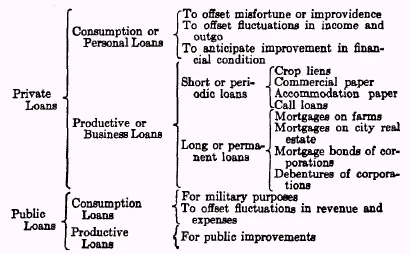
Personal loans are loans of individuals for personal purposes rather than those arising out of business relations. Of these, the first class comprises loans contracted because of misfortune or improvidence. These constitute today a very small fraction of total indebtedness. It Edition: current; Page: [357] was against interest on such loans that the biblical, classical, and medieval prohibitions and regulations were directed, and it is chiefly against interest on such loans that today, in enlightened communities, regulations affecting the rate of interest still survive. It is such loans that supply a large part of the business of pawn shops and of "loan sharks," the patrons of which are too often victims of misfortune or of improvidence.
The theory of interest which has been propounded in this book applies to this species of loan. Sickness or death in one's family, or losses from fire, theft, flood, shipwreck, or other unexpected causes, make temporary inroads upon one's income. It is to tide over such stringencies in income that a personal loan is contracted. It ekes out the inadequate income of the present by sacrificing something from the more adequate income expected in the future. Similar principles apply to the spendthrift, who, though not a victim of accidental misfortune, brings misfortune upon himself. He borrows in order to supplement an income inadequate to meet his present requirements, while he trusts to future resources for repayment. It is evident, therefore, that the loans just described are made by the borrower for the sake of correcting an income stream the time shape of which is unsatisfactory.
The second class of personal loans comprises those growing out of such fluctuations in income as are not due to misfortune or improvidence. Some persons receive their money income in very irregular and unequal installments, while their money outgo may likewise have an irregular time schedule. Unless the two series happen to synchronize, the individual will be alternately "short" and "flush." Thus, if he receives his largest dividends Edition: current; Page: [358] in January, but has to meet his largest expenses, let us say taxes, in September, he is likely to borrow at tax time for the ensuing four months, in anticipation of the January dividends. That is, he borrows at a time when his real income would otherwise be low, and repays at a time when it would otherwise be high. The effect is to level up the fluctuations of his income. He could, of course, proceed in the opposite way, lending in January when "flush" and being repaid in the fall in time to help him when "short" because of tax payments.
In brief, either he borrows, when short, because his degree of impatience, in view of the flush time coming, is higher than the rate of interest, or he lends when flush because his degree of impatience, in view of the lean time coming, is lower than the rate of interest.
The third class of personal loans comprises those which grow out of large expected additions to income or income earning power. Heirs to a fortune sometimes borrow in anticipation of bequests coming to them, the prospect of which excites their impatience. A considerable volume of such loans are made perhaps most often in Great Britain. The borrower under these circumstances borrows so that he can enjoy in the present some of the income which otherwise he would have to wait for. The same motives actuate young men preparing for the earning period of life and explain the loans which are often contracted by them for defraying the expenses of education. It was for such persons that Benjamin Franklin left his peculiar bequests to the cities of Philadelphia and Boston in 1790. To each he bequeathed £1000 to be lent out in small sums at 5 per cent to young married "artificers". The sums repaid, including interest, were to be added to the fund and again lent. Modern building and loan associations Edition: current; Page: [359] are organized to accommodate young couples and others wishing to enjoy good homes in anticipation of their power to pay for them in full. Installment buying, now so widely used to finance the buying of dwellings, furniture, automobiles, radios and other long-lasting instruments, cater to the same desires. They all appeal to young people with small immediate incomes but great expectations for the future.
It is evident that all the foregoing cases, comprising personal loans, are taken care of from the viewpoint of the borrower in the theory of interest; they are all expressions of impatience for greater income expected in the future.
The Theory of Interest
Read the whole book online · Book details
Free to read online and to download from this archive.