
Chapter 19 of 227 · The Theory of Interest by Irving Fisher
§16. Application to this Book
The problem of the rate of interest is entirely a problem of spending and investing, of deciding between various possible enjoyments constituting income, especially between relatively small but immediate enjoyments and relatively large but deferred enjoyments. There is an eternal conflict between the impulse to spend and the impulse to invest. The impulse of a man to spend is caused by his impatience to get enjoyments without delay, and his impulse to invest is caused by the opportunities to obtain by delay relatively more enjoyment either for himself or others.
For the study of interest from this point of view we need as our chief subject matter a picture of a person's income stream. We may get this most clearly by plotting day by day, month by month, or year by year, the closest statistical measure of one's real income, namely, one's cost of living.
If this income flows at a constant rate of $200 a month or $2400 a year, the picture of the income stream is as shown in Chart 1.
If the income stream flows at an increasing rate, the picture is as shown in Chart 2.
If it flows at a decreasing rate, the picture is as in Chart 3.12
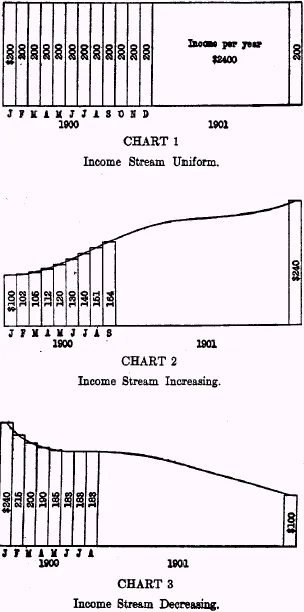
Of course, these particular forms are only special types; numerous other types might be given.
In interest theory the income with which we deal are not statistical records of the past but those of the expected future. What is to be one's future income stream, chosen from among several income streams available, becomes of supreme importance.
The Theory of Interest
Read the whole book online · Book details
Free to read online and to download from this archive.