
Chapter 3 of 16 · Theory of Money and Fiduciary Media by Jörg Guido Hülsmann
1. The Early Evolution of Mises’s Monetary Theory
1
Jörg Guido Hülsmann
The Early Evolution of Mises’s Monetary Theory
The publication of Ludwig von Mises’sTheorie des Geldes und der Umlaufsmittel in 1912 marks a turning point in the history of economics, and of the Austrian School in particular. Mises integrated the theory of money within the framework of the theory of subjective value pioneered by Carl Menger. Based on this foundation he revisited all the great monetary debates of his time and of the preceding century, and weighed in these debates with original and penetrating arguments, each of which he articulated at its proper place within the edifice of an encompassing monetary treatise.
He also made an astounding number of other major contributions, so-to-say in passing. Most notably he developed the general theory of subjective value itself by stressing that value was rooted in choice. He developed a subjectivist typology of money starting from which he delivered a systematic theory of the causes and consequences of money prices. He applied that theory to international relations, thus becoming a pioneer of international monetary economics. He analyzed the pricing process in unorganized markets. He delivered in-depth refutations of the mechanical quantity theory of money, of mechanical price theories, of the index-number method, of Currency School theory, and of Banking School theory. Last but not least, he developed a theory of economic crises, stressing that monetary expansion is likely to entail inter-temporal disequilibria of the structure of production. Side by side with these major contributions, Mises fleshed out various other noteworthy themes. For example, he highlighted particular features of economics as compared to neighboring disciplines such as law or history; and he made several important observations on monopoly theory, on economic calculation, and on the consequences and limitations of government interventionism.
Mises’s monetary thought would remain the backbone of his entire economic theory. Eventually he would articulate it within the larger context of a general theory of human action, but the main theses remained unaltered.[1] The first publication of his treatise in 1912 presented more than a full-fledged theory of money prices. It opened virtually all other major threads of his later work as well, with the notable exception of epistemology.[2] While Mises changed his mind on a certain number of issues (see Gertchev 2004) his theory of money features a remarkable continuity throughout the four decades stretching from the first to the last edition of his treatise.[3] The purpose of the following pages is to highlight the logical structure of his treatise and its chief contributions, as well as the most notable changes made to the second German edition of 1924 and the English edition of 1934.[4]
The Logical Structure of His Treatise
In Theorie des Geldes und der Umlaufsmittel, Mises extended and developed Carl Menger’s (1871, 1892) general approach to economic analysis and the theory of money in particular. Menger had shown that the market prices of economic goods were caused by the subjective marginal value of these goods. However, he had neglected the special case of monetary prices, and well-known critics such as Carl Helfferich and Knut Wicksell had argued that it was impossible indeed to apply the new subjective-value theory to the monetary economy. Mises stepped in to fill this gap with the publication of his Habilitation thesis.
Following in Menger’s footsteps, he set out to explain the causes and consequences of money prices. But he did not simply apply the Mengerian concepts to a special case that hitherto had been neglected. In the first part of the book, he completely revised Menger’s framework itself to lay the foundations for a new theory of money. Most notably, Mises revised the general theory of subjective value and developed a new typology of monetary objects in line with the subjectivist approach. He also stressed the methodological importance of that approach. All economic phenomena had to be traced back to individual decision-making, lest the analysis be vitiated and lead to wrong conclusions. Let us highlight these contributions in some more detail.
New Foundations for the Theory of Money and Banking
Mises stressed that a correct causal analysis of market prices requires tracing the explanation back to individual human behavior. Again and again, at crucial junctures of his argument, he emphasized that aggregate considerations lead into error, and that a correct causal analysis of the pricing process must start from individual choices. For example, discussing one of Helfferich’s contentions, Mises stated:
The error in this argument is to be found in its regarding the utility of money from the point of view of the community instead of from that of the individual. . . . All consideration of the value of money must obviously presuppose a state of society in which exchange takes place and must take as its starting point individuals acting as independent economic agents within such a society, that is to say, individuals engaged in valuing things.[5]
Mises did not just apply the theory of subjective value that he had received from Menger and Böhm-Bawerk. Rather, he purged that theory from all elements of cardinal value, respectively cardinal utility, and stressed the ordinal nature of subjective value, which springs from human choices.[6]
Moreover, right from the first edition of his book, Mises repeatedly emphasizes that human action takes place in a context of uncertainty (see for example, A6, A117, A162, A182) and points out that the very existence of money is premised on this fact. Indeed, people want “to hold a sum of money in reserve against unforeseen and indefinite expenditure. (A349, C338). Most importantly, human choice respectively, subjective value is itself one source of uncertainty. The relative impact of any cause of an exchange ratio is mediated through the individual value judgements. Quantitative factors therefore never have a constant impact on market prices. For example, the apple price might remain constant even in the presence of changes in the apple stock and the money stock, if the value judgements of buyers and sellers offset these changes. Similarly, the apple price might change even though both the apple stock and the money stock remain constant. In Mises’s words:
. . . in monetary theory, as in every other branch of economic investigation, it will never be possible to determine the quantitative importance of the separate factors. Examination of the influence exerted by the separate determinants of prices will never reach the stage of being able to undertake numerical imputation among the different factors. All determinants of prices have their effect only through the medium of the subjective estimates of individuals; and the extent to which any given factor influences these subjective estimates can never be predicted.[7]
In short, there are no constant relationships between market prices (A216, A471). This entails the related impossibility to measure any variations of the purchasing power of money (PPM). The causal analysis of economic theory traces the change in the exchange ratio between any two goods—money included—back to the demand for and supply of the two goods, and from there to their subjective values. But this theoretical analysis can never establish how much of the observed change was due to which cause. It can never make a quantitative determination. Hence, the demand for money and the impossibility to measure the purchasing power of money both have their origin in the pervasive fact of uncertainty.
Mises therefore questioned the usefulness of quantitative methods in economic analysis. He eventually acknowledged that index numbers can “perform useful workaday services for the politician” if they are based on “points of time that lie close to one another.”[8] But he always rejected outright the possibility to demonstrate any contention about causes and consequences with statistical or other quantitative methods.[9]
The subjectivist approach which Mises had adopted from Menger led him straight to a new classification of monetary goods. In order to explain money prices as resulting from individual choices, it is necessary to consider how individuals evaluate the different monetary economic goods when they exchange them against non-monetary economic goods. Mises stressed that, while this evaluation process has certain general features, there are also categorical differences in the evaluation of different types of money. These differences do not stem from the physical characteristics of the goods, but from man-made differences rooted in legislation, contracts, and business practice.[10]
Mises’s classification of money relies on the fundamental distinction between money—respectively money proper[11]—and money substitutes. This economic distinction must not be confused with the physical characteristics of the respective monetary objects. A paper note can be a money substitute, but it can also be fiat money, depending on whether it is redeemable into some other economic good that serves as money. Gold coins or silver coins are not per se money proper, but can also be money substitutes if redeemable into some other economic good that serves as money. Token coins are not a separate form of money, but are a metallic form of money substitutes.[12]
As far as money proper is concerned, Mises distinguished three forms: commodity money (including precious metals), fiat money, and credit money (see A43–48). In all three cases, the monetary object is evaluated in its own right. It is wrong, therefore, to interpret money in general as a claim or as an “assignment” to some other good.[13] While some monetary goods are indeed claims, money itself is not by its very nature a claim. It can be used to bid for other goods in market exchanges. But, unlike a claim, money proper cannot be redeemed into other goods.[14]
Yet there are monetary objects that are truly claims on something else—namely, on money proper respectively money in the narrow sense—and which can therefore be evaluated as though they were money. They are “money substitutes.” Regarding such money substitutes, he stressed the difference between fully covered substitutes, which he called “money certificates,” and substitutes without any coverage, which he called “fiduciary media.”
The upshot of these distinctions is that fiduciary media feature a number of very particular causes and consequences.[15] Most notably, while the production of money proper or of money certificates is costly and therefore constrained within fairly narrow limits, fiduciary media are essentially costless to produce and can therefore in principle be produced in unlimited amounts. Their production is constrained in practice only because of accidental circumstances such as a lacking coordination among banks or legal interference. Most importantly, the creation of fiduciary media tends to bring about economic crises, whereas no such consequence results from an increase of the supply of money proper or of money certificates. To highlight these very particular features of fiduciary media was a central achievement of Mises’s book. This was also reflected in its title, which in a literal translation reads Theory of Money and Fiduciary Media.[16]
In the second part of his book, Mises set out to analyze the causes and consequences of the “value of money” in general. He did so by presupposing hypothetically that all money substitutes were fully covered by money. In other words, he assumed there would be no fiduciary media at all. In the third part, he would drop this assumption and turn to study the particular features of “fiduciary media and their relationship to money.” He pointed out (A145, A206, B407) that this procedure had already been the methodological approach of the Currency School, which based its reasoning on the hypothesis of a “purely metallic currency” in comparison to which it had analyzed the impact of banknotes.
The Value of Money
The second part of the Theorie des Geldes und der Umlaufsmittel deals with the “value of money” (Geldwert). This expression is shorthand for the cumbersome Mengerian concept of the “inner exchange value of money.”[17] Following the classical economists and Thomas Malthus in particular, Menger developed his monetary analysis starting from the concrete phenomenon of money prices.[18] He contended that the latter were directly determined by four factors: the demand for and supply of the non-monetary goods that were being traded for money; and the demand for and supply of money itself. All four factors colluded to entail the concrete purchasing power of money (PPM), which Menger called the “outer exchange value” (äusserer Tauschwert) of money. But from an analytical point it was possible to single out the monetary conditions (demand for and supply of money) and call their impact on the PPM the “inner exchange value” (innerer Tauschwert). Conceptually, according to Menger, it was even possible to stabilize the latter, whereas the stabilization of the PPM presupposed comprehensive government price controls.[19]
Somewhat reluctantly, Mises endorsed this terminology.[20] It was a fateful choice. With it came the heavy baggage of the analytical focus on the exchange value of money. With it too came the unfortunate focus on the possible stability of monetary conditions. And last but not least, it risked entailing utter confusion in Mises readers, especially in those who became acquainted with his thought only through the English edition, for the nuance of the distinction between the exchange value of money and the “inner” exchange value of money was dropped in that edition. As a consequence, the Mengerian-Misesian vocabulary—especially “inflationism,” “monetary policy,” “inflation,” and “deflation”—was inaccurately translated.
Thus, Mises defines inflation as “an increase in the quantity of money (in the broader sense of the term, so as to include fiduciary media as well), that is not offset by a corresponding increase in the need for money (again in the broader sense of the term), so that a fall in the inner objective exchange value of money must occur.”[21] The same problem pertains to the entire final chapter of the second part of his book—the one dealing with “monetary policy”—in which Mises studies government interventions designed to influence the inner exchange value of money. Indeed, the original German title of that chapter is Geldwertpolitik (Policy designed to influence the value of money), and Mises defines it as follows: “Questions of currency policy are questions of the inner objective exchange value of money.”[22]
Causes and Consequences of the Value of Money
Mises found that the traditional literature on the purchasing power of money (PPM) had entirely focused on analyzing the impact of changes in the supply of and demand for money. But before even getting to this question it was necessary to explain the level of PPM in the first place. Only in a second step could one set out to explain the transition from one level to another. Mises provided this missing foundational analysis, highlighting the central role of the subjective value of money and formulating what he would later call the “regression theorem.” He argued that the PPM is directly determined by the subjective value of money—that is, the relative importance of money as compared to the non-monetary goods for which it is being exchanged, in the eyes of all the partners to these exchanges. Thus the subjective value of money explains the equilibrium level of the PPM.
Mises refuted the objections formulated by Wicksell and Helffering against the very possibility of this approach, stressing that they had analyzed the PPM from an overall point of view, whereas the pricing process could only be adequately understood by adopting the subjective point of view of the exchange partners. The subjectivist approach was not unproblematic. The central difficulty was the interdependence between the subjective value of money (SVM) and the PPM. Money was valuable because it had purchasing power, but the purchasing power resulted from the SVM. This seemed to be an instance of circular reasoning, not of causal analysis. But Mises could solve this problem by developing an explanation which he found in Wieser: SVM and PPM did not determine one another simultaneously—which would have precluded causal analysis—but diachronically. Today’s SVM determined today’s PPM, which in turn determines tomorrow’s SVM, which determines tomorrows PPM, etc.[23]
Mises then proceeded to analyze the consequences of changes in the demand for and supply of money. He first dealt with their impact on money prices, especially the price level, and then with their impact on the production and distribution wealth and income. He concluded this part of the book by discussing the policy implications of his findings. Let us highlight his chief contributions in turn.
Concerning the impact of changes in the demand for and supply of money on the price level, Mises made three contributions. First he delivered a subjectivist interpretation of the quantity theory of money, arguing that the money supply and the price level were positively correlated, but stressing at the same time that this relationship was not mechanical. There was no fixed quantitative relationship between an X% variation of the money supply and some Y% variation of the price level.
Second, then, Mises delivered an in-depth critique of the most important variants of the traditional rigid quantity theory, refuting the conceptions of Hume, Mill, and Fisher. Most notably, he argued that, even if one fictitiously assumed that increases in the money stock had no impact on the distribution of wealth and income, such increases would still modify individual value scales and therefore entail a different price structure than the one that had existed before. While the marginal value of money would diminish for each individual, it would not diminish in exactly the same proportion.[24] Again, the mechanical quantity theory does not apply. In the 1924 edition (C168, B126f.), Mises added an additional paragraph to clarify this argument:
If we compare two static economic systems, which differ in no way from one another except that in one there is twice as much money as in the other, it appears that the purchasing power of the monetary unit in the one system must be equal to half that of the monetary unit in the other. Nevertheless, we may not conclude from this that a doubling of the quantity of money must lead to a halving of the purchasing power of the monetary unit; for every variation in the quantity of money introduces a dynamic factor into the static economic system. The new position of static equilibrium that is established when the effects of the fluctuations thus set in motion are completed cannot be the same as that which existed before the introduction of the additional quantity of money. Consequently in the new state of equilibrium the conditions of demand for money, given a certain exchange value of the monetary unit, will also be different. If the purchasing power of each unit of the doubled quantity of money were halved, the unit would not have the same significance for each individual under the new conditions as it had in the static system before the increase in the quantity of money. All those who ascribe to variations in the quantity of money an inverse proportionate effect on the value of the monetary unit are applying to dynamic conditions a method of analysis that is only suitable for static conditions.
Third, he discussed various complications, considering most notably the impact of changes in the demand for money on the PPM (neglected in the traditional theory), as well as inter-local price differences (he denied that they could exist in equilibrium) and the theory of exchange rates (he resuscitated Ricardo’s purchasing-power-parity theorem).
Mises here also briefly touches upon the impact of changes in the demand for and the supply of money on interest rates, but does not yet present his views on the matter, which would have led him to discuss his business cycle theory already in this second part of the book (where it in fact belonged from a systematic point of view). He merely points out that, traditionally, the problem of the purchasing power of money had been completely neglected in inter-temporal exchanges, both by theoreticians and by investors and other practitioners.[25]
Mises proceeded to study the impact of changes in the demand for and supply of money on the production and distribution of wealth and income. Here he emphasizes right from the outset, and then repeatedly throughout the remainder of the book, that there is no relationship between the money supply and aggregate output. Increases of the money supply do not spur, and decreases of the money supply do not hamper the production of wealth. The first time he brings up this point is in the context of his discussion of the general differences between money and all other goods. Here he states:
Both changes in the available quantity of production goods or consumption goods and changes in the available quantity of money involve changes in values; but whereas the changes in the value of the production goods and consumption goods do not mitigate the loss or reduce the gain of satisfaction resulting from the changes in their quantity, the changes in the value of money are accommodated in such a way to the demand for it that, despite increases or decreases in its quantity, the economic position of mankind remains the same. An increase in the quantity of money can no more increase the welfare of the members of a community, than a diminution of it can decrease their welfare.[26]
Thus right from the outset he makes three fundamental points. One, the real money supply (the aggregate purchasing power of all cash balances) tends to adjust to the real demand for cash balances. Two, as a consequence, the nominal money supply is irrelevant for the services provided by money. Three, as a further consequence, changes in the nominal money supply are equally irrelevant for those services. Only under exceptional circumstances could an increase of the nominal money supply, directly or indirectly, bring about advantages from the overall point of view. Increases of the money supply usually did not tend to increase the supply of consumers’ goods (see A227, A335). They had just an impact on the distribution of those goods. Mises reiterated this point again and again as the starting point for all reflection on the social effects of money.[27]
However, Mises stressed almost in the same breath that any change in monetary conditions (demand for and supply of money) affects the distribution of income and wealth. In other words, although there is no causal relationship between the money supply level on the one hand and aggregate production on the other hand, any change in that level, and any change in the demand for money, entails a redistribution of real incomes and therefore also a redistribution of wealth. The reason is that any such change does not affect all prices at the same time and to the same extent. For example, the first users of newly produced money units tend to gain real revenue at the expense of later users, because they can spend these new units right away, while their purchasing power is still relatively high; whereas the later users have to spend them when their purchasing power has already somewhat decreased. These causal relations also play out in the international sphere and affect trade patterns and capital flows.
Based on these elements, Mises concludes the second part of his Theorie des Geldes und der Umlaufsmittel with an in-depth discussion of the nature and scope of monetary policy. He starts off by distinguishing between traditional and modern monetary policy (A246, B200). Traditional interventionism, which involved most notably the depreciation of silver and gold coins, had a purely fiscal motivation. By contrast, modern monetary policy does not necessarily have such a motivation. Rather, its characteristic feature is the hypothesis that changes in the “inner objective exchange value of money” (IOEVM)—especially a decreasing IOEVM—are beneficial. The explanation why they are beneficial varies from one author to another, but the common conviction is that such benefits exist.[28] Thus modern monetary policy is from the outset at crossroads with classical economics à la Ricardo, which rejected the notion that the value of money had anything to do with the wealth of nations. Modern monetary policy seeks to pursue its objectives by modifying the money supply. This presupposes that the modification of the money supply is technically feasible in the first place. It follows, therefore, that the most important tool of modern monetary policy is the choice of the kind of money to be used within the country. In Mises’s words:
The principal instrument of monetary policy at the disposal of the state is the exploitation of its influence on the choice of the kind of money. It has been shown above that the position of the state as controller of the mint and as issuer of money substitutes has allowed it in modern times to exert a decisive influence over individuals in their choice of the common medium of exchange. If the state uses this power systematically in order to force the community to accept a particular sort of money whose employment it desires for reasons of monetary policy, then it is actually carrying through a measure of monetary policy. . . . If a country has a metallic standard, then the only measure of currency policy that it can carry out by itself is to go over to another kind of money. It is otherwise with credit money and fiat money.[29]
The remainder of the chapter on monetary policy has undergone the most momentous changes in the second edition. We will highlight these changes in a subsequent section. In what follows we shall take a closer look at the flow of his initial argument, as presented in the first edition.
Policy Designed to Influence the Value of Money
In the first edition, Mises had approached the actual practice of monetary policy in a very peculiar manner. His discussion is very largely carried on from a historical point of view, and the policy conclusions almost appear as generalizations from the empirical record. This approach was probably motivated by the fact that the book was supposed to earn him a Habilitation degree. Mises had to demonstrate thorough acquaintance with the historical aspects of his field. But he also had to avoid antagonizing his examiners. A straightforward theoretical approach—in line with the previous chapters, as well as with the later ones—would have put his libertarian policy conclusions in stark relief and thus might have compromised his success. As a consequence, the thirteenth chapter of the first edition clashes in style and content with the rest of the book. On these pages Mises writes more like Adam Smith, rather than like Ricardo. The result is pleasant to read and contains many intellectual gems. In what follows we will largely focus on the elements pertaining to causal analysis.
In sections 3 and 4 of chapter 13 (§§3 and 4 of part two, chapter seven in the German editions) Mises presented a very detailed analysis of the history of deflationary (“restrictionist”) and inflationary policies. He especially focused on the nineteenth century, as well as on the history of thought relating to these policies. Mises first deals with the deflationary policies of Austria-Hungary (section 3, A251–58) and then delivers a theoretical explanation of the unpopularity of such policies in general.[30] He argued that the lacking popularity of such policies was essentially due to two factors. One, deflationist policies are usually applied only in a part of the world economy, but this implies that the exports of this country will diminish, while its imports increase—a highly unpopular result. Two, such policies are not advantageous for the ruling classes. Rather, they benefit creditors and “policies favoring creditors at the expense of debtors have never been popular. Lenders of money have been held in odium, at all times and among all people.”[31]
Next (section 4) he turns to the history of inflationary policies, first dealing with the case of England (A264–68), then with the British colonies in North America and with the United States (A268–76), and finally with continental Europe (A276–79). Remarkably, Mises barely mentions the motivations for these policies, deeming them unworthy of discussion. By contrast, he stresses that the actual driving force of such policies was in fact not to be found in theoretical arguments, but rather in the observed stimulation of the economy that had resulted from them (A267).
He goes on (section 5) to discuss the case for inflationism and starts off with the observation that such a policy does not work one time for all, because its effects are only temporary (A279f.). It is therefore necessary to constantly reduce the IOEVM in order to realize the desired objectives. But this is not possible in practice, for three reasons (A280–86). One, the necessary knowledge about quantitative causal relations does not exist. Two, an inflationary policy would invariably wet the appetites of special-interest groups and thus be pushed to exaggerated levels. Three, such a policy would entail disadvantages in respect to international economic relations.
This result seems to suggest that the ideal monetary policy should seek to stabilize the IOEVM.[32] But Mises refutes this conclusion with four related arguments (A287f.). One, such a policy could only be carried out with the help of fiat money and it would require permanent interventions. Two, the quantitative knowledge necessary to carry it out does not exist. Three, special-interest groups would constantly try to exploit this lack of knowledge to their advantage. Four, inflationary policy invites abuse by the state.
What is, then, the best monetary policy? Mises presents a surprising solution—surprising because nothing in his previous argument had prepared it. He argues that in light of his previous considerations “the state should at least refrain from exerting any sort of influence on the value of money. A metallic money, the augmentation or diminution of the quantity of metal available for which is independent of deliberate human intervention, is becoming the modern monetary ideal.”[33] He adds: “The significance of adherence to a metallic-money system lies in the freedom of the value of money from state influence that such a system guarantees.”[34]
Causes and Consequences of Fiduciary Media
Mises’s discussion of monetary policy concludes the second part of his book, which deals with the causes and consequences of the inner exchange value of money in general. In the subsequent third part, he turns to the particular characteristics of the demand for and supply of fiduciary media.
The entire third part can be read as one long, systematic, and exhaustive commentary on the great nineteenth century debate between the Currency School and the Banking School. It has not the form of a commentary, though, but of a treatise. Mises walks his readers through the six great questions under contention: (1) the nature of fiduciary credit, respectively the difference between genuine (commodity) credit and (false) fiduciary credit; (2) the question whether the production of fiduciary media has any limits, and which; (3) the crucial question whether the production of fiduciary media tends to be elastic in the sense that it would accommodate changes in the demand for money; (4) the role of bank reserves for maintaining the redemption of fiduciary media into species; (5) the dis-equilibrating nature of fiduciary media; (6) the appropriate policy to deal with them.
Mises had announced this discussion right from the preface to the first edition (not translated into English). There he wrote that the theory of banking was in a less satisfactory state than the theory of money (which could rely on the works of Menger and Wieser), even though the writings of the classical economists had provided remarkable elements, which in turn had been elaborated by the Currency School. The basic shortcoming of that school was that it lacked a solid foundation; it lacked the modern theory of value. Mises went on to declare:
Some of its errors have been rightly criticised by Tooke and Fullarton. But what the latter two have put at the place of the currency theory is not a useful theory at all. The banking theory does not just contain errors, it goes wrong in the very way it states the problem.[35]
In the second part of the book, Mises had criticized one important element of the Banking School doctrine, namely, its contention that changes in money hoarding tended to neutralize the impact of changes in the money supply on the price level, and that therefore the quantity theory did not hold (see A160–65). Now he brought his critique full circle, refuting Fullarton’s and J.S. Mill’s contention that owning a banknote means granting credit to the bank (A311, C304f.), as well as the “law of reflux” (A355, C342) and other elements of the doctrine pioneered by Tooke and Fullarton. He concluded (A408f., C383f.):
The fatal error of Fullarton and his disciples was to have overlooked the fact that even convertible banknotes remain permanently in circulation and can then bring about a glut of fiduciary media the consequences of which resemble those of an increase in the quantity of money in circulation. Even if it is true, as Fullarton insists, that banknotes issued as loans automatically flow back to the bank after the term of the loan has passed, still this does not tell us anything about the question whether the bank is able to maintain them in circulation by repeated prolongation of the loan. The assertion that lies at the heart of the position taken up by the Banking School, namely, that it is impossible to set and permanently maintain in circulation more notes than will meet the public demand, is untenable; for the demand for credit is not a fixed quantity; it expands as the rate of interest falls, and contracts as the rate of interest rises. But since the rate of interest that is charged for loans made in fiduciary media created expressly for that purpose can be reduced by the banks in the first instance down to the limit set by the marginal utility of the capital used in the banking business, that is, practically to zero, the whole edifice built up by Tooke’s school collapses.
Mises went on to state that, in distinct contrast to the overrated Banking School, “the works of the much abused Currency School contain far more in the way of useful ideas and fruitful thoughts than is usually assumed . . .” (A409, C384).
He himself had highlighted the shortcomings of the Currency School in due detail. Its champions had based their reasoning about money prices on a mechanical interpretation of the quantity theory. In analyzing the production of fiduciary media, they had considered only the problems for independent groups of banks increasing its issues while some other banks did not follow suit, thus neglecting the fundamental theoretical question whether those problems could be overcome by a generalized expansion of the money supply through all banks at the same time (see A421, C393). Thus they were unable to come to grips with the question whether credit could be costless—which in his eyes was “the chief problem in the theory of banking.[36]
Most importantly, however, the Currency School had failed to recognize that demand deposits and banknotes shared the same economic nature (see A438f., C407). In other words, it had remained stuck at the surface of visible phenomena, whereas the relevant essential differences were those between covered and uncovered money substitutes, irrespective of the physical embodiment.
But even this central shortcoming “is of small significance in comparison with that made by the banking principle” (A439, C408). Right from the first edition of his book, therefore, Mises endorsed both the basic methodological approach of the Currency School (comparative analysis of a purely metallic currency relative to a currency consisting of fiduciary media) as well as its central policy prescription (stopping the further creation of fiduciary media). He himself developed the theory of the Currency School and integrated it into the Mengerian approach. In 1912 as in his later publications on money and banking, he would highlight the central importance of the Currency School as a forerunner of his own thought.
The most famous element that Mises added to the theoretical edifice of the Currency School was his business cycle theory, presented in a chapter on “Geld, Umlaufsmittel und Zins” (Money, Fiduciary Media, and Interest). This theory was Mises’s answer to the fundamental question whether credit could be gratuitous. It was the crowning achievement of the third part of his book.
Mises begins with a discussion of the causes of monetary interest, continuing the analysis begun in the second part. His analysis starts most notably from Böhm-Bawerk’s conception, according to which inter-temporal subjective values determine the size of the subsistence fund, which in turn determines the interest rate.[37] Another starting point is Wicksell’s distinction between natural interest and monetary interest.[38] Mises first focuses on the impact of money in the narrow sense on interest rates, making three related claims: (1) There is no constant direct relationship between the supply of and demand for money on the one hand, and the interest rate on the other hand. (2) Neither is there any direct relationship between changes in monetary conditions and changes in the interest rate.[39] (3) However, monetary conditions and the interest rate are indirectly related, because changes in the demand for and supply of money affect the distribution of incomes and wealth, and thereby also affect the interest rate. Thus Mises concludes the analysis of the social consequences of a changing value of money, which he had begun in chapter 12 (chapter 6 of the second part).
After these preliminary clarifications, he turns to analyzing fiduciary media. Here he raises the same basic question as before, namely, whether there is any relationship between the supply of and demand for fiduciary media on the one hand, and the interest rate on the other hand. Most importantly, was it possible, by increasing the supply of fiduciary media, to bring the interest rate down to zero? In Mises words (A417, B360, C390):
It is indisputable that the banks are able to reduce the rate of interest on the credit they grant down to any level above their working expenses (for example, the cost of manufacturing the notes, the salaries of their staffs, etc.). If they do this, the force of competition obliges other lenders to follow their example. Accordingly, it would be entirely within the power of the banks to reduce the rate of interest down to this limit, provided that in so doing they did not set other forces in motion which would automatically re-establish the rate of interest at the level determined by the circumstances of the capital market, that is, the market in which present goods and future goods are exchanged for one another. The problem that is before us is usually referred to by the catch-phrase “gratuitous nature of credit.” It is the chief problem in the theory of banking.
He went on to discuss the three principal answers to this question that could be found in the literature (see A418–24). The first answer was the one of the money cranks, which asserted that, indeed, credit could be gratuitous if only the money supply was sufficiently increased. The second answer was the one of the Banking School. Its answer was to say that the problem did not exist. It was impossible to increase the money supply beyond the needs of trade. Therefore, the interest rate could not fall to zero. The third answer came from Knut Wicksell. He argued (a) that commercial banks would sooner or later be concerned about the redemption of their issues, and (b) that as a consequence of the increase of the overall money supply, the price level would increase, and therefore also the price of gold. Thus sooner or later people would start redeeming their fiduciary media into gold and the banks then had to stop issuing them. Mises replied that argument (b) only concerned commodity-money systems, but not fiat-money systems, and that argument (a) contradicted Wicksell’s own assumption, namely, that money had been entirely replaced by fiduciary media.
Mises answer was different. He argued that the increase of the supply of fiduciary media entailed an inter-temporal disequilibrium that put the entire economy on an unsustainable path. In his words:
Now if the rate of interest on loans is artificially reduced below the natural rate as established by the free play of the forces operating in the market, then entrepreneurs are enabled and obliged to enter upon longer processes of production.[40]
. . . The situation is as follows: despite the fact that there has been no increase of intermediate products and there is no possibility of lengthening the average period of production, a rate of interest is established in the loan market which corresponds to a longer period of production; and so, although it is inadmissible and impracticable from an overall point of view, a lengthening of the period of production becomes at first profitable. But there cannot be the slightest doubt as to where this will lead. A time must necessarily come when the means of subsistence available for consumption are all used up although the capital goods employed in production have not yet been transformed into consumption goods. This time must come all the more quickly inasmuch as the fall in the rate of interest weakens the motive for saving and so slows up the rate of accumulation of capital. The means of subsistence will prove insufficient to maintain the laborers during the whole period of the process of production that has been entered upon.[41]
Sooner or later, therefore, it will be impossible to continue the investment projects that have been begun under the impact of the initial expansion of the money supply. Further expansions, even if pursued with utmost determination, can only delay, but not prevent the eventual outbreak of the crisis (see A436, B375, C404).
In the light of these considerations, Mises comes to endorse his policy conclusions in the last chapter of the third part of his book, dealing with the “Legal limitation of the issue of fiduciary media and discount policy,” as well as in the final fourth part giving an “Outlook into the future of money and fiduciary media.”[42] The central point of his position is the recommendation to outlaw the issue of any further fiduciary media.
Mises does not recommend outlawing any and all fiduciary media, but only further issues. The reason is that the disappearance from one day to another of all fiduciary media would have a very strong deflationary impact on the price level and thus on the distribution of income and wealth (see A376–79).
Mises opposes further issues of fiduciary media, first because they lead to price inflation and thus also to a redistribution of incomes and wealth; second, and most importantly, because they inevitably lead to wasteful boom-bust cycles and, in fact, to the ultimate destruction of the monetary and banking system.[43] He recommends outlawing any such further issues because he does not think that competition between fractional-reserve banks is a sufficient bulwark against the virtually unlimited expansion of fiduciary media. He acknowledges that competition slows down this expansion:
So long as the banks do not come to an agreement among themselves concerning the extension of credit, the circulation of fiduciary media can indeed be increased slowly, but it cannot be increased in a sweeping fashion. Each individual bank can only make a small step forward and must then wait until the others have followed its example. Every bank is obliged to regulate its interest policy in accordance with that of the others.[44]
However, the banks have a very strong self-interest in coming to an agreement. In practice the coordination between commercial banks has been promoted by governments and central banks. But even without such political support, the banks would eventually work out an agreement anyway.[45] The long-run implication is patent: “The quantity of fiduciary media in circulation has no natural limits. If for any reason it is desired that it should be limited, then it must be limited by some sort of deliberate human intervention—that is by banking policy” (A360, C346). Mises therefore recommends a monetary reform in the spirit of Peel’s Act, with the explicit objective of suppressing “all further issues of fiduciary media.” In his words: “The basic conception of Peel’s Act ought to be restated and more completely implemented than it was in the England of his time by including the issue of credit in the form of bank balances within the legislative prohibition” (A473, B418, C447). This was his bottom-line and conclusion from the first German edition of 1912 to the last American edition of 1953.
Important Changes in the Second Edition
While the essence of Mises’s argument, as outlined above, remained unchanged between the first (1912) and the second edition (1924), he made a certain number of substantial changes to various elements of his treatise.[46] While some of these changes are of a purely theoretical nature and unrelated to personal experience, most of them do reflect the progression of his thought resulting from personal confrontation with the disastrous events of the war economy, of the Austrian (1922) and German (1923) hyperinflations, as well as of communal and national experiments with socialist policies, both abroad and in his hometown of Vienna. In what follows we shall highlight four major areas of changes.
Value Theory
The 1912 edition contained a mixed value theory including both praxeological and psychological elements. Following the psychological conception of value as it was prominent at the time in the writings of Jevons, Wieser, and Böhm-Bawerk, Mises declared that the ultimate foundation of market prices was in human psychology (see A118), that demand and supply sprang from the pleasure and pain associated with owning those goods (A301f.). Subjective value itself was characterized as a “feeling” (A16). Human action sprang from “economic motives” on the one hand, but also from other, non-economic motives; and accordingly there were also economic and non-economic prices.[47]
However, on the other hand, right from that first edition he also emphasized the strictly praxeological dimension of value, which sprang from acts of judgement and choice.[48] By the time of preparing the second edition, he must have come to realize that these two conceptions were unhappy bedfellows and he purged his argument from the psychologizing elements (see Hülsmann 2007, pp. 591f.).
Business Accounting and Anticipations
One of the topics that Mises dealt with in more detail as from the second edition is the significance of variations in the PPM for business accounting. In particular, such variations would have to be considered in evaluating non-monetary assets (Sachgüter) and in write-downs, as well as in the profit-and-loss-statement, lest capital would be consumed.[49] Mises was possibly the first economist to draw attention to this completely neglected problem in the aftermath of WWI.[50] By 1924, hyperinflations had ravaged both Austria and Germany, and in both cases had dramatically reinforced capital consumption. Switching to gold prices as the basis for business accounting could provide an antidote. However, this presupposed that the gold standard had not itself been depreciated.[51]
Already in the first edition, Mises had pointed out that inflation was bound to induce capital consumption because it compromised the accuracy of business accounting. Now he added that capital consumption was likely to result, too, when creditors anticipated the decline of the value of money. Mises stated:
Depreciation of money can benefit debtors only when it is unforeseen. If inflationary measures and a reduction of the value of money are expected, then those who lend money will demand higher interest in order to compensate their probable loss of capital, and those who seek loans will be prepared to pay the higher interest because they have a prospect of gaining on capital account. . . . And if those who were seeking credit were inclined to refuse to pay this additional compensation, the diminution of supply in the loan market would force them to it. . . . [T]he more the development of capitalism has made money loans (bank and savings-bank deposits and bonds, especially bearer bonds and mortgage bonds) the most important instruments of saving, the more has depreciation necessarily imperiled the accumulation of capital, by decreasing the motive for saving.[52]
A few pages later, Mises explained that such anticipations might completely offset any and all economic policy. Fifty years before Friedman and Lucas, Ludwig von Mises articulated the essential conclusions of the so-called rational-expectations theory, yet without falling into the exaggeration of that later theory. He wrote that individuals had the power to “eliminate” the consequences of policy-induced changes in the value of money if they “clearly recognize that the purchasing power of money is constantly sinking and act accordingly” (B210, C257f.). He went on:
If in all business transactions they allow for what the objective exchange value of money will probably be in the future, then all the effects on credit and commerce are finished with. In proportion as the Germans began to reckon in terms of gold, so was further depreciation rendered incapable of altering the relationship between creditor and debtor or even of influencing trade. By going over to reckoning in terms of gold, the community freed itself from the inflationary policy, and eventually even the government was obliged to acknowledge gold as a basis of reckoning.
Right from the first edition of his treatise, Mises had realized that anticipations were an essential element in all pricing processes. He had occasionally highlighted this fact, yet without giving it any systematic consideration. For example, we find the following intriguing statement in the chapter dealing with the social consequences of changes in the exchange value of money:
He who makes long-run contracts without including provisions against falling or rising prices, and without hedging himself on the financial-futures market, will be significantly hurt by any ex-post change in price which he did not anticipate and reckon for.[53]
This sentence was deleted in the 1924 edition, probably because Mises then set out for a more in-depth discussion in chapter 12. There we find the following passage, added to the 1924 edition:
. . . so long as continued depreciation is to be reckoned with, those who lend money demand higher rates of interest and those who borrow money are willing to pay the higher rates. If, on the other hand, it is expected that the value of money will increase, then the rate of interest will be lower than it would otherwise have been.[54]
Referring to J.B. Clark, Mises drew the conclusions:
Thus if the direction and extent of variations in the exchange value of money could be foreseen, they would not be able to affect the relations between debtor and creditor; the coming alterations in purchasing power could be sufficiently allowed for in the original terms of the credit transaction.[55]
These thoughts imply, ultimately, that the analytical focus on the exchange value of money and on the stability of that exchange value—a focus inherited from classical economics—was an intellectual dead end. It did not matter whether the price level increased or decreased. The problems of price-inflation and price-deflation—respectively of increases and decreases of the “inner” exchange value of money—were secondary both in practice and for economic theory. The true problems pertained to the creation of money. Who should be authorized to produce money? Which limitations came into play? Which consequences followed from excessive money production?
Starting in the 1920s, Mises slowly made that shift in analytical focus. The second edition of his monetary treatise was an important milestone, followed by Geldwertstabilisierung und Konjunkturpolitik (1928), then by his great treatises Nationalökonomie (1940) and Human Action (1949), and finally by the fourth part that he added to the 1953 first American edition of Theorie des Geldes und der Umlaufsmittel. Here Mises makes a case for “monetary reconstruction” aiming at the re-establishment of an effective gold coin circulation, just as he had already done in 1924. But the argument he presents does no longer revolve around the inner or outer exchange value of money. His emancipation from the value theory of the classical economists was finally complete. And thus he reinforced the classical case for sound money.
Monetary Policy
In the second edition, Mises deleted more than 20 pages dealing with deflation and inflation from a historical point of view, and added some 10–15 pages full of new considerations. He now approached his subject from a theoretical point of view and presented a series of hard-hitting arguments and conclusions. Meanwhile he had lived through WWI and through a hyperinflation in Austria. He had witnessed the even more catastrophic hyperinflation in Germany. He had refined his thoughts on a good number of elements of economic analysis[56] as well as his social philosophy in general. He had published Nation, State, and Economy (1919a) as well as his magnificent treatise Socialism (1922). All of these elements came to be reflected in the new edition. He completely rewrote the monetary policy chapter[57] and he added a new chapter on the monetary policy of statism.
Mises devoted particular attention to the argument of those who held that inflation had to be accepted as the collateral effect of the fiscal use of the printing press; it was the lesser of two evils. This argument had been at the heart of monetary policy in Germany and Austria during and after WWI. The governments of the two countries did not have enough tax revenues to cover their expenditure. Neither could they obtain new credits at interest rates that were affordable to them. Therefore, they used the printing press to cover the public deficit.[58] Rebutting this argument, Mises raised the question why it would be the case that government could not obtain revenue through taxation or credit. This is his answer:
A government always finds itself obliged to resort to inflationary measures when it cannot negotiate loans and dare not levy taxes, because it has reason to fear that it will forfeit approval of the policy it is following if it reveals too soon the financial and general economic consequences of that policy. Thus inflation becomes the most important psychological resource of any economic policy whose consequences have to be concealed; and so in this sense it can be called an instrument of unpopular, that is, of antidemocratic, policy, since by misleading public opinion it makes possible the continued existence of a system of government that would have no hope of the consent of the people if the circumstances were clearly laid before them. That is the political function of inflation. It explains why inflation has always been an important resource of policies of war and revolution and why we also find it in the service of socialism. When governments do not think it necessary to accommodate their expenditure to their revenue and arrogate to themselves the right of making up the deficit by issuing notes, their ideology is merely a disguised absolutism.[59]
Mises also analyzed in great detail the adjustment of market participants to a strongly inflationary environment, emphasizing the inner dynamics of this process which ultimately destroyed the monetary system or, more precisely, the replacement of the inflationary fiat money with commodity money.[60] Indeed, permanent inflation was not likely to merely entail an increase of the price level. It would also motivate the market participants to abandon the inflationary money and turn to using other monies—natural monies such as gold and silver coins, or foreign fiat money that was not plagued by inflation. The final station in this process was currency reform through the market:
The collapse of an inflation policy carried to its extreme—as in the United States in 1781 and in France in 1796—does not destroy the monetary system, but only the credit money or fiat money of the state that has overestimated the effectiveness of its own policy. The collapse emancipates commerce from etatism and establishes metallic money again.[61]
Banking Policy
Apart from the chapters dealing with monetary policy, the most visible addition to the second edition concerned the last chapter of part three. Here Mises added a lengthy section on “problems of post-war policies related to fiduciary media” (Probleme der Umlaufsmittelpolitik in der Zeit nach dem Kriege). His argument revolves around three related claims.
One, the ever-expanding production of fiduciary media under the gold-exchange standard undermines the principal advantage of the gold standard, namely, independence from politics.[62] The gold price is no longer effectively independent of government policies, most notably of the policy of the U.S. government. Thus banking policy is at a crossroads. It is senseless to incur the costs of the gold-exchange standard without enjoying the benefits for which it seemed to be desirable. Therefore, either one has to return to the effective use of gold—to a monetary system based on the circulation of gold coins—or one should go the full way of monetary expansion, abandon any ties to gold whatsoever, and base the banking system on fiat monies. Mises underlines that the return to an effective gold circulation would have certain undesirable consequences (price deflation). “But all its disadvantages must be accepted as part of the bargain if other services are demanded of the monetary system than that of preparing for war, revolution, and destruction” (B405, C434).
Two, he discusses and refutes the Fisher Plan to introduce fiat money and stabilize its PPM based on an index-number method (see B411–17, C438–45). Mises starts off underscoring that the popularity of Irving Fisher’s proposal stems from the fact that a return to an effective gold coin circulation was likely to produce a very strong price deflation. Then he argues that the plan was impossible to apply in the case of long-term credits, and superfluous to provide protection in short-term contracts. Most importantly, the plan did not provide any protection at all against the redistribution of incomes and wealth resulting from Cantillon effects, and it was completely unsuited to make the value of money independent of political inference.
Three, Mises now makes a conditional case for free banking (see B407–09). He argues:
Unfortunate experiences with banknotes that had become valueless because they were no longer actually redeemable led once to the restriction of the right of note issue to a few privileged institutions. Yet experience of state regulation of banks-of-issue has been incomparably more unfavorable than experience of uncontrolled private enterprise. What do all the failures of banks-of-issue and clearing banks known to history matter in comparison with the complete collapse of the banking system in Germany? Everything that has been said in favor of control of the banking system pales into insignificance beside the objections that can nowadays be advanced against state regulation of the issue of notes. The etatistic arguments, that were once brought forward against the freedom of the note issue, no longer carry conviction; in the sphere of banking, as everywhere else, etatism has been a failure.[63]
We have already shown that the dangers envisaged by the currency principle exist only when there is uniform procedure on the part of all the credit-issuing banks, not merely within a given country, but throughout the world. Now the monopolization of the banks-of issue in each separate country does not merely fail to oppose any hindrance to this uniformity of procedure; it materially facilitates it.[64]
But his endorsement of free banking was far from being unreserved and unconditional. Taking exception to the freedom of fractional-reserve banks, he recommended outlawing small-denomination banknotes (B405f., B408). He also stressed that no institutional arrangement in banking can provide sufficient safeguards against government encroachment if the statist ideology is not abandoned. For example, a competitive banking system would not have been a bulwark against inflationary war finance in WWI:
The governments of the belligerent-and neutral-states overthrew the whole system of bank legislation with a stroke of the pen, and they could have done just the same if the banks had been uncontrolled. There would have been no necessity at all for them to proceed to issue Treasury notes. They could simply have imposed on the banks the obligation to grant loans to the state and enabled them to fulfill this obligation by suspending their obligation to redeem their notes and making the notes legal tender. The solution of a few minor technical problems would have been different, but the effect would have been the same. For what enabled the governments to destroy the banking system was not any technical, juristic, or economic shortcoming of the banking organization, but the power conferred on them by the general sentiment in favor of etatism and war.[65]
Mises admitted that “in recent times” competitive banking had provided effective protection against excessive issues of fiduciary credit. But things might change in the years to come. Then it would become necessary to impose legal limitations.[66] Therefore, in spite of his favorable reconsideration of free banking, Mises still maintained the general conclusion from the first edition, in which he advocated the legal interdiction of any further issues of fiduciary media.
Lost in Translation
The first English edition of Mises monetary treatise was translated from the second German edition and published in 1934. American editions followed in 1953, 1971, 1981, and 2009. The latter were identical to the English edition except for the spelling.
On the foregoing pages, we have occasionally pointed out misleading or erroneous translations in that text. However, there is one mistranslation that is systematic and concerns fiduciary media. As the original German title Theorie des Geldes und der Umlaufsmittel suggests, the core subject matter of Mises’s book was the comparative analysis of fiduciary media. This concern is also reflected in the very structure of the three parts: nature of money—value of money—fiduciary media and their relationship to money. This gets lost in all the translations of titles and chapter headings including the word Umlaufsmittel. The English version always renders this as “credit.” Thus the title of the book becomes Theory of Money and Credit; Umlaufsmittelzirkulation (circulation of fiduciary media) is translated as “credit circulation,” Zirkulationskredit as “bank credit,” Umlaufsmittelbanken as “credit-issuing banks,” Umlaufsmittelzirkulation und Wirtschaftskrisen as “credit and economic crises,” Umlaufsmittelpolitik as “credit policy,” etc.
This might be explicable by the translator’s concern to avoid unusual terminology, especially since the term Umlaufsmittel was—and still is—unusual even in the German scientific literature. But the plain fact is that Mises chose this terminology for the one perfectly good reason that justifies terminological innovation, namely, that there was no other terminology available at all to describe the phenomenon that was at centre stage in his analysis. The translator completely missed the point that there was no inherent link between fiduciary media and credit at all. In modern banking, it is true, fiduciary media are virtually always issued in credit contracts. But this is not necessarily so, and historically it has not always been so. This was the reason why Mises stressed the difference between the bankmäßige issue of fiduciary media (that is, in the form of bank loans) and the nicht bankmäßige issue, in which fiduciary media are created, not to earn revenue, but for other reasons. (The translation renders this as “two ways of issuing fiduciary media”—that is, it sidesteps the challenge to find adequate English terms.)
To top it all, the English edition contains a diagram to illustrate Mises’s typology of money which demonstrates a complete lack of understanding for its subject.

Figure 1
Diagram added to the 1934 edition of the Theory of Money and Credit
The diagram reflects precisely that sort of thinking about money that Mises wished to overcome. It clings to the physical surface of things. Token coins seem to be always fiduciary media, and money certificates seem to have nothing to do with deposits or tokens or banknotes, etc. The very point of Mises’s theory was that these physical manifestations could be very different economic goods, depending on the legal and contractual context.[67] A more appropriate graphical representation of his typology of money would look like this:
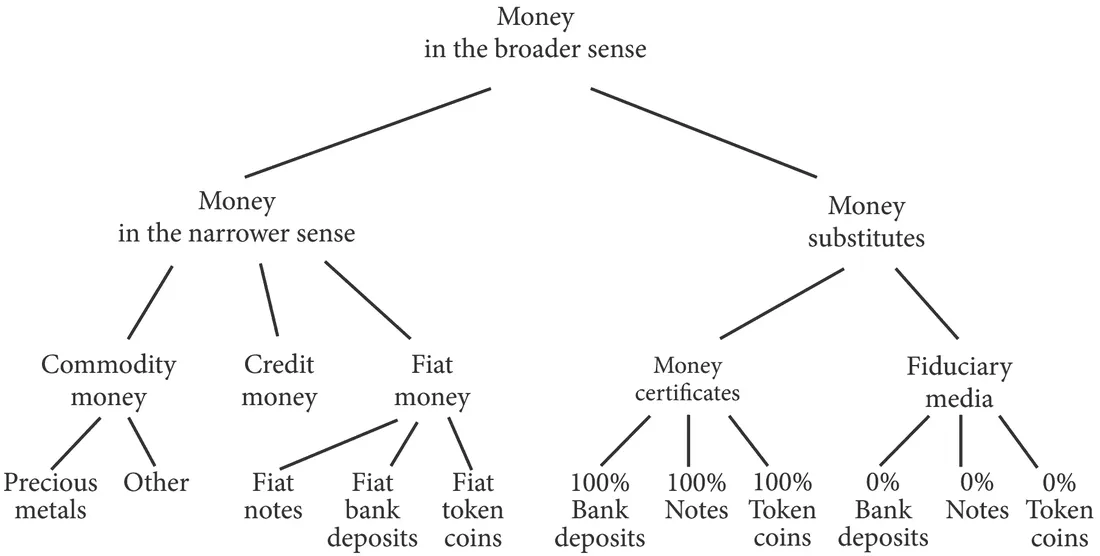
Figure 2
Classification of Monetary Goods According to Mises
(elaborated from Hülsmann 2007, p. 216)
Conclusion
Ludwig von Mises’s Theorie des Geldes und der Umlaufsmittel is a masterpiece and a milestone in the history of economic thought. On the foregoing pages we have tried to trace back the evolution of his early monetary thought, covering in particular the first two German editions and the first English-language edition. Two findings stand out.
First, Mises slowly shifted his analytical focus, ever more away from the exchange value of money (which he inherited from classical economics through Carl Menger), and ever more toward the political economy of the production of money. This transition was completed in the 1953 first American edition of his monetary treatise.
Second, the English edition of his book is plagued by numerous inaccuracies and outright wrong renditions. Hopefully his students will not have wait for the next centenary to obtain a better translation.
Bibliography
Bryan, Michael F. 1997. “On the Origin and Evolution of the Word Inflation.” Federal Reserve Bank of Cleveland Economic Commentary (October 15).
Gabriel, Amadeus. 2012. “Why was the Reception of the First Edition of Mises’s Theory of Money and Credit so Lukewarm?” In The Theory of Money and Fiduciary Media: Essays in Celebration of the Centennial. J.G. Hülsmann, ed. Auburn, Ala.: Ludwig von Mises Institute.
Gertchev, Nikolay. 2004. “Dehomogenizing Mises’s Monetary Thought.” Journal of Libertarian Studies 18, no. 3: 57–90.
Hülsmann, Jörg Guido. 2003. “Introduction to the Third Edition: From Value Theory to Praxeology.” Ludwig von Mises, Epistemological Problems of Econoimcs. 3rd ed. Auburn, Ala.: Ludwig von Mises Institute.
——. 2007. Mises: The Last Knight of Liberalism. Auburn, Ala.: Mises Institute.
——. 2008. “Mises on Monetary Reform: the Private Alternative.” Quarterly Journal of Austrian Economics 11, no. 3: 208–18.
——. 2009. “The Demand for Money and the Time Structure of Production.” In Property, Freedom, and Society: Festschrift for Hans-Hermann Hoppe. J.G. Hülsmann and S. Kinsella, eds. Auburn, Ala.: Mises Institute.
Mahoney, Dan. 2011. “Free Banking and the Structure of Production: A Contrast of Competing Banking Systems.” Libertarian Papers 3, no. 14.
Menger, Carl. 1871. Grundsätze der Volkswirtschaftslehre. Vienna: Braumüller.
——. 1909. “Geld” Handwörterbuch der Staatswissenschaften, 3rd ed. Reprinted in Gesammelte Werke. F.A. Hayek, ed. Tübingen: Mohr, 1968. Vol. IV, pp. 1–124.
Mises, Ludwig von. 1912. Theorie des Geldes und der Umlaufsmittel. 1st ed. Munich: Duncker & Humblot.
——. 1919a. Nation, Staat und Wirtschaft. Vienna: Manz.
——. 1919b. “Der Wiedereintritt Deutsch-Österreichs in das Deutsche Reich und die Währungsfrage.” Schriften des Vereins für Sozialpolitik 158.
——. 1923. “Die geldtheoretische Seite des Stabilisierungsproblems.” Schriften des Vereins für Sozialpolitik 164.
——. 1924. Theorie des Geldes und der Umlaufsmittel. 2nd ed. Munich: Duncker & Humblot.
——. 1928. Geldwertstabilisierung und Konjunkturpolitik. Jena: Fischer.
——. 1981. Theory of Money and Credit. Indianapolis, Ind.: Liberty Fund.
——. 1949. Human Action. New Haven, Conn.: Yale University Press.
——. 2009. Memoirs. Auburn, Ala.: Ludwig von Mises Institute.
North, Gary. 1993. Salvation through Inflation: The Economics of Social Credit. Tyler, Texas: Institute for Christian Economics.
Pallas, Carsten. 2005. Ludwig von Mises als Pionier der Geld- und Konjunkturlehre. Marburg: Metropolis.
Selgin, G., and L. H. White. 1999. “A fiscal theory of government’s role in money.” Economic Inquiry 37.
Jörg Guido Hülsmann is professor of economics at the University of Angers in France.
[1] “Writing my Nationalökonomie afforded me the opportunity to think through my theory of money and credit yet again and present it in a new form. . . . Thus did I carry out the plan I had conceived thirty-five years earlier; I combined the theory of indirect exchange with the theory of direct exchange into a unified system of human action.” Mises (2009, pp. 94f.)
[2] However, the most important facts which eventually would become the starting points for his methodological and epistemological reflections were already highlighted in the Theorie des Geldes und der Umlaufsmittel in 1912. See below, pp. 4f.
[3] To our knowledge, no scholar has so far traced the evolution of Mises’s economic thought back to the first edition, which was never translated into English. This also concerns most notably Pallas (2005) and Hülsmann (2007).
[4] All references to page numbers of the first edition of 1912 are preceded by the letter “A”. Similarly, references to page numbers of the second edition of 1924 are preceded by the letter “B” and the letter “C” refers to the widely used American edition of 1981, which is identical with the English edition of 1934, except for the spelling and the additional fourth part added to the 1953 American edition.
[5] A130f., C144. See also A6, A142, A155, A159.
[6] “Every economic transaction presupposes a comparison of values. But the necessity for such a comparison, as well as the possibility of it, is due only to the circumstance that the person concerned has to choose between several commodities” (A15, C51f.). See also A119, A130, A178, A234, A354, A373. We have discussed Mises’s contribution to the theory of value in some detail in Hülsmann (2003) and Hülsmann (2007).
[7] C218. The original text: “Wie in jedem anderen Zweige der nationalökonomischen Forschung wird es nämlich auch auf dem Gebiet der Geldtheorie niemals möglich sein, zur Bestimmung der quantitativen Bedeutung der einzelnen Faktoren zu gelangen. Die Prüfung der Einwirkung der einzelnen Preisbestimmungsgründe wird niemals dahin kommen, die zahlenmäßige Zurechnung an die verschiedenen Faktoren vorzunehmen. Alle Preisbestimmungsgründe wirken nur durch das Medium der subjektiven Wertschätzungen der Individuen; wie stark ein bestimmtes Moment die subjektiven Werturteile beeinflußt, kann aber niemals vorausgesagt werden” (A217, B173).
[8] C222, B177. The section where he makes this concession to the practical utility of index numbers has been added to the second edition of the book.
[9] See A171, A216, A276, A405, A474.
[10] Thus Mises deals with one of the major shortcomings of the conceptions of the Currency School. See below.
[11] He calls money also “money in the narrow sense.” Most economists today call it “base money.” Notice that Mises argued that the essential function of money is to serve as a generally accepted medium of exchange. All other functions are consecutive functions. They are derived from this primary one (A10–12). Mises endorsed Knies classification of money as a good sui generis, that is, as distinct from consumers’ goods and from capital goods. The reason is, again, that these three types of goods are subject to different laws of valuation and pricing (A79).
[12] Mises argued most notably that the fatal error of the Currency School, which otherwise had sound conceptions that he endorsed in his book, was to regard banknotes as some form of money, whereas it considered demand deposits as pure credit instruments and not as a form of money. This was in Mises’s eyes a distinction without a difference and it led to the practical failure of Peel’s Act. We will deal with this issue in more detail below.
[13] During WWI, Mises refuted the assignment theory in a 1916 journal article “on the classification of monetary theories.” This paper would then be incorporated into the 1924 edition of his Theorie des Geldes und der Umlaufsmittel (chapter 9 of the second part; see B242–63) and remained as an appendix in the 1953 edition (see C503–24).
[14] See North (1993, p. 159).
[15] They are not different in all respects. For example, increasing the supply of fiduciary tends to entail an increase of the price level, just as it would be in the case of an increased supply of money proper or of money certificates.
[16] Unfortunately, the English rendering as Theory of Money and Credit obscured this central theme. We will address the problems of this translation below.
[17] See Menger (1968 [1909], pp. 73–75, 80–91. In the English edition the distinction between inner and outer exchange value was completely dropped. In a footnote (on p. C146) Batson explains: “Since this distinction has not been usual in English terminology, it has been omitted from the present version; and, in what follows, wherever ‘the objective exchange value of money’ is referred to, it is the innere exchange value that is meant unless the contrary is explicitly stated.”
[18] He repeatedly referred to Mathus’s Principles of Political Economy. See especially Menger (1968 [1909], p. 82).
[19] See Menger (1968 [1909], p. 75.
[20] In a passage where he explained that distinction (not translated into English), he stated (A132f., B104): “Both expressions are somewhat odd. But they have become accepted in science ever since Menger used them. Therefore they shall be used where appropriate in the following investigations.” (Beide Ausdrücke sind nicht gerade glücklich gewählt. Aber sie haben einmal in der Wissenschaft das Bürgerrecht erlangt, seit Menger sie verwendet hat; darum sollen sie auch in den folgenden Untersuchungen dort gebraucht werden, wo dies mit Nutzen geschehen kann.)
[21] B200, my emphasis JGH. The word “inner” lacks in the English edition, see C272. Similarly, see the definition of the term “inflationism” on A265 (deleted from the second edition). Mises was reluctant to use the term inflation at all, referring to the reservations expressed by Pigou. He thought scientific analysis could do without them. For a penetrating history of the common definitions of the terms inflation and deflation see Bryan (1997).
[22] A246, B200. Again, the English edition lacks the words “inner” (see C248). The translator, Batson, also tried to make a distinction between Geldwertpolitik, Geldpolitik, and Währungspolitik (see C247, footnote), whereas Mises used all three terms synonymously, as is common in the German-language literature. Similarly, Mises stated that monetary policy in that sense is the “complement” or “corollary” (Gegenstück) of policies designed to influence the prices of single commodities or groups of commodities. Batson translates Gegenstück out of context as “antithesis.”
[23] Amadeus Gabriel highlights the interesting fact that the core idea of the regression theorem can be traced back to the contemporary German literature. See Gabriel (2012) in the present volume, chapter 2.
[24] See A154f., B122f., C164.
[25] In a passage deleted as from the second edition (see A244f.), Mises discusses Irving Fisher’s attempt to empirically validate his contention about the relationship between real and nominal interest rates. Mises points out that Fisher succeeded only in those cases in which the inter-temporal exchange (the credit) involved several currencies; but not in those cases in which the credit was given and returned in terms of a commodity money.
[26] A78, C101f. See also A263, A402f.
[27] At one point he almost justified his repetitiveness, stating: “This was not recognized for a long time and to a large extent it is not recognized even nowadays” (A403, C379).
[28] The monetary interventionism recommended by mercantilist authors such as John Law was therefore not modern monetary policy in Mises’s sense. The mercantilists wished to increase the money stock, but they did not wish to diminish the PPM (even though they might have accepted this consequence as a collateral effect of their policies). See A263f.
[29] C250, A250, B203.
[30] He points out that the monetary history of Austria-Hungary in the nineteenth century was one of the most important cases of deflationist policies (A257).
[31] C264, A261, B217. At this point he quotes Bentham’s In Defence of Usury (1790).
[32] In the second edition, too, he characterizes a stable inner objective exchange value of money as a—yet unattainable—ideal of monetary policy (see B401).
[33] C269f., B222, A288. Notice that the English text falsely translates Sachgeld (commodity money) as metallic money.
[34] C270, B222, A290.
[35] AIV. The original text: “Manche ihrer Fehler sind von Tooke und Fullarton mit Recht getadelt worden. Aber das, was diese beiden an die Stelle der Currency-Theorie gesetzt haben, ist mit nichten eine brauchbare Theorie. Die Banking-Theorie enthält nicht nur Irrtümer, sie fehlt schon in ihrer Problemstellung.”
[36] A417, C390. Mises mentions the circumstance that explains this neglect: Currency School and Banking School agreed amongst themselves that there could be no such thing as costless credit. See A406f., C381.
[37] See A410, A412, A415–17, A428–30.
[38] This distinction is one of the central concepts to which Mises refers constantly through the entire book. See pp. A80, A145, A353, A358, A358, A419, A422, A429, A430f., A432, A435f., A445, A452.
[39] The only exception concerns commodity money. Here an increase in the demand for money tends to entail increases of the interest rate; but Mises contends that this fact is without practical significance. For a more recent re-interpretation of the significance of this fact see J.G. Hülsmann, “The Demand for Money and the Time Structure of Production,” Hülsmann and Kinsella, eds., Property, Freedom, and Society: Festschrift for Hans-Hermann Hoppe (Auburn, Ala.: Mises Institute, 2009); Dan Mahoney, “Free Banking and the Structure of Production: A Contrast of Competing Banking Systems,” Libertarian Papers 3, no. 14 (2011).
[40] A428f., B369f., C399.
[41] A430f. In the second edition, he modified the argument concerning the nature of the impossibility of artificially lengthening the period of production. He stated “and so, although it is in the last resort inadmissible and impracticable, a lengthening of the period of production promises for the time to be profitable” (C399; emphasis JGH). The original text of the second edition: “damit wird die Verlängerung der Produktionsperiode, obwohl in letzter Linie unzulässig und undurchführbar, zunächst scheinbar rentabel” (B371). The original text of the first edition reads: “damit wird die Verlängerung der Produktionsperiode, obwohl volkswirtschaftlich unzulässig und undurchführbar, privatwirtschaftlich zunächst rentabel” (A430). Thus whereas Mises argued at first that the artificial expansion of the money supply entailed a contradiction between overall possibilities and the individual assessment of those possibilities, he later argued that it temporarily entailed illusory profits. Clearly this new argument is problematic, because not all profits in the boom phase are illusory. The main motivation behind the change of argument seems to be Mises’s general quest, in the second edition, to get rid of all references to an overall or macroeconomic (volkswirtschaftlich) point of view, to emphasize methodological individualism, and to deny the existence of possible contradictions between individual interests and the common good. Thus we find in the new chapter on “the monetary policy of étatism” the following statement: “In this case, as in all others in which similar assertions are made, it is not true that there exists an opposition between the interests of the individual and the interests of the community” (B240, C290).
[42] The chapter title has subsequently been changed into “Pre-war policy problems relating to fiduciary media” (Probleme der Umlaufsmittelpolitik in der Zeit vor dem Kriege; English translation: “Problems of credit policy before the war”). The concluding fourth part of the first edition (A467–76) has subsequently been deleted respectively integrated into the final pages of the last chapter of part three.
[43] “It would be a mistake to assume that the modern organization of exchange is bound to continue to exist. It carries within itself the germ of its own destruction; the development of the fiduciary medium must necessarily lead to its breakdown” (A472, B419, C448).
[44] A444, C411. See also A360, A420, and A425.
[45] “We know . . . that all credit-issuing banks endeavor to extend their circulation of fiduciary media as much as possible, and that the only obstacles in their way nowadays are legal prescriptions and business customs concerning the covering of notes and deposits, not any resistance on the part of the public” (A426, C397).
[46] A noteworthy minor change, for example, is Mises’s acknowledgement that index numbers can “perform useful workaday services for the politician” if they are based on “points of time that lie close to one another” (C222, B177). The section where he makes this concession to the practical utility of index numbers has been added to the second edition of the book. Another intriguing minor change is the footnote on B347 (C378), in which Mises for the first time expresses his reservations about Böhm-Bawerk’s theory of interest. He also presents his theory of the business cycle as a full theory in its own right, not just one possible explanation of economic crises to be used in conjunction with other explanations (compare A433–36 with B374, C403f.; see also Hülsmann 2007, p. 506). Finally, we also consider the already-mentioned addition of the chapter on the classification of monetary theories, first published as a journal article in 1916, to be a minor addition.
[47] See A107, A110, A157, A181, A181f., A192, A383, A411
[48] See A15, A16, A119, A130, A178, A234.
[49] See B187–89, C235f.
[50] See Mises (1919a, pp. 129ff.).
[51] See B190, C236f.
[52] C252f., B204f. See also C255, B208.
[53] A224. The original text: “Wer lange laufende Abschlüsse ohne Baisse- und Hausseklausel und ohne die Sicherung der entsprechenden Deckungsgeschäfte auf dem Terminmarkt getätigt hat, wird durch jede nachträglich eintretende Preisverschiebung, die er nicht vorausgesehen und mitkalkuliert hat, wesentlich betroffen.”
[54] B184, C231. Mises adds a footnote referring to Knies and Fisher. In the subsequent chapter presenting his business cycle theory, Mises also modifies his argument accordingly, stressing that as a consequence of the anticipation of a quickly rising price level, interest rates are likely to explode in a panic-driven movement. See B373, C402.
[55] Ibid. He added right away that the premise is never actually given. He went on to discuss the merits of a tabular standard or commodity standard, pointing out that the latter might actually increase the uncertainty of future payments. This was also the bottom-line of his discussion in the first edition. However, there he had not acknowledged the theoretical possibility of anticipating the future evolution of the PPM.
[56] This concerned most notably the classification of monetary theories, international trade, socialism, government interventionism, hyperinflation, and currency competition.
[57] See especially the section on “inflationism,” pages B203–15 (C251–61). Here he brings into play the experiences from the war and from hyperinflation.
[58] Mises stressed (B207) that inflationary war finance was an important factor in prolonging the war.
[59] C255, B208.
[60] See C258–61, B211–14.
[61] C261, B214. His analysis of currency competition in an inflationary environment was first presented in two lengthier articles published in the aftermath of WWI (see Mises 1919b, 1923). In some of his work he underlined that these mechanisms could be relied on for free-market monetary reforms that drove inflation-bent governments out of the production of money (see Hülsmann 2008).
[62] “Those protagonists of the gold-exchange standard who have recommended it as a general monetary system and not merely as an expedient for poor countries, have overlooked this fact. They have not observed that the gold-exchange standard must at last mean depriving gold of that characteristic which is the most important from the point of view of monetary policy—its independence of government influence upon fluctuations in its value” (B403, C431f.).
[63] B406, C434f.
[64] B408f., C437.
[65] B407, C436.
[66] “In this respect, we cannot yet know how circumstances will shape. If it should prove easier now for the credit-issuing banks to extend their circulation, then failure to adopt measures for limiting the issue of fiduciary media will involve the greatest danger to the stability of economic life” (B410, C439).
[67] He was perfectly familiar with the problem. In private correspondence he once wrote: “I am outright horrified about the sense-distorting errors that I have found in French and German translations of my English publications, and in English and French translations of my German books.” (Ludwig von Mises to Rudolf Berthold, letter dated November 4, 1959; Grove City Archive: Berthold file) It is a mystery why he condoned these known practices.
Theory of Money and Fiduciary Media
Read the whole book online · Book details
This work is published under a Creative Commons licence. You may copy, share, and re-host it with attribution.