
Chapter 9 of 12 · Toward a Libertarian Society by Walter Block
III. Personal Liberties A. Feminism Chapter 24 Four Firemen Die in Socialist Fire; Worse, Two of Them Were Woman
The headline in the newspaper was a horrendous one: Wildfire kills 4 firefighters in N. Cascades. Pictured was Pete Soderquist, the fire management officer in charge on the Cascade Mountains in central Washington state, who explained that the deaths were due to “when what had been a five-acre fire exploded into a wall of flame that trapped the crew.” Also featured in photographs were the four firemen who perished: 30-year-old Tom Craven, 18-year-old Karen Fitzpatrick, 21-year-old Devin Weaver, and 19-year-old Jessica Johnson, all who lived in either Ellensburg or Yakima, Washington.
Any time there is a death of a human being, it is a tragedy (the reaction of the over-populationists to the contrary notwithstanding). When this occurs for any reason other than old age, this is even worse. When death is not instantaneous, and not painless, this is worse yet. When this occurs to four people in the prime of their lives — they were, respectively 30, 18, 21 and 19 years old — the degree of catastrophe rises even more, in view of the now never to be seen potential these four youngsters might have attained had they lived.
So far, these comments are pretty conventional. Very few would demur. But there are two controversial points to be made about this episode, both of which may teach important lessons.
First, this calamity occurred on public property, not private. The flames that consumed these four people took place in the Okanogan and Wenatchee National Forests, and are believed to have been set near Thirty Mile campground, another example of socialized land ownership. Now I am not saying that no deaths occur on private property. I do not maintain that these particular occurrences would necessarily have been avoided were these lands under private control.
However, the two are not unrelated, either. When a forest fire consumes private timber, there are individuals who feel it in their bank accounts; this is not the case with socialized land holdings. This means that the incentives are greater, by how much is an empirical matter, for profit making individuals to take greater precautions regarding their property than is true for their public counterparts. If we have learned anything from the fall of the Soviet economic system — and this is a highly debatable point — it is that things work better under private ownership. These four young people will have not died totally in vain if we use their deaths as a rallying cry for privatization of the forest. Perhaps if we succeed in this effort, other lives will be saved.
Second, there were two females amongst the death toll in this fire. I see their smiling faces shining out at me from the newspaper coverage of this event. Both young girls were very pretty.
There was a time in our past when no such thing could have occurred; when firefighting (along with other such dangerous activities as mining, policing, soldiering, lumberjacking, deep sea fishing, etc.) was the total province of men. Women and children died in calamities to be sure, but only if they were caught up in them as victims. Nowadays, with our modern dispensations, we place females in the front lines.
This is no less than an abomination. Females are far more precious than males. It is not for nothing that farmers keep a few bulls and hundreds of cows. It is due to patriarchy that we owe our very existence as a species. Imagine if our cavemen ancestors had sent their women out to hunt and face the lions and tigers when they came a-calling, instead of throwing themselves at these enemies, sacrificing themselves so that mankind could persist. After World War II, the adult male population of Germany, Russia, and other countries that suffered the most from the fighting was virtually wiped out. Yet the next generation, thanks to the relatively few men who survived, was able to come into being as if those losses had never occurred. Imagine if this war was fought primarily by the fairer sex; there would have been virtually no next generation. It cannot be denied that biologically speaking, men are in effect expendable drones.
So let us use the unfortunate deaths of these two young girls to resolve to turn back the clock to an earlier day when women were treated the way they should be treated. Let us return from “firefighters” to “firemen.” Let us no longer blithely acquiesce in the senseless slaughter of precious females. Let us, instead, place them back up on that “pedestal” from which the so-called feminist movement has thrown them.
Now, of course, in a free society, people should be able to hire whomever they choose. Females should not be prohibited from trying to enter dangerous professions. And, of course, there are certain police jobs for which only women are by nature qualified to fill: e.g., prison guard in a female facility (but not to help wipe out prostitution, which should be legalized in any case). So this plea that we use the deaths of these two young Cascade women as an inspiration for ensuring the safety of future generations cannot be done through compulsion. But at the very least let us rescind all laws which require equal representation, or “balance.” This should be done in all occupations, but let us at least begin with the dangerous ones. Freedom of association is not only just, it will promote the survival of our species as well.
Published July 27, 2001.
Chapter 25
Arm the Coeds
According to police and newspaper reports there has been a spate of robberies and sexual assaults aimed at university coeds in uptown New Orleans. A single black man approaches girls walking in the street in pairs at night and then proceeds to rob, confine, and sexually assault them.
The reaction on the part of the police authorities is the usual blather about being “street smart,” not carrying a weapon, not resisting, and not venturing out at night. If going unarmed was such great advice, why don’t they follow it themselves? Further, why should the victims have to pay twice, once in the form of being robbed and raped, and then, again, in the form of having their liberties to walk on the public streets curtailed?
The response from school authorities is, if anything, even worse: holding candlelight vigils, praying, having “take back the night” marches, and organizing teach-ins attempting to indoctrinate the students with the usual leftist feminist and liberal shibboleths, ad nauseam. If these things give university students any comfort, it is a false sense of security, which could prove to be their undoing. Quite possibly the assailant joins the very parade setup against him, biting his lip to keep from laughing outright, which might well be the only harm that befalls him from these events. Such tactics might make some people feel good, but they do nothing to address the problem.
In contrast, we offer a five-point program of arming the victims, virtually guaranteed to solve the problem.
1. Take down those signs on campuses announcing they are “gun-free” zones. That is the worst possible message to be sent to potential perpetrators of violence against our community. We might as well post a sign saying, “C’mon in, attackers, we’ve disarmed ourselves and will be easy prey.” This no-gun policy, thank God, does not apply to campus police who can’t be everywhere, as is the case with their city counterparts.
2. Require that all female students own a pistol or other means of self-defense; (e.g., pepper spray or mace, stun gun or other electric shock device) and carry it with them at all times. The women of Kennesaw, Georgia, an affluent northern suburb of Atlanta, Georgia, were once plagued by rapists. This town not only allowed, but required its citizens to be armed. You’ll never guess what happened to the rape rate after this progressive policy was enacted.
The law, however, was compulsory, and, as such, violated the rights of pacifists and other local citizens who might have objected. But this would not at all apply to Loyola, a private institution. This change in policy would have to be “grand-fathered in” so as to avoid contractual violations, but in the future females who do not wish to protect themselves in this way would be perfectly free to attend other universities. They would have no right to be on campus, unless they obey all rules and regulations (in contrast, the citizenry of Kennesaw did have a right to remain there, in violation of the law). In the meantime, this enlightened policy could be introduced on a voluntary basis, and encouraged by the administration.
3. Packing a weapon is necessary, but not sufficient. All women at Loyola ought to be required to take a course in gun safety. The last thing we want are accidental shootings. Leftists bruit about statistics on accidents where children are killed with revolvers. But these data are wildly exaggerated by including the shooting deaths of young, teenaged gangbangers, whose deaths are certainly purposeful.
4. Volleyball, basketball, cross country, and baseball teams are all well and good, but a sports organization aimed at improving marksmanship would be far more helpful in present circumstances. (When is the last time a Loyola student won an Olympic medal in target shooting? Never, that’s when. It is time, it is long past time, for a change.) All students don’t have to be sharp shooters. Reasonable accuracy even at 10 to 15 feet will be more than enough to scare off potential rapists. Heck, even the presence of an automatic in a coed’s handbag or pocket fully accomplishes this task.
5. When the new student center at Loyola is erected, it should include an indoor shooting range, just as the old field house did. The new rifle and pistol team would practice there, as would every woman student who so wished. The muffled sounds of target practice would alone give pause to all ne’er-do-wells in the neighborhood.
It will undoubtedly be objected against this “modest proposal” that arming young girls will not protect them; that their weapons will be seized by their attackers. Logic, common sense, and vast hordes of empirical evidence give the lie to all such negativism. Put yourself in the position of a New Orleans mugger and rapist: would you really want to engage in your usual depredations in the uptown area, knowing full well that you could do so on no more than even terms? Not bloody likely. The uptown predator has already come armed; let his victims face him on even terms. As to the facts of the matter, world-class economist John Lott has done a series of studies linking gun ownership with increased personal safety.
After this forward-looking policy proves a success in the collegiate uptown area, it could be implemented by private organizations throughout the entire city. Then and only then would the scourge of raping and robbing have a good chance of being vastly decreased throughout our whole community.
Published November 10, 2001.
Chapter 26
Don’t Take Your Daughter To Work and Other Un-PC Thoughts
When Murray Rothbard was asked to account for his writing output, he would sometimes reply, “Hatred is my muse.” By this he meant that he would read something — a book, an article, an op-ed, whatever — and he would be filled with a loathing for its content. He would be almost driven to blast away at it, swearing a mighty oath that the offending verbiage would not be allowed to stand unanswered.
Right now I have in front of me a piece by Newsweek sob sister Anna Quindlen extolling the virtues of Take Our Daughters to Work Day. While I don’t mean to equate my output with Rothbard’s writing, certainly not with the sheer enormity of it, to say nothing of its quality, something of the same reaction is welling up in me. If I read any more of this sort of thing, I think I’ll be sick. It’s either that or criticize it, however unaccustomed I am to such a role. Accordingly, I shall attempt to at least start the process of peeling away some of the many fallacies and pretensions of the feminists who argue in this way. Not that Miss (sic!) Quindlen is the worst offender of this ilk, but as the wrap-up writer for every second issue of Newsweek, she certainly reaches a large audience. Hence, a few critical remarks.
1. There is nothing wrong with taking children — both girls and boys — to work to see what their parents are up to on Monday through Friday, 9–5. If the kids can more easily picture their parents while separated from them, this cannot help but be all to the good. But surely this applies equally to boys and girls.
Even here, however, there are problems. For one thing, why is it that there are so many mothers who have abandoned their children, many at very tender ages? If poverty has engendered this decision, well and good. But all too often this stems either from feminist ideology (“work good, motherhood bad;” “we can too have it all”), or from the avaricious nature of the modern state, which has raised taxes to such unconscionable levels that both parents are often forced to work.
2. Another motive for taking the kiddies to work is to get them acclimated to this activity. Here, the case is far less compelling. For one thing, it is way too premature, especially for the very young. For another, there is always the danger that the lesson learned will be that the kids should follow in their parent’s footsteps, not with regard to work in general, but rather that specific type of employment. This is problematic because the well-being of the next generation depends upon their making their own way in this regard. There is nothing more sad than picking a career not based upon personal likes and dislikes, but rather on the basis of following in the footsteps of someone else. Of course, one Take Your Kids to Work Day per year is unlikely to lead to any such result, except for fanatics, such as populate the women’s “liberation” movement.
3. But assume, for the sake of argument, that introducing children to the world of work has unambiguous good effects. Who should have preference in this regard, given that for some reason this must be done, males or females? Members of the feminist cult will froth at the mouth that such a question should even be raised (that’s no news; they have this emotional reaction to anything or anyone disagreeing with their party line) but they themselves started this by organizing a day at the office or factory for only one gender.
To ask this question is to answer it: boys should have preference over girls. After all, it is man, not woman, who will spend the lion’s share of their adult life behind a desk, or on an assembly line. It is women, not men, who will take time out to raise the next generation, if there is to be one, a less than certain state of affairs if feminists get their way.
How many women’s lives have been immiserated, when they follow the siren song of equality between the sexes, of the “we can have it all” school, only to arrive, childless, at early middle age, when certain options are forever foreclosed? Ask not for whom the clock ticks; it ticks for thee! To avoid this horrendous fate, both individually and for the species as a whole (although it cannot be counted as totally bad that the genes of these foolish women will be less likely to be passed on), little girls ought to be taught homemaking, cooking and make-up application, the better to attract a husband. Now, no one is calling for “barefoot, pregnant and in the kitchen,” and for less than full attachment to the labor force, on a coercive basis, through law. But as generations of experience have shown, this is not an altogether bad recipe for personal happiness on the part of women and species survival (the lefties seem more worried about the extinction of any and all species with the exception of our own).
4. But what about the “glass ceiling,” feminists, including Miss Quindlen (“the Senate is still 87 percent male,” she wails) are always decrying? Won’t Take Our Daughters to Work Day (and dozens of other such programs) at least put a dent in this injustice?
Not at all. Females are under-represented in the highest reaches of law, politics, Nobel prizes, chess grand master rankings, IQ, SAT and ACT scores, etc., not because of male plotting, nor discrimination, nor yet general injustice. Rather, this stems, mainly, from biological considerations. Yes, the normal or bell curve for male and female ability (as measured, say, by IQ) peaks at around the same point. This is why, barring the asymmetric effects of marriage, male and female incomes are indistinguishable, on average. (Marriage raises male incomes and reduces those of females, due to the unequal sharing of household tasks, labor force participation rates, time spent on child rearing, etc. The evidence? There is no pay gap whatsoever for never-marrieds; zero; nada.) But the variances between men and women are very different. Relatively more females cluster around the mean (YX). Proportionately, males are all over the lot (XY). If women are God’s (or evolution’s) insurance policy, then men are the crap shoot. It is for this reason that men but not women, in the main, have been able to rise above the “glass ceiling” (A), and that women but not men are rarely found below “hell’s floor” (D), to coin a phrase. Go to any prison, mental institution, or homeless shelter, and count the numbers of men (C) and women (D) on the left tail of the bell curve. The former outnumber the latter by roughly the same proportions that hold true on the right side of the normal curve in the boardroom, or in the executive suite, or in the president’s office, or on the battle field (A vs. B). (The curves are drawn freehand so as to exaggerate the differences between male and female standard deviations for purposes of illustration.)
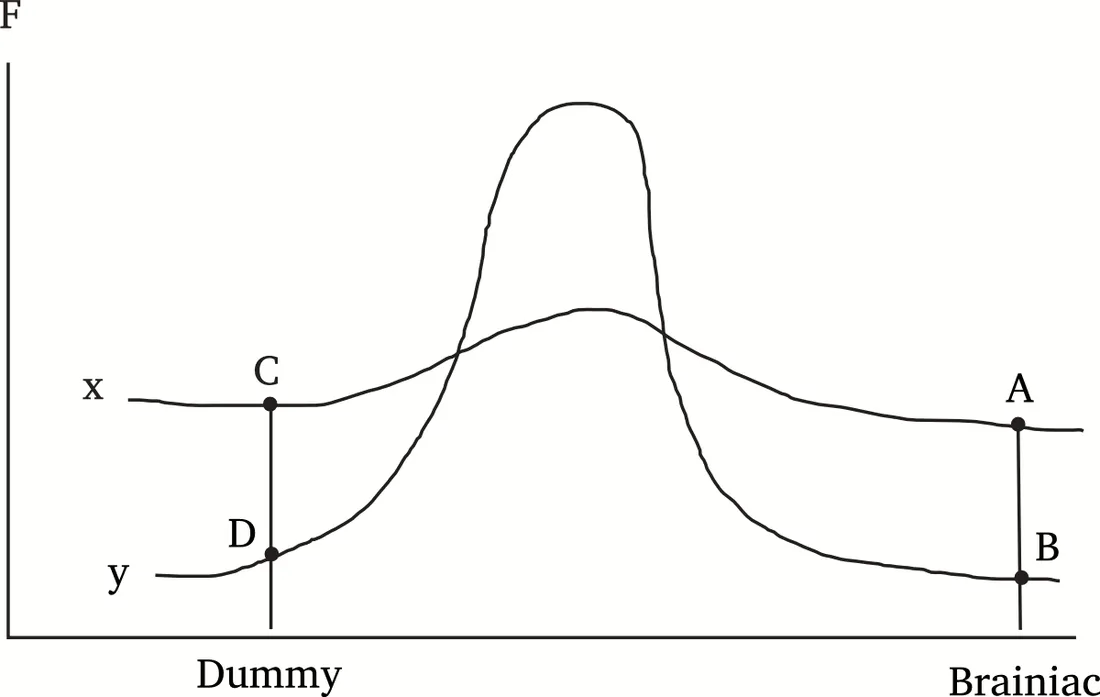
Moreover, there are good and sufficient sociobiological reasons why this should be so, which stem from requirements for the survival of the human species (something very far removed from the concerns of the feminists): it takes far fewer males than females to create the next generation. It is not for nothing that the farmer keeps 50 cows and 1 bull, not the reverse. Biologically speaking, if there were 50 bulls to go along with a like number of cows 49 of the former would be superfluous, and the reverse does not hold at all.
If human males are heterodox in their abilities, and there is a bias in favor of the genes of the smarter ones (strictly speaking, those whose survival until child rearing age is more likely for whatever reason) then great male but not female variation improves the quality of the human herd. This argument does not apply to females, since they are the bottleneck when it comes to raising the next generation. That is, with the usual proportion of 50 cows and one bull, not a single one of the former is superfluous, so there are no particular gains if they vary greatly in ability.
Imagine two tribes of ancient humans, otherwise identical, except that one was like our own, and the other had a great variation in female, but not male abilities. Which would out compete the other insofar as improvements in the gene pool were concerned? Ours would, since virtually all the females who wished to could become impregnated (this was before the era of feminism), while mainly the superior males would supply the sperm. In the other tribe, again virtually all of the females would become pregnant, if the tribe is to survive, but very few of the fathers would be “superior” types, since by stipulation, there are few such in this tribe. Thus, our tribe is eugenic, and survived, while, relatively speaking, this other tribe was dysgenic, and becomes extinct.
Published June 6, 2002. Co-authored with William Barnett II.
Chapter 27
Feminist Sports Fraud; High School Boys Are Better Than The Top Women Athletes
Annika Sorenstam has accepted her invitation to play in the men’s Professional Golf Association tournament in Fort Worth, Texas, and everyone and his uncle (excuse me, his aunt) has practically dropped their teeth over this wondrous occurrence.
Headlines range from “Let’s hear it for Sorenstam,” to “She’s an inspiration,” to “Why this Swede is ‘da woman’ of golf.” If there has been a critical reaction to this phenomenon in the mainstream press, I have not heard about it.
Her first day 71 score (one over par) at the Bank of America Colonial was good enough to beat out or tie several of her male competitors. This set off even more paroxysms of self-congratulation and high-fiving amongst the politically correct sports commentators. According to one low-key journalist, this accomplishment “made golf fans around the world scream with joy.” Another has even gone so far as to characterize Annika’s accomplishment “as one of the all-time greatest performances by a female athlete in any sport.” There may be a glass ceiling in the business world (that is a bit of economic illiteracy that shall have to be discussed on another occasion), but the “grass ceiling” in athletics in general, and golf in particular, seems to have been pierced.
Before we get caught up in the general hysteria, let us recognize a few worms in this particular apple. If females can enter male competitions on the grounds that they are just as good as men, then, based on this egalitarian “logic,” the latter will no longer be able to be kept out of those that have previously been limited to women. After all, why have different sections of an athletic event, if there are no relevant differences? No one organizes special matches for left- and right-handed people, for the blue eyed and the brown eyed, because these differences are not thought to be relevant to ability. If the internal plumbing of human beings is now likewise determined to be of no moment, competitively speaking, thanks to Annika’s marvelous accomplishments, why, then, there would be no reason to preclude males from female competitions. There would no longer be separate track and field, swimming, basketball, golfing, or tennis leagues for men and women. In this one size fits all new world order, all separations between the LPGA and the PGA, between the NBA and the WNBA would disappear. Segregation, after all, is invidious.
But this would pretty much spell the death knell for women’s sports. With the possible exception of sports that call more for finesse than strength (think billiards, bowling, and, ok, maybe, golf), females would be all but frozen out of professional top-flight competition (and even here, it would be the rare woman who could effectively compete with men). In the present left-wing feminist frenzy, this may not be readily apparent in basketball, tennis, soccer, baseball, and other team sports. The two genders rarely if ever meet each other in sanctioned official matches. Although even here, there is some supportive evidence. E.g., the top speed for a male tennis serve is 149 mph; the female counterpart is only 127.4 mph. Yes, yes, (a young) Billie Jean King beat (an old) Bobby Riggs in a tennis match. This is just the exception that proves the rule.
However, there is a plethora of data, emanating from sports in which success can be measured objectively, which indicates that few or no women would be able to compete effectively against men. For example:
• The high jump world record for men is 8'5"; for women it is only 6/10'.25". In contrast, the boys’ high school record is 7'6".
• The best male long jump is 29'4.5"; the top female can do only 24'8". The long jump record in high school (male, of course) is 26'9.25".
• The mile can be run by a male athlete in 3:43.1; a female takes 4:12.6; a high schooler can do this distance in 3:53.
• The male record for the 100-meter run is 9.78 seconds, the female, 10.49; the high school record is 10.13.
Forget competing against world-class male athletes; the top women would not even be able to garner medals in a robust high school setting.
This pattern of male dominance holds true for all sports where a premium is enjoyed by possessing strength, speed, and endurance. And in quite a few “sports” where it is not. For example, this applies to virtually all chess grandmasters.
These points are made not to demonstrate male superiority in athletics. Their dominance is so well established by the facts, that only hysterical left-wing feminists (of both sexes) must be reminded of them. No. We take cognizance of them because of the danger to women’s sports, posed by allowing Annika Sorenstam to compete with men. If we are logically consistent, and allow the genders to play against each other in such environments, there will be (virtually) no athletic contests where girls and women will have any chance of victory.
In boxing and other martial arts, there are commonly weight divisions. This doesn’t mean that a pugilist weighing 120 pounds can never triumph over someone at the 190-pound level. We engage in such segregation because weight gives such a clear advantage to the heavier athlete, other things equal, that a match between two such competitors would be too one-sided. It would be boring to watch. Most people would consider it “unfair.”
It is precisely the same with men and women.
Published May 24, 2003; statistics compiled by Dan D’Amico and Erich Mattei.
Chapter 28
Term Limits Hurt Female Politicians; A Silver Lining
Let us consider the silver lining involved in term limits: it reduces (this is not a misprint) the percentage of female politicians.
There is much wailing and gnashing of teeth at this phenomenon on the part of our friends on the Democratic side of the aisle. According to an editorial appearing in the Seattle Times (okay, okay, this statement doesn’t appear on the editorial pages, but rather is disguised as “news”): “Fewer female legislators in statehouses: Term limits are seen as culprit in curtailing women’s progress in winning seats, which has stalled since the early 1990s.” The editorial, sorry, the story, goes on to say that in states with term limits, female politicians are very rare. For example, 9.4 percent of South Carolina legislators were female, in Alabama it was 10 percent, and in Kentucky the figure was 10.9 percent. In contrast, in the non-term limit states, the percentages were much higher. E.g., 36.7 percent in Washington, 52 percent in Michigan, 33 percent in both Colorado and Maryland. (The overall average in 2003 was 22.3 percent, down from a high of 22.7 percent in 2002.)
So much for the facts. Where is the silver lining?
In order for there to be a silver lining, there has to be an evil, and, also, some good must come out of it. I am already on record (see chapter 45) in taking the position that term limits are highly problematic. I did so on ground blazed by Professor Hans Hoppe. His argument is based on time preference: other things equal, the longer a politician is in office, the more of a long-run viewpoint he can afford to take. If he can leave the office to his children (e.g., a monarchy) he will act even more responsibly; he doesn’t want to kill the golden goose, otherwise there will be nothing left for his progeny to exploit.
In the other direction, if a politician could only be in office for, say, one month, then “make hay while the sun shines,” even more so than at present, would become his motto. That is, he would have very little incentive to rein in his natural rapaciousness, for he would be turned out all too soon. There would only be the thinnest veneer of “public service” to cover the theft-as-usual policies. Why leave much of anything for the next officeholder, certainly not if it interferes with your own pillage?
Term limits, then, are a disaster, in that they enhance the already very great incentives for politicians to loot.
But there is a silver lining: females appear to be booted out by this initiative to an even greater degree than males. Why is this to be considered a good thing?
On the economic front, it is clear that women on average favor social welfare schemes more than men, and I extrapolate from females in general to their sister politicians. It is surely no accident that programs such as social security, welfare, and unemployment insurance came after the “weaker sex” was given the right to vote. This phenomenon might stem from women being more risk averse than men, and seeing such coercive socialistic policies as somehow “safer.”
Further evidence: there is a large “gender gap” between the Republican and Democratic parties on domestic issues; females favor the latter over the former; as well, the membership of the Libertarian Party is overwhelmingly male. (As against this, I must concede that on matters of imperialism and foreign military adventurism, female timidity probably inclines them to a less aggressive stance.)
Second, apart from considerations of this sort, there is no intrinsic reason to favor male over female politicians. With the exception of Ron Paul and only a few others, all are hypocritical and pompous mountebanks, not content with merely robbing us, but determined to convince us they do it for our own good. However, another issue arises: one of the strongest motivating forces behind the leftish push for female politicians is the quaint notion that apart from underhanded skullduggery, all groups would be exactly equal. That is, in the truly just society, both genders, all races and nationalities, all ages, people of all sexual orientations, etc., bloody, etc., would be equally represented in all callings. If they are not, this is due to exploitation, or injustice, or some such. That is, absent improprieties such as racism, sexism, look-ism (I kid you not), able-ism, etc., since males and females comprise roughly 50 percent each of the electorate, this would also be their representation amongst office holders. (Also, the National Basketball Association would employ as players tall strong athletic blacks, and short fat Jews, in proportion to their overall numbers in the population; it is only due to racial discrimination against Orientals that so few of them are on National Football League team rosters.)
There is no one who has done more to combat this pernicious fallacy than Tom Sowell. (See this, among his many excellent books, Race and Culture.) But he needs all the help he can get on this mission. It is incumbent upon all men of good will to help him in this regard. And one way that we can do so is to recognize one of the side order benefits of that otherwise insidious policy of term limits: that it disproportionately penalizes female politicians.
To clarify matters. I do not favor term limits. However, I do recognize that there is a silver lining in this particular cloud.
Published September 3, 2003.
B. Drugs
Chapter 29
Second Thoughts on Drug Legalization: It Means More Loot For the State
Don’t get me wrong. I am entirely and totally committed to the legalization of drugs. This includes all addictive substances, not just marijuana. When they write about drugs, most libertarians favor legalization. I am enough of an iconoclast to consider the case in behalf of prohibition (on libertarian grounds, of course). But, don’t worry, I come out on this issue on the correct side.
There are many good and sufficient reasons for this stance, none of which concern us today, since I wish, now, to discuss, not justifications for legalization, but, rather, one argument for prohibition, and one against legalization.
What then is the argument against legalization? Paradoxically, it is one often made by non-libertarians in favor of decriminalization. The argument goes as follows: right now, addictive drugs can only be bought and sold on the black market. As such, the government obtains no tax revenues thereby, since all these transactions are entirely off the books. However, if this industry were but recognized as a legitimate one, then its products could be taxed, just as in the case of all legal goods and services. Thus, the government could obtain more revenues than at present. And this in turn would mean either a reduction in other taxes, a lower deficit, more government services, or some combination of all three.
Any argument the conclusion of which is that the government will have more revenues at its disposal is highly problematic. For the libertarian, this is pretty much a refutation. For the state already has too much of our money, far too much. The last thing it needs is more encouragement, in the form of greater income. Yes, drugs should still be legalized, since their use and sale does not violate the libertarian non-aggression axiom, but this should occur in spite of the fact that the tax take will rise, not because of it.
If, as a result, there is a reduction in other taxes, it is not readily apparent why this should be an unambiguous gain for liberty. All that would occur is that some people would pay more, and others less. If there is a lower deficit, this will even the more encourage the government in its profligate expenditure policies. Nor is an increase in government “services” an unequivocal gain, not for utility, let alone liberty. For virtually all state spending, even apart from the compulsory way in which it is financed, does far more harm than create benefit. One need only mention in this regard public schools which are educational cesspools, and foreign military adventurism which kill innocents in their thousands.
Let us now consider the second argument, that in favor of prohibition: it puts numerous criminals in jail who otherwise would not have been caught. According to some estimates, in the neighborhood of 40–60 percent of all inmates owe their present address to the drug laws. Some of them, probably, are guilty of no real libertarian crime at all: peacefully buying, selling, and using controlled substances. And with regard to such people, the drug laws are an unmitigated disaster, morally, legally, and economically. However, many of those incarcerated for drug violations are guilty of committing violent crimes, and a significant proportion of these would not be in jail but for the present prohibition of addictive substances.
Face it; the public police are an inept lot (see Murray Rothbard, For a New Liberty; and also Patrick Tinsley, “A Case for Private Police”). What else do you expect from an institution run on the same principles as public education, the army, the motor vehicle bureau, and the post office? Were there private police, they would undoubtedly be far more efficient. But there are not. Scared citizens, then, can be excused for appreciating the fact that the drug laws put numerous miscreants behind bars who would otherwise be free to roam the streets, pillaging, rioting, robbing, and raping, as is their wont.
To the extent, then, not that innocent people are imprisoned due to the drug laws, but that this applies, rather, to murderers, rapists and thieves who would not otherwise have been caught, it cannot be said that this legislation is all bad.
Gary Becker, for one, is not likely to much appreciate this argument. He maintains, to the contrary, that one of the horrors of prohibition is that so many denizens of the black inner cities are placed in jail, which wreaks havoc, he thinks, on this community. But if it is correct that a significant proportion of such people are really dangerous malefactors (even though found guilty in government courts for what libertarians would consider non-crimes), then this community, to say nothing of the rest of us, is far safer under present conditions.
Becker correctly sees the high rate of incarceration of blacks as causally connected to elevated rates of illegitimacy. But he states: “Unfortunately, some states still make it difficult for two-parent families to collect welfare.” Evidently, this Nobel prize-winning economist thinks that welfare is a solution to, not a source of, the travails of the black community. He seems not to have read, or perhaps not fully appreciated, Charles Murray’s Losing Ground, which shows that welfare is the cause of family breakdown, not the solution to this problem.
This is rather disappointing to those who look to the University of Chicago for free market solutions. Perhaps it is a case of mistaken identity to expect libertarian analysis to emanate from the Windy City’s most famous university.
Let us conclude. I am not arguing in favor of drug prohibition. I favor legalization. But we should be aware that there are real drawbacks to this stance: more money for the government, and more (real) criminals running loose.
Published August 12, 2003.
Chapter 30
The Libertarian Case For Drug Prohibition
Ok, ok, already, hold onto your horses. I have not given up on libertarianism. Nor have I finally, and completely, succumbed to Alzheimer’s disease. It is just that since all of us who favor economic freedom oppose drug prohibition, the contentious part of my personality naturally looks around for reasons on the other side of this debate.
That, plus the fact that I had the unfortunate experience at a recent conference I attended of hearing a supposed libertarian “defend” drug legalization; he did so in such a manner that I didn’t have to be particularly quarrelsome or defensive about libertarianism to oppose him. Moreover, the fact that this seminar was constructed in such a manner that I was not able to publicly criticize the outrageous case he offered made it all the more important that I somehow get this off my chest. You, gentle reader, will have to stand in for the audience I might have otherwise addressed.
So, what are the reasons, in general, for maintaining the status quo regarding the prohibition of addictive substances?
1. Without this law, our movies, television programming, plays, novels, and other vehicles of storytelling would be much less enriched than now they are. Award winning television series such as Law and Order and The Sopranos would be particularly hard hit by repeal. It is an exaggeration to say that programming of this ilk contains nothing but this motif, but not by much. Surely, at least half of the themes explored in the cops and robbers genre depend upon the fact that there is a black market in marijuana, cocaine, and heroin.
2. Were addictive materials to be legalized a whole host of jobs would be lost. (Look, I said I would give reasons in support of prohibition; I did not say I would give good ones in this regard. As far as I am concerned, there are no good reasons. I am willing to defend the “undefendable,” but this is not undefendable.) We are talking, here, about judges, policemen, jail guards, social workers, lawyers, district attorneys, psychologists, munitions makers, small planes, and boats, etc., bloody etc. Could it be that one of the strongest reasons for the retention of this horrid law is this self-same fact? I wonder. Not, of course, that jobs are needed. That is the unfortunate legacy of Keynes and Keynesianism. As every Austrian from Mises to Hazlitt to Rothbard has shown, it is not rational to create jobs merely for the sake of creating jobs. We could all be employed digging ditches and filling them in again, and would starve as a result. No, the whole point of jobs is to create goods and services of value, and the ones that come about as a result of drug prohibition hardly qualify.
What, then, are the obnoxious reasons offered by this “libertarian” in behalf of drug legalization?
3. The present drug laws bring about a general disrespect for law and order, and this is something to be greatly regretted. But this is highly problematic from the libertarian perspective. Thousands? Tens of thousands? Hundreds of thousands? But how many laws are there today? This is hard to determine. Probably no one knows to an exactitude, even as of any given date (there are new ones coming on board every day). It depends upon whether or not administrative decisions should be counted; and why not? If so, laws presumably number in the millions. Literally.
And, of these, how many are good laws, e.g., enactments compatible with the libertarian axiom of non-aggression? Well, let’s see. There are laws against murder, theft, trespass, fraud, kidnapping, assault and battery, rape, … I am quickly running out of examples. Well, I suppose we can pick up a few more, possibly, from the Ten Commandments; and defense of contracts from the civil law. But that is about it.
So, it is pro-libertarian to promote a general respect for law? Hardly. Virtually all law is bad law. Only an infinitesimal percentage of all law is good law. Respecting law in general, then, is to promote evil. How, then, are we to regard favoring the repeal of drug laws on the grounds that they reduce respect for law in general? Whatever else may be said about this contention, it cannot be claimed that it is compatible with libertarianism.
4. The economist goes on and on, ad nauseum, about how he as an economist needs data for public policy analysis. Without data, he never tires of telling us, it is impossible to make an informed decision as to whether or not addictive substances should be legalized.
But this is stuff and nonsense. Whether or not drugs should be prohibited by law is a matter of normative economics. Data, in stark contrast, is part and parcel of positive economics. To be sure, in some moral systems, e.g., utilitarianism, the latter is not irrelevant to the former. But for the deontological libertarian, it comes down to a matter of rights. Does the (adult) individual have the right to inject into his body whatever he pleases, harmful or not? And the answer is, of course he does.
It is more than passing curious that this economics professor, after recounting the necessity of data, and bewailing its absence, nevertheless takes the pro-legalization side of this debate. Perhaps the statistics are not that necessary after all.
5. According to the speaker at this conference I am criticizing, the market price of a pound of marijuana is presently about $3,000. He estimates that the total costs under legalization would be something of the order of $3 per pound. Thus, the profit (plus the black market costs, given that this market is illegal) amount to some $2,997, or 99.9. percent of the total.
This speaker “doesn’t like” the people who are presently enjoying this differential. He favors legalization, so that they will no longer have access to these funds. He full well realizes that when and if the government legalizes this product, it will tax the stuffing out of it, just as it presently does in the cases of booze and tobacco. He offers as yet another reason for legalizing marijuana that this will, in one fell swoop, take the profits away from the present producers.
Now I full well sympathize with this professor’s assessment of your typical denizen of the drug market. He is mean and vicious, fully willing and able to use violence against police, competitors, sometimes even customers. It is thanks to him and his confreres that we have a new word to describe innocent victims of drug gang warfare: “mushrooms.” His product is oft-time poisonous, and the dosage uncertain. These are altogether a pretty despicable lot of people. Of course, as is well known in the libertarian community, these characteristics stem, entirely, from the illegal status of drugs. During alcohol prohibition, the proprietors were similar to today’s drug dealers. Nowadays, under legalization of beer, wine, and liquor, the purveyors are indistinguishable from those who manufacture cheese or chalk.
However, with whom are we comparing these very bad people? (Typical economist’s joke; question: “How’s your wife?” answer: “Compared to whom?”) Answer: we are comparing them with the government! How many innocent people have all the drug gangs in the world murdered? A couple of hundred? A couple of thousand? A few tens of thousands? In contrast, according to R.J. Rummel, Death By Government, governments are responsible for killing no fewer than about 170 million of their own residents and citizens in the twentieth century; we are talking non-combatants here. This economist wants data? Here is data. What can we say about the moral status of a commentator who favors a public policy (partially) on the grounds that a gang responsible for a relative handful of deaths will be deprived of financial resources, and that they will be given over to a different gang of people who have killed millions?
Yes, by all means, let us legalize drugs. (I told you I’m still a libertarian.) And, perhaps, our plays and movies will be less dramatic. But there will be no gain from decriminalization concerning jobs, or respect for law, or better allocation of funds from drug gang to government gang.
Published July 12, 2002.
C. Charity
Chapter 31
Celebrities Engaged in Legalized Theft
Muhammad Ali had a storied career as a boxer, activist in the “black is beautiful” movement and anti-Viet Nam War protester. He inspired millions of people with his exploits inside and outside of the boxing ring.
Michael J. Fox brought great pleasure to millions of television viewers with his work on Family Ties, and then Spin City. He has also appeared in numerous movies, — who can ever forget the Back to the Future series? — to great critical and commercial acclaim. Then there is Christopher Reeves who has attained world renown for bringing Superman alive to us. His steely blue eyes, his red and blue uniform with the “S” on the chest, his cape, his deeds of derring-do, are a vital part of our culture.
In their past careers, these three men were stars. The entire nation, nay, virtually all of the civilized world, venerated them. Young people tried to emulate them in their own lives. Women would swoon whenever any of these three appeared.
Where are they now? Each, unfortunately, has been struck with a dread debilitation. Ali and Fox have contracted Parkinson’s disease, and Reeves has been victimized by a spinal cord injury. But there have been moral lapses as well. Ali, Fox, and Reeves, along with many other professional athletes and stars of stage and screen, have been actively engaged in inciting theft. To wit: they have testified before Congress, asking that money be allotted to the study and cure of these diseases and debilitations. If you don’t believe this characterization, ask yourself: where will these monies come from?
Are Ali, Fox, and Reeves asking for voluntary contributions from willing charitable donors? Not a bit of it. Very much to the contrary, these funds will be demanded from taxpayers at the point of a gun. Yes, the purposes to which they will be put will be good ones. Who, after all, can oppose medical research, and support for the afflicted? But the road to hell is paved with good intentions; the devil is in the details. It does not suffice that the aims are good ones; the means must also be proper as well, and here they are not.
It cannot be denied that these celebrities have had great success in their booty seeking. They have already succeeded in raising vast sums of money not their own from politicians. And the indications are that there is more to come in future: yesterday, Michael J. Fox’s testimony before a Senate committee was greeted by applause, an all but unprecedented occurrence in those “hallowed” halls.
This attempt to garner money against the will of their owners stands in very sharp contrast indeed with their earlier careers that brought them fame in the first place. There, not a penny was mulcted from unwilling donors. Every penny earned by Ali in the boxing ring came from fans who voluntarily plunked their money down on the barrel head to see him fight. The boxers pummeled by him in the ring agreed to be there, and were paid for their own efforts. In the cases of Fox and Reeves, here was not a single solitary movie-goer or television watcher who was forced to pay for these benefits; all participated in commercial endeavors with these actors on a completely voluntary basis.
So I beseech these actors, athletes, and other heroes of the culture: do not allow your names to be used in this nefarious manner. Return to your voluntary roots. Go back to the behavior which first made you famous: capitalist acts between consenting adults. Certainly, raise money to fight these debilitations! But do so in a civilized manner, not one befitting a thug. If you cease and desist from these evil acts, I personally promise to contribute to your charitable goals. Yes, there may at the end of the day be less money forthcoming for these noble purposes, but every penny of it will be legitimate.
Published May 24, 2002.
Chapter 32
Don’t Donate To the Red Cross
In chapter 16 and 17 I have written about hurricanes afflicting New Orleans, and my attempts as a resident of the Big Easy to escape from them; once on Ivan, and then on Katrina. The latter led to a good many responses.
There was plenty of positive response, but I will not reply to any of that, except to thank the readers for their warm support.
The negative reaction expressed two concerns; first that I was talking through my hat (the word “moron,” and worse, kept cropping up) in terms of free enterprise being able to control the weather, and second that I was totally off-base in urging that people not contribute to the Red Cross, but instead to the Salvation Army for short-term needs (I thanked the sainted Wal-Mart Corporation for doing so), and to support the Mises Institute and the Libertarian Parties of Louisiana, Mississippi, and Alabama for long-term considerations.
Let me now reply to each of these issues.
I. Cloud seeding
First, the weather (I owe a great debt of gratitude to Yang Chenping for steering me to the material I cite below in this section).
I concede to my critics that the free enterprise system is nowhere near to being able to quell category 5 hurricanes such as Katrina (she slowed down to a category 4 level only when she reached the coast). However, there is at least such a thing as a weather control industry. It is viable. It is operational. It has made great strides already, and is continually improving. It is benefiting from the weeding out process, whereby firms that satisfy customers enlarge their scale of operation, and those that do not pass by the wayside. This is the recipe for success in every other industry known to man, and there is no reason to posit that it cannot, indeed, is not, functioning in this way at present in terms of weather control.
Consider in this regard Dyn-O-Mat, Inc. The stock in trade of this company, located in Riviera Beach, Florida, is to “implode” storms by seeding them with chemicals, and/or to at least reduce their severity. According to CEO Peter Cordani “attacking a pie-shaped sliver of a hurricane as it forms over water could slow the storm down by 15 to 20 mph, causing the winds to turn on themselves.” He continued: “We’re not going to get rid of the storm,” he said. “There will still be heavy rain. We’re just trying to take the punch out of it.”
Then there is Weather Modification, Inc. This firm has been operating out of Fargo, North Dakota since 1961 and offers services in terms of “rainfall increase (rain enhancement), snow pack augmentation, hail damage mitigation (hail suppression), and fog clearing (fog dissipation).
North American Weather Consultants, Inc., “incorporated in 1950, specializes in providing Weather Modification, Air Quality Services, Ambient Monitoring, Tracer Studies, (and) Applied Meteorological Studies.”
“Research from the Great Barrier Reef off the Australian coast shows that corals are packed full of the chemical dimethyl sulphide, or DMS. When released into the atmosphere, DMS helps clouds to form, which could have a large impact on the local climate.”
The Nissan Corporation protected its parking lot, chock full of automobiles, from a hailstorm by shooting off a cannon that sends “sonic waves up to 50,000 feet in the air.” According to Eric Rademacher, an environmental engineer with Nissan, “Hailstones are formed and begin with a piece of dust in the clouds. There is a lot of activity going on, and what we do is to de-ionize that activity in the clouds and keep those dust particles from collecting moisture out of the clouds in turn reacting and forming what we know as a hailstone.” Hailstones today, hopefully hurricanes tomorrow.
But all is not well regarding the private enterprise of weather control. Government is sticking its evil nose into the initiative. From 1962 until 1983, the National Weather Service was involved in such initiatives with its Project Stormfury. But they gave up, and now bash private companies such as the ones above, who are attempting to improve matters.
Even that great bastion of free enterprise, China, has gotten into the act. According to a China Daily report “Drought-stricken central Henan province has been using a method called cloud seeding, in which chemicals are shot at clouds.” The only problem here is that those responsible for these acts were not actually market participants; rather, they were elements of the government.
A similar threat to a complete role for private enterprise in protection against the elements emanates from Russia. In order to protect its sixtieth anniversary of its victory over Nazi Germany the Russian air force was dispatched to disperse rain clouds.
As well, the governments of Philippines, India, Thailand, New South Wales, and others, plus several U.S. states such as Utah, North Dakota, Nevada, Arizona, Kansas, Texas, and Colorado have gotten into the act. They, too, are horning in on what should ideally be entirely a private initiative. Perhaps the worst aspect of this is that the U.S. government is now contemplating getting back into this business. Weather socialism we can do without. (Happily, some such as Oklahoma seem to have suspended their involvement.) There is even a silver lining in the cloud of Moscow’s celebration. Private individuals too, such as Paul McCartney, have entered the fray, kicking in “$55,000 for three jets to spray the clouds above the city with dry ice. Some 50,000 people gathered in Palace Square for McCartney’s concert, only his second performance in Russia. The former Soviet regime had banned Beatle’s music as a corrupting influence.”
Personal disclosure. I have no stock in any cloud seeding or any other such company. I am an economist, not a meteorologist. I make no claim that this technology shall be the one that finally brings winds on steroids like Katrina to her knees. There are dangers in this technology, too. All I am saying is that the market — with proper protections for private property owners — can be trusted to satisfy consumers in this field as in all others.
Is there any doubt that if the government can keep its mitts off this industry, in the years to come it will make great strides in protecting us from inclement weather? But that means no excessive taxation, no unnecessary and stultifying regulation, no nationalization, and no subsidization of government bureaus in competition with these folks (such as the case in which public libraries compete with private bookstores and lending libraries, and even with your local neighborhood Block Buster.)
The technology of cloud seeding has been utilized since 1946. Vincent Schaefer of General Electric Labs was the pioneer in this regard. Private enterprise is not anywhere near perfecting it. But it is my contention that if government stays away, objections to the contrary notwithstanding, that this is the last best long-run hope for humanity to rid itself of this ancient scourge.
II. Charity
Let us now consider the issue of charity, in the aftermath of Katrina’s devastation.
First, the short-run. Why do I continue to favor the Salvation Army? Mainly because the proportion of their donations spent on salaries, fund-raising, and administrative costs is very low. The overwhelming majority of the money entrusted to them is allocated to the purpose for which it is donated. Second, they cooperate with the sainted Wal-Mart Corporation, and no one who does that can be all bad.
How about the Red Cross? I have several things against them. Minor point: they are over bureaucratized. They turned down offers from numerous people anxious to offer help to the victims of Katrina. Then, as I mentioned before, they are so politically correct they did not sufficiently scrutinize the blood donations made by homosexuals, due to considerations of political correctness. As a result, innocent people contracted AIDS. Then, too, they are in far too close association with government for my tastes.
What about the long run? Here, I suggested two institutions. My first recommendation was that people concerned with the plight of the poor in general, and specifically with future unfortunates such as those now victimized by Katrina, donate money to the Mises Institute. In this regard, one of my critics challenged: “How is funding Mises going to influence the disposition of 250,000 homeless unemployed?”
I readily “concede” that this Auburn, Alabama institution will not directly devote itself to the care and feeding of the New Orleans homeless. They are simply not in the business of handing out bottles of water, food and housing accommodations to refugees. But this misconstrues my suggestion. I was urging support of the Mises Institute not as a short run solution, but as a LONG RUN one.
How so? Funding the Mises Institute (and LewRockwell.com) will promote free enterprise. If Bill Gates or George Soros were to give this organization just $1 billion, a mere pittance for people of this sort, the market system will be given a gigantic boost. Not only in the future, when hundreds more Austro-libertarians will become professors, journalists, etc., but even in the immediate future. Just think in terms of a new Washington Post with Lew Rockwell as publisher. Or, imagine a new Fox News with Lew as the editor. That’s point one.
Point two is that to the degree a country embraces libertarianism and economic freedom, it becomes richer, far richer. (For those of you who are empirically oriented, for an illustration of that claim, see, James Gwartney, Robert Lawson, and Walter Block, Economic Freedom of the World, 1975–1995.)
Point three is that with a radically richer society, it would be just that much easier for people in the U.S. to come to the rescue of “250,000 homeless unemployed.” And not through welfare checks either, but rather via the creation of new employment to produce still more wealth.
Nor does the Mises Institute and LRC stand merely for free enterprise. They also urge an end to U.S. imperialism abroad (e.g., Iraq and Afghanistan, at present). Bringing back the troops as soon as possible would create still additional wealth, with which to help, further, the “250,000 homeless unemployed.”
Moreover, the Mises Institute opposes regulations, such as the minimum wage law and coercive union legislation that are responsible for unemployment. By the way, it is an economic fallacy that additional wealth is needed to give jobs to these “250,000 homeless unemployed.” Even if we were half as rich as we now are, everyone could be employed in the absence of government laws that preclude such a situation.
Please realize several things in this regard. First, I am not employed by the Mises Institute and thus cannot speak in their behalf. I am a member of the senior faculty along with a dozen others, but this means only that my advice is sometimes sought, and I am regularly invited to speak at Mises events, but always on a contractual basis. The views expressed above are only my own opinion.
Second, the Mises Institute was not the only organization I advised that people contribute to, in my column on Katrina. I also mention LewRockwell.com, and the Libertarian Parties of Louisiana, Mississippi, and Alabama. They, too, play an important role in raising public appreciation for the free enterprise system in those states, where it is most sorely needed in the aftermath of the hurricane.
What I continue to regard as these eminently reasonable statements on my part were met with a storm of protest. Political parties are evil, including, even the Libertarian Party. Anyone who locates himself in the Belly of the Beast (Washington, D.C.) will soon “grow in office,” like Cato, and eschew their prior free enterprise principles. Politics is a creation of the Devil.
Not so, not so. Ron Paul is exhibit “A” for the case to the contrary. And he is only the tip of the iceberg. There are numerous elected Libertarian Party members, all over the country, who have not compromised on their principles by one iota. And, there are plenty of former once very able and accomplished libertarians who have renounced their prior ideology, who have not been connected with politics in any way (Murray Rothbard is presumably spinning in his grave over these incidences of treason; some of them were his chief lieutenants years ago). Yes, there is a tendency to take on left liberal, and neo-con positions when located within the beltway. But this certainly does not apply to all. Even the Mises Institute for a time had an office in Washington D.C., where Lew Rockwell had been Ron Paul’s chief of staff. But this did not lead them to temper their free enterprise message in the slightest.
So, I reiterate my earlier claims. The last best hope for society and a civilized order is the freedom philosophy. The promotion of Austro-libertarianism is the dark horse candidate to protect future generations from horrors such as Katrina. This can and will be done two ways. One, directly, by allowing a private enterprise industry devoted to cloud seeding and other such techniques to stop future storms dead in their tracks. Two, indirectly, by making us ever so much more wealthy, so that we will one day have the wherewithal to support such new technology, and better care for those few who still fall victim.
Published September 12, 2005.
Chapter 33
Social Justice; A Scary Concept
On many university campuses, there is a push on to promote social justice. There are two ways to define “social justice.”
First, this concept may be defined substantively. Here, it is typically associated with left wing or socialist analyses, policies, and prescriptions. For example, poverty is caused by unbridled capitalism; the solution is to heavily regulate markets, or ban them outright. Racism and sexism account for the relative plight of racial minorities and women; laws should be passed prohibiting their exercise. Greater reliance on government is required as the solution of all sorts of social problems. The planet is in great danger from environmental despoliation, due to an unjustified reliance on private property rights. Taxes are too low; they should be raised. Charity is an insult to the poor, who must obtain more revenues by right, not condescension. Diversity is the sine qua non of the fair society. Discrimination is one of the greatest evils to have ever beset mankind. Use of terminology such as “mankind” is sexist, and constitutes hate speech.
Second, social justice may be seen not as a particular viewpoint on such issues, but rather as a concern with studying them with no preconceived notions. In this perspective, no particular stance is taken on issues of poverty, capitalism, socialism, discrimination, government regulation of the economy, free enterprise, environmentalism, taxation, charity, diversity, etc. Rather, the only claim is that such topics are important for a liberal arts education, and that any institution of higher learning that ignores them does so at peril to its own mission.
So that we may be crystal clear on this distinction, a social justice advocate of the first variety might claim that businesses are per se improper, while one who pursued this undertaking in the second sense would content himself by merely asserting that the status of business is an important one to study.
Should a university dedicate itself to the promotion of social justice? It would be a disaster to do so in the first sense of this term, and it is unnecessary in the second. Let us consider each option in turn.
Should an institution of higher learning demand of its faculty that they support social justice in the substantive left-wing sense, it would at one fell swoop lose all academic credibility. For it would in effect be demanding that its professors espouse socialism. But this is totally incompatible with academic freedom: the right to pursue knowledge with an open mind, and to come to conclusions based on research, empirical evidence, logic, etc., instead of working with blinders, being obligated to arrive only at one point of view on all such issues.
This would mean, for example, in economics, the area with which I am most familiar, to be constrained to conclude that the minimum wage law is the last best hope for the unskilled, and that continually raising it is both just and expeditious; that free trade is pernicious and exploitative. It is more than passing curious that those in the university community who are most heavily addicted to diversity cannot tolerate it when it comes to divergence of opinions, conclusions, public policy prescriptions, etc.
What about promoting social justice in the second sense; not to enforce conclusions on researchers but merely to urge that questions of this sort be studied?
This is either misguided, or unnecessary.
It is misguided in disciplines such as mathematics, physics, chemistry, music, accounting, statistics, etc., since these callings do not typically address issues related to social justice. There is no “just” or “unjust” way to deal with a “T” account, a quadratic equation, or an econometric regression; there are only correct and incorrect ways to go about these enterprises. To ask, let alone to demand, that professors in these fields concern themselves with poverty, economic development, wage gaps, or air pollution is to take them far out of their areas of expertise. It is just as silly as asking a philosopher to teach music, or vice versa.
And it is totally unnecessary, particularly in the social sciences but also in the humanities. For if members of these disciplines are not already conducting studies on issues germane to social justice (and, of course, to other things as well) then they are simply derelict in their duty. If historians, sociologists, anthropologists, economists, philosophers are ignoring poverty, unemployment, war, environmentalism, etc., no exhortations to the contrary are likely to improve matters.
Colleges and universities therefore ought to cease and desist forthwith from labeling themselves in this manner, and from promoting all extant programs to this end. It is unseemly to foist upon its faculty and students any one point of view on these highly contentious issues. It would be just as improper to do so from a free enterprise, limited government private property rights perspective as it is from its present stance in the opposite direction.
Of course, social justice may be defined in yet a third manner: as favoring justice in the “social” arena, as opposed to other venues. Here, all intellectual combatants would favor the promotion of this value; the only difference is that leftists, for example, mean by this some version of egalitarianism, while for libertarians justice consists of the upholding of private property rights. For a college to uphold social justice in this sense would be highly problematic, in that two very different things would be connoted by this phrase.
Published January 26, 2004.
D. Medical
Chapter 34
Stem Cells: A Libertarian Compromise?
With regard to the recent brou-ha-ha about stem cell research, libertarian theory is in a position to offer the combatants in this debate something unique: a compromise, a principled one which does not consist of adding up both positions, somehow dividing by half, and giving each side part of the loaf.
Actually, the debate concerns not only the propriety of using embryos as laboratory animals, but also of government funding for this enterprise. About that, there is no libertarian compromise possible: this is entirely incompatible with our philosophy, and must be rejected out of hand as an illegitimate function of government.
But what about the research itself, privately financed?
To anticipate matters somewhat, I shall — under certain conditions to be specified below — be coming down on the side of those who support the laboratory use of fertilized eggs. Therefore, it behooves me to assume that human life begins not at birth, but at the two celled stage. When the sperm enters the egg, that is it! There is a now a (very young) human being in existence.
I make this assumption for two reasons. One is in order to obviate the charge of creating a straw man argument. Given my conclusion, logical rigor requires me to make the assumption that least helps my case. Two, I happen to believe, independently of this consideration, that this is the only appropriate assumption. With the advent of modern technology, birth is becoming merely a matter of a change of address. Whether the baby lives on the inside of the womb, or in a test tube, or in a host mother, is quickly becoming almost (if not quite) a matter of indifference as far as its health, well-being, and survival is concerned. The real change is not eviction from the placenta, but rather the move from separated sperm and egg, which will not grow into a human being in that state, to one where the sperm enters the egg, which will result in the creation of a new member of our species.
With this as background, we now move on to a consideration of the libertarian theory of child possession. Please have patience with what follows: it will sound at first glance somewhat cavalier, even cruel and cold. But this is because cool dispassionate language is sometimes required to address exceedingly vexing problems.
Youngsters occupy a middle ground, homesteading wise, between ownership of property, such as a cow, and that concerning other people, which does not exist. The way to demonstrate ownership in an hitherto un-owned bovine is to domesticate it; once the homesteading period is over, you are the proper and complete owner.
Precisely the same logic applies to the child. The arch-typical way to homestead an infant is to engage in sexual intercourse, and then provide a “home” for it for nine months, and thereafter. But if a male and female scientist inserted a sperm belonging to one of them into an egg belonging to the other, and then grew the resulting embryo in a test tube, or in a willing host mother, and then cared for the baby after the nine month gestation period, they, too, would be considered the proper parents. The only difference between the cow and the child is that in the former case outright ownership is possible, while in the latter all that is “owned” is the right to continue to homestead (e.g., care for) the child. Doing so establishes the right to keep doing so, until the youngster reaches adulthood.
Are there any positive obligations to bring up a child? No, in the libertarian philosophy, there are only the negative requirements that one keep ones mitts off the persons and legitimately owned property of another. If a parent wishes to abandon a baby he has been raising in the past, and notifies the proper authorities (e.g., a church, a hospital, an adoption agency, etc.) he violates no libertarian law. (However, no positive obligations notwithstanding, if he abandons the child without notification, e.g., starves it in his own home, he is guilty of murder. This would be akin to forestalling; refusing to homestead unowned land, but putting a fence around it so that no one else can homestead it either; this would be a violation of the libertarian code. When done to a human child, this rises to the level of a capital crime.)
Suppose a parent wishes to abandon a child, makes this wish publicly known, but finds no one else willing to take on this responsibility. Then and only then may this child be killed. This does indeed sound cruel and heartless, but it is the only way to consistently apply the libertarian stricture against positive obligations. The only time a child can be legitimately consigned to death is if there is no one, absolutely no one in the entire world, willing to take care of it. If a parent wants to stop homesteading his child, e.g., caring for it, then he loses all rights to it; the rights of any other would be adoptive parent supersedes his own, even if he is the “natural” parent. “Use it or lose it,” would be the libertarian motto for child abandonment.
There was a case in Canada where a father “mercy” killed his severely handicapped daughter. Under libertarian law, he would be treated as a murderer. His mistake was not first offering his child up for adoption. Were there anyone else willing to care for her, he would not have been entitled to kill her. It is only if no one else were to step forward in this regard that his action would then be considered legitimate.
Now to the compromise position on stem cell research.
Allow all those who wish to do research on embryos to create as many of them as they wish. (To do so is not to contravene the one libertarian legal axiom of non-aggression against non-aggressors). It matters not one whit whether these embryos are unneeded frozen left overs from in vitro fertility clinics, or are created de novo for the express purpose of medical research. It is also a matter of complete indifference, as far as libertarian law is concerned, whether the “activated egg” has a sperm cell in it, or a transferred nuclei from a non-somatic area of the body. As long as the egg fertilized in either manner will eventuate in a child when properly housed, it is a human being at that point, by stipulation.
The medical experimenters can treat these fetuses as laboratory animals, as is their desire, contingent on one and only one stipulation: that no one else in the world wishes to raise these very young infants on their own. If there are adoptive parents forthcoming (presumably from the pro-life community, but not at all necessarily limited to it) then their rights trump those of the creators of the fertilized egg, since the latter do not wish to homestead them, e.g., protect them from harm, while the former do. The people who want to homestead (care for and raise) these fetuses get first crack at them. (And this goes for those in the womb too, when, if and to the degree that medical science makes such transfers possible.) It is only if there are no takers that those who wish to use fertilized eggs for research purposes can do so.
If allowed, this scenario will constitute a true compromise between the contending forces on the stem cell research debate. It will be an empirical issue as to which side will win the fertilized egg “race.” Will the demand on the part of potential adoptive parents outstrip the supply of fetuses that can be created in the laboratory? If so, then not a single one of them will be killed, and no research will take place. Or, will the ability of the medical technicians to create fetuses in this way overwhelm the willingness of adoptive parents to bring them up? If so, then some fetuses will be saved, those who are adopted, and others will be destroyed in medical research, the ones which exceed the demand of adoptive parents.
But in neither eventuality will the libertarian legal code be contravened. In our presently lawless society, that is not a benefit that should be overlooked.
Published September 3, 2001.
Chapter 35
Dr. Government; The Bureaucrat With the Stethoscope
Socialized Medicine is the Problem
Recently, Canadian Prime Minister Jean Chrétien changed his mind about his country’s system of socialized medicine. After long and hard opposition, he now favors a two-tier health system, including user fees and private provision. This makes it all the more important to take another look, not just at the surface of state-run medical care, but at its basic principles.
Ever since Vancouver Canuck hockey player Daniel Sedin jumped the healthcare queue with his herniated and ruptured lower back disc, there has been an outbreak of wailing and gnashing of teeth on the part of defenders of socialized medicine. Nor was this the only such high-profile case. About a year ago Grizzlies basketball center Bryant “Big Country” Reeves hurt his ankle and was similarly catapulted to the head of the medical waiting list. But beyond such headline-grabbing cases there are numerous other privileged characters: politicians and bureaucrats and their families and friends with political pull, and doctors, nurses, other healthcare professionals, and those who can rely on them for favors. This is called “professional courtesy.”
Most complaints have focused on the unfairness of a system that allows the privileged to receive medical care within a few days of an injury, while forcing others to wait weeks and even months, if not years. But this is exactly backward. The problem is not that some few people are treated quickly, as they should be. It’s that we aren’t all dealt with like members of an advanced civilization, where quick service is always the order of the day. We all should be treated like paying customers — and if we were, we would be.
Why are there long waiting lines that do not dissipate quickly? In economic parlance, this comes about because demand is greatly in excess of supply. There is no other reason; that is it: supply’s falling short of demand is a necessary and sufficient cause of long and enduring queues.
But to answer in this manner is only to put off the inevitable question: why does demand continue to exceed supply in some markets but not in others? Again, the answer comes straight out of Economics 101: a permanent shortage arises and endures if and only if prices are pegged at below-equilibrium levels and kept there through force of law.
Some people think there is something special about medical care. There is not. Yes, if we do not avail ourselves of it, we will be in dire straits. But no less can be said for food, clothing, shelter, energy, transportation — you name it. And economic law, just as in the case of chemistry or physics, is no respecter of how important an industry is to human well-being; it works just the same in medical services as for paper clips or rubber bands. Impose artificially lower prices in a market — let alone virtually zero prices as in medicine — and you guarantee a shortage.
If any evidence of this phenomenon were needed, it has recently been furnished in three completely separate markets. Rent control pegs rent below market levels; it reduces incentives to supply additional residential rental units and decreases benefits to tenants who economize on space. The energy shortage in California stems entirely from the fact that retail prices are fixed at artificially low levels, thus retarding incentives on the part of customers to decrease their usage, and on the part of potential suppliers to bring more energy to this market.
Last but not least, and most relevant to our present concerns, is the health care market in Canada. Here, too, consumers are prevented by law from paying prices that reflect the scarcity value of medical services. We do this, of course, out of misguided compassion. But this policy is based on blatant economic illiteracy. Canadians think they can violate economic law with impunity. They cannot.
Our much-vaunted (in coercive socialistic circles, that is) health care system is predicated on a violation of economic principles. It is built on a foundation of quicksand.
Rescind Socialized Medicine
The only way to enable all citizens to enjoy the benefits now accorded only to a Sedin, a Reeves, or other medically privileged characters, is to completely rescind socialized medicine. It should be privatized and take its place among all other industries (cars, computers, chalk) that contribute mightily to our advanced standard of living, with no queues for anyone, thank you. This step would, with one fell swoop, radically reduce waiting lists and the brain-drain of Canadian doctors and nurses as well. Chrétien’s recent conversion is too little too late if we want the healthcare system to function as well as these other industries do.
Adam Smith’s invisible hand of the market works its magic in every industry known to man. Health care is no exception. Those who take the opposite point of view are responsible for the needless suffering of the sick who cannot get timely help, thanks to medical socialism. This system did not work in the USSR. It cannot function with regard to Canadian health care either. Must we suffer through this for 70 years as the unfortunate Russians did? You don’t like queue jumpers? Get used to it. It was part and parcel of the old Soviet system, and there is no way we can escape this if we copy the Soviets in health care.
At this point the critic will retort, “It is not fair to charge people market prices for health care; the rich will be treated better.” But that is precisely the point of being richer in the first place. If the wealthy did not get better treatment, what would be the point in trying to amass riches? (And if they didn’t try to amass riches, the entire economy would tank, not just health care.) In any case, the better-off are already advantaged under the present system: they can jump queues in Canada or take their business to the United States.
Another obligation: there’s nothing for the poor in returning health care to the private sector. Nonsense. The poverty-stricken are treated far better in capitalist countries than anywhere else, and medical service is again no exception. Yes, of course, the impecunious have to wait for the well-off to purchase MRIs (many small states in America have more of them than all of Canada does), but when they do, low-income people too can avail themselves of high-tech diagnostics. This is precisely why the poor have color televisions, computers, cars, and more. Had these too, been socialized, they would still be toys reserved for the rich.
Published December 2001; reprinted from Ideas for Liberty (Foundation for Education Education).
Toward a Libertarian Society
Read the whole book online · Book details
This work is published under a Creative Commons licence. You may copy, share, and re-host it with attribution.