
Chapter 8 of 14 · Why Wages Rise by F.A. Harper
7. Contracting for Progress
Money, the lubricant for exchange, makes widespread trade possible. Without it our present high level of wages could hardly have come to be. Yet, serious inflation and deflation can cause money to lose its capacity to lubricate exchange.
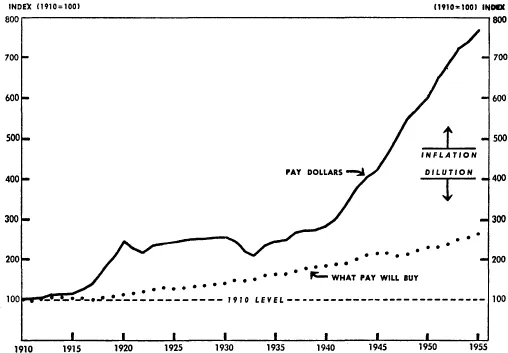
Inflation mixes worthless dollars with the sound dollars of a productive economy. The dollars inflation puts into pay envelopes add nothing but higher price tags on things.1
As inflation becomes blended with the real buying power of production, dollars of diluted worth are the result. You can buy less at the counter with one of them. Not only is the worth of the dollar diluted, but understanding about the source of progress also is distorted by the illusion of inflation.
Rich Uncles and Welfare
Inflation fools us into a false sense of welfare. Perhaps the illusion comes about in some such manner as the following:
Suppose a wage earner has an industrious and thrifty uncle who remembers him in his will. At the uncle’s demise the wage earner gains buying power, dollar for dollar in proportion to the amount of the inheritance. Everyone knows that.
If this happens to two people, both of them will gain in like manner. Or three. Or four.
And so it seems at first blush that if only this could happen on a national scale, everyone would benefit in like manner. But who will serve as the universal uncle? Our common uncle, Uncle State, of course.
Most uncles die only once, and an inheritance once received can never be repeated. But the State, on the other hand, has innumerable lives to give to its needy nephews and nieces. It seems able to grant them a sort of inheritance over and over again. The State, however, is confronted with the problem of a source for the funds it gives, since the State is without economic means itself. So the State must first collect from its nephews and nieces the substance of the repeated “inheritances” to be given back to them.
Inflation Is a Tax
Inflation is one way the State obtains these funds. And thus the buying power of money is diluted with these inflation dollars, which become the source of the inheritances from Uncle State.
The nephews and nieces, of course, are no better off as a result.2 Somewhere there has been a slip of reasoning betwixt one person’s rich uncle and an uncle without means for all of us. The clue to the answer lies in the fact that such benefits can come only out of production; that without production there can be no benefits.
The singular rich uncle was productive and thrifty. He saved up buying power by foregoing consumption over the years. And it was title to that real, productive wealth which became yours at the time of his demise.
If Uncle State, on the other hand, tries to give all of us enough to live on for the rest of our lives so that we could retire, who would produce the things for us to live by? Therein lies the catch in such a scheme for general welfare. For if nothing is produced, we would have nothing to live on from these promises to be financed by inflation.
Were we all to receive in like manner half enough, presumably, to live on and were all to half retire, we could have only half a living — the half we produced. The inflation inheritance of half a living would, likewise, give us nothing.
And for lesser degrees of inflation, the same would be true. We can have only what is produced, no more and no less. For production is the only thing that gives either wages or inheritance their substance. Money dilution for any purpose merely causes the price tags to go higher and higher.
That is the real danger of the inflation illusion. And we can’t live on the substance of an illusion — full time or half time or a minute a day, now or in old age. In trying to live beyond the means produced and available, tragedy will surely ensue in one form or another.
One exceedingly foreboding form that this inflation illusion seems to be taking has to do with wage agreements. In important respects these contracts amount to an attempt to contract for progress. The certain consequences of any such attempt at the impossible should give us deep concern.
Let me illustrate.
A Wage Contract for My Boy
In the year 2012, the Lord willing, my boy will be old enough to retire at age 65. He will then be in the final year of what I hope will have been a worthy occupational life, just prior to being forced to retire.
Here is a proposal. Let us say that I want to help him by bargaining for his wage for that year — the year 2012. As his representative at this collective bargaining table, I shall herewith state my proposal and give my reasons for my demands. Then if anyone will accept the offer, we shall see if we can work out the other minor details of the agreement.
My proposal is that you pay him a wage of $29.99 per hour for the year 2012.
This figure is arrived at by the same method now coming into vogue in negotiations over wage contracts. Contracts are being offered for a period of five years, or perhaps more. What I am proposing is merely to extend the idea of these five-year contracts, on the theory that if a principle is good for five years, it is even better for 56 years. Eleven times better for 56 years than for five years? Well, better, anyhow.
My proposal is based on the actual record of wages over the past working generation. I have merely taken trends since a man now ready to retire started work on reaching age 21, and extended them on to the year 2012 on a strictly mathematical basis.
Beginning with the present average wage rate for all laborers in the petroleum and coal industries ($2.52 per hour), I first added the average yearly rate of increase in productivity since 1910 (2.2 per cent).3 Since increases in productivity have appeared in wage rates more or less in full, this step would seem to have ample precedent.
REAL AND UNREAL WAGE RATES
Hourly wage rates, United States
SOURCE: Real wage column derived from Employment and Wages in the United States by W. S. Woytinski & Associates, Twentieth Century Fund, p. 586; Economic Report to the President, January 1956, p. 191. Nominal wage column derived from Woytinski, op. cit., p. 585; Economic Report to the President, op. cit., p. 208.
Next, the dollar has lost buying power over this period at a rate which, unless wages had risen enough to offset it, would have almost exactly canceled out all the increase from productivity. Except as this loss in buying power of the dollar was offset by wage increases, labor would be no better off now than a generation ago; except for such an adjustment in wages, wage dollars would have lost buying power about in proportion to the increase in productivity. So I am adding an inflation factor to my demands, based on past experience for nearly half a century.
These two factors give me my figure of $29.99 an hour for the year 2012, which I am proposing for a contract.
You may feel that you would be taking too great a risk in accepting such an offer, because productivity and inflation may not continue to go up for the next working generation as fast as they have in the one just past. True. But it is also true that they may go up even faster; that is the risk my son would be taking in signing such a contract. Do not these risks offset one another — yours vs. his — at this figure of $29.99? To equalize risks in this way would seem fair enough.
You may argue that you are opposed to inflation. But to that I would reply that you can do nothing about inflation all by yourself; that you have been opposed to it in the past, too, but that it has existed in spite of you; that holding your hands up against the wind will not stop it, so you might just as well take inflation as a fact and proceed to adjust yourself to it accordingly.
The Way To Begin
You may argue that if everyone takes this attitude of not opposing inflation by every means at his command, merely because he can’t do anything about it alone, nobody will ever do anything about it; that only the combined efforts of enough persons who want to do something about it will ever terminate inflation; that one thing you can do, for sure, is to avoid becoming a contractor for future inflation by writing the assumption of its continuance into your wage and other contracts; that you can’t fight inflation if you become a vested interest in its behalf, as in such a wage contract.
At this point in our bargaining I am ready to concede the force of these objections. And so I shall withdraw my offer of any such contract, urging all other wage bargainers to avoid such a scheme, too.
From the standpoint of the welfare of wage earners, such a general pattern of wage contracts is sheer folly. Some even question seriously putting both an assumed increase in productivity as well as a “cost of living” clause into long-term wage contracts. But this scheme is far worse. It not only contracts for a progressive increase in productivity at a predetermined rate; but in addition, it guarantees a continuous rise in the cost of living, in effect.
General wage agreements such as this would merely entrench inflation as a contractual way of life. This is true whether the agreement extends to the year 2012, or to 1961, or to 1957. The longer the period contracted on any such basis, the more serious its threat to the stability and progress of our economy.
The Erosion of Savings
Were I to argue the danger, and bargain for built-in inflation in the wage contract on some such basis, another problem arises to plague me.
My son, let us assume, wants to become self-responsible in his old age. He wants to provide for his elderly freedom and independence by saving enough during his working years to take care of his needs after retirement. How can he do this?
Let us first appraise his problem under the assumption that there were to be no inflation and no increase in productivity — that wage rates were to be stable, in other words. And let us also assume that my son wants to plan for a retirement income equal to half his working wage of $2.52 an hour. He is to provide for an income after retirement amounting to $2,620.80 a year, let us say.4
In order to provide for this sum on retirement, he would have to save and invest in a pension fund at the rate of $353.81 a year for the entire period. This would be 6¾ per cent of his income.5
Buying Power Diminished
If, on the other hand, inflation were to be built into the wage structure in the manner previously explained, my son would have to save at a much higher rate. For instance, a dollar saved during his first year of work would, in the first year after retirement, amount to only 38 cents in buying power, as a result of the inflation. This means that he would have had to put in $2.65 during his first working year in order to have, on retirement, the buying power that one dollar would have had without the inflation.
So why not add enough to the $29.99 rate to cover the loss of buying power of the wage earner’s savings? Since the loss was due to inflation, why not charge it to inflation? Why not add it to wages, as was done with the inflation factor explained earlier?
If this were done, it would merely mean that still higher prices would result, cutting even further into the value of savings for retirement. This, in turn, would call for adding even more to the wage for the same reason. And so forth. An endless process would have been set in motion, like a cat hopelessly chasing its bobtail at an ever-increasing speed.
This pursuit of something for nothing by means of inflation is a fruitless search that can yield nothing to the general welfare of wage earners. Time and effort and hopes spent on it are wasted from gainful pursuits.
Inflation in France
This wasted effort and false hope, of contracting inflation into higher wages, should especially concern the wage earner. To see why, we need only review earlier historical experiences with their tragic ending of the inflation act.
In speaking of the consequences of inflation at the time of the French Revolution, Andrew Dickson White said:
Now began to be seen more plainly some of the many ways in which an inflation policy robs the working class . . . . the classes living on fixed incomes and small salaries felt the pressure first, as soon as the purchasing power of their fixed incomes was reduced. Soon the great class living on wages felt it even more sadly . . . . the demand for labor was diminished; laboring men were thrown out of employment . . . the price of labor . . . went down. . . . Workmen of all sorts were more and more thrown out of employment.6
So if the wage earner is to be able to enjoy further increases in real wages through a healthy and sound economic growth, inflation must be stopped. But inflation can never be stopped if it becomes entrenched in the wage structure as a contractual way of life. It can never be stopped if wage contracts are so designed that employers and employees come to have a divided and conflicting interest in meeting the common enemy of inflation.
Progress cannot be built on an inflation bubble. It cannot be built on a raise in wages offset by a decline in what a dollar of wage will buy. For then the welfare of wage earners will burst when the inflation bubble bursts, hurting them especially.
1Inflation is an increase in the quantity of money, not a rise in prices which is only the consequence of inflation.
2They are worse off, in fact, but the reasons are beyond the scope of this discussion.
3In calculating the $29.99 rate, I am assuming that in the year 2012 his work will correspond to that of present laborers in the petroleum and coal industries.
4Based on 40-hour week and vacations with pay.
5Tigures provided by a leading insurance company. The plan is the usual pension plan, invested mainly in bonds, mortgages, and the like.
6White, Andrew Dickson. Fiat Money Inflation in France. Irvington-on-Hudson, N. Y.: The Foundation for Economic Education, Inc., 1952, pp. 32, 65-66.
Why Wages Rise
Read the whole book online · Book details
Free to read online and to download from this archive.