
Chapter 27 of 37 · A Treatise on Currency and Banking by Condy Raguet
BOOK THE THIRD. OF THE LAWS WHICH REGULATE A CURRENCY COMPOSED ENTIRELY OF INCONVERTIBLE BANK PAPER.
IN the first book I described the operation of a currency purely metallic, and in the second that of a mixed currency of coin and bank notes strictly convertible on demand into coin. I come now to describe the operation of a currency consisting wholly of inconvertible bank paper.
It has been shown that under a currency purely metallic, the fluctuations which can take place in its quantity and value are circumscribed within narrow limits, and that consequently the greatest possible stability which the nature of things will admit, exists in the operations of commerce. It has also been shown, that under banks of circulation conducted upon the principle of strict convertibility, although there is an occasional liability to temporary fluctuations, yet that these are not perhaps so great as altogether to neutralise the benefits which the community derives from their operations. It is only when banks, by their inordinate expansions, destroy convertibility and endanger their solvency, or what is worse, bring on a general stoppage of specie payments, that they are guilty of high offences against the community, and are justly obnoxious to the charge of inflicting misery on the country. Previous, however, to examining the operations of a currency after a suspension by the banks, I will call the attention of the reader to that state of delusion and apparent prosperity which invariably precedes it, and which, with sagacious minds, is easily distinguished from a state of real prosperity.
CHAPTER I.
OF THE CAREER USUALLY RUN BY BANKS OF CIRCULATION PREVIOUS TO A GENERAL STOPPAGE OF PAYMENT.
HAVING shown that banks of circulation, as such, neither create nor lend capital, and that what they do lend is their credit, by means of which the capital of individuals is circulated with more facility and less security than it would be without their instrumentality, I come now to examine this question, upon which most of the popular delusion hangs: Does not the increased activity given to business, occasioned by banks lending their credit very freely, tend to the promotion of public prosperity, and to the production of wealth, faster than would otherwise take place? The answer will appear in the sequel, and will not be found in accordance with the cherished opinions of the day.
By the operation of such bank issues the credit of the banks is placed at the disposal equally of all who borrow from them. Consequently, the inexperienced, the unskilful, the incautious, and the speculative, are placed upon a level, in their purchases, with the experienced, the skilful, and the prudent. The result of this equality is, that some men are able to buy who before were not able owing to a deficiency of credit.* More competitors are brought into the market, and prices rise from the spirit of speculation, which never fails to be engendered by the facility of procuring the means to speculate with. In addition to this local rise which takes place from the competition of new dealers in the immediate neighborhood of the banks, a general rise takes place from the expansion of the currency, owing to the abundance of the paper which has been thrown amongst the community by the original borrowers from the banks. This rise goes on with every new emission of paper, and appearing to the public, which is not acquainted with the internal operations of banks, like an increase in value, the spirit of speculation is excited amongst all classes of the community, and purchases are made for no other reason than that the buyers suppose they can sell the next day at a profit. Industrious persons abandon productive employments to pursue speculation, which, however profitable it may be to the successful operator, does not at all add to the wealth of the community, seeing that what is gained by one man is lost by another. Extravagance and luxury are increased in proportion to the increasing abundance of paper credits, because, as prices rise, all who have property or commodities on hand think they are getting richer every day. Merchants embark in more extensive enterprises; manufacturers extend their establishments; farmers build houses that are not wanted, and ornament their farms; railroads, canals, and every other species of internal improvement, are prematurely projected. All these operations give employment to the laboring classes, and for a time exhibit the semblance of accumulating wealth. Every new sale of property or commodities on credit creates new promissory notes or obligations, and these create a new demand for more discounts, whilst more currency is required to circulate the same commodities at their augmented price.*
But there is a final limit to this delusion. The depreciation of the currency has become so great, from these extraordinary issues, that timid people become alarmed, and make a run upon the banks, whilst coin is also demanded for exportation. The banks are called upon to pay their notes, and they in turn call upon their debtors, who are by this means first awakened from their dreams. Money becomes scarce, and prices of property and commodities fall. The operation which the banks require is merely that those with whom they exchanged notes upon such unequal terms, shall exchange back again. But with this demand the merchant cannot comply, because he has long since parted with his bank notes, and has in their place a store full of goods, which he has been induced to import or purchase, on account of the high prices created by the issues of the banks, but which he cannot now sell without a loss that will render him insolvent. Or he has parted with his bank notes in exchange for goods which he has sold to country merchants, who cannot pay him owing to the fact that the planters or farmers whom they trusted have over-planted or over-farmed, or over-speculated in lands, or over-expended. The manufacturer pleads the same inability, because the same high prices and appearance of universal prosperity induced him to erect buildings and machinery, not required under a diminished demand for goods, which he cannot now dispose of at any price; whilst the farmer or planter confesses, that the temporary rise in the prices of land agricultural produce, and slaves, which he thought was a permanent rise in value, had induced him to invest in unproductive improvements on his estate, and in the purchase of slaves and new lands, the notes which he had received from the banks; or, that his belief in his apparently growing wealth had led him into extravagance and luxurious expenditures.
The speculators in railroads and canals, who subscribed to those improvements, not because they had capital to invest, but because they fancied that the delusion under which they labored was a reality, and that consequently they would be able to sell their stock at an advanced price, cannot pay their notes, because they can find no purchasers with actual capital who are willing to take their bad bargains off their hands. At this winding up of the catastrophe, it is discovered that during the whole of this operation, consumption had been increasing faster than production—that the community is poorer in the end than when it began—that instead of food and clothing it has railroads and canals adequate for the transportation of double the quantity of produce and merchandise that there is to be transported—and that the whole of the appearance of prosperity which was exhibited while the currency was gradually increasing in quantity, was like that appearance of wealth and affluence which the spendthrift exhibits whilst running through his estate, and like it, destined to be followed by a period of distress and inactivity.*
But even admitting all this to be true, it may be argued, that at any rate banks of circulation, by liberal issues of their notes, make what is called money plenty. That they make it plenty with those who first get their paper is undoubtedly true, as is evinced by the speculative operations which have been above described; but as soon as time has been afforded for that general rise in the prices of property and commodities which is inseparable from increased issues of paper after it has become diffused throughout the circulation, the plenty disappears. It requires, at the new prices, the whole existing quantity of currency to circulate the commodities which at the old prices were circulated by the original quantity, and a scarcity of money is just as likely to be felt under a depreciated currency as under a sound one, as soon as the expansion has ceased by the banks refusing to extend their discounts any further, and more especially when they begin to contract their loans.* The case is precisely the same as would exist if all the specie in the world were suddenly doubled, the effect of which would be that it would require two ounces of gold or silver to purchase as much of all other commodities as could previously have been purchased with one. Money would be no more plenty than before. Gold and silver would be more plenty, but money would not be, for the simple reason, that the prices of property and commodities would be expressed by double the number of coins; and any one can perceive that the disappearance of any portion of the augmented quantity of specie would occasion a scarcity of money, even though it were true that the quantity still left in circulation should be fifty per cent. more than the quantity which existed before the doubling took place.† This would continue until the excess should be carried off by manufacturers or exportation, when prices would fall to their old rates.
In reference to a general suspension of specie payments, a very singular phenomenon sometimes presents itself, which is worth being noticed in this place. It will appear to the reader at first sight as quite incredible, and yet it is demonstrably true. It is, that a mixed currency, whilst the paper portion of it is nominally, and to a certain extent really convertible, may be immediately before a general stoppage of specie payments absolutely more depreciated than it is immediately after the stoppage, when the paper is not convertible at all. The reason is this—before the stoppage the currency is composed of two elements, coin and paper; after the stoppage, it is composed of nothing but paper, and consequently the aggregate mass of the whole is diminished to the whole extent of the specie thus withdrawn from circulation; and as depreciation in such case is the result of quantity, its degree must diminish with every reduction of the mass whether the reduction be of the metallic or the paper portion. This is the reason why after a stoppage of specie payments, prices do not always rise and sometimes even fall, which gives color to the idea entertained by many, that the difference between specie and paper is occasioned by an enhancement in the value of the former, and not by the depreciation of the latter, and hence we see under an inconvertible paper currency, specie quoted at a premium.
CHAPTER II.
OF FLUCTUATIONS IN THE MARKET PRICE OF SPECIE AND OF BILLS OF EXCHANGE UNDER AN INCONVERTIBLE PAPER CURRENCY.
AS soon as a general stoppage of specie payments by the banks has taken place, it is evident that the only conceivable check to over-issues has ceased to exist, and that the public has no means whatever of protecting itself against a still greater depreciation of the currency. The issues of each bank not being regulated as before by a common standard, and having in fact no standard of any kind to be referred to, the inevitable consequence is, that their quantity and value fluctuate according to the urgent wants of borrowers, or to the ignorance or knavery of the issuers. Were it not for the system adopted in the large commercial towns and cities, of the banks agreeing amongst themselves to pay interest on balances, there would be in large cities as many currencies as banks, and of as many different degrees of depreciation; but the practice above alluded to, establishes a uniform currency at each place, without, however, having any positive reference to the currency of any other place.*
This diversity of value in the currencies of different places, soon shows itself in the market prices of commodities. At that point where the currency is most in excess, the prices of every species of property, such as gold and silver, merchandise, stocks, foreign and domestic bills of exchange, produce, and real property, will be highest; and at that point where the currency has been least in excess the prices of those things will be lowest. At all important points the scale of excess will be quickly shown by the market price of specie, and the rate of exchange on foreign countries, and as a general rule, this may be considered to be conclusive as to the degree of depreciation.
Of this general principle, however, there are modifications. In the chapter on Exchange, in Book First, it was shown that the rate of exchange between two countries or places may vary according as the balance of trade may be one way or the other, to an extent equal to the expenses of transmitting the precious metals from one country or place to the other. The influence which belongs to the balance of trade, is not destroyed by a suspension of specie payments: and, consequently, its operation may sometimes be displayed in such a way as to augment or to diminish the apparent difference in the degree of depreciation between two places. Thus, suppose under a suspension of specie payments, the currency of Philadelpnia to be depreciated five per cent., and that of New Orleans seven per cent., at a period when there was no balance of trade due one way or the other, the difference of depreciation would be of course two per cent., and nominal exchange at Philadelphia on New Orleans would be at two per cent discount. It is well known, that at the season of the year when the cotton crop comes into the New Orleans market, say from October to May, there is a demand in the northern cities for bills on New Orleans to remit for the purchase of cotton. If we suppose this demand to affect the market price of bills to the extent of two per cent., the consequence would be, that bills at Philadelphia on New Orleans would rise at that season to nominal par, and there would consequently be presented the appearance of an equality in the currency; whereas, in point of fact, there would be still existing the original difference in the degree of depreciation. So, on the other hand, were the course of trade at the opposite season of the year to augment the supply of bills on New Orleans in the Philadelphia market, so as to occasion a fall of two per cent. below the rate existing before the late supposed rise, the exchange would be nominally four per cent. below par, and yet the real difference in depreciation would be as before, but two per cent. What is here said of the trade between Philadelphia and New Orleans, is equally applicable to that between any other two places; and whatever may be the influence of the balance of trade upon the rate of exchange, that amount should be added to, or subtracted from, the market rate of exchange, as the case may be, in order to arrive at the difference in depreciation.
It is proper, however, here to remark, that under an inconvertible paper currency, the rise and fall of exchange are not limited, as under a metallic or mixed currency, by the expenses of transporting coin, and they may consequently exceed it, as I shall proceed to show.
Under an inconvertible paper currency, although its depreciation for a long period together is best to be measured by what is called the premium on specie yet it is clear that if at any particular place an extraordinary demand for specie were suddenly to arise, for domestic or foreign purposes, the paper currency; and the specie in the market remaining the same in quantity, specie would rise as compared with paper, and thus the currency would appear to be depreciated more than it was at the period before the rise. And so on the other hand, if a large importation of specie were suddenly to take place, the paper currency and the demand for specie remaining the same, a fall would take place in specie, and thus the currency would appear to be less depreciated than before the fall. A knowledge of these facts, and the uncertainty of any long continued fixed relation between specie and paper at any particular place, occasions merchants sometimes to sell bills at a lower rate, and at other times to buy them at a higher rate, than they would under a metallic or mixed currency. As regards New York and Philadelphia, between which two cities advices of the state of the markets may be transmitted in six hours, the difference would hardly be perceptible; but between New York and Mobile, or New Orleans, it might be double or treble under an inconvertible currency, to what it would be under a metallic or mixed currency, and this may account in part (or the remarkable and sudden fluctuations which took place at New-York, in the exchanges on those cities, during the suspension in the years 1837 and 1838.*
In reference to this subject of a high exchange under an inconvertible paper currency, a very general error prevails of ascribing the whole of it to the balance of trade. From the 1st of July, 1837, to the 14th of April, 1838, exchange at New York on Philadelphia at sight gradually fell from ½ to 1, to 4¾ to 5 per cent, discount. Prior to the suspension of specie payments in May 1837, it was never more than a quarter per cent, above or below par, for the simple reason, that specie could be sent from one city to the other, at an expense less than a quarter per cent., and it was therefore very evident that no balance of trade could occasion so great an exchange as 4¾ to 5 per cent. But notwithstanding this self-evident truth, the great body of superficial reasoners ascribed it to that cause, and they were led so to do, from being acquainted with the fact, that the banks of Philadelphia were largely indebted to the banks of New York, sometimes even to the extent of a million and a half of dollars. Their error consisted in mistaking the effect for the cause. The rate of exchange which represented the greater depreciation of the currency of Philadelphia over that of New York, was the cause of the balance and not the balance the cause of the rate of exchange. The superiority of the currency of New York, being nearer in value to specie than that of Philadelphia, was the result of a gradual diminution of its quantity, which was commenced in August, 1837. This diminution by making money more scarce and consequently more valuable in New York than in Philadelphia, occasioned a fall in the former city in the prices of every species of merchandise and stocks and bills of exchange to such an extent as to make it an object for Philadelphia merchants and speculators to go to New York to purchase, and at the same time occasioned the transmission to Philadelphia of a large quantity of merchandise to be sold at auction., These operations created a debt in favor of New York against Philadelphia; the evidences of which came into possession of the New York banks by the discount or collection of Philadelphia paper; and as the New York banks which resumed payment on the 23d of April, knew that on the resumption of specie payments in Philadelphia, which they expected soon to follow, the amount would be payable in specie; they permitted it to lie undrawn for, although not bearing interest, rather than to incur a loss by the purchase of specie at Philadelphia equal to the extent of the depreciation of the currency of that city, considering it, in fact, as nearly equivalent to coin in their own vaults, and as a part of the funds upon which they relied to enable themselves to resume or to sustain specie payments. No such effect could have been produced by any balance existing against Philadelphia, had her currency been as near the standard as that of New York, for as an equal value would have existed in the money of both places, and consequently an equal scale of prices, there could have been no motive for the transmission of merchandise, stocks, “or bills of exchange, from one place to the other for sale, except that which ordinarily exists, and which at all times, under a sound currency, leads to a mutual and equivalent interchange of commodities and property.*
The remarks which have here been made in reference to the domestic exchanges will apply with equal force to the foreign exchanges of the country. Foreign bills will show in their market price the relative degrees of the depreciation of the currency of the places at which they are sold. If there be a favorable or unfavorable balance of trade, capable, under a sound mixed or metallic currency, of depressing or raising the price of bills one or two per cent. below or above par, that amount will subtract from, or add to the rate of depreciation, and consequently make it appear less or greater than the true rate. In like manner, also may the market rate of exchange fluctuate to a greater extent than under a mixed or metallic currency, owing to the uncertain continuance of the same degree of depreciation at the place where bills are drawn. Thus if the currency of New York under a suspension for example, were five per cent. depreciated below the gold standard of London, whilst the course of trade was such that, under a convertible currency, the exchange would be at par, the paper money rate of exchange on London would be five per cent premium. Now, if there were all at once to arise a strong probability that within a short period the banks of New York would resume specie payments, it might be more advantageous for the holder of a bill on London to sell even as low as the paper money par, which would be in fact, five per cent, below the true par, than to import gold for the amount of his bill; for the simple reason, that by the time his gold could get there, the banks might have resumed payment, in which event he could obtain no premium for it, and would consequently be the loser of all the expenses of importation. It was the gradual diminution of the currency of New York, attended by a great pressure, which by degrees reduced the premium on specie, and gave assurance of an early resumption of specie payments, which in the month of February, 1838, reduced the exchange on England five or six per.cent below the true par, which could not have happened in ordinary times, under a metallic or mixed currency.*
So also on the other hand, if the currency of New York were five per cent. depreciated below the gold standard of London, and the paper money rate of exchange, as in the former case, were at five per cent. premium, that is, at the true par, it might, if the currency were expanding, be more advantageous for the holder of a bill on London if he had debts to pay, which could be discharged with paper money, to import gold than to sell his bill at five per cent. above that true par, for the simple reason that the price of specie might rise to such a premium as to afford him an additional profit over and above the expenses of importation, which could not have happened under a mixed or metallic currency.
CHAPTER III.
OF THE TRUE CHARACTER AND EFFECTS OF A GENERAL SUSPENSION OF PAYMENTS BY THE BANKS, AND THEIR OBLIGATIONS UNDER IT.
WHEN an individual bank fails by mismanagement or over-trading, so that it cannot pay its notes or deposites, we say that the bank has broke; but when eight hundred or a thousand banks do the same thing, we call it suspending specie payments, as if there were any thing but specie of which a stoppage of payment by a bank or any individual could be predicated. For all the banks, therefore, of a country, to stop together, call it what we may, it is nothing more nor less than a general bankruptcy, under which the banks find themselves in the precise condition of individual traders, who, when they meet with temporary embarrasments, are obliged to call upon their creditors for an extension of time. Between the mode, however, in which the two parties make the appeal to their creditors for this extension, there is a very wide difference. The individual trader solicits it as a favor which his creditor may grant or withhold at his pleasure; and if, in his opinion, his estate is ample for the ultimate payment of the whole of his debts, he stipulates to pay interest for the time he is to be indulged, and during which his creditor is to be kept out of his property.
On the other hand, banks, when they default in their payments, not only never ask the indulgence of their creditors for any specified extension of time, but they do not even think themselves under obligations to pay interest to their creditors for the funds they forcibly detain from them;* nay, they very frequently, in the midst of their insolvency, declare dividends of the very profits which actually belong to their creditors, who, and not the stockholders, are entitled to interest for their withholden funds. Excepting where legislative enactments have forbidden dividends under a suspension of payments, instances are extremely rare wherein a sense of justice on the part of the directors of banks has led them to refrain from such manifest injustice, and the consequence has been, that a direct inducement is thereby created for taking no steps towards a resumption of payment, for fear of diminishing the profits of lending other people’s money, whilst refusing to allow interest for its use.*
From these remarks, it may be inferred, that I consider a resumption of payment by solvent banks, after they have stopped, as not of so difficult accomplishment as many persons imagine. The fact is even so, and the chief delay that takes place with most of them is the simple result of a calculation of profit and loss. It is not profitable to resume expeditiously. This is with such banks the whole pith of the question, and that I may not be considered as asserting a proposition unsusceptible of proof, I will establish it thus:—
A bank with a capital of ten millions of dollars, has loans out at the time of the suspension to the amount, we will suppose, of fifteen millions. Of this fifteen millions, we will suppose three to constitute that excess, which, in conjunction with the excesses issued by the other banks, has caused the depreciation of the currency, terminating in the stoppage, and consequently, that that is the amount of immediate liabilities, which, if they were put out of the way, would restore the bank to a sound condition, seeing that under the securest conduct, it can always maintain without danger of reaction, loans amounting to twelve millions.
The first and most natural mode that presents itself to accomplish this end is to call upon the debtors of the bank, for the payment of three millions of dollars. One could hardly suppose, that any bank having loans out to the amount of fifteen millions, could not within a reasonably short period collect twenty per cent. of the amount, seeing the fact to be, that paper money must needs be plenty, as is proved from the very necessity of diminishing its amount in consequence of its being in excess; and more especially would this be true, if any large part of the loans made by the bank was upon a pledge of stocks of any kind; for it must be manifest that all such stocks are saleable for cash at the market price; and if a loss should occur upon a forced or unexpected sale, the owner would have no right to complain, because such was the contingency under which he pledged them.
But let us suppose, what is most commonly urged upon such occasions, that the debtors of the bank can not pay at all without a long indulgence as to time, and that if their stocks are sold at forced prices, the bank will lose a large part of the security she holds for the debt. I can see no objection to a creditor, if he finds it consistent with his interest, accommodating his debtor by a postponement of his demands. It is done every day, and is just as legitimate when performed by a corporation, as when performed by an individual. But in either case, the party who grants the accommodation, must take care that in effecting it, he adheres to the rules of honesty. The means by which he effects his purpose, must be his own, which he has authority to dispose of. No creditor would have a right to indulge a debtor, by withholding money from a third party without his consent, and without paying him interest for the use of it, and especially if he was himself deriving an interest from the indulged creditor.
And now I would ask, if this be true in reference to individuals, upon what principle has a corporation a right, to accommodate its own debtors, for the purpose of securing its debts, at the expense of its creditors, the public? If, indeed, in the indulgence shown by banks to their debtors, there was a waiving of the interest, the public might have some corresponding return for their own loss, inasmuch as some bank creditors might also be bank debtors. But we never hear of any such generosity. Every dollar is demanded for every day’s indulgence, where the parties are solvent; and when those who feel themselves aggrieved complain, that by the depreciation of the currency they have to pay an increased price for all they purchase, they are considered as quite unreasonable for not being willing to submit to some sacrifice for the public good, which means in this case the good of the stockholders of the banks.
Now cannot any one perceive, that, if the bank in question had acted with a strict regard to justice when it resolved to accommodate its debtors, it would at once have borrowed three millions of dollars, or such part of that sum as it could not have collected from its debtors, for such length of time as would have enabled it to afford the requisite relief? Cannot any one perceive, that such a course would have restored the currency, without depriving any one of his just rights? The matter is too plain to admit of dispute. Why then is it not resorted to in such emergencies? Because, as I have said, it is not profitable.
But it may be said, that some banks could not borrow. This is highly probable. But it is hardly possible that any bank should be in such bad credit that it could not borrow its own notes or the claims of its depositors, upon some terms satisfactory to the holders, which is all that it wants to absorb the excess of its issues. If there should be any such banks, the sooner they are found out the better, and the sooner their notes are rejected from the circulation, the sooner would the currency be restored.
But this is not all. An inconvertible currency transfers from the pockets of creditors to those of their debtors without an equivalent, a sum equal to the extent of the depreciation. Thus in New York and Philadelphia, all notes for merchandise given before the stoppage of the banks in May 1837, and which fell due before the resumption, were paid in paper from ten to one per cent, depreciated according to the date, and in those cases where the receivers of this paper were indebted to foreign merchants, to whom they were obliged to make remittances, this loss was wholly uncompensated.* It was, in fact, an abstraction of this amount from their pockets, precisely of the same nature as would have resulted from the debasement of the coin to the same extent by the government. The same remark may with the same truth be made in reference to the payment of all other debts, the creditor being deprived of a certain portion of the gold or silver, or its equivalent, which by his contract he was entitled to receive. And how stands the case with reference to that large portion of the community who live upon fixed incomes, such as the interest upon mortgages, state loans, ground rents, salaries, and wages, which they have not the power to increase so as to meet the increased prices of food, clothing, fuel, &c.? They are all losers precisely in the same way and to the same extent as the creditors that have been referred to, to the whole extent of their receipts.
In refutation of these positions, it is all idle to say, that the expenses of living are not augmented by a depreciated currency. It is not possible that it can be otherwise, and although in small transactions the fact may not be very observable, yet no sound thinker will maintain that a ten dollar bank note worth in the market nine silver dollars, will buy as much of any thing as ten silver dollars, which can be converted when the owner pleases into eleven dollars of bank notes.
In like manner, it would be equally idle to say, that the great mass of persons gain as much as they lose by the depreciation of the currency. This is only true of those who owe just as much as they are indebted to others at the time of the stoppage of the banks, and of those whose business is of such a nature, as enables them to charge for what they have to sell, an additional price equal to the depreciation. All others who cannot do this, are obliged to pay more for all the articles required for their subsistence, without any corresponding return, and have therefore just ground for complaining of a system which operates so greatly to their prejudice.
But there is one class of persons upon whom the depreciation of a currency falls, who have a paramount right to complain. I mean foreigners to whom debts are due by individuals, and who cannot, by any means, direct or indirect, remunerate themselves for the loss. Every one such whose debts are remitted in bills of exchange purchased with the depreciated currency, loses precisely the amount of the depreciation. And what shall be said of that large class of creditors, who constitute the foreign holders of the public debt of one of our states, and who were compelled to receive, during the late suspension, the amount of their interest, not in coin or its equivalent, for the payment of which the faith of the state was pledged, but in depreciated paper? I blush for the credit of my native state, Pennsylvania, when I recollect that the governments of New York, Ohio, Indiana, and probably some other states, considered themselves bound in honor to pay the foreign interest on their debts in the equivalent of specie, whilst she, for a less sum than a hundred thousand dollars, was willing to be stigmatised all over Europe, as guilty of a breach of public faith, the notoriety of which cannot fail to influence the future value of her stock abroad, unless she makes the reparation so manifestly and so justly due.*
CHAPTER IV.
OF THE CRIMINALITY OF BANKS IN AUGMENTING THEIR ISSUES AFTER A SUSPENSION OF PAYMENTS.
BUT however culpable banks render themselves by not, immediately, after a general suspension, adopting measures for a resumption, accompanied by the payment of interest to all who are forcibly withheld from the possession of their property, yet they are far less culpable than those, which, after the removal of all checks upon issues, take advantage of the ignorance or forbearance of the public, and expand their circulation, so as greatly to depreciate the currency below the rate at which the suspension found it. The effect of such a course is to re-produce, but with far more generality, the scene described in the first chapter of this book, under the head of the career usually run by banks before a suspension. Speculation, over trading, and extravagance, are all multiplied, as every new addition of the currency appears to augment what people suppose to be the mass of wealth. More especially is such a state of the currency apt to inflict misery and ruin upon the landholders throughout the country, who, by a rise in the paper money price of land, which they fancy to be a real rise in value, are induced to make purchases, upon credit, by giving mortgages payable at a future day in coin, for an amount perhaps double the metallic value of the property.
The only examples of the state of things here described, that need be referred to, are the following:—
1. The suspension of cash payments by the Bank of England and all the county banks, which took place in 1797, and continued until 1821, in the course of which time the depreciation at one period was as great as twenty-five per cent.
During the gradual process of this depreciation, the prices of commodities gradually rose, by which means the actual incomes of persons living upon the funds or annuities, was proportionately decreased, whilst lands and rents also rose, so that long leases were renewed at higher rates than before. The revulsion resulting from this state of things, was disastrous in the extreme. The gradual contraction of the currency produced a fall of prices, a prostration of trade, and a general distress throughout the manufacturing districts. The new rents contracted for in a currency worth fifteen shillings in the pound, could not be paid in coin, after the resumption; and thus the agricultural interest was embarrassed, whilst the augmentation of the national debt raised by subscription in depreciated paper, and of the national expenses occasioned by the increased prices of naval and military supplies immensely added to the burthens of the people.
2. The second example referred to, is the supension of payments by all the banks of the United States, south of New England, in August, 1814, and which continued until February, 1817. Those who can remember the events of that period will not have forgotten the abuse of the public forbearance exhibited by them upon that occasion. The sanction of the community was extended to them during the continuance of the war then existing with Great Britain, on account of the belief that their condition was forced upon them by the peculiar circumstances of the country; but no sooner had peace returned in the early part of 1815, than all their pledges were violated, and instead of manifesting by their actions a desire to contract their loans so as to place themselves in a situation for complying with their obligations, they actually expanded the currency by extraordinary issues, whilst there was no existing check upon them, until its depreciation became so great that speculation and overtrading in all their disastrous forms, involved the country in a scene of wretchedness, from which it did not recover in ten years.*
3. The third example referred to is that which took place in some parts of the United States after the general suspension of payments in May, 1837. In the state of Mississippi was this criminal conduct displayed to the greatest extent. Not only were new banks established, but those which previously existed were guilty of the most unjustifiable issues of paper, upon the plea, that by making advances to the planters upon their crop of cotton, they would be enabled to hold it for a higher price, and not be forced to submit, as always before, to the fair and natural competion of the market. Under the delusive expectation that such engagements might be advantageous to them, a large number of planters were most shamelessly plundered. Every emission of notes made by these accommodating banks depreciated the currency more and more, so that the planter who was to receive $60 in paper per bale advance, found when it came into his possession that his $60 in paper would not buy more provisions and clothing for his slaves, and other supplies for his plantation and family, than $40 good money would have bought. In the mean time the banks shipped the cotton, converted it into available funds at New Orleans, Philadelphia, or New York, and with these very funds, perhaps, bought up, at a great depreciation in the market, the very notes with which they accommodated the planter, who, on the restoration of specie payments in Mississippi, is expected to pay up the balance of his account in hard money or its equivalent.*
CHAPTER V.
OF THE COST TO A COMMUNITY, PECUNIARY AND MORAL, OF BANKS OF CIRCULATION, COMPARED WITH THE BENEFITS DERIVED FROM THEM.
HAVING shown in former chapters that banks of circulation neither create capital nor make money permanently plenty, nor promote national wealth by the facilities they afford to the circulation of the existing capital, which are the three particulars upon which their importance to a country is generally considered to rest, and that in reality, their only power to do good is limited to the simple operation of substituting their paper for a portion of the coin which would be required for the currency if there were no banks, by which a country gains a sum equal to the profit earned upon the amount so substituted employed in commerce, and the advantage arising from the employment of a medium, for large payments and for inland transmission more convenient than coin, I come now to inquire what is the probable amount of this gain in the United States, and whether the expenses incurred in the support of, and the evils constantly liable to result from, the abuse of the circulating banking system, do or do not counterbalance this gain. In the result of this inquiry, every individual in the community is interested; and as I have no motive in this investigation but the establishment of truth, I beg the reader to watch my arguments and positions closely, in order that he may detect any untenable or erroneous positions, should such be advanced.
It is perhaps no easy matter to ascertain with any reasonable certainty the amount of currency required for the use of the population of the United States, now supposed to amount to about sixteen millions of souls. The only estimates hitherto made, have been founded upon rather a sort of conjecture than upon any accurate knowledge respecting the fact. As regards the specie portion of it, there is no existing document that can throw any light upon its amount. The known fact that much is imported, which does not appear on the custom house books, and that most of the plate manufactured in the country is made from melted coins, added to the probability that more is at this time hoarded by timid people than in ordinary times, arising from the late suspension of specie payments by the banks, precludes the possibility of any exact estimate and whether the true amount be fifty millions of dollars or a hundred millions of dollars, or some intermediate or even greater sum, it is not possible precisely to determine. The common impression appears to be, and it may possibly be as near the truth as any other sum that could be designated, that it is at this time about eighty millions of dollars.*
In regard to the extent of the paper portion of the currency, the statistical documents which have appeared at times from the treasury department, have been imperfect, from the want of uniformity in the dates at which the different bank statements have been made out, as well as uniformity in the mode of the banks stating their accounts, the absence of which renders them not easily understood. From the different estimates that have appeared, it may, perhaps, be assuming a fair amount, to take the actual paper currency at one hundred millions of dollars; and we shall accordingly reason upon the presumption that banks, by the substitution of their paper in the place of coin, enable the country to employ that sum as commercial capital, and of course to add to the wealth of the country the annual profit resulting therefrom.*
The next point to be considered is, how much is the probable annual gain made upon this sum from its employment as commercial capital, instead of its being employed in the comparatively unprofitable service of a circulating medium.
We find that upon the security of state and other stocks of indubitable credit, we have borrowed capital in Europe at five per. cent per annum. But capital would not be sought for at that rate of interest, unless a profit could be made beyond five per cent. by its employment in some productive branch of industry connected with agriculture, commerce, or manufactures; for without such productive employment, there could be no accumulation of national wealth, and, consequently, no means of paying the interest. It would perhaps, bea fair supposition to assume in the United State ten per cent. per annum as the average return upon the employment of capital including the compensation for the services of the undertaker of an enterprise; and the profit, therefore, that the country would derive from converting one hundred millions of dollars of capital unproductively employed, into capital producing ten per cent., would be ten millions of dollars. In addition to this, the country would save an amount equal to the annual wear and tear of a hundred millions of dollars in coin, the amount of which, however, is too small to be noticed in a calculation of this kind.*
Here, then, we have ten millions of dollars per annum as the whole amount standing to the credit of the circulating banking system, which is equal to sixty two and a half cents per head of the population, estimating it at sixteen millions of souls. And now, let us look at the debit side of the account, in order to ascertain the cost at which this great paper system is maintained, in order that, by striking the balance, we may be enabled to determine, with a clear and unprejudiced view of the subject, whether the country is or is not, upon the whole, a gainer by the system.
The cost of the circulating banking system may be considered under two heads pecuniary and moral.
Under the pecuniary head, the first thing that strikes us, is the expense of maintaining nine hundred banks and branches, comprising the salaries of the presidents, cashiers, tellers, clerks, book keepers, porters, watchmen, and runners, the rent of the banking houses or the interest of the capital invested in them, the cost of copper plates, note paper, account books, blank checks, stationery, fuel, postages, and the numerous elements which constitute the annual outlays of a bank of circulation. If the expenses of each bank were to be estimated at $2500 per annum, (a large proportion of the country banks being small ones,) on an average, we should have $2,250,000, as the cost of their support.
This however is but a small portion of the cost of banks of circulation. The principal item consists in the pecuniary loss sustained by the public in the suspension of industry occasioned by the derangement of business consequent upon expansions and contractions of the currency, which never fail to unsettle the ordinary transactions of commerce; by the waste of capital arising from its faulty distribution in times of speculative excitement, by which immense sums are expended on railroads and canals, and other improvements which have been improvidently projected, and have never been completed, or have not been worth after they were finished as much as they cost; and by the unproductive consumption from extravagance in living, that never fails to be engendered by an expansion of the currency and its attendant facility of borrowing, which gives the appearance of augmenting wealth, to persons who are really going behind hand. Every one acquainted with the simplest principles of political economy, knows, that every day’s labor that is lost, is a loss to the community equivalent to the value of a day’s labor, for the plain reason that a value fails to be produced which would have been produced, and that this loss occurs, whether the labor be lost in agriculture, commerce, or manufactures. In a former chapter it has been shown, that a million of dollars expended on a rail-road or canal left uncompleted, is as much a loss to the community, as if the food, clothing, utensils, and materials consumed by the laborers whilst engaged on the work, were consumed by fire or any other process; and that an improvement which costs two millions of dollars, and is only worth one million after it is completed, that is, will only yield an income equal to one half the income which could have been derived from the capital employed in other pursuits, is as much a loss of capital as if one million of silver dollars had been thrown into the sea. And every one knows that the man who expends in living three thousand dollars a year, who can really afford to spend but two, is an unproductive consumer of the public wealth to the extent of this excess. What all these items would amount to, it is not possible to ascertain, but it is hardly likely that any body who has watched the wasteful and lavish expenditure of capital in the United States, upon turnpike roads, canals, and railroads, known to have their origin in bank facilities and bank expansions, that have turned out worthless or partially so,* who has seen the prostration of business, which resulted from the suspensions of 1814, 1837 and 1839, and from the numerous expansions and contractions which have taken place with less disastrous results at various other periods, and who has noticed the growth of luxury and extravagance created by the facility of borrowing paper money of banks; it is hardly likely, I say, that any body who has been an observer of all these effects, would doubt that they were quite equal upon an average of years to the remaining seven and a half millions of dollars which stand at the credit of the circulating banking system. He certainly would not doubt this, if he were told, what is the fact, that if only one-tenth part of the population should have increased their expenses five dollars each per annum, in consequence of the cause we have alluded to, this amount would be exceeded. To these items of pecuniary cost, may be added the loss to the community by bank failures and by forgeries,* and the expenses incident to the prosecution of the offenders, by the loss of bank notes burnt or otherwise destroyed, by the support of brokers who deal in uncurrent bank notes, by the sacrifices made by the ignorant in the sale of such notes, and the various frauds practised upon them.
So much for the pecuniary cost of the circulating banking system. Let us now examine into its moral cost.
And here we are first met, by the distress of mind and suffering experienced in times of contraction, by the tens of thousands of persons who have accommodation loans from banks, every time a note comes round, arising from the uncertainty of its renewal, and the apprehended necessity of being obliged to raise funds elsewhere, without having satisfactory security to offer. To this must be added, all the mental suffering of those who have become embarrassed by over-trading and over-speculation, into which they were seduced by the facility of bank loans and the expansion of the currency, or who, although prudent in themselves, have been embarrassed by the overtrading of others. The misery originating in these causes, which was experienced in the United States during the years 1837, 1838, and 1839, was of incalculable amount, as may readily be inferred from the fact, that in the city of New York alone, nearly one thousand failures took place between January and July of the year first above named, which could not have happened had there been no banks of circulation.*
The second item in the moral cost of banks of circulation is the temptation to forgery, by which so many ingenious mechanics, calculated by their skill and dexterity to be valuable citizens, have ruined themselves, and augmented the number of the convicts in our prisons.
A third is, the temptation they hold out to artful and designing men to create banks with fictitious capitals, by which the intelligent and cautious, as well as the ignorant and unwary, are deceived, and induced to give currency to notes which represent no capital whatever. The extent to which this practice has been carried is probably much greater than is commonly supposed, and had it not been for the investigations made by officers or committees of the legislatures of several of the States in the year 1838, into the transactions of some of their banks, the public might long have remained in ignorance of it.*
A fourth is, the temptation to a violation of truth by discolored statements of the condition of the banks made periodically to the legislatures, especially as to the amount of specie in the vaults, the same sum being frequently reported by different banks on the same day as composing part of the assets of each, by which the moral sense becomes blunted, and sometimes even prepared for perjury.
A fifth is, the temptation constantly existing to augment the profits of banks, by resorting to evasions if not positive breaches of the laws against usury, and by various extortions and impositions. Specimens of this description of offence were exposed in abundance in the chapter on the expedients resorted to by some banks to augment their dividends.
A sixth is, the spirit of speculation and gambling in stocks, engendered by the facility of borrowing the credit of banks through the means of post notes or otherwise, by which imprudent and sanguine men, not only abandon industrious pursuits, and lose all their property and that of other people besides, but are frequently driven by desperation to frauds, and even forgeries.
A seventh is, the temptation held out to directors and officers of banks to become dealers in stocks, the market price of which they have it in their power in a great measure to control by their action on the currency, or, by their speculations in it from the facilities afforded to themselves, a consequence of which sometimes is, that false entries are made in the books of the banks, concealments practised, accounts overdrawn, money abstracted, and even false certificates of stock issued, as they have been by the officers of other corporations. Numerous notices in papers of absconding presidents, cashiers and tellers of banks, have appeared in the papers in 1838, 1839 and 1840, the frauds practised by some of whom have reached the amount of half a million, and in one case, of upwards of a whole million of dollars.
And an eighth item is, the tendency to destroy all moral sense of justice and rectitude by absolving each individual from personal liability, for the acts of the corporation, by which means, caution in the choice of borrowers, prudence in the amount of loans, a regard to the interests of the public in the distribution of the favors of the bank, are lost sight of, in consequence of which banks are frequently turned into mere loan offices for the accommodation of the officers and directors and their immediate friends, or lend their capitals to a few, to the exclusion of the many; and when, by their expansions, they cause an explosion, in the currency, a callousness is displayed as to the obligation of paying honest debts, as if a legislative act of incorporation could absolve men from the discharge of their moral duties, of which the payment of debts, where there is ability, is one.
And after all let us ask, for what purpose is this pecuniary and moral sacrifice made? It has been shown that banks of circulation cannot create capital, or make money permanently plenty, and so far, therefore, as the employment of the industry of the country, or the commerce of trade are concerned, no advantage whatever is gained by their establishment. The answer is, it is made in order that the stockholders of banks may have a chance of deriving two or three per cent. interest for their capitals beyond legal interest, or, that speculators who generally originate banks, may make their fortunes, by selling, at a profit to others the stock for which they subscribed, but perhaps never paid. If we assume $350,000,000 in round numbers as the actual amount of the capitals, real and nominal of all the banks in the United States, it will result that to the mere hope of gaining seven to ten millions of dollars per annum, are to be ascribed all the disasters which have resulted to the country from an inflated system of paper money. I say “to the hope of gaining,” because the hope in numerous cases has not been realized, if the general depreciation in the market prices of bank stocks, is an indication of the general belief of the public, that a large portion of their capitals has been lost by mismanagement, by frauds and by the insolvency of borrowers.
CHAPTER VI.
OF THE DIFFERENT KINDS OF DEPRECIATION TO WHICH AN INCONVERTIBLE PAPER CURRENCY IS LIABLE.
So long as bank notes are convertible into coin on demand, they are liable to depreciation, or a fall in value, in common with the gold and silver for which they are interchangeable, from all the causes which we have shown capable of producing that effect upon a currency purely metallic. But in addition to this, they are susceptible themselves of depreciation from excessive issues, and in such event involve the metallic portion of the currency in the same depreciation. This sort of depreciation arising from excessive issues, produces the same effect upon a mixed currency, as the excessive importation of bullion would upon a metallic currency. There is, however, this difference between them. The one can always be removed sooner or later by the exportation of the superabundant metal, whilst the other cannot always be removed by a contraction of bank loans, as the several examples of a general suspension of specie payments in the United States have sufficiently established.
When bank notes cease to be convertible into coin, by a general suspension of specie payments, the currency may, for a long period together, remain without any depreciation, except that which is the result of the excessive issues which occasioned the suspension. During the long suspension of payment by the Bank of England from 1797 to 1821, no part of the depreciation appears to have resulted from any want of confidence in the ultimate ability of the bank to pay its notes, for had such want of confidence been displayed, it would probably have shown itself immediately after the stoppage. Such, however, was not the fact. The bank, by restricting its issues, for some time after that event, to an amount very little exceeding their accustomed extent, kept up the value of its paper, so nearly to par, that the market price of gold for two years after the suspension, payable in bank notes, did not exceed the mint price, which could not have happened, if any discredit had accompanied the depreciation.*
The same may be said of the two general suspensions of specie payment which took place in the United States in 1814 and 1837. With the exception of a comparatively few banks, the unsoundness, or imprudent conduct of which was too apparent to be concealed, no want of confidence as to ultimate solvency appears to have entered into the estimate of the depreciation. The amount of excessive issues in each place, appears to have determined the depreciation of the currency of that place, and we have seen that just in proportion to the absorption of the excess, the depreciation disappeared.
There is, however, a reason why bank notes are not necessarily involved under a general suspension of specie payments, in a depreciation arising from discredit. The public is always indebted to the banks to an amount far greater than the banks are indebted to the public, and as a bank note will be received by the bank that issues it in discharge of a debt, there always exists, except in a case of an extensive bankruptcy among the borrowers, a demand for notes greater than the supply. Herein consists the difference between paper money issued by banks, and paper money issued by governments. The former is accompanied by a legal obligation on the part of a responsible borrower, to return it, or an equal sum of coin to the bank at a specified time with interest, whilst the latter is unconnected with any such stipulation, and in most cases forms a much larger supply than is wanted for payments of debts and taxes to the government.
A second cause of depreciation to which bank notes are liable, is a want of confidence in their ultimate redemption, or in their redemption at any fixed or definite period. The effect of this depreciation, where the want of confidence referred to is very considerable, is to hrow the notes entirely out of circulation, except perhaps in the immediate vicinity of the bank. In this event they are bought up by capitalists to hold until the bank can collectitsdebts, upon the very fair presumption that the whole of the capital of the stockholders must be sunk before any loss can attach to the creditors of the bank, it must have been a miserably managed institution, that cannot sooner or latter contrive to pay its notes, even though the stockholders should sink their whole capital. In estimating the extent of this depreciation, the purchasers of such bank notes would probably expect a full remuneration for the risk they would run of not being paid at all, and ample interest for the longest period of time that they might possibly have to wait, before that fact could be ascertained; and it is more than probable, that amongst these purchasers would be found many solvent debtors of the bank who would postpone the payment of their debts, and plead inability in order to profit by the lowest stage of the depreciation.*
* This is especially the case where banks of circulation are established with little or no capital, or where the directors lend the credit of the bank to themselves, of which such numerous examples have been lately furnished, in Massachusetts, Mississippi, Louisiana, and other states.
* Abundant evidence of the truth of this proposition is furnished by the treasury documents in reference to the augmentation of the currency which took place during the two years which preceded the general stoppage in May, 1837, as will appear from the following statement, giving the amount of the circulation and deposites of all the banks in the United States, according to returns nearest to the periods mentioned.
| Circulation. | Deposites. | Totals. | |
| Jan. 1, 1835, | $103,692,495 | $83,081,365 | $186,773,860 |
| Jan. 1, 1836, | 140,301,038 | 115,104,440 | 255,405,478 |
| Jan. 1, 1837, | 149,186,890 | 127,397,185 | 276,584,075 |
* In confirmation of these views, as well as of others expressed in this work, the following remarks of the Bishop of Llandaff (Copleston), are presented. They are contained in a note to a volume published in London, in February, 1840, page 322, entitled “Letters of the Earl of Dudley, to the Bishop of Llandaff.”
“This letter (dated 17th June, 1822) relates to a paper in the Quarterly Review on the Currency Question, which was reprinted as a pamphlet in 1830. That paper was written by me after long study of the subject, and nearly twenty years of experience since it was written have confirmed me in the opinions there maintained, and have, I think, proved the correctness of its reasoning: but mankind are unwilling to believe that what skilful practical men find difficult and perplexing, can be resolved into a few simple principles, the forgetfulness of which had caused all the difficulty. The temporary prosperity also which springs from an extensive paper currency not only blinds the eyes of the public at large, but raises up numerous interests among individuals whose profits depend upon a continuance of the delusion. The patient is accordingly flattered by nostrums which give immediate ease, but really increase the malady; until at length a crisis comes, which demands a desperate remedy. The alternative is, either a debasement of the coinage (which is national bankruptcy, i. e. paying so much in the pound—and this has been the usual remedy for insolvency with all the governments of Europe,) or a severe reaction on the victims of the delusion, which causes embarrassment and stagnation in trade, and ruin to thousands who lived and flourished upon the ideal property. A dreadful dilemma! America is now suffering under it, and is probably doomed to undergo greater convulsions before the cure can be effected, boundless as her physical resources are.
“ Unfortunately too, in such a state of things, a large party are ever prone to run into the opposite extreme. Struck with dismay at the fatal consequences of excess, they preach up, not temperance, but total abstinence. They are for no paper money. Thus it ever is—Dum vitant stulli vitia, in contraria currunt. They are disposed to any thing except moderation. The plain truth is, that convertibility at the will of the holder is the one sufficient security against depreciation:—and if ever this convertibility is restrained, either by the law (as it was in England for more than 20 years) or by public opinion equivalent to law (as it has been for many years in America,) the system becomes bloated and plethoric, although exhibiting many of the outward appearances of health; and a course of depletion must be submitted to, with all its mortifications, in order to save life.”
* The truth of this proposition was most remarkably illustrated in this country for six months prior to the stoppage of specie payments in May, 1837. Although the amount of the currency was greater than it had ever been before in the United States, yet the scarcity of money was so great, than in all the commercial cities of the north it would readily command from one to three per cent. a month.
† In stating the effect of a doubling of the curreney, I do not intend positively to declare that the prices of property and commodities would be precisely doubled. The proportion might be different, but the one I have assumed is the plainest for illustration.
* During the suspension of 1837, the banks of Philadelphia paid interest to each other at the rate of 4 per cent. Soon after the suspension of October 1839, they fixed the rate at 5 per cent. The true policy in both cases would have been to have adopted 6 per cent. the rate they charge other borrowers.
* Rates of exchange at New York on New Orleans and Mobile, payable in New York currency, as also the rate of premium, on half dollars, at the dates respectively mentioned.
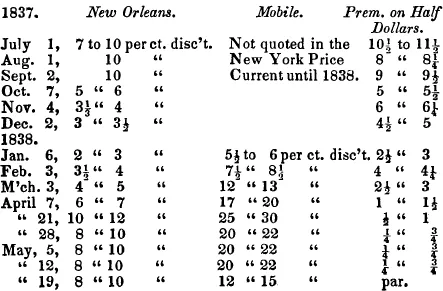
* Upon the resumption of payments by the Philadelphia banks, on 13th August, 1838, the exchange at New York on Philadelphia fell to ¼ to , and from that period up to the suspension of October, 1839, it was at no time below ¼ and was frequently at par.
* On the 10th of February, 1838, nominal exchange on London at New York was quoted at 7 to 8 per cent. premium, being an average of 7½. The true par as has been shown is near 9½ per cent. advance on the old computed par. The price of specie on the same day, payable in New York currency, was 3½ per cent, premium, and consequently exchange on London, if paid for in coin, was 4 per cent. nominal premium, which was in reality 5½ per cent. below the true par.
* Since the first edition of this work was printed, one exception to the generality of this remark has been presented in the case of the Branch Bank of Darien in Georgia, located at Milledgeville, which stopped payment a second time on the 27th of March, 1839. The directors, in announcing the fact to the public, gave notice, that the bank would pay an interest of seven per cent. upon all sums of one hundred dollars and over, deposited in the bills of said bank during the suspension.
* During the suspension of 1837 and 1838, all the banks of Pennsylvania made dividends, although it was prohibited in the charters of most of them. After the suspension, which took place in Philadelphia, in October, 1839, most of the banks of that city resolved not to declare dividends, until the pleasure of the Legislature could be known. By an act authorising the continuance of the suspension until the 15th of January, 1841, permission was granted to make dividends, contrary to every principle of justice and equity.
* One merchant informed me, that he had lost upon his remittances during the suspension of 1837, $20,000, in the exchange. Others lost much more.
* On the 10th of June, 1839, after the publication of the first edition of this work, the Legislature of Pennsylvania made provision for paying to the holders of her loans, the loss incurred by them on the depreciated paper given in payment of the interest falling due during the suspension of 1837, but the amount has not yet been paid. See Appendix, I.
* For a particular history of the money crisis of this period, see a report made to the Senate of Pennsylvania on the 29th of January, 1820, by the author of this treatise, Appendix, H. See also Gouge on Banking.
* How far he will be able to comply with his engagements may be inferred from the following paragraphs from newspapers.
From the National Intelligencer of 4th April, 1839. “The Vicksburg Whig of the 13th ult. gives quite a gloomy picture of the monetary affairs of Mississippi. It represents the darkest days of 1837, as presenting but a faint picture of what is now exhibiting in every town and country of the state. Goods have been sold at less than half the original cost, and lands and negroes have gone off under the sheriff’s hammer for one fifth of their value.”
From the New Orleans True American of about 18th April, 1839.—“The state of affairs in Mississippi is any thing but flattering. The greatest distress seems to prevail. The newspapers teem to overflowing with legal advertisements. We hear daily of the sacrifice of property, and credit is a thing which is sometimes talked of but hardly expected, much less known.
Some estimate may be placed on the situation of things in Mississippi from the fact that on a single offering day, upwards of 5000 notes were tendered the Union Bank for discount, amounting in the aggregate to about $15,000,000! Great distress must prevail, and the worst may not yet have come. It is a bitter thing to wake up from the dream of exhaustless wealth to the reality of embarrassment and a future poverty and labor. Such we fear has been the fate of many, and we trust that their backs may be strengthened to the burthen.”
From the Raymond (Miss,) Times of—Sept. 1839.—“Good plantations with every improvement and convenience, such as houses, gins, and negro cabins have been often sold at from $2 to $5 per acre.”
From the Nashville Whig of—April, 1840.—“We were informed last evening, by a gentleman just from Vicksburgh, who had been over a considerable portion of the country in the vicinity of that city, that five out of every six of the cotton farms were now vacated and lying a barren waste—farms, too, which but a year or two ago, were worth from $10,000 to $50,000.
* This amount was assumed by Mr. Webster in a speech early in 1838. The secretary of the treasury, in his report on the finances of 3d December, 1838, assumes it to be from eighty-five to ninety millions of dollars.
* Mr. Webster assumed this as the amount in the speech referred to in the foregoing note. See also Appendix. (C)
* The director of the mint, in a report made to the President of the United States, in 1826, computes the loss from abrasion of gold coins at two per cent. in fifty years, and silver coins at only one per cent.; from which it would appear that silver is the most economical currency of the two.
In a report made to the Senate of the United States in 1830 by a committee of which Mr. Sandford was chairman, it is asserted that half dollars and half eagles will circulate for one hundred years, and dollars and eagles for two hundred years, without being so much worn or defaced, as not to serve the purposes of a currency.
Mr. Gallatin, in his pamphlet on the currency, estimates the loss at seventy thousand dollars per annum, at the very utmost, in a coinage of forty millions.
* As a specimen of unproductive expenditures on Railroads and Canals, as fax as the same can be ascertained from the market prices of stocks, the following table of actual sales as reported by the Board of Brokers, of New York, is given.
Sales at New York, of Stocks, in the months of November 1839, and April 1840.
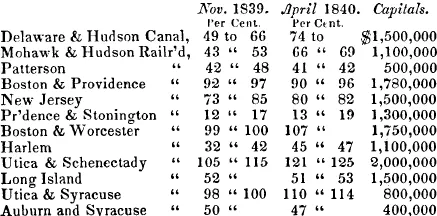
Only three out of 12 have commanded par.
A recent report made to the Legislature of New York, gives the following as the net profit in 1839, of some of the foregoing roads, viz:
| Mohawk & Hudson, | $58,279 equal to about | 5.3 perct. on cap. |
| Harlem, | 12,816 “ “ | 1.2 “ “ |
| Utica & Schenectady, | 223,720 “ “ | 11.2 “ “ |
| Long Island, | 5,755 “ “ | 3.8 “ “ |
| Utica & Syracuse, | 90,856 “ “ | 11.3 “ “ |
| Auburn & Syracuse, | 25,900 “ “ | 6.5 “ “ |
* Bicknell’s Counterfeit Detector and Bank Note List, of 1st Jan. 1839, contains the names of 54 banks that had failed at different times; of 20 fictitious banks, the pretended notes of which are in circulation; of 43 banks besides, for the notes of which there is no sale; of 254 banks, the notes of which have been counterfeited or altered; and 1395 descriptions of counterfeited and altered notes then supposed to be in circulation, from one dollar to five hundred.
* In the month of October, 1839, the rate of interest on the best commercial paper in the New York market, was at times from 3 to 5 per cent. a month, evincing a distress greater than was ever before known in that city.
* See the Financial Register, for the Reports made to the Legislature of Massachusetts, upon the affairs of the Commonwealth, Lafayette, Hancock, Fulton, Kilby, Norfolk, Commercial and Roxbury Banks, for the most astounding disclosures. See also the same work for a statement of the affairs of the Lumberman’s Bank of Pennsylvania, and the Brandon Bank of Mississippi.
* For authority on this subject, see the Bullion Report of 1810, sect. 1, which will be found in the Financial Register. For a part of this time, bank notes were even at a small premium. See M’Culloch’s Commercial Dictionary, article Bank of England, now in the course of publication in Philadelphia, under the editorial supervision of Professor Vethake, author of a treatise on the Principles of Political Economy.
* As a specimen of the extent to which Bank notes may be depreciated by the mismanagement of Banks, the following quotations are given.
From the New Orleans Price Current and Commercial Intelligencer of the 25th April 1840.
Rates of Specie, Bank Notes, &c.
| Specie, | 5to6 per ct. premium. |
| Alabama State Bank and Branches, | 3½“4½ discount. |
| Tennessee Banks, | 4“6“ |
| Arkansas Banks, | 30“35“ |
| Pensacola, Florida, | 20“25“ |
| Life & Trust, Florida, | 20“25“ |
Planters, Agricultural & Commercial of Natchez, on demand, (fives) |
5“10“ |
| Do. do. branches, on demand, | 10“20“ |
| Natchez Railroad, “ | 75“80“ |
| West Feliciana, at Woodville “ | 16“20“ |
| Bank of Port Gibson, (fives’) “ | 10“15“ |
| Commercial Bank Manchester, “ | 10“15“ |
| Do. Rodney, “ | 35“45“ |
| Union Bank of Mississippi, “ | 55“60“ |
| Commercial Bank of Columbus “ | 30“40“ |
| Grand Gulf Railroad Co. “ | 50“55“ |
| Lake Wash’gton & Deer Creek, “ | 55“60“ |
| Commercial & Railroad Bank Vicksburgh, | 55“60“ |
Post Notes.
Commercial, Agricultural, & Planters Banks, Natchez, 12 months, spring of 1839, bearing interest, „ : |
30“40“ |
Union Bank of Mississippi, bearing interest, “ |
55“60discount, |
Woodville, Manchester & Port Gibson, “ |
30“40“ |
| Rodney, do | 35“45“ |
| Natchez Rail Road,do | 75“80“ |
Commercial & Railroad Bank Vicksburgh, |
55“60“ |
| Bank of Vicksburgh, | 60“70“ |
| Waterworks Bank of do. | 60to70“ |
| Citizens’ Bank of Madison County | 80“85“ |
| Tombigbee Rail Road Co. | 75“85“ |
| Brandon Bank. | 93“95“ |
All these banks are in the state of Mississippi, except the five first named.
A Treatise on Currency and Banking
Read the whole book online · Book details
Free to read online and to download from this archive.