
Chapter 26 of 37 · A Treatise on Currency and Banking by Condy Raguet
CHAPTER XII. ON THE CIRCULATION OF SMALL BANK NOTES.
IT must be manifest to all who will reflect upon the subject, that the currency of the United States is exposed to dangers from over-expansions to which that of Great Britain is not in the same degree liable. The distance from the American to the European continent is so great, that even after the general establishment of steam packets, a month would be requisite for obtaining a supply of the precious metals under a panic, which could be obtained in England from the adjacent parts of the continent in four or five days, and it would therefore seem to be sound policy for the state legislatures of our Union to authorise no measures to be pursued by our banks which can have a tendency to diminish the metallic basis of our paper currency so greatly, as to endanger its convertibility. It is self-evident, that just in proportion to the diminutive size of bank notes authorised in a country, will be the supply and consequent circulation of gold and silver. In France, where no bank note is allowed to be issued of a less denomination than five hundred francs, (equal to about ninety-four dollars of our money,) the whole of the retail transactions of a community of thirty millions of people, nearly double our population, are carried on by the precious metals.* In England, no note of a less denomination than five pounds sterling (equal to twenty-four dollars and upwards,) can be issued by the Bank of England, or by any joint-stock or private bank; so that in that country too, the minor channels of circulation are kept well filled with gold, so that on any emergency, a large fund can be made available to meet any reaction of the banking system, before the necessity occurs of ordering bullion from abroad.
In the United States, unfortunately, the blindness of the legislatures and the public, and the avarice of the bankers, has at all times, since the existence of banks, led to the emission of notes of a much less denomination. With the exception of the Bank of the United States, incorporated by congress in 1816, and the Pennsylvania Bank of the United States, chartered in 1836, which were not allowed to issue notes of a less denomination than ten dollars, and of the new bank of Missouri, which can issue none of a less denomination than twenty dollars, there has probably been no bank chartered by any of the states which has not been authorised to issue five dollar notes. The consequence of this policy has been, that the stock of the precious metals in the country has at all times been much less than it would have been, had the policy intended by congress in 1816 been preserved by the state. I say “intended” because the prohibition was evaded by the issue by the bank, of checks for five dollars drawn by the branches upon each other, which answered all the purposes of five dollar notes.
But although, by the exclusion of all notes of a less denomination than ten dollars, the security of our paper currency would be greatly strengthened in case of an unexpected panic, yet the design of this chapter is more particularly to inveigh against the growing propensities in some of our legislative bodies to authorise the emission of notes of a denomination less even than five dollars, a policy which, if adopted by all the states, will fill not only all the arteries of circulation, but even the very smallest veins, with paper, and drive from the country the few coins which the five dollar notes have spared.
A short sketch of the history of small bank notes may not be without interest.
Prior to the suspension of specie payments in August, 1814, I am not aware that any notes of a less denomination than five dollars were any where issued, although there may have been in a few of the states. By that event, specie disappeared wholly from circulation in all the states except those of New England, where the banks, coerced by efficient laws and public opinion combined, continued to fulfil their engagements, and its place was supplied by emissions of notes by banks from three dollars down to twenty-five cents, some with the sanction of law, granted for the especial occasion, and some without it; and by other emissions from all sorts of corporations, public officers, private institutions, and even by individuals, who generously accommodated the public with their credit for sums as small as five cents, in the hope that the notes would be worn out. or lost, and that they should never be troubled with a demand for their payment. This wretched state of things continued for some time after the restoration of specie payments in February, 1817. An incubus appeared to be fastened upon the community, which no combination of individuals could shake off, and which continued for a longer or shorter time, according as legislative interference was delayed. In Pennsylvania, where, from the multiplicity of banks, this evil was of great magnitude, an act was passed on the 22d of March, 1817, prohibiting, under a penalty, the emission or circulation of any notes or tickets in the nature of bank notes, of a less denomination than five dollars, excepting by banks duly authorised; and also prohibiting, after the first day of October following, any bank from issuing such notes: a privilege which had been granted by act of 28th December, 1814. This law, being partially carried into effect, expelled from circulation the principal part of the miserable trash against which it was directed, and the silver fractions of a dollar began to make their appearance from the pockets and strong boxes of the public, where they had been concealed for near three years. Still the cure was not complete, owing to evasions of the law, and to the introduction of small notes and tickets of neighboring states. The banks of Pennsylvania, having ceased after the first of October to issue notes of a less denomination than five dollars, the neighboring states of Delaware, New Jersey, and New York, sent us an abundant supply and the chief effect of the law appeared to be, not to give us a circulation of specie in the place of small notes, but to fasten upon us a set of notes not known to the public, for another set that was known. And yet, with this fact staring them in the face, the Senate of Pennsylvania rejected, by a vote of 16 to 15, on the 9th of March, 1820, a bill introduced into that body by the author, who was then a member, prohibiting the circulation of all notes of a less denomination than five dollars, wheresoever or by whomsoever issued.
After the defeat of this measure, which was opposed most strenuously on the ground that if the small notes were expelled, the people in the interior where they chiefly circulated, would be wholly destitute of change; and advocated on the ground, that so far from this being the effect, the immediate and necessary consequence would be, that every man who had in his pocket a dollar in paper would find it instantly converted into a dollar in silver, the subject was permitted to sleep for a number of years; and it was not until the 12th of April, 1828, that Pennsylvania was convinced of the impolicy of a measure which prevented specie from flowing in upon her citizens. The act of that date fixed upon the 1st of January, 1829, as the period for enforcing the prohibition, and it was not without great apprehensions of a repeal before the appointed day, that the friends of a wholesome currency saw numerous petitions with that object presented to the legislature in the preceding month of December. Happily, however, these evidences of ignorance and folly were disregarded by the legislature. The law went into operation, the flood of foreign paper was forced back upon its issuers, and, as if by magic, silver was immediately seen to circulate in abundance in those counties where before there was nothing but paper.
The successful issue of this experiment in Pennsylvania was followed in subsequent years by a number of other states, which in turn proscribed notes under five dollars; and their total expulsion from all the states of the Union might reasonably have been expected in the course of a few years, had it not been for the unfortunate suspension of specie payments in May, 1837, which again deluged the country from one end to the other with a flood of small notes and tickets, from three dollars down to five cents, and extinguished in some of our legislatures the lights of science which so much pains had been for so many years taken, by the intelligent few, to kindle into a flame. New York has backslided by authorising, by a recent act, the emission by her own banks of notes of a less denomination than five dollars, and as far as she is concerned, has proclaimed her unwillingness to assist in retaining in the country a proper specie basis for the huge mass of paper money which her banks fabricate. The state of Maine, too, has fallen off by a similar recreant step, and indications have also elsewhere appeared of a similar delinquency. Still it is to be hoped that this retrograde movement will be of limited extent, and that the example of those states which entertain sounder views of a currency will ultimately operate upon the rest, and convince them that the profit of private corporations should never be made to outweigh the substantial interests of the community, by placing the stability of the currency in a constant state of jeopardy.*
* According to the report of the secretary of the treasury of April, 1840, the number was 901, with a paid up capital of near $360,000,000. See Appendix C.
* Book I. Chap. 4.
† This expression must be qualified thus. Every emission of a paper currency in any country drives out a portion of its coin, and augments the total amount of the currency of the world, in the same manner that an additional quantity of gold and silver from the mines would do it; and hence an emission of paper money any where must augment the currency every where, after time has been afforded for the distribution.
* I am aware that the usual practice of banks is to call in their capitals by instalments, and to lend out those instalments as fast as received, which is undoubtedly the best mode, if the loans were not so apt to be made to needy or speculating stockholders, to enable them to pay up the subsequent instalments.
* If it be objected to this proposition, that the losses of the banks in the United States are comparatively few, I would reply, that this result is to be ascribed to the absence of a general bankrupt law, which would prevent those partial assignments for the benefit of endorsers at bank, by which banks become preferred creditors in most cases of insolvency, and thereby get a larger share of the assets of their debtors, than other creditors.
* The depreciation of a currenny when it takes place must necessarily show itself in reference to every species of property and commodity, although it takes longer to reach some things than others, so as to occasion a change in their price. A depreciation of the currency, in reference to particular things only, cannot be supposed, any more than a rise of the tides in reference to some particular objects on the margin of a river, and not to all others.
* Strictly speaking, the export would not be quite equal to the amount of the paper issued, for the reason assigned in the second note to this chapter, page 73.
* The banks of Pennsylvania, and perhaps most other states, are authorised to charge one per cent, interest for sixty days, and to receive it in advance. Individuals can only charge six per cent. per annum, without the right to receive it before hand, but the law in this case is seldom observed.
* Except in those cases where deposites constitute a large portion of the amount loaned by the bank.
* To this circumstance may also be mainly ascribed the practice which of late years has generally prevailed of long credits on merchandise sold. Eight months are now given, where formerly only four were required, the effect of which is to double the stocks of dealers who buy on credit, and to double the amount of outstanding debts. When long notes are discounted by banks, long credits will be given by the merchants.
* The discount will of course be deducted.
* Whenever gold and silver legal tenders are both saleable at a premium, it is proof of the absence of true convertibility.
* Mr. McCulloch in his Commercial Dictionary, edition of 1834, pages 109 and 110, has the following remarks. “Bad as our system of country banking undoubtedly is, we should be exceedingly sorry to see any attempt made to improve it, by the adoption of even the best parts of the American system!” * * * * * * “That part of the American system which limits the responsibility of the partners in a bank to the amount of their shares, seems to us to be in the last degree objectionable. It affords a strong temptation to the commission of fraud, and we have yet to learn, that it possesses a single countervailing advantage. We have been assured by those well acquainted with the facts, that it has been productive of the most mischievous consequences.”
For an able exposition of the principles of individual liability, see the article G, in the Appendix, by James Cox Esq., of Philadelphia, now first published.
* The banks of New York are prohibited from issuing post notes. Some of those of Philadelphia entered very deeply into this branch of business in the years 1838 and 1839, abroad as well as at home, and became greatly embarrassed by it.
* The following article which appeared in a newspaper in December, 1839, is important as regards this practice.
Important Legal Decision.—The Cincinnati Gazette contains a notice of the decision of a case at Columbus, Ohio, which attracted much attention on account of the principles involved. The facts were briefly these:
Paddleford wrote to the cashier of the bank, inquiring if they would discount a note with his and other names mentioned, payable east 6 or 8 months. The cashier replied, that the bank was not discounting, but his bill with the names mentioned for $5000, at 6 months payable in New York, Philadelphia, or Baltimore, would be purchased at their usual rates, and the procceeds paid in their own bills, if intended for circulation or in a check east at the usual premium: and he endorsed a printed blank form of a bill, Paddleford and the other person signed the blank paper filled up only with the sum, and he sent it to the cashier in a letter requesting him to remit the proceeds to him in an eastern check, less the premium. The paper was received at the bank, and filled up with the name of their own correspondent in New York, the cashier of a bank as a drawee, in their own favor. The drawer never had funds in his hands. Deducting the interest for six months and four days, and one per cent, they remitted him the net proceeds in a check on New York less 1½ per cent, premium, and ordered a notice to be furnished to him of the name of the drawee, and of the time and place of payment, which notice was duly received.
The charter of the bank prohibits them from taking more than at the rate of 6 per cent, per annum on their loans or discounts. The defendants, the securities, (Paddleford not having been served with process) set up as a defence, that this bill was discounted at a higher rate than 6 per cent. per annum, and therefore was against the charter, unlawful and void. The bank claimed that the bill was fairly purchased in the market, and that one per cent, was retained as exchange. The court instructed the jury that the bank could buy and sell exchange at any fair Tate agreed upon, without violating its charter; and if the transaction before them was a real purchase of a bill at 1 per cent, exchange and interest off, the bank could recover, but if the intention was to get a greater compensation for the use of the money than at the rate of 6 per cent, per annum, and the form of the bill was resorted to, to cover up that design, then the contract was unlawful, and the defendants must have a verdict; that the jury should be governed by the real transaction, no matter what form it assumed.
This decision seems to cut up by the roots, the business of discounting fictitious bills of exchange by banks similarly restricted, merely for the purpose of exacting high interest under the name of exchange.
* The essay last mentioned, appeared in the National Gazette, of 10th April, 1828, under the title of “The Currency.” The reply was published in the Philadelphia Gazette, of 17th April, 1828, under the title of “On Exchange.” Both essays were republished in the Free Trade Advocate in 1829.
* The following western and southwestern bank stocks were sold at New York and Philadelphia, where a large amount of them are owned, between the 1st of September, 1839, and the 1st of January, 1840, as low as the prices specified in the first column. The sales at Philadelphia were made prior to the suspension of specie payments on the 9th of October, so that in both cases the specie price is given.
The second column gives the lowest and highest prices between the 1st of January and the 1st of May, 1840.
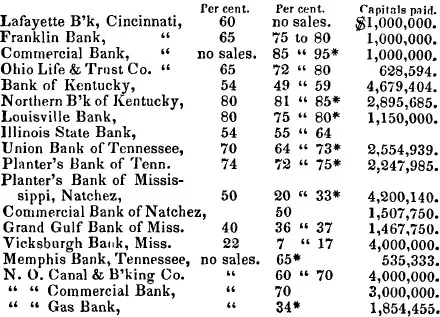
* These sales were made at Philadelphia, in paper currency, depreciated from 8 to 5 per cent, the range between January and May.
It is supposed that at least fifteen millions of dollars of Philadelphia and New York capital have been invested in the stocks of the western and south-western banks and internal improvement companies, but chiefly in banks, which accounts in some degree for the present embarrassment of those two cities.
* Silver is virtually the currency of France. Gold being undervalued at the mint in relation to silver, commands a small premium in the market, when wanted for travellers or exportation.
* During the suspension of specie payments which commenced on 9th October, 1839, and which still continues in all the States south and west of New York, small notes as low as $1, issued by the banks of Delaware and New Jersey, have been current in Pennsylvania. No notes under five dollars having been issued by bank corporations or individuals in Pennsylvania.
A Treatise on Currency and Banking
Read the whole book online · Book details
Free to read online and to download from this archive.