
Chapter 13 of 38 · An Essay on Economic Theory by Richard Cantillon
Chapter Eleven: The Par or Relation between the Value of Land and Labor
Chapter Eleven
The Par Value or Ratio between the Value of Land and Labor
Abstract: William Petty set off the search for a par value between land and labor. Cantillon provides a theoretical answer (referenced in Adam Smith’s Wealth of Nations) that property owners must provide their labor with the production of at least twice the land necessary to sustain the worker in order that enough children are raised to maintain the workforce over time. The amount of land will actually vary from job to job, person to person, and among different countries and societies. Therefore, the practical circumstances of the world dictate that there is no such “par” value between land and labor, only money—a “most certain measure”—can be used for income measurements and comparisons.
IT DOES NOT APPEAR that Providence gave the right of land possession to one man over another. The most ancient titles are founded on violence and conquest. The lands of Mexico belong today to the Spaniards and those of Jerusalem to the Turks. But however people come to the ownership and possession of land, we already have observed that it always falls into the hands of a small number of people compared to the total number of inhabitants.
If the owner of a great estate manages it himself, he will employ slaves or free men to work upon it. If he has many slaves, he must have supervisors to make them work. He must likewise have slave artisans to supply goods and life’s pleasures for himself and his workers, and must have skills taught to others in order to carry on the work.
In this economy, he must provide his laboring slaves their subsistence and wherewithal to raise their children. The supervisors must receive advantages proportional to the confidence and authority that they possess. The slaves, who are being taught a craft, must be maintained without any return during the time of their apprenticeship. In addition, the artisan slaves and their supervisors, who should be competent in the crafts, must have a better subsistence than the laboring slaves, etc., because the loss of an artisan would be greater than that of a laborer, and more care must be taken of him given the expense of training another to take his place.
On this assumption, the labor of an adult slave of the lowest class is worth at least as much as the quantity of land that the owner is obliged to allot for his food and necessities, and also to double the land which serves to raise a child until he is of age or fit for labor. Knowing that half of the children born die before the age of 17, according to the calculations and observations of the celebrated Dr. Halley18, two children must be reared in order to maintain one of them until working age, and it seems that even this would not be enough to ensure a continuance of the labor force because adult men die at all ages.
It is true that the one half of the children who die before 17, more die in the first years after birth than in the following years, with at least one- third dying in their first year. This seems to diminish the cost of raising a child to working age. However, as the mothers lose much time in nursing their children in illness and infancy, and the daughters, even when grown up, are not the equals of the males in work and barely earn their living, it seems that to maintain one of two children to manhood or working age, as much land must be employed as for the subsistence of an adult slave. This is true whether the owner raises the children himself in his house or has them raised there, or if the slave father brings them up in a house or hamlet apart. Therefore, I conclude that the daily labor of the lowest slave corresponds in value to double the produce of the land required to maintain him, whether the owner gives it to him for his subsistence and that of his family,19 or provides him and his family subsistence in his own house. This matter does not allow for an exact calculation, and exactitude is not very necessary; it suffices to be near enough to the truth.
If the owner employs the labor of vassals20 or free peasants, he will probably maintain them better than slaves, according to the custom of the place where he lives. Yet, in this case, the work of a free laborer also ought to correspond in value to double the product of land needed for his maintenance. However, it will always be more profitable for the owner to maintain slaves than to maintain free peasants, because when he has raised too many slaves for his requirements, he can sell the surplus, as he does his cattle, and obtain for them a price proportionate to what he has spent in rearing them to manhood or working age, except in cases of old age or infirmity.21
In the same way, one may appraise the labor of slave artisans at twice the production of the land that they consume and that of supervisors likewise, because of the favors and privileges given to them above those who work under them.
When the artisans or laborers have their double portion at their own disposal, they employ one part of it for their own upkeep and the other for their children, if they are married.
If they are unmarried, they set aside a little of their double portion to enable them to marry and to save a little for the household, however, most of them will consume the double portion for their own maintenance.
For example, the married laborer will be satisfied to live on bread, cheese, vegetables, etc., will rarely eat meat, will drink little wine or beer, and will have only old and shabby clothes, which he will wear for as long as he can. The surplus of his double portion will be used to raise and maintain his children. On the other hand, the unmarried laborer will eat meat as often as he can, will buy himself new clothes, etc., and use his double portion on his own maintenance. Thus, he will personally consume twice as much of the produce of the land as the married man.
I do not here take into account the expense of the wife. I assume that her labor barely suffices to pay for her own living, and when one sees a large number of little children in one of these poor families, I assume that charitable persons contribute something to their maintenance. Otherwise, the parents must deprive themselves of some of their necessities to provide for their children.
To better understand this, it is to be observed that a poor laborer may maintain himself, at the lowest estimate, upon the produce of an acre and a half of land, if he lives on bread and vegetables, wears hemp garments, wooden shoes, etc. However, if he can allow himself wine, meat, woolen clothes, etc., he may, without drunkenness or gluttony, or excess of any kind, consume the product of four to ten acres of land of average quality, such as the case with most of the land in Europe. I had some calculations made, which will be found in the Supplement, in order to determine the yearly amount of land which one man can consume the product of under each category of food, clothing, and other necessaries of life, according to the ways of life found in Europe, where peasants in different countries often are nourished and maintained very differently.
This is why I did not determine how much land corresponds in value to the work of the cheapest peasant or laborer when I wrote that it was worth double the product of the land used to maintain him because that varies according the ways of life in different countries. In some southern provinces of France, the peasant maintains himself on the product of one acre and a half of land, and the value of his labor may be reckoned equal to the product of three acres. But in the county of Middlesex, the peasant usually consumes the product of five to eight acres of land and his labor may be valued at twice as much.
In the country of the Iroquois,22 where the inhabitants do not plow the land and live entirely by hunting, the common hunter may consume the product of fifty acres of land, since it probably requires this amount to maintain the animals he eats in one year, especially as these savages have not the industry to grow grass by cutting down some trees, but leave everything to nature.23 The labor of this hunter may then be reckoned equal in value to the product of one hundred acres of land.24
In the southern provinces of China, the land yields up to three crops of rice per year, and can bring in, each time, up to a hundred times as much as is sown. This is because of the great care they take with agriculture and the fertility of the soil, which is never fallow. The peasants, who work almost naked, live only on rice and drink only rice water and it appears that one acre can support more than ten peasants. It is not surprising, therefore, to see extraordinary population numbers. In any case, it seems from these examples that nature is altogether indifferent whether land produces grass, trees, or grain, or maintains a large or small number of vegetables, animals, or men.
Farmers in Europe seem to correspond to supervisors of laboring slaves in other countries, and the master artisans, who employ several journeymen artisans, to the supervisors of artisan slaves.
These master artisans know approximately how much work a journeyman artisan can do in a day in each craft, and often pay them in proportion to the work they do, so that the journeymen work as hard as they can, in their own interest, without further supervision.
As the farmers and master artisans in Europe are all entrepreneurs working at risk, some get rich and gain more than double their subsistence, others are ruined and become bankrupt, as will be explained more in detail in the analysis of entrepreneurs [Part 1 Chapter 13]. However, the majority support themselves and their families from day to day, and their labor or supervision may be valued at approximately three times the product of the land that serves for their maintenance.
Evidently, these farmers and master artisans, if they are supervising the labor of ten laborers or journeymen artisans, would be equally capable of supervising the labor of twenty, according to the size of their farms or the number of their customers. This renders uncertain the value of their labor or supervision.
By these examples, and others of the same sort that could be added, it is seen that the value of the day’s work has a relation to the product of the soil. The intrinsic value of any thing may be measured by the quantity of land used in its production and the quantity of labor which enters into it, that is to say, by the quantity of land of which the product is allotted to the laborers. As all the land belongs to the prince and the property owners, all things that have this intrinsic value, have it only at their expense.
The money or coin, which finds the proportion of values in exchange, is the most certain measure for judging of the par between land and labor and the ratio of one to the other in different countries. This par varies according to the greater or less produce of the land allotted to those who labor.25
If, for example, one man earns an ounce of silver every day by his work, and another in the same place earns only half an ounce, one can conclude that the first has twice the amount of the production of the land to spend as the second.
Sir William Petty26, in a little manuscript of the year 1685, considers this par or equation between land and labor as the most important consideration in political arithmetic. However, the research he made in passing is fanciful and remote from natural laws because he has attached himself, not to causes and principles, but only to effects, as Mr. Locke27, Mr. Davenant28, and all the other English authors who have written on this subject, have done after him.

Cantillon’s Three Rents
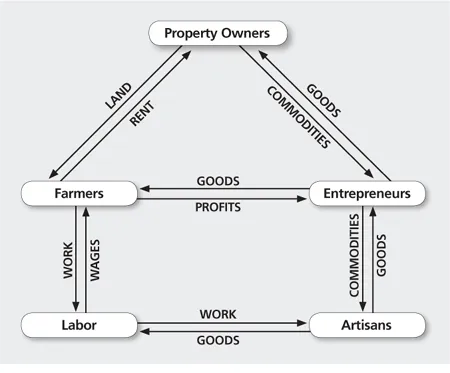
Cantillon’s Three Rents
18 This is no doubt Dr. Edmond Halley (1656-1742) the famous astronomer who predicted in 1705 that a comet would appear in 1758 based on Newton’s laws of motion and comet sighting in the years 1531, 1607, and 1682. The comet did indeed return as predicted and was later named in his honor. Dr. Halley is also credited with the publication of Newton’s groundbreaking Principia Mathematica because he paid the publication’s expenses and corrected the proofs of the book that otherwise might not have been published. Dr. Halley contributed to Issac Newton’s Universal arithmetick, or, A treatise of arithmetical composition and resolution, to which is added, Dr. Halley’s method of finding the roots of aequations arithmetically (1720).
19 In the Higgs edition (pp. 345-6), the French version of this section is italicized, but the English version is not. Apparently in the original manuscript only the first two words are underlined. This conclusion is noteworthy because it is a conclusion that Adam Smith attributed to Cantillon in the Wealth of Nations.
20 Someone bonded to the land of a feudal landowner who would provide protection in exchange for the alligience of the vassal.
21 Cantillon reaches the same conclusion as Fogel and Engerman (1974) did two hundred and forty-four years later. Cantillon found that slave labor was more profitable than free labor because the slave owner can sell off any excess supply of labor and recoup his cost, while a landowner dependent on free labor can only dismiss the labor and is unable to recoup his costs of rearing free labor. Fogel and Engerman base their argument on empirical calculations and attribute profits to exploitation. Although both discuss supervision and the loss of runaway slaves, neither consider the cost of policing a slave labor force, which is the major difference between supervising a free and slave labor force, and which greatly undermines the profitability of slave labor.
22 The six native American tribes of Northern and Western New York State lived under a Constitutional confederacy called the Iroquois nation.
23 In the original French version the paragraph ends here. In the Higgs translation he combines the paragraphs. The natural paragraph break would include the next sentence (as we have done) and start the next paragraph (which discusses China) with the the sentence that follows. This is possible evidence that the French edition was made from a copy of the original manuscript.
24 This “nation” consisted of the Iroquois, Mohawk, Oneida, Onondaga, Cayuga and Tuscarora tribes of western New York and surrounding areas of Pennsylvania and Canada. They actually did practice some agriculture and are reported to have used the technique of burning down areas of forest lands to increase the quantity of grass available for the animals that they hunted. They are also known to have used second growth trees (those that grow after forest fires) to build the structures they lived in called longhouses. In addition, the Iroquois nation had a very advanced form of constitutional government.
25 This paragraph is italicized in the French version of the Higgs edition, but not in the English version. It was not underlined in Mirabeau’s copy of the manuscript. However, it is a noteworthy point in the chapter.
26 William Petty (1623-1687) was an English statistician and political economist, but also was a scientist, inventor, and entrepreneur. He is mostly known for his survey of Ireland and one of his most famous books was the one Cantillon alludes to here, Treatise of Taxes and Contributions (1662, 1667 and 1685) although Petty also discusses ‘par’ in The Political Anatomy of Ireland (1691) and declared it the “most important consideration of political economy.” Cantillon was obviously influenced by Petty, but mostly in the subject matter, not method or conclusions, because Cantillon is distinctly hostile to Petty throughout the Essai. It is interesting to note that Petty amassed a huge estate in Kerry County, Ireland (and throughout Ireland), the same County in which the Cantillon family lost its estates. See Aspromourgos (1996) for a detailed analysis of Petty and Cantillon on the subject of par value.
27 John Locke (1632-1704), English philosopher whose economic works include Some Considerations on the Consequence of Lowering the Rate of Interest and Raising the Value of Money (1691), Short Observations on a printed paper entitled, For encouraging the Coining of Silver Money in England, and after for Keeping it here (1695), and Further Considerations concerning Raising the Value of Money (1695).
28 Charles Davenant (1656-1714), English economist, lawyer, and member of Parliament who was Commissioner of the Excise (tax) from 1683 to 1689 and Inspector general of Exports and Imports from 1705 until his death in 1714. His important publications include An Essay on the East India Trade (1697), Two Discourses on the Public Revenues and Trade of England (1698), An Essay on the probable means of making the people the gainers in the balance of Trade (1699), and A Discourse on Grants and Resumptions and Essays on the Balance of Power (1701).
An Essay on Economic Theory
Read the whole book online · Book details
This work is published under a Creative Commons licence. You may copy, share, and re-host it with attribution.