
Chapter 4 of 15 · Boundaries of Order: Private Property as a Social System by Butler Shaffer
Chapter 2: The Eroding Structure
Chapter Two
The Eroding Structure
As our populations expand, as a world-wide movement from countryside to city embraces all peoples, as problems of housing, of broken homes and juvenile delinquency, of mass education and delayed independence of the young rise about us in our very human midst, as David Riesman’s “the lonely crowd” comes more and more aptly to describe all humankind, have we not the right to ask: Is what we are witnessing, in essence, not the first consequence of the deterritorializing of man? And if man is a territorial animal, then as we seek to repair his dignity and responsibility as a human being, should we not first search for means of restoring his dignity and responsibility as a proprietor?
— Robert Ardrey
I must explain, at the outset, that this book is not simply an abstract discussion of the property concept. One must consider the relative importance of property principles within the broader context of particular metaphysical models that are presumed to both describe phenomena and prescribe systems and behavior that conform to a given model. If a particular paradigm has been accepted to explain the regularities in nature, efforts will be made to broaden the acceptance of that model as widely as can reasonably be accomplished. Because this book explains the nature of property from the perspective of a traditional model of social beliefs and systems, and proposes an alternative paradigm—one that already seems to be emerging—it is essential to begin with an historical analysis of what has brought us to our present situation.
For centuries, Western civilization has functioned on a model, developed by Isaac Newton, that presumed the universe to be composed of basic building blocks—atoms having become the preferred explanation—held together, and their behavior regulated, by discernible “laws” (e.g., laws of motion, gravity, light, thermodynamics, etc.). This provided a mechanistic and reductionist model that helped provide, within the realm of human society, the metaphysical base for the emergence of modern institutionalized systems of social order. Implicit in such a view is the idea that nature is structured in relatively simple patterns of calculation that can be accurately identified and measured. Because of the presumption of certainty inherent in such a model, it has long been an article of faith that, given sufficient information, it is possible for human beings to predict the consequences of events in both our physical and social worlds. Indeed, the universe came to be regarded as a giant clockwork, destined by the second law of thermodynamics to run down. If nature, including human action, was predictable, it was also controllable, a presumption upon which vertically-organized systems have depended for their existence.
While Newtonian thinking provided the intellectual base upon which the sciences built, political systems had long been grounded in similar assumptions about the governance of societies. Plato’s Republic,1 dating back to the fourth-century B.C., provided what one scholar has called “The first work that deserves to be called political science.”2 Plato envisioned a pyramidal governmental system in which society would be structured into a hierarchy of rulers, followed by a class of soldiers and administrators whose function would be to regulate the lowest class: the producers, whose existence makes society possible. That this arrangement continues to define modern political society is a proposition I trust requires no independent citation of authority! The imagery of such thinking can be seen in the Washington Monument towering above the District of Columbia.
The mechanistic model of a predictable and controllable universe has underlain programs of state planning and control, including the regulation of economic behavior, health care, the environment, foreign policies, education, wildlife management, urban renewal, transportation systems, and monetary policies, to name but a few. From the more ambitious undertakings of the erstwhile Iron Curtain systems, to the proliferation of legislative codes, administrative rulemaking, and judicial decisionmaking, all of which combine to dominate Western societies, modern assumptions about the necessity for the imposition of order differ from the mindset of the ancient lawgiver, Hammurabi, only in the expanded scope of their application. The belief that order must be intentionally generated and imposed upon society by institutional authorities continues to prevail.
This centrally-directed model is premised upon what F.A. Hayek called “the fatal conceit,” namely, the proposition “that man is able to shape the world according to his wishes,”3 or what David Ehrenfeld labeled “the arrogance of humanism.”4That such practices have usually failed to produce their anticipated results has generally led not to a questioning of the model itself, but to the conclusion that failed policies have suffered only from inadequate leadership, or a lack of sufficient information, or a failure to better articulate rules. Once such deficiencies have been remedied, it has been supposed, new programs can be implemented which, reflective of this mechanistic outlook, will permit government officials to “fine tune” or “jump start” the economy, or “grow” jobs, or produce a “quick fix” for the ailing government school system. Even as modern society manifests its collapse in the form of violent crime, economic dislocation, seemingly endless warfare, inter-group hostilities, the decay of cities, a growing disaffection with institutions, and a general sense that nothing “works right” anymore, faith in the traditional model continues to drive the pyramidal systems. Most people still cling to the belief that there is something that can be done by political institutions to change such conditions: a new piece of legislation can be enacted, a judicial ruling can be ordered, or a new agency regulation can be promulgated. When a government-run program ends in disaster, the mechanistic mantra is invariably invoked: “we will find out what went wrong and fix it so that this doesn’t happen again.” That the traditional model itself, which is grounded in the state’s power to control the lives and property of individuals to desired ends, may be the principal contributor to such social disorder goes largely unexplored.
Faith in the traditional model began to erode with work done in the field of “quantum mechanics.” The Newtonian dream of being able to describe the universe as a kind of cosmic erector set has been upset by a view of subatomic behavior in which spontaneity seems to offer a more plausible explanation for events than does mechanics. Traditional beliefs that phenomena could be explained as simple deterministic, cause and effect patterns, like David Hume’s vector analysis of the behavior of billiard balls, have given way to an awareness of more dynamic and mysterious interactions among particles than had before been imagined. One can still play a very adept game of pool using Newtonian principles, but his system is no longer sufficient to explain complex dynamics.
Just as distressing to adherents of the Newtonian paradigm was the realization that, at the subatomic level, change occurred not through gradual processes of evolution, such as a molecule of water progressively getting warmer as it was subjected to heat, but through “quantum leaps.” While the collective temperature of the water could be said to gradually increase, for any specific molecule such a change came about instantaneously, as a jump from an unheated to a heated state. What this means is that prediction—hence, the ability to control —is impossible at the subatomic level, and must give way to estimates of probabilities, based on the law of large numbers. Even our atomic “building-block” assurances about the existence of matter have, at the subatomic level, been shattered. The on-again, off-again character of particles led Einstein to characterize “matter” as “frozen energy,”5 much as Emerson had described the world as “thickened light,”6 or some physicists to speak of particles in terms of “tendencies to exist.”7 To have a science that no longer admits being able to control specific complex events, a presumed power that has been further diminished by the study of complexity and chaos, has been quite devastating, not only to many scientists themselves, but to members of the institutional order, whose authority has depended upon the appearance of such ability.
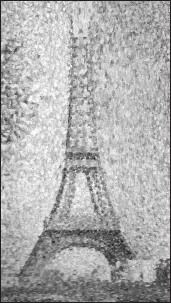
Quantum mechanics has been a major contributor to the breakdown of traditional centrally-directed models of order. With an understanding of events focused on the margins of subatomic behavior, the universe begins to look less and less like an assemblage of parts subservient to some whole, and more like patterns of reciprocal interconnectedness. This emerging model may find an analogy in the pointillistic art style of Georges Seurat, or of photographs in a newspaper. In each, the picture is seen only as the composite of individual dots of paint on a canvas, or ink on a page of newsprint.
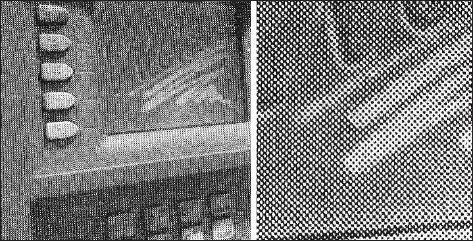
Newspaper picture, with section enlarged
Though our eyes are accustomed to seeing the pictures as single, complete entities, a closer examination reveals their individualized composure. The reality of the pictures is found only in the interconnectedness of the dots (or “quanta”). Without the individualized dots, there is no picture. Like the fast moving series of still photographs that produce what we call “motion pictures,” these dots create the illusions we think of as “reality.” As Einstein has helped us to understand, our visions of the world are dependent upon the perspective—including our paradigms—from which we view events.
The most devastating blow to the long-established model of order is coming from the emerging science of “chaos,” which is revealing the integrated complexity of the universe and the processes by which such complexity spontaneously generates order. We have long been familiar with the phenomenon of apparently regular behavior suddenly becoming erratic. A water faucet will drip at a fairly regular rate, increasing its flow proportionately to any additional supply of water. For a time, the relationship between input and output is linear in nature (i.e., any change in the pattern of flow is proportionately related to input changes). For example, if “x” produces “y,” “x + 1” will produce “y + 1.” There comes a point, however, where a further increase in input will produce disproportionate effects, generating erratic patterns. At this bifurcation point, a linear and basically predictable system is thrown into non-linearity and randomness. “X + 4” now produces not “y + 4,” but “z,” with “z” representing turbulence. Like the proverbial straw that broke the camel’s back, the consequence of adding one more unit is to create a nonlinear effect. These occurrences of nonlinearity are also seen in such examples as air turbulence, the flow of rivers, arrhythmic heartbeats, and the smoke from a cigarette whose rising regularity suddenly breaks up into erratic patterns.
Until recently, scientists and others have been content to dismiss such turbulence as random disorder. Because of the second law of thermodynamics, such irregularity has heretofore been accepted as only a confirmation of the entropic nature of the universe. But in the study of chaos, we are beginning to discover that, even within apparent disorder, patterns of orderliness and regularity can be found. Using computers as their principal tools, chaos scientists have identified behavior patterns in nature that recur, but do not precisely repeat themselves in any predictable manner. In the continual branching patterns of a river system, or a tree, or a cauliflower, we find examples of a recurring self-similarity that scientists have named “fractals.” Fractals are a means by which systems most efficiently organize themselves by continually repeating successful patterns at different levels of scaling. Even nonlinear and seemingly random events, in other words, reveal a deep, hidden order, organized around so-called “attractors,” which are the functional principles around which turbulence and perceived chaos regularize themselves. Earthquake fault lines, arrhythmic heart patterns, or brain wave patterns during a seizure, are just a few examples. Irregularity, in other words, has been found to have a certain regularity to it.
In spite of the regularity that has been discovered, it must be emphasized that chaotic systems are, by definition, nonlinear in nature (i.e., output changes are out of proportion to changes in input). Furthermore, a system can be rendered chaotic by even the most seemingly insignificant factor, whose effects are then fed back into the system, thus greatly multiplying its initial influences. This process by which a factor is able to produce a multiple of itself is known as “iteration,” and can operate either to stabilize a system or to generate change.8 In the regularities that keep iterating themselves deep within the behavior that we have heretofore regarded as disordered chaos, we are discovering a more dynamical and complex conception of order.
An awareness that order can arise spontaneously and without conscious design has begun to alter our views concerning the forms and functions of social organizations. As Hayek has observed, “we are able to bring about an ordering of the unknown only by causing it to order itself, ...not by deliberately trying to arrange elements in the order that we wish them to assume.”9 We are also developing a better understanding of how a healthy, creative order involves a continuing interplay between the forces of stability and change.
Because of such complex, nonlinear influences, our ability to predict outcomes associated with such behavior becomes impossible over any extended period of time. It is the unpredictable nature of complex systems that is most troublesome to practitioners of the traditional model of order. Predictability depends upon an awareness of all the factors that bear upon an event in question —what chaos scientists call a “sensitive dependence on initial conditions.”10 To overlook any factor, no matter how minimal its apparent significance, will eventually produce exaggerated errors in what we try to foretell. These and other factors contribute toward making complex systems increasingly unpredictable with the passage of time. In what has come to be known as the “butterfly effect,” chaos theorists offer the metaphor that the flapping of the wings of a butterfly over the Andes will influence the weather in Tibet. As regular and permanent as our solar system appears, even planetary orbits—which are subject to numerous disturbing influences—remain unpredictable over a long period of time.
Our inability to identify and accurately measure the multitude of factors influencing complex systems not only makes extended forecasting impossible, but it makes historic explanations equally subject to error. There has probably been no topic of human history more thoroughly examined and debated than the cause of what Edward Gibbon called “the decline and fall of the Roman Empire.” There is not even agreement among historians as to whether Rome “fell” or was only “transformed” from what it had once been. One scholar has identified as many as 210 explanations for this watershed occurrence.11
There are numerous factors at work that make it impossible to ever have sufficient information to allow for the prediction of outcomes in complex systems. The first is the logistical difficulty of marshalling and accurately assessing all relevant information. Complex systems are subject to a number of variables, whose existence, fluctuations, and interactions may be both unknown and immeasurable. Furthermore, the interplay of positive and negative feedback loops can influence complex systems in unexpected ways. Additionally, our senses have a capacity for processing only a tiny fraction of the reality to which they are exposed. We are biologically incapable of even perceiving all of the factors acting upon events in our lives, including the dynamics by which such factors interrelate. Furthermore, our capacities for synthesizing all of the information that we do perceive is limited by our tendencies to experience information overload, which can cause us to periodically anesthetize or even shut down our minds.12 Contrary to our hubristic assumptions about our capacities for understanding, there are simply far too many matters affecting our lives that will forever be beyond our epistemological grasp.
Our lack of ability to foretell the future becomes even more pronounced with the increased complexity of the systems and/ or the extension of time frames being considered. This is why government economic planning has been such an unmitigated disaster for millions of people. Hayek has thus identified the shortcomings of central planning: “the totality of resources that one could employ in such a plan is simply not knowable to anybody, and therefore can hardly be centrally controlled.”13 Centralized decision-making increases, exponentially, the interconnected factors at work upon situations for which one is trying to anticipate outcomes. On the other hand, a given individual acting on matters of his immediate concern has far fewer factors to consider in making a decision, thus reducing the range of uncertainty. While his ability to predict outcomes remains subject to the limitations posed by complexity, should his prognosis prove erroneous, the impact of his mistake will be much more confined.
As Hayek has expressed it, the spontaneous ordering of social systems requires us to “allow each individual element to find its own place within the larger order.” This process
requires that dispersed information be utilized by many different individuals, unknown to one another, in a way that allows the different knowledge of millions to form an exosomatic or material pattern. Every individual becomes a link in many chains of transmission through which he receives signals enabling him to adapt his plans to circumstances he does not know.14
We shall discover, further on, how a system of privately-owned property is not only essential to such self-organizing processes but, by decentralizing decision-making, serves to localize, rather than universalize, the consequences of erroneous judgments.
Closely related to these matters is the fact that all of our knowledge of the world is both subjective and abstract in nature. Our understanding has been produced by our mind organizing itself around various abstract concepts, and then cataloging and interpreting our experiences by reference to such concepts. If, as I believe, we do live in an objective universe, we can never experience its reality except as subjectively held opinions. We translate our world by reference to the mental constructs we have created for ourselves, which makes our understanding different from the world itself. We seem fated to dealing with the world by reference to such abstractions as “trees,” “rivers,” “justice,” “furniture,” “mankind,” and “thunderstorms,” concepts that inhere in our minds, not in what they describe. Alfred Korzybski reminded us of the metaphorical nature of our thinking when he declared that “the map is not the territory.”15 The words and other symbols that we employ never precisely equate with what they are used to describe and must, therefore, be interpreted when being applied in our world.
Through more precise use of language, we can narrow the range of uncertainty, but some amount of “fuzziness” remains because words are never the equivalent of what they seek to describe.16 To assist us in our efforts, we turn to dictionaries, which are collections of words (abstractions) we use to interpret other words. Even a photograph has a great deal of information loss. It provides a two-dimensional representation of an observable three-dimensional event, thus lacking the perspectives of depth, time, and energy. Because our concepts are based upon limited prior experiences, and, therefore, less than complete knowledge, there is an unavoidable information loss between the concept and the event itself; between the word and what the word is supposed to represent. As such, our opinions must always be regarded as incomplete and tentative in nature. We must develop an awareness not only of the importance of using sufficient clarity in our words so as to allow us to function with one another, but of the inherent uncertainties in language that foster conflict.
Our mind presents us with an additional problem: it functions on a dualistic model of perceiving and organizing the world into mutually-exclusive categories. We organize our experiences, through both formal and informal methods of learning, around “either-or” concepts. Something is either “A” or “non-A,” “animal” or “vegetable,” “hot” or “cold,” a process that unavoidably leads us to see the world as a series of divisions. That the rest of the universe functions in an indivisible manner, without any apparent awareness of the partitions into which our minds have organized it, is a further limitation on our capacities for understanding.
Thus, when we deal with some event in the world, we are bound to interpret its causal explanations and meaning in light of what our prior experiences tell us are relevant to consider. Such interpretations will always be done by minds that are both limited as to content and separated from other phenomena. What we already know, in other words, restricts the range of our inquiries about the unknown, a fact that creates an inevitable gap between our beliefs and the universe in which we live.
The study of quantum physics has afforded us another insight into the limitations of our capacities for obtaining sufficient information upon which to make predictions. Werner Heisenberg’s “uncertainty principle” informs us that we cannot simultaneously measure both the location and the momentum of a physical object; that the act of focusing our attention on something influences what we end up seeing. The behavior of subatomic particles is affected by the fact that they are being observed, just as the insertion of a thermometer into a container of a hot liquid will alter the temperature of the liquid. One finds this phenomenon in television coverage of political demonstrations, wherein the appearance and enthusiasm of demonstrators rises when the cameras are turned on, and diminishes when the television reporters leave. Nor can we overlook the influence of observer bias —whether intended or unintended—in choosing what phenomena upon which to focus attention. Because a scientific experiment is always an interplay between fact and the theory upon which the experiment is conducted, what the scientist ends up observing is the external world’s response to human thought.
In the command-and-control thinking spawned by our adherence to the pyramidal model, there remains a latent tendency to believe that the accumulation of more information can overcome uncertainties and the unpredictable nature of a complex world. But such thinking is illusory, for the reasons stated. Our task is not to manage complexity, which implies trying to control it for intended results, but to respond to its presence. An example of this latter approach is found in the warnings given to participants in whitewater river-rafting: should you fall overboard and be drawn beneath the raft, do not fight the turbulence but give in to it, and you will return to the surface on the other side. Those who fight the turbulence often end up drowning.
There is an arrogance, bordering on a presumed omniscience, connected with an insistence upon vertically-structured systems for the control of the complex and spontaneous events that comprise nature, including human society. The appetites for such systems are fed by desires for certainty in an inherently uncertain world, and for security from the inevitable vicissitudes of spontaneous change. The fallacy that centrally-managed power structures can put such fears to rest is being confronted by a growing awareness that decision-making authority is best left in the hands of individuals who, responding to the singular and marginal nature of the events before them, are best able to minimize the potentially adverse consequences of uncertainty.
What clearer example of our inability to foresee the course of complex events could be found than the failure of so-called government “intelligence” to predict four of the more dramatic occurrences of recent decades: the fall of the Shah of Iran, the tearing down of the Berlin Wall, the collapse of the Soviet Union, and the attacks on the World Trade Center on 9/11? Despite untold tens of billions of dollars spent on gathering the most detailed information about the Middle East, the “Iron Curtain” countries, and international “terrorism,” government officials were unable to anticipate these momentous events.
The record of economic planning by the state is even more abysmal. The “oil crisis” created by the Nixon administration’s imposition of price controls was troublesome to most Americans having to endure the resulting shortages. Cars lined up at gasoline pumps were reminiscent of Russians standing in lines to purchase everyday household needs. The deadly consequences of such planning, however, were no better revealed than in the governmental policies in the past half-century in China. As a result of Mao Tse Tung’s “Great Leap Forward” program, begun in 1958, millions of people were forced to leave their farms in order to work in factories, resulting in what two scholars have estimated as a 61 percent decrease in grain production17 which, in turn, led to the starvation deaths of anywhere from 20 to 43 million people. In following years, the Chinese government instituted its “One Child Only” program—legally restricting the number of children a couple could have—some of the effects of which have included increased numbers of abortions, infanticide, and the practice of small children being left to die.
Ignorance of the inconstancies of complicated systems has also produced catastrophic consequences in various government conservation and environmental protection programs. Employing computerized mathematical models—whose capacities for planning are also dependent upon an awareness of all interconnected influences—government agencies have often produced the adverse outcomes they were intended to prevent.18 So presumptuous are the political faithful in their ability to circumvent the uncertainties inherent in complexity, that one federal court, dealing with the disposal of radioactive wastes in Nevada, insisted that the Department of Energy predict the effects thereof for a period extending from 300,000 to 1,000,000 years!19That such an extended prognostication could not take into account such uncertainties as earthquakes, climate changes, soil erosion, the area being hit by a comet or asteroid, or any of a number of other unforeseeable factors, did not seem to diminish the court’s confidence in its capacity to formulate rules to accomplish such ends. Such an effort would be as absurd as trying to foretell—on the eve of mankind’s emergence on earth— the course of human history.
Why should our understanding of chaos and complexity raise doubts about the adequacy of hierarchical systems? Because the ability to plan outcomes is essential to any system of formalized control, be it the state or a business organization, chaos theory challenges the foundations upon which our traditional social practices have been built. For our world to be predictable and controllable, it must be mechanistic and linear in nature. But, the illusions of the behaviorists to the contrary notwithstanding, there is nothing less mechanistic and linear in nature than the human mind, whose intricacies and capacities have yet to be matched by even the most sophisticated computers. When one multiplies the uncertain and constantly fluctuating qualities and preferences of the individual by the hundreds of millions of individuals comprising modern, complex societies, and then multiplies these factors by their recurring feedback effects, the unpredictable nature of human behavior increases to exponential levels of uncertainty. When one further considers the myriad of purely physical factors that interact and interconnect with one another—themselves producing iterations of their own unforeseen effects—the inconstant and variable nature of the world becomes even more apparent.
The dismal failure of state systems of economic planning, provide the most vivid example of this phenomenon. The hubris of government planners has never been a match for spontaneous market forces that know no masters; unlike the marketplace pricing system, administered pricing practices of state socialism have been unable to determine efficiencies. The world is simply too complex for any groups of human minds to calculate its labyrinthine interconnections. The Achilles’ heel of socialist systems has been their failure to resolve this calculation problem.
Two political leaders grasped the truth of this. Over four centuries ago, Emperor Charles V acknowledged the futility of trying to universalize social order, when he observed: “To think that I attempted to force the reason and conscience of thousands of men into one mould and I cannot make two clocks agree.”20 French president Charles deGaulle reached the same conclusion in observing, centuries later: “How can anyone govern a nation that has 246 different kinds of cheese?”21 If prediction within complex systems becomes impossible, the rationale for institutional authorities to centrally control social conduct in order to achieve some desired end is swept away. Chaos theory, in other words, is calling into question the entire logic upon which our highly structured world of institutional direction and governance has been predicated.
Through the study of chaos, we may be able to transcend the dualistic patterns of our thinking, and to understand that what we polarize as “order” and “chaos” may represent a continuous, interconnected process. Consider, for instance, the following image on the top of the next page. What does it represent to you? Is it nothing more than a collection of random, disordered splotches? Or, do you see the beginnings of a Jackson Pollock painting? Perhaps it is a photo of bird droppings on a car. If you are unable to find a recognizable pattern; what about figure 2?

Figure 1.

Figure 2.
Do you recognize this, at once, as major sections of North America? If so, why did you not immediately perceive figure 1, which is an enlarged segment of figure 2, taken from a nighttime satellite photograph? Figure 1 provided you with no recognizable pattern with which to connect it, while figure 2 did. In other words, the “chaos” of figure 1 became the orderly presentation of figure 2 not because of any inherent qualities of either, but because your mind discerned a familiar pattern in the latter.
These photos can help demonstrate the important lessons being drawn from the study of chaos, namely, that what any of us may regard as “disorder” may only represent an “order” whose patterns we have not yet identified, or which conflict with our expectations. As with learning in general, it may be that only new patterns of order are being discovered. Did the substance of what you saw change, or only your interpretation thereof? If we think of order as a kind of information system, our failure to discover the underlying harmony or regularity may lead us to conclude that we are facing disorderly conditions. But isn’t the difference between what we think of as order and disorder accounted for only by the state of our understanding rather than by the rest of nature? Has the universe suddenly changed from “chaos” to “order,” or has there only been a change in our perspectives—encouraged, perhaps, by the availability of improved technologies—such that we are now able to discover these hidden patterns of order? And isn’t the process of discovering order in what seems to us disorderly, only a synonym for learning? Harlow Shapley expressed the point in these words: “Chaos is but unperceived order; it is a word indicating the limitations of the human mind and the paucity of observational facts. The words ‘chaos,’ ‘accidental,’ ‘chance,’ ‘unpredictable,’ are conveniences behind which we hide our ignorance.”22
Quantum mechanics and the study of chaos are transforming our assumptions about the certain and foreseeable nature of the world. While many continue to express faith in the proposition that “the more complex society becomes, the greater the need for centralized, governmental regulation,” the truth lies elsewhere. Because of the unpredictability factor, it is simple— not complex—systems that can more easily be organized from the top-down. The more complex a society becomes, the less capable political systems are to provide for social order—if, indeed, they ever were—and the more we must rely upon spontaneous and informal processes. Politics is a means for trying to enforce a simplified model of structured regularity upon a complex, nonlinear world. Our lack of awareness of the inner complexities of the world, including human society, helps generate much of the confusion and conflict in our lives.
Contrary to the tenets of our institutionally-directed thinking, conditions of nonequilibrium, of instability, are essential to the health of any system. If a system is to survive, it must continue to renew itself, a process that implies variation, diversity, and change, a movement toward a more orderly condition. “Life,” itself, emerged and continues to develop through spontaneous responses to nonequilibrium conditions. If biological stability were the only consideration for living systems, life might never have had the occasion to develop beyond the bacterial stage. Life became more complex, in other words, only by partially abandoning the linear regularity of single celled forms. Only by becoming more chaotic did life become more complex and proliferate itself.23 Life is a continuing interplay between organizational form and spontaneity, not an effort to stabilize some momentarily advantageous strategy. But it is this reciprocal process that institutions find threatening to their presumed needs for stability and permanence. Rather than seeing the long-term benefits to themselves in remaining adaptable to the forces of change, institutions tend to regard continuing transformation as a threat to their interests. In order to minimize the effects of this perceived menace, established systems— which insist upon being regarded as ends in themselves—have been attracted to mechanisms for the structuring of human conduct. But such efforts enervate the health of any vibrant system. In the words of Edmund Sinnott: “Constancy and conservatism are qualities of the lifeless, not the living.”24 The early Greek philosopher, Heraclitus, recognized this truth some twenty-five hundred years ago when he observed that “nothing endures but change.”25
The fate of Western civilization may depend on whether— and how—we respond to the turbulence in which we now find ourselves. Efforts to maintain static, equilibrium conditions may prove as fatal to a society as to an organism or business firm. One historian, Carroll Quigley, has identified such practices as leading to the collapse of civilizations.26 This is brought about when “instruments of expansion” (i.e., those systems within a civilization that have incentives for invention, saving, and investment) become institutionalized (i.e., ends in themselves, rather than the means for producing the negentropy upon which that civilization depends for its survival). River valleys—e.g., the Tigris-Euphrates in Mesopotamia, the Nile in Egypt, the Ganges in China, the Indus in India—became generators of the earliest civilizations. They could be characterized as “instruments of expansion” as irrigation was introduced, allowing people to more fruitfully sustain themselves through agriculture. In a complex industrialized society, these “instruments of expansion” can take a variety of forms: the economic system for the production and exchange of goods and services, technology, agriculture, the sciences, medicine, and the arts being some of the more prominent examples. Information, itself, is rapidly becoming a dominant creative instrument for what may prove to be a civilization in transition. What has proven to be such a productive instrument for Western Civilization—particularly the American version—has been the concept and practices of private ownership of property. This sytem has given real-world expression to the creative energies that lie within the self-interests of free men and women.
When such instruments become institutionalized and structured, they lose those qualities that are essential for resisting entropy: resiliency, creativity, and the capacity for growth— conditions that are dependent upon an environment receptive to change. Having transformed their raison d’etre from that of fulfilling specific functions, to preserving their organizational structures, institutions tend to exhibit varying degrees of rigidity and an unwillingness to adapt their behavior to the environmental and internal turbulence to which healthy systems would ordinarily have to respond.27 The failure of the Roman army to convert from its long-established infantry base to cavalry, for example, allowed Germanic barbarian horsemen to subdue Rome.28 Business organizations that are unable or unwilling to deviate from established practices in response to more creative or efficient competitors, provide further examples of institutional ossification.
Because the negentropic behavior of other organizations and individuals are often inconsistent with the primacy of institutional interests, efforts are undertaken to restrain any incompatible conduct, and to channel behavior in institutionally serving ways. Such efforts may be voluntary (e.g., private cartels, trade association codes of ethics29) or involuntary (e.g., statutes, administrative agency regulations) in nature. In either event, rules regarding the decision-making of owners over their property begin to proliferate. When such rules are agreed to voluntarily—i.e., as contracts—there is no more conflict with property interests than there is with any marketplace transaction. Other market participants, not being bound by such contractuallybased rules, remain free to make responses that frustrate these efforts to restrain trade. Furthermore, the self-interests even of those agreeing to such restraints will rise up to defeat the effort. This is why voluntary cartels and price-fixing agreements have been such weak mechanisms.
On the other hand, when the power of the state is invoked; when legislative and judicial processes are employed on behalf of institutional interests (e.g., by propping up ailing industries, providing subsidies, or inhibiting competitive change in various regulatory ways), such practices prevent entropy from working its way out of the system. Malinvestments become protected, inefficient firms have their lives extended beyond what market disciplines would tolerate, and creative alternatives are discouraged. All of these have a restrictive effect on how people direct their energies or other property interests. Because such regulations interfere with the negentropic behavior of others, conflicts begin to multiply, producing even more pervasive restraints in a futile effort to alleviate such frictions and restore the orderliness these measures have upset. The proliferation of inefficient firms and practices provokes a major political response. This may take the form of government loan guarantees to corporations, restrictions on the importation of lower-priced goods, sanctimonious campaigns against “cheap” foreign labor, or other protectionist measures. Such practices contribute to the institutionalization of the “instruments of expansion” that threaten the health of a civilization.
As their own purpose for being, institutions are desirous of maintaining the status quo which they represent. As such, they find enforced standardization of behavior essential for limiting the responses they 0entry of competitors; the establishment of product, employment, and trade practice standards; the imposition of wage and price controls; import restrictions on foreign products; and zoning laws and land-use restrictions; or other inhibitions upon innovation, to name but a few.
Regardless of whose immediate interests are being served by any particular government regulation, the practice invariably increases the costs and inefficiencies of marketplace activities. Not only do such regulations increase transaction costs, their mandate often increases the prices of goods and services.30 By its very nature, imposing requirements upon marketplace participants beyond what they would otherwise have freely negotiated, increases the costs of productive human action, and limits the options that facilitate the creative and efficient use of resources.
Government regulation fosters inflexibility and increases structuring of economic activity by restricting the uses owners can make of their property. For instance, it is easier for larger firms to distribute the fixed costs of regulation over a greater volume of products than it is for smaller firms with a lesser output. The added per unit production costs resulting from compliance with such regulation will be lower for the larger firm, giving it a comparative advantage when it comes to the pricing of its products. For the same reason, someone who develops a fundamentally new or innovative product might first have to satisfy a lengthy and expensive process of government-mandated testing or licensing before being allowed to produce and sell the product. Unless this person is financially capable of absorbing such up-front costs, he or she might be inclined to sell the creation to a large firm that could more easily bear such costs. In such ways have government regulatory practices promoted both increased concentration within industries as well as disincentives for generating the creative alternatives that keep a civilization vigorous.
State-mandated conservation practices are another form of government regulation designed to protect established firms from energetic competition. While the avowed purpose of such programs has been to “preserve natural resources,” they have had the actual and intended effect of maintaining higher prices for products in such industries as petroleum, lumber, and coal by restricting increased supplies. Again, conservation programs are usually directed against the owners of resources in order to stabilize the interests of existing firms.31
Another factor that contributes to a weakening of the dynamics necessary to sustain a vibrant economy is found in Joseph Schumpeter’s analysis of the development of business organizations. He shows the significance of how property is owned and controlled by distinguishing between “owner”— and “manager”—controlled systems. The perspectives of owners, he posits, tend to be more long-term oriented, as contrasted with the shorter-term outlooks of managers. In his view:
[T]he modern businessman... is of the executive type. From the logic of his position he acquires something of the psychology of the salaried employee working in a bureaucratic organization.... Thus the modern corporation, although the product of the capitalist process, socializes the bourgeois mind; it relentlessly narrows the scope of capitalist motivation; not only that, it will eventually kill its roots.32
Capitalism, in the course of its development, “tends to automatize progress,”33 he adds. An owner-entrepreneur risks his energies and financial resources in the uncertainties of the marketplace, an undertaking that proves disappointing to most who try. In the course of developing his enterprise, the successful entrepreneur will likely get funding from investors and lending institutions who are now more concerned with preserving the value of their interests than with further venturesome pursuits by the firm’s creator. Accordingly—and particularly as ownership of the firm increasingly comes into the hands of passive investors—the entrepreneur’s control is replaced by that of hired managers, attuned to practices designed to help preserve existing interests.
With management divided from ownership, an emphasis on cautious and conservative policies becomes separated from the risky practices that could either further enhance the profitability of the firm, or bankrupt it. Although the dynamics of chaos would emphasize the need for any vibrant system to remain resilient to changing conditions by altering its existing practices, the voices of prudence and hesitancy more often prevail. With preservation of the organization now an ascendant principle, corporate interests—whose concentrated nature provides them more political influence than that of other market participants—seek governmental restraints and other state-conferred benefits designed to reduce the risks of additional, more innovative, or more aggressive competition. In such ways does the widespread institutionalization of the “instruments of expansion” begin to erode the creative processes that sustain a civilization, and contribute to its collapse.
The metamorphosis identified by Schumpeter found reinforcement in the classic work by James Burnham, The Managerial Revolution.34 A system of private capitalism—with the control of enterprises exercised by their owners—was being replaced by managerial hierarchies that would centrally direct economic decision-making. This transformation would have profound significance not only for traditional business and political institutions, but for what is implicit in the personal and social meaning of property.
As we shall discover in subsequent chapters, conflict is likely to emerge whenever ownership is divided from control. In the case of a business firm, a manager may have purposes of his own that differ from those of an owner. As an employee with shorter time-preferences, he may be more interested in having a greater portion of company earnings directed to salaries than to plant expansion. Likewise, as in so-called “hostile takeovers,” the hostility that often arises is between the managers and the owners. The acquiring firm may pay a sizeable amount of money to the managers, whose jobs would be jeopardized by the merger, in order to elicit their cooperation in the merger process. Such payments become part of the acquirer’s cost of purchasing the enterprise, an amount that would otherwise be available to the stockholders.
In the same way, conflict occurs whenever the state, through its regulatory practices designed to enforce standardized conduct, insinuates itself into an owner’s control over his or her property. With ownership and control fragmented, it becomes increasingly difficult for an individual or a firm to make creative adaptations to a constantly changing world. Such difficulties are greatly exacerbated when, as now, the speed of both communication and technological innovation demand swifter responses than are otherwise allowed by bureaucratically-structured mandates. When decision-making authority is unified in the hands of an owner, however, symmetry—not conflict— tends to prevail. Whether the owner is then able to make appropriate responses to a constantly inconstant world will depend upon his or her creative talents that are unhindered by formal restraints.
One other area of human activity the state has always insisted upon controlling is the definition and enforcement of standardized rules of law governing transactions and personal disputes. For instance, people will always have disputes with one another, as well as a need to resolve them. The question needs to be asked: must resort be had to governmental court systems or, as the increasing use of arbitration, mediation, collaborative/holistic practices illustrate, might marketplace processes satisfy these needs as effectively as they provide for other goods and services? Such an inquiry calls into question the concept of “judicial review,” which is premised on the state’s court system defining legal principles and standards of conduct to be made uniform within a given jurisdiction. In marketplace transactions, individually-driven preferences of buyers and sellers generate a multitude of transactions of diverse terms and conditions, without presuming a need for definitive and uniformly enforced standards for food, music, household products, clothing styles, etc., or their prices. For the same reasons, we may discover the value of competition in the resolution of disputes, without a need for superintending authorities to review such decisions. If auto mechanics, building contractors, grocers, and orthodontists are capable of providing their goods and services without a presumed need to have their transactions reviewed and approved by others, might not disputes get peaceably and efficiently resolved by a variety of independent means? What we may discover is that judicial review is but one of the methods by which the institutionalization of society has come about, by centralizing and standardizing the rules that operate among people.
Boundaries of Order: Private Property as a Social System
Read the whole book online · Book details
Free to read online and to download from this archive.