
Chapter 241 of 301 · Conceived in Liberty by Murray N. Rothbard
31. The Struggle in Pennsylvania and Delaware

Congress’ May resolutions spurred independence sentiment throughout the colonies, and John Adams soon exulted that “every post and every day rolls in upon us Independence like a torrent....” Virginia had struck for independence, and the Massachusetts House primed support in the grassroots by asking the towns their views on independence. Through May and June the Massachusetts towns, as might be expected, answered that they would support the measure “with their lives and fortunes.” Rhode Island, too, was stimulated to instruct its delegates to sign any necessary treaties with foreign states; it had opted for independence as early as May 4 when the legislature had renounced all allegiance to King George and assailed “his debasing and detestable tyranny.”
Adams’ jubilation was decidedly premature. America could not proclaim its independence without the middle colonies, and the middle colonies still stood obdurately outside, or opposed to, the independence movement. The powerful landed oligarchs of New York and the highly conservative Philadelphia financiers stood foursquare against independence. Their brilliant leaders—the Morrises, the Jays, the Livingstons, the Dickinsons, the Willings et al.—not only thoroughly dominated their provinces; they were shrewd enough not to turn outright Tory and thus lose any hope of ruling their respective populaces. Independence could not be assumed while these two great colonies remained adamant in opposition. The Pennsylvania Assembly had, in November, specifically directed its delegates to oppose any plan for independence; and the instructions of New York, Maryland, and Delaware had clearly emphasized American ties with Great Britain. Even as late as the May 1776 assembly election, the conservatives carried Philadelphia. On May 15 when Virginia and the Continental Congress were taking such rapid strides towards independence, the Maryland Convention, in a burst of reaction, was resolving unanimously that “a reunion with Great Britain on constitutional principles” would best secure the rights, liberty, and happiness of the whole empire.
The radicals readily concluded that Pennsylvania was the key to their problem. If that great ultraconservative province should capitulate to the radicals and independence, the other colonies would have to swing into line. Maryland and Delaware, caught between Pennsylvania and the South, could not hold out, and neither could a New York isolated from all of her sister colonies. But to accomplish such a drastic change would require something on the order of a veritable internal revolution.
The key to Pennsylvania politics was its almost unique status as a proprietary colony—a status it shared only with Maryland and Delaware, the latter being associated with it in the proprietorship of the Penn family. Directly under a sympathetic proprietary rather than the crown, Pennsylvania did not have to confront the royal tyranny directly or have its assembly dissolved or humbled by Great Britain. In contrast to the other colonies, therefore, Pennsylvania was not propelled into a “state of nature” and thence to a rule by spontaneously formed local committees and provincial congresses. Instead, throughout 1775, its colonial government continued complacently unaltered. Continuing in power were Pennsylvania’s thoroughly undemocratic and malapportioned assembly as well as its executive and judiciary appointed by the proprietary. Controlling the assembly with an iron hand was archconservative John Dickinson along with the Quaker and financial oligarchy of Philadelphia and eastern Pennsylvania, all strongly opposed to independence. The Quakers and the proprietary party, formerly enemies, were now united in opposition to independence and in favor of the existing political structure. In Pennsylvania there was no confusion between internal and external issues among the radical and conservative camps; the conservatives were opposed to independence and domestic reform, and the radicals were squarely on the side of both. Indeed, the issues were conjoined, as neither aim could be achieved without the other.
One vital factor aiding the Pennsylvania Left was the presence of the Continental Congress in Philadelphia; heavily committed to independence, the Congress, especially since its resolution of May 15, 1776, exerted continual pressure on behalf of the Pennsylvania radicals. Over a month of agitation led by Joseph Reed, Washington’s former aide, brought the assembly to enlarge its membership in mid-March, but this was a mild reform, and Dickinson, Robert Morris, and their conservative allies were still in comfortable control.
While local committees had not assumed power in Pennsylvania, they were in existance and a growing force in the province. They were a vital part of the protest movement against Great Britain; and a provincial convention of these committees during January 1775, while effectively hobbled by Dickinson and the conservative leaders, had marked the beginning of influence by the spontaneous organs of public sentiment. After Lexington and Concord, county committees formed voluntary militia units called “associations.” While the county associations were governed by the assembly, friction developed as the radicals, eager to get on with the Revolution, demanded either conscription of or special taxation upon the numerous conscientious objectors in the province. And in September 1775 the Philadelphia committee declared outright that free speech had to end when used for “counteracting... virtuous exertions against injury and oppression.” In such cases the human and divine laws “justify the punishment of such licentiousness.” William Nelson rightly adds that the “committee thereupon adopted the tyrant’s usual plea of necessity: ’no person has a right to the protection of a community or society he wishes to destroy.’ “* Thus Pennsylvania pacifists as well as Tories were subjected to invasions of their liberty—in the name of liberty.
The restiveness of the associations was seen in the bitter attack by the association of Lancaster County upon the pacifism of the Mennonites, demanding taxation of the Mennonites for military measures. Indeed, the living example of pacifism proved catching, and the Philadelphia association refused to serve as minutemen after contemplating the total exemption of the Quakers from the war machine. The leaders of the Philadelphia association also demanded a tax on conscientious objectors and a transformation of the libertarian institution of voluntary military association into the more familiar compulsory provincial militia. The assembly partially bowed to the pressure by levying a heavy tax of over two and a half pounds upon all nonassociators.
More important for the political structure of Pennsylvania was the radicalizing experience of belonging to the military associations, which were especially prominent in the west. For the masses began to wonder why they should risk their lives for the revolutionary cause and yet not —in the words of the Committee of Privates headed by Dr. James Cannon at the end of February—“be admitted to the enjoyment of all of the rights and privileges of a citizen of that county which they have defended and protected.” The assembly’s brusque treatment of the committee’s petition, as well as its presuming to appoint their military officers, led the Committee of Privates to the revolutionary repudiation of the authority of the constituted Pennsylvania government. Furthermore, the committee was perceptive enough to apply the argument of taxation without representation to affairs at home; since they were not represented proportionately in the assembly, the authority of the government need not be recognized. Moreover, they moved to elect their officers and in many cases to make their military decisions by majority will of the particular military company. It is not surprising that the associators were noted for their individualistic spirit and their failure to abide by orthodox military rules of hierarchy and submission.
That internal liberal democracy and independence were two sides of the same Pennsylvania coin was fully recognized by the Pennsylvania Right. During the spring of 1776, John Dickinson declared retention of the British royal power “indispensable” to protecting the colonies from civil war and democracy, and his views were echoed more circumspectly by James Wilson. The looming threat of independence and internal reform propelled many ultraconservatives into a quasi-Tory position, and many of them wrote pamphlets and articles denouncing independence. Thus, the Anglican clergyman William Smith cited Montesquieu in praise of the English form of government as the best guarantee of “liberty.” And “Civis” railed against a republicanism that would lead to a government by a “set of men whom nobody knows,” by apprentices and immigrants. George Chalmers, the young author of the pamphlet Plain Truth, an attack on Common Sense, also cited Montesquieu and attacked Paine for not resigning himself to the necessary imperfections of mankind’s state, especially man’s laws.
A particularly interesting statement of the right-wing position in Pennsylvania was that of the Tory Anglican priest, Charles Inglis. His pamphlet, The True Interest of America Impartially Stated, was specifically designed as a rebuttal to Common Sense. Since its entire first printing was destroyed by a radical mob, it did not have any influence on the struggle over independence. Nonetheless, Inglis’ arguments provide important insights into the thinking of the conservatives. He began with a statement of fundamental opposition to Paine’s allegedly Utopian individualism. Man was not born free in a state of nature, he maintained, but born necessarily into society, and therefore supposedly born under innate social obligations. Inglis saw that Locke’s and even Hobbes’ ultimate individualism had to be repudiated in order to uphold the Tory cause. He maintained that man could not exist without society, society could not exist without law, and that law could not exist without government. After employing this string of non sequiturs to imply that government was anterior to man, he naturally concluded that government was not a “necessary evil” but a necessary good. He further adopted the classical Tory equation of government with human civilization. Thus the clash of Paine and Inglis posed critical questions of political philosophy, among which were: Is the individual logically anterior to society? Is society or civilization to be equated with or clearly distinguished from the State apparatus? Inglis, of course, deduced from his thesis that Americans were naturally and inherently part of English society and government, and therefore must not assert their independence; moreover, he turned to Montesquieu to support the need for monarchy and aristocracy as well as to eulogize British institutions.
One assiduous radical writer perceptively charged that when the conservatives talked of their preference for the “mild and wise laws of Great Britain” as contrasted to the “tyranny of the many,” they were really protesting at the prospect of losing their own special privileges, at being “governed by any laws that will effectually secure the liberty and property of the people from their ravenous clutches.”* To this end, one radical, “Elector” (who may have been the radical theoretician Dr. Thomas Young), went beyond his fellows to advocate suffrage for all adult members of military associations in Pennsylvania.
The Pennsylvania radicals were handicapped by a lack of eminent leadership; the well-known and well-born were almost completely on the Right. Even Joseph Reed was not a radical and was not really ardent about independence. But this lack of “status” was one of the main reasons for the unique intensity of Pennsylvania radicalism. Its leaders came from outside the Pennsylvania power structure; these were new independent men, free from vested interest in the status quo. The leadership of the revolutionary Left included two mathematicians, the eminent astronomer David Rittenhouse and Prof. James Cannon of Philadelphia College; the roistering Philadelphia mechanic and retailer Timothy Matlack; Col. Daniel Roberdeau; and two great theoreticians of the radical libertarian movement, Dr. Thomas Young, the former Massachusetts mentor of Ethan Allen in liberalism and deism, and, of course, Thomas Paine. Virtually the only radical leader who had been prominent in the movement against Britain before the war was the Philadelphia merchant George Bryan. Cannon, writing as “Cassandra,” came to the defense of Common Sense against its enemies, and other radical pamphleteers called for extensive widening of the suffrage.
Paine was a host unto himself, and in the “Forester’s Letters,” published in April 1776, he counterattacked his critics and elaborated his libertarian doctrine. In his third letter, he answered the common conservative contention that the evil inherent in human nature requires a strong State to repress it: “If all human nature be corrupt, it is needless to strengthen the corruption by establishing a succession of kings, who be they ever so base, are still to be obeyed....” Furthermore, he argued, it is far more consistent for freemen to choose their governors than to be ruled by mere birth. Certainly, it is both folly and tyranny to give any one man power over all: “No man since the fall hath ever been equal to the trust....” As to whether America could be happy under its own government, Paine sensibly replied: “As happy as she pleases; she hath a blank sheet to write upon....” Let America make what it will out of this tabula rasa.
Paine also stressed in this letter the libertarian importance of trial by jury as the people’s way to completely circumvent the government in making judgments: “Here the power of kings is short cut. No royal negative can enter the court. The jury... is a republic, a body of judges chosen from among the people. “ He pointed out that, typically, the Magna Carta that secured this liberty had not been granted by the largesse of the crown, but had been forced out of the king by irresistible pressure from below.
Paine also emphasized the goal of an isolationist foreign policy for the new republic that he envisioned on the horizon. America, he urged, will make peace with Britain as with an enemy; then, independent, it will live in peace “remote from all the wrangling world... bounded by the ocean, and backed by the wilderness, who has she to fear but her God?”
During May, the Pennsylvania Left was reinforced by the news of the hiring of Hessian mercenaries, followed by Virginia’s electrifying decision for independence, and it stepped up its demand for a democratic provincial convention elected by all the freemen of Pennsylvania. But the major impetus to the radicals was the Continental Congress’ resolutions of May 10 and 15, denouncing all allegiance to the enemy George III and calling on all colonies to form their own governments independent of Great Britain. The main resolutions were implicitly directed against Pennsylvania, the only province, along with its associated Delaware, that was still dominated by its old British-directed government.
The Congressional resolutions acted as a mighty signal (perhaps prearranged) to the Pennsylvania Left. The radical leaders, urged on by John and Sam Adams, now saw that they could put together the long-sought radical alliance of Philadelphia mechanics and artisans and western frontiersmen. Swiftly, on the night of May 15, the radical Philadelphia Committee, of which James Cannon was secretary, met to consider the formation of a new government. The opportunistic Delaware lawyer Thomas McKean was in the chair at the meeting, but the power resided in a steering committee that included Cannon, Young, and Paine. In presumed obedience to congressional advice, the committee called for a provincial conference of county committees to demand a vote for independence, and a constitutional convention—outside the stultifying structure of the assembly—to form a new and democratic revolutionary government for Pennsylvania. A mass meeting of nearly five thousand people, whipped up by Paine and others, gathered on May 20 at the behest of the Philadelphia Committee, with Colonel Roberdeau in the chair. The meeting denounced the assembly as holding its authority from the king and for being based on a narrow elecorate; it also called for a constitutional convention for Pennsylvania. A provincial conference of committees was set for June 18 to organize a constitutional convention, and associations throughout the province enthusiastically endorsed the lead of the Philadelphia Committee.
The conservatives of Philadelphia were able to organize a mass meeting of their own on May 21, as well as a remonstrance of 6,000 people to preserve the old government. This meeting was led by John Dickinson, Charles Thomson, and even Joseph Reed. Other conservative protests against the May 20 meeting came from the Committee of Inspection of Philadelphia County and from Chester County in eastern Pennsylvania. On the other hand, the York County committee soon demonstrated its power by forcing the York assemblyman James Rankin into a public recantation of the “bad tendency of my past conduct” in advocating the old Pennsylvania government. Citizens of Reading in Berks County burnt the conservative remonstrance as treasonable, and hundreds of Philadelphia signers shifted and withdrew their signatures. The numerous and powerful associations throughout Pennsylvania, superbly organized by Professor Cannon, joined the call for a new government and a constitutional convention. The tide of radical opinion was indeed swift; not even repeated concessions by the assembly could stem its flow.
The Pennsylvania Assembly, bewildered at seeing its public support rapidly dwindling, decided to wither away and allow Pennsylvania’s great internal revolution to be bloodless. In this resolve, it was aided by Assemblyman Joseph Reed; on June 8 the assembly withdrew its November instructions to the delegates to the Continental Congress to oppose independence. The delegates were now authorized to adopt any measures they deemed necessary. To block any attempt by moderates to preserve the moribund assembly by taking charge of the forthcoming convention, radical members boycotted assembly meetings after June 13, thus preventing the gathering of a quorum. The Pennsylvania Assembly drifted into hopeless adjournment on June 14.
On June 18, the government of Pennsylvania changed hands in a peaceful but impressive revolution. The provincial conference met on that date, with delegates selected by the radical county committees. The conference itself dramatized the thorough transformation of political power. None of the old conservative or moderate Whig leaders were present: no Dickinson, no Thomson, no Mifflin, no Wilson, no Reed, no Morris. Fully half the delegates were leaders in their local military associations. The conference looked to the vanguard Philadelphia Committee for leadership, and here the only old-line Whig in prominence was Thomas McKean, who was chosen president of the conference. That venerable opportunist, Benjamin Franklin, never one to be in any minority, had seen the way the wind was blowing and allowed himself to be included temporarily among the Left. He nominally headed the Philadelphia delegation to the conference, but never attended meetings. Apart from McKean, the leading delegates from the Philadelphia Committee were Committee President Christopher Marshall, Dr. Benjamin Rush, and Col. Timothy Matlack, with Cannon, Paine, and Rittenhouse active in the background.
The provincial conference began its work quickly; The assembly was declared abolished and a constitutional convention summoned for a new government based on the people of Pennsylvania. The suffrage for the convention was to be widened to all adult taxpaying associators. (Unreconstructed Tories were denied the privilege.) A more serious blow to liberty was the conference’s decision to require an oath of Christian belief for all those elected as deputies to the constitutional convention. This oath —an effort to disfranchise the Quakers—opened a bitter debate between the elderly Christopher Marshall and the other, far younger, leaders of the radical camp. Marshall strongly supported the religious test oath against the vigorous opposition of Rush and especially Cannon, who privately denounced the supporters of the oath as “fools, blockheads, self-righteous, and zealous bigots.”
Representation at the convention was not allocated proportionately and democratically; understandably, exhilirating vengeance against the old overweighting of the east led to an even greater overweighting on behalf of the west. Each county was given eight delegates to the constitutional convention, so that sparsely settled western counties enjoyed almost the same representation as Philadelphia.
On June 24, the provincial conference surprised no one by declaring that George III had forfeited American allegiance and voting to concur in any declaration of independence. By late June, Pennsylvania was firmly in the camp of the proindependence radicals; indeed, the outcome had been clear since the beginning of June.
As for Gov. John Penn, of the proprietary family, he was generally sympathetic to the American cause and gave little trouble about his disappearance from the political scene. Indeed, he was content to remain a private citizen of the new commonwealth of Pennsylvania.
Where Pennsylvania went, little Delaware could not be far behind. The two were almost one province, having the same proprietary governor. Delaware, too, had retained its old assembly and governmental structure after Lexington and Concord. Its three delegates to the Continental Congress were Thomas McKean, a radical; George Read, an archconservative; and Ceasar Rodney, a centrist. By the end of 1775, Rodney had shifted leftward, winning the delegation for the American cause. Pennsylvania’s opting for independence quickly convinced Delaware. On June 14, McKean presented to the Delaware Assembly the May 15 resolution of Congress along with the recent resolutions of Pennsylvania. On June 15, Delaware removed the restrictions that prohibited its delegates from voting for independence, which had been in force since March 1775, when the delegates were instructed to aim for reconciliation with the mother country. Now, in imitation of the Pennsylvania Assembly’s resolve of June 8, the Delaware Assembly ordered its delegates to concur with other delegates in favoring whatever measures may be necessary for the interest of America. The way was clear for the Delaware delegation to vote for independence.
* William H. Nelson, The American Tory (Oxford: Clarendon Press, 1961), p. 129.
* See Nelson, American Tory, pp. 128–30.
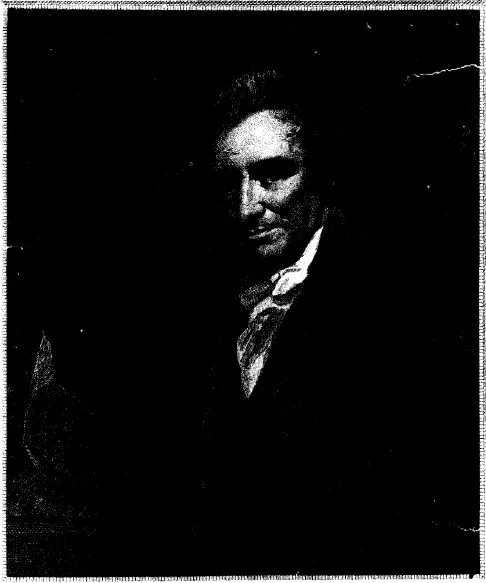
Courtesy of the New-York Historical Society, New York City.
Tom Paine
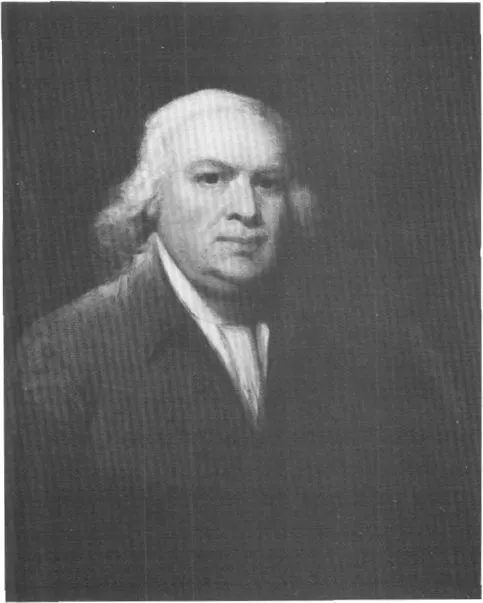
Courtesy of the New-York Historical Society, New York City.
Robert Morris
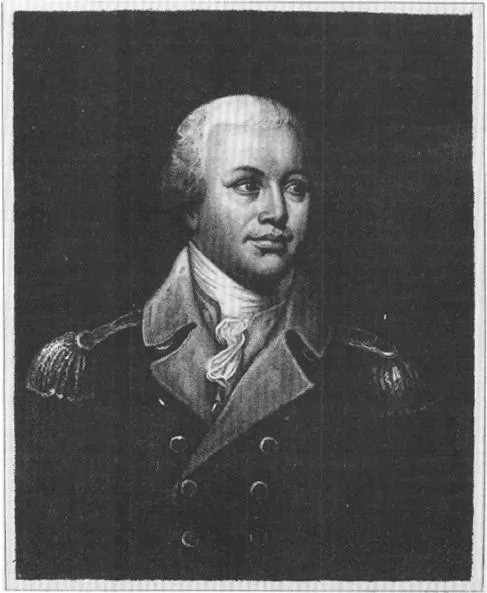
Courtesy of the New-York Historical Society, New York City.
Nathanael Greene
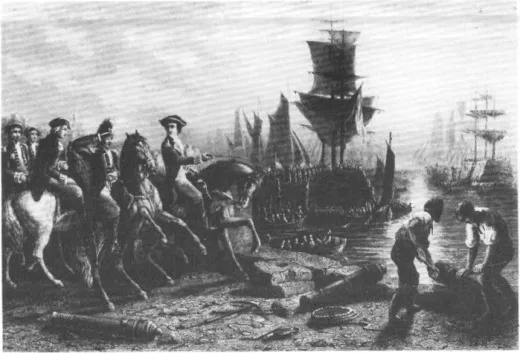
Courtesy of the New-York Historical Society, New York City.
General Howe Evacuating Boston, March 1776
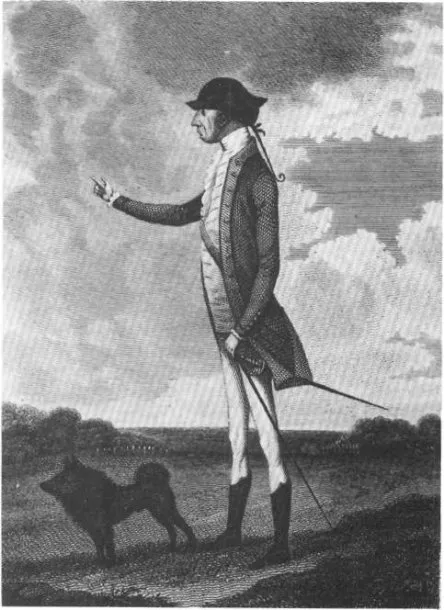
Courtesy of the New-York Historical Society, New York City.
Charles Lee
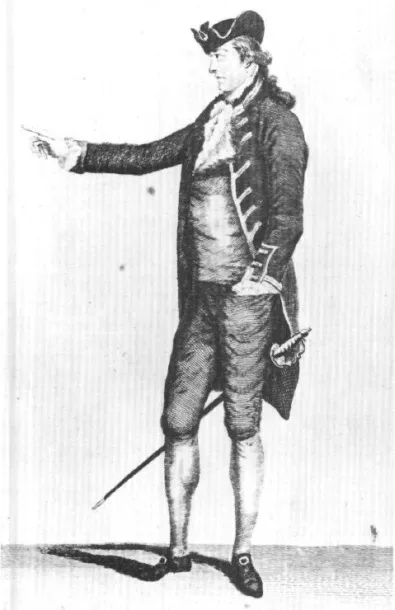
Courtesy of the New-York Historical Society, New York City.
Sir Richard Howe

Courtesy of the New-York Historical Society, New York City.
Benjamin Franklin

Courtesy of the New-York Historical Society, New York City.
Horatio Gates
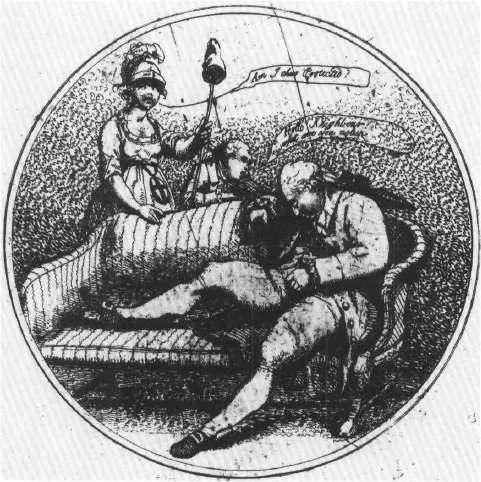
Courtesy of the New-York Historical Sociery, New York City.
1781 Caricature: The State Watchman Discovered by the Genius Britain Studying Plans for the Reduction of America
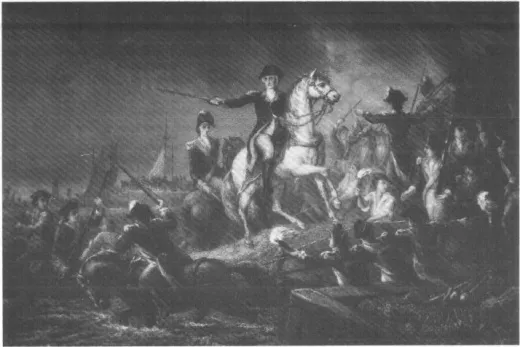
Courtesy of the New-York Historical Society, New York City.
Washington’s Retreat at Long Island, August 1776
Conceived in Liberty
Read the whole book online · Book details
This work is published under a Creative Commons licence. You may copy, share, and re-host it with attribution.