
Chapter 136 of 178 · Mises: The Last Knight of Liberalism by Jörg Guido Hülsmann
American Citizen
Mises had applied for citizenship at the earliest possible date—August 1945—and on January 14, 1946, he became an American citizen.94
One of the first things he did was to get in touch with his old employer to reclaim the retirement funds that he rightfully owned, but which had been denied to him in an August 1938 letter from a Nazi official.95 He was told he was entitled to a monthly payment of 953.95 schillings, starting May 1, 1945. The money was transferred to his old bank account in Vienna. Foreign exchange controls were still in place, however, and Mises could not transfer the money to an American account unless he provided an authorization from the Nationalbank.
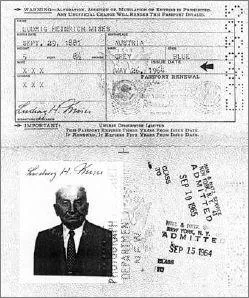
Mises's American passport issued on May 26, 1964
Did he ever think about returning to Vienna? He did not. Mises was still in touch with some prewar acquaintances, for example, with Carl Brockhausen and historian and writer Richard Charmatz. He had Idaho publisher J.H. Gipson send them CARE packages.96 He also took care of the surviving mother of Ludwig Bettelheim-Gabillon, who had died at the hands of the Nazis.97 Still Mises did not use the opportunity to visit Germany or Austria. Both countries were still occupation zones and access required special permits.98 From correspondence with Charmatz he knew that Vienna was in even worse shape than after World War I, and this time lacked the leadership to prevent the rampant socialization of the entire country. As Charmatz wrote, many Austrians had been looking forward to allied victory, from which they expected liberation—quite literally. Instead they got even more government regimentation than before. Even the so-called “liberal” professions were now coerced into state-controlled organizations; and as in the worst years of the war, the population lived on food rations, the only difference being that the rations were smaller and that the food coupons could not always be redeemed.99
But Mises's disinclination to visit Vienna also had another source. As he wrote to his friend Carl Brockhausen, a former professor of constitutional and administrative law at the University of Vienna: “I do not yearn for an encounter with the mob who applauded the massacre of excellent men.”100 It is not quite clear whom Mises had in mind. The good-hearted Brockhausen tried to convince Mises that this severe judgment was not borne out by the facts—there had been no lynch mobs in Vienna.101 But by “mob” Mises probably meant men such as Hans Mayer, Othmar Spann, Srbik, and Nadler, who had actively supported the Nazi takeover of Austria and yet were once again in positions of influence. Mises did eventually make his way back to Vienna, but only to visit.
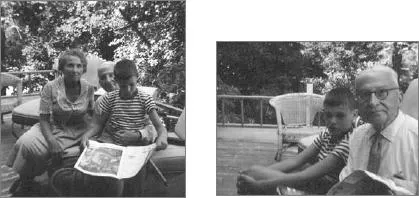
Mises with Margit's grandson, Chris Honeyman, in 1958
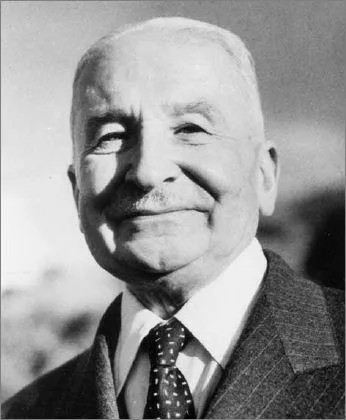
Mises in 1956
Mises: The Last Knight of Liberalism
Read the whole book online · Book details
Published here by permission of Jörg Guido Hülsmann. This work is still in copyright: free to read and download from this archive, but not licensed for re-publication elsewhere.