
Chapter 135 of 178 · Mises: The Last Knight of Liberalism by Jörg Guido Hülsmann
New Friends
The honorarium for the Mexican lectures supplemented their income and things looked far rosier in 1942 than they had in their first year in the new country. But the financial situation was still bleak, with no permanent source of income and Ludwig's retirement fund frozen in Austria. On December 18, 1942 he reported on the activities of the year and applied for another extension of his research grant. He also tried to convince NBER to finance a large-scale research project to elucidate the origins of modern totalitarianism. He planned a comprehensive seminar with people like Rougier, Röpke, Hayek, and others. The project did not materialize, but his research grant was extended in January 1943. Mises even received a two-year extension under the same conditions as before. It was the normal policy of the Rockefeller Foundation to subsidize the integration of European émigré scholars into American universities for about two years. Thus Mises could be happy to obtain twice as much support. However, it was to be the very end of their cooperation. The second year's bonus was a not-so-subtle good-bye. The Rockefeller Foundation's Willits made it clear, and NBER's Carson made it even more stark, that this extension would be the last one.70
Fortunately for Mises, he had found a more amenable source of support independent of the Rockefeller Foundation: the National Association of Manufacturers. NAM leadership opposed the New Deal and other statist projects. These men were determined to prepare a counterattack, starting a large-scale campaign to educate the American public about the benefits of what they called the free enterprise system. NAM needed intellectual leadership from people who were conversant both in the world of business and in the world of ideas. By February 1943, they had discovered what they were looking for in the person of Ludwig von Mises. Many years in the Vienna chamber of commerce had accustomed him to dealing with businessmen and to communicating effectively his economic and political insights to this audience. Just when the Rockefeller Foundation made it clear that they were no longer interested in supporting the Austrian economist, NAM immediately stepped in and offered to hire Mises as a consultant—“starting today”71 Mises became a member of the Economic Policy Advisory Group. He later became a member of NAM's Economic Principles Commission and of its Advisory Group on International Economic Relations. The contract provided for an annual honorarium of $3,000, which was 20 percent more than what Mises earned at NBER. The contract was extended on an annual basis. In the 1944–1945 period, Mises's honorarium increased to $3,600.72
Mises worked closely with NAM secretary Noel Sargent, who in 1943 commissioned a study from him on “international monetary reconstruction” after World War II. By the fall of the year, Mises had written a 68-page memorandum on the subject, in which he advocated a return to the gold standard and criticized reconstruction plans that Harry Dexter White and Keynes had made in preparation for the 1944 Bretton Woods conference. A few months later, he took part in a NAM-sponsored expert meeting to discuss the Keynes and White Proposals. The group included Rufus Tucker from General Motors, Princeton professor Edwin Kemmerer, and Mises's old acquaintance, Albert Hahn, who became a good friend during their years in Manhattan.
By June 1944, Mises had prepared another memorandum, this time on monopoly73 A few months later, he addressed two Advisory Committee luncheons on the West Coast. At that point, he had already acquired a solid reputation through the publication of Bureaucracy and Omnipotent Government in the same year by Yale University Press. Accordingly, he was presented as “the most eminent and uncompromising defender of English liberty and the system of free enterprise which has reached its highest development here in the United States.”74 He addressed the local NAM chapters in San Francisco (October 18) and Los Angeles (October 25) and met “such excellent men as Leonard Read, [Orval] Watts and R.C. Hoiles.”75
The encounter with Leonard Read was a fateful one. They may have met a few years earlier, shortly after his arrival in the United States. Read later recalled such a first meeting in 1940, at which he had been much impressed by the purity of Mises's opposition to any government power beyond the minimum necessary for the preservation of domestic peace and the market. Mises had reportedly attended a party in Read's home.76 One of the other guests asked Professor Mises:
All of us will agree with you that we are headed for troubled times but, Dr. Mises, let's assume that you were the dictator of these United States and could impose any changes you think appropriate. What would you do?
Read clearly recalled the answer:
Quick as a flash, Mises replied, “I would abdicate!”77
Mises had remained in touch with Read through correspondence. He may also have been on Read's mailing list and received one of the 1.5 million copies of Read's four-page pamphlet, “Why Not 1,900?”—a reaction against FDR's proposed legislation to seize all annual salaries in excess of $25,000. Read had argued that there was no objective reason not to seize all salary in excess of the national average salary, which happened to be $1,900.
Leonard Read
Read was a self-made businessman who had spent the greater part of his career as an executive for various West-Coast chambers of commerce. He had the good luck to manage the chamber of Palo Alto in 1928, when that city's most prominent resident was elected president of the United States. Read organized a sort of a pilgrimage for 700 Californians to Washington, D.C., and caught the eye of Herbert Hoover's entourage. His career was made. He moved on to ever-higher positions within the larger network of California chambers of commerce and eventually became general manager of the world's largest chamber of commerce, in Los Angeles. By that time, he had become a champion of laissez-faire capitalism, had published his first book—a critique of New Deal economic policies—and had for many years managed the Western School for Commercial Organization Secretaries.
Once in his new position in Los Angeles, he hired V. Orval Watts, a professor of economics who had been a popular instructor at the Western School.78 Watts thus became the first economist ever hired by a U.S. chamber of commerce on a fulltime basis. Together they fought the New Deal rather effectively, organizing many courses and other educational conferences throughout California. Mises's lectures were part of this effort. On the evening of Tuesday, October 17, one day before his NAM luncheon talk, Mises gave a lecture to the Rotary Club on “credit expansion and depression” and that same evening addressed an audience at the Santa Ana High School on the “causes of the war.” Mises stayed as a guest at the home of R.C. Hoiles, who published the predecessor of the present-day Orange County Register.79 Several weeks before the talks, the Los Angeles Chamber of Commerce and the Register started promoting the event through articles and columns, and it turned out to be a success. Read in particular was much impressed by what he had seen and heard. A year later he would move to New York and eventually establish the mother of all libertarian think tanks in collaboration with Mises. The association would last for the rest of Mises's lifetime.
The alliance with NAM, in contrast, did not last long. Mises continued to “advise” NAM, co-authoring a two-volume study on the American Individual Enterprise System, which was published on April 1, 1946. The book was part of a large-scale NAM campaign aiming at the abolition of the wartime Office of Price Administration. The campaign succeeded and the Office expired, but so did Mises's contract. He continued to serve on NAM's Advisory Group on International Economic Relations, but resigned at the end of 1948, when NAM became increasingly agnostic on the question of inflation and its consequences. The final straw for Mises was when NAM started championing the view that increased productivity was the proper antidote to inflation.80
At about the same time he began his work for NAM, Montes de Oca wrote from Mexico City that he had made good progress in the preparation of the International Institute of the Social Sciences. He now asked Mises to submit a list of prospective permanent professors, and some indication of the salaries they would require. Mises replied that Walter Sulzbach, Alfred Schütz, Louis Rougier, Jacques Rueff and he himself—all European expatriates living in New York without American citizenship—would be available for permanent employment in Mexico City for an annual compensation of some $6,000 per head. This was a fairly generous salary, and proved to be a major stumbling block for the establishment of the Institute. But in early 1943 everything seemed possible: a group of first-rate intellectuals with classical-liberal pedigree was at least potentially available and another group of men was interested in financing the venture. Moreover, there was a plan: Louis Rougier would be invited to the University of Mexico City for a series of lectures; Mises was to prepare a study on Mexican politico-economic conditions (which Montes de Oca had commissioned for his Banco Internacional); and Montes de Oca continued to work on a translation of Socialism.81
In planning for the future teaching staff of an institute in Mexico City, Mises had also brought up the names of Plant, Machlup, Rappard, Röpke, and Robbins.82 He also made one last attempt to win Lionel Robbins over. In early 1943, he invited Robbins to come to New York. Robbins combined his scientific authority and personal network with great organizational skills and an unusual ability at clear and convincing expression in spoken and written language. The fate of Britain, and thus of Europe, depended on where he weighed in. Mises sought to get him out of his Cambridge and London milieu, to breathe the fresh air of liberty. But Robbins never came to New York: instead he became a champion of the British interventionist government.83
Mises eventually delivered the study on Mexican economic conditions to his Mexican friend when the latter came to New York in December 1944. Montes de Oca was now eager to have an epilogue for the forthcoming Spanish edition of Socialism.84He had still not given up on the Institute of the Social Sciences, although another problem besides the salary question had so far prevented any progress. Most of the prospective permanent and temporary teaching staff—Robbins, Plant, Machlup, Sulzbach, and others—were by then employed in war offices of the French, British, and U.S. governments, and were either unable or unwilling to leave until the war was over.85 Montes de Oca invited Mises to return to Mexico City as a visiting professor during the year, but Mises declined because he planned to apply for U.S. citizenship in August—five years after his arrival—and sought to avoid any complications that might result from a trip abroad.
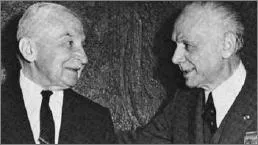
Mises and Philip Cortney in the 1950s
Mises's social integration into the cosmopolitan milieu of New York accompanied a more general integration into American society. One sign of adjustment was the change of Mises's manners, which became less formal in his dealings with friends. During 1942, when he wrote a series of editorials for the New York Times and other journals, Henry Hazlitt felt comfortable enough addressing his Austrian friend to leave behind the deferential “Professor Mises” in favor of “Dear Ludwig” (July 1942) and later “Dear Lou” (December 1942).
In April 1945, he made another important and lasting acquaintance, when he started correspondence with Philip Cortney, at the time the vice-chairman and treasurer of Coty, the perfume company. Mises wrote to congratulate Cortney on a paper in which he had criticized Keynesianism. Cortney, who already knew Mises's work, wrote back saying there was “no person in the world whose opinion I value more than yours” and that he hoped to meet him soon at dinner with their mutual friend, André Maurois.86
On the professional level, however, Mises's integration proceeded more slowly. The essential reason was his unwillingness to trade away his convictions for social acceptance. By 1944, he was a member of the New York Overseas Rotary Fellowship, which meant nothing to him—he found the meetings extremely boring and after a short while stopped attending them.87 He also had some access to the national press through Hazlitt at the Times, but quickly ran into confrontations.
A case in point is a letter to the editor of the New York Times published on January 3, 1943. Here Mises explained that mere organizational devices would not make for world peace after the war. In particular, he rejected the idea that some new version of the League of Nations would make international relations better than they had been in the interwar period. Only a “radical change in political mentalities and social and economic ideologies” toward the classical-liberal position could make the world safe for peace and prosperity.88 The letter provoked the editor of Barron's to solicit similar pieces from Mises.89 But this cooperation was not fated to last very long. Mises contributed only one article on “Big Business and the Common Man,” which was published in February 1944 and only after sharp protestations from some “associate” of Barron's.90 The essential point under contention was whether or not Mises had exaggerated in claiming that the inventive spirit was absent in Russia. Mises wrote:
As far as I know the best that the Russians have achieved was imitating foreign models. The major attraction of their exhibitions at the World's Fairs in Paris and in New York were imitations of American agricultural implements and of Ford cars and tractors. Their planes and tanks were not original. Today they are fighting almost entirely with lend-lease material.
Incidentally I want to remark that Germany also contributed very little to the improvement of weapons. The iron ship, the armored ship, the torpedo, the submarine, the plane, the machine-gun, the tank came from England, France and America. The German General Staff mistrusted the airplane and the tank and Tirpitz, before the first War, belittled the U-boat. The Zeppelin is a genuine German invention. But it is both commercially and militarily impracticable.91
The cooperation with Barron's ended soon after.
Similarly, Mises's integration into professional organizations of American economists suffered a setback. Just when Fritz Machlup joined the AER editorial board in October 1943, Mises felt he had to stop further cooperation with the journal. What had happened? He reviewed books for various journals, focusing on works dealing with postwar reconstruction in Europe. Two of these were invited reviews for the American Economic Review92 and the AER had published a rejoinder by a certain Alfred Braunthal to the first of the two reviews, without giving Mises the opportunity to respond. To Mises this was a clear sign of discrimination. Writing to Machlup, Mises said that he was
no longer prepared to contribute to a periodical whose editors fail to comply with the principles of literary decency for partisan considerations. They should rather send their books directly to Mr. Braunthal or other comrades.93
Mises: The Last Knight of Liberalism
Read the whole book online · Book details
Published here by permission of Jörg Guido Hülsmann. This work is still in copyright: free to read and download from this archive, but not licensed for re-publication elsewhere.