
Chapter 64 of 68 · Money, Bank Credit, and Economic Cycles by Jesus Huerta de Soto
5. An Economic Analysis of the Process of Reform and Transition toward the Proposed Monetary and Banking System
To begin this section, we will briefly consider the major issues involved in any political strategy for bringing about economic reform in any area, including that of finance, credit, and money.
A FEW BASIC STRATEGIC PRINCIPLES
The most serious danger to all reform strategies looms in the political pragmatism of daily affairs, which often causes authorities to abandon their ultimate goals on the grounds that they are politically “impossible” to reach in the short term. This is a grave danger which in the past has sabotaged different programs for reform. Indeed, pragmatism has systematically prompted politicians to reach joint, ad hoc decisions in order to acquire or retain political power, and these decisions have often been fundamentally incoherent and counter-productive with respect to the most desirable longterm objectives. Furthermore, as discussion has centered exclusively on what is politically feasible in the immediate short term, and final goals have been postponed or forgotten entirely, authorities have not completed the necessary, detailed study of these goals nor the process of spreading them to the people. As a result, the possibility of creating a coalition of interests in support of the reform is continually undermined, since other programs and objectives considered more urgent in the short term weaken and overshadow such an effort.
The most appropriate strategy for the reform we propose must therefore rest on a dual principle. The first part consists of constantly studying and educating the public about the substantial benefits they would derive from the achievement of the final medium- and long-term objectives. The second part involves the adoption of a short-term policy of gradual progress toward these objectives, a policy which must always be coherent with them. This strategy alone will make politically possible in the medium- and long-term what today may seem particularly difficult to accomplish.95
Let us now return to our topic: banking reform in market economies. In the following sections, we will suggest a process for reforming the current system. In formulating our recommendation, we have taken into account the above strategy and the essential principles theoretically analyzed in this book.
STAGES IN THE REFORM OF THE FINANCIAL AND BANKING SYSTEM
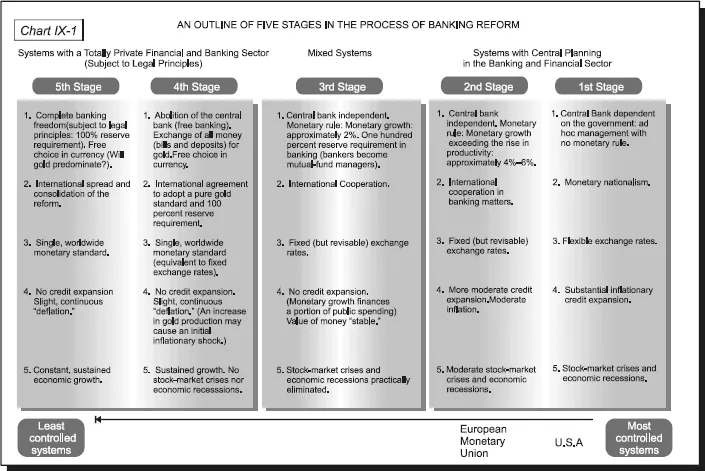
Chart IX-1 reflects the five basic stages in a reform process involving the financial and banking system. In our outline the stages progress naturally from right to left; that is, from the most controlled systems (those with central planning in the banking and financial sector) to the least controlled ones (those in which the central bank has been abolished and complete freedom prevails, yet the banking industry is subject to legal principles—including a 100-percent reserve requirement).
The first stage corresponds to “central planning” for financial and banking matters; in other words, a system strictly controlled and regulated by the central bank. This type of arrangement has predominated in most western countries up to the present time. The central bank holds a monopoly on the issuance of currency and at any given time determines the total amount of the monetary base and the rediscount rates which apply to private banks. Private banks operate with a fractional reserve and expand credit without the backing of real saving. They do so based on a bank multiplier which regulates growth in fiduciary media and is established by the central bank. Thus the central bank orchestrates credit expansion and increases the money supply via open-market purchases (which go toward the partial or complete monetization of the national debt). In addition it instructs banks as to the strictness of the credit terms they should offer. This stage is characterized by the independence of the different countries with respect to monetary policy (monetary nationalism), in a more or less chaotic international environment of flexible exchange rates which are often used as a powerful competitive weapon in international trade. This system gives rise to great, inflationary credit expansion which distorts the productive structure and repeatedly provokes stock-market booms and unsustainable economic growth, followed by severe economic crises and recessions that tend to spread to the rest of the world.
In the second stage the reform process advances a bit in the right direction. The central bank is legally made “independent” of the government, and an attempt is made to come up with a monetary rule (generally an intermediate one) to reflect the monetary-policy goal of the central bank. This goal is usually expressed in terms of a rate of monetary growth exceeding the rise in productivity (between 4 and 6 percent). This model was developed by the Bundesbank of the Federal Republic of Germany and has influenced the rule followed by the European Central Bank and other central banks throughout the world. This system fosters an increase in international cooperation among different central banks and promotes, even in large geographical areas, where economic and trading uniformity is greater, the establishment of a system of fixed (but in some cases revisable) exchange rates to end the competitive anarchy typical of the chaotic environment of flexible exchange rates. As a result, credit expansion becomes more moderate, though it does not completely disappear, and hence stock-market crises and economic recessions continue to hit, though they are less serious than in the first stage.96
In the third stage, the central bank would remain independent, and a radical step would be taken in the reform: a 100-percent reserve requirement would be established for private banks. As we pointed out at the beginning of this chapter, this step would necessitate certain legislative modifications to the commercial and penal codes. These changes would allow us to eradicate most of the current administrative legislation issued by central bankers to control deposit and credit institutions. The sole, remaining function of the central bank would be to guarantee that the monetary supply grows at a rate equal to or slightly lower than the increase in productivity in the economic system. (As we know, Maurice Allais proposes a growth rate of around 2 percent per year.)
THE IMPORTANCE OF THE THIRD AND SUBSEQUENT STAGES IN THE REFORM: THE POSSIBILITY THEY OFFER OF PAYING OFF THE NATIONAL DEBT OR SOCIAL SECURITY PENSION LIABILITIES
In the banking industry, reform would revolve around the concept of converting today's private bankers into mere managers of mutual funds. Specifically, once authorities have announced and explained the reform to citizens, they should give the holders of current demand deposits (or their equivalent) the opportunity to manifest their desire, within a prudent time period, to replace these deposits with mutual-fund shares. (People would receive the warning that if they should accept this option, they would no longer be guaranteed the nominal value of their deposits, and a need for liquidity would oblige them to sell their shares on the stock market and take the current price for them at the moment they sell them).97 Each depositor to select this option would receive a number of shares strictly proportional to the sum of his deposits with respect to the total deposits at each bank. Each bank would transfer its assets to a mutual fund which would encompass all of the bank's wealth and claims (except for, basically, the portion corresponding to its net worth).
After the period during which deposit holders may express a wish to continue as such or instead to acquire shares in the mutual funds to be constituted following the reform, the central bank, as Frank H. Knight recommends,98 should print legal bills for an overall amount equal to the aggregate of all demand deposits and equivalents recorded on the balance sheets of all the banks under its control (excluding the sum represented by the above exchange option). Clearly the central bank's issuance of these legal bills would not be inflationary in any way, since the sole purpose of this action would be to back the total amount of demand deposits (and equivalents), and each and every bank would receive banknotes for a sum identical to its corresponding deposits. In this way a 100-percent reserve requirement could be established immediately, and banks should be prohibited from granting further loans against demand deposits. In any case, such deposits would always have to remain perfectly balanced with a reserve (in the form of bills held by banks) absolutely equal to the total of demand deposits or equivalents.
We must point out that Hart suggests the new paper money the central bank prints to back deposits be handed over to banks as a gift. If this occurs, it is obvious that banks' balance sheets will reflect an enormous surplus, one precisely equal to the sum of demand deposits backed 100 percent by a reserve.
We might ask ourselves who should own the total of banks' accounting assets which exceed their net worth. For the operation we have just described reveals that by functioning with a fractional reserve, private banks have historically created means of payment in the form of loans produced ex nihilo, and these loans have permitted banks to gradually expropriate wealth from the whole of the rest of society. Once we take into account the difference between banks' income and expenditures each year, the aggregate wealth the banking system has expropriated in this way (by a process that produces the effects of a tax, just as inflation does for the government) is precisely equal to the assets banks possess in the form of real estate, branch offices, equipment and especially, the sum of their investments in loans to industry and trade, in securities acquired on the stock market and elsewhere, and in treasury bonds issued by the government.99
Hart's proposal that the basis of the reform consist of simply giving banks the sum of the bills they need to reach a 100-percent reserve ratio is a bitter pill to swallow. This method would make the total of private banks' current assets unnecessary in the account books as backing for deposits, and hence, from an accounting viewpoint, they would automatically come to be considered the property of banks' stockholders. Murray N. Rothbard has also advocated this solution,100which does not seem equitable. For if any group of economic agents has historically taken advantage of the privilege of granting expansionary loans unbacked by real saving, it has precisely been the stockholders of banks (to the extent that the government has not at the same time partially expropriated the profits of this extremely lucrative activity, thus obliging banks to devote a portion of their created monetary stock to financing the very state).
The sum of private banks' assets can and should be transferred to a series of security mutual funds, the management of which would become the main activity of private banking institutions following the reform. Who should be the holders of the shares in these mutual funds, which at the time of their conversion would have a value equal to the total value of all of the banking system's assets (except those corresponding to the equity of its stockholders)? We propose that these shares in the new mutual funds to be created with the assets of the banking system be exchanged for the outstanding treasury bonds issued in all countries overwhelmed by a sizeable national debt. The idea is simple enough: the holders of treasury bonds would, in exchange for them, receive the corresponding shares in the mutual funds to be established with the assets of the banking system.101 This move would eliminate a large number (or even all) of the bonds issued by the government, which would benefit all citizens, since from that point on they would no longer have to pay taxes to finance the interest payments on the debt. Furthermore the current holders of treasury bonds would not be adversely affected, since their fixed-income securities would be replaced by mutual-fund shares which, from the time of the reform, would have a recognized market value and a rate of return.102 Moreover there are other government liabilities (for example, in the area of state social-security pensions) which could be converted into bonds and might also be exchanged for shares in the new mutual funds, either instead of or in addition to treasury bonds, and with highly beneficial economic effects.
Chart IX-2 shows a breakdown of the different accounting assets and liabilities which would appear on the consolidated balance sheet for the banking system once all bank deposits had been backed by a 100 percent reserve and mutual funds had been created with the system's assets. From that point on, banks' activities would simply consist of managing the mutual funds created with their assets, and bankers could obtain new loans (in the form of new shares in these funds) and invest them, while charging a small percentage as a fee for the management of this type of operation. Bankers could also continue to engage in the other (legitimate) activities they had always pursued in the past (the performance of payment, cashier and bookkeeping services, transfers, etc.), and they could charge the corresponding market prices for these services.
In any case, international cooperation (and fixed, but revisable exchange rates) would continue in this third stage, and once deposits were backed with a 100 percent reserve, credit expansion would completely disappear. As we have indicated, the central bank would be limited to increasing the size of the money supply by a small percentage and using this increase to finance a portion of state expenditures, as Maurice Allais proposes.103 In no case would this new money be used to make open-market purchases or directly expand credit, activities rampant in Argentina's failed attempt at banking reform under General Perón. The reforms described above would lead to the almost complete elimination of stock-market crises and economic recessions. Beginning at that point, the behavior of savers and investors in the market would be very closely coordinated.
The establishment of a 100-percent reserve requirement is a necessary condition for the definitive abolition of the central bank, which would occur in the fourth stage. Indeed, once private banking is made subordinate to legal principles, complete banking freedom should be demanded, and remaining central-bank legislation could be eliminated, as could the central bank itself. This would require the replacement of today's fiduciary money, which the central bank alone has the power to issue, with a form of private money. It is impossible to take a leap in the dark and establish an artificial monetary standard which has not emerged through an evolutionary process. Hence the new form of money should consist of the substance humanity has historically considered money par excellence: gold.104
Murray N. Rothbard has devoted considerable thought to the process of exchanging for gold all bills already issued by the Federal Reserve, a step which would follow the establishment of a 100-percent reserve requirement on all bank deposits. Based on data from 1981, Rothbard reaches the conclusion that this exchange would be contingent on a gold price of $1,696 per ounce. Over the past fifteen years the price of the exchange has risen noticeably. Therefore, if we take into account that the current [1997] price of gold is around $350 an ounce, it is clear that in a country with an economy as large as that of the United States, the complete privatization of fiduciary money and its replacement with gold would require a nearly twenty-fold increase in the present market value of gold.105 This sharp rise in the price of gold would initially drive up its supply and perhaps cause an inflationary shock which we could hardly quantify, but which would be felt only once and would not exert any acute distorting effects on the real productive structure.106

The fifth and last stage in the privatization of the financial and banking system would begin when the conditions of gold production and distribution had stabilized. This last stage would be characterized by absolute freedom in banking (though the system would be subject to legal principles, and hence, a 100-percent reserve requirement on demand deposits) and the existence of a single, worldwide gold standard with a 100-percent reserve ratio in an environment of slight, gradual “deflation” and sustained economic growth. At any rate, the evolutionary process of experimentation in the field of money and finance would continue, and it is impossible to predict whether gold would continue to be the currency chosen by the market as a medium of exchange, or whether future changes in social conditions would spontaneously, through a process of evolution, give rise to the emergence of an alternative standard.
In this fifth and last stage, in which a single gold standard would spread throughout the world, it would be advisable for the different countries to arrive at an international agreement designed to prevent the transition from having any unnecessary, real effects (apart from the initial, inflationary shock which would be unavoidable, since the jump in the value of gold would trigger an increased influx of the metal into the market). Such an agreement would stipulate the prior creation of a structure of fixed exchange rates between all currencies. This would make it possible to uniformly assess the entire world supply of fiduciary media and to redistribute among the economic agents and private banks of the different countries the stocks of gold held by the world's central banks. This redistribution would be carried out in exact proportion to the sum of deposits and bills in each.
Thus would be the end of the final stage in the privatization of the banking and financial sector, and economic agents would reinitiate the spontaneous market process of experimentation in the field of money and finance, a process which was historically interrupted by the nationalization of money and the creation and fortification of central banks.
THE APPLICATION OF THE THEORY OF BANKING AND FINANCIAL REFORM TO THE EUROPEAN MONETARY UNION AND THE BUILDING OF THE FINANCIAL SECTOR IN ECONOMIES OF THE FORMER EASTERN BLOC
The above remarks on the reform of the western banking and financial system might be helpful in the design and management of the European Monetary Union, a topic that is currently sparking great interest among specialists in the field.107 These considerations provide at least an indication of the direction European monetary reform should take at all times and of the dangers to avoid. It is evident we should steer clear of a system of monopolistic national currencies which compete with each other in a chaotic environment of flexible exchange rates. Moreover we should avoid maintaining a European central bank which prevents competition between currencies in a broad economic area, fails to meet the challenges of banking reform (100-percent reserve requirement), fails to guarantee a level of monetary stability at least as high as that of the most stable national currency at any given point in history and, in short, represents an insurmountable obstacle to subsequent reforms, i.e., the elimination of the central financial planning agency (the central bank). Therefore perhaps the most workable and appropriate model in the short and medium term would consist of the introduction throughout Europe of complete freedom of choice in currencies, both public and private and from both inside and outside the Union. The national currencies still in use due to tradition would be placed in a system of fixed exchange rates108 which would adjust the monetary policy of each country to the most solvent and stable policy among all the countries at any point in time. Thus the door would at least remain open to the possibility that nation-states in the European Union might in the future advance in the three fundamental areas of monetary and banking reform (freedom of choice in currency, free banking, and a 100-percent reserve requirement on demand deposits). In doing so, states would oblige the other Union members to follow their strong monetary leadership, as Maurice Allais maintains.
Once the European Central Bank was created on June 1, 1998, it became important that criticism of it and the single European currency center around the distance between this system and the ideal of a pure gold standard and 100-percent reserve requirement. Many libertarian theorists (mainly those of the Chicago School) mistakenly focus their criticism on the fact that the new arrangement does away with the former system of monetary nationalism and flexible exchange rates. However, a single European monetary standard which is as rigid as possible would represent a healthy step toward a pure gold standard. Furthermore it would complete the institutional framework of the European free-trade system, since it would preclude monetary interference and manipulation on the part of each member country and oblige those countries with more rigid economic structures (Germany and France, for example) to introduce the flexibility they need to compete in an environment in which resorting to inflationary national monetary policies to compensate for structural rigidities is no longer an option.
Some very similar thoughts could be applied to the necessary establishment of a financial and banking system in the economies of the former Eastern bloc. While we must recognize that these economies start from a highly unfavorable position after decades of central planning, the present transition toward a market economy offers a unique and crucially important opportunity to avoid the major errors committed in the West up to now and to advance directly to at least the third or fourth stage in our reform plan. At the same time, a jump straight to the fourth stage would be quite feasible in the former Soviet Union, where abundant gold reserves would permit the establishment of a pure gold standard, a measure which would benefit the nation a great deal. At any rate, if these countries fail to learn from the experience of others and attempt, in awkward imitation of the West, to set up a fractional-reserve banking system directed by a central bank, the financial pressures of each moment will lead to policies of rampant credit expansion and enormous harm to the productive structure. Such policies will foster feverish speculation and create a climate of social unrest which might even endanger the overall transition of these societies to a full-fledged market economy.109
Money, Bank Credit, and Economic Cycles
Read the whole book online · Book details
Free to read online and to download from this archive.