
Chapter 8 of 19 · The Myth of National Defense: Essays on the Theory and History of Security Production by Hans-Hermann Hoppe
4. Nuclear Weapons: Proliferation or Monopoly?
Bertrand Lemennicier
The problem of nuclear proliferation is an old one, dating back to the first offensive nuclear detonation in 1945 when the United States used nuclear weapons on Japan. The problem resurfaces each time a new nation develops nuclear weapons: the Soviet Union in 1949, the United Kingdom in 1952, France in 1962, and China and India in 1974. Israel claims to have nuclear weapons; Brazil, South Africa, and Argentina could but have stopped development; and Iran, Iraq, and probably others (e.g., North Korea) have expressed the desire to have them.
If nuclear weapons in the hands of governments present a real or perceived threat of intrusion or invasion among their neighbors, we can expect smaller nations to move to protect their territory and political independence through nuclear weapons production or acquisition. The French government used this argument against the American nuclear program when Charles De Gaulle came to power in 1945. At the same time, technological and political changes have reduced the cost of acquiring nuclear weapons. Further, technological progress should make possible the miniaturization of these weapons. Small organizations could someday have access to them. This possible proliferation is currently considered a curse, not a blessing. Why? Mainly because everyone fears that such a proliferation of weapons of mass destruction combined with advanced means for their delivery intensifies “the problem of ensuring global security,” as Dagobert Brito and Michael Intriligator1 wrote recently in Economic Affairs.
The claim that the proliferation of any weapons—small or large, in the hands of ordinary citizens or politicians—is a general threat is, in fact, the first step in the centralization and monopolization of power. It is through the argument that proliferation itself is dangerous that individuals around the world, in being forbidden to own weapons of their choice, have been deprived of the basic right of self-protection by (and from) the tyrants governing their own countries.
Part of the problem is fear instilled in others when one possesses weapons. Imagine a situation in which miniature nuclear weapons with great power are available and affordable for ordinary citizens. I could give the French government an ultimatum, as they sometimes do with other governments. My ultimatum might be, “If you take my resources through taxation and invasion of my property, I will destroy Paris.” Or worse, “The residents of Paris must pay me a tribute or face annihilation.”2
Facts and common sense contradict this simplistic argument. In France in 1991 there were 16,000 arrests for possession of illegal arms, and only 1,600 homicides. Only 45 percent of the homicides were committed with guns, shotguns, or hand-held weapons. The probability of use of restricted weapons is very low—around .45 percent. Since arrests involve only a fraction of persons carrying or possessing legal or illegal weapons, the real probability of forbidden weapons being used is quite low. And of course, the only time in history where nuclear weapons were used was when the United States was able to do it without fear of retaliation.
IS PROLIFERATION A CURSE?3
We need to establish a correlation between arms possession and the number of assaults. Does legally or illegally arming additional people increase the probability of aggression, or decrease it? Does the probability of nuclear war increase when additional countries develop nuclear weapons? Brito and Intriligator, through a cardinality theorem, tried to show such a correlation.4 Their thesis was traditional in that the dominant factor was not the proliferation of nuclear weapons per se, but the increase in accidents or inadvertent launches by those possessing them. Alternatively, the nonproliferation case often focuses on the irrationality of the marginal actor who can destroy the “terror equilibrium of nuclear weapons”—a classical argument used to justify a cartel.
Imagine there is only one armed person. The temptation for aggressive behavior instead of peaceful conflict resolution for this person would be strong—because he has a comparative advantage. Now imagine two similarly armed people (or States). The fundamental question is whether either will use an aggressive (Hawk) strategy, or a cooperative (Dove) strategy, in a conflict. If the use of weapons will lead to a deadly war in which both sides likely will lose not only their property but their lives, an aggressive strategy is not the preferred one. If we suppose that both are rational entities, they will adopt Dove behavior over Hawk behavior only if the expected gains from using the Dove strategy exceed those of the Hawk strategy. The complication is that future gains from either strategy for one player depend on the behavior of the other player. There is a nonzero probability of armed conflict, though this probability is much lower than in the case in which a party faces no risk of retaliation. In that case, the Hawk strategy would dominate for the armed player.
Let’s formalize5 this interaction between John and Peter, two individuals or princes representing their countries, both possessing nuclear weapons:
Peter | |||||
1–λ(2) |
λ(2) | ||||
John |
Dove |
Hawk | |||
Dove |
λ(1) |
V/2 |
V/2 |
0 |
V |
Hawk |
1–λ(1) |
V |
0 |
(–C) |
(–C) |
V measures gains from a conflict. C is the cost of war. If they both use the Dove strategy, they divide gains, V/2. If there is a balance of power, nuclear weapons make war very costly. When both make war, the use of nuclear weapons imposes only losses, –C, for John and for Peter. In the case that John has a monopoly in nuclear weapons, he has no fear of retaliation; here, there are only gains (V > 0) for John and no losses or gains for Peter, as he surrenders.
If John has a monopoly, the dominant strategy for him is the Hawk strategy.6 In the case of a balance of power, each party will adopt the Hawk strategy if and only if he is sure the adversary will play the Dove. If both play the Hawk strategy, losses are the only outcome. If John plays Hawk and Peter plays Dove, John will get the totality of gains, V. In the opposite case his gain is zero. The game is symmetric since both sides have the same weapons. We can see that the Hawk strategy is not the most attractive behavior as the outcome (–C) is negative. But the Dove strategy is dubious since V > V/2. Thus, John plays Hawk only if Peter plays Dove. In the absence of perfect foresight, John has to predict Peter’s behavior. From John’s perspective, λ(2) is the probability that Peter will adopt the Hawk strategy and 1–λ(2) that Peter will adopt the Dove strategy. And for Peter, λ(1) is the probability that John will adopt the Hawk strategy and 1–λ(1) the Dove strategy.
Future expected gains for John in adopting the Hawk strategy are:
(1) E(U)H = (1–λ(2))V + λ(2)(–C)
If he plays the Dove they are:
(2) E(U)D = (1–λ(2))λV/2 + (2)λ0 = (1–λ(2))λV/2
Thus he plays the Dove if and only if
(3) E(U)D = (1–λ(2))λV/2 > E(U)H = (1–λ (2))λV + λ(2)λ(–C)
and he will play Hawk when:
(4) E(U)D = (1–λ(2))λV/2 < E(U)H = (1–λ(2))λV + λ(2)λ(–C)
He will be indifferent between the two strategies when:
(1–λ(2))λV + λ(2)(–C) = (1–λ(2))λV/2
that is, when
(5) λ(2)* = V/(2C + V)
The interpretation of the ratio V/(2C+V) is straightforward: It is the relation between the gain of the Hawk strategy, V, when the other plays Dove; and the opportunity costs of war (2C+V)7 when the other plays Hawk. If John estimates that the probability, λ(2), that Peter will play Hawk is less than this ratio, λ(2)*, John will play Hawk. Otherwise, if he estimates that this probability is higher than the ratio, John will play Dove. We also notice that as the damage from war compared to gains increases, the more likely John (or Peter) will adopt the Dove strategy, as the threshold probability is lower. If the ratio of gains over costs from the war approaches zero (which is the case with nuclear weapons), the probability of peaceful conflict resolution increases drastically. Now, as the game is symmetric, we have λ(1)* = λ(2)*.
In such an interaction, λ(2) and λ(1) are key variables in the decision to enter a nuclear conflict. Assume that John is convinced erroneously by a third party, Paul, that Peter will play Dove, or that Peter is very likely to play Dove (while Peter in fact is ready to play Hawk). Then John will adopt the Hawk strategy based on incorrect information. Nuclear war is then the outcome of this incorrect information. This explains why governments have developed direct communications between those who have the power to start a nuclear conflict, protecting themselves against such erroneous decisions. But as players are rational, they anticipate difficulty in predicting the behavior of others. A natural consistency requirement is that expectations are also rational.
The convergence of anticipations between John and Peter is crucial. Consider the following figure:
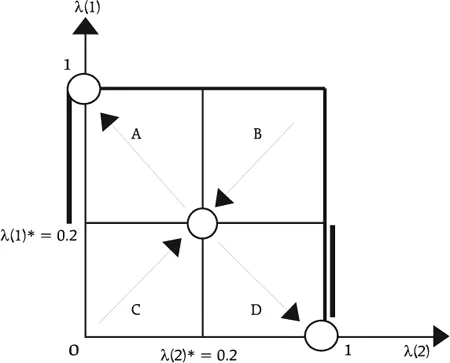
On the horizontal axis, we plot John’s expectations of Peter, λ(2), while on the vertical axis we plot Peter’s expectations of John, λ(1). Assume we are in zone A. In that case, λ(1) > λ(1)* while λ(2) < λ(2)*. This means Peter should play Dove as the best response to the behavior of John, as John rationally plays Hawk. For expectations in zone A, a stable strategy is the couple λ(1) = 1, λ(2) = 0. John plays Hawk and Peter plays Dove. In zone D, we have the opposite, λ(1) = 0, λ(2) = 1; John plays Dove and Peter plays Hawk. There are two pure strategies: Either John dominates or Peter dominates. In regions B and C, both Peter and John play the same strategy, either Hawk or Dove, as λ(1) > λ(1)* and λ(2) > V(2)* (zone B), or λ(1) < λ(1)* and λ(2) < λ(2)*. The mixed equilibrium λ(1)* = λ(2)* is not in fact stable in regions A and D. But when C increases drastically, as with nuclear weapons, the value of λ(1)* = λ(2)* = V/(2C+V) approaches zero, such that regions of peace A, B, and D increase in size. This means an increase in the probability that the outcome of the interaction is peace.
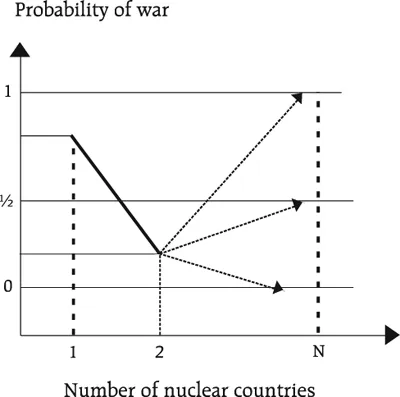
Consequently, the arms race between two nuclear countries to establish a power equilibrium should decrease the odds of an armed conflict. The more deadly the weapons become, the more they are dissuasive. The next question is: Does the introduction of additional participants increase, decrease, or leave unchanged the probability of conflict? Refer to the next figure.
On the vertical axis is plotted the probability of war, and on the horizontal axis the number of countries or governments with nuclear weapons. With a monopoly the probability of war approaches 1. With two players the probability nears zero. Adding participants either lowers this probability to zero or increases it until we reach pure uncertainty8 (the probability of war is .50) or pure certainty (the probability of war approaches 1).
Adding one player to the interaction implies a new game with three players, each always having two strategies to play, Hawk or Dove:
Patrick |
Hawk (λ(2)) |
Dove (1–λ(2)) | ||
|
|
|
|
Dove (1–λ(3)) |
Patrick plays either Hawk or Dove. Then Peter plays either Hawk or Dove, conditional on whether Patrick has played Hawk or Dove. Then what is John’s strategy? In a nuclear conflict, if two players play Hawk the destructive power of nuclear weapons is such that the other actor who plays Dove may be destroyed as well.9 In fact, gains occur for one or for all when only one actor plays Hawk while the others play Dove, or when all play Dove.
Consequently, knowing this matrix, John will calculate the expected value of adopting the Hawk strategy versus the Dove by anticipating the aggressive behavior of the two other players.
Hawk strategy:
(6) E(U)H = λ(2)λ(3)(–C) + λ(2)(1–λ(3))(–C) + (1–λ(2))(1–λ(3))λV
Dove strategy:
(7) E(U)D = λ(2)λ(3)(–C) + (1–λ(2))(1–λ(3))(V/3)
John will play Hawk when
(8) E(U)H =λ(2)λ(3)(–C)+λ(2)(1–λ(3))(–C) + (1–λ(2))(1–λ(3))λV > E(U)D = λ(2)λ(3)(–C) + (1–λ(2))(1–λ(3))(V/3)
He will be indifferent when:
(9) E(U)H = λ(2)λ(3)(–C) + λ(2)(1–λ(3))(–C) + (1–λ(2)) (1–λ(3))λV =E(U)D = λ(2)λ(3)(–C) + (1–λ(2))(1–λ(3))(V/3)
As the game is symmetrical, and knowing that expectations are rational (that is, each player’s expectations of the others coincide with actual choices the others intend to make), we can write: λ(1) = λ(2) = λ(3) = 3λ, where 3λ is the threshold with three players. Solving equation 9 for 3λ, we find:
(10) 3λ = V/(3C + V)
The threshold on which John bases his strategy is lower with three players than with two. Adding N players in this game leads to a threshold on which all players base their strategy:
(11) Nλ = V/(NC + V)
Increasing N to infinity reduces the threshold to zero. Each nuclear power will be incited to play Dove. Adding N players implies N pure strategies where one is dominant (that is, plays Hawk while all others play Dove) and one mixed equilibrium λ(1)* = … = λ(N)* = V/(NC+V). In the N-dimensional space of the λ(i), the corresponding C area in the two-dimensional space shrinks to zero, insuring high stability of peace.10
To an outside observer, the frequency with which a nuclear conflict can emerge is given by
Looking at the matrix with three players, we see there are three cases with two players at war, and one case with all players at war. But the product of a probability raised to the power N is negligible. Then the frequency of a nuclear war in a matrix of N players is reduced to:
As N approaches infinity, the frequency of nuclear war is the ratio of gains V over the cost of war C. With nuclear weapons, C is very high compared to V, which predicts that the frequency of nuclear war will approach zero. The lesson from this formal analysis is that the more armed players there are, the more the threshold probability to have armed conflicts depends only on the ratio V/C. The more dissuasive the means, the less the chances for conflict. Formalization can always be suspect of rhetorical trickery, and the present demonstration is no exception. At least the formal model appeals to reason and not passions. If the model is correct, then it is important to liberalize the right to have extremely dangerous weapons and accept their dissemination among nations or individuals.
IS NUCLEAR PROLIFERATION A BLESSING?
Yes it is. Why? Because things that are good for us are good for others. The terror equilibrium was a guarantor of peace in Europe during the cold war. Without it, the Soviets might have been tempted to invade Europe. When there are no nuclear weapons there are classic wars, which can result in massacres comparable to those seen with the use of conventional weapons in the world wars. The Iran/Iraq war is a case in point: If both sides had had nuclear weapons, they might have hesitated to enter the conflict, saving millions of lives.
Possession of nuclear weapons by all players is a good and not a bad. Indeed, the more countries possess such dissuasive weapons, the wider will be the territory of peace and stability as experienced in Europe throughout the cold war. There have to be serious reasons to prohibit certain countries from owning such means of dissuading potential aggressors.
This sort of support of nuclear arms proliferation is natural for economists but heretical for noneconomists. The countries who are members of the nuclear club form a cartel that is looking to protect its monopoly in respect to other countries. They even use violence in order to prevent countries they do not like from obtaining nuclear technology. If nuclear weapons reduce the possibility of armed conflicts, i.e., protect human lives and territory from external invaders and violence, it means nuclear weapons possession is efficient.
Nuclear weapons possession will become more necessary as the costs of nuclear technology decrease. Competition between countries to defend themselves against external aggressors will lead to the proliferation of nuclear weapons. The cartel of members of the nuclear club (Russia, England, France, China, and the United States) will fail as more countries develop weapons. There are two major forces in this process. Club members have reason to cheat by giving nuclear weapons to other countries (e.g., France and Iraq, China and Iran); and other countries can enter the market on their own (e.g., India, Pakistan, Israel, Iran, Iraq, North Korea). Remember also that Kazakhstan, Belarus, and Ukraine inherited nuclear weapons from the USSR. Perhaps if Ukraine keeps its nuclear arsenal, Poland will decide to acquire the same. South Africa, Japan, Germany, Brazil, and Argentina will in the near future have nuclear weapons if they do not already.
This point of view is increasingly shared by Western military strategists, many of whom believe countries willing to obtain such weapons should be helped and not considered outlaws. An article by J. Fitchett in the International Herald Tribune11notes this change in opinion among military advisers. But Fitchett claims that if proliferation prevails, the risk of conflict increases due to everyone’s inability to control everyone else’s dissuasion. Pentagon experts note that when communication between the USSR and the U.S. was limited, it minimized provocative behavior. Fitchett continues: With territories like Asia and the Middle East, nationalistic passion and irrational behavior are reality. Those leaders frequently are autocratic and are ready to destroy their countries in a nuclear conflict just to satisfy their interests or territorial appetites. Even though the 1991 Iraq conflict showed the opposite (Saddam Hussein did not dare use chemical weapons under the nuclear threat of Israel and the U.S.), we cannot extrapolate this to a world where nuclear weapons are commonplace. We should not forget that nuclear conflict is not local and it can affect, as did the Chernobyl nuclear disaster, uninvolved third parties. This argument is not new—it is similar to the one used by French medical doctors, who in the name of protecting consumers are impeding the sale of drugs in supermarkets. Another argument holds that competition in airline services leads to an increase in accidents due to airlines’ failing to invest sufficiently in safety under the pressure of competition. This has proven to be false. All defenders of monopolies and cartels use such arguments, including the one concerning nuclear weapons.
It is difficult to believe that a taxi drivers’ monopoly protects consumers. But when a medical board announces that a monopoly benefits consumers, the public is persuaded. Indeed, reasoning is distorted when the arguments relate to our lives. In this manner, when we think about nuclear weapons we often lose our ability to think clearly.
Let’s return to the economic argument. Before 1989 there was nuclear parity between the USSR and the U.S. We can regard this situation as a Cournot bi-polarity. The essential question of that time was the arms race in nuclear missiles. For a given level of Soviet armament, U.S. production of missiles to match it was profitable, measured in dissuasion capacity. The same way, for a given level of American offensive capacity, matching it with nuclear warheads in the USSR was advantageous.
The intersection between these two functions is the Cournot equilibrium. The number of missiles being produced was very high. It was possible to improve outcomes for both adversaries through mutual arms reduction. If both parties agreed to reduce their arms while retaining dissuasion capacity, it would have been optimal for them not to miss the opportunity. From the beginning of the cold war we witnessed conferences on arms reduction and treaties on nonproliferation. Each side in such an agreement would have maintained a certain quota of missile production or brought stockpiles down to a level that maximized profits for both parties.
All those conferences between superpowers were simple agreements to optimize the tradeoff between costs and dissuasion. The failure of such agreements is intriguing. Why did they fail? Because agreements have to be respected. The majority of such treaties not only gave exact details concerning quotas but also the means to verify whether the quotas were respected. In other words, the issue of agreement or cartel created a prisoner’s dilemma. An advantage was gained by the one who cheated while the other respected the agreement. This incentive not to respect the agreement explains the continuous failure of such agreements. The cold war was characterized by missile production at the Cournot point with attempts to reduce these arms at the equilibrium point. Only the disappearance of the USSR ended this strategic interdependence—the bi-polar structure disappeared.
TWO DIRECTIONS OF FUTURE DEVELOPMENT
The U.S. retains a monopoly on nuclear dissuasion and plays the part of world enforcer, excluding international exchanges for countries seeking nuclear weapons. Such a position is costly, and the U.S. has no legitimate claim to such a role.
We should allow more and more countries to develop nuclear weapons.
The first lesson of history is that in the absence of an enforced monopoly, no agreement or cartel, even one organized by States, can survive. One of the best known examples is the oil cartel. The second lesson is that competition is the means by which we maximize our exchange profits. Nuclear arms possession is the most efficient defense of territory because it produces fear. It reduces armed conflicts and does not require many personnel. Such technology, as it becomes more affordable, will face increasing demand from countries with fewer resources. Such democratization is the result of competition.
I use the term “democratization” rather than “dissemination” to make a point. For many, “democratization” has a positive connotation. If a poor Iraqi or Pole can benefit from such protection it is “democratization.” For a rich Frenchman or American it is “dissemination.” For an economist it is competition.
The argument that an Iraqi, Pole, or Libyan is more irrational than a Frenchman is fundamental. This is the argument used against nuclear arms proliferation. It was evoked during the Gulf War. Saddam Hussein is not one of us, he does not share our values, and he is a murderous dictator, but he is not irrational or crazy. But those who share this point of view insist that we cannot extrapolate from Saddam Hussein’s case. Yet if we follow their logic we will have to demonstrate that nondemocratic political systems constantly have as their leaders irrational and crazy persons. There is no proof of this. It would also have to be proven that democratic systems are immune to such phenomena. Hitler and National Socialists came to power through democratic mechanisms. Thus, this argument fails also.
We can link this theory to the one that prohibits citizens to carry firearms. The problem with this prohibition is that citizens are defenseless and the only armed persons are police, who often do not know how to shoot, or turn their arms against innocent civilians; or gangsters, who use their arms against citizens who have been disarmed by the State. We also see that within any given territory, relaxing gun laws leads to a reduction in crime. The mechanisms proposed to account for this trend, shown most notably by John Lott,12 are the same ones I propose will decrease violent multinational conflict following the free proliferation of nuclear weapons.
1D. Brito and M. Intriligator, “Deterring nuclear weapons proliferation,” in Defence Economics, Economic Affairs IEA (December 1977).
2Of course, at present only governments, through massive taxation, are able to afford nuclear weapons.
3Here, I am indebted to Nikolay Gertchev, who helped me develop a formal model of conflict based on the traditional Hawk and Dove interaction in game theory.
4D. Brito and M. Intriligator, “Proliferation and the Probability of War,” Journal of Conflict Resolution (March 1996): 206–14.
5 This model is a variant of the Hawk and Dove model of modern game theory first developed by J.M. Smith, Evolution and the Theory of Games (Cambridge, U.K.: Cambridge University Press, 1982).
6Asymmetries, imbalance of power, and hierarchy of political forces are usually the sources of political power. In the analysis we assume perfect symmetry of forces as a result of the spread of nuclear weapons: Military technology is available or accessible at a certain price for individuals or groups. Let’s drop this hypothesis. We introduce asymmetry between John and Peter. Costs and gains for them are divergent. The matrix looks as follows:
Peter | |||
Dove |
Hawk | ||
Dove |
V/2, v/2 |
0, v | |
John |
|||
Hawk |
V, 0 |
(–C), (v–c) | |
We give Peter an advantage in aggression, v–c > 0. John is aware that Peter will play Hawk due to this advantage. Because Peter definitely will play Hawk, John’s strategy will be to surrender to Peter, since 0 > –C. Peter beats John. This interaction will lead to domination by one party, which strangely is praised by political scientists. The origin of such domination lies not necessarily in asymmetry itself, but in the belief in it on John’s part. This helps highlight the role of misinformation as military strategy as well as the role of technology in multinational conflicts.
72C+V measures for both players the sum of the direct cost of war, C, and the loss suffered by each player in losing the gain of the Dove strategy, V/2. 2(C+V/2) = 2C+V.
8Brito and Intriligator recognize the monopoly and duopoly cases, but they argue that an increase in the number of players will increase the probability of errors. In that case the probability of conflict increases to .50—that is, to complete uncertainty.
9One thought is that the third party who does not take part in the nuclear conflict will be the last survivor and will profit from the destruction of his competitors in the fight for resources. Actually, this strategy moves the third player to autarky, which implies losses compared to the present situation of no conflict. Further, we can add an externality problem—collateral damage—with nuclear war due to the destructive power of nuclear weapons.
10The underlying idea is simple: if k players anticipate that N–k players will play Dove, λi < λ(i)*, then their best strategy is to play Hawk. But if they all play Hawk at the same time, the outcome is a generalized conflict and their own disappearance due to the externalities of a nuclear conflict. Knowing that each of the k players anticipates that the k–1 other players will have the same bet, they will play Hawk only if they are sure that all others will play Dove. This possibility diminishes drastically as the number of players increases.
11International Herald Tribune, http://www.iht.com/diplo.
12John R. Lott, Jr., More Guns, Less Crime: Understanding Crime and Gun Control Laws (Chicago: University of Chicago Press, 1998).
The Myth of National Defense: Essays on the Theory and History of Security Production
Read the whole book online · Book details
Published here by permission of Hans-Hermann Hoppe. This work is still in copyright: free to read and download from this archive, but not licensed for re-publication elsewhere.