
Chapter 5 of 20 · Prosperity Through Competition by Ludwig Erhard
Chapter III OVERCOMING THE KOREAN CRISIS
THE UNREST AND UNCERTAINTY which the Korean war brought in its train led to a considerable increase in demand. A slight hope that the consumer would react quietly proved false. On the other hand on the positive side it should be mentioned that since currency reform a great deal had been invested; though, lacking an adequate capital market, the greater part of these investments were too expensive. Here moral evaluation and sober economic judgment may differ. In the first five months of the Korean conflict the increase in demand led to an increase in the volume of production from a point in the index of 107.6 in June to 133.3 in November 1950. At the same time the price index of basic industrial materials rose from 218 to 265, and that of industrial products from 178 to 195 (1938 = 100). In spite of the increases in prices caused by these unsettling events, they were less marked in Western Germany, due to her astonishing elasticity of production, than elsewhere in the West.
Unhappily the consumer had also to suffer this rise. The cost of living index climbed from its lowest point, 148 in September 1950, to 151 at the end of the year, and to 179 at the end of 1951 (1938 = 100). Rising prices in the world market and the nervousness of the consumers and buyers in all parts of the economy are reflected in these indices.
Few believed that the freedom of the consumer, which represented for me one of the essential basic human freedoms, would survive the crisis. This is what I said on February 6, 1952, in Zurich:
‘It was self-evident that a people as experienced in inflation as the Germans should have reacted to an event such as Korea in so sensitive a manner. In other words, everyone went off the rails a little. Some wanted raw materials under all circumstances and at any price, which is understandable in a country such as Germany, which is so poor in raw materials. On the other hand we had to reckon with the consumer who, experienced in tragic events, wondered whether on the morrow his needs would be met, or whether we should have to return to a system of planning or rationing. So the German consumer was ready to buy bad goods today at a high price rather than to get perhaps nothing tomorrow. And all that in a situation which was restricted from a monetary and a foreign currency point of view.’
Troubles in Bonn
There were then troubles indeed in Germany. The situation in many respects was similar to that at the end of 1948. The foes of the market economy made pacts with the ever-prevaricating. Even those with experience of economics regarded a return to planning as unavoidable. That the Social Democrats, in opposition, should do all within their power to destroy the economic policy they disliked was not surprising. But it was serious and dangerous that the policy of a market economy found only partial support within the Government and coalition, and sometimes had to meet open and covert opposition.
Within the Government and the coalition the year 1951 produced a depressing picture of disunity and thus a growing inability to take action. It was only thanks to the strength of the social market economy that the free economic system was preserved through the difficulties of this time. To recall here the details of the discussions which then took place would be tedious. But it should be remembered how action was paralysed, some difficulties made unnecessarily more difficult, and their solution retarded by these discussions themselves.
How many different points of view confronted the Minister for Economic Affairs ! The Ministry of Finance wished to copy the English purchase tax; suggestions were made to appoint a special commissar for foreign currencies, in order to limit the functions of the Minister for Economic Affairs. A special economic cabinet under the guidance of Dr. Ernst was devised, and by the end of 1951 a proposal was put forward for the creation of a special overlord ministry, which would have reduced the Federal Minister for Economic Affairs to a mere cipher.
In such circumstances it became increasingly difficult to put sensible ideas into effect. Thus my plan to break through the bottlenecks in the supply of basic materials by straightening out prices foundered. Another idea to help the basic material industries by building up stocks with ‘savings for reconstruction’, in order eventually to qualify under the Law of Investment Assistance by industry was held up for months. The law was finally passed in the Federal parliament on December 31, 1951. Added to these difficulties were interventions from the Americans, which curtailed Marshall aid, opposed a suitable initial position for Germany at the foundation of the E.P.U., and held up the much needed freeing of counterpart funds. Extraordinary declarations were made—the head of the E.C.A. mission in Germany described the German tax system as the most ‘anti-social in the world’. In addition there was constant pressure from the U.S.A. to introduce controls, in order to qualify for the acquisition of scarce materials.
Battles with the International Ruhr Authority about the most important material in short supply—coal—took place daily. Sharp discussions with the D.G.B. (trade unions) had to be endured. Its Federal committee, after months of hesitation, decided to stop collaboration in all economic policy discussions.
This list could be continued almost indefinitely; similar occurrences persisted until the beginning of 1952—when the necessity of continuing with the market economy became obvious even to the most ignorant. This change became clear in two particular events. At the end of 1951, Germany was no longer in danger of exceeding her credit limit with the E.P.U.; on the contrary, for the first time Western Germany became a creditor country within the E.P.U. At the same time, prices steadied.
These eventful weeks were reflected in all my speeches:
‘Because in Germany I kept to the rules of economic order and healthy commonsense, I was asked: freeze prices now or resign. I neither resigned nor ordered a price freeze. That my socialist opponents should have looked at things from a party political point of view I cannot grudge them. It was worse that even good friends should have gone so wrong as to think that my economic policy would land Germany in disaster. I argued that one should just remain quiet for a time, and this proved itself worth while.’
This brief survey of the events of those days shows how necessary it was to keep one’s nerve. An indication has already been given of the spending spree which began in the last half of 1950, and which in the spring of 1951 led to ‘grotesque increases in turnover’. Purchases of shoes, for example, rose by 90 per cent within a year. How immense was the performance of the German economy, and how the system of market economy proved itself, is shown by the trend of business in the retail trade. Taking clothing and household linen as an example, the value of retail sales rose as follows:
Increase in Turnover during Korean Boom
First half year 1949 |
86 |
Second half year 1949 |
114 |
„ „ „ 1950 |
109 |
„ „ „ 1950 |
152 |
„ „ „ 1951 |
136 |
„ „ „ 1951 |
157 |
Many factors stimulated this psychosis. Falling prices in the month before the Korean conflict had led producers and the public to be careful in their policy of stocking. Then the stormy movements of prices in the world markets set in.
West German industry, which was still in process of reconstruction, soon reached the limits of its capacity. A considerable part in this process was played by the spending of hoarded money, which had been accumulated for different motives and from different sources since the time of currency reform. On top of all this, the once urgently needed measures to stimulate the economy began to work just at this particular time. The Income Tax Law of April 23, 1950, aimed at cutting taxes—welcome in itself—was finally sanctioned by the Allies, but in a completely different economic and political climate. To fill the cup to the brim it should be added that the purchasing boom by the consumer did not come only from current income, but at least in part from savings accounts, which had been built up in the past few years, and were now used almost exclusively for consumption. For several months the increase in savings accounts almost ceased.
Increase in Production leads to Bottlenecks
Production figures reflect this hectic development: the over-all index rose from 107.6 in June 1950 to 130.9 within a year, and even to 147.8 at the peak of the year in November 1951 (1936 = 100). The capital goods sector benefited especially from this Korean boom, as is shown by the index of capital goods, which rose from 108.4 to 164.1. The consumer goods sector suffered in the first six months of 1950 from buyers’ resistance; a real stagnation took place. The index measuring this production, however, jumped steeply between June 1950 and November 1951 from 101.9 to 148.4.
It naturally followed that this stormy development brought with it bottlenecks which the general nervousness intensified. These bottlenecks were felt particularly where natural or structural limits were set to a rapid growth in capacity.
As a result of much effort since the collapse in 1945, West German coal production was increased appreciably; the general industrial index on the day of currency reform stood at 51% of the 1936 figure; coal production, because it had been favoured, stood at 76.4%. Already in June 1950, however, coal mining had fallen behind in relation to general production. Even if by the end of 1950 it was possible to make a further increase of 15%, the difference between the two sectors was bound to widen still further. A similar state of affairs reigned in the iron and steel sector.
Was this really a fault of the market economy? Did this justify abandoning our free economic system? I tried to give a clear answer to this question in the Handelsblatt of December 31, 1951:
‘In any reckoning of failures the market economy is always debited with just those sins that belong to the account of planning and State control, the remains of which the market economy has so far been forced to carry with it. The bottlenecks in the basic industries are discussed, but there is silence about the fact that it is in these sectors that bureaucracy has celebrated its triumphs. It is there that the function of the market, particularly the free adjustment of prices, has been completely eliminated.
Naturally these bottlenecks did not allow us to remain idle. It has already been mentioned that a thorough purge of prices foundered in the face of many-sided resistance. Among the many obstacles, the formulation of the Law for Investment Assistance by Industry of January 7, 1952, must be remembered. After months of discussion this had been passed by the Federal Parliament on December 13, 1951. This Law of Investment Assistance was later much criticized. But in fact it represented a remarkable attempt to master the sudden difficulties through self-help. Historically speaking, it will one day find a just appreciation. In implementing the decree, the hard-pressed basic industry sector received not less than DM one milliard of credits, divided thus:
DM 296 million for the iron and steel industry
„ 228 „ for coal mining
„ 242 „ for electricity
„ 77 „ for water
„ 50 „ for the Federal railways
This aid enabled investment plans to be pushed through to a total of DM 4,745 milliard. Added to these credits from the Investment Assistance Law were DM 2,227 milliard of retained earnings from the individual industries, and DM 1,518 milliard of other credits.
The Trade Balance Worsens
Rising prices in world markets, as much as the unavoidable pressure to meet growing production, led to considerable increases in imports. Moreover, on September 1, 1950, the liberalization agreement between the O.E.E.C. countries raised quotas to 60%. The commercial trade balance worsened steadily; in the second half of 1950 it showed a deficit of DM 535 milliard. The balance of payments looked even more unfavourable. Already within four months of the start of E.P.U. the German quota of credits of $320 million was exhausted.
Nevertheless this increase in imports was sensible as a defence of the market economy, because in this situation it was important to stretch as far as possible the supply of goods. It is fair to say, then, that the fight against the planners in Germany, i.e. against those who wished to throw overboard the freedom of the economy, became at one and the same time a battle with the E.P.U., in order to get it to accept for the time being the German foreign trade deficit, confident that later it would change completely.
Among the measures which my Ministry took or supported at this time should be mentioned first of all the means of reducing imports to a politically possible limit. Licences were regulated, and above all cash deposits were demanded up to 50% of the German equivalent of the foreign currency needed for the imports. The issue of import licences in the hands of the private foreign trade banks was transferred to the Central Banks of the Länder. On February 21, 1951, steps had to be taken to halt temporarily the liberalization of E.P.U. imports, after the difficulties of the Korean conflict had brought further big increases in demand. In addition monetary measures were taken: thus the minimum reserves ratios were increased by an average of 50% on October 1, 1950. Simultaneously, facilities to rediscount bank acceptances were limited to certain institutions (October 31, 1950). The discount rate and the rate for secured overdrafts were raised from 4 to 6% and from 5 to 7% respectively (on November 27, 1950)—also against the wishes of the politicians. On November 1, 1950, the Länder Central Banks were asked to cut the discount credits which they had granted to commercial banks by 10%.
All the same, the foreign currency situation remained critical. Even the grant of a special credit of $120 million from E.P.U. could not immediately exorcize the evil of a balance of payments deficit. By suspending liberalization, the danger of acute balance of payments difficulties was successfully averted—but at the price of a tight administrative limitation of imports. The Bank Deutscher Länder, with the full agreement of the Federal Ministry for Economic Affairs, continued its restrictive line. At the beginning of 1951 regulations in regard to credits were further tightened. In January 1951 all commercial banks were asked forthwith to avoid all increases in short-term credit, and on February 28, 1951, there followed the request to reduce the volume of short-term credits by about DM 1 milliard.
Other measures went hand in hand with these efforts. In the Federal Ministry for Economic Affairs a special raw material board was set up. At the beginning of 1951 the so-called economic security law (Wirtschaftssicherungs Gesetz) was passed, which allowed the Government to intervene in production and in the distribution of goods. The interventions that followed as a result of this law were kept within modest limits. These measures were taken principally as a result of pressure by the Americans, who only wished to allot raw materials against authorization by the State. I must confess that I never took these rules particularly seriously, and above all I did not greatly value their economic importance.
Rearmament Without Inflation?
The Korean war allowed for the first time the idea of German rearmament to appear. This is an important date and one must recall first reactions. I constantly and earnestly urged from the first that we should avoid inflation. Thus I opposed the widely held view that everything to do with armaments would necessarily mean inflation. On September 15, 1950, 1 said:
‘Possibly as a result it will be necessary to use certain measures of direction, but these need not disturb or endanger the system of the market economy. The great danger which is now threatening, and which I anticipate with certainty, comes from another direction. If the State will have to spend considerable sums on West German participation in the defence of Europe, then some people and even some parties will consider that this money cannot be found out of the budget, but that the central bank credit would have to be mobilized in some way. Though it is unlikely that the form of the “mefo”bills of exchange5 (mefowechsel) or the limitless prolongation of treasury bills will be copied, basically all manipulation of this kind comes to the same thing, namely the beginning of an inflation.’
The C.D.U. meeting in Goslar on October 22, 1950, at the height of the Korean boom, offered me a welcome opportunity to speak openly about the problems of the day. It was at a time when opinion seemed resigned to the ruin of West Germany. Thus the chairman of O.E.E.C., the Dutch Foreign Minister, Dr. Strieker, said: ‘Europe is facing the bankruptcy of West Germany.’ The Federal Government, through ‘reckless imports within four months’, had used up the E.P.U. credit of $320 million. West Germany’s future was thus very doubtful; an inflation similar to that following the first world war was imminent.
Opposition at home joined with international criticism—the one hoping for my fall, the other expecting bankruptcy. Here is my view as submitted to the C.D.U.:
‘The economy, and economic progress, know no absolute law. It is thus quite wrong for the socialists to demand, as they have recently done, that every price increase must be compensated by a corresponding increase in wages. We believe that with increasing productivity reductions in prices can well go parallel with increases in wages to support the case of market economy. To defend the market economy is not a dogma but, for the sake of the German people, an important commandment. And it is for this reason that the Federal Government has brought in the generous programme of anticipating imports, which, in expectation of supplies of foreign currency in the next three or four months, guarantees the foodstuffs and raw materials which we require to secure German nutrition and the maintenance of employment and production. The Federal Government was fully conscious of the fact that for this programme all available means had to be brought to bear. But only a courageous policy promises success in this situation.’
Calmness—but no Crisis
With prices rising day by day, and the foreign trade balance becoming ever more unfavourable, to speak of such things was only possible through a deep conviction that the market economy was right. It still took months before the change became apparent, but this turn towards salvation was, as a result, all the more positive and lasting.
While the monthly average of 1950 showed an adverse foreign trade balance of about DM 250 million, and even during the first quarter of 1951 no noteworthy improvement took place, the trend changed in the second quarter, leading to a favourable balance of nearly DM 350 million. This was the turning point, which initiated the period of a permanent foreign trade surplus.
Thus the year 1950 became the most exciting in the young story of the market economy. In the following months of 1951 it became even clearer that all the difficulties were being successfully overcome. The skilful political economist knew that we were ‘out of the wood’. The battles over the market economy and over the position of the Federal Minister for Economic Affairs, however, only reached their peak in 1951.
This year brought the decline and end of the Korean boom, and with it the first answer to the significant question as to whether the see-saw of economic trends was unavoidable, or whether the modern market economy was in a position to overcome this cycle.
Supply and demand in many sectors became better balanced without a slowing down of economic progress. The rise of prices, conspicuous since the autumn of 1950, slackened visibly in the second half of 1951. First of all this decline affected raw materials; later, at the turn of the year 1951/52, it also affected the cost of living. The cost of living index for clothing, for example, dropped from 212 in May 1951 to 205 by the end of the year (1938 = 100).
This change also made itself apparent in the sector of production. The consumer goods industry in the second half of 1950 had to deal with an increase of roughly 40%. The usual decline in December, too, proved itself to be a turning point. The index dropped from its peak of 141.0 in November 1950 to 112.6 in July 1951. Yet production was still 15% higher than in the comparable period of the previous year. One could no longer speak of a crisis unless one wished to regard the hysterical increases of the Korean boom as normal.
There was even less cause for worry when at the end of 1951 a lively recovery pushed the index of production up to 150, higher than the previous peak. Then again followed months of a slight slackening of the economy until the middle of 1952. Yet the figures generally prove that the Korean boom in the consumer goods sector already ended with the turn of the year 1950/51—quite contrary to the opinions current in those days.
At this time a remarkable new trend began in our economy. Until the end of 1950 the restoration of investment and consumer goods production ran in a merrily parallel line. In the future there was to be a distinct contrast. The readiness to engage in capital expenditure remained; the index within this sector rose from 141.3 in November 1950 to 164.1 in November of the following year, and in 1952 retained almost uninterruptedly its upward trend. The result of this development was that industrial production rose 30 points above the index of output of the consumer goods industry.
This differential development—apart from a short interruption at the end of 1953—continued also during the following year. How little it was possible to speak of a crisis, in spite of many fears, is best shown by the general production figures. The index of total production moved in this time as follows:
Index of Total Industrial Production ( 1936 = 100)
1950 1st half year |
99.7 |
1951 2nd half year |
134.3 |
1950 2nd half year |
121.7 |
1952 1st half year |
133.4 |
1951 1st half year |
127.7 |
1952 2nd half year |
145.3 |
While, as already mentioned, in the consumer goods sector the Korean boom had already ended by the end of 1950, in the investment goods sector, the hangover of unfulfilled orders continued somewhat longer. This prolongation of the Korean boom thus led to a continuation of bottlenecks in coal and steel. In consequence of these changed structural conditions the import of American coal became an increasingly important problem.
The bottleneck in coal supplies, imposed by the traditional West German export obligations, but also by the particularly intractable stand of the International Ruhr Authority during the Korean conflict, became steadily more apparent. Coal imports of all kinds (pit, brown and bituminous coal, coke and briquettes) thus rose from 5.3 million tons in 1950 to 10.4 million tons in the following year, with the result that in the same period the export surplus shrank from 20.1 million tons to 14.4 million tons.
The lively economic activity at this time is reflected in the employment figures. For the average of the year the numbers of employed rose from 13.83 million in 1950 to 14.56 million in 1951 and 15.0 million in 1952. This increase of 1.2 million over a short period expresses more pointedly than statistics of unemployment the upward economic trend. This was continuously swollen by new recruits to the labour force, who—apart from the immediate problem—represented a most unusual enrichment of the West German production potential. In the later years of the boom particularly, it was proved how little my wish for greater expansion could have been realized but for this welcome help. Within this period of three years the numbei of unemployed fell from 1.58 million in 1950 to 1.38 million for the average of 1952.
Return to Liberalization
In spite of the noticeable cooling of the economic climate, the restrictive monetary and credit measures were for some time retained. No change in favour of an economic policy of expansion was called for so far, as prices generally did not show any very clear signs of falling. Lower prices in some sectors were insufficient to neutralize increases left over from the time of the boom.
Some of the measures of economic policy should be mentioned here:
1. As regards financial policy tax brakes were applied at the end of 1951 through an increase in company and turnover taxes, as well as in the abolition of important concessions regarding income tax. The change in the income tax law alone added an extra burden of about DM 1 milliard.
2. In monetary policy there was at first only a limited relaxation of the credit squeeze. The decisive loosening did not take place until October 1951. The compulsory cash deposit of 50% against imports, which was reduced to 25% at the end of December 1950, effectively lost most of its importance: it was completely abolished at the end of 1951.
3. Of much greater importance was the fact that the liberalization of imports from the O.E.E.C. countries was again put into force step by step from January 1952. The first free list in the beginning of January 1952 covered 57% of imports from the O.E.E.C. area (measured by the value of imports in the relevant year of 1949). Already from April 1, 1952, it was increased to 77% of imports.
4. The minimum reserve requirements of the banks were first lowered on May 29, 1952, by 1% and later lowered again. The Bank Deutscher Länder during this time made its measures of credit policy more selective. For example, rediscount quotas for some banks were introduced, and the lines of credit policy more definitely outlined, in order to restore open market operations from the autumn of 1951.
Parallel with these complex and dynamic events there went developments in production and turnover, and a strong increase in wages and salaries. The year 1951—similar to that of 1949—is marked by a sharp increase in wage rates.
The gross hourly earnings of industrial workers rose in this year by 14.8%; the gross weekly earnings by 13.3%. In contrast to 1949 a part of the increase in wages was offset by price increases, so that real wages in 1951 effectively rose only by 5.4%, while the increase in 1949 was 20.5%. These two figures clearly demonstrate the truth of the thesis that increases of wages in excess of increases in productivity are nonsensical and damaging and, thus, that the mass of consumers are best served by the maintenance of price stability.
The Ideal Trinity
The Korean boom finally ended with the turn of the year 1951/52. This was the finish of the third phase of the social market economy—the phase of testing and safeguarding this system of economic policy. But the march of events allowed us to detect the weak spots of our economy. The next period covers the years 1952, 1953 and part of 1954, to be followed by a powerful boom.
What characterized this fourth phase? Here that trinity, which for every modern market economist must be the ideal picture, came to life. Rising production and productivity accompanied by rising nominal wages, and the increase in prosperity, thanks to stable or lower prices, brought all-round benefits. It may be accepted that the social harmony of this happy trinity was decisive for the overwhelming electoral success of the party of the Federal Minister for Economic Affairs on September 6, 1953. In this situation I said:
‘Our economic policy serves the consumer; he alone is the yardstick and judge of all our economic activities. This policy of the social market economy has proved to the whole world that the principles of free competition in production, of free consumer choice, as well as the free development of the personality, guarantee economic and social successes better than any form of State direction or State control.
Industrial production during 1952 and 1953—apart from the usual seasonal changes—was marked by a steady increase. Starting with the trough in February 1952, at 128.6%, November registered a peak of 160.8 (1936 = 100). The seasonal low in January 1953, at 134.0, could not halt developments. Production in November 1953 stood at 175.6. The year 1954 is marked by a particularly rapid rise, so that in November of that year production was double that of 1936, and that of the spring of 1950.
This enormous increase is irrefutable proof of the inner force of the German economy, and also a vindication of that dynamic economic policy which was realized in Germany, and of the indefatigable efforts of all sections of the population. To state this is all the more justified since the increase in the volume of production did not end with the doubling of the pre-war performance. In spite of all the difficulties of international comparisons of industrial production it cannot be denied that the rate of progress of the German economy overtook almost all those of other countries. This is still true if, instead of starting comparisons when the German economy was shattered, the year 1950 is chosen. Even in West Germany, by 1950 the pre-war level was well surpassed. (Index of 1950 = 110.9 per cent of 1936.)
International Comparisons of Total Industrial Output
(1950 = 100)
1938 |
1949 |
1950 |
1951 |
1952 |
1953 |
1954 |
1955 |
1956 | |
Federal |
107 |
80 |
100 |
119 |
126 |
139 |
155 |
178 |
192 |
France |
81 |
99 |
100 |
113 |
118 |
115 |
125 |
137 |
159 |
Norway |
65 |
88 |
100 |
107 |
108 |
114 |
125 |
129 |
140 |
Canada |
48 |
94 |
100 |
107 |
110 |
117 |
116 |
126 |
134 |
U.S.A. |
43 |
87 |
100 |
107 |
111 |
120 |
112 |
124 |
128 |
Great Britain |
75 |
93 |
100 |
104 |
101 |
107 |
114 |
121 |
120 |
Denmark |
— |
89 |
100 |
102 |
98 |
102 |
108 |
113 |
113 |
Hidden behind this general development was a change of emphasis in favour of the consumer goods industries—a change which rightly permitted one to call 1953 the ‘year of the consumer’.
It has already been shown how the course of the investment and consumer goods industries differed in past years. The drop in output of the consumer goods industries to 111.5 in July 1952 (investment goods 155.6) troubled consumers and economists alike. But the trough also indicated a change—as a result not of chance, but of deliberate intention. A big increase in consumer goods pushed the index of consumer goods production up to 164.5 in November 1952 and to 180.4 in November 1953, thus reaching the level of production of investment goods again.
Mass Purchasing Power Grows
A 60% rise in output within a period of only eighteen months was rewarded through an improvement in mass incomes. Salary and wage increases for civil servants and employees were accompanied by increases in wages and pensions through the Law for Payments for the Equalization of Burdens. Further, the limited tax reform of June 24, 1953, brought about on average a lowering of payments by 15%.
With prices going down, the market proved itself particularly absorbent. For the first time in two decades the break-through to an all-out expansion of business was successful. The eagerness of the public to consume was marked not only by increasing purchases of traditional consumer goods, but above all by a rising demand for durable goods. The demand for a higher standard of living, which amongst other things was expressed by an increasing amount of travel, was firmly established.
How did the balance sheet for the West German people look after Korea?
Between the end of 1951 and the middle of 1954 almost two million more people found secure employment. Simultaneously the number of unemployed dropped from the seasonal low in October 1951, with 1,214 million, to 820,900 in the seasonal low of 1954. Gross weekly earnings of all industrial workers rose from DM 68.52 for the average of 1951 to DM 74.00 in the following year and to DM 80.99 in 1954.
Though as a result of the Korean conflict the cost of living index in 1951 rose by 7.7% compared with the previous year, a welcome calm followed. In 1952 the index rose again by 1.8%, but in 1953 it dropped by 1.8%. These averages hide various cross-currents. Thus the index for clothing dropped from 111 for 1951 to 98 for 1953 and to 97 the following year.
As already mentioned, the tendency to invest more slowly was due to the fact that the determination to increase capacity had given way to the wish to modernize. Industrial initiative appeared to be held back by the unstable political situation, the uncertainty of the plans of the Messina powers and the fate of the European Defence Community. The capital goods industries, however, were much helped by the Law of Investment Assistance, and self-finance by the basic industries was facilitated by higher prices. Prices of coal at the pit rose from DM 32.92 to DM 52.08 per ton between 1950 and 1953; the basic prices of steel rods (Thomasguete Oberhausen) from DM 227.35 to DM 400.62 per ton.
These price increases reflected the need to free the basic industries from the fetters of State control and to allow them to charge the market price.
Building also contributed appreciably to the general economic growth in 1952/53. Here the first part of the Housebuilding Law, with its cheaper finance, was effective. The number of completed flats rose in the period 1952/53 from 443,000 to 518,000 units. At the middle of 1953 it should be noted that 10% of the labour force was employed in building.
During these years the building industry faced up to its task of providing proper accommodation for the millions of refugees and bombed-out persons. The annual construction of flats since 1953 has added more than half a million flats. In the past three years more than 540,000 new flats annually have been built. In 1929, by contrast, 197,000 new flats were built. The annual financial expenditure since 1954 moved between DM 9 and 11 milliard, the public authorities financing about 30%, while the capital market helped with 40 to 50%.
This picture of a growing economy was also reflected in the foreign trade figures. While the import-export balance in 1949 and 1950 seemed to be ‘incurably’ in deficit to the tune of DM 3 milliard, by 1951 the deficit had fallen to DM 1.49 million.
The phase of long-term improvement in the balance of payments had begun, after months of thoughtful discussion. In 1953 the favourable balance amounted to DM 2.5 milliard. And this was in no way due to a restriction of imports. Imports increased considerably from DM 11.37 milliard in 1950 to more than DM 14.7 milliard in 1951 and DM 16.2 milliard in 1952. Only in 1953 did the level of imports become stabilized. In 1954 imports grew to 19.3 and in 1955 to 24.47 milliard DM and by 1956 came to DM 27.96 milliard.
From this situation grew an increasingly serious problem, which occupied the political economists: the result of these surpluses was to make the economy more liquid. That has not in the meantime been fully appreciated, purely because of the neutralizing effect of the sterilization of money through record budget surpluses.
The Mistake of the Planners
The Marshall Plan, which, in its fourth year, still brought in 106 million dollars, ended on June 30, 1952. It was superseded by M.S.A., which, during the next two years, until June 30, 1954, granted us a payment of 98.6 million dollars. I have already mentioned my scepticism regarding all projection of trends and about the belief that these economic trends can always be tied down into plans.
The end of the Marshall Plan is a suitable occasion to review the so-called Long Term Plan (LTP). This initial plan (LTP), which played a big role in the discussion of economic policy at the beginning of 1949, formed the basis of the economic and financial developments until 1952. The targets, worked out in painful collaboration between the German and American authorities, were then regarded by those German experts who believed in planning as too high. How much this pessimism was refuted by events may be illustrated by some examples.
1. For 1952/53 LTP aimed at an industrial production of 110% of 1936. In fact 145.5% was achieved.
2. The target for the standard of living in 1952/53 was fixed at 20% below that of 1936. In fact, private consumption per head of population in 1936 equalled DM 768 and, in 1952/53, DM 827 (expressed in 1936 prices).
3. The LTP forecast that the German export trade would be about 2,818 million dollars when Marshall aid ended. In fact, exports in 1952 came to 4.04 million and in 1953 to 4.42 million dollars.
4. Typical of the limitations of such plans are the following points: it was said that an increase in coal production must be achieved by all possible means, since the increase of general production was closely linked with the supply of coal. From this point of view a daily production of 425,000 tons for 1952/53 was regarded as absolutely essential. In spite of considerably exceeding the LTP targets in all other economic sectors, the daily production of coal mining remained considerably below 408,000 tons.
The balanced economic situation later allowed a further slackening of the restrictions which had been introduced during the Korean crisis. After the high discount rate of 6% was reduced by 1% on May 29, 1952, there followed four further reductions, so that on May 20, 1954, the level of 3% was reached—a low one for German economic conditions.
The Development of Discount and Bill Rates
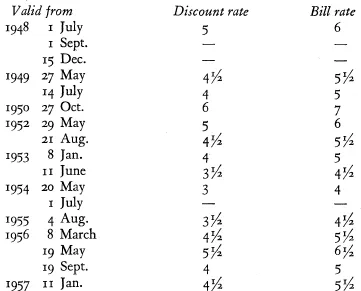
Step by step the minimum reserve requirements were lowered during these months from the high levels they had reached during the Korean war.
The Break-through
It was important to point out that the state of the market was one in which there was a rising volume of goods for sale, in order to sustain the advance. Here is what I said on the occasion of the opening of the technical fair in Hanover at the end of April 1953.
‘I do not wish to reply to the gossip which says that the arrears are made up and consumption satisfied. That is blasphemy. But it is easy to sense something else. I have felt it when, during the past quarter, I said that we must go beyond merely satisfying the people’s basic needs and their day-to-day demands. We must see to it that in German households, and particularly in working-class households, durable goods, such as refrigerators, washing machines, vacuum cleaners amongst others, will be used.’
In reply I was told how much a pensioner earns, and that such people were not in a position even to think of such purchases. Naturally it is not the pensioner who can start increasing consumption. In the U.S. it was surely not the poorest who drove the first motor cars. But it is always true that the luxury of today is in general demand tomorrow and in general consumption the day after.
If we lack the courage to fight social resentment, if we cannot bear it that without being especially deserving some become consumers of the new product before others, then we shall have to continue living in an artificially preserved poverty.
If we do not begin to try to improve the life of our people, we are undermining the basis of technical progress. Then we shall leave the circle of civilized nations. We can only participate in a further happy and healthy development if we have the courage to consume.
Was this pure theory or a sensible glimpse of the future? Some statistical data here may prove the point:
Production of Refrigerators
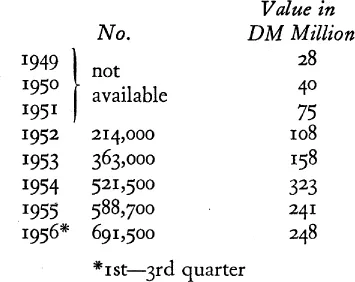
At the second international exhibition of bicycles and motor-bicycles in Frankfurt/Main on October 17, 1953, I took the opportunity to counter a frequently heard argument, which was to fight the overcrowding of the roads by restricting motoring:
‘I believe that it is no concern of the State how the individual citizen wants to spend his money—it should not in this sense do any moral teaching. Every individual shall be happy according to his own lights…. What is more, I believe that the traffic problem can only be solved through expansion; with further motorization the necessary will have to be done concerning road building and the opening up of new communications.’
When I said this the figure of production of motor-bicycles and mopeds had gone up from 143,800 in 1949 to 290,800 for 1951 and 524,400 for 1953. The expansion which we had expected from this economic sector can be even better illustrated by the production of motor cars. Already the break-through of self-interest had taken place on the part of employers and workers, as purchasers of motor cars. Production here increased even more markedly, from 104,055 in 1949 to the current yearly figure of 850,000.
Pessimism at Work
When at the turn of the year 1953/54 the feeling that the boom was ending began to spread—it was even said and feared that the power and ability of the German economy to expand was slowing down—I found it essential to contradict this:
‘The German economy leads the other European national economies in any comparison of the rate of development. This dynamic must not slow down; it is thus necessary to re-enliven the driving forces of the economy, which are the will to invest and to modernize and to keep fresh the joys of consumption.
‘There is no logically compelling reason which must lead to a slackening of the tendency to improve, since the average standard of living, in spite of all progress, still remains at a level which contradicts all indications that arrears have been made up and that the consumer is satiated.
‘Everything depends on keeping production going and increasing it, because as a result of production of goods—and only with it—the national income, i.e. the purchasing power, is created which ensures sales.’
And on another occasion, reviewing the year of 1954:
‘If—as stated—the proper relationship between investible funds, the demands for capital, and the requirements of consumption cannot, for a number of reasons, be worked out in advance, then I consider it more advantageous in the present situation to maintain high consumption, and to allow strains to arise in the capital market rather than reduce consumption to adjust savings to a satisfactory level but at the price of causing anxiety about sales.’
Prosperity Through Competition
Read the whole book online · Book details
Free to read online and to download from this archive.