
Chapter 6 of 20 · Prosperity Through Competition by Ludwig Erhard
Chapter IV HARNESSING THE BOOM
IN 1954 the transition to the next, the fifth chapter, of the young history of market economy, that is, the transition to the boom, was already clear to those looking into the future. The new task which presented itself was again not easy to solve. Above all it was a question of effectively countering the danger of an inflationary over-taxing of the boom.
The implementation of this task proved so difficult that many tended to take a one-sided view of the problem, forgetting what tremendous progress had already been made in all sectors of the economic and social life of the people. Since the middle of 1956 the threat of collapse has been easier to control. With the slowing down of economic progress the transition to a calmer and steadier development may be regarded as assured.
The second part of the task, which was to control a slight inflation of costs, will be discussed later. At present it is a matter of dealing with certain newly-created sources of income which, introduced in this fifth period, will not be fully effective before 1957. These must be absorbed without endangering price stability.
The full transition to the boom in 1954 is clearly recognizable in the index of industrial production shown on page 61.
These figures demonstrate how the years 1954 and 1955 were ripe for investment returns. Progress was uneven in the investment and consumer goods industries during this period.
This particular boom was at first welcome, since at the time there were still unused reserves of human labour—in the second quarter of 1954, 1.15 million were unemployed. Realizing the connection between an economic policy of expansion and the raising of the standard of living, I approved this growth:
‘That economic success is at the same time the basis and cause of all social progress, and alone can offer a large measure of economic security, cannot be denied—because where nothing exists even the trade unions lose their rights. A national income can only be divided if, first of all, a national income has been created.’
Production During the Boom
1953 |
1954 |
1955 |
1956 | ||||
1st half year |
2nd half year |
1st half year |
2nd half year |
1st half year |
2nd half year |
1st half year | |
All industry |
145.6 |
161.5 |
162.1 |
l8l.2 |
187.9 |
206.9 |
207.3 |
Investment goods |
167.6 |
178.4 |
193.6 |
215.1 |
242.2 |
261.1 |
274.5 |
Basic Industries |
132.3 |
141.2 |
147.6 |
164.5 |
174.3 |
186.9 |
188.9 |
Consumer goods |
142.2 |
161.5 |
157.6 |
173.2 |
174.2 |
193.8 |
191.3 |
(1936=100) |
|||||||
The graph on page 23 shows production trends for the whole of industry since currency reform, Table 1 in the Appendix that of the most important economic sectors.
The conflicting rhythm between the consumer and the investment goods sector in the first phase of the boom I described thus:
‘In view of the coming shortage of labour, which has been evident to the intelligent for some years, naturally the pressure in the past two years for greater productivity and for modernization has been particularly strong. But consumption must not lag behind. Much more is it the task of a good economic policy to see that all individual sectors of the economy benefit in turn from the boom. But it will not be the same for both sectors: always one or the other will be ahead by the length of a nose.’
The statistics of the increase in production over the same period of the previous year are impressive.
Rate of Growth of Industrial Production
Percentage Increase Over Twelve Months
1953 |
1954 |
1955 |
1956 | |
January |
+ 4.0 |
+ 11.0 |
+ 17.4 |
+ 13.2 |
February |
+ 7.3 |
+ 10.2 |
+ 16.7 |
+ 8.1 |
March |
+ 10.7 |
+ 8.4 |
+ 15.8 |
+ 10.1 |
April |
+ 12.0 |
+ 9.7 |
+ 14.9 |
+ 12.4 |
May |
+ 11.1 |
+ 13.8 |
+ 15.8 |
+ 11.0 |
June |
+ 10.9 |
+ 12.1 |
+ 16.2 |
+ 6.0 |
July |
+ 14.7 |
+ 9.3 |
+ 15.2 |
+ 8.6 |
August |
+ 10.9 |
+ 11.1 |
+ 15.4 |
+ 7.4 |
September |
+ 11.1 |
+ 11.7 |
+ 14.8 |
+ 6.2 |
October |
+ 9.3 |
+ 12.0 |
+ 13.7 |
+ 3.9 |
November |
+ 9.2 |
+ 12.5 |
+ 14.5 |
+ 4.5 |
December |
+ 13.8 |
+ 13.3 |
+ 12.2 |
+ 4.5 |
During the middle of 1954 it became evident that we were approaching a prolonged boom. This forecast was mainly based on the trend of orders. The order book for all industry during the first six months of 1954 exceeded that for the same period of 1953 by 23.6%. In the basic industries it was even more, 33.3%. In the capital goods industries the rise was 27.8%, while in the consumer goods sector an increase of only 6.6% took place.
In the second half of 1954 we were approaching full employment, which, since the crisis of the thirties, politicians as well as theorists in economics had come to regard as the most desirable aim. During the five months of June to November 1954, unemployment for the first time fell below the million mark; a year later, on September 30, 1955, with 18 million employed, the figure of unemployed had sunk to less than 500,000. In many trades and areas full employment had been reached.
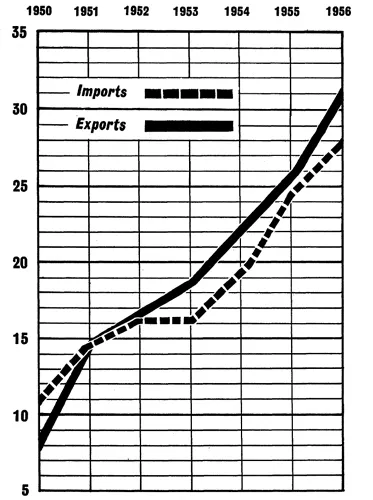
FOREIGN TRADE OF THE FEDERAL REPUBLIC IN DM MILLIARDS
The above chart shows the impressive development of the export trade, whereby an excess of imports over exports of DM 3 Milliard in 1950 was transformed into an excess of exports over imports of a like amount in 1956.
These facts are further confirmed by data for 1956. In September the unemployment figure had dropped to 411,100 while the figure of employed had risen to 18.1 million. Within a year about 800,000 people had found new jobs, and only a tenth of them had come from the fortunately shrinking reserve of the unemployed. One would have thought that this success would have found some acknowledgment even in the camp of my opponents.
Employment and Unemployment
Employed |
Unemployed |
Total | |
30.6.48 |
13,468 |
451 |
13,919 |
30.9.48 |
13,463 |
784 |
14,247 |
30.9.49 |
13,604 |
1,314 |
14,918 |
30.9.50 |
14,296 |
1,272 |
15,567 |
30.9.51 |
14,885 |
1,235 |
16,120 |
30.9.52 |
15,456 |
1,051 |
16,507 |
30.9.53 |
16,044 |
941 |
16,986 |
30.9.54 |
16,831 |
823 |
17,653 |
30.9.55 |
17,807 |
495 |
18,302 |
30.9.56 |
18,610 |
411 |
19,021 |
30.9.57 |
19,400 |
367 |
19,767 |
This trend in the labour market shows that far more people than there were unemployed according to the statistics have found employment. In the past seven years the unemployment figure dropped by 900,000, while the figure of employed rose by 5 million. In the autumn of 1956 the unemployment figure was 2.2% of the potential of employment (men 1.4%; women 3.6%).
Headhunters at Work
This unusual problem for Germany, which grew out of so-called full employment, obscured what had been achieved. I therefore thought it necessary to stress on September 8, 1955:
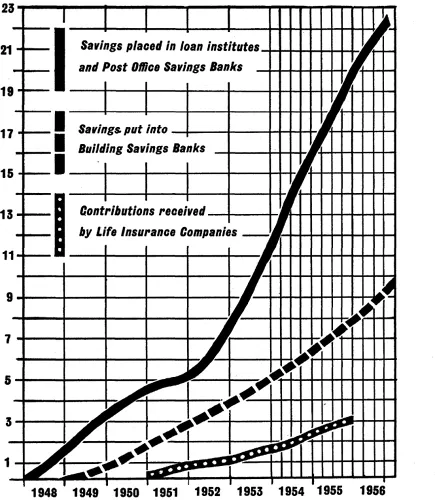
DEVELOPMENT OF SAVINGS
Despite the disturbing effects of two currency devaluations a savings total of DM 35 Milliard was reached by the end of 1956; the increase in savings during the last four years is particularly noticeable.
‘Whoever keeps his ears open might sometimes assume that with full employment, a high level of production, and with growing consumption, a disaster had befallen us, and special efforts would have to be made to subdue our economic performance. Commonsense spurns such views. It will not accept that what has been to the advantage of each individual can be dangerous or damaging from a general economic point of view.’
These new events were met by an awkwardness which eventually led to a clarification of the real issues. Some believed that they could fight the consequences of the changed situation of the labour market by trying to entice workers. This unhappy practice threatened to ruin any sane wage policy. Plain speaking was needed:
‘I have been told by the trade unions: “Look what is happening in the labour market, and ask yourself whether we of the unions can still pursue a responsible wage policy, when recruiting officers from one industry are going through the country taking labour from other industries.”I am not against a free choice of jobs or against the freedom of the worker to choose his own place of work; but what is happening now I can only describe as the work of headhunters, who are trading in human lives.
‘These happenings are not only to be condemned economically; they should be morally and socially condemned. No argument exists which could justify the use of such means.’
This shortage of labour increasingly proved to be the most serious problem facing the economy:
‘The best solution, which would simultaneously have favourable social and economic consequences, is to be found in an increase in the productivity of our economy. We must therefore do everything we can to modernize. We must use every means to increase productivity, to compensate what we lack in quantity, i.e. through a higher standard of efficiency. ’
As Minister for Economic Affairs I had to see that no difficulties would develop in the wake of the quick upward surge on the investment goods side, and at the same time I was trying to emphasize the necessity to increase effort, and, through modernization, to arrive at a better output and thus raise the efficiency of human labour. I stressed several times that, with full employment, it was indisputable that the enterprising investment of today would be the gain of the worker tomorrow.
If, in these months, I felt that I had to express some scepticism about the boom in the investment sector, it was because the signs of mistakes and misunderstandings in respect of the capabilities of the economy were increasing there. Therefore, I said on November 12, 1955:
‘The present level of investment of 27% of the gross national income proves clearly enough that our economy has recognized in time the approaching problem of a shortage of labour. But it must now also be ready to appreciate that a further increase in investment, which strains the capacity of the relevant branches of industry, and therefore leads to an over-taxing of the boom, cannot be an acceptable means of economic policy. Consumption, as well as investment, should be guided by the budget.’
In fact investment in 1955 was appreciable, as can be recognized in the figures of production and also in the share of investment in the national income.
Use of National Income by Percentage
1936 |
1949 |
1950 |
1952 |
1954 |
1955 | |
Private consumption |
60.5 |
65.2 |
63.8 |
56.1 |
56.1 |
56.1 |
Government consumption |
20.8 |
18.3 |
16.3 |
17.9 |
16.5 |
15.4 |
Investment and Foreign Aid |
18.7 |
16.5 |
19.9 |
26.0 |
27.4 |
28.5 |
Gross National Income |
100 |
100 |
100 |
100 |
100 |
100 |
1936 |
1949 |
1950 |
1952 |
1954 |
1955 | |
Private consumption |
60.5 |
61.7 |
60.6 |
58.1 |
59.2 |
59.4 |
Government consumption |
20.8 |
22.0 |
19.1 |
19.3 |
17.4 |
16.2 |
Investment and Foreign Aid |
18.7 |
16.3 |
20.3 |
22.6 |
23.4 |
24.4 |
Gross National Income |
100 |
100 |
100 |
100 |
100 |
100 |
In 1956 in the private sector—according to these estimates— an increase of approximately 8% took place, with a gross investment of barely 6%, while Government consumption remained unchanged. The total gross national income in 1956 increased by 7.1% (these calculations are made by eliminating all price changes).
Insofar as one can abstract the investment in plant and equipment from the total sum of investment, the past years showed the following trend:
In Million DM
1952 |
1953 |
1954 |
1955 | |
In actual prices |
24,680 |
27,735 |
30,630 |
38,100 |
In 1936 prices |
10,942 |
12,566 |
14,078 |
16,791 |
Increases in Wages and Salaries
The clear picture of a boom shown here finds its reflection in the trend of incomes of the employed population, and even other sectors of the population. The gross hourly wages of the industrial worker, which in relation to 1953 had increased by 4.6%, and to 1954 by 2.9%, rose considerably in 1955 (by 6.8%). The trend continued even faster in 1956, and in the first three-quarters of that year rose by 8.5, 8.9 and 8.4% respectively over the same periods of the previous year, though the increase in productivity did not keep pace.
The strong impetus of this movement in the wages section meant, according to statistics of the BDL, that net wages and salaries had grown from DM 54.1 milliard in 1954 to DM 60.9 milliard in 1955.
This increase by nearly 7 milliard far exceeded that of any previous year. According to the provisional calculations of the BDL, 1956 shows an increase of just under 12% and a rise to DM 67.9 milliard. Pensions (after tax deductions) also increased, pensions and maintenance payments rising from DM 17.7 milliard in 1954 to DM 19.6 milliard the next year. Here, too, appreciable increases of 12% can be seen for 1956 compared with the previous year, the total of these payments thus rising to DM 22 milliard. Total incomes thus rose altogether from DM 71.8 milliard in 1954 to DM 80.6 milliard in 1955. These figures certainly highlight the enormous strides made in social advancement. In 1956—again according to the preliminary figures of the BDL—total incomes reached DM 89.9 milliard, and were thus double those of 1950.
Date |
Gross Wages and Salaries total DM Mrd. |
Per employed DM |
Deduction |
Net Wages and Salaries DM Mrd. |
Pension etc. |
Total Incomes |
1950 |
39.3 |
2,839 |
5.3 |
34.0 |
11.4 |
45.4 |
1952 |
53.5 |
3,560 |
8.4 |
45.1 |
15.0 |
60.1 |
1954 |
63.8 |
3,922 |
9.7 |
54.1 |
17.7 |
71.8 |
1955 |
72.2 |
4,193 |
11.2 |
60.9 |
19.6 |
80.6 |
1956 |
80.8 |
4,473 |
12.9 |
67.9 |
22.0 |
89.9 |
This favourable trend, and the intention of the Federal Government further to increase social service payments, can naturally only exist in a flourishing economy. The general increase in prosperity may be seen by making a comparison of the national income per head of the present population, after allowing for price increases, with the figures for 1936.
Comparison of National Income per Head
1936 |
1949 |
1950 |
1952 |
1954 |
1955 | |
In RM/DM |
992 |
836 |
939 |
1,086 |
1,230 |
1,350 |
1936=100 |
100 |
84 |
95 |
109 |
124 |
136 |
1949= 100 |
— |
100 |
112 |
130 |
147 |
161 |
We not only succeeded in overcoming the ravages of the war, but output in 1956 was 45% higher than that of the last year of peace, and, compared with 1949, was up by 70%. These are figures which speak to the unbiased observer more clearly than long commentaries about the success of the social market economy.
Rapid Reaction of the Saver
Among the economic factors responsible for the boom, but which were also influenced in turn by the prevailing economic situation, the rate of saving must be mentioned. The beginning of the boom coincided with an intensive period of saving. It is therefore justifiable to describe 1954 not only as a year of investment but also as a year of savings. This identity, which predominated again in the following year, 1955, only broke up in 1956. The total amount of savings had risen from the beginning of 1954 to the beginning of 1955 from DM 11.24 milliard and, until the same time in 1956, had grown by nearly another DM 4 milliard to DM 20.67 milliard. The building societies’ deposits also showed a similarly favourable trend, though naturally on a smaller scale.
This remarkable willingness to save was at the time a strong stabilizing factor, while the later slowing down of savings gave some cause for worry. The total amount of savings was DM 20.67 milliard in January 1956, but by November had grown to only DM 22.495 milliard. That, without a doubt, indicates a relatively lower rate of growth. Happily, a change for the better has taken place more recently.
The increase of voluntary savings since currency reform proves how much can be done when the population has confidence in the stability of the currency; this in spite of unfavourable conditions, for, after all, savings have twice been wiped out in Germany (cf. graph on page 65).
The opening phase of the boom was finally marked by another important event. With the ending of the so-called Law for the Encouragement of the Capital Market the way was clear to help the capital market to return to a role appropriate to a market economy. From this date (December 31, 1954) the rates of interest and yields on the various securities worked together again according to the rules of a market economy. The tendency towards lower rates of interest thus brought about was interrupted because credit restriction had become necessary in the economic circumstances of the boom. At the same time it can be assumed that this good start was not wasted. The recovery of the capital market, together with the revival of savings accounts and insurance premiums went ahead together to satisfy the heavy demand for investment in respect of the capital market (cf. Table 2 in Appendix).
This view of the value of the capital market encouraged the hope that a renaissance of the stock market might soon be brought about.
The repercussions of the boom could also be clearly seen in the development of foreign trade. Both 1954 and 1955 were marked by a very strong rise in the volume of foreign trade, whilst a burst of imports in 1955 halved the surplus of the trade balance of 1954. The year 1956 showed an unexpectedly strong rise in both imports and exports, as well as a return to a surplus in the trade balance. The impetus behind this rise in exports followed some slackening in the capital goods industries at home, which freed capacity for deliveries overseas. Without a doubt this trend would have gone further if the Federal Ministry for Economic Affairs had not at this time adopted a policy of easing imports. Germany’s position in the world market had become stronger. Its export performance came third, after the U.S.A. and Great Britain.
These facts, stamped out by economic success, could be taken as proof that at the same time price stability could have been maintained. This idea, however, as all experience shows, is very difficult, if not impossible, to realize in this phase of the economy. But it has to be acknowledged that the stormy upward trend of export and internal demand was accompanied by only relatively small price increases. There was, and is, no need for dramatization. A strong upward trend of prices might have been feared all the more, as during the boom orders always surpassed deliveries. So far as exports are concerned, this is still the case today.
Prices which had remained stable until the second half of 1954 now rose slightly. In the previous two years prices of manufactured products tended to fall. They dropped from a level of 121 to 116, and this lower level was maintained until September 1954 (1950 = 100). From that moment a slow but steady increase took place. In February 1956, the level of 1952 was again reached and moved until September of that year between 120 and 121. Not until the autumn of 1956 were there further increases, so that in November the price level compared with the same months of the previous year rose by 2.9% and compared with November 1954 by 5.1%.
In view of these price movements during the past two or three years the trend of the cost of living index must be regarded as relatively stable. For 1954 as a whole it remained at the 1953 level (i.e. at 108% of 1950), then rose in 1955 to 110% and has moved since January 1956 between 112 and 114%. For 1955, it is calculated that a rise of the total cost of living (of the medium consumer group) of 1.8% took place compared with the previous year. In the late autumn of 1956 the total index had gone up by 1.8% compared with the same period of the previous year; it rose above the level of 1954 by 3.7%. A comprehensive view of the development of these economically important prices is given in Table 3 in the Appendix.
Compared internationally, the Federal Republic, as is shown in the following table, can be proud of its record.
Cost of Living Index (1949/51 = 100)
1953 |
1954 |
1955 |
9 months of 1956 | |
West Germany |
103 |
103 |
105 |
108 |
Belgium |
106 |
108 |
107 |
110 |
U.S.A. |
109 |
109 |
109 |
111 |
France |
126 |
126 |
127 |
129 |
Denmark* |
115 |
116 |
121 |
128* |
Sweden |
120 |
122 |
125 |
132 |
Great Britain |
120 |
122 |
128 |
132 |
Norway* |
129 |
135 |
136 |
142* |
*1950=100 |
||||
Price Stability is Imperative
The slight drop in the level of consumption which took place shows the disadvantages of the boom. I have again and again pointed out that, in the long run, no amount of economic progress can be big enough to offset even the most apparently harmless softening of the currency. I warned repeatedly:
‘The economic question is not whether prices should be kept stable, or whether in certain conditions they may be allowed to rise. The level of prices must in all circumstances be maintained. The only question is how we can secure this.’
I absolutely deny that a strong expansion must be naturally or lawfully combined with a general rise in prices. In the interest of all those drawing incomes and all savers, the aim must be a rising and more embracing prosperity while keeping prices stable.
‘Perhaps the experience of the past has often been interpreted differently; however I see no reason to relax my efforts, through responsible monetary, credit and financial policies, to prove that an expansion can continue while prices remain stable.’
Finally in the crucial weeks and months I had frequently to oppose those who thought that only by a steady, although slight, weakening of the currency could those impulses grow which in the long run would secure economic expansion. I said at the time: ‘After the past ten years many false ideologies and dogmas have been practically discredited; in real life it seems to me to be time also to destroy this last and perhaps most dangerous illusion.’
All measures taken to restrain economic development were based on the wish to safeguard the stability of the currency, but I could never have abandoned the principle and the aim of an expanding economy. Because it is so important to find the right measures to make further steady progress, one of many of my sayings on the subject deserves to be reproduced here:
‘I really cannot be accused of wishing to propagate a restrictive policy for selfish reasons, nor is it true that I could suppose that to depress this boom forcibly is a worthwhile aim. No— certainly not—because the secret of the success of our economy lies in the fact that we have never retreated from the difficulties, but have always found the solutions through moving forward dynamically and by expanding. And thus it shall remain, though naturally it should not be overlooked—and not only today—that some difficulties are becoming increasingly obvious.’
Unpopular Truths
Out of this basic conception several measures to curb and direct the boom have been taken. These attempted to influence those factors which caused disturbances or set off new dangers. For example, in this connection, the many psychological influences should be remembered. These were based on the conviction that the actual dangers were not a necessary part of life but rather had their roots in the disregard of economic limitations. My original thesis here naturally was always the stability of the currency. A special chapter has therefore been devoted in this book to that campaign.
In those months I never tired of declaring the unpopular truth: that wages and prices, in spite of all denials and tactical manoeuvres, remained indissolubly linked.
‘When wages, even if only on one sector of the economy, get out of control, then they cannot remain stable elsewhere. This means that it is not possible (and thus must not happen) that in any branch of the economy wage demands to the size of X can be met, while other industries are only able at the best to grant half X or only a quarter X, unless price increases are to gain ground.
‘It is irresponsible to allow a price simply to get out of hand or to believe falsely in exploiting to the last such favourable boom conditions. Such behaviour in a situation like this creates naturally a precedent which it is a temptation to follow. But that means inflationary trends, which must be stopped at the start.’
Such thoughts then caused me, in spite of much opposition and shaking of heads in those turbulent months, to fight against all avoidable price increases, whether in industry or agriculture. I tried to oppose all wage increases which were not justified by progress in productivity. On the other hand there was considerable scope for higher wages, since the trend of productivity was showing good results.
Higher wages were balanced by progress in productivity during 1955. But the discrepancy between progress in productivity and the increase in total incomes for 1956 cannot be denied. Gross wages and salaries per worker rose—according to preliminary estimates of the BDL—by about 7%, total incomes by almost 12%, compared with 1955, while the increase in productivity in 1956 was 3.4% per hour worked in industry and 2.4% elsewhere. No one can say that he acted without knowledge of the consequences, for I had literally run up and down the country to explain this simple truth to even the most limited mind.
No Doubt About Price Responsibility
The connection between price increases and the growth of personal incomes in excess of the progress of productivity, i.e. above what the economy can produce, must not be overlooked in this phase of economic development. The inevitable consequences can be measured to within 1%. The responsibility for these price increases, for the slight watering down of purchasing power, shall and must be ascribed to those responsible. That is true as much for the joint management concerns6 as for the Government and members of Parliament. It should be stated once more that there is nothing against changes which are made within what is economically possible. Such improvements are even desirable, since they absolutely meet the requirements of the market economy.
The psychological campaign which I initiated was meant to be accompanied by other plans, which only partly succeeded. My suggestions were aimed at slowing down the effects of the growing surplus of foreign trade by making the financial system more liquid. Above all, this was to be achieved through increasing imports to make more goods available at home, and thus exercise a pressure on prices. After months of discussion in the Government and Parliament, cuts in customs duties were proclaimed on April 1, 1955, but not to the extent that I had wished, or regarded as desirable. The degree of liberalization with the O.E.E.C. countries was increased step by step, and the free list for imports from the dollar area considerably widened.
Special measures aimed at achieving a remedial effect where the difficulties appeared greatest. A limitation of public funds for investment went side by side with a retrenchment of public investment in building.
Because my proposals were often accepted only in part and often too late, I increasingly supported the BDL, and even encouraged it to depart from the very liberal monetary and credit policy which had been introduced after the end of the Korean boom.
The Federal Ministry for Economic Affairs and the BDL both judged the economic situation alike. On August 4, 1955, the low discount rate of 3% which had been valid since May 20, 1954, was altered to 3½%. This step was followed on March 8, 1956, by a further increase in the discount rate of 1%, and on May 20 a new tightening of the reins lifted the discount rate to 5½%. This logical policy was reinforced with other measures by the BDL. Thus, on September 1, 1955, the minimum reserve requirements were raised and rediscount facilities limited. The most remarkable fact of the economic situation of those months was that my close collaboration—or rather agreement—with the Central Bank was by no means generally approved.
These many-sided developments were not without success. During the middle of 1956 the return to a healthy and realistic production rate took place. The tempo of expansion adapted itself to the potential growth of the economy. The annual increase in production which, in 1955, was over 15%, dropped to 8% or less, but remained at a level which could not be termed a stagnation or crisis. The lowering of the bank rate on September 6, 1956, from 5½% to 5%, and the further cut by ½% of January 1, 1957, can be regarded as evidence of consolidation.
Success is Achieved
There are many reasons for this better balance. I believe that the psychological campaign, together with the measures taken by the BDL, played an important role. The increase in imports in those sectors which were particularly endangered by rising prices, was also effective. Even the imports of foodstuffs rose from DM 2.14 milliard in the fourth quarter of 1955 to DM 2.82 milliard in the same period of 1956.
All statistical data indicate that the phase in which the threat of a boiling over of the boom became a real danger could be considered as past, to make room for a period of steady upward development. Nevertheless it should not be overlooked that a heavy mortgage remains from this period, with which economic policy will have to come to terms. In particular, this is true of those wage increases which exceeded the increase in production. The socially necessary increase in pensions and assistance payments from public funds, and the increase in the social security payments during social reform must be mentioned here, particularly since only a part of this expenditure could be financed from increased contributions. In any case here are sums amounting annually to milliards which will reach the market simply as spending power. Insofar as the cut in taxes becomes effective the same is true. These changes in the structure of incomes have naturally forced us also to improve the earnings in the public service, so that even in this quarter incomes have received a renewed impetus. Finally, one must consider the widening of consumer purchasing power in relation to the will to save.
Much Depends on the Will to Save
Whether those potentially expansionist tendencies will cause trouble will depend on savings. In the third quarter of 1956 the growth of savings came to only DM 90.7 million—one-eighth of that for the same period of 1955. Fortunately it appears that the most recent measures of the Federal Government have renewed the will to save. It is to be hoped further that satisfaction with the Government will increase social confidence, and thus increase saving.
This development can be taken as evidence of how much the saver reacts to a real or assumed deterioration of the value of money. Reminders that a debasement of the currency is not taking place and that worries are groundless will therefore not be successful psychologically. To clarify what has already been stated, the fate of a one hundred mark note paid in on the day of currency reform is sketched out here. The trend of the price index at the time clearly shows that only a small part of the rise in interest rates and compound interest rates on monies paid into a savings bank has been eliminated by higher prices.
Price Index of the Cost of Living
2nd half of | |
In payments on 21 June 1948 = DM 100 |
1948 = 100 |
Total Deposit on 31 December 1948 = DM 101.22 |
—— |
Total Deposit on 31 December 1949 = DM 103.75 |
1949 = 99 |
Total Deposit on 31 December 1950 = DM 106.39 |
1950 = 92 |
Total Deposit on 31 December 1951 = DM 109.58 |
1951 = 100 |
Total Deposit on 31 December 1952 = DM 112.87 |
1952 = 102 |
Total Deposit on 31 December 1953 = DM 116.26 |
1953 = 100 |
Total Deposit on 31 December 1954 = DM 119.75 |
1954 = 100 |
Total Deposit on 31 December 1955 = DM 123.34 |
1955 = 102 |
Total Deposit on 30 December 1956 = DM 127.45 |
30 Dec. |
To counter all possible misunderstandings at the outset, it should be noted that the comparison of savings and the cost of living index in no way constitutes a special appeal for a stabilization of the index of savings.
The future shape of our foreign trade will also be of great importance. Expansionist tendencies to which it might give rise could in the future be even more important, since the neutralizing effect of budget surpluses is not likely to be as marked as in past years.
In the final phase of the boom, in spite of a noticeable slowing down in the rate of increase of production, a higher level of costs, wages and prices has been established. It is possible to point to several factors which will further provoke higher prices in those economic sectors nearest to the consumer, unless my repeated appeal that wages should only be allowed to rise in step with higher productivity is obeyed.
The central problem of economic policy is therefore to keep the further growth of the economy free from inflationary tendencies. To maintain the stability of money is the basic condition for a balanced economic growth, and for true and certain social progress. The economic policy of the Federal Government must thus in future be increasingly directed towards maintaining financial stability. Whether restrictive measures will finally be needed will depend on the readiness of all sections of our population to deny themselves those special advantages which are gained at the expense of all.
Prosperity Through Competition
Read the whole book online · Book details
Free to read online and to download from this archive.