
Chapter 1 of 8 · The De Moneta of Nicholas Oresme and English Mint Documents by Nicholas Oresme
Introduction
THE aim of this volume is to give an account of the theory and practice of coinage in the thirteenth and fourteenth centuries. For the theory, Nicholas Oresme’s De Moneta presents the scholastic doctrine derived from Aristotle’s Politics, For the practice, it seemed best to translate the treatise preserved in the Red Book of the Exchequer, and presumably written by William de Turnemire, Master of the Mint in 1279, with other documents from Hargrave MS 313 and from some of the registers of Bury St Edmund’s Abbey, relating to the recoinages of 1247, 1279 and 1300, and to the gold coinage of Edward III.
I
NICHOLAS ORESME
Nicholas Oresme 1 is supposed to have been born about the year 1320 at the village of Allemagne near Caen, but the earliest certain fact about him is that he was a ‘bursar’ of the college of Navarre in the University of Paris from 1348 to 4 October 1356, when he was appointed Master. He is described as a Norman. He studied in Theology, but it is not known when he took his degree of Master in Theology. He remained Master of the college till 4 December 1361, when he was forced to resign. He became a canon of Rouen, 23 November 1362, and dean 18 March 1364. He preached a celebrated sermon before Pope Urban V on Christmas Eve 1363, denouncing the corruption of the world and the Church, and calling for repentance. Some time before 1370 he became one of the chaplains of Charles V (1364–80), since he undertook the translation of the Ethics (1370) and Politics and Economics of Aristotle at the king’s request. The treatise on Money in its Latin and French forms is earlier than these translations, since it is mentioned in the preface to the Politics.2 Oresme became bishop of Lisieux 16 November 1377 and was consecrated 28 January 1378. He died at Lisieux 11 July 1382.
Besides the works mentioned above, Oresme translated Aristotle’s De Caelo et Mundo, and wrote several books directed against the claim of astrologers to predict the future as well as sermons and theological tracts. The translations were not from the Greek, but from the Latin versions of Grosseteste and William of Moerbeke. The treatise on money, though based on the Politics, was an economic tract provoked by the successive debasements of the coinage by Philip VI and John II and the consequent derangement of trade and social relations. It has been suggested that it brought its author to the notice of Charles V, who was then acting as regent during his father’s captivity in England. But it is more likely that he was already employed in the king’s service, as he is stated to have been engaged in raising a loan in Normandy in 1360, and there was a halt in the debasement of the coinage from 1360 to 1385.
In his treatise Oresme takes the Aristotelian view that a coin is a definite weight of precious metal, the quantity and fineness of which is guaranteed by the stamp of the authority issuing it. The currency does not belong to the issuing authority, but to the public which uses it for the purpose of exchange of goods. The prince has therefore no right to vary the standard or the weight or (if two metals are, as usually, employed) the bimetallic ratio; though the last may be done if the relative value of the metals is materially altered by a new source of supply. And any necessary alteration must be by agreement of the whole community. Debasement is condoned as a temporary political expedient, but the true values must be re-established as soon as possible. It is remarkable that Oresme takes no account of credit, nor of bills of exchange, which were already extensively used by Italian bankers at the beginning of the fourteenth century. Paper money (which Goethe credits Mephistopheles with inventing) had not yet appeared to complicate the question. In an age in which inconvertible paper is the rule, there is something particularly apposite in Oresme’s arguments; and it is not surprising that a German translation by Dr Edgar Schorer (Jena 1937) lays some stress on this in an introduction.
It is curious that Oresme takes no account (pp. 13–14, 19–20) of what must have been a powerful motive for a gradual debasement of the coinage in the Middle Ages, the wear of the current coin. There was always a temptation to make the new coin approximate in value to the average worth of the coin in daily use. It was necessary either to call in all the old coin, and throw the loss upon the holders of it, or to see the new coin disappear into private hoards. And before the introduction of milled edges, the loss from wear was very heavy. The evidence of the mint officials estimated it at about 20 per cent in the early years of Richard II, when there had been no coinage of silver on a large scale for nearly thirty years, and there was a great lack of halfpence and farthings. Their estimate may have been too high, but the deterioration must have been considerable. To Oresme, to whom the maintenance of the standard was of supreme importance, there was little or no difference between such an adjustment of the new money and deliberate debasement; but he makes no provision for the gradual withdrawal of light money from circulation and its replacement by sound currency. A complete recoinage, the remedy which he proposes, throws the whole burden of the loss on the holders, at the moment, of the old money.
Oresme has been credited with the anticipation of ‘Gresham’s Law’ on the strength of a passage in the French translation describing the effect of debasement on the coinage. But this passage comes from an addition to Oresme’s own version, and is not contained in the two earliest MSS (Paris, Bibl. Nat. MSS fr. 5913 and 23,926), as M. Bridrey has pointed out.3 It has been suggested that longer versions were added by officials of the Flemish mint, who had observed the failure of Charles V’s attempt to reform the French coinage, and had frequent opportunities to repeat the observation in the Low Countries.4 One MS at all events (MS fr. 5913) is written by a Flemish copyist, and reads (f. 3) ‘et maintenant est au present en ce pays de Flandres et les voisins’.
II
THE TEXT OF ORESME’S TREATISE
(Contributed by R. A. B. Mynors)
For the De Moneta we have no original manuscript; only a number of copies, whose making is spread out over the hundred years that followed the author’s death. Taken together these agree so closely that we are rarely left in any doubt what the author wrote; and where their testimony differs, one or more of the earlier will always produce a reading by which the demands of sense and latinity are satisfied. As individuals they vary widely in external appearance and in quality, and give us some idea of the circulation of the work before it appeared in print.
Our three oldest are Parisian, two from the Abbey of St Victor and one from St Germain des Prés, and take us back to the theology schools of the University of Paris at the end of the fourteenth century:
PARIS, Bibliothèque Nationale lat. 14,579 (formerly St Victor in), ff. 336–43. Paper, with occasional leaves of parchment, 295 X 215 mm., 2 columns of about 50 lines, in a small current hand using pale ink, with rough red capitals. Bound in the old boards, re-covered. This stands at the end of a large collectaneous volume of moral and theological treatises, in different but contemporary hands, by Petrus de Alliaco, Henricus de Alemannia, Johannes Gerson, Nicolaus de Lyra and others, including Oresme himself.5
PARIS, Bibl. Nat. lat. 14,580 (formerly St Victor 100), ff. 213–20. Paper and parchment, 305 X 210 mm., about 45 lines, no ornament, rebound. A volume in appearance and contents very much like the last, acquired for the library of St Victor’s under their active prior, Jean Lamasse. It had belonged to a Paris theologian, Germanus de Rungiaco, from whose executors it was bought for 48 sols.; and their signatures to a receipt for the price, dated 4 August 1417, are still to be seen on f. 222v.
PARIS, Bibl. Nat. lat. 13,965 (formerly St Germain 1103). Parchment, 240 X 170 mm., 13 leaves, about 35 lines, in a good small hand dated A.D. 1397, with one illuminated initial. The other contents of the volume, which has been rebound, are in a hand of the same date: a widespread collection of literary commonplaces (beginning: ‘Ordo iuris expostulat ut amicorum …’) and a collection of French proverbs, with Latin analogues from the Bible and other sources.
These three volumes are characteristic university books: the first two on paper in the rapid, much-abbreviated current hand, with no ornament, that looks like the work of a scholar writing for his own use, or to eam his keep, rather than of a professional scribe; the third on parchment, obviously written by a professional, and with professional ornament, but still in the close abbreviated script used for philosophical and theological texts. The best of them, probably the best of all our manuscripts, is 14,580; for 14,579 is full of small deviations from the standard text, peculiar to itself and having no claims to authenticity. 13,965 can be neglected; for it is evidently a copy of the same parent manuscript as 14,580, and a much less faithful copy.6
Next, probably, both in value and date come:
PARIS, Bibliothèque Ste Geneviève 343, ff. 139V- . Paper, 385 X 285 mm., 2 columns of 55–60 lines, well written at the end of the fourteenth or early in the fifteenth century, with red headings and red and blue capitals, medieval binding. The first page of the volume, which contains works of canon law and political philosophy, is ornamented with a miniature in quite good style. Owned previously by the Carmelite house at Dijon.
POITIERS, Bibliothèque de la Ville 93 (243), ff. 50–70V. Paper, 215 X 150 mm., about 30 lines to the page, in a small fifteenth-century current hand, with red headings and red and blue capitals. Part of a rather miscellaneous volume, all of the same date, in its original white skin binding, complete with four ties and a bookmarker. On the flyleaf is an inscription of ownership which might be legible, and ‘Iste liber est episcopi Lingonensis ex dono subprioris beati Remigii Remensis sibi facto’. It belonged later to the Jesuit College at Poitiers.
The first of these, though written on paper, shows a high standard of finish, and may well have been ordered by some well-endowed canon lawyer; the other belonged to a bishop of Langres, who has been identified as Gui Bernard (1453–81). They correspond closely in text, and there is at least one place where they are right and all our other copies wrong.
In our next group, we find at least one copy written for a wealthy layman:
PARIS, Bibl. Nat. lat. 8681 (formerly Fonds du Roi 5200). Parchment, 255 X 175 mm., 16 leaves, 34 long lines, in a good fifteenth-century ‘lettre bâtarde’, with space left for illuminated capitals, which have never been filled in. Old red velvet binding.
PARIS, Bibl. Nat. lat. 8733A. Parchment, 210 X 145 mm., 44 leaves (with blank quires before and after), 22 lines ruled in red, with red headings and illuminated capitals, paragraph-marks and space-fillers. Illuminated frontispiece showing moneyers at work striking coins (their elegant attire suggests that realism is not intended); in the border, the motto and badge (two bombards discharging their cannon-balls) of Louis de Bruges, Seigneur de la Gruthuyse, the great Flemish bibliophile who died in 1492, and the arms and porcupine badge of Louis XII of France. Modern binding, retaining the characteristic gauffered edges.7
PARIS, Bibl. Nat. 18,205 (formerly Carmes de la Place Maubert 10), ff. 103–21. Paper, 210 x 150 mm., about 30 lines, in a fifteenth-century current hand, with simple capitals in red and blue. Original binding, rebacked. The other contents are theological treatises, mostly by or ascribed to Johannes Gerson. Owned previously by the Paris Carmelites.
It sometimes happens that the more expensive the appearance of a literary manuscript, the worse its text; but this copy made for Louis de Bruges is very good, right two or three times where all the rest are wrong. I group 8681 with it, because though not particularly close in text, they are externally similar: parchment books, in ‘lettre bâtarde’, containing the De Moneta by itself, meant for the bibliophile rather than the scholar. As for 18,205, it groups itself with 8733A by an obvious textual relationship; but it is a poor relation, and can be disregarded.
There is another fifteenth-century paper manuscript, of which at present I know nothing:
UTRECHT, University Library 318; the De Moneta is ff. 114–28 of a volume of most miscellaneous contents.
And, to conclude this account of the manuscripts, here is one which looks forward into a different world:
BRUSSELS, Bibliothèque Royale 9899 (being ff. 204–13 of a volume numbered 9896–9901). Paper, 290 X 200 mm., 45 lines, very neat hand with coloured penwork capitals, written in the last twenty years of the fifteenth century, and, as the context indicates, in Louvain. The other contents of this volume, which has been rebound, are primarily of humanistic interest, and some of them are printed: Valerius Maximus (no. 133 in Paul Thomas’s catalogue of the classical MSS in Brussels) dated Louvain June 1483; Isocrates ad Demonicum in the version of Rodolphus Agricola and his De Regno in that of Leonardo Bruni, the latter dated Louvain 5 February 1499; Oresme, undated; Bruni’s Isagogicum, produced ‘non fluviali calamo sed arte quadam caracterizandi modernissima’ by John of Paderborn at Louvain, 10 June 1475 (GKW 5616; Polain 4076); and a printed copy, without date or place, of Persius’s Satires with the commentary of Bartholomeus Fontius. It was previously owned by the Jesuit College in Louvain.
As far as its text goes, this Brussels copy has nothing to offer us; indeed, it has, I think, been corrected against the edition printed at Cologne in 1484. But could one ask for a more appropriate bridge between manuscript and printed text?
The first of the printed editions appeared in 1484, as part of the Opera Johannis Gerson (Cologne, Johann Koelhoff 1483–4; Hain 7621), vol. IV ff. 268V-80. It was a good text, resembling that of Paris lat. 8681 and 8733A; unfortunately it remained unknown to later editors, who depend entirely upon its inadequate successor. This appeared in Paris, without date, but about the year 1511, as a sixteen-page small-quarto pamphlet, put out by a printer in a small way, Thomas Kees. The source was a manuscript very close to Paris lat. 14,579, with all its peculiar readings, but it lacked, it seems, one pair of leaves, so that in Kees’s edition there are two large gaps, to which no attention is drawn; he omits (pp. 24–8) ‘casibus prius dictis … in indebita mutacione monete’, and (pp. 35–8) ‘sicut de re … uelle ergo amouere’. Rare as it is now (the copy in the Bibliothèque Nationale is believed to be unique), Kees’s text with these two gaps is the sole source for all its successors down to 1864, when manuscript evidence was again brought into play. The first reprint was that of the Sacra Bibliotheca Sanctorum Patrum of M. De la Bigne, vol. IX (Paris 1589), col. 1291–1310. This was repeated five or six times in the course of the seventeenth century at Paris, Cologne and Lyons, and the Oresme text was reprinted separately from the Paris print of 1610 in 1622 at Helmstadt and at Luneburg in 1625. An independent reprint of Kees, with a good deal of editorial alteration, was published in 1605 by Gothard Voegelin at Leyden, as part of the De Re Monetaria veterum Romanorum of Marquard Freher; and there are said to be other editions, by Jacobus Genathius at Basle in the early seventeenth century and by David Thomas de Hagelstein in Acta publica monetaria I (Augsburg 1642, second edition 1692), which I have not seen.
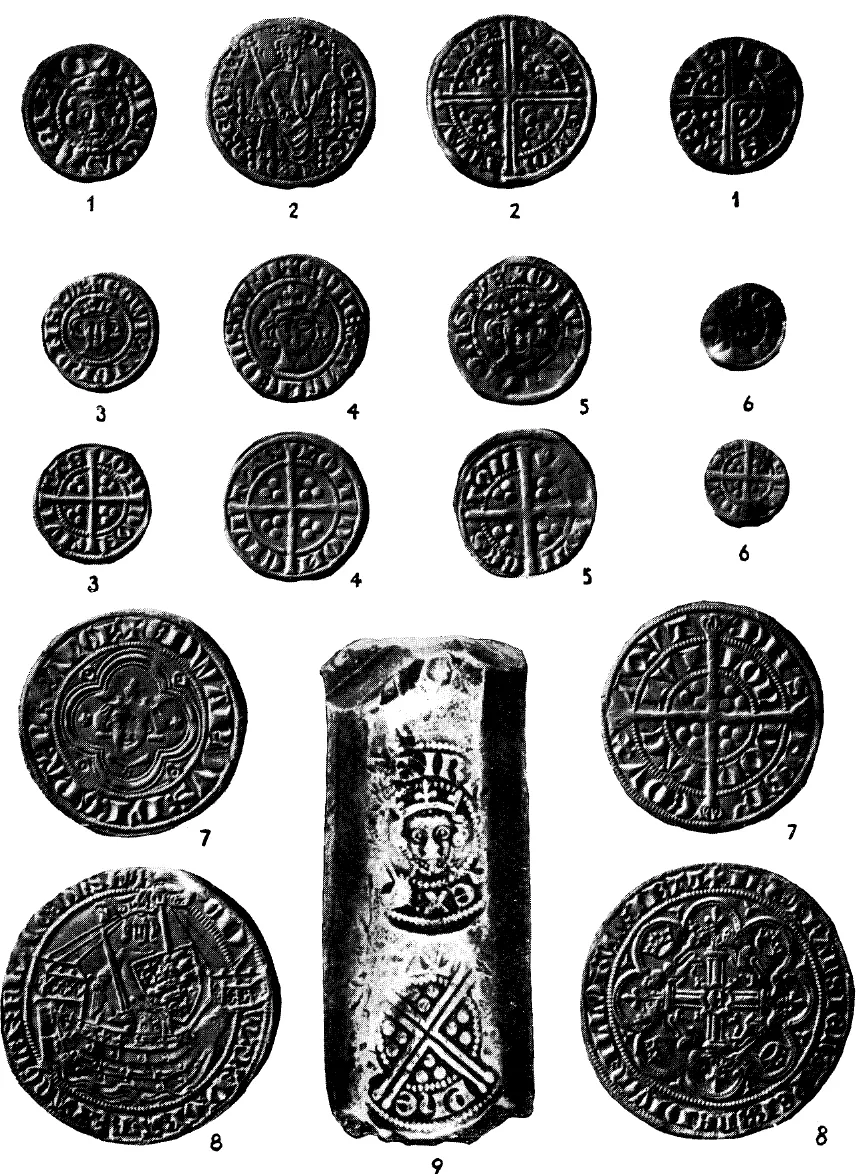
COINS, AND A TRIAL PLATE FOR 1279 COINAGE
1. Henry III long-cross penny 1247–8. 2. Henry III gold penny 1257. 3. Edward I halfpenny 1280, 4. Edward I penny 1279. 5. Edward I penny (Hull) 1300–2. 6. Edward I farthing (base) 1279. 7. Edward I groat 1280–5. 8. Edward III gold noble 1346–51. 9. Surviving portion of standard of 1279 (enlarged 5:4). This has the imprint of the old coinage, but that of the new is unfortunately missing, presumably because the pieces for assay were taken from that part.
All coins are silver, actual size, and London Mint, except where otherwise stated.
By kindness of the Deputy Master of the Royal Mint and of the Trustees of the British Museum
This all suggests that a lively interest was taken in these currency problems in the seventeenth century, but there was no recourse to fresh evidence for the text; the two gaps in Kees’s edition are still there, camouflaged now by a renumbering of the chapters made in 1589. The credit of putting an end to this state of affairs belongs to L. Wolowski, who in 1864 produced the complete text for the first time for three hundred and eighty years: Traictie de la premiere Invention des Monnoies de Nicole Oresme, textes français et latin, using three of the less good copies in the Bibliothèque Nationale, and quoting carefully the variants of the edition of 1605, because he did not realise that they were mere inventions of its editor. Wolowski’s edition of the French and Latin texts was the basis of the exhaustive study of the treatise by Emile Bridrey, La Théorie de la Monnaie au XIVe siède, Nicole Oresme (Paris 1906), which with its xxxix+741 pages (and no index) is the fullest discussion of the De Moneta that has yet been or is ever likely to be published.8
The text here printed is based on the following MSS: V = Paris lat. 14, 579; W = Paris lat. 14,580; G = Paris, Ste Geneviève 343; P = Paris lat. 8681; G = Paris lat. 8733A
They rarely leave one in any doubt of the correct reading, and give clear indications of spelling, though not of punctuation, in which the scribes seem to have taken little interest. It is clear however that their common ancestor was not the author’s autograph, but a copy of it, for all alike show the same displacement of eight words on p. 47; and this may mean that there are other errors in the text which cannot now be detected. The French version printed by Wolowski, though made from a Latin which in one or two places was already defective, is occasionally useful.
There has been one previous translation into English, by an unknown hand, of which a few specimens are printed by Bridrey. It survives, so far as is known, only in a fifteenth-century paper manuscript of the Customs of London, now MS O. III. 11 in the library of Trinity College, Cambridge. But this seems to be little more than a curiosity: it is so literal as sometimes to be unintelligible unless one has the Latin in front of one, and its author was clearly an indifferent Latinist. His original had the same dislocation in the text on p. 47 as all our Latin copies, and for our purposes his version is of no importance.
III
ENGLISH MINT DOCUMENTS
The other contents of this volume consist of the entries relating to the coinage to be found in three Exchequer MSS: the Red Book, which came to the Public Record Office as one of the treasures of the Queen’s Remembrancer of the Exchequer, Hargrave MS 313 and Cotton MS Cleopatra A. 16 in the British Museum, which contain much of the Red Book material, the former being demonstrably copied from it, and so closely akin to it in style that it has obviously been an Exchequer MS. Both the Red Book and the Hargrave MS are mainly of the thirteenth century, though the Red Book has some later additions. The account of the trial of the Pyx for the coinage of 1248 is only found in the Hargrave MS, though we should have expected to find it in the Red Book. We do not know whether this is the earliest instance of such a trial. The assay described in the Dialogus de Scaccario probably served the same purpose.
A further description of these manuscripts will be found in Dr Hubert Hall’s edition of the Red Book of the Exchequer (London 1896) pp. i-cxlviii, and in Dialogus de Scaccario (Oxford 1902), pp. 3–5. Some additional passages have been taken from cartularies of the abbey of St Edmund’s, Bury, in the British Museum (Harl. MS. 645 and Add. MS. 14,847). These were printed by Lord Francis Hervey in The Pinchbeck Register (London 1925) from another cartulary of the abbey in the Cambridge University Library (Ee.3.60).
To put these documents into their proper context it is necessary to give a sketch of the history of the English coinage from the Conquest to the fourteenth century. The system which William the Conqueror inherited from Edward the Confessor was to permit the coinage of pence, the only coin then current, in the boroughs of the several counties, by licensed moneyers, the number of whom varied with the importance of the borough. Moneyers were a privileged class. Some had official residences, and they had jurisdiction over their workmen, for whom they were responsible. The moneyers bought in silver or old coin at suitable rates and paid out the new coin. The king received no direct profit from the recoining, but he was paid a fee by the moneyer on appointment and a similar fee every time the type of coin was changed, and part of the annual ‘farm’ of the borough was a payment for the privilege of coining.9 If the mint had been granted, or belonged by prescription, to a bishop or abbot, these fees were payable to him. The types of coin were periodically changed, and new dies purchased from London, where they were engraved. The monopoly of engraving was hereditary since 1107 in the family of Otto the Goldsmith. The dies were in two parts: the ‘pile’ or lower die, which had a spike on the end to drive into a wooden block, and the ‘trussel’ which was placed over the blank as it rested on the pile and hammered down. The trussel was held in place by a twisted withe. The pile was engraved with the design for the obverse of the coin, showing the king’s image, and the trussel with the reverse bearing a cross with the name of the moneyer and the place of issue. The trussel wore out much more quickly than the pile, and was beaten into a shape rather like a mushroom by the hammering. The names on the reverse enabled the maker of light or impure coins to be identified, and the punishment inflicted on the moneyer might be mutilation. The makers of false coin were therefore given to alter the legend of the trussels by substituting meaningless groups of letters for their names and those of the boroughs where they coined.10 The dies were not engraved in the ordinary sense of the word, but made up after a set model by means of punches, straight or curved, impressing on the die the components of the letters or design on the coin.11 Sir John Craig says that the patterns of these punches were changed ten times between the Conquest and Edward I to bring in new styles of epigraphy.12 Thus it seems probable that the introduction of ‘serifs’, the short finishing strokes seen in type, involving the making of an extra punch, marks the reform of the coinage by Henry I in 1108.13
There is no direct evidence of any control of the moneyers by the reeves of the boroughs to which they belonged, or by the exchequer, in the period immediately after the Conquest. But reforms of the coinage took place from time to time, and the chroniclers record the punishments then inflicted on makers of bad money. As soon as payments in kind from the tenants of crown manors began to be replaced by money payments, and the payments made by the sheriffs were assayed at the exchequer in the manner described in the Dialogus de Scaccario, it must have been obvious that light or debased coin was in circulation. Whether the change of the type of the coin, possibly every three years, was connected with a periodical test of the coinage cannot certainly be known. But in any case, the sheriff whose payments were much over sixpence in the pound short of their nominal value, and who was surcharged with the difference, was not likely to shield the moneyers responsible, especially if the bulk of the money paid in was in new coin.14 Although the institution of the assay of the farms of counties is attributed to Roger of Salisbury, it is clear from Domesday Book that assaying was in use at the Conquest, and it is likely that an assay was taken before each change of coin-type, in order to determine the relative value of old and new coins.
The periodical change of type ceased with the first of the ‘cross and crosslet’ or ‘Tealby’ issues of Henry II in 1158. After that the king’s bust on the obverse was always facing, and not to right or left in profile. The scarcity of earlier coins in the hoards containing coins of Henry II suggests that the recoinage was complete. The wear of the coins must have been heavy, and the lack of a milled edge together with irregularities resulting from careless striking exposed them to clipping. It is worth noting that the author of the Dialogus insists that the samples for assay must be well mixed, so that they may ‘answer to the weight’. He knew he must expect a considerable proportion of light coins. Henry I, hearing that good money was being refused because the coins were cracked, is said by William of Malmesbury to have ordered that all pence should be nicked before they were issued. And a number of types of Henry’s coins, dated roughly between 1108 and 1125 or a little later have a cut made in them accordingly.
The recoinage of 1180, which also appears to have involved the recall of earlier issues, was marked by an important change in policy. The changing of money, which had previously been the lawful privilege of the moneyers, was now ‘nationalised’, i.e. brought under the direct control of the Crown. Moneyers had already ceased to work in some of the boroughs, and they were now replaced by a company of foreign workmen under the control of Philip Aimer of Tours, who was brought over from Barfleur by Richard of Ilchester, Bishop of Winchester, one of the principal members of the Exchequer. Philip and his men were described as the king’s cambitores, or changers, but it is clear from the accounts in the Pipe Rolls that they were occupied in making the new money, and that the recoinage was completed in 1182. They seem to have returned to the Continent after their work was done. The new or ‘short-cross’ type remained without alteration even of the king’s name Henricus until the recoinage of 1247. After 1182 the Pipe Rolls contain notes of amercements for the offence of ‘exchanging contrary to the assize’. The persons guilty are sometimes described as moneyers, but the earliest was sheriff of Northamptonshire. It is not very easy to determine whether the offence consisted in unlicensed exchanging or in false coining, but some of the cases seem to indicate that money of the old coinage had been given out in exchange. The close association of exchanges with mints caused Cambium to be used indifferently for both.
The next general recoinage took place in 1205 under the control of Reginald of Cornhill as Warden of the Exchange of all England. All coins earlier than the ‘short-cross’ coins were recalled, as well as any of the latter which had lost more than an eighth of their weight. There is not much information in the Pipe Roll about the extent of this recoinage, as the provincial mints were let to farm. But the London mint received £1,257 os Id from the treasury to start the recoinage.15
From 1205 until the recoinage of 1247 the exchanges and mints were usually let to farm. Thus, during the minority of Henry III, William Marshal the younger was appointed Warden in 1218 with control of all the exchanges and mints at a farm of 500 marks, during the king’s pleasure. The officials under him are described as keepers of the dies, assayers and moneyers. The London mint was then in the hands of two foreign merchants, William, son of Benedict, and Herbert Bonamy, who probably retained its actual management under Marshal’s orders.16 Though no general recoinage took place until 1247 there was no doubt a certain amount of exchange business and coining being done. So we find in 1223 that merchants at Ypres, Arras, St Omer’s and Ghent were warned that the exchange of silver-plate and bullion was limited to the cities of London and Canterbury.17 And in 1232 a safe-conduct was promised to all merchants bringing silver to the same cities, while proclamation was also made that any Jew or Christian dealing in silver or exchanging new for old money or vice versa, except in the king’s exchanges, was liable to severe penalties.
William Hardel, who was Warden of the mints of London and Canterbury for the most of this period, was ordered, on 19 June 1233, to call together the moneyers, assayers, keepers of the dies and workers of the two mints, and to provide enough workers for the king’s business,18 and we find him constantly being called upon to find money for payments in cash, or for the purchase of silver, gold and other expensive materials for plate or vestments from time to time. In 1238 he was authorised to borrow money, if he had not enough new money at his command, for the expenses of an envoy to the Roman court.19 In 1234 the moneyers of London and Canterbury were exempted from the tallage levied in that year, in accordance with their prescriptive rights.20 On 28 August 1235 a commission was appointed ‘to hear and determine trespasses and other things pertaining to the office of the king’s mint of London’, and a like commission for Canterbury. The Warden of the Mint and the constables of the Tower and of Canterbury respectively were to be the commissioners.21 The death of three moneyers between 1235 and 1237 enables us to see how their places were filled up. The die was taken into the king’s hand and the post was sold or given to a new moneyer. A new die was then cut with the name of the moneyer on the trussel.22 In 1241 certain goldsmiths of London were made to take an oath in the presence of the Treasurer and the Warden of the Mint that they would not themselves, nor by any agent Christian or Jew, exchange, buy or sell silver, whether plate, ore or clippings (in pl[ata] vel mina vel retonduris) or otherwise, contrary to the assize and constitution of the Mint (Cambii).23 Another indication that the mint was not working at its full capacity, is an order to the Barons of the Exchequer, dated 3 May 1242, to enrol a grant to Nicholas of St Albans, melter of the mints of London and Canterbury, that the farm of £90 a year which he paid for his post should be reduced to compensate for loss of business through war. War with France was then impending.24 A note in the Red Book (p. 50 below) gives an account of the sources from which silver for coining might be derived. In the form of plate it might come from the French or Spanish lands bordering on the Pyrenees, from Germany, the Low Countries or Italy. The coins mentioned imply trade with the Low Countries and, probably through them, with Germany and Italy. No mention is made of Scottish coins which were of the English standard and were usually current in England.25
In 1247, when a new coinage was needed, Reyner of Brussels was empowered (August 28) to recruit workmen from abroad for the mint.26 The king had not, it seems, enough treasure in hand to finance this operation. So on 27 July he had agreed to borrow 10,000 marks (£6,666 13s 4d) from his brother Richard, Earl of Cornwall, to be repaid by instalments on the security of the profits of the exchange and mint. At the same time the Earl was given, for seven years (afterwards extended to twelve) from 6 November 1247, the right to coin, with a half-share of the profits, with a provision that the earl should, before any profits accrued, have back the same amount of money by tale as he had brought in to be recoined.27 It is to this recoinage that the memorandum on the duties of the mint officials printed below (p. 51) refers. The officers named are the changer, the moneyers with their workmen, the assayer, the keeper of the dies and the usher. The old money was received by weight and a deduction of 16 dwt. was made, sixpence for seignorage and ten pence for the average lack of fineness in the old coin. The moneyers had also a prescriptive right to add 6 dwt. of copper to each pound for mintage, three for the wages of the workmen and three for the rent of the foundry and the pay of the workmen there and elsewhere, for the dies, coals and other expenses. As it appears from the account of the trial of the new and old money on 11 March 1248, that the old lost sixpence on assay, this statement is confirmed. If the moneyers refused to accept the estimate of the changer as to the fineness of uncoined silver purchased by him, the silver was to be refined by the changer at the expense of the king and the Earl of Cornwall, the cost (a halfpenny per pound) being paid from the profit of the dies. If the silver was better than had been estimated, the profit went to the king and the earl. The assayer had to see that the blanks were of due weight and fineness and also to assay the coins as they come from the dies. Twenty dwt. should not lose more, or less, than a half-pennyweight. The keepers of the dies were responsible for seeing that the striking was accurate and the coins of good weight and fineness. They received one shilling per hundred pounds from the moneyers.
The old coinage was clearly in a bad state, since on 26 November 1247 it was ordered that all sheriffs south of Trent, except those of Hereford, Salop and Stafford, should proclaim that no clipped money should be current, and that any such money found should be pierced.1 The new coinage seems to have been limited at first to the mints of London and Canterbury.28 The monks of Bury St Edmunds got an order for the delivery of their die on 6 December 1247. In February 1248 an inquiry was ordered into the best way for a general reform of the coinage and the mayor of London was ordered to assemble twelve prominent citizens and twelve goldsmiths to consult with the Council on the steps to be taken. The inquiry was held before the king and the Earl of Cornwall, the Treasurer, Edward of Westminster, ‘fusour’ (or melter) of the Exchequer, William Hardel, Warden of the mints of London and Canterbury, Ralph of Ely, a Baron of the Exchequer and others. On 11 March an assay was made of both the old and the new money, the old losing tenpence in the fire and the new only sixpence, and the rate of exchange was accordingly fixed at tenpence, with the option of having the old money refined before purchase by the mint. The old standard of eighteen pence in the pound alloy was maintained and Sir John Craig estimates that the fineness of the coin should have been (making allowance for the inaccuracy of the assaying) about 935,29 but that this is improbable. About -925 (a little above the result of Sir William Roberts-Austen’s assay of a ‘cross and crosslet’ coin of Henry II) seems a likely estimate.30 To check clipping, the cross on the reverse of the coin was made to extend to the margin, and to make the new coin more readily recognisable the number III was added to the king’s name on the obverse. Two trial-plates were made, each weighing half a pound, to be kept in the Treasury, one of ‘pure silver’ and the other of standard silver; and similar plates weighing two ounces each for the mints of London, Canterbury, Bury St Edmunds, Norwich, Oxford, Northampton, Lincoln, Winchester, Gloucester, Exeter, York and Ilchester. The mayors, reeves or bailiffs of the towns, other than London and Canterbury, where money was to be coined were subsequently ordered to elect for each town four moneyers, as many keepers of the dies, two assayers and one clerk; and the names of the persons elected are given. This must have been done towards the end of the month, since Peter de Gannoc, who appears in the list of officers at York, was sent by a writ of 31 March to act as deputy to William Hardel. He is listed as a clerk ex parte regis. Mandates were sent to Shrewsbury, Wallingford, Carlisle, Wilton, Hereford, Bristol and Newcastle, as well as to the towns already named, and they also received trial-plates. The Earl of Cornwall had already, on 1 March, had letters patent providing that he should be repaid all money sent by him to be coined, together with half the profits on the coining, and giving him power to distrain if the towns should default.31 On 28 April William Hardel, Warden of the London and Canterbury mints, was appointed Warden of the Mint (Cambium) throughout England.32 It is probable that of the persons named in these lists only the assayers were skilled in metallurgy. The actual coining must have been done mainly by foreign workmen, since on 16 July 1248 Jordan of Brunswick was empowered to engage at the king’s expense ‘ministers cunning in any kind of minting and exchange of silver (monetarie et cambii argenti)’ to be paid at the usual rates in the mint, and to have safe conduct while staying and returning to their homes.33 The ‘moneyers’, whose names would appear on the reverse of the coins,34 were local men of some consequence. William Prior, for instance, one of the moneyers of Winchester, became mayor in 1251.35 Geoffrey of Stockwell was mayor of Oxford in 1238. And it is clear from entries in the Patent Rolls that a moneyer’s place at Canterbury was an office of profit which could be used as a pension for one of the king’s clerks.36 Other moneyers paid £5 a year for their dies.37 On 2 March 1248 the Treasurer and Barons of the Exchequer were ordered to hold an inquiry into unlawful exchanging and three days later the sheriff of Yorkshire was ordered to make proclamation that all money of the realm should pass current, unless it were clipped or counterfeit. The same instructions were given to the sheriff of Lincoln and the bailiffs of Stamford with regard to the Stamford fair. The ‘short-cross’ coins had clearly not yet been called in. When William Hardel had been replaced as Warden of the Mint by the king’s clerk, John Silvestre (18 January 1249),38 it was found necessary to take steps against clippers and counterfeiters of the coin. Commissions were appointed (2 February 1251) to inquire:
Who changed new money for old without warrant and how much each changed and for how much?
Who changed new money for plates and how much?
Whether any goldsmith bought any silver except broken plate (vasa fracta) from any but a king’s changer and how much and for what?
How much silver the goldsmiths changed of broken metal (fractivo) in ingots (virgis) and plates?
How much silver each goldsmith bought of the king’s changers and for how much?
Whether any one of the changers changed any money without the king’s change and to his own use? 39 [i.e. any officer of the mint exchanging or coining unofficially on his own account.]
The recoinage for England was presumably complete in 1251, since similar steps were taken in Ireland on 8 May in that year. There, however, there appears to have been strong opposition from the Irish.40 The Irish mint was closed on 8 January 1254.41 The bishop’s mint at Durham, which had been closed during the recoinage, was reopened in 1253 and sanction was given for the cutting of the necessary dies.42
The most interesting episode in the history of the coinage of Henry III has left no record in the Red Book. It is the king’s attempt to establish in England a gold coinage on the model of the florin in Florence, issued in 1252, twenty-four years after the unsuccessful augustale of Frederick II, the first European gold coin since the Carolingian empire. Gold coins were not unknown, though the Exchequer of Henry I usually accepted silver in discharge of debts in gold at a ratio of nine to one. In the thirteenth century a ratio of ten to one had become normal. In 1255 the ratio was a little less than ten to one.43 The coins in circulation in England were mostly ‘besants’ from the imperial mint at Constantinople, or ‘obols of musk’ of half their value.44 Henry III needed gold for payments to be made abroad and for plate, as well as for offerings at the shrines of saints, and employed Edward of Westminster, melter of the Exchequer, to purchase it for him. In 1252, however, he asked Edward to find him a skilled man whom he could appoint as ‘King’s Goldsmith’ at a salary.45 William of Gloucester was appointed to the post and had exemption from tallage as ‘King’s Goldsmith’ within a fortnight.46 It does not appear at what precise date it was determined to issue a gold coinage, but the council was considering financial reform in April 1257, when 20,000 marks (£13,333 6s 8d) were appropriated to clearing the debts of the Wardrobe and £1,000 to the costs of work on Westminster Abbey.47 These appropriations were given priority to all other debts at the Exchequer. It is probable that the new coinage had been planned before this date, since the new money was proclaimed as current on 16 August 1257.48 It seems probable that the king’s goldsmith, William of Gloucester, was responsible for striking the coin, since he was ordered to make payments out of it to William de Valence and another on 30 August.49 The style and execution of the coin are considered to be above the usual standard of the mint at this date.50 Gloucester was a moneyer, having succeeded Nicholas of St Albans in the London mint in 1255.51 He bought a die in the Canterbury mint on 1 October, and on the same day was appointed Warden of the Mint for all England.52 The new coin was not successful as it was held to be over-valued at its legal rate of twenty pence for a coin weighing two pennies, and it was accordingly withdrawn. William ceased to be Warden of the Mint on 18 January 1262.53
Bartholomew de Castello, the last Warden of the Mint under Henry III, was ordered to prove and assay the king’s money throughout the realm, with the object of checking clipping and the importation of counterfeit coin on 1 July 1270.54 He remained warden until the recoinage by Edward I in 1279. It is to this recoinage that most of the remaining documents in the Red Book relate. The prohibition of usury by the statute of 1275, which deprived the Jews of their main source of income, though it enabled them to become merchants or artisans, failed in its object because it gave no security against violence or fraud. The result was an increase in clipping and an increasing prejudice against the Jews, which led up to their final expulsion.55 They were not, of course, the only offenders, and the coinage was in a bad state. A general arrest of the Jews throughout England was made on 18 November 1278, and a large number of them were hanged. The recoinage began in the following year. The total amount of bullion purchased in the first six years of the king’s reign was a little under 85,000 lb., considerably less than was bought in the first nine months of the recoinage. The warden was still Bartholomew de Castello, who died 29 November 1278. The office remained vacant till 28 April 1279, when the king appointed Gregory de Rokesle, a prominent merchant, and mayor of London, and Orlandino di Poggio, who probably represented the company of the Riccardi of Lucca, as joint wardens. They had already been ordered to prepare the mint for its work in February 1279.56 Philip of the Change (de Cambio) had been appointed master moneyer of the mints of London and Canterbury before the death of the late warden. He was replaced soon after the new wardens came into office by one Master Albert. Before Michaelmas Albert gave place to three master moneyers, the chief of whom came from Asti, and his two assistants from Marseilles,57 and one of the latter, William de Turnemire contracted for the whole recoinage on 8 December in the same year. The ‘Form of the New Money’ can thus be assigned to the autumn of 1279. The most noticeable reform was the coinage of halfpence and farthings, which had previously been obtained by cutting the penny into halves and quarters. The new round farthings were called ‘Lundreis’ (Londoners) since they were only to be coined at London. They contained a larger proportion of alloy than the pence to make them easier to handle; but four farthings were to contain as much silver as a penny. Another innovation was the coining of groats (or fourpenny pieces), corresponding with the Gros Tournois of the French coinage. Trial plates were to be provided for both pence and farthings. These were to be kept at the Exchequer, and duplicates of the pence standard were probably sent to the provincial mints; but the abbot of St Edmunds was not allowed one, though he seems to have had one in 1247. The Warden of the Mint was to see that the coins were of correct weight; 243 pence to the pound. Arrangements were made for assay at regular terms and for a box (the ‘Pyx’) to hold samples of each batch of coin. The prohibition of changing money except at the king’s exchange was renewed and gold-smiths were forbidden to buy silver, except worn plate, otherwise than at the same exchanges. They were to work publicly in the main streets of the towns. The new Masters of the Mint were to be sworn in before Michaelmas.
The silver for the new coin came from several sources. There was the silver and clippings arising from the arrest of the Jews and the value of the chattels of those who were condemned, the clipped coin brought in by merchants and others and accepted by weight for recoinage, £2,000 borrowed from Edmund, Earl of Cornwall in July 1279,58 and silver purchased abroad.59 Orlandino’s connection with the Riccardi must have made it easier to purchase foreign silver, and Rokesle, who was a goldsmith as well as a wool-merchant, would know of the most likely English sources. The commissioners appointed on 5 January 1279 to punish clippers of coin were also bidden to examine the various mints and to correct offences there, and the preparations made in February were presumably the result of their report.60

MEDIEVAL DIES (scale 1:2 approx.)
By courtesy of the Royal Mint

COINING IN PARIS c. 1500
(From a French print c. 1755)
According to the new indenture with William de Turnemire, mints were to work at London, Canterbury, Bristol and York. The number of dies at London was not limited; there were to be eleven at Canterbury, including the Archbishop’s three, and twelve each at Bristol and York. The bishop of Durham had his three dies sent him on 2 November 1279.61 William was to have deputy-masters at the three provincial mints, and was to bear all charges, the king paying him 7d in the pound of new money to cover all wages and expenses. The king was to find the buildings needed and to pay the fees due to the FitzOtho family for cutting the dies. He was also to lend William the tools in use, to be replaced by William in as good condition as when he received them. He was also to have any profit arising from the saving of expense due to coining groats instead of pence. On account of the extra alloy needed to make the farthings large enough for use and of the extra labour in striking them, it was estimated that the master would receive 10½d in the pound for mintage. The king would have a shilling in the pound for seignorage on all money coined. No mention is made of halfpence, but the account for January to May 1280 shows a mintage charge of 5½ in the pound for pence, 7d for halfpence and iod for farthings.62 Fazio Galgani mentioned in the indenture as the king’s assayer, weigher and buyer of the mint, received his honourable discharge on 20 May 1281.63 In 1280 new mints were opened at Lincoln, Newcastle and Chester. Peter Bertin de Turnemire, William’s brother, appears as master-moneyer at York in August 1280, and it appears that both the York and Newcastle mints were furnished with new money for exchange from the Durham mint.64 Surnak of Lucca is named as a master moneyer, possibly of one of the provincial mints in July 1281, and John Gyot, who may have succeeded Bonifazio Galgani, as assayer.65
The Treatise on the New Money, which is here attributed to William de Turnemire, was obviously written by a foreigner who was also Master of the Mint. This is clear from his allusion to the possibly conflicting interests of the Warden of the Mint, or the assayer who bought silver on his behalf, and the master. Moreover, the mintage rate of 5½d for pence and the allowance of three halfpence for the inferior fineness of the old money correspond with the figures in Turnemire’s indenture. These two rates taken together add up to sevenpence, the rate which was paid to Turnemire before the memorandum of 10 February 1284, in which it was stated to have been reduced to 6½d. But this reduced rate is already shown in the account beginning 24 February 1281, so that the treatise may reasonably be assigned to the years 1279–81.
Another indication that this treatise was written by a foreigner will be found in his treatment of the proportion of alloy in the coin. He estimates the fineness of the silver for the purposes of the assayer, not by the pound Tower of 5400 gr. but by a pound of which the divisions correspond to those of the pound Troy 5760 gr., giving a penny of 24 gr. instead of 22·5 gr. This has the convenience that the ratio of 1 gr. to half an ounce is the same as that of a penny to the pound Tower, and thus the number of grains lost on assay will correspond with the number of pence in the pound to be reckoned as base metal. These assay grains are described as ‘light grains,’ as though the Tower and Troy pounds were of equal weight, but that seems unlikely. It is more probable that the system of division is borrowed from the pound which was more generally used abroad by goldsmiths and apothecaries.
Sir John Craig credits Turnemire with improvements in technique.66 The dies, though making no attempt at a portrait, are ‘well modelled and graceful’, very different from the earlier punched effigies, and the method of shearing and preparing the blanks was altered. They had previously been cut from ribbons of silver of the approximate thickness of the coin. The silver was now made into rods whose cross-section was of about the same area as the face of the coin, and the rods were cut into slices a little heavier than a penny. These were ‘held in rouleaux by tongs and forged to roundness by beating in the angles’, and then ‘sized’ (i.e. trimmed and filed to the correct weight). The workmen had 2½d per lb. for this task. The blanks were checked for weight and fineness and returned to the master, who handed them to the men who struck the coins. Nothing of this is, however, described in the treatise. But it seems clear that this was the traditional practice of the London mint until machinery was introduced in 1663.67 Sir John Craig is satisfied that ‘casting and cutting processes were certainly revolutionised in 1279’, though he mentions an MS in the Mint Library which records a payment in 1299 (the next great recoinage) to ‘another man called Guie for improvements of coining methods’. It is tempting to identify this person with the Guy de Turnemire (for that seems to be the name intended) who was given £60 on 14 March 1300, for his work and advice in connection with the new coinage.68 He may have been a son or nephew of William de Turnemire, who received letters patent of honourable discharge on 28 January 1284.69
The treatise itself deals with the purchase of silver and the kinds of silver likely to be offered for purchase, and proceeds to the processes of alloying it to produce standard silver (with an argument that the master should control the buying to ensure that enough fine silver is bought to maintain the standard), shearing and striking, and finally assaying, and the Trial of the Pyx. A number of notes are appended which are probably of later date. The last, at all events, which deals with coinage of gold, must be assigned to c. 1344.
Some of the Bury St Edmunds registers contain not only a fuller account of the episode of the trial-plate, but also what appears to be a revision of Turnemire’s treatise made either by the warden or by the changer, whose duty it was to purchase the silver for recoining. The order of the sections is altered; a great deal of technical matter relating to the rates of purchase and the parallel between the grains in the half-ounce assayed and the pence in the pound is omitted, as is the complaint of the master about the possibility that he may be defrauded if the warden does not buy enough good silver. On the other hand more detail is given as to the supply and custody of the dies and the testing of the coins for number to the pound and weight of individual coins. And the purchase by the changer is fully described and a set of specimen entries in the Roll of Purchases is added. The date of the revision is not certain. It must be after July 1290, when the deduction on foreign silver was reduced from 16 dwt. to 11½ dwt. It is also after the marriage of John de Botetourt to Maud, daughter of Thomas FitzOtho, of which the earliest mention is 27 June 1292.70 As there is no mention of ‘crockards and Pollards’, it is probably earlier than the recoinage of 1300. It seems unnecessary to print it in full, but the additions to Turnemire’s treatise have been translated and appended to the original work.71
Orlandino di Poggio ceased to be joint-warden on 15 July 1281, though he seems to have remained in England trading on behalf of the Riccardi till 1290, when he left for Italy and ceases to be mentioned on the Rolls.72 It is probable that the Riccardi had no longer any financial interest in the mint. The form in which the account of it was presented at the Exchequer had been altered in the April before Orlandino’s retirement. Henceforth Rokesle was sole warden. He remained so until his death in 1291.
The new coinage was not destined to last. Clipping began again even before the recoinage was finished. A case is recorded as early as 28 January 1280.73 Gregory de Rokesle and Baroncino Gualtiere, a merchant of Lucca, were appointed commissioners on 1 March 1289, to enforce obedience to the proclamation against clipping.74 Besides, the coins were too good. ‘Sterlings’ were not peculiar to England, and despite prohibitions against the importation of foreign coins, it seems clear that a penny (or rather a ‘sterling’) would pass current provided it appeared to be of fairly good weight, by whatever authority it was struck. A consequence of this was that, by Gresham’s Law, the worse coins drove out the better, and England was flooded with ‘sterlings’ from the Low Countries which received the nickname of crockards and pollards, eagles, lions, Brabantines’. Efforts were made to stop the importation of any foreign coin which resembled English, and on 14 October 1283 the use of bills of exchange was forbidden with the same object. The business of the mint had seriously declined as early as 1288, and in 1290 the deduction on foreign silver was reduced from 14½ dwt. to 11½ dwt. to encourage its being brought to the exchanges. It is probably a mere coincidence that this new provision took effect in the same month as the decree for the expulsion of the Jews. The most likely cause for the fall in the supply of foreign silver is the financial decline of the Riccardi, whose place was only gradually filled by merchants of Florence, Siena and Pistoja, of whom the most important were the Frescobaldi. In 1291 the use of imported counterfeit money was prohibited and any found was ordered to be pierced.75 And when the king, needing money for the war with France in June 1294, sent commissioners to inspect money left on deposit in churches and monasteries, clipped and counterfeit money was probably sent to the mint.76 It is, perhaps, significant that the account of the London mint for that year specifies £1,020 6s 8d (by weight) ‘clipped money recoined without deduction’. The expedition to Flanders in 1297 probably brought a good deal of the coinage of the Low Countries into England, and it is clear from the Wardrobe Book of 1299–1300 that such coin was generally accepted as current until the ‘Statute of Stepney’ (May 1299) which forbade the export of silver and the importation of foreign money.77 A proclamation at Christmas 1299, ordained that these coins might pass at the value of a halfpenny until Easter, after which they were entirely demonetised.
The first result of the Statute, which forbade the purchase of goods within the realm except by coin of the realm or hallmarked plate, was the sale of wool (for export) for crockards and pollards. A proclamation of 23 August 1299 made this a capital offence, but the death penalty was afterwards withdrawn.78 The Frescobaldi had already received a pardon for the importation of such coin on 3 August.79 When restrictions were relaxed and crockards were allowed to be accepted at half the nominal value, the Italian merchants bought them up and made a considerable profit. An examination of the cases recorded in the Liber Quotidianus in which parcels of crockards and pollards were taken to the mint and recoined shows an average value of about 72.5 per cent of the sums which they nominally represented.80
The order in council of 29 March 1300, which regulated the recoinage, contemplates an even bigger recoinage than that of 1280; thirty furnaces at London, eight at Canterbury, four at Hull, two at Newcastle, four at Bristol and two at Exeter, besides a separate establishment for Ireland of four furnaces at Dublin. This last, together with the mints at Hull, Newcastle and Exeter was leased to the Frescobaldi, who were to account for the issues to John de Sandale, Warden of the Mint, who in turn accounted to the king for them as well as for the mints of London, Canterbury and Bristol, and for the mint subsequently authorised at Chester. Sandale had power to oversee all the mints. A keeper of the dies was appointed at each mint who acted as controller on the king’s behalf, and the changer of the London mint, Roger de Frowyk, appointed deputies for the mints of Canterbury and Bristol. At the others the exchange was in the hands of the Frescobaldi, who with the Bellardi of Lucca, seem to have been the main agents for the buying up of crockards and pollards. These were purchased as ‘foreign silver’ by the mint until 19 February 1300, from which date they paid the higher deduction as ‘English silver’. The assayer of the London mint was to be allowed his travelling expenses when he visited provincial mints other than Canterbury. Extra clerks were to be employed during the period of extra pressure consequent on the demonetisation of the crockards and pollards.
A feature which all these recoinages have in common is the recruiting of foreign workmen from France, Italy or the Low Countries and their departure to their own homes when their job is completed. The men whom John de Sandale got together for the recoinage of 1300 81 seem to have come from many different places and to have been sent in gangs to the various provincial mints and to Dublin. No doubt, like other medieval craftsmen such as masons, they were constantly on the move from place to place as the demand for their work shifted.82 In the same way recoinages seem to have depended on the co-operation of the great Italian financial houses, the Riccardi, Frescobaldi, or the Bardi and Peruzzi, to whom the control of the mint was a speculation, comparable with the Constableship of Bordeaux, or the Irish Customs. Their international character would enable them to provide the necessary workman either from Italy or from their agencies in Bruges or Ghent or Cologne. Their importance in England suggests a parallel with the Welsers in Venezuela; the Frescobaldi, at any rate, must have been almost as powerful until their expulsion in 1311.
The notes on the gold coinage which have been appended to Turnemire’s treatise are probably of a date not long after the mint indenture of 27 January 1349, which is quoted in the first of them, although gold had been coined in London since 1344. They are concerned with the calculation of the alloy in each coin, and consequently of the proportional allowance to be made in the assay for it and for the ‘remedy’ within which a coin may pass if below or above standard fineness. The instructions given for making the assay describe fairly correctly the process of refining gold by cementation, as it may be found in a practical manual for chemical manufacture (Gray’s Operative Chemist) of 1828, and is stated to be then still in use at Venice, and probably at Constantinople and elsewhere in the East. The main differences are the addition of ‘copperas heated to redness’ and the reduction of the time in the furnace from three days to eighteen to twenty-four hours. An addendum repeating the warning against depending on the touchstone, already given by Turnemire in the case of silver, implies that there was no such systematic use of this method as was usual in the sixteenth century.83
1 For the details of Oresme’s life I have followed the Essai sur la Vie et les Ouvrages de Nicole Oresme by Francois Meunier (Paris 1857), supplemented by the biographical and bibliographical sections of E. Borchert’s ‘Die Lehre von der Bewegung bei Nicolaus Oresme’ in Beiträge zur Gesch. der Philos. und Theol. des Mittelalters xxi. 3 (1934), and by Émile Bridrey’s La Théorie de la Monnaie au xiv1e Siède (Paris 1906).
2 M. Bridrey (op. cit. p. 47) argues that it was written before the end of 1355 because (1) the Gabelle was extended to the whole kingdom at the end of that year, and Oresme would not have dared to attack it as he does in Chapter X, and (2) Oresme’s suggestion that trial-plates should be kept was accepted in an Ordonnance of 28 December in the same year.
3 op. cit. p. 65n
4 H. Laurent. ‘Le Problème des Traductions francaises du Traité des Monnaies d’Oresme dans les Pays-Bas bourguignons’ in Revue d’Histoire Economique et Sociale xxi. pp. 13–24 (Paris 1933)
5 It is the MS taken as a base for the text of Oresme’s De Communicatione Ydiomatum by E. Borchert in Beiträge xxxv. 4/5, 1940.
6 The two scribes found some difficulties in the text of their common exemplar. On p. 1, for cessante scrupulo 14,580 has et sante scrupulo; 13,965, rather than transcribe nonsense, leaves a gap. Twice, on pp. 5 and 17, they both for a ueteribus read (h)abentibus; in the parent the words were so written that the u looked like a b, and the abbreviation-mark after the t, intended to signify er, could be taken to stand over the preceding e, where it could only signify n.
7 On Louis de Bruges, see L. Delisle, Le Cabinet des MSS de la Bibl. Impériale I (Paris 1868) 40–46. Two frontispieces with his device are reproduced by Philip Hofer in the Harvard Library Bulletin VII (1953), plates i and ii. Our MS has rather pretty subdued capitals in grey on a black ground diapered in gold; once, on f. 20v, it suddenly lapses into an M in blue and red which would not have looked out of place a hundred years earlier.
8 It must be read with the comments of R. Landry in Moyen Age XXII (29e série XIII), 1909, 145–78.
9 Allen, Catalogue of English Coins in British Museum, lxxviii seq.
10 Brooke, Catalogue of English Coins : Norman Kings i. cxlix seq.
11 Brooke, op. cit. i. ccxxxv seq. Allen, op. cit. xxxv seq.
12 Craig, The Mint, p. 18
13 Brooke, op. cit., i. clv
14Dialogus (Med. Ser.), pp. 39, 43
15Pipe Roll for 1205, p. 12
16Patent Rolls, 1216–25, p. 138
17 ibid. p. 366
18Close Rolls, 1231–4, p. 230
19Close Rolls, 1237–42, p. 101
20Close Rolls, 1231–4, p. 375. See also op. cit. 1242–7, p. 364 for the liberty of freedom from arrest (in 1245).
21Patent Rolls, 1232–47, p. 127
22Close Rolls, 1234–7, pp. 144, 270, 421. The purchaser of one of the Canterbury dies paid 10 marks.
23Close Rolls, 1237–42, p. 322
24 ibid. p. 421
25Close Rolls, 1253–4, P. 2. They were prohibited on 8 July 1251. Close Rolls, 1247–51, p. 549
26Patent Rolls, 1232–47, p. 508
27 op. cit. pp. 505, 511
28Close Rolls, 1247–51, p. 12
29 Craig, The Mint, p. 25
30 The proportion of alloy in the reign of Edward I is stated to be 18½ dwt. of copper to the pound, giving a nominal fineness of about -923 (see p. 68). Sir John Craig’s figure seems to assume that the old standard was supposed to be approximately pure silver, which it certainly was not. See Dialogus de Scaccario (Oxford 1902), p. 31, n. 1.
31Patent Rolls, 1247–58, p. 10
32 ibid. p. 12
33 ibid. p. 21
34Close Rolls, 1259–61, p. 351
35Patent Rolls, 1247–58, p. 117
36 ibid. p. 408
37 ibid. p. 449
38 ibid. p. 36
39 ibid. p. 115
40 ibid. pp. 94, 114
41Close Rolls, 1253–4, P. 13
42Close Rolls, 1251–3, p. 370
43Close Rolls, 1254–6, p. 178
44 Thus Solomon le Evesque, a Jew of London, had 85 marks, 40 dwt. of gold, most of which was in either of these forms, though 26 marks, 40 dwt. were in leaf. (Close Rolls, 1250–9, p. 459.) Mr P. Grierson has identified ‘obols of musk’ with the Almohade dinars or gold halfpence. (E.H.R. lxvi (1951), pp. 75 seq.)
45Close Rolls, 1251–3, p. 433
46Patent Rolls, 1247–58, p. 168 (26 December 1252)
47Close Rolls, 1256–9, p. 46
48 ibid. p. 88
49Patent Rolls, 1247–58, p. 576
50 Craig, The Mint, p. 36
51Patent Rolls, 1247–58, p. 409
52 ibid. p. 580. Close Rolls, 1256–9, p. 97
53Patent Rolls, 1258–66, p. 197
54Patent Rolls, 1266–72, p. 438
55 C. Roth, History of the Jews in England, pp. 70 seqq.
56Patent Rolls, 1272–81, p. 301
57 ibid. pp. 313, 305
58 ibid. p. 321
59 ibid. p. 322
60 ibid. p. 338
61Close Rolls, 1272–9, p. 552
62Numismatic Chronicle, 4th Series XIII, pp. 204 seq. As the total deduction was igd on English silver and I7d on foreign, the seignorage must be over-estimated in the indenture. A change of mintage rates appears to have been made at Christmas 1280 (op. cit. p. 207), which is the date given by Sir John Craig (The Mint, p. 45) for the abandonment of the alloyed farthings.
63Patent Rolls, 1272–81, p. 448
64Close Rolls, 1279–88, pp. 32 seq.
65Patent Rolls, 1272–81, p. 448
66 Craig, The Mint, pp. 41 seq.
67 ibid. p. 42, n. 1
68Close Rolls, 1297–1302, p. 347
69Patent Rolls, 1281–92, p. 111
70Close Rolls, 1288–96, p. 235
71 This version of the treatise was known to Stow, who quotes from it in his description of the Tower of London.
72 ibid. p. 367
73Patent Rolls, 1272–81, p. 412
74Close Rolls, 1288–96, p. 9
75Close Rolls, i288-g6, p. 203
76 Powicke, The Thirteenth Century, p. 670
77Liber Quotidianus Contrarotulatoris Garderobae … A.D. MCCXCIX & MCCC (London 1787), pp. 52 seq.
78Patent Rolls, 1292–1301, pp. 435, 473
79 ibid. p. 430
80 op. cit., pp. xxiii, 5, 57–60
81Close Rolls, 1297–1302, p. 347
82 Craig, The Mint, pp. 55 seq.
83 ibid. p. 70
LATIN TEXT
and
ENGLISH TRANSLATION
The De Moneta of Nicholas Oresme and English Mint Documents
Read the whole book online · Book details
Free to read online and to download from this archive.