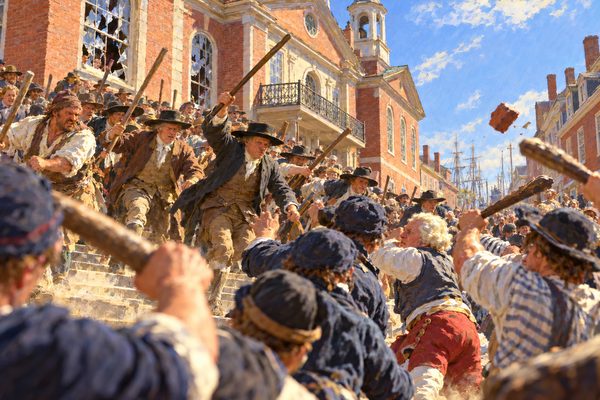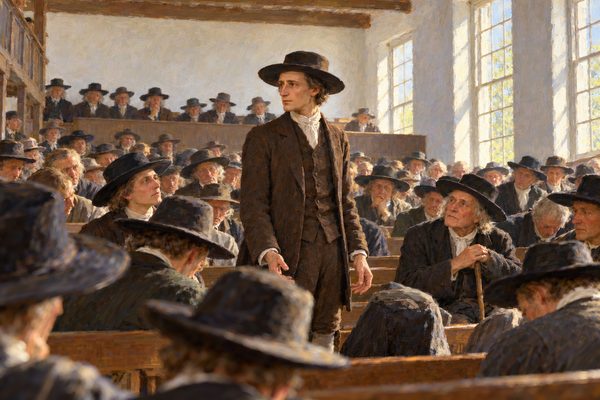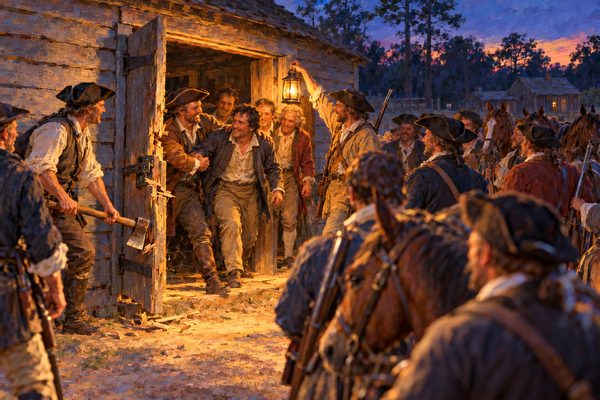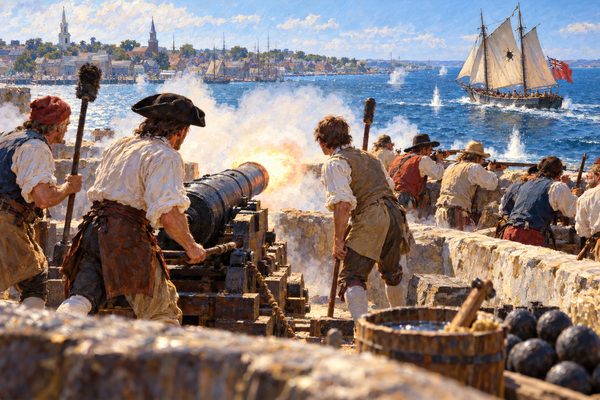
The Liberty Archive FREECAPITALISTS.ORG
Companion menu

All scenes

Browse selected scenes across all volumes. Chapter order follows the book; timeline order follows the event dates. This collection is not an exhaustive chronology.


Views and filters

140 scenes

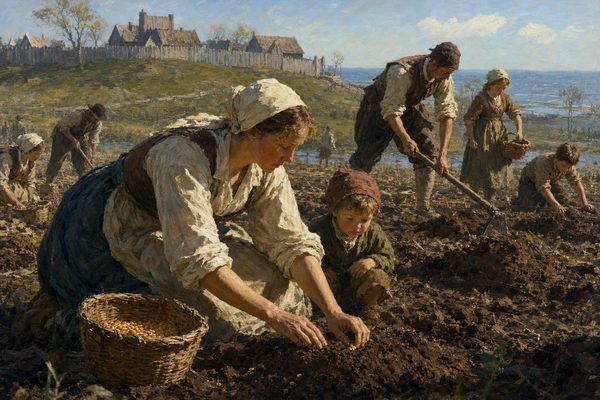
A woman in a white cap and rolled sleeves crouches in freshly turned earth, pressing seed into a mound while a small child watches. Other families work separate plots behind them, below a palisaded hill.

1623, planting season · Volume I

A plot of their own

The Founding of Plymouth Colony

The family corn plots on the south side of Town Brook, below the palisaded town, Plymouth, Massachusetts

By 1623 Plymouth had spent its first years farming a common field for the London company that financed the voyage, and it had spent them hungry.

Read chapter 18
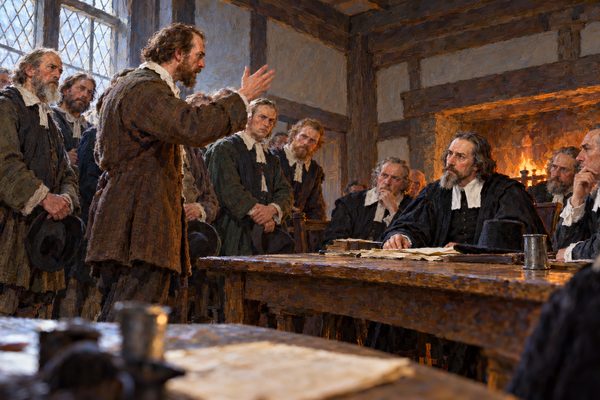
In a plain timber room, a farmer in a brown coat raises one hand in argument at the end of a table, facing a grave man in black seated behind it with other magistrates, while his neighbors stand behind him.

17 February 1632 · Volume I

Watertown will not pay

Watertown challenges a tax levy

Watertown and Boston, Massachusetts Bay

Watertown challenges a levy imposed without its own representatives deciding.

Read chapter 19
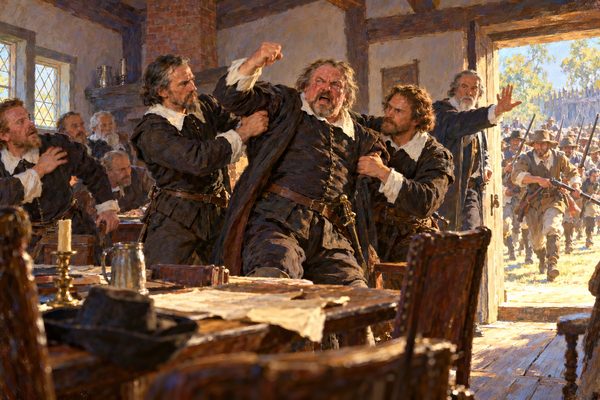
In a timber-beamed room, two men in dark doublets grip the arms of a red-faced, shouting man with a raised fist, while another man stands in a sunlit doorway with his hand up and armed men run toward the house behind him.

28 April 1635 · Volume I

And we you, for treason

The Royal Government of Virginia

The Governor's house at Jamestown, Virginia, where the Council sat

By 1635 Virginia’s royal governor, Sir John Harvey, had taxed tobacco exports, charged fees on immigrants, jailed his critics and taken Lord Baltimore’s side against Virginia’s own William Claiborne.

Read chapter 8
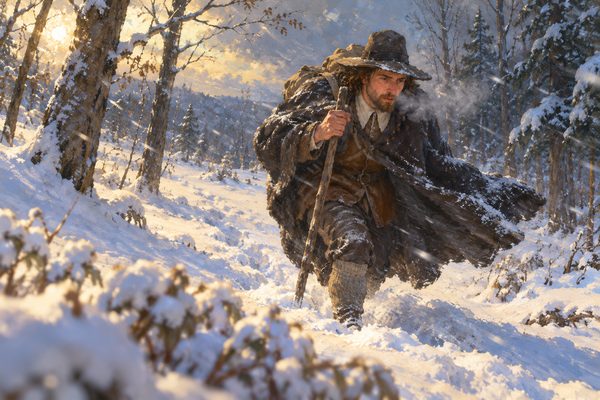
A lone man in a heavy dark cloak and wide hat leans into a snowstorm, trudging knee-deep through bare winter woods with a staff, a line of his footprints trailing behind him.

January 1636 · Volume I

The sources establish January 1636, not the exact day of departure.

Gone three days before

Roger Williams flees Massachusetts Bay

South of Salem, Massachusetts Bay

A dispute over religious authority drives Roger Williams out of Massachusetts Bay.

Read chapter 21
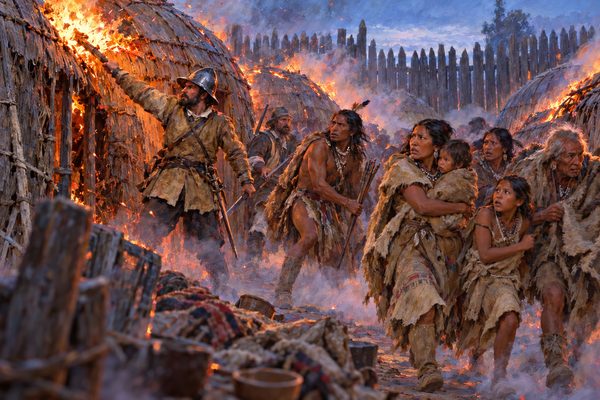
In a narrow lane of mat-covered wigwams, a helmeted soldier holds a burning brand to a roof as flames and smoke spread, while Pequot men, women and children move away, looking back at the fire.

Friday, 26 May 1637 (Old Style), at first light · Volume I

A joint slaughter

Joint Action in New England: The Pequot War

The Pequot fort at Mystic (Mistick), on a hilltop above the Mystic River, now Groton, Connecticut

Rothbard’s opening charge: New England’s “first exercise in united action came in a joint slaughter of Indians” (p.

Content note: The narrative describes mass killing of Pequot men, women, and children, burning of their settlement, and enslavement of survivors.

Read chapter 27
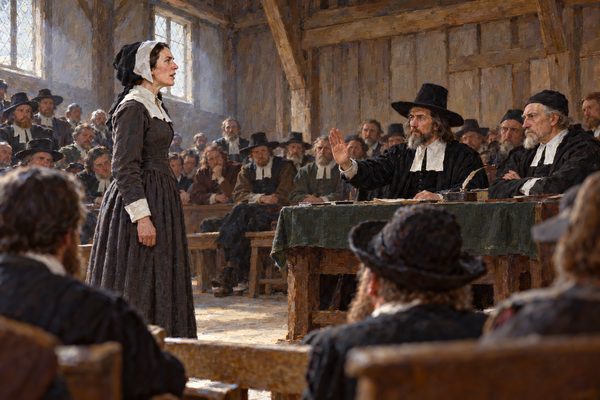
A pale woman in a dark gown and white coif stands alone on a plank floor before a grave man in black who raises a hand to silence her, while rows of seated men in black watch from the benches.

8 November 1637 · Volume I

The court knows wherefore

Anne Hutchinson before the General Court

Newtown, Massachusetts Bay

Anne Hutchinson confronts a court that combines lawmaking and judicial power.

Read chapter 22
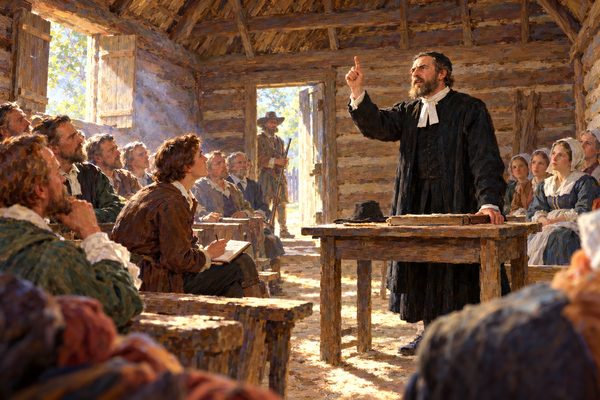
A man in black stands at a plain wooden table in a small log meeting room, one hand raised, while townspeople sit on rough benches and a young man writes in a notebook, in shafts of daylight.

Thursday, 31 May 1638 (Old Style) · Volume I

Authority by free consent

The Planting of Connecticut

The first meetinghouse of Hartford, Connecticut

On Thursday 31 May 1638 Thomas Hooker, minister of the river town of Hartford, gave his midweek lecture on a verse from Deuteronomy about choosing wise men to be rulers.

Read chapter 25
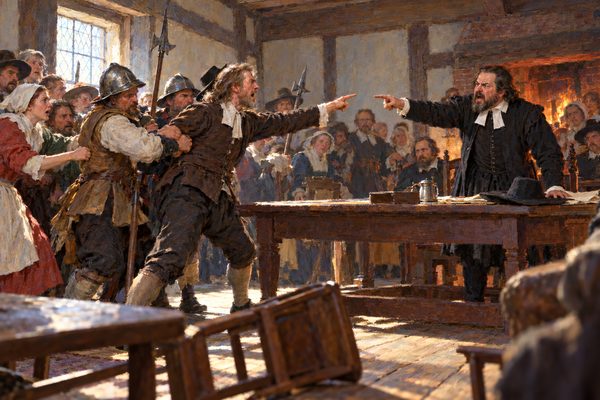
Two men shout and point at each other across a heavy table in a timber-framed room, while guards grip the arms of one and townspeople crowd around, a tipped stool in the foreground.

1640 · Volume I

The accounts differ between August and the end of 1640; only the year is asserted here.

Lay hold on Coddington

The Further Settlement of Rhode Island: The Odyssey of Samuell Gorton

The court of Portsmouth on Aquidneck Island, Rhode Island

Samuell Gorton had already been driven out of Plymouth for standing up for a servant against the magistrates, and by 1640 he was at Portsmouth on Aquidneck.

Content note: The narrative describes Gorton being whipped and his supporter being put in the stocks.

Read chapter 23
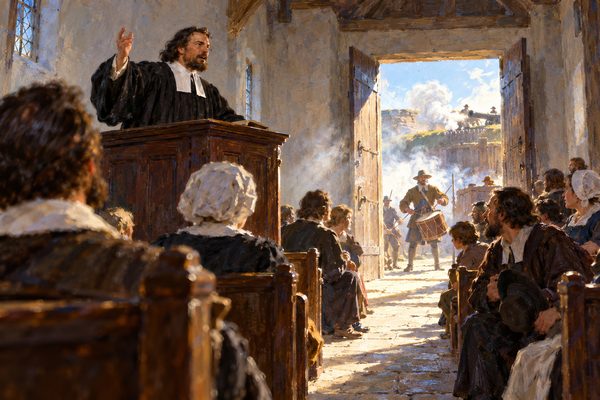
Inside a plain stone church, a dark-gowned minister at a wooden pulpit raises a hand while worshippers turn to the bright open doors, where a soldier beats a drum in drifting smoke.

mid-1640s (exact year unrecorded) · Volume I

The noise is undated within the mid-1640s; no exact year is recorded for the incident.

He would not be silenced

Governors and Government

The stone church inside Fort Amsterdam, New Amsterdam

Domine Everardus Bogardus, the Dutch Reformed minister of New Amsterdam, had denounced Director Willem Kieft from the pulpit as a plunderer whose whole art of government was to dismiss, to banish and to ship men off to Holland.

Read chapter 39
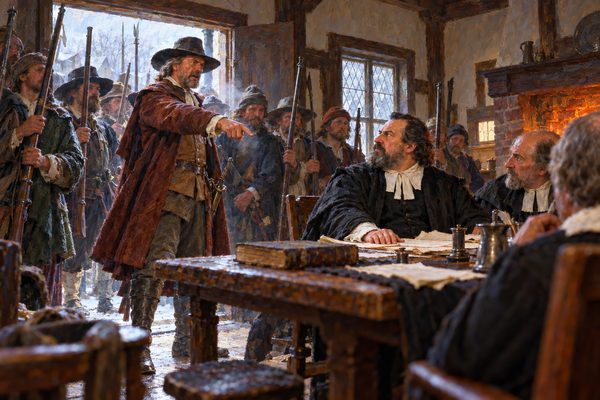
In a small timber-framed room, a man in a doorway points at three seated magistrates behind a table, while armed men with muskets and pikes crowd in behind him in cold grey light.

early 1652 (about February) · Volume I

Early 1652 is supported; February is approximate and no exact day is recorded.

Governor for life, briefly

Rhode Island in the 1650s: Roger Williams’ Shift from Liberty

Coddington's town house in Newport, Aquidneck (Rhode Island)

In 1651 William Coddington came back from England with a commission from the Council of State that made him governor of Aquidneck for life.

Content note: The narrative describes the crowd hanging Coddington’s aide Captain Partridge.

Read chapter 24
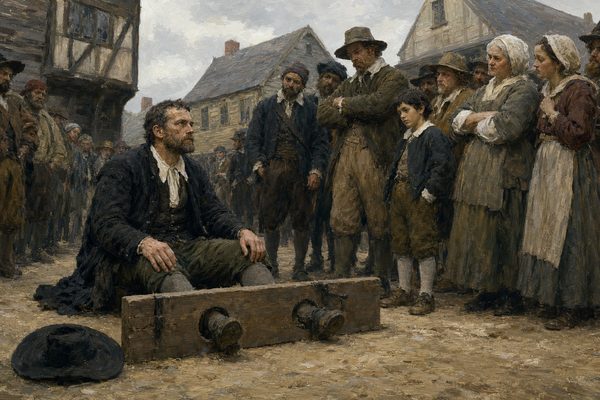
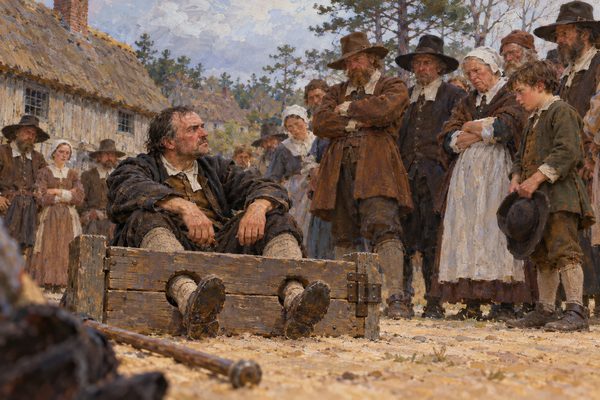
A bareheaded man in a plain dark coat sits on the dirt street with his ankles locked in wooden stocks, looking calmly up at a half circle of townspeople in wool clothes before timber-framed houses.

1656, the day unrecorded · Volume I

The year and place are disputed secondary retellings: this reconstruction follows 1656 in Boston, while another account gives 1653 in Charlestown; no primary record was found.

Two hours for a kiss

The Puritans Purify: Theocracy in Massachusetts

A public street in Boston, Massachusetts Bay

Rothbard describes the Puritan Sunday in Massachusetts: work, travel and levity were outlawed, and “kissing one’s wife in public on a Sunday was also outlawed” (CiL, p.

Read chapter 20
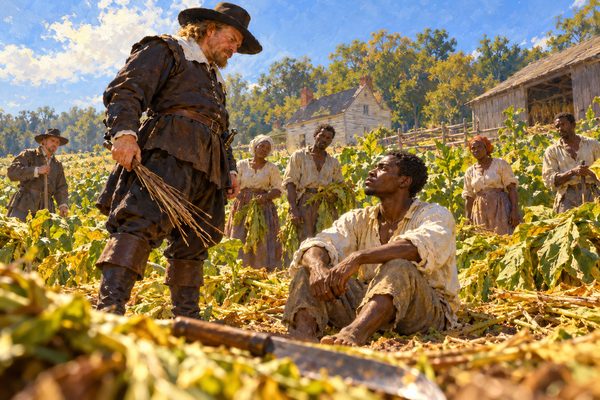
A young Black man in a plain linen shirt sits upright on the ground among cut tobacco plants, looking steadily up at a white man in dark clothes and a broad hat who stands over him with a switch, while field workers watch from the rows.

20 September 1656 · Volume I

Tony will not rise

Maryland

Symon Overzee's plantation at St. John's, St. Mary's County, Maryland, outside St. Mary's City

Tony had run from Symon Overzee’s plantation at St.

Content note: The narrative describes an enslaved man beaten, restrained, and killed by his enslaver.

Read chapter 12
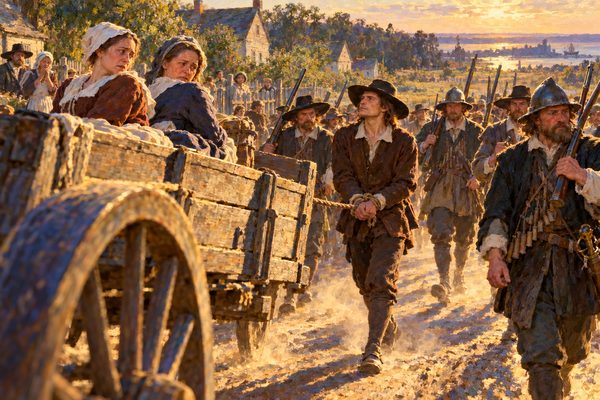
A young bearded man in a plain dark coat and broad hat walks bound behind a cart on a dusty road, two women in the cart looking back at him, musketeers marching on both sides in low sun.

August 1657 · Volume I

Dragged at the cart’s tail

New Netherland Persecutes the Quakers

The road out of Hempstead, Long Island, toward New Amsterdam

In August 1657 Robert Hodgson, a young English Quaker, landed at New Amsterdam and went out among the English towns of Long Island to preach.

Content note: The narrative describes Hodgson being restrained, dragged behind a cart, beaten, and whipped for his religious preaching.

Read chapter 41
A bareheaded man sits on sandy ground with his ankles locked in wooden stocks, glaring up at a half circle of townspeople in plain wool clothes before a small thatched town house.

after 1 June 1658, during Barlow's term as marshal of Sandwich (the day is unrecorded) · Volume I

The incident has no recorded day; the sources place Barlow’s term and the resistance in 1658–61.

The town stocks its marshal

The Decline and the Rigors of Plymouth

The town stocks in Sandwich, Plymouth Colony (Cape Cod), beside the town house

In June 1658 Plymouth Colony made George Barlow constable of Sandwich and special marshal for the Cape towns, and paid him on commission for the heretics he found.

Read chapter 36
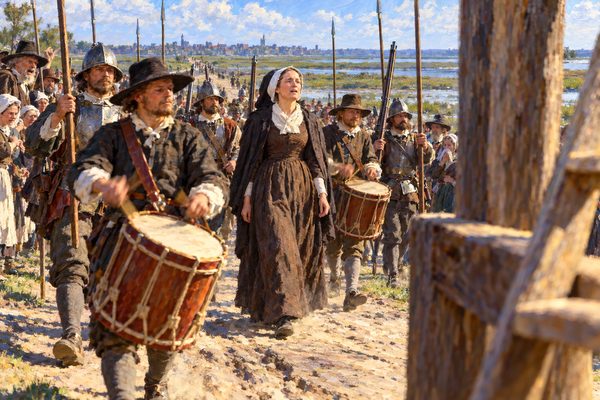
A calm woman in a plain brown dress and white linen cap walks up a dusty marsh road between two drummers and soldiers carrying tall pikes, toward the blurred timber post of a gallows at the right edge of the picture.

1 June 1660 · Volume I

That none might hear her speak

Suppressing Heresy: Massachusetts Persecutes the Quakers

The road to the gallows on Boston Neck, Boston

Mary Dyer had been banished from Massachusetts on pain of death for being a Quaker.

Content note: The narrative describes Mary Dyer and other Quakers being hanged for their religious dissent.

Read chapter 29
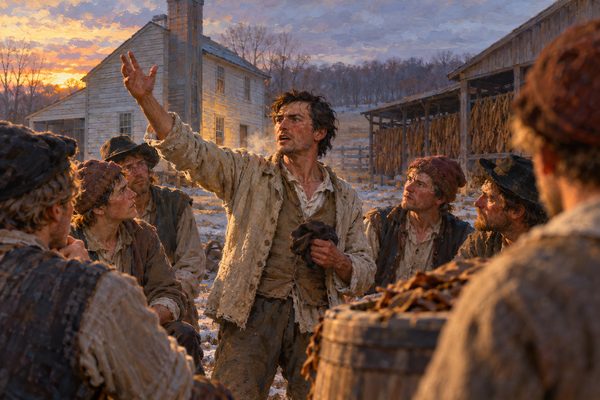
A lean man in a rough canvas coat raises one arm in a cold farmyard at dusk, speaking to a ring of poorly dressed men who watch him closely, with a wooden farmhouse and barn behind them.

around New Year 1661, before 6 January 1661 · Volume I

The conversation is undated; it occurred before the depositions taken on 6 January 1661, not on a verified New Year’s Day.

Who will be for liberty?

The Social Structure of Virginia: Bondservants and Slaves

Major James Goodwin's house and yard among the servants, York County, Virginia

In the winter of 1660-61 the servants on Major James Goodwin’s plantation in York County, Virginia, were fed corn and water and reckoned they were owed meat three times a week.

Content note: The narrative describes indentured servitude and the execution of leaders of a later servant plot.

Read chapter 6
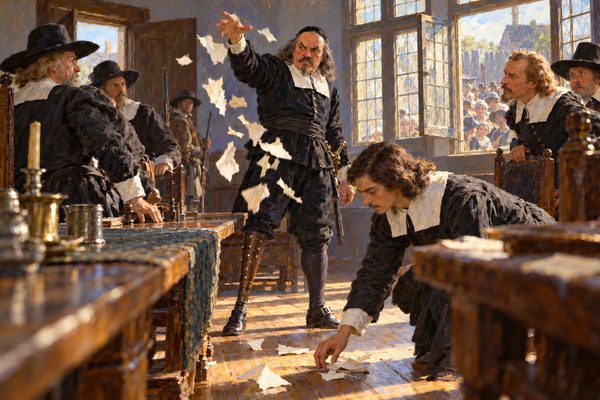
In a plain council room, a stern man in black with a wooden leg flings torn paper to the floor while burgomasters draw back and a young man stoops to gather the scraps.

2 September 1664 · Volume I

Torn to bits, read anyway

The Fall and Breakup of New Netherland

Fort Amsterdam, New Amsterdam

At the end of August 1664 an English fleet carrying a thousand men anchored off New Amsterdam, against Stuyvesant’s 150 soldiers and 250 citizens under arms, and Colonel Richard Nicolls demanded the town.

Read chapter 42
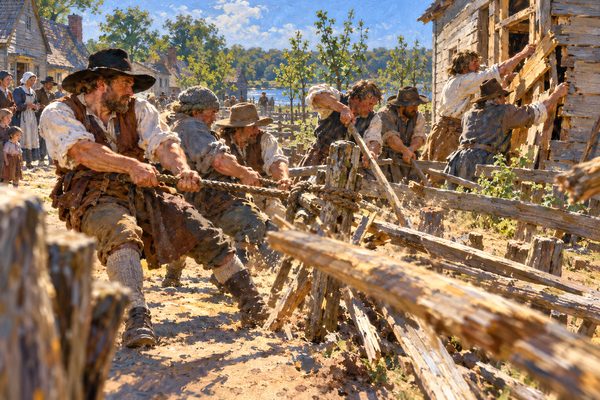
In a sunlit dirt lane, eight townsmen in plain wool and broad hats haul on a rope and pry with poles, tearing a split-rail fence apart as rails fly, while two rip boards from a new house behind.

1671 · Volume I

The sources establish 1671, without a recorded month or day.

Not the governor’s to give

The Northern Colonies, 1666-1675

A town lot at Elizabethtown, East Jersey

Elizabethtown was settled by New Englanders on a grant from Governor Nicolls, and its people ran their affairs through a town meeting, as they had at home.

Read chapter 43
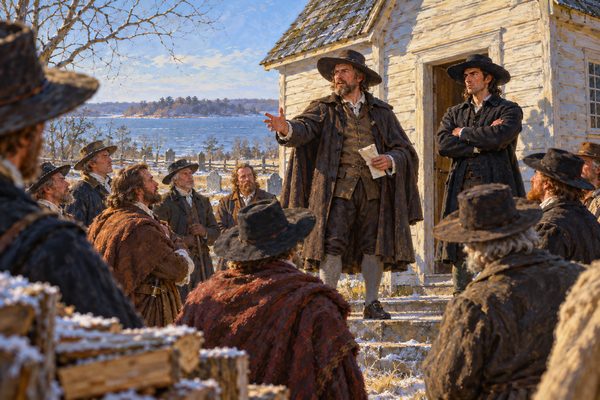
A broad-shouldered man in a dark coat and wide hat stands on the step of a small wooden church and speaks to a half circle of men in winter cloaks on frosty ground, with a wide river behind them.

12 December 1673 · Volume I

We will pay no more

British Mercantilism over Virginia

Lawnes Creek Parish Church and its churchyard, Surry County, Virginia, on the south side of the James River

By 1673 Governor Berkeley’s clique ran Virginia’s county courts.

Read chapter 9
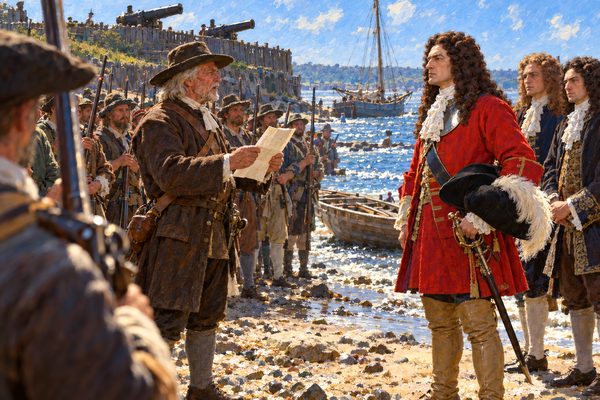
A gray-haired officer in a plain brown coat reads from a paper to a tall, wigged gentleman in a red coat on a shingle beach, with soldiers holding muskets behind him and a small fort and ship beyond.

13 July 1675 · Volume I

His bluff called at Saybrook

King Philip’s War

The shore below the fort on Saybrook Point, at the mouth of the Connecticut River

King Philip’s War had just broken out in the summer of 1675 when Sir Edmund Andros, the Duke of York’s governor at New York, sailed for the Connecticut River with two small vessels to claim everything west of it for the duke.

Read chapter 46
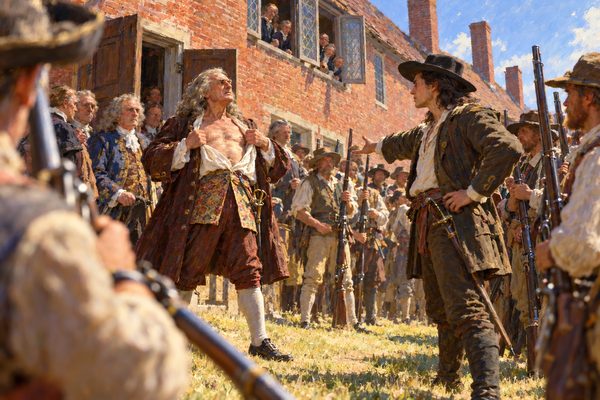
An old man in a long coat pulls his shirt open before a young man flanked by men with long guns, outside a brick statehouse whose upper window is crowded with faces.

23 June 1676 · Volume I

Commission at gunpoint

Bacon’s Rebellion

Before the statehouse door, Jamestown, Virginia

On 23 June 1676 Nathaniel Bacon, twenty-nine years old, marched about five hundred armed volunteers into Jamestown while the Assembly was sitting and drew them up before the statehouse door.

Read chapter 11
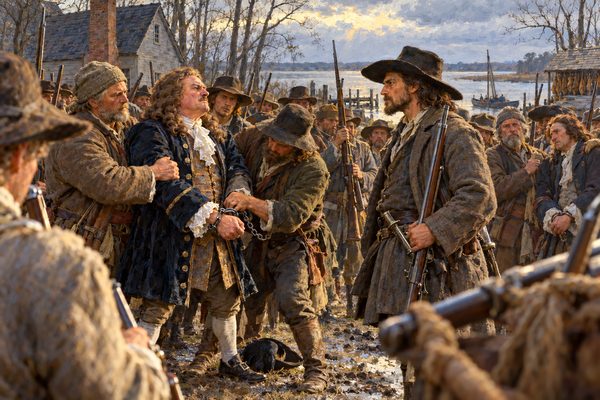
A well-dressed man in a long wig is held by the arms by rough planters as iron manacles are closed on his wrists, while a weathered man in a broad hat watches him and armed men crowd the yard of a wooden house beside a wide river.

4 December 1677 · Volume I

Clapped in irons

The Aftermath of Bacon’s Rebellion in the Other Southern Colonies

Albemarle County in Carolina, on the Pasquotank River (present-day Pasquotank County, North Carolina)

Thomas Miller came to Albemarle in 1677 as the proprietors’ collector and acting governor and set about enforcing the tobacco tax the settlers hated, raising quitrents and putting prices on the heads of the province’s leaders.

Read chapter 14
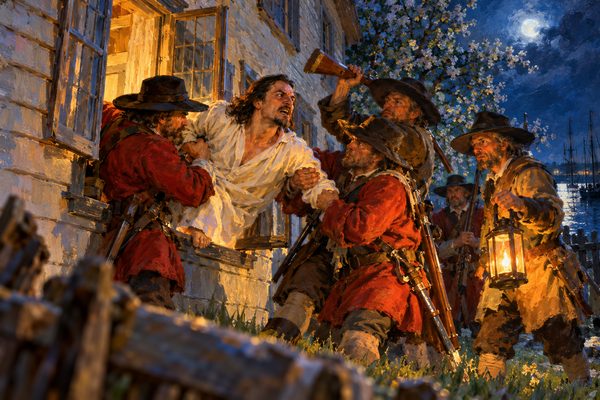
At night in a lantern’s glow, soldiers in coats and broad hats drag a barefoot man in a white nightshirt out through a house window while one raises a musket butt.

30 April 1680 · Volume I

Dragged through the window

Turmoil in East New Jersey, 1678-1686

Carteret's country house at Elizabethtown, East Jersey

In the spring of 1680 Sir Edmund Andros, governor of New York for the Duke of York, claimed East Jersey and ordered Governor Philip Carteret to stop governing it.

Read chapter 53
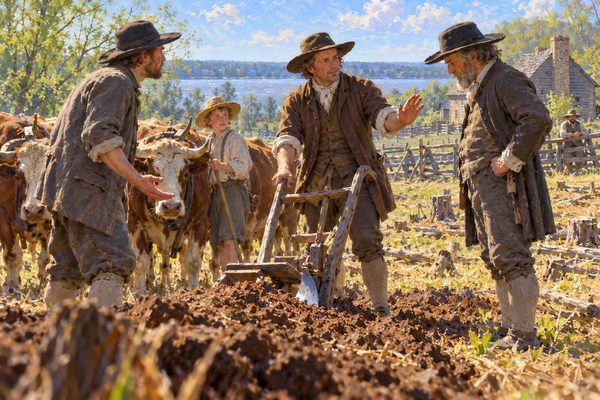
A farmer in a plain broad hat stands at his plow behind halted oxen, one hand raised, between two neighbors who face him in a stump-dotted spring field beside a plank farmhouse.

1680 · Volume I

No day or season is recorded for this mediation; spring plowing is an artistic choice within 1680.

Justice at the plow

The Development of West New Jersey

A plowed field on a farm in the Quaker settlements of West New Jersey, near Burlington on the Delaware

Thomas Olive came to West Jersey from Wellingborough in England as one of the Quaker proprietors, sat as a justice of the provincial court at Burlington, and later served as Speaker of the Assembly and deputy governor.

Read chapter 54
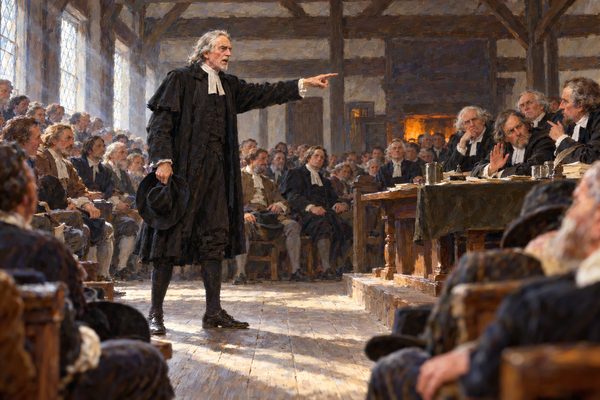
A tall old man in black stands alone on a plank floor, arm outstretched, speaking to rows of seated men in dark coats in a plain timber room lit by small grey windows; some wave him down and some glare.

February–March 1682 · Volume I

Danforth’s speech has no recorded day; it belongs to the February–March 1682 court session.

Danforth calls it treason

Edward Randolph versus Massachusetts, 1680-1684

The General Court's chamber in the Town House, Boston

In February 1682 the General Court of Massachusetts heard a letter from Charles II read aloud, carried over by Edward Randolph, the customs collector.

Read chapter 49
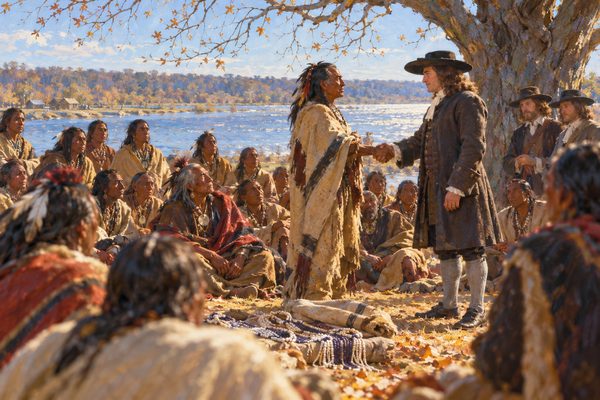
A man in a plain dark coat and broad-brimmed hat clasps the hand of a standing Lenape speaker before a half-circle of seated Lenape elders in woven mantles, beneath a great bare elm above a wide river.

November 1682 (the traditional date of the treaty of friendship at Shackamaxon) · Volume I

November 1682 is the traditional treaty date, not an established date from a surviving contemporary record.

Peace under the elm

“The Holy Experiment”: The Founding of Pennsylvania, 1681-1690

Shackamaxon, on the west bank of the Delaware above Philadelphia (now Kensington and Fishtown)

William Penn landed in his new province in late October 1682, and Rothbard writes that in November he concluded the first of several treaties of peace and friendship with the Delaware Indians at Shackamaxon, near Philadelphia.

Read chapter 55
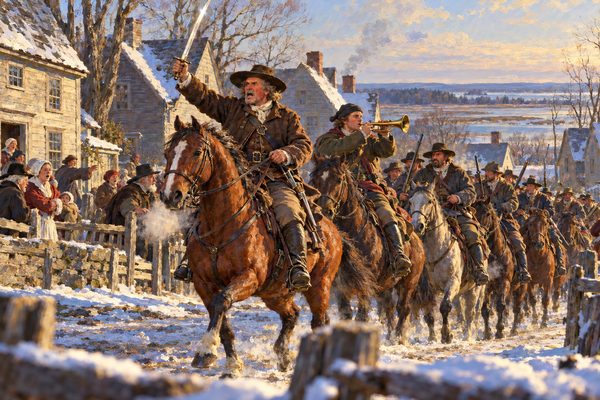
A heavy man in a brown winter coat and broad-brimmed hat rides a bay horse down a village street, sword raised, with a trumpeter at his side and armed riders behind, while villagers watch from their doors.

27 January 1683 · Volume I

Sword drawn, trumpet sounding

The Crown Takes Over New Hampshire, 1680-1685

The road into the village of Hampton, New Hampshire

Edward Cranfield arrived in October 1682 as New Hampshire’s first royal governor and set about ruling by decree.

Read chapter 48
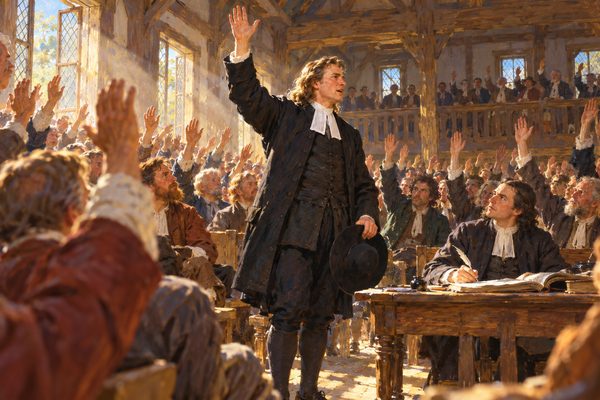
A very tall man in a black coat stands in the aisle of a plain timber hall with one arm raised, while rows of farmers on benches lift their hands, and a clerk at a table looks up from his quill.

23 August 1687 · Volume I

Stand for our privileges

Ipswich refuses a tax commissioner

Ipswich, Dominion of New England

A town withholds the commissioner needed to administer a disputed tax.

Read chapter 56
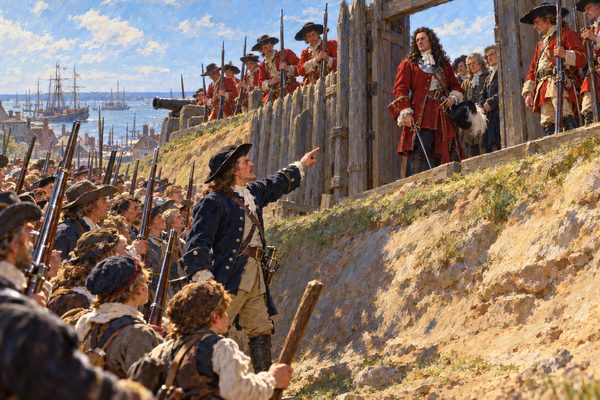
A young man in a dark coat points up an earth bank at a periwigged governor in red at a gate, with a crowd of armed townsmen behind him and red-coated soldiers standing with grounded muskets on the top.

18 April 1689 · Volume I

The fort and the governor

The Glorious Revolution in the Northern Colonies, 1689

Fort Hill, at the South End of Boston: the earth and timber battery called the Sconce

On Thursday 18 April 1689 Boston rose against Governor Sir Edmund Andros and the Dominion of New England.

Read chapter 57
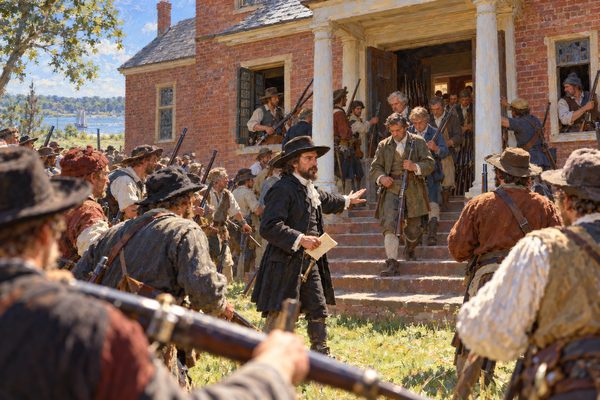
A lean man in a plain dark coat stands on the grass with a folded paper, before a two-storey brick building, as men with long guns crowd its door and window and other armed men file out.

27 July 1689 · Volume I

Marched up resolutely

The Glorious Revolution and its Aftermath

Before the State House at St. Mary's City, Maryland, the colony's capital

In the summer of 1689 Maryland learned that William and Mary had taken the English throne, and rumors spread that the Catholic proprietor’s deputy governors were arming the State House at St.

Read chapter 15
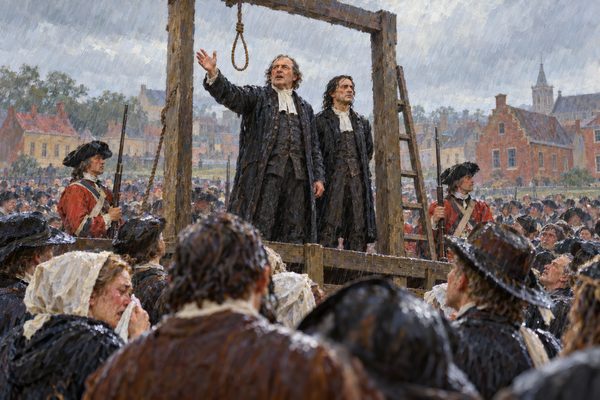
Two men in dark wet coats stand bareheaded on a plank scaffold in the rain, one with a hand raised, before a packed crowd of weeping townspeople, under a timber gallows from which a single empty noose hangs.

16 May 1691 · Volume I

Hanged in his own garden

The Glorious Revolution in the Northern Colonies, 1690-1692

the gallows on the northern edge of New York town, in Leisler's own garden on the Commons (near present Park Row and Spruce Street)

Rothbard tells Jacob Leisler’s story without flattery.

Content note: The narrative describes Jacob Leisler and Jacob Milborne being hanged and then beheaded.

Read chapter 58
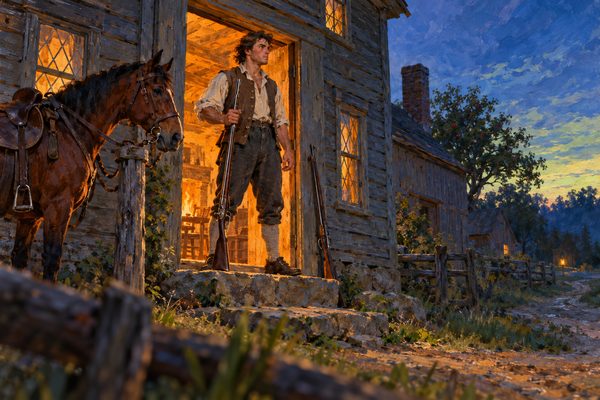
A young farmer in shirtsleeves and a waistcoat stands in the firelit doorway of a clapboard farmhouse at dusk, a musket upright at his side, looking down an empty lane while a saddled horse waits at the post.

1692 · Volume I

Come at your own peril

Aftermath of the 1690s: The Salem Witch Hunt and Stoughton’s Rise to Power

The Putnam farmhouse in Salem Village, Massachusetts (now Danvers)

The Salem witch-hunt of 1692 was not a mob.

Read chapter 59
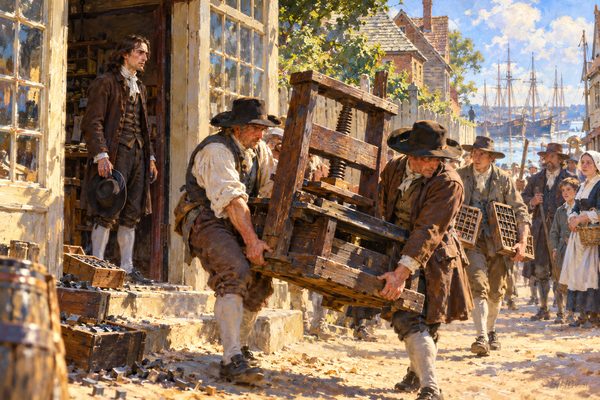
A young man in a plain brown coat stands on a shop doorstep in a sunlit street of brick and timber houses, watching officers carry a heavy wooden printing press and cases of type down the steps.

summer 1692, before the proclamation against Keith at the end of August · Volume I

The press seizure has no recorded day or month in the sources used here; the narrative places it in summer 1692 before the end-of-August proclamation.

Philadelphia’s only press, seized

William Bradford’s printing press is seized

Philadelphia, Pennsylvania

A religious dispute becomes a struggle over the tools of public expression.

Read chapter 64
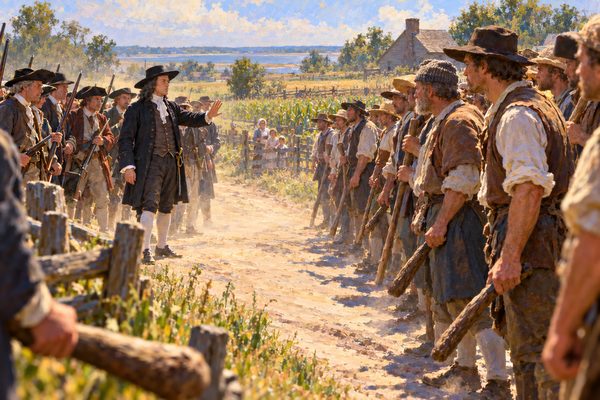
Farmers in wool coats and broad hats stand across a sandy country road holding clubs at rest, facing a governor in a periwig and his halted posse, under a hazy summer sky with fenced fields behind.

late July 1700, after the assault on Sheriff Stewart on 17 July and before 30 July · Volume I

The sources bracket the march after 17 July and before 30 July 1700 without giving a day.

A hundred men with clubs

The Unification of the Jerseys

the road into Middletown village, Monmouth County, East New Jersey

East Jersey’s towns had refused Governor Jeremiah Basse’s sharp new taxes in 1699, and by the summer of 1700 they were shutting the proprietors’ courts, jostling their judges and freeing their prisoners.

Read chapter 63
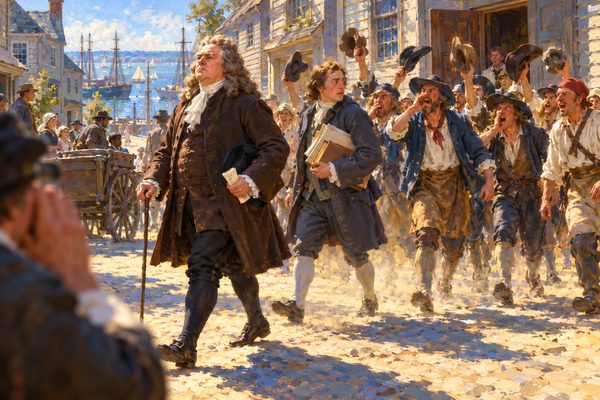
A stout man in a long wig and brown coat walks stiffly down a dusty street with a clerk, while a crowd of workmen behind him hoots and waves their hats, with a harbor and ship masts at the end of the street.

27 June 1705 · Volume I

Hooted down the street

Rhode Island and Connecticut after the Glorious Revolution

A street in Newport, Rhode Island, just outside the room where the Court of Admiralty sat

In June 1705 a Rhode Island privateer, Captain John Halsey’s brigantine Charles, brought a prize into Newport under a commission from Governor Samuel Cranston.

Read chapter 62
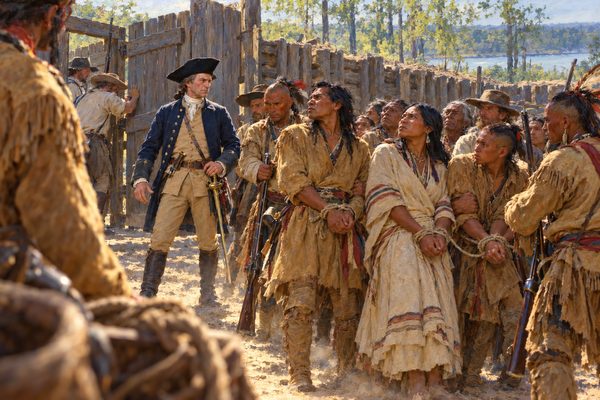
Inside a log fort’s gate, armed men bind the wrists of a group of Indian men and women while a coated officer with a sword stands watching; the captives look back at him, steady and angry, in soft spring light.

spring 1712, after the peace made at Hancock's Fort on 17 April · Volume II

Peace was the bait

Indian War in North Carolina

Fort Barnwell, the new log fort on the Neuse River at the abandoned Indian village of Core Town, in the New Bern country of North Carolina

In January 1712 Colonel John Barnwell marched from South Carolina to help North Carolina against the Tuscarora, leading about thirty white officers and some five hundred Indian allies, most of them Yamasee.

Content note: The narrative describes Native people captured under a pretense of peace and taken away to be sold into slavery.

Read chapter 19
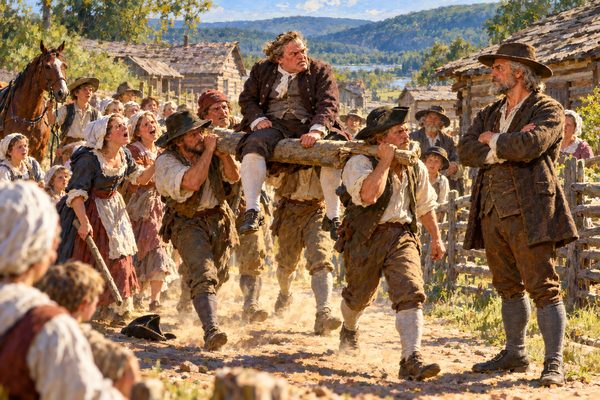
A red-faced man in a dark coat and askew wig sits astride a fence rail carried by four men through a dirt lane, glaring at a bearded farmer with folded arms, while women in caps follow and log cabins line the lane.

1715 · Volume II

Run out on a rail

New York Land Monopoly

Weiser's Dorf, the southernmost of the Palatine villages on the Schoharie Creek, New York

In 1713 the Palatine refugees, who had already been worked like servants by the Crown and by Robert Livingston, settled on the Schoharie and bought their land from the Mohawks.

Read chapter 7
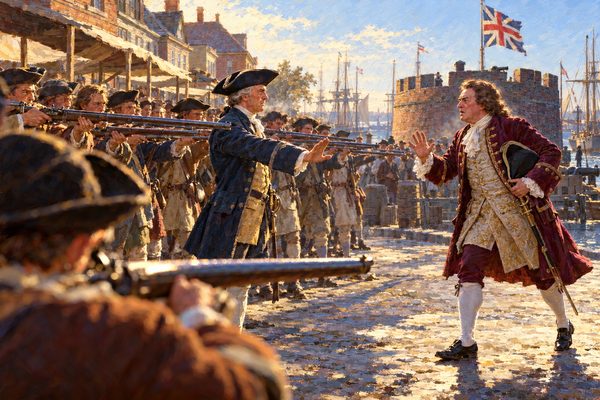
On a cold harbor-front street a line of townsmen in plain coats and hats levels muskets across the open ground at a periwigged governor, stopped mid-stride with one hand up, while a grey-wigged colonel holds out a flat palm.

21 December 1719 · Volume II

Muskets for the governor

Proprietary Rule in South Carolina

East Bay Street beside the town market, before the Half-Moon Battery on Charleston's harbor front

In November 1719 South Carolina’s militia was under arms against a feared Spanish attack, and its men used the muster to do something else.

Read chapter 23
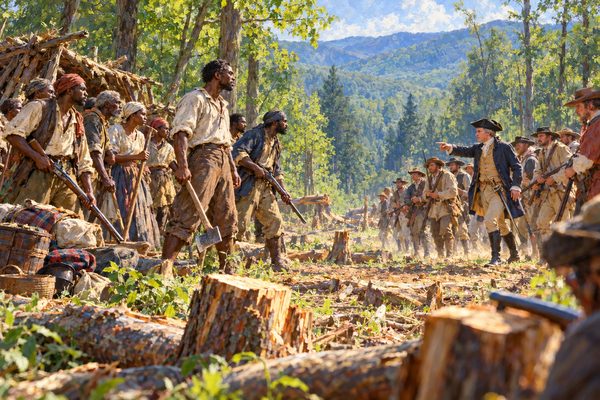
At the edge of a half-cleared mountain plot, a band of Black men and women in plain work clothes hold axes, hoes and two guns pointed down, facing armed white men who come out of the forest toward them in spring light.

1729 · Volume II

They cleared their own land

Slavery in Virginia

a clearing in a forested mountain hollow in the Blue Ridge, west of the James River plantation they fled

In 1729 a band of slaves left a new plantation on the James River and went west into the mountains.

Content note: The narrative describes escaped enslaved people recaptured after a fight and mentions whippings, slave patrols, and hangings.

Read chapter 18
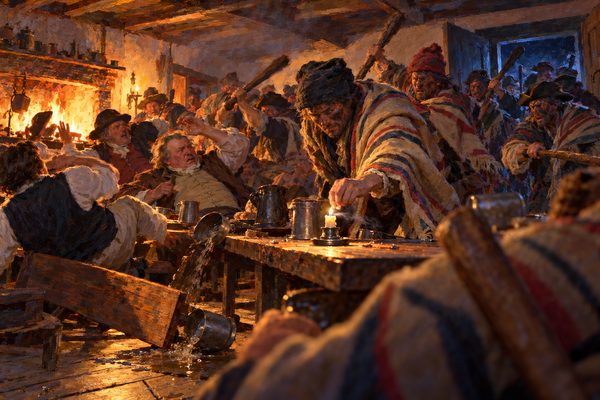
In a low, firelit taproom, men in blankets and caps with soot-smeared faces burst in with clubs on seated men at a long table, while one attacker pinches out the last candle.

23 April 1734 · Volume II

When the candles went out

Mercantilist Restrictions

the taproom of Gilman's tavern, a public house in Exeter village, on Water Street by the Squamscott River, New Hampshire

By 1734 New Hampshire’s loggers had been fighting the Crown’s claim to the white pines for a generation.

Read chapter 35
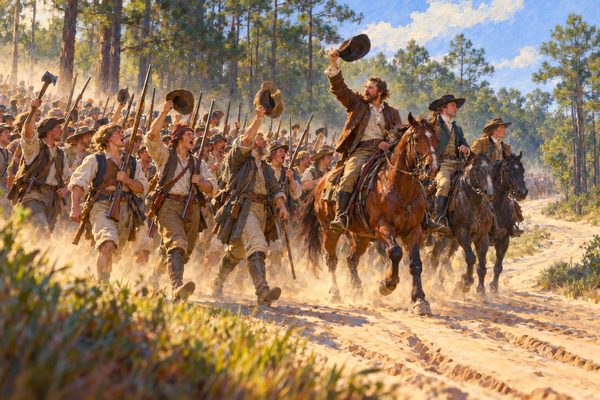
A dense column of farmers in linen shirts and wool coats marches along a sandy road through tall pines, guns on shoulders, hats raised, a rider at the head turning to shout back at them, dust rising in afternoon sun.

1737, in the months before Governor Johnston's letter of 6 October · Volume II

Five hundred marched for one man

Royal Government in North Carolina

the road toward Edenton in Chowan precinct, five miles short of the town, running through pine woods from Bertie and Edgecombe

Gabriel Johnston, royal governor of North Carolina, wanted the quitrents paid in sterling or in paper money valued by his Council, and he wanted the arrears as well.

Read chapter 21
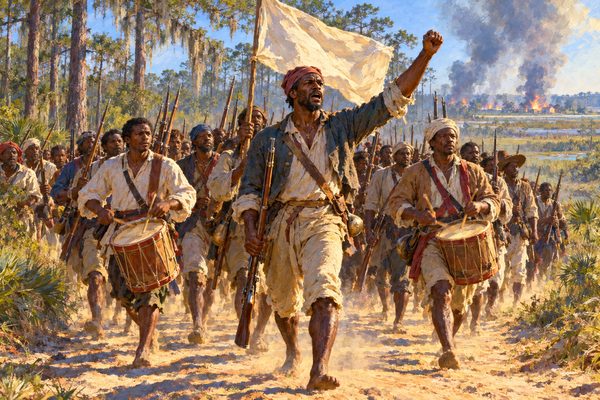
Along a sandy pine-lined road a column of enslaved men in plain shirts and caps marches toward the viewer behind a bareheaded leader, two drummers and a raised pale banner, muskets on shoulders, smoke rising far behind them.

9 September 1739 · Volume II

Drums beating, marching for liberty

Slavery in South Carolina

the Pon Pon road south of the Stono River, in the South Carolina Lowcountry about twenty miles southwest of Charleston

In Rothbard’s telling, “the especial brutality toward and the high concentration of slaves made South Carolina the focal point for slave rebellion” (p.

Content note: The narrative describes slavery, killings during the rebellion, and captured rebels being shot or hanged.

Read chapter 22
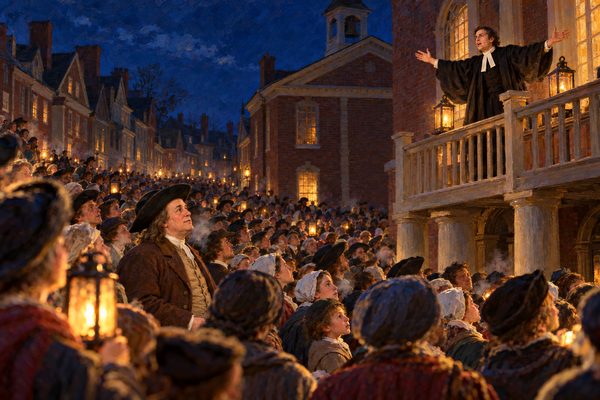
At night a young man in a black gown and white bands spreads his arms from a brick gallery, lit by lanterns, while a packed street of hatted men and women looks up in silence, a stout man in a plain coat among them.

8 November 1739 · Volume II

A voice for thirty thousand

The Great Awakening

the Court House in the middle of Market Street at Second Street, Philadelphia, preaching from the gallery over the crowd filling Market and Second Streets

George Whitefield landed in Philadelphia on a Friday night in early November 1739 and began preaching in the church.

Read chapter 29
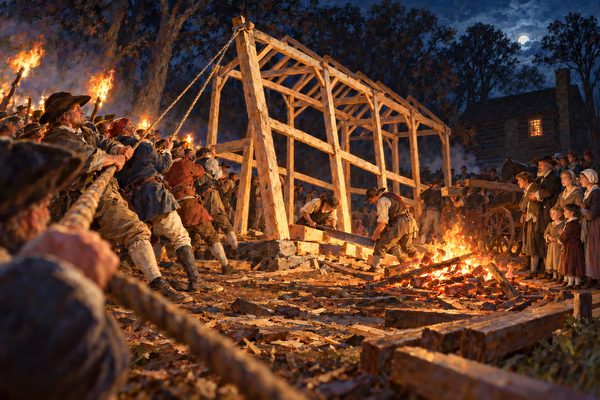
At night, townsmen haul on a rope to pull over the racked timber frame of a meetinghouse, while two men saw a beam and a small fire burns; a group of plainly dressed families watches at the edge of the firelight.

1740 · Volume II

The reconstruction follows 1740, but another historical account places the destruction in 1719; neither supplies a month.

Pulled down in the night

The Ulster Scots

Worcester, Massachusetts: the west side of Lincoln Street (the old Boston road), near the old garrison house and the stand of oaks

In 1718 several hundred Ulster Presbyterians landed at Boston and met a cold welcome.

Read chapter 10
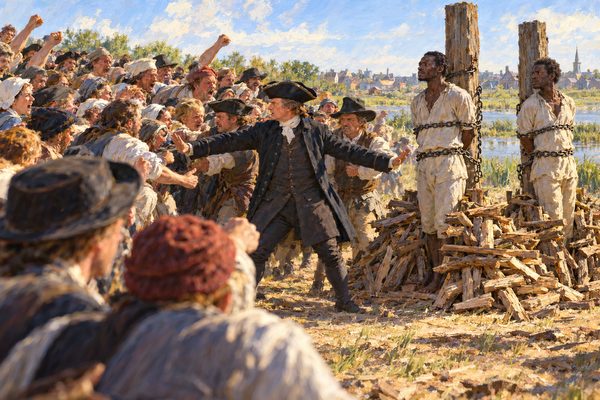
A sheriff with arms spread holds back a packed, shouting crowd in front of two tall stakes where two chained men stand upright, wood piled at their knees, on open ground under a spring sky.

30 May 1741 · Volume II

The crowd would not wait

Slavery in New York

the execution ground on the northern edge of New York town, by the Collect Pond, a little east of the gibbet by the Powder House

The winter of 1740-41 was hard in New York.

Content note: The narrative describes enslavement, confessions extracted by torture, burning people alive, and hangings.

Read chapter 8
Before a brick Court House in a sunlit street, broad-hatted Quakers and German farmers come down the steps with staves raised, driving back sailors in short jackets and knitted caps who swing clubs and give ground.

1 October 1742 · Volume II

Knock down the broad brims

Pennsylvania: Quakers and Indians

the steps of the Court House in the middle of Market Street at Second Street, Philadelphia

Philadelphia voted once a year, on 1 October, at the Court House in the middle of Market Street, and in 1742 rumor ran ahead of the day: the Quakers would bring unnaturalized Germans in from the country, and the governor’s friends would bring sailors.

Read chapter 12
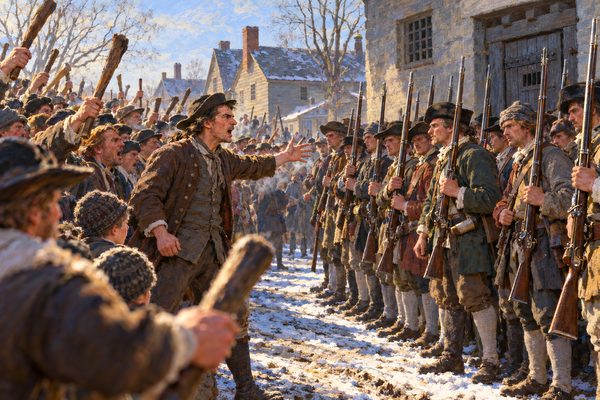
A lean farmer with one arm flung out leads a packed crowd with raised clubs across a frozen street toward a double rank of militia holding muskets upright before a plain jail, on a cold bright winter morning.

January 1746 · Volume II

January 1746 is the scene’s date; whether the militia confrontation occurred on the dated jail break-in of 16 January or a few days afterward is not established.

Fire and you die

Land Conflicts in New Jersey

the jail on Broad Street, by the courthouse, in Newark, Essex County, New Jersey

New Jersey’s land war began because dozens of owners claimed the same ground.

Read chapter 9
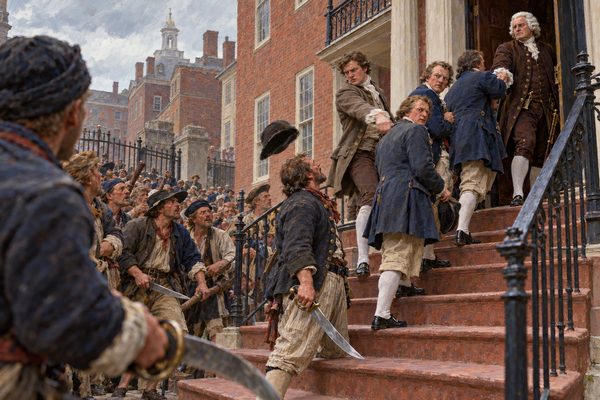
In a brick house’s courtyard a governor in a white wig stands on the top step at his door drawing in a naval officer, while below a seaman with a cutlass loses his hat to a blow and a crowd of armed seamen looks up.

17 November 1747 · Volume II

A cutlass at the governor’s door

King George’s War

the court yard and front door of the governor's house in Boston: the Province House, a three-story brick mansion on Marlborough Street

On the morning of 17 November 1747 the Royal Navy’s press gangs had taken almost fifty Boston laborers and dragged them to Commodore Knowles’s ships, and the town answered at once.

Read chapter 36
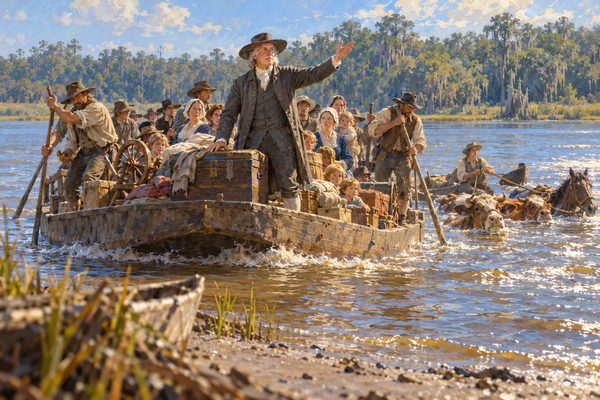
A wide river under a bright sky: a flat boat loaded with chests, tools and families is poled toward the viewer, a plain-dressed man in a broad hat standing at its bow, cattle swimming beside it and a boy in a dugout canoe.

April 1755 · Volume II

Into the land of no-government

Georgia: The “Humanitarian” Colony

a crossing of the Altamaha River in southern coastal Georgia, on the way south to the Satilla

Georgia’s first royal Assembly met in early 1755 over a fight Edmund Gray was losing.

Read chapter 25
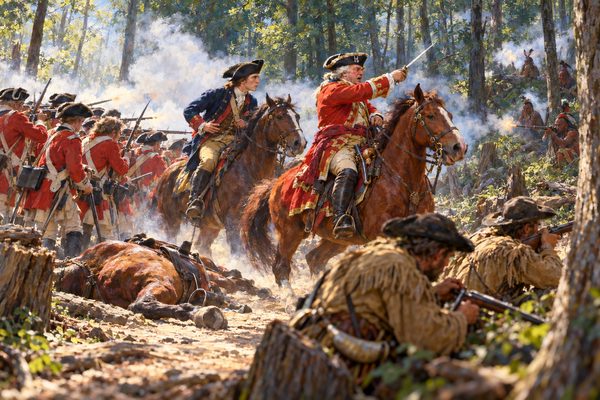
A stout general in a red coat and a young officer in dark blue sit their horses in a forest road among red-coated soldiers firing across it, with white smoke in the trees and a dead horse in the dust.

9 July 1755 · Volume II

The general rides into the smoke

Early Phases of the French and Indian War

the twelve-foot military road through the forest on the north side of the Monongahela, about seven miles short of Fort Duquesne, in western Pennsylvania

In the summer of 1755 General Edward Braddock led some twenty-five hundred men, in Rothbard’s count, out of Virginia toward Fort Duquesne, a road of his own cutting through the Allegheny forest.

Read chapter 37
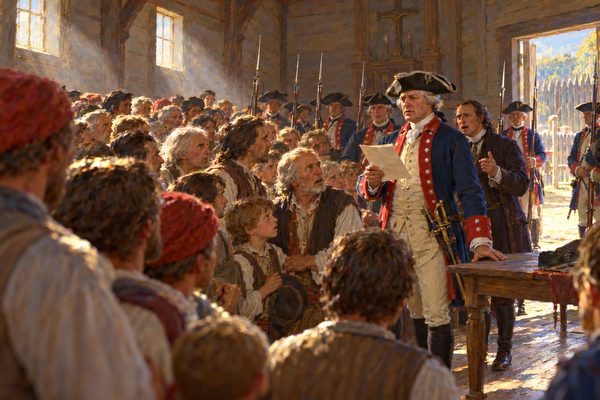
Packed Acadian men and boys in a plain timber church turn toward a blue-coated officer who stands among them reading from a paper, with soldiers holding bayonets upright along the wall and daylight through the open door.

Friday, 5 September 1755, at three o'clock in the afternoon · Volume II

Come and hear the King’s orders

The Persecution of the Acadians

inside the parish church of Saint-Charles-des-Mines at Grand-Pre, on the Minas Basin, Nova Scotia

On 2 September 1755 Lieutenant-Colonel John Winslow of Massachusetts posted a summons at Grand-Pré: every man and boy of the parish was to come to the church on Friday at three o’clock to hear what His Majesty had ordered.

Read chapter 38
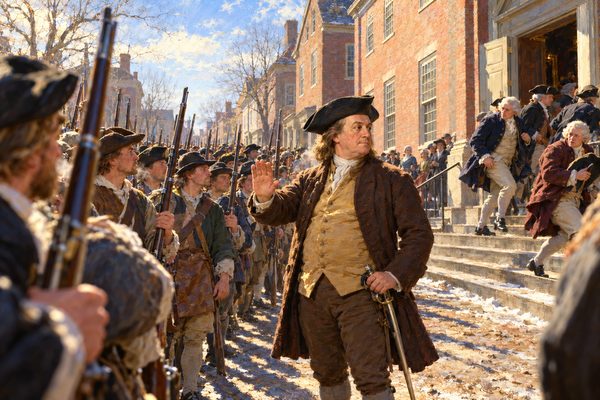
A stout man in a dark coat and cocked hat, one hand raised, halts a long column of militiamen in a cold street before a large plain building as gentlemen in wigs hurry down its steps and away.

28 February 1756 · Volume II

The colonel halts at the Academy

The Emergence of Benjamin Franklin

Fourth Street before the Academy's New Building at Fourth and Arch Streets, Philadelphia

Franklin drafted the militia act of November 1755 himself, and when Philadelphia’s men elected him their colonel, Governor Robert Hunter Morris signed his commission on 24 February 1756, reluctant, Leonard Labaree wrote, but unable to refuse a man so popular.

Read chapter 13
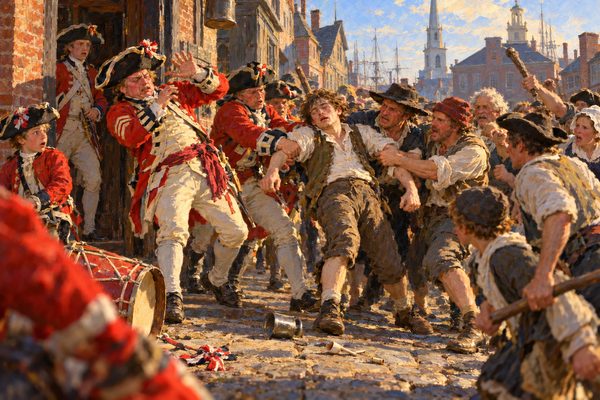
In a plain whitewashed meeting house, a slight man in a broad-brimmed hat stands up from a bench to speak while rows of hatted Quaker men around him sit bowed or turn to listen, light falling from tall windows.

September 1758 · Volume II

It is not a time for delay

The Quakers and the Abolition of Slavery

the meeting house of Friends at Burlington, New Jersey, where the Philadelphia Yearly Meeting sat in 1758

John Woolman had come to the yearly meeting of 1758 with a heavy heart.

Content note: The narrative discusses the oppression of enslaved people and efforts to persuade Quaker enslavers to free them.

Read chapter 31
At dusk, armed men in good coats and boots split open the heavy door of a small timber jail by lantern light while four freed prisoners step out; horses stand behind the ring of men.

14 May 1759 · Volume II

They broke their neighbors out

The North Carolina Proprietary

the jail at Enfield, in Halifax County, North Carolina (the Granville District)

Lord Carteret, now the Earl of Granville, held a huge block of northern North Carolina, more than half the province, and his agents charged excessive fees, demanded quitrents in coin and issued fraudulent deeds.

Read chapter 20
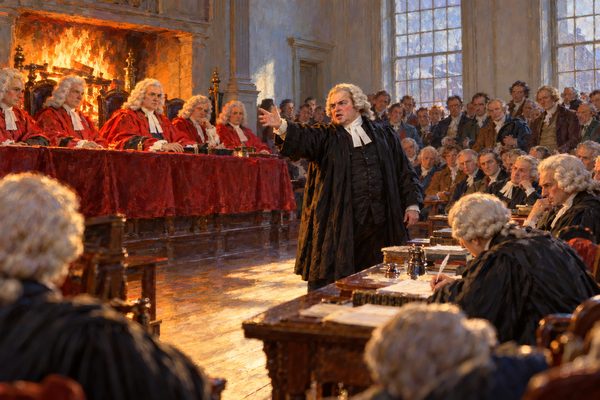
In a high panelled chamber lit by a great fire, a stout man in a black gown and white wig flings out one arm before five judges in scarlet robes and white wigs, while gowned barristers at a long table and a packed crowd watch.

24 February 1761 · Volume III

An act against equity is void

Writs of Assistance in Massachusetts

the Council Chamber of the Town House (now the Old State House), at the head of King Street, Boston

On 24 February 1761 the Massachusetts Superior Court sat in the Council Chamber of the Town House to decide whether customs officers could keep their general writs of assistance.

Read chapter 5
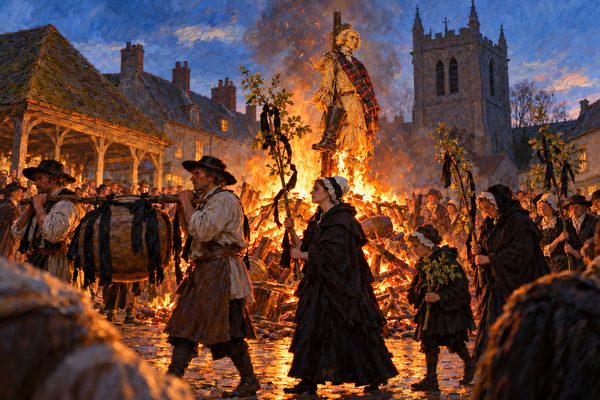
At dusk in a market square, townspeople in black carry an empty cider cask hung with crape and young apple trees round a roaring bonfire where a straw figure in a plaid burns on a post, a church tower behind.

spring 1763 · Volume III

Burying cider, burning Bute

The British Army and the Grand Design

the market square of a Devon cider-country town, before the parish church and a market house

In March 1763 Lord Bute’s government laid a tax on cider, and the tax collectors’ right to enter private homes made it the most hated in the land.

Read chapter 4
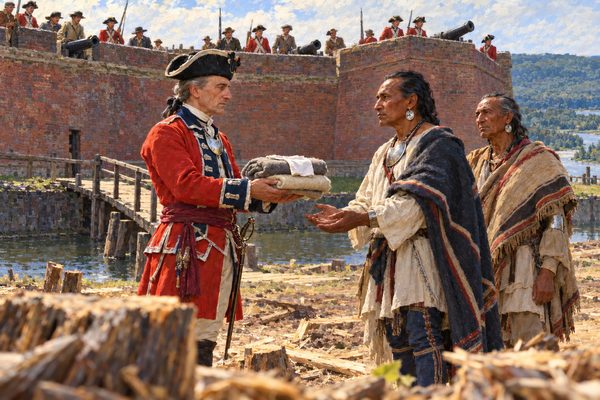
Before a brick-faced fort under a summer sky, a scarlet-coated officer holds out folded blankets in both hands to a Delaware man in a blanket and silver gorget, a second Delaware man beside him, soldiers watching from the rampart.

24 June 1763 · Volume III

A gift from the hospital

The Ohio Lands: Pontiac’s Rebellion

the open ground just outside Fort Pitt, before the brick-faced land front of the fort at the forks of the Ohio, western Pennsylvania

By late June 1763 Pontiac’s war had reached the forks of the Ohio.

Read chapter 2
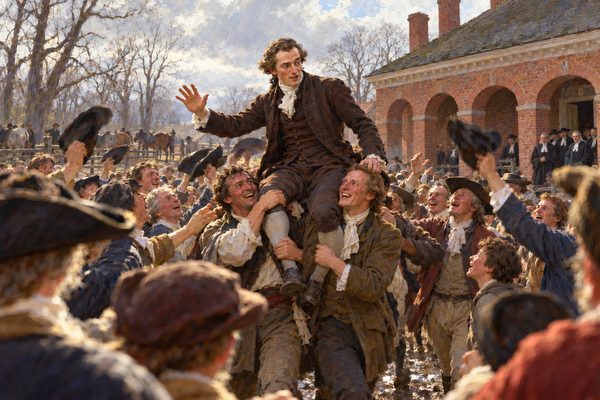
A young man in a dark coat rides high on the shoulders of four men across a muddy yard, one hand raised, as a crowd of farmers and townsmen cheers and waves hats before a brick courthouse with arched doorways.

1 December 1763 · Volume III

One penny and a hero

The Parsons’ Cause

the yard before Hanover Courthouse, Hanover County, Virginia

Virginia paid its Anglican parsons in tobacco, and in 1758 a drought sent the price soaring.

Read chapter 17
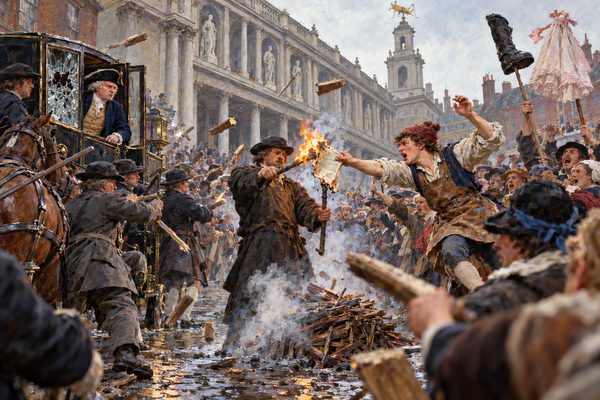
In a grey London street before an arcaded exchange, a young man in a knitted cap snatches a smoking paper from a hangman’s torch as a packed crowd hurls wood, a gentleman watching from a carriage with a broken window.

3 December 1763 · Volume III

They saved the North Briton

Wilkes and Liberty, 1763-1764

Cornhill before the Royal Exchange, London, near the Mansion House

John Wilkes had printed his attack on the king’s speech in issue number 45 of his newspaper, the North Briton, and the government answered with a general warrant and the Tower.

Read chapter 18
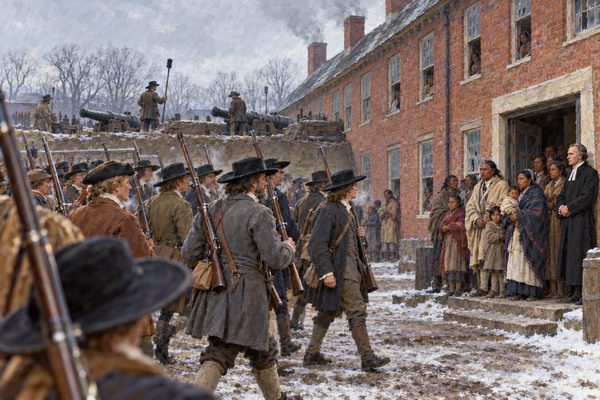
In a winter barracks square, plain-coated men in broad hats march with muskets on their shoulders past a line of cannon toward a doorway where Indian families in simple clothes stand and watch.

6 February 1764 · Volume II

Quakers shoulder arms

The Paxton Boys

the square of the barracks in the Northern Liberties, north of Philadelphia, between Second and Third Streets

The Moravian Indians of Nain and Wechquetank came to Philadelphia in November 1763, sent down by the governor because the people of Northampton County were determined to cut them all off.

Content note: The narrative describes the killing of the Conestoga people and threats against Moravian Native people who later suffered deaths from smallpox.

Read chapter 14
Behind a stone fort wall, gunners beside a cannon wreathed in white smoke and townsmen with muskets watch a small two-masted schooner sail away across sunlit water below a far shore of roofs and steeples.

July 1764 · Volume III

Fire on the King’s schooner

The Newport Case

the gun platform of Fort George on Goat Island, in Newport Harbor, Rhode Island

Newport spent the summer of 1764 at odds with the Royal Navy.

Read chapter 15
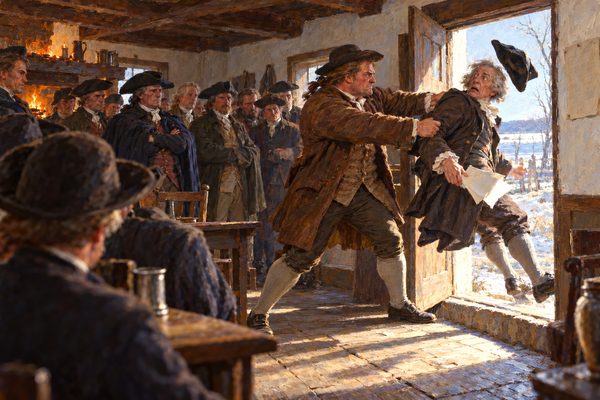
In a low tavern room a big man in a greatcoat grips a thin man in a wig by the collar and shoves him out through a sunlit doorway, his hat flying, while a ring of silent merchants looks on.

late November 1764 · Volume III

No bids, and a shove

Enforcement Troubles

the local tavern where the sale was advertised, in Maryland; the town and the keeper are not named, but Heron's district lay on the Eastern Shore

In 1764 Parliament raised the stakes on the old molasses trade.

Read chapter 14
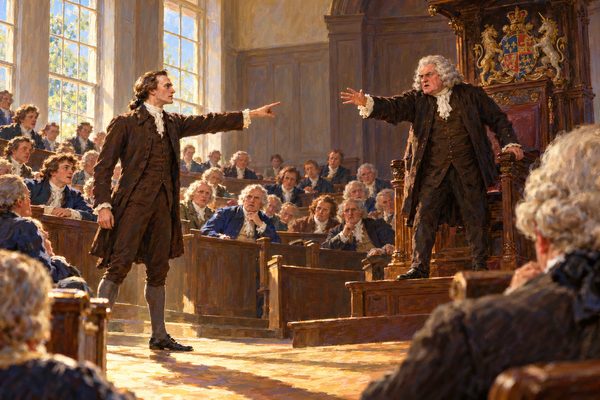
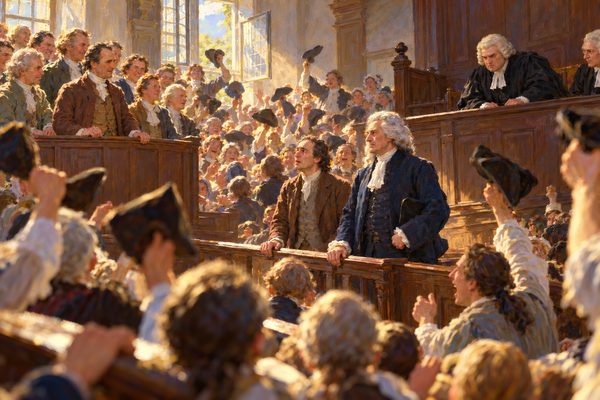
In a wood-paneled hall a young man in a dark coat stands among benches of wigged gentlemen, one arm stretched toward a canopied chair where an older man in a grey wig has risen, hand flung out, as the whole room turns to watch.

29 May 1765 · Volume III

Caesar had his Brutus

Patrick Henry Intervenes

the House of Burgesses in the Capitol, Williamsburg, Virginia

By the third week of May 1765 only about a third of Virginia’s burgesses were still in Williamsburg.

Read chapter 21
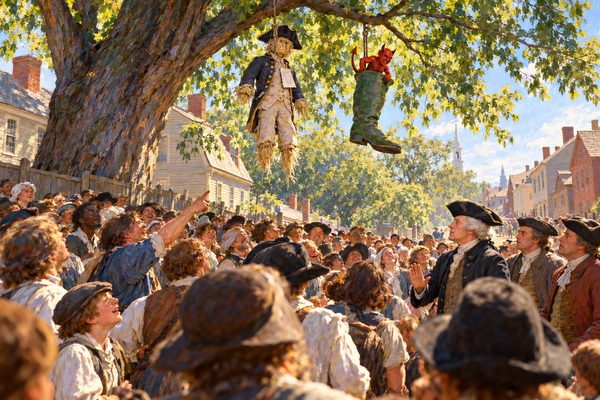
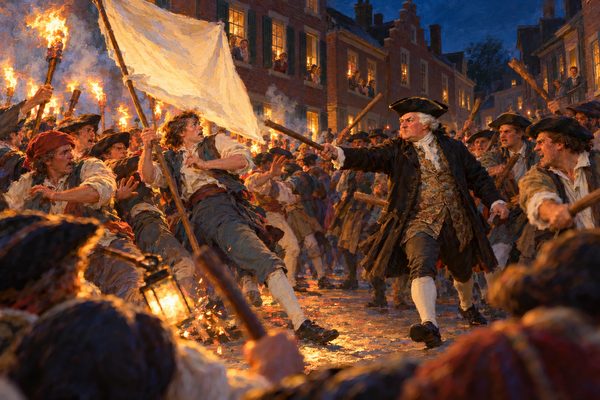
Under a great elm in summer light, a crowd of tradesmen, sailors and women look up at a straw figure in a coat and a green boot with a small devil hanging from a branch, while a gentleman and two deputies hold back at the crowd’s edge.

14 August 1765 · Volume III

The first revolutionary blow

Sam Adams Rallies Boston

the elm on Orange Street (today's Washington Street) near Essex Street in Boston's South End, in the front yard of Deacon John Elliott, later called the Liberty Tree

At dawn on 14 August 1765 Bostonians found a straw figure of Andrew Oliver, the province’s new stamp master, hanging from an elm on Orange Street.

Read chapter 22
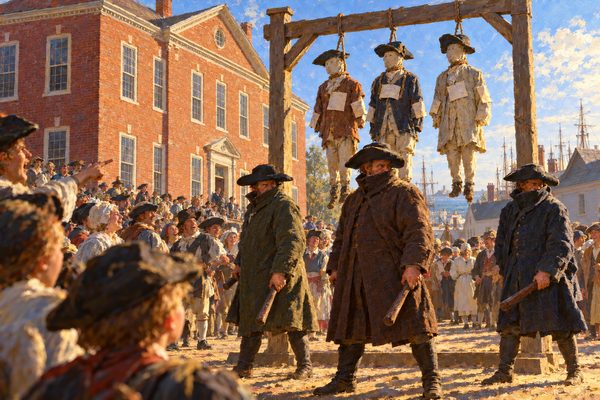
Before a long brick courthouse, three cloth effigies with ropes round their necks hang from a wooden gallows in afternoon sun, while three hunched men in heavy coats and flapped hats hold clubs in front of it and a crowd looks up.

27 August 1765 · Volume III

The Tory Junto swings in effigy

Rhode Island Responds

the open ground before the brick Colony House (the courthouse) at the head of the Parade, Newport, Rhode Island

On 27 August 1765, Newport answered Boston.

Read chapter 23
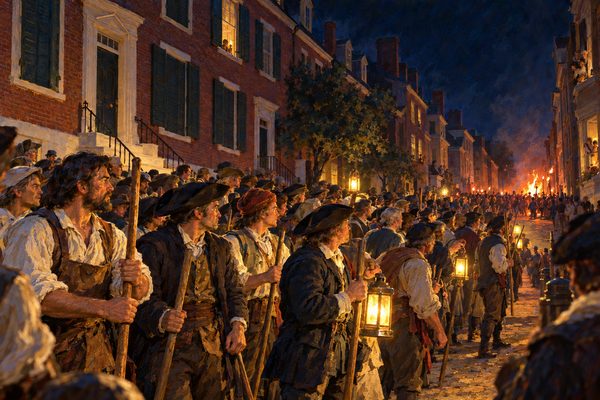
On a night street lit by hand lanterns, ranks of workmen in aprons and round hats stand holding sticks before a shuttered brick house, all turned toward a far orange glow at the end of the street.

16 September 1765 · Volume III

Tradesmen defend the stamp master

Response in Pennsylvania

the street before John Hughes's brick house in Philadelphia

John Hughes was Benjamin Franklin’s man in Pennsylvania, the stamp distributor Franklin had recommended from London, and he refused to resign.

Read chapter 27
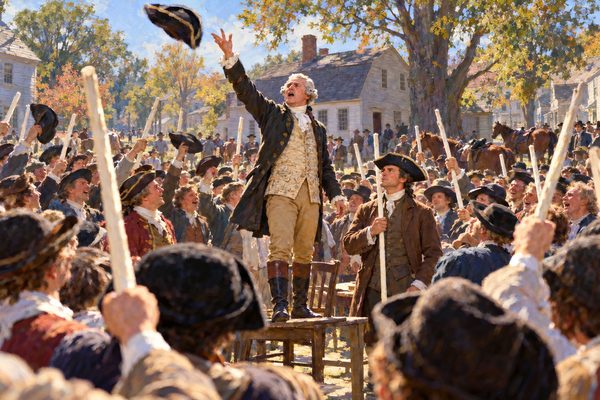
In a sunlit village street a man in a wig and long coat stands on a wooden chair, one arm flung up as his cocked hat sails into the air, ringed by a crowd of men raising pale staves and hats, with horses and clapboard houses behind.

19 September 1765 · Volume III

Made to cheer for liberty

Response in Connecticut

Broad Street, Wethersfield, Connecticut, before a tavern near Colonel John Chester's house

On 19 September 1765 about five hundred riders from eastern Connecticut, each with a freshly peeled white staff, met the colony’s new stamp master, Jared Ingersoll, on the road to Hartford and turned him into Wethersfield.

Read chapter 26
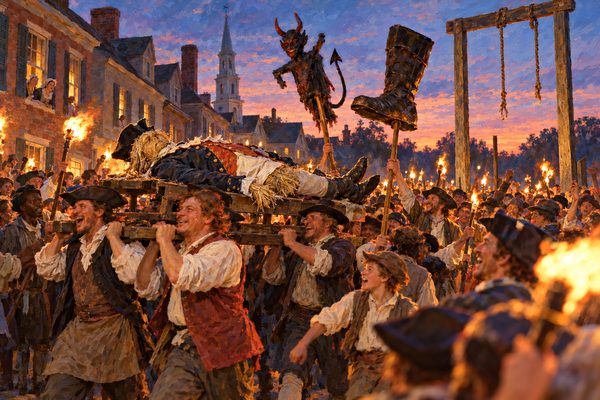
At dusk in a torchlit street, six men carry a stuffed figure in a gentleman’s coat on a bier, a horned devil and a huge boot on poles above the crowd, a tall empty gallows behind them.

19 October 1765 · Volume III

A funeral for the stamp master

Response in the Carolinas and Georgia

Charleston, South Carolina, at the gallows at the corner of Broad and Church streets

Caleb Lloyd, South Carolina’s stamp distributor, stepped off the ship at Charleston on October 18, 1765, with the stamped paper, and Governor William Bull soon lamented that men’s minds had been “universally poisoned” with principles from Boston and Rhode Island.

Read chapter 28
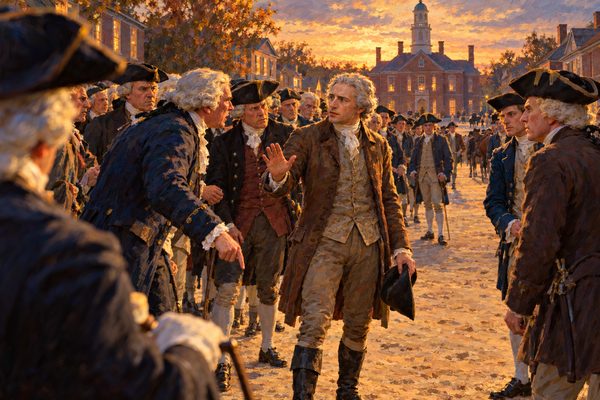
In a wide sandy street at dusk a dusty, pale man stands alone with one hand raised, hat in the other, ringed by gentlemen in good coats and wigs who lean in to press him, with a long brick building at the end of the street.

30 October 1765 · Volume III

The mob wore good coats

Response in Virginia

the Duke of Gloucester Street by the Capitol, Williamsburg, Virginia

George Mercer was a Virginia planter and a former aide of George Washington.

Read chapter 25
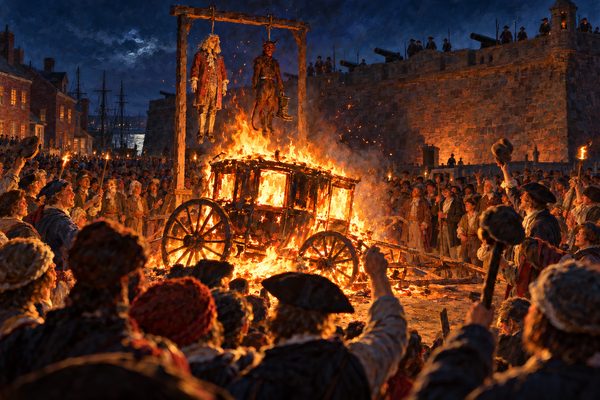
At night a closed coach burns on a green, flames lighting a ring of packed faces and two effigies hanging from a wooden gibbet, with the dark ramparts and gun muzzles of a stone fort looming behind and sparks rising.

1 November 1765 · Volume III

Burn the governor’s coach

Response in New York

Bowling Green at the foot of Broadway, before Fort George, New York City

The stamped paper reached New York at the end of October 1765, and it found the city waiting.

Read chapter 24
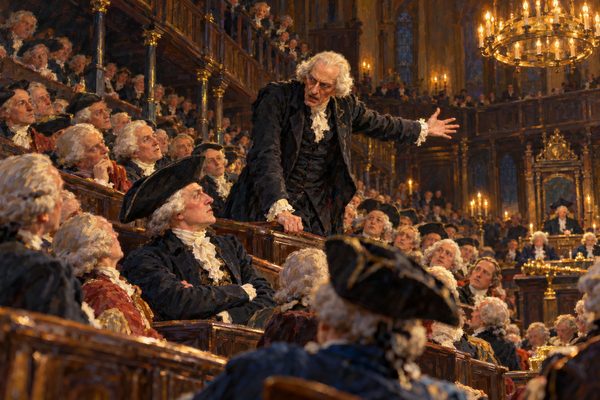
In a packed, candle-lit chamber of tiered benches a gaunt man in a white wig stands gripping the bench before him, one arm flung out, looking down at a seated man with folded arms, as rows of wigged members turn to watch.

14 January 1766 · Volume III

I rejoice that America resisted

Repeal of the Stamp Act

the House of Commons in St Stephen's Chapel, Westminster, London

Parliament opened on 14 January 1766 with the Grenville wing demanding that the Stamp Act be enforced, with troops if need be.

Read chapter 33
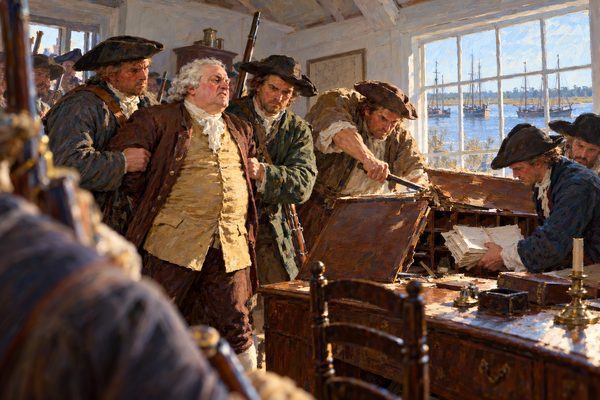
In a plain timber room, armed men in coats and felt hats hold a stout man in a grey wig by the arms while another forces open a writing desk and pulls out papers, three vessels’ masts in the window behind.

19 February 1766 · Volume III

The collector’s desk is forced

Ignoring the Stamp Tax

the collector's room at Brunswick, North Carolina, a port town on the west bank of the Cape Fear River

By January 1766 the ports of North America were opening, one customs official after another giving way to crowds.

Read chapter 31
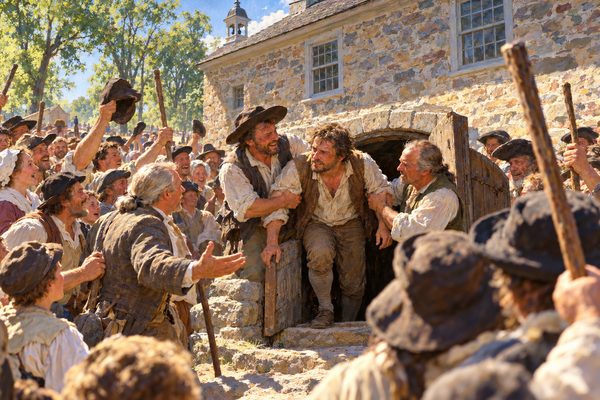
A tired, unshaven man in shirt and waistcoat stoops out through a low stone cellar door into bright sun, caught by the forearms by two farmers, as a packed crowd in felt hats raises staves around him.

early June 1766, a few days before 10 June · Volume III

The debt was for rent

The New York Land Revolt

the Dutchess County court house and jail at Poughkeepsie, New York, on the west side of the post road from New York to Albany

The rent war on the Hudson came to a head in 1766.

Content note: The narrative describes a sentence of hanging and quartering that was prevented by a royal pardon.

Read chapter 36
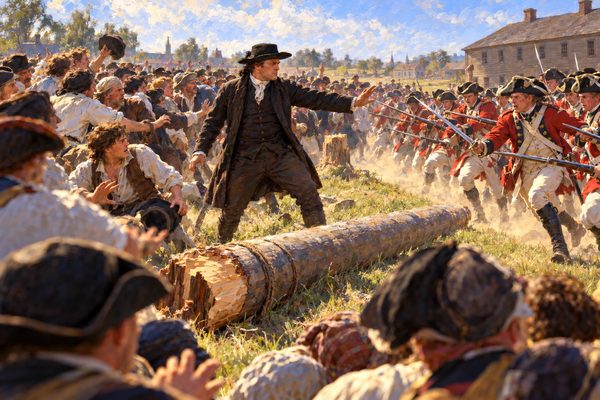
On a dusty common a crowd of tradesmen and sailors falls back around a felled pine mast as red-coated soldiers rush in with bayonets and drawn swords, a stocky man in a dark coat standing ahead of the crowd with one hand raised.

11 August 1766 · Volume III

Cut down the Liberty Pole

Aftermath of Repeal

the Common (the Fields) north of the town, New York, where the Liberty Pole stood

New York’s Sons of Liberty raised their Liberty Pole on the Common in May 1766 to celebrate the repeal of the Stamp Act, a tall pine mast hung with a board for King George, Pitt and Liberty.

Read chapter 34
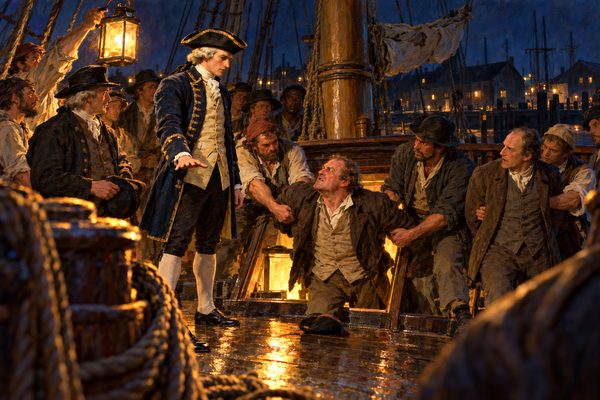
On a lantern-lit ship’s deck at night, a tall man in a dark blue coat and wig stands with one hand extended toward the planks while two sailors lift a plain-coated man up out of a hatch, among a ring of watching men.

9 April 1768 · Volume III

No search below deck

Conflict in Boston

on the deck of Hancock's brigantine Lydia while she discharged her cargo at a Boston wharf

On the evening of Saturday, 9 April 1768, two customs tidesmen, Owen Richards and Robert Jackson, stood guard as John Hancock’s brigantine Lydia unloaded.

Read chapter 39
Before a high brick prison wall, a double rank of redcoated soldiers fires in thick white smoke while a magistrate in a wig flings out an arm, and a packed crowd in the foreground recoils with raised hands and hats.

10 May 1768 · Volume III

Fired on for crying Liberty

Wilkes and Liberty: The Massacre of St. George’s Fields

St. George's Fields in Southwark, on the open ground before the wall and gate of the King's Bench Prison

John Wilkes came home from exile in early 1768, won the Middlesex election under the cry of “Wilkes and Liberty,” and was jailed in the King’s Bench Prison by Lord Mansfield.

Content note: The narrative describes soldiers killing a bystander and firing into a crowd, killing and wounding people.

Read chapter 40
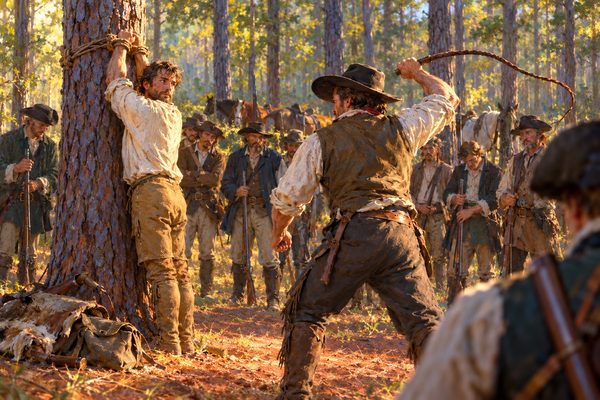
In a sunlit pine clearing a bearded man stands with his wrists bound around a tree trunk, looking back over his shoulder, while a man behind him draws back a whip and armed men look on.

summer 1768, after the Regulators' congress adopted the Plan of Regulation in June · Volume III

Summer 1768 follows the June adoption of the plan; no particular flogging is dated to a single day.

The test of an honest living

The South Carolina Regulation

the back country of South Carolina, in a clearing in the pine woods

The back country of South Carolina had no courts, no sheriffs and no police in the 1760s, and outlaw gangs plundered it at will.

Content note: The narrative describes poor people flogged, banished, or compelled to work for planters.

Read chapter 50
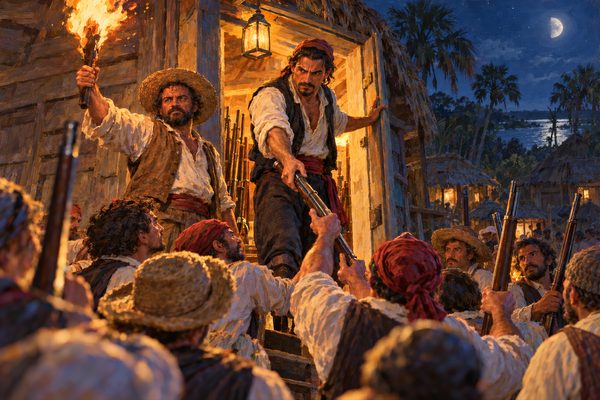
At night a dark-haired man in a vest and sash stands on a lit doorstep passing a musket down to reaching hands, a grim man with a blazing torch beside him, a crowd of straw-hatted laborers below, thatched huts and palms behind.

19 August 1768 · Volume II

Enough of Turnbull’s seven years

Administering the Conquests

the store of Turnbull's settlement at New Smyrna, thirty miles north of Cape Canaveral on the Atlantic coast of British East Florida, by Mosquito Inlet

Dr.

Content note: The narrative describes forced indentured labor, lethal suppression of a revolt, and condemned leaders made examples of by the authorities.

Read chapter 42
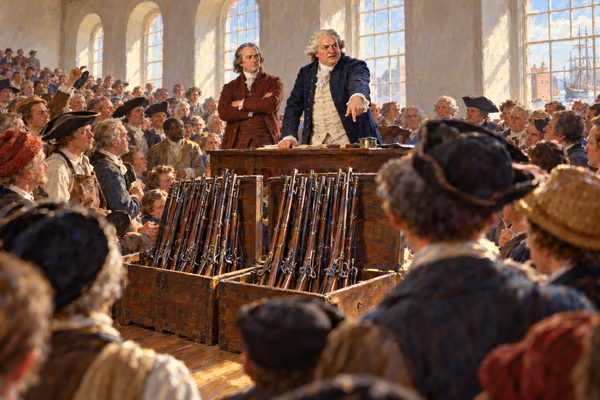
In a long plain hall crowded with men, a stout man in a blue coat and white wig points down at two open chests of upright muskets, a plainly dressed man beside him with folded arms, tall arched windows behind.

12 and 13 September 1768 · Volume III

There are the arms

British Troops Occupy Boston

the long upper hall of Faneuil Hall, Boston

In the summer of 1768 Boston learned that British regiments were on their way.

Read chapter 41
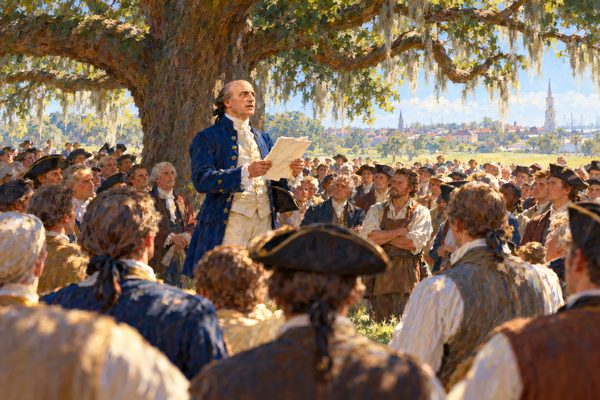
In the shade of a huge moss-hung oak, a bald man in a blue coat and pale waistcoat holds up a paper and reads aloud to a packed crowd of gentlemen and craftsmen, some with hats in hand.

22 July 1769 · Volume III

Read aloud under the Liberty Tree

Nonimportation in the South

under the Liberty Tree, a great live oak in a pasture on the edge of Charleston, South Carolina

Charleston was the South’s biggest trading town, and in the spring of 1769 its merchants would not join the boycott of British goods that had swept Boston, New York and Philadelphia.

Read chapter 42
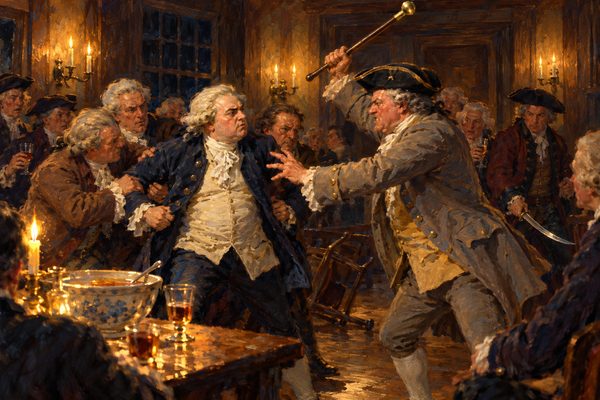
In a candlelit tavern room, a florid man in a grey coat raises a cane over a stout man in a blue coat and white wig who is held by the arms by several others, as watchers half rise from their chairs around them.

5 September 1769 · Volume III

Otis denied fair play

Boycotting the Importers

the British Coffee House on King Street, Boston, a tavern-like room where the Crown's officers met

On 4 September 1769 James Otis printed a notice in the Boston Gazette attacking the customs commissioners, and said he had a natural right to break John Robinson’s head if Robinson misrepresented him.

Read chapter 44
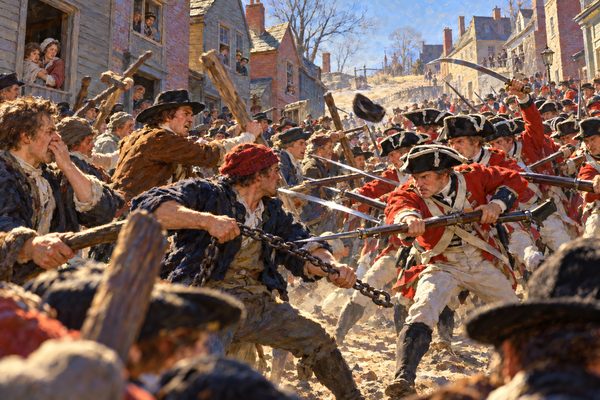
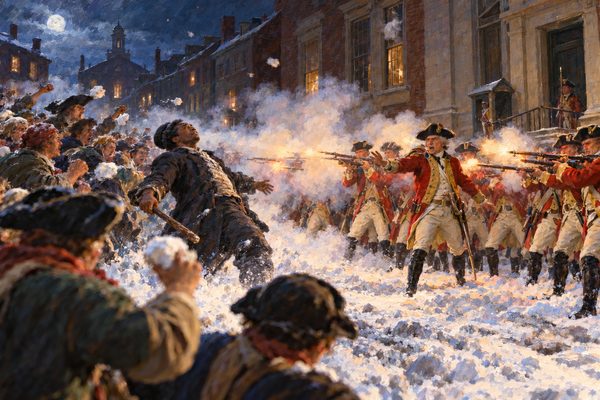
On a snowy night a line of redcoated soldiers fires muskets into a crowd, white smoke billowing, while a tall man at the front of the crowd staggers backward, a stick slipping from his hand, before a two-story building with one lit window.

5 March 1770 · Volume III

Who fired from the window?

The Boston Massacre

King Street (now State Street) in front of the Custom House, Boston, Massachusetts

British troops had been in Boston since late 1768, and the town had been waging a campaign against them for liberation.

Content note: The narrative describes a child killed by gunfire, soldiers firing into a crowd, and two soldiers later branded on the hand.

Read chapter 45
On a night street, torchlit marchers behind a tall plain banner stagger back as a crowd of men with raised sticks, led by a stout merchant in a wig and cocked hat, surges into them between rows of brick houses with lit windows.

7 July 1770 · Volume III

Clubs break the boycott parade

New York Breaks Nonimportation

a street in New York City

By the summer of 1770 the boycott of British goods was the colonists’ great weapon, and New York was its weak link.

Read chapter 49
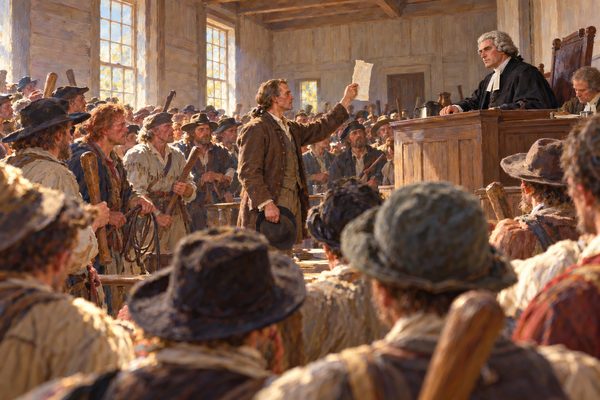
In a plain timber courtroom packed with men in hunting shirts and felt hats holding clubs and whips, a lean farmer holds up a paper before a wigged judge seated at a raised bench.

24 September 1770 · Volume III

A courtroom packed with clubs

The North Carolina Regulation

the Orange County courthouse, Hillsborough, North Carolina

By 1770 North Carolina’s Regulators had tried everything legal.

Content note: The narrative describes a lawyer beaten and Edmund Fanning whipped by the crowd.

Read chapter 51
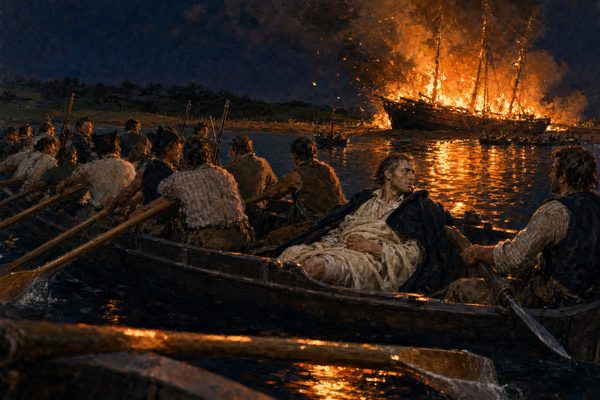
Night on calm water: a longboat full of men at the oars pulls away from a two-masted schooner burning on a low shore, its fire mirrored in the water. In the stern a pale man wrapped in a white blanket and dark coat lies back, looking at the flames.

10 June 1772 · Volume III

The Gaspee burns behind him

The Gaspee Incident

the Providence River off Namquid Point, Warwick, Rhode Island

On the afternoon of 9 June 1772 HM schooner Gaspee, which had spent three months stopping and searching nearly every vessel in Narragansett Bay, ran aground on Namquid Point below Providence.

Read chapter 53
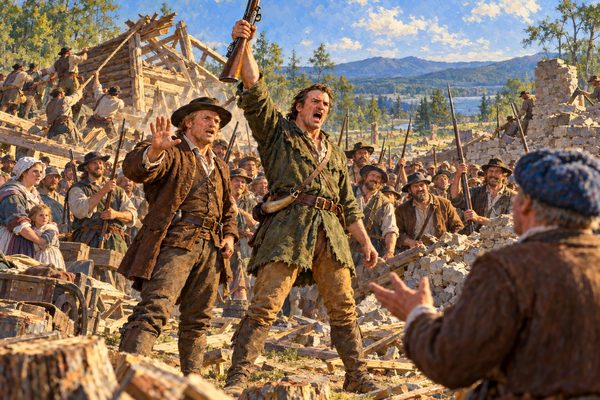
In a forest clearing a tall man shouts with a long gun raised high overhead, muzzle to the sky, beside a stocky man holding up an open hand, before a crowd of armed countrymen pulling down a half-built log house.

August 1773 · Volume III

This is my law

The Vermont Revolution: The Green Mountain Boys

the clearing of Colonel John Reid's new settlement on the western New Hampshire Grants, in the Otter Creek country (now Vermont)

In the 1760s settlers poured into the country west of the Green Mountains on land grants from New Hampshire, and paid for them.

Content note: The narrative describes whipping, destruction of houses, and coercion in the settlers’ conflict with New York claimants.

Read chapter 71
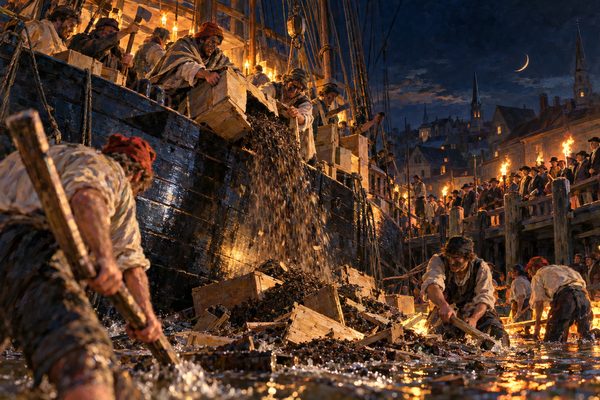
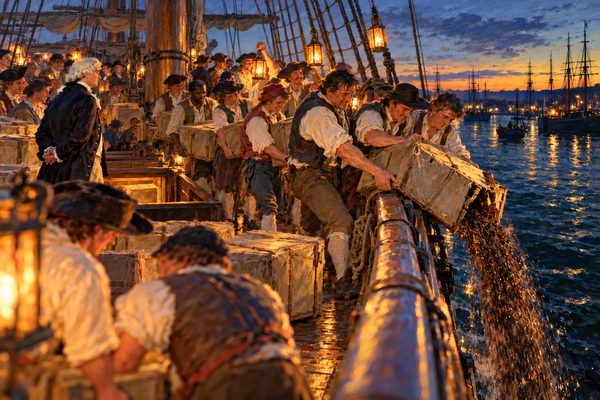
From low on the mud beside a ship’s dark hull, men with blackened faces and blankets tip a split chest over the rail, tea pouring onto a heap of leaves and broken boards where bare-armed youths beat it with staves. Torchlit onlookers line the wharf.

16 December 1773 · Volume III

The monopoly’s tea hits the mud

Boston protesters destroy East India Company tea

Boston Harbor, Massachusetts

A blocked demand to return tea leads protesters to destroy the cargo.

Content note: The scene depicts colonists using disguises associated with Native people. The exact identification of those disguises differs across the cited accounts; the picture does not document Native participation.

Read chapter 56
By lantern light on a ship’s deck at dusk, New Yorkers in shirts and round hats tip a stove-in tea chest over the rail so dark tea pours into the river, while others carry chests from an open hatch and a gentleman in a white wig looks on.

22 April 1774 · Volume III

The captain hid eighteen chests

The Other Colonies Resist Tea

the deck of the ship London, moored at a wharf on the New York waterfront, with the open river beyond her rail

New York had prepared for the tea for months.

Read chapter 57
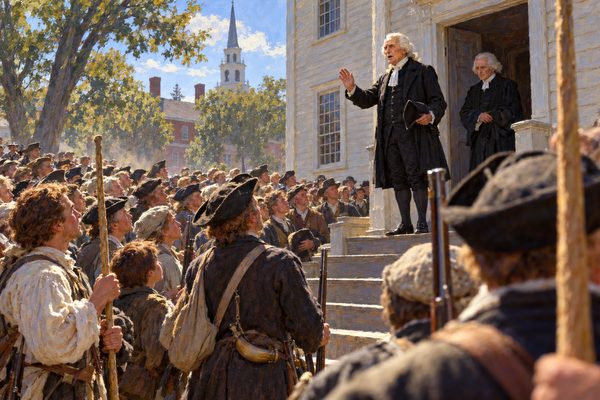
A white-wigged old judge stands on wooden court house steps with one hand raised as a packed crowd of dusty farmers in felt hats, some with staves and grounded muskets, looks up at him in silence on a sunlit road.

2 September 1774 · Volume III

Thousands came for the powder

Resistance in Massachusetts

the front of the Middlesex county court house in Harvard Square, Cambridge, Massachusetts, where the steps face the road

General Gage had spent the summer watching Massachusetts govern itself around him.

Read chapter 62
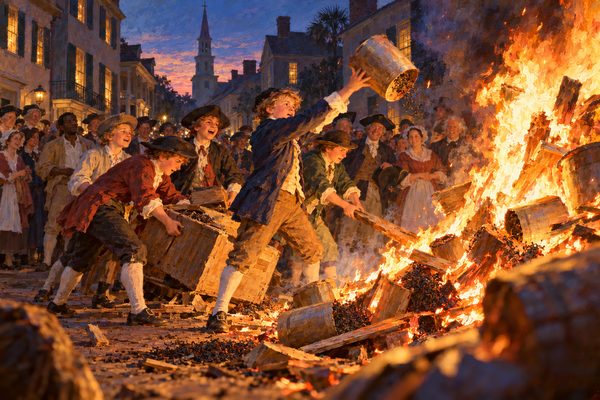
At dusk in a Charleston street, schoolboys in small coats and round hats drag a splintered tea chest and throw a canister into a roaring bonfire while townspeople watch from behind.

5 November 1774 · Volume III

The schoolboys’ tea bonfire

The Continental Association

a street in Charleston, South Carolina

Tea drinking, a favorite pastime of Americans, was the hardest part of the boycott to enforce.

Read chapter 64
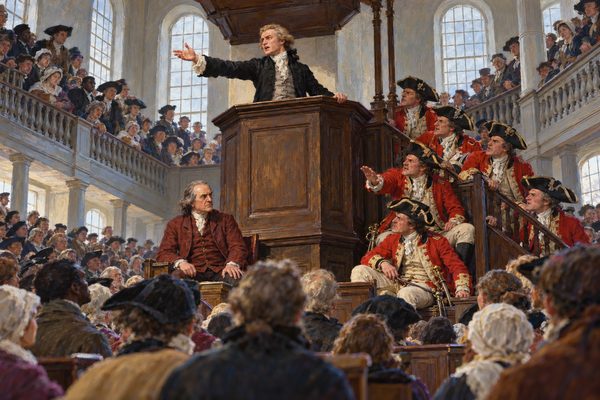
In a tall packed meeting house, a young man in a black coat stands in a high pulpit with one arm flung out, while scarlet-coated officers on the pulpit stairs lean forward hissing and a plainly dressed man sits below facing them.

6 March 1775 · Volume III

Fields of blood, and a hiss

Massachusetts: Nearing the Final Conflict

Old South Meeting House, corner of Washington and Milk Streets, Boston

Boston in March 1775 lived under the guns of the army that had occupied it since 1768.

Content note: The narrative describes a man tarred, feathered, and marched through Boston after his arrest.

Read chapter 67
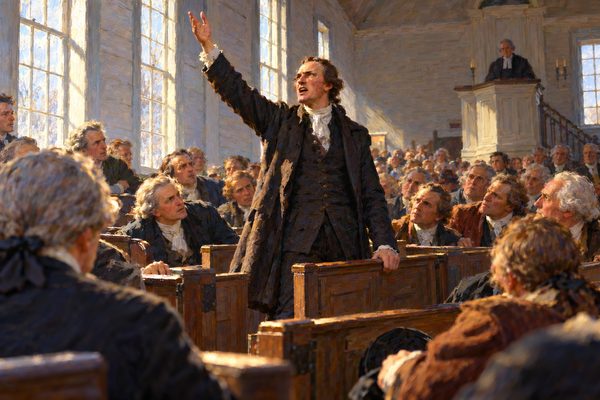
In a plain wooden church a lean man stands upright in a box pew, one arm thrust high, as rows of wigged delegates in dark coats lean toward him in the cold light from tall windows.

23 March 1775 · Volume III

Give me liberty, or death

Support from Virginia

St John's Church, Richmond, Virginia (Henrico Parish)

In late March 1775 the Virginia convention, an enlarged House of Burgesses meeting without the governor’s leave, met in St.

Read chapter 68
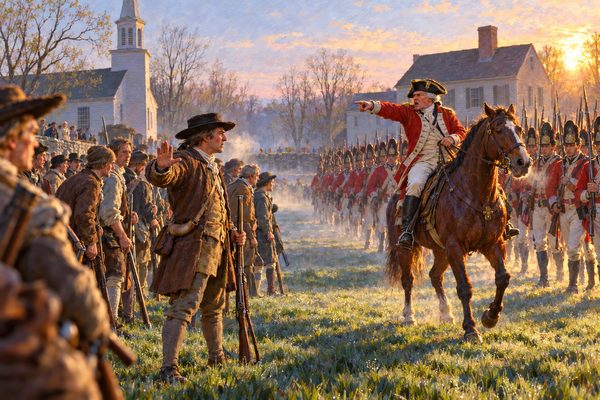
At dawn on a village green, a mounted officer in a red coat flings out an arm and shouts at a line of farmers in mismatched coats and hats, while their captain, hand raised, turns toward him; redcoats in black caps stand behind.

19 April 1775 · Volume III

Throw down your arms

“The Shot Heard Round the World”: The Final Conflict Begins

Lexington Common, the triangular green at the center of Lexington, Massachusetts, where the road from Boston meets the roads to Bedford and Concord, with Buckman Tavern across the street and the town's meetinghouse beside it

General Gage had received his orders on 14 April and meant to strike first.

Content note: The narrative describes British troops firing on dispersing militia and killing eight Americans.

Read chapter 69
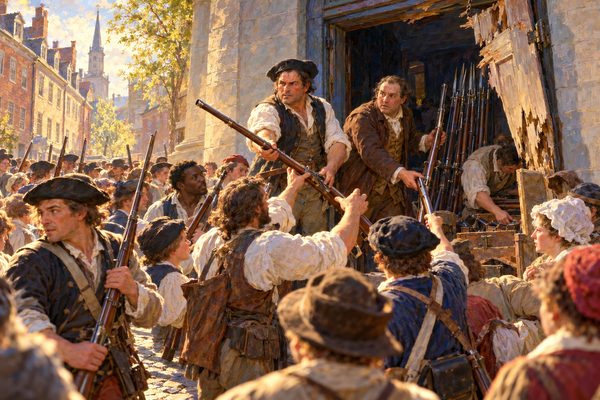
Two stout men in shirtsleeves stand in a smashed stone doorway handing long muskets to a crowd of artisans and sailors whose hands reach up, while the first men walk off with guns on their shoulders.

23 April 1775 · Volume IV

Muskets for all comers

New York Fumbles in the Crisis

before the old City Hall at the head of Wall Street, New York

New Yorkers learned of Lexington and Concord on Sunday, April 23, and the city’s two radical leaders, Isaac Sears and John Lamb, seized the moment.

Read chapter 12
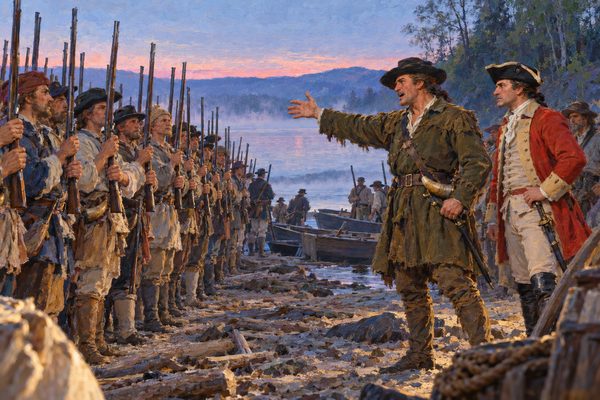
At gray dawn on a lake shore a tall man in a hunting frock flings out an arm before long ranks of countrymen, who hold their guns upright in answer, with an officer in a scarlet coat beside him and empty boats behind.

10 May 1775 · Volume IV

Poise your firelocks

The Seizure of Fort Ticonderoga

the western (New York) shore of Lake Champlain just below Fort Ticonderoga, where the men landed after crossing from Hand's Cove

Fort Ticonderoga sat at the narrows of Lake Champlain, the gateway to Canada and home to the largest store of cannon in the colonies.

Read chapter 4
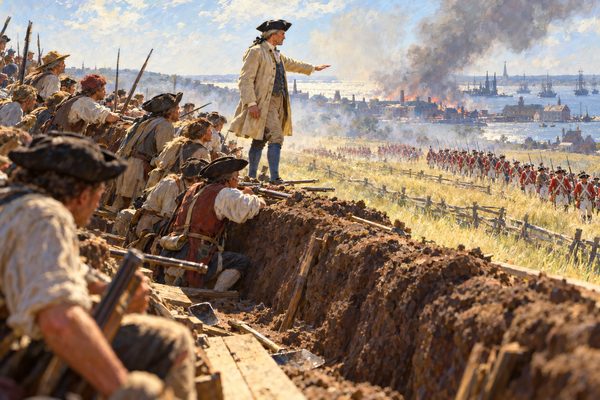
Inside an earthen fort, a lean officer in a pale loose coat stands on the wall with one hand out flat, and militiamen rest long guns on the parapet as lines of redcoats climb a hay-covered hill under smoke.

17 June 1775 · Volume IV

Hold your fire

The Battle of Bunker Hill

the earthen redoubt on the summit of Breed's Hill, Charlestown Peninsula, Massachusetts, looking out over the slope toward Charlestown and Boston harbor

By mid-June 1775 the Americans besieging Boston had learned that Britain meant to fortify the heights that commanded the town.

Read chapter 7
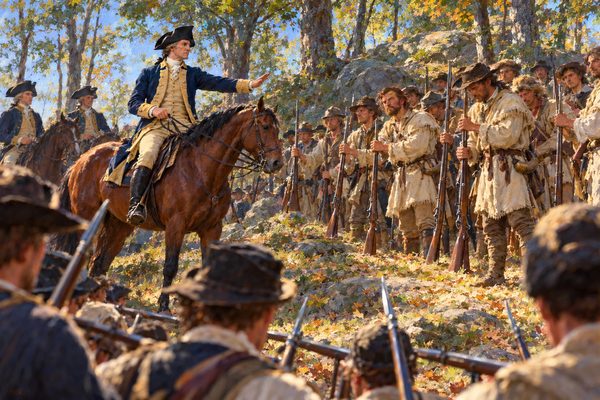
On a wooded hill a tall rider in a blue coat holds out a hand to frontiersmen in pale fringed hunting frocks, who lower long rifles to the ground, while a ring of infantry with fixed bayonets surrounds them.

10 September 1775 · Volume IV

Ground your arms

Washington Transforms the Army

a wooded hill about half a mile from the Continental camp at Cambridge, Massachusetts, between Prospect Hill and Cambridge

When Washington reached Cambridge on July 2 he found a people’s army: its officers elected, its pay nearly level, its men free to come and go.

Read chapter 8
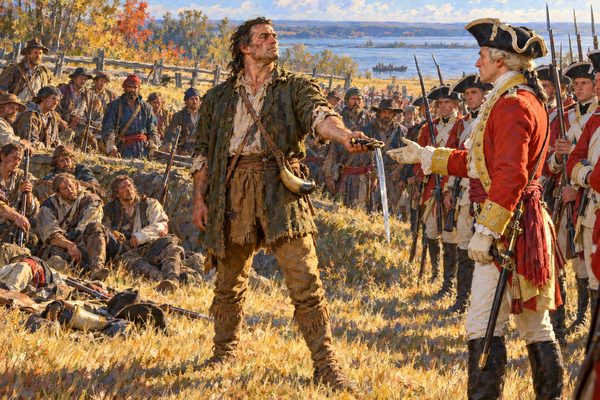
In a field by a ditch, a huge hatless man holds out his sword hilt first to an officer in a red coat, with tired countrymen in the ditch behind him and redcoats and militia with fixed bayonets closing in.

25 September 1775 · Volume IV

Allen hands over his sword

The Invasion of Canada

open farm fields and a field-edge ditch on the island of Montreal near Longue-Pointe, east of the town, with the St. Lawrence in view

Allen’s luck ran out in the north.

Read chapter 9
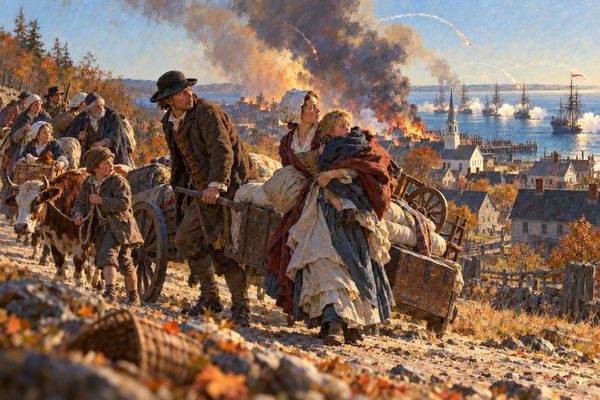
On a country road a woman carrying a child looks back over her shoulder as families with a handcart and a cow hurry away, while warships fire at a burning wooden town beside the harbor below.

18 October 1775 · Volume IV

Burn, destroy, and lay waste

Privateering and the War at Sea

the road out of the town of Falmouth on Falmouth Neck (now Portland), Maine, then part of Massachusetts

By the autumn of 1775 Admiral Graves at Boston could not stop the American schooners and whaleboats that were preying on his supply ships.

Read chapter 21
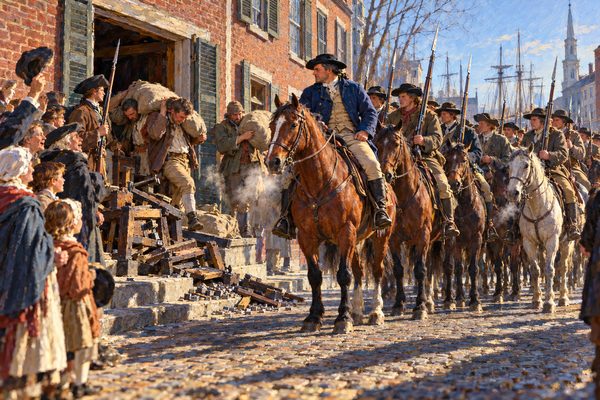
In a cold bright street a stocky rider leads two ranks of horsemen with fixed bayonets before a brick shop, while men carry out sacks and a wrecked press and a crowd on the pavement cheers.

23 November 1775 · Volume IV

Smashing the Tory press

Suppressing Tories in New York

the street before James Rivington's printing office near the foot of Wall Street, New York

By the autumn of 1775 Isaac Sears, the old radical leader of New York, had left in disgust for Connecticut.

Read chapter 15
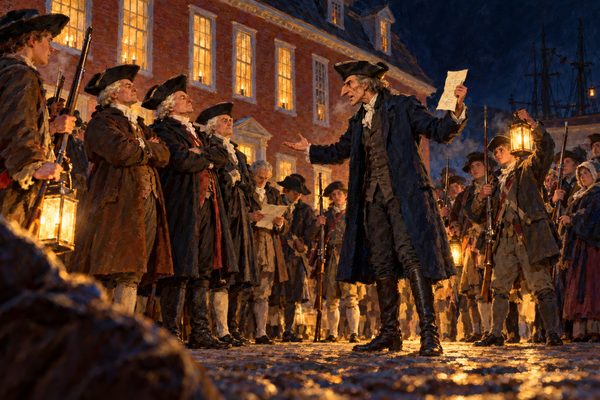
At night before a lit brick courthouse, a tall gaunt general holds up a paper toward three proud gentlemen with folded arms, while young soldiers with muskets and lanterns stand round them.

25 December 1775 · Volume IV

Swear it or be jailed

Suppressing Tories in Rhode Island and Connecticut

the Parade before the Colony House, Newport, Rhode Island

Newport swarmed with Loyalists, and by the autumn of 1775 it was a town under siege.

Read chapter 14
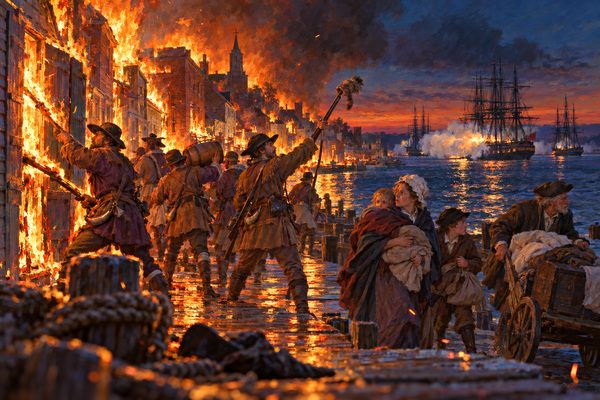
At dusk on a wharf, soldiers in long hunting shirts thrust torches into burning wooden houses and warehouses, while a frigate in the river fires a broadside and a family with a handcart flees along the quay.

1 January 1776 · Volume IV

Who burned Norfolk?

Virginia Battles Lord Dunmore

the waterfront of Norfolk on the Elizabeth River, its wharves, warehouses and houses burning, with the British ships lying in the river off the town

Norfolk was Virginia’s largest town, a port of about six thousand people, with Scottish merchants and their clerks, wharves and warehouses on the Elizabeth River, and a good many Tories.

Content note: The narrative mentions an offer of freedom to enslaved people who fought for Dunmore and describes the destruction of most of Norfolk.

Read chapter 17
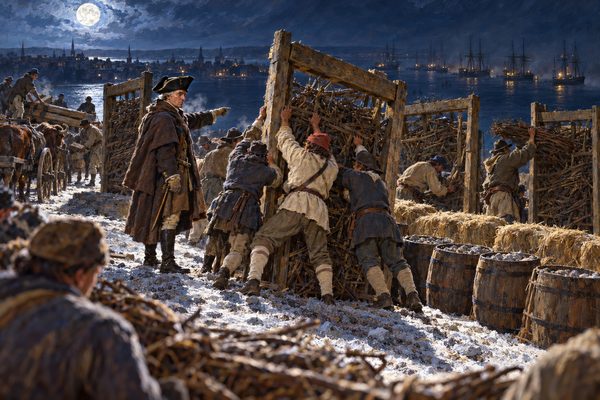
On a frozen hilltop under a bright moon a general points as workmen heave a heavy timber frame upright beside others packed with brush, with hay bales and barrels at the edge and a dark harbor and town beyond.

4 March 1776 · Volume IV

More in one night

Forcing the British Out of Boston

the crest of Dorchester Heights, Dorchester Neck, south of Boston, Massachusetts

By the winter of 1775 the siege of Boston had stalled.

Read chapter 20
In a driving rain a stout man in a dark coat stands on a plank stage holding a paper while a vast crowd of men cheers and throws hats into the air before a red brick State House with a tall steeple.

20 May 1776 · Volume IV

Hats flying in the rain

The Struggle in Pennsylvania and Delaware

the State House yard, Philadelphia, behind the State House on Chestnut Street between Fifth and Sixth Streets

By the spring of 1776 Pennsylvania was the great holdout.

Read chapter 31
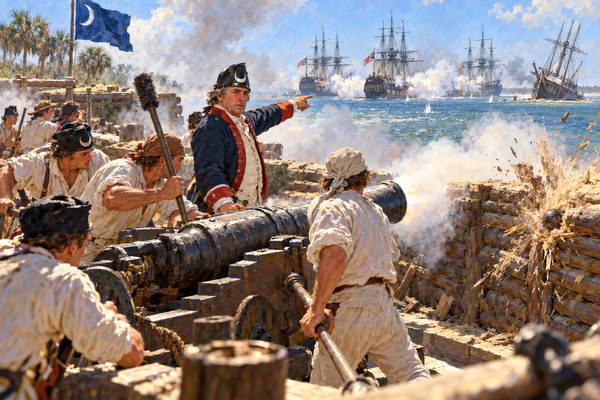
On the gun platform of a log fort a crew in shirtsleeves fires an iron cannon through the parapet in a cloud of smoke, while an officer in a blue coat points at British warships firing across the bright water.

28 June 1776 · Volume IV

Logs against the Royal Navy

The British Assault on Charleston

the gun platform of Fort Sullivan, on the south-western tip of Sullivan's Island in Charleston harbor, South Carolina

In the spring of 1776 General Clinton, with three thousand regulars and a fleet of more than fifty warships under Commodore Sir Peter Parker, set out to take Charleston, or at least Fort Sullivan in its harbor, as a base for invading the whole South.

Read chapter 19
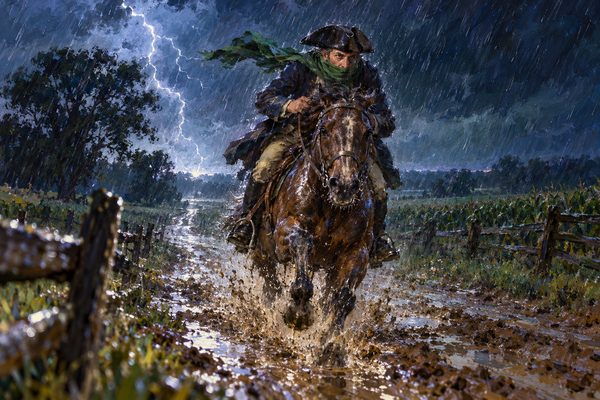
A thin rider in a green scarf and dark coat gallops a muddy, sweating horse straight toward the viewer down a night road, lit by a fork of lightning, with slanting rain over flat fields and fences.

1 July 1776 · Volume IV

Ride all night for independence

Caesar Rodney rides to vote for independence

Dover, Delaware, to Philadelphia

A divided Delaware delegation awaits the representative whose presence can change its vote.

Read chapter 33
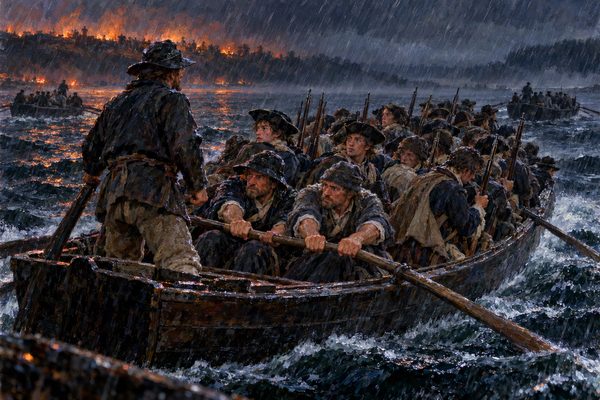
In rain at night, two fishermen row a crowded open boat across a dark river while a third steers from the stern, and soldiers with upright muskets sit packed between them, looking back at a distant glow.

29 August 1776 · Volume IV

The night the army slipped away

The Invasion of New York

the East River off Brooklyn Heights, a mile wide, between the Brooklyn shore and Manhattan

By the last week of August 1776, William Howe had landed 20,000 men on Long Island, flanked the American line through the undefended Jamaica Pass and smashed it.

Read chapter 35
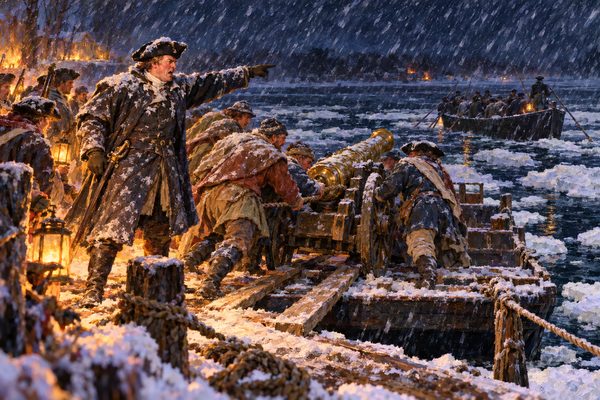
In falling snow at night, a huge officer shouts and points across a river as men heave a brass field gun up planks onto a ferry scow, while a dark boat of soldiers moves off into floating ice.

25 December 1776 · Volume IV

Eighteen guns across the ice

The Campaigns in New Jersey

McConkey's Ferry landing on the Pennsylvania bank of the Delaware

By Christmas of 1776 Washington’s army had been chased out of New Jersey and was camped on the Pennsylvania bank of the Delaware, ill, barely clothed and about as low as an army can get.

Read chapter 36
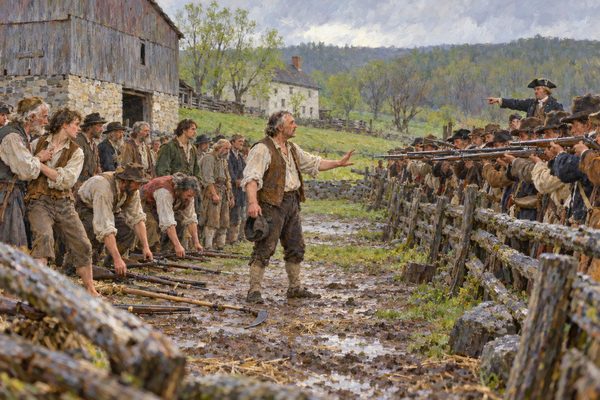
In a hill farmyard, a bareheaded farmer stands alone with open hands before a line of militia aiming muskets from a rail fence, while ragged men behind him set their old guns on the ground.

5 May 1777 · Volume IV

Fire on any man who runs

Rebellion at Livingston Manor

a hill farm in the southeastern corner of Livingston Manor, the Taghkanic hill country east of the Hudson, New York

Livingston Manor ran for 160,000 acres along the east bank of the Hudson, and its tenants wanted one thing from the war: the land they had cleared and farmed for years.

Content note: The narrative describes tenants killed and others put to death after their surrender offer was rejected.

Read chapter 38
In a country store a crowd of women in caps and aprons holds out bags and baskets round a counter where two soldiers weigh tea from an open chest and stack a few coins, watched by a pale woman behind the counter.

19 May 1777 · Volume IV

Their own price for tea

Inflationary Finance and Price Controls

the front-room store of Peter Mesier's stone house on Wappingers Creek, Dutchess County, New York, near Poughkeepsie

Peter Messier was a New York City merchant with Loyalist leanings who fled the war and bought a stone house and 420 acres on Wappingers Creek, near Poughkeepsie, in May 1777.

Read chapter 67
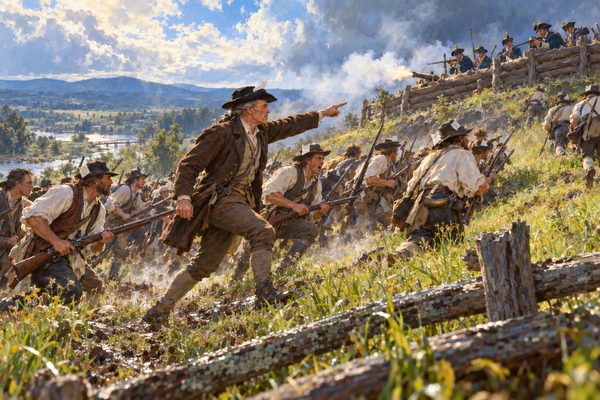
A lean man in plain clothes strides uphill pointing at a log fort on the crest, while farmers in shirtsleeves with paper in their hats run up the slope behind him, and white smoke drifts from the fort.

16 August 1777 · Volume IV

Or Molly Stark sleeps a widow

The Burgoyne Disaster

the hilltop Dragoon Redoubt at Walloomsac, New York, about ten miles from Bennington

In August 1777 John Burgoyne, short of food and horses on his march south from Canada, sent about 700 men under the Hessian Lt.

Read chapter 39
A column of thin, ragged soldiers in blankets and patched coats trudges along a frozen rutted road toward a bare hillside, the nearest man barefoot with bloodied rags on his feet, under a low grey sky.

19 December 1777 · Volume IV

Shoeless into Valley Forge

Winter at Valley Forge

the ground of the encampment at Valley Forge, Pennsylvania, about twenty miles west of British-held Philadelphia

By December 1777 Washington had lost Philadelphia and his army needed a place to sit out the winter.

Read chapter 41
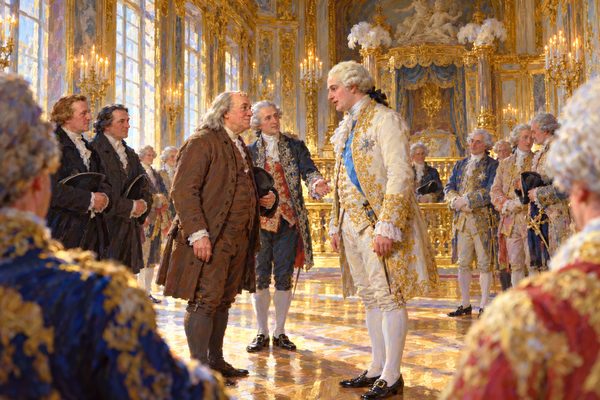
In a gilded chamber an old man in a plain brown coat, his white hair unpowdered, bows slightly before a tall young king in embroidered silk, while courtiers in powder and silk look on before a great canopied bed.

20 March 1778 · Volume IV

The plain man at court

Response in Britain and France

the King's Chamber (the King's Great Chamber), Palace of Versailles, France

For Americans, the great aim was to turn France from a secret supplier into an open ally.

Read chapter 43
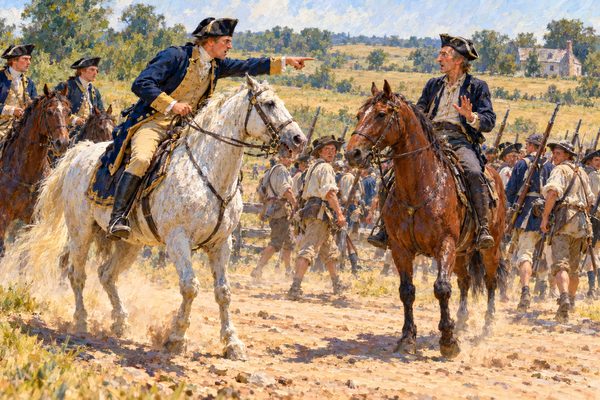
Under a hot noon sun a tall rider on a white horse thrusts out an arm and shouts at a thin man on a brown horse who shrinks back, while tired soldiers in shirtsleeves file past behind them on a dusty road.

28 June 1778 · Volume IV

No chance to explain

The Battle of Monmouth and the Ouster of Lee

open farm country on high ground east of the middle ravine, west of Monmouth Court House, New Jersey

The British had to get out of Philadelphia, and in June 1778 General Clinton marched ten thousand men across New Jersey toward New York, strung out and weighed down with baggage.

Read chapter 42
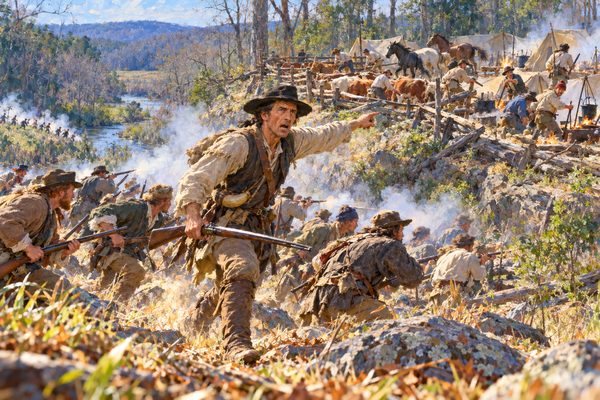
Up a rocky winter hillside a lean man with one arm thrown forward runs at the head of a rush of homespun militiamen, rifle smoke streaming, toward a camp where men scatter among penned cattle and loose horses.

14 February 1779 · Volume IV

The camp surrounded

The Invasion of Georgia

the Loyalist camp on a rocky hill in a bend of Kettle Creek, in the back country of Georgia, on the Georgia side of the Savannah River

On 23 December 1778 the British landed below Savannah, and by February all of Georgia was under their control.

Content note: The narrative describes captive Loyalists condemned for treason and five of them hanged.

Read chapter 53
At a muddy farm gate in early spring, a man in a plain coat hands the halter rope of a red cow to a smiling farmer, while a crowd of men with muskets and a second cow wait behind him and a woman holds a child.

April 1779 · Volume IV

The Cow War begins

The Republic of Vermont

a farm lane in the Connecticut River towns of southeastern Vermont, near Brattleboro and Putney

In 1779 Vermont was a republic that no other state recognized.

Read chapter 75
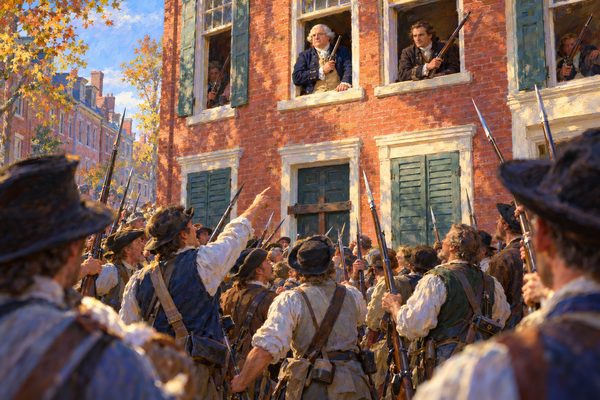
A crowd of militiamen with muskets and bayonets stands in a street looking up at a three-storey brick house, where two men at upper windows hold guns beside gun barrels thrust out over the street.

4 October 1779 · Volume IV

Barricaded on Walnut Street

Conservative Counter-Revolution: Massachusetts and Pennsylvania in 1780

the street before James Wilson's house on the southwest corner of Third and Walnut Streets, Philadelphia

In 1779 Pennsylvania was run by radicals under its new democratic constitution, and the country was drowning in paper money and price controls.

Read chapter 68
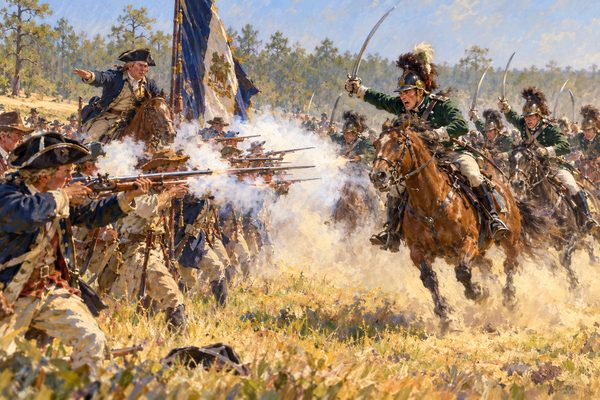
On open ground a young officer in a green jacket and plumed helmet leads a line of galloping dragoons with raised sabres into a thin line of musket-armed infantry firing through white smoke as a mounted colonel gives the order.

29 May 1780 · Volume IV

Tarleton’s quarter

The Capture of Charleston

open ground beside the road in the Waxhaws settlement, near the North Carolina border, South Carolina

When Charleston fell on 12 May 1780, the whole southern army was lost, but one Continental force was still in the field: some 350 Virginians under Colonel Abraham Buford, who had come south too late to help and were ordered to retreat to North Carolina as fast as they could.

Content note: The narrative describes attacks on disarmed and wounded soldiers attempting to surrender.

Read chapter 54
Behind a weathered rail fence at dawn, homespun riflemen fire across a road, their rifles on the top rail, powder smoke streaming, into a camp of tents where men in green jackets stir and an officer swings onto a horse.

12 July 1780 · Volume IV

The fence rail volley

The Emergence of Guerrilla Warfare in South Carolina

James Williamson's plantation, near present-day McConnells, York County, in the back country of South Carolina

After Charleston fell in May 1780, the British thought South Carolina was pacified.

Read chapter 55
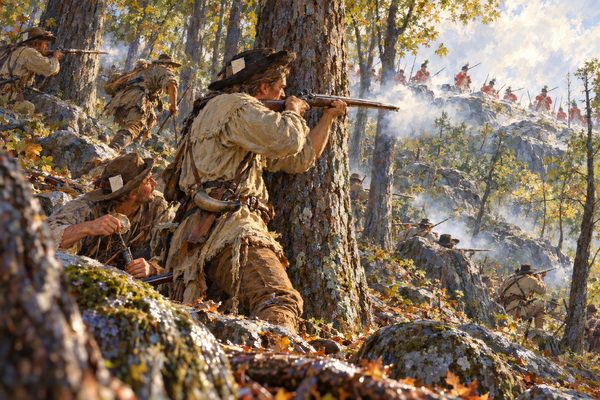
Frontiersmen in hunting shirts climb a wooded, rocky slope, one aiming a long rifle uphill from behind an oak while gunsmoke drifts between the trunks toward red-coated soldiers on the open summit above.

7 October 1780 · Volume IV

Tree to tree, up the mountain

The Battle of King’s Mountain and the End of the 1780 Campaign

King's Mountain, a low, rocky, forested ridge on the North Carolina and South Carolina border

By late September 1780 the British thought the Carolina back country was theirs.

Content note: The narrative includes a threat to hang rebel leaders and describes deaths in the battle.

Read chapter 57
Inside a log stockade a dark-haired rifleman in a hunting shirt levels his long rifle from the hip at a pale major in a blue coat who gestures toward a half-open gate, while grim militiamen look on behind him.

17 October 1780 · Volume IV

A bullet before surrender

The War in the West

inside the stockade of the Middle Fort in the Schoharie Valley, New York

In October 1780 Sir John Johnson and Joseph Brant came down on the New York frontier with some 1,200 men, in step with a British thrust from Lake Champlain and the hope that Benedict Arnold would deliver West Point.

Read chapter 51
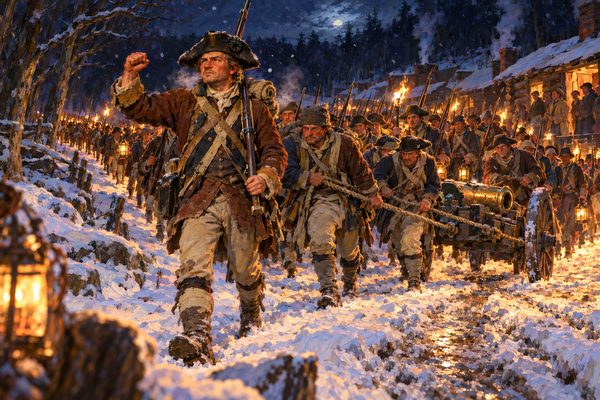
At night in the snow a stocky sergeant strides at the head of a long column of ragged soldiers, one fist raised, behind men hauling a small cannon on ropes, torches burning, rows of log huts behind them.

1 January 1781 · Volume IV

Justice before obedience

The Pennsylvania Line mutinies

Morristown and Princeton, New Jersey

Soldiers challenge military obedience over unpaid wages and disputed service terms.

Content note: The narrative describes an officer killed during the mutiny, emissaries executed as spies, and executions after the separate New Jersey mutiny.

Read chapter 49
On a cold, frosty meadow at dawn, British dragoons with raised sabres charge from the left toward a line of frontiersmen in hunting shirts, who aim long rifles as a big mounted officer turns in the saddle to watch.

17 January 1781 · Volume IV

Fire, fall back, fire again

Greene’s Unorthodox Strategy

the Cowpens, an open pasture on the south side of the Broad River, South Carolina

Rothbard says Greene, like Morgan, grasped “the necessity for a guerrilla strategy” and split his inferior army in “a daring and highly unorthodox maneuver” (p.

Read chapter 58
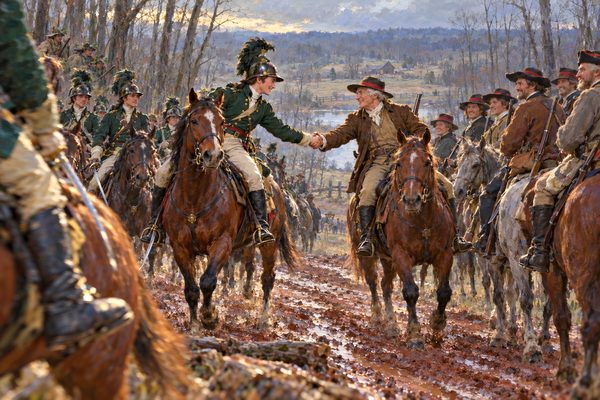
On a tropical beach a thin old admiral in a blue and white coat stands among rows of barrels while sailors roll more from stone warehouses and Dutch merchants in dark coats look on, stunned, under a hard blue sky.

February 1781 · Volume IV

Plunder on the beach

The War at Sea

the beach of the Lower Town at Oranjestad, on the Dutch island of St. Eustatius, in the West Indies

St.

Read chapter 50
On a muddy road through a winter wood, a young officer in a green jacket and plumed helmet clasps the hand of a grey-haired man in a brown coat while green-coated horsemen ride past with swords held low.

25 February 1781 · Volume IV

The handshake on the road

The Battle of Guilford Courthouse

the road near the Haw River, in what is now Alamance County, North Carolina, about eight miles west of Hillsborough

After Greene’s army crossed the Dan, Cornwallis fell back to Hillsborough and on 20 February invited every loyal subject in North Carolina to join him.

Content note: The narrative describes a deceptive encounter ending in mass killing and wounding of Loyalist recruits.

Read chapter 60
At dawn a tall tower of notched pine logs rises over open ground, riflemen on its top platform firing down over the stockade of a fort on a steep earth mound, while a lean officer at the tower’s foot watches.

23 April 1781 · Volume IV

Riflemen above the stockade

The Liberation of South Carolina

Fort Watson, a stockaded British post on an old Santee Indian mound beside the Santee River, South Carolina

In April 1781 Greene sent Henry Lee’s Legion to join Francis Marion on the lower Santee, and on the 14th they laid siege to Fort Watson.

Read chapter 61
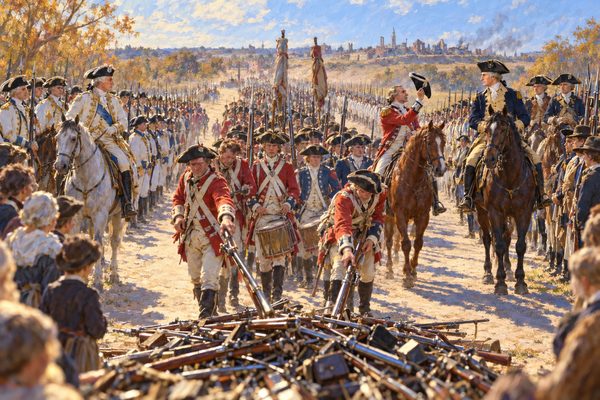
Two long lines of allied soldiers, French in white and Americans in blue and brown, face a road where a column of British soldiers in red lays muskets on a pile as two commanders on horseback look on.

19 October 1781 · Volume IV

The World Turned Upside Down

The Final Battle

the road and field outside Yorktown, Virginia, where the British marched out between the French and American lines

In the summer of 1781 Cornwallis marched his army into Virginia and, on Clinton’s orders, dug in at Yorktown on the York River.

Read chapter 62
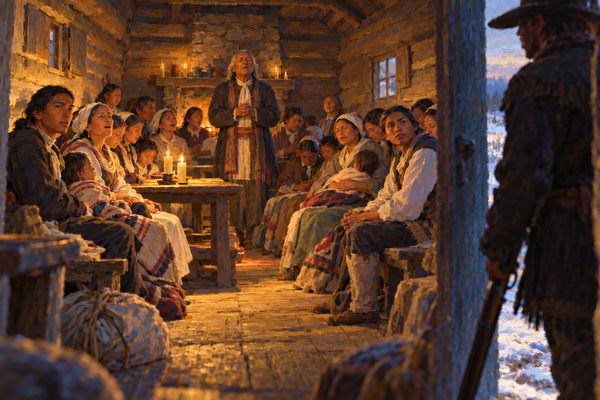
In a dim log chapel at dusk, families sit close together on benches and sing, an old man leading with his eyes closed, while a dark figure with a rifle held low stands in the open doorway at the edge of the frame.

7 March 1782 · Volume IV

The hymn before the morning

After Yorktown in the West

the Moravian mission chapel at Gnadenhutten on the Tuscarawas River, Ohio country

The Moravian mission towns on the Tuscarawas River, Gnadenhutten among them, were home to Delaware Indians who had become Christians and given up war.

Content note: The narrative describes the killing and scalping of unarmed Native men, women, and children.

Read chapter 63
Before a plain wooden courthouse, a hatless man in a dark coat holds a stick high and points at a woodpile, while farmers in homespun crowd round him and two men in grey wigs watch from the open doorway.

4 April 1782 · Volume V

Knock their grey wigs off

The Burdens of State Public Debt

in front of the Hampshire County courthouse at Northampton, Massachusetts, on the small hill by the meeting house, at what is now Main and King streets

In 1782 Massachusetts was collecting about a third of a farmer’s income in hard-money taxes to pay a war debt that had passed from soldiers into the hands of speculators, and the courts threw those who could not pay into jail.

Read chapter 4
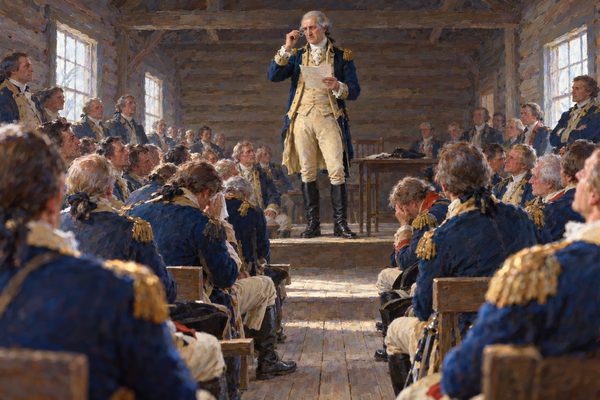
In a long log hall under grey window light, a tall grey-haired man in a blue coat lifts spectacles to his face with a letter in his other hand, as rows of officers on benches look up at him, some wiping their eyes.

15 March 1783 · Volume IV

Gray and almost blind

The Newburgh Conspiracy

the Temple, a large log meeting hall in the Continental Army's cantonment at New Windsor, near Newburgh, New York

By the winter of 1783 the war was won and the army was unpaid.

Read chapter 72
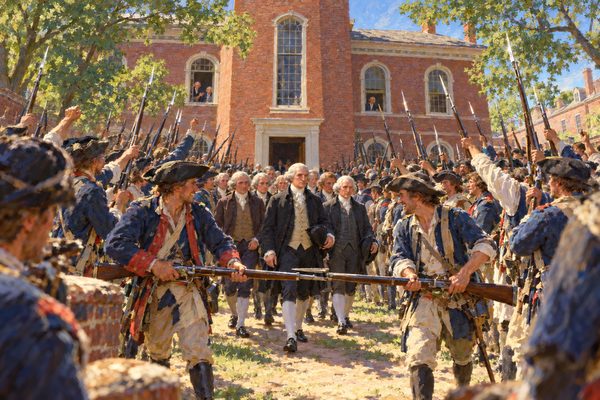
Two ranks of soldiers with fixed bayonets line a lane across a yard before a red-brick hall with a tower, while a small group of men in dark coats and white wigs walks down it, and soldiers raise muskets toward the windows.

21 June 1783 · Volume IV

Congress leaves under bayonets

The Fall of Morris and the Emergence of the Order of the Cincinnati

the Pennsylvania State House (now Independence Hall) and its yard on Chestnut Street, Philadelphia

The war was over and the army was unpaid.

Read chapter 73
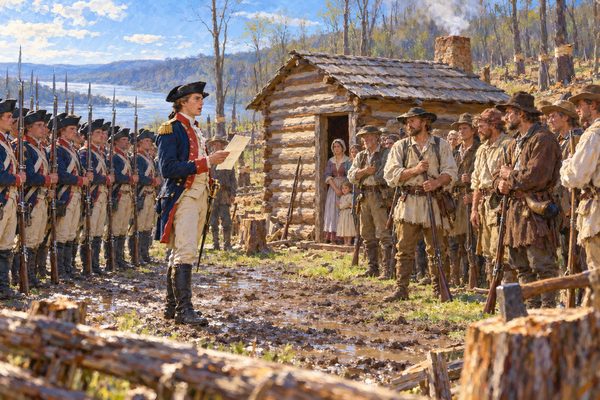
In a muddy clearing by a log cabin, a young officer in a blue coat holds a paper open and reads aloud to a line of armed settlers in hunting shirts, while soldiers with grounded muskets stand in ranks behind him.

April 1785 · Volume V

Forty rifles and one order

The Old Northwest

a new settlement of log cabins in the bottomland on the northwest (Ohio country) bank of the Ohio River, across from Wheeling

By 1785 Congress had made the western lands its own and meant to survey them and sell them for revenue, a dollar an acre.

Read chapter 7
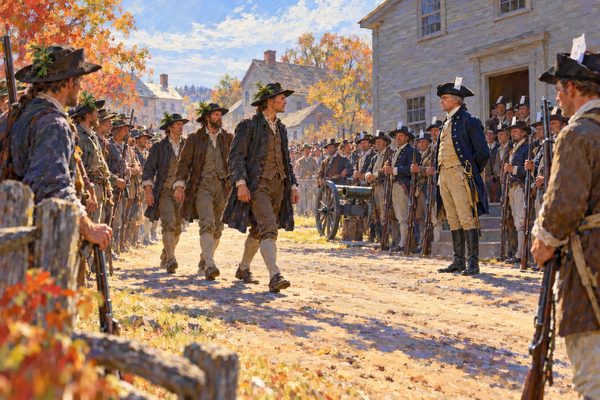
Farmers with green sprigs in their hats crowd one side of a dirt road and militia with white paper in theirs stand on the other, before a small wooden courthouse, as three plainly dressed men walk across between them.

26 September 1786 · Volume V

Hemlock against white paper

Shays’ Rebellion

the Hampshire County courthouse and the town street before it, Springfield, Massachusetts

By the autumn of 1786 the farmers of western Massachusetts had spent two years being taxed and sued.

Read chapter 11
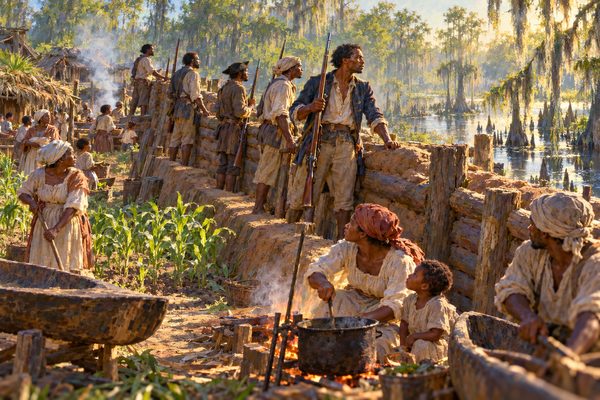
Behind a log wall in a swamp camp, armed men stand guard looking out over black water and moss-draped cypress, while a woman tends a cooking fire with a child at her side and an older woman stands in a small cornfield.

April 1787 · Volume IV

The King of England’s soldiers

Elimination of Feudalism and the Beginnings of the Abolition of Slavery

the walled maroon camp at Bear Creek, in the swamps of the lower Savannah River on the Georgia side

When the British left Savannah in 1782, about 4,000 escaped slaves sailed with them, and 6,000 more left Charleston.

Content note: The narrative discusses escaped enslaved people and a militia attack that burned their fortified refuge.

Read chapter 78
In a tall, plain hall with a raised platform at the far end, a grey-haired man in a torn brown coat lunges toward a side door while townsmen spread their arms to block it, as a thickset man glares from a table.

29 September 1787 · Volume V

A quorum by force

Absent Pennsylvania legislators are forced into the Assembly

Philadelphia, Pennsylvania

A forced quorum permits Pennsylvania’s Assembly to proceed toward a ratifying convention.

Content note: The narrative describes legislators seized and forced into a chamber; the reconstruction depicts a blocked attempt to leave.

Read chapter 25
In a dim print shop lit by candle and torchlight, a lean man in shirt and waistcoat stands in a far doorway with a smoking pistol, while men tip a case of metal type across the floor and out of a window.

26 July 1788 · Volume V

Type in the street

The Battle for New York and the Twilight of the Antifederalists

Thomas Greenleaf's printing office and house in New York City, a ground-floor shop with an entry passage behind it

Thomas Greenleaf’s New-York Journal was the one paper in the city still open to Antifederal writers.

Read chapter 33